Editorial 1: Lighten the pollution burden of thermal power States
Context
Thermal power producing States need to be well compensated for bearing the burden of pollution while supplying electricity to power consuming States.
Introduction
In its first updated Nationally Determined Contribution under the Paris Agreement to United Nations Framework Convention on Climate Change (UNFCCC) in August 2022, India has committed to first, adopting a climate-friendly and cleaner path to economic development; second, reducing the emissions intensity of its GDP by 45% by 2030 from the 2005 level, and third, achieving about 50% cumulative electric power installed capacity from non-fossil fuel-based energy resources by 2030 along with other six commitments. Currently, thermal power has the dominant share in India’s electricity basket. Under the new regime, thermal power will also have a 50% share.
An agent of emissions
- Thermal power production results in a huge amount of carbon emission.
- The power-producing States bear the burden of all this pollution to provide electricity to the consuming States.
- So, who should pay for the pollution burdens of thermal power plants? This article looks at thermal power production under the central sector and recommended compensation mechanisms for thermal power-producing States.
Installed Capacity of India
- India has a total installed capacity of 4,56,757 MW in which:
- The central sector has 22.9% share.
- The State sector has 23.7%.
- The private sector, a 53.4% share.
- Out of the total electricity generation capacity from thermal power plants (2,37,268.91 MW):
- Private sector power plants have a capacity of 85,899.095 MW (36.20%).
- The State sector has 75,991.905 MW (32.03%).
- The central sector has the capacity of 75,377.91 MW (31.77%).
- Central sector power plants, which are located in several States, have 31.77% of the total electricity generation capacity.
Carbon Emissions and Coal Reserves
- NITI Aayog data show that India accounts for 20,794.36 kg of carbon emission from electricity generation.
- According to the Ministry of Coal, Government of India (April 1, 2023), the total reserves of coal in India are 378.21 billion tonnes, of which Odisha alone accounts for 94.52 billion tonnes.
- Around 59.12% of the total energy supply in India is from coal.
- In India, around 73.08% (11,80,427.19 million units) and 1.48% (23,885.04 million units) of electricity are generated from coal, oil, and natural gas, respectively, in 2022-23. Thus, the thermal power sector remains a major contributor to carbon emissions in India.
State-wise Thermal Power Generation
- According to the Central Electricity Authority (CEA), Maharashtra had the highest non-renewable electricity generation capacity (31,510.08 MegaWatt or MW), followed by Uttar Pradesh (26,729.374 MW) and Gujarat(26,073.41 MW) in 2022-23.
- Rajasthan had the highest renewable electricity generation capacity in India at 22,398.05 MW of installation capacity.
- Despite having the highest electricity generation capacity, some States consume more than their generation.
Electricity Consumption and Generation Discrepancies
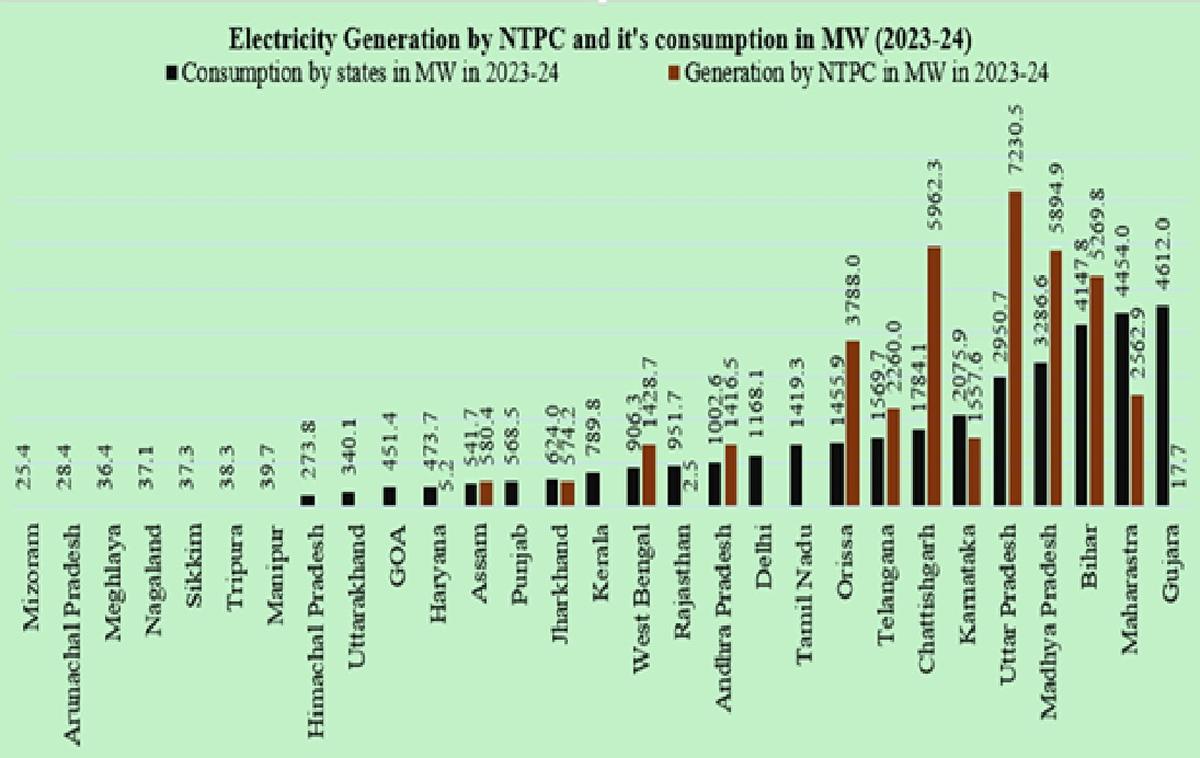
- Thermal electricity generation by the National Thermal Power Corporation (NTPC) also shows that the States producing the maximum electricity do not consume most of it:
- Uttar Pradesh: Only consume 40% of electricity produced by NTPC.
- Odisha: 38.43%
- Chhattisgarh: 29.92%
- Gujarat is the biggest consumer of NTPC-produced electricity (4,612 MW) despite the State’s meagre generation of 17.7 MW by the NTPC. Gujarat and Maharashtra purchase electricity from different States from what is produced by the central sector and in other sectors.
Pollution Burden in Thermal Electricity-Producing States
- Thermal electricity-producing States bear a disproportionate pollution burden when compared to the consuming States.
- Data from the CEA show that:
- Tripura has the highest (96.96%) share of thermal power in the total electricity generation capacity.
- Bihar: 95.57%
- Chhattisgarh: 94.35%
- Jharkhand: 92.69%
- Delhi: 87.96%
- West Bengal: 87.72%
- Uttar Pradesh: 81.84%
- Not all the electricity generated in the State is being utilised inside the State:
- Bihar sold 16,529.62 MW of electricity in 2022-23.
Net Sellers and Importers of Electricity
- NITI Aayog data show that Chhattisgarh is the highest net seller of electricity among all Indian States with 535.29 MW in 2022-23, followed by:
- Madhya Pradesh: 379.19 MW
- Himachal Pradesh: 153.43 MW
- Rajasthan: 135.14 MW
- Odisha: 95.40 MW
- Meghalaya: 55.22 MW
- These are the States where the central sector produces more thermal electricity and sells to others.
- Gujarat is the highest importer of electricity (528.17 MW), followed by:
- Haryana: 212.63 MW
- Maharashtra: 187.50 MW
- Delhi: 162.97 MW
- Punjab: 160.82 MW
- Tamil Nadu: 128.37 MW in the year 2022-23.
No compensation
- India’s electricity and environmental regulatory structures do not compensate States that generate electricity from central sector thermal power plants.
- Net exporting States of central sector power producers bear the burden of all pollution.
- Net importing States enjoy clean electricity, without bearing the environmental costs.
- Coal-rich States such as Jharkhand, Chhattisgarh, and Odisha produce the maximum thermal electricity.
- Despite generating the most thermal electricity, per capita electricity consumption in these States remains substantially lower than in more economically well-off States.
- Thus, coal-rich States face a new form of resource curse.
Corporate Social Responsibility (CSR) and Environmental Damage
- Under the Corporate Social Responsibility (CSR) scheme:
- Thermal power-producing companies spend a small amount of funds to develop the periphery.
- However, this is far from compensating for the environmental damage caused by thermal power production.
- The National Clean Energy and Environment Fund was created to promote renewable energy and assist States with cleaner technology.
- Electricity is a Concurrent subject (Entry 38 of List III of the Seventh Schedule of the Constitution), allowing both central and State governments to legislate on electricity matters.
- States are constitutionally permitted to:
- Levy taxes on electricity consumption and sale, but not on its generation.
- The central government does not impose any specific tax on electricity production.
- In October 2023, the Ministry of Power issued a directive:
- Prohibiting State governments from levying additional taxes or duties on electricity generation.
- Clarifying the constitutional boundaries on electricity taxation.
Exemption from Goods and Services Tax (GST)
- As a commodity, electricity is exempt from GST.
- Services related to electricity transmission or distribution by utilities are also GST-exempt.
- The consuming States receive the electricity duty levied on electricity sales, while the electricity-producing States do not get any tax revenue but only bear the burden of pollution.
A formulation to pursue
- Electricity produced and consumed within the State internalises all the benefits and costs.
- However, when electricity is produced in one State and consumed in another, it creates a pure negative externality for the producing State.
- States producing thermal power under the central sector should be compensated for all the electricity consumed by other States.
Proposed Compensation Mechanisms
- Tax on Thermal Power Generation: States where central sector power plants are located can tax thermal power generation.
- Union Government’s Role: Alternatively, the Union government can collect and transfer the generation tax to the producing State.
- Finance Commission Mechanism: The Finance Commission of India can implement a compensation mechanism.
- The last three Finance Commissions have recommended a formula to transfer funds to States under environmental and climate change concerns.
- This has been done through grants and horizontal devolution criteria.
Conclusion
The Sixteenth Finance Commission should seriously consider India’s international climate commitments and develop a fiscal road map to achieve those goals. Whatever the mechanism, thermal power-producing States under the central sector should be compensated adequately for carrying the burden of other States’ electricity consumption.
Editorial 2: Georgia and the resurrection of the colour revolutions
Context
Whether soft power strategies such as promoting democracy through the colour revolutions are still effective is the question
Introduction
With the dawn of the 21st century, post-Soviet States experienced a wave of uprisings known as the “colour revolutions”. The movements were associated with specific colours and were largely peaceful protests to replace pro-Moscow governments with a pro-West government in the name of democratic reforms. Though they were non-violent, peaceful and democratic, the Russian elites often perceived them to be western-backed strategies in order to weaken Moscow’s sphere of influence.
- The most notable examples include
- Georgia’s Rose Revolution (2003),
- Ukraine’s Orange Revolution (2004), and
- Kyrgyzstan’s Tulip Revolution (2005).
- These protests, on the face of it, appeared peaceful and democratic.
- These movements received active help from western governments and organisations such as the National Endowment for Democracy (NED), formed during the Cold War to support and promote American social and political values.
The Russian view
- British strategist B.H. Liddell Hart’s concept of fighting “on the other side of the hill” describes an approach prioritising destabilisation and political subversion over direct confrontation.
- Russia viewed such movements as threats to its influence in neighbouring States and as a model that could inspire similar challenges within its borders.
- This perspective extended beyond the former Soviet space, with Russia and other powers, including China, seeing these ‘colour revolutions’ as a blueprint for low-cost, high-impact interventions in regions such as:
- West Asia
- Africa
- Central Asia
- South Asia
Expectations and Failures of Colour Revolutions
- The fate of these ‘colour revolutions’ was not up to the expectations for which they were brought about:
- Transforming States, most of them with primordial loyalties, into corruption-free Western allies.
- Soon after the revolutions, the changes that resulted failed to ameliorate the situation on the ground:
- One set of corrupt people was replaced by another set, owing their allegiance and political ideas to the West.
- The people became frustrated, and public disillusionment arose over unfulfilled expectations.
- The long-term failures of these patterns of transitions have highlighted the limits of externally-driven democratic experiments.
The Rose Revolution 2.0
- Georgia’s Rose Revolution is a pivotal example of this phenomenon.
- This movement replaced the then President Eduard Shevardnadze with a pro-West President, Mikheil Saakashvili. Initially celebrated as a victory for democratic values, it became increasingly evident that the ‘revolution’s’ success was facilitated by western backing, and the movement was given financial and logistical support by patrons in the West, especially the United States. Soon after the election, the Saakashvili regime became synonymous with corruption, authoritarianism and undemocratic practices, further maligning the movement’s character.
Recent Political Developments in Georgia
- Two decades later, a similar scenario is unfolding in Georgia. Recent parliamentary and presidential elections have reignited passions, with the ruling Georgian Dream party securing a decisive and clear victory. One of the outcomes of these elections was the change of guard in the presidential office.
- The Georgian Dream Party candidate, Mikheil Kavelashvili, a former footballer, was elected President.
- The former President, Salome Zourabichvili, who had initially refused to vacate the office and the presidential palace in favour of the incumbent President, agreed to leave, calling herself the ‘only legitimate President’.
- She also alleged that the parliamentary and presidential elections were marred by electoral malpractices and corruption, and hence ‘illegitimate’. Ms. Zourabichvili was empathetic towards the protests against the ‘illegitimate’ elections and joined in the street protests.
Allegations of External Influence and Protests
- The ruling party alleged that these protests were organised at the behest of the West through non-governmental organisations funded by them — proving their contention about external interferences in Georgia’s internal matters.
- This is not without precedent. The post-Soviet space has long been a battleground for competing geopolitical agendas, with western-backed ‘movements’ challenging Moscow-aligned regimes.
- There is a relative downgrade in the position that Russia held prior to its war with Ukraine, at least in the short term. Russia is more focused on its ties with the ‘Near Abroad’, but this narrative often underestimates Russia’s enduring resilience as a significant power in the post-Soviet space.
- Protests in Georgia have also coincided with a period of heightened global anxiety over the role that the U.S. might play, with Donald Trump now the American President. Internal challenges have limited Washington’s capacity to engage decisively in Georgia.
- As a result, the effectiveness of soft power strategies such as promoting democracy through colour revolutions, is waning.
The importance of Georgia
- Georgia's Strategic Positioning: Georgia’s strategic positioning, at the crossroads of Europe and Asia, makes it a focal point for major power struggles.
- Its geography and historical vulnerabilities have left it susceptible to external influences, positioning it as a pawn in broader geopolitical contests.
- Challenges of Balancing Domestic Governance with External Pressures: Georgian politics illustrates the challenges of balancing domestic governance with external pressures in an increasingly complex world.
- Managing Relationships with East and West: As the U.S. grapples with its diminishing global influence and Russia continues to assert its role as a regional power, Georgia is deftly managing its relationships with both East and West.
- Broader Implications for Post-Soviet States: The broader implications of this struggle extend beyond Georgia, shaping the political trajectories of other post-Soviet States that are caught in the crossfire of competing geopolitical agendas.
Conclusion
Whether the colour revolution model remains a viable tool for political change or fades into history as a relic of early 21st-century geopolitics will depend on the evolving dynamics of international relations, testing the resilience of States navigating these turbulent times.