Fundamentals of Ecology & Ecosystems MCQ Questions
Ques:
1
What is the thin layer of gases around the earth called?
Correct Answer:
(C)
Atmosphere
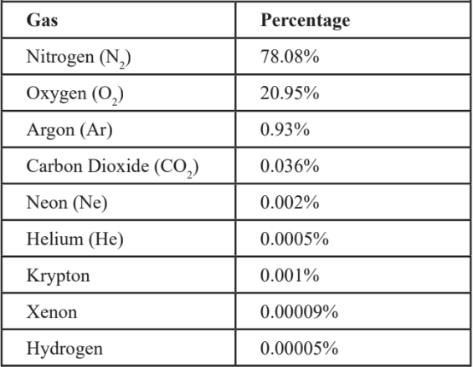
The thin layer of gases surrounding the earth is called the atmosphere. The majority of the Earth’s atmosphere consists of a high amount of Nitrogen, along with smaller amounts of Oxygen and Carbon Dioxide.
Note: Air is a mixture of gases. By volume, about 78% of this mixture is nitrogen and about 21% is oxygen. Carbon dioxide, argon, methane, ozone and water vapour are also present in very small quantities.
Ques:
2
Percentage of Nitrogen in dry air –
Correct Answer:
(D)
78%
The air around us is a mixture of gases, mainly Nitrogen and Oxygen, but containing much smaller amounts of water vapour, Argon, and Carbon Dioxide and very small amounts of other gases.
Ques:
3
If all the plants and trees vanish from the earth, the gas which will decrease is –
Correct Answer:
(D)
Oxygen
We need oxygen to survive and we depend on trees to provide this oxygen. To make food for themselves, trees go through a process known as photosynthesis where they take in carbon dioxide from the air and release oxygen back into the atmosphere. Hence option (d) is the correct answer.
Ques:
4
The concept of weathering relates to –
Correct Answer:
(C)
Natural process leading to the decomposition of rocks
Weathering is defined as mechanical disintegration and chemical decomposition of rocks through the actions of various elements of weather and climate. Weathering processes are conditioned by many complex geological, climatic, topographic and vegetative factors.
Ques:
5
Consider the following statements about the ionosphere:
It is the uppermost layer of the atmosphere.
The molecules and atoms of nitrogen and oxygen in this layer absorb some of the solar radiation and become ionized.
This layer is responsible for reflecting back the radio wave transmitted from the earth.
Which of the statements given above are correct?
Correct Answer:
(C)
2 and 3 only
The following are true about the ionosphere: This layer’s molecules and atoms of nitrogen and oxygen receive some solar energy and get ionized, and it is responsible for reflecting back the radio wave transmitted from the earth.
Ques:
6
The equipment to measure atmospheric humidity is
Correct Answer:
(B)
Psychrometer
A psychrometer is the equipment used to measure atmospheric humidity. It is a type of hygrometer, which is an instrument used to measure the relative humidity of the air. A psychrometer utilizes two thermometers: a dry-bulb thermometer and a wet-bulb thermometer. The wet-bulb thermometer has a wet wick covering its bulb, allowing it to cool down as water evaporates.
Ques:
7
In case of which one of the following biogeochemical cycles, the weathering of rocks is the main source of release of nutrients to enter the cycle?
Correct Answer:
(C)
Phosphorus cycle
Phosphorus is a chemical element found on Earth in numerous compound forms, such as the phosphate ion (PO43¯), located in water, soil and sediments. Much of the phosphorus on Earth is tied up in rock and sedimentary deposits, from which it is released by weathering, leaching, and mining. Some of it passes through freshwater and terrestrial ecosystems via plants, grazers, predators, and parasites, to be returned to those ecosystems by death and decay. Much of it, however, is deposited in the sea, in shallow sediments, where it circulates readily, or in ocean depths, whence it wells up only occasionally. Phosphorus is brought back to the land through fish harvests and through collection of guano deposited by seabirds.
Ques:
8
What is the possible path of nitrogen movement?
Correct Answer:
(B)
Air-soil-plants-animals-soil-air
The path of nitrogen movement, starting from the air and ending back in the air, involves a cycle of transformation and movement through various ecosystems. Here's a breakdown of the possible path: Air to Soil, Soil to Plants, Plants to Animals, Animals to Soil, Soil to Air.
Ques:
9
Major biogeochemical cycle includes:
Correct Answer:
(D)
All a, b and c
A biogeochemical cycle, or more generally a cycle of matter, is the movement and transformation of chemical elements and compounds between living organisms, the atmosphere, and the Earth's crust. Major biogeochemical cycles include the carbon cycle, the nitrogen cycle and the water cycle.
Ques:
10
Consider the following statements with respect to Biochemical Cycle:
It is the way in which an element or compound moves between its several biotic and abiotic forms and locations in the biosphere.
It starts by absorbing the chemical elements by the organism and is returned to the air, water, and soil through decomposition.