Whatsapp 88106-52225 For Details
Get Free IAS Booklet
Get Free IAS Booklet


Introduction
• India witnessed the early development of cultures and civilizations.
• Since the Old Stone Age, various groups migrated multiple times across the region, adapting culturally to different eco-zones.
•
Each group developed its own unique culture, shaped by their experiences in each new environment, leading to a diversity of beliefs and systems.
• Transitioning from foraging and nomadic pastoralism, the settlers of the Indus region eventually reached a more advanced way of life during the Bronze Age.


Sources
Archaeological sources serve as the foundation for understanding this extensive period in Indian history.
• These sources include archaeological sites, geological sediments, animal bones and fossils, stone tools, bone tools, rock paintings, and various artifacts.
• There is no written record from this era, although the Harappans had a script that remains undeciphered.
• Faunal (animal) and floral (plant) evidence are crucial for understanding how Stone Age people interacted with their environment.
• Floral evidence, such as charred seeds, pollen, and phytoliths (plant stones), provides insights into the farming practices of Stone Age people.
• Human genetics also play a key role in tracing prehistoric migrations, with mitochondrial DNA (mt-DNA) studies offering valuable information.
Some Important Terms to Be Understood
• Sites: Places from where historical evidence can be collected.
• Factory Sites: These are the places where stone tools were made.
• Habitation Sites: Places where people started residing.
• Acheulian Industry: A type of industry based on producing stone tools which was present during Palaeolithic times.
Process of Making Stone tools:
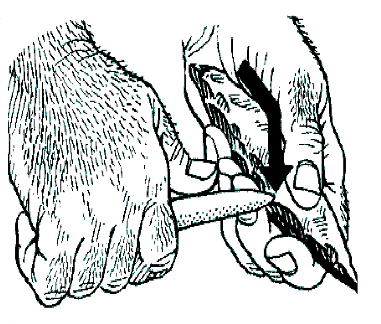
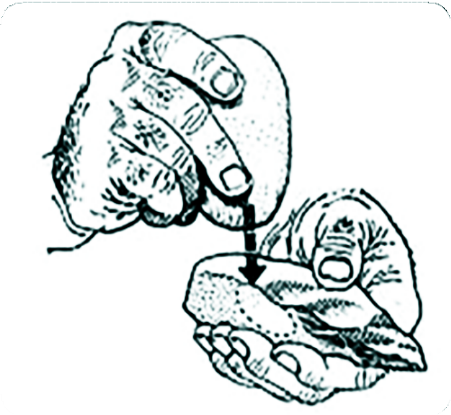
Majorly two techniques were popular.
Stone on Stone Technique: Stones were used to cut other stones/rocks to make tools.
Pressure Flaking: Pressure techniques were used to remove outer unwanted material around the stones and thus making the desired tool.
• Based on research, two independent cultural traditions of hand axe (Acheulian) and pebble-flake (Sohanian) industries were confirmed in India.
• Acheulian industry mainly had hand axes and cleavers. The Sohan industry is considered to have used only chopper and chopping tools.
• The Sohan industry gets its name from the Sohan river valley of Pakistan. These two cultural traditions are not considered distinct any longer.
• Recent studies argue that there was no independent Sohan tradition as Acheulian tools are found in the Sohan industry as well.



Various periods under Lithic or Stone Age
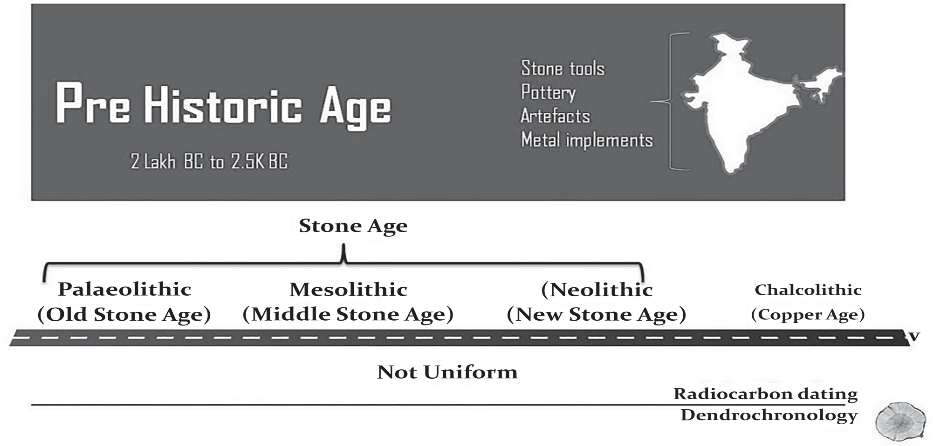
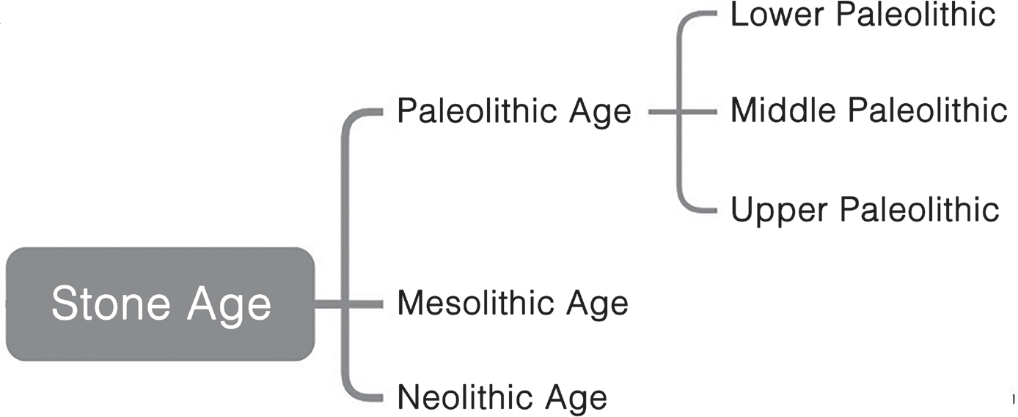
On the basis of the type and technology of stone tools, and subsistence base, the Indian Stone Age is classified primarily into three types:
• Old stone Age or Palaeolithic Age (5,00,000 10,000 BCE)
• Late Stone Age or Mesolithic Age (10,000 6000 BCE)
• New Stone Age or Neolithic Age (6,000 1000 BCE)
Paleolithic Age
• Etymology: Paleo means old and lithic means stone.
• Time Range: It ranges from 5,00,000 BCE to 9,000 BCE and coincides with the Ice age. The Paleolithic culture in India developed during the Pleistocene period of Geological time scale.
• Geographical Spread: It was found in all parts of India except Indus and Ganga basin
• This age is divided into upper, middle and lower paleolithic periods.
• Humans started residing in India from 500,000 years ago. Various paleolithic sites contain tools and remains of that era.
• Sources of study: Archaeological sites, geological sediments, animal bones and fossils, stone tools, bone tools, rock paintings and artefacts.
• Wild plants and animals grow naturally and independently. When they are domesticated, their lifestyle and physical characteristics (such as self-propagation) change. Consequently, the seeds of domestic plants become smaller in size. In the case of domesticated animals, they lose their ferociousness.
• Man in this age had no knowledge of agriculture, house building, pottery, or any metal.
• It is characterized by the use of unpolished stone tools such as hand axes, cleavers, choppers, blades, burin, and scrapers.
• Human Species: The Paleolithic tools were usually made of “Quartzite”, thus the Paleolithic man in India is also known as “Quartzite Man”.
• Lower Paleolithic Age: Existence of Homo Erectus
• species.
• MiddlePaleolithic Age: Existence of Homo Neanderthal species.
• Upper Paleolithic Age: Existence of Homo Sapien species.
• On the basis of the type of the stone tool used by people, the Palaeolithic Age in India is divided into three phases as follows:
• Lower Paleolithic Period: (Between 5,00,000 to 1,50,000 BCE)
• It covers the greater part of the ice age.
• Bori in Maharashtra is considered to be the earliest Lower Palaeolithic site.
• Tools used:
• The first Palaeolithic tools were identified at the site of Pallavaram near Chennai by Robert Bruce Foote in 1863, where climate was humid and suitable for paleolithic human. He found many pre-historic sites in South India.


• According to anthropological evidence, hand axe, stone cutting tools, cleavers, choppers were used for hunting, butchering and skinning the animals.
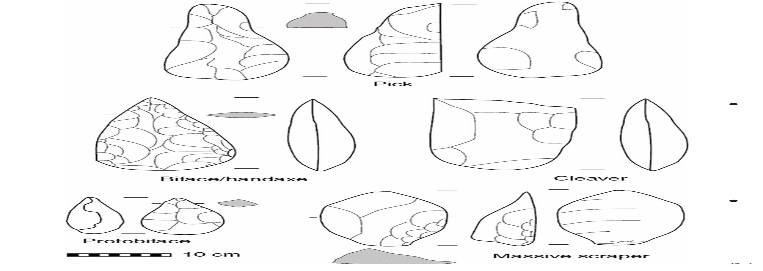
Acheulian: This is used to refer to a kind of stone tool. The industries of Palaeolithic cultures are divided into the Early, Middle and Late Acheulian Industries. The early Acheulian tools include polyhedrons, spheroids, hand axes, cleavers and flake tools.
Levallois Technique: Tool making technique in which flakes around the stone used to be removed.
Sites:
Lower Palaeolithic tools are widely distributed across India, though they are absent in certain areas, including parts of the Indus and Ganges valleys, southern Tamil Nadu, and the hilly regions of the Western Ghats.
Notable Palaeolithic sites where Acheulian tools have been discovered include Athirampakkam, Pallavaram, and Gudiyam near Chennai, Hunsgi Valley and Isampur in Karnataka, and Bhimbetka in Madhya Pradesh.
•
The Valley of the River Son (also known as Sohan), located in Punjab (present-day Pakistan), along with Kashmir, the Thar Desert, and Belan Valley in Uttar Pradesh, are prominent Palaeolithic sites. Other key locations include the Didwana Desert in Rajasthan, Chirki-Nevasa in Maharashtra, Nagarjunakonda in Andhra Pradesh, and the caves and rock shelters of Bhimbetka near Bhopal. Excavations at Didwana have uncovered not only Lower Palaeolithic stone tools but also those from the Middle and Upper Palaeolithic periods.
• Settlements: In some areas, prehistoric settlements have also been discovered. These sites can be identified by the presence of stone tools. Early human ancestors crafted large stone blocks and pebbles, using another hard stone to shape them into tools. Items like hand axes, cleavers, and choppers were made by striking off chips through a process called flaking. Settlements were typically located near these tool-making sites.
Occupation: Hunting and gathering
• People of the Lower Palaeolithic culture hunted animals and gathered roots, nuts, and fruits.
• They consumed the flesh and bones of animals hunted by predators.
• Evidence from sites like Bhimbetka in Madhya Pradesh and Gudiyam near Chennai shows that they lived in open-air areas, river valleys, caves, and rock shelters.
Linguistics:
• Sign Language existed.
• The pre-historic human ancestors, who belonged to the species of Homo erectus, did not have a complex language culture like us, the Homo Sapiens.
Mid Palaeolithic Period: (Between 1,50,000 and 35,000 BCE)
• Tools Used:
• Middle Palaeolithic industries primarily relied on flakes or small pieces of stone, which have been discovered across various parts of India, showing regional differences.
• Anthropological evidence indicates that, compared to the Lower Palaeolithic period, lighter stone tools, such as flake tools, became more prominent.
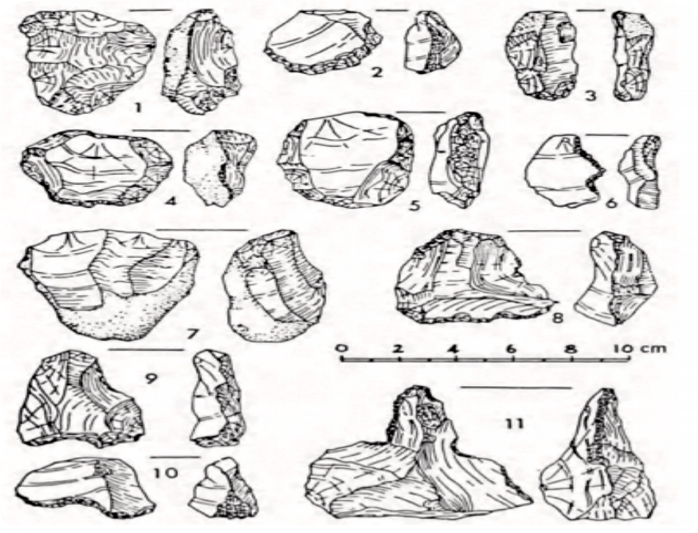
• The tool types from the Middle Palaeolithic period include hand axes, cleavers, choppers, scrapers, borers, points, projectile points (or shouldered points), and knives made from flakes.

• Upper Paleolithic Period: (Between 35,000 and 10,000 BCE)
• Tools Used:
• According to anthropological evidence, more sharpened Blades and Flake stone tools are found.
• Blade and Bone tool technologies became prominent.

• Climatic Conditions: Ice age was about to end during this era.
• Sites:
• In India, the Middle Palaeolithic phase was first identified by H.D. Sankalia on the Pravara River at Nevasa. After this discovery, several sites of this period have been identified such as Narmada, Godavari, Krishna, and Yamuna River valleys.
• Settlements: It got enhanced as compared to Lower Palaeolithic era. Majorly open air, cave and rock shelter sites were dominant. After about 4,00,000 years BP (Before Present), changes took place in the lithic technology and the species of human ancestors diverged. The species of Homo Neanderthals existed in this period.
• Burial Sites: Tools were found in the region around Soan Valley and Ganga Plains.
• The main features of the Indian Middle Palaeolithic period include the following:
• The tools became smaller.
• The decrease in the use of hand axes in relation to other tools.
• Use of core preparation techniques in stone tool production.
• Use of chert, jasper, chalcedony and quartz as raw materials to make stone tools.
• Microliths (tiny stone tools) were introduced in this period and these tools were made using different varieties of silica-rich raw materials.
• Climatic Conditions: More Humid conditions existed because Ice Age was coming to an end.
• Sites: Meralbhavi in Karnataka, Kurnool caves and Godavarikhani in Telangana, Baghor I and Baghor III of Son Valley in Madhya Pradesh and Patne in Maharashtra are some of the Upper Palaeolithic sites of India.
• Ostriches: Large quantities of ostrich eggshells were found at Patne in Maharashtra.
• Settlements: Caves and open-air space used by Homo sapiens who existed in this period.
• Art:
• Evidence of art in the Upper Palaeolithic period appears in the form of paintings. Beads and ornaments of this period have also been found. Green colour paintings of Bhimbetka.
• Earliest evidence of Shrine: Found in Baghor.


• This Age came to an end with the end of the ice age around 10,000 BC.
• Discovery of fire in upper paleolithic age
Mesolithic Culture or Mesolithic Period or Middle Stone Age:


• The date of the Mesolithic culture varies in different parts of the world. This culture is assigned to pre-agricultural times in certain areas.
• In Levant (Eastern Mediterranean), they are dated between 20,000 and 9500 BCE.
• In case of India, Mesolithic period existed from 10,000 BCE to 6000 BCE.
• In certain parts of India including Kerala and Tamil Nadu, it continued up to 1000 BCE, till the beginning of the Iron Age.
• In Sri Lanka, the microliths appeared about 28,500 years BP.
Sites:
Terrain: Mesolithic sites are found in most parts of India in all eco-zones from the coasts to the hills, sand dunes, rock shelters deltaic regions, lake areas, forested territories, hilly and mountainous areas, rocky terrains and coastal environments.
Geographical Spread: Mesolithic sites in India are found in Paisra (Bihar), Langhnaj (Gujarat), Baghor II, Chopani Mando, Sarai Nahar Rai, Mahadaha and Damdama (all in Uttar Pradesh), Sankanakallu and Kibbanahalli (Karnataka).
Rock shelter sites are found in Lekhakia, Baghai Khor, Adamgarh and Bhimbetka.

Early India- From the Stone Age to Chalcolithic Age 17
Coastal sites with microlithic evidence have been found in Mumbai, the Teri sites of Thoothukudy in Tamil Nadu, and Visakhapatnam.
Flora & Fauna:
Adamgarh in Madhya Pradesh and Bagor in Rajasthan provide the earliest evidence of animal domestication, dating back to around 5000 BCE.
The earliest evidence of plant cultivation dates to approximately 7000-6000 BCE.
Occupations:
People engaged in hunting, fishing, and food gathering.
Agriculture was not practiced during the early stages.
By the end of the Mesolithic period, humans had begun to domesticate animals, setting the stage for the Neolithic way of life.
The paintings at Bhimbetka depict various animals being hunted, with both men and women participating together. Bones of rhinoceros and elephant have also been found at the site.
Faunal evidence from this period indicates that people hunted a wide range of animals, including cattle, gaur, buffalo, barasingha, porcupines, sambar, chital, gazelle, hog deer, nilgai, jackal, turtle, fish, wild hare, lizard, fox, and monitor lizard.
Tools used:
Mesolithic culture is characterized by the use of more advanced stone tools which are known as Microliths.
They used spears, bow and arrow and traps.

Art:
Geometric patterns were engraved in a chert stone found in Chandravati near Rajasthan.
Paintings: Bhimbetka art is famous for Palaeolithic and Mesolithic era paintings. Colours were made from minerals like iron oxide, limestone. Paint Brushes were made from tails or furs of animals. The rock paintings of Central India depict hunting, trapping, fishing and plant food collection.
Haematite, an iron-rich stone with traces of rubbing, has been found.
Climatic Conditions:
With the end of the Ice Age and the onset of global warming, human groups became more mobile and began to settle in various eco-zones.
The monsoon pattern had already begun to emerge, bringing higher rainfall to some regions. In Didwana (western Rajasthan), freshwater lakes are known to have existed between 10,000 and 3500 BP. The animal bones from this period indicate that the region supported a dry deciduous type of forest during the Mesolithic period.
Burials: They buried the dead which suggests their belief and humane relationships.
Settlements:
Round huts and rock shelters were used as settlements.
The Mesolithic people were highly mobile.
They moved in search of animals and plant foods. They made temporary huts and also used caves and rock shelters.
Neolithic Culture or Neolithic Period or New Stone Age:
In the world, the New Stone, or the Neolithic age began in 9000 BC.
Early evidence of Neolithic culture is found in the Fertile Crescent region of Egypt and Mesopotamia, the Indus region, the Ganges valley of India and also in China.
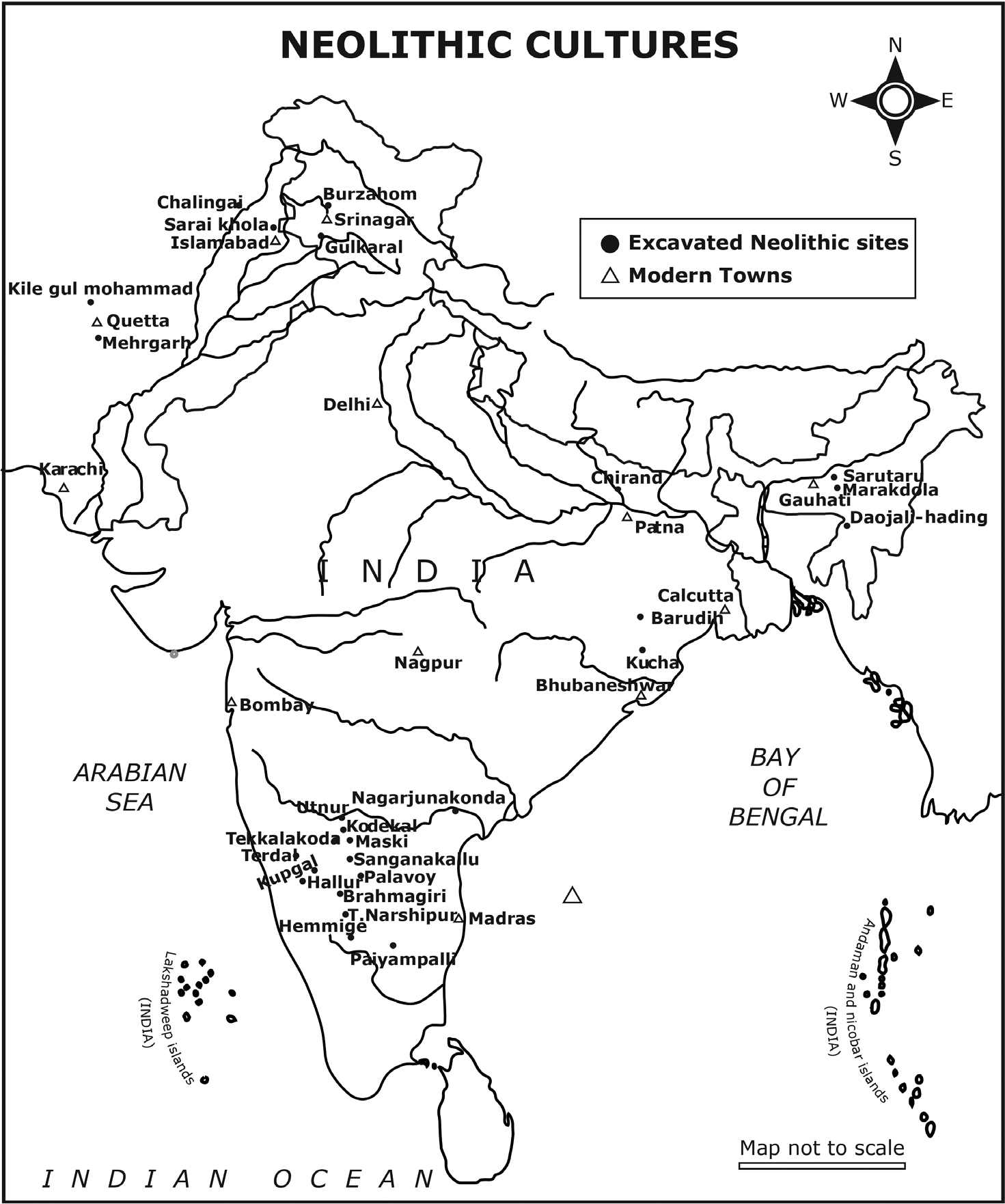
The only known Neolithic settlement in the Indian subcontinent, attributed to 7000 BCE, is in Mehrgarh, located on the bank of the Bolan River in Balochistan, Pakistan.
The Neolithic cultures of India are classified into several regional cultures, each flourishing during different time periods. In the north-western regions of India and Pakistan, Neolithic culture began at a very early stage.
The Neolithic period marked the beginning of agriculture and animal domestication.
It is also known as the phase of Neolithic Revolution according to V. Gordon Childe.


Early India- From the Stone Age to Chalcolithic Age

Neolithic Revolution:
It is the remarkable and large-scale shift from hunting gathering economy to an economy based on farming and surplus food production, leading to permanent settlements.
It led to the development of new technologies that included ground or polished stone tools like axes which helped clearing the forests, develop fine pottery, and practice weaving.
• Occupations: Hunting, Fishing, Animal Domestication and Farming activities. Early dentistry evidence was found in
Mehrgarh.

• Tools used:
• Started using polished stone tools.
• People used both stone and bone tools in agriculture and practiced cattle rearing.
• Neolithic settlement on the basis of the types of axes used by Neolithic settlers:
| Neolithic Settlement | Type of axe used |
| North-western settlement | Rectangular axes with a curved cutting edge |
| North-eastern settlement | Polished stone axes with a rectangular butt and occasional shouldered hoes |
| Southern settlement | Axes with oval sides and pointed butt. |
Early India- From the Stone Age to Chalcolithic Age 19

• Sites:
• Major regions are Mehrgarh, Mahagarh, Burzhom, Gufkaral, Koldihwa, Piklihal and Daojali Hading.
• Northern spurs of the Vindhyas (5000 BCE) and the Kaimur hills.
• Dried basin of Hakra and Garo hills in Meghalaya.
• Koldihwa and Mahagra in Allahabad district (Uttar Pradesh) are known for the cultivation of rice in the fifth millennium BCE.
• In north-eastern India, Neolithic culture appears relatively late, generally dating from around 2500- 1500 BCE or even later. Shouldered axes and splayed celts have been discovered at sites in Assam, Meghalaya, Nagaland, and Arunachal Pradesh. Notable Neolithic sites in the Assam region include Daojali Hading and Sarutaru.
• Numerous Neolithic sites are found across Bihar and West Bengal, with Birbhanpur and Chirand being some of the key sites in this area, alongside Kuchai, Golbaisasan, and Sankarjang.
• The Neolithic cultures of South India, dating around 2500 BCE, have been mainly found in Andhra Pradesh, Karnataka, and the north-western part of Tamil Nadu. These sites often feature ash mounds at the center, surrounded by settlemeants.
• Art: Bhimbetka and Adamgarh contains paintings from Neolithic times.
• Burials: They buried their dead.
• Ornaments: Made of seashell, limestone, turquoise,
lapis lazuli and sandstone.
• Settlements: Built houses with mud. Pit houses were used in Kashmir.
• Sculptures:
• Terracotta figurines and glazed faience beads were found.
• The people belonging to this age did not use pottery.
• Trade:
• These people traded with Harappan Civilization.
• The long-distance trade was practiced, as revealed by Lapis Lazuli, which is available only in Badakshan.
• Cultivation:
• The Neolithic culture of north-western India is the earliest to have evidence of plant and animal domestication in India.
• They were semi-nomadic, pastoral groups.
• Wheat, Barley, cereals, Common pea and Lentils
were cultivated, and sheep, goat and cattle were domesticated. This culture preceded the Indus Civilisation.
• They broke the ground with stone hoes and digging sticks at the end of which ring stones weighing one to half a kilogram were fixed.
• They produced ragi and horse gram (kulathi), rice and became acquainted with the cultivation of cereals.
• The people of Mehrgarh produced wheat and barley and lived in mud-brick houses.
• The introduction of domestication of animals and plants resulted in the production and supply of a large quantity of grains and animal food. The fertile soil deposited by the rivers enhanced the growth of agriculture, generating a surplus of grains.
• Potteries:
• People needed pots in which they could store their food grains hence pottery appeared for the first time in this age.
• Evidence of menhirs, usage of redware pottery, black-burnished ware, grey ware, mat-impressed ware, and painted pottery.

Early India- From the Stone Age to Chalcolithic Age
• The potter’s wheel was known to people since/after
4500 BCE.
Progress in and Limitations of the Neolithic Phase – between 9000 and 3000 BCE
New means of food and shelter, they see people were on the threshold of civilization:
• Development of the arts of cultivation, weaving, pot- making, house building, stock raising, writing, and the like.
• Cultivation of a variety of crops: ragi and horse gram (Kulathi), rice, cereals, wheat, and barley.
• Establishment of villages.
•
Use of stone celts which were edged and pointed as tilling tools such as hoes and ploughshares for digging the ground and sowing seeds.
• The people no longer depended on hunting, fishing, and gathering, with cultivation and cattle husbandry providing them with food.
• People of the Stone Age faced a significant limitation. Relying almost entirely on stone tools and weapons, they were restricted in their ability to settle far from hilly areas. This reliance also meant they could not produce more than what was necessary for basic subsistence.
Key Features of the Phases of Stone Age
Pre-Historic Phases:

Chalcolithic Culture or Copper Stone Age:
The end of the Neolithic period saw the use of metals such as copper giving rise to the copper-stone phase.
In South India, the Neolithic phase imperceptibly faded into the Chalcolithic, and so these cultures are called Neolithic-Chalcolithic.
Chalcolithic cultures were followed by the Bronze Age Harappa culture.
• The pre-Harappan cultures are the earliest Chalcolithic cultures of India, and they are found in the time before the beginning of the mature phase of the Harappan culture and continued to exist in the later period. Metal dominantly used: Copper.
• Unlike the mature urban phase of the Harappan civilization, Chalcolithic cultures were pastoral and based on farming, generally rural in nature. They used stone and copper objects, but they also occasionally used low-grade bronze and even iron.


• The largest Chalcolithic Settlements was Daimabad in Maharashtra in the Godavari valley.
• Their settlements were sedentary or semi-sedentary.
• Tools and weapons:
• Stone tools:
• People used tiny tools and weapons made of stone in which the stone blades and bladelets were an important element.
• The stone blade industry flourished in south India and stone axes continued to be used.
| Location | Metal Tools |
| Ahar or Tambavati c. 2100 and 1500 BCE | Ahar is called Tambavati due to the local availability of copper. No use of microlithic tools, stone axes, and blades. Used copper flat axes, bangles, several sheets, etc. The use of bronze sheets is evident. |
| Jorwe and Chandoli | Flat, rectangular copper axes and copper chisels. |
| Ganeshwar (Near Khetri copper belt in Rajasthan) | The principal craft was the manufacture of copper objects, they were unable to urbanize. Produced and used arrowheads, spearheads, fishhooks, colts, bangles, chisels, etc. |
• Pottery:
• Black-and-red ware was widely prevalent and produced channel-spouted pots, dishes-on-stand, and bowls-on-stand.
• OCP (Ochre-Coloured Pottery) which is a Red- slipped ware often painted in black and largely in vase forms.
• Practice of Agriculture and Domestication of Animals:
• People of the Chalcolithic age domesticated animals like cows, sheep, goats, pigs, and buffaloes, and also hunted deer. Camel remains have been found, although they were generally not familiar with horses.
• The diet of these people included beef, pork, and fish.
• They practiced agriculture, cultivating wheat, rice, bajra, and various pulses such as lentils (Masur), black gram, green gram, and grass peas.
• The people of Navdatoli in Maharashtra were known for producing beer, linseed, and a wide variety of cereals, making it one of the largest producers in India.
• Houses:
• TheChalcolithic people we regenerally not acquainted with burnt bricks.
• Their houses were made of mudbrick, with wattle and daub.
• Houses in Ahar: People in Ahar lived in stone houses.
• Houses in Inamgaon: This site is a large Chalcolithic settlement having mud houses with ovens, circular pit houses fortified and surrounded by a moat, and numerous grave sites.
• Chalcolithic arts and crafts:
• They crafted tools, weapons, and copper bangles, as well as beads made from semi-precious stones like carnelian, steatite, and quartz crystal.
• The people were skilled in spinning and weaving, as evidenced by the discovery of spindle whorls in Malwa.
• Cotton, flax, and silk threads made from both
cotton silk and small silk (cotton tree) were found in Maharashtra, showcasing their expertise in cloth manufacturing.
• Their society included various craftsmen such as potters, smiths, ivory carvers, lime makers, and terracotta artisans.
• Ornaments were made from copper and terracotta.
• Society and regional differences in social structure:
• Burial practices: In Maharashtra, people buried their dead in urns beneath the floors of their houses, placing the bodies in a north-to-south orientation, without using separate cemeteries. Pots and some copper objects were placed in these graves as offerings.
• Religion:
• Terracotta figures found in Inamgaon of women suggest that the Chalcolithic people venerated the mother goddess.
• In Malwa and Rajasthan, stylized bull terracottas show that the bull was the symbol of a religious cult.
• Social Inequality:
• Indicated by diverse burial practices and a kind of settlement hierarchy visible in several Jorwe settlements.
• There were two-tier habitations with the larger settlements dominating the smaller ones.
• Chalcolithic cultures and Harappan civilization: The Chamoli culture existed in Pre-Harappa, contemporary to Harappan culture and post-Harappa period. Some of them are associated with Harappa and some are non Harappan.
• Pre-Harappan Chalcolithic cultures: Kalibangan in Rajasthan, Banawali in Haryana, and Kot Diji in Sindh in Pakistan.
• Mature Harappan Chalcolithic cultures: Ganeshwar (Rajasthan) contributed to the making of the mature Harappan culture.
• Non-Harappan Chalcolithic cultures: Malwa culture (1700-1200 BC) found in Navdatoli, Eran, and Nagda; Jorwe culture (1400-700 BC); settlements of the Vindhya region, Bihar, and West Bengal.


• Importance of the Chalcolithic Phase:
• They knew the art of copper smelting.
• Use wheel-turned black-and-red pots.
• First to use painted pottery.
• Used both the lota and thali.
• The Chalcolithic people seem to have been colonizers
in western Maharashtra and Rajasthan.
• Establishment of the first large villages in peninsular India.
• Cultivation of far more cereals than were known to the Neolithic communities.
• Distinct burial practices: In Maharashtra, the dead body was placed in the north-south position, but in South India in the east-west position.
• Limitations of Chalcolithic Cultures
• The domesticated animals were slaughtered for food and not used for milk and dairy products.
• Neither hoe nor plow has been found at Chalcolithic sites.
• The rate of infant mortality was very high.
• People were unaware of bronze.
• People were unable to write.
Regions of Chalcolithic Culture
| Culture | Period | Sites | Features |
| Aha | 2800-1500 B.C | Ahar, Balathal, Gilund | Distinctive black and red ware pottery decorated with white designs. Cultivation of rice, jowar, bajra, ragi, green peas, lentil, green gram and black gram. They lived in stone houses. |
| Kayatha | 2450-1700 B.C | Chambal region of M.P | Red slipped ware painted pottery with chocolate- coloured designs. |
| Malwa | 1900-1400 B.C | Navdatoli, Eran, Nagada, Maheshwa | Largest Chalcolithic settlement. Pottery is coarse in texture but has a thick buff surface over which designs are made in red or black colour. Cultivation of wheat and barley. |
Jorwe culture (c. 1400 to 700 BCE):
• It is related to the Jorwe culture named after Jorwe, the type-site situated on the left bank of the Pravara River, a tributary of the Godavari, in Ahmednagar district, Maharashtra.
• Major Sites:
• The largest Jorwe sites are Inamgaon, Daimabad (Godavari valley) and Prakash (Tapi valley). These sites had permanent agricultural villages.
• Others are Songaou, Chandoli, and Nevasa.
• Daimabad contained various terracotta seals of this era.
• Pottery: Red and Black Pottery.
Malwa Culture:
• Situated in Madhya Pradesh and Deccan region.
• Major Sites: Navadatoli, Maheshwrar, Nagda and Eran.
Kayatha Culture:
• Situated in Madhya Pradesh.
• Red and Black Pottery were found.
• People well acquainted with copper-technology.
• Tools of Copper and copper axes were found.
Ahar Culture:
• Found in Mewar(Rajasthan) region only.
• Red and Black Pottery with polished edges were found.
• People well acquainted with copper-technology.
• Tools of Copper and copper axes and copper flakes were found.
Ganeshwar - Jodhapura Culture:
• Situated in Northeastern Rajasthan (mostly in Sikar region).
• Red Pottery with polished edges were found.
• Major copper tool sites were found here.
• Tools of copper and copper axes and copper flakes were found.
• Shows beginning of metal work