Whatsapp 88106-52225 For Details
Get Free IAS Booklet
Get Free IAS Booklet
Introduction
Politically, the small tribal settlements of the Vedic period gave way to stronger kingdoms, with an increase in royal power.
The term ‘Rashtra’ first appeared during this period.
Wars shifted focus from cattle raids to territorial conquests, reflecting the transition from the predominantly pastoral society of the Early Vedic period to an agricultural one.
The core geographical region of the Rig Vedic texts corresponds to Eastern Afghanistan, Punjab, and western Uttar Pradesh. In contrast, the core area of the Later Vedic texts corresponds to the Kuru-Panchala region, encompassing the Indo-Gangetic divide and the upper Ganga Valley.
• The Painted Grey Ware Culture and Northern Black Polished Ware, both associated with the Iron Age, belong to the Later Vedic period.
Eastward expansion of the Aryans
• During the Later Vedic period, Aryan speakers expanded from Punjab to Western Uttar Pradesh, particularly in the Ganga-Yamuna Doab.
• It is suggested that while the Aryans migrated to the eastern part of the Ganga Valley, the Indo-Iranians moved from Iran to the Punjab region.
• Tribes such as the Kurus, Panchalas, Vashas, and Ushinaras are mentioned during this period. Later Vedic texts refer to the region of Kuru-Panchala, which is located in the Indo-Gangetic divide and the Upper Ganga Valley. The Rig Veda mentions the southeastern boundary of the Aryans, which is described in the Aitreya Brahmana as
the "midland," suggesting the movement of Aryans into the Ganga Valley during the Later Vedic period.
The expansion of the Aryans was likely driven by the need for water and land resources.
Later Vedic texts also mention the Saraswati and Dhrishtavati rivers. Around 1000 BCE, the Vedic Aryans moved towards the Kosala region in eastern Uttar Pradesh and Videha in northern Bihar, where they encountered local populations practicing Chalcolithic material culture.
The Vedas also refer to the Munda-speaking people living in the Ganga Valley.
• Kosala and Videha represented the easternmost territories of Aryan expansion during this period.
• The Atharva Veda mentions that the people of Anga and Magadha were enemies.
Later Vedic Culture and Iron
• It was previously believed that iron first emerged around 700 BCE, but recent research suggests its use dates back to around 1200 BCE or even earlier.
• By the end of the Vedic period, the knowledge of iron had spread to eastern Uttar Pradesh and Videha.
• Iron was referred to as syama-ayas or krishna-ayas, meaning "dark metal."
• Iron played a crucial role in transforming the forests of the Ganga Valley into agricultural land.
• While earlier views placed excessive emphasis on iron as a key factor in the colonization of the Ganga Valley, recent scholarship argues that iron alone was not the primary driver of population expansion.
Settlements and Territories
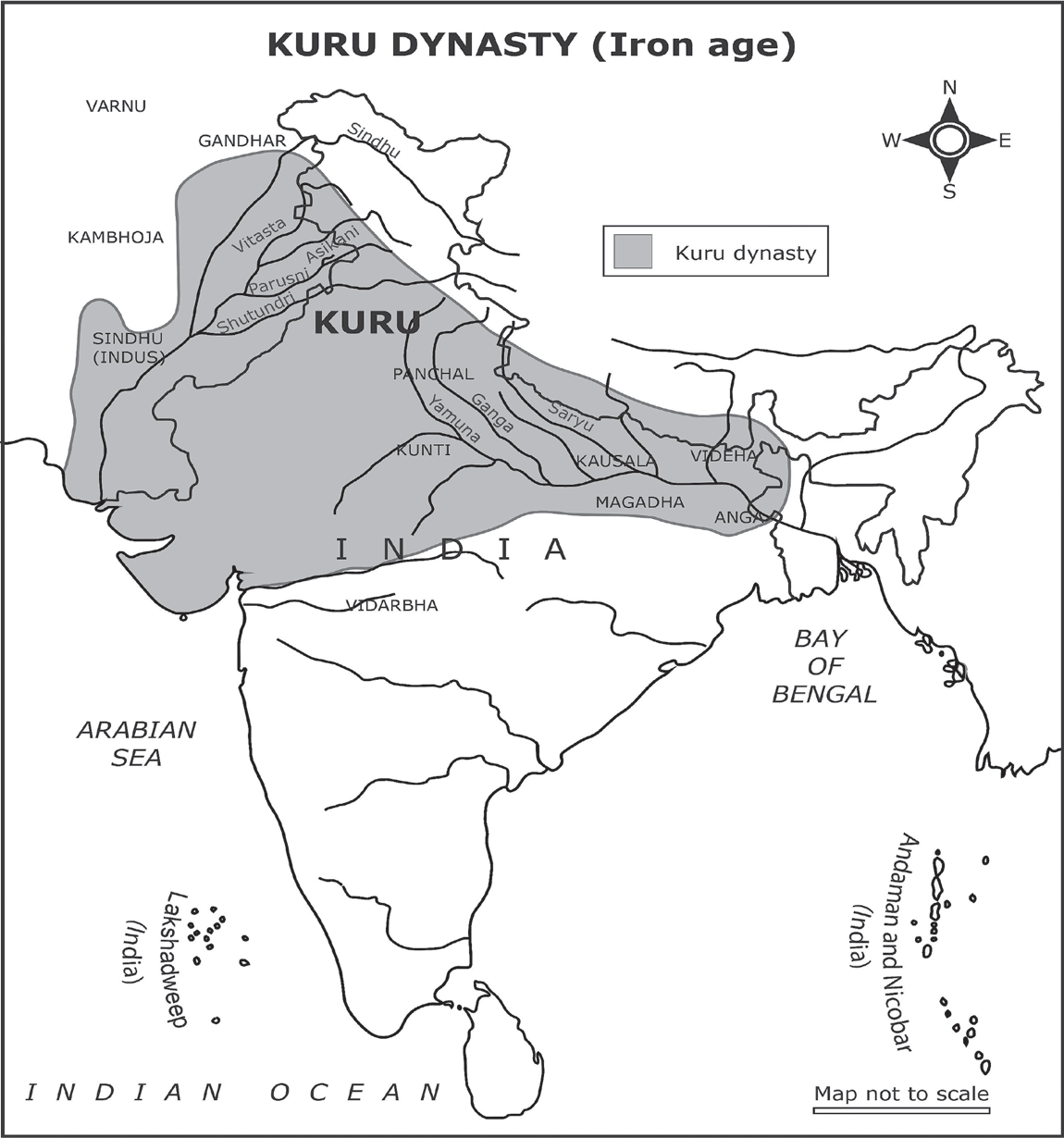
During the Later Vedic period, the upper Ganga Doab became the center of Aryan culture, referred to as the land of Kuru-Panchala.
This period saw the emergence of territorial units.
The term Janapada, meaning territory, appears in the Brahmanas, which are dated to around 800 BCE.
Over 1,000 sites associated with the Painted Grey Ware culture have been found in this region, indicating the establishment of new settlements in the upper Ganga Valley.
• Mud brick houses were commonly used.
• The foundations for towns began to take shape during the Later Vedic period, marking a time of significant interaction and development.
• The term nagara, referring to commercial quarters, appears in later Vedic texts, but large towns only emerged towards the end of the Vedic period.
• The sites of Hastinapur and Kausambi are regarded as proto-urban settlements, displaying characteristics of early urbanization. The material culture of this period shows greater diversity and represents an advancement over the Early Vedic period.
• It can be inferred that surplus agricultural production supported various social classes, including chiefs, princes, and priests.
Political Organization
• Later Vedic period is marked by lineage of clans, and small kingdoms developed in many parts of the Ganga
valley, leading to the development of the state after 600 BCE.
• The idea of Janapadas and Rashtra as territorial units had developed. The Raja wielded much power, and the social divisions began to strike deep roots.
• Assemblies became less important. In the Early Vedic Age tribal polities were dominant and the king was elected by assemblies.
• Influence of the assembly called Vidhata disappeared.
• Samiti and Sabha were still there. Though their importance started declining as compared to rig Veda times.
• The power of the king increased and played a great role in administering the criminal law.
• The concept of Samrat/Samrajya developed and they suggest an increase in the power and ambition of the king. Now, the king started acquiring more and more territories.
• Rajan became the controller of the social order.
• King became more independent.
• King got distanced more from the Vis (Clan).
The government machinery became more elaborate and new civil functionaries came into existence. They were:
• Bhagadudha: Collector of the taxes,
• Suta / Sarathi: The royal herald or Charioteer,
• Khasttri: Chamberlain,
• Akshavapa: Courier.


• This period saw the beginning of the regular system of the provincial government comprising:
• Sthapati: Administrator of the outlying areas,
• Satapati: Administrator of the group of hundred villages,
• Adhikrita: Village official,
• Ugras: Police official.
• Role of Priests:
• The post of Purohita became important in Polity and Administration. He was the ‘one who places the king in the forefront’.
• Srauta sacrifices so as to achieve some benefits were carried out to control resources.
• Aitreya Brahmana says that the king must provide 1000 pieces of gold and cattle to the Brahmana who anoints (to put oil or water on somebody’s head as part of a religious ceremony) him.
• Sacrifices and rituals gained importance.
• Vajapeya ritual involved chariot race. It was performed to preserve peace in the state. It’s the highest form of Soma Yajna.
• Rajasuya Yajna was related to consecration of the King and is prescribed as a way of maintaining the king’s sovereignty.
• Vajapeya and Rajasuya were performed to ascertain the suzerainty of the king in the region.
• Asvamedha-yajna involved letting a horse loose into areas where it moved freely. This was an assertion that the authority of the king was recognized.
• Mahabharat and Ramayana showed struggles to control territories.
• Rajya and gana-sanghas (Oligarchies) developed during the later Vedic period.
• The 12 Ratnins according to the Satapatha Brahmana are as follows:
| Purohita | Priest |
| Mahishi | The Queen |
| Yuvaraja | Crown price |
| Sarathi / Suta | The Chariotee |
| Senani | The army general |
| Gramani | Head of the Village |
| Kshata | Gateman |
| Sangrahitri | Treasure |
| Bhagadudha | Tax collecto |
| Akshavapa | Courie |
| Palagala | Friend of the king |
| Govikarta | Head of the forest department |
Social Organization
The Varna system became more dominant and rigid, and the society came to be known as Varna-ashrama-dharma society.
The non-Aryans came to known as Shudras.
Teaching was seen as the occupation of the Brahmanas.
Some social groups were placed in ranking even below the Sudras.
• Rajanya refers to kshatriyas and they were warriors and rulers who received bali as tax. Vaisya referred to the common people who were cattle breeders, artisans and farmers. Vaisyas paid tax to the kings.
• In Panchavimsa Brahmana, the Kshatriyas were placed first and then Brahmans were placed below them. In Satpatha Brahmana, the Brahmans were placed first and then Kshatriyas were placed. Aitreya Brahmana said that Brahmana was the seeker of support, and he could be removed by the king from his position.
• The concept of Dvija (Twice born) developed and the ritual of upanayana (sacred thread) was limited to the upper three sections of the society namely Brahmana, Kshatriya and Vaishya. Education was largely confined to dvija castes. Dvija discriminated against both Shudras and Chandalas.
• Upanayana ceremony marked the initiation for education.
• Gayatri mantra could not be recited by the Shudras.
• Women were also denied Gayatri mantra and Upanayana.
Family
• Family was patriarchal. This shows that the power of family was in hands of the men. He became the bread earner of the family.
• Patrilineal descent was there. The property of family transfers from man of one generation to the man of next generation.
• Polygyny (taking many wives) was prevalent. This shows that position of women in the society declined as compared to Vedic times.
• Yajamana was married man. This concept developed as religion became more important and Varna system became by birth.
• The concept of asramas (various stages of life) was not well developed.
• Brahmacharya, Grihastha and Vanaprastha were mentioned, Sannyasa had not developed.
• Right of primogeniture (succession of first male heir) was strong.
• Gotra means group of people from common ancestor and thus they could not inter-marry. This idea emerged during Vedic times.
• Marriage with Shudras was prohibited.


• Types of Marriages in Later Vedic Period:
Women
• Status of women declined. Emergence of patriarchal society and patrilineal society was the result of it.
• Women were barred from participating in rituals attending political assemblies.
• Aitreya Brahman mentions daughters as a source of trouble.
CULTURE
Philosophy and Education
• Philosophy, science and literature developed in this period.
• Other subjects taught during this period were – history, grammar, astrology, astronomy, mathematics, ethics, dialectics, military science, fine arts, music and medical science.
• Aranyakas were the first books which were taught by sages in forests.
• Upanishads texts with philosophical enquiries, were composed during this period.
• Upanishads were referred as Vedanta, since they were attached as last part of Vedic texts.
• Education was for a privileged few. Only Brahmans and Kshatriyas were allowed to be educated. Education was limited to males.
• Women despite contributing to composition of the Vedas, were discouraged from vedic education and studying vedic literatures.
Later Vedic Texts
Yajur Veda, Sama Veda, and Atharva Veda.
Also, Vedangas,Sutras, Upavedas,Puranas, Dharamshastras and the Epics were composed.
This literature is also known as Smriti (literally means ‘to remember’) written by ordinary sages.
Music and Art:
Music and art played an important role in the Later Vedic Age (1000-500 BCE).
Music was used in religious rituals, as well as for entertainment and social gatherings.
The Samaveda, one of the four Vedas, is a collection of hymns that were meant to be sung during religious ceremonies.
The Gandharva-Veda, an Upaveda (supplementary Veda), provides detailed instructions on the performance of music.
• Some of the musical instruments used during the Later Vedic Age include the flute, lute, harp, cymbals, and drums. The heptatonic scale (seven notes) was also in use during this time.
• Art during the Later Vedic Age was primarily expressed through pottery and metalwork.
• Pottery was made from a variety of clays and was often decorated with geometric patterns or images of animals and plants.
• Metalwork was used to create a variety of objects, including jewelry, weapons, and utensils.
• Silk and ornaments of metals like Gold and copper were found.
• Metal mirrors were used.
• Fabrication of Glass beads for jewelry.
Economy
The economic activities during this period were highly diversified, with agriculture, pastoralism, craft production, and trade all contributing to economic growth.
Land became more valuable than cattle.
Agriculture
Agricultural activities expanded, highlighting the importance rulers placed on cultivation and the shift towards farming to support the growing population.
• Mixed farming, which combined cultivation and herding, was a primary occupation for the Later Vedic people.
• God Brahma was depicted with a plough, and the Satpa tha Brahmana mentions rituals related to ploughing.
• The crops cultivated included barley, rice, and wheat.
• Wheat was the staple food in the Punjab region.
• The Vedic people began cultivating rice in the Ganga- Yamuna Doab, and rice, rather than wheat, became prominent in Vedic rituals.
Pastoralism
• Cattle was considered sacred.
• Offering of Cattle as part of Dakshinas still continued.
Craft Production
• Craft production became specialized.


• Bow makers, rope makers, arrow makers, hide dressers, stone breakers, physicians, goldsmiths, astrologers are some of the specialized professional groups.
• Metals such as iron, tin, gold, copper, bronze and lead
were used.
• Copper objects were used for making weapons of war
and hunting.
• Leatherwork, pottery and Carpentry were well known.
• Kulala: Term used for potters.
• Urna sutra: Term used for wool.
• New occupations came to exist such as fishermen, washermen, dryers, doorkeepers, and footman.
• The Later Vedic people were acquainted with four types of pottery:
• Painted Grey Ware
• Black and Red Ware
• Black-slipped Ware
• Red Ware
Trade and Exchange
• The material culture found in the archaeological sites reveals the movement of commodities and materials. Specialized caravan traders existed.
• Atharva Veda contains references about the elephant.
• Trade and commerce were developed.
•
No evidence of coins was found; thus, the barter system
must have been the medium of exchange.
• There is evidence of the organization of the merchants’ guilds called Shresthins.
• Niskha was used as a convenient unit of value (not as currency).
• Collection of taxes and tributes was made mandatory and were done by Sangrihitri.