Whatsapp 88106-52225 For Details
Get Free IAS Booklet
Get Free IAS Booklet
Introduction:
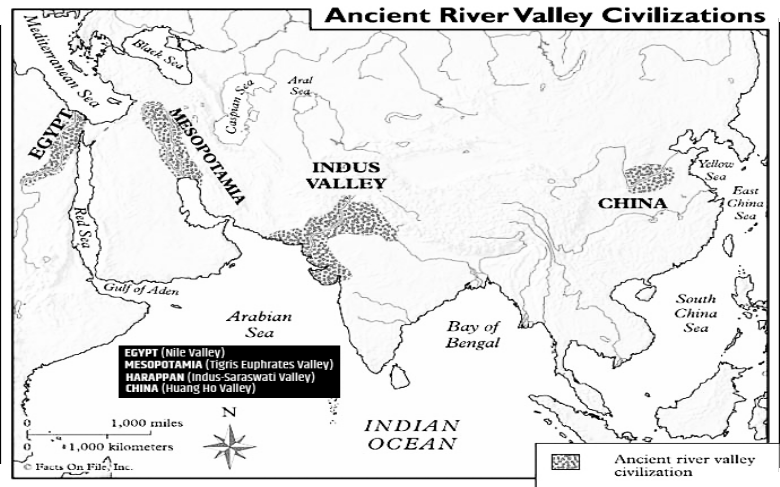
The Indus Valley was home to the largest of the four ancient urban civilizations of Egypt (Nile), Mesopotamia (Tigris and Euphrates), India and China (Hwang Ho).
The civilisation appeared in the north- western part of India and Pakistan in third millennium BCE.
It forms a part of the proto history of India and belongs to the Bronze Age.
The Indus or the Harappan culture is older than the Chalcolithic cultures that have been examined earlier, but as a bronze-using culture, it is far more developed than the latter.
The beginnings of the Neolithic villages in this region go back to about 7000 BCE at the Neolithic sites of Mehrgarh.
The Indus region (Mehrgarh) is one of the areas of the world where agriculture and animal domestication began very early.
Anthropological evidences indicate that Harappans were Proto-Australoids.
Nomenclature, Phases and Chronology:
Why it was called Harappan Civilization?
Scholars referred to it as the ‘Indus Valley Civilization’ because most of the early settlements were discovered in the plains of the Indus River and its tributaries.
Archaeologists however prefer, to call it the ‘Harappan Civilization’. This is because in archaeology there is a convention that when an ancient culture is described, it is named after the modern name of the site which first revealed the existence of this culture.
But of late historians prefer to call it the Harappan Culture. This is because in recent years, a large number of sites belonging to this civilization have been found in areas far away from the Indus Valley. Further, most sites have many similarities with urbanised culture of Harappa. For example, the sites at Kalibangan and Lothal.


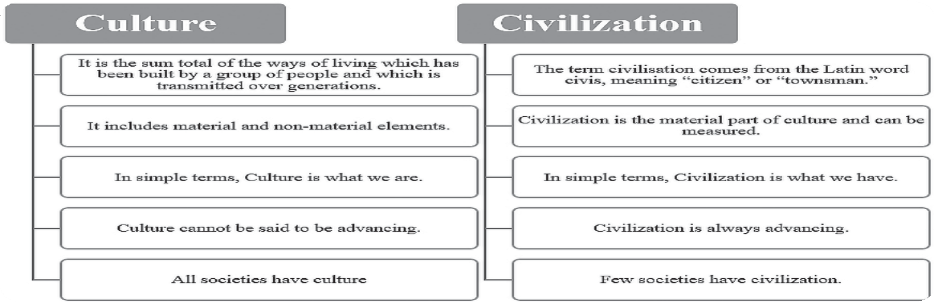
The Bronze Age or Harappan Civilization Era
Geographical Spread


Harappan civilization developed and matured into an urban civilization in the north-western part of the Indian subcontinent.
The heart of the mature Harappan culture was located in Sindh and Punjab (present-day Pakistan). From there, it spread southward and eastward, extending across parts of Punjab, Haryana, Sindh, Balochistan, Gujarat, Rajasthan, and the outskirts of western Uttar Pradesh.
It extended from the Shiwaliks in the north to the Arabian Sea in the south, and from the Makran coast of Balochistan in the west to Meerut in the north-east.
Theories of Origin of the civilization:
• Migration theory of Mackay: He stated that migration of people from Sumer led to the origin of Harappan civilization.
• Amalanada Ghosh theory: He stated that Sothi culture of Rajasthan brought the origin of Harappan civilization.
Discovering the Indus Valley Civilization
• Alexander Cunningham: He was director of Archaeological Survey of India. He took interest in Harappan site and found potteries and bricks. He was also known as father of archaeology.
•
Daya Ram Sahni: He started excavation of Harappa in 1921.
• R.D. Banerji: He started excavation of Mohenjo-Daro in 1922.
• John Marshall: In 1924, he formally announced the Harappan Civilization existence.
| Archaeological Survey of India (ASI) |
| Founded in: 1861, Founder Director: Alexander Cunningham, Presently under: Ministry of Culture. Function: Preserving monuments and artefacts, Regulates Ancient monuments and archaeological sites and remains act, Regulates Antiques and art, 1972. |

Three stages or phases of Harappan Civilization:
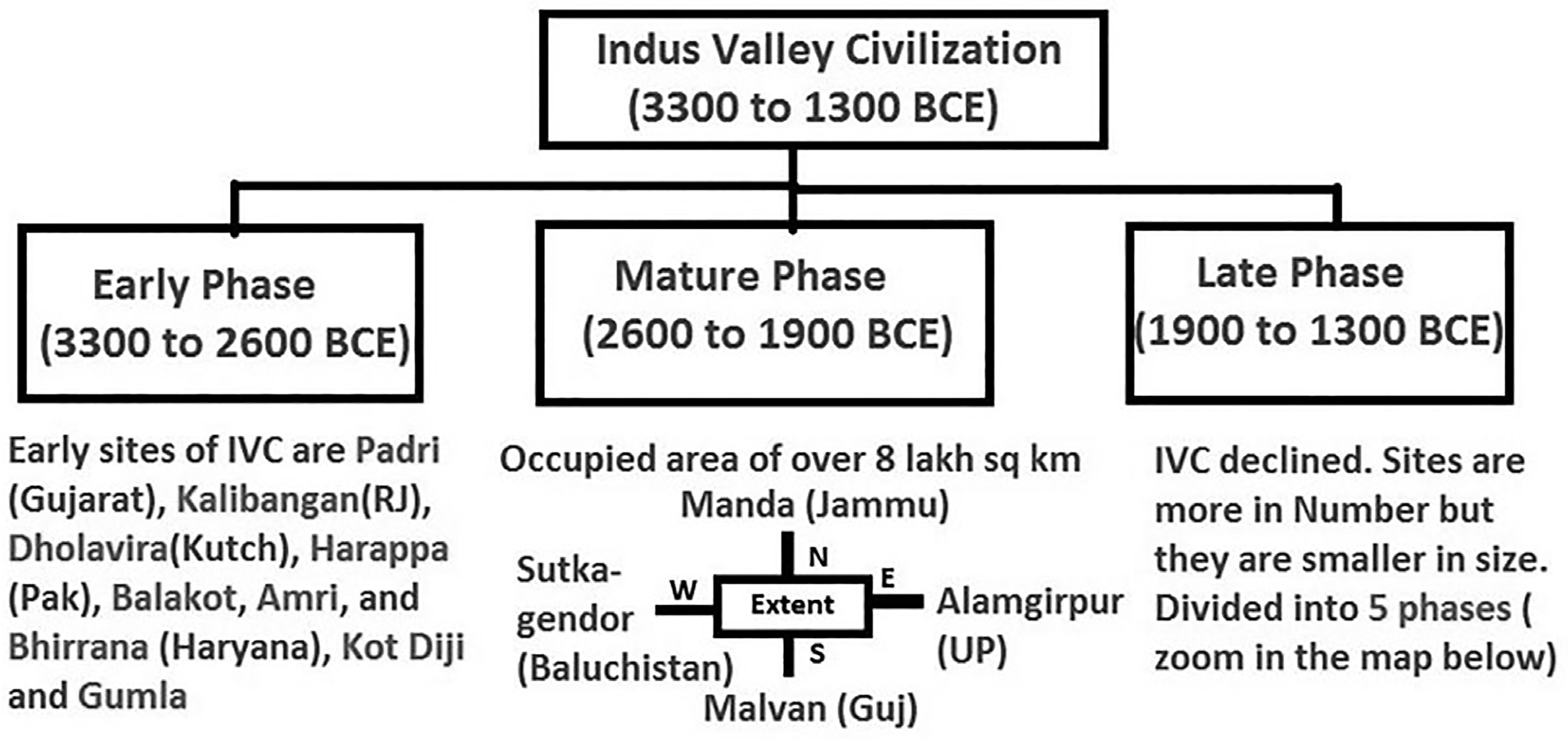
Early stage (3200 BCE - 2600 BCE): This is village phase of Harappan civilization. Major sites were Padri (Gujarat), Dholavira (Kutch), Harappa (Pakistan), Balakot, Amri and Bhirrana (Haryana), and Kot Diji.
Mature Stage (2600 B.C. – 1900 B.C.): This is urbanized phase of the civilization. Major cities were Harappa, Mohenjo-Daro, Lothal, Chahundaro, and Kalibangan.
Late Stage (1900 B.C. – 1300 B.C.): This is post-urban phase of the Harappan civilization. Here decline of civilization started. Major regions were Kudwala (Cholistan), Dwarka (Gujarat), Daimabad (Maharashtra).
Settlements of Harappan Civilization
More than 1500 cities were found.
The Indus Civilisation and the contemporary cultures covered nearly 1.5 million sq. km. area in India and Pakistan.
Its core area was in the regions of Pakistan, Gujarat, Rajasthan and Haryana.
Extended from (Jammu) in the North to Daimabad (Maharashtra) in the South.
In west, this civilization was extended till Sutkangedor (Afghanistan).
The boundaries of this civilization extended from Sutkagen-dor in the west, along the Pakistan-Iran border, to Shortughai in the north (Afghanistan), Alamgirpur in the east (Uttar Pradesh, India), and Daimabad in the south (Maharashtra, India).
However, the largest site is Mohenjo-daro, which covers
500 ha.
Some important cities of Harappan Civilization and their description:
Harappa (Punjab, Pakistan), Mohenjo-Daro (Sindh, Pakistan), Dholavira, Lothal, and Surkotada (Gujarat, India), Kalibangan and Banawali (Rajasthan, India), and Rakhigarhi (Haryana, India) are the major cities in the Harappan period.
Harappa
• First city to be discovered. That’s why the civilization is known as Harappan Civilization.
• Located on the left bank of Ravi.
• Burnt bricks were found, that conveys that houses were made up of burnt bricks.
• Granaries were found, which represents the storage of grains in Harappa region.
• Cemetery were found, which throw light on the burial system.
Mohenjodaro
• Meaning: Mound of the dead.
• Located on the right bank of Indus.
• The site of Mohenjo-Daro had a planned town, built on a platform. It has two distinct areas. One is identified as a Citadel and another as the Lower town.
• Seal of Pasupathi was found. Animals that were present
over this seal – Rhino, Tiger, Elephant, Buffalo, and Deer.
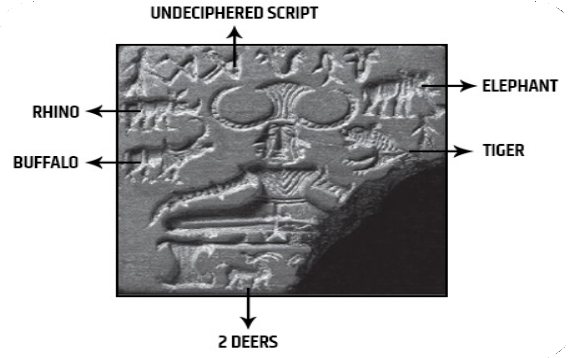
Seal o f Pasupathi


• The houses featured bathrooms paved with burnt bricks and had well-designed drainage systems. Some houses included stairs, suggesting the presence of an upper floor. The homes were spacious, with multiple rooms. Many also had a central courtyard, surrounded by rooms on all sides.
• Great Bath was found, a public place where people used to take bath. The Great Bath is a tank situated within a courtyard.
• Largest granary was found here.
• Important artifacts found:
• Dancing girl figurine was found here.
• Bearded man (possibly a priest) made of steatite found here.
• Seal representing Mother Goddess with a plant growing from her womb.
• A lot of human skeletons found indicating an invasion or a massacre.


Kalibangan
• Meaning: Black Bangles.
• Located on left bank of Ghaggar river.
• Town was fortified.
• Evidence of ploughed field was found.
• Doesn’t have drainage system.
• Seven Fire Altars were found.
• Decorative bricks used in flooring only at this site.
• Earliest evidence of surgery was concluded as skull of a child was found.
• Evidence of double burial was found.
• Burials were in rectangular and circular graves.
• Bones of a camel also found.
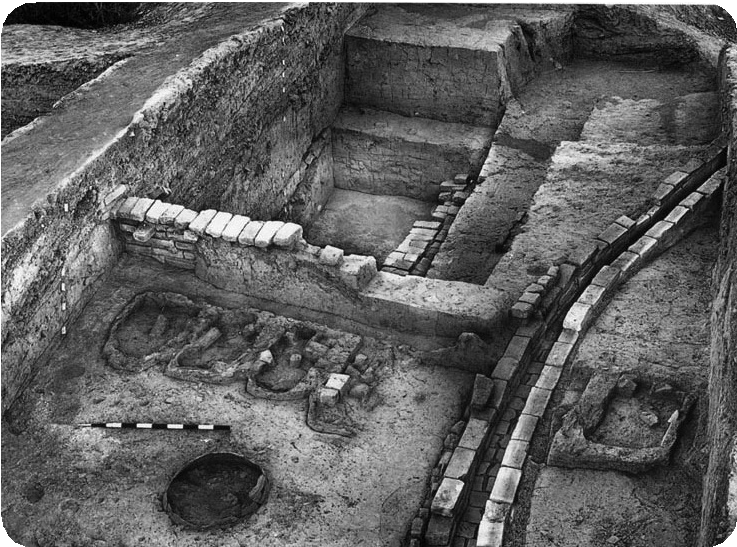
• Provides evidence of a pre Harappan civilisation at a lower layer of excavation and mature Harappan at upper layer of excavation.


Bea rded Priest
Dholavira
• Located on Runn of Kutch.
• One of the latest discovered site and largest site after Rakhigarhi (Haryana).
• Reservoirs were found which shows the importance of conservation of water.
• Evidence of a stadium was found.
• Harappan script inscription was found.
• Plough field evidence was also found.
• Seven stages of cultural development can be found here.


Lothal
• Called as Acropolis.
• Evidence of a dockyard was found and a trade port.
• Important Findings:
• A beadmaking factory,
• Fire altar,
• Cultivation of rice can be estimated from the remains of rice husks found,
• Painting on a jar resembling the story of the cunning fox in Panchatantra,
• A double burial has been found here,
•
Persian Gulf seal was found here which conveys the maritime activities,
• A brick-built tank-like structure was unearthed at the site.
• A seal from Mesopotamia was also found, reflecting long-distance trade links.
• Floor with tiles of intersecting circular designs,
• An instrument to measure angles.
• City divided into six sectors and each section was built on a wide platform of unique brick.
• Here, house entrances were opening up towards main roads while house entry in other sites was from sides or back.

Rakhigarhi

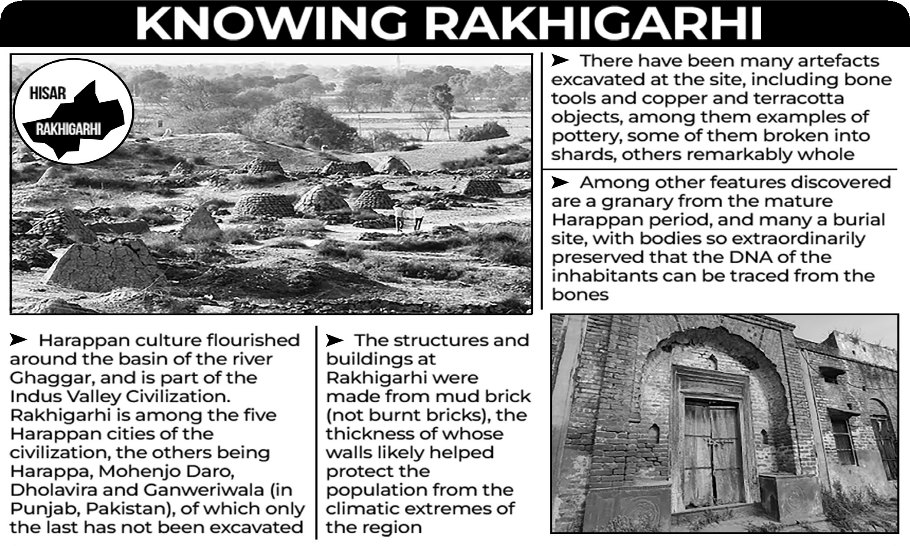
• Largest excavated site.
• Situated in Haryana.
• It is a Fortified city.
• Situated near Ghaggar River.
• Lapidary workshop was found with unfinished beads.
• Cemetery was found.
Banawali (Hisar)
• This site at village Banwali is on the dry bed of ancient river Sarasvati.
• Centre of pre Harappan, Mature Harappan as well as Late Harappan civilisation.
• High quality barley Ceramics.
• Steatite seal Fire altars.
• Clay model of plough.
• Seals found only in lower town and not in citadel.
Other Sites
Chahundaro:
• Located on left bank of Indus.
• Town wasn’t fortified.
• Bead making workshop was found over here.
•
Footprints of a dog and cat found.
Rangpur (Near Lothal):
• Located on the bank of the Madar River, near Lothal, Gujarat.
• Remains of both Pre-Harappan and Mature Harappan culture.
• Flakes Yellow and grey color pots of pre Harappan people.

Surkotada:
• It is located in Bhuj, Gujarat.
• Bones of horse and graveyard found.
Sutkagendor:
• On banks of river Dasht in Baluchistan.
• It was a trade port between Harappa and Mesopotamia.
Ropar:
• It is located on the bank of the Sutlej River in Punjab, India.
• Cemetery, seal and an earthen pot found.
• Buildings are mainly made of stone and soil.
• Evidence of burying a dog along with a Human.
Evidence of five cultural phases – Harappan period, Painted Grey Ware, Northern Black Polish Ware, Kushan- Gupta period and Medieval period
Achievements of Harappan Era in various sectors:
Kot Diji
Citadel and outer area found.
Located in Sindh, Pakistan on the East Bank of Sindh- opposite Mohenjo-daro.
A toy cart with wheels found.
Pottery found from this site has designs with horizontal and wavy lines, or loops and simple triangular patterns.
Desalpar Gunthli
Situated on on the northern bank of Dhrud river in Kutch Gujarat.
Glazed ware pottery found.
Also, three seals with scripts found.

Highly Planned Urbanization
Cities like Mohenjo-Daro, Harappa are the evidence of it, which were highly advanced cities relative to contemporary times.
The entire city was used to be walled. This is called as
Fortification.
• Town Planning and Structures: The Harappan culture was distinguished by its system of town planning.
• Citadel or Acropolis:
•
In Harappa and Mohenjo-Daro.
• It was occupied by members of the ruling class.
• Lower Town with Brick Houses:
• Had social status below that of a Citadel.
• It was inhabited by the common people.
• These houses followed a grid system with roads cutting across one another virtually at right angles.

• Barracks: Found in Harappa which possibly accommodated laborers.
• Monuments: They symbolize the ability of the ruling class to mobilize labour and collect taxes.
• The huge brick constructions were a means of impressing upon the common people the prestige and influence of their rulers.
Structure of Urban Segments
Roads were well planned, and they cut each other at ninety degrees.
Houses were multi-storied. Doors weren’t there, but no one from outside could see the happenings inside the home.
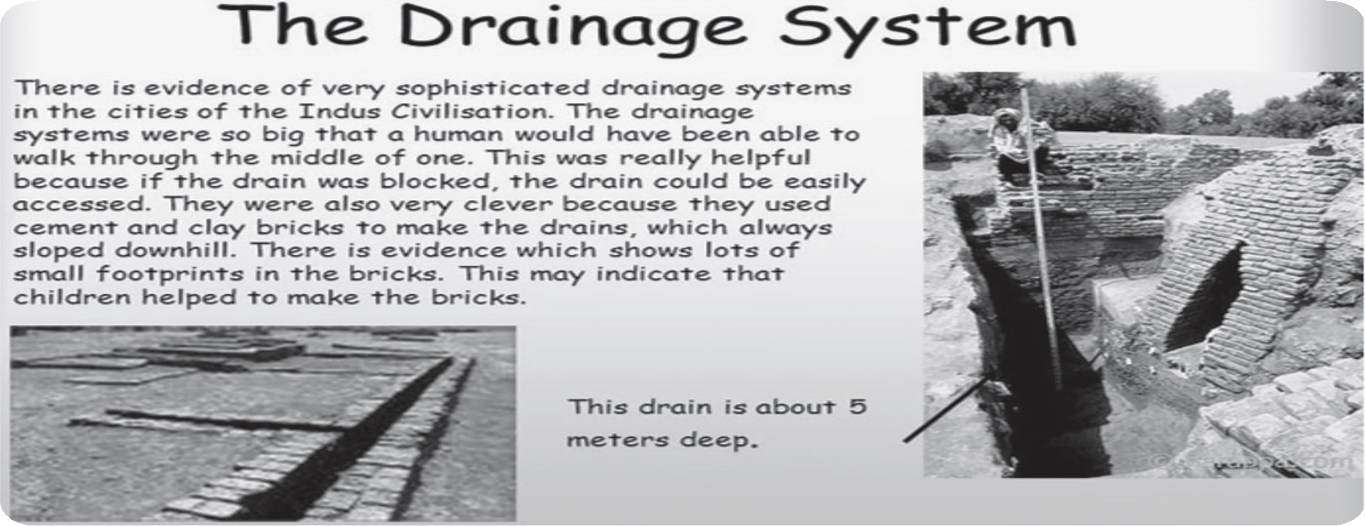
• Drainage System



• The drainage system was well developed. It used to be entirely covered with bricks and sometimes with stone slabs.
• In Mohenjo-daro and in almost all the cities, every house, large or small, had its own courtyard and bathroom.
• In Kalibangan many houses had their own wells.
35
• Granaries
• Granaries were developed so as to store grains for the people of the region.
• There are six granaries in Harappa. Each granary measured 15.23 x 6.09 m and lay within a few meters of the riverbank. To the south of the granaries at Harappa lay working floors consisting of rows of circular brick platforms used for threshing grains.
• Granaries are found in Harappa, Mohenjo-daro and the southern part of Kalibangan.
• Great Bath of Mohenjo-Daro:
• It comprises the tank which is situated in the citadel mound.
• The floor of the bath was made of burnt bricks.
• It has been suggested that the great bath was primarily intended for ritual bathing. which has been vital to any religious ceremony in India.

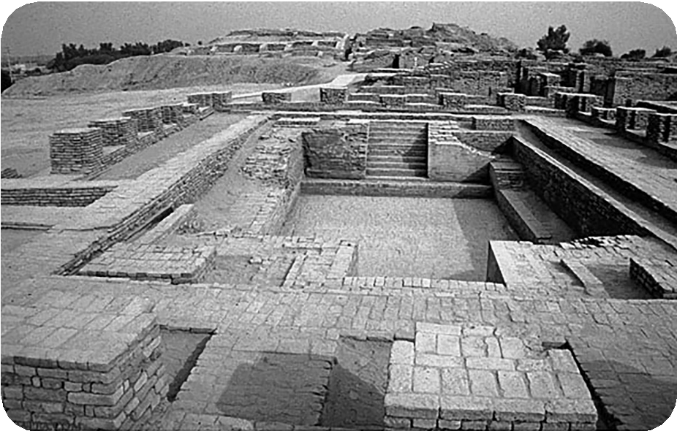
Great Bath of Mohenjo-Daro
• Tank in Dholavira: The Dholavira tank was probably used for the same purpose as the great bath of Mohenjo-daro.
Developments in Farming System
• As people were residing near river sources farming was a major occupation during this era.
• The rainfall in this region also caused annual flooding.
• Agriculture was an important source of subsistence for the Harappans, and they used to sow seeds in the flood plains in November and reaped their harvests of wheat and barley in April. They produced wheat, barley, mustard, peas, etc. Rice was grown at Lothal.
• The Indus people were the earliest people to produce
cotton.
• They adopted a double cropping system.
• The Harappans used ploughs. They perhaps ploughed the land and then sowed the seeds. Ploughed fields have been found at Kalibangan.
• They used both canal and well irrigation.
• Irrigation facilities were well developed in Baluchistan and Afghanistan regions.
• In Shortughai (Afghanistan), canals were found but not in Punjab and Sindh.
Animal Husbandry Technique (Domestication of Animals)
• Oxen, buffaloes, goats, sheep, dogs, cats, wild ass, horse, camel, fowl, elephants and pigs were domesticated.
• The remains of a horse are reported from Surkotada, west Gujarat.
• Boar, gharial, deer and rhinoceros were well known to the Harappans.
• Pastoralism was also practised by the Harappans.
Craft and Smelting Technology (Craft Production)
• Bead making:
• Bead making factory was found at Chanhudaro. Craft production was an important part of the Harappan economy. Bead and ornament making, shell bangle making and metalworking were the major crafts.
• Materials used for Bead Making: stones like camelian, jasper, crystal, quartz and steatite: metals like copper, bronze and gold; and shell, faience and terracotta or burnt clay.
• They were exported to Mesopotamia and the evidence for such exported artefacts have been found from the excavations in Mesopotamian sites.
• Shell object making factory were situated in Nageshwar and Balakot.
• Bronze:
• The people of Harappa were very well acquainted with the manufacture of bronze by mixing tin with copper, but they occasionally also mixed arsenic with copper for this purpose.
• They produced bronze images, utensils, and weapons such as axes, saws, knives, and spears.
• The Cire Perdue method (lost wax process) was used for casting tools, ornaments and figurines made of Bronze.
• Sculpture of Bearded man and bronze figurine of
Dancing Girl was found from Mohenjo-Daro.


• Bricklaying was an important craft in the Harappan era.
• Harappan people also practiced boat-making, seal- making, and terracotta manufacturing.
• Goldsmiths made jewelry of silver, gold, and precious stones.
• They were aware of the use of the wheel and carts.
Pottery
• The potter’s wheel was extensively used.
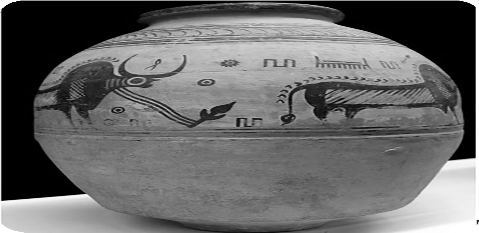
• The Harappans used diverse varieties of pottery for daily use. They use well-fired pottery. Their potteries have a deep red slip and black paintings.
• The painted motifs commonly found on Harappan pottery include designs such as pipal leaves, fish-scale patterns, intersecting circles, zigzag lines, horizontal bands, and geometric shapes with floral and faunal elements. The pottery is well-baked and adorned with intricate decorations.
• Harappans also used glazed pottery which is earliest example of its kind in the world.

•
Rohri Chert: The chert, a fine-grained sedimentary rock, was found in the region of Rohri in Pakistan. It was used by the Harappans for making stone blades and tools.
• Copper was mined from Khetri copper mines of Rajasthan.
• No use of iron has been found.
• Largest number of copper tools were found at Gunjeria.
• Inventions:
• Dental drill
• Bow drill
• Button
• Furnace
• Levee
• Ruler
• Step well
• Transport tools:
• Solid wheels were used.
• Bullock carts were used.
• Boats and plank-built watercrafts with sails are found.
Textiles and Ornaments:
• Cotton and woolen clothes were used.
• A piece of woven cotton has been recovered from Mohenjo-Daro.
• They used combs, mirrors, bangles, necklaces which shows that they were highly fashionable.
Weights and Measures
• Weights and measures were used for trade and other transactions.
• Cubical weights made of Chert stone were used.
• These were used to weigh precious stones and metals.
• They knew the art of measurement. Sticks inscribed with measure marks have been found, and one of these is made of bronze.
• Multiples of 16 were used to measure weights.
• They did not use metallic money.
Seals, Sealing and Scripts

Harappan Burial Pottery
Metals, Tools and Weapons
• The Harappans crafted tools from chert blades, copper, bones, and ivory.
• Copper was used to make various tools, including points, chisels, needles, fishhooks, razors, weighing pans, mirrors, and antimony rods.
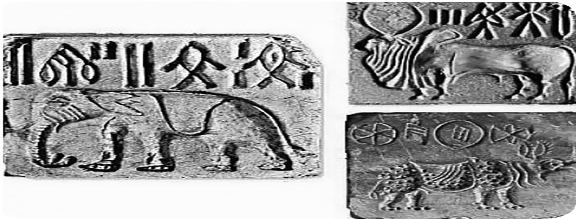
Harappan Seals

• The Harappan Script is pictographic and not alphabetical. It is yet to be deciphered. The script is Boustrophedon (means “ox-turning”) i.e., written bidirectionally from right to left in first line and left to right in second line. There are around 400 signs discovered.
• Seals were made of clay and sealing was done by stamping an impression of seal on the wet clay.
• Seals were used for locking packages of goods to ensure integrity of package, which is to be transported.
• The majority of seals carry short inscriptions with pictures of one-horned animals (unicorns or rhinoceroses), buffaloes, tigers, goats, elephants, antelopes, and
crocodiles.
Arts and Amusements.
• Terracotta Figurines were either used as toys or objects of worship and represented men, women, birds, dogs, sheep, cattle, and monkeys. Terracotta models of plough were found in Cholistan and Banawali.
• Stonework: Some stone works are the citadel of Dholavira and stone slabs used in burials.
Trade and Commercial Exchange
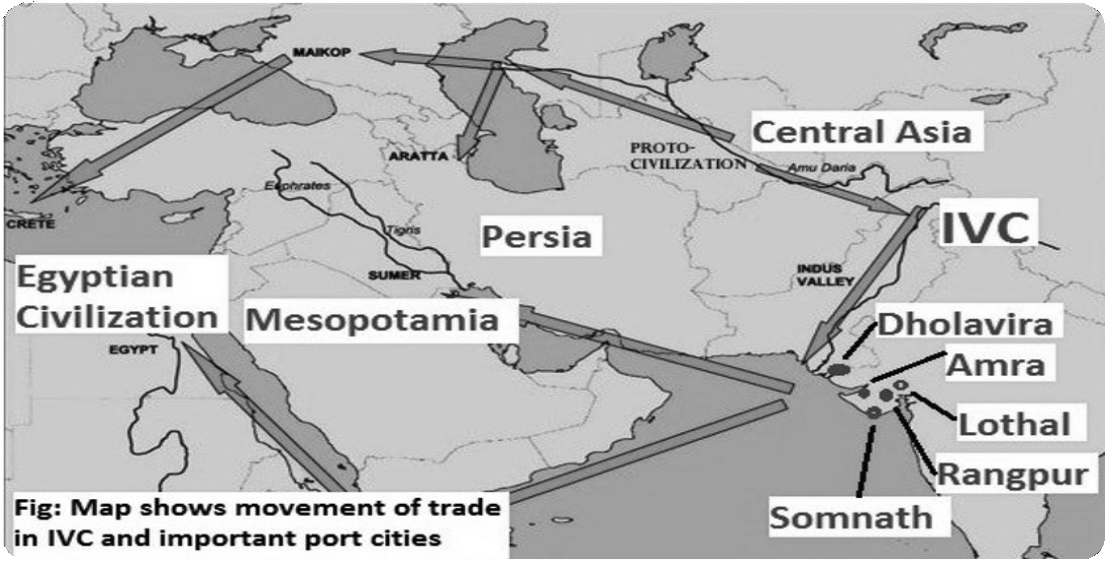
Harappan seals have been found in regions like Mesopotamia, Egypt, and Oman, indicating that Harappan trade flourished in these areas as well.
Sumerian or Mesopotamian texts from Iraq frequently mention three key trade centers: Magan, Dilmun, and Meluhha (the Indus Valley).
• Lapis Lazuli was imported from Shortughai.
• Carnelian beads were sourced from the Bharuch region.
• Gold came from Kolar, while tin was imported from Rajasthan.
• Steatite was brought from Iran, and turquoise from Persia.
• Ships and ports in Lothal facilitated imports and exports. Other significant Harappan and late Harappan ports included Lakhabawal, Kindarkhera, Kuntasi, Megham, Prabhasa, Todio, and Amra.
• Taxes were collected in grain, and granaries served as treasuries.


| Evidence Harappan External Trades: |
| Sumerian literature mentiond Indus civilization as Meluha. Indus seals were obtained from Mesopotamian sites of Ur, Kis, Susa, Logas. Cylindrical seals found in both Mesopotamia and Mohenjodaro. Mesopotamian cosmetic products found from Harappan sites. Coffin burials were frequently practiced in Harappan and Mesopotamian civilizations. Mesopotamian seals with image of humped bull which was chiefly a Harappan figure. |
| Major Harappan Imports: | |
| Gold Silver Copper Tin Agate Chalcedony Lead Lapiz Lazuli Turquoise Amethyst Jade Carnelian | Afghanistan, Persia, Karnataka Afghanistan, Iran Baluchistan, Khetri (Rajasthan) Afghanistan, Central Asia Western India Gujarat Rajasthan, South India, Afghanistan, Iran Badakashan, Kashmir Central Asia, Iran Maharashtra Central Asia Gujarat |
Societal Strata
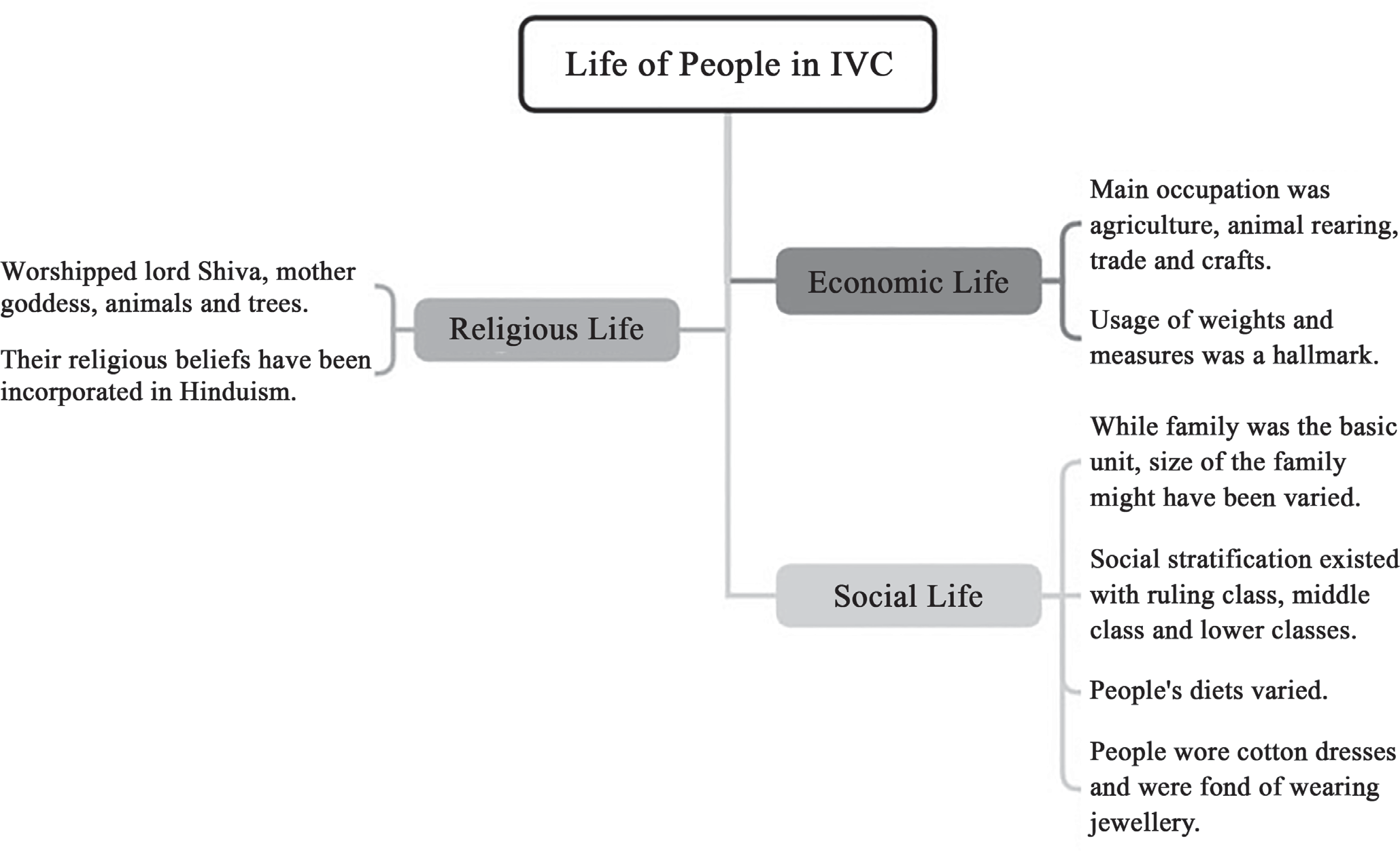
• Social Hierarchy was evident in Harappan era.
• People were Vegetarian and Non-Vegetarian.
• Games like chess, dicing, bull fighting were present. People practices yoga as well.
• Stringed musical instruments are found.
• Conditions of women were equal to men.
Political Strata
• No clear indication of the prevalent political structure exists but evidence of a centralized system is there as can be seen from planned cities, standardised weights and measures and monumental architecture.
• It seems that merchants might have been the ruling class.
• Nature of inheritance is not known either.
Faith and Belief System
• No temples were found in Harappan era.
• Goddess of Earth was worshipped in the form of terracotta figurines of women in which a plant is shown growing out of the embryo of a woman.
• Pashupati Mahadeva: This male deity is represented on a seal and has three-horned heads with the sitting posture of a yogi, with one leg placed above the other. This god is surrounded by an elephant, a tiger, a rhinoceros, buffalo, and deer.
• Nature worship was present. The people also worshipped trees such as Pipal and animals such as unicorn (rhinoceros), humped bull,elephant, a tiger, buffalo, and deer.
• Mythical animals like human figure with a bull’s horns, hoods and a tail; three headed chimeras; human faced goat and a semi-human demi-bovine creature.
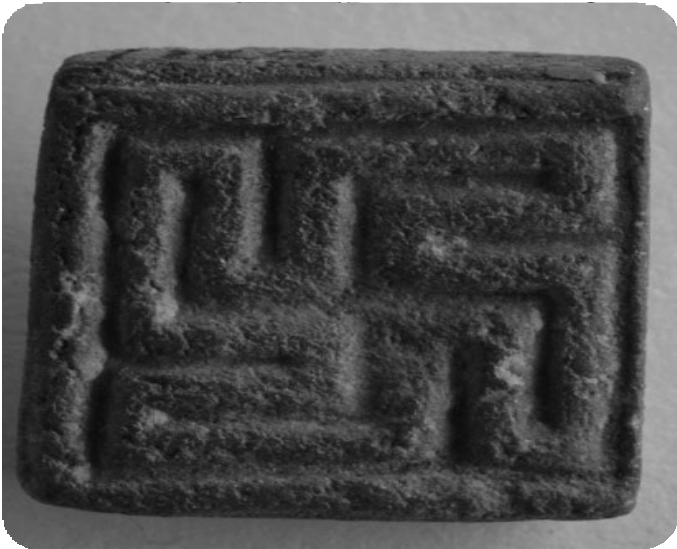
Swastika symbol was found.
People used to worship the phallus (linga) and vulva
(yoni) too.
Faith in magic and charms can be speculated due to the use of amulets.
Three different types of burial were found which indicate the belief in afterlife:
Complete Burial: Their entire corpse was buried.
Circular and rectangular burial patterns were found.
Partial Burial: Corpse was given to birds and animals and the bones were then buried.
Urn or Pot Burial: The body was cremated, and the ashes were placed in an urn, which was subsequently buried. Over 100 pot burials were discovered during excavations around Harappa. Research indicates that typically, a single pot was used to enclose the bones, although some exceptions were found.
• Belief in Life after death:
• Dead people were buried with household pottery, ornaments and articles of daily use. Their ashes were preserved in clay urns.

Various Terms associated with Megaliths

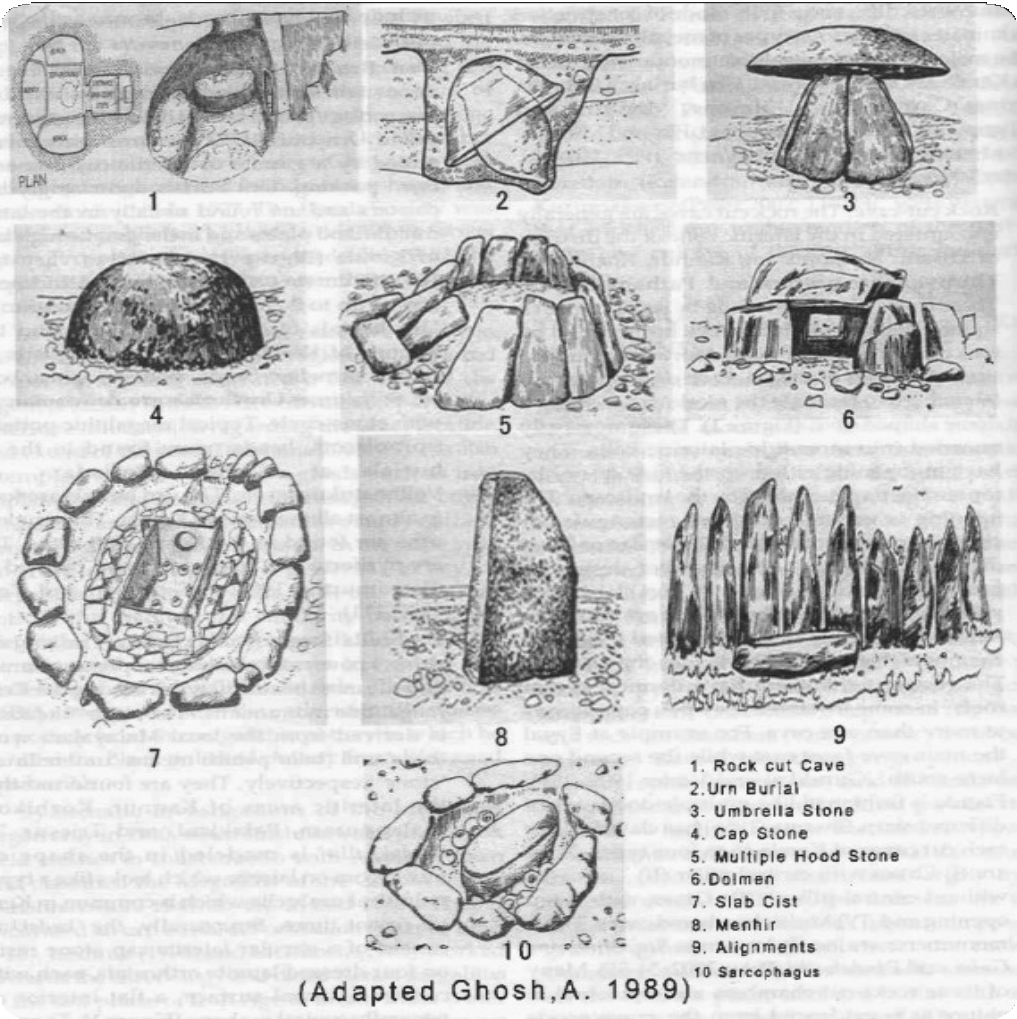
Majo r type of Megalithic monuments found in Kerala
Chamber Tomb: A type of grave from the Megalithic era.
Cist: An underground megalithic tomb constructed with vertical and horizontal stone slabs.
Dolmen: A megalithic tomb built above ground.
Dolmenoid: A partly underground megalithic tomb.
Menhir: A megalithic burial marked by a single, large standing stone.
Barrow: It is a mound or tumulus made of earth. It may be:
•
Circular on plan,
• Oblong or oval on plan.
Barrow may or may not contain stone cist, built on or below the original ground. It may or may not be defined by a circle of stones or a ditch or both.
• Cairns: It is also a barrow but made of heap of stone rubble. It may or may not contain cist and built always on the original ground. In some cases, it is defined by a circle of stones.

Fall of contemporary civilizations like Egypt, Mesopotamia and Greece not Indo-Gangetic Civilization
• Western civilizations heavily relied on large-scale slavery, which played a significant role in their decline. In contrast, slavery in India was neither as rigid nor widespread. While there were social outcasts and untouchables, their status was generally better than that of slaves in other regions.
• Western civilizations were largely absorbed by the spread of Christian and Islamic cultures, which reshaped the region. On the other hand, the Indian subcontinent embraced and integrated the cultural elements of successive civilizations.
• A distinctive feature of Indian culture is its ability to remain dynamic and continuous, adapting to change while preserving its core essence. It has consistently discarded what became irrelevant in the modern age, allowing its spirit to endure.
Continuity of Indus Valley Civilization features in Modern Times
• Renowned scholar Jim Shaffer notes that the archaeological evidence shows no clear cultural break between the Vedic period (associated with the Painted Grey Ware culture) and the indigenous protohistoric Harappan culture.
• Weights and measurements: A precise system of weights, typically made from a stone called chert and usually cubical with no markings, was used. The lower denominations followed a binary system (1, 2, 4, 8, 16, up to 12,800), likely for weighing jewelry and beads, while higher denominations followed the decimal system.
• India maintained a currency system based on binary denominations, with 16 Annas equaling 1 Rupee, a system that continued into modern times.
• Agriculture: The Indus Valley civilization employed various irrigation techniques and utilized ploughs and
stone sickles. They were the first to cultivate rice and used the Banawali plowshare for this purpose.
• Rice remains a staple food for most Indians to this day.
• Urban Planning:
• The Indus civilization is famous for its advanced town planning, featuring a grid pattern of housing, narrow lanes between homes, standardized brick sizes, organized civic administration, sophisticated
water management, and an efficient drainage system, including toilets with commodes.
• Many of these features can still be seen in modern cities today, such as the general orientation, internal grid patterns of roads, enclosing fortifications as symbols of authority, garbage bins along main streets, pillared halls, and covered drains.
• Harappan town planning also incorporated auspicious proportions, many of which align with those described in classical Hindu architectural literature and continue to be followed today. For example, the 5:4 ratio can be found in structures like the outer fortifications of Dholavira, the port-town of Lothal near Ahmedabad, Harappa’s granary, large houses in Mohenjo-Daro’s lower city, significant Vedic altars, the king’s palace, Ashoka’s columns, and Delhi’s Iron Pillar.
• Religion:
• The swastika is a classical Indian symbol with possible Indus civilization origins. This symbol is still considered sacred in Hinduism and other religions.
• Phallus worship, such as Harappa’s fertility goddess statue with a woman with a plant growing from her embryo and Male Linga in Harappa. Indication of the practice of fire cult in Lothal in a


later phase and Yoga - Pashupati Mahadeva’s seal indicates the Yogic pose.
• The linga and the trishula (trident), animal sacrifice, and the sacred peepal tree (sacred fig) is still revered.
• Idol worship and use of fire altars for sacrifices and rituals, ponds and sacred baths still practiced.
• Gods having multiple faces, ornamental arches, and yogic postures. Some of their figurines seem to join their hands in a similar fashion, signifying “namaste.”
• Art and Tools:
• Metal sculpting: The Harappans employed the lost-wax technique to craft sculptures from copper, bronze, and gold. One of the earliest examples is the 'Dancing Girl' from Mohenjo-Daro, posed in the tribhanga stance, dating back to 2500 BCE. This technique is still widely used around the world today, particularly in India.
• Oxcarts have mostly survived in shape and size, with very few changes.
• Some plowing techniques have also continued till the present times.
• We still use objects like the frying pans and cooking pots found in Indus cities.
• Children still play with rattles, whistles, and spinning tops.
• Ornaments:
• Bangles, anklets, nose-pins, and ear studs documented at several Indus civilization sites, remain an integral part of ornaments worn by the Indian women of today.
• The married Hindu women applying vermilion at the parting of their hair seem to have Harappan origins (figurines found at Nausharo).
• The traditional techniques of working with metals like gold and bronze, making bangles, and carving ivory in today’s India also derive their roots from the Harappan times.

