Whatsapp 88106-52225 For Details
Get Free IAS Booklet
Get Free IAS Booklet
INTRODUCTION
The origin of dance in India can be traced to the Mesolithic paintings in the rock shelters of Bhimbetka. Various descriptions of community dance forms have been found in these rock shelters. The Indus Valley Civilisation also had a rich dancing tradition as can be evidenced from the bronze sculpture of dancing girl in tribhanga pose recovered from Mohenjo-Daro. Shiva’s tandava dance and Nataraja image are examples of association of divinity to dance forms. Shiva is also considered as the supreme dancer. The first formal mention of dance, however, is found in Bharata Muni’s Natyashastra (200 BCE to 200 CE) which is of a much later date. It is a complete and comprehensive treatise on Indian Classical Dance. Other important works dealing with the same subject are- Abhinaya Darpana, Nartana Sarvaswam, Ramayana, Mahabharata and Harivamsha.
Aspects of Indian Dance
According to the Natyashastra, Indian classical dance has two fundamental aspects:
1. Lasya: This represents grace, bhava (emotion), rasa (sentiment) and abhinaya (expression). It is associated with the feminine qualities of dance as an art form.
2. Tandava: This is linked to the male aspects of dance, focusing more on rhythm and movement.
In the Abhinaya Darpana (5th-4th century BC), a key treatise on dance by Nandikeshvara, the fundamental elements of dance are outlined:
1. Nritta: This refers to the basic dance steps performed rhythmically, without any expression or mood.
2. Natya: This refers to the dramatic elements of dance, where a story is portrayed and elaborated through the performance.
3. Nritya: This involves the emotions and sentiments conveyed through dance, including mime and the use of mudras (hand gestures) to express various feelings.
Nandikeshvara further explains the concept of Nayaka Nayika Bhav, where the eternal deity is portrayed as the hero (Nayaka), and the devotee performing the dance is seen as the heroine (Nayika). Through the dance, nine rasas or emotions are expressed
The Navrasas All forms have traditionally been structured around the nine rasas (emotions), which are Shringaara (love or beauty), Hasya (laughter), Karunaa (compassion/sorrow), Raudra (anger), Vgira (heroism or courage), Bhayanaka (terror or fear), Bibhatsa (disgust), Adbhuta (surprise or wonder), and Shaanta (peace or tranquility).
These moods and emotions are conveyed to the audience by employing the use of mudras which are combination of hand gestures and body postures along with facial expressions. There are a total of 108 fundamental mudras
The Role of Abhinaya
There are certain features that are common to all dance styles. They all incorporate the three elements of Nartana or dance which are Nitta (pure dance) or abstract, Nitya or expressive and Natya or dramatic dance. Being a communicative art forms, the role of abhinaya is very important which means to carry across ideas to the audience’. Sentiments, feelings and even moral precepts are carried across. Abhinaya is of four kinds:
1. Angikaabhinaya- comprises of movements of the body or anga.
2. Vaachikaabhinaya- consists of vachana or words, songs, speeches and narration.
3. Aahaaryaabhinaya- includes costumes, jewelry, make-up, stage props and setting, that which has been acquired or aaharita.
4. Saatvikaabhinaya- includes inner spiritual feelings, emotions and psychic states-expressed in a visible outward form.
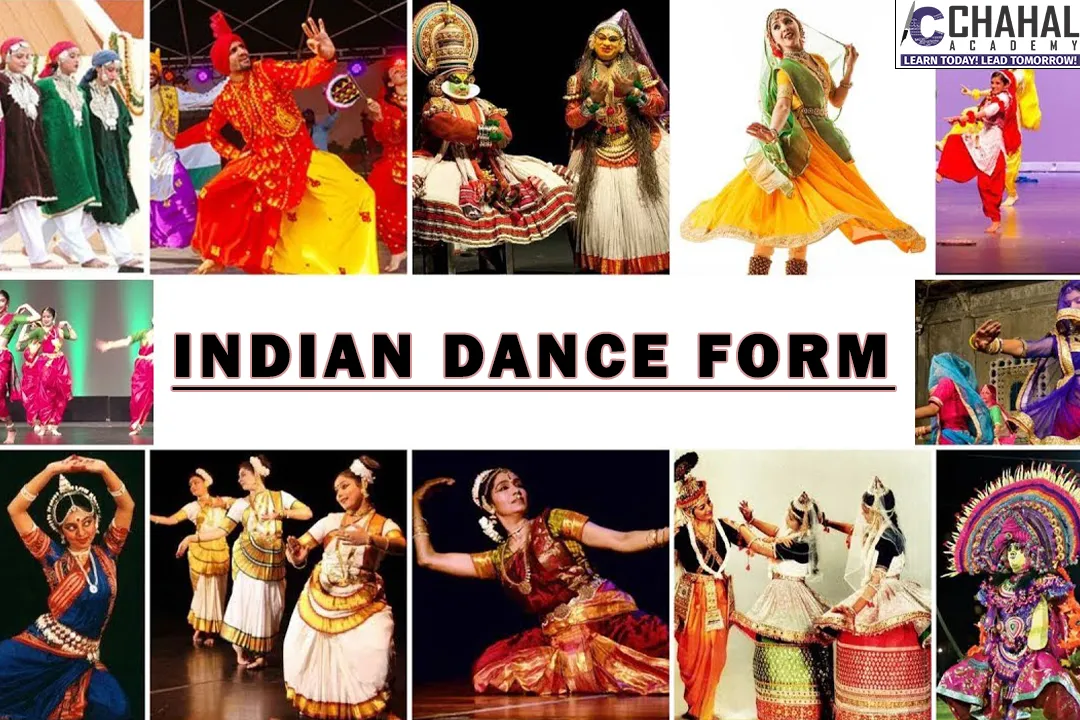
Indian Classical Dance Forms
It is believed that the Classical Indian dance forms originated around the time when Janapadas were founded in India. While all these forms differ from each other in various aspects, all of these dance forms are governed by the same set of rules and guidelines that can be found in the Natyashastra of Bharata Muni. The main rule being that true transfer of knowledge can only come through a guru, thus giving weightage to the Guru-Shishya Parampara of ancient India.
While, Sangeet Natak Akademi has recognized eight classical dance forms, the Ministry of Culture has recognized nine classical dance forms including Chhau dance.
| CLASSICAL DANCE FORM | FEATURES |
| Bharatanatyam (Tamil Nadu) | Oldest among all the Classical dance forms Its name is derived from four most important aspects of dance: Bha from Bhaava meaning emotion Ra from Raaga meaning music or melody Ta from Taala meaning rhythm Natyam meaning dance It started as a temple dance tradition called Dasiyattam (the dance of maid servants or devadasis) It is often referred to as the ‘fire dance’ as it is the manifestation of the fire in the human body. Most of the movements in Bharatanatyam resemble a dancing flame. There is an equal emphasis on both Lasya and Tandava aspects, while the major emphasis is on the mudras. In Bharatnatyam recitals, the knees are mostly bent, and the weight is equally distributed. |
| Kathak (Uttar Pradesh) | Traces its origins from the Ras Leela of Brajbhoomi, and derives its name from ‘Katha’ or story. It is characterised by the use of intricate footwork and pirouettes. Jugalbandi is the main interaction of Kathak recital which showcases a competitive play between the dancer and the tabla player Ghat Bhav is the form of Kathak where there is no music or dancing. Kathak is generally accompanied by dhrupad music. Taarans, Thumris and ghazals were also introduced as during the Mughal period. The journey of Kathak is long and diversified and the dance form has gharanas in Lucknow, Jaipur, Varanasi and Raigarh. |
| Odissi (Odisha) | The caves of Udayagiri-Khandagiri provide earliest examples of Odissi dance. It derives its name from ‘Odra Nritya’ mentioned in the Natyashastra. Boys are recruited and are dressed as females to perform this art. They are called as Gotipuas. It is similar to Bharatanatyam in its use of mudras and facial expressions to convey emotions The tribhanga pose (body bent at three places) is central to Odissi dance form During the dance the lower part of the body remains stationary and the upper body moves. It is unique in its use of gracefulness, sensuality and beauty. The dancers often create geometrical shapes with their bodies. It is accompanied by Hindustani Classical Music and instruments used are- manjira(cymbals), pakhawaj(drums), sitar and flute. The woman dancer has an elaborate hairstyle along with silver jewellery. The lyrics of Gita Govinda are used along with local renditions |
| Kathakali (Kerala) | Two forms of dance-drama emerged in Kerala known as Ramnattam and Krishnattam based on Ramayana and Maharbharata stories. These art forms later combined to form Kathakali. It derives its name from ‘Katha’ and ‘Kali’ meaning story and drama respectively. It is closely related a Sanskrit drama tradition (Koodiyattam) and other ancient martial art forms. It is generally an all-male dance performance with minimal use of props. Elaborate facial makeup and use of headgear is prominent in Kathakali. It involves both dance and drama and most Kathakali performances are a representation of an eternal conflict between good and evil. It is also called as the ‘Ballad of the East’. The language used in Kathakali performances is Manipravalam- a mixture of Sanskrit and Malayalam Gestures used in the performance are very important. It is remarkable in the use of eyes and eyebrows movements to convey the representation of rasas. Navrasas are extensively used to convey emotions as well. It is generally performed in open air theatres with lush green trees of Kerala providing the backdrop. |
| Mohiniyattam (Kerala) | ‘Mohini’ meaning a beautiful woman and ‘attam’ means dance; Mohiniyattam is also known as the dance of an enchantress. It was essentially a solo dance form that got patronage from the rulers of Travancore. It combines grace and elegance of Bharatanatyam with the vigour of Kathakali. There is a marked absence of thumping of footsteps; instead, footwork is light and delicate. The Lasya aspect is dominant in the recital. And it generally narrates the story of feminine dance of Vishnu. Costume is of special importance with off white and white being the main colours with gold brocade designs. Musical instruments used are – cymbals, veena, drums and flutes, among others. The element of air is symbolised through the Mohiniyattam dance. |
| Kuchipudi (Andhra Pradesh) | Derives its name from Kuchelapuram village in Andhra Pradesh. It was formalised by Siddhendra Yogi in the 17th Century. Stories from the Bhagawat Purana form a central theme of the recitals and the dancers are known as Bhagwathalus. There is dominance of Shringaara Rasa. It involves difficult foot movements and is generally performed by a team of dancers. This dance form is a manifestation of the earthly elements in the human body. As a dancer may combine roles and become a singer in the performance, it becomes a form of dance drama. Both Lasya and Tandava elements are important in this dance form It is generally accompanied with Carnatic Music, violin and mridangam being the principal instruments. The recital is in Telugu language. |
| Manipuri (Manipur) | The Manipuri dance form finds its mythological origin in the celestial dance of Shiva and Parvati in the valleys of Manipur along with the local ‘Gandharvas”. The dance gained prominence with the advent of Vaishnavism in the 15th century. Krishna became the central theme of this dance form. It is performed generally by female dancers. In the modern times, Rabindranath Tagore brought back the dance form into the limelight when he introduced it in Shantiniketan (West Bengal). It is unique in its emphasis on devotion and not sensuality. The faces are covered with a thin veil, and facial expression is of lesser importance. Hand gestures and gentle movement of feet are important. While the dance incorporates both Tandava and Lasya, emphasis is laid on the latter. The female dancers wear unique long skirts. The focus is mainly on slow and gracious movements of hand and knee positions. Nagabandha mudra, in which the body is connected through curves in the shape of ‘8’, is an important posture in the Manipuri dance form. Ras Leela (Radha-Krishna love story) is a recurring theme of the Manipuri dance recital. The drum- pung is an intricate element of the recital. Flute, khartals (wood clapper), dhols and others also accompany the music. |
| Sattriya (Assam) | Sattriya dance, in its modern form, was introduced by the Vaishnava saint Sankardev in the 15th century AD in Assam. The dance takes its name from the Vaishnava monasteries called "Sattras," where it was predominantly practiced. It is mentioned in the Natyashastra and is rooted in the Bhakti movement. Sattriya is a fusion of various regional dance styles, including Ojapali and Devadasi traditions. The main focus of Sattriya recitals is on devotion, with performances narrating mythological stories of Vishnu. Typically performed by male monks, called 'Bhokots,' the dance is part of daily rituals or special festival celebrations. The main instruments used in Sattriya performances include the Khol (drum), cymbals (Manjira), and flute, while the songs, known as 'Borgeets,' were composed by Sankardev. Sattriya dance emphasizes rhythmic syllables, precise footwork, and specific dance postures, combining both Lasya and Tandava elements. Strict guidelines govern hand gestures and footwork, both playing crucial roles in the performance. Male dancers wear a Dhoti and ‘Paguri’ (turban), while female dancers adorn traditional Assamese jewelry and attire, such as the ‘Ghuri’ and ‘Chador,’ made from Pat silk. Waist cloths are worn by both men and women. In contemporary times, Sattriya dance has evolved into two main forms: the Gayan-Bhayanar Nach and the Kharmanar Nach. |
| Chhau (Eastern India) (Orissa, Jharkhand, and West Bengal) | This dance is a blend of martial traditions, temple rituals, and folk and popular performance of this region. It is found in three styles named after the location where they are performed, Purulia Chhau of West Bengal Seraikella Chhau of Jharkhand Mayurbhanj Chhau of Odisha The dance is performed at night in an open space to traditional and folk melodies, played on the reed pipes mohuri and shehnai. In 2010, it was inscribed in the UNESCO’s Representative List of the Intangible Cultural Heritage of Humanity. The Sangeet Natak Akademi has established a National Centre for Chhau Dance at Baripada, Odisha. Masks form an integral part of Chhau Dance in Purulia and Seraikela. The Chhau mask of Purulia (West Bengal) is registered under Geographical Indications. The stories enacted by Chhau dancers include those from the Hindu epics (Ramayana, Mahabharata) and other Indian literature. |
Importance of Classical Dances
• Each of the locally distinct dances includes local music and recitations in the native tongue or Sanskrit. They convey the same essential themes in a variety of styles, attire, and expressions.
• A youngster who wants to learn dance must first put in a lot of effort to learn discipline and patience, two of the most important skills in a child’s growth.
• Through the motions of the dance, the kid gains physical stamina and maintains body control. It also allows for the expression of intimate feelings and fosters self-confidence.
• Through mythology-based Indian classical dance, children are taught the significance of India’s rich literary and cultural legacy.
The greatest strenght of the dance has been its capacity to reveal society’s flaws using various instruments such as facial expressions, costumes, and rhythm
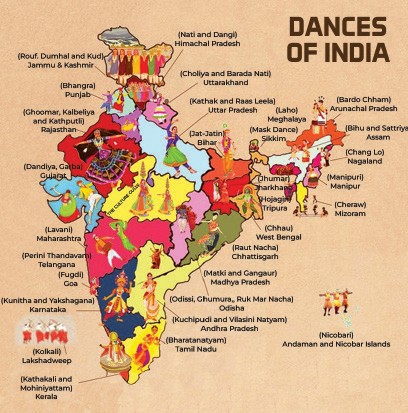
FOLK DANCES
• Folk dance is a type of dancing that is both popular and culturally meaningful. Folk dances frequently represent cultural traditions or norms and appear during ceremonies, festivals, major cultural events, and for entertainment.
• Folk dances are also frequently composed of big groups of dancers or specific portions of a community that participate. While most folk dances have ethnic roots, not all ethnic dances are folk dances. Dances of ritual origin are not included in folk dancing. Ritual dances are religious dances that are not commonly performed for sport or enjoyment.
• Generally, this is done in rural regions during festivals, fairs, or religious and cultural events. Each region or state in India has its unique folk dance, which is based on local stories, customs, and culture.
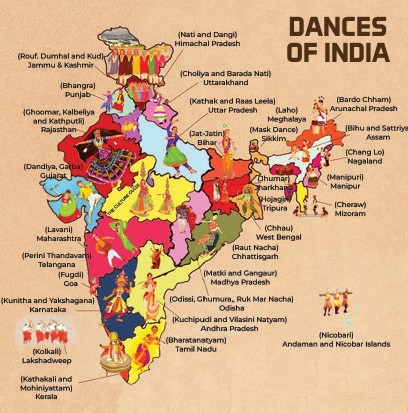
| FOLK DANCES/ THEIR STATES | DETAILS |
| Mathuri / Koppu (Andhra Pradesh) | This folk dance is generally performed by the backward classes of the Umji and Indravelli forest areas of Adilabad district of Andhra Pradesh. This dance is performed by both Males and Females both individually and together. The duration of the dance is approximately 12 minutes. The instruments which are used in this dance are called Sutta, Tasha or Nagara, Dappu etc. They dance for hours together on the occasion of Krishna Astami in Sravana Maasam. Because of their unique hair style, they are also called KOPPU LAMBADI. Women dance is very slow in tempo whereas male dance is fast and very vigorous. Male artists hold a handkerchief and a stick in their hands. |
| Kolattam (Andhra Pradesh) | It is also known as KolKollannalu and Kolannalu. It is a stick dance. This dance form originated in the Seventh century. Earlier only women performed this dance; however over time and the dance is now done by both males and females. |
| Butta Bommalu (Andhra Pradesh) | Butta Bommalu Dance literally translates as “basket toys made of wood husks, dry grass, and cow dung.” The dancers must wear masks that cover their heads and shoulders. The Butta Bommalu Dance is distinguished by constant rhythmic body motions and non- verbal music. |
| Veeranatyam (Andhra Pradesh) | Veeranatyam is a folk dance that is dedicated to Lord Shiva. This dance has a lot of fury and aggressive gestures. Veeranatyam means dance of the brave - Veera means brave and Natyam means dance. This dance is mostly performed by men. A plate called “Veerabhadra Pallem” carrying camphor fire is carried out on hands from elbow to palm. A priest holding chants in the background while the dance performance is going on. The dancers stay in colourful clothes that represent rage, anger, and passion. |
| Bihu (Assam) | The Bihu dance is a folk dance from the Assam region of India that celebrates the Bihu festival. In order to convey youthful love, this joyful dance is done by both young men and women and is distinguished by brisk dancing steps, rapid hand movements, and a rhythmic swaying of the hips. Dancers dress in traditional, vibrant Assamese attire. The Spring Festival, also known as “Bohag Bihu” or “Rangali Bihu,” which is held in the middle of April, is the most significant and flamboyant of the three Bihu festivals. The lyrics of Bihu songs frequently have sensual connotations and revolve around themes of love. Traditional clothing such as the dhoti, gamocha, and chadar, mekhala, is worn by people. The traditional mekhela chador is a cylindrically formed costume worn on the bottom half of the body, the chador is thrown over the top half like a shawl. The clothes are mainly made of Muga silk, which is only produced in Assam. Bihu dance has long been a part of the culture of Assamese ethnic groups such as the Deoris, Sonowal Kacharis, Moran, Borahis, and others. According to Assamese legend, the first Bihu dance performance occurred in 1694, when Ahom monarch Rudra Singha (1696-1714) summoned Bihu dancers to perform on the occasion of Rongali Bihu. |
| Bagurumba (Assam) | Bagurumba folk dance is a colourful folk dance from Assam. It is performed by the Bodo community of Assam. This folk dance is inspired by and dedicated to nature. Bagurumba folk dance is performed at the Bwishagu festival. Music Instruments Used In Bagurumba Serja – looks like a violin. Sifung – similar to flute. Kham – It’s a drum made of animal skin and wood. Jota – made of Iron. Gongwna – made of Bamboo. |
| Biraha (Bihar) | Biraha dance and its offshoot, Bidesia, are prominent forms of entertainment in rural Bihar. It illustrates the pain of women whose lovers have left them behind. This dance is solely performed by men who also portray female roles. |
| Jat-Jatin (Bihar) | It is a famous folk dance of Bihar. It is especially popular in North Bihar, notably in the Mithila and Koshi districts. During the monsoon season, the dance is performed in moonlight by women. From midnight to the early hours of the morning, grown-up girls and young housewives gather in the courtyard to dance to the rhythm of a drum. It is often performed by two people. The dance expresses the love and fights of a married couple. |
| Jhijhiya (Bihar) | The mythological town of Mithila is the site of the popular Bihar folk dance known as Jhijhiya. This dance is performed by women only. To honour the three manifestations of the Goddess Lakshmi, Parvati, and Saraswati, the whole Navaratri “nine nights” festival is observed. |
| Raut Nacha (Chattisgarh) | Raut Nacha is a ceremonial dance mostly performed by the Chhattisgarh tribal group. It is done after the Diwali celebration on “dev udhni ekadashi.” It is mostly performed by Yaduvanshis. The dancing form brings sacred mythical and religious traditions with it. |
| Kaksar (Chattisgarh) | The Kaksar dance is performed by the Abuj-Maria tribe in Chhattisgarh. In reality, Kaksar is a god who is adored in preparation for a bountiful harvest. In this custom, when the boys and girls dance, they select their lifelong mates. |
| Taranga Mel (Goa) | Taranga Mel is a Goan dance performed by young boys and girls on the festivals of Dushehra and Holi. It gets its name from the streamers, which are also called as “tarang” in the dance. The dancers create noises and wave multicoloured flags and streamers to the beat of instruments such as “Dhol” and “Romut.” |
| Veerbhadra (Goa and Karnataka) | Veerbhadra festival is a folk art which is usually celebrated in a few places in Ponda, Goa on the last day of the Dhalo festival. It is also celebrated during the Shigmo festival and also during Gudi Padwa. Devotees in Karnataka organise the Veerbhadra dance on the first full moon night of the Chaitra month in the Hindu calendar. Origin - Karnataka as there are many temples dedicated to Veerbhadra who is a form of lord Shiva. The dialogues stated by Veerbhadra, while in the performance, are in Kannada. This dance form symbolises the fight against injustice. |
| Samai (Goa) | This is also known as Lamp Dance of Goa. Samai means brass. Because both men and women dance while wearing brass lights or Deepak on their heads, it is known as the Samai dance. This dance is performed before Holi. For several days, the locals offer prayers in front of the Tusli. This continues till Holi. Although the goal of this dance is to have fun and relax, its roots are religious. |
| Rathwa ni Gher (Gujarat) | The Rathwas, who dwell in Rath-Vistar, the hilly area of the southeastern part of Gujarat state, perform the Rathwa ni Gher dance. It is performed on the occasion of Holi It is also known as Kavant festival. The exquisite make-up, synced footfall, forceful twirling of the dancers and hypnotic symphony made by indigenous musical instruments demonstrate how ancient and polished the dance style is. The Rathwas’ artistic expression of religion, cultural identity and awareness of nature is represented through the tradition. |
| Tippani (Gujarat) | Tippani is also known as the “manual laborer’s dance.” This is a mostly “women-oriented” dance genre evolved in the Chowrad district of Gujarat, India. Furthermore, this dance form, like the “Dandiya Raas,” features the usage of sticks. Dhol, manjira, Turi and Thali (brass plate), Zanz, Tabla and shenai are among the musical instruments used. |
| Daang (Gujarat) | This dance is performed by the Dangi tribe of Gujarat during festivals like Holi. The dance is fast-paced and rhythmic. It is performed by both males and females. |
| Garba (Gujarat) | It is a high-energy dancing style that is a fascinating fusion of customs and cultures. The Gujarati dancing style known as garba is derived from the Sanskrit word “garbha,” which means “womb.” With a lamp or statue of the goddess Shakti, also known as Amba, or a depiction of her in the centre, this dance is done in circular motions. The light represents life, particularly a foetus in the womb. Despite the variances in shape, the lamp or Goddess in the centre, which represents how the universe is always portrayed as a feminine deity, never changes. Hinduism believes in a cyclical rotation, namely about birth, life, death, and reincarnation. The circular dance moves are consistent with these beliefs. Although it is frequently performed at other social gatherings, the Garba dance is the major attraction during the nine-day Navratri festivities. Garba performances often include singing and a musical accompaniment traditionally provided by dhol (double-headed drum) and the similar but smaller dholak; hand clapping; and assorted metallic idiophones, such as cymbals. In addition, the majority of the songs are in Gujarati. Garba dances exalt women, celebrate fertility and pay homage to a variety of mother goddesses. A girl’s first menstrual cycle and, subsequently, her upcoming marriage are traditionally marked through dances in Gujarat. During the nine-day Navratri celebration, garba dance is also practised. |
| Dandiya Raas (Gujarat) | Dandiya Raas is an Indian traditional dance from the state of Gujarat. It is typically performed by both men and women in groups. It is most commonly seen during the Navratri celebration. It is a popular dance genre with variations like Gopgunthan Solanga Raas and Mer Dandiya Raas. Dandiya has several social and religious meanings. It is a visually appealing dance with a lot of hues. Beautifully adorned wooden sticks are utilised as props when performing the dance. The bamboo is used to make the wooden sticks. The dance involves circular movements along with a partner. Other states, such as Madhya Pradesh (Indore, Bhopal) and Rajasthan (Marwar area), in addition to Gujarat, also have Dandiya performances. Interestingly, the Mewar district of Rajasthan also has performances of the Dandiya Raas. Both men and women dress in particular for the Dandiya Raas dance. In contrast to how women dress, males wear Kurta-Pyjama sets. Additionally, these are the Gujarati traditional garments. |
| Charba (Himachal Pradesh) | It is performed during the Dussehra festival. |
| Kinnauri Nati (Himachal Pradesh) | Kinnauri Nati is a popular Himachal Pradesh folk dance. This dance has a strong connection to nature. Along with this dance, reaping and harvesting are honoured. This dance has two purposes: it welcomes the New Year and it also indicates a bountiful crop. |
| Alkap (Jharkhand and West Bengal) | Alkap is a traditional village dance-drama that is performed in the Rajmahal Hills of Jharkhand and the Rajshahi, Murshidabad, and Malda regions of West Bengal. Ten to twelve dancers in each group perform it, together with one or two gayens (lead vocalists). The troops perform comic skits known as kap interspersed with well-known folktales and myths. The dance is frequently associated with the Gajan festival of Shiva. |
| Jhumair (Jharkhand, West Bengal, Odisha and in Assam tea gardens) | Jhumair is important because of its connection to the harvest season. Tribal people from Odisha, Jharkhand and West Bengal perform it. In the shape of a human chain, the dance is performed. Most of the dancing is done by men, who also sing the uplifting song that goes along with the dance. The dancers constantly circle around each other while holding hands. The dance also requires the use of musical instruments. The music for this traditional dance is provided by the bansuri, sangi, dhol and kartal. Women can also do jhumair on occasion. The Jhumair becomes Janani Jhumair when performed by women, and Mardana Jhumair is another variation of the Jhumair. |
| Dumhal (Jammu and Kashmir) | The most famous dance form in Kashmir is “Dumhal.” The dancers that execute this dance are beautifully attired in conical hats that are typically beaded and come in a variety of brilliant colours. This dance can only be performed by men of Wattal tribe, and only on rare occasions. Not all men can execute this dance. |
| Hulivesha (Karnataka) | Karnataka’s coastline region is home to a dance form known as Huli Vesha, or Tiger Faced Dance. During the Navratri Festival, local youngsters perform Huli Vesha as a devotion to Goddess Durga, whose official animal is a tiger. During the Goddess Huli Vesha performance, a group of individuals dress like tigers, with tiger face masks or paints, tiger stripes on the body, and yellow or orange shorts. |
| Pata Kunitha (Karnataka) | Pata Kunitha in Karnataka is a popular folk-dance form extremely popular among the inhabitants of Mysore region. Its original significance is primarily religious. It employs the use of the pata, which are primarily long bamboo poles decorated with colourful ribbons. The dancers are extremely skilled in manoeuvring the long bamboo poles. The dancers manipulate the poles with great dexterity and to the accompaniment of a largely rhythmic music. |
| Dollu Kunitha (Karnataka) | Dollu Kunitha is a traditional folk dance of Karnataka that incorporates the use of drums. The dance incorporates the use of drums called Dollu, which are made of hollowed-out tree trunks and covered with animal hide. The performers play the drums in unison while dancing. It is performed by men of the Kuruba tribe. In 2011, the Ministry of Culture, Government of India, included Dollu Kunitha in its list of intangible cultural heritage. |
| Rouf (Kashmir) | Rouf dance is a rhythmic and traditional folk dance from Jammu and Kashmir. Rouf dance developed in Kashmir’s Muslim community. It was gradually accepted by everyone in the valley. Rouf is usually conducted to commemorate the spring harvesting season. Rouf is distinguished by beautiful movements and deft feet, which are complemented by heartfelt music and singing. The dance is performed by women dancers by creating a circle in vivid traditional clothing, expressing the peaceful beauty and cultural legacy of the region. |
| Jabro (Ladakh) | Jabro is a traditional dance genre found in the Ladakh regions of Chang Thang and Rong. This dance is practised by nomadic Tibetan people who live in the high highlands of this region. Melodious songs are characteristic of Jabro, in which both males and females participate to commemorate Losar, or the Tibetan New Year. Dancers create rings or rows facing one another. They go forth and backwards together, singing wonderful tunes. Flute and Damien (a string guitar like instrument) are the musical instruments used in this dance form. |
| Chavittukali (Kerala) | Chavittukali is a folk dance of Kerala that is staged during festivals like Onam, Vishu and in certain temple fairs. Popular in central Kerala and Malappuram, the art form is performed by Ullada, Oorali, Cherumar and Kanakkaar communities. Both men and women participate in this art form which is rich in enthusiasm and festive spirit. Chavittukali doesn’t demand any special attire, and dancers wear their everyday dress. |
| Rai Nritya (Madhya Pradhesh) | It is a folk dance of the Bundelkhand region. This folk dance is an intrinsic part of the Bediya tribe’s cultural heritage. It is a women’s peacock dance. |
| Jawara (Madhya Pradhesh) | The Jawara dance is a well-known traditional dance from Madhya Pradesh. This art style is particularly popular among the inhabitants of the Bundelkhand region. It is often referred to as the Harvest Dance. This dance is performed by the local peasant population to commemorate their delight and ecstasy after a successful harvest. Men and women from the region do this dance together. While performing the dance, the women hoist a basket filled with Jawara crop on their heads. |
| Matki (Madhya Pradhesh) | Matki is a traditional Malwa dance performed by ladies on important occasions such as weddings and other festivals. It is usually performed alone, with a number of earthen pots balanced on the head. The Matki Dance is also referred to as “Aada” and “Khada Nach.” |
| Badhai (Madhya Pradhesh) | This traditional dance is performed in the Bundelkhand region to celebrate the various occasions of human life. A group of dancers gathers to show matchless facial expressions with cheerful rhythm and movements. It is a ceremonial dance that is performed during childbirth, weddings or any other gathering to commemorate pleasure and joy. |
| Baredi (Madhya Pradhesh) | Dancers from Madhya Pradesh’s Aheer community (Yadavas) perform the Baredi dance. Lord Krishna, who belonged to this clan of cowherds, is thought to have invented the dance. Every year, it is done the day after the Diwali festival and is danced every day for a fortnight, till the night of Kartik Poornima. The god Dulhadev is worshipped on the first day. |
| Dindi (Maharashtra) | Dindi is a Maharashtrian folk dance that is often performed on Ekadashi day in the month of Kartik. This religious devotional dance depicts Lord Krishna’s lighthearted demeanour. Dindi is a tiny drum, similar to a ‘Tamate’. The musicians, who include a ‘Mridangam’ player and a vocalist, stand in the centre and provide the appropriate musical background for the dancers. The dance is performed by men and women to rhythmic music. |
| Lavani (Maharashtra) | Lavani is a musical debate. It is a blend of traditional singing and dance that is especially performed to the captivating sounds of ‘Dholak’. Dance performed by women wearing nine-yard saree. They are sung at a fast speed. The word Lavani is derived from the word “Lavanya,” which means “beauty.” |
| Lezim (Maharashtra) | The ‘Lezim’ is a Maharashtrian folk dance in which the performers hold a miniature musical instrument with jingling cymbals called Lezim. It is performed during Gudi Padwa. The dancing is accompanied by the Dholki, a percussion instrument. Halagi and Cymbals are also used as musical instruments throughout the dance performance. |
| Cheraw (Mizoram) | The Cheraw or bamboo dance is considered to be one of the oldest dances of Mizoram. In this dance form, bamboos are kept in horizontal or cross formation on the ground. Pairs of these bamboo staffs are held by six to eight people. The male dancers move these bamboos to a rhythmic beat while the female dancers move gracefully while stepping in and out of the bamboo formations. The bamboos are clapped together by the male dancers to a specific beat. The dancers are attired in colourful traditional costumes like the thihna, vakiria, kawrchei and puanchei. |
| Lewatana (Meghalaya) | It is a Meghalayan folk dance which is performed by the Hajong tribe usually during Diwali. |
| Dhol cholom (Manipur) | It is also known as the Drum Dance or Dholak Cholom. This is conducted during the ‘Yaosang’ or Holi Spring Festival season in the spring. Male members of the group participate in the dance the most. The Meities of the Manipur valley are credited with creating this dance. The Dhol Cholom is an integral part of the Sankirtana tradition of Manipur. |
| Thang-Ta (Manipur) | Thang Ta is an ancient Manipuri Martial Art developed by the Meitei community from the military context of Manipur. Thang Ta was also known as Huyen Lallong, which translates as “Sword and Spear Art.” Thang emphasises Phidup (coil), or lowering one’s body close to the ground to allow for a spring movement for expansion and attack. |
| Rangma (Nagaland) | This dance is typically done during religious and joyful events. The Naga males, in particular, execute war dances. This is a martial arts dancing style. The dance is usually performed to the beat of the drums and features precise footwork and movement. The dancers dress up in colourful apparel and use extravagant headdresses and cosmetics. |
| Paika (Odisha and Jharkhand) | The Paika Naach or Paika Nritya is a well-known dance type of Orissa’s Khurda area. It has been practised in Orissa since ancient times and is now an integral feature of the state’s famous festivities. The Munda tribe of Mayurbhanj, Jharkhand, is well-known for its Paika dance. It is a distinct folk-dance genre that represents the martial arts. The dancers recreate the epic fighting scenes of the Paika insurrection against the British. The musical instruments used are dhol, nagara, shehnai, and ranbheri. The dance is mostly linked with Dussehra festivities. Dancers use spears, shields, swords, and headgear to perform. |
| Gotipua (Odisha) | “Goti” means “single” and “Pua” means “boy” in Oriya, the state language from Odisha in eastern India. ‘Gotipua’ is a dance form where young boys dress up as girls in honour of Lord Jagannatha and Lord Krishna. |
| Ghanta Mrudangam (Odisha) | The Ghanta Mrudangam is a Tribal Folk Dance of Odisha’s Vaishnava portion, performed in honour of Radha, Krishna, and Lord Jagannath. |
| Changu (Odisha) | The Changu is a popular folk dance from Odisha which is performed by nearly all of Odisha’s regional tribal populations. Even though the Changu dance is practised by various tribes, it is associated with the Bhuyan tribe of Odisha. The Changu dance is named after the Changu drum, which serves as the primary and required musical accompaniment for the dances. The dance is only done by unmarried men and women from the village in groups with different roles in Changu performances. |
| Danda Jatra (Odisha) | The Danda Nata, also known as the Danda Jatra, is a religious practice of Ganjam region in Odisha and one of India’s oldest folk arts. While the majority of the story is on Shiva myths and tales, the underlying theme is one of societal peace and togetherness. Danda Nacha is a strange rite done by believers in Odisha’s Ganjam District to satisfy Goddess Kali. Danda Nacha means “Punishment Dance,” and followers inflict harm on themselves throughout the ceremony. |
| Dalkhai (Odisha) | Dalkhai dance is a well-known Orissa traditional dance that is accompanied by a magnificent orchestra of folk music played on various instruments. It is the most well-known traditional Sambalpur tribal dancing form in western Odisha. Dalkhai dance is typically done by unmarried young ladies. It depicts the legendary love narrative of Radha-Krishna, as well as incidents from the Ramayana and Mahabharata. The Dalkhai dance form is performed at important Odisha festivals such as Dussehra, Phagun Puni, Bhaijiuntia, Nuakhai, and others. |
| Bhangra/Gidda (Punjab) | Bhangra/Gidda is a vibrant genre of folk music and dance from Punjab. Bhangra is performed to celebrate the harvest’s success. People sing Punjabi Boliyaan lyrics and at least one person plays the dhol drum during Bhangra. While male members perform Bhangra, female members perform Giddha. The dancers form a circle around the drummer, who occasionally elevates the two sticks with which he strikes the drum to encourage the dancers to move at a faster pace. The drummer determines the tempo and movement of the dancers. When the dancers attain the spirit of the dance, they shape a rhythmic shout or delight. |
| Garadi (Puducherry) | Garadi is a famous folk dance of Puducherry. This dance has mythological origin and it is performed to celebrate the victory of Lord Rama over Ravana. The performers disguise themselves as the vanars or monkeys from the legendary Ramayana. The dancers wear unique iron rings, ten on each leg, known as ‘Anjali’ that add to the music played on the drums. |
| Tera Tali (Rajasthan) | Tera Tali is another well-known Rajasthan traditional dance performed by the ‘Kamar’ tribe. The ladies sit on the ground with ‘manjeeras’ (little brass discs) connected with long strings to their wrists, elbows, waists, arms, and a pair in their hands. Their male accompanists sing and play the ‘tandoora,’ while the ladies generate a powerful rhythm with the ‘manjeeras,’ using deft and delicate gestures. |
| Chakri (Rajasthan) | Chakri, means ‘Chakkar’ (Circle) rotation. Chakri is one of the most popular folk dances of the Kanjar tribe of Rajasthan. Chakri Dance is performed in almost all the marriages and festivals exclusively by the womenfolk of Kanjar tribe and it is also their main source of livelihood. |
| Ghoomar/Gangore (Rajasthan) | Ghoomar dance is a traditional folk dance of Rajasthan and Haryana. It was inherited by Rajasthani communities from the Bhil tribe. The Ghoomar dance is a women’s dance that is performed exclusively by women at ladies’ gatherings wearing colourful Ghagras (long skirts) on songs of love, glory or defeat. Ghoomar dance is done by groups of ladies moving in a circular pattern and wearing swirling robes as men and women sing together. Ghoomar is also presented by men. Men and women dance in a circle, with one half made up of males and the other half made up of women. Instrumental and vocal music are accompanied by dance. This dancing form is distinguished by its accelerated beat pace and hand clapping. |
| Kalbelia (Rajasthan) | Rajasthan is home to the folk dance known as Kalbelia. It is also well-known as the “Sapera Dance” or the “Snake Charmer Dance” performed by the “Kalbelia” tribe of Rajasthan. The Kalbelia dance and songs from Rajasthan have been included since 2010 on UNESCO’s representative list of the Intangible Cultural Heritage of Humanity due to the dance’s immense popularity across the world. On festive occasions, dancers wearing black skirts perform this dance, which has a snake- like movement. In the Kalbelia dance, men play a variety of traditional instruments e.g. Been as women dance. |
| Singhi Chham (Sikkim) | It is a religious folk dance of sikkim by which the people of Sikkim pay tribute to Mount Khang-chen-Dzong-pa (Kanchenjungha), their guardian deity. The word ‘Singhi Chham’ means the ‘Lion Dance’. The dancers are dressed in furry lion costumes and wear lion masks to represent the snow lion. |
| Lama Music and Dances (Sikkim) | Lama dances are masked dances performed with beats of Buddhist monks of Sikkim as a part of their religious practice. They are codified in the religious texts of Sikkim in accordance with the teachings of Guru Padmashambhava. Gorgeous attire and colourful masks made according to the scriptures are used with traditional musical instruments like cymbals and big horns rendering codified religious music and chanting. |
| Tamang Selo (Sikkim) | “Tamang Selo” is performed by the Tamang tribe of Sikkim to the rhythmic sound of the “Damphoo” musical instrument which the dancers carry in their hands. This dance is therefore also called the “Damphoo Dance”. |
| Koothu or Therukoothu (Tamil Nadu) | It is an ancient form of storytelling performed for many generations in Tamil Nadu. The performers are dressed in elaborate costumes and make-up and perform dialogues, songs and dances. The word therukoothu consists of two words – theru meaning ‘street’ and koothu meaning ‘theatre/performance’. The Tamil epic Silappadikaram mentions 11 types of koothu. Generally held in the months of Panguni (March-April) and Aadi (July-August), it is held as a prayer for a good harvest, rain, or as a part of temple rituals. The major themes on which therukoothu is performed are the Mahabharata, Ramayana, Periya Puranam, and other Tamil literary works from the Sangam period. Performance takes place in an open area. Traditionally, only male artists performed and hence, they also enacted the role of female characters. However, recent performances also have female participation. The costume for a therukoothu performance includes a high towering dress, sparkling shoulder plates, wide colourful skirts, and heavy make-up. The orchestra, seated on a bench on the side, consists of a lead singer and other artists with instruments such as mukhaveena, harmonium, mirudhangam, and kanjira. |
| Hojagiri (Tripura) | The Hojagiri celebration, also known as Laxmi Puja, takes place on the full moon night after Durga Puja. Hojagiri is a Reang tribal folk dance performed during this occasion. Most frequently, it occurs following the third day of Dussehra. The Goddess Mailuma (Laxmi) is celebrated on this day. The Kham and Sumui (Kshumu) is a musical instrument played and sung by its male members. |
| Garia (Tripura) | The Tripuri Tribal Community primarily performs this dance at Garia puja held in April. People mostly worship Lord Shiva or the Garia God through this dance. It signals the start of the sowing season and people pray for a bountiful harvest. Young boys and girls from the group walk door to house in the village holding the Lord Shiva idol during the puja. |
| Lebang Boomani (Tripura) | Tripura’s Lebang Boomani Dance is a type of regional dance distinguished by delicate motions that show the women of the area collecting Lebang insects as musical instruments are played in the background. The Kolai community of Tripura primarily performs this dance after the Garia Puja awaiting the monsoon. |
| Meladom (Tripura) | In the month of Karthik after harvesting, men and women of the Kaipeng community participate in the Meladan/Meladom dance. At this time cottons are collected and they start weaving. It is believed that the dance originated from the process of weaving. |
| Mosak Sumani (Tripura) | This is a well-known and beautiful Tripura dancing style that is connected to wild animal hunting. With the help of rhythmic steps and gestures and postures, the hunting sequences are displayed in excellent manner. The Tripuri, Noatia, and Murasing communities perform this dance. |
| Raslila (Uttar Pradesh) | Raslila is a famous art form of the Braj region of Uttar Pradesh. The territories in and surrounding Mathura are included in the Braj region. This traditional Indian dance performance celebrates the everlasting union of Lord Krishna and Radha. Raslila is specifically defined as the Lord dancing in a circle with the gopis (maidens). It also shows the many different colourful feelings that make up love, like romance, arguments, carelessness and anxiety, jealousy, complaints, and finally the ultimate reconciliation. |
| Dhobiya (Uttar Pradesh) | Only male dancers take part in this dance, which is popular among the Dhobi (Washermen) community in eastern Uttar Pradesh. In this dance from the Dhobi caste, one dancer assumes the role of the washerman while the other dances as his donkey. The musical instruments used are drums, cymbals and ghungroos. |
| Dadra (Uttar Pradesh) | Dadra is a semi-classical dance performed by courtesans in the Lucknow district of Uttar Pradesh. This dance genre is mostly concerned with marriages and sexual satisfaction. Dance has a distinct style. The vocalists in this dance provide playback to the performers performing on stage; they lip-sync with the singers. |
| Raee (Uttar Pradesh) | Raee folk dance is popular in Madhya Pradesh and Uttar Pradesh’s Bundelkhand area. Originated in ancient times to celebrate the successful homecoming of the military troops after a war, it is largely a female dance in which dancers with veils over their faces move their feet and spin their bodies in sync to the accompanying music. The major musical instruments utilised in this dance are algoza, mridanga, and dhapali. |
| Choliya (Uttarakhand) | Choliya dance is a sword dance that depicts the Kumaoni tribe’s martial arts heritage. The Choliya dancers are armed with swords and shields, regional brass instruments such as Turi and Ransing, and percussion instruments such as dhol and damaru, among other things. The dancers dress up like Kumaon warriors and perform simulated sword combat with perfectly timed twists and spins of the body. |
| Oppana (Kerala and Lakshadweep) | In the Malabar area of Kerala, ladies perform the traditional and entertainment dance known as oppana. It is a kind of dance that is usually performed by women and is associated with wedding ceremonies. It is known for its vibrant costumes and rhythmic moves. |
| Fugdi (Konkan region) | Fugdi folk dance is mostly performed by Konkan women in Goa. This dance is only performed by females. It is also conducted during the harvest season, when women have more time on their hands. This dance also indicates a break for ladies from their everyday duties. |
| Chakyar Koothu (Kerala) | Chakyar Koothu is a performance art which is similar to a comic art or a mono act. This dance is performed by the people of Chakyar caste and is performed from the Koothambalam in temples. It is an ancient theatrical art and the expressions and gestures performed in Koothu are related to the principles mentioned in the treatise Bharata’s Natya Shastra. The dancer is dressed as a snake with a large moustache, headgear and red spots all over the body. |
| Kolkali Parichakali (Kerala and Lakshadweep) | In the southern Kerala and Lakshadweep regions, it is a popular martial dance. Kol and Paricha both refer to a stick or a shield. The dancers act out fight scenes while holding wooden prop weapons. The performance moves gently at first before picking up speed and reaching a frenzy- inducing conclusion. |
| Ottan thullal (Kerala) | This dancing style was developed in the 18th century by the renowned Malayalam poet Kalakkaththu Kunchan Nambiar. In thullal, the performer sings and narrates the tale themselves. It features a (mainly) single actor who does all the acting and dancing while sporting green makeup, wearing bright clothes, and speaking the thullal lyrics (dance tunes). |
| Padayani (Kerala) | Padayani is a type of ritual theatre that is connected to the Goddess temples in Kerala’s Central Travancore area. The Padayani ceremonies, which are carried out at night inside the temple, are a symbolic gesture for appeasing the Goddess Bhadrakali. Padayani, which translates to “row of warriors,” is believed to have been done by Kalaripayattu-trained warriors to demonstrate their bravery and power. The dancers interpret sacred and semi-divine narratives while donning enormous masks called Kolams. Popular figures include Bhairavi, Kalan (the God of Death), Yakshi and Pakshi. Additionally, it is a time of thankfulness for a successful harvest, which the people felt would not have been possible without the help of the Gods and Goddesses. |
| Ottan Thullal (Kerala) | Ottanthullal is a Kerala recite-and-dance art form. Kunchan Nambiar (1705-1770), a great Malayalam poet, popularised it in the 18th century. It is known for its comedy and social satire, and it is distinguished by its simplicity in comparison to more complicated dance traditions such as Kathakali and Koodiyattam. Ottanthullal adheres to the traditional ideas of Natyasasthra (an art treatise written in the second century BCE). It is implemented in three distinct versions - Ottanthullal Seethankan thullal Parayan thullal |
| Kaikottikali (Kerala) | In Kerala, a common dancing style is called Kaikottikali. Although it is performed by both men and women, during the celebration of Onam women predominantly perform the Kaikottikali dance to celebrate the rich harvest. On the day of Thiruvathira, which is part of the Onam celebration, Kaikottikali is performed. Due to the fact that it is carried out on the day of Thiruvathira, Kaikottikali is also commonly known as Thiruvadirakali. |
| Nagaradhane (Tamil Nadu) | Nagaradhane is a type of snake worship that is practised by members of the Tuluva community. For several social, religious, and ecological reasons, cobras are revered as deities. The two different ceremonies known as Aashleshabali and Nagamandala are conducted in homage to snakes. The longest and most vivid of the two is Nagamandala. The divine union of male and female snakes is shown in the Nagamandala. |
| Buta Kola (Tamil Nadu) | Buta Kola a.k.a Bhuta Kola or Daiva Kola is a captivating ritual dance, performed in honour of the local deities. It is a non-Vedic ritual and an integral part of Tulu adivasi traditions. The deities are prayed to seek protection for the villages; usually, a person who is believed to become a god himself during the ritual performs the dance. Captivating music accompanies the dance procession. The entirety of the preparation is supported by continuous chanting and drums. Next come elaborate headgear, ornaments and masks. After dance performances, the oracle hears grievances about land, debt, robbery and other issues before providing a resolution. |
| Aati Kalenja (Tamil Nadu) | It is a traditional folk art form that the Tulu people, mostly those in the Nalike community, practice because it is said to bring wealth to the community during the month of Aati. It is mostly practised from July through August (Aati), which is the wet season. In the dance, a man assumes the role of Bhuta, the spirit that Kalenja symbolises. People firmly believe that all evil spirits will go from society as a result, to their benefit. |
| Mayilattam (Tamil Nadu & Kerala) | The peacock dance, or Mayilattam, is traditionally performed in Hindu temples to honour Lord Murugan and Lord Subrahmanya. Like any other classical dance, its moves are elegant and graceful, complete with colourful attire, strong facial expressions, and symbolic hand gestures known as mudra. Mayilattam performers dress from head to toe in costumes like a peacock with a beak that can be opened and closed with a thread and execute special dances. The performer dances on a tall piece of wood connected to the end of his feet rather than his bare feet. The peacock dance differs from other styles as it requires the performer to know the different beats of the music, while making performative gestures in the form of mudras such as anjali and tripataka. |
| Kavadiyattam (Tamil Nadu) | The Kavadi Attam festival is a religious folk dance of Tamil Nadu. The word Kavadi Attam means ‘burden dance’. Lord Murugan, the God of War, is honoured during this festival. The term ‘Kavadi’ signifies ‘burden’. Lord Murugan is worshipped by making ritual sacrifices and offerings to him in order to ask him to assist people pay off their debts and avoid tragedy. The Kavadi can be any form or size, and it contains rice, milk or anything else that the devotee wishes to gift to Lord Murugan. |
| Kummi (Tamil Nadu & Kerala) | Kummi is an Indian traditional dance prevalent in Tamil Nadu and Kerala. This is done by women. The women form a circle and clap their hands rhythmically as they dance. One of the ladies leads the singing with a positive song, while the others chant the refrain. This dance is typically done at temple festivals, Pongal and family gatherings. Dancers in different locations simulate other agricultural operations. Kummi is frequently accompanied with songs known as “Kummi songs”. Tamils of Sri Lanka also perform it. |
| Karagam (Tamil Nadu) | It is a traditional dance that is performed while holding a pot perched atop your head. This dance was traditionally done by the locals in honour of the river deity Gangai Amman and the rain goddess Mari Amman. |