Whatsapp 88106-52225 For Details
Get Free IAS Booklet
Get Free IAS Booklet
INTRODUCTION
Performing art traditions have been a big part of human lives. From prehistoric ages, man has always had a keen sense for art and culture and has displayed the same through the innovative use of technology available to him at the time. Art is a diverse range of human activities resulting out of creative skills and imagination. Vātsyāyana has described sixty-four arts. Interestingly, in that list, the first four are performing arts:
1. Vocal music2. Inst rumental music
3. Dance4. Theat re
This also indicates that a strong tradition of Performing Arts can be traced back to the old civilisation of India. These performing arts have had a significant place in the Indian history and society. Classical forms of performing arts are often derived from folk and local forms. They are just more specialised in nature and have more stringent rules that have to be followed.
MUSIC IN INDIA (BHARTIYA SANGEET)
The background of Indian music has been built over the course of various occasions and simultaneously enriched Indian culture. It has a rich treasure of classical, regional and folk forms expressed through vocal music and instrumental music. According to Sangeeta Ratnakar, Indian Music has three art forms Gita, Vadya and Nritya. The development of
Indian Music can be traced through three periods:
Ancient Period (2500 BCE – 1200 CE)
While the origin of Indian music can be traced to the Indus Valley Civilisation, it was during the Vedic Period that the rules and traditions of music were codified and
written down.
The rhythmic chanting of Vedic hymns is known as trichayein.
• Samaveda has a collection of selected trichayein set to definite Svaras keeping their chandas (rhythmic meters) intact.
• Three Svaras were used in the Samaveda:
• Udaatta – sharp pitch
• Anudaatta – grave pitch
• Svarita – combined the characteristics of both pitches
• Panini further outlined two additional svaras:
• Uccaistara- higher than Udatta
• Sannatara- lower than Anudatta
Musical Practices and Instruments in the Vedic Age
As can be seen from above discussion the seven notes of music- Sa, Re, Ga, Ma, Pa, Dha and Ni originated from the three Svaras of ‘Samagaan’. Samagaan is the practice of singing mantras with Svaras during religious activities. The specialised group of people who sing Samagaan are known as Saam Gaayaks.
Musical instruments such as the Ghosha, Veena, Kashyapi, Audumbarie, Venu, Dundhubi, Pushkara, Tunava and Aadambara were in prevalence.
• Further seven notes emerged from the three Vedic Svaras mentioned above:
• Nishaad (Ni, the seventh svara) and Gaandhaar (ga, the third svara) arise from Udaatta
• Rishabha (Re, the second svara) and Dhaivata (Dha, the sixth svara) arise from Anudaatta
• Shadaja (Sa, the first svara), Madhyama (Ma, the fourth svara) and Panchama (Pa, the fifth svara) originate from Svarita
In the Ancient period, two streams of music were practised:
• Maargi or Gaandharva Sangeeta which was practised for salvation
• Deshi Sangeeta which had Classical, Semi-Classical, Folk Music, etc. in its ambit.
| MENTIONED BY | Ramayana | Mahabharata |
| MUSICAL TERMS | Sangeeta, Svara, Laya, Taala, Maatraa, Moorchanaa, Jaati, Maarg Sangeeta and Gaandharva | Graama, Moorchanaa and the names of seven basic Svaras such as Shadaja(Sa), Rishabha(Re), etc. |
| MUSICAL INSTRUMENTS | Vipanchi, Vallakee, etc. | Bheree, Jharjharee, Toorya, Veena, etc |
Bharat’s Naatyashastra covers music, dance, and drama. It has 36 chapters; 6 focus on music. Topics like Shruti, Graama, Jaati, Moorchanaa, Geeti, Alankaara, etc. are explained deeply. Dhruva Geeta is special, used between scenes (this is called as Naatya Sandhis). Rasa has been detailed for aesthetic experience. The Naatyashastra is also the first text on Indian Instruments’ classification:
• Tat (string instruments)
• Susheeraa (wind instruments)
• Avanaadha (percussion instruments)
• Ghana (brass or wood instruments)
• We get the glimpse of Deshi Raaga for the first time in Matanga Muni’s Brihaddeshi. He was also the first to place frets (parde) on the Kinnaree Veena.
• We are also introduced to the concept of ‘Time Theory of Raagas’ in Sangeeta Makaranda written by Naarada Muni.
• Other important works in the ancient period include- Naaradi Shiksha, Sangeeta Samayasaara, Dattilam, Geeta Govinda and Sangeeta Paarijaata.
Method of Teaching:
• The Guru Shishya Parampara In the absence of a written tradition and lack of writing technology, knowledge was passed down to the newer generations through oral traditions. In India, these Oral traditions were particularly well developed, taking the form of Shrutis and Guru-Shishya Parampara system. In the Guru-Shishya Parampara system, the pupil (shishya) resided at the place of his Guru after his sacred thread ceremony. He studies the Vedas and other subjects under the guidance of the Guru for a period of twelve years. The Gurus were expected to teach everything they knew to the shishya. This system was the precursor to the Gharana system of Indian music and dance where the only difference was that learning exclusively happened in music, dance and that too in a particular style or shaili.
Medieval Period (1201 CE – 1800 CE)
• In the Medieval Period, development of musical forms, instruments and documentation of music in various granths exponentially multiplied. Sangeeta in the Medieval Period is classified as Maarga Sangeeta and Deshi Sangeeta.
• Classical Music in India evolved into distinct traditions of Hindustani Music and Carnatic Music. The advent of Islam at the end of the Twelfth Century brought Persian culture and its own style of music.
• Further, during the Bhakti and the Sufi Movements, a fresh impetus was imparted to the development of musical traditions of India. New musical forms and instruments developed and the Gharana system of musical education was firmly established during this time
• Sharangadeva (1210-1247) authored Sangeeta Ratnakara in which he described Sangeeta as a composite art having Geeta (melody), Vadya (drumming) and Nritya (movements of the body) in harmony.
• Construction and techniques of playing various instruments have also been mentioned
• Music for the masses was designated as Deshi Sangeeta.
• Hindustani Music spread to the Northern, Eastern and Western Parts of India and Carnatic Music to the Deccan Plateau region.
• Differences in language, singing styles, svarsthaanas, rhythmic patters (taals) and melodic structures were wide due to regional and political changes.
• While in the north, both the temple and Darbaari Sangeeta were prevalent, the southern classical tradition maintained its purity and restored it within the sanctity of its temples.
In the Ancient Period, Jaati Gaayana transformed into Prabandha Gaayana. Later, in the Medieval period, Prabandha Gaayana evolved to Dhrupada, Dhamara, Khayaal, Taraanaa, etc.
• Music accompanying drama evolved into its own style.
• New instruments like the Sitaar and Tabla were developed. Amir Khusro contributed to the development of many new musical forms such as quawwali, qual, kalbana, etc. Ragas such as Yaman, Saazgiri; Taals Chapaka, Fartost, etc. were also developed by him.
The concept of Ragas
Every raga has a set number and sequence of svaras. Ragas also have to be performed within the time allotted to them.
Pandit Somnath in his text Raga Vivodha, has described:
Devamaaya Svaroopa- ethos of Raga
Naadamaaya Svaroopa- tonal structure of Raga
For better understanding of the ethos of the Raga, poetic description of Ragas was created. This was known as Dhyaan Mantras. These dhyaans were later also depicted through the Raga Mala paintings.
• As music got the patronage of rulers, it got even more refined and into different and subtle variations of styles. This resulted into the ‘Gharana System of Music’ which was derived from the Guru-Shishya traditions of the ancient times. In fact, the concept of Guru-Shishya maintains the sustainability of a Gharana. Gharanas must have at least three generations to attain recognition.
Modern Period
During the Modern Period (from 1800 till now), Indian music thrived in royal courts. Foreign scholars like Sir William Jones, Sir W. Ouseley, Captain C.R. Day, and Captain N.A. Willard showed keen interest in Hindustani Music, contributing valuable books on the subject.
Muhammad Raza penned an important treatise called Naghmat-e-Asafi in 1813, being among the first to adopt the Bilawal Scale, similar to the Shuddha Scale. Pt. V.N. Bhatkhande and Pt. V.D. Paluskar dedicated themselves to uplifting music and musicians. They organized music conferences, established institutions, and authored books. They pioneered the documentation of music by developing a systematic Notation System. This period marked a significant shift by formalizing music education. Scholars worked hard to gain recognition for music as a discipline equivalent to other academic fields.
Major Contributions in the Modern Period
• Pt. V.D. Paluskar started Gandharva Mahavidyalaya in Lahore (at present Pakistan).
• Pt. V.N. Bhatkhande started Marris Music College in Lucknow, Uttar Pradesh, India
CLASSIFICATION OF INDIAN MUSIC
India is one of the world’s most diversified countries, with several regions and cultures. Indian music is classified based on its traditions, socio-economic practices, and place of origin. There are various popular forms of Indian music that have gained popularity around the world. Many new styles have emerged from the great range of musical forms and practices, while ancient styles continue to inspire. Some genres lean toward classical music and gharanas, whereas contemporary styles emerge with fusion and capture the interest of the western world. As a result, pop, hip-hop, jazz, and independent experiments are taking place in Indian music. To get a better picture, let’s take a closer look at the classification.
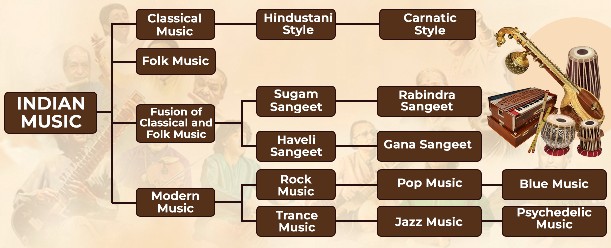
Classification o f Music
By the 12th-13th centuries the music of the North of India came into contact with Persian and Arabic music due to the repeated invasions that took place in the North. This resulted in a bifurcation of Indian music into two distinct branches-
• North Indian or the Hindustani System
• Carnatic or South Indian form (The South of India was largely insulated from invasions, retained its original character)
Both styles are however based on the common bed-rock of the Raga or Melodic scale set to specific rhythmic cycles or Talas. The distinguishing feature of Indian classical music is its concept of improvisation where artists develop a raga in several ways (alap/alapana, sargams/kalpana swarams, taans etc.) extemporaneously in a performance.
Hindustani Music
The Hindustani Branch embraced the ‘Shudha Swara Saptaka’ or Octave of Natural Notes scale. It was passed down from generation to generation through the Guru- Shishya Parampara in ancient times. Hindustani music is primarily vocal in nature.
Khayal, Ghazal, Dhrupad, Dhammar, Tarana, and Thumri are the principal vocal forms connected with Hindustani classical music. Tansen is the ancestor of the majority of Hindustani artists.
In Hindustani music, there are ten main forms of singing: ‘Dhrupad’, ‘Khayal’, ‘Tappa’, ‘Chaturanga’, ‘Tarana’, ‘Sargam’, ‘Thumri’, ‘Ragasagar’, ‘Hor’i and ‘Dhamar’.
| HINDUSTANI MUSIC | FEATURES |
| Classical Hindustani Music | |
| Dhrupad | Its roots can be traced back to Prabhanda and Druvpada. It finds mention in the Natyashastra and is the oldest and grandest form of Hindustani Classical Music It reached its zenith during the times of Mughal Emperor Akbar with Swami Haridas, ‘Mian’ Tansen and Baiju Bawra being its top proponents. It is essentially a poetic form of music with extended style marked with precise elaboration of Raga. It starts with ‘Aalaap’- sung without any words just to evoke the mood of the audience which coincides with the mood of the Raga being performed. Dhrupad is of temple origin and as a result has Sanskrit terms in it. Based on the different styles of singing, Dhrupad has four gharanas attached to it: Dagari Gharana Darbhanga Gharana Bettiah Gharana Taalwandi Gharana |
| Khayal | It is also called as ‘Bandish’. It is derived from Persian and it means ‘idea or imagination’. Amir Khusrau was the originator of this form of music. It is based on short songs ranging from two to eight lines and hence provides a greater scope for improvisation. Hussain Shah of the Jaunpur Sultanate gave patronage to it in the 15th Century. Unique features of Khayal music is the frequent use of taans in the composition. A Khayal performance uses two songs: Bada Khayal comprises most of the performance generally and is sung in slow tempo Chota Khayal is sung in fast tempo Each singer sings the same ‘bandish’ differently, keeping the rest of the ragas constant. The theme for khayal bandish is generally romantic in nature – they often sing about love even if it is love for divine creatures. Major Gharanas of Khayal music are: Gwalior Gharana Kirana Gharana Agra Gharana Patiala Gharana Bhendibazar Gharana Taarana Style of Khayal Rhythm plays a crucial role in this variation. Structure mainly has melody, is usually short and is repeated many times. There is a second contrasting melody which has higher notes. It was invented by Amir Khusrau in the 13-14th Centuries and was also used by Guru Gobind Singh, the 10th Sikh Guru. |
| Semi-Classical Styles of Hindustani Music While this style is also based on the svara, lighter versions of ragas are used such as Bhoopali, Malkaush, etc. They also employ lighter versions of taal and use madhyam or dhrut laya, thus maintaining a faster tempo as a result. There is greater emphasis on bhaav and lyrics than alap-jor-jhala. | |
| Thumri | Was inspired by the Bhakti Movement, originated in Uttar Pradesh and is based on use of mixed simple ragas. Can be devotional or romantic in nature. Language used is Hindi in the Braja Bhasha dialect. It is usually sung by women and the text usually revolves around a girl’s love for Krishna. It is linked to Kathak. The main gharanas of Thumri are in Varanasi and Lucknow. Thumri name is often also used for lighter forms such as Dadra, Hori, Kajari, Saavan, Jhoola and Chaiti. |
| Tappa | The composition is based on fast, subtle and knotty constructions and thus, rhythm plays an important role. Originated from folk songs of the camel riders in the northwest India but gained prominence during the rule of Mughal Emperor Muhammad Shah. In this, very quick turn of phrases is used. During the early colonial rule, under the patronage of the elite zamindars, the baithaki style of Thumri was evolved. |
| Ghazal | It is a short poem with rhythmic couplets called sher or bayt. Most ghazals have 7 to 12 shers. While it originated in Iran in the 10th Century and was brought to India by the Sufi mystics, it reached its zenith under the patronage of the Mughal Court. Amir Khusrau was one of the first expounders of this art in India. Ghazal not only has a specific form but is also limited to one subject: love. Unconditional, superior and rare form of love that is written in a manner which is open to interpretation. |
Carnatic Music
Carnatic music is a system of music commonly associated with South India. The pan-Indian Bhakti movement, which stimulated the usage of religious themes, had a significant influence on Carnatic Music, which was rooted in South India.
Unlike Hindustani music, the primary emphasis in Carnatic music is on vocal music; most works are written to be sung, and even when played on instruments, they are intended to be performed in gayaki (singing) style.
Carnatic music is taught through intricate compositions that allow for free improvisation, resulting in unique and distinct renditions that embody the composer’s vision and the musician’s interpretation.
Carnatic music is founded on kriti and emphasizes the sahitya, or the quality of the words of the musical work. The Kriti is a highly developed musical song set to a certain raga and tala (rhythmic cycle).
Carnatic tradition is known for its complex rhythms and melodies, based on the classical Indian frameworks of talas and ragas.
The most popular instruments used in Carnatic performances include Vocals, Mridangam, Ghatam, Kanjira, Santoor, Venu Flute, Tanpura and Veena.
Most compositions in Carnatic music have three parts to their body. The first or two thematic lines of the song are referred as ‘Pallavi’, which are often repeated in each stanza. Pallavi is usually followed by two more lines called ‘Anu Pallavi which is sung in the beginning and sometimes also towards the end of a song, but not necessarily repeated after each stanza or ‘Charanam’.
Musical Forms of Carnatic Music
1. Varnam - Varnam is a composition that exposes the overall form of the Raga and is frequently sung or played at the beginning of a recital. It is divided into two halves: ‘Purvanga’ or the first half, and ‘Uttaranga’ or the second half.
2. Kriti - Kriti is a highly developed musical song sung to a specific raga and tala (rhythmic cycle).
3. Ragam - Ragam is a melodic improvisation in free rhythm performed without the accompaniment of a mridangam.
4. Thanam - Thanam is a spontaneous rhythmic melodic improvisation technique.
5. Pallavi - Pallavi is the “Pièce de résistance” or best part of the Carnatic composition ‘Ragam Thanam Pallavi,’ where the musician has a lot of leeway.
6. Trikalam - Trikalam is the portion in which the ‘Pallavi’ is played in three different speeds while keeping the tala constant.
7. Swara-Kalpana - Swara-Kalpana is an improvisational part played in medium and fast speeds with the drummer.
Ragamalika - Ragamalika is the final section of Pallavi in which the soloist freely improvises before returning to the original theme at the end
Early exponents of Carnatic Music:
• Purandaradasa (1484-1564) is considered to be the father of Carnatic music. To him goes the credit of codification of the method of Carnatic music. He is also credited with the creation of several thousand songs.
• Venkat Mukhi Swami (17th century) is another prominent name related with Carnatic music. He is regarded as the grand theorist of Carnatic music. He also developed “Melankara ‘’, the system for classifying south Indian ragas.
• Thallapaka Annamayya (1408-1503), popularly known as Annamacharya was a popular saint-composer of Andhra Pradesh and is revered as ‘Pada Kavita Pitamaha’ and as ‘Sankirtanacharya’ (Acharya of devotional songs). Annamyya dedicated his life to composing and singing the glories of Lord Venkateswara of Tirupati. It is believed that he composed over 32000 songs praising the Lord Venkateswara. His songs were preserved and propagated by the Tirumala temple.
• Kshetrayya (17th-century) was a composer and poet who wrote padams in Telugu, expressing devotion to Lord Muvva Gopala. These padams, known as Madhura Bhakti, are outpourings of love for Lord Krishna. They have influenced South Indian dance forms, now incorporated into classical performances to showcase artist talent in Abhinaya.
• Kancharla Gopanna {1620 – 1688), popularly known as Bhakta Ramadasu or Bhadrachala Ramadasu was a 17th-century devotee of Lord Rama, a saint-poet and a composer of Carnatic music. He is a famous Vaggeyakara (classical composer) from the Telugu classical era.
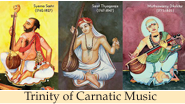
Trinity of Carnatic Music The Three Jewels of Carnatic music, consisting of Tyagaraja, Muthuswami Dikshitar, and Syama Sastri, were renowned for their unique compositions and messages. Carnatic music was not only a religious and devotional practice but also a spiritual exercise, guiding individuals towards higher states of philosophy and liberation. Their contributions to Indian philosophy and spirituality are unparalleled.
Carnatic Music
Carnatic music is a system of music commonly associated with South India. The pan-Indian Bhakti movement, which stimulated the usage of religious themes, had a significant influence on Carnatic Music, which was rooted in South India. Unlike Hindustani music, the primary emphasis in Carnatic music is on vocal music; most works are written to be sung, and even when played on instruments, they are intended to be performed in gayaki (singing) style.
Carnatic music is taught through intricate compositions that allow for free improvisation, resulting in unique and distinct renditions that embody the composer’s vision and the musician’s interpretation. Carnatic music is founded on kriti and emphasizes the sahitya, or the quality of the words of the musical work. The Kriti is a highly developed musical song set to a certain raga and tala (rhythmic cycle). Carnatic tradition is known for its complex rhythms and melodies, based on the classical Indian frameworks of talas and ragas.
The most popular instruments used in Carnatic performances include Vocals, Mridangam, Ghatam, Kanjira, Santoor, Venu Flute, Tanpura and Veena.
Most compositions in Carnatic music have three parts to their body. The first or two thematic lines of the song are referred as ‘Pallavi’, which are often repeated in each stanza. Pallavi is usually followed by two more lines called ‘Anu Pallavi’,
which is sung in the beginning and sometimes also towards the end of a song, but not necessarily repeated after each stanza or ‘Charanam’.
How is Carnatic Music different from Hindustani Music?
| PARAMETERS | CARNATIC MUSIC | HINDUSTANI MUSIC |
| Origin | South India | North India |
| Ragas | 72 melakartas, ragas and janya ragas | 6 ragas |
| Influence | Indigenous | Arab, Persian, Afghan |
| Improvisation Scope | Less scope of improvisation | Greater scope of improvisation |
| Time Bound? | No time limit is imposed | Time limit exists as each raga is rendered at a specific time |
| Instruments used | Veena, Mridangam and Mandolin | Tabla, Sarangi, Sitar and Santoo |
| Emphasis on | Taal | Ragas |
| Gharana system | No gharana system is found in Carnatic Music | Existence of the and guru-shishya parampara in Hindustani music |
| Major vocal forms | Alapana, Niraval, Kalpanaswaram and Ragam Thana Pallavi | Dhrupad, Khayal, Tarana, Thumri, Dadra and Ghazals |
| Similarity | Flute and Violin | Dheera Shankarabharanam raga of Carnatic music is similar to Rag Bilawal in Hindustani music |
FOLK MUSIC
Folk music is a genre encompassing traditional and contemporary pieces. It is traditionally transmitted orally, often with unknown composers, played on traditional instruments, and often associated with cultural or national identity, often being rural in origin. India is known for its rich and diverse cultural heritage, and folk music plays a significant role in representing the various regional traditions and customs. The different types of folk music found across India are as follows:
Folk Music Traditions in India
| FOLK MUSIC | DESCRIPTION |
| Sufi (Kashmir) | Sufi music is deeply rooted in the spiritual traditions of Kashmir. It often features devotional poetry and mesmerizing vocals, accompanied by instruments like the santoor, rabab, and tabla. |
| Qawwali | While Qawwali originated in the Middle East, it has become an integral part of India’s musical landscape, particularly in the northern regions. It is a devotional form of music associated with Sufism, featuring powerful vocals and repetitive melodies. |
| Bhangra (Punjab) | Bhangra is a lively and energetic folk music and dance form from the Punjab region. It is characterised by rhythmic beats, strong percussion and energetic movements. |
| Lavani (Maharashtra) | Lavani is a popular folk music and dance form from Maharashtra. It is characterised by fast-paced rhythmic patterns, expressive movements and powerful vocals. It often addresses social and political issues. |
| Baul (West Bengal | Baul music is a mystical and spiritual folk tradition from West Bengal. Baul singers, known as Bauls, travel from place to place, singing songs that convey messages of love, devotion and the search for enlightenment |
| Bihu (Assam) | Bihu is a folk music and dance form from Assam, particularly associated with the festival of the same name. It features lively rhythms, flutes, and drums, and celebrates the joy of the agricultural season. |
| Nadaswaram and Thavil (Tamil Nadu) | These classical folk music instruments are commonly used in temple rituals, weddings and other cultural events in Tamil Nadu. |
| HaryanviFolkMusic (Haryana) | Haryanvi folk music includes songs and dances like Ragini and Rasa. These forms celebrate rural life and traditions. |
| Bhavageet (Karnataka) | Bhavageet is a genre of Kannada folk music known for its poetic and emotional lyrics. It often expresses deep sentiments and emotions. |
| Pandavani | It is a traditional folk narrative singing style from the state of Chhattisgarh. It is named after the Pandavas, the central characters from the Indian epic, the Mahabharata. |
| GarbaandDandiya (Gujarat) | Garba and Dandiya are energetic folk-dance forms accompanied by traditional music. They are an integral part of Navratri celebrations in Gujarat. |
| Mandoa | It refers to a traditional music and dance form from the state of Goa. Mandoa music is an integral part of Goan culture and is often performed during festivals and special occasions. |
| Barhamasa | It also spelled as “Barahmasa” or “Bara Masa,” is a genre of traditional North Indian poetry and music that is centered around the changing seasons and emotions associated with each month of the year. The term “Barhamasa” can be translated as “Twelve Months” in English. |
| Pankhida | It refers to a genre of devotional music that is popular in Gujarat, particularly among the Gujarati-speaking population. This music is characterized by its upbeat and rhythmic style and is often associated with religious festivals and celebrations, especially those dedicated to Lord Krishna. |
| Soha | It is a traditional form of music and song that is often associated with childbirth and related rituals in various regions of India, particularly in North India and parts of Rajasthan, Uttar Pradesh, and Punjab. The term “Sohar” is derived from the Hindi word “Suhar,” which means “auspicious.” |
| Chhakri | It is a traditional folk music and dance style that originates from the Indian state of Gujarat, particularly among the Gujarati-speaking population. It is known for its lively and rhythmic nature and is often associated with celebratory occasions and festivals. |
| Kajri | It is a traditional genre of folk music and poetry that originates from the northern regions of India, particularly the states of Uttar Pradesh and Bihar. It is associated with the monsoon season and is often performed during the rainy months to celebrate and evoke the beauty of nature, the arrival of the rains, and the emotions of love and longing. |
| Daskathia | It is a traditional folk dance and performance art form that hails from the coastal regions of the Indian state of Odisha, particularly in the Ganjam and Gajapati districts. Daskathia is characterized by its energetic movements, rhythmic music, and storytelling elements. |
| Lai Haraoba | It is a traditional festival celebrated in the Indian state of Manipur, particularly among the Meitei community. It is a significant cultural and religious festival that combines dance, music, and rituals. Lai Haraoba songs play a vital role in this festival, as they are used to convey stories from Manipuri mythology and the history of the Meitei people. |
| Chai Hia | It is a traditional and popular Mizo folk song from the northeastern Indian state of Mizoram. These songs are characterized by their lively and rhythmic nature and are often performed during various social and cultural occasions. |
| Sukur Ke Biah | It is a traditional Bhojpuri folk song that originates from the Bhojpuri-speaking regions of India, particularly in the states of Bihar and Uttar Pradesh. The song is known for its lively and celebratory nature and is often performed during weddings and other joyous occasions. |
| Bhuta | Also known as “Bhoota Kola,” is a traditional folk music and dance form that is native to the coastal regions of Karnataka, particularly in the Tulu-speaking regions. Bhuta Kola is a significant cultural and religious practice among the Tulu-speaking communities, and it involves performances dedicated to spirit worship and folklore. |
| Burrakatha | It is a traditional storytelling and folk art form that originates from the Indian states of Andhra Pradesh and Telangana, particularly among the Telugu-speaking communities. It is a unique and engaging narrative performance that combines storytelling, music, and dance. |
| Villu Pattu | It is also known as “Bow Song” or “Villupattu,” is a traditional folk music and storytelling form that originated in the Indian state of Tamil Nadu. The term “Villu” refers to the bow used in this art form. Villu Pattu is known for its unique combination of music, narration, and the use of a bow-like instrument. |
Blend of Classical and Folk Music
The blend of classical and folk music often results in a unique and rich musical experience that combines the intricate structures and melodies of classical music with the earthy, authentic expressions of folk music. This fusion can lead to the creation of diverse and culturally significant musical genres.
| MUSIC FORM | FEATURES |
| Bhajan | They originated with the Bhakti movement are most popular devotional songs in north India. Lyrics are set to simple melodies and are sung in one or more raga. Bhajans are accompanied by musical instruments such as the chimta, dholak, dafli, manjira etc. Major expounders included Kabir, Mirabai, Surdas and Tulsidas. |
| Shabad | Due to Sikhism and devotional songs sung in the Gurudwaras, this form of music developed. Raga based, Traditional shabad and lighter shabad are three forms of shabad singing. |
| Qawwali | It is also a devotional music form often used in praise of Allah but is not limited to Islamic traditions only. It has a repetitive structure and is sung in a group with one or two lead singers. Musical instruments such as tabla, harmonium and harmonica are often used to gradually build up the tempo and intensity. Amir Khusrau has been credited as its originator. |
| Rabindra Sangeet | It is one of the most famous ways of producing music, following in the footsteps of Rabindranath Tagore. It is a mixture of classical elements with Bengali folk strains. |
| Gana Sangeet | It is sung in choirs or groups and has patriotic elements attached to it. They generally try to either carry a social message or as a protest against issues in the society. Ex: Vande Mataram |
| Abhanga | In praise of God Vithoba (a form of Vishnu). Songs are sung and composed by Tukaram, Namdeva, etc. |
| Bhatiali | About nature and daily lives and is sung by boat drivers |
| Tevaram | Sung by the Shaivite community |
| Kirtan | Involves singing and dancing, taking inspiration from Gita Govinda |
| Sopana Sangeetham | Originated in temples, with religious themes. |
Important Books on Indian Music
Indian music has a rich and ancient tradition dating back thousands of years, and several important texts have contributed to its development and understanding. Here are some significant ancient books on Indian music:
| BOOK | WRITTEN BY | REMARKS |
| Natya Shastra | Bharata Muni | “Natya Shastra” is an ancient Sanskrit text believed to have been written around the 2nd century BCE to the 2nd century CE. It is one of the foundational texts for Indian performing arts, including music, dance, and theatre. It covers various aspects of music, including scales, instruments, and the emotional impact of music. |
| Brihaddeshi | Matanga | It, composed in the 7th century CE, is one of the earliest known treatises on music in India. It provides insights into the musical instruments, scales, and vocal music of its time. |
| Sangeet Makarand | Narada | It is a 13th-century Sanskrit text attributed to Narada, the legendary sage. It covers various aspects of music, including ragas, talas, and musical instruments. |
| Sangeeta Ratnakara | Sharngadeva | Composed in the 13th century CE, it is a highly regarded Sanskrit text that provides a comprehensive overview of Indian music. It covers topics such as ragas, talas, and musical instruments and includes historical and theoretical information. |
| Sangita Darpana | Damodara | It is a 14th-century text that focuses on vocal music and provides detailed information on ragas and their characteristics. It is an essential text for understanding the classical music of its time. |
| Sangeeta Sudhakara | Haripala | It was composed in the 14th century CE, and is an important work on Indian music theory. It covers topics such as scales, ornamentation, and the classification of ragas. |
| Sangeeta Samaya Sara | Parsvadeva | This 16th-century text by Parsvadeva is a comprehensive treatise on music theory, particularly in the context of the Hindustani classical music tradition. |
| Raga Tarangini | Lochana Kavi | It is a 17th-century work that provides detailed descriptions of ragas and their melodic structures. It is an important source for understanding the development of Indian classical music. |
These ancient texts are valuable resources for studying the history, theory, and practice of Indian music. They offer insights into the foundations of classical music, the classification of ragas and talas, and the philosophy of music in Indian culture. While some of these texts are quite old, they continue to influence and inform the practice of Indian music to this day.
MUSICAL INSTRUMENTS
Medieval India witnessed the flourishing of various musical traditions and the development of a wide range of musical instruments. These instruments were used in both classical and folk music, and they played a significant role in the cultural and musical heritage of the time. Some notable musical instruments from medieval India are as follows:
| MUSICAL INSTRUMENT | DESCRIPTION |
| Veena | The veena is one of the most ancient and revered musical instruments in India. It was commonly used in classical music and came in various forms, including the Rudra Veena, Saraswati Veena, and Vichitra Veena. The veena is a stringed instrument played by plucking the strings with the fingers. |
| Sita | The sitar is a plucked string instrument that gained popularity during the medieval period. It has a unique sound and is known for its use in Indian classical music, particularly in the North Indian tradition. |
| Tabla | The tabla is a pair of hand-played drums that became an essential component of Indian classical music, particularly in the medieval period. It consists of two drums, the smaller drum (dayan) and the larger drum (bayan), and is used to create intricate rhythms and patterns. |
| Sarod | The sarod is a fretless string instrument that is played with a pick or the fingernails. It has a deep and resonant sound and is commonly used in classical music, especially in the Hindustani tradition |
| Flute | The bamboo flute, known as the bansuri, has been a part of Indian music for centuries. It is a simple yet melodious instrument used in classical and folk music. |
| Pakhawaj | The pakhawaj is a traditional barrel-shaped drum used in North Indian classical music, especially in the Dhrupad style. It is played with the hands and produces a rich and resonant sound. |
| Mridangam | The mridangam is a percussion instrument used in South Indian classical music, particularly in the Carnatic tradition. It is similar in shape to the pakhawaj but has a distinct playing style and sound. |
| Shehnai | The shehnai is a wind instrument that gained popularity during the medieval period. It is often associated with auspicious occasions and is commonly played at weddings and religious ceremonies. |
| Dilbruba | The dilruba is a bowed string instrument with sympathetic strings. It is used in various forms of Indian classical and devotional music. |
| Nagaswaram | The nagaswaram is a traditional wind instrument used in South Indian classical music, particularly in temple rituals and processions. |
| Harmonium | While the harmonium has European origins, it was adapted and became an integral part of Indian music during the colonial period. It is commonly used in various Indian musical genres, including classical and devotional music. |
These musical instruments played a crucial role in shaping the musical traditions of medieval India, and many of them continue to be important in contemporary Indian music. They contributed to the diversity and richness of India’s musical heritage during that era.