Whatsapp 88106-52225 For Details
Get Free IAS Booklet
Get Free IAS Booklet
The origin of Indian drama probably lies in the tribal ritual dances and celebration of antiquity. What probably began as community participation would gradually break down into two groups—those who perform and those who watch, that is the actors and the audience.
In India, there developed a rich tradition in theatre, particularly the classical Sanskrit drama. Natyashastra ascribed to Bharata Muni, is the oldest treatise on dramaturgy and gives an interesting account of the origin of Indian Naatya tradition in its opening chapter.
Mythological Story on the Origin of Indian Theatre
It is said that the four Vedas—as repository of knowledge and wisdom were accessible to upper castes and classes (Varnas), and not to women and lower caste or class. Dissatisfied with this situation, the Gods went to Brahma, the creator, for a solution.
The creator suggested the creation of the Fifth veda (Panchamaveda) as Natyaveda.
This task was accomplished by Bharata Muni by way of extracting the wisdom of Rigveda, performative rituals of Saamveda, musicality of Yajurveda and emotive representations of Atharvaveda.
The voluminous work, thus created, embodied all physical, theoretical and conceptual ideas behind traditional Indian drama.
Natyashastra, thus, speaks about the thought process and behaviour of people, their temperament, problems in society, needs, sorrow, etc., paving the way and promise for a better life.
The early drama was a combination of mime, poetry, prose, dialogue, humour, songs and dance. This made theatre as an all-inclusive art form. Gradually it became an important medium for entertainment, learning, communication and reflexive thinking on human conditions.
Beauty of Naatyashastra
Naatyashastra was written around period between 200 B.C. and 200 A.D. According to the text (Chapter 35), a theatre group should have persons specialised in seventeen types of works:
Bharata- Manager or producer or a multidimensional person
Vidooshaka- Jester
Tauripta- experts in playing musical instruments
Naja- actor or Dancer
Sootradhara- linking and interpreting the text
Natyakara- the playwright
Nandi- in praise of the Creator while invocating the play)
Nayaka- person in lead character
Mukutakara- Mask makers
Aabharanakara- person engaged in making ornaments for a performance
Malyakara- person engaged in making garlands/ ornaments
• Vesakara- costume makers
• Chitrakara- painter/artist
• Rajaka- person engaged in cleaning the costumes
• Karukara sculptor-decorator
• Kusilava- actors in role proficient as actor-dancer- musicians
This list helps us to understand the components of a theatre group. Interestingly Naatyashastra includes names of each and every allied work considered necessary for a performance. For that reason, the Rajakas or Malayakaras were honoured as a member of a theatre group, although they were not directly related to performances.
While the tradition of theatre in India certainly developed much before Naatyashastra, the systematic thinking or theorising about theatre arts took shape only because of the treatise. In fact, it is believed that Naatyashastra had developed by compiling and conceptualising the prevailing folk traditions. For Bharata Muni, the composite term ‘Abhinaya’ means— ‘Abhi’, meaning learning from the play and ‘ni’, meaning to carry it forward. It intends to entertain and educate people simultaneously. Ancient drama tradition can be categorised in two ways: 1. Lokadharmi or popular 2. Natyadharmi or conventional. Sanskrit plays had a ‘Sootradhaara’ who created a link of events in a play through commentary, musical interlude or interpretative extempore.
Language used in Classical Sanskrit Plays Interestingly, in Sanskrit drama characters could speak differently in classified dialects. The hero or the principal male characters speaking in Sanskrit; the heroine and principal female character in Prakrit; the royal attendants, servants and traders, rogues and villains, intriguers, cowherds, the people of the forest, and so on, in their respective dialects. This reveals the social categorisation of people of that time.
Evolution of Play Traditions in India
1. Early Origins: Fragments of palm leaves found in Central Asia date back to the Kushan period around the 1st century AD. The earliest Sanskrit play, Sariputra Prakarana by Ashvaghosha during King Kanishka’s reign, marks the beginning of Indian dramatic literature.
2. Glorious Sanskrit Era: The Gupta dynasty era had renowned poets and playwrights. Kalidasa’s timeless classics like Malvikaagnimitram and Abhijnanashakuntalam continue to be performed on stages. Shudraka’s masterpiece Mrichchkatikam and Vishakhadatta’s Mudrarakshasam enriched Sanskrit drama.
3. Legacy of Bhavabhuti: Bhavabhuti, a scholarly Brahmin, contributed significantly with three works: two of which may be called historical/mythological- Mahaviracharitam and Uttaramacharitam; both dealing with the Ramayana, and the third- a romance titled Maalatimadhavam.
4. Decline of Sanskrit Drama: Political turmoil from the 9th to 12th centuries led to a decline in Sanskrit drama’s glory Language barriers also played a role in its decreasing popularity.
5. Rise of Prakrit and Folk Theatre: Despite the decline in Classical Sanskrit drama, regional languages like Prakrit gained prominence, fostering their own literary traditions. This period birthed a robust folk theatre tradition persisting through Indian history.
6. Urdu Theatre’s Influence: Wajid Ali Shah’s court became a significant hub for Urdu theatre, showcasing the patronage of performing arts during that time.
7. Southern Contributions: Tamil literature references dramatic performances, with enduring forms like Kuttu found in various folk expressions, notably the rural artistic tradition of therukuttu. Southern India’s most prominent contribution, however, lies in storytelling through dance drama forms like Bharatanatyam, Kathakali, Bhaagwata Mela Naatakam, Yakshagana, and Kuchipudi, blending drama, dance, mime, gesture, and music.
Reasons for decline of Classical Sanskrit theatre
1. As Sanskrit dramatists began to diverge towards poetry, and the lyrical writings started gaining popularity over the dramatic works.
2. The rigid orthodoxy of the Sanskrit theatre restricted the creative space of new playwrights who turned to other forms.
3. As Sanskrit became more and more embellished, it lost popularity among the masses.
4. It was increasingly confined to the religious sphere and among the Brahmins, while other languages such as Pali and Prakrit took its place.
5. With the advent of Muslim rulers, Sanskrit theatre took a definite backseat, as dance and music gained patronage
Prominent Ancient Sanskrit Plays
| Autho | Play/Drama | Features | Timeline |
| Bhasa | Swapnavasavadatta(Vasavadattain dream) | One of the best dramas written by him | Due to non-conformity with the rules of Bharata’s Natyashastra, it is believed that he belonged to within the 3rd or 4th century BC. |
| Pratima and Abhisheka | These are based on Ramayana | ||
| Madhyamavyayoga, Dutaghatotkacha, Karnabhara and Urubhanga | Thesearebasedon Mahabharata stories. | ||
| Pancharatra and Charudatta | Other works |
| Kalidasa | Malvikaagnimitram (Malvika + Agnimitra) | The story of Malavika, a maiden of the Queen and Agnimitra, the son of Pushyamitra Shunga | Kalidasa (4th-5th century AD) flourished during the reign of Chandragupta II. But his best works were probably written during the reign of Kumaragupta. |
| Vikramorvasiyam (Vikram + Urvasi) | Love story of Vikram and Urvasi | ||
| Abhijnanashakuntalam | The recognition of Shakuntala asmentionedinthe Mahabharata | ||
| Sudraka | Mrichchkatika (The Little Clay Cart) | It is a story of a love affair of a young Brahmin Charudatta with a wealthy courtesan | It was probably written after Bhasa’s Charudatta (3rd century AD). Kalidasa has not mentioned anything about Sudraka, but it has been mentioned in Kalhana’s Rajatarangini. |
| Vishakhadatta | Mudrarakshasa | A political drama that narrates the ascent of Chandragupta Maurya to power in India | Though the period is not certain, it could be dated in or after the 6th century AD. According to some sources, Vishakhadatta was a contemporary of Chandragupta II, and lived in the late 4th century to early 5th century. |
| Devi Chandraguptam | It is the story of the Gupta King Ramagupta who surrenders his queen Dhruvadevi to a Shaka invader and his younger brother- Chandragupta who rescues her, dethrones his elder brother and marries his wife. | ||
| Harshavardhana | Ratnavali | The love story of princess Ratnavali, daughter of the King of Ceylon and King Udayana. The mention of celebration of Holi festival for the first time can be found here. | Harshavardhana ruled north India from 606 AD to 647 AD with Kannauj as his capital. |
| Nagananda | Story of how Prince Jimutavahana gives up his own body to stop a sacrifice of serpents to the divine Garuda. One unique characteristic in this drama is the invocation to Lord Buddha in the Nandi verse. | ||
| Priyadarshika | Describes the union of Udayana and Priyadarshika daughter of the king Dridhavarman |
| Bhavabhuti | Uttararamacharitam | Describes the later life of Rama | He has been mentioned by Kalhana as a poet in the court of the King Yashovarman of Kanyakubja |
| Mahaviracharitam | Based on the early life of Rama, the hero of Ramayana | ||
| Maaltimadhavam | It is a complex love intrigue intermingled with sorcery and Tantric practices, including human sacrifice and much violence. | ||
| Ashvaghosha | Sariputraprakarana (Sanskrit Drama) | It is regarded as the first example of traditional Sanskrit theatre. It deals with Sariputta or Sariputra, the disciple of Buddha. | Asvaghosha was part of Kanishka’s court from 78AD to 144 AD. |
Folk Theatre
In India, folk theatre is a hybrid art form that combines elements from dance, music, pantomime, versification, recitation of epics and ballads, visual and performing arts, religion, and festival celebrations
Folk theatre, which has origins in native culture, is ingrained in the social values and local identity.
In addition to offering public amusement, it has long served Indian society as a means of interpersonal, inter-group, and inter village communication.
In India, folk theatre has been widely utilized to spread important messages about social, political and cultural concerns in order to raise public awareness
Being an indigenous form, it transcends all institutional barriers to human interaction and speaks to the populace directly. Describes the later life of Rama Based on the early life of Rama, the hero of Ramayana It is a complex love intrigue intermingled with sorcery and Tantric practices, including human sacrifice and much violence. It is regarded as the first example of traditional Sanskrit theatre. It deals with Sariputta or Sariputra, the disciple of Buddha. He has been mentioned by Kalhana as a poet in the King court of the Yashovarman of Kanyakubja Asvaghosha was part of Kanishka’s court from 78AD to 144 AD.
With the aid of numerous languages and regional customs, the folk theatre violently arose throughout the 15th and 16th centuries A.D. in a number of locations. The folk theatre had a mostly devout tone when it first emerged, but as time went on, its material grew more secular and it started to emphasise romantic folk tales, ballads of courage, and biographical descriptions of local heroes.
According to Bansi Kaul, folk theatre imparts “social wisdom” and shouldn’t just be seen as cheap pleasure. Folk theatre has been effectively utilised to spread social messages in the post-Independence era on topics like health, family planning, adult education, etc. For presentation and storytelling, a lot of contemporary playwrights draw extensively from folk tradition styles.
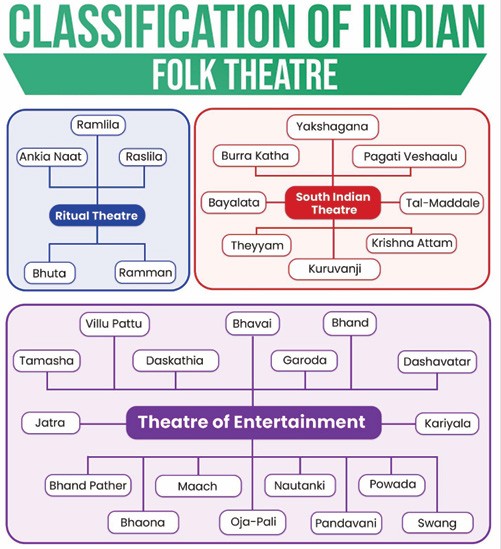
The “Ritual Theatre’’ and the “Theatre of Entertainment” are two major categories into which Indian folk theatre may be divided:
Religious 2. Secular
Folk theatres can be divided into three major categories based on their theme:
1. Ritual Theatre
2. Theatre of Entertainment
3. South Indian Theatre
Ritual theatre, put simply, is the performance of a myth or archetypal tale with the goal of promoting healing—typically to solve a problem, cope with a challenging experience, replenish depleted energies, or smooth over a transition.
| Theatre | Features |
| Ankia Nat (Bhaona) (Assam) | It is a classic one-act play. It portrays events from Lord Krishna’s life and is done in operatic style. It was created in the 15th–16th centuries AD by the revered Vaishnava Saint Sankardev and his student Madhavdev |
| Ramlila (Uttar Pradesh) | It is a portrayal of the Ramayana with music, dances and speech, usually performed just before Dussehra. It is typically performed by male actors, who also play Sita. |
| Raslila (Gujarat) | This traditional Indian dance performance celebrates the everlasting union of Lord Krishna and Radha. |
| Bhuta Aradhana (Karnataka) | Bhoota aradhana or spirit worship is a religio-cultural ritual practised on the west coast of Karnataka. The ritual is prevalent mainly among the Tulu speaking people of this state. The bhootas are considered to be benevolent Gods or guardian spirits by the people. The bhootas can also be manifestations of animals like the five-faced Nandigona, the bull spirit or the mother goddess-like Ullalthi. Kol is the main form of Bhuta Aradhana Worship is a ritual theatre. |
| Ramman (Uttarakhand) | The Ramman celebration is mostly observed during the Baisakh festival in April. Ramman is known for its celebration of local deity worship and obscene offerings to “Bhumiyal Devta.” Inscribed in the UNESCO’s Representative List of Intangible Cultural Heritage of Humanity in 2008. |
Theatre of Entertainment
The purpose of this type of folk dance was to amuse the general public. It features secular issues including romance, love, bravery, and cultural and social customs.
| Theatre | Features |
| Oja-Pali (Assam) | It is an Assamese tale theatre and is linked to the snake goddess Manasa. A chorus of singers and dancers perform Ojapali, in which they dance, play tiny cymbals (Khutitals), and recite tales from Hindu epics and Puranas. |
| Jatra (West Bengal) | Introduced by Sri Chaitanya when he himself played the role of Rukmini. Jatra is a type of folk play that combines singing, dancing, and acting. Jatra is thought to have originated from ritual events done before to embarking on a journey. It evolved from processions held in worship of various gods and goddesses. |
| Villu Pattu (Deccan Region) | Vilpattu, a.k.a Villu Paatu, Bow Song, is a traditional type of musical story-telling in which music and narrative are intermingled. Villu means bow and Pattu means song in Malayalam. The Nadar and Ezhava castes of the former Travancore Kingdom are big fans of this art style. |
| Garodas (Gujarat) | The ‘Garoda’ Brahmin group in Gujarat is known for this well-known art style. This type of theatre tells the tale through painted images. To make the paintings more vibrant, they were divided into sections using black, bold lines and various watercolour hues. |
| Bhavai (Gujarat and Rajasthan) | Gujarat’s Bhavai is a well-known kind of folk theatre with a 700-year history. The term “Bhavai” refers to a type of art that carries feelings since it combines the terms “bhav,” which means “emotion,” and “vahini,” “carrier.” |
| Kariyila (Himachal Pradesh ) | Kariyila is one of the most appealing and popular folk drama forms of Himachal Pradesh, portraying social satire with the accompaniment of folk dance and music. The Kariyala performance is actually a fun collection of short plays, farces, skits, revues, and burlesques rather than the staging of a single play in the order of introduction, plot, and conclusion. |
| Bhand Pather (Kashmir) | Bhand Pather is a sarcastic and realistic drama that mixes mythical stories and present social criticism; a typical blend of art forms. The term bhand means “jester,” and the word pather means “drama.” It is based on the events of daily life and it has an element of satire. |
| Dashavatar (Konkan and Goa) | Dashavatar is the most established theatre form in Konkan and Goa. A classic religious drama based on the Hindu mythology notion of Lord Vishnu’s 10 rebirths. |
| Tamasha (Maharashtra) | Tamasha is a type of traditional Marathi folk art which encompasses both singing and dance. It is a mobile theatre that travels around Maharashtra. Tamasha is a Persian term that means “to have fun or to play.” Tamasha implies ‘a blend of specialised acts such as dance, music, varied enactments or roles by women or girls, involvement of women, and singing lavanis’ in Marathi. |
| Powada (Maharashtra) | The Powadas are a type of Marathi song composed in an exciting style that tells inspiring stories about historical events. This comprises descriptions of renowned kings heroic actions. The first famous Powada, “Afzal Khanacha Vadh” (The Killing of Afzal Khan), was written in 1659 by Agnidas and described Shivaji’s conflict with Afzal Khan. The following famous Powada was “Tanaji Malusare” by Tulsidas, which described how Maratha military leader Tanaji Malusare took control of the Sinhagad Fort. |
| Swang (Punjab, Rajasthan, Uttar Pradesh, Madhya Pradesh and Haryana) | Swang is a traditional dance theatre that includes the appropriate amount of impersonation, song, and speech, as well as theatrics. Instead of being movement-oriented, it is dialogue-oriented. The theme relies on a variety of sources, including morality tales, folklore, the lives of role models, tales from Indian mythology and more modern subjects like health and cleanliness, literacy, etc. The two main types of Swang come from Hathras (Lang - Brajbhasha) and Rohtak (Lang - Bangru). |
| Nautanki (Uttar Pradesh) | Nautanki is primarily a form of entertainment, with stories and themes drawn primarily from secular sources. These include well-known North Indian legends and stories, Arabic and Persian romances, folk epics from Rajasthan, Punjab, and Uttar Pradesh, tales of saints, kings, heroes, and modern events, as well as themes of social inequality and gender violence. |
South Indian Theatre
In contrast to north Indian theatre, which emphasises music, south Indian theatre places a greater emphasis on dance as a result of the demise of sanskrit classical theatre in North India.
| Theatre | Features |
| Burra Katha (Andhra Pradesh) | The percussion instrument “burra” is employed throughout the story and gives the play the name “Burra Katha.” Burra Katha was initially created to spread modern themes that would raise social consciousness, but over time it started to be used for political ends. Three narrators make up the Burra Katha team. ‘Bobbilli Katha’ and ‘Palnati Yuddham’ are two classical tales spoken by the Burra Katha team. |
| Bayalata (Karnataka) | Karnataka residents, particularly those who reside in the south, practise bayalata. The dance is also seen as a religious ritual performed in deference to the gods. The region’s harvest season comes to a conclusion with the Bayalta dance performance. |
| Tal Maddale (Karnataka) | The performers evaluate their oratory abilities based on the selected episode while seated across from one another in the “talamaddale,” which is devoid of costumes. There are no dances or costumes; simply spoken words are present. It is therefore Yakshagana without the dance, costumes, and stage traditions. |
| Yakshagana (Karnataka) | Yakshagana is a form of Karnataka traditional theatre. It is a type of temple artwork that illustrates myths and Puranas. Massive headgear, intricate facial makeup, and vivid costumes and accessories are used throughout performance. It is mostly performed in Kannada, however it is also done in Malayalam and Tulu (a south Karnataka dialect). Cymbals such the chenda, maddalam, jagatta, or chengila as well as smaller cymbals like the chakratala or elathalam are used to execute it. |
| Koodiyattam/Kutiyattam (Kerala) | One of Kerala’s most ancient kinds of traditional theatre is kutiyattam. It is based on the customs of Sanskrit theatre. In Malayalam, the words “kuti” and “attam” both basically imply “combined” or “together,” hence the phrase “kutiyattam” translates to “combined acting.” Hasta abhinaya (the language of gestures) and netra abhinaya (eye expression) are significant in this stylised and codified dramatic language. They emphasise the main character’s feelings and ideas. In Hindu temples, there are theatres called Kuttampalams where it is customarily played. Male actors known as Chakyars and female actresses known as Nangiars perform Kutiyattam, with the help of drummers known as Nambiars. A component of Kutiyattam called Pakarnattam is taking on and emoting the roles of both men and women. The solo portion of a woman’s Kutiyattam performance is called Nangiar Koothu. UNESCO has designated Kutiyattam as one of the masterpieces of the oral and intangible heritage of humanity. |
| Krishna Attam (Kerala) | The narrative of Krishna is told in a series of eight plays and was written by Manaveda (1585-1658 AD), the then Zamorin Raja of Calicut in northern Kerala. The performance is a dance-drama. Avataram, Kaliyamardanam, Rasakrida, Kamsavadham, Swayamvaram, Banayuddham, Vividavadham, and Swargarohanam are the eight dramas. |
| Mudiyettu (Kerala) | The mythical narrative of a conflict between the goddess Kali and the demon Darika serves as the basis for the Keralan ceremonial dance drama known as Mudiyettu. On a designated day, the villagers travel to the temple early in the morning after harvesting the summer crops. Performers of the Mudiyettu ritual purify themselves through fasting and prayer before invoking the goddess’ spirit by using coloured powders to create the enormous picture of Kali, known as the kalam, on the temple floor. Every year, the goddess temples known as “Bhagavati Kavus” in various Keralan villages host the festival known as Mudiyettu. The players don elaborate make-up, spectacular clothing, traditional facial painting, tall headgear, and other props to give the performance a supernatural sense. It is inscribed in 2010 on the Representative List of the Intangible Cultural Heritage of Humanity |
| Theyyam (Kerala) | In Kerala and Karnataka, India, theyyam is a popular ritualised dance style of devotion. It was made up of a thousand-year-old set of traditions, rites, and practises. Each Theyyam is a man or woman who achieved celestial rank by engaging in valiant actions or living a moral life. The majority of Theyyams are said to represent Shiva or Shakti (Shiva’s spouse) in human form. Or they are closely related to these Hinduism’s main deities. More than 400 theyyams exist. |
| Kuravanji (Tamil Nadu) | A lady born into a “kuravar” (gipsy) family is referred to as a “Kuravanji”. The Kurati lady has a significant part in Kuravanji dramas. Human love for God and other people is Kuravanji’s central concept. In some stories, the Kuruvanji, appears as a fortune-teller or soothsayer who predicts whether the heroine will succeed in winning her love. |
| Therukoothu (Tamil Nadu) | It literally translates to “street play” and is the most well-known type of Tamil Nadu folk theatre. To ensure a bountiful crop, it is typically carried out at Mariamman’s (the rain goddess) yearly temple ceremonies. A cycle of eight plays based on Draupadi’s life makes up the bulk of Therukoothu’s wide repertory. Therukoothu performance’s Sutradhara, Kattiakaran, provides the audience a summary of the play, while Komali amuses them with his antics. In Therukoothu, clothes and makeup are regarded as being of utmost significance. They perform while sporting intimidating moustaches, plenty of makeup, vibrant outfits, and a few males costumed as women from mythology. |
