Biodiversity Conservation Indian Efforts
BIODIVERSITY CONSERVATION INDIAN EFFORTS
Indian Forest Act, 1927
Forests and forestry are subjects of prime importance for a country and the public interest.
The Indian Forest Act, 1927 consolidates the law relating to forests, the transit of forest-produce and the duty leviable on timber and other forest-produce.
The Indian Forest Act, 1927 was enacted after repealing the Indian Forest Act, 1878 for the purpose of consolidating the law relating to forests, the transit of forest produce and the duty leviable on timber and other forest produce.
This Act is an important piece of the Central legislation and various State enactments have made amendments to suit their local requirements and some of the States have enacted their own full-scale forests Acts.
Objective
The Indian Forest Act was enacted to preserve and safeguard the forests generally in India.
The Act makes various provisions for conservation of forests and in the scheme, it provides for a State Government to constitute any forest lands or wastelands, which are property of the Government over which the Government have proprietary rights, a reserved forest.
Salient Features
The Act deals with the subject of forests in 13 Chapters.
Under its various chapters the Act contemplates the protection of forest land under certain conditions, whether they be reserved forests, village forests, protected forests or forest of private owners.
Although the Indian Forest Act deals specifically with (i) reserved forests; (ii) village forest, viz., reserved forest which have been assigned to any village community; and
(iii) protected forests.
The preamble and other provisions of the Forest Act are wide enough to cover all categories of forests.
This Act is one curtailing proprietary rights of individuals and so the Act and the notifications issued under it must be construed strictly where the rights of individuals are trenched upon.
Provisions under the Act
Definitions
Cattle includes elephants, camels, buffaloes, horses, mares, geldings, ponies, colts, fillies, mules, asses, pigs, rams, ewes, sheep, lambs, goats.
•
Forest-produce includes products found in, or brought from, a forest or not, that is to say timber, charcoal, caoutchouc, catechu, wood-oil, resin, natural varnish, bark, lac, mahua flowers, mahua seeds, and myrabolans.
Power to reserve forests lies with the State government.
Formation of Village Forests: The State Government may assign to any village community the rights of Government to or over any land which has been constituted a reserved forest, and may cancel such assignment. All forests so assigned shall be called village-forests.
Power to declare a forest as protected forest lies with the State Government.
Power to impose duty on timber and other forest produce lies with the Centre government.
Drawbacks
The Act mainly focuses on the forest land, its produce and the officers whereas there are no detailed provisions for the fauna under the Act. The reason behind this is that the Act was incorporated during the British times, keeping in mind their interests of hunting and so it did not constitute separate laws for the wildlife which forms the part of the forest.
The Act though wanted to protect the rights of the forest dwellers, it failed to meet the expectations of the local inhabitants as they were denied the occupancy and property rights even after residing in the forests for years.
Wild Life (Protection) Act, 1972
Wild Life, which is a part and parcel of the environment, constitutes the wealth of the nation. It included wild animals, birds, plants etc.
Wildlife is nature’s gift and its decline has an adverse effect on ecology and hence there is an urgent need to protect the wildlife.
Therefore, in order to protect the wildlife from destruction, the Indian Parliament passed the Wild Life (Protection) Act in the year 1972.
It helped India become a party to the Convention on International Trade in Endangered Species of Wild Fauna and Flora (CITES).
Objective
The main objective of the Act is to provide protection to the wild animals, birds and plants.
The Act empowers the Central Govt. to declare certain areas as Sanctuaries or National Parks.
The Act prohibits hunting of wild animals; birds etc. and imposes punishment for violating the same.
Types of Protected Areas under the Act
Sanctuaries
Notified by State Government
Purpose: For protecting, propagating or developing wild life or its environment.
National Parks
Notified by State Government
Purpose: For protecting, propagating or developing wild life or its environment.
Conservation Reserve
Declared by the State Government.
Purpose: For protecting landscapes, seascapes, flora and fauna and their habitat
Community Reserve
Declared by the State Government.
Purpose: For protecting fauna, flora and traditional or cultural conservation values and practices.
Tiger Reserve
Tiger Reserves are notified by State Governments as per provisions of the Wildlife (Protection) Act, 1972 on advice of the National Tiger Conservation Authority.
Note: Section 138 of the Wildlife Protection Act provides for power of the Central Government to declare areas as sanctuaries or National Parks or conservation reserves.
Therefore, according to the act both Centre and State governments can declare an area as sanctuary or national park or conservation reserve.
Hunting of Wild Animals
The Act prohibits hunting of wild animals. No person shall hunt any wild animals as specified in the Schedules. However, there are certain exceptions.
The State Govt. may order to kill or wound in good faith any wild animal for self-defense or to protect or save another.
The Govt. may permit killing of certain wild animals for academic purposes.
Schedules in the Act providing varying degree of protection
Schedule I: Specifying the animal species with the highest level of protection.
Schedule II: Specifying the animal species with a relatively lower degree of protection.
Schedule III: For plant species.
Schedule IV: For species protected under Convention on International Trade in Endangered Species of Wild Fauna and Flora (CITES).
Statutory Bodies established under the Act
National Tiger Conservation Authority (NTCA)
Wildlife Crime Control Bureau (WCCB)
Central Zoo Authority (CZA)
National Board for Wildlife (NBWL)
National Tiger Conservation Authority (NTCA)
The National Tiger Conservation Authority (NTCA) is a statutory body under the Ministry of Environment, Forests and Climate Change constituted under enabling provisions of the Wildlife (Protection) Act, 1972, as amended in 2006, for strengthening tiger conservation, as per powers and functions assigned to it under the said Act.
Objectives
Providing statutory authority to Project Tiger so that compliance of its directives becomes legal.
Fostering accountability of Center-State in management of Tiger Reserves, by providing a basis for MoU with States within our federal structure.
Providing for an oversight by Parliament.
Addressing livelihood interests of local people in areas surrounding Tiger Reserves.
Members
Chairperson: Minister in charge of the Ministry of Environment and Forests
Vice-Chairperson: Minister of State in the Ministry of Environment and Forests
Three Members of Parliament of whom two shall be elected by the Lok Sabha and one by the Rajya Sabha.
Secretaries of the Ministry of Environment and Forests, Ministry of Tribal Affairs, Ministry of Social Justice and Empowerment, Ministry of Panchayati Raj.
Director General of Forests and Special Secretary, Ministry of Environment and Forests
Chairpersons of National Commission for the Scheduled Tribes and National Commission for the Scheduled Castes.
Eight experts or professionals … and other members.
Powers and Functions
To approve the tiger conservation plan prepared by the State Government under section 38 O (1) (a) of this Act
Evaluate and assess various aspects of sustainable ecology and disallow any ecologically unsustainable land use such as, mining, industry and other projects within the tiger reserves
lay down normative standards for tourism activities
and guidelines for project tiger from time to time for tiger conservation in the buffer and core area of tiger reserves and ensure their due compliance
provide for management focus and measures for addressing conflicts of men and wild animal and to emphasize on co-existence in forest areas outside the National Parks, sanctuaries or tiger reserve, in the working plan code
provide information on protection measures including future conservation plan, estimation of population of tiger and its natural prey species, status of habitats, disease surveillance, mortality survey, patrolling, reports on untoward happenings and such other management aspects as it may deem fit including future plan conservation
Approve, coordinate research and monitoring on tiger, co-predators, prey habitat, related ecological and socio-economic parameters and their evaluation
Ensure that the tiger reserves and areas linking one protected area or tiger reserve with another protected area or tiger reserve are not diverted for ecologically unsustainable uses, except in public interest and with the approval of the National Board for WildLife and on the advice of the Tiger Conservation Authority
facilitate and support the tiger reserve management in the State for biodiversity conservation initiatives through eco-development and people\’s participation as per approved management plans and to support similar initiatives in adjoining areas consistent with the Central and State laws
ensure critical support including scientific, information technology and legal support for better implementation of the tiger conservation plan
facilitate ongoing capacity building programme for skill development of officers and staff of tiger reserves
Project Tiger
• The Government of India has taken a pioneering initiative for conserving its national animal, the tiger, by launching the “Project Tiger” in 1973. From 9 tiger reserves since its formative years, the Project Tiger coverage has increased to 51 at present, spread out in 18 of our tiger range states. This amounts to around 2.23% of the geographical area of our country.
• Project Tiger is an ongoing Centrally Sponsored Scheme of the Ministry of Environment, Forests and Climate Change providing central assistance to the tiger States for tiger conservation in designated tiger reserves.
The tiger reserves are constituted on a core/buffer strategy. The core areas have the legal status of a national park or a sanctuary, whereas the buffer or peripheral areas are a mix of forest and non-forest land, managed as a multiple use area. The Project Tiger aims to foster an exclusive tiger agenda in the core areas of tiger reserves, with an inclusive people oriented agenda in the buffer.
Wildlife Crime Control Bureau (WCCB)
• Wildlife Crime Control Bureau is a statutory multi- disciplinary body established by the Government of India under the Ministry of Environment and Forests, to combat organized wildlife crime in the country.
• The Bureau was constituted by amendment to the Wild Life (Protection) Act, 1972. It has been envisaged as a multi - disciplinary statutory body that will have officials from forests, police, customs and other similar agencies. The constitution is specified in Section 38 (Y) of the Wild Life (Protection) Act, 1972.
• Location
• The Bureau has its headquarter in New Delhi and five regional offices at Delhi, Kolkata, Mumbai, Chennai and Bhopal; three sub-regional offices at Guwahati, Amritsar and Cochin; and five border units at Ramanathapuram, Gorakhpur, Motihari, Nathula and Moreh.
• Powers and Functions subject to the provisions of Wildlife Protection Act
• Collect and collate intelligence related to organized wildlife crime activities and to disseminate the same to State and other enforcement agencies for immediate action, so as to apprehend the criminals and to establish a centralised wildlife crime data bank
• Coordination of actions by various officers, State Governments and other authorities in connection with the enforcement of the provisions of this Act, either directly or through regional and border units set up by the Bureau
• Implementation of obligations under the various international Conventions and protocols that are in force at present or which may be ratified or acceded to by India in future
• Assistance to concerned authorities in foreign countries and concerned international organisations to facilitate coordination and universal action for wildlife crime control
• Develop infrastructure and capacity building for scientific and professional investigation into wildlife crimes and assist State Governments to ensure success in prosecutions related to wildlife crimes
• Advise the Government of India on issues relating to wildlife crimes having national and international ramifications, and suggest changes required in relevant policy and laws from time to time.
Central Zoo Authority (CZA)
• The Indian Board for Wildlife re-constituted its Zoo Wing as ‘the Expert Group on Zoos’ at its 9th session held on 18th November, 1972 at New Delhi to make detailed study for setting up and maintenance of zoos in the country.
• The Expert Group on Zoos submitted its report in June, 1973 which was accepted by the Board in its meeting in November, 1973. The report recommended setting up of a central agency (Zoo Grants Commission), and to give effect to this recommendation, the Wildlife (Protection) Act, 1972 was amended through an amendment Act in the year 1991.
• A separate chapter, Chapter IVA containing Section 38 A to 38 J was added to the Wildlife (Protection) Act, 1972 for establishment of the Central Zoo Authority in India.
• Accordingly, the Central Zoo Authority was established as a statutory body under the Ministry of Environment & Forests by the Government of India in the year 1992. The Authority consists of a Chairman, ten members and a Member Secretary.
• The main objective of this Authority is to complement and strengthen the national effort in conservation of the rich biodiversity of the country, particularly the fauna as per the National Zoo Policy, 1998.
• Other objectives of this Authority include- enforcing minimum standards and norms for upkeep and healthcare of animals in Indian zoos and to control mushrooming of unplanned and ill-conceived zoos.
• For the overall management of the animals housed in the Indian zoos, standards and norms for appropriate housing, upkeep, health care, diet etc. have been laid down under the Recognition of Zoo Rules, 1992 which was further amended in the year 2009 and 2013.
• Every zoo in the country is required to obtain recognition from the Authority for its operation. The Authority evaluates the zoos with reference to the parameters prescribed under the Rules and grants recognition, accordingly. The Authority’s role is more of a facilitator than a regulator. It therefore provides technical and financial assistance to such zoos which have the potential to attain the desired standard in animal management.
• Apart from the primary function of grant of recognition, the Central Zoo Authority also regulates the exchange of animals of endangered category listed under Schedule- I and II of the Wildlife (Protection) Act, 1972 among zoos.
• Exchange of animals between Indian and foreign zoos is also approved by the Authority before the requisite clearances under EXIM Policy and the CITES permits are issued by the competent authority.
The Authority also coordinates and implements programmes on capacity building of zoo personnel, planned conservation breeding programmes and ex- situ research including biotechnological intervention for conservation of species for complementing in-situ conservation efforts in the country.
Vision
The zoo will have healthy animals in ecosystem based naturalistic enclosure, be supportive to in-situ conservation with competent and content staff, good educational and interpretive facilities, have the support of people and be self-sufficient.
Mission
The Central Zoo Authority’s mission is to provide better upkeep and veterinary care to the wild animals housed in zoos in India to ensure their conservation through best practices of management and bringing education & awareness among the people.
Forest Conservation Act, 1980
The Forest Conservation Act 1980 was enacted to help conserve the country’s forests. It strictly restricts and regulates the de-reservation of forests or use of forest land for non-forest purposes without the prior approval of the Central Government. To this end the Act lays down the prerequisites for the diversion of forest land for non- forest purposes.
Forest Conservation Act 1980 is a unique piece of legislation and regulatory mechanism that reflects the collective will of the nation to protect its rich forests, biodiversity and natural heritage and resources.
The act permits only unavoidable use of forest land for various development purposes. It embodies the firm commitment of the Government to balance the conservation of forests with the sustainable developmental need of the society contributing to better environment, health and economy.
This act is regulatory in nature and not prohibitory.
Objective
• To ensure the conservation and maintenance of forests.
• To organize the diversion of forest land for other purposes, such as mining and infrastructural development.
• Ensure that any diversion of forest land is done only for a specific purpose and with prior approval from the Central Government.
• Compensate for any loss of forest cover due to such disturbance through afforestation and reforestation activities.
Key Provisions
• Section 2: Restriction on the de-reservation of forests or use of forest land for non-forest purpose
• Forest land cannot be used for non-forest purposes, de-reserved, or transferred to private entities without the prior approval of the Central Government.
• Non-forest purposes include activities like mining, industrial projects, agriculture, infrastructure development, etc.
• This provision ensures that state governments or private entities cannot divert forest land without the Central Government’s permission.
• Section 3: Constitution of Advisory Committee
• The Central Government has the authority to constitute an Advisory Committee to review proposals involving the use of forest land for non- forest purposes.
• This committee provides recommendations to the central government on whether to approve or reject such proposals.
Biological Diversity Act, 2002
• To provide for conservation of Biological Diversity, sustainable use of its components and fair and equitable sharing of the benefits arising out of the use of biological resources and knowledge, a Convention, the United Nations Convention on Biological Diversity was held at Rio de Janeiro in 1992, wherein the sovereign rights of the State over their Biological resources reaffirmed. India being signatory to the said Convention found it necessary to give effect to the said Convention. Accordingly the Biological Diversity Bill was introduced in the Parliament.
• The Biological Diversity Act, 2002 was enacted by the Parliament of India to conserve biological diversity, sustainable use of its components and ensure fair and equitable sharing of the benefits arising out of the use of biological resources and knowledge associated with it.
Objectives
• To regulate access to biological resources of the country equitable share in benefits arising out of the use of biological resources.
• To conserve and sustainable use of biological diversity.
• To respect and protect knowledge of local communities traditional knowledge related to biodiversity.
To secure sharing of benefits with local people as conservers of biological resources and holders of knowledge and information relating to the use of biological resources.
Salient Features of the Act
Setting up of National Biodiversity Authority (NBA), State Biodiversity Board (SBB) and Biodiversity Management Committees (BMCs).
NBA and SBB are required to consult BMCs in decisions relating to bioresource / related knowledge within their Jurisdiction.
All foreign nationals / organizations require prior approval of NBA for obtaining biological resources and / or associated knowledge for use.
Indian scientists / individuals require approval of NBA for transferring results of research to foreign nationals / organizations.
Creation of National, State and Local Biodiversity Fund and its use for conservation of biodiversity.
Provisions for notifying heritage sites by State Government in consultation with local body.
Prior approval is needed from NBA for IPRs in any invention in India or outside India on Bioresource.
Scheduled Tribes And Other Traditional Forest Dwellers (Recognition Of Forest Rights) Act, 2006
The Forest Rights Act (FRA), 2006 recognizes the rights of the forest dwelling tribal communities and other traditional forest dwellers to forest resources, on which these communities were dependent for a variety of needs, including livelihood, habitation and other socio-cultural needs.
The forest management policies, including the Acts, Rules and Forest Policies of Participatory Forest Management policies in both colonial and post-colonial India, did not, till the enactment of this Act, recognize the symbiotic relationship of the STs with the forests, reflected in their
dependence on the forest as well as in their traditional wisdom regarding conservation of the forests.
The Act encompasses Rights of Self-cultivation and Habitation which are usually regarded as Individual rights; and Community Rights as Grazing, Fishing and access to Water bodies in forests, Habitat Rights for PVTGs, Traditional Seasonal Resource access of Nomadic and Pastoral community, access to biodiversity, community right to intellectual property and traditional knowledge, recognition of traditional customary rights and right to protect, regenerate or conserve or manage any community forest resource for sustainable use.
It also provides rights to allocation of forest land for developmental purposes to fulfill basic infrastructural needs of the community.
In conjunction with the Right to Fair Compensation and Transparency in Land Acquisition, Rehabilitation and Settlement Act, 2013 FRA protects the tribal population from eviction without rehabilitation and settlement.
The Act further enjoins upon the Gram Sabha and rights holders the responsibility of conservation and protection of biodiversity, wildlife, forests, adjoining catchment areas, water sources and other ecologically sensitive areas as well as to stop any destructive practices affecting these resources or cultural and natural heritage of the tribals.
The Gram Sabha is also a highly empowered body under the Act, enabling the tribal population to have a decisive say in the determination of local policies and schemes impacting them.
Thus, the Act empowers the forest dwellers to access and use the forest resources in the manner that they were traditionally accustomed, to protect, conserve and manage forests, protect forest dwellers from unlawful evictions and also provides for basic development facilities for the community of forest dwellers to access facilities of education, health, nutrition, infrastructure etc.
Objectives
To undo the historical injustice occurred to the forest dwelling communities
To ensure land tenure, livelihood and food security of the forest dwelling Scheduled Tribes and other traditional forest dwellers
To strengthen the conservation regime of the forests by including the responsibilities and authority of Forest Rights holders for sustainable use, conservation of biodiversity and maintenance of ecological balance.
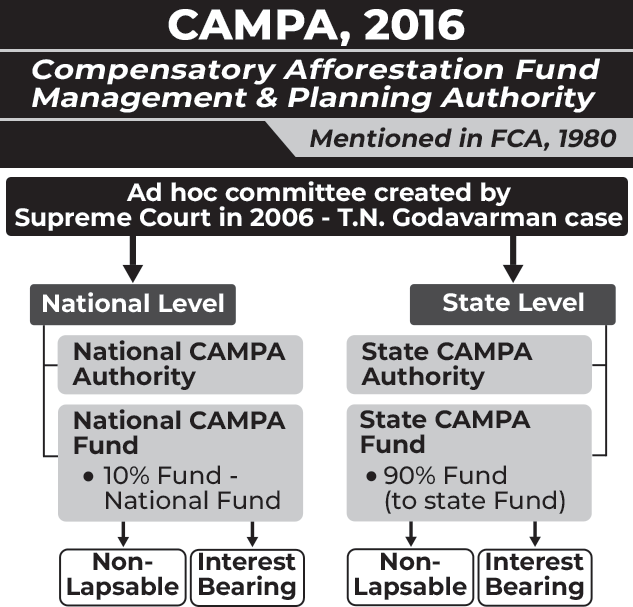
Compensatory Afforestation Fund (CAF) Act, 2016
The Compensatory Afforestation Fund (CAF) Act, 2016 was enacted in 2016 and Compensatory Afforestation Fund (CAF) Rules, 2018 were notified on 10.08.2018.
The Act and Rules came into force w.e.f. 30.09.2018. Under the provisions of CAF Act, 2016, two special interest bearing funds, namely “National Compensatory
Afforestation Fund” (National Fund) and “State Compensatory Afforestation Fund” (State Fund) under the Public Account of India and under Public Accounts of 33 States/UTs respectively have been established for depositing the monies.
The CAF Act, 2016 also paved the way for establishment of the National CAMPA (National Authority) in place of the Ad-hoc CAMPA at the center and State Authorities in respective States/UTs.
Objective
The Compensatory Afforestation Fund Act, 2016 aims to compensate for the loss of ecosystem and forest land due to diversion of forests for non forest use through compensatory afforestation, restoration of degraded forest, improvement of wildlife habitats, enrichment of biodiversity, etc.
The CAMPA Act aims to minimize the impact of forest land diversion for non-forest purposes by ensuring that funds are promptly, efficiently, and transparently released and utilized through a well-defined institutional mechanism.
Funds
The National Fund is under the control of the Central Government and is managed by the National Authority.
Similarly, the State Fund is under the control of the respective State Government/UT Administration and is managed by the State CAMPA.
These funds are non-lapsable and get interest as per rate declared by the Central Government on a year to year basis.
CAMPA fund supports large-scale afforestation efforts, forest protection, restoration of degraded forests and wildlife conservation activities.
Significance of CAF Act, 2016
The initiative significantly boosts green employment in rural and forest areas, particularly benefiting tribal and women communities.
CAMPA focuses on soil and moisture regime improvement, biodiversity enrichment, and climate change mitigation.
CAMPA has contributed to Mission Namami Gange through afforestation and soil and moisture conservation works in the catchment of Ganges and its tributaries.
It is also supporting large scale urban greening under Nagar Van Yojana through development of Nagar Van in cities for improvement and conservation of urban environment and biodiversity.
Noteworthy studies under CAMPA include river rejuvenation plans of thirteen (13) major rivers of the country.
National Authority’s wildlife conservation efforts include critical support to conservation of endangered species of Great Indian Bustard, Dugong, Sangai deer and river Dolphin and reintroduction of Cheetah in the Indian subcontinent.
Financial aid extends to initiatives like PARIVESH 2.0 for streamlining online processes of statutory approvals for environmental, forest, wildlife and CRZ clearances.
CAMPA supports Mission MISHTI for restoration of 540 sq.km of mangroves on the 7500 km long coastline of the country and the Green Credit Scheme for sustainable development actions.
National CAMPA’s backing of the National Transit Pass System enhances monitoring and record-keeping for transit permits through an online process.
National Red List Roadmap and National Red List Assessment
India has launched National Red List Roadmap at the IUCN World Conservation Congress in Abu Dhabi in October 2025.
India has launched the National Red List Assessment initiative which is align with the objectives of the Convention on Biological Diversity (CBD) and the Kunming–Montreal Global Biodiversity Framework (KMGBF).
India’s Vision 2025–2030 for the National Red List Assessment (NRLA) with aim to publish National Red Data Books that consist the list of flora and fauna by 2030 with collaboration of the Zoological Survey of India (ZSI) and the Botanical Survey of India (BSI). It is just similar with the red Data Book published by IUCN for monitoring the conservation status of Indian species