Whatsapp 88106-52225 For Details
Get Free IAS Booklet
Get Free IAS Booklet
ENVIRONMENTAL IMPACT ASSESSMENT
Environmental Impact Assessment
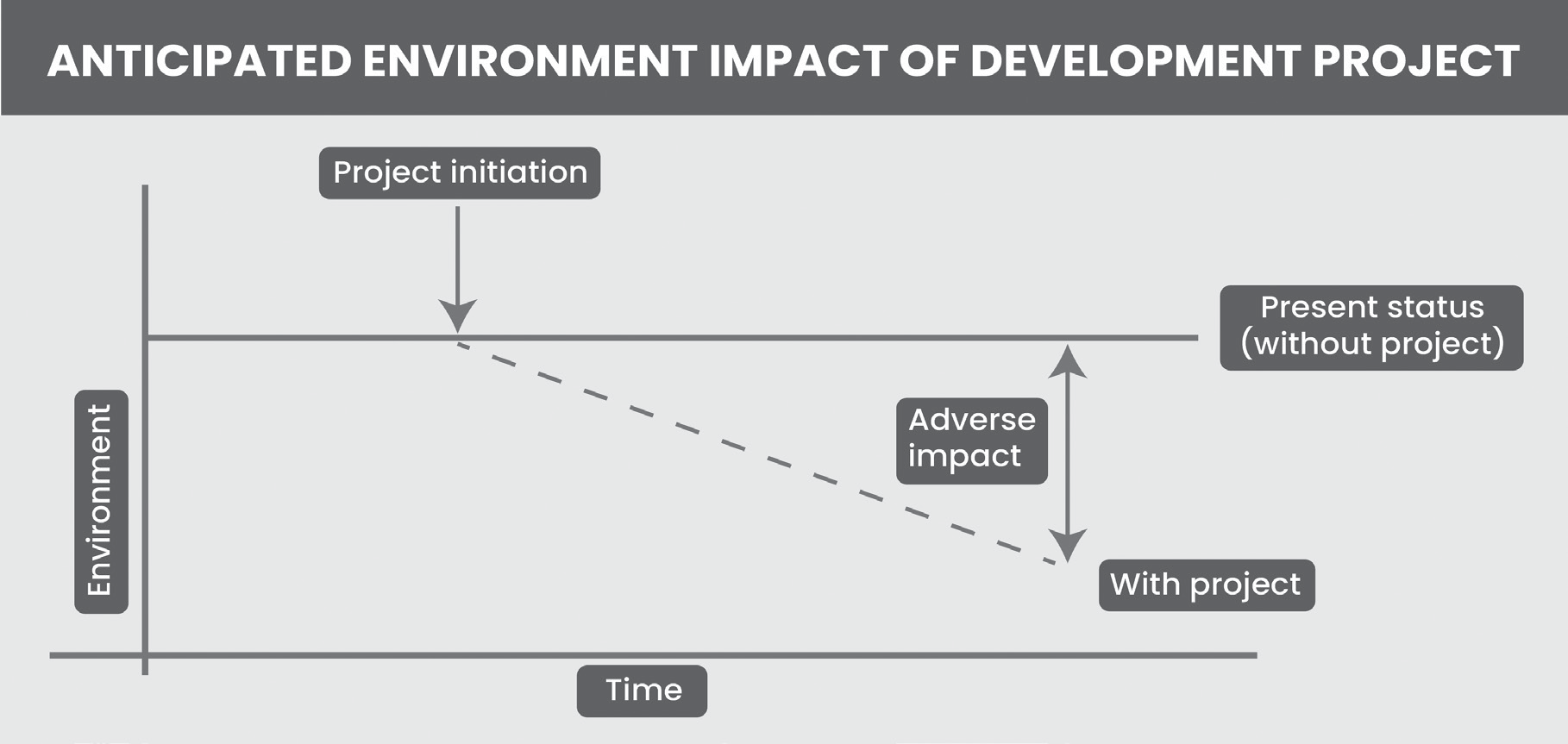
Environmental Impact Assessment (EIA) is a process used to evaluate the potential effects, both positive and negative, that a proposed project, policy, program, or any other action may have on the environment.
It is conducted before the decision to proceed with the proposed action is made.
The goal of EIA is to ensure that development activities are aligned with environmental considerations, aiming to strike a balance between development and environmental protection.
Evolution of EIA
• The Environmental Impact Assessment (EIA) process originated in the early 1970s with the implementation of the National Environment Policy Act (NEPA) in the United States in 1969. Initially, it was mainly practiced in
high-income countries like Canada, Australia, and New Zealand around 1973-74.
However, some developing countries also adopted EIA relatively early, such as Colombia in 1974 and the Philippines in 1978.
The EIA process gained momentum after the mid-1980s, with the World Bank adopting EIA for major development projects in 1989. Under this approach, borrower countries were required to conduct an EIA supervised by the World Bank for significant projects.
| Mid 1980s to end of decade | From the mid-1980s to the end of the decade: In Europe, the European Commission (EC) Directive on EIA was established, setting out basic principles and procedural requirements for all member states. There were increasing efforts to address the cumulative effects of Environmental Impact Assessment (EIA), considering the combined impacts of multiple projects or activities. Leading international aid agencies, including the World Bank, established Environmental Assessment (EA) requirements for projects they financed. The EIA process spread widely in Asia, with more countries in the region adopting and implementing EIA procedures to assess environmental impacts. |
| 1990s | The Espoo Convention introduced requirements to consider trans-boundary effects in Environmental Impact Assessment (EIA). There was an increased use of Geographic Information Systems (GIS) and other information technologies in EIA processes. The sustainability principle and global issues received increased attention in EIA. India formally adopted Environmental Impact Assessment (EIA) procedures. Many developing countries formulated Environmental Assessment (EA) legislation during this period. There was a rapid growth in Environmental Assessment (EA) training programs. |
EIA in India
EIA in India has evolved over several decades:
In 1976-77, the Indian government initiated the examination of river-valley projects from an environmental perspective, under the direction of the Planning Commission and the Department of Science and Technology.
This approach expanded to include projects requiring approval from the Public Investment Board (broadening the scope of environmental assessment).
However, until 1994, environmental clearance from the Central Government was largely an administrative decision lacking legislative support.
On 27 January 1994, a significant development occurred with the promulgation of an EIA notification by the Union Ministry of Environment and Forests (MEF) under the Environmental (Protection) Act 1986.
This notification made Environmental Clearance (EC) mandatory for the expansion, modernization, or establishment of new projects listed in Schedule 1 of the notification.
Objective
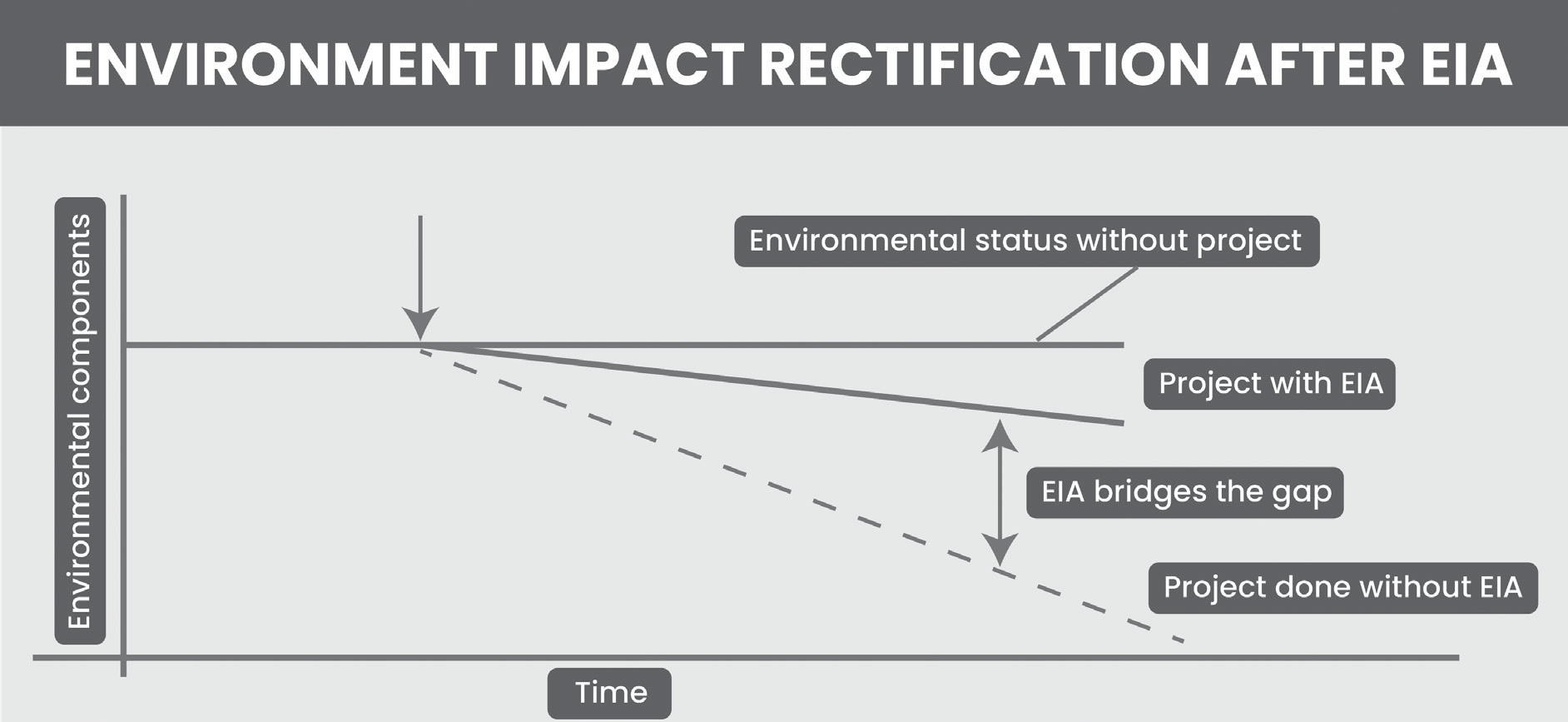
The main goal of Environmental Impact Assessment (EIA) is to help planners anticipate any environmental issues that could arise from a proposed development.
By identifying these potential problems early on, during the planning and design phase of a project, EIA allows for measures to be taken to address and mitigate them
effectively.
EIA Process
Screening: Determine if EIA is needed and the level of assessment required.
Scoping: Identify key issues, impacts, study boundary, and timeframe.
Impact Analysis: Identify and predict environmental and social impacts, and evaluate significance.
Mitigation: Recommend actions to reduce adverse environmental consequences.
Reporting: Present EIA results in a report to decision- makers and stakeholders.
Review: Assess adequacy and effectiveness of the EIA report.
Decision-making: Decide project approval, rejection, or modifications.
Post-monitoring: Ensure project impacts comply with legal standards and mitigation measures are implemented as described in the EIA report.
Forms of impact assessment
Health Impact Assessment (HIA): Evaluates the health consequences of development projects or policies.
Social Impact Assessment (SIA): Assesses the social consequences of development initiatives.
Strategic Environment Assessment (SEA): Analyzes the environmental effects of strategic actions, policies, plans, and programs.
| Strategic environment assessment | Environment impact assessment |
| Takes place at earlier stages of decision-making cycle Pro-active approach to developmentproposals Identifiesenvironmentalimplications,issuesof sustainable development Broad range of potential alternatives are considered Early warning of cumulative effects. Emphasisonmeetingenvironmentalobjectives, maintaining natural systems. Broad perspective, lower level of detail toprovide a vision, overall framework. Multi-stage process, overlapping components, policy level is continuing, iterative. Focuses on sustainability agenda | Takes place at the end of decision-making cycle Reactive approach to development proposal Identifies specific impacts on the environment Considers a limited number of feasiblealternatives Limited review of cumulative effects Emphasis on mitigating & minimizing impacts Narrow perspective, high level of detail Well-defined process, clear beginning and end Focuses on standard agenda, treats symptoms of environmental deterioration |
Stakeholders in the EIA Process
Proponent of the project
Environmental consultant who prepares EIA on behalf of project proponent
Pollution Control Board (State/ National)
Public
Impact Assessment Agency
Regional centre of the MoEFCC
Salient Features of 2006 Amendments to EIA Notification
Projects were categorized into Category A and Category B, with Category A projects requiring appraisal at the national level by the Impact Assessment Agency (IAA) and the Expert Appraisal Committee (EAC), while Category B projects are appraised at the state level.
State Level Environment Impact Assessment Authority
(SEIAA) and State Level Expert Appraisal Committee (SEAC) were established to provide clearance to Category B projects. Four Stages of EIA Cycle: The EIA process was divided into
four stages:
Screening,
Scoping,
Public Hearing,
Appraisal.
Category A projects require mandatory environmental clearance and do not undergo the screening process.
Category B projects undergo the screening process and are classified into two types:
Category B1 projects: These mandatorily require EIA.
Category B2 projects: These do not require EIA. Exclusion of Category B2 Projects: Category B2 projects are excluded from the complete EIA process.
Composition of the expert committees for EIA
Expertise in Various Disciplines: The committees include experts in disciplines such as ecosystem management, pollution control, water resource management, flora and fauna conservation, land use planning, social sciences, project appraisal, ecology, environmental health, and subject area specialists.
Representation of Concerned Parties: The committees also include representatives from non-governmental organizations (NGOs) or individuals concerned with environmental issues.
Chairmanship: The Chairman of the committee is an experienced ecologist, environmentalist, or technical professional with wide managerial experience in relevant development sectors.
Member-Secretary: The representative of the Impact Assessment Agency serves as the Member-Secretary of the committee.
Individual Capacities: Chairman and members serve in their individual capacities, except for those specifically nominated as representatives.
Limit on Membership: The membership of a committee is limited to a maximum of 15 members.
Shortcomings of Environmental Impact Assessment Applicability
There are certain projects that have notable environmental effects but are not covered by the notification because they either don’t appear on Schedule I or their investments fall below the threshold specified in the notification. This means that these projects are not subject to the same environmental assessment and clearance process outlined in the notification.
Composition of expert committees and standards
It has been observed that the teams responsible for conducting Environmental Impact Assessment (EIA) studies lack expertise in various important fields. For example, they may lack environmentalists, wildlife experts, anthropologists, and social scientists who are needed to thoroughly evaluate the environmental and social impacts of the project.
Public hearing
Public comments are not taken into account early on, leading to conflicts during later stages of project clearance.
Many projects with significant environmental and social impacts are exempted from mandatory public hearings.
Documents that the public should have access to are often not provided on time.
The knowledge and input of local people are not respected or considered by those collecting data for the projects.
Quality of EIA
Reports are often incomplete and contain inaccurate data.
Many EIAs rely on data collected during only one season, which may not accurately represent environmental conditions throughout the year.
EIA documents are often overly technical and difficult to understand, making it hard for decision-makers to use them effectively.
Lack of Credibility
Project proponents commission the EIA, but they have a vested interest in getting approval for their project.
The funding for the EIA often comes from parties interested in project approval, leading to potential bias.
EIA reports may be biased or fraudulent, with inaccurate data or the same data used for different locations.
There’s no accreditation for EIA consultants, so those with a history of fraud can’t be held accountable.
It’s unlikely for consultants, who are paid well by project proponents, to produce a report suggesting the project is unviable.
Case Study
The Ministry of Environment and Forests (MoEF) formed a panel called the Western Ghats Experts Ecology Panel (WGEEP) in 2010, led by Prof. Madhav Gadgil.
The panel submitted a report in 2011 suggesting significant changes to conserve the Western Ghats, but it was not immediately made public.
The recommendations were strict and could adversely affect mining and sand mafias, as well as local encroachers.
Due to pressure from different stakeholders, MoEF established the High-Level Working Group (HLWG), chaired by Dr. K. Kasturirangan, to review WGEEP’s recommendations.
The HLWG watered down many of WGEEP’s suggestions
to accommodate the interests of various mafias.
Monitoring, compliance and institutional arrangements
Sometimes, especially for industries like nuclear energy, the plans for managing environmental impacts (EMPs) are kept secret due to political or administrative reasons.
Information about how well the mitigation measures are working and if they are being followed is often not shared.
Plans for dealing with emergencies are not explained well enough, and the information is not shared with the communities.
Independent EIA Authority.
Establish a separate organization that oversees the environmental impact assessment process independently.
Conduct assessments for entire industries rather than individual projects.
Create a central repository of basic environmental data for easy reference during assessments.
Share all project-related details with local communities and the public, from project announcement to clearance.
Applicability
Any project that could significantly change ecosystems should require environmental clearance, with no exceptions.
Protection of Ecologically Sensitive Areas: Avoid allowing industrial development in areas that are ecologically fragile or sensitive.
Public hearing
Public hearings should be required for all projects that previously didn’t need them but now have environmental impacts.
Quality
EIA should prioritize conserving natural resources over using them.
EIA reports should better assess the biodiversity of project areas and its impact.
EIA reports should clearly list the negative impacts of proposed projects, separate from technical details.
EIAs should be prepared independently of the project proponent to ensure impartiality.
Grant of clearance
The notification should clarify that site clearance doesn’t guarantee full environmental clearance from the Impact Assessment agency.
Composition of expert committees
Replace current executive committees with experts from various stakeholder groups who are respected in environmental and related fields.
Monitoring, compliance and institutional arrangements EIA notification should include automatic withdrawal of clearance if conditions are violated, with stricter penalties
for noncompliance. Currently, the notification only addresses clearance stage.
Redressal
Change NGT composition to include more environmental judges. Citizens should have access to address violations and non-compliance issues.
Capacity building
NGOs, civil society, and local communities should improve their ability to use EIA notifications for better decision- making on projects.
These are the categories of projects that require clearance from the central government:
Individualp rojects requiringcentral government clearance.
Nuclear power and related projects.
River valley projects, including hydel power, major irrigation, and flood control.
Ports, harbours, and airports (excluding minor ports and harbours).
Petroleum refineries, including crude and product pipelines.
Chemical fertilizers and pesticides.
Petrochemical complexes, petrochemical intermediates, and basic plastics production.
Bulk drugs and pharmaceuticals.
Oil and gas exploration, production, transportation, and storage.
Synthetic rubber production.
Asbestos and asbestos products.
Hydrocyanic acid and its derivatives.
Primary metallurgical industries (iron and steel, aluminium, copper, zinc, lead, ferroalloys).
Chlor-alkali industry.
Integrated paint complexes, including resin and raw material production for paints.
Viscose staple fibre and filament yarn production.
Storage batteries integrated with lead oxide and lead antimony alloy production.
Tourism projects within 200m-500m of High-Water Line and above 1000m elevation with
investment exceeding Rs. 5 crores.
Thermal power plants.
Mining projects with leases exceeding 5 hectares.
Highway projects (excluding improvement works not passing through ecologically sensitive areas).
Tarred roads in the Himalayas and forest areas.
Distilleries.
Raw skins and hides.
Pulp, paper, newsprint, and dye production.
Cement production.
Electroplating.
Meta aminophenol production, etc.
The important aspects of EIA are
Risk assessment: Identifying and evaluating potential risks to the environment posed by a proposed project.
Environmental management: Implementing strategies to minimize and manage adverse environmental impacts during and after the project.
Post-project monitoring: Continuously observing and assessing the project’s environmental performance after its completion.
EIA is meant to
Serve as a primary tool for assessing environmental impacts, with clear guidelines and regulations.
Be applied consistently to all projects that could affect the environment.
Use scientific methods to identify potential impacts and recommend mitigation measures.
Address all possible effects, including short-term and long-term, at various scales.
Consider sustainable practices such as environmental capacity, biodiversity protection, and carrying capacity.
Involve the public in the decision-making process through a flexible approach.
Establish mechanisms for ongoing monitoring, feedback, and follow-up to ensure compliance with environmental standards.
Include processes for monitoring, auditing, and evaluating the effectiveness of mitigation measures.
Environmental Components of EIA
The EIA process examines various components of the environment, including:
Air environment:
Assessing the quality of the air and predicting any changes.
Gathering meteorological data like wind speed, humidity, etc.
Estimating the amount of emissions expected from the project and their impact on the area.
Setting pollution control measures to meet air quality standards.
Noise:
Evaluating existing and predicted noise levels.
Planning strategies to minimize noise pollution.
Water environment:
Examining the quality and quantity of ground and surface water resources in the project area.
Assessing how the proposed project might affect water resources.
Biological environment:
Studying the flora and fauna present in the area affected by the project.
Predicting potential damage to biodiversity from project- related activities like emissions and landscaping.
Assessing biological stress caused by the project.
Land environment:
Analyzing soil characteristics, land use, and drainage patterns.
Predicting the adverse impact of the project on the land.
Evaluating the project’s impact on historical monuments and heritage sites.
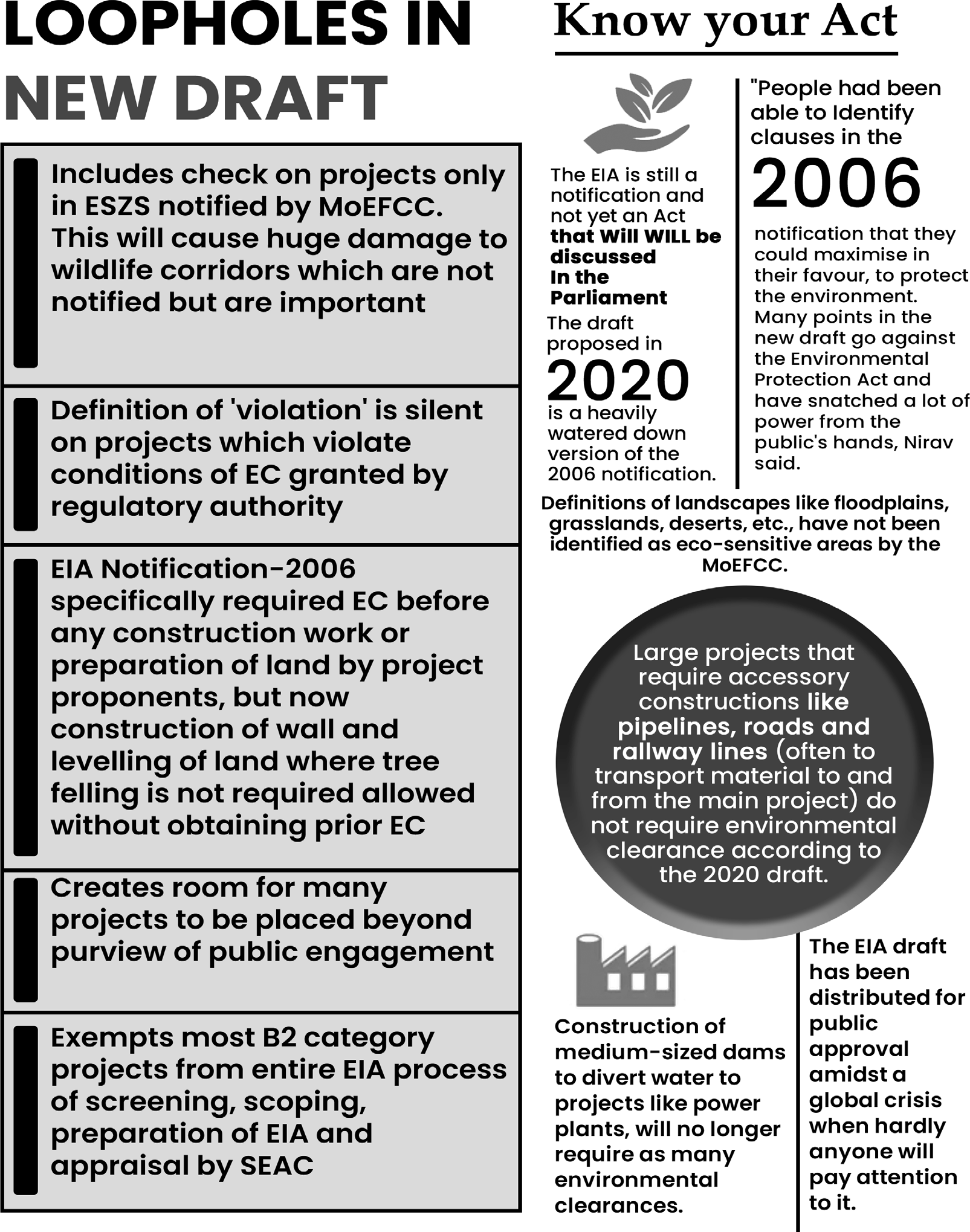
New Draft EIA, 2020
The new Draft EIA, 2020 introduces three project categories: A, B1, and B2, based on their social, economic, and geographical impacts.
It proposes two types of approvals: prior environmental clearance (EC) with expert committee approval and environmental permission (EP) without such approval.
Around 40 projects, including clay and sand extraction, solar thermal power plants, and common effluent treatment plants, are exempt from prior EC or EP.
Additionally, certain projects like irrigation, chemical fertilizers production, building construction, and highways are exempt from public consultation.
Issues with Draft EIA 2020
Ex Post Facto Clearance of Projects
In 2017, the Ministry of Environment, Forest and Climate Change (MoEF) introduced a notification allowing such projects to apply for environmental clearances.
This provision has now become permanent through the draft Environmental Impact Assessment (EIA), 2020.
Essentially, industrial units or projects operating illegally without environmental clearance have the opportunity to become legal by submitting a remedial plan.
Even projects that may have acquired land illegally or through coercion or fraud can benefit from this scheme.
However, the Supreme Court has previously ruled that post facto clearances go against environmental laws and are harmful to the environment. Despite this, post facto clearance has been provided in India even before the issuance of these notifications.
Exclusion of Projects from Prior Environmental Clearance
40 projects were exempted from needing prior environmental clearance (EC) or environmental permission (EP).
Activities like removing sand deposits from agricultural fields and community works no longer need prior EP or EC.
The new draft specifies that constructing buildings smaller than 150,000 square meters (about the size of a small airport or stadium) doesn’t require environmental clearance.
Exempting such projects from environmental regulations could harm the environment.
The validity period of environmental clearance has been extended for mining, river valley, and other projects, which doesn’t align with the purpose of the notification or the parent act.
Exclusion of Projects from Public Consultation
Public participation is crucial in the EIA process.
However, many projects were exempted from public consultations.
This includes highways and building construction projects, among others.