Geoengineering to Fight Climate Change
GEOENGINEERING TO FIGHT CLIMATE CHANGE
Geoengineering is when humans intentionally intervene in
the Earth’s natural systems to address climate change.
This can involve various methods like managing sunlight, capturing carbon dioxide and other greenhouse gases from the air, planting trees on a large scale, and protecting icy regions like polar ice caps.
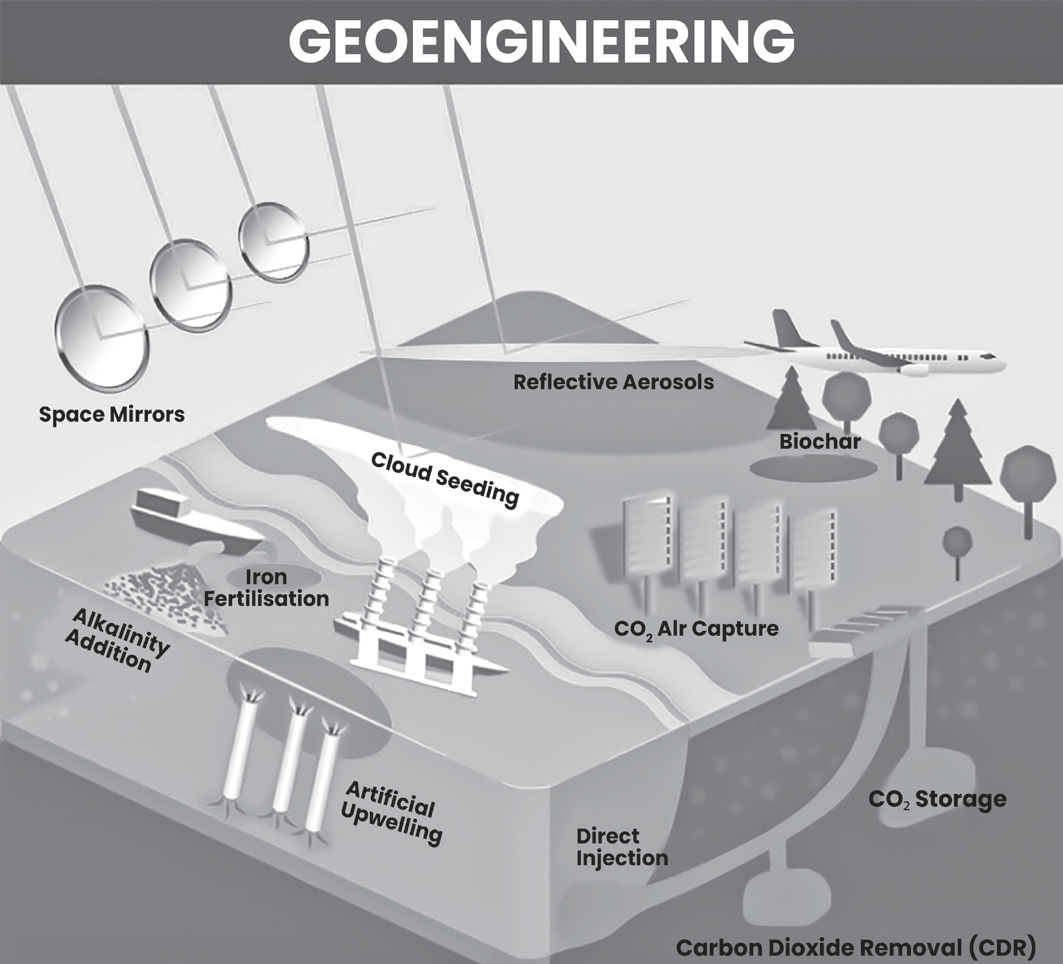
Solar Radiation Management (SRM) or Solar Geoengineering
Solar Radiation Management (SRM) or Solar Geoengineering involves methods to reflect some of the Sun’s energy back into space to cool the Earth.
This can include making clouds or land surfaces more reflective (Albedo Enhancement), deploying space reflectors to block sunlight, or releasing reflective particles (Stratospheric) into the upper atmosphere.
Greenhouse Gas Removal (GGR) or Carbon Geoengineering Greenhouse Gas Removal (GGR) or Carbon Geoengineering involves methods to directly remove carbon dioxide or other
greenhouse gases from the atmosphere.
These methods include
Afforestation: Planting trees on a large scale globally to absorb carbon dioxide from the atmosphere.
Biochar: Converting biomass into charcoal-like material and burying it in the soil to lock up carbon.
Bio-energy with carbon capture and sequestration: Growing biomass, burning it for energy, and capturing and storing the carbon dioxide emissions produced.
Ambient Air Capture: Building machines that can directly capture carbon dioxide from the air, especially beneficial if they are carbon negative (absorbing more carbon than they emit).
Ocean Fertilization: Adding nutrients to the ocean to stimulate the growth of phytoplankton, which can absorb carbon dioxide during photosynthesis.
Enhanced Weathering: Exposing minerals that naturally react with carbon dioxide in the atmosphere, leading to the formation of stable compounds that can be stored in the ocean or soil.
Forests play a crucial role in carbon geoengineering
Boreal forests, found in cold regions, store up to 80% of their carbon in the soil, particularly in dead organic matter like peat.
Tropical forests absorb about 18% of the carbon dioxide emitted from fossil fuel burning.
Trees, plants, and soil can capture and store carbon dioxide from the atmosphere, providing a temporary solution to reduce emissions.
International agreements like the Kyoto Protocol recognize the importance of forests in absorbing carbon dioxide, considering it as valid as reducing emissions from fossil fuels to combat global warming.
Artificial snow
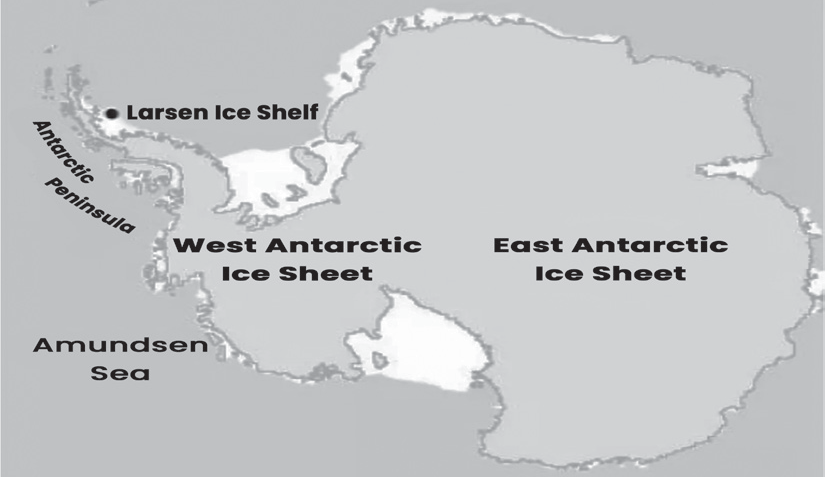
As a last-resort geoengineering effort to prevent the disintegration of the West Antarctic Ice Sheet, scientists propose covering its surface with artificial snow. This ambitious plan would utilize thousands of wind turbines to pump seawater up to the surface, where it would freeze into snow. The goal is to add enough weight to the ice sheet to prevent further collapse, thus mitigating the risk of significant global sea level rise caused by its melting.
Transition Away from Coal
Transitioning away from coal is essential to align with the IPCC’s trajectory for limiting global warming to 1.5 C. One proposal to achieve this is by prioritizing the phase- out of the oldest coal plants. This approach would involve gradually decommissioning coal-powered electricity generation, starting with the oldest plants.
It would allow for a differentiated transition rate between developed and developing economies, as many older coal plants are located in developed countries, while newer ones are prevalent in developing nations, with many still under construction.
Current phaseout efforts
Current efforts to phase out coal include plans by several countries like the UK, France, Italy, and Germany to shut down coal-fired electricity generation.
The “Powering Past Coal” Alliance, announced at UNFCCC COP23, aims to coordinate international efforts to phase out coal, targeting OECD countries by 2030 and globally by 2050.
However, major coal consumers and exporters like the US, Japan, China, India, Australia, Indonesia, Russia, and South Africa are not fully engaged.
Also, existing phase-out plans, such as Germany’s, are not ambitious enough to meet the 2 C target. Despite efforts in Europe and OECD countries, coal consumption is projected to increase globally by five percent between 2010 and 2040, with India’s coal consumption expected to rise by 29 percent by 2040.
Barriers to Phasing Out Coal Power
The obstacles to phasing out coal power are mainly economic and political, rather than technological. They typically involve four main challenges: stranded assets, loss of livelihoods, electricity price concerns, and issues related to irresponsible financing.
Livelihood impacts
The transition away from coal power can have significant impacts on livelihoods, especially in countries like India, China, and Australia where many people depend on coal- related jobs. In India, about one million jobs are directly or indirectly tied to coal power, while in China, around five million people work in the coal industry.
Similarly, in Australia, approximately 50,000 people are employed in coal mining. These jobs often provide significant income, with coal royalties making up a large portion of earnings in states like Jharkhand and Odisha in India. However, many coal workers are older and may face challenges in finding new employment opportunities or acquiring new skills.
Stranded assets
Stranded assets refer to investments that become economically unviable or obsolete before the end of their expected lifespan. In the context of coal power, this
means that investments made in coal-fired power plants may not generate the expected returns due to changes in energy markets or policies aimed at reducing carbon emissions.
For example, in India, significant investments have been made in coal power plants since 2006, totaling around 151 gigawatts (GW) of new capacity. However, much of this capacity uses older, less efficient technology, making it vulnerable to becoming stranded assets as cleaner and more cost-effective alternatives emerge.
Similarly, China has also experienced overcapacity issues in its coal power sector due to policy decisions that led to an oversupply of coal-generated electricity.
In countries like Europe and the US, coal power plants are closer to the end of their operational lives, so the issue of stranded assets is less significant compared to countries like India and China.
However, coal remains a major export commodity for countries like Australia and Indonesia, which could face economic challenges if global demand for coal declines due to efforts to combat climate change.
Electricity prices
Electricity prices play a significant role in the transition away from coal power. In India, electricity generated from newly built coal power plants is still cheaper than electricity from renewable sources, although new renewable energy projects are becoming more cost- effective than proposed new coal power plants.
Also, renewable energy sources like wind and solar may require investments in battery and storage technology to ensure continuous availability, which adds to the overall cost.
Moreover, residential consumers typically pay lower electricity tariffs compared to industrial consumers. This price difference makes it less likely for residential consumers to switch to renewable energy sources, as they may not see immediate cost benefits.
Irresponsible financing
Irresponsible financing refers to the financial support provided by larger economies for coal-based projects in developing countries. Despite global efforts to reduce coal usage, the number of countries using coal power has increased.
This trend is driven by public finance from major economies, which prioritizes fossil-based growth in the developing world over renewable energy projects.
In recent years, G20 members have allocated more funding for overseas coal projects than for renewables. This has led to a surge in planned coal plants in regions like Africa, which require significantly more capacity than what currently exists.
Developed countries, which are phasing out their own coal plants, are seeking new markets for their coal in the developing world.
Climate Smart Cities
Climate Smart Cities are urban centers that adopt an integrated approach to managing their landscapes and ecosystems to address both sustainable development and climate change challenges.
Since cities are responsible for a significant portion of global greenhouse gas emissions, they face severe consequences such as heat waves, water crises, flooding, and more.
Making cities more resilient, sustainable, inclusive, and
safe is a crucial aspect of achieving the United Nations’ Sustainable Development Goal 11.
This involves modifying urban infrastructure and systems to reduce heat generation and retention, promoting clean transportation options like public transit and electric vehicles, and transitioning to cleaner fuels.
By reducing the heat-retaining nature of cities, they can lower their carbon footprint and contribute to mitigating climate change.
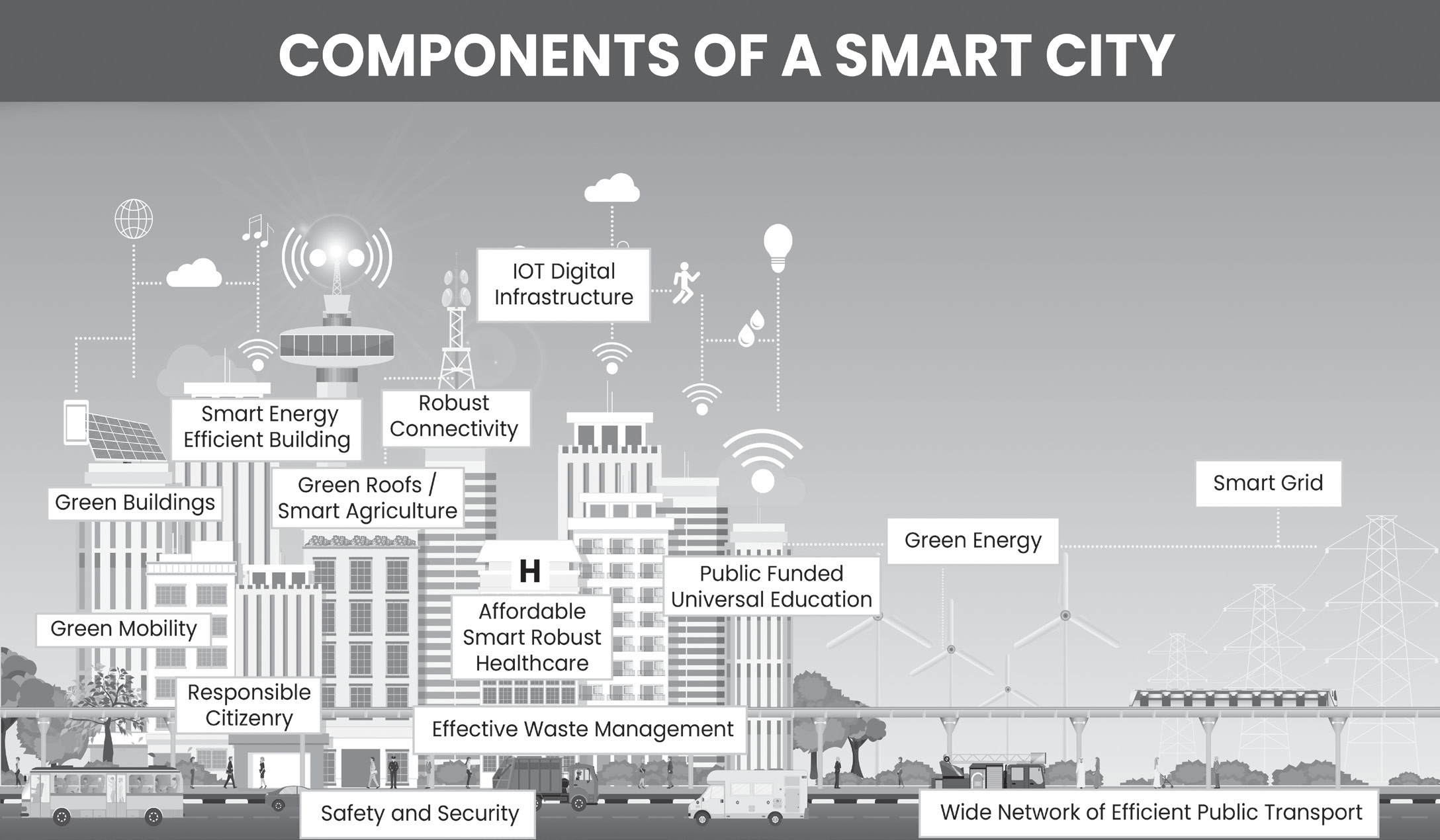
Measures Required to Reduce the Heat-Retaining Nature of Cities
To reduce the heat-retaining nature of cities, we can take several measures:
Use light-colored materials like asphalt and roofing to reflect sunlight instead of absorbing heat.
Implement cool pavements and rooftops designed to reflect more sunlight and absorb less heat, reducing the need for air conditioning.
Adopt green roofing by covering roofs with vegetation, which also helps in cooling buildings.
Transition away from materials that absorb heat towards alternative construction materials and technologies.
Develop green cities by decentralizing development and incorporating sustainable practices like in Dholera Smart City, Gujarat.
Relocate polluting industries away from urban areas to reduce heat and pollution.
Increase tree and vegetation cover within cities to provide shade and cool the environment.
Treat heat waves as natural disasters and implement strategies to mitigate their effects.
Improve ventilation in cities through urban planning and design interventions.
Incorporate the green belt concept in urban planning and enforce building codes that promote passive cooling practices.
Use double glazing for windows to reduce heat transfer.
Utilize evaporative cooling through fountains to dissipate heat.
Implement indirect radiant cooling methods to transfer heat away from high-conducting materials to cooler surfaces.
Measures Taken in India
In India, several measures are being taken to reduce the heat- retaining nature of cities:
Cool roof and Cool pavement programs: These initiatives involve lightening the colors of roofs and pavements to reduce heat absorption and are part of Indian cities’ heat action plans.
National Mission on Sustainable Habitat: This mission focuses on transitioning away from heat-absorbent materials to more sustainable alternatives.
Building Material and Technology Promotion Council (BMTPC): This council, under the Union Ministry of Housing and Urban Affairs, promotes various alternative materials and technologies to reduce heat retention in buildings.
Climate-Smart Cities Assessment Framework: This framework aims to incorporate climate-sensitive approaches into urban planning to create cities that are resilient to climate change effects.
Climate-Smart Cities Assessment Framework (CSCAF)
The Climate-Smart Cities Assessment Framework (CSCAF) is an initiative by the Ministry of Housing and Urban Affairs to address the challenges of rapid urbanization in India.
With 40% of the population expected to live in cities by
2030, there’s a need to adopt a climate-sensitive approach to urban planning and development.
CSCAF aims to promote sustainable and resilient urban habitats by encouraging cities to adopt and implement best practices. It sets standards by comparing India’s efforts with international benchmarks.
The Climate Centre for Cities, under the National Institute of Urban Affairs, supports the Ministry in implementing CSCAF.
Also, other programs like the Green India Mission, National Clean Air Programme, AMRUT (which focuses on providing basic amenities for urban improvement), Swachh Bharat Mission, and Urban Transport are also contributing to making cities climate-smart.
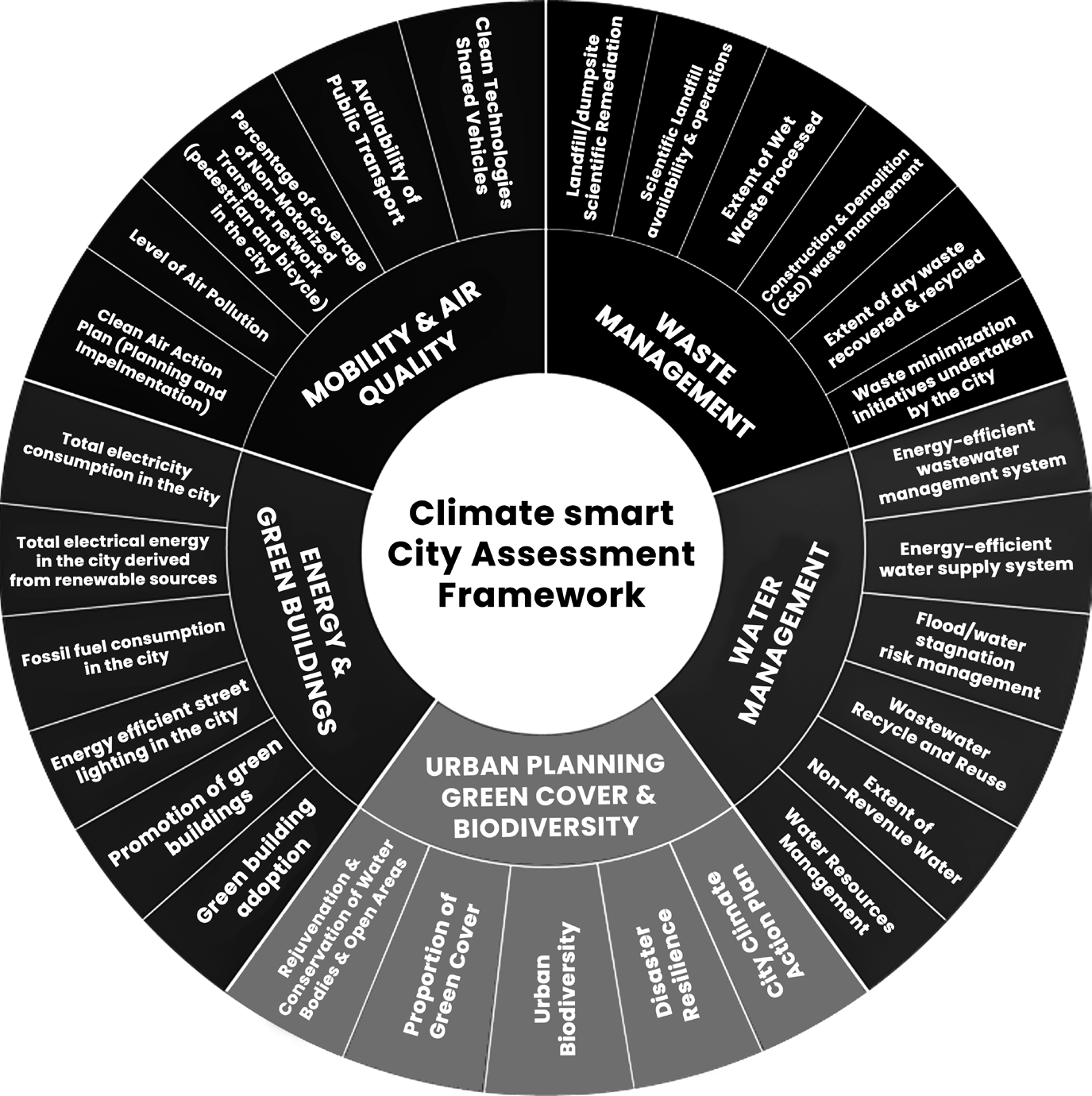
Climate-Smart Cities Assessment Framework (CSCAF 2.0) The Climate-Smart Cities Assessment Framework (CSCAF 2.0) is a tool launched by the Ministry of Housing and Urban
Affairs (MoHUA) to help cities tackle climate change in their planning and actions.
It provides a roadmap with 28 indicators grouped into five categories:
Energy and Green Buildings
Urban Planning, Green Cover & Biodiversity
Mobility and Air Quality
Water Management
Waste Management
Green Rating for Integrated Habitat Assessment (GRIHA)
Green Rating for Integrated Habitat Assessment (GRIHA) is a rating system used in India to evaluate how environmentally friendly buildings are.
It’s like a report card for buildings, assessing their performance against specific standards.
Developed by The Energy & Resources Institute (TERI) with support from the Ministry of New & Renewable Energy (MNRE), GRIHA helps identify which buildings are truly “green” based on their environmental impact.
Some of the benefits of a green building are
They use less energy while still keeping people comfortable.
They help protect natural areas, wildlife, and soil from damage.
They reduce pollution in the air and water, which is good for our health.
They use less water.
They produce less waste because they recycle and reuse materials.
Transition to Green Economy
Transitioning to a green economy involves three main priorities:
Reducing the carbon emissions in our economy.
Ensuring fairness and equality for everyone in environmental decisions.
Protecting and preserving the natural world.
Measures to Adapt Green Economy
Conducting energy audits to reduce your building’s environmental impact.
Practicing sustainable fishing methods.
Managing forests in a sustainable manner.
Using electronic files instead of paper to reduce paper consumption.
Supporting products made from certified sustainable forests.
Sharing rides or using public transportation instead of driving alone.
Walking or biking for short trips instead of using a car.
Using water wisely and conserving it.
Investing in clean and renewable energy sources like solar and wind power.
Recycling materials and composting food waste.
Transitioning to a green economy can lead to sustainable development.
Green Contracts
Green contracts are agreements between businesses that require them to reduce their greenhouse gas emissions while providing goods or services.
These contracts often start during the bidding process when companies compete for the opportunity to fulfill the contract.
Green tender
A green tender is a bidding process where companies compete for a contract while considering environmental qualifications. Once a bidder is selected, the contract specifies the environmental obligations, making them legally binding.
Advantages
Reduced environmental impact, such as lower carbon emissions.
Enhanced reputation and goodwill for the corporation in the market.
Potential tax rebates for participating corporations.
Concerns
Lack of effective auditing to ensure compliance with the terms of the contracts.
Higher costs associated with green contracts compared to conventional contracts that don’t consider environmental factors.
Net Zero Emissions & Carbon Neutrality
Net zero emissions means that the amount of greenhouse gases (GHGs) emitted into the atmosphere is balanced by the amount removed.
Similarly, carbon neutrality, or net zero carbon footprint, refers to achieving a balance between the amount of carbon dioxide (CO2) emitted and the amount removed from the atmosphere.
To keep global warming below 1.5 C, greenhouse gas emissions need to be reduced by 45% by 2030 and reach net zero by 2050, as outlined in the Paris Agreement.
Achieving this target requires a transition away from coal and towards renewable energy sources.
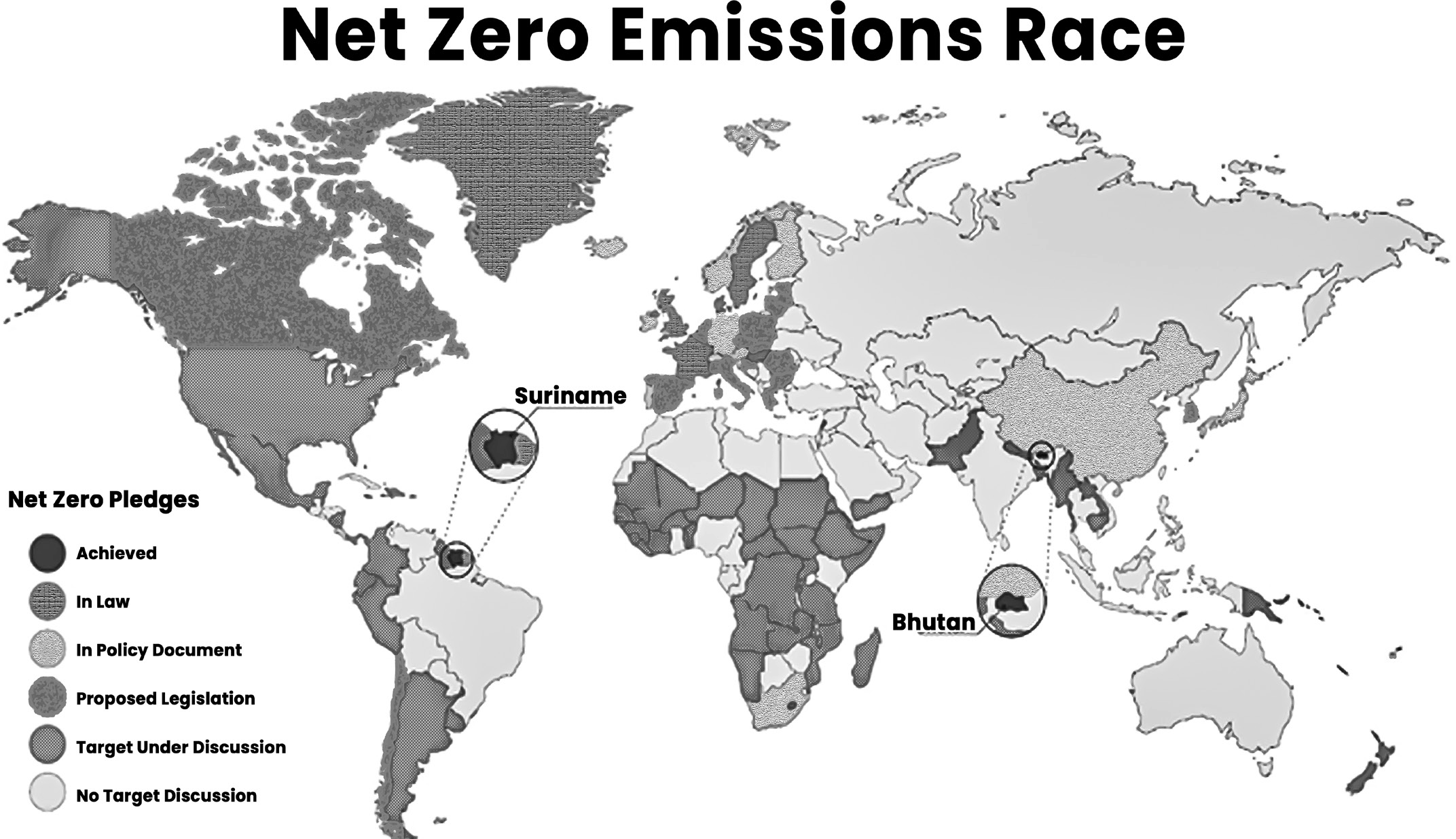
Some countries have committed to achieving net zero emissions, but major emitters like China, the US, and India have not yet made such commitments.
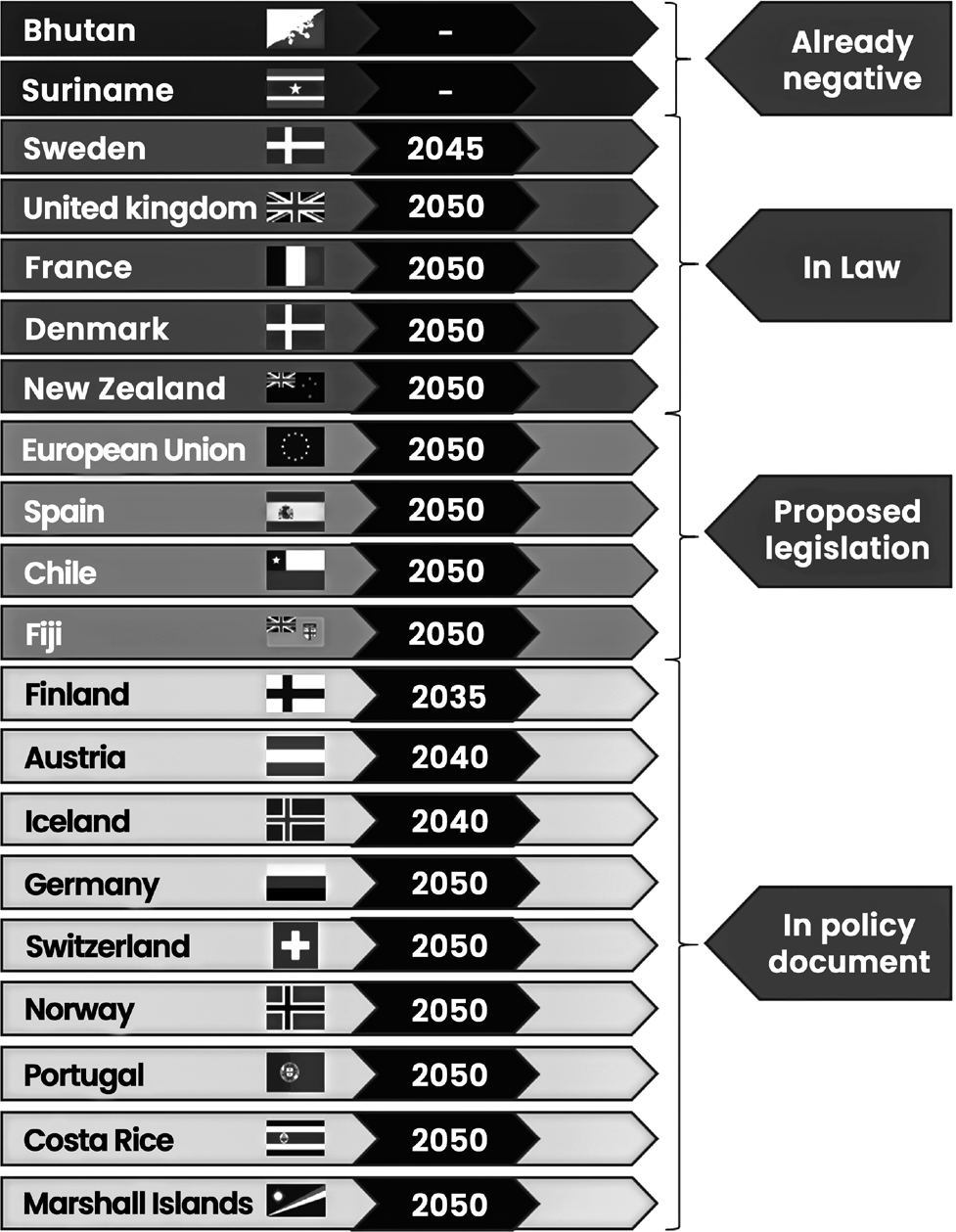
Among developed countries with net zero legislation, only Sweden aims to achieve net zero before 2050.
Suriname and Bhutan are the only countries that have achieved carbon neutrality, where GHG emissions are less than the amount removed.
Clean coal technology: This is a How Can Net Zero Emissions Be Achieved?
short-term measure aimed at reducing CO2 emissions from coal-based power plants.
Carbon sequestration: This is a long-term sustainable measure that involves capturing and storing CO2 emissions underground to prevent them from entering the atmosphere.
Afforestation: Planting trees and restoring forests to act as carbon sinks, absorbing CO2 from the atmosphere and storing it in biomass and soils.
Geoengineering: While considered a last-resort option, geoengineering involves large-scale interventions in the Earth’s climate system to counteract global warming.
Electric mobility and renewable energy: Transitioning to electric vehicles and increasing the use of renewable energy sources like solar and wind power helps reduce reliance on fossil fuels.
Carbon trading and carbon tax: These are long-term measures aimed at putting a price on carbon emissions, either through a tax on emissions or through a market- based system where companies can buy and sell carbon credits.
European Green New Deal
The European Green New Deal is a plan by the European Union to tackle climate change and reduce greenhouse gas emissions.
The EU is one of the world’s largest emitters of greenhouse gases, so it’s taking action to reduce its emissions.
Previous Commitments: Under the Paris Agreement, the EU pledged to cut its emissions by 40% by 2030 compared to 1990 levels.
New Targets: With the European Green New Deal, the
EU is now aiming for even more ambitious goals. It wants to increase its emission reduction target to at least 50% by 2030 and work towards reaching climate neutrality (zero emissions) by 2050, possibly aiming for a 55% reduction.
Even before this, the EU had more ambitious reduction targets than other developed countries like the US, which had committed to cutting emissions by 26-28% by 2030 compared to 2005 levels. However, the US has since withdrawn from the Paris Agreement.
India’s Objection to Net Zero
The Paris Agreement does not explicitly include net zero goals. It emphasizes each country’s best efforts to combat climate change through their Intended Nationally Determined Contributions (INDCs).
Many countries have set targets for emissions reduction by 2025 or 2030, but developed nations have not fully met their past commitments under the Paris Agreement.
Instead of diverting attention to net zero targets, countries should prioritize fulfilling their existing promises.
As a developing country, India prioritizes economic growth, which may be hindered by immediate net zero emission goals.
Carbon removal technologies are often unreliable or prohibitively expensive, posing challenges to achieve net zero emissions.
India’s increasing energy demands make achieving net zero emissions in the near future unfeasible