Sources of Energy
SOURCES OF ENERGY
Conventional Sources
Conventional sources of energy primarily refer to fossil fuels such as coal, oil, and natural gas. These resources have been formed over millions of years from the decomposition of organic matter. However, their extraction and consumption rates far exceed the natural replenishment rate, making them non-renewable. As a result, they are being depleted rapidly, leading to environmental degradation and geopolitical tensions.
Non-Conventional Sources:
Non-conventional sources of energy, on the other hand, encompass renewable energy sources such as solar, wind, hydroelectric, geothermal, and biomass energy. Unlike conventional sources, these resources are replenished naturally and continuously. They offer sustainable solutions to energy needs while minimizing environmental impact and reducing dependency on finite fossil fuels.
| Conventional Sources of Energy | Non-Conventional Sources of Energy |
| These sources of energy are not abundant, present in limited quantity, e.g. coal, petroleum, natural gas. | These sources of energy are abundant in nature, e.g. solar energy, wind energy, tidal energy, biogas from biomass etc. |
| They have been in use for a long time. | They are yet in development phase over the past few years. |
| They are not replenished continuously. They are formed over a million years. | They are replenished continuously by natural processes. |
| They are called non-renewable sources of energy. | They are called renewable sources of energy. |
| They can be exhausted completely due to over- consumption except for hydel power. | They cannot be exhausted completely. |
| They pollute the environment by emitting harmful gases and also contribute to global warming. | They are environment-friendly, do not pollute the environment. |
| They are commonly used for industrial and commercial purposes. | They are used commonly used for household purposes. |
| Heavy expenditure is involved in using and maintaining these sources of energy. | Using these sources is less expensive. |
| They are used extensively, at a higher rate than the non-conventional sources. | They are not used as extensively as conventional sources. |
Nuclear Energy Sources
| Fuel | Advantages | Limitations |
| Nuclear energy | No air pollution Fuel efficient | High cost of construction of nuclear plant. Fear of security and nuclear accidents. Problem of safe disposal of nuclear waste. |
Nuclear energy is derived from certain radioactive minerals, primarily uranium and plutonium, which undergo controlled nuclear reactions to produce energy.
In nuclear fission, the nucleus of a heavy atom, such as uranium-235 or plutonium-239, is bombarded with neutrons, causing it to split into smaller fragments. This process releases a tremendous amount of energy in the form of heat, which is used to generate steam and drive turbines connected to generators to produce electricity. Nuclear fission is the principle behind the operation of nuclear power plants and is currently the most widely used method of generating nuclear energy.
Nuclear fusion involves the fusion or joining together of small nuclei, such as isotopes of hydrogen (deuterium and tritium), to form heavier nuclei. This process also releases a significant amount of energy, much more than nuclear fission.
Nuclear Fission
Radioactive minerals used in nuclear fission, like uranium, are considered non-renewable resources as they are ores found in limited quantities and cannot be replenished on human timescales.
Atomic nuclei of radioactive minerals, like uranium-235, are inherently unstable and can undergo fission when struck by a neutron. When a neutron collides with the nucleus of uranium-235, it causes the nucleus to split into smaller fragments, such as krypton and barium, releasing a significant amount of energy.
Additionally, several neutrons are emitted during this process, which can go on to strike other uranium-235 nuclei, triggering a chain reaction.
The chain reaction continues, releasing energy in the form of heat, as long as there is sufficient fissile material (uranium-235) and the conditions for sustaining the reaction are met. This continuous release of energy makes nuclear fission an efficient means of generating electricity.
In a nuclear power plant, the rate of the chain reaction is carefully controlled to prevent overheating and ensure safety. The heat generated by the fission process is used to produce high-pressure steam, which drives turbines connected to generators to produce electricity.
A cooling system, typically using water, is employed to carry away excess heat from the reactor core. The heat is transferred to water in a steam-generating unit through a heat exchanger, where it is converted into steam to power the turbines.
The steam produced from the heat generated by nuclear fission powers turbines, which, in turn, generate electricity. After passing through the turbines, the steam is condensed back into water using a cooling water system for reuse in the steam-generating unit.
Two other nuclear technologies for generating electricity from nuclear fuel in a safe and economic way have also been proposed, but so far, they have not proved operationally successful. These are: (i) nuclear breeder reactor, (ii) fusion reactor.
Nuclear Breeder Reactor
Traditional nuclear reactors, such as light water reactors (LWRs), use uranium fuel inefficiently. Only about 1% of the uranium-235 present in the fuel is utilized to produce steam for generating electricity.
A breeder reactor is designed to achieve significantly higher efficiency in fuel utilization compared to conventional reactors.
Typically, a breeder reactor is capable of utilizing between 40% and 70% of its nuclear fuel, making it much more efficient in extracting energy from the fuel.
Breeder reactors achieve this higher efficiency by using different fuel cycles and exploiting fissionable isotopes more effectively.
Instead of relying solely on uranium-235, breeder reactors utilize more abundant isotopes like uranium-238 or thorium-232.
These isotopes, upon absorbing a neutron, can be converted into fissile isotopes such as plutonium-239 or uranium-233, respectively.
Plutonium-239 and uranium-233 are capable of sustaining a nuclear chain reaction, thus serving as additional fuel sources within the reactor.
Nuclear Fusion Reactor
Nuclear fusion involves the merging or “fusion” of two light atomic nuclei to form a heavier nucleus, accompanied by the release of a substantial amount of energy.
This process is the primary source of energy production in stars, including our sun, where hydrogen nuclei fuse to form helium.
Replicating controlled nuclear fusion reactions on Earth for practical energy generation has been challenging.
The fusion reaction of deuterium (D) and tritium (T), isotopes of hydrogen, is one of the most studied fusion reactions. Deuterium-tritium fusion requires extremely high temperatures, around 100 million degrees Celsius, to overcome the electrostatic repulsion between positively charged nuclei and initiate the fusion process.
Problems Related to Nuclear Energy Generation
The major problems associated with the generation of nuclear power are:
The long-term storage and disposal of radioactive nuclear waste, which remains hazardous for thousands of years, pose significant challenges. Identifying suitable disposal sites and implementing safe containment measures are crucial but often contentious issues.
Accidental releases of radioactive materials from nuclear facilities can contaminate the environment, leading to long-lasting radioactive pollution. This contamination can have adverse effects on ecosystems, wildlife, and human health, particularly in the vicinity of nuclear accidents.
Nuclear power plants typically require large quantities of
water for cooling purposes, leading to thermal pollution when heated water is discharged into rivers, lakes, or oceans, affecting aquatic ecosystems.
Exposure to low levels of radiation from nuclear operations can increase the risk of cancer, genetic mutations, and other health problems among workers and nearby populations.
Uranium, the primary fuel for nuclear reactors, is a finite resource with limited global reserves. Ensuring a sustainable supply chain for uranium ore extraction and processing presents challenges for the long-term viability of nuclear energy.
The construction and maintenance of nuclear power plants involve significant capital investments and operational expenses, making nuclear energy comparatively expensive.
Despite rigorous safety protocols, nuclear reactors remain vulnerable to accidents, technical failures, and natural disasters, raising concerns about reactor safety and the potential for catastrophic events.
Human error, technical malfunctions, or deliberate sabotage can lead to serious accidents or incidents at nuclear facilities, with potentially far-reaching consequences for public safety and environmental health.
The nuclear fuel cycle, including the processing of reactor waste, carries the risk of nuclear proliferation, where materials and technologies intended for peaceful purposes are diverted for weapons production.
Decommissioning nuclear power plants at the end of their operational life presents logistical, environmental, and financial challenges, including the safe disposal of radioactive materials and the remediation of contaminated sites.
Location of Radioactive Mineral Ore in India
In India, thorium, a key element for nuclear energy, is primarily sourced from monazite deposits found along the Travancore coast, stretching from Kanyakumari to Quilon. Monazite is a rare earth mineral that contains significant amounts of thorium. These deposits represent a valuable resource for India’s nuclear energy program.
Additionally, uranium, another essential element for nuclear power generation, is sourced from uranite or pitchblende mineral deposits. In India, significant uranite deposits are found in various regions, including Gaya in Bihar, Ajmer in Rajasthan, and Nellore in Andhra Pradesh. These deposits contribute to India’s uranium supply, supporting the operation of nuclear power plants
and research activities in the country.
India’s Nuclear Energy Programme
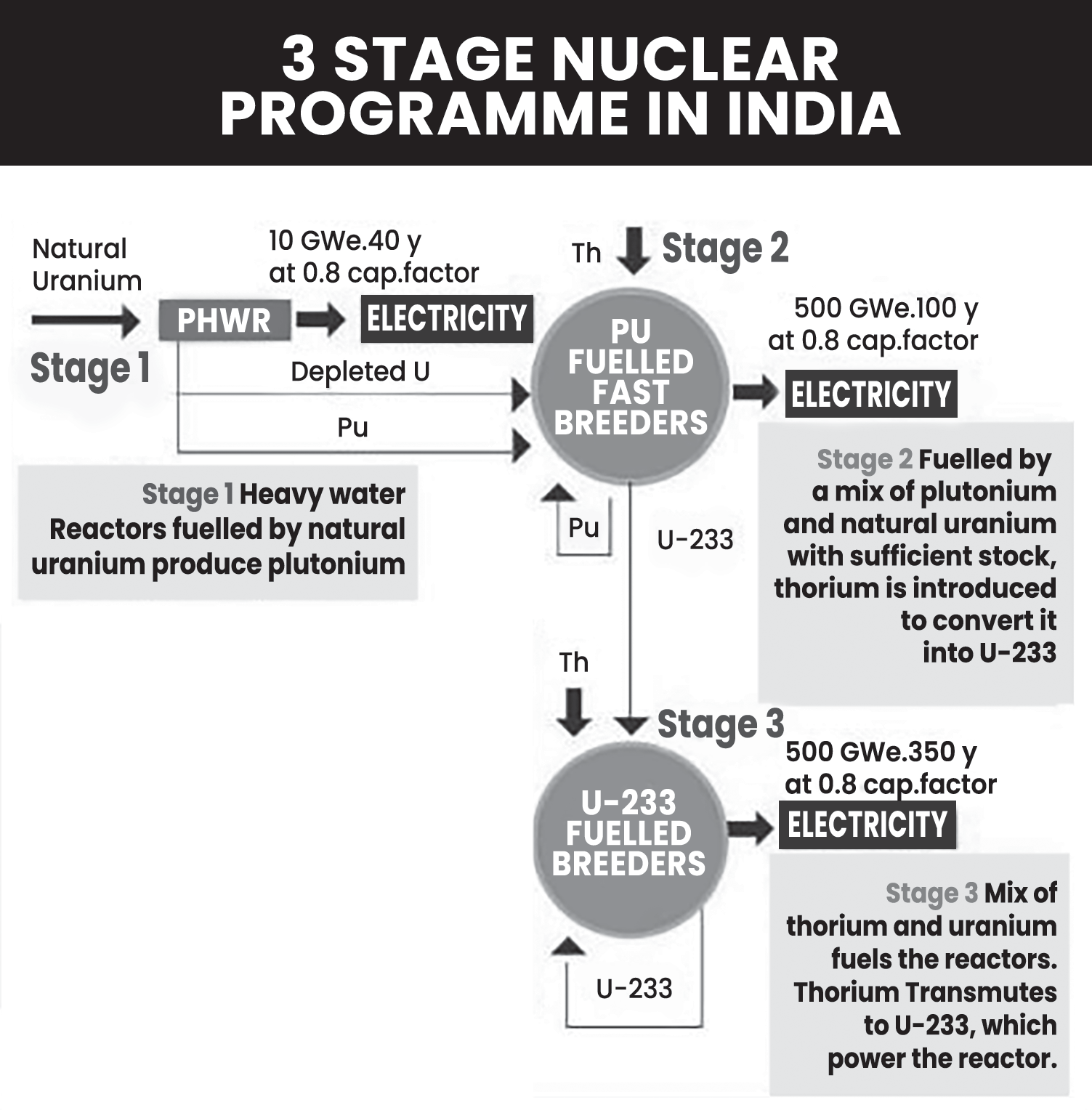
India’s Three Stage Nuclear Power Programme is a strategic plan aimed at utilizing thorium as a viable option for nuclear energy production. Thorium, abundant in monazite ore along the coastlines of Kerala and eastern India, will be utilized as fuel in the third stage of India’s nuclear program.
Three Stages of the Nuclear Power Programme
Stage I: Utilization of natural uranium in Pressurized Heavy Water Reactors (PHWRs) to generate electricity.
Stage II: Use of plutonium obtained from the spent fuel of PHWRs in Fast Breeder Reactors (FBRs), where plutonium is bred and used as fuel to generate additional electricity.
Stage III: Deployment of thorium in thermal breeder reactors, where thorium is converted into uranium-233 (a fissionable material) through neutron absorption and decay processes, thereby enabling energy production.
Utilizing thorium in nuclear reactors offers a clean source of energy, as it does not emit greenhouse gases during the energy generation process.
Thorium-232, although fertile, is not directly fissionable. It needs to be converted into uranium-233, a fissionable material, within a reactor before it can be used as fuel.
Commercial utilization of thorium on a significant scale is contingent upon the availability of abundant supplies of either uranium-233 or plutonium resources.
Large-scale introduction of thorium can only occur after a substantial inventory of plutonium becomes available from Fast Breeder Reactors (FBRs) deployed in the second stage of the nuclear power program.
Thorium utilization in nuclear reactors is envisioned to occur after several decades of large-scale deployment of FBRs, as part of the phased implementation of the Three Stage Nuclear Power Programme.
Prototype Fast Breeder Reactor (PFBR) at Kalpakkam in Tamil Nadu attained its first criticality in 2026
Date of attaining first criticality - 6th April 2026,
Result - The initiation of a sustained nuclear chain reaction.
Capacity- 500 MWe
Built by - Bharatiya Nabhikiya Vidyut Nigam Limited (BHAVINI) at the Kalpakkam Nuclear Complex.
Importance-
• India has entered in the second phase of its nuclear program which is necessary for sustain nuclear chain reaction.
• India become the second country after Russia to achieve this Milestone.
• This stage is very Important for Thorium-Based Reactors of third stage of nuclear program.
• India has abundant thorium reserves. It will reduce the dependency on Uranium for which India is depend on import from other countries.
Criticality means the steady state-controlled chain reaction has been established by the nuclear reactors by which the number of neutrons from the fission balance the destructive or lost neutrons
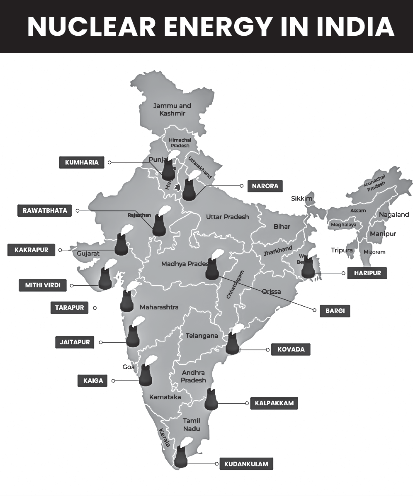
Nuclear Energy in India
The Atomic Energy Commission (AEC) was established in 1958 to formulate policies and oversee matters related to nuclear energy in India.
AEC formulates policies for the Department of Atomic Energy (DAE) concerning all aspects of nuclear energy usage.
Targets for nuclear power generation are established annually as part of the Nuclear Power Corporation of India Limited (NPCIL)’s Memorandum of Understanding (MoU) with the Department of Atomic Energy. For instance, the electricity generation from nuclear power plants in the year 2023-24 (up to November 2023) is about 32017 Million Units against the aspirational MoU target of 52340 Million Units for the year.
Installed Nuclear Power Capacity:
India has plans to expand its installed nuclear power capacity significantly. According to the Government of India, the present installed nuclear power capacity is set to increase from 7480 MW to 22800 MW by 2031-32 on progressive completion of projects under construction and accorded sanction.
Nuclear Mission
India has set a target to achieve 100 GW energy from nuclear
power plant by 2047 under the ambitious ‘Nuclear Mission’.
SHANTI Act, 2025
To support the nuclear mission, the Government has enacted the ‘The Sustainable Harnessing and Advancement of Nuclear Energy for Transforming India (SHANTI) Act, 2025.’
The Act consolidates and modernises India's nuclear legal framework.
It enables limited private participation in the nuclear sector under regulatory oversight, opening new avenues for collaboration and investment.
This sector is considered very vital and critical for the national defence security as well as energy security that is why the private company were restricted in this field. But now the scenario has been changed. Defence and security experts considers it as a historical move of government in the field of nuclear energy