Public Administration
Public Administration
• Administration is a collective effort aimed at achieving common objectives, with public administration functioning within a political framework.
• The term "public" in public administration signifies its association with government, making it a distinct form of administration focused on public bureaucracy.
• Public administration serves as the executive arm of the government, managing the structure and processes necessary for implementing government functions effectively.
• As government responsibilities expand, public administration has evolved into a highly specialized and complex field to meet the increasing demands of public services.
Difference between Government and Administration
Characteristics of Public Administration
Public administration functions as a part of the executive branch of government.
It is responsible for implementing state activities and governance.
It ensures the execution of public policies effectively.
It translates the aspirations of the people into action as formulated by the government.
Scholars like Waldo emphasize the need for commitment and dedication to public welfare; without this, administration may become rigid and impersonal.
• Public administration maintains political neutrality in its operations.
| Government Government is the system responsible for ruling a country or state, including institutions and processes that create and enforce laws and policies. It serves as the primary decision-making authority. It comprises elected or appointed officials who represent the people’s interests and have the power to govern. It establishes the overall direction, vision, and policies for a nation or region. It exercises legislative, executive, and judicial functions. It manages public decision-making, policy development, and resource allocation. | Administration Administration involves managing and carrying out laws and policies. It focuses on implementing and executing government decisions. Itconsistsoftheexecutivebranch,including departments, agencies, and officials. It handles the daily operations of governance, such as enforcing laws, managing public services, and overseeing bureaucracy. It is concerned with the execution, coordination, and supervision of government functions. It ensures the implementation of policies, delivery of public services, and smooth functioning of governmental processes. |
Public Service and Public Service Values
• Public service refers to government-provided services for the general public, either directly or by funding private providers.
•
It operates within a legal and regulatory framework, ensuring ethical conduct in public administration and corporate governance.
• Ethics in public service are fundamental to maintaining public trust and are essential for good governance.
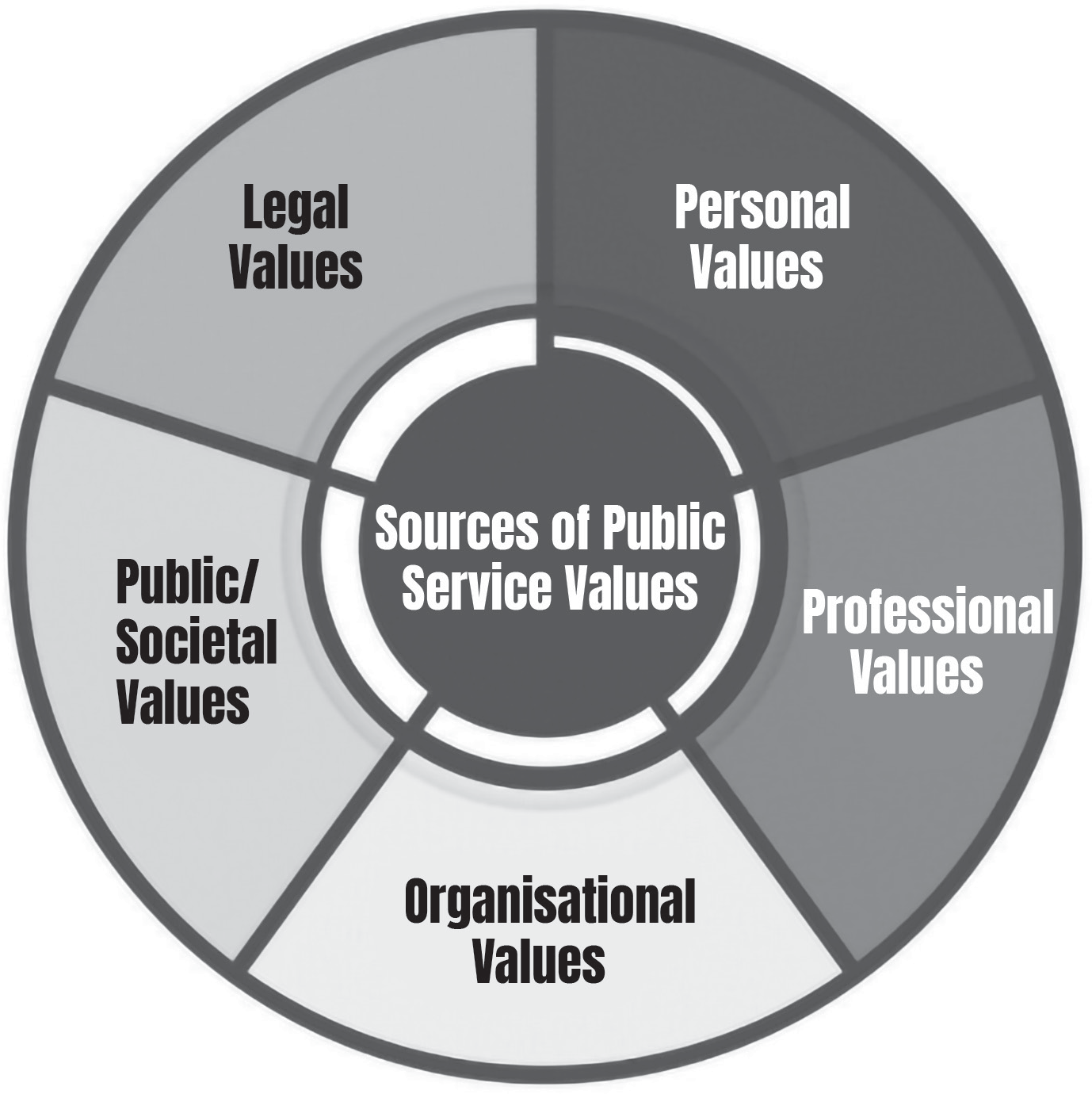
Figure: Sources of Public Service Values
• Public service is based on trust, requiring officials to act with integrity, fairness, and accountability while upholding democratic values like equality, justice, and rights.
• The role of public service in a democracy is debated, balancing political neutrality, loyalty, fairness, transparency, and impartiality.
• Sherman analyzed public sector codes across various countries and identified key values: honesty, integrity, impartiality, respect for the law and individuals, diligence, efficiency, and responsiveness.
• The OECD highlighted impartiality, legality, and integrity as the most commonly emphasized public service values.
Ethics in Public Administration
• Ethics denotes the professional code of morality in civil service. They constitute the moral character of civil servants. They regulate the conduct and behaviour of different categories of civil servants. They provide ‘rule of the game’.
• The code of ethics consists of traditions, precedents, and standards which have to be kept up by the civil servants. The civil servants are expected to set up
high moral standards not only for themselves for the community at large, particularly, in the context of the growing importance of administration and its impact on the society.
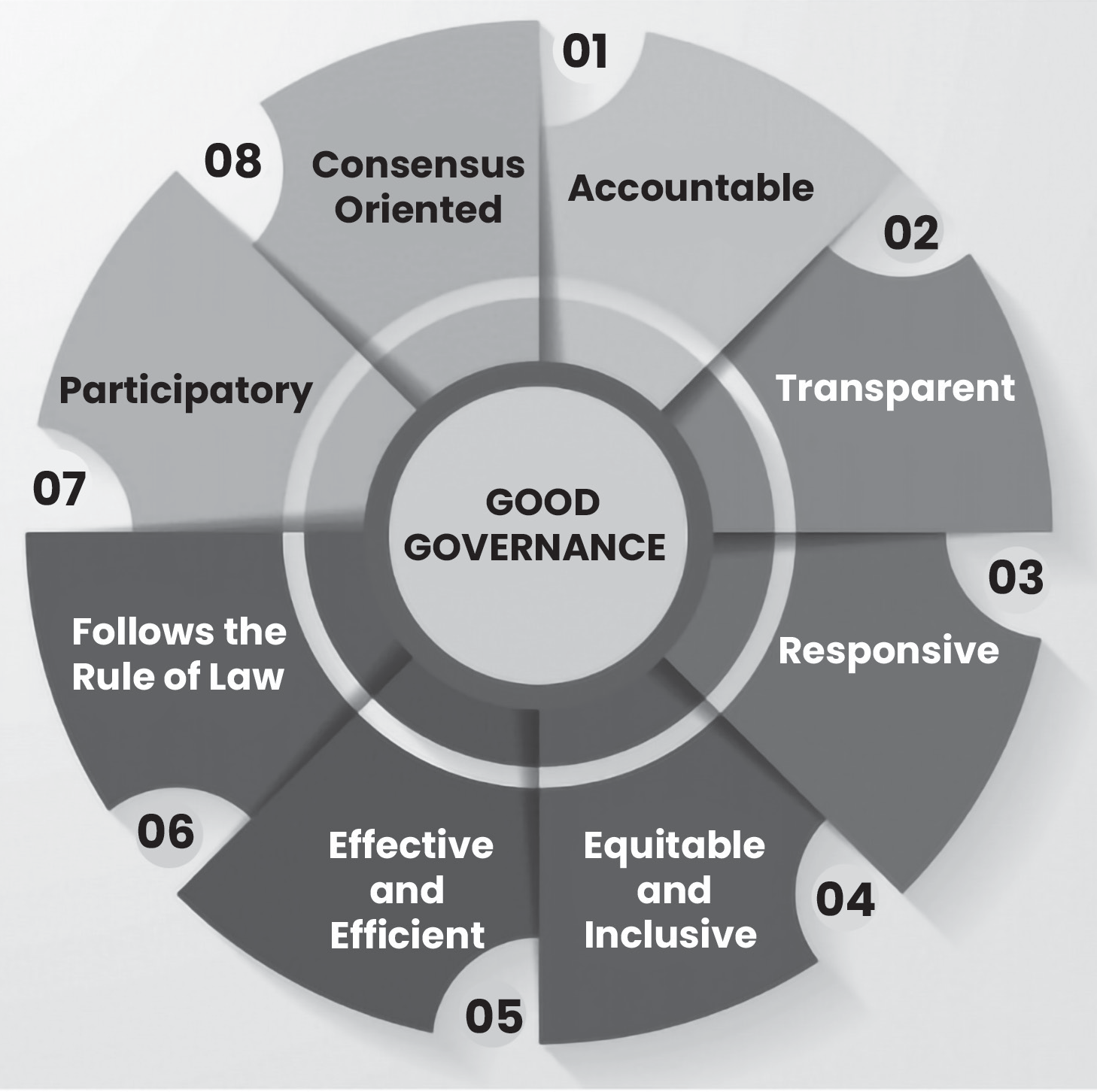
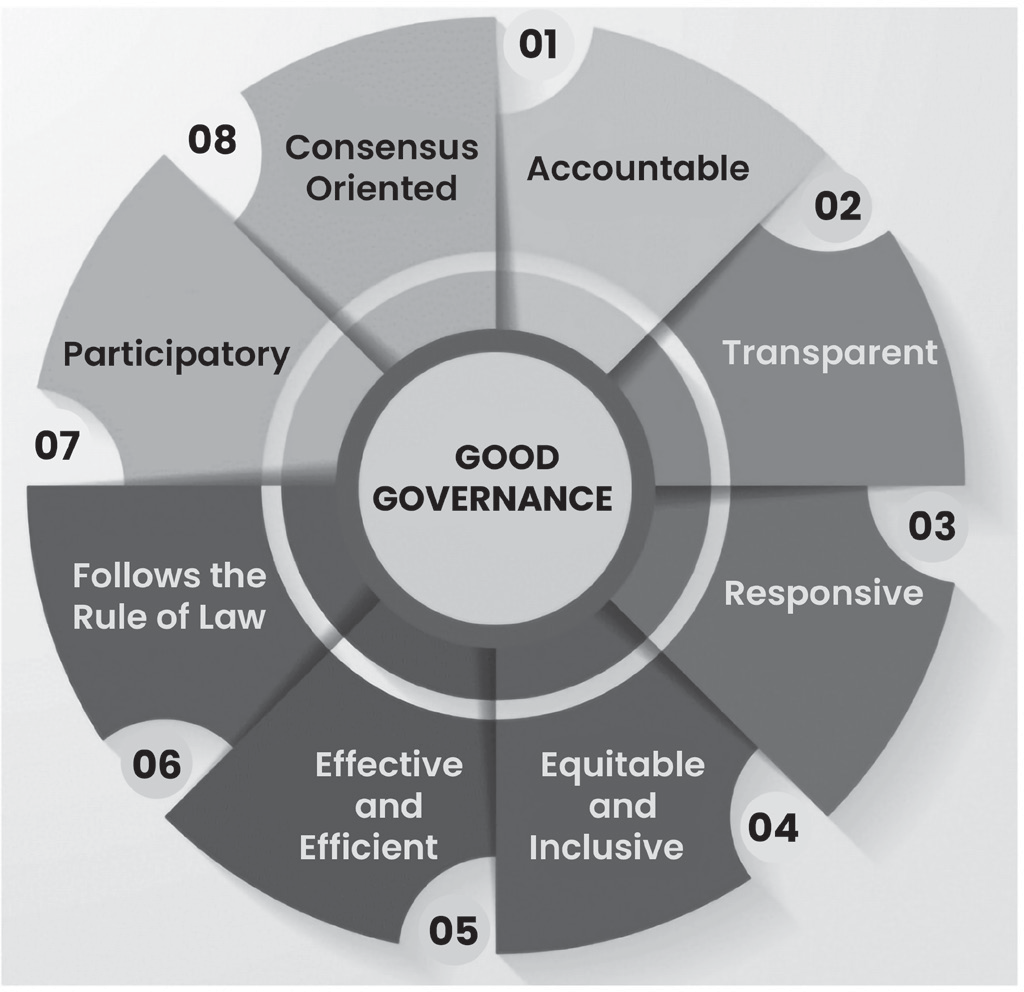
Figure: Good Governance
• For a government to be good, it is essential that their systems and sub systems of governance are
• Efficient in time and effort like in case of GST system
• Economical or affordable like contractualization or making of Tejas
• Ethical like Uttarakhand scheme for destitute children during COVID.
• Equitableand Inclusive likep rovisionof
reservation, tax slab exemptions.
• Just, Reasonable, Fair and Citizen Friendly (Rule of Law) governing process like Judiciary quick and proper, Mobile Courts in tribal areas, etc.
• Accountable like civil servant in a democracy is held accountable for his action both to the public (as paid by taxpayer’s money) and elected
representatives (as part of Executive).
• Responsive like Citizen Charters.
• Transparent like RTI Act, etc.
• People’s Participation like MyGov, CM Window, etc.
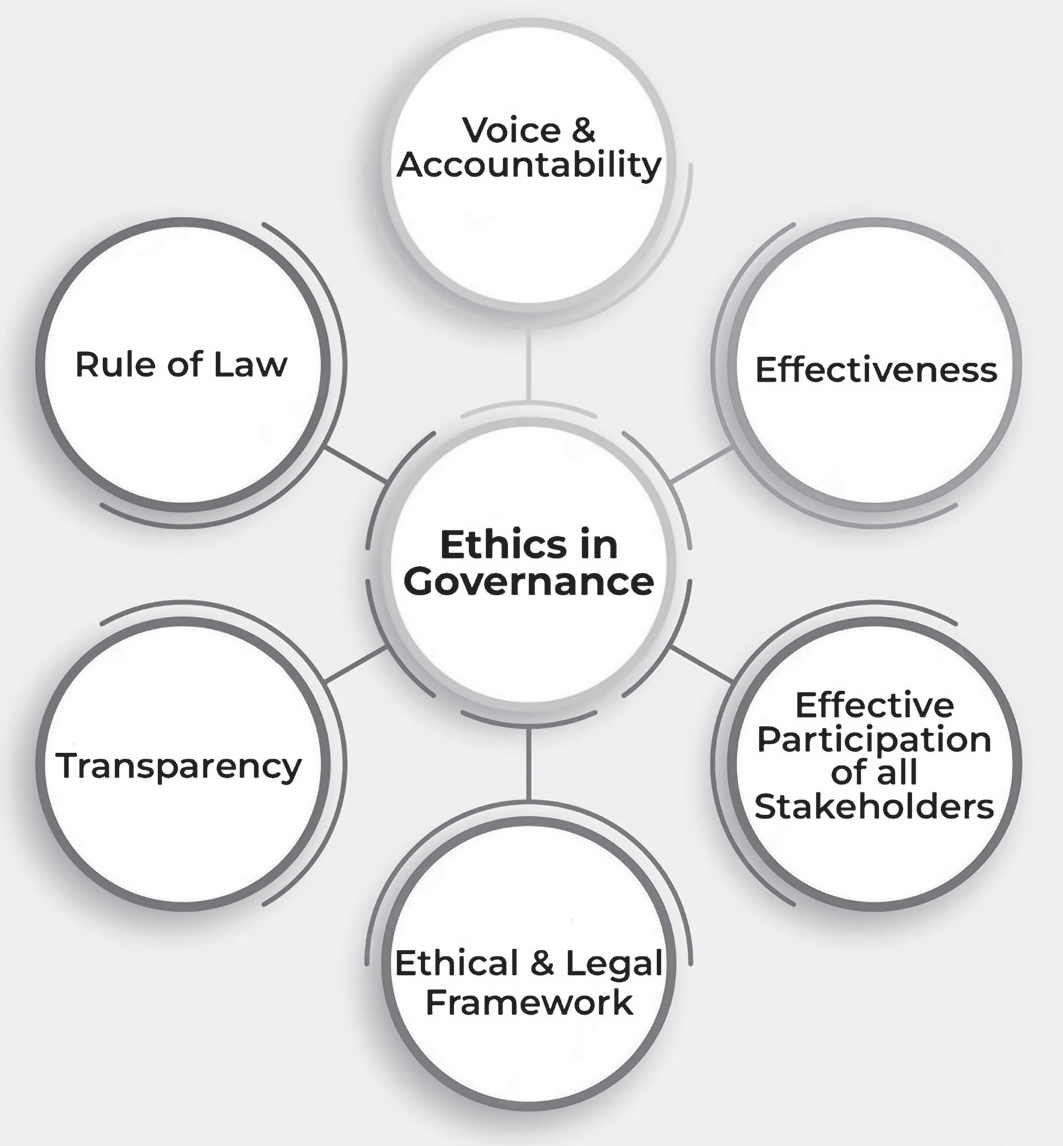
Figure: Ethics in Governance
• Paul H Appleby (in his book Morality and administration in Democratic Government) preferred the expression, “morality” to “ethics”. He argues that morality and administration cannot be separated. He delineated the following attributes of a moral administrator:
• Sense of responsibility
• Skillsin communication and personnel administration
• Ability to cultivate and utilize institutional resources
• Willingness to engage in problem-solving and to work with others as a team
• Personal confidence to initiate new ideas
• Prefers to be influenced by public needs, interests and sensitivities rather than resorting to the use of raw bureaucratic power.
• The key principles of Public Service Ethics on which modern democratic governments are based upon, are as follows;
• Public office is a trust so it should be used to advance only public interest not personal interest.
• Objective decision making based on merits, free
from partiality, prejudice or conflicts of interest.
• Conduct government openly, efficiently, equitably and honourably so that the public can make informed judgements and hold public officials accountable.
•
Honour and respect democratic principles, and observe them in letter and spirit.
• Safeguard public confidence in the integrity of government by avoiding appearances of impropriety and conduct unbefitting a public official.
• Most modern Ethics, Laws and Public Service ethics for public officials endorse the following minimum set of principles:
• Serving the Public Interest – by strengthening public’s trust and confidence in government, by demonstrating the highest standards of professional competence, efficiency and effectiveness,upholding the Constitution and the laws, and seeking to advance the public good at all times.
• Transparency – Public officials use powers and resources for public good, so they are accountable for the decisions they make, and be prepared to justify their actions.
• Integrity – Making decisions and act solely in the public interest, without any private interests, is a must in public employment as it is in public trust to avoid a serious breach of duty.
• Legitimacy –Officials must administer the laws, and exercise power legally, impartially and without fear or favour, for its proper public purpose to make it legitimate.
• Fairness –Officials must take fair and equitable decisions, without bias or prejudice, only on the merits of the matter, and respecting the rights of affected citizens.
• Responsiveness – As agents and employees, officials must serve the legitimate interests and needs of the government and all citizens, in a timely manner, with care, respect and courtesy.
• Efficiency and Effectiveness –Obtain best value for public assets deployed in or through public management, and avoid waste and extravagance in it.
Factors Determining Status of Values Ethics in Public Administration
Factors determining Status of Values/Ethics in Public Administration
Administrative Ethics is the product of several contextual structures and it never ends to grow and change. Some of these contextual factors that influence ethics in the public administrative systems are enlisted below:
Determinants of Ethics in Public Administration:
Ethical standards in public administration are shaped by historical, legal, socio-cultural, and
political factors** that influence governance and decision-making.
HistoricalInfluences on Ethics in Public
Administration
The ethical framework of a nation is deeply rooted in its historical experiences. Corruption, for example, has existed throughout history:
Buddhism and Jainism gained popularity as a response to corruption within Brahminical practices.
Kautilya extensively discussed corruption in his treatises on governance.
The Bakshish system was prevalent during the
Mughal era, normalizing bribery.
Warren Hastings, the first Governor-General of Bengal, faced impeachment on corruption charges.
• Legal and Judicial Aspects
• A well-structured legal system that emphasizes fair conduct and honesty plays a crucial role in promoting ethical governance. A strong and efficient judiciary that ensures timely justice serves as a deterrent to corruption.
• Example: Under Chief Justice M. N. Venkatachaliah, the Supreme Court witnessed a significant reduction in pending cases due to his proactive approach, ensuring swift and effective justice.
• Socio-Cultural Influences
• Since administrators come from society itself, the values and behaviors present in society inevitably influence governance. The cultural and religious orientations of a community shape the work ethic of its people.
• Constitutional values such as equality, justice, and the abolition of untouchability were imposed on society, even though people may not have been fully prepared for these changes.
• Mahatma Gandhi stepped away from active politics in the 1930s, realizing that Indians were not yet ready for independence. To prepare them, he initiated Individual Satyagraha in the 1940s.
• Endogenous (internal) changes must occur before exogenous (external) reforms can succeed. This is why imposing democracy in the Middle East has largely failed.
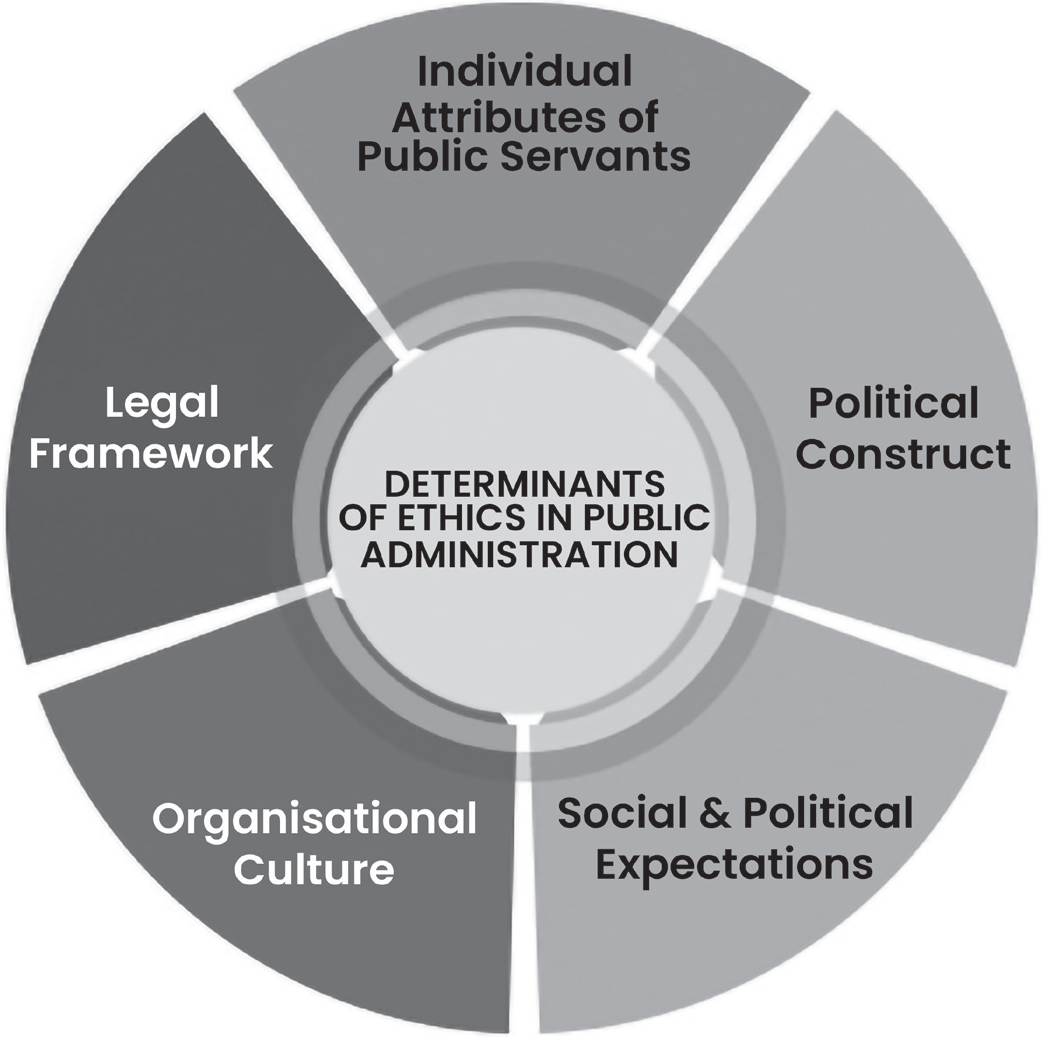
Determinants of Ethics in Public Administration
Political factors play a crucial role in shaping moral perspectives in a democracy, with political parties, pressure groups, and the media influencing public attitudes and ethical standards.
The level of political integrity within a country directly impacts its administrative system. For instance, Scandinavian nations uphold high ethical standards, whereas many South Asian countries struggle with political self-interest, which affects governance.
In India, the electoral system is often seen as a major driver of political corruption. Candidates spend vast sums on elections and later seek to recover these costs, often through unethical means. While ethical options are limited, corrupt practices have no such constraints.
Politicians’ actions set an example for civil servants, influencing their conduct. An independent and fearless media can play a vital role in curbing corruption, promoting transparency, and encouraging ethical behavior within the administration.
Economic Factors:
A low level of economic development, coupled with economic disparities, can deepen divisions among social classes and groups.
The underprivileged or economically disadvantaged may feel compelled to compromise ethical values in their struggle to meet basic needs and ensure security. However, wealth does not automatically equate to greater honesty—although the affluent have the financial stability to uphold
ethical standards, it does not guarantee that they will do so.
Need for Public Service Values/Ethics in Public Administration
• Public Service Values and Their Growing Importance
• While the field of public administration has significantly evolved over the years, the core principle of public service values remains central to governance and administration.
• Among all aspects of public administration and policymaking, public values hold the highest importance, and their significance has only increased in recent times. Several factors have contributed to the rising prominence of ethics in governance:
• Resource constraints due to a growing population.
• Complex societal needs, leading to demands for new rights such as the right to services, education, and a clean environment.
• Globalization and international integration,
influencing governance structures.
• The IT revolution, transforming public service delivery.
• Competition from the private sector, as seen in organizations like BSNL and India Post.
• Increasedpublicparticipationand decentralization,
strengthening democratic processes.
• Greater awareness and sensitivity towards rights among citizens, leading to higher expectations from public institutions.
Why Status of Values/Ethics in Public Administration is so high?
• Consequences of Losing Ethical Values:
• The erosion of trust and credibility in governance.
• A loss of legitimacy, weakening institutional authority.
• A slower development process due to inefficiency and corruption.
• The inability to achieve good governance and ethical administration.
• Constitutional Responsibilities:
• Article 14 mandates impartiality in civil service.
• Secularism upholds tolerance asa co re constitutional value.
• Articles 14 and 15 emphasize objectivity and adherence to the rule of law in governance.
• Special Responsibilities Towards Society:
• Civil servants are entrusted with public resources
and must manage them responsibly.
•
Their decisions impact individuals and communities, shaping overall well-being.
• They hold significant power and discretion, but often with limited accountability.
Lack of Public Confidence:
The public remains skeptical about improvements in bureaucratic behavior, likely due to the absence of a standardized ethical framework or a uniform approach to ethics training.
Problem of Ethics in Public Administration
Ethics in public administration faces significant challenges due to its complex and evolving nature.
Should ethics be based on philosophy, and if so, which tradition—Greek, German, or another?
Is reality subjective, shaped by individual consciousness, or governed by objective principles?
Should right and wrong be considered absolute or relative, depending on context and individuals involved?
• Philosophical foundations provide a strong ethical framework but may be compromised by the pressures of daily administration.
• However, the absence of philosophy can lead to a governance crisis.
• John Rohr proposed a middle-ground approach called "Regime Political Values," which focuses on constitutional principles and judicial interpretations.
• This approach is often complicated by conflicting
legal rulings and lengthy judicial opinions.
• Peter Drucker advocated for a universal ethical guideline similar to the Hippocratic Oath, emphasizing “primum non nocere” ("above all, do no harm").
• Ethical governance is not just about following rules or laws but requires a continuous management process.
• Ethics has become a key factor in the efficient functioning and development of government institutions.
• Integrating ethical values into administration is challenging, as every decision can lead to unintended consequences.
• Addressing these challenges requires a structured approach to uphold ethical principles while ensuring effective governance.
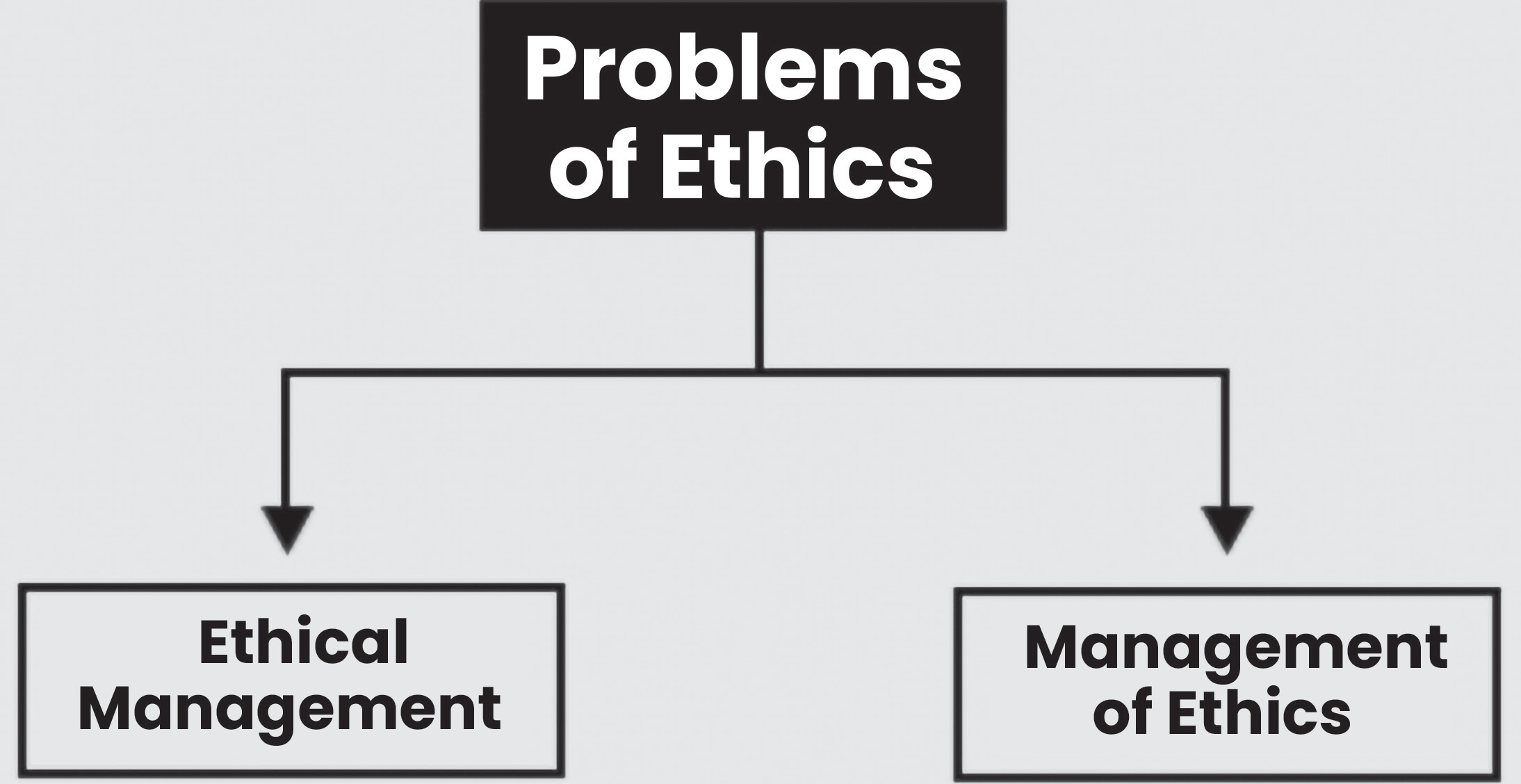
Ethical Management vs Management of Ethics
| Ethical management involves integrating ethical principles into the administration of institutions like government bodies, NGOs, and private organizations. Includes training managers and employees to enhance ethical awareness and professionalism. Recognizes values as a fundamental aspect of governance and incorporates them into organizational structures. Emphasizes the importance of social and constitutional values in institutional operations. Ensures organizations align their actions with societal and ethical expectations. Helps define what is considered acceptable and unacceptable within both society and the organization. | Management of ethics involves establishing codes, norms, or policies to ensure ethical behavior in society and institutions. Example: Formulating a code of conduct for professions like civil services or law. It is a process that develops and implements tools and techniques to integrate ethical values into administration, workplace conduct, and citizen behavior. Aims to ensure compliance with ethical standards, accountability, and prioritization of public interest while addressing value conflicts. Helps in maintaining integrity by setting clear ethical guidelines for individuals and organizations. |
Ethics in Public Life
• Ethics is rooted in responsibility and accountability.
• In a democracy, all public officials are ultimately accountable to the people.
• This accountability is upheld through laws and regulations enacted by elected representatives.
• Ethics serves as the foundation for legal systems.
• Laws and rules are shaped by societal moral values.
• The legal framework reflects a collective vision of justice and fairness.
• Significance of Ethics in Public Life:
• In a democracy, all authority originates from the people, making public officials trustees of the public.
•
As government functions expand, public officials wield significant influence over citizens' lives.
• Ethical governance requires officials to act in the best interest of the public rather than for personal gain.
• Key Elements of Ethical Behavior in Public Service:
• Establishing ethical codes and norms for guidance.
• Requiring officials to disclose personal interests to prevent conflicts between public duty and personal benefit.
• Implementing mechanisms to enforce ethical standards.
• Defining criteria for qualifying or disqualifying public officials based on ethical conduct.
• Limitations of Laws in Ensuring Ethical Conduct:
• No legal framework can cover every possible ethical dilemma.
• While lower-level officials with limited discretion can be governed by strict rules, higher-ranking officials have broader discretionary power that cannot always be regulated by laws.
• Ethical judgment becomes increasingly important at higher levels of public service.
Resolving Ethical Dilemmas
Resolving Ethical Dilemmas
A dilemma refers to a complex problem with no clear or satisfactory solution, often requiring a choice between equally unfavorable options.
Ethical dilemmas occur when an individual must choose between two morally conflicting options, neither of which fully resolves the issue in an ethically acceptable way.
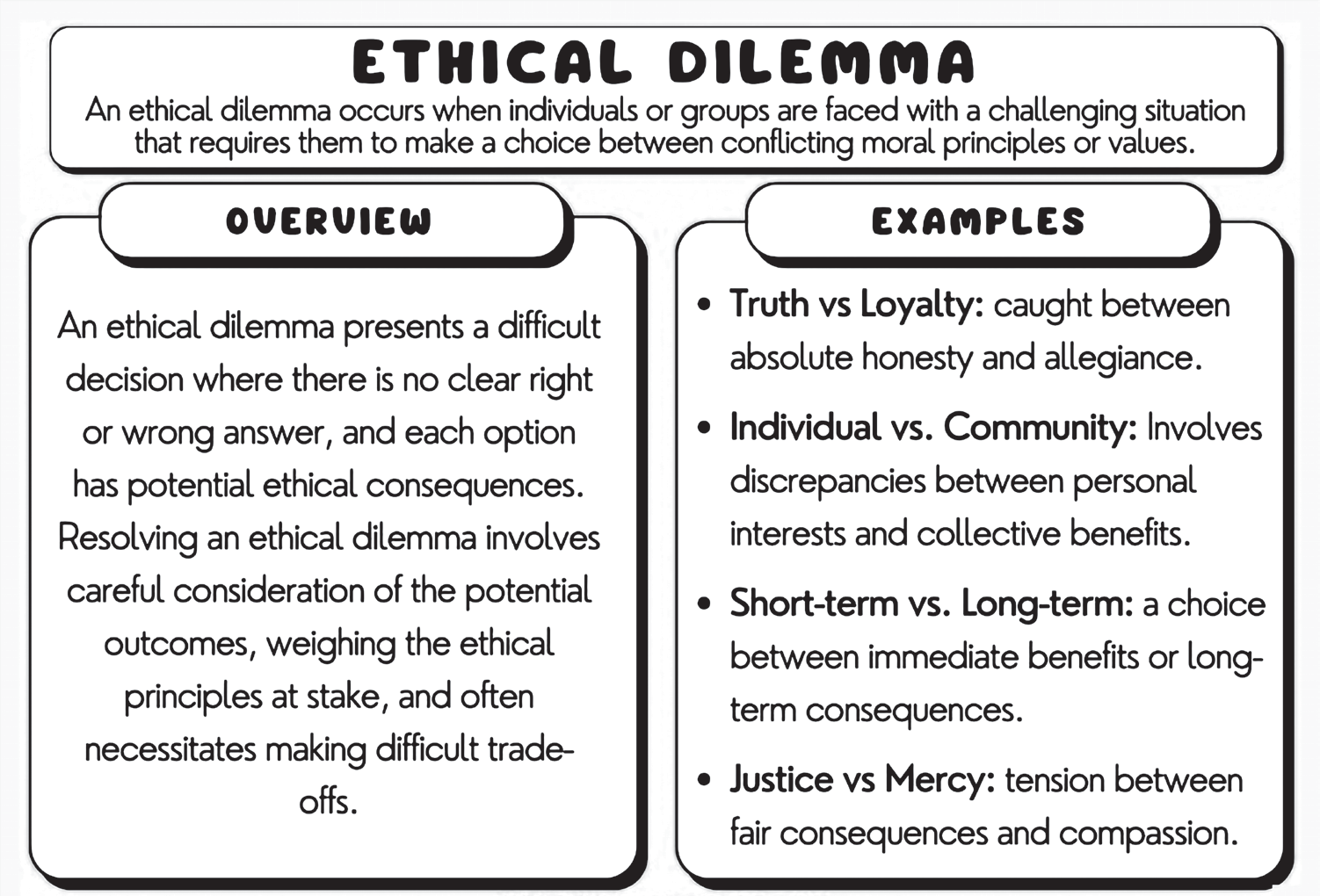
In such cases, social and personal ethical guidelines may not provide a clear or satisfactory solution.
• These dilemmas involve a mental conflict between competing moral imperatives, where following one principle may lead to violating another.
• Theoretical studies suggest that ethical dilemmas arise from situations requiring a choice between conflicting values or principles.
• They often occur in uncertain, undesirable, or morally complex situations that challenge decision-making.
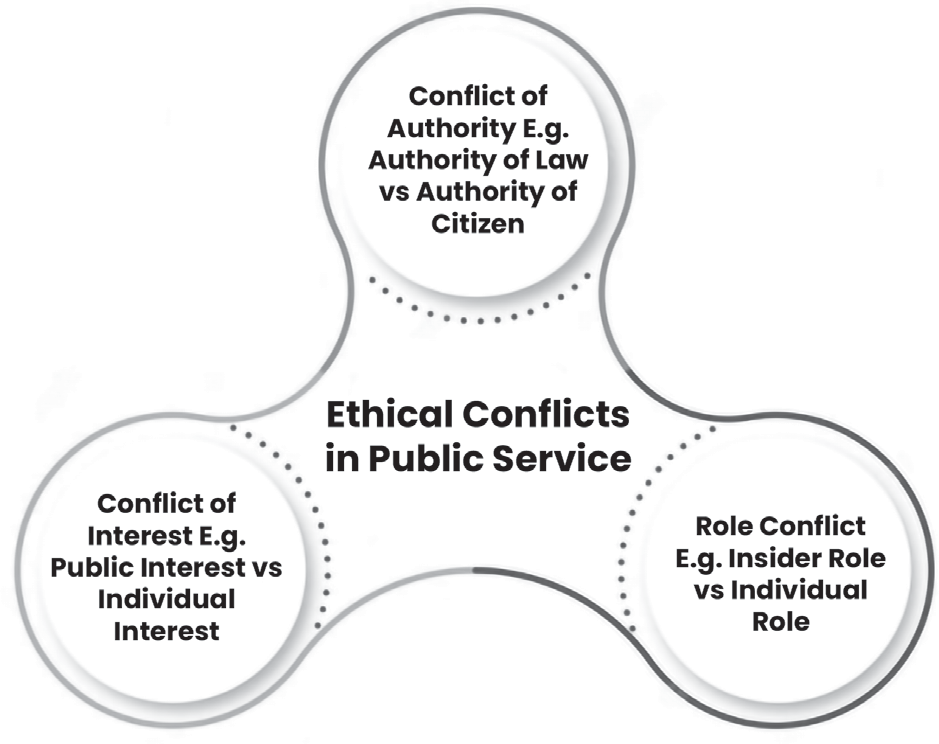
Conditions for a Situation to Be Considered an Ethical Dilemma:
A decision must be required:
• The person facing the dilemma (referred to as the "agent") must make a choice between different courses of action.
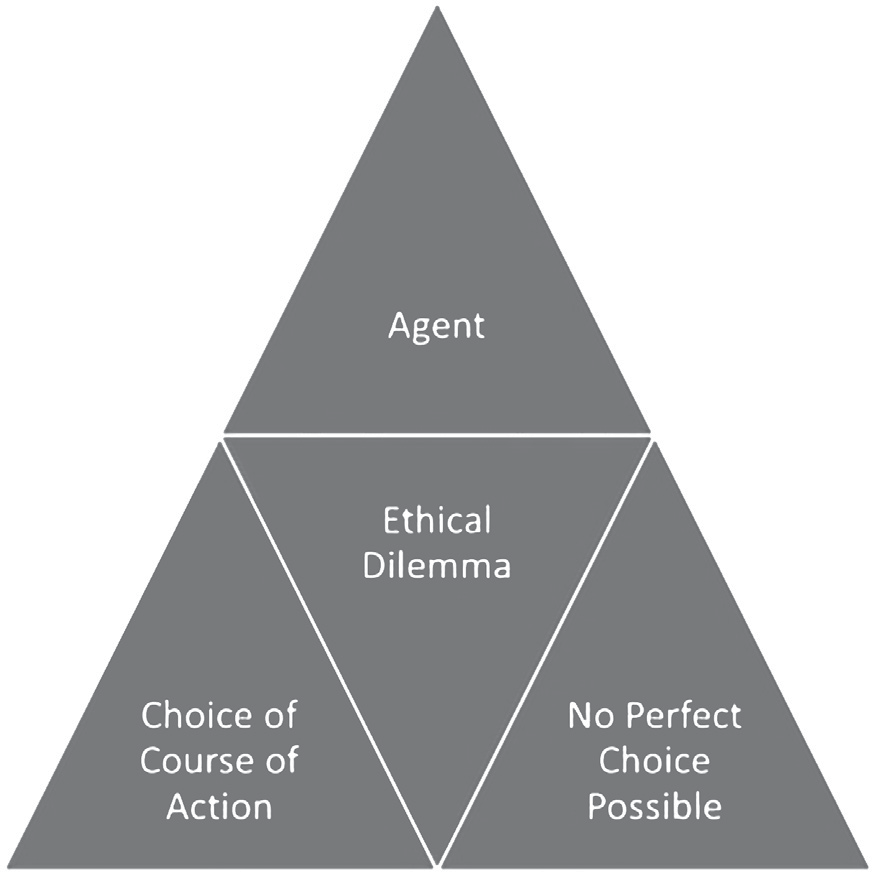
Figure: Components of an Ethical Dilemma
• If a situation is merely uncomfortable but does not require a choice, it does not qualify as an ethical dilemma.
• There must be multiple courses of action available:
• The dilemma must present at least two distinct options, forcing the individual to weigh the ethical consequences of each choice.
• If there is only one possible action, the situation does not qualify as a dilemma.
• An ethical principle will be compromised regardless of the choice:
• In an ethical dilemma, no option provides a completely moral or ideal solution.
• No matter what decision is made, at least one ethical principle or value will be sacrificed.
• Thismakes thedecision-making p rocess
challenging and morally conflicting.
• Types of Ethical Dilemmas:
• Personal Cost Ethical Dilemma:
• This arises when a person must choose between upholding ethical principles and facing personal hardship.
• The individual is placed in a situation where acting ethically leads to significant personal consequences such as job loss, financial burden, or social alienation.
• Example: A whistleblower in an organization discovers corruption and must decide whether to report it, risking job security and personal safety.
• Right-versus-Right Ethical Dilemma:
• This occurs when an individual is torn between two or more morally correct choices that conflict with each other.
• Both options uphold ethical values, but choosing
one means sacrificing the other.
• Example: A journalist has information about a public figure’s wrongdoing. Publishing the story serves public interest (truth and accountability) but may severely impact the individual's personal life and privacy.
• Conjoint Ethical Dilemma:
• This is the most complex type, occurring when a decision-maker faces a mix of different ethical dilemmas at once.
• It requires careful consideration of competing moral values, personal consequences, and societal impact to determine the best course of action.
• Example: A doctor working in an underfunded hospital must decide how to allocate limited resources. Should they prioritize a young patient
with a high survival chance or an elderly patient who has been a long-term community member? Either choice carries ethical consequences.
Choosing between Deontological and Teleological approach
• Ethical thinkers are often divided into two camps: teleologists, or relativists who believe that what is right is determined by the consequences of the decision and deontologists, or absolutists; who believe that certain actions are inherently right or wrong (Reamer, 1995).
• Deontological statements include: Always tell the truth, always obey the law, and never kill an innocent person.
• One weakness of the deontological approach appears when good principles lead to bad outcomes. For example, telling the truth can lead to great harm if individuals who have evil intent use that truth to find and kill innocent people.
• Another weakness of the deontological approach appears when two or more ethical principles conflict with each other, which is, by definition, an ethical dilemma.
• A teleological approach is based on the basic principle that “good ends can justify the means”. One’s ethical obligation is determined by the goodness of the consequences rather than the means. Individual and group actions are justified if they produce desired results for the individual and the majority.
• The teleological perspective would support stealing to feed the hungry, lying to achieve personal gain, and subjugation of a minority to support economic advantages for the majority. Thus, this perspective
tends to ignore rights of minorities.
• Amartya Sen argues in his book ‘An Idea of Justice’,goals must take precedence over means where questions of human life are involved.
• Teleological approach is further divided into two major schools: egoism and utilitarianism.
• Egoism argues that people should pursue their own self-interests to ensure good.
• Utilitarianism argues that an action is right if it promotes the maximum good for maximum people.
• The presence of two or more ethical principles creates the possibility of dilemmas.
• This problem can be addressed, by developing prioritized lists of ethical principles specific ethical dilemmas. These include (a) Five important clarifications (b) three essential distinctions (c) five important principles.
Conflict of Interest
• A conflict of interest is also a kind of ethical dilemma only, which involves a conflict between a public official’s duty to serve the public interest, and the public official’s private interests.
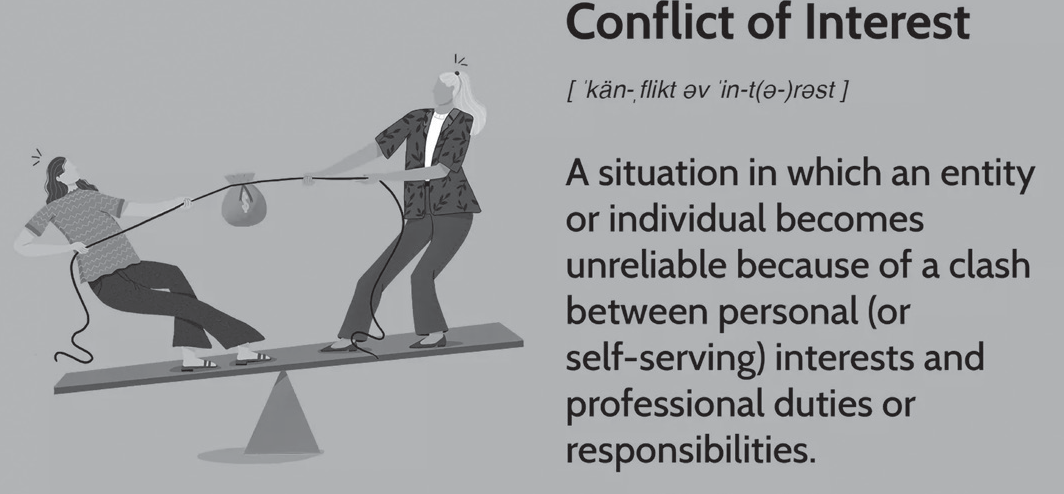
• Conflict of Interest as an Ethical Dilemma
• Definition and Nature:
• A conflict of interest is a type of ethical dilemma
• Private Interest vs Public Interest:
where a public official’s duty to serve the public is at odds with their personal interests.
• It arises when personal gains or relationships interfere with impartial decision-making in public service.
• Key Characteristics:
• A situation where professional judgment or actions related to public welfare are influenced by personal benefits.
• Creates a risk of bias in decision-making, leading to ethical concerns.
• Example:
• If a civil servant’s personal well-being or financial interests contradict public welfare, their ability to act impartially is compromised.
| Private Interests in Conflict of Interest Definition and Scope: Private interests refer to personal, professional, or business concerns that can impact a public official’s decisions, either positively or negatively. These interests may affect the officer directly or benefit/disadvantage individuals or groups they are associated with. Types of Private Interests: Personal Interests: Involves family, friends, rivals, or anyone with whom the official has a personal connection. Professional Interests: Includes affiliations with organizations, colleagues, or business partners. Financial Interests: May involve direct or indirect financial benefits such as property, investments, outstanding debts, gifts, job offers, or secondary employment. Non-Financial Interests: Though not monetary, factors such as personal relationships, social or cultural affiliations, and sports or community activities may still influence decision-making. | Public Interest and Ethical Responsibility Definition of Public Interest: Public interest refers to the well-being and collective good of the entire community. It is not merely the sum of individual interests or the agenda of any specific group. Priority of Public Interest: Officers in All India Services and the public sector are expected to prioritize public welfare over personal or private interests. Their decisions and actions should align with the greater good rather than individual benefits. Applicability of the Principle: This ethical responsibility extends to all individuals involved in delivering government programs and services. It applies to full-time and part-time employees, contractual staff, board members, consultants, and even volunteers. |
Understanding Conflict of Interest and Its Types
• Conflict of Interest:
• Simply having a conflict of interest is not inherently wrong.
• The ethical concern lies in how the individual manages or resolves it.
•
Even in the absence of actual wrongdoing, conflicts of interest can create the perception of impropriety.
• Common Types of Conflicts of Interest:
• Self-Dealing: Occurs when a professional in a managerial role engages in transactions that benefit them personally while harming their company or its clients.
• Acceptance of Gifts: Receiving gifts from clients or business associates can lead to biased decision- making and is often prohibited by organizations.
• Misuse of Confidential Information: Using privileged information obtained through professional duties for personal gain, such as insider trading in financial markets.
• Nepotism: Favoring relatives or close associates in hiring, promotions, or other professional opportunities, leading to unfair advantages and potential conflicts.
• Three Types of Conflict of Interest:
Actual Conflict of Interest: When a person’s private interests directly influence their professional responsibilities.
Example: An officer handling a project where a company they or their family members have financial stakes is involved.
Perceived Conflict of Interest: When an individual’s actions appear to be influenced by their personal interests, even if no actual bias exists.
Example: Justice Kurian Joseph avoided an official dinner in Italy while overseeing a case involving an Italian marine to prevent any appearance of bias.
Potential Conflict of Interest: When a situation has
the possibility of creating a conflict in the future, requiring preventive measures.
• Example: An employee or director has financial ties that could interfere with their public responsibilities in the future, necessitating proactive mitigation.
• For example,
• Examples of Conflict of Interest for a Public Officer
• Ownership of Property: When an officer owns property whose value could be directly affected by the decisions or activities of their government agency.
• Business Interests: If an officer or their family holds shares in a business that is bidding for a contract with the agency they work for.
• Receiving Benefits: When an officer is offered gifts, incentives, or any form of personal benefit while performing their official duties.
• Secondary Employment: Holding a second job or consultancy role in an organization that is seeking approvals, contracts, or any other consideration from the officer’s agency.
• Personal Beliefs and Bias: Having strong personal convictions on an issue that is under review by the agency, potentially influencing decision-making.
• Misuse of Government Resources: Using government procurement systems or privileges for personal or private business gains.
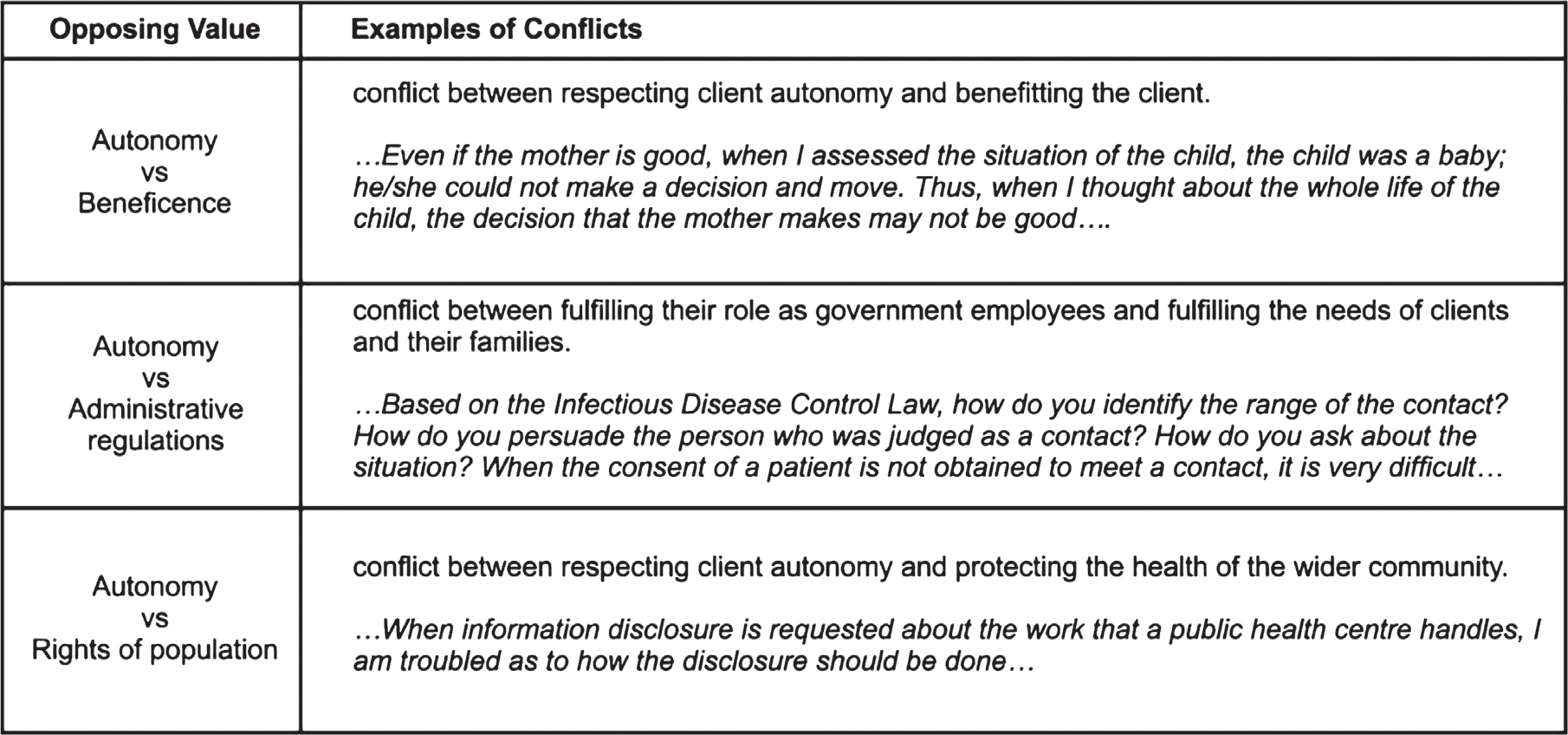
Common Ethical Dilemmas
• Ethical Issues in Journalism
• Conflict of Interest: Occurs when a journalist's personal connections or biases influence reporting. Examples include:
• Interviewing friends or acquaintances.
• Selecting interviewees from a specific group or with a particular viewpoint.
•
Covering organizations, teams, or clubs in which the journalist is involved.
• Using reporting as a means of retaliation against someone.
• Plagiarism: Presenting someone else’s work, ideas, or content as one’s own without proper attribution. This includes:
Biases to Be Avoided in Decision Making
Biases to be Avoided in Decision Making
Understanding Bias
Definition of Bias: A tendency to favor one person, idea, or thing over another, often in an unfair or subjective manner.
Unconscious Bias:
As humans, we all have inherent biases, often shaped by our experiences and surroundings.
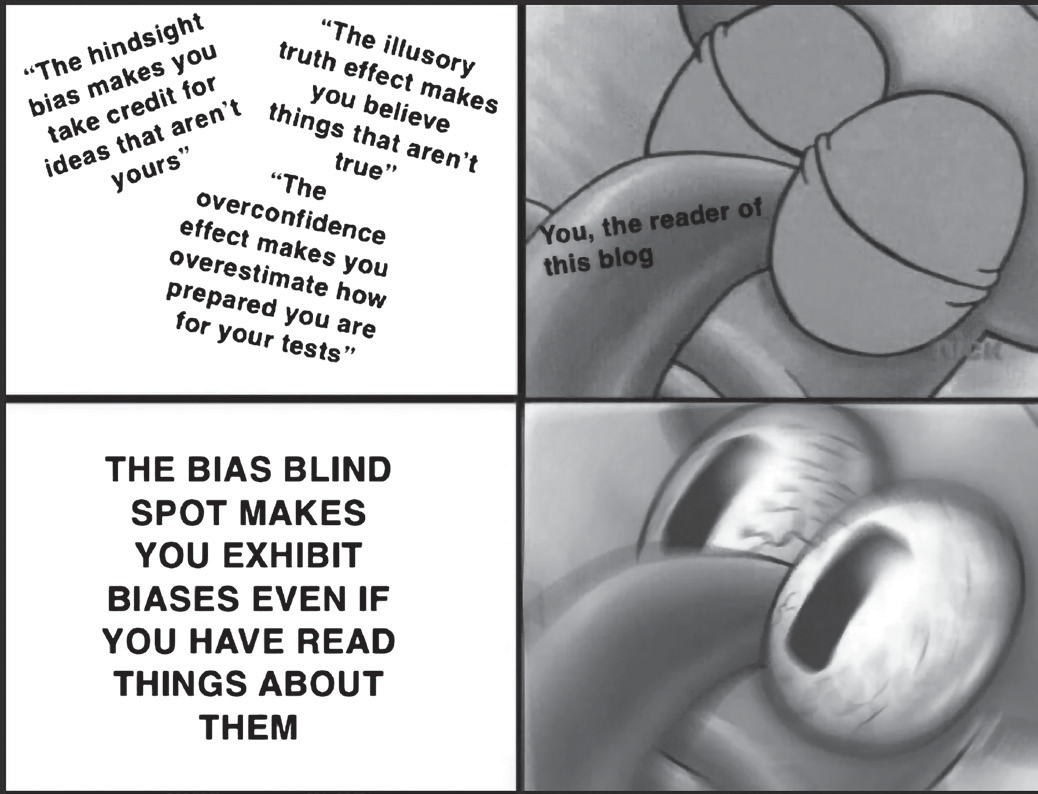
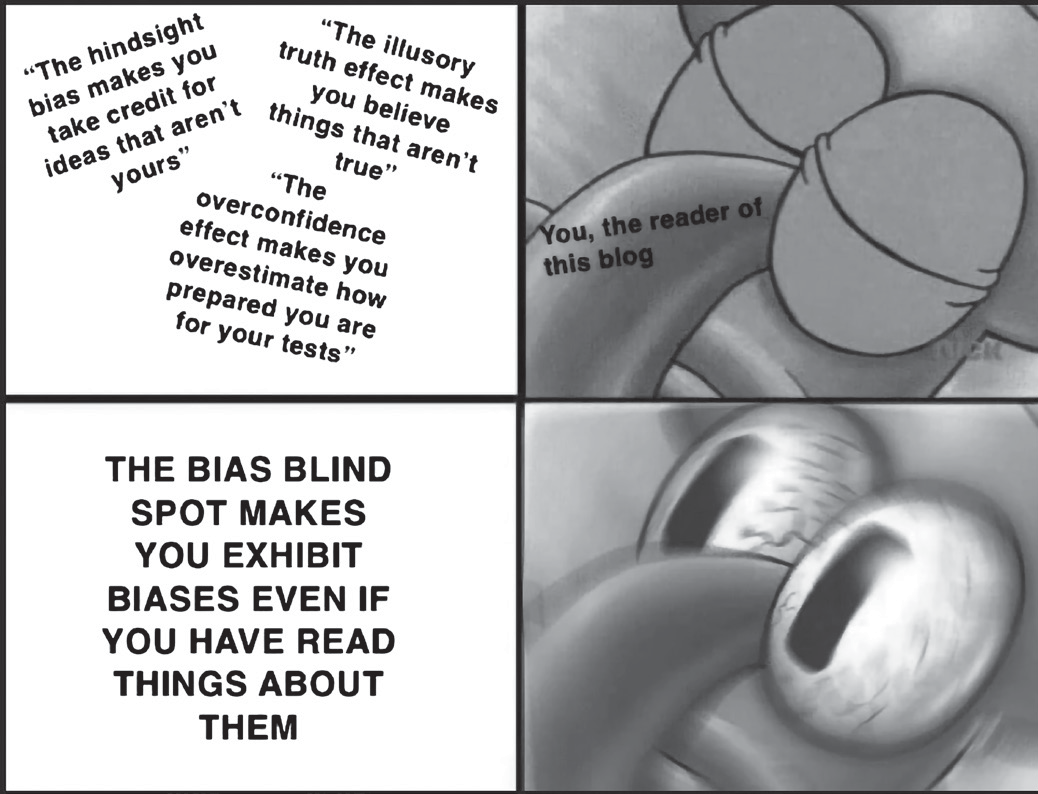
Many people are unaware of their own biases, making them difficult to recognize and address.
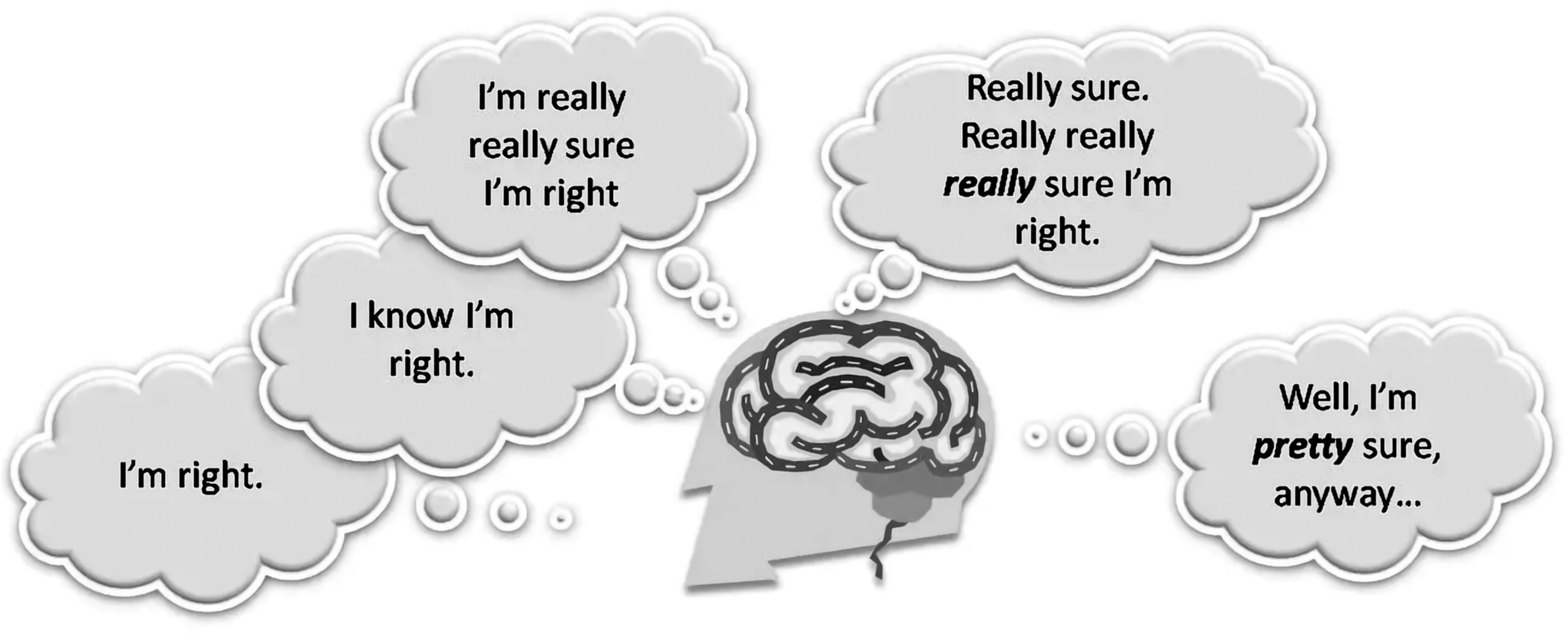
Blind Spot Effect:
People struggle to acknowledge their own biases, making them "blind spots" in their perception.
The more someone believes they are less biased than others, the more likely they are to misunderstand their own bias.
Example – Gun Control Debate in the US:
Some individuals believe that increasing the number of guns leads to higher violence, shaping their stance on gun control.
Others argue that owning guns enhances personal safety, leading them to purchase and store firearms.
• Example: Ram is late because he is lazy, but I am late because I had a bad morning.
• Self-Serving Bias: We take credit for successes but blame external factors for failures.
• Example: Winning an award is due to hard work, but failing a test is due to lack of sleep.
• In-Group Favoritism: We prefer those within our group over outsiders.
• Example: Liking Rahul more than Suresh because Rahul attends the same church.
• Bandwagon Effect: Popular ideas, trends, and beliefs gain traction as more people adopt them.
• Example: Parents believe fidget spinners help
children, and others follow suit.
• Groupthink: To maintain harmony, groups make irrational decisions that avoid conflict.
• Example: Instead of choosing between ice cream and T-shirts, the group settles on ice cream-themed T-shirts.
• Halo Effect: A positive impression in one area leads to assumptions about other traits.
• Example: Assuming Sameena is kind just because she is cute.
• Availability Heuristic: We rely on immediate examples when making judgments.
• Example: Choosing a store based on the most recent advertisement seen.
• Moral Luck: We judge moral character based on outcomes rather than intent.
• Example: Believing a victorious nation was morally superior in war.
• Defensive Attribution: People sympathize more with victims when they relate to them.
• Example: A habitual texter blames a reckless driver instead of a distracted victim in a crash.
• False Consensus Effect: We assume more people agree with us than actually do.
• Example: Saying, "Everyone thinks this!" without real evidence.
•
Just-World Hypothesis: We believe people get what they deserve, assuming fairness in life.
• Example: Thinking someone's purse was stolen due to past bad behavior.
• Curse of Knowledge: Once we learn something, we assume everyone else knows it too.
• Example: A teacher struggling to understand why students find a topic difficult.
• Spotlight Effect: We overestimate how much others notice our behavior or appearance.
• Example: Thinking everyone will notice an "embarrassing" T-shirt.
• Naïve Realism: Believing our perception is objective, while others are misinformed or biased.
• Example: Thinking, "I see reality as it is, others are just ignorant."
• Naïve Cynicism: Assuming others act selfishly or with hidden motives.
• Example: Believing someone is only being nice to gain something in return.
• Forer Effect (Barnum Effect): People believe vague, general statements apply uniquely to them.
• Example: "This horoscope describes me perfectly!"
• Dunning-Kruger Effect: Less knowledgeable individuals overestimate their expertise, while experts doubt themselves.
• Example: Confidently claiming ice cream contains no kelp despite lacking dairy industry knowledge.
• Anchoring Bias: We rely too much on the first piece of information given when making decisions.
• Example: Thinking a 50% discount means a great deal, without checking the original price.
• Automation Bias: Over-reliance on automated systems, even when they make errors.
• Example: Trusting autocorrect to change "its" to "it’s" without verifying.
• Google Effect (Digital Amnesia): Forgetting information that can be easily searched online.
• Example: Repeatedly looking up an actor’s name but never remembering it.
• Reactance: Resisting authority or advice when it feels like a threat to freedom.
• Don’t we always make a decision and interpret it with data to justify? We see patterns based on our past experiences, and connect the dots at an almost innate level.
• For instance, when physicians receive gifts from pharmaceutical companies, they tell others that these gifts do not affect their decisions as no memory of gifts after a time period.
• Nevertheless, if you ask them whether a gift might unconsciously bias the decisions of other physicians, most will agree while continuing to believe that their own decisions are not.
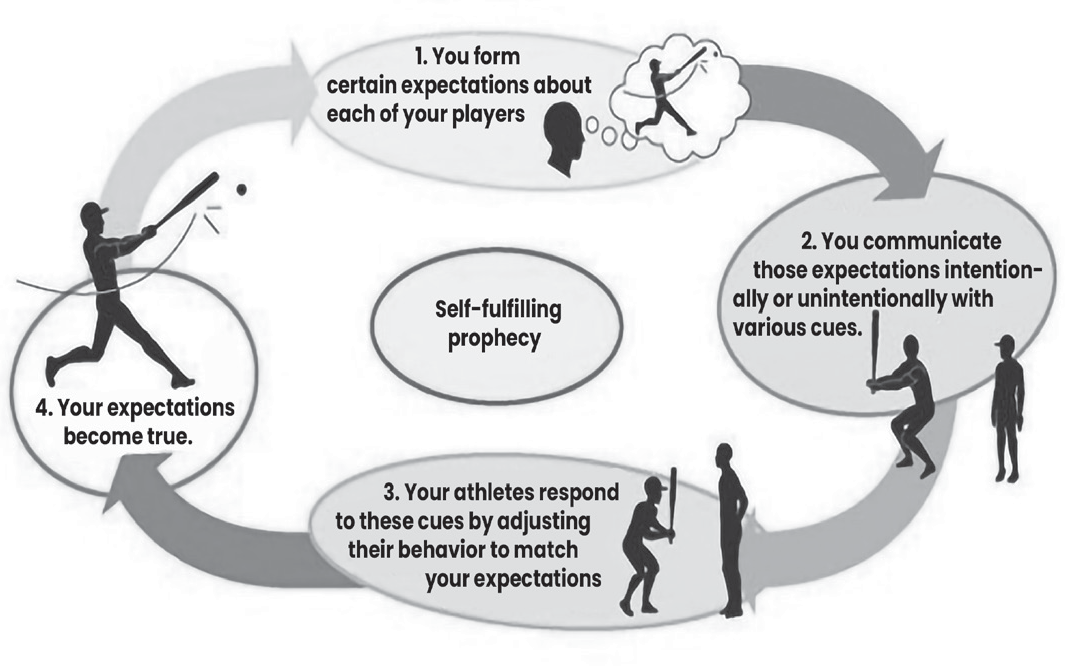
Development of Biases:
• Our brains are wired to take shortcuts when processing information, helping us make quick decisions and judgments.
• Biases are shaped by multiple factors, including genetics, education, profession, social interactions, cultural background, childhood experiences, friendships, and upbringing.
• Example: When asked about the deadliest mass murderer in history, most people assume it was Adolf Hitler or Joseph Stalin, but in reality, it was Mao Zedong, responsible for up to 45 million deaths.
Is completely Unbiased Decision Making Possible or even Desirable?
• Humans are naturally biased, as we simplify the world by categorizing things and people into mental "buckets"—such as good or bad, interesting or boring.
• A completely unbiased person would struggle to function, as they would waste time analyzing everything without making assumptions or inferences.
• Example: Not boarding a flight due to a lack of trust in the pilot or failing to recognize danger from someone pointing a gun.
• Scientific studies indicate that prejudice cannot be entirely eradicated.
• While eliminating bias completely is impossible, we can reduce its impact by increasing self- awareness, staying curious, and being open to new experiences.
Ways To Control Your Biases
• Embrace Cognitive and Human Diversity
• Learn to tolerate and appreciate people with
different thoughts, actions, and emotions.
• Expose yourself to opposing viewpoints, such as watching a TV show or podcast you dislike.
• Engage with people who challenge your values to understand their perspectives.
• Finding common ground with others can foster open-mindedness and tolerance.
• Cultivate Empathy
• Empathy is the ability to understand and share others' feelings and perspectives.
• Analyze people's thoughts, motives, and challenges, especially those who are less privileged.
• Recognize that others may be just as hardworking and talented but face different circumstances.
• Practicing empathy can make you more tolerant and reduce biases.
• Acknowledge Your Biases
• Being aware of biases is essential for addressing them.
• Tools like the Implicit Association Test can help uncover hidden prejudices related to race, gender, and more.
• Some biases seem positive but still reinforce stereotypes, e.g., assuming Black people are great athletes or female leaders are always caring.
• Regulate Your Behavior
• Actions matter more than beliefs—someone with prejudiced views can still behave inclusively, while an open-minded person may act in a discriminatory way.
• Research shows that attitudes and behaviors
often do not align.
• Many people support organ donation or environmental conservation but do not actively participate in these causes.
• Similarly, many hold racist beliefs, but only a few act on them negatively—this is a sign of societal progress.
SOME MORE BIASES FOR WIDER UNDERSTANDING
• Authority Bias
• We give more weight to the opinions of authority figures.
• Example: "My teacher said this, so it must be true."
• Placebo Effect
• A treatment can have real effects if we believe it will work.
• Example: Shakti's pain decreases after taking a placebo pill.
• Survivorship Bias
• We focus on successful cases while ignoring failures.
• Example: Raju believes Minakshi’s purse business will succeed because a famous brand used the same strategy—ignoring many failed attempts.
• Tachypsychia
• Time perception changes under stress, drugs, or physical exertion.
• Example: "Time slowed down when the car almost hit me."
• Law of Triviality (Bike-Shedding)
• We spend more effort on minor issues than major ones.
• Example: A city council debates bike sheds instead of solving homelessness.
• Zeigarnik Effect
• Unfinished tasks stick in our memory more than completed ones.
• Example: Ram feels unproductive until he sees all the tasks he has already completed.
• False Memory
• We recall imagined events as real.
• Example: Manjeet insists Harleen told a funny joke about pineapples, but it actually came from TV.
• IKEA Effect
• We overvalue things we helped create.
• Example: "This pot is amazing because I painted it myself!"
Solving
Solving Ethical Dilemma
Solving Ethical Dilemma
Recognizing Ethical Standards – To resolve an ethical dilemma, one must identify and apply appropriate ethical principles or standards that can guide decision-making. These principles help justify and defend the choices made in complex situations.
No Perfect Decision – It is important to acknowledge that no decision is universally perfect or justifiable in all circumstances. Ethical choices often involve trade- offs, and their appropriateness depends on the specific context.
Multiple Correct Decisions – There can be multiple valid decisions for a given ethical issue. The challenge is not about finding the single “right” answer but rather determining which option is the most suitable and ethical in a particular situation.
Relative Evaluation in Decision-Making – In many cases, such as civil service examinations (e.g., UPSC), ethical decision-making questions do not have absolute right or wrong answers. Instead, all options may be valid, but some choices may be more effective or contextually appropriate than others.
Context-Specific Ethical Dilemmas – Ethical decisions often involve balancing competing interests. Examples include:
Armed Forces Special Powers Act (AFSPA): Balancing national security concerns with human rights.
Right to Protest (JNU Case): Weighing democratic rights against maintaining public order.
FDI in the Retail Sector: Considering the rights of small retailers versus broader economic and social benefits.
Steps for Resolving Ethical Dilemma
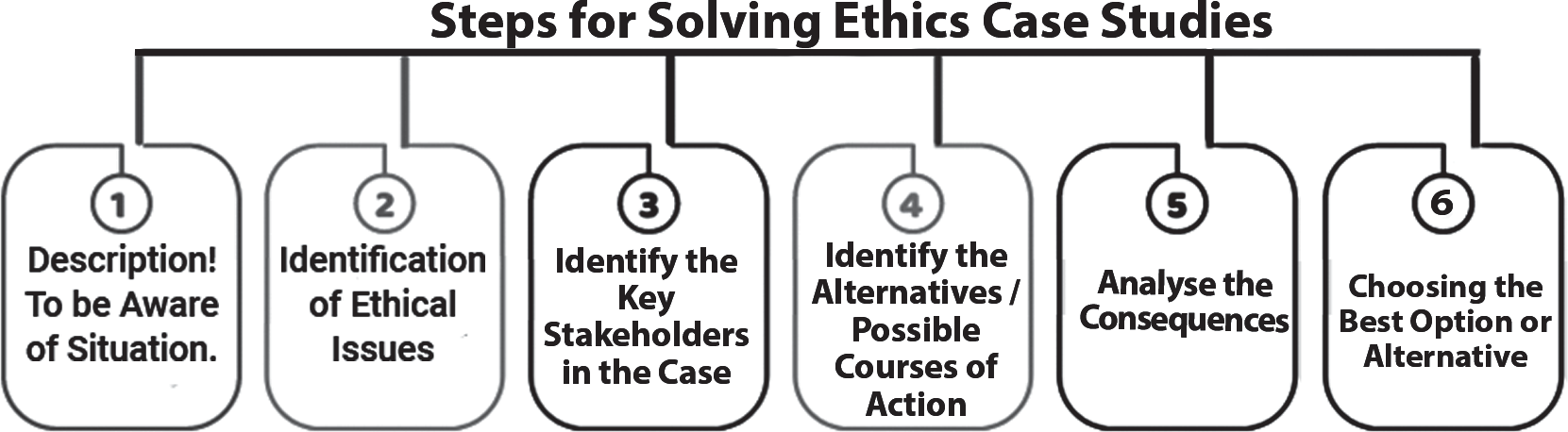
• Register – The conflict of interest is formally disclosed and recorded in an official register to ensure transparency and accountability. This helps in tracking potential biases and preventing any undue influence on decision-making.
• Restrict – The officer’s participation in the matter is limited or controlled to prevent any unfair advantage or unethical influence. This could involve preventing them from making decisions, accessing certain information, or engaging in discussions related to the matter.
• Recruit – A neutral third party is appointed to oversee or handle part or all of the process to ensure fairness and objectivity. This helps mitigate any biases that may arise from the officer’s involvement and ensures an impartial resolution.
• Remove – The officer either voluntarily steps aside or is officially requested to withdraw completely from any engagement with the matter. This eliminates the risk of any potential conflict affecting the process or outcome.
• Relinquish – The officer gives up their personal interest that is causing the conflict, such as selling off financial holdings, stepping down from a conflicting external role, or cutting ties with entities that create a conflict. This allows them to continue in their official role without any ethical concerns.
• Resign – If no other solutions effectively address the conflict, the officer may choose or be required to resign from their position. This step is taken when the conflict is irreconcilable and could severely compromise integrity and trust in the organization.
Five Important Clarifications
• Clarifying Ethical Dilemmas – It is essential to distinguish between true ethical dilemmas and other types of challenges to avoid unnecessary confusion in ethical decision-making.
• Human vs. Ethical Dilemmas – While all ethical dilemmas are human dilemmas, not all human dilemmas are ethical in nature.
• Example: Choosing between a high-paying and a low-paying job is a personal dilemma, not an ethical one.
• Right vs. Wrong vs. Guilt – Making a wrong ethical decision does not always mean the person is guilty of wrongdoing. Ethical errors and moral culpability are distinct concepts.
• Ethical vs. Legal Considerations – Ethics and law are separate domains. An action may be legally permissible but still ethically questionable, or vice
versa.
• Ethics as Minimalist, Not Maximalist – Ethical guidelines, such as professional codes of conduct, establish the minimum necessary ethical standards. They do not dictate the highest possible moral actions or personal virtues.
• Ends vs. Means and Value Conflicts – Ethical dilemmas are not about justifying means with ends but about choosing between competing values or disvalues. Ethical choices often involve prioritizing one value over another rather than deciding whether an end justifies a particular means.
Three Essential Distinctions
Ethical Considerations in Decision-Making – Understanding key ethical principles can help in making the right choices when faced with conflicting values.
Dignity vs. Welfare – Ethical decisions must balance individual dignity with collective welfare.
Example: The principle of "the greatest good for the greatest number" cannot justify harming an innocent person for the benefit of many.
Values like self-respect and justice should never be compromised for the sake of welfare.
Moral Evil vs. Non-Moral Evil – Moral evils are tied to ethical wrongdoing, while non-moral evils are not.
Example: Injustice is a moral evil, whereas physical pain is a non-moral evil.
Ethical decisions should never intentionally cause moral evil, even if they aim to achieve a greater good.
Direct vs. Indirect Harm – The manner in which harm occurs carries ethical significance.
Example: Pushing someone into a river is direct harm, while opening a dam sluice gate, unintentionally causing a flood that harms people, is indirect harm.
Ethical responsibility differs based on whether the harm is a direct action or an indirect consequence.
Five Important Ethical Principles
Guiding Principles for Ethical Decision-Making – These principles help navigate ethical dilemmas and determine the right course of action.
Greater Good or Lesser Evil Principle – Decisions are often justified based on what seems right at the
moment by choosing the greater good or the lesser harm.
• Double Effect Principle – Some actions have both positive and negative consequences, and the ethical choice is made when the good outweighs the bad.
• Example: Self-defense, where protecting oneself may unintentionally harm the aggressor.
• Nonmaleficence Principle – The duty to avoid harming others takes precedence over the duty to benefit them.
• Example: While we may take moderate risks to prevent harm to others, we are not obligated to take risks just to benefit them.
• Justice Principle – Fairness dictates that equals should be treated equally, while differences should be acknowledged and addressed accordingly.
• Proportionality Principle – When an action may cause harm to protect a greater value, the least harmful method should always be chosen.
Model for Ethical Decision Making
• Reamer’s Ethical Decision-Making Process: A structured approach to resolving ethical dilemmas in professional practice.
• Identify Ethical Issues: Determine the conflicting values and duties involved in the situation.
• Identify Affected Parties: Consider individuals, groups, and organizations that will be impacted by the decision.
• Explore Possible Actions: List all potential courses of action, participants involved, and assess risks and benefits for each.
• Evaluate Justifications for Each Option: Analyze each action using:
• Ethical theories (e.g., deontological, utilitarian perspectives).
• Professional codes of ethics and legal guidelines.
• Work-related principles and best practices.
• Personal values, including cultural, religious, and political beliefs that may influence decision-making.
Seek Expert Consultation: Discuss with colleagues, supervisors, legal advisors, or ethics scholars for guidance.
Make and Document the Decision: Choose the best course of action and maintain a record of the decision- making process.
Monitor and Evaluate the Outcome: Assess the effectiveness of the decision and document its impact.
Ethical Scrutiny in Decision-Making: Ethical considerations should not only focus on achieving the best outcome but also ensuring that the methods used align with ethical principles.
Balancing Pros and Cons: Ethical dilemmas arise when benefits and drawbacks are evenly matched, requiring careful value-based judgment.
Understanding Values in Conflict: Identifying conflicting values helps in assessing their influence on decisions.
Timely Decision-Making: While not all outcomes are controllable, making the right choice at the right time can prevent negative consequences.
Awareness of Principles and Actions: Ethical awareness is crucial in guiding decisions and professional conduct
Ethical Concerns and Dilemmas
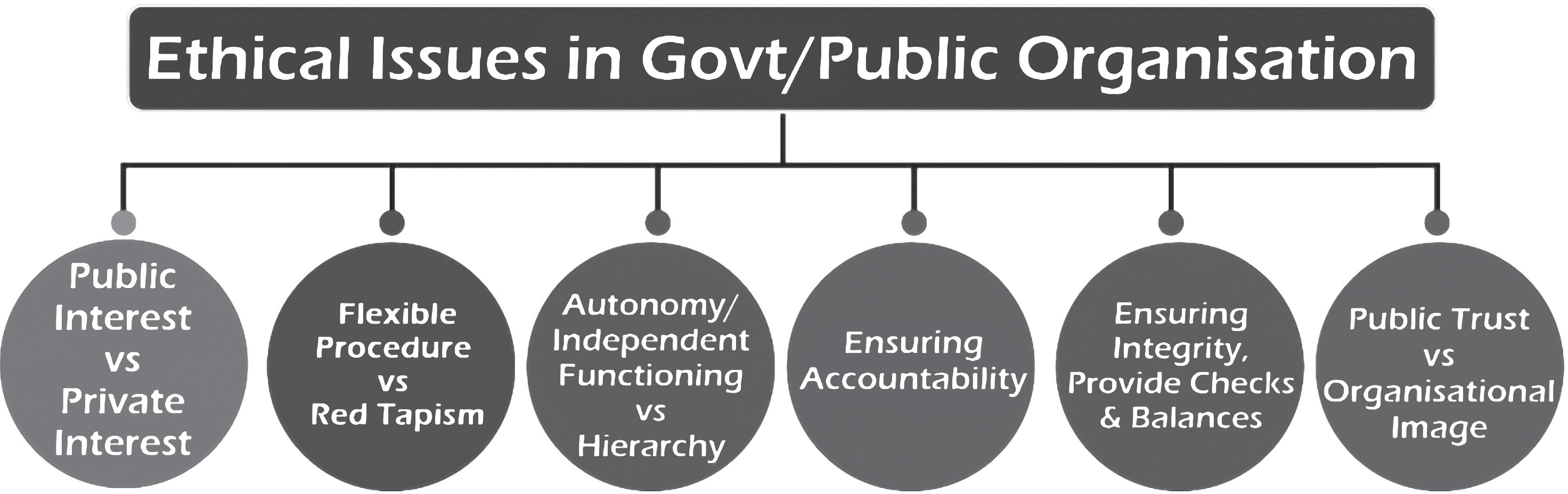
Ethical Concerns and Dilemmas in Public Organisations
Ethics in Public Organizations: Public administrators act as "Guardians of the State", ensuring public service and welfare.
Key Role of Public Administrators: Their responsibilities are broad, urgent, and crucial for societal stability and progress.
Impact of Public Organizations: They operate within multiple contexts, influencing and being influenced by various external factors.
Core of Administrative Ethics: Ethical decision- making remains central to ensuring integrity and accountability in public service.
Ethics in Action: Public servants demonstrate ethics through their decision-making.
Choosing one option over another reflects ethical
considerations.
Ethical decision-making integrates both facts and values in the process.
Broad Ethical Values in Public Organisations include:
• Legality and Rationality: Government bodies must operate ethically within the boundaries of established laws, rules, and regulations.
• Decisions should be made based on reason and logical analysis, rather than personal opinions or biases.
• Responsibility and Accountability:
• Responsibility implies that a public servant acts in alignment with the will and interests of the public, while accountability refers to the formal mechanisms and processes through which officials are held answerable.
• Responsibility is more internal and personal, whereas accountability is external and enforceable.
• These principles form the foundation of good governance in a democratic system.
• An honest administrator must be willing to take ownership of their decisions and actions, while also being answerable to senior officials and the public, who are the ultimate recipients of governance.
• Example: E. Sreedharan, former Delhi Metro chief, offered his resignation following a bridge collapse incident, demonstrating accountability.
• Work Commitment:
• This refers to an employee's dedication and enthusiasm towards completing their official duties.
• Work should be viewed as a chance to serve society, not as a burden.
• Excellence:
• A capable administrator strives for the highest level of quality in all decisions and actions, without compromising for convenience.
• True excellence stems from a combination
of efficiency, cost-effectiveness, and overall effectiveness.
Responsiveness:
It involves the ability to respond appropriately to both internal and external challenges, adapting to changing circumstances while maintaining ethical standards.
Citizens expect the government to address their
concerns promptly and effectively.
• Civil servants should practice empathy and compassion while adhering to legal and regulatory frameworks, ensuring fairness toward marginalized sections of society.
• Justice involves providing individuals with what they rightfully deserve, ensuring fairness in governance and administration.
• Ethical values are deeply rooted in a society’s prevailing sense of justice.
• Transparency requires openness, clear communication, and accountability.
• Citizens, as direct stakeholders in government policies and programs, have the right to access information.
• Acting in the national interest strengthens a country’s reputation and enhances the quality of public service delivery.
• Additional ethical values in governance include benevolence, teamwork, courage, dedication, integrity, fairness, selflessness, loyalty, privacy, adherence to constitutional principles, tolerance,
sincerity, optimism, and legality.
• The overarching goal is to uphold good governance by embedding ethical principles, behaviors, and decision-making in public administration.
• Ethical values are interconnected, and the violation of one often leads to the compromise of others, impacting governance standards.
Various Ethical Concerns or Challenges in Public Organisation include
• Officials like District Magistrates hold excessive authority, which can be misused even in cases of corruption.
• Instances of misuse of power under AFSPA or unjust actions like assaulting citizens and refusing to file FIRs.
•
Cases such as Hathras DM’s conduct highlight unchecked authority.
• Excessive legal protection under Articles 309-311 shields government officials from disciplinary actions.
• Awarding government contracts to relatives or close associates of politicians, leading to cronyism and unfair practices.
• Cases of UPSC members engaging in misconduct and nepotism in awarding government tenders undermine ethical governance.
• Disciplinary measures often limited to suspension or transfer, failing to ensure accountability.
• Whistleblowers like Rinkoo Singh Rahee and Satyendra Dubey faced attacks for exposing corruption, indicating poor security mechanisms.
• Lack of clear ethical guidelines for public servants results in inconsistent behavior and decision-making.
• Government authorities often fail to disclose important information and lack empathy toward common citizens' concerns.
Ethical Dilemmas encountered in Public Organisations include
• Public officials often face dilemmas when their personal interests conflict with their public responsibilities.
• Example: In a small town with only one road contractor, who happens to be the District Magistrate’s relative, awarding the contract becomes ethically challenging despite the necessity of road construction.
• Tensions arise between core values of public administration, such as individual privacy versus crime prevention.
• Example: Counterterrorism measures may require biometric data access, conflicting with the fundamental right to privacy.
• Other cases include balancing efficiency with due process or economic growth with environmental sustainability.
• Ethical conflicts can exist within a code of conduct,
such as confidentiality versus transparency.
• Example: RTI requests demanding disclosure of discussions within the Collegium regarding the appointment of the Chief Justice.
• Personal beliefs may clash with government directives, particularly in sensitive matters.
• Example: An official opposed to capital punishment may be required to authorize an execution order.
• Example: A doctor bound by patient confidentiality might be instructed to share
patient data for government records, creating a professional ethics dilemma.
• Overlapping or Conflicting Accountabilities:
• Public officials are often answerable to various stakeholders—such as the public, government bodies, senior authorities, and the media—each with their own set of expectations and priorities. This can create challenges in balancing and fulfilling these diverse responsibilities effectively.
• Example: A subordinate ordered by a senior official to carry out a "shoot-at-sight" directive without informing the media faces a difficult ethical decision.
• Ethics in Private Institutions refer to the moral principles that should guide business practices. Business ethics serve as a framework for proper conduct, offering direction to both managers and employees in fulfilling their professional responsibilities. These ethics establish acceptable standards of behavior within business operations, and numerous actions within the workplace can be evaluated through an ethical lens.
• Initially, moral frameworks such as codes of ethics, ethical standards, and conduct guidelines were not present in private enterprises. With the advent of globalisation, there was a noticeable rise in unethical practices, especially involving labour rights and environmental violations.
• Common ethical breaches have included child labor, mistreatment and harassment of employees. To counter these, measures such as anti-discrimination laws, freedom of association, collective bargaining rights, safe working conditions, fair wages, and regulated working hours have become necessary.
Key ethical aspects for private institutions include:
• Transparency and Accountability to all stakeholders— employees, customers, shareholders, management, and society. A lack of transparency, as seen in scandals like chit fund frauds, often leads to public distrust and unethical outcomes.
• Integrity, Loyalty, and Honesty are essential character traits expected from all members of a private organization.
• Compliance with laws and regulations fosters trust and cooperation between the private sector and government institutions. Following legal guidelines is inherently ethical.
• Commitment refers to dedication toward organizational objectives and ensuring the well-being of all stakeholders involved.
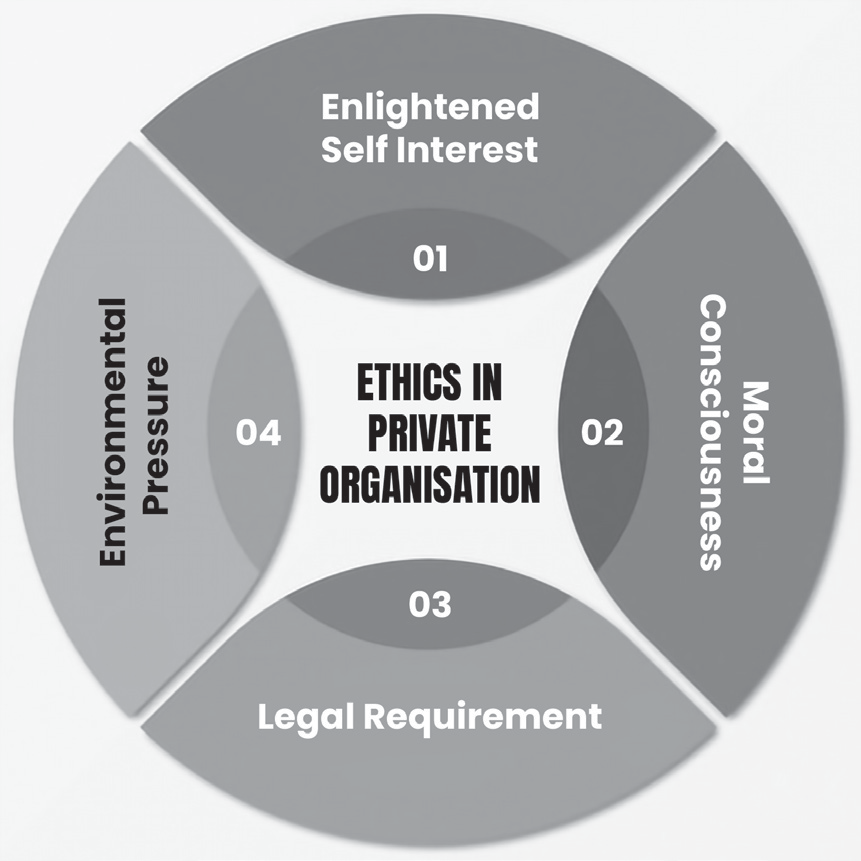
• Responsiveness implies that private companies must address the concerns and interests of clients, customers, and shareholders in a timely and responsible manner.
• Product and Service Quality is critical for any organization, as it impacts all stakeholders. Falsely promoting or delivering inferior quality than promised is widely regarded as unethical.
• Excellence combines efficiency, effectiveness, and cost-consciousness. While natural inefficiency isn't unethical, willful underperformance or lack of effort can be considered unethical behavior. Every employee is expected to perform their duties to the best of their abilities.
• Social Responsibility emphasizesthatprivatefirms often prioritize administrative efficiency, but they must not overlook their broader responsibilities to society, even if they're not directly involved in public policy or service delivery.
Ethical Dilemmas in Private Institutions include
• Striking a balance between cost-cutting vs employee and public health and safety.
• Like in case of manufacturing or hazardous industries like petrochemicals, or famous case of Bhopal Gas Tragedy which occurred due to cost cutting.
• Workers’ privacy vs freedom for legitimate business purposes. Some businesses monitor all online activity and email against privacy and sovereignty.
Working Conditions: Forinstance, non-discriminatory working environment, vs diversity
Law, Rules and Regulations As Source of Ethical Guidance
Law, Rules and Regulations as Source of Ethical Guidance
Sources of Ethical guidance: In any ethical dilemma or situation, laws, rules, regulations and conscience play a major role in reaching solutions.
Very often the term Acts, Rules and Regulations are confused as being one and the same. But these terms hold distinct meaning albeit have a connection to each other.
The Constitution of India under Article 13 (3)(a)
[1] says “law” includes any Ordinance, order, bye- law, rule, regulation, notification, custom or usage having in the territory of India the force of law.
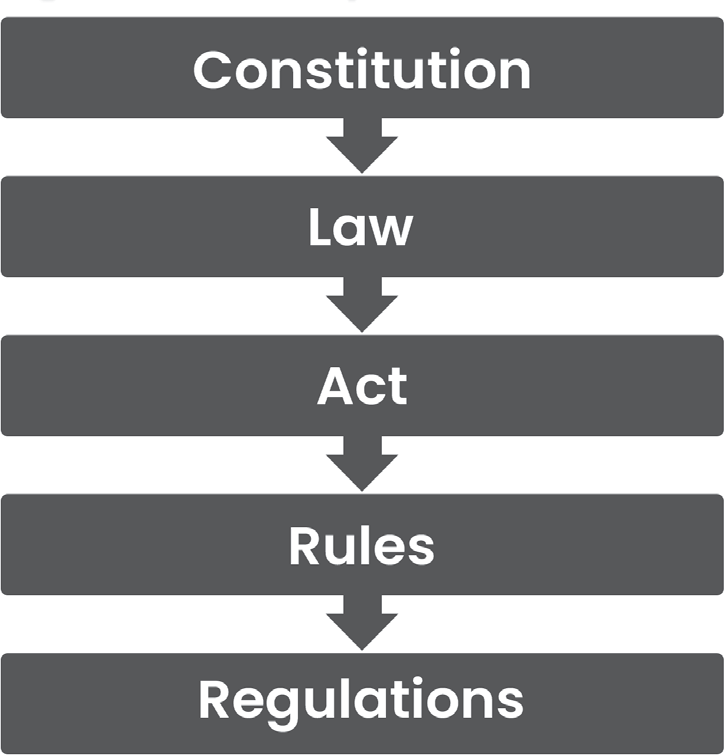
• The three terms Act, Rules and Regulations have an interwoven relationship. The act is the main source from which rules and regulations derive their power.
• Law is defined as an assemblage of rules and regulations that are indispensable and must be followed.
• An Act is a decree that is approved by the respective legislature. Acts are embodiment of laws on a particular matter.
• Rules provide a complimentary source of guidelines for proper conduct.
• Regulations are laid down by statutory/ executive bodies and are deemed as standard laws which ought to be followed.
Laws as a Source of Ethical Guidance
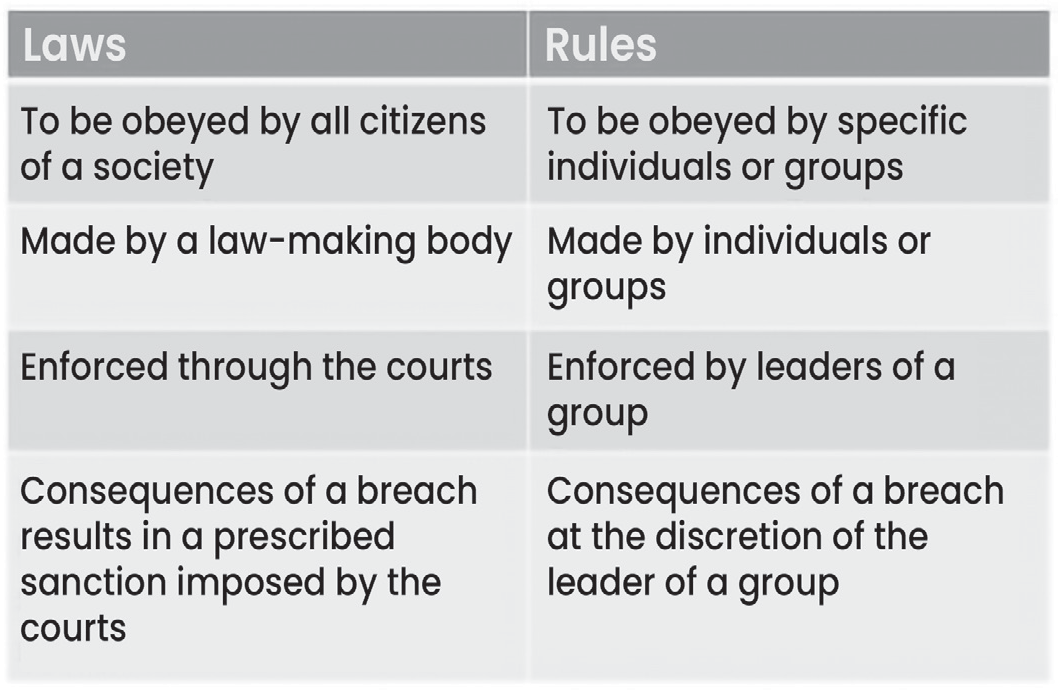
• Law is a system of rules that are enforced through legal authority to govern behaviour.
• Laws can be made by legislator, resulting in statutes, by the executive through decrees and regulations, or by judges through binding precedent, normally in common law
jurisdictions.
• The term Law comes from ‘lex’ in Latin from ‘ligare’
i.e. to bind. Thus, law means which induces to act or restrains i.e. an obligation.
• Laws are enactments of legislature and enjoy legitimacy. Laws are sacrosanct and their violation can be prosecuted in court of law.
• Generally speaking, laws are reflection of societal ethics that are codified and laid down for enforcement.
• Thomas Aquinas defineslawasan ‘ordinance of reason directed towards common good and promulgated by the one who cares for the community.’
• It imposes an obligation and a course of action to be followed. Also, laws must conform to human nature and they must be physically and morally possible to obey them in addition to being just.
• Laws are not just suggestions and expectations, but are requirements to behave in the stipulated ways.
• As it is believed that government makes the enactment and rules, they also see to ensuring that people live within the dictates of the law. They achieve this by using law-enforcement agencies.
LAWS, RULES, REGULATIONS AND CONSCIENCE AS SOURCES OF ETHICAL GUIDANCE
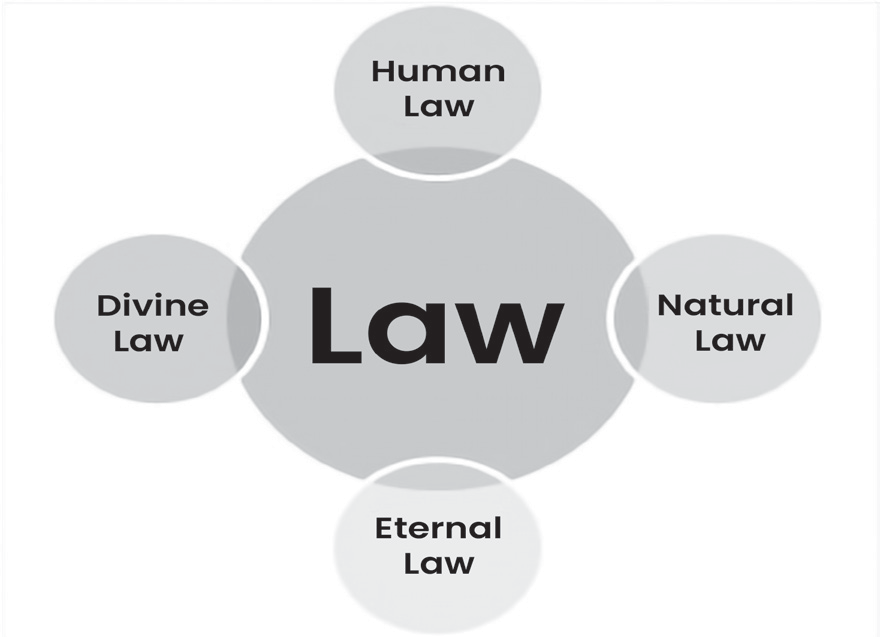
• Types of Laws:
• Eternal Law:
• Reflects God’s governance over the universe.
• Represents divine wisdom and the ultimate plan for creation.
• Everything in existence is believed to be subject to
eternal law.
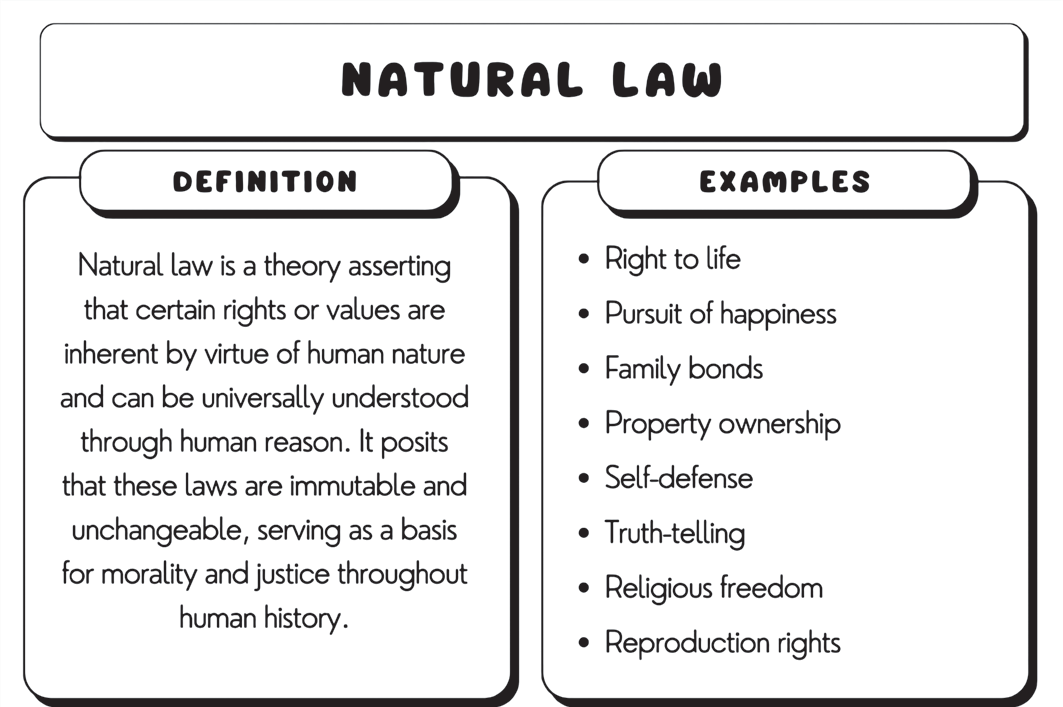
• Natural Law:
• Based on morality and ethics, guiding human actions to differentiate between good and evil.
• Discovered through human reason, not created by governments or institutions.
• Encourages actions that promote human life and well-being.
• Has two key attributes:
• Universality: Applies to all humans, allowing them to form moral judgments naturally.
• Immutability: Does not change over time, as human nature remains constant.
• Divine Law:
• Derived from religious scriptures like the Bible, Qur’an, or Vedas.
• Provides spiritual and ethical guidance that goes beyond natural law.
• Helps believers achieve eternal happiness and moral righteousness.
• Human (Positive) Law:
• Created by governments and societies to regulate human behavior.
• Rooted in natural law but tailored to address the
specific needs of a community.
• Key Characteristics of a Law:
• Consistency:
• Laws must be logically structured and not contain contradictions.
• Conflicting laws create confusion and make enforcement difficult.
• Universality:
• Laws should apply equally to all individuals in similar situations.
• Thereshould be nodiscrimination or favoritism in legal application.
• Publication:
• Laws must be officially recorded and made
accessible to the public.
• Citizens must be able to read and understand their rights and obligations.
• Acceptance:
• Laws should be designed to be reasonable and just, so they gain public acceptance.
• A law that is widely rejected by society may fail in its implementation.
• Enforcement:
• Legal authorities must ensure compliance with the law.
• Those who violate laws should face appropriate penalties.
• Example: Traffic laws regulate road safety and are strictly enforced to prevent accidents.
Rules as Source of Ethical Guidance
• Rules as Social and Legal Frameworks:
• Created by humans to regulate interactions and
maintain order in society.
• Some rules are essential, such as speed limits, ensuring safety and discipline.
• Others may be arbitrary or minor, like an
individual deciding where to cross a street for personal convenience.
• Rules that apply only to specific individuals rather than society as a whole are often termed petty rules.
• Legal Status and Authority of Rules:
• Rules function as subordinate legislation and have the same enforceability as laws.
• Laws cannot cover all possible scenarios, so provisions exist for creating rules to ensure proper implementation.
• The executive branch of the government is responsible for rule-making.
• Rules must align with the law and cannot exceed its scope. They are subject to legislative approval.
• Example: Under Section 469(2) of the Companies Act, 2013, the central government is empowered to frame rules for the Act’s implementation.
• Purpose and Adaptability of Rules:
• Designed as guidelines for appropriate behavior and operations.
• Can be modified or adjusted based on evolving circumstances.
• Importance of Rules in Organizations and Businesses:
• Define expected behaviors and standards within an organization.
• Shape the work culture, ensuring clarity in how employees should act and perform.
• Even if rules seem like mere guidelines, failure to follow them can lead to disciplinary actions.
Regulations as source of Ethical Guidance
• Definition and Purpose of Regulations:
• Regulations are directives formulated for specific
situations to ensure proper implementation.
• They are established through delegated (subordinate) legislation, where the executive branch is granted authority by legislation to create rules.
• Regulations are essential for the effective
enforcement of laws and policies.
• Regulatory Authorities and Their Role:
• Various sector-specific regulatory bodies are created to enforce regulations, such as:
• SEBI (Securities and Exchange Board of India) – Regulates financial markets.
• RBI (Reserve Bank of India) – Regulates banking and monetary policies.
• IRDA (Insurance Regulatory and Development Authority) – Regulates the insurance sector.
• Examples of Regulation-Making Powers:
• FEMA Act, 1999:
• Rules framed by the central government under
Section 46.
• Reserve Bank of India (RBI) is empowered to make regulations under Section 47.
• SEBI Act, 1992:
• SEBI issued the Capital and Disclosure Requirements (ICDR) Regulations, 2018 under Section 30(7).
• Protection of Human Rights Act, 1993:
• Regulation-making powers are vested with the National Human Rights Commission (NHRC) under Section 10(2).
• Functions and Importance of Regulations:
• Serve as a mechanism for monitoring and enforcing laws.
• Act as written instruments that help in law enforcement.
• Created by the executive branch to ensure compliance with legal provisions.
• Laws often provide a basic framework, while regulations offer detailed implementation guidelines.
• Help in clarifying complex legal provisions, making them more practical and enforceable.
Conscience As Source of Ethical Guidance
CONSCIENCE AS SOURCE OF ETHICAL GUIDANCE
• Laws, rules, and regulations outline external standards of morality, whereas conscience governs the internal assessment of moral actions.
• Conscience is a mental function that evaluates whether an action is morally right or wrong. It is essentially the awareness of the ethical dimension of one’s behavior, coupled with the tendency to choose right over wrong.
• The term "conscience" originates from the Latin word "conscientia," which means "shared knowledge" or "awareness."
• Conscience acts as a mental ability, instinct, or decision-making process that enables individuals to differentiate between good and bad actions.
• Example: In cricket, former Australian wicketkeeper-batsman Adam Gilchrist used to voluntarily walk off the field if he believed he was out, regardless of the umpire’s decision — a clear example of conscience in action.
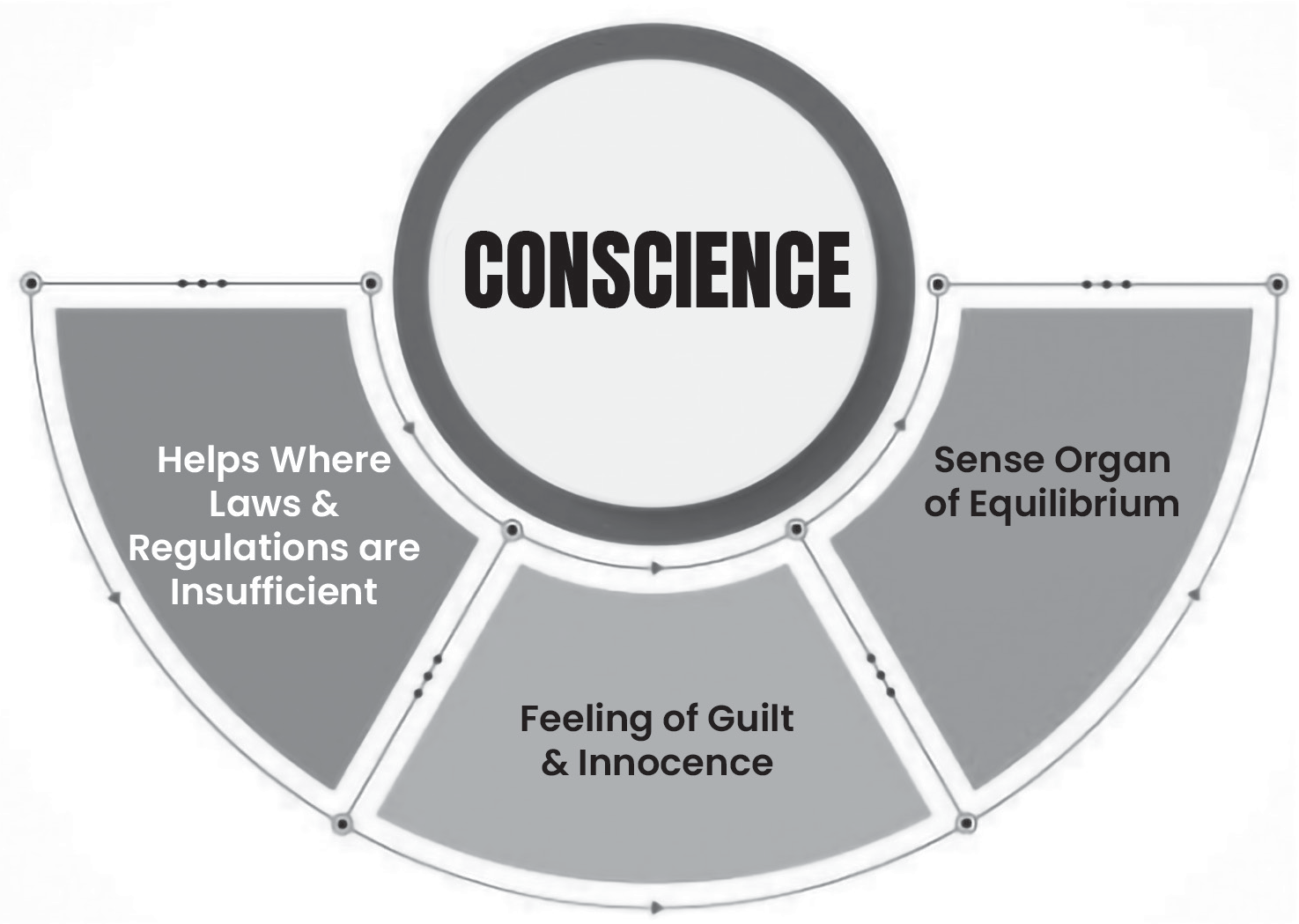
Conscience functions as a unique mental activity where the intellect evaluates the moral quality of specific actions. It is a practical assessment of real, human conduct.
• From a deontological perspective, conscience is understood as a judgement, not an emotional response or mere feeling.
• The functioning of conscience generally involves the following steps:
• Understanding moral principles,
• Applying these principles to the specific context,
• Evaluating the morality of a particular act (whether done or intended),
• Making a wise and ethical decision based on that evaluation.
• In philosophy, conscience is viewed as an ethical faculty. It reflects internalized moral values, which are acquired over time through various means. Our ethical instincts are significantly shaped by our surroundings and upbringing. However, just because society teaches us certain moral instincts doesn’t automatically make them right.
• For most people, most of the time, these instincts serve well. Still, we should not accept them blindly, as doing so may lead us to justify unethical behavior when these instincts go wrong.
• There are individuals who commit harmful acts yet believe they are not doing anything wrong. Their moral sense might be distorted due to:
• Traumatic experiences,
• Abusive backgrounds, or
• Neurological or chemical imbalances in the brain.
• Regardless of the cause, it’s important to remain vigilant and not rely solely on our conscience unless we have verified its accuracy through other means.
• Conscience and law are not the same. While law provides general guidelines for behavior, conscience offers personalized moral judgments on specific actions. applies that law or action is much broader than law.
Importance of Conscience
• Importance of Inner Voice in Democracy:
• Democracy involves multiple stakeholders, including citizens, NGOs, and corporations, governed by elected politicians.
• On an individual level, conscience plays a crucial role in decision-making, helping people move beyond self-centered thinking.
• Role of Conscience at Different Levels:
• Political Level:
• Helps reduce corruption, nepotism, and self- serving behavior among politicians.
• Encourages leaders to act in the public interest
and uphold constitutional values.
• Bureaucratic Level:
• Raises ethical dilemmas about whether to blindly follow orders or make morally sound decisions.
• Citizen Level:
• Collective and individual conscience reflect
societal values.
• Encourages civic responsibilities such as keeping surroundings clean, participating in elections, and opposing undemocratic practices.
• Helps prevent social unrest, such as riots or mob violence, by promoting rational decision-making.
Famous Quotes on Conscience
• “I love the man that can smile in trouble, that can gather strength from distress, and grow brave by reflection. It’s the business of little minds to shrink, but he whose heart is firm, and whose conscience approves his conduct, will pursue his principles unto death.” -- Thomas Paine
• “There is a higher court than courts of justice and that is the court of conscience. It supersedes all other courts.” – Mahatma Gandhi
• “Conscience is the inner voice that warns us somebody may be looking.” -- H.L. Mencken
• “Scourges, racks, and flames, can inflict no pains to be compared with the stings and tortures of a guilty conscience.” -- John Thornton
• “Let every man be free to act from his own conscience; but let him remember that other people have consciences too; and let not his liberty be so expansive
that in its indulgence it jars and crashes against the liberty of others.” -- E. H. Chapin
• “If we neglect conscience, most evils are possible.” --
Edward Counsel
• “We never do anything so secretly, but that it is in the presence of two witnesses: God, and our own conscience.” -- Benjamin Whichcote
• “Consciences keep silence more often than they should, that’s why laws were created.” -- José Saramago
Conscience and Consciousness
• Consciousness: It is generally defined as ‘awareness’ of self and the world around, thoughts, actions, feelings, sensations, perceptions, and other mental processes. In other words, they say, this suggests that
consciousness isn’t just one mental process but rather
a part of many.
• For example, memories can be conscious, but consciousness is not just memory. Perceptions can be conscious, but consciousness is not just perception.
• While the two terms are often confused, the conscious and the conscience refer to very different things. Your conscious allows you to be aware of your place in the world, while your conscience allows you to behave in this world in morally and socially acceptable ways.
• Conscience is generated internally whereas consciousness is emerged due to external phenomenon sometime by listening, reading or by any other mean.
Voice of Conscience
• The Voice of Conscience is the internal guide that influences behavior, thoughts, and speech. It serves as the mind’s mechanism for distinguishing between morally right and wrong actions. This inner voice is crucial for ethical decision-making and acts as a personal moral compass.
• When we take a moment to listen to our conscience, we often find clarity and answers to our dilemmas. These answers are usually grounded in ethical principles.
• Notable Quotes on the Voice of Conscience:
• “The human voice can never reach the distance that is covered by the still small voice of conscience.”
— Mahatma Gandhi
• “The voice of conscience is so delicate that it is easy to stifle it; but it is also so clear that it is impossible to mistake it.”* — Madame de Staël
• “In matters of conscience, the law of the majority has no place.”* — Mahatma Gandhi
• “Conscience is the authentic voice of God to
you.”* — Rutherford B. Hayes
• “Conscience is the voice of the soul.” — Jean- Jacques Rousseau
• “Always listen to the voice of your conscience. If your conscience conflicts with your faith, question everything.” — Suzy Kassem
• “Never do anything against conscience even if the state demands it.”* — Albert Einstein
• Ways to Strengthen and Follow the Voice of Conscience:
• Take time to reflect on the different aspects of an issue before making a decision.
• Develop the habit of practicing silence and introspection.
• Engage in meditation and prayer to enhance self- awareness.
• Free yourself from external pressures and personal biases to make impartial decisions.
Crisis of Conscience
• Crisis of Conscience is a situation in which it is very
difficult to decide what is the right thing to do.
• The term is also used when there is a sense of worry or fear because they think that have done something unfair or morally wrong.
• It is found in the case of an ethical dilemma, but often in a stronger sense.
• Guidelines to solve Crisis of Conscience:
• Ensure Equity and Justice
• Display Mercy and Kindness
• Practice Compassionate treatment
• Specific tools to resolve the crisis include
• Use of Gandhi’s Talisman
• Asking for Forgiveness
• Paying the Price
• Telling the Truth
Accountability and Ethical Governance
Accountability and Ethical Governance
Governance as a Core Necessity:
A well-functioning state relies on governance for
stability and development.
Analyzing governance aspects helps in identifying discrepancies between the current and ideal systems.
This analysis drives efforts toward achieving better governance standards and ensuring public welfare.
Role of Ethics and Accountability:
Ethics and accountability are fundamental pillars
of governance.
Many nations struggle with legitimacy issues, making these values even more critical.
Understanding Governance:
Governance is the framework for decision-making and the mechanism for implementing or failing to implement those decisions.
World Bank defined Governance as “the way…. power is exercised through a country’s economic, political, and social institutions.”
Accountability: It is the obligation of the administration to give a satisfactory account of their performance and the manner in which they have exercised the power conferred on them.
The aim of accountability is to check wrong and arbitrary actions and to increase efficiency and effectiveness.
Accountability also means liability or answerability. It is responsibility to some outside or higher level of authority by a person or group of persons in an organisation.
Accountability is reinforced by punitive action.
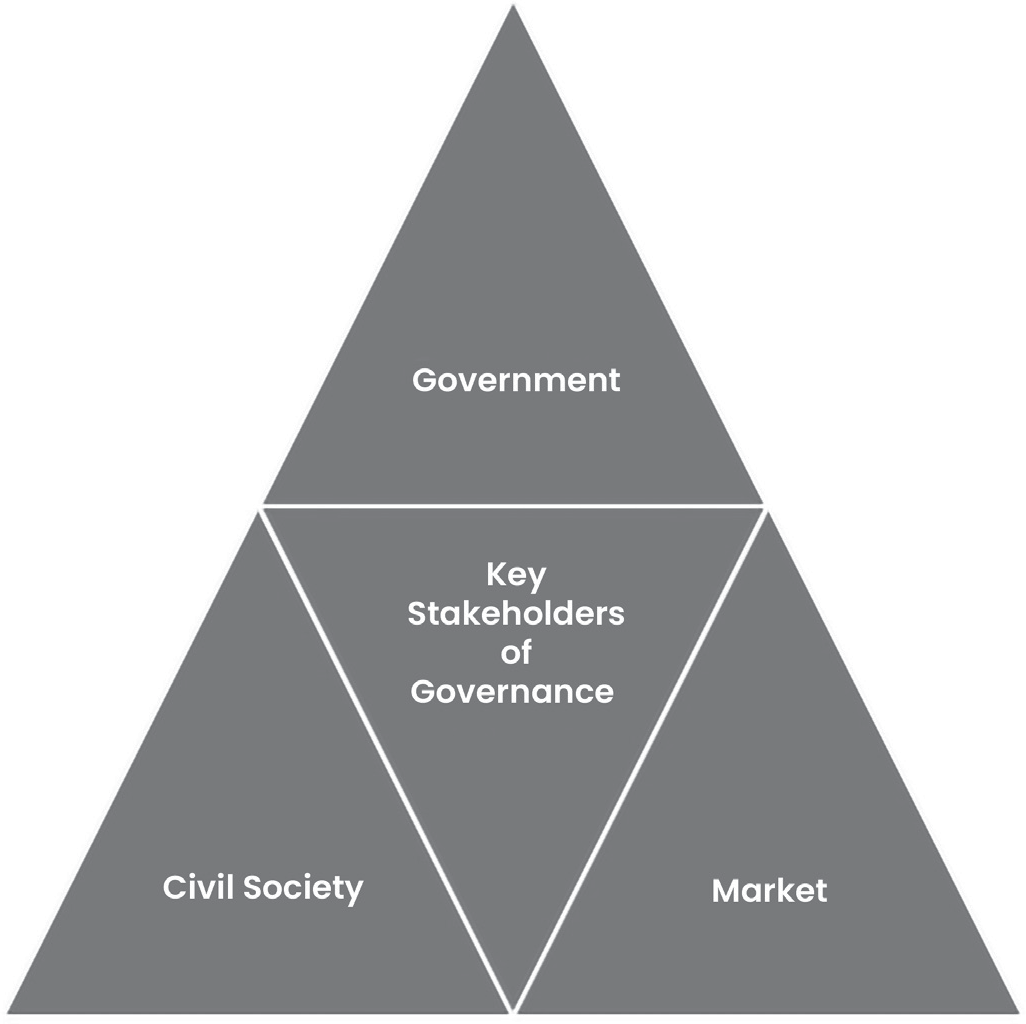
Figure: Key Stakeholders of Governance
Government vs Governance
| Government Government is a machinery and an institution. Power to serve external and internal interests of political community Ruling the people by official machinery Legitimate authority prerogative of the elected leaders or selected bureaucrats | Governance It is process and result of decision making Power to serve the benefits of society Serving the people Ensuresactive participationof people in just, transparent and accountable manne |
Good Governance, Ethical Governance and e-Governance
• It has no single definition or exhaustive or universal scope.
• When ‘good’ is added as a prefix to governance, a
value dimension is added, which includes both means and ends oriented values in context of democracy, profession, citizens, ethics and morality.Good Governance is inherently ethical in nature.
• There are some parameters of Good Governance like voice and accountability, absence of political instability and violence, effectiveness, reasonableness, Rule of Law and absence of graft.
• Ethical Governance:
• It means to serve others by setting high standards of moral conduct and their jobs as vocation (i.e. purpose driven life to the well being of all)
• Rule of Law and Absence of Graft (i.e. bribery)
are most significant for Ethical Governance.
• Thus, Ethical Governance denotes administrative measures, procedures and policies that fulfil criteria required for the ethically good or acceptable handling of public affairs, such as in public
administration, public health care, education, and social security.
• World Bank defined E-governance as the use by government agencies of information technologies (such as Wide Area Networks, the Internet, and mobile computing) that have the ability to transform relations with citizens, businesses, and other arms of government.
Minimum Government, Maximum Governance
• "Minimum Government, Maximum Governance" emphasizes reducing government intervention in daily life while empowering citizens to contribute to national growth and development.
• Achieving "minimum government" involves
simplifying bureaucratic processes,reducing red tape and corruption, and promoting e-governance for greater efficiency.
• Maximizing governance focuses on improving ease of doing business and enhancing the quality of life for citizens through key initiatives such as:
• Ensuring law and order.
• Investing in essential infrastructure.
• Maintaining macroeconomic stability.
• Providing basic social services.
• Safeguarding vulnerable communities.
• Protectingthe environment forsustainable development.
Accountability vs Responsibility
• Accountability refers to the obligation of power holders to take responsibility for their actions. It is a broader concept that inherently includes responsibility.
• It signifies answerability for performance in tasks assigned to an individual, whereas responsibility is the specific duty or role a person is expected to fulfill.
• Accountability is a legal obligation, requiring
individuals to justify their actions, whereas responsibility is a moral obligation to complete a task with integrity.
• Accountability is external and objective, enforced by laws, policies, or oversight, while responsibility is internal and subjective, driven by personal ethics and motivation.
Strengthening of Ethical and Moral Values in Governance
• In modern India, as education levels rise and people become more aware of their rights, the focus on ethics in governance has increased. Ethical governance is essential for ensuring moral values, responsible practices, and ethical behavior in public administration. These values are instilled through family, education, religion, society, and workplace culture.
• Strengthening Public Administration is crucial, especially in developing countries, to:
• Promote socially equitable and sustainable economic growth
• Create policies that enable participation in a globalized economy
• Combat poverty effectively
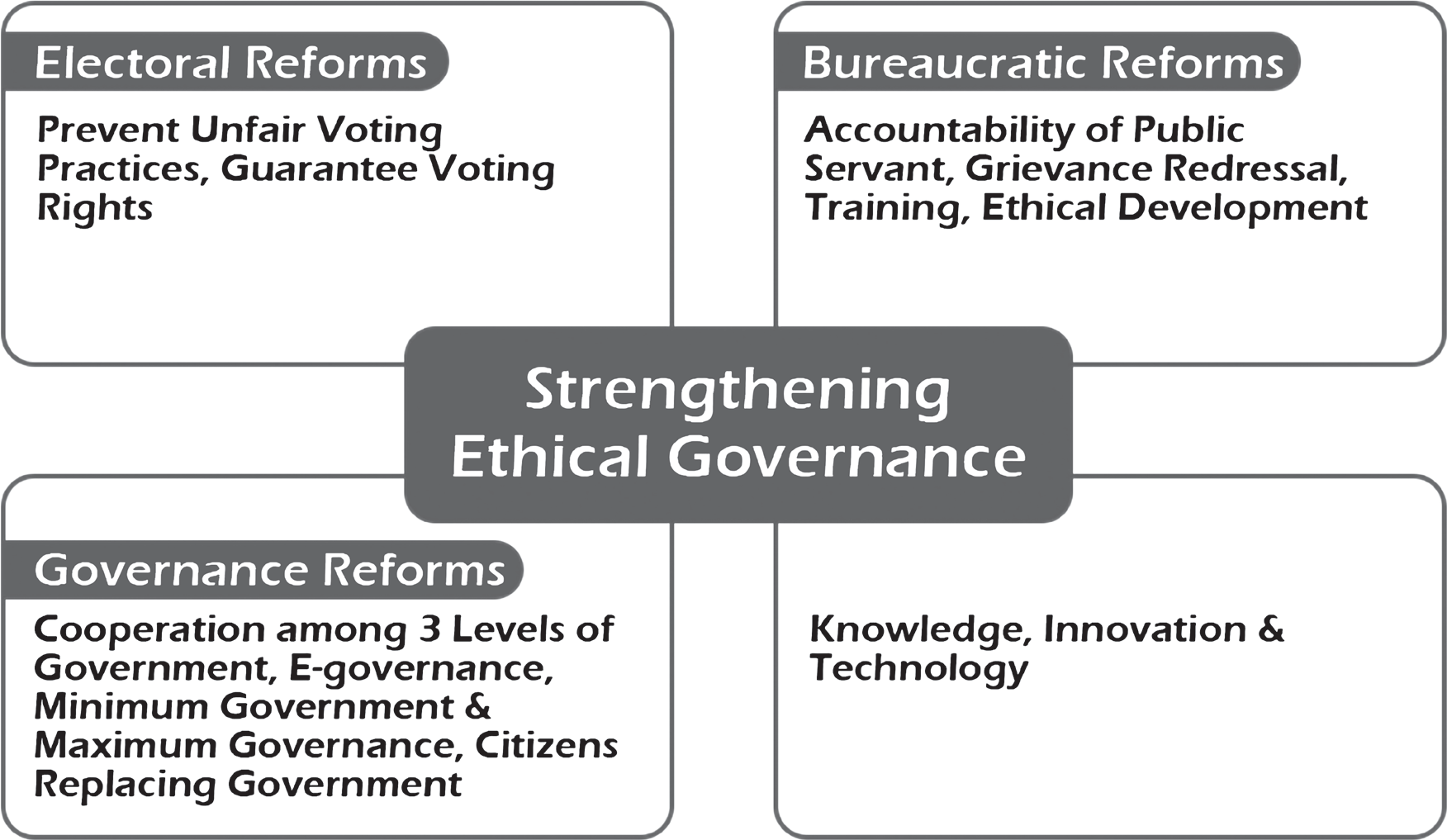
• Governance must effectively and impartially implement the social contract, requiring a competent, well-informed administration. Government institutions should be:
• Innovative and participatory
• Focused on sound policy-making and citizen- oriented approaches
•
Open to **reforms and adaptability
• Ways to Strengthen Moral Values in Governance:
• Creating an Ethical Environment: Encourage moral values in society, invest in education and healthcare, uphold civil rights, and implement judicial and police reforms.
• Leading by Example: Establish role models in governance who demonstrate ethical leadership.
• Enhancing Accountability and Transparency: Use tools like RTI, social audits, and citizen charters to hold authorities accountable.
• Embedding Ethics through Training and Incentives: Strengthen moral education for public officials.
• Implementing a Practical Code of Ethics: Develop a clear ethical framework for public officials at all levels.
• Adopting a Zero Tolerance Policy Against Corruption: Ensure strict action against unethical practices.
• Decentralizing Governance: Reduce bureaucratic discretion and empower local governments.
Encouraging Public-Private Partnerships (PPPs): Collaborate with private entities and NGOs for effective service delivery
Corporate Governance
CORPORATE GOVERNANCE
• Corporate governance is the system by which companies are directed and controlled. Boards of directors are responsible for the governance of their companies. The shareholders’ role in governance is to appoint the directors and the auditors and to satisfy themselves that an appropriate governance structure is in place.
• The responsibilities of the directors include setting the company’s strategic aims,providing the leadership to put them into effect, supervising the management of the business and reporting to shareholders on their stewardship. The Board’s actions are subject to laws, regulations and the shareholders in general meeting.
Principles of Corporate Governance
Corporate governance is built on fundamental principles that guide a company’s operations, ensuring ethical conduct, transparency, accountability, and fairness. These principles help maintain stakeholder confidence and promote responsible management.
• Transparency
• Transparency involves open and honest
communication about a company’s operations,
financial performance, and strategic decisions.
• Openness in Business Operations: Companies must provide stakeholders with clear and accurate information about their activities, including financial statements and corporate strategies.
• Financial Disclosure: Organizations should truthfully report financial performance to avoid misleading investors and regulators.
• Stakeholder Communication: Shareholders, investors, and regulatory bodies should have access to accurate and timely information about the company’s performance and risks.
• Timely and Accurate Reporting: Companies should ensure that disclosures are made at regular intervals to keep stakeholders informed.
• Accountability in Management: Clearly defined roles and responsibilities of board members and executives ensure transparency in decision- making.
• Example: Publicly listed companies publish annual and quarterly financial reports to maintain transparency.
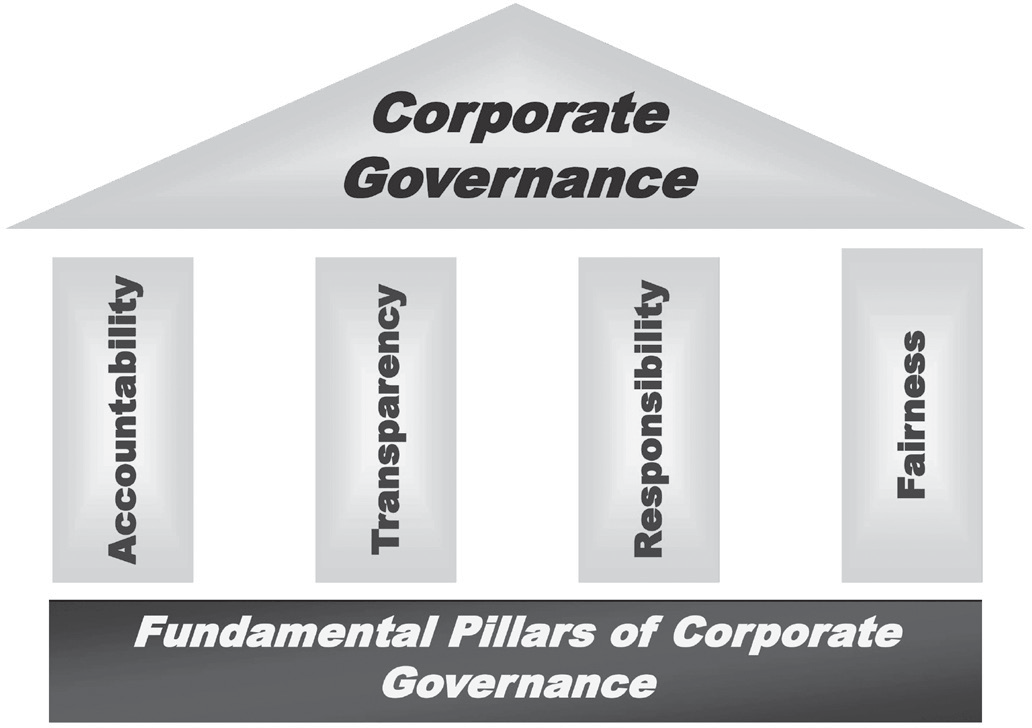
Accountability
Accountability ensures that corporate leadership takes responsibility for their actions and decisions.
Board’s Responsibility: The Board of Directors must ensure that the company follows ethical standards and operates efficiently.
Risk Management: Boards must identify and manage financial and operational risks to safeguard the company’s stability.
Internal Controls: Effective internal control mechanisms must be in place to prevent fraud, mismanagement, and unethical practices.
Corporate Reporting: Companies must adopt
transparent and formal reporting structures to ensure compliance with governance standards.
Stakeholder Communication: Boards should regularly engage with shareholders and investors to provide insights into the company’s direction and challenges.
• Responsibility
• The Board of Directors is entrusted with the authority to make decisions on the company’s behalf. With this authority comes the obligation to take full ownership of the powers they wield and the actions they undertake.
• They are tasked with supervising the company’s operations, managing its affairs, appointing the CEO, and regularly evaluating the company’s overall performance. In carrying out these duties, they must always act in the best interest of the organization.
• The Board should actively encourage ethical conduct and responsible decision-making within the company.
• Accountability is closely linked to responsibility. The Board must be held answerable to stakeholders for how they fulfill their roles and carry out their duties.
• Fairness:
• The principle of fairness ensures that shareholders have the right to express concerns and seek resolution when their rights are violated.
• This concept emphasizes safeguarding shareholder rights, ensuring equal treatment of
all shareholders without bias or favoritism, and providing avenues for addressing any grievances.
• It also involves acknowledging and fulfilling the company’s legal and moral responsibilities toward all legitimate stakeholders.
Importance of Corporate Governance
• The Uday Kotak Committee on Corporate Governance observed that research strongly supports the idea that companies with strong corporate governance practices deliver considerably higher returns—ranging from 10% to 40% more than those with weaker governance structures.
• Studies exploring the governance frameworks responsible for this enhanced value highlight several key elements:
• The structure of the board, particularly the board's independence—both in legal terms and in spirit— from company management;
• The knowledge and expertise possessed by the board members;
• The composition and autonomy of important board committees, such as the audit committee and the nomination and remuneration committee;
• The independence of external auditors and the credibility of the company’s financial audits;
• The transparency and quality of corporate disclosures; and
• A thoughtful approach to balancing the rights and interests of majority (controlling) shareholders and minority shareholders.
| Success Models | Examples of Failure |
| Prominent Corporate Governance Models in India | Corporate Governance Failures: Key Case Studies |
| 1. Tata Model (Tata Group) Focuses on ethics, integrity, and accountability as core principles of governance. Prioritizes corporate social responsibility (CSR) and sustainable business practices. Emphasizes long-term value creation rather than short-term profits. Recognized as a benchmark for ethical governance in India. | 1. Yes Bank Crisis Once a leading bank, Yes Bank faced a severe downfall due to governance failures. Poor risk management, lack of transparency, and financial misreporting contributed to its collapse. The crisis highlighted the importance of strong corporate governance in financial institutions. Served as a wake-up call for the banking industry, emphasizing the need for accountability and regulatory oversight. |
| 2. Mahindra Model (Mahindra Group) Centersaroundemployeeandstakeholder empowerment for business success. Encourages a culture of inclusivity, transparency, and innovation. Believes that strong internal governance fosters sustainable growth. Known for employee-friendly policies and fair corporate practices. | 2. Enron Scandal Enron, a global energy company, collapsed due to unethical practices and financial fraud. The company prioritized short-term profits over long- term stability, engaging in accounting manipulation. Governance failures led to one of the biggest corporate bankruptcies, causing massive financial losses to investors and employees. The scandal underscored the critical need for transparency, ethical leadership, and stringent regulatory frameworks. |
| 3. Infosys Model (Infosys Ltd.) Built on the principles of transparency, integrity, and shareholder value. Promotesamerit-basedculture,rewarding performance and innovation. Focuses on clear financial disclosures and ethical decision-making. Has gained a strong reputation for reliability and trustworthiness due to its governance practices. |
• Advantages of Implementing Corporate Governance Practices:
• Improved Corporate Performance:
• Strong governance frameworks and procedures support sound decision-making, promote effective succession planning for leadership roles, and contribute to the sustainable growth of businesses. This leads to improved outcomes—such as increased profitability or share price—regardless of the company’s type or financial sources.
• Greater Investor Confidence:
• Companies that offer transparent operations and detailed disclosures are more likely to attract investors who feel confident about their investments.
• Easier Access to International Markets:
• Robust corporate governance attracts foreign investors, resulting in enhanced performance and efficiency in the financial system.
• Increase in Enterprise Value:
• Whenmanagement demonstrates accountability and operational transparency, it meets investor expectations, boosting their trust and thereby enhancing the company's market valuation.
•
Simplified Institutional Financing:
• A company with well-established governance is perceived as more credible, making it easier to obtain financing from financial institutions.
• Lower Risk of Crises and Scandals:
• Efficient corporate governance ensures the presence of sound risk management systems. By identifying and addressing potential threats early, companies can prevent crises and maintain stability.
• Fighting Corruption:
• Transparent companies that follow robust accounting and auditing standards foster honesty in business operations, thus reducing opportunities for corrupt practices.
• Ensuring Accountability:
• Maintaining transparent and consistent communication with shareholders is a key aspect of corporate governance. Since shareholders entrust the management with increasing the value of their investments, companies must provide regular updates to maintain strong investor relations.
• Improved Employer-Employee Relationships:
• Ethical management is reflected in how employees are treated. Providing a safe and fair
work environment, free from discrimination based on gender, religion, or disability, helps build trust between the workforce and the management.
Constituents of Corporate Governance:
• The Board of Directors:
• The board of directors holds a central position in any corporate governance framework. It is answerable to the stakeholders and is responsible for guiding and overseeing the company’s management. The board provides leadership, defines the company’s strategic direction and financial objectives, supervises their execution, ensures the establishment of robust internal control mechanisms, and offers regular, transparent reports to stakeholders regarding the company's activities and performance.
• Types of Directors:
• Executive Directors: Also known as inside directors, they are actively involved in day- to-day operations and may head various departments as CEOs. Typically, individuals holding a significant share in the company are appointed to these roles.
• Independent Directors: These directors have no significant ties or relationships with the company. Their role is primarily advisory. Appointed by the board’s nomination committee, independent directors are crucial for maintaining oversight, particularly in companies that have raised funds from public capital markets.
• The Shareholders:
• In corporate governance, shareholders are responsible for appointing directors and auditors. They ensure proper governance by holding the board accountable
and by requiring regular, transparent updates on the company's functioning and progress.
• The Management:
• Management is tasked with operating the company in alignment with the strategic direction provided by the board. It must implement effective control systems, ensure they function smoothly, and deliver timely, transparent information to the board so that management’s accountability can be effectively monitored.
Legal Framework of Corporate Governance
Key Corporate and Securities Laws in India
• Companies Act, 2013:
•
Replaced the Companies Act, 1956 to modernize corporate governance and regulations.
• Aims to align India’s corporate practices with global standards.
• Securities Contracts (Regulation) Act, 1956 (SCRA):
• Regulates trading of securities, including shares, bonds, stocks, and debentures.
• Defines the rules for stock exchanges and their functioning.
• Securities and Exchange Board of India (SEBI) Act, 1992:
• Established SEBI as the independent capital market regulator.
• Protects investor interests and regulates securities markets.
• Depositories Act, 1996:
• Created the framework for electronic holding (dematerialisation) of securities.
• Established depositories for shares and securities
to ensure smooth transactions.
Important Provisions of Companies Act, 2013
• At least one-third of the board in listed companies must be independent directors.
• Government may mandate a minimum number of independent directors in other public companies.
• The board must meet at least four times a year.
• The gap between two meetings should not exceed four months.
• Should be qualifiedand independ ent, with independent directors forming the majority.
• Independent directors should be evaluated by the
entire board, excluding the director under review.
• Stakeholders’ Relationship Committee to address investor concerns.
• Nomination and Remuneration Committee to oversee appointments and compensation.
• National Company Law Tribunal (NCLT) and National Company Law Appellate Tribunal (NCLAT) to fast-track corporate legal cases.
• Vigil Mechanism for directors and employees to report concerns, with incentives for ethical conduct.
Regulatory mechanism of Corporate Governance
• Independent regulatory agencies – SEBI, RBI, IRDA etc Lack of clear demarcation of role of regulatory bodies crates problem many a times.
• Third part assurance providers – rating agencies like CRISIL, Standard & Poor’s (S&P), Moody’s Fitch Group etc.
Important Recommendations of SEBI on Corporate Governance
• Align top executives' salaries with their performance and company growth.
• Ensure at least one female director on the board.
• No restrictionson appointing relatives of promoters (as per SEBI guidelines).
• Provide certification courses and training for independent directors.
• Independent directors should be removed only with the approval of at least half of the independent directors.
• Separate the roles of Chairman and Managing Director for better governance.
• Increaseboard size toenhance stakeholder representation.
• Corporate Governance Monitoring:
• Introduce Corporate Governance Ratings by independent agencies to assess compliance.
• Conduct regular inspections by SEBI and stock exchanges.
• Example: The Sahara Scam, where the company raised funds without listing in the capital market, operating like a chit fund.
• Develop a structured transition plan to prevent leadership gaps and ensure company stability.
• Enhance the powers of minority shareholders to ensure fair representation and protection of their interests.
Important Committees and their Recommendations for Corporate Governance
• The various committees set up by the government suggested various steps that can make the existing corporate governance practice an effective one include:
• Board of Directors (BoD)
• The BoD should be accountable to stakeholders for maintaining corporate governance standards.
• Diversity and expertise among board members should be disclosed. (Kotak Committee)
•
Independent Directors
• Strengthening the role of independent directors in company management.
• Ensuring proper review and implementation of committee recommendations for better governance.
• Audit Committees
• Focus on fairness, transparency, and accountability in financial audits and risk management. (Murthy Committee)
• Strengthening Legal Enforcement
• Benami Transactions Prohibition Act should be effectively enforced to prevent misuse of black money in businesses.
• Strict compliance with corporate governance codes (e.g., Cadbury Code, Birla Committee, Murthy Committee) should be mandatory.
• Abolition of Sick Units Act to prevent its misuse by corrupt industrialists.
• Review of Banking Secrecy Act to curb malpractices in the banking sector.
• Legal and Administrative Measures
• Making corporate governance compliance compulsory.
• Strict action against habitual defaulters to ensure ethical business conduct.
Corporate Social Responsibility
• CSR is a management approach where businesses incorporate social and environmental concerns into their operations and stakeholder interactions.
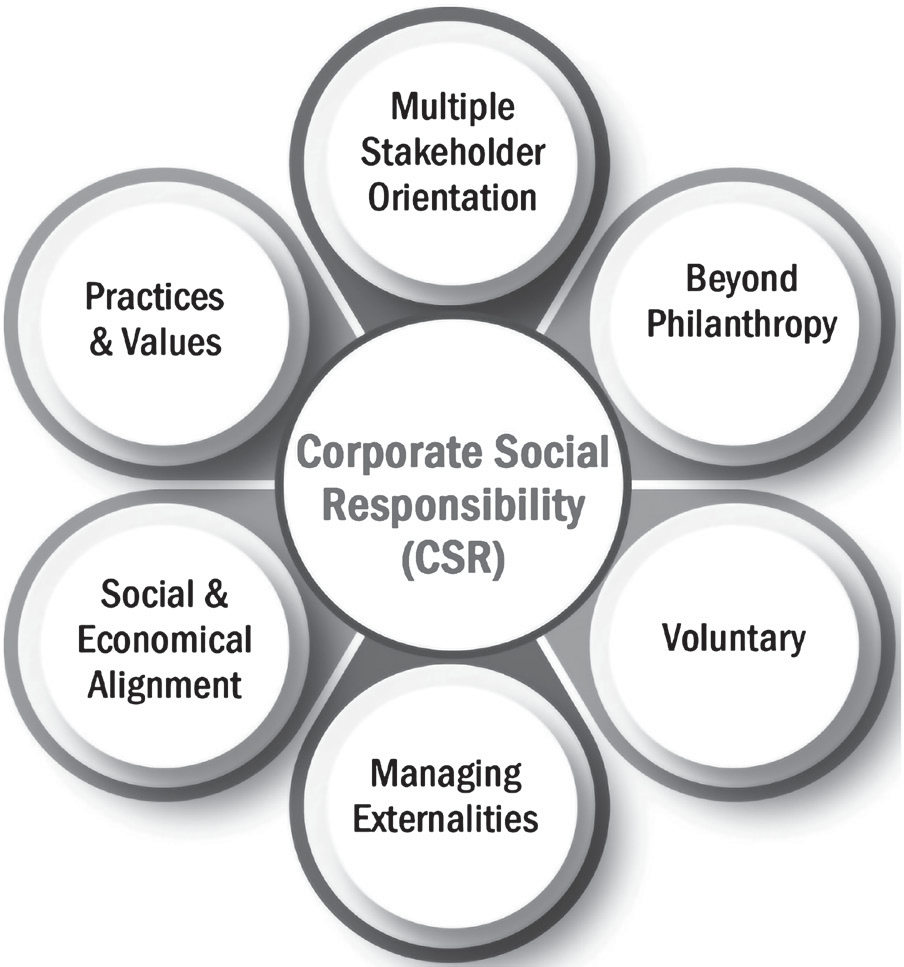
• Examples of Socially Irresponsible Practices:
• An automobile company selling cars with faulty brakes.
• A pharmaceutical company making false claims about its medicines.
• A food company promoting low-quality products through misleading advertisements.
• Beyond Legal Compliance:
• CSR is not just about following laws and ethical norms but also about actively contributing to societal well-being.
Eligibility of Corporate Social Responsibility
• CSR Spending Requirement
• Companies must allocate 2% of their average net profit from the past three years for CSR if they meet any of the following criteria:
• Annual turnover of ₹1,000 crore or more.
• Net worth of ₹500 crore or more.
• Net profit of ₹5 crore or more.
• Importance of Corporate Social Responsibility (CSR)
• Facilitates Fund Mobilization – Provides a legal framework for companies to contribute to social causes.
• Legal Obligation – Makes social spending a
mandatory corporate duty.
• Ensures Societal Justice – Corporations benefit from society; CSR serves as a way to give back and balance benefits and burdens.
• Builds Trust & Social Cohesion – Enhances public confidence in private companies, aiding in land acquisition and other national development efforts.
• Encourages Emotional Connection & Behavioral Change – Companies involved in women empowerment initiatives often see a positive shift in gender diversity within their workforce.
• CSR Activities Include:
• Eradicating hunger and poverty.
•
Promoting education and gender equality.
• Fighting diseases like HIV/AIDS.
• Ensuring environmental sustainability.
• Contributing to the PM National Relief Fund or PM CARES Fund.
Corporate Social Responsibility Initiatives in India
• Tata Group CSR Initiatives
• Focus on community development and poverty alleviation.
• Contributions to education: Tata Institute of Fundamental Research (1945, Mumbai), Indian Institute of Science (1909, Bangalore), Tata Institute of Social Sciences.
• MANSI (Maternal and Newborn Survival Initiative) by Tata Steel aims to reduce child and infant mortality in Jharkhand.
• ITC Group CSR Efforts
• Created sustainable livelihoods for over six million people.
• e-Choupal program connects 40,000 villages and
4 million farmers to digital agricultural markets.
• Social & farm forestry programs help farmers convert wasteland into pulpwood plantations.
• Mahindra & Mahindra Initiatives
• Nanhi Kali promotes girl education.
• Mahindra Pride Schools offer industrial training.
• Lifeline Express provides healthcare services in remote areas.
• Project Hariyali has planted over 8 million trees.
• SBI’s Rural Development Programs
• Under “SBI Ka Apna Gaon”, villages in Uttarakhand are being developed for improving social and infrastructure facilities.
• Infosys Foundation CSR Initiatives:
• Midday Meal Program, in collaboration with Akshaya Patra Foundation, supports chool children across multiple states in India.
Citizens Charter
Citizens Charter
• Citizen Charter is a document that outlines an organization’s commitment to its citizens, covering service standards, information accessibility, choice and consultation, non-discrimination, grievance redress, courtesy, and value for money.
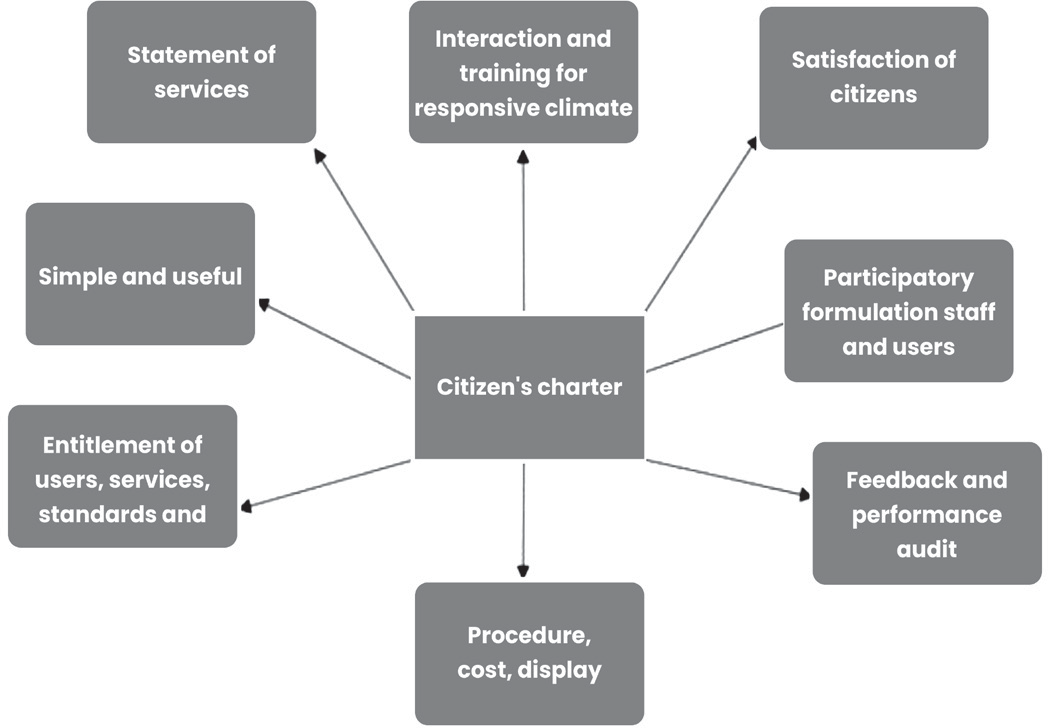
Figure: Aspects of Citizen’s Charter
• A tool designed to enhance transparency, accountability, and citizen-friendly services.
• Represents a formal pledge by an organization to maintain high standards in the services it provides.
Principles of the Citizen Charter
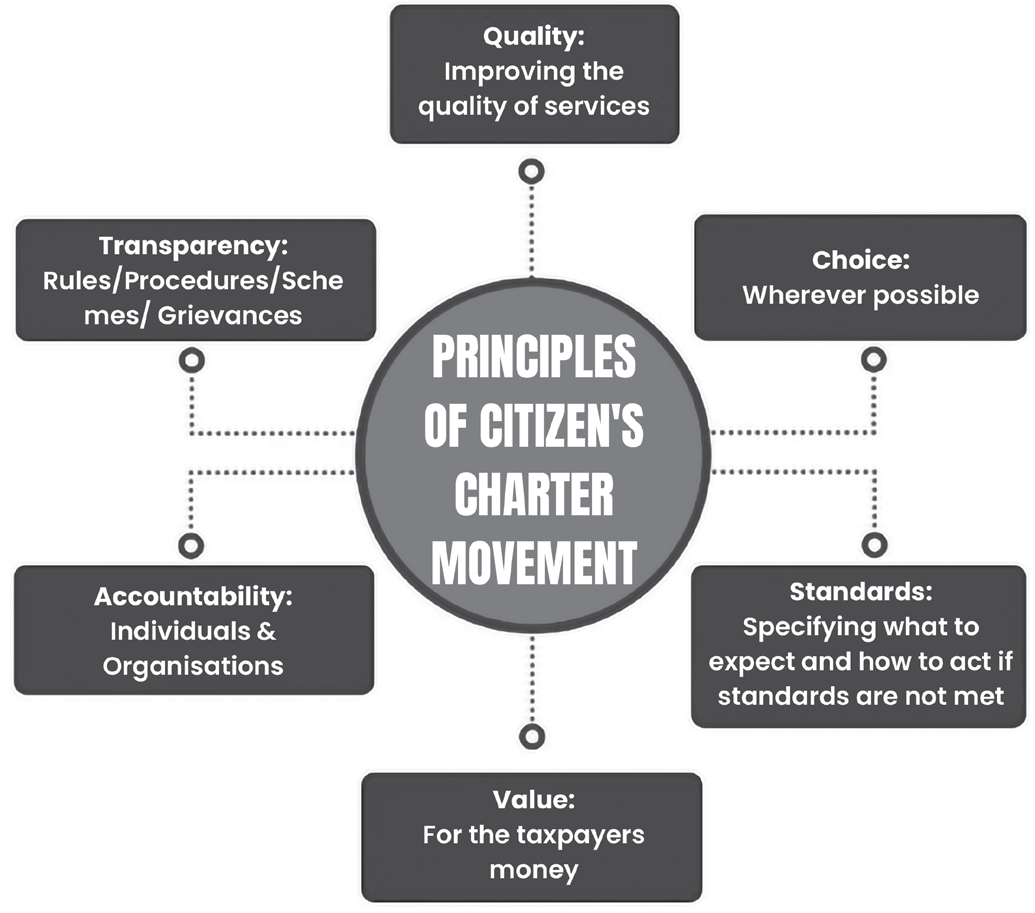
Figure: Principles of Citizen’s Charter Movement
Component of Citizen’s Charter
Key Components of a Good Citizen’s Charter:
Visionand Mission Statemen t**of the organization.
Details of Business Transacted by the organization.
Information on ‘Citizens’ or ‘Clients’, who are the recipients of services.
• Statement of Services** including:
• Standards, quality, and time frames for each service.
• How and where to access these services.
•
Additionalcommitments, such as compensation for failure to deliver services.
• Expectations from Citizens or Clients (An Indian innovation, not found in the UK model).
• Grievance Redress Mechanism and instructions on how to access it.
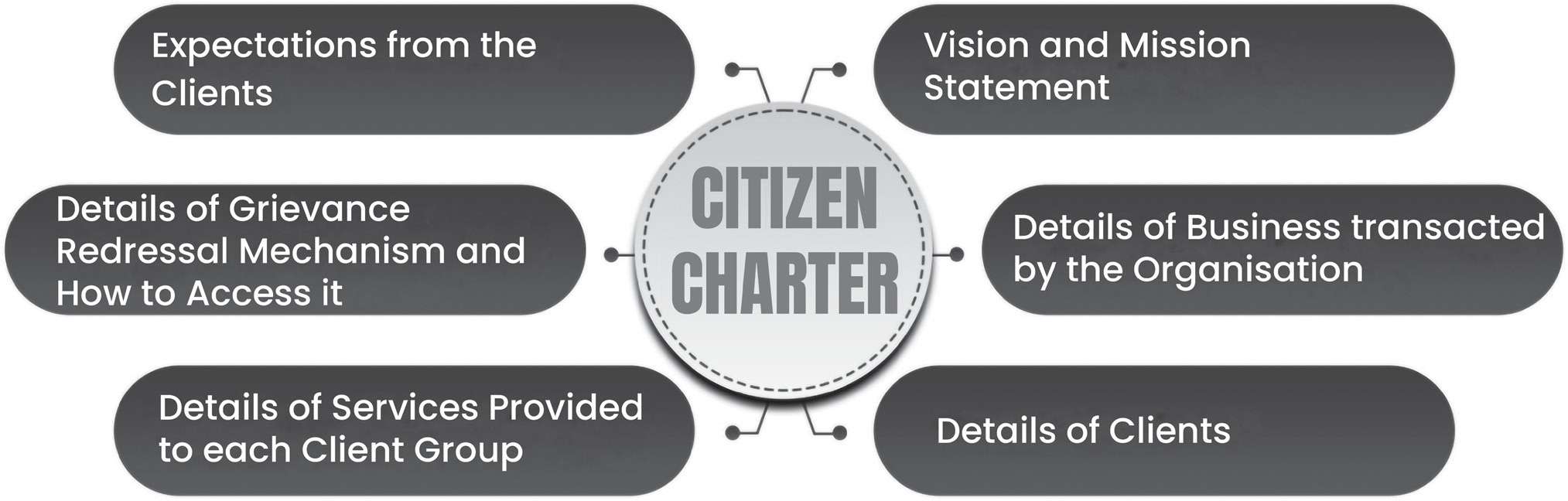
Figure: Components of Citizen Charter
Objectives of the Citizen Charter
• Objectives and Six Principles of the Citizen’s Charter:
• Empowerment: The primary goal is to empower citizens in relation to the delivery of public services.
• The Six Core Principles:
• Quality: Enhance the quality of services.
• Choice: Offer choices wherever feasible.
• Standards: Define expectations and outline actions if standards are not met.
• Value: Ensure services provide value for taxpayers’ money.
• Accountability: Holdindividuals and o rganizations accountable.
• Transparency: Maintain transparency in rules, procedures, schemes, and grievance handling.
Significance or Role of Citizen Charter
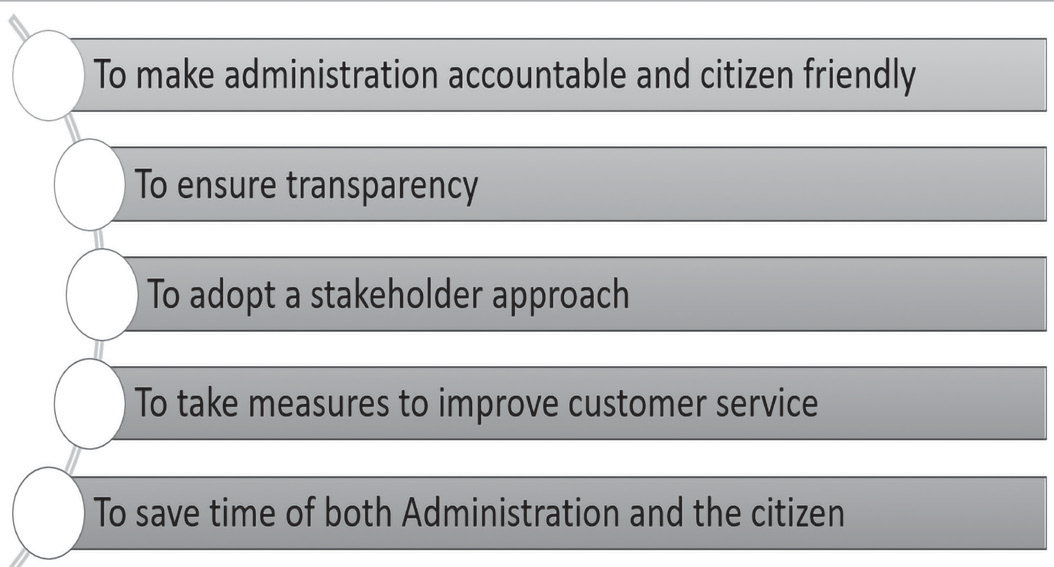
Figure: Significance of Citizen Charter
India and Citizens’ Charter
Chief Ministers' Conference (1997):
In 1997, an "Action Plan for Effective and Responsive Government" was adopted at the Centre and State levels.
Major Decision:
It was decided that both Central and State Governments would create Citizen’s Charters, starting with sectors with high public interaction (e.g., Railways, Telecom, Posts, Public Distribution Systems, etc.).
Role of DARPG:
The Department of Administrative Reforms and Public Grievances (DARPG) took on the responsibility of coordinating, formulating, and implementing Citizen’s Charters.
Guidelines:
Guidelines and a list of do’s and don’ts were provided to various government departments and organizations to help them develop focused and effective charters.
Key Elements of the Charters:
Vision and Mission Statement
Description of the business operations of the organization
Information about the client groups served
Details of services offered to each client group
Information on the grievance redress mechanism and how to access it
Expectations from the clients
Citizen’s Charters - Model Guidelines (as per DARPG)
• Need for a Citizen’s Charter:
• The Citizen’s Charter arises from dissatisfaction with the quality of service previously provided by public sector organizations.
• Guidelines for a Citizen’s Charter:
• The Charter should be simple and easy to understand.
• It must be developed not only by senior experts but also through collaboration with frontline staff who will implement it, as well as with users (individual organizations).
• Announcing the Charter alone will not improve service quality; it is essential to create a responsive environment through interaction and training.
• The Charter should begin by clearly stating the services offered.
• For each service, the Charter should specify the user’s entitlements, service standards, and remedies available if standards are not met.
• Information about procedures, costs, and charges should be accessible online, on display boards, booklets, or at inquiry counters as specified in the Charter.
• While the Charter's commitments are not legally enforceable, it should be viewed as a promise to be honored by the organization and towards the user.
• A mechanism for gathering feedback and conducting performance audits should be established, with a schedule for reviewing the Charter at least every six months.
• Separate Charters can be created for different services or for organizations/agencies under a Ministry or Department.
Shortcomings of Citizen Charter in India
• Lack of Participative Mechanisms:
• In many cases, the Citizen Charter is not developed through a consultative process involving frontline staff who will be responsible for its implementation.
• Inadequate Consultation:
• End-users, civil society organizations, and NGOs are often not involved in the drafting of Citizen Charters.
• Limited Public Awareness:
• Only a small proportion of end-users are aware of the commitments outlined in the Citizen Charter, as effective communication and public education efforts have not been carried out.
Lack of Interest:
There is no citizen-friendly mechanism to compensate individuals if the organization fails to meet its commitments, leading to diminished interest.
Poor Design and Content:
Citizen Charters often lack clarity and meaningful content, and do not provide essential information that would allow end-users to hold agencies accountable.
Charters are Often Not Updated:
Charters are frequently treated as a one-time exercise and remain unchanged, becoming outdated.
Measurable Standards of Delivery are Rarely
Defined:
Without clear metrics, it is difficult to determine if the promised level of service has been achieved.
Uniformity in Citizen Charters:
There is a tendency to apply a uniform Citizen Charter across all offices under a parent organization, which neglects local issues.
Not all Ministries/Departments have adopted Citizen Charters, which further undermines their effectiveness.
Second ARC Recommendations on Citizen Charter
• According to the 12th Report of the Second Administrative Reforms Commission (Citizen- Centric Administration - The Heart of Governance), the effectiveness of Citizen’s Charters can be enhanced by following these principles:
• Develop separate charters for each independent unit within the overall framework of the organization’s charter.
• Engage in wide consultations, including civil society and staff, during the preparation process.
• Make firm commitments to ensure accountability and clarity.
• Adopt a customized approach; one-size-fits-all solutions are not suitable.
• Periodically evaluate the effectiveness of Citizen’s Charters.
• Use end-user feedback for benchmarking and improvement.
• Replicatebest practices fromsuccessful implementations.
• Reform internal processes and structures to align with the commitments in the Citizen’s Charter:
• Allocate specific budgets for awareness campaigns
and staff orientation.
• Establish a redress mechanism for addressing defaults or non-compliance.
• Hold officers accountable for delivering the promised results.
• Create a database of consumer grievances and track the redress process.
• Publicize the Charter widely through various channels such as print media, posters, banners, leaflets, handbills, brochures, local newspapers, and electronic media.
• Train and orient staff on the Charter’s key features, objectives, vision, and mission. Additionally, provide training in team building, problem-solving, grievance handling, and communication skills.
Sevottam Model
• Sevottam is derived from two words: Seva meaning service, and Uttam meaning excellence. It is a comprehensive framework aimed at enhancing the quality of public service delivery, as recommended by the Second Administrative Reforms Commission (ARC). The Sevottam model was developed to address the limitations of the earlier Citizen Charter approach and provides a structured mechanism for evaluating and improving the delivery of services to the public.
• Key Components of the Sevottam Framework:
• Effective Implementation of Citizen Charters:
• The first element emphasizes the proper
execution of Citizen Charters, which helps integrate citizen feedback into the service planning process. These charters outline citizens’ rights and service expectations, empowering them to demand better quality services by making entitlements transparent and publicly accessible.
• Public Grievance Redress Mechanism:
• The second component focuses on establishing a robust grievance redressal system that ensures citizens are satisfied with how their complaints are addressed, regardless of the final outcome. A responsive system enhances citizens’ trust in public organizations.
• Achieving Excellence in Service Delivery:
• The third element highlights that an organization can achieve high standards in service only by effectively managing essential components of service delivery and developing its internal capacity for continual improvement.
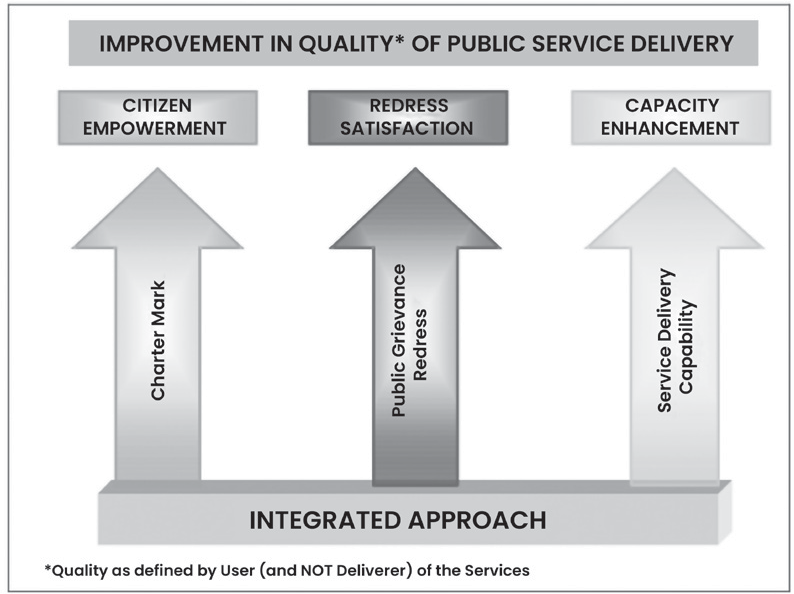
Figure: Improvement in Quality of Public Service Delivery
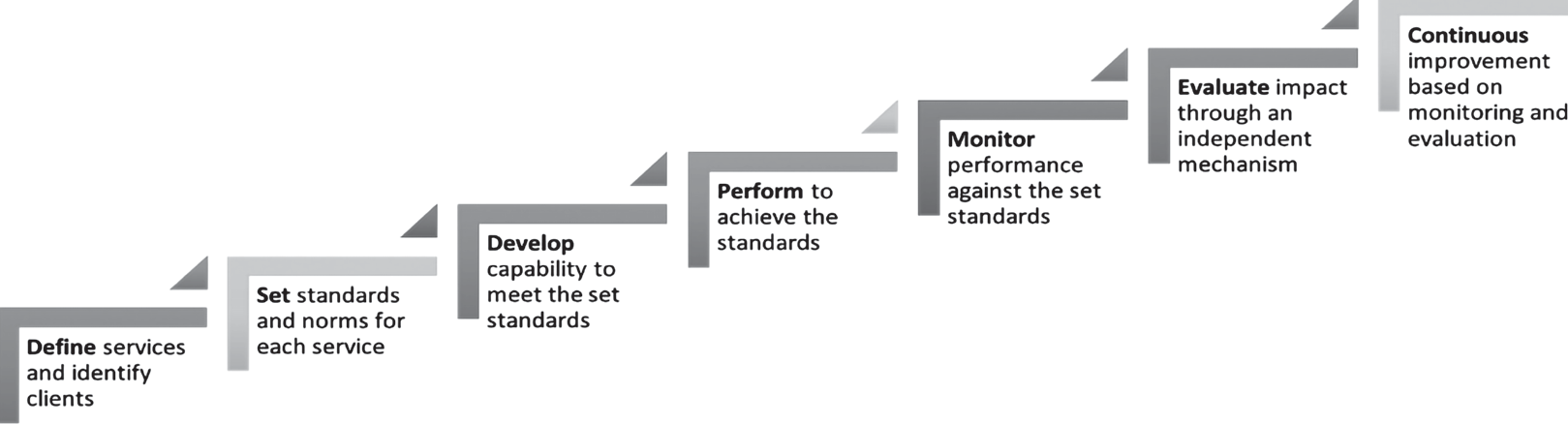
Figure: Stages of Implementation in Sevottam Model
• Steps in the Sevottam Model:
• Public organizations that adopt the Sevottam framework for service delivery must follow a sequence of seven steps and develop three core modules.
• The implementation of this model across government departments began in 2009.
• Eventually, Sevottam evolved into a certification- based scheme, awarding the Sevottam symbol of excellence to public service institutions that meet
the defined management system criteria outlined
in a specially designed standard.
• This standard, called IS 15700:2005, was created by the Bureau of Indian Standards (BIS), aligning with the objectives set out under Sevottam.
• Importance of the Sevottam Framework:
• It serves as a Quality Management tool tailored to the functioning of public service organizations at their point of interaction with citizens.
• The model acts as a guiding instrument for implementing agencies, helping them initiate systematic and long-term improvements in service delivery.
• It enables organizations to carry out a structured and credible self-evaluation (also referred to as a gap analysis) focused on making services more citizen-oriented.
• Based on the insights gained from this assessment, organizations can incorporate practical and sustainable solutions into their daily operations, leading to consistent and long-lasting enhancements in service delivery