Development and Management of Human Resource Sector and Issues in India
Development and Management of Human Resource sector
The Age Pyramid shows India’s population is young, which, NFHS-5 notes, is typical of developing countries with low life expectancy. The pyramid also shows that fertility has decreased considerably in the last 5 years, it says.
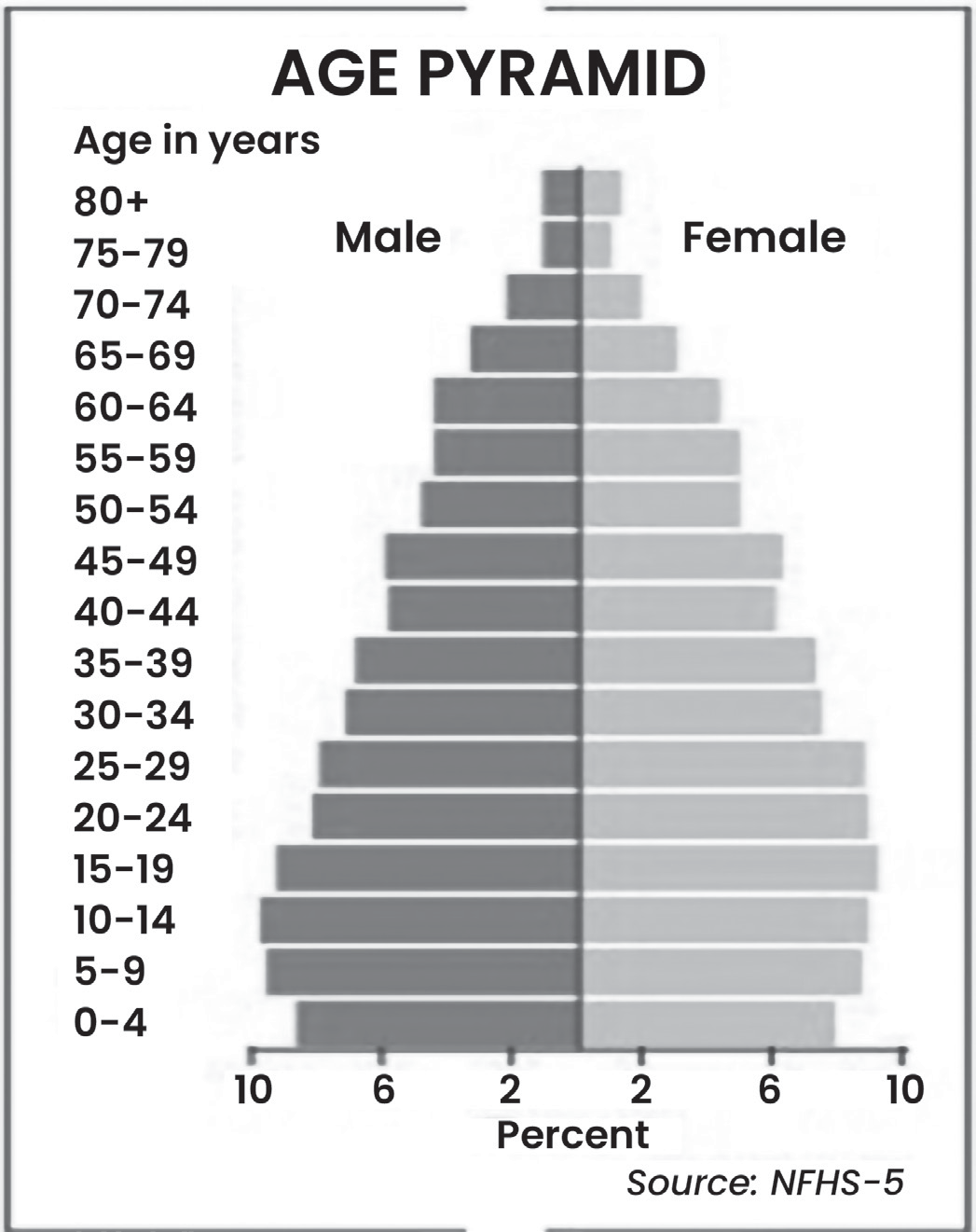
Figure: Age Pyramid of India
In 2022, the median age of an Indian was 28.7 years, compared to 38.4 for China and 48.6 for Japan; and, by 2030; India’s dependency ratio will be just over 0.4.
Some Key Human Resource Statistics/Human Resource Potential
United Nations data in 2022 shows that India would
surpass China as the world’s most populous country by 2023.
• India has 62.5% of its population in the Demographic Dividend age group of 15-59 years which is ever increasing and will be at the peak around 2036 when it will reach approximately 65%. These population parameters indicate an availability of demographic dividend in India, which started in 2005-06 and will last till 2055-56.
• By 2020, developed nations will have shortage of
~57 million workers & foreign companies will have to outsource work elsewhere
• Companies require cheap but skilled labour force (India will have ~47 million new workers by 2020)
• Every year, 12 million Indians join workforce but out of them only 10% are skilled compared to 70% in and 50% in China. Therefore, success of Make in India, will depend on success of this scheme
• According to Census 2011,
• During 2001-2011, the growth rates of population
of almost all States and UTs have declined.
• For the first time since 1921,urban India added more numbers to its population in a decade than rural India did.
• In India, the proportion of workers is only 39.8% (2011 census) leaving a vast majority of about 60% as non-workers.
Skill Development and Human Resource Policies
• Skills and knowledge are driving forces of economic growth and social development for any country. Countries with higher levels and better standards of skills adjust more effectively to the challenges and opportunities in domestic and international job markets. Thus, requirement of a long-term comprehensive policy is always felt.
• NationalPolicy on Skill Development and Entrepreneurship 2015
• It supersedes the Policy of 2009 and envisages to create an ecosystem of empowerment by skilling on a large scale at speed with high Standards and to promote a culture of innovation-based entrepreneurship which can generate wealth and employment so as to ensure sustainable livelihoods for all citizens in the country.
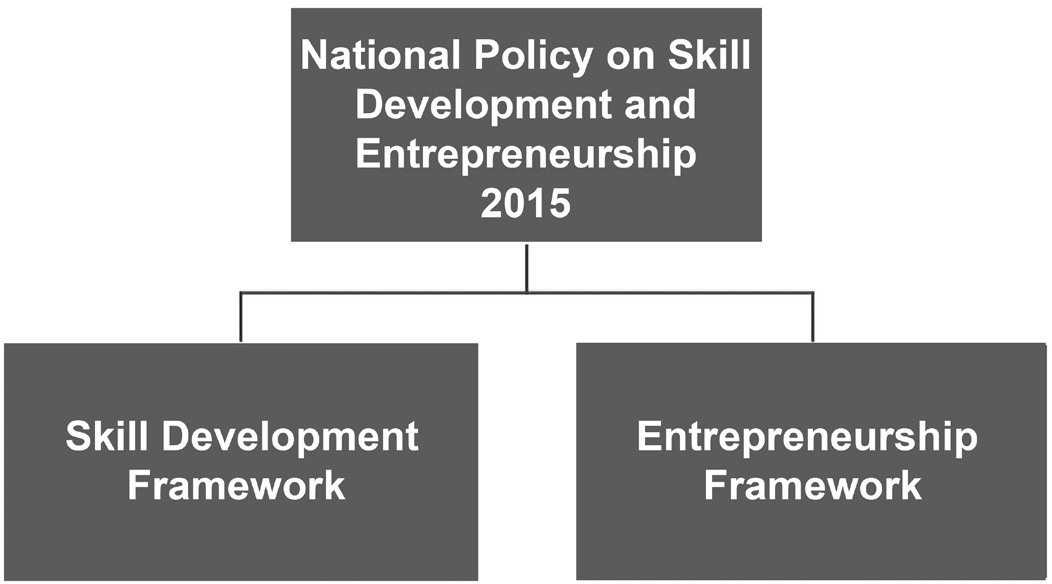
• Objectives of Skilling Framework
• The core objective is to empower the individual, by enabling her/him to realize their full potential through a process of lifelong learning.
• Make quality vocational training aspirational for both youth and employers
• Ensure both vertical and horizontal pathways to skilled workforce for further growth by providing seamless integration of skill training with formal education.
• Focus on an outcome-based approach.
• Increase the capacity and quality of training infrastructure and trainers.
• Aligning supply of skilled workers with sectoral requirements of industry and the country’s strategic priorities.
• Establish an IT based information system.
• Promote national standards in the skilling space.
• Focus on Socially and geographically disadvantaged and marginalized groups.
• Entrepreneurship Framework:
• The core objective of the entrepreneurship framework is to coordinate and strengthen factors essential for growth of entrepreneurship across the country.
• Promote entrepreneurship culture
•
Support for potential entrepreneurs through
mentorship and networks
• Integrate entrepreneurship education in the formal education system
• Foster innovation driven and social entrepreneurship to for ‘bottom of the pyramid’ population
• Reducing entry and exit barriers to ensure ease of doing business
• Credit and market linkages for financial support
• Support to socially and geographically disadvantaged sections of the society.
Performance Analysis of the Skill Development Policy
• Sharada Prasad Committee for Rationalisation and Optimisation of the functioning of the Sector Skill Councils in 2017, stated that India’s goal of skilling
402 million people is way too large, unnecessary and
unattainable.
• Target no met: The target of Skill India was to reach out to 300 million young people by 2022, but only 25 million had been trained under this scheme by the end of 2018.
• This is partly due to mismanagement and partly due to not spending available funds because of lack of candidates.
• Low Entrepreneurship Turnout: While the government expected that some of the PMKVY-trainees would create their own enterprise, only 24% of the trainees started their business. And out of them, only 10,000 applied for MUDRA loans.
• Even those trained unable to find jobs.
The current context has also changed in some major ways:
• A major development since the adoption of Liberalization, Privatization and Globalization (LPG) reforms has been the Mahatma Gandhi National Rural Employment Guarantee Act 2005 or MGNREGA which laid down legal underpinnings for achieving right to work in India.
• With the rise of big data, machine learning, and artificial intelligence, requirement of a skilled workforce, particularly involving mathematics, computer science, and data science, in conjunction with multidisciplinary abilities.
• With climate change, increasing pollution, and depleting natural resources, growing emergence of epidemics and pandemics will also call for new innovative workforce with new skills to adapt to the changing environment.
Key Challenges and Issues of Human Resource in India
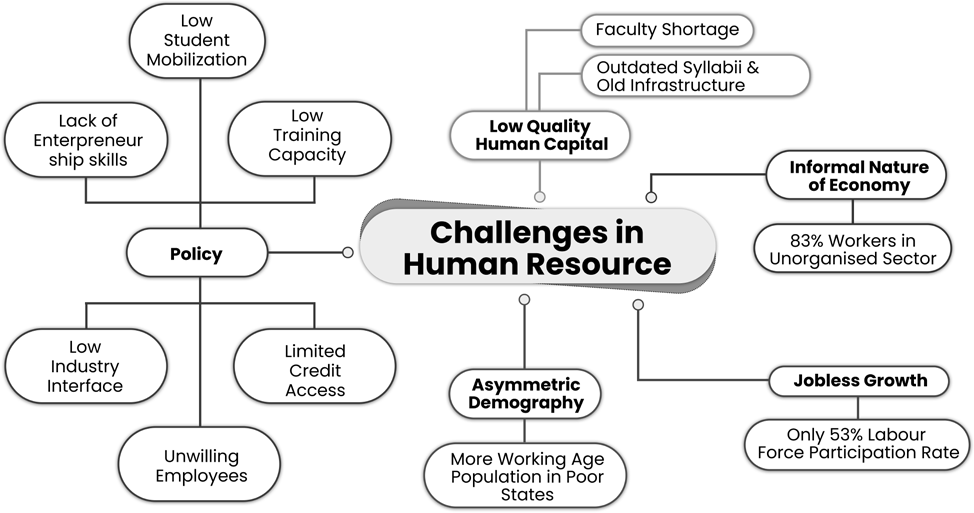
Figure: Challenges in Human Resource
• Challenges in Policy
• Insufficient training capacity: The training manpower is not sufficient causing low training and skilling man hours.
• Lack of entrepreneurship skills: Due to lack of business culture, lesser ease of doing business, high compliance burden, corruption and low credit availability.
• Low industry interface: Most of the training institutes have low industry interface as a result of which the performance of the skill development sector is poor in terms of placement records and salaries offered.
• Low student mobilization: The enrolment in skill institutes like ITIs, and polytechnics, remains low.
• Employers’ unwillingness: India’s joblessness issue is not only a skills problem; it is representative of the lack of appetite of industrialists and SMEs for recruiting.
• Due to limited access to credit because of Banks’ NPAs, investment rate has declined and thus a negative impact on job creation and skilling. Recent PNB fraud, Mallya-Nirav Modi cases have led to the tightening of purse by the banks making it difficult for the prospective entrepreneurs to get credit.
• Other issues:
• Asymmetric Demography: The growth in the working-aged ratio is likely to be concentrated in some of India’s poorest states
• Inadequate skills: low human capital base and lack of skills in Indian workforce is a major challenge.
• Poor Human Development Parameters: India ranks 130 out of 189 countries in UNDP’s Human Development Index, which is alarming.
•
Informal nature of economy more than 80% of all the jobs are generated in the informal sector
• Jobless growth-There is mounting concern that future growth could turn out to be jobless due to de-industrialization, de-globalization, the fourth industrial revolution and technological progress. As per the NSSO Periodic Labour Force Survey 2017- 18, India’s labour force participation rate for the age-group 15-59 years is around 53%, that is, around half of the working age population is jobless.
Proposed Reforms of Human Resource in India
Proposed Reforms of Human Resource in India
• For harnessing the enormous demographic advantage, India needs to build the capacity and infrastructure for skilling/reskilling/up-skilling existing and new entrants to the labour force.
• According to NITI Aayog’s India@75 report, various recommendations of reforms include
• Skill Development
• Demand-driven skill development ecosystem by mapping skill requirements for a geography and sector wise
• Upgradation of teacher training institutes to ensure quality trainers through cross learning through industry-institute linkages.
• Vocational education in secondary schools
from class VIII.
• Awareness about Apprenticeship through National Apprenticeship Promotion Scheme (NAPS), Scheme for Higher Education Youth in Apprenticeship and Skills (SHREYAS).
• Mainstreaming skill development via academic equivalence to Industrial Training Institute (ITI) qualifications.
• Funding
• Alternatives funding for Skill Development such as Corporate Social Responsibility (CSR) funds, Compensatory Afforestation Fund Management and Planning Authority (CAMPA) funds, Building & Construction Workers’ Cess, Members of Parliament Local Area Development (MPLAD) Fund, Mahatama Gandhi National Rural Employment Guarantee Act (MGNREGA), etc.,
• Strengthening Sector Skill Councils via clustering based on occupations and Qualification Packs across domains.
Other Committee Recommendations
• Sharda Prasad Committee 2016 on Sector Skill Councils:
• Constituted to review, rationalise and optimise the functioning of sector skill councils under National Skills Development Council.
• Recommendations
• Scrap all Councils: The Centre should scrap all existing skill councils, many of which have
Steps taken by the Government
overlapping roles.
• Oversight Mechanism: Introduce an oversight mechanism on the NSDC, preferably from the central bank, as it is registered as a non-banking finance company
• Comprehensive Review: Government should review the NSDC’s role and functioning comprehensively with reference to its Memorandum of Association
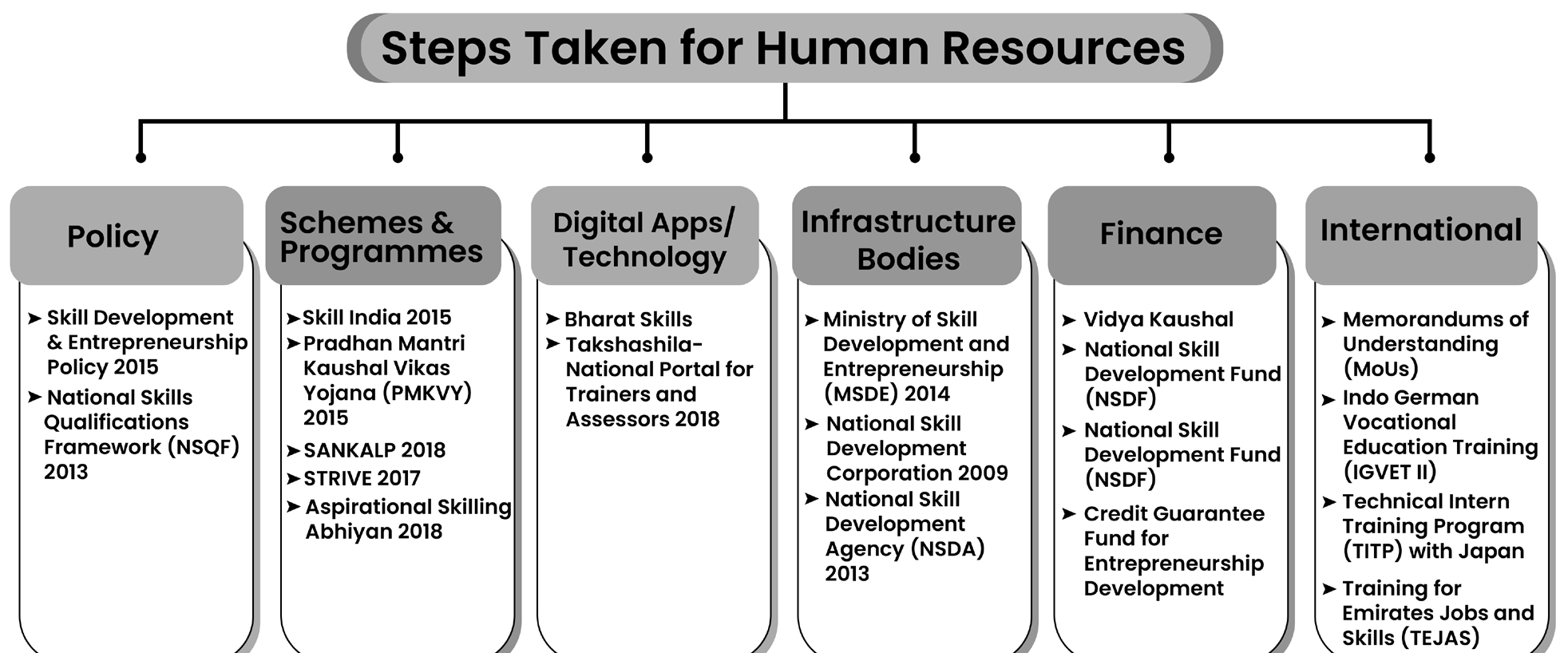
• Skills and knowledge are the driving forces of economic growth and social development in a country. As opposed to developed countries, where the percentage of skilled workforce is between 60% and 90% of the total workforce, India records a low 5% of workforce (20-24 years) with formal vocational skills. Over 20 Ministries are running skill development programmes for human resource development.
• At the Policy Level
• National Policy on Skill Development and Entrepreneurship 2015
• It focuses on training the youth mainly from underprivileged section of the society.
• A follow up on the government’s 2009 National Policy for Skill Development, the scheme aims at developing the skill of the youth and the employed for employment in India and abroad. Apart from this, the scheme focuses on instilling a sense of entrepreneurship in the citizens of the country, encouraging self-reliance.
• It envisages to create an ecosystem of empowerment by skilling on a large scale at speed with high standards and to promote a culture of innovation-based entrepreneurship which can generate wealth and employment
so as to ensure sustainable livelihoods for all citizens in the country.
National Skills Qualifications Framework (NSQF) 2013
The NSQF is anchored in National Skill Development Agency (NSDA) and is implemented through the National Skill Qualification Committee (NSQC). A permanent secretariat for NSQC is set up in NSDA.
The key elements of the NSQF provide:
National principles for recognising skill proficiency and competencies at different levels leading to international equivalency
Multiple entry and exit between vocational education, skill training, general education, technical education and job markets
Progression pathways defined within skill qualification framework
Lifelong learning and skill development
Partnership with industry/employers
A transparent, accountable and credible mechanism for skill development across various sector
Recognition of prior learning
At the Schemes/Missions Level
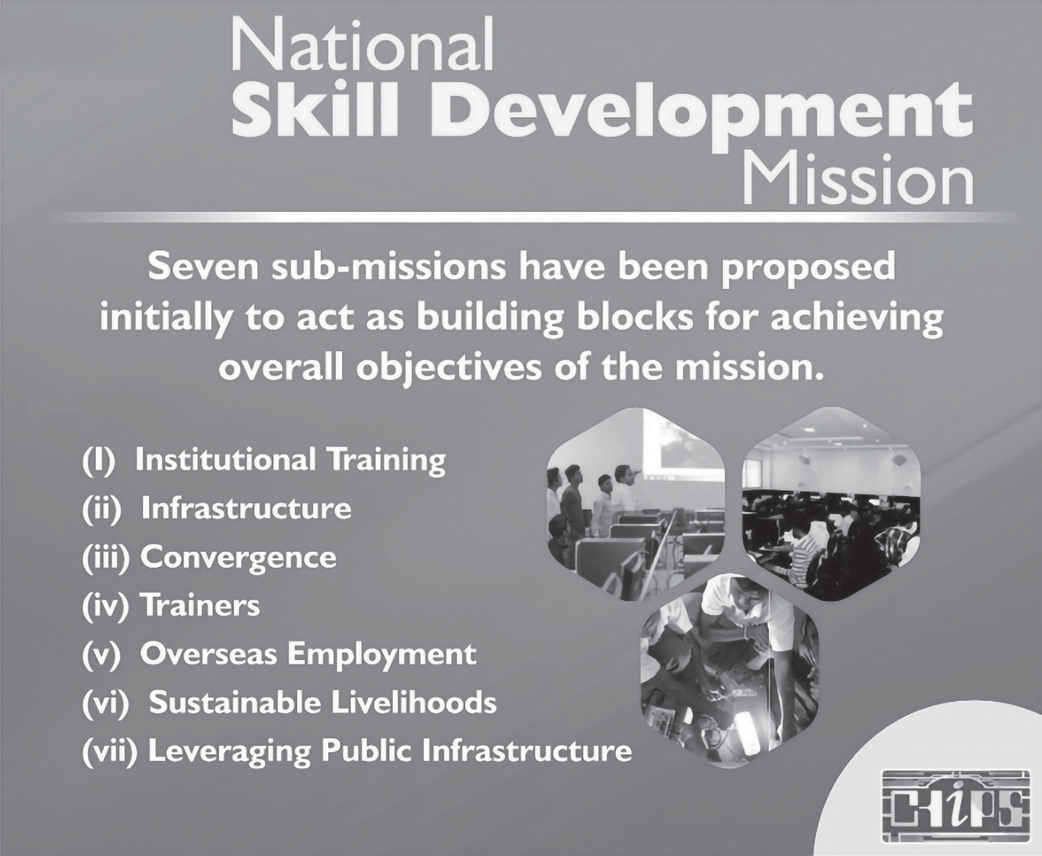
National Skill Development Mission (NSDM) or Skill India 2015:
• It aims to create convergence across sectors and States in terms of skill training activities and expedite decision making across sectors to achieve skilling at scale with speed and standards. It aims to train over 30 crore people in India in different skills by 2022.Objectives
• It aims at creating an end-to-end, outcome- focused implementation framework, which aligns demands of the employers for sustainable livelihoods and life-long learning.
• Establish and enforce cross-sectoral, nationally and internationally acceptable standards for skill training though sound quality assurance framework
• Build capacity for skill development in critical un- organised sectors.
• Develop a network of quality instructors/ trainers in the skill development
• A credit transfer system for transitioning between the vocational training system and the formal education
• Support weaker and disadvantaged sections of society through focused outreach programmes
Pradhan Mantri Kaushal Vikas Yojana (PMKVY) 2015
• PMKVY 1.0 was launched in 2015, PMKVY 2.0 in 2017 and PMKVY 3.0 in January 2021.
• PMKVY 2016-20 was launched by scaling up both in terms of Sector and Geography and by greater alignment with other missions of Government of
India like Make in India, Digital India, Swachh Bharat, etc. The Scheme is aligned to Common Cost Norms.
Objectives of PMKVY 2016-20
Enable and mobilize a large number ofyouths to take up industry designed quality skill training, become employable and earn their livelihood.
Increase productivity of the existing workforce,and align skill training with the actual needs of the country.
Encourage standardisation of the Certification process and put in place the foundation for creating a registry of skills.
Benefit 10 million youth over the period of four years (2016- 2020).
Eligibility
Indian Citizen, 18-45 years, 12th class dropouts or 10th pass students can enroll in PMKVY to develop their skill set.
Key Components
The Short-Term Training imparted at PMKVY Training Centres (TCs)
Recognition of Prior Learning (RPL) .
Special Projects component of PMKVY.
Implementation components:
Centrally Sponsored Centrally Managed (CSCM): This component is implemented by National Skill Development Corporation. 75% of the PMKVY 2016-20 funds and corresponding physical targets have been allocated under CSCM.
Centrally Sponsored State Managed (CSSM): This component is implemented by State Governments through State Skill Development Missions (SSDMs). 25% of the PMKVY 2016-20 funds and corresponding physical targets have been allocated under CSSM.
Deen Dayal Updhyaya Antyodaya Yojana (Day)
It is a scheme for upliftment of urban and rural poor through enhancement of livelihood opportunities through skill development and other means
Aim is to provide Skill training to the poor in cities and villages. This would make them eligible for employment and will help in poverty alleviation
Also, under the current urban poverty alleviation programmes, only 790 cities and towns are covered
The government has decided to extend these measures to all the 4,041 statutory cities and towns, there by covering almost the entire urban population.
Two Components of the Scheme
Rural component:
Deen Dayal Upadhyaya Grameen Kaushalya Yojana Under: Ministry of Rural Development
As sub-component of Ajivika Scheme
Eligibility: Indian Citizen between 15 and 35 years. For women and other vulnerable groups like persons with disabilities, the upper age limit is relaxed to 45 years.
Objectives:
Target: Train 10 Lakh rural youth by 2017
• Demand led skill training at no cost to the rural poor in rural area.
Inclusive:Mandatory coverage of socially disadvantaged groups (SC/ST 50%; Minority 15%;
Women 33%)
• Shifting focus from Training to Career Progression: Pioneers in providing incentives for job retention, career progression and foreign placements
• Guaranteed Placement for at least 75% trained candidates and post-placement support, migration support and alumni network
• Regional Focus: Jammu and Kashmir (HIMAYAT),The North-East region and 27 Left- Wing Extremist (LWE) districts (ROSHINI)
• Standard Operating Procedures supported by geo- tagged, time stamped videos/photographs.
• Training syllabus will be designed on international standards
Urban component
Deen Dayal Upadhyay Antyodaya Yojana (DAY)
Under: Ministry of Housing & Urban Poverty Alleviation (HUPA)
Eligibility: Urban poor
Target: Train 5 Lakh people every year
6 Components:
• Setup City Livelihood Centres with Rs. 10 lakh grant
• Give training to each urban poor via these centres. Government will spent Rs.15k-18k on training each of them
• Form Urban Self Help Groups (SHG) and give Bank linkage and Rs.10,000 to each group
• Setup Vendor markets and give skill training to vendors as well
• Construction of permanent shelters for urban homeless & other essential services
• Help the poor to setup enterprises & give them loan at 7% interest rate
Tie up with NSDC
• NSDC will give training to poor, according to market needs, via its training centre
SANKALP 2018
Skill Acquisition and Knowledge Awareness for Livelihood Promotion (“SANKALP”) is a five- year programme till March 2023 of the Ministry of Skill Development with loan assistance from the World Bank.
It aims to improve short term skill training qualitatively and quantitatively Skill Strengthening for Industrial Value Enhancement (STRIVE) 2017
• This project is a World Bank assisted- Government of India project with the objective of improving the relevance and efficiency of skills training provided through Industrial Training Institutes (ITIs) and apprenticeships.
• It is an outcome focused scheme marking shift in government’s implementation strategy in vocational education and training from inputs to results.
• Focus on improving quality & market relevance of skill development training programs in long term vocational education training.
• Aspirational Skilling Abhiyan- Aspirational Districts through Skill Development 2018
• It aims on identification of challenges for skill development and co-creating customized solutions to help the 117 aspirational districts overcome these challenges and endeavours to facilitate strengthening of governance and institutional infrastructure for skill development.
• Objectives
• Mapping of skill profile of the district
• Appraisal of District Skill ecosystem
• Identifying district specific Challenges and Potential areas of support required in the district
• Development of District Skill Development Plan through consultation process
• Implementation support for the work plan to the districts through District Skill Committee, District Skill Development Plan, convergence of Initiatives, partnering with expert organizations and leveraging their strengths and reach for assisting districts and Technical and Financial Assistance
• Earn While you Learn’ Scheme
• The Ministry of Tourism has launched a Scheme titled ‘Earn While You Learn’ with a view to inculcate appropriate tourism travel traits and knowledge amongst trainees to enable them to work as ‘student volunteers’.
• The salient features of the Scheme are:
• College-going students pursuing graduation courses or graduates in the age group of 18 to 25 years will be eligible for the training programme.
• The candidates are selected by following a transparent procedure.
• The duration of each programme is 21 working days.
•
The course contents is finalized by the Ministry of Tourism/ implementing Institutes in consultation with stakeholders.
• The Indian Institute of Tourism & Travel Management (IITTM) and Jamia Milia Islamia University was authorized to conduct training.
• The Green Skill Development Programme (GSDP)2017
• Under Ministry of Environment, Forest and Climate Change (MoEF&CC), it is an initiative for skill development in the environment and forest sector to enable India’s youth to get gainful employment and/or self-employment and to help attainment of the Nationally Determined Contributions (NDCs), Sustainable Development
Goals (SDGs), National Biodiversity Targets (NBTs), as well as Waste Management Rules (2016).
At the Digital Application Level
• Bharat Skills
• This initiative is among National e-Governance Award Winners 2022.
• Beneficiary: Trainees of all the government and private Industrial Training Institutes (ITIs) and National Skills Training Institutes (NSTIs).
• Key Aspects
• Bharat skills proved to be a big boon as an e-Governance platform to provide e-learning to demonstrate hands-on skilling techniques to the candidates.
• Takshashila - National Portal for Trainers and Assessors
• It is an initiative by National Skill Development Corporation (NSDC) under Skill India Mission. The portal is a dedicated platform towards management of trainers and assessors in life- cycle approach.
At the Infrastructure/Bodies Level
• Ministry of Skill Development and Entrepreneurship (MSDE) 2014
• A dedicated ministry was set up to implement Skill India or National Skill Development Mission (NSDM), which envisions skilling at scale with speed and standards
National Skill Development Corporation 2009
• The National Skill Development Corporation India (NSDC) was setup as a one of its kind, Public Private Partnership Company with the primary mandate of catalysing the skills landscape in India.
• NSDC is a unique model having three pillars:
• Create: Proactively catalyse creation of large, quality vocational training institutions.
• Fund: Reduce risk by providing patient capital. Including grants and equity.
• Enable: the creation and sustainability of support systems required for skill development. This includes the industry led Sector Skill Councils.
Objectives
• Upgrade skills to international standards.
• Enhance, support and coordinate private sector initiatives for skill development through appropriate Public-Private Partnership (PPP) models.
• Play the role of a “market-maker” by bringing financing. Prioritize multiplier or catalytic effect
initiatives as opposed to one-off impact.
National Skill Development Agency (NSDA) 2013
• It is an autonomous body registered as a society under the Societies Registration Act, 1860, under the Ministry of Skill Development and Entrepreneurship.
•
Salient Features:
• Take all possible steps to meet skilling targets as envisaged in the 12th Five Year Plan and beyond.
• Coordinate and harmonize the approach to skill development among various Central Ministries/Department.
• Be the nodal agency for State Skill Development Missions.
• Raise extra-budgetary resources for skill development.
• Evaluate existing skill development schemes.
• Create and maintain a national data base related to skill development.
• Ensure that theskilling needs of the disadvantaged and the marginalized groups.
• DNational Council for Vocational Education
and Training (NCVET)
• The National Council for Vocational Education and Training (NCVET) was notified by MSDE on 5th December 2018. NCVET will subsume the existing skill regulatory bodies- National Skill Development Agency (NSDA) & National Council for Vocational Training (NCVT) and will act as an overarching skills regulator.
• The NCVET will regulate the functioning of entities engaged in vocational education and training, both long & short-term.
• The NCVET will enable integration of fragmented regulatory system and infuse quality assurance across the entire vocational training value chain, leading to better outcomes.
• Sector Skill Councils (SSC) 2018
• Sector Skill Councils are set up as autonomous industry-led bodies by NSDC.
• They create Occupational Standards and Qualification bodies, develop competency framework, conduct Train the Trainer Programs, conduct skill gap studies
• Pradhan Mantri Kaushal Kendras:
• To transform India into the skill capital of the world, Ministry of Skill Development and Entrepreneurship (MSDE) established state- of-the-art Model Training Centres, called as Pradhan Mantri Kaushal Kendra (PMKK). It will be implemented by National Skill Development Corporation (NSDC).
• Objectives
• Create benchmark institutions that demonstrate aspirational value for competency- based skill development training.
• Focus on elements of quality, sustainability and connection with stakeholders in skills delivery process.
• Transform from a Mandate-driven footloose model to a sustainable institutional model.
• Funding Support
• NSDC will provide a concessional secured loan funding per centre, up to 75% of the project investment,
• At the Finance Level
• Vidya Kaushal
• A first of its kind initiative of National Skill Development Corporation (NSDC), one-stop platform for students to apply for financial assistance/loan to pursue skill development training courses.

• It supports courses by Training Partners (TPs) under National Skill Development Corporation (NSDC).
• Features of Vidya Kaushal
• For Individuals
• Access to skill loan financing options
• courses and centres
• For Training Partners and Centres
• Enabling better conversion of candidate
• Better mobilization of candidates
• Will provide pan India visibility
• Will increase access to fee-based enrolments
• For Financial Institutions
• Platform provides leads of authenticated loan applicant profiles
• National Skill Development Fund (NSDF)
• A public Trust set up by Government of India is the custodian of the Fund.
• The Fund acts as a receptacle and aggregator vehicle for pooling the funds of multilateral agencies, companies, foundations, NGOs and individual for all donations.
• To attract funds
• Companies: Minimum 25% of their Corporate Social Responsibility (CSR) funds on skill development initiatives directly or through NSDF.
• All Government schemes will be encouraged to set aside 10% of the scheme budget towards skilling of human resources.
•
A Credit Guarantee Fund for skill development and a ‘National Credit Guarantee Trustee Company’ (NCGTC) has been set up to support the initiative of loans. Also Credit Guarantee Fund for Entrepreneurship Development has been established under Prime Minister MUDRA Yojna through NCGTC.
At the International Level
• Memorandums of Understanding (MoUs)
• Ministry has 8 Government to Government (G2G) MoUs with countries like Australia, Denmark, France, Germany, Japan, Qatar, United Arab Emirates (UAE) and United Kingdom (UK) in the field of skill development and vocational education training.
• NSDC has signed 18 Business to Business (B2B) MoUs with countries like Japan, Australia, Germany, UAE, Malaysia, Canada, Kingdom of Saudi Arabia, (KSA) etc. in aspects like:
• Country specific engagements
• AUSTRALIA
• Agreement between NSDC and VETASSESS.
• Agreement between NSDCI and Perdaman Global Services (PGS).
• GERMANY
• Indo German Vocational Education Training (IGVET II).
• IGnITE (Indo- German Initiative for Technical Education) project – This skill development project is run by the GIZ and Siemens India, in coordination with DG Training under MSDE.
• QualIndia - Quality Analysis in Indian Vocational Education and Training Institutions.
• JAPAN
• Technical Intern Training Program (TITP) with Japan
• Specified Skilled Worker (SSW) with Japan
• Gulf Cooperation Council (GCC) Countries
• Training for Emirates Jobs and Skills (TEJAS).
• Kingdom of Saudi Arabia (KSA): NSDCI signed a MoU with Takamol Holding to support KSA’s Skills Verification Program (SVP).
• Skill India International Center at Varanasi:
NSDCI has partnered with DP World, UAE.
• MoUbetween National Qualifications
Authority, Govt. of UAE and MSDE