Governance
Introduction:
For any type of functioning state, governance is the basic necessity. The study of various aspects of governance helps a state to understand the gap between existing and ideal governance system and motivate it to work for achieving of highest standards of governance and welfare.
What is governance?
The concept of “governance” is not new. It is as old as human civilization. Simply put “governance” means: the process of decision-making and the process by which decisions are implemented (or not
implemented).
As per Kaufman, Governance is- “The traditions and institutions by which authority in a country is exercised”.
Word Bank defined Governance as “the way…. power is exercised through a country’s economic, political, and social institutions.”
• Governance can be used in several contexts such as corporate governance, international governance, national governance and local governance.
• Since governance is the process of decision making and the process by which decisions are implemented, an analysis of governance focuses on the formal and informal actors involved in decision-making and implementing the decisions made and the formal and informal structures that have been set in place to arrive at and implement the decision.
Stakeholders of governance:
• Government is one of the actors in governance. Other actors involved in governance vary depending on the level of government that is under discussion. In rural areas, for example, other actors may include influential land lords, associations of peasant farmers,
cooperatives, NGOs, research institutes, religious leaders, finance institutions, political parties, the military etc.
•
Usually, three main stakeholders can be found in the governance process- state, civil society and the market.
• Each of them is interdependent on each other and for smooth functioning of any nation, some form of coordination and cooperation must be found among them.
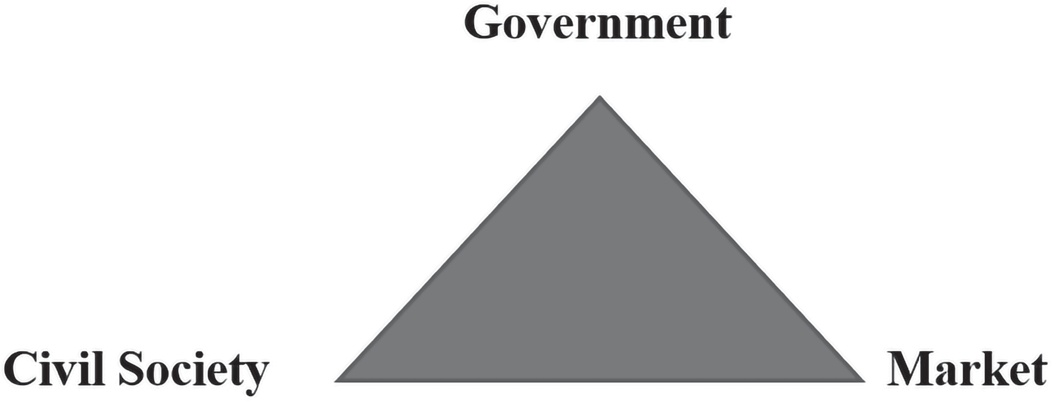
Figure: Key Stakeholders of Governance
• Government: Government includes the three elements i.e., executive, legislative and judiciary. In a functioning government, the legislative makes law, the executive implements those laws and judiciary adjudicates if any conflicts arise. Hence these three elements are the foundation of governance process.
• Civil Society: All actors other than government and the military are grouped together as part of the “civil society.” The job of civil society is to advocate for the relevant policy intervention by the state, act as check
and balance on the state and agitate if demands are not met. In some countries in addition to the civil society, organized crime syndicates also influence decision-making, particularly in urban areas and at the national level.
• The market: It includes the formal and informal private sector. In the governance process, the market acts as test ground for any policy outcome. If any policy is accepted by market, it would result into favourable outcome and if market rejects any policy, it may result into unfavourable outcome. Examples include the feedback on national budget of any state.
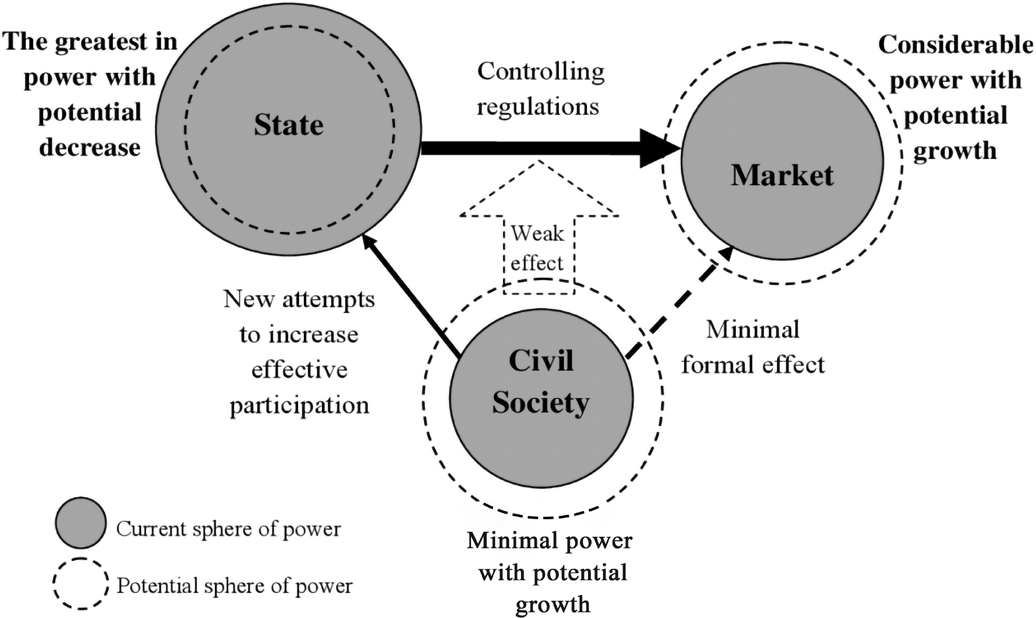
Figure: Relationships amongst Stakeholders
What is Good Governance?
Governance itself has various dimensions which makes it welfarist in outcome. The ‘good governance’ only enhances the status of these dimensions. Various UN agencies formulated and defined what constitutes good governance.
The United Nations Development Programme (UNDP) notes that: “Good Governance is, among other things, participatory, transparent and accountable. It is also effective and equitable. And it promotes the rule of law. Good governance ensures that political, social and economic priorities that are based on broad consensus in society and that the voices of the poorest and the most vulnerable are heard in decision-making over the allocation of development resources.”
The World Bank’s Eight Principles of Good Governance
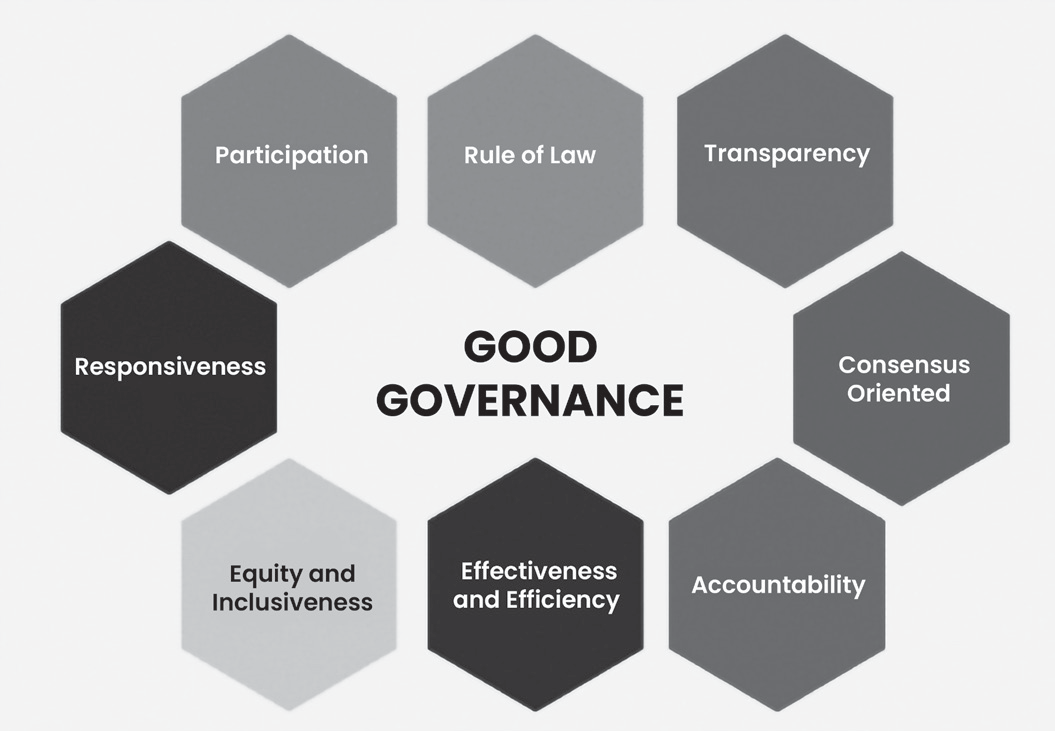
Figure: Principles of Good Governance
Participation
• Participation by both men and women is a key cornerstone of good governance.
•
Participation could be either direct or through legitimate intermediate institutions or representatives.
• It is important to point out that representative democracy does not necessarily mean that the concerns of the most vulnerable in society would be taken into consideration in decision making.
• Participation needs to be informed and organized. This means freedom of association and expression on the one hand and an organized civil society on the other hand.
• Right from Plato, Aristotle to Mahatma Gandhi and Amartya Sen- each one of them has emphasized the role of participation of common people in the governance.
• If we look in Indian context there are various formal and informal forms in which public participation in governance are sought.
• For example, voting, direct democracy through gram sabha, social audit, citizen report cards, participatory online platforms like mygov.in etc.
Rule of law
• Good governance requires fair legal frameworks that are enforced impartially.
• It also requires full protection of human rights, particularly those of minorities.
• Impartial enforcement of laws requires an independent judiciary and an impartial and incorruptible police force.
• If we see in Indian context, the constitution itself has provided Article 14 which mandates rule of law in India.
• Rule of law is also seen as a fundamental necessity for stable government and ease of business.
Transparency
• Transparency means that decisions taken and their enforcement are done in a manner that follows rules and regulations.
• It also means that information is freely available and directly accessible to those who will be affected by such decisions and their enforcement.
• It also means that enough information is provided and that it is provided in easily understandable forms and media.
• Across the world, governments are seen as secretive and non-transparent; because of that the problem of corruption has become endemic to the governments. It is the job of all the stakeholders to promote transparency in governance, especially the civil society must act as vigilant watchdog.
Responsiveness
• Good governance requires that institutions and processes try to serve all stakeholders within a reasonable timeframe.
• The responsiveness of any government can be seen from its willingness and promptness in hearing and solving the grievances of common citizens.
• In Indian context, the responsiveness of governments and bureaucracy is a cause of concern. This is major reason for lack of quick and quality service delivery in India.
GRIEVANCE REDRESSAL: A CHECK ON RESPONSIVENESS
The grievance redressal completes the feedback loop of the policy formulation cycle. Any initiative of good governance is futile without a robust grievance redressal system. In Indian context, followings are the mechanisms of grievance redressal-
For central government:
• Department of Administrative Reforms and Public Grievances (DARPG) – It functions under the Ministry of Personnel, Public Grievances and Pensions.
• Directorate of Public Grievances – It is part of
Cabinet Secretariat
Department of Administrative Reforms and Public
Grievances (DARPG)
• The primary role of this department is to plan and implement citizen-centric measures in the domain of public grievances and carry out administrative reforms so that the Government is in a position to deliver quality public services without any obstacles.
• The grievances received will be forwarded to the respective ministries, departments, and state governments. The cases will be followed until it is closed.
Directorate of Public Grievances (DPG)
• It was set up in the Cabinet Secretariat in 1988. They handle complaints pertaining to 16 Central Government Organisations.
Ombudsman
• This concept came from Sweden. It means an officer appointed by the Legislature to handle complaints against a service or administrative authority. In India, the government has appointed Ombudsmen to resolve grievances in the following sectors.
• Insurance Ombudsman
• Banking Ombudsman
• Income Tax Ombudsman
Lokpal
• Lokpal was established under the Lokpal and Lokayuktas Act 2013 to investigate corruption against public functionaries, even the Prime Minister.
• Lokpal can order investigation from its internal inquiry wing, Central Bureau Investigation (CBI), Central Vigilance Commission (CVC).
Tribunals
• Tribunals are formed to address delays in disposal of cases in courts. These are quasi-judicial institutions. Some of the most important tribunals are mentioned below.
• Central Administrative Tribunal (CAT)
• Railway Claims Tribunal
• Debt Recovery Tribunal
• Customs, Excise and Service Tax Tribunal
• Income Tax Appellate Tribunal
• Labour Tribunal
Committee on Petitions – Parliamentary Committee
• This is a Parliamentary Committee which works on redressing grievances of the public, and a citizen can submit petitions for grievance redressal.
Some e-governance initiatives for grievance redressal in India
• Central Public Grievance Redress and Monitoring System (CPGRAMS)
• Pro-Active Governance and Timely Implementation (PRAGATI)
• E-Nivaran
• UnifiedMobile Application for New-Age Governance (UMANG)
• MyGov
• IntegratedGrievance Red ressalMechanism (INGRAM)
• Mera Aspataal (My Hospital)
Some Citizen oriented grievance redressal mechanism are
• RTI
• Citizen Charters
• Gram Sabha etc.
Issues with the effectiveness of grievance redressal system in India
• Lack of awareness among citizens as whom to approach
• Multiplicity of institutions leads to confusion
• The time consuming and tiresome departmental grievance redressal mechanism
• Refusal of genuine RTI on the exception of section 8
of RTI act.
• Inadequate action is being taken after grievance redressal, even World bank has also commented that India has low conviction rate of violator of laws.
• The digital divide across India, which makes the effectiveness of e-grievance redressal mechanism sub-optimal.
• The perpetual problem of lack of 3Fs by the system, i.e., Fund, Function and Functionaries.
Suggestions by 2nd ARC for the improvement of grievance redressal mechanism in India:
• Need for a strong and effective internal grievance redressal mechanism in each organization
• The government should do an analysis of the concerned areas wherein the interventions would be required
• Designation of public grievance redressal officers like PIOs
• Make proper use of Lok Adalat
• There needs to be proper state-society cooperation
• Participation of women and physically challenged in the grievance redressal mechanism
Consensus oriented
• There are several actors and as many view points in a given society.
• Good governance requires mediation of the different interests in society to reach a broad consensus in society on what is in the best interest of the whole community and how this can be achieved.
• It also requires a broad and long-term perspective on what is needed for sustainable human development and how to achieve the goals of such development.
• This can only result from an understanding of the historical, cultural and social contexts of a given society or community.
• For example, to promote the principle of good governance in tax collections, government came up with GST law and GST council. In GST council all (except one or two) decisions were taken by consensus of the participants.
• Similarly, government's mantra of ‘sabka sath, sabka vikas, sabka prayas’ promotes consensus-oriented development.
Equity and inclusiveness
• A society’s wellbeing depends on ensuring that all its members feel their stake in it and do not feel excluded from the mainstream of society.
• This requires all groups, but particularly the most vulnerable, have opportunities to improve or maintain their wellbeing.
• Both the terms promote social justice in Society.
• In Indian context, constitution through Article 14, 15,
16, 17 and 18 promotes equality and inclusiveness. At the same time, the Directive Principles of State Policies (DPSP) under various articles direct state to increase the participation of marginal section into development and promote their welfare.
Effectiveness and efficiency
• Good governance refers to the ability of processes and institutions to deliver outcomes that meet societal needs while optimizing the use of available resources.
• In the context of good governance, efficiency also includes the sustainable management of natural resources and environmental protection.
• In India, mechanisms like the JAM trinity (Jan Dhan, Aadhar, and Mobile) and subsidy distribution through Aadhar have significantly enhanced the effectiveness and efficiency of welfare programs.
Accountability
• Accountability is a key requirement of good governance.
• Not only governmental institutions but also the private sector and civil society organizations must be accountable to the public and to their institutional stakeholders.
• Who is accountable to whom varies depending on whether decisions or actions taken are internal or external to an organization or institution.
• In general, an organization or an institution is accountable to those who will be affected by its decisions or actions.
• Accountability cannot be enforced without transparency and the rule of law.
Strategies for Good Governance
• Reorienting priorities of the state through appropriate
investment in human needs
• Provision of social safety nets for the poor and marginalized
• Strengthening state institutions
• Introducing appropriate reforms in the functioning of Parliament and increasing its effectiveness
• Enhancing Civil Services capacity through appropriate reform measures that matches performance and accountability
• Forging new alliances with civil society
• Evolving a new framework for government-business cooperation
The Worldwide Governance Indicators project – World Bank
What are the World Governance Indicators (WGI)?
• The World Governance Indicators (WGI) are a research dataset that aggregates the opinions of a substantial number of corporate, citizen, and experts survey
respondents from both developed and developing nations on the quality of governance.
• It assesses 215 countries and territories based on a certain set of criteria:
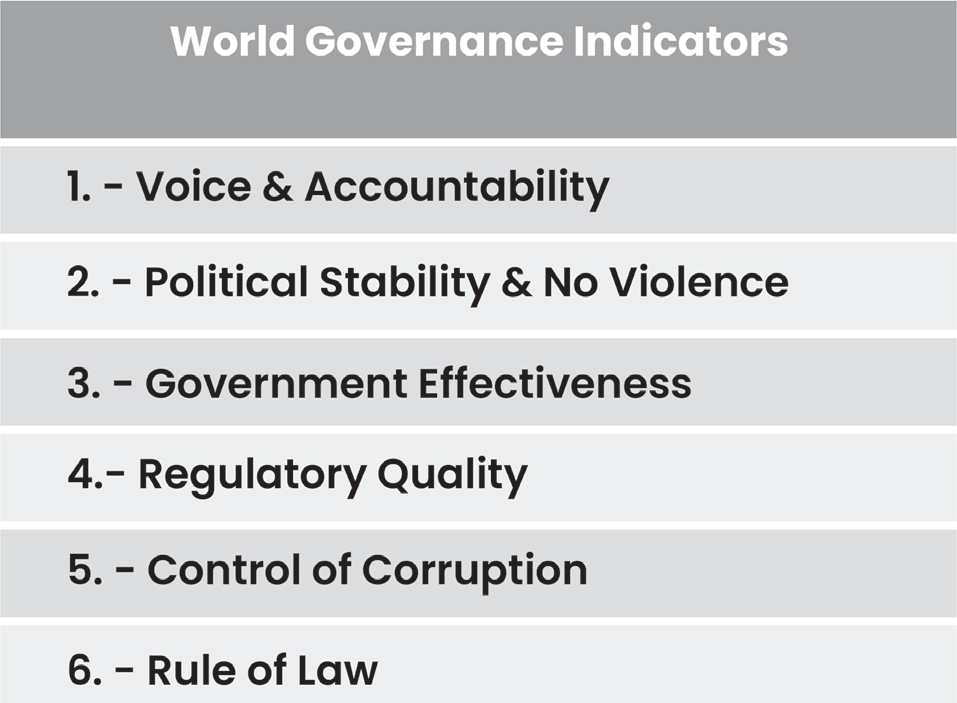
•
India’s WGI score is much below the BBB Median on all six indicators.
• While BBB is an investment-grade rating issued by global rating agencies such as S&P and Fitch.
• A WGI score below BBB Median would suggest that India falls below the middle when the scores of countries are arranged in a descending order.
• Various reports on which India’s WGI ranking based upon are-
• Economist Intelligence Unit
• Varieties of Democracy Project
• Heritage Foundation Index of Economic Freedom
• Freedom House Report
Governance and Good Governance Initiatives in India
Governance in India
In order to assess governance, it has been first deconstructed into five broad dimensions – Political, Legal & Judicial, Administrative, Economic and Social.
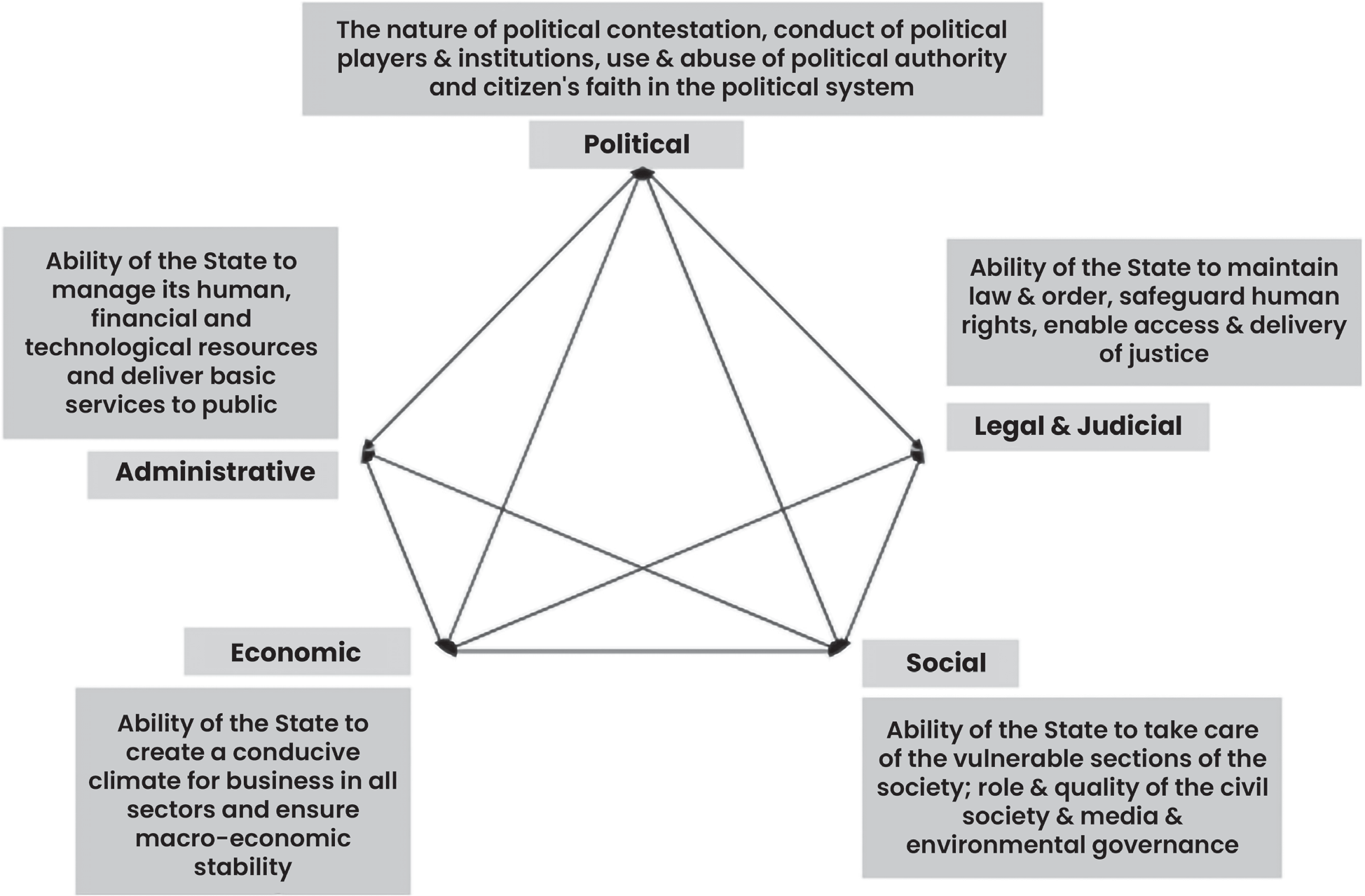
Figure: Aspects of Governance in India
| Sr.no. | Dimension | Components/sub-dimension | Governance issues in India |
| 1 | Political | Exercise of Franchise Profile & Conduct of Political Representatives Conduct of Political parties & Legislative Quality/ Functioning of the Political Executive Political Decentralisation | Criminalization of Politics Misuse of political power Decentralization more in letter, less in spirit |
| 2 | Legal/ Judicial | General conditions of Rule of Law & Internal Security Accessibility, Approachability&Citizen- friendliness of the Police Police Administration & Functioning Access to Justice & Judicial Administration | Delayed justice, issue of under trials Lack of accountability in Judiciary Threat to life and personal security |
| 3 | Administrative | Citizen orientation, responsiveness & transparency & Use of IT Managing Human Resources Financial Management Basic Service Delivery Corruption Perception, Vigilance & Enforcement | Lack of sensitivity, transparency and accountability in the working of State machinery Bureaucratic Delays Resistance to changes which promote transparency and accountability Corruption |
| 4 | Economic | Fiscal Governance Business Environment Support to the Primary Secto | Poor management of economy Persisting fiscal imbalances Regional disparities |
| 5 | Social/ Environmental | Welfare of the Poor & Vulnerable sections Role of Civil Society Role of Media Environmental Management | Denial of basic services to a substantial proportion of the population Marginalisation and exclusion of people on account of social, religious, caste and gender affiliation Existence of a significant number of voiceless poor with little opportunity for participation in governance; and Deterioration of physical environment, particularly in urban areas. |
Good Governance Initiatives in India
Decentralisation of Indian polity, LPG reforms, awareness in common people about the quality of public services, growth of ICT, increase in per capita income and ambitions of Indian citizens have led the common people demand the improvement in governance quality in India. It was fulfilled by governments at various levels through various measures like-
Decentralization and People’s Participation - 73rd and 74th Constitutional Amendment Act 1992
Developing programs for weaker sections and backward areas
Financial management and budget sanctity
• Lokpal and Lokayukta for better vigilance
• Ease of Doing Business, Ease of Living, Good Governance Index at national level
• Aspirational District Programme and Aspirational Blocks Programme
• Citizen’s Charters (CC)
• Sevottam model
• Redressal of Citizen’s Grievances
• E-Governance and use of ICT tools
• Public service morale & anti‐corruption measures
Corporate Social Responsibility (CSR)
Mission Karmayogi
Transparency and Accountability measures
• Right to Information (RTI)
• Social Audits
Minimum Government, Maximum Governance
“Minimum Government, Maximum Governance” refers to reducing government intervention in the common man’s day-to-day activities and empowering the people to ensure their own as well as the country’s growth and development.
While there are several aspects to achieving “minimum government”, it broadly includes making government processes easier by reducing red-tapism and corruption, and encouraging e-governance.
To maximize governance, there would be emphasis on raising ease of doing business and ease of living of citizens. This can be done by implementing the following-
Establishing law & order.
Investing in basic infrastructure.
Maintaining macroeconomic stability.
Delivering basic social services.
•
Protecting the vulnerable.
• Protecting the environment.
Steps required to achieve minimum government and maximum governance with respect to the various types of Government Interaction:
• G2G (Reforming internal functioning):
• Downsizing the Government structure (we need less government and more governance).
• Reforming personnel administration
• Increase internal accountability while giving freedom to eliminate corruption and improving efficiency.
• Decentralisation up to the local self-governance.
• Use of e-governance for better service delivery.
• G2B (Dealing with the market):
• Speedy process for starting a new business or related to existing business (bankruptcy laws).
• Single window-clearance.
• Contract out tasks to them which they can do better.
• Infuse competition in the market so that quality service is provided at the least cost.
• G2C (Dealing with citizens):
• Abolishing around 1,600 obsolete laws, doing away with interviews for government jobs, and encouraging digitization of facilities like the RTI.
• Launch of a citizen-centric platform to empower people to connect with the Government and contribute towards good governance (“world’s largest citizen engagement platform” with over 1.9 crore registered users in 2021).
Focus on the client (focus on their needs, giving them a voice on what to provide them).
Being accountable to them, improving transparency.
In 2019, National e-Governance Service Delivery Assessment (NeSDA) initiative was launched by the Department of Administrative Reforms and Public Grievances (DARPG) to measure the success of e-governance services.
• In its last report, which was published in 2021, the NeSDA said that in a nationwide survey, 74 per cent of respondents had expressed satisfaction with e-services.
Empower citizens to involve them in their own problem-solving, through participatory approach.
The goal of minimum government and maximum governance in the twenty-first century is to close the gap between promise and performance as well as between the governing and the governed. Strong institutions, knowledge, technology, and skill are necessary prerequisite to achieve this.
Citizen's Charter
Citizen's Charter
• A Citizens’ Charter represents the commitment of the organisation towards standard, quality and time frame of service delivery, grievance redress mechanism, transparency and accountability.
• It has been recognised the world over that good governance is essential for sustainable development, both economic and social.
• The three essential aspects emphasised in good governance are transparency, accountability and responsiveness of the administration.
• The “Citizen’s Charters initiative” is a response to the quest for solving the problems which a citizen encounters, day in and day out, while dealing with organisations providing public services.
Principles of the Citizen Charter
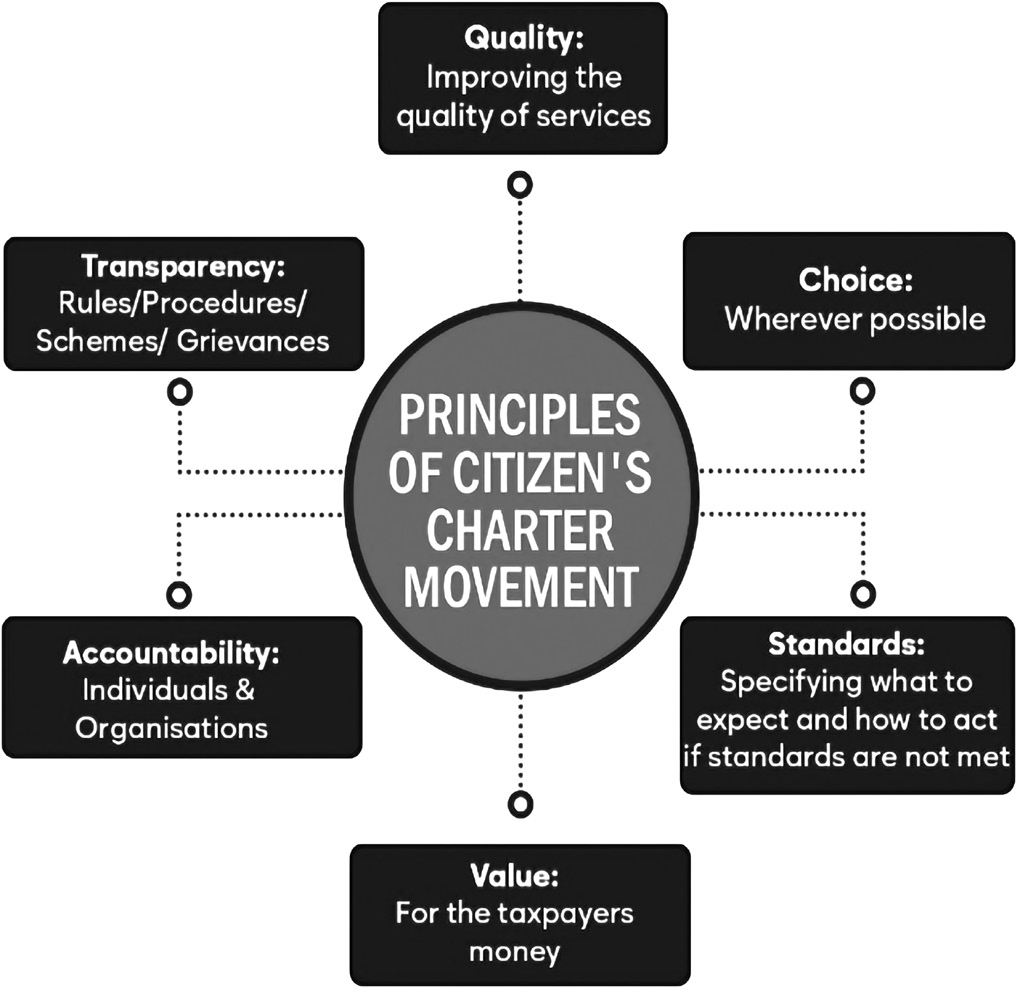
Figure: Principles of Citizen's Charter Movement
Significance of Citizen's Charter
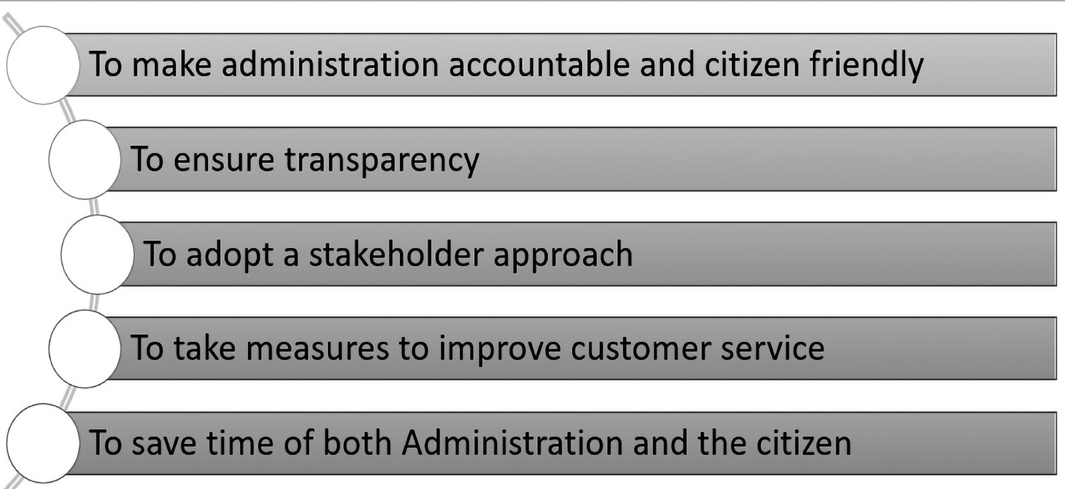
India and Citizens’ charter
• At a Chief Ministers’ Conference in 1997, an “Action Plan for Effective and Responsive Government” at the Centre and State levels was adopted.
• One of the major decisions at that Conference was that the Central and State Governments would formulate Citizen’s Charters, starting with those sectors that have a large public interface (e.g., Railways, Telecom, Posts, Public Distribution Systems and the like).
• Department of Administrative Reforms and Public Grievances in Government of India (DARPG) initiated the task of coordinating, formulating and operationalising Citizens’ Charters.
Guidelines for formulating the Charters as well as a list of do’s and don’ts were communicated to various government departments/organisations to enable them to bring out focused and effective charters.
The Charters are expected to incorporate the following elements:
Vision and Mission Statement
Details of business transacted by the organisation
Details of clients
Details of services provided to each client group
Details of grievance redress mechanism and how to access it
Expectations from the clients
Components of CC (as per DARPG)
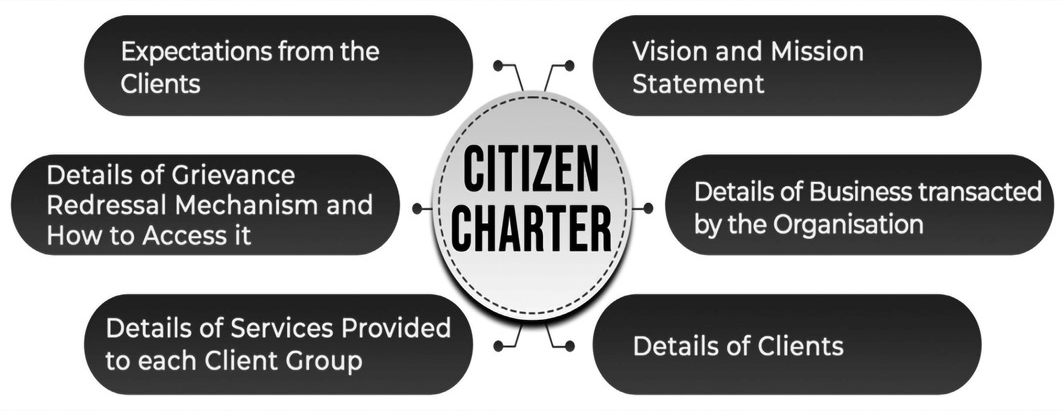
Figure: Components of Citizen Charter
Citizen’s Charters - Model Guidelines (as per DARPG)
The need for a Citizen’s Charter arises from the dissatisfaction of the citizen / consumer / customer with the erstwhile quality of service offered by a public sector organisation. The following guidelines should therefore be useful:
To be useful, the Charter must be simple;
The Charter must be framed not only by senior experts, but by interaction with the cutting-edge staff who will finally implement it and with the users (individual organisations);
Merely announcing the Charter will not change the way we function. It is important to create conditions through interaction and training for generating a responsive climate;
Begin with a statement of the service(s) being offered;
A mention be made against each service the entitlement of the user, service standards and remedies available to the user in case of the non- adherence to standards;
Procedures/cost/charges should be made available on line/display boards/ booklets inquiry counters etc. at places specified in the Charter;
Indicate clearly, that while these are not justiciable, the commitments enshrined in the Charter are in the nature of a promise to be fulfilled with oneself and with the user;
Frame a structure for obtaining feedback
and performance audit and fix a schedule for
reviewing the Charter every six months at least;
Separate Charters can be framed for distinct services and for organisations/ agencies attached or subordinate to a Ministry/Department.
Shortcomings of Citizen's Charter in India
• Devoid of Participative Mechanisms: In a majority of cases, Citizen's Charter is not formulated through a consultative process with cutting edge staff who will finally implement it.
• No Proper Consultation: End-users, civil society organisations and NGOs are not consulted when Citizen's Charters are drafted.
• Lack of Public Awareness: Only a small percentage of end-users are aware of the commitments made in the Citizen Charter since effective efforts of communicating and educating the public about the standards of delivery promise have not been undertaken.
• Lack of Interest: since there is no citizen friendly mechanism to compensate the citizen if the organisation defaults.
• Poor Design and Content: There is a lack of meaningful and succinct Citizen's Charter and absence of critical information that end-users’ need to hold agencies accountable.
• Charters are Rarely Updated: Making it a one- time exercise, frozen in time.
• Measurable Standards of Delivery are Rarely Defined: Making it difficult to assess whether the desired level of service has been achieved or not.
• Uniformity in Citizen's Charter: Tendency to have a uniform Citizen's Charter for all offices under the parent organisation. Citizen's Charters have still not been adopted by all Ministries/Departments. This overlooks local issues.
Second ARC Recommendations on Citizen Charter
• As per 12th Report of Second Administrative Reforms Commission (Citizen Centric Administration - The Heart of Governance), Citizen’s Charters should be made effective by adopting the following principles:
• Citizen’s Charter should be prepared for each independent unit under the overall umbrella of the organisation’s charter
• Wide consultation which includes civil society and staff in the process
• Firm commitments to be made
• One size does not fit all
• Periodic evaluation of Citizen’s Charters
• Benchmark using end-user feedback
• Replication of best practices in this field.
• Internal process and structure should be reformed to meet the commitments given in the Charter
• Earmarking of specific budgets for awareness generation and orientation of staff.
• Redress mechanism is case of default
• Hold officers accountable for results
• Need for creation of database on consumer grievances and redress
• Need for wider publicity of the Charter through print media, posters, banners, leaflets, handbills, brochures, local newspapers etc. and also through electronic media.
• Training and Orientation of staff about the salient features and goals/objectives of the Charter; vision and mission statement of the department; and skills such as team building, problem solving, handling of grievances and communication skills.
Sevottam Model
Sevottam Model
It is a combination of two words: Seva (service), Uttam excellence). Sevottam is a generic framework for achieving excellence in public service delivery and was proposed by the Second Administrative Reforms Commission (ARC). It has been developed with the overarching objective of improving the quality of public service delivery in the country. The model was introduced by overcoming the drawbacks with the Citizen Charters (CC) and provides a framework to assess and improve the quality-of-service delivery to citizens.
Components of Sevottam Model
The model has three components-
The first component of the model requires effective charter implementation thereby opening up a channel for receiving citizens’ inputs into the way in which organizations determine service delivery requirements. Citizens’ Charters publicly declare the information on citizens’ entitlements; making citizens better informed and hence empowering them to demand better services.
The second component of the model, ‘Public Grievance Redress’ requires a good grievance redress system operating in a manner that leaves the citizen more satisfied with how the organization responds to complaints/grievances, irrespective of the final decision.
The third component ‘Excellence in Service Delivery’, postulates that an organization can have an excellent performance in service delivery only if it is managing the key ingredients for good service delivery well, and building its own capacity to continuously improve delivery.
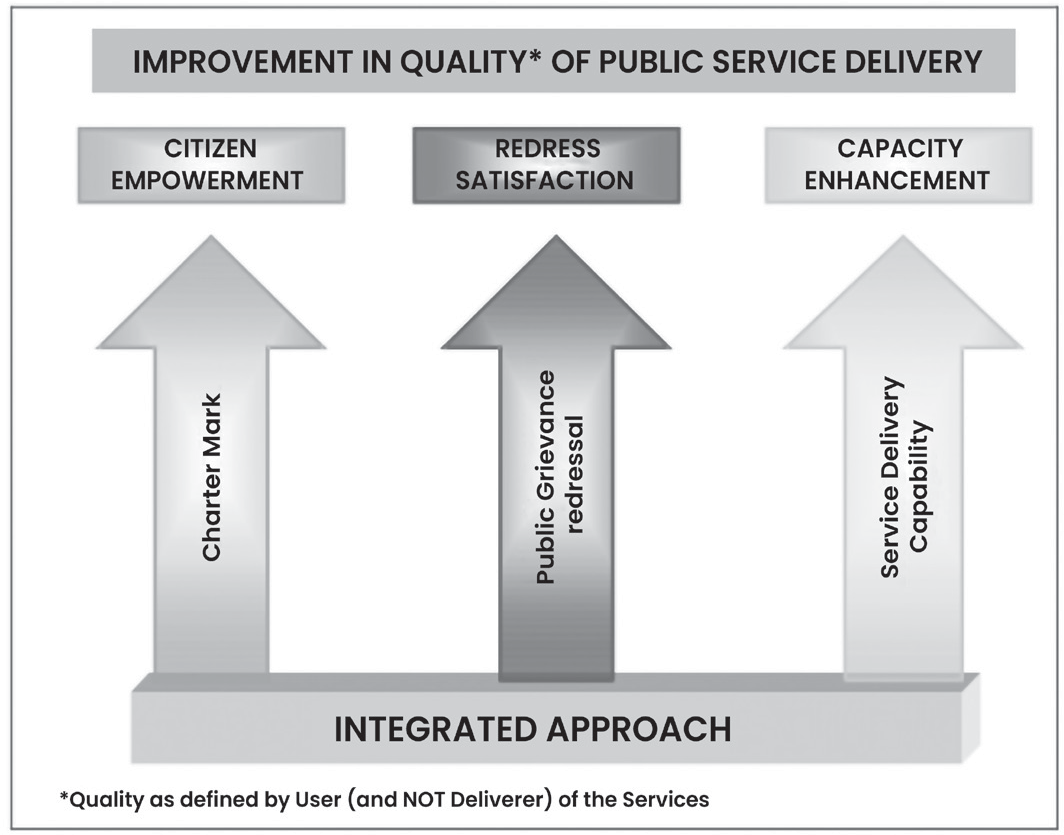
Figure: Sevottam model
Steps involved in Sevottam model
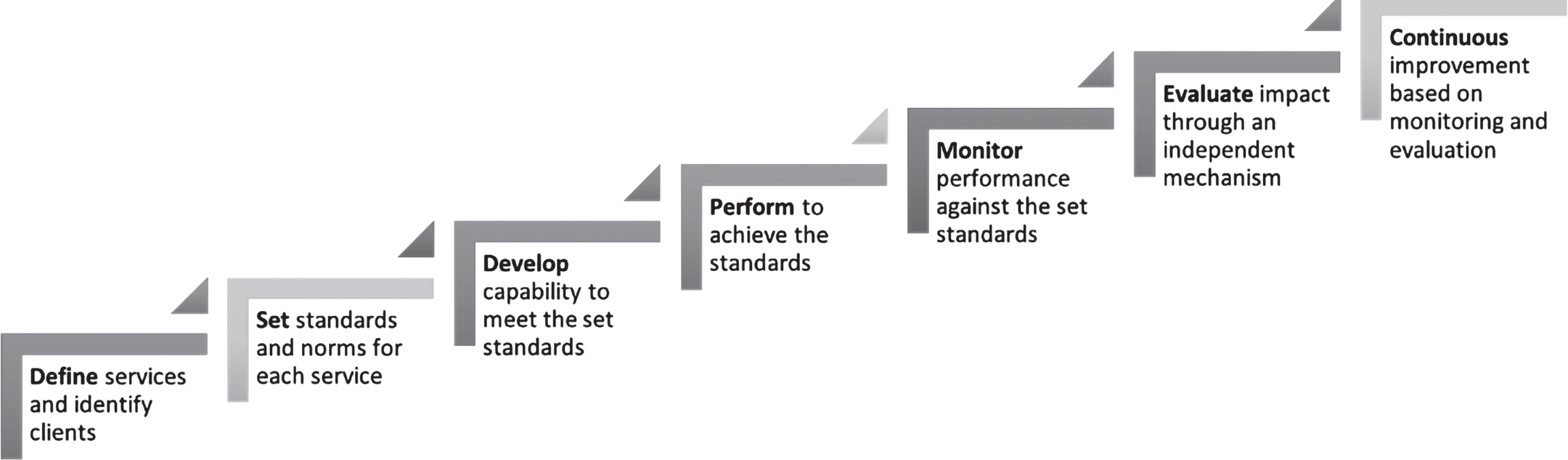
Figure: Steps in Sevottam Model
• Organizations adopting Sevottam model for service delivery need to comply with seven steps and ensure formulation of three modules.
• Implementation of Sevottam framework in the government departments was started in 2009.
• Later, Sevottam has been launched as a certification scheme which provides for the award of the Sevottam symbol of excellence to public service organizations that implement and are able to show compliance to a set of management system requirements that have been specified in a specially created standard document.
• This standard, known as IS 15700:2005, was developed by the Bureau of Indian Standards (BIS) based on the objectives of Sevottam.
Significance of the Model
• It is a Quality Management framework applicable to the activities of public service delivery organizations at the point of interface with service recipients.
• The framework is a tool in the hands of implementing organizations.
• It guides them through systematic initiatives for sustainable improvements in service delivery
• The framework enables implementing organizations to undertake a systematic, credible and authenticated self-assessment (or ‘gap analysis’) for citizen-centric service delivery.
• Using this analysis, practical solutions are gradually and systematically incorporated into the organization’s day- to-day routine thereby ensuring sustainable results.
Social Audit
Social Audit
What is Social Audit?
• Social Audit is a process in which, details of the resource, both financial and non-financial, used by public agencies for development initiatives are shared with the people, often through a public platform.
• Social audits allow people to enforce accountability and transparency, providing the ultimate users with an opportunity to scrutinize development initiatives.
Need of Social Audit:
• The social welfare programmes needed to be audited based on their outcome, which was not possible through normal auditing mechanism
•
A need is felt to increase the participation of people who are on the recieving end of the welfarist programmes
• A need to strengthen the direct democracy through Gram Sabha
• A need to check the transparency and accountability of implementing agencies at the ground level
• A need to inculcate professionalism among ground level staffs
• A need to generate demand for more welfare scheme, coming from the beneficiary people
Principles of Social Audit
Eight specific key principles have been identified from Social Auditing practices around the world. They are:
• Multi‐Perspective/Polyvocal: Aims to reflect the views (voices) of all those people (stakeholders) involved with or affected by the organisation/department/ programme.
• Comprehensive: Aims to (eventually) report on all aspects of the organisationʹs work and performance.
• Participatory: Encourages participation of stakeholders and sharing of their values.
• Multidirectional: Stakeholder share and give feedback on multiple aspects.
• Regular: Aims to produce social accounts on a regular basis so that the concept and the practice become embedded in the culture of the organisation covering all the activities.
• Comparative: Provides a means, whereby, the organisation can compare its own performance each year and against appropriate external norms or benchmarks; and provide for comparisons with organisations doing similar work and reporting in similar fashion.
• Verification: Ensures that the social accounts are audited by a suitably experienced person or agency with no vested interest in the organisation.
Disclosure: Ensures that the audited accounts are disclosed to stakeholders and the wider community in the interests of accountability and transparency
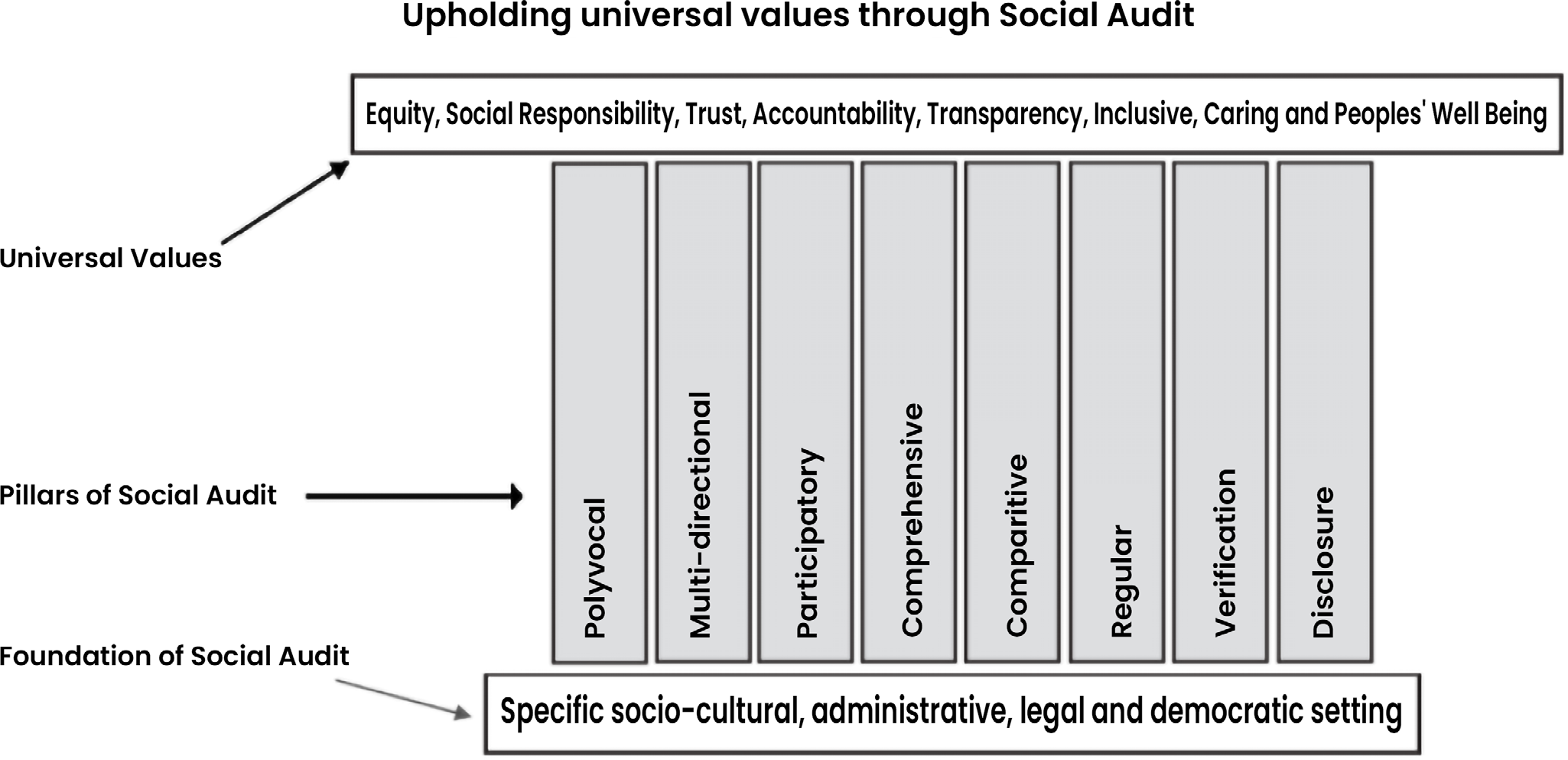
Figure: Principles of Social Audit
Social Audit Cycle
Steps in Social Audit in Local Bodies
Clarity of purpose and goal of the local elected body.
Identify stakeholders with a focus on their specific roles and duties.
Definition of performance indicators which must be understood and accepted by all. Indicator data must be collected by stakeholders on a regular basis.
Regular meetings to review and discuss data/ information on performance indicators.
Follow-up of social audit meeting with the panchayat body reviewing stakeholders’ actions, activities and viewpoints, making commitments on changes and agreeing on future action as recommended by the stakeholders.
Establishment of a group of trusted local people including elderly people, teachers and others who are committed and independent, to be involved in the verification and to judge if the decisions based upon
social audit have been implemented.
The findings of the social audit should be shared with all local stakeholders.
Advantages of social audit
• Trains the community on participatory local planning.
• Encourages local democracy.
• Encourages community participation.
• Benefits disadvantaged groups.
• Improve transparency in programme implementation and can point out corruption
• Promotes collective decision making and sharing responsibilities.
• Develops human resources and social capital
• Provide feedback to policy makers about effectivity of welfare programmes
• Helps the governments in justifying the investments in social sector schemes
• Helpsgovernments to evolve outcome-based budgeting
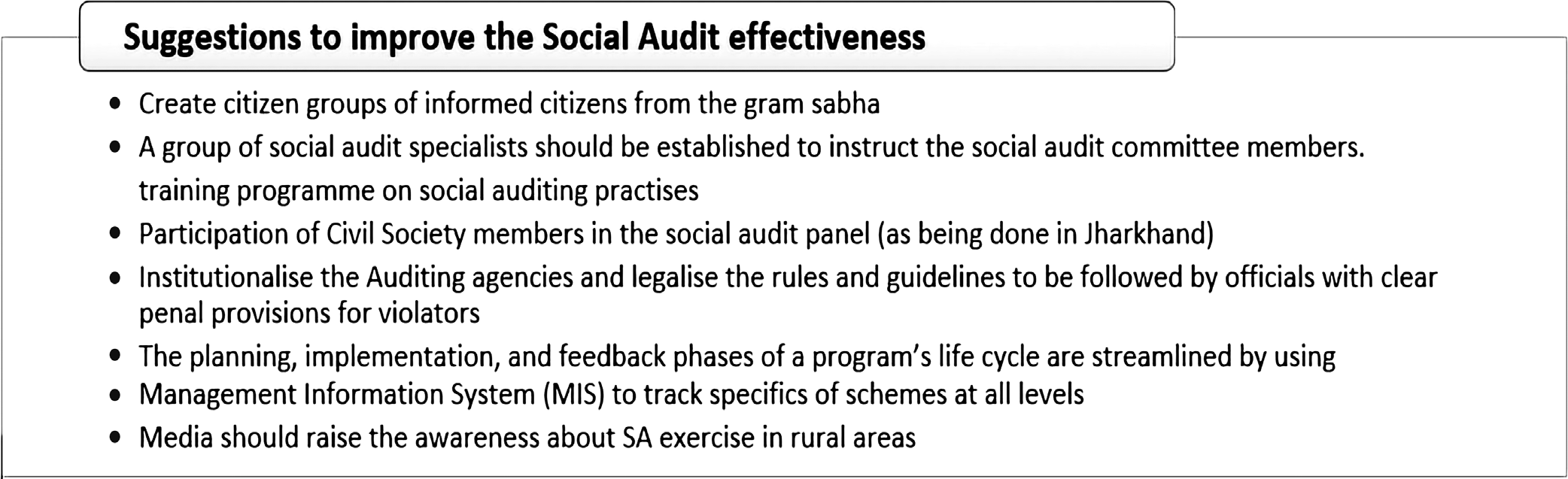
Legalisation of Social Audit
Meghalaya became the first state in India to operationalise a social audit law – ‘The Meghalaya Community Participation and Public Services Social Audit Act, 2017’. Important Features of the Act:
• A Social Audit Facilitator will be appointed to conduct the audit directly with the people who will present
findings to the Gram Sabha, which will further add inputs and the result will finally go to the auditors.
• A Social Audit Council (SAC) has been established as a panel to review government programmes during the course of their implementation.
• The Act provides a list of programmes, schemes and projects to be audited.
Some success stories of Social Audits in India
Jan Sunwai initiative of Majdoor Kisan Shakti Sangathan (MKSS)
• State-led NREGA social audits in India have their origins in movement-led Jan Sunwai.
• In the early 1990s, a grassroots organization, the Mazdoor Kisan Shakti Sangathan (MKSS or Workers and Peasants Collective) first developed Jan Sunwai or rural public hearings to expose corruption in rural development programs.
• The Jan Sunwai that inspired social audits evolved
out of grassroots struggle by daily wage workers and middle-class activists to enforce minimum wages on government-run welfare programs.
Workers and Peasants were trying to enforce minimum wages on public works programs which they knew were being embezzled by local elites.
• As the struggle evolved, workers linked the demand for right to information to issues of livelihood and survival.
• This jan sunwai model later became precursor for all the social audit model in India.
Society for Social Audit,Accountability and Transparency (SSAAT) of Andhra Pradesh:
• Society for Social Audit, Accountability and Transparency, an autonomous body insulated from government interference, was set up in Andhra Pradesh.
• The state of Andhra Pradesh has become a role model for all the other states as far as implementation of SA is concerned.
• The main aim of the SSAAT is to uphold the concept of eternal vigilance by the people, facilitated by social activists and Government acting in conjunction.
• It aims at empowerment of the rural population covered by welfare schemes such as MGNREGA and minimization of leakage and wastage of public funds.
• Public vigilance, verification of the various stages of implementation and ‘Social Audit Forums-Public Hearings’ are important components of the social audit process followed by SSAAT.
Jharkhand
• Public hearings are heard by juries with Panchayati Raj Institutions (PRI) and Civil Society Organization (CSO) members.
An advisory for action to be taken on specific irregularities has been formulated for the guidance of the jury members.
Hearings are held at the panchayat, block, district and state levels.
• Special and test audits are done
• A cultural workshop for Information-Education- Communication (IEC) activities was conducted and songs in eight different languages have been prepared.
Chhattisgarh
• Apart from MGNREGA, social audit team also collects complaints regarding other issues and hands it over to the Sarpanch and Sachiv in the Gram Sabha.
Wall writing of muster rolls,bills and measurement books is carried out to ensure active involvement of the community in the social audit process.
E-governance
e-Governance
What is e-governance?
According to the 2nd Administrative Reform Commission (ARC) Report, e-Governance involves performing governance functions and achieving desired outcomes
through the use of Information and Communication Technology (ICT).
E-Governance is method to transform the existing government and brings in SMART Governance viz:
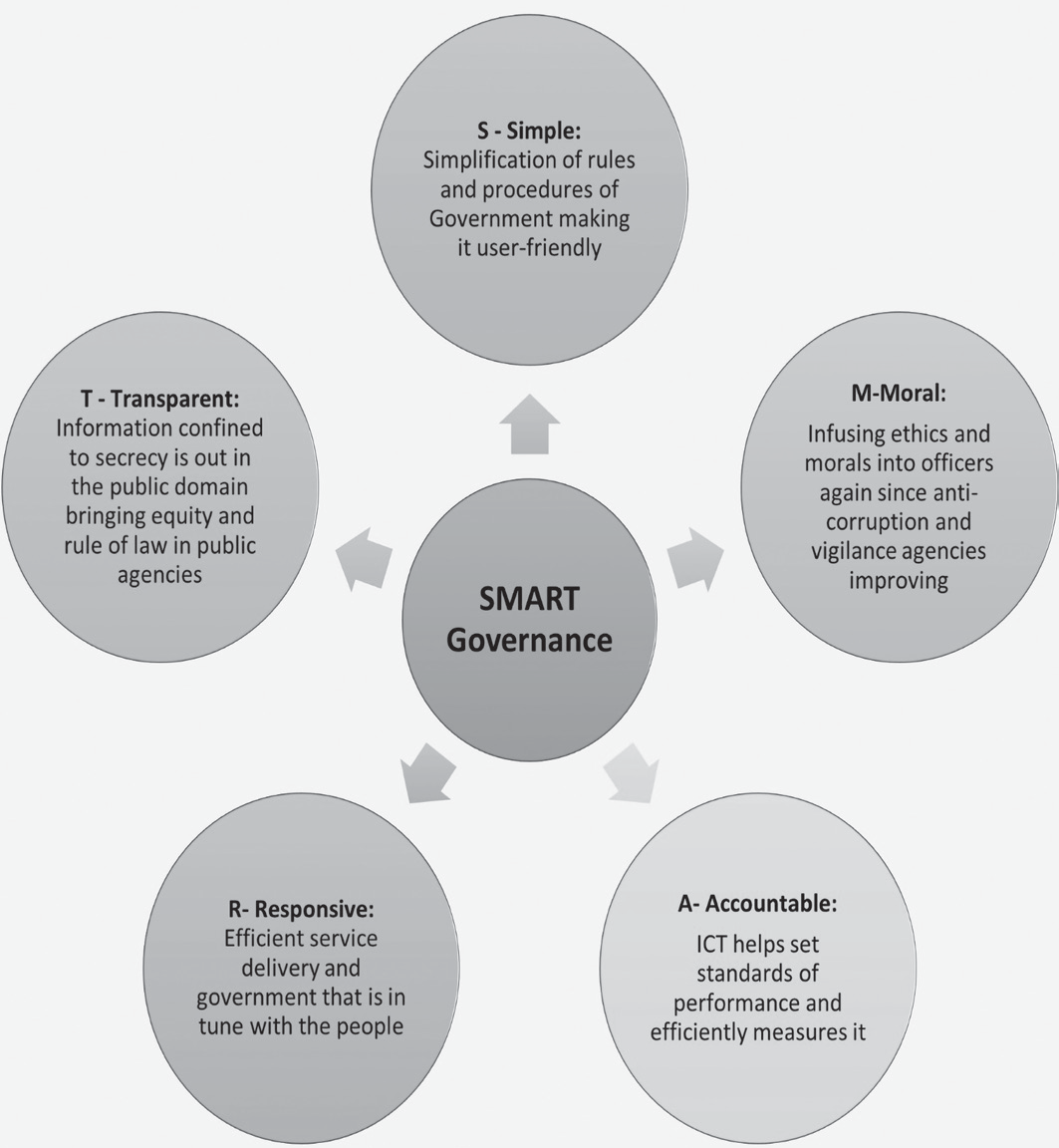
Figure: Smart Governance
Why e-governance is needed?
The purpose of e-governance is to reach the ideals of good governance, in this context e-governance can become the mean to achieve the end of good governance-
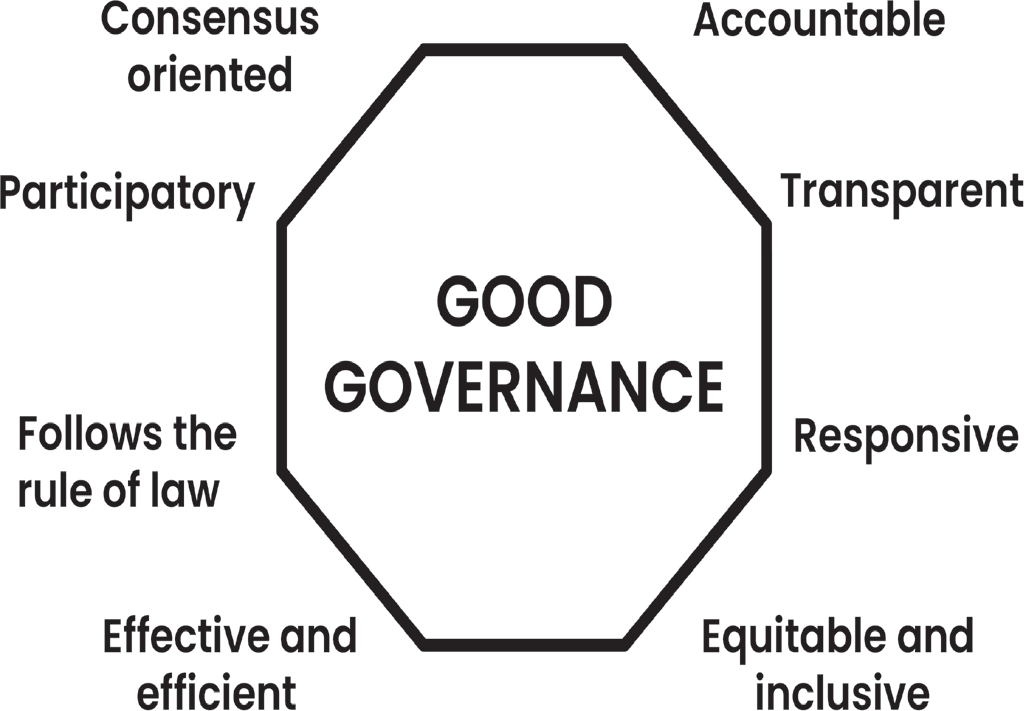
Figure: Principles of Good Governance
| Sr No. | Good Governance principles | How e-governance helps to achieve these principles |
| 1 | Participation | E-governance increases participation of citizens into public affairs as citizens become more aware about good governance. E.g., through Mygov platform citizens are giving their feedbacks to government |
| 2 | Transparency | The RTI is allowed to be filed online and various information are now made public on governments’ website under section 4 of RTI act. This is enhancing the transparency in system |
| 3 | Consensus building | As digital mediums are becoming cheap and more accessible, this increases the scope of online, virtual meetings. And this increases the scope of consensus building among all the stakeholders. |
| 4 | Responsiveness & Accountability | It will help in government becoming more responsive and accountable. E.g., at C-Vigil launched by the Election Commission, grievance related to over election expenditure related to MCC can be filed. |
| 5 | Effectiveness & Efficiency | Faster and more efficient delivery of public services through ICT. At the same time big data analysis can help in optimize the allocation of resources. E.g., JAM trinity has made distribution of subsidies more efficient and effective in India. |
| 6 | Equity & inclusiveness | The use of e-devices and ICT have made the distribution of resources more equitable. Now anyone can avail public services online from anywhere at a reasonable charge or free of cost. |
Models of e-governance:
There are four models of e-governance: - Government to Citizen (G2C), Government to Government (G2G), Government to Businessmen (G2B) and Government to Employees (G2E).
| E-governance model | Governmentto Citizen (G2C) | Governmentto Government (G2G) | Government to Businessmen (G2B) | Government to Employees (G2E) |
| Description | This model of e-governance refers to the government serviceswhich are shared by the citizen. This model strengthens the bond between government and the citizen. | This model refers to the services which are shared between the governments. There is lots of information that need to be shared between various government agencies, department and organizations. | Through this model, bondbetween privatesector and government strengthens. | This model increases the transparency between government and its employees and thus strengthens their relationship. |
| Examples | -Paymentof online bills such as electricity, water, telephone bills etc. -Online registration of applications -Online copies of land-record -Online filling of complaints -Availabilityof any kind of online information | -Government document exchange which includes preparation, approval, distribution, and storage of all governmental documents is also done through e-governance. -Most of the finance and budget work are also done through e-governance. | -Collection of taxes -Rejectionand approval of patent -Payment of all kind of bills and penalty -Sharing of all kind of information, rules and data -Complaints or any kind of dissatisfaction can be expressed | -All kind of data submission (attendance record, employee record etc.) from various government offices -Employeecanfilecomplaints and dissatisfaction Rules & regulation and information for employees can be shared -Employees can check their payment and working record |
| Government schemes | -Computerisation of Land Records (Department of Land Resources) -Bhoomi Project in Karnataka (Online Delivery of Land Records) -MyGov -e-Pramaan (Certificate and IDs) | -e-Procurement Project in Andhra Pradesh and Gujarat -GEM for e-procurement e-BIZ | -Public Finance Management System (PFMS) E – Samikhsa -UPAAI App (unified planning and analysis interface) e-courts | -Online performance appraisal -Online salary filings -Online attendance system |
Digital Literacy in India
Definition According to the National Statistical Office, a ‘digitally literate’ person is at least five years old and can navigate the Internet via a web browser, use e-mail, and find, evaluate, and communicate information using social media tools.
• The office’s statistics show that while over 55 per cent of Indians have access to broadband, only 20 per cent had the ability to use the Internet.
• According to National Sample Survey Office (NSSO) data, only 4.4 per cent of rural households own computers, out of which only 14 per cent have a computer with an internet connection.
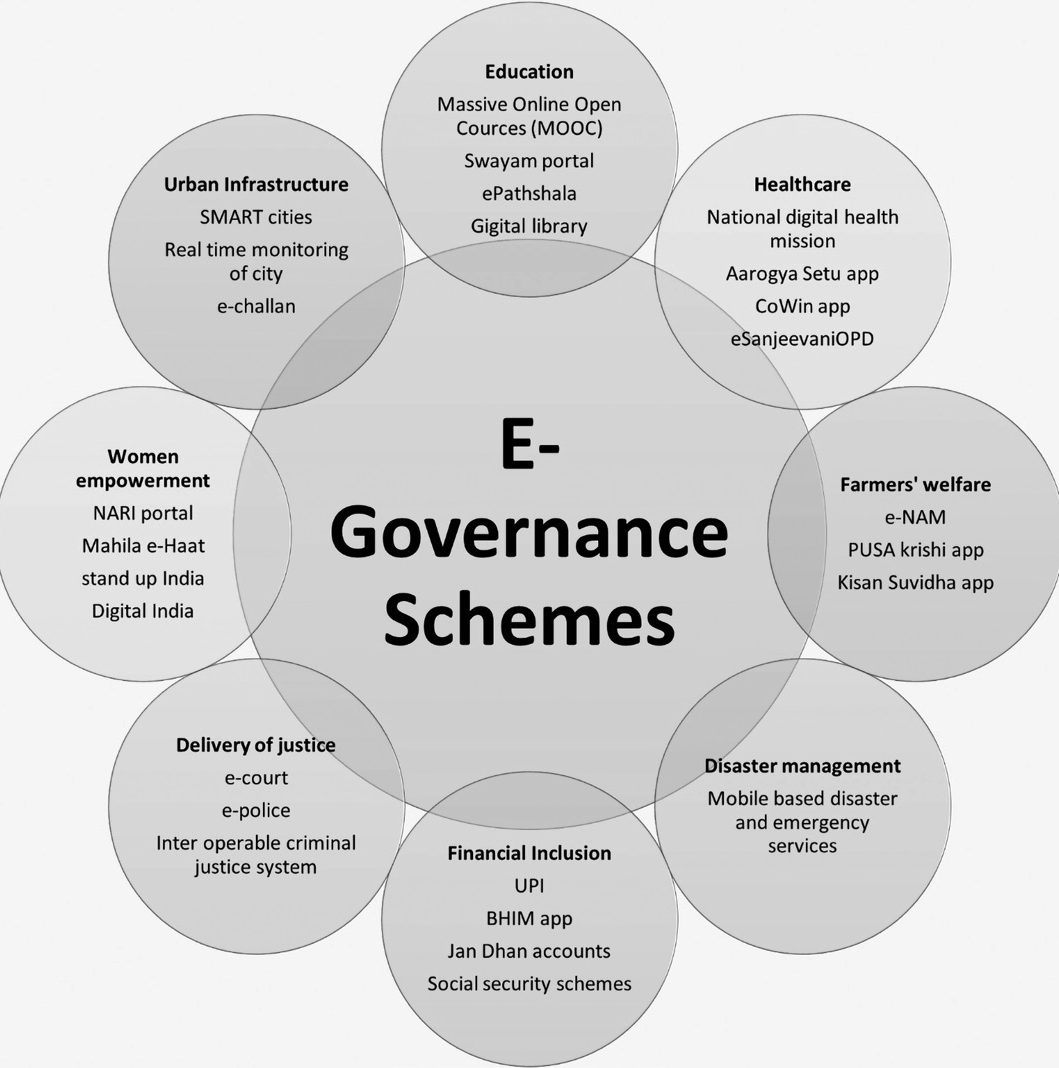
• On an average, less than 3 out of 10 women in rural India and 4 out of 10 women in urban India ever used the Internet, according to the NFHS-5.
• The Digital India report 2024 report revealed that a total of 1.12 billion cellular mobile connections were active in India in early 2024, with this figure equivalent to 78.0 percent of the total population.
State of India’s Digital Economy Report 2024-
• India’s Digital Economy Status: India is the third most digitalized economy globally, after the United States and China, in terms of overall economy-wide digitalization. However, in the digital adoption by individual users, India ranks 12th among G20 countries, reflecting comparatively lower digital engagement at the user level.
• Contribution of the Digital Economy: In 2022–23, the digital economy accounted for 11.74% of India’s GDP, and it is projected to grow to 13.42% by 2024–
25. It employs 2.55% of the total workforce while demonstrating a productivity level approximately five times higher than the average across the economy.
• Two Schemes titled “National Digital Literacy Mission” (NDLM) and “Digital Saksharta Abhiyan” (DISHA) were implemented by the Government with a target to train 52.50 lakh
candidates in digital literacy across the country. Under these two schemes, a total of 53.67 lakh beneficiaries were certified. (by 1st April 2020)
• In 2017, a scheme titled “Pradhan Mantri Gramin Digital Saksharta Abhiyan (PMGDISHA)” was launched to usher in digital literacy in rural India by covering 6 crore rural households (one person per household). So far, a total of around 5.78 crore candidates have been enrolled and 4.90 crore have been trained, out of which around 3.62 crore candidates have been certified under this scheme. (by 1st April 2020)
Advantages of e-Governance
Improves delivery and efficiency of government services
Improved government interactions with business and industry
• Citizen empowerment through access to information
• More efficient government management
• Less corruption in the administration
• Increased transparency in administration
• Greater convenience to citizens and businesses
• Cost reductions and revenue growth
• Increased legitimacy of government
• Flattens organisational structure (less hierarchic)
• Reduces paperwork and red-tapism in the administrative process which results in better planning and coordination between different levels of government
• Improved relations between the public authorities and civil society
• Re-structuring and streamlining of administrative processes
Challenges and Issues inhibiting the success of e-governance in India
There are a large number of obstacles in implementation of e-Governance in India. These can be categorized under the following titles: Environmental and Social Challenges, Economical Challenges and Technical Challenges. These challenges are explained below:
Environmental and Social Challenges
• Different Language: The diversity of people in context of language is a huge challenge for implementing e-Governance projects as e-Governance applications are written in English language. And also, English may not be understandable by most of the people which creates gap in communication.
• Low Literacy: Literacy level of India is very low which is a huge obstacle in implementation of e-Governance projects. Illiterate people are not able to access the e-Governance applications; hence the projects do not get much success.
• Low IT Literacy: Most of the people in India are not aware about the usage of Information Technology. It leads to the poor effectiveness low utilization of the tools of e-governance.
• User friendliness of government websites: User unfriendliness, for those who have less IT knowledge, causes the users to abandon the kiosks and portals, which leads to loss of investment to exchequer.
•
Services are not accessible easily: There is lack of internet penetration across India. Even if the users of Internet are growing but still there is a major part of Indian population which is not able to access e-Governance activities for variety of reasons, e.g., some people may have limited access to Information and Communication Technologies and devices. This puts a limit on impact of government schemes in rural and remote areas.
• Confidence on technologies provided by government: If balance between preventing fraudulent transactions and the burden of extensive checks is not kept, then honest people are discouraged and aim of e-governance is not achieved.
• Struggle to Change: Hesitation in moving from a paper-based to a web-based system to interact with government also causes issue of maladjustment and continuity of obsolete procedures causing inefficiency in implementation.
• Lack of awareness among people: Most of the Indian people are not aware of the benefits of e-Governance services. This leads to underutilization of resources and inability of the citizens to realize their potential and improve their standard of living.
Economic Challenges
• Cost: In developing countries like India, cost is one of the most important obstacles in the path of implementation of e-Governance where major part of the population is living below poverty line. This causes high out-of-pocket expenditures and discourages citizens from using e-governance services.
• Maintenance and Upgradation: As the Information Technology changes very fast and it is very difficult for us to update our existing systems very fast. Latest fourth Industrial Revolution technologies like Artificial Intelligence, Internet of Things, Cloud Computing, Blockchain technology, etc are still at nascent stage, very expensive and cause the phenomena of “missed the bus” of cutting-edge technologies.
• Limited financial resources: There is limit to government’s resources, which it can invest on the promotion and provision of ICT devices and e-governance initiatives across nation. Lack of funds cause issues of limited scope and scale of implementation of government programmes and inability to meet the aspirations of the people.
Technical challenges
Interoperability or Portability: e-Governance applications must be independent from hardware
or software platforms. Lack of portability causes issues of silos and compartmentalization causing inefficiencies and lack of integration at various levels of implementation.
Scalability: e-Governance projects have to be designed to scale from the day one. E-Governance is supposed to affect every citizen of the country, so e-Governance applications must have the scale to interface with every citizen.
Multimodal Interaction: Multimodal interaction provides the user with multiple modes of interfacing with a system. An e-Government application can be really effective if its users can access it using different devices.
Privacy and Security: A critical obstacle in implementing e-Governance is the privacy and security of an individual’s personal data that He/ She provides to obtain government services. Lack of security standards can limit the development of e-Government projects that contain personal information such as income, medical history etc.
Local language: The acceptance of English language in India is very low. The e-governance applications are written in English. That is why e-Governance projects do not get success. Hence, the e-governance applications must be written in local language of the people so that they may be able to use and take advantage of these applications.
Government’s initiative to promote e-governance
National e-Governance Plan 2006
• The National e-Governance Plan (NeGP), takes a holistic view of e-Governance initiatives across the country, integrating them into a collective vision, a shared cause.
• Around this idea, a massive countrywide infrastructure reaching down to the remotest of villages is evolving, and large-scale digitization of records is taking place to enable easy, reliable access over the internet.
• The ultimate objective is to bring public services closer home to citizens, as articulated in the Vision Statement of NeGP.
• In 2011, 4 projects - Health, Education, PDS and Posts were introduced to make the list of 27 MMPs to 31Mission Mode Projects (MMPs).
• In order to promote e-Governance in a holistic manner, various policy initiatives and projects have been undertaken to develop and support core infrastructure. The major core infrastructure components are-
•
State Data Centres (SDCs),
• State Wide Area Networks (S.W.A.N),
• Common Services Centres (CSCs) and middleware gateways i.e National e-Governance Service Delivery Gateway (NSDG),
• State e-Governance Service Delivery Gateway (SSDG), and
• Mobile e-Governance Service Delivery Gateway (MSDG).
• The important support components include Core policies and guidelines on Security, HR, Citizen Engagement, social media as well as Standards related to Metadata, Interoperability, Enterprise Architecture, Information Security etc.
• New initiatives include a framework for authentication, viz. e-Pramaan (National e-Authentication service) and GI cloud, an initiative which will ensure benefits of cloud computing for e-Governance projects. e-Kranti (Electronic delivery of services)
The focus of the e-Kranti is to transform the e-Governance services by expanding the portfolio of Mission Mode Projects (MMPs) in e-Governance under various Government Departments, undertaking Government Process Reengineering (GPR), work flow automation, introducing latest technologies such as Cloud and mobile platform and focus on integration of services.
India Enterprise Architecture (IndEA) 2017
• It was conceived and designed “with the goal of facilitating alignment of IT advances with government organisations’ business visions.”
• IndEA provides a generic framework that consists of a set of architectural reference models that may be turned into a Whole-of-Government Architecture for India, Ministries, States, Government Agencies, and other entities.
• It is based on The Open Group Architecture Framework (TOGAF)- a high level design approach for designing, planning, implementing, and governing an enterprise information technology architecture.
• The IndEA framework is built on a federated architecture approach that understands the requirement to support both greenfield (new) and brownfield (current / legacy) eGovernment activities.
Aims:
Documenting and communicating architecture best practises, both explicit and implicit
Assisting with the creation of enterprise architectures.
Capturing important architectural features and their interrelationships
By establishing an audit procedure, we may provide the means for architecture governance.
InDEA 2.0
• InDEA 2.0 presents a Federated Digital Identities paradigm that aims to reduce the number of digital identities required by citizens.
• The citizen’s many digital IDs, ranging from PAN and Aadhaar to driving licence and passport numbers, can be linked, stored, and accessed through a single unique ID under the new approach.
• Citizens can use their digital ID “to access other third- party services through authentication and consented e-KYC,” according to the government.
• It would also act as a key to a registry that would store all of the different state and central identities.
• It enables governments and private-sector companies to create IT architectures that extend beyond their organisational borders, allowing them to provide customers with comprehensive and integrated services.
Recommendations of 2nd ARC on e-governance
Following are some of the important recommendations of 2nd Administrative Commission on e-governance:
• Building a Congenial Environment: Building a congenial environment is a sine-qua-non for successful implementation of e-Governance initiatives. This should be achieved by:
• Creating and displaying a will to bring change within the government
• Providing political support at the highest level
• Incentivizing e-Governance
• Creating awareness in the public with a view to generating a demand for change.
• Business Process Re-engineering: Governmental forms, processes and structures should be re-designed to make them adaptable to e-Governance, backed by procedural, institutional and legal changes.
• Capacity Building and Creating Awareness: Capacity building efforts must attend to involve the organizational capacity building as also the professional and skills up gradation of individuals associated with the implementation of e-Governance projects.
•
Developing Technological Solutions: Develop a National E-Governance ‘Enterprise Architecture’ framework as has been done in some countries.
• Monitoring and Evaluation: Monitoring of e-Governance projects should be done by the implementing organization during implementation. It should be done in the manner in which project monitoring is done for large infrastructure projects.
• Public-Private Partnership (PPP): Several components of e-Governance projects allow Public- Private Partnership (PPP) mode and it should be promoted. The private partner should be selected through a transparent process. The roles and responsibilities of government as well as the private partner should be clearly laid down in the initial stage itself, leaving no room for any ambiguity.
• Protecting Critical Information Infrastructure Assets: There is need to develop a critical information infrastructure assets protection strategy. This should be supplemented with improved analysis and warning capabilities as well as improved information sharing on threats and vulnerabilities.
• The Common Support Infrastructure: The State Data Centres (SDCs) should be maintained by Government agencies such as NIC as it involves handling of sovereign data. Further, all data centres at the State level should be subsumed in the SDCs.
• Mission Mode Project on Computerization of Land Records: Surveys and measurements need to carried out in a mission mode utilizing modern technology to arrive at a correct picture of land holdings, land parcels and rectification of outdated maps. This needs to be accompanied by an analysis of the existing mechanism for updating land records which varies from State to State – to be supplanted by an improved and strengthened mechanism which ensures that all future transactions in titles are immediately reflected in the land records.
• Legal Framework for e-Governance: A clear road map with a set of milestones should be outlined by Government of India with the ultimate objective of transforming the citizen-government interaction at all levels to the e-Governance mode.
• Knowledge Management: Union and State Governments should take proactive measures for establishing Knowledge Management systems as a pivotal step for administrative reforms in general and e-Governance in particular.
What more can be done to popularize e-governance in India
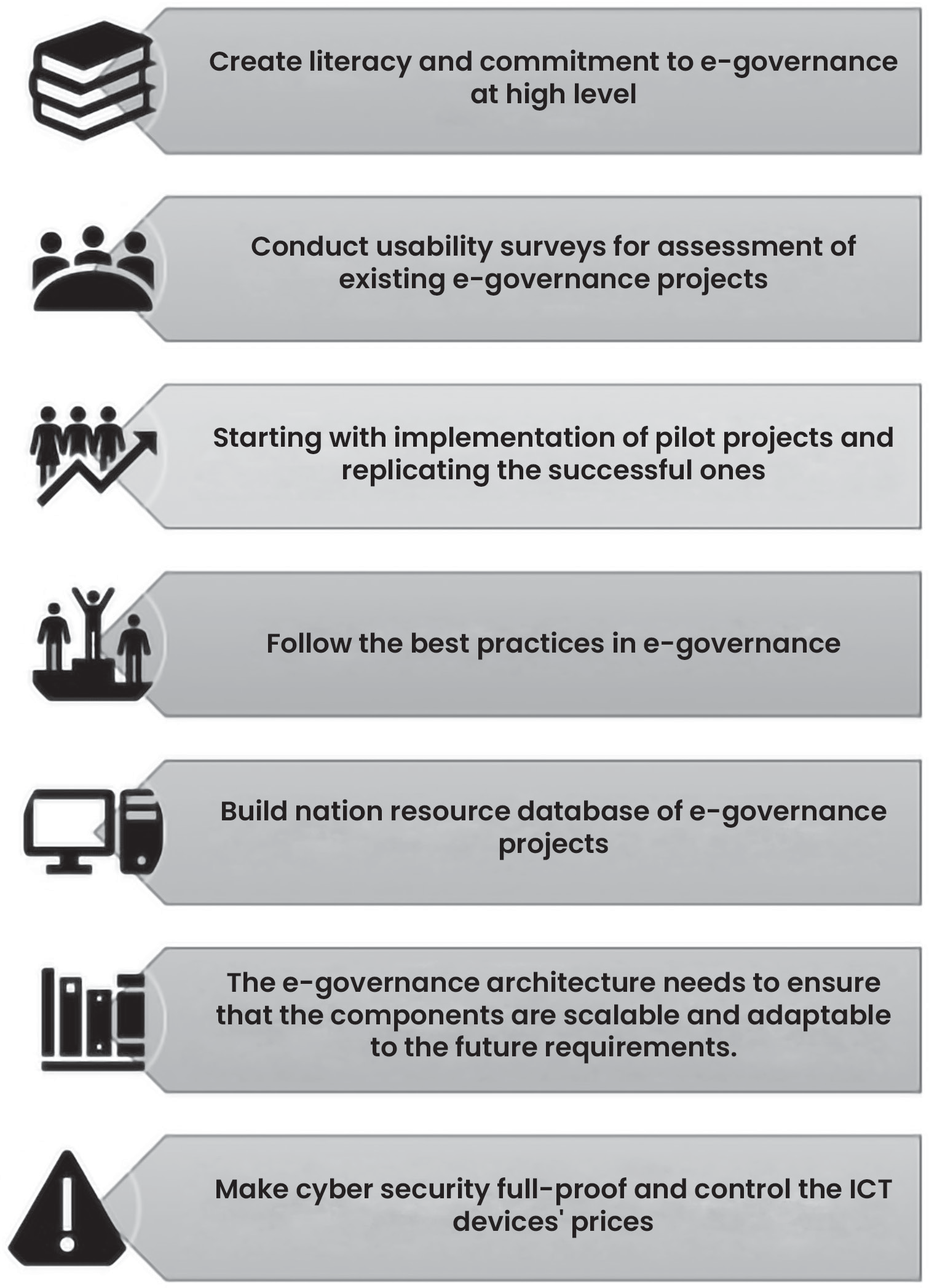
Figure: Ways to Popularise e-Governance
UNIT
02