Social Empowerment Marginalisation Vulnerability and Structure of Government Schemes
Introduction:
India is considered to be a ‘welfare state’ and the Hon’ble Supreme Court termed ‘welfare state’ as an element of the Basic Structure of the Constitution.
Welfare is more important for vulnerable sections because they experience a higher risk of poverty and social exclusion than the general population.
India, being a diverse society having varied gender, caste, class, and ethnic identities coexisting simultaneously often experience structural discrimination in varied forms which deprives equal access to social services and economic opportunities.
According to India Exclusion Report, most of the disadvantaged groups in India i.e. women, dalits, tribals, Muslims, informal sector workers, the poor, the elderly and the disabled etc continue to be excluded from access to four key public goods:
Pensions
Digital access
Land, Labour & Resources
Legal Justice
Social Empowerment
Development discourse has been undergoing momentous changes in recent times. To expand the social base of democracy and development, the trend now is to work towards mobilising people’s initiatives in the development process.
The notion of ‘empowerment’, in this context, assumes considerable significance. It is acquiring a wider connotation implying strengthening the capacities of individuals, eliciting their participation in the development process. Civil society as an important part of the socio- political and public administrative framework is emerging as a new and important actor in the processes of development. Empowerment of hitherto marginalised
groups - those deprived in social, economic, political, administrative and cultural terms - is featuring as a major issue in development discourse.
As per World Bank, Empowerment stands for ‘the expansion of assets and capabilities of poor people to participate in, negotiate with, influence control, and hold accountable institutions that affect their lives’. No doubt, therefore, empowerment is essentially a political process.
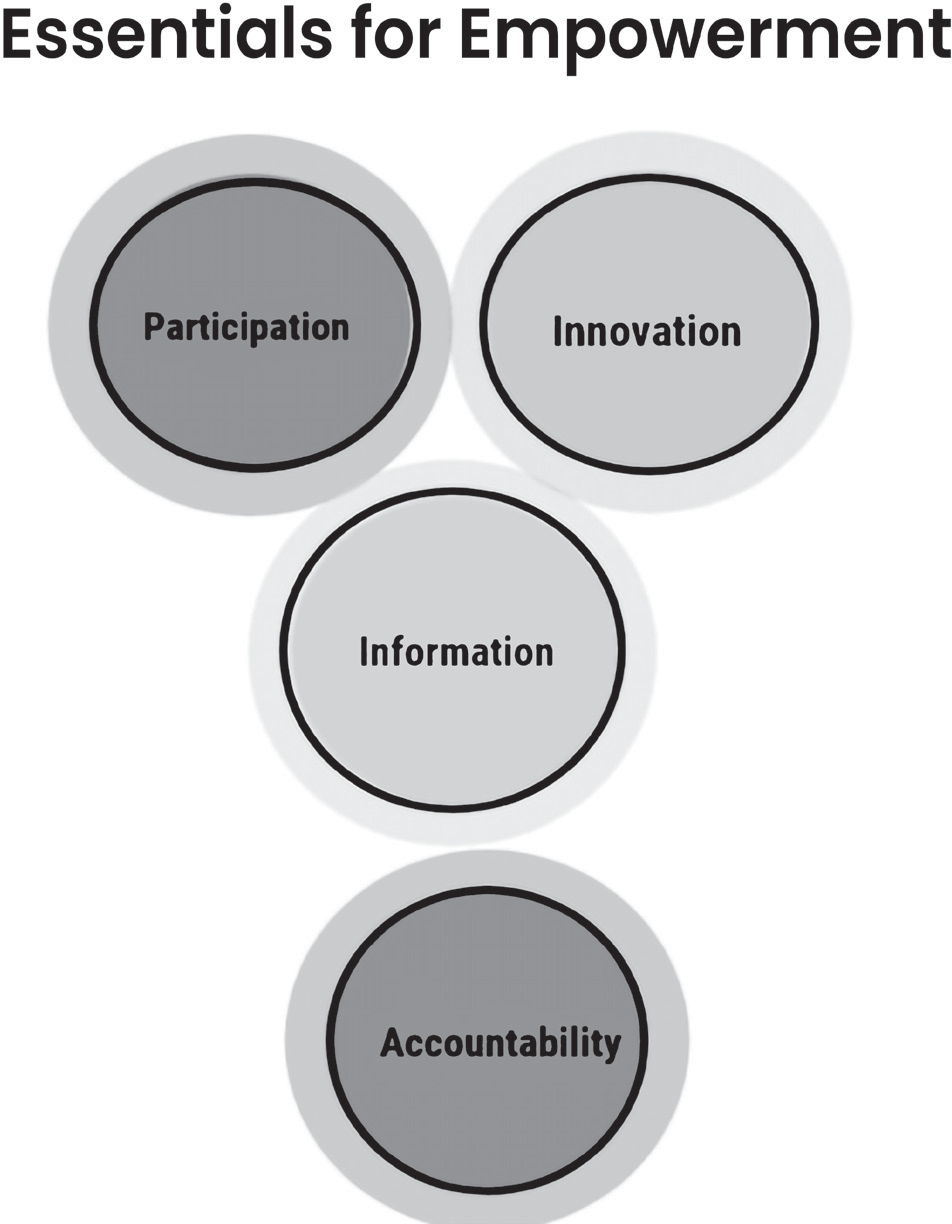
Figure: Essentials for Empowerment
Central to the concept of empowerment are four core elements:
Access to Information
Inclusion and participation
Accountability
Local organised capacity and subsequent networking with wider movement groups to create a climate of pressure on the holders of power.
Marginalisation
Marginalisation in the conventional parlance is a complex process of relegating specific group(s) of people to the lower or the outer edge of the society. It effectively pushes these groups of people to the margin of the society following the parameters of exclusion and inclusion in terms of economic, political, cultural and social aspects.
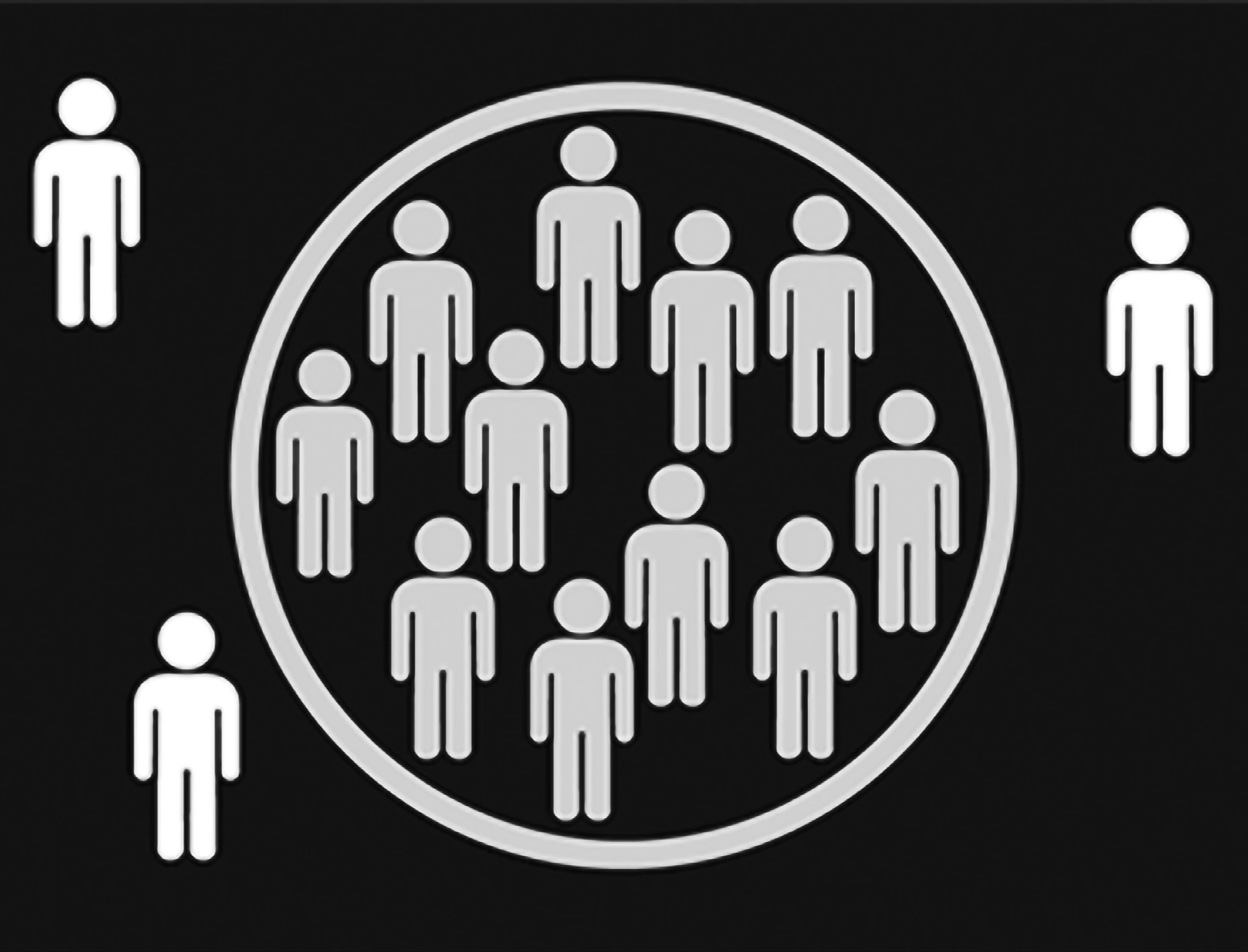
Figure: Marginalisation of the People
Dimensions of denials and deprivations:
The process of marginalisation economically denies a large section of the society:
Equal access to productive resources
Avenues for the realisation of their productive human potential
Opportunities for their full capacity utilisation.
These denials ultimately push this population to the state of rampant poverty, human misery, devaluation of their work, low wage and wage discrimination, casualisation in the workforce and livelihood insecurity.
Thus, they are provided with very limited space for upward occupational and social mobility, and are excluded from the range of economic opportunities and choices.
• Politically, this process of relegation denies these people to have equal access to the formal power structure and participation in the decision-making processes leading to their subordination to and
dependency on the economically and the politically dominant groups of the society. Politically these groups emerge to be the underdogs, under represented and dis-empowered.
• In this ongoing process of marginalization, individuals become culturally excluded from the mainstream society, emerging as a "part society with part culture"— outsiders within. They experience alienation and disintegration, ultimately acquiring a stigmatized cultural identity, an ascribed low social status, and falling victim to cultural segregation.
• As a consequence of the economic, political and cultural deprivation a vast chunk of the population of the country has emerged to be socially ignorant, illiterate, uneducated and dependent. Devoid of the basic necessities of life, they are relegated to live in the margin of the society with a subhuman existence.
Structure of the Government Schemes
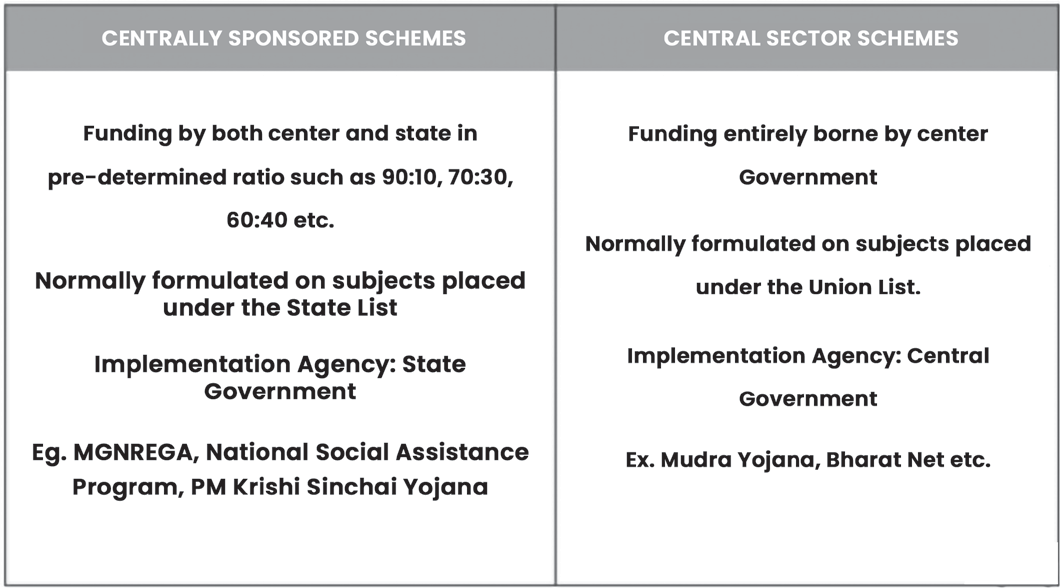
Indian Government, at all levels, announces Welfare Schemes for various marginalised sections of the society
from time to time. These schemes could be either Central ,State specific or a joint collaboration between the Centre and the States.
The Government of India (GoI) spends close to Rs. 14 lakh crores annually on development activities, through nearly 750 schemes implemented by Union Ministries.
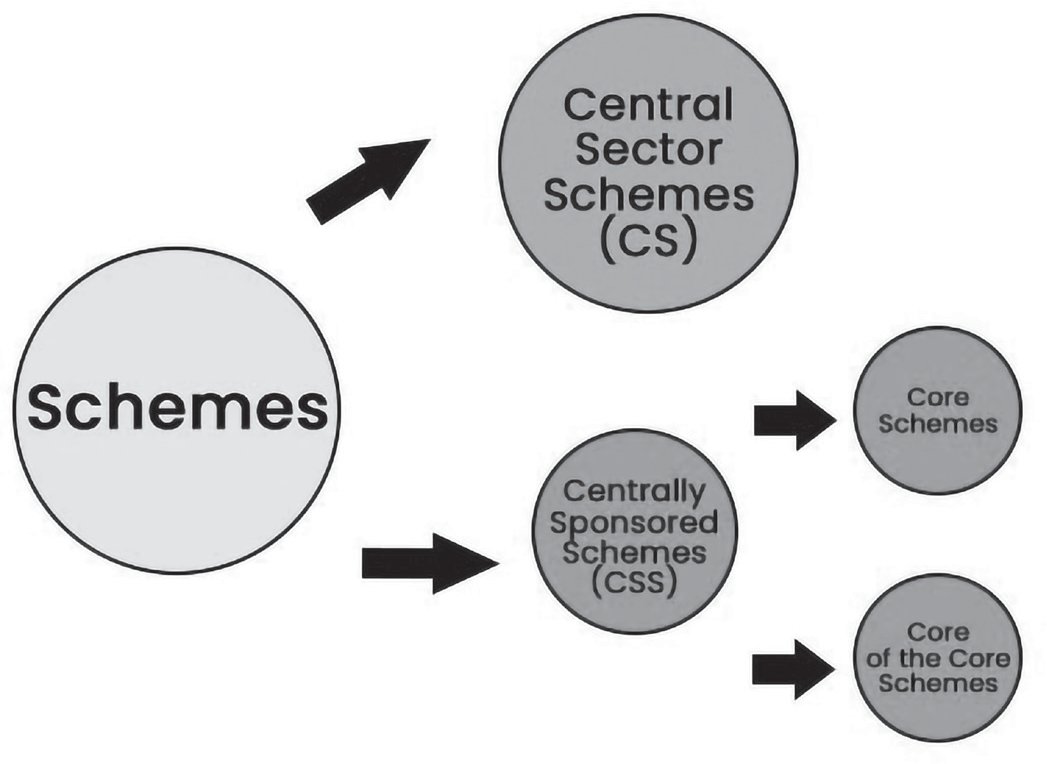
Figure: Classification of Government Schemes
In June 2013, Government of India had restructured the Centrally Sponsored Schemes (CSS) in response to issues raised by Chief Ministers in the National Development Council.
In March 2015, Prime Minister constituted ‘The Sub- Group of Chief Ministers on the rationalisation of Centrally Sponsored Schemes’.
The Sub-Group undertakes extensive consultations with the Central Ministries, NITI Aayog and States and UTs. The formation of the Sub-Group is testimony to the resolve of the Union and the States /UTs to work as Team India in the spirit of Cooperative Federalism.
Based on the recommendation of Shiv Raj Singh Chauhan Panel 2015, government is restructuring CSSs.
Government has reduced the number of centrally sponsored schemes (CSS) from 66 to 28 umbrella schemes, effective from the financial year 2016-17
Schemes are now classified into three types :
• Core of the Core (Total 6 schemes)
• Core (Total 20 schemes)
• Optional (Total 2 schemes)
Special Category states are: 11 total (8 North Eastern states + 3 Himalayan states i.e. Uttarakhand, HP & JK)
Core of the Core Schemes:
• MGNREGA
• National Social Assistance Program (For Senior citizens, widows etc.)
• Umbrella Scheme for SC (All schemes for SC in one)
• Umbrella Scheme for ST (All schemes for ST in one)
• Umbrella Scheme for OBC (All schemes for OBC in one)
• Umbrella Scheme for Minorities (All schemes for Minorities in one)
CORE SCHEMES
Krishi Unnati Yojana Rashtriya Krishi Vikas Yojana
White Revolution – Rashtriya Pashudhan Vikas Yojana
Blue Revolution
Pradhan Mantri Krishi Sinchai Yojana
Accelarated Irrigation Benefit and Flood Management Program (Har Khet Ko Pani)
Per Drop More Crop
Integrated Watershed Development Program Pradhan Mantri Gram Sadak Yojana National Rural Drinking Water Mission Swachh Bhart Abhiyan
National Health Mission
Rashtriya Swasthya Suraksha Yojana National Education Mission(NEM) NEM – Sarva Shiksha Abhiyan
NEM – Rashtriya Madhyamik Shiksha Abhiyan
NEM – Teacher’s Training and Adult Education NEM – Rashtriya Ucchatar Shiksha Abhiyan Mid Day Meals Program
Integrated Child Development Scheme (Umbrella ICDS)
• Core ICDS
• National Nutrition Mission
• Maternity Benefits Program
• Scheme for Adolescent Girls
• Integrated Child Protection Schemes
Pradhan Mantri Awas Yojana National Mission for Green India
Integrated Development of Wildlife Habitats Conservation for Natural Resources and Ecosystems
Urban Rejuvenation Missions – SMART Cities and
AMRUT
Modernisation of Police Forces Infrastructure Facilities for Judiciary
Member of Parliament Local Area Development Schemes
What is vulnerability and who constitute vulnerable groups in india:
Individuals experience vulnerability when they become physically weak, economically impoverished, socially dependent, publicly humiliated or psychologically
harmed.
Families feel vulnerable when they do not have access to good quality affordable healthcare, when they are exposed to unsafe environments, or when safety is compromised when societies are faced with crime and violence. At the same time, all new born babies are vulnerable to diseases, just as all women are to domestic violence.
Therefore, vulnerability in the society may arise because of gender, age, caste, historical factors, geographical location, socio-economic status etc.
In India the major vulnerable groups are women children, old age people, scheduled caste, schedule tribe, minorities and distressed people
Welfare of Minorities
Welfare of minorities
Minority refers to a group of people who are lesser in number as compared to the members of a dominant social group. Globally minorities comprise 10-20% of population. They need special protection measures asoften they are among the most disadvantaged groups in society facing exclusion, discrimination and injustice in public and political life.
In rural India, during 2009-10, 11 percent of households followed Islam with about 12 per cent of the population. Christianity was followed by about 2 per cent of the population.
In urban areas, the percentages of households and population following Islam were about 13 and 16 and following Christianity were about 3% and 3%, respectively.
In terms of religious representation, 90.4% of MPs in Lok Sabha are Hindus, 5.2% are Muslims and other religious community represents 4% MPs. Muslims contribute only 2.5% of the Indian bureaucracy.
International Covenant on Civil and Political Life, United Nations Convention on Rights of Child and United Nations Declaration on Rights of Persons Belonging to National, Ethnic, Religious and Linguistic
Minorities ensure protection of Rights of Minorities.
India is a land of diversities and thus, there are numerous minorities in India. As per the Census 2011, the percentage of minorities in the country is about 19.3% of the total
population of the country. The population of Muslims are 14.2%; Christians 2.3%; Sikhs 1.7%, Buddhists 0.7%, Jain
0.4% and Parsis 0.006%.
Government of India has also identified a list of 121 minority concentration districts having at least 25% minority population, excluding those States / UTs where minorities are in majority (J&K, Punjab, Meghalaya, Mizoram, Nagaland and Lakshadweep).
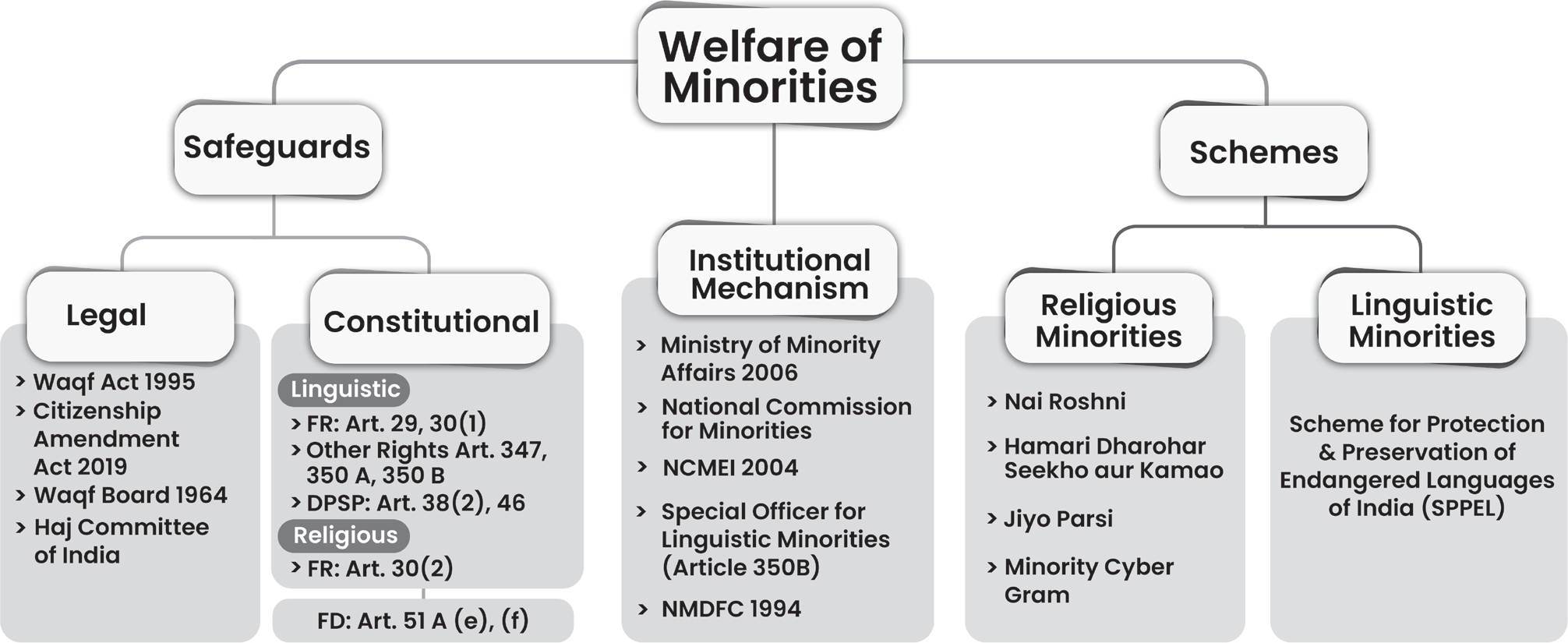
Figure: Welfare of Minorities
Constitutional and Legal Safeguards for Minorities in India
Though the Constitution of India does not define the word ‘Minority’ and only refers to ‘Minorities’ and speaks of those ‘based on religion or language’, the rights of the minorities have been spelt out in the Constitution in detail.
‘Common domain’ and ‘Separate domain’:
The rights which fall in the ‘common domain’ are those which are applicable to all the citizens, minority as well as majority of our country.
The rights which fall in the ‘separate domain’ are those which are applicable to the minorities only and these are reserved to protect their identity.
The Preamble to the Constitution declares the State to be ‘Secular’ and this is a special relevance for the Religious Minorities. Equally relevant for them, especially, is the declaration of the Constitution in its Preamble that all citizens of India are to be secured ‘liberty of thought, expression, belief, faith and worship and ‘equality of status and of opportunity.’
Fundamental Rights under Part III of the Constitution:
In the ‘common domain’, the following fundamental rights and freedoms are covered:
Article 14 people’s right to ‘equality before the law’ and ‘equal protection of the laws.
Article 15 (1) & (2): prohibition of discrimination against citizens on grounds of religion, race, caste, sex or place of birth
Article 15 (4): authority of State to make ‘any special provision for the advancement of any socially and educationally backward classes of citizens’ (besides the Scheduled Castes and Scheduled Tribes).
Article 16(1) & (2): citizens’ right to ‘equality of opportunity’ in matters relating to employment or appointment to any office under the State – and prohibition in this regard of discrimination on grounds of religion, race, caste, sex or place of birth.
Article 16(4): Authority of State to make ‘any provision for the reservation of appointments or posts in favour of any backward class of citizens which, in the opinion of the State, is not adequately represented in the services under the State.
Article 25(1): people’s freedom of conscience and right to freely profess, practice and propagate religion – subject to public order, morality and other Fundamental Rights.
Article 26: right of ‘every religious denomination or any section thereof – subject to public order, morality and health – to establish and maintain institutions for religious and charitable purposes, ‘manage its own affairs in matters of religion’, and own and acquire
movable immovable property and administer it ‘in accordance with law.
Article 27: prohibition against compelling any person to pay taxes for promotion of any particular religion.
Article 28: people’s ‘freedom as to attendance at religious instruction or religious worship in educational institutions’ wholly maintained, recognized, or aided by the State.
The Minority Rights under ‘Separate Domain’ include: -
Rights under Part IV
• Linguistic
• Article 29(1): right of ‘any section of the citizens’ to ‘conserve’ its ‘distinct language, script or culture’.
• Article 29(2): restriction on denial of admission to any citizen, to any educational institution maintained or aided by the State, ‘on grounds only of religion, race, caste, language or any
of them’.
• Article 30(1): right of all Religious and Linguistic Minorities to establish and administer educational institutions of their choice.
• Religious
• Article30 (2): freedom of Minority-managed educational institutions from discrimination in the matter of receiving aid from the State.
Rights outside Part IV:
• Linguistic
• Article 347: special provision relating to the language spoken by a section of the population of any State.
• Article 350 A: provision for facilities for instruction in mother-tongue at primary stage.
• Article 350 B: provision for a Special Officer for Linguistic Minorities and his duties;
• Religious
• Sikh community’s right of ‘wearing and carrying of kirpans; (Explanation 1 below Article 25)
Directive Principles of State Policy under Part IV:
Article 38 (2): obligation of the State ‘to endeavour to eliminate inequalities in status, facilities and opportunities’ amongst individuals and groups of people residing in different areas or engaged in different vocations.
Article 46: obligation of State ‘to promote with special care’ the educational and economic interests of ‘the weaker sections of the people’ (besides Scheduled Castes and Scheduled Tribes).
Fundamental Duties in Article 51 A under Part IVA:
• citizens’ duty to promote harmony and the spirit of common brotherhood amongst all the people of India ‘transcending religious, linguistic and regional or sectional diversities; and citizens’ duty to value and preserve the rich heritage of our composite culture.’
Legal Protection
In India, Muslims, Sikhs, Christians, Buddhists, Jain and Zoroastrians (Parsis) have been notified as minority communities under Section 2 (c) of the National Commission for Minorities Act, 1992
Waqf Act 1995:
Waqf is a permanent donation, a movable or immovable property given in the name of God in muslim community for religious and charitable purposes, created through a deed or instrument, or a property can be deemed waqf if it has been used for religious or charitable purposes for a long period of time.
The proceeds are typically used to finance educational institutions, graveyards, mosques and shelter homes.
A person creating the waqf cannot take back the property and the waqf would be a continuing entity. The grant is known as mushrut-ul-khidmat, while a person making such dedication is known as Wakif.
A non-Muslim can also create a waqf but the individual must profess Islam and the objective of creating the waqf has to be Islamic.
Citizenship Amendment Act 2019:
The CAA, 2019 amends the Citizenship Act of 1955 to make persecuted immigrants, who are Hindus, Sikhs, Buddhists, Jains, Parsis and Christians from Afghanistan, Bangladesh and Pakistan who entered India on or before December 31, 2014, eligible to apply for Indian citizenship.
The amended Act reduces the period of naturalization from 11 years to 5 years for all migrants from these three countries belonging to these six religious communities.
In 2002, Hon’ble Supreme Court in TMA Pai Foundation vs. State of Karnataka case ruled that a minority, either linguistic or religious, is determinable only by reference to the demography of the State and not by taking into consideration the population of the country as a whole. Further in 2022, Supreme Court clarified that Minority status of religious and linguistic communities is “State- dependent”.
Institutional Mechanisms in India
Ministry of Minority Affairs 2006:
It was carved out of Ministry of Social Justice & Empowerment and created on 29th January, 2006 to ensure a more focused approach towards issues relating to the notified minority communities namely Muslim, Christian, Buddhist, Sikhs, Parsis and Jain.
The mandate of the Ministry includes formulation of overall policy and planning, coordination, evaluation and review of the regulatory framework and development programmes for the benefit of the minority communities.
Vision: Empowering the minority communities and creating an enabling environment for strengthening the multi-racial, multi-ethnic, multi-cultural, multi-lingual and multi-religious character of our nation.
Mission: To improve the socio-economic conditions of the minority communities through affirmative action and inclusive development so that every citizen has equal opportunity to participate actively in building a vibrant nation. To facilitate an equitable share for minority communities in education, employment, economic activities and to ensure their upliftment.
National Minorities Commission
With the enactment of the NCM Act, 1992, the first National Commission for Minorities with a statutory status was formed in 1993.
Composition of the commission:
• The commission consists of seven members which include a Chairperson and a Vice-Chairperson along with five other members.
• All members of the commission must belong to minority communities enlisted as minorities, and from amongst persons of eminence, ability and integrity.
• Every member of the Commission holds office for a period of three years.
National Commission for Minority Educational Institutions (NCMEI) 2004
With the enactment of the NCMEI Act, 2004, it gives minority status to educational institutions on the basis of six religious communities notified by the government. It does not cover linguistic minorities.
It is a type of quasi-judicial body headed by a Chairman and three other members. They must be from minority communities only.
The Chairman and members are nominated by the Central government.
NCMEI advises the Central Government or any State
Government on any question relating to the education of minorities in India.
Waqf Board 1964
It is an Indian statutory body established in 1964 by the Government of India under the Waqf Act, 1954 (now a subsection of the Waqf Act, 1995) for the purpose of advising it on matters pertaining to the working of the State Waqf Boards and proper administration of the Waqfs in the country.
It is headed by a chairperson, who is the Union Minister in charge of Wakfs and there are maximum 20 other members, appointed by Government of India as stipulated in the Waqf Act.
Haj Committee of India is a statutory body under the Ministry of Minority Affairs. It is set up under the provisions of Haj Committee Act, 2002.
It is a body corporate having perpetual succession. It has the responsibility of making arrangements for the pilgrimage of Muslims for Haj, and related matters.
Every year, it invites applications from the intending pilgrims for Haj, makes selection of the pilgrims, and make arrangements for their accommodation, transportation and welfare in Saudi Arabia in close coordination with the Consulate General of India in Jeddah and Ministry of Civil Aviation under the overall supervision of Ministry of Minority Affairs.
National Minority Development and Finance Corporation 1994
It aims to promote economic and developmental activities for economic empowerment of recognized minorities. It is a Public Sector Unit registered under Companies Act as a not-for-profit company.
It provides concessional finance to the Minorities for self-employment/ income generation activities. Under NMDFC programme, preference is given to Artisans & Women.
Promote Developmental activities primarily through:
• Vocational Training / Skill Development Programme
• Marketing Support
• Mahila SamridhiYojana
• Awareness/Advocacy Programme
Special Officer for Linguistic Minorities (Article 350B)
• The President of India appoints it to protect the rights of linguistic minorities. In 1957, the post of the Special Officer for Linguistic Minorities was established in accordance with Article 350B of the Constitution. He/She is designated as the Linguistic Minorities Commissioner.
• The Special Officer’s responsibility is to investigate all matters relating to the safeguards provided for linguistic minorities under the Constitution and report to the President at such intervals as the President may direct, and the President shall cause all such reports to be laid before each House of Parliament and sent to the governments of the States concerned.
The Central Institute of Indian Languages (CIIL), Mysore
• It is a subordinate office of the (Now - Ministry of Education ) is implementing a scheme for preservation and protection of languages spoken by less than 10000 people. Under the scheme, grammatical descriptions, monolingual and bilingual dictionaries, language primers, anthologies of folklore, encyclopedias, etc of all the endangered languages / mother tongues, especially those spoken by less than 10000 persons are prepared.
Welfare Schemes for Religious Minorities
• Nai Roshni: (Ministry of Minority Affairs)
Scheme: It is a six-day non-residential/five-day residential training programme conducted for women belonging to minority community between the age group of 18 years to 65 years.
The training modules cover areas related to programmes for women such as Health and Hygiene, Legal Rights of Women, Financial Literacy, Digital Literacy, Swachch Bharat, Life Skills, and Advocacy for Social and Behavioural changes. The scheme has been merged as PM VIKAS as a component.
Analysis: The Nai Roshni scheme has empowered and enhance confidence among minority women by generating awareness about women rights and interventions for ‘Leadership Development’. Since its inception about
4.35 lakh beneficiaries have been trained under the ‘Nai Roshni’ scheme.
• Hamari Dharohar Seekho aur Kamao (Ministry of Minority Affairs)
Scheme: “Hamari Dharohar” aims to curate rich culture and heritage of minorities under overall concept of Indian Culture. The scheme also includes preservation of literature/ documents and promotion of research and development etc.
• Jiyo Parsi (Ministry of Minority Affairs)
Scheme: Launched in 2013-14, the Jiyo Parsi scheme is a distinctive initiative aimed at reversing the decline in the Parsi population. Its primary goal is to halt the decreasing numbers of Parsis in India by implementing scientific protocols and structured interventions to stabilize their population.
The scheme offers financial assistance to Parsi couples for medical treatments, child care, and support for elderly individuals. Additionally, advocacy and outreach programs are organized to raise awareness within the Parsi community.
Analysis: The Parsis, originally from Persia, sought refuge in India due to religious persecution. Today, they are one of the wealthiest communities in India. However, their population has dwindled to a critical level of just 61,000. Since the program's launch, 403 babies have been born to Parsi families.
• Minority Cyber Gram: (Ministry of Minority Affairs)
Scheme: Launched in 2014-15, it is a Digital Literacy programme for Minority Communities. Under this initiative, students of minority communities are provided hands on training in computers to enable them to acquire
basic Information and Communication Technology (ICT) skills to become digitally literate and to actively participate in knowledge-based activities, access financial, social and government services and to use internet for communications.
The initiative covers students of Class VI to Class X belonging to notified minority communities (Muslims, Sikhs, Christians, Buddhists, Parsis and Jains) residing in minority concentration areas indentified under Multi- sectoral Development Programme (MsDP).
• Maulana Azad Sehat scheme (Ministry of Minority Affairs)
Scheme: Launched in 2014, the scheme has provision for Sehat Card for every student of the Institution financially aided by Maulana Azad Education Foundation (MAEF). Besides it has provision for Preventive Health Check-ups and financial assistance for treatment in government institutes.
Welfare Schemes/Steps for Linguistic Minorities:
The term linguistic minority has not been mentioned in the constitution. In order to be recognised as a linguistic minority, the community’s language need not be included
in list of 22 languages mentioned in the eighth schedule.
Scheme for Protection and Preservation of Endangered Languages of India (SPPEL):
Under this Scheme, the Central Institute of Indian Languages (CIIL), Mysore works on protection, preservation and documentation of all the mother tongues/languages of India spoken by less than 10,000 people which are called endangered languages.
In the first phase of the scheme, 117 endangered languages/ mother tongues have been chosen from all over India for study and documentation on a priority basis.
Welfare of Women
WELFARE OF WOMEN
Women have been considered as a vulnerable section of population across the world from a very early time. The Indian government has launched a number of schemes for women over the past few years to ensure their economic security and expose them to more opportunities in education, work, and more.
Despite being almost 50% of the population, Indian Women in parliament have a share of meager 14.5%. Though, after 73rd Amendment Act 1992, women got 33% representation in Panchayats in India making up 1.3 million women representatives.
Literacy rate of women in India is about 65% according to Census 2011. Women over 25 with secondary education are only 41.8% as compared to Men at 53.6%. Women in labour force are at 27.2% as compared to Men at 78.8%. According to National Family Health Survey 2019-21, female literacy is 71.5% and male literacy is 87.4%.
At the International level, Gender Inequality Index (GII) of United Nations Development Programme (UNDP) ranked India at 122nd out of 191 in 2021. Similarly, Global Gender Gap Index of World Economic Forum (WEF) ranked India at 135th out of 146 in 2022.
According to European Institute of Gender Equality (EIGE), Women’s empowerment has five components:
Women’s sense of self-worth
Their right to have and to determine choices
Their right to have access to opportunities and resources
Their right to have power to control their own lives, both within and outside the home
Their ability to influence the direction of social change to create a more just social and economic order, nationally and internationally
In this context, important tools for empowering women and girls to claim their rights include
Education
Training
Awareness raising
Building self-confidence
Expansion of choices
Increased access to and control over resources
Actions to transform the structures and institutions
that reinforce and perpetuate gender discrimination and inequality
According to NITI Aayog, empowering women include education, skilling and microfinancing for the women which will help attain increased knowledge, self- confidence, financial literacy and income security and awareness of gender equity along with awareness about their rights. This will help her avoid discrimination. However, still women in India face hurdles in our society. Therefore, there is a need to do much more, to protect women. Also, there is a need to uphold their dignity at par with the status of men in the society.
United Nations Sustainable Development Goal 5 indicates aims “to achieve gender equality and empower all women and girls”.
The Convention on the Elimination of all Forms of Discrimination Against Women (CEDAW) 1981 was adopted by United Nations as an international bill of rights for women. Consisting of a preamble and 30 articles, it defines what constitutes discrimination against women and sets up an agenda for national action to end such discrimination.
Declaration on the Elimination of Violence against Women 1993 adopted by United Nations, Joint Declaration on Trade and Women’s Economic Empowerment 2017 under WTO Ministerial Conference in Buenos Aires, Declaration on Gender Equality and Women’s Empowerment 2019 at G7 Summit in Biarritz cover various aspects of women’s rights.
National Policy for the Empowerment of Women (2001)
The principle of gender equality is enshrined in the Indian Constitution in its Preamble, Fundamental Rights, Directive Principles and Fundamental Duties and state is empowered to adopt measures of positive discrimination in favour of women. India has also ratified various international conventions and human rights instruments committing to secure equal rights of women.
Goal and Objectives: The goal of this Policy is to bring about the advancement, development and empowerment of women, with active participation of all stakeholders. Specifically, the objectives of this Policy include
Creating an environment through positive economic and social policies for full development of women to enable them to realize their full potential
The de-jure and de-facto enjoyment of all human rights and fundamental freedom by women on equal basis with men in all spheres – political, economic, social, cultural and civil
Equal access to participation and decision making of women in social, political and economic life of the nation
Equal access to women to health care, quality education at all levels, career and vocational guidance, employment, equal remuneration, occupational health and safety, social security and public office etc.
Strengthening legal systems aimed at elimination of all forms of discrimination against women
Changing societal attitudes and community practices
by active participation and involvement of both men and women.
• Mainstreaming a gender perspective in the development process.
Elimination of discrimination and all forms of violence against women and the girl child; and
Building and strengthening partnerships with civil society, particularly women’s organisations.
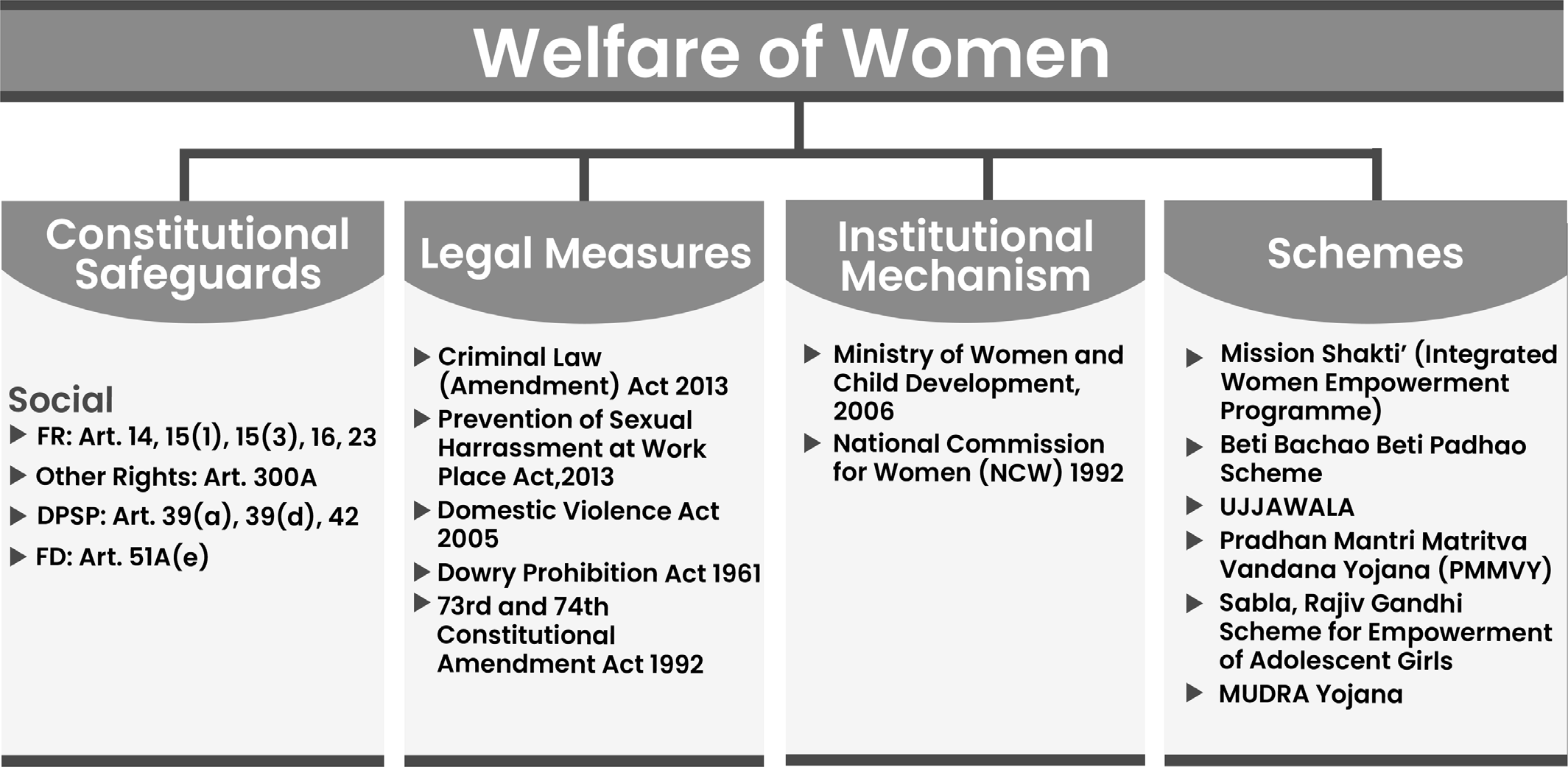
Figure: Welfare of Women
Constitutional and Legal Safeguards for Women Fundamental Rights under Part III
Article 14– Men and women to have equal rights and
opportunities in the political, economic and social spheres.
Article 15(1)– Prohibits discrimination against any citizen
on the grounds of religion, race, caste, sex etc.
Article 15(3)- Special provision enabling the State to make affirmative discriminations in favor of women.
Article 16– Equality of opportunities in matter of public
appointments for all citizens.
Article 23– Bans trafficking in human and forced labour
Rights outside Part III
Article 300 (A)-Right of property to women Directive Principles of State Policy under Part IV
Article 39(a)-The State shall direct its policy towards securing all citizens men and women, equally, the right to means of livelihood.
Article 39(d)- Equal pay for equal work for both men and women.
Article 42– The State to make provision for ensuring just
and humane conditions of work and maternity relief.
Fundamental Duty under Part IVA
Article 51 (A)(e)- To renounce the practices derogatory to the dignity of women
Legal Provisions
73rd and 74th Constitutional Amendment Act 1992- Reservation 1/3rd of seats in local bodies of panchayats and municipalities for women.
Sati (Prevention) Act 1987 – The practice of Sati which was first abolished in 1829, was revised and made illegal in 1887. It provided for a more effective prevention of the commission of sati and its glorification and for matters connected therewith.
Amendment to criminal Act 1983– This Act talks about domestic violence as an offence, rape is also made a punishable offence.
Prohibition of Child Marriage Act 2006- It has been amended to fix the minimum age of marriage at 21 yrs for males & 18 yrs for females.
Hindu Succession Act 1956– Equal share to daughter from property of father, while a widow has the right to inherit husband’s property. An amendment in this Act in 2005 enabled daughters to have equal share in ancestral properties.
Immoral Traffic Prevention Act (ITPA), 1986– Suppression of Immoral Trafficking in women and girls Act (SITA) 1956 was amended in 1986 & renamed The original SITA was enacted to prohibit and abolish trafficking in women and girls for immoral purposes. The amended Act extended its provisions to cover both sexes and introduced stricter penalties for offenses involving minors.
Dowry Prohibition Act 1961– Now court is empowered to act in his own knowledge or on a complaint by any recognized welfare organization on dowry Indian Evidence Act is also amended to shift the burden of
proof to husband & his family where bride dies within 7 yrs of marriage.
Maternity benefit Act 1961– An Act to regulate the employment of women for certain period before and after childbirth and to provide for maternity benefits like paid leaves for 6 months.
• Earlier a lot of women left out their job after giving birth to children, due to which lot of working women unemployed. The government has passed the Maternity Benefit (Amendment) Act 2017 increasing the maximum period of maternity leaves from 12 weeks to 26 weeks. The landmark law has given a new life to the vision of women- led development.
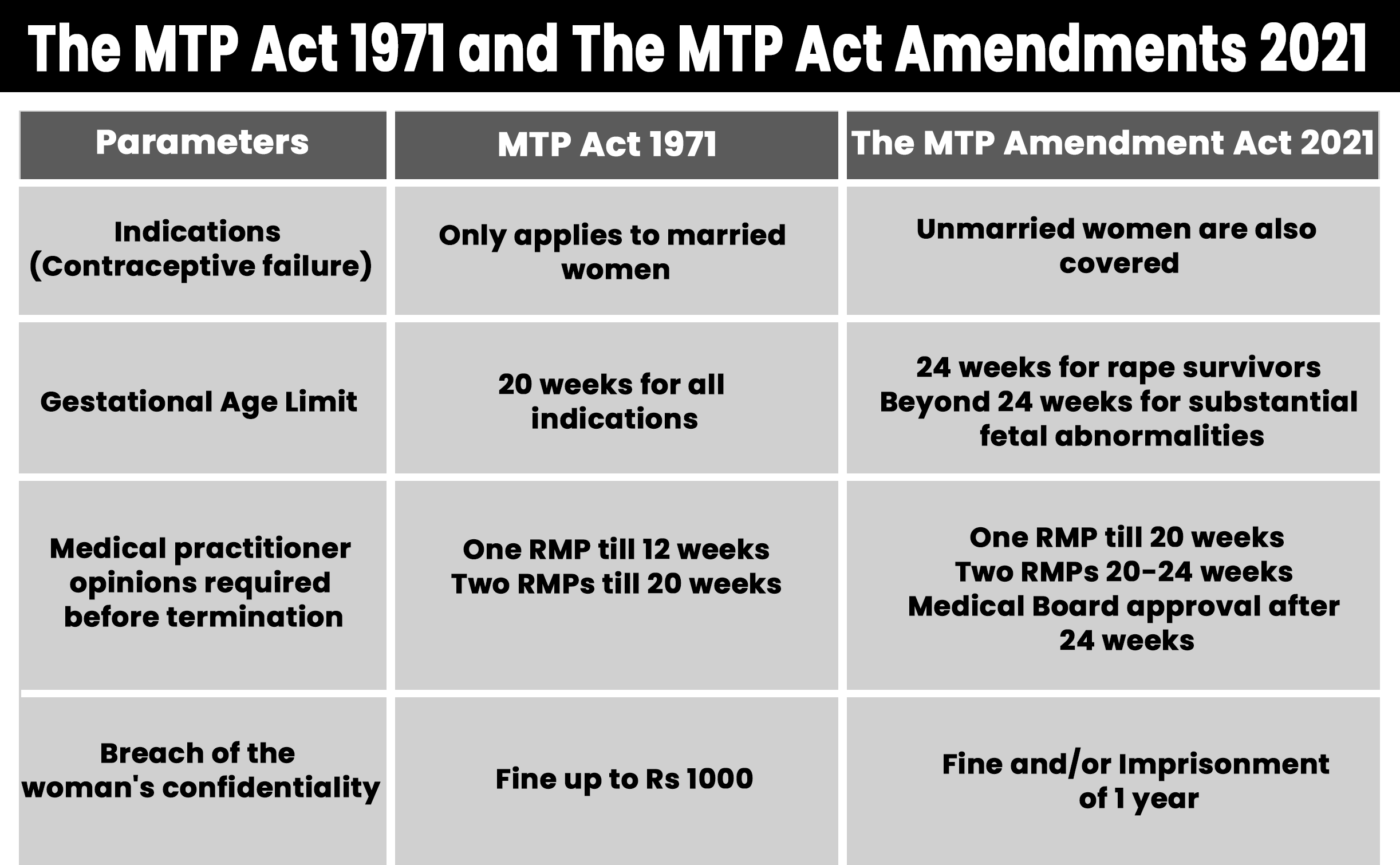
Medical Termination of Pregnancy Act 1971– Legalize abortion in case if foetus is suffering from physical or mental abnormality, in case of rape & unwanted pregnancy within 12 weeks of gestation period & after 12th week, before 20th week if the pregnancy is harmful for the mother or the child born would be severely deformed.
Indecent Representation of Women (Prohibition) Act, 1986– This Act prohibits the indecent portrayal of women in advertisements, publications, writings, paintings, images, or any other medium, along with related provisions.
Domestic Violence Act 2005- It seeks to determine domestic violence in all forms against women & make it a punishable offence.
Criminal Law (Amendment) Act 2013 – In the backdrop of December 16 gang rape, this Act was
passed amending the CrPC. The new law has provisions for increased sentence for rape convicts, including life- term and death sentence, besides providing for stringent punishment for offences such as acid attacks, stalking and through the revised Bill, the government has amended various sections of the Indian Penal Code, the Code of Criminal Procedure, the Indian Evidence Act and the Protection of Children from Sexual Offences Act.
Women's Reservation Act, 2023
The Constitution (106th Amendment) Act, 2023, reserves one-third of all seats for women in Lok Sabha, State legislative assemblies, and the Legislative Assembly of the National Capital Territory of Delhi, including those reserved for SCs and STs.
• The reservation will be effective after the publication of the census conducted following the Act’s commencement and endures for a 15-year period, with potential extension determined by parliamentary action.
• The rotation of seats allocated for women will be governed by parliamentary legislation after each delimitation process.
• Need: Currently, around 15% of the total members of the 17th Lok Sabha (2019-2024) are women while in state legislative assemblies, women on average constitute 9% of the total members.
Institutional Mechanism for Women
Ministry of Women and Child Development, 2006
It was converted from a department under the Ministry of Human Resources Development, into a full-fledged ministry. The Ministry was constituted with the prime intention of addressing gaps in State action for women and children for promoting inter-Ministerial and inter- sectoral convergence to create gender equitable and child- centered legislation, policies and programmes.
• Vision: Empowered women living with dignity and contributing as equal partners in development in an environment free from violence and discrimination.
• Mission: Promoting social and economic empowerment of women through cross-cutting policies and programmers, mainstreaming gender concerns, creating awareness about their rights and facilitating institutional and legislative support for enabling them realize their human rights and develop to their full potential.
National Commission for Women (NCW) 1992
NCW is a statutory body setup in 1992 under the National Commission for Women Act, 1990. It aims to strive towards enabling women to achieve equality and
equal participation in all spheres of life by securing her due rights and entitlements through suitable policy formulation, legislative measures, effective enforcement of laws, implementation of schemes/policies and devising strategies for solution of specific problems/situations arising out of discrimination and atrocities against women.
Key objectives include:
• review the Constitutional and Legal safeguards for women;
• recommend remedial legislative measures;
• facilitate redressal of grievances
• advise the Government on all policy matters affecting women.
WELFARE SCHEMES FOR WOMEN
• Beti Bachao Beti Padhao Scheme: (Ministry of Women and Child Development)
Scheme: Beti Bachao Beti Padhao (BBBP) Scheme was launched on 22nd January 2015 with an aim to address declining Child Sex Ratio (CSR) and related issues of empowerment of girls and women over a life cycle
continuum.
The objectives of the scheme are, to prevent gender biased sex selective elimination, to ensure survival and protection of the girl child and to ensure education and participation of the girl child.
Analysis: The Census (2011) data showed a significant declining trend in the Child Sex Ratio between 0-6 years with an all-time low of 918. The issue of decline in the CSR is a major indicator of women disempowerment as it reflects both, pre-birth discrimination manifested through gender biased sex selection, and post birth discrimination against girls (in form of their health, nutrition, educational needs).
Therefore, in order to make coordinated and convergent efforts to ensure survival, protection and empowerment of the girl child, government launched the Beti Bachao Beti Padhao (BBBP) scheme in January, 2015.
Since its inception, the BBBP scheme has been quite successful in dealing with gender-based discrimination against the girl child as the 161 districts that have been a part of the initial implementation of the BBBP scheme have witnessed an improving trend of Sex Ratio at Birth (SRB) in 104 districts.
• Ujjawala Scheme 2007: (Ministry of Women and Child Development)
Scheme: The Ujjawala is a “Comprehensive Scheme for Prevention of Trafficking for Rescue, Rehabilitation and
Re-Integration of Victims of Trafficking for Commercial Sexual Exploitation”.
It aims to prevent trafficking of women and children through social mobilization and involvement of local communities. To facilitate rescue of victims and to provide both long-term and immediate rehabilitation.
The scheme also has provision for shelter, food, clothing, medical treatment including counselling, legal aid and guidance and vocational training for the victims of trafficking.
Analysis: Trafficking of women and children for commercial sexual exploitation is an organized crime that violates basic human rights. India has emerged as a source, destination and transit for both in-country and cross border trafficking. Therefore, a multi sectoral approach is needed which will undertake preventive measures to arrest trafficking especially in vulnerable areas and sections of population.
Nevertheless, the repatriation of cross-border victims to their country of origin and reintegration of the victims into the family and society is still the challenging question for policy makers.
• Swadhar Greh Scheme: (Ministry of Women and Child Development)
Scheme: The Swadhar Greh Scheme is a programme for the victims of difficult circumstances in need of institutional support for rehabilitation so that they could lead their life with dignity. Under the Scheme, Swadhar Greh will be set up in every district with capacity of 30 women with the following objectives:
• To cater to the primary need of shelter, food, clothing, medical treatment and care of the women in distress.
• To enable them to regain their emotional strength.
• To provide them with legal aid and guidance.
• To rehabilitate them economically and emotionally.
• To enable them to start their life afresh with dignity and conviction.
Analysis: Since 2021, several women-centric schemes have been rationalised. The Swadhar Greh (SG) scheme is broader in scope as it includes victims of violence, abuse, harassment or driven by poverty and / or old age.
However, the budget allocation to the scheme in the last five years has seen a steady decline. In each of the financial years since 2016-17, the revised budget allocation under the scheme shows a downward trend, indicating less demand for fund or slash in budget due to low rates of fund utilisation.
•
Pradhan Mantri Matritva Vandana Yojana (PMMVY):
(Ministry of Women and Child Development)
Scheme: Launched in 2017, the Pradhan Mantri Matru Vandana Yojana (PMMVY) is a Centrally Sponsored Conditional Cash Transfer Scheme. The maternity benefit under PMMVY is available to all Pregnant Women & Lactating Mothers (PW&LM), excluding PW&LM who are in regular employment with the Central Government or the State Governments or Public Sector Undertakings (PSUs).
Under the scheme Rs.5,000/- are provided to the eligible beneficiary in three installments during pregnancy and lactation in response to individual fulfilling certain nutrition and health seeking conditions.
The eligible beneficiary also receives the remaining cash incentive as per approved norms towards maternity benefit under Janani Suraksha Yojana (JSY) after institutional delivery so that on an average, a woman gets Rs.6,000/-.
Analysis: A significant portion of rural Indian women suffer from undernourishment and anaemia. An undernourished mother almost gives birth to a low-birth- weight baby. This ultimately results in poor health of the infant and the mother too. Therefore, the Pradhan Mantri Matru Vandana Yojana is social welfare maternity benefit programme that aims to arrest the issue of malnutrition among the women.
• One Stop Centre Scheme: (Ministry of Women and Child Development)
Scheme: Launched in 2015, OSC is a sub-scheme of the National Mission for Empowerment of Women which also includes the Indira Gandhi Matritva Sahayog Yojana. The scheme is funded by the Nirbhaya fund.
The OSC scheme provide a range of integrated services under one roof including police facilitation, medical aid, legal aid and counselling, psycho-social counselling and temporary shelter to women affected by violence or in distress.
Analysis: As of 2022, 704 OSCs have been operationalised in 35 States/ UTs, which have assisted over 4.50 lakh women. The setting up of OSCs from the year 2015 onward, at district level, have provided a dedicated platform to women facing violence and who are in distress to get necessary help and assistance, which was not available earlier.
• Sabla, Rajiv Gandhi Scheme for Empowerment of Adolescent Girls
Scheme: The Government is implementing Rajiv Gandhi Scheme for Empowerment of Adolescent Girls (RGSEAG)
‘Sabla’, in 205 districts. The scheme Sabla aims at empowering Adolescent Girls (AGs) (11-18 years) through nutrition, health care and life skills education.
Scheme Sabla has two major components viz.
Nutrition: All out of school AGs in the age group of 11-14 years attending AWCs and all girls in the age group of 14-18 years are provided Supplementary Nutrition containing 600 calories, 18-20 grams of protein and micronutrients, per day for 300 days in a year.
Non-Nutrition: The non-nutrition component addresses the developmental needs of adolescent girls. Under this, the school adolescent girls of 11- 18 years are being provided IFA supplementation, health check-up & referral services, nutrition & health education, counselling on family welfare
Analysis: The scheme has a broader aim of mainstreaming out of school AGs into formal/non formal education. Nearly 100 lakh adolescent girls per annum are expected to be benefitted under the scheme.
• Kishori Shakti Yojna (KSY): (Ministry of Women and Child Development)
Scheme: Launched in 2007 in Odisha, the KSY seeks to improve the nutritional, health and development status of adolescent girls, promote awareness of health, hygiene, nutrition and family care.
The target group is girls of age 11-18 years. This scheme is a redesign of the already existing Adolescent Girls (AG) Scheme being implemented as a component under the centrally sponsored Integrated Child Development Services (ICDS) Scheme.
Analysis: The scheme is viewed as a holistic initiative for the development of adolescent girls. The programme through its interventions aims at bringing about a difference in the lives of the adolescent girls. It seeks to provide them with an opportunity to realize their full potential.
• MUDRA Yojana (Micro Units Development and
Refinance agency Ltd)
• It is one such scheme which was launched on 8 April 2015 in which loans upto Rs. 10 lakh are provided to women entrepreneurs, without any collateral.
• For instance, A woman namely Kamla, a daily wage labour from Panipat has taken a loan of Rs. 45,000 from State Bank of India in order to
start work of beauty parlour and she is engaged in gainful employment with dignity now.
• Mission Shakti’ (Integrated Women Empowerment Programme): (Ministry of Women and Child Development)
Scheme: Government launched ‘Mission Shakti’ for the safety, security and empowerment of women for implementation during the 15th Finance Commission period 202l-22 to 2025-26. The norms of ‘Mission Shakti’ will be applicable with effect from April 2022.
It aims at strengthening interventions for women safety, security and empowerment. It seeks to realise the Government’s commitment for "women-led development" by addressing issues affecting women and by making them equal partners in nation-building.
‘Mission Shakti’ has two sub-schemes - ‘Sambal’ and ‘Samarthya’.
• “Sambal” sub-scheme is for safety and security of women.
• “Samarthya” sub-scheme is for empowerment of women.
Analysis: Though most of these districts have ‘one-stop centres’, established under Mission Shakti, to receive victims, there is still a lack of clarity about how many of them actually employ protection officers to effectively help the traumatised survivors.
Recently the Supreme Court has sought more information from the government about Mission Shakti. According to the court there are 4.4 lakh cases of domestic assault that are pending across 801 districts.
• Nari Shakti Puruskar:
The Nari Shakti Puraskar is an annual award given by the ‘Ministry of Women and Child Development’ to individuals in recognition of their service towards the cause of women empowerment, especially vulnerable and marginalized women.
The award is given on international women’s day i.e., on 8th march. Nari Shakti Puraskar provides an opportunity to Young Indians to understand the contribution of women in building of society and the nation.
The maximum number of awards is 15. The Award in each category shall carry a certificate and a cash amount of rupees Two lakh per awardee.
Welfare of Children
Welfare of Children
Children have been considered as a vulnerable section of population across the world from a very early time. The Indian government has launched a number of schemes for children over the past few years to ensure their safety, development, security and enhance more opportunities in education, nutrition and freedom.
United Nations Convention on the Rights of the Child (UNCRC) 1989:
It was adopted in 1989 and enforced in 1990, is a multilateral legally-binding human rights treaty that sets the political, civil, economic, social, health and cultural rights of children. As of 27 April 2023, 196 countries are party to it, including every member of the United Nations except the United States.
Its four core principles include
non-discrimination
right to life, survival and development
best interests of the child
respect for the child’s views
It ensures that children develop to their full potential. The Convention recognizes the fundamental human dignity of all children and the urgency of ensuring their well-being and development.
The convention identifies a child as a human being below the age of 18 and every child is entitled to fundamental rights like:
Right to life, survival and development.
Right to education that facilitates them to reach their full potential.
Right to protection from abuse, violence or neglect.
Right to express opinions and be heard.
Right to be raised by or have a relationship with their parents.
Two optional protocols of UNCRC were adopted on 25 May 2000:
The First Optional Protocol restricts the involvement of children in military conflicts.
Second Optional Protocol prohibits the sale of children, child prostitution and child pornography.
Every child has basic rights, including the right to life, to their own name and identity, to be raised by their parents within a family or cultural grouping, and to have a relationship with both parents, even if they are separated.
The convention also obliges signatory states to separate legal representation for a child in any judicial dispute concerning their care and asks that the child’s viewpoint be heard in such cases.
The convention forbids capital punishment for children, but it makes no reference to corporal punishment. Also, Child marriage as slavery is not directly addressed by the convention.
United Nations Children’s Fund (UNICEF) was founded in 1946 is responsible for providing humanitarian and developmental aid to children worldwide. The Universal Declaration of Human Rights 1948 of United Nations mentions about mothers and children.
The International Labour Organization (ILO) adopts a convention that sets out 18 as the minimum age for people to undertake hazardous work.
The Declaration on the Protection of Women and Children in Emergency and Armed Conflict 1974, under the United Nations Economic and Social Council (UNECOSOC), on the grounds that women and children are often the victims of wars, civil unrest, and other emergency situations that cause them to suffer “inhuman acts and consequently suffer serious harm”.
National Policy for Children, 2013:
The Policy recognises every person below the age of eighteen years as a child and covers all children within the territory and jurisdiction of the country. It recognizes that a multisectoral and multidimensional approach is necessary to secure the rights of children.
As children’s needs are multi-sectoral, interconnected and require collective action, the Policy calls for purposeful convergence and coordination across different sectors and levels of governance.
The Policy has identified four key priority areas:
survival,
health and nutrition;
education and development;
protection and participation.
Constitutional and Legal Safeguards for Children Fundamental Rights under Part III
Article 14 – Right to Equality: State shall not deny to any person the equality before the law or the equal protection of laws within the territory of India.
Article 15 of the Indian Constitution prohibits discrimination.
In Article 15(3), nothing in Article15 shall prevent the State from making any special provision for women and children.
Article 21A –Right to Education: State shall provide free and compulsory education to all the children of the age of six to fourteen years in such manner as the State may by law, determine.
Article 24 –Prohibition of Employment of Children in Factories, no child below the age of fourteen shall be employed to work in any factory or mine or engaged in any other hazardous employment.
Directive Principles of State Policies under Part IV
Article 39(e) states that the health and strength of workers, men and women, and the tender age of children are not forced by economic necessity to enter avocation unsuited to their age or strength.
Article39 (1)(f) states that children are given opportunities and facilities to develop in a healthy manner and in conditions of freedom and dignity and that childhood and youth are protected against exploitation and against moral and material abandonment.
Article 45 State shall endeavour to provide early childhood care and education children below the age of six years.
Fundamental Duties under Part IVA
Article-51A(k) It shall be the duty of every citizen of India
who is a parent or guardian to provide opportunities to provide education for his child or, as the case may be, ward between the age of six and fourteen years.
Legal Provisions
The Constitution (Eighty-sixth Amendment) Act, 2002 inserted Article 21A in the Constitution to provide free and compulsory education of all the children in the age group six to fourteen years as a Fundamental Right.
Indian Penal Code 1860/ Bharatiya Nyaya Sanhita (BNS)
IPC Section 82 (BNS 20), nothing is an offence which is an offence done by a child under the age of seven years and Section 83 states that, nothing is an offence which is done by a child above seven years of age and under twelve.
IPC Section 305 (BNS 107) states the Abetment of Suicide if any person under the age of eighteen years of age commits suicide and whoever abets them to does such an act shall be punished under the punishments under the act.
IPC Section 315 (BNS 91) refers to Infanticide which comes in the category of crimes against children. It provides punishment for the act of killing an infant. Section 316 states Foeticide, whoever does the act of causing death of quick unborn child by act amounting to culpable homicide
IPC Section 317 (BNS 93) states the exposure and Abandonment of a child under twelve years, by parent or person having care of it. The exposure and abandonment by a father or mother of a child under the age of 12 will be punished for the same.
IPC Section 369 (BNS 97) states the punishment of kidnapping a child under the age of ten with an intention to steal from its person.
IPC Section 366A (BNS 96) states the punishment for the Procreation of minor girls (for inducement to force or seduce, to illicit intercourse). This section provides the action against the said crime to ensure the protection of the girl child in India.
IPC Section 372 (BNS 98) and IPC Section 373 (BNS 99) states the punishment for buying, selling or attain the possession of a person under the age of eighteen at any age employed or used for the purpose of prostitution or illicit intercourse with any person or for any unlawful purpose.
Prohibition Of Child Marriage Act 2006
The Government of India introduced the Prohibition of Child Marriage Act 2006 after the repeat of the Child Marriage Restraint Act. The main aim of this Act is to prevent child marriage. This Act ensures that child marriage is completely eradicated from society. A child according to
this Act is female who has not attained the age of eighteen and a male who has not attained the age of twenty-one.
Apprentices Act 1961
The main purpose of this Act was to prohibit the apprenticeship or training of children under the age of 14 years and for other minors there require a contract between the employer and the guardian. A person is qualified to be engaged in apprentice if he is not less than fourteen years and satisfies such standard of education and physical fitness.
Juvenile Justice Act 2015
This Law, brought in compliance of the Child Rights Convention repealed the earlier Juvenile Justice Act of 1986. This Act was further amended in 2006 and 2010. This Act was again repealed in 2015, This Act provides a special approach to the protection, treatment and development of children, this law mentions how a child should be protected in a home, without a home, begging etc…Under section 15 of this Act special provision had been made to tackle child offenders committing heinous offences under the age group of 16-18 years. The way in which a child should be protected from all the external threats.
The Child Labour (Prohibition and Regulation) Act 1986: This prohibits the engagement of children in certain employment which is hazardous to the child who can affect the child mentally and physically. It regulates the conditions of work of children in other employment.
The Orphanages and Other Charitable Homes (Supervision and Control) Act 1960: This Act provides the supervision and control over the orphanages, homes for the abandoned women.
The Guardian and Wards Act 1890
This Act deals with the qualification, appointment and removal of guardians of children by the courts and is applicable to all the children irrespective of religion. When it comes to divorce there exists confusion about with whom the child should go with. It is the wish of the child that the court consider first, there can be influences on the child due to the factor of their age and hence after the pleading by both the parties the court comes to a conclusion where the court ensures the protection of the child.
The Hindu Adoption and Maintenance Act 1956: This Act generally dealt with the provisions for a Hindu adult to adopt a child and the Hindu law of maintenance to wives, parents and children.
Probation of Offenders Act 1958: This law lays down the restrictions on the imprisonment of offenders fewer than
twenty-one years of age. This Act is in order to prevent the conversion of young offenders to obstinate criminals. Since there are chances for their transformation when they are subjected to jails along with criminals.
The Protection of Children from Sexual Offences (POCSO) Act 2012: The POCSO Act, 2012 is a legislation designed to protect children from sexual assault, sexual harassment, and pornography, while ensuring their interests are safeguarded throughout the judicial process through child- friendly procedures. The Act establishes Special Courts that conduct trials in-camera and protect the child's identity.
Institutional Mechanism for Children
Ministry of Women and Child Development, 2006
It was converted from a department under the Ministry of Human Resources Development, into a full-fledged ministry. The Ministry was constituted with the prime intention of addressing gaps in State action for women and children for promoting inter-Ministerial and inter- sectoral convergence to create gender equitable and child- centered legislation, policies and programmes.
Vision: Well nurtured children with full opportunities for growth and development in a safe and protective environment.
Mission: Ensuring development, care and protection of children through cross-cutting policies and programmer, spreading awareness about their rights and facilitating access to learning, nutrition, institutional and legislative support for enabling them to grow and develop to their full potential.
The National Commission for Protection of Child Rights (NCPCR) 2005
It was established by NCPCR Act, 2005. The Commission works under the aegis of Ministry of Women and Child Development, GoI. It emphasizes the principle of universality and inviolability of child rights and recognizes the tone of urgency in all the child related policies of the country. Thus, it prioritizes actions for the most vulnerable children like backward or on communities or children under certain circumstances, and so on. Also, every right the child enjoys is seen as mutually-reinforcing and interdependent without gradation. It aims “to ensure that all Laws, Policies, Programmes, and Administrative Mechanisms are in consonance with the Child Rights perspective as enshrined in the Constitution of India and the UN Convention on the Rights of the Child.” As defined by the commission, child includes person up to the age of 18 years.
Welfare Schemes for Children
Integrated Child Development Scheme
ICDS was launched by the Government of India in 1975 with the objective to improve the nutritional and health status of preschool children 0-6 years of age group with following services:
Objectives
• To improve the nutritional and Health status of pre-school children in the age- group of 0-6 years;
• To lay the foundation of proper psychological development of the child;
• To reduce the incidence of mortality, morbidity, malnutrition and school drop-out;
• To achieve effective coordination of policy and implementation amongst the various departments to promote child development; and
• To enhance the capability of the mother to look after the normal health and nutritional needs of the child through proper nutrition and health education.
Services
• Supplementary Nutrition.
• Health Check-up.
• Immunization.
• Referral Services.
• Early Childhood Care and Pre-school Education
• Nutrition and Health Education.
Improving Infant & Young Child feeding
Position of optimal infant and young child feeding practices is crucial for preventing malnutrition, infant mortality and for promoting integrated early child development for which the scheme for Improving Infant and Young Child Feeding has been sanctioned in the year 2005-06 by the State Govt.
Objectives
• To give training to grass root level ICDS functionaries on Infant and young child feeding practices.
• To generate awareness on Infant Young Child Feeding Practices.
Target Group: CDPOs, Supervisors, AWWs, SMS,SHGs and ASHA.
Apki Beti Hamari Beti
Aapki Beti Hamari Beti is a Haryana State Government Scheme in which a sum of Rs 21000 is invested with Life Insurance Corporation LIC in the name of 1st Girl child
of SC/BPL families and 2nd child of family belonging to any caste. On attaining 18 years of age, the girl child will be paid a tentative. With effect from 24.08.2015 third girl child born in families belonging to any caste were also covered.
Objectives
To bring about change in the societal attitude towards the birth of the girl child. To improve child sex ratio in the state. To improve enrolment and retention of girl children in schools and to assist the girls to undertake income generating activities. To raise the age at marriage of girls.
Integrated Child Protection Scheme (ICPS)
It is a centrally sponsored umbrella scheme under which various schemes for children in need of care and protection, and children in conflict with law are covered. The programme is being implementing through Haryana State Child Protection Society (HSCPS). The children in need of care and protection are being provided Institutional as well as Non-Institutional Care under the scheme. For providing non-Institutional Care State Adoption Resource Agency (CARA) has been set up at State level. At the district level the District Child Protection Unit (DCPU) and District Child Protection Committee under the chairmanship of Deputy Commissioner has been constituted. The Integrated Child Protection Scheme (ICPS) is mainly an instrument to implement the provisions of Juvenile Justice Act, 2000 which has been amended as Juvenile Justice Act, 2015 and came into force in 2016. The State has created a Juvenile Justice Fund for providing facilities to the juveniles. Child Welfare Committees (CWC) and Juvenile Justice Board (JBB) have been set up in all the district for the effective implementation of Juvenile Justice (Care & Protection of Children) Act 2015.
Objectives
ICPS brings together multiple existing child protection schemes of the Ministry under one comprehensive umbrella, and integrates additional interventions for protecting children and preventing harm. ICPS, therefore, would institutionalize essential services and strengthen structures, enhance capacities at all levels, create database and knowledge base for child protection services, strengthen child protection at family and community level, ensure appropriate inter-sectoral response at all levels.
Category of Children Covered
• Children in Conflict with Law: - means a child who is alleged to have committed an offence. Children in conflict with law who enter the juvenile justice system through Juvenile Justice Board (JJB), require residential care and protection during pendency of any inquiry
are facilitated Observation Homes as per section 47 of
Juvenile Justice (Care & Protection of Children) Act.
• Children in Need of Care and Protection: - For care, protection, treatment, development and rehabilitation of the children in need of care and protection, there are 78 Child Care Institutions in Haryana State run by Govt, Semi Govt. and Private Organizations
Non-institutional care services for children under Mission Vatsalya
The Mission Vatsalya of the Ministry of Women and Child Development supports children through following modes of Non-Institutional Care:
Sponsorship: financial support may be extended to vulnerable children living with extended families/ biological relatives for supporting their education, nutrition and health needs.
Foster Care: The responsibility of the child is undertaken by an unrelated family for care, protection and rehabilitation of the child. Financial support is provided to biologically unrelated Foster Parents for nurturing the child.
Adoption: finding families for the children found legally free for adoption. Specialized Adoption Agencies (SAA) will facilitate the adoption programme.
After Care: the children who are leaving a Child Care Institution on completion of 18 years of age may be provided with financial support to facilitate the child’s re-integration into mainstream of society. Such support may be given from the age of 18 years up to 21 years, extendable up to 23 years of age to help her/him become self-dependent.
Benefits: A monthly grant of Rs. 4000/- per child shall be provided for Sponsorship or Foster Care or After Care.
PM-CARES for Children’ scheme 2021
The PM CARES for Children Scheme was launched in 2021.
It aims to support children who have lost both the Parents or legal Guardian or Adoptive Parents or Surviving Parent to COVID-19 pandemic during the period starting from 11th March 2020 to 28th February, 2022. The objective of the Scheme is to ensure comprehensive care and protection of children in a sustained manner, and enable their well- being through health insurance, empower them through education and equip them for self-sufficient existence with financial support on reaching 23 years of age.
Eligibility: All children who have lost both parents or surviving parent or legal guardian/adoptive parents due to Covid 19 will be supported under ‘PM-CARES for Children’ scheme.
Benefits to children
• Fixed Deposit in the name of the child:
• PM CARES will contribute through a specially designed scheme to create a corpus of Rs 10 lakh for each child when he or she reaches 18 years of age. This corpus:
• Will be used to give a monthly financial support/ stipend from 18 years of age, for the next five years to take care of his or her personal requirements during the period of higher education and
• On reaching the age of 23 years, he or she will get the corpus amount as one lump-sum for personal and professional use.
School Education: For children under 10 years
• The child will be given admission in the nearest Kendriya Vidyalaya or in a private school as a day scholar.
• If the child is admitted in a private school, the fees as per the RTE norms will be given from the PM CARES.
• PM-CARES will also pay for expenditure on uniform, text books and notebooks.
School Education: for children between 11-18 years:
• The child will be given admission in any Central Government residential school such as Sainik School, Navodaya Vidyalaya etc.
• In case the child is to be continued under the care of Guardian/ grandparents/ extended family, then he or she will be given admission in the nearest Kendriya Vidyalaya or in a private school as a day scholar.
• If the child is admitted in a private school, the fees as per the RTE norms will be given from the PM CARES.
• PM CARES will also pay for expenditure on uniform, text books and notebooks.
Support for Higher Education:
• The child will be assisted in obtaining education loan for Professional courses / Higher Education in India as per the existing Education Loan norms. The interest on this loan will be paid by the PM CARES.
• As an alternative, scholarship equivalent to the tuition fees / course fees for undergraduate/ vocational courses as per Government norms will be provided to such children under Central or State Government Schemes. For children who are not eligible under the existing scholarship schemes, PM CARES will provide an equivalent scholarship.
Health Insurance
• All children will be enrolled as a beneficiary under Ayushman Bharat Scheme (PM-JAY) with a health insurance cover of Rs. 5 lakhs.
• The premium amount for these children till the age of 18 years will be paid by PM CARES.
Scholarship
• Total scholarship allowance will be Rs.20,000/- per child per annum to be released at the beginning of every academic year and will comprise of: (a) Monthly allowance of Rs. 1,000/-. (b) Annual academic allowance of Rs. 8,000/- to cover the cost of the books and uniform, shoes and other educational equipment.
Sukanya Samriddhi Scheme
It is a small deposit scheme for girl child, launched as a part of the ‘Beti Bachao Beti Padhao’ campaign, which would fetch an attractive interest rate and provide income tax rebate.
Eligibility: Parents or legal guardians can open deposits on behalf of a girl children (including adopted girl child) for up to 2 daughters aged below 10. Three girl children, in case of twin girls as second birth or the first birth itself results in three girl children.
Benefits: Interest rate on deposits 7.6 % w.e.f 1.1.2023 - 31.3.2023). Compounded annually with option for monthly interest pay-outs to be calculated on balance in completed thousands. As applicable under section 80C of the IT Act, 1961, the scheme has been extended Triple exempt benefits
i.e. there will be no tax on the amount invested, amount earned as interest and amount withdrawn.
• Only one account can be opened in the name of a girl child.
• Minimum of Rs 250 of initial deposit with multiple of Rs 150 thereafter with annual ceiling of Rs.150000 in a financial year.
• Maximum period upto which deposits can be made 15 years from the date of opening of the account. The account shall mature on completion of 21 years from the date of opening of account or on the marriage of Account holder whichever is earlier.
• Requirement of a birth certificate of the girl child
• Account can be opened in Post office and branches of authorised banks.
Welfare of Scheduled Caste
Welfare of Scheduled Caste (SC)
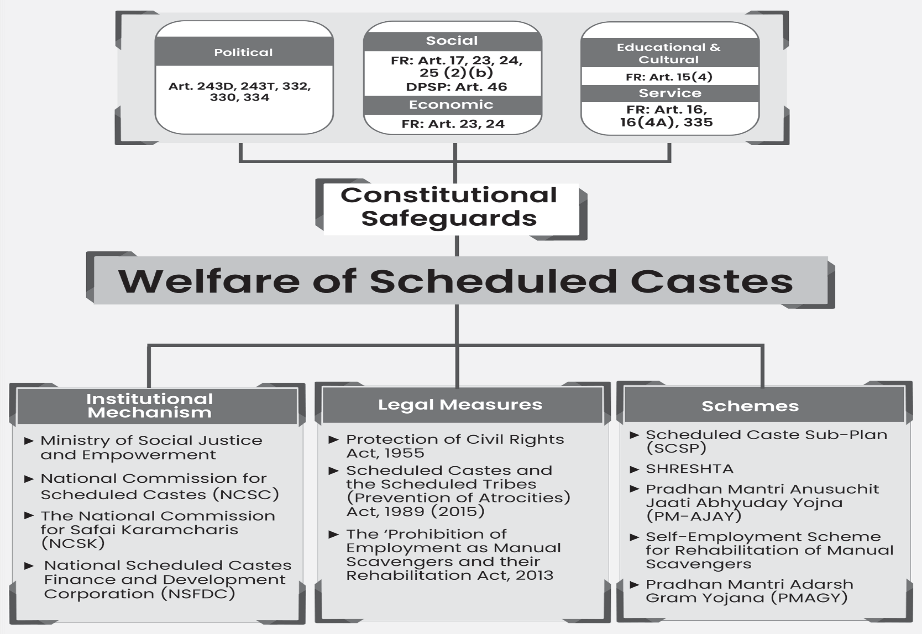
Figure: Welfare of Scheduled Castes
Welfare of Scheduled Caste (SC)
Scheduled Castes (SCs), who constitute 16.6% of our population as per 2011 Census, have historically suffered social and educational disabilities and economic deprivation arising therefrom.
SCs face the second highest incidence of multidimensional poverty, after the Scheduled Tribes (STs) in India. Around 33.3% of the 28.3 crore SC population is living in poverty (Global Multidimensional Poverty Index, 2021).
Successive National Family Health Survey (NFHS) data shows a higher prevalence of malnutrition among SC children. Similarly, these students have a higher dropout rate at the secondary level, and a lower Gross Enrolment Ratio at the post-secondary level as compared to the ‘all- students’ average.
Crimes against SCs increased by 6% from 2009 to 2018 with over 3.91 lakh atrocities being reported.
COVID-19 induced lockdown affected the marginalised communities much more severely than the ‘upper’ castes; the share of employment loss for SCs being three times (21 percentage points) higher than that of the upper castes (7 percentage points).
Accordingly, special provisions have been enshrined in the Constitution for advancement of their interests. These provisions range from measures to remove any kind of social disabilities imposed on them to ensure equality of opportunity in every sphere, so as to bring them at par with rest of the population.
Constitutional and Legal Safeguards for SCs
Social Safeguards
• Fundamental Rights under Part III
• Article 17 abolishes Untouchability and its practice in any form is forbidden.
• Article 23: - Prohibition of traffic in human beings and forced labour
• (1) Traffic in human beings and begar and other similar forms of forced labour are prohibited and any contravention of this provision shall be an offence punishable in accordance with law
• (2) Nothing in this article shall prevent the State from imposing compulsory service for public purpose, and in imposing such service the State shall not make any discrimination on grounds only of religion, race, caste or class or any of them
Article 24: - Prohibition of employment of children
in factories, etc No child below the age of fourteen years shall be employed to work in any factory or mine or engaged in any other hazardous employment provided that nothing in this sub- clause shall authorise the detention of any person beyond the maximum period prescribed by any law
Article 25(2)(b): empowers the States to make laws for social welfare and social reform. Social immoral activities can’t be practiced in the name of god or in the name of religion. Under this sub- clause, the State is empowered to throw upon all Hindu religious institutions of a public character to all classes and sections of Hindus.
• Directive Principles under Part IV
• Article 46: - The State shall promote, with special care, the educational and economic interests of the weaker sections of the people, and in particular, of the Scheduled Castes, and the Scheduled Tribes, and shall protect them from social injustice and all forms of exploitation.
Economic Safeguard
Article 23: - Prohibition of traffic in human beings and beggar and other similar form of forced labour;
Article 24: - Forbidding Child Labour.
Educational & Cultural Safeguards
• Article 15(4) special provisions for their advancement.
Political Safeguards
• Article 243D provides for reservation for Scheduled Castes and Scheduled Tribes in Panchayats in the same proportion as the population of Scheduled Castes or Scheduled Tribes in the village.
• Article 273T promises the same proportionate reservation of seats in Municipalities.
• Article 330 provide for reservation of seats in favour of the Scheduled Castes and the Scheduled Tribes in the House of Lok sabha.
• Article 332 provide for reservation of seats in favour of the Scheduled Castes and the Scheduled Tribes in the legislative assemblies of the States.
• Article 334
Service Safeguards
Article 16(4): Equality of opportunity in matters of public employment while still State can make reservation of appointments or posts in favour of any backward class of citizens which, in the opinion of the State, is not adequately represented in the services under the State
Article 16(4A): Provides that the State can make any provision for reservation in matters of promotion
in favour of the Scheduled Castes and Scheduled Tribes if they are not adequately represented in the services under the State.
Article 335: Claims of Scheduled Castes and Scheduled Tribes to services and posts
Legal Provisions
• Protection of Civil Rights Act, 1955 has been enacted, in order to prescribe punishment for the preaching and practice of “Untouchability” for the enforcement of any disability arising due to it.
• Scheduled Castes and the Scheduled Tribes (Prevention of Atrocities) Act, 1989 (Amended in 2015) has been enacted, in order to prevent the commission
of offences of atrocities against the members of the
Scheduled Castes and the Scheduled Tribes, to provide for Special Courts for the trial of such offences and for the relief and rehabilitation of the victims.
• The ‘Prohibition of Employment as Manual Scavengers and their Rehabilitation Act, 2013’ (MS Act, 2013): Eradication of dry latrines and manual scavenging and rehabilitation of manual scavengers in alternative occupation has been an area of high priority for the Government. Towards this end, a multi-pronged strategy was followed, consisting of the following legislative as well as programmatic interventions:
• Enactment of “Employment of Manual Scavengers and Construction of Dry Latrines (Prohibition) Act, 1993(1993 Act);”
• Integrated Low Cost Sanitation (ILCS) Scheme for conversion of dry latrines into sanitary latrines in urban areas; and
• Launching of National Scheme for Liberation and Rehabilitation of Scavengers (NSLRS).
• Self-Employment Scheme for Rehabilitation of Manual Scavengers.
Institutional Mechanism for SCs
Ministry of Social Justice and Empowerment: It is the nodal Ministry to oversee the interests of the Scheduled Castes. Though the primary responsibility for promotion of interests of the Scheduled Castes rests with all the Central Ministries in the area of their operations and the State Governments, the Ministry complements their efforts by way of interventions in critical sectors through specifically tailored schemes. The Scheduled Castes Development (SCD) Bureau of the Ministry aims to promote the welfare of Scheduled Castes through their educational, economic and social empowerment. Efforts
made by State Governments and Central Ministries for protecting and promoting the interests of Scheduled Castes are also monitored.
National Commission for Scheduled Castes (NCSC): As per Article 338 of the Constitution of India, the has been set-up to,
• inter-alia, investigate and monitor all matters relating to the safeguards provided for the Scheduled Castes and to evaluate the working of such safeguards; and to inquire into specific complaints with respect to the deprivation of rights and safeguards of the Scheduled Castes.
The National Commission for Safai Karamcharis (NCSK): It was constituted in 1994 as a statutory body by ‘National Commission for Safai Karamcharis Act, 1993’ but the Act lapsed in 2004 and Commission is acting as a Non-Statutory body of the Ministry of Social Justice and Empowerment.
National Scheduled Castes Finance and Development Corporation (NSFDC): Set up under the Ministry, to finance income generating activities of Scheduled Caste beneficiaries living below double the poverty line limits (presently Rs 98,000/- per annum for rural areas and Rs 1,20,000/- per annum for urban areas). NSFDC assists the target group by way of refinancing loans, skill training, Entrepreneurship Development Programmes and providing marketing support through State Channelizing Agencies, RRBs, Public Sector Bank and other Institutions.
National Safai Karamcharis Finance and Development Corporation (NSKFDC): It is another corporation under the Ministry which provides credit facilities to beneficiaries amongst Safai Karamcharis, manual scavengers and their dependants for income generating activities for socio-economic development through State channelizing agencies.
Welfare Schemes for Scheduled Castes (SC)
Both the central and state governments have taken a number of initiatives for development of SCs, which have yielded positive outcomes, and have also resulted in narrowing the gaps between Scheduled Castes and the rest of the population.
• Pradhan Mantri Adarsh Gram Yojana (PMAGY)
(Ministry of Social justice and empowerment)
Scheme: The Scheme of Pradhan Mantri Adarsh Gram Yojana (PMAGY), which is now being implemented as ‘Adarsh Gram’ component of the Scheme of Pradhan Mantri Anusuchit Jaati Abhyuday Yojana (PM-AJAY), has been designed with an area-based approach, wherein
villages having high density of Scheduled Castes (SCs) populations are taken up for holistic development.
In order to cater to more SC population, the selection criteria for villages have been recently revised in 2022-23 from ‘more than 50%’ SC population to ‘more than 40%’.
Analysis: Since majority of villages dominated by SC population are lagging behind on many parameters of development, the PMAGY has the potential to play an instrumental in development of such villages. After inception of the scheme till December 2021 (1252) villages have completed all the works identified under the Village Development Plan.
• Self-Employment Scheme for Rehabilitation of Manual Scavengers (Ministry of Social justice and empowerment)
Scheme: In accordance with the provisions of the provision of the “Prohibition of Employment as Manual Scavengers and their Rehabilitation Act, 2013, the Self Employment Scheme for Rehabilitation of Manual Scavengers was revised in 2013.
The objective of SRMS is to provide assistance to the identified manual scavengers and their dependants for their rehabilitation in alternative occupations. The main components of SRMS are:
• Onetime cash assistance of Rs.40000/- to identified manual scavenger.
• Credit linked back-end capital subsidy upto Rs. 3.25 lakh with provision of concessional loans for project of upto Rs. 15.00 lacs.
• Skill Development Training upto two years with stipend of Rs.3000/- per month.
• Coverage of Manual Scavengers for Health Insurance under Ayushman Bharat Yojana.
• Behavioural training, health camps etc.
Analysis: Manual scavenging is a “dehumanizing practice” which has carried on in the country with a background of historical injustice and indignity suffered by the manual scavengers. While over 90 percent of the Manual scavengers belongs to Scheduled caste, few also belongs to Scheduled tribe and OBC community.
Identification of manual scavengers is done by the concerned State Governments through survey by the Urban Local Bodies/Gram Panchayats. Although a fresh survey of manual scavengers was started in 2018,
thousands of such people are still not covered under the programme.
• Pradhan Mantri Anusuchit Jaati Abhyuday Yojna (PM-AJAY): (Ministry of Social justice and empowerment)
Scheme: Since the objectives as well as interventions of the Scheduled Caste Sub Plan (SCSP), The Babu Jagjivan Ram Chhatrawas Yojana and the Pradhan Mantri Adarsh Gram Yojana (PMAGY) were similar, all the existing three schemes were merged into one scheme, namely Pradhan Mantri Anusuchit Jaati Abhyuday Yojana (PM-AJAY), from 2021-22 for better convergence of public money and optimal utilization of resources.
The PM-AJAY scheme has following objectives:
• Reduce poverty of the SC communities by generation of additional employment opportunities.
• Improve socio-economic developmental indicators by ensuring adequate infrastructure.
• Increase literacy and encourage enrolment of SCs in schools and higher educational institutions.
Analysis: Although the scheme sounds to be promising for the SC community, the implementation of the components of the PM-AJAY scheme have remained below satisfactory. Against the target of constructing one hostel in every Block headquarters of low literacy districts, only around 800 hostels have been constructed so far.
Recently a parliamentary committee flayed the Union government over 46 years of missing data for the Central scheme to construct hostels for Scheduled Caste boys and girls across the country. While on the other hand the Ministry of Social Justice and Empowerment had cited the lack of proposals for hostels from State and Union Territory governments.
• National Overseas Scholarship for SC candidates.
(Ministry of Social justice and empowerment)
Scheme: The National Overseas Scholarship is to facilitate the low-income students belonging to the Scheduled Castes, Denotified Nomadic and Semi-Nomadic Tribes, Landless Agricultural Labourers and Traditional Artisans category to obtain higher education abroad thereby improving their Economic and Social status.
The Scheme provides financial assistance to the selected candidates for pursuing Masters level courses and Ph.D. courses abroad in the Institutions/Universities accredited by the Government/an authorized body of that country in any fields of study.
For 2022-23, out of 125, 115 Awards were given to the Scheduled Castes candidates. 30% of the awards are earmarked for women candidates.
The age of candidate should not be more than 35 years, as on first day of April of the selection year. Total family income from all sources shall not exceed Rs. 8.00 lakh per annum in the preceding financial year.
• SHRESHTA
Scheme: The SHRESHTA- “Scheme for residential education for students in High school in Targeted Areas” was launched in 2022. The Scheme aims to uplift the socio-economic status of the Scheduled Castes by providing high quality education to their children in best private residential schools in the country. Admission will be provided in Class 9 and Class 11 of CBSE affiliated private schools.
The scheme has been formulated with the objective to provide quality education and opportunities for even the poorest Scheduled Caste students, as per the Constitutional mandate.
Analysis: The students from the Scheduled Caste communities, for long been subjects to inequality, were kept out of quality education and a situation that perpetuates the disadvantages carried forward for generations of lack of adequate education.
The Governmental efforts to spread educational facilities without discrimination have worked well in achieving near universal access. However, the objective of providing access to quality education that provides a level playing field is still far from reality.
• Scheduled Caste Sub-Plan (SCSP)
Under the Scheduled Castes Development Bureau, the Ministry implements Schedules Caste Sub-Plan (SCSP) which is an umbrella strategy to ensure flow of targeted financial and physical benefits from all the general sectors of development for the benefit of Scheduled Castes.
• Objective: The main objective is to give a thrust to family oriented schemes of economic development of SCs below the poverty line, by providing resources for filling the critical gaps and for providing missing vital inputs so that the schemes can be more meaningful.
• Since the Schemes/programmes for SCs may be depending upon the local occupational pattern and the economic activities available, in choice of schemes to be implemented out of Special Central Assistance, within the overall frame work of the scheme.
Special Central Assistance: Special Central Assistance (SCA) to Scheduled Castes Sub Plan (SCSP) is a central scheme under which 100% grant is given to the States/ UTs as an additive to their Scheduled Castes Sub Plan (SCSP).
Critical Review of Scheduled Caste Sub-Plan
Despite the implementation of the Special Component Plan (SCP) since the 1970s, which has provided both physical and financial benefits, Scheduled Castes (SCs) continue to face marginalization across social, educational and economic dimensions.
Key issues include:
• The SCSP has primarily focused on supporting the survival of SCs, rather than fostering equity and ensuring sustainable economic empowerment.
• Previous efforts have been hindered by a lack of structural and economic support, as well as persistent challenges identified in the Sixth Five Year Plan, many of which continue to affect the SC community These challenges are :-
• poor design and planning,
• low allocation (many states/Union territories quantifying funds under SCSP only from the divisible sectors/programmes),
• notional funding,
• diversion of the fund,
• non-uniformity across states,
• presentation of the budget and
• lack of social group wise beneficiary data.
• As the needs of the SC community were considered homogeneous without taking into account the regional, local, and community-wise variance, the fund did not reach the target population to bring about desired outcomes.
• For instance, plan outlays from schemes did not reach the SC habitations outside villages and towns, and priority sectors schemes like education, health, vocational training for SCs, etc., were not planned as per needs.
• Additionally, development schemes relating to roads, major irrigation projects, mega power and electricity projects did not offer any direct and immediate benefits to SCs.
• Further, SCSP funds were diverted to the other general sectors despite creating dedicated budget heads and sub-heads.
• As per the National Commission for Scheduled
Castes (NCSC) Report 2016, many states used this fund meant for the most deprived sections of the society for other purposes.
• More recently, the Bihar government, in 2018- 19, diverted more than Rs 8,800 crore meant for SC/ST scholarships to projects related to roads, embankments, medical colleges and government buildings.
Steps Taken So Far
• New guidelines for SCSP issued by NITI Aayog in 2017, whereby SCSP was rechristened as ‘Development Action Plan for SCs’ (DAPSC) in 2017, focused on specific schemes to ensure relevant budgeting and non-diversion of funds.
• It also suggested outcome-based monitoring creation of a Head “Non-lapsable Central Pool of SCSP Funds (NLCPSF)”, in the Public Account similar to that created for North East Region to ensure non-lapsability of the fund.
• The fund is to be used for implementing schemes for SCs development and for providing incentives to state governments for effective implementation of SCSP. However, a quick analysis of the situation after the 2017-18 fiscal shows that this might not be the case.
• Although the number of ministries allocating funds towards SCSP has increased and their total allocation has almost doubled since 2021-
22 in absolute numbers, the percentage of DAPSC allocation out of total scheme allocation declined significantly since 2021-22.
• Also, the share of DAPSC allocation in the total scheme budget is less than the proportion of the SC population in the total population in 2021- 22 and 2022-23. Therefore, even with the rise in SCSP allocation in absolute terms, the allocation itself has been consistently lower than the prescribed 16.2% allocation by the NITI Aayog guidelines.
• Further, the allocation towards DAPSC continues to be notional, even after the new guidelines that call for allocation to be made scheme-wise. Over-allocation in general schemes tends to be notional as these schemes
Welfare of Scheduled Tribe
Welfare of Scheduled Tribe (ST)
The tribal population in India, though a numerically small minority (8.6 percent), represents an enormous diversity of groups. In the post-Independence period, sincere efforts were made for the economic and educational development of tribes.
However, the performance of the tribes in socio economic parameters is much lower than the Scheduled Castes and non-scheduled tribal population.
The Criterion followed for specification of a community, as scheduled tribes are:
• Indications of primitive traits,
• Distinctive culture,
• Geographical isolation,
• Shyness of contact with the community at large, and
• Backwardness.
This criterion is not spelt out in the Constitution but has
become well established. It subsumes the definitions contained in 1931Census, the reports of first Backward Classes Commission 1955, the Advisory Committee (Kalelkar), on Revision of SC/ST lists (Lokur Committee), 1965 and the Joint Committee of Parliament on the Scheduled Castes and Scheduled Tribes orders
(Amendment) Bill 1967 (Chanda Committee), 1969.
Certain tribes have been characterised as Particularly Vulnerable Tribal Groups (PVTGs) (earlier known as Primitive Tribal Groups) on the basis of their greater ‘vulnerability’ even among the tribal groups. In 1973, the Dhebar Commission created Primitive Tribal Groups (PTGs) as a separate category, who are less developed among the tribal groups. There are 75 such tribes in India, who are characterised by
Pre-agriculture level of technology
Stagnant or declining population
Extremely low literacy
Subsistence level of economy
They had been subjected to various forms of deprivation such as alienation from land and other resources. Tribal women, in particular, had also been facing deprivation of various basic amenities like- health issues, water availability, primary education, etc.
Key Issues faced by Scheduled Tribes in India include
• Loss of Control over Natural Resources: Issue of loss of ownership rights over land, owing to chronic indebtedness, unscrupulous landlords, moneylenders, contractors and officials. With the concepts of protected forests and national forests gaining currency, the tribals felt themselves uprooted from their cultural moorings and with no secure means of livelihood.
• Lack of Education: According to the Periodic Labour Force Survey (PLFS) report 2017-18 published by Ministry of Statistics and Programme Implementation, literacy rate for STs is 67.7%, thus nearly 33 per cent of the tribals are illiterates. Illiteracy factors include tribal superstitions and prejudices, extreme poverty, nomadic lifestyle of certain tribes, lack of interest in alien subjects taught through an alien language and a lack of suitable teachers and other facilities in the tribal areas.
• Displacement and Rehabilitation: After independence, the focus of the development process was on heavy industries and the core sector. As a result, huge steel plants, mining and power projects and large dams came up—most of them in the tribal inhabited areas. Acquisition of tribal land by the government led to large scale displacement of the tribal population. The tribal pockets of Chhotanagpur region, Orissa, West Bengal and
Madhya Pradesh suffered the most. This has caused various movements like Narmada Bachao Andolan, movement by Thakkar Bappa, movement against
Vedanta by Odisha’s Dongria Kondh tribe.
The cash compensation provided by the government was frittered away on wasteful expenditure.
No settlements were provided for the displaced tribals within the industrial areas, who were forced to live in peripheries in slums or to migrate to adjoining states to work as unskilled workers in conditions of poverty.
The migration of these tribals to the urban areas causes psychological problems for them as they are not able to adjust well to the urban lifestyle and values.
Problems of Health and Nutrition: Because of economic backwardness and insecure livelihood, the tribals face health problems, such as prevalence of disease, like malaria, cholera, tuberculosis, diarrhoea and jaundice, problems associated with malnutrition like iron deficiency and anaemia, high infant mortality rates, low levels of life expectancy, etc. According to Tribal Health Report 2013 of the Ministry of Health and Family Welfare showed:
The estimated infant mortality rate (IMR) among tribal people is somewhere between 44 to 74 per 1,000 live births. The under-five mortality rate has reduced by nearly 60 per cent, but the gap with favourable social groups has widened, it said.
According to the National Family Health Survey conducted in 2014, the tribal infant mortality rate was 38 per cent, more than “others” (other than ST, Schedule Castes and Other Backward Classes), it said.
Malnutrition -- stunting among children and low body mass index among adults -- in tribal people is “unacceptably high”. The intake of various nutrients such as proteins, calories, and vitamins has decreased in tribals in the last decade, according to the expert committee.
The panel said alarmingly, almost 50 per cent tribal girls aged 15 to 19 years are underweight or have a body mass index of less than 18.5.
NFHS data showed the 65 per cent of tribal women in the age group of 15-49 years suffer from anaemia.
Gender Issues: The opening of the tribal belts to mining, industries and commercialisation has exposed tribal men and women to the ruthless operations of the market economy, giving rise to consumerism and to commoditisation of women.
Erosion of Identity: Increasingly, the traditional institutions and laws of tribals are coming into conflict with modern institutions which create apprehensions among the tribals about preserving their identity. Extinction of tribal dialects and languages is another cause of concern as it indicates an erosion of tribal identity in certain areas. This has led to rise of various movements like Pathalgadi Movement in Jharkhand
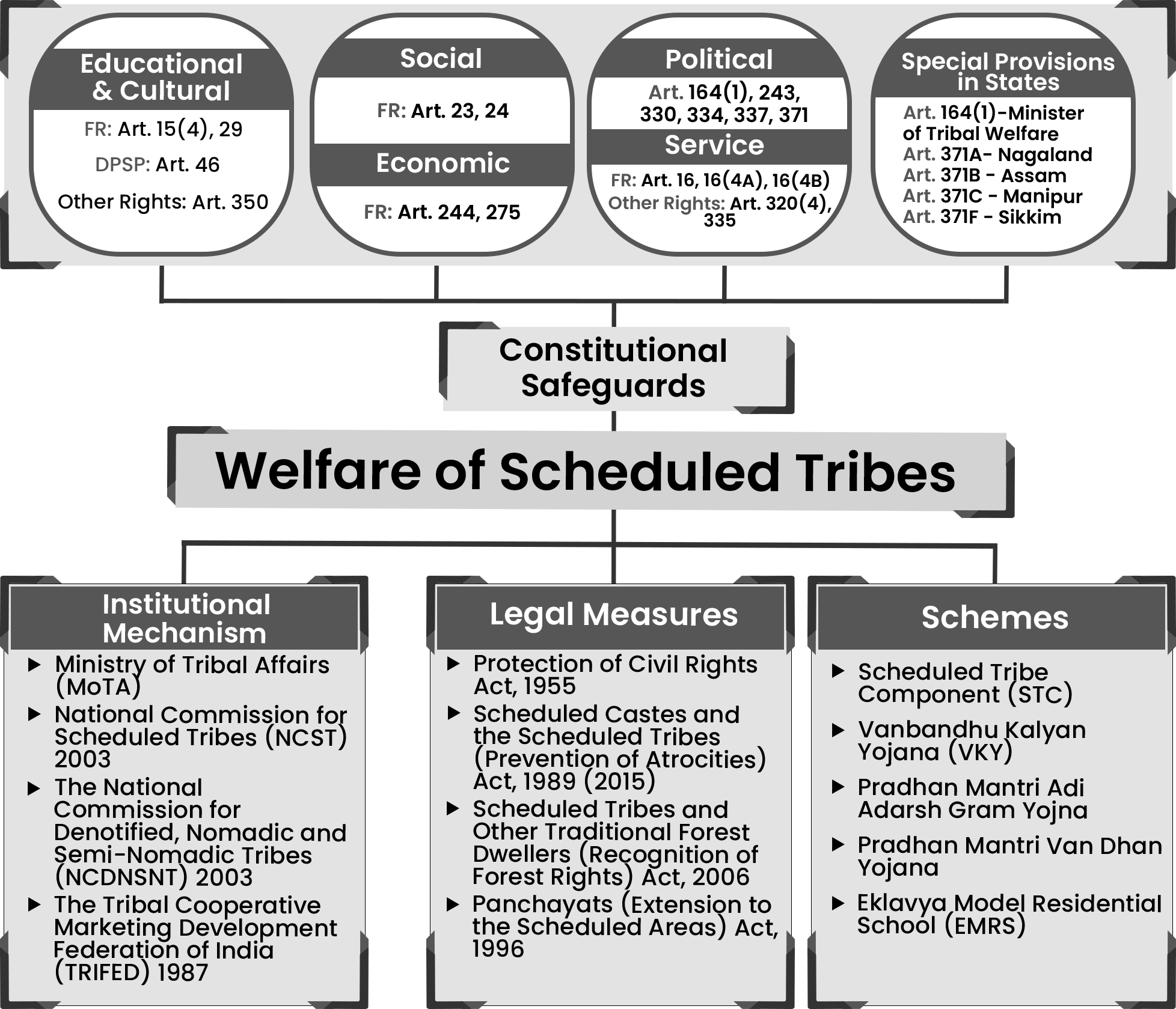
Figure: Welfare of Scheduled Tribes
Since the beginning of the Planning process, efforts have been made to ensure that the tribal people were included in the growth process.
Major population of the tribes is found in Chhattisgarh, Orissa, Jharkhand, Madhya Pradesh, North Eastern states and the Andaman and Nicobar Islands.
Constitutional and Legal Safeguards for STs
Educational & Cultural Safeguards
Article 15(4): - Special provisions for advancement of other backward classes (which includes STs);
Article 29: Provides protection to the interests of minorities by ensuring that any group of citizens with a distinct language, script, or culture can preserve and promote their unique heritage.
Article 46: - The State shall promote, with special care, the educational and economic interests of the weaker sections of the people, and in particular, of the Scheduled Castes, and the Scheduled Tribes, and shall protect them from
social injustice and all forms of exploitation.
Article 350: - (Right to Use Any Language) Article 350 ensures that every person has the right to submit representations for the redress of grievances to any Union or State authority in any of the languages used in the Union or the respective State.
Inclusivity: This provision promotes linguistic inclusivity by allowing individuals to communicate in their preferred language when seeking redressal from government authorities.
Aricle 350 A: - It shall be the endeavour of every State and of every local authority within the State to provide adequate facilities for instruction in the mother-tongue at the primary stage of education to children belonging to linguistic minority groups
Social Safeguard
Article 23: - Prohibition of traffic in human beings and beggar and other similar form of forced labour;
Article 24: - Forbidding Child Labour.
Economic Safeguards
Article 244: - Clause (1) Provisions of Fifth Schedule shall apply to the administration & control of the Scheduled Areas and Scheduled Tribes in any State other than the states of Assam, Meghalaya, Mizoram and Tripura which are covered under Sixth Schedule, under Clause (2) of this Article.
Article 275: - Grants in-Aid to specified States (STs&SAs) covered under Fifth and Sixth Schedules of the Constitution.
Political Safeguards
Article 164(1): - Provides for Tribal Affairs Ministers in Bihar, MP and Orissa;
Article 330 mandates the reservation of seats in the House of the People (Lok Sabha) for Scheduled Castes (SCs) and Scheduled Tribes (STs), including specific provisions for the Scheduled Tribes in the autonomous districts of Assam.
Article 334: - The reservation of seats for the Scheduled Castes and the Scheduled Tribes in the House of the People and in the Legislative
Article 243: - Reservation of seats in Panchayats.
Article 371: - Special provisions in respect of NE States and Sikkim
Service Safeguards
• Article 16(4): Equality of opportunity in matters of public employment while still State can make reservation of appointments or posts in favour of any backward class of citizens which, in the opinion of the State, is not adequately represented in the services under the State
• Article 16(4A): Provides that the State can make any provision for reservation in matters of promotion in favour of the Scheduled Castes and Scheduled Tribes if they are not adequately represented in the services under the State.
• Article 16(4B): Added by the 81st Constitutional Amendment Act, 2000 which enabled the unfilled SC/ST quota of a particular year to be carried forward to the next year.
• Article 335: Claims of Scheduled Castes and Scheduled Tribes to services and posts
• Article 320(4): (4) Nothing in clause ( 3 ) shall require a Public Service Commission to be consulted as respects Article 16(4) respects the manner in which effect may be given to the provisions of Article 335.
Other provisions applicable in specific states
• Article 164(1) provides that in the States of
Chhattisgarh, Jharkhand, Madhya Pradesh and Odisha there shall be a Minister in charge of tribal welfare who may in addition be in charge of the welfare of the Scheduled Castes and backward classes or any other work.
• Article 371A has special provisions with respect to the State of Nagaland.
• Article 371B has special provisions with respect to the State of Assam.
• Article 371C has special provisions with respect to the State of Manipur.
• Article 371F has special provisions with respect to Sikkim.
Legal Provisions
Besides, several legislations are in place to prevent discrimination against people belonging to Scheduled Tribes and to protect their rights. These, inter-alia, are:
• Protection of Civil Rights Act, 1955 has been enacted, in order to prescribe punishment for the preaching and practice of “Untouchability” for the enforcement of any disability arising due to it.
• Scheduled Castes and the Scheduled Tribes (Prevention of Atrocities) Act, 1989 (Amended in 2015) has been enacted, in order to prevent the commission
of offences of atrocities against the members of the
Scheduled Castes and the Scheduled Tribes, to provide for Special Courts for the trial of such offences and for the relief and rehabilitation of the victims.
• Panchayats (Extension to the Scheduled Areas) Act, 1996 has been enacted, in order to provide for the extension of the provisions of Part IX of the Constitution relating to the Panchayats to the Scheduled Areas.
• Scheduled Tribes and Other Traditional Forest Dwellers (Recognition of Forest Rights) Act, 2006 has been enacted, to recognize, record and vest the forest rights and occupation in forest land in forest dwelling scheduled tribes and other traditional forest dwellers who have been residing in such forests
for generations.
Institutional Mechanism for STs
Ministry of Tribal Affairs (MoTA):
It was set up in 1999 after the bifurcation of Ministry of Social Justice and Empowerment with the objective of providing more focused approach on the integrated socio- economic development of the Scheduled Tribes (STs).
The welfare schemes comprising economic, educational and social development through institution building. The Ministry also supplements the efforts of other Ministries by way of various developmental interventions in critical sectors through specially tailored schemes.
National Commission for Scheduled Tribes (NCST) 2003 It was established by amending Article 338 and inserting a new Article 338A in the Constitution through the Constitution (89th Amendment) Act, 2003.
By this amendment, w.e.f. 19 February, 2004, the erstwhile National Commission for Scheduled Castes and Scheduled Tribes was replaced by two separate Commissions namely-
National Commission for Scheduled Castes (NCSC), and
National Commission for Scheduled Tribes (NCST).
• To investigate, monitor and evaluate all matters relating to the safeguards provided for the Scheduled Tribes
• To inquire into specific complaints with respect to the deprivation of rights and safeguards of the Scheduled Tribes;
• To participate and advise in the planning process of socio-economic development of the Scheduled Tribes and to evaluate the progress of their development under the Union and any State;
• To make in such reports, recommendations as to the measures that should be taken by the Union or any State for effective implementation of those safeguards and other measures for the protection, welfare and socio- economic development of the Scheduled Tribes, and
The National Commission for Denotified, Nomadic and Semi-Nomadic Tribes (NCDNSNT) 2003
It is a national commission set under the Ministry of Social Justice and Empowerment, to study various developmental aspects of denotified and nomadic or semi-nomadic tribes in India.
The commission had following terms of reference:
• To specify the economic interventions required for raising the living standards of Denotified, Nomadic and Semi Nomadic Tribes by asset creation and self-employment opportunities;
• To recommend measures to utilize the existing channeling agencies set up for the economic development of SC/STs and OBCs for extending an economic development package to these groups, keeping in view their specific requirements; and
• To identify programmes required for their education, development and health;
• To make any other connected or incidental recommendation, that the Commission deems necessary.
The Tribal Cooperative Marketing Development Federation of India (TRIFED) 1987:
Under the Ministry of Tribal Affairs, TRIFED was
established in August 1987 under the Multi-State Cooperative Societies Act, 1984 as a National level Cooperative body with the basic mandate of bringing about socio-economic development of tribals of the country by institutionalizing the trade of Minor Forest Produce (MFP) & Surplus Agricultural Produce (SAP) collected/ cultivated by them.
As a market developer and service provider, capacity building of the tribal people through sensitization, formation of Self Help Groups (SHGs) and imparting training to them for undertaking a particular activity, exploring marketing possibilities in national as well as international markets, creating opportunities for marketing tribal products on a sustainable basis and creating a brand.
It is engaged in marketing development of tribal products including art and craft items. TRIFED has been marketing tribal products through its own shops called “TRIBES India” and through the outlets of the state emporia on consignment basis.
National Scheduled Tribes Finance and Development Corporation (NSTFDC) 2001
Under the Ministry of Tribal Affairs, it is a corporation is managed by a Board of Directors with representatives from Central Government, State Channelizing Agencies (SCA), National Bank for Agricultural and Rural Development (NABARD), Industrial Development Bank of India (IDBI), Tribal Cooperative Marketing Development Federation of India Ltd. (TRIFED) and three eminent persons representing Scheduled Tribes.
The main objectives of the Corporation are :-
• Socio-economic and educational upliftment of Scheduled Tribes (STs),
• Provide better self-employment avenues
• Ensure economically independent and self-reliant community
It provides consessional financial assistance and soft loans to the poor STs. For helping tribal students to pursue higher education, loans are offered which are subsidized by the Ministry of Human Resources Development (now - Ministry of Education).
Also, it provides grants for conducting training and skill development programs for tribal youth so that they can enhance their employability /productivity or can take-up entrepreneurial activity.
Welfare Schemes for STs
Pradhan Mantri Van Dhan Yojana (Ministry of Tribal Affairs)
Scheme: Launched in 2018, it aims to enhance the income
of tribals involved in the collection of Minor Food Produces (MFPs).
Under this scheme, the Van Dhan Vikas Kendras are constituted that provides skill up-gradation and capacity building training and setting up of primary processing and value addition facilities. TRIFED, the nodal agency for the scheme has set up target of sale of Van Dhan products to Rs. 10000 crores by 2023.
Analysis: The scheme is basically a Market Linked Tribal Entrepreneurship Development Program for forming clusters of tribal SHGs and strengthening them into Tribal Producer Companies. After the launch of the scheme various tribal products are getting good response in the ‘Aadi Mahotsav’ organised by TRIFED.
Pradhan Mantri Adi Adarsh Gram Yojna: (Ministry of Tribal Affairs)
Scheme: Pradhan Mantri Adi Adarsh Gram Yojna (PMAAGY)’, aims at transforming villages with significant tribal population into model village (Adarsh Gram) covering about population of 4.22 crore (About 40% of the total Tribal Population).
It is envisaged to cover 36,428 villages having at least 50% tribal population and 500 STs across States / UTs with notified STs. It would be implemented during 2021-22 to 2025-26.
The main objective of this scheme is to achieve integrated socio-economic development of selected villages through convergence approach. It includes preparing Village Development Plan based on the needs, potential, and aspirations.
The scheme envisions to mitigate gaps prominently in 8 sectors of development viz. Road connectivity (Internal and Intervillage /block), Telecom connectivity (Mobile /internet), School, Anganwadi Centres, Health Sub-Centre, Drinking water facility, Drainage and solid waste management.
Vanbandhu Kalyan Yojana (VKY) (Ministry of Tribal Affairs)
Scheme: The VKY aims at overall development of tribal people with an outcome-based approach, which would ensure that all the intended benefits to the tribal people through various programmes/schemes actually reach them by way of appropriate convergence.
Through VKY, it is envisaged to develop the backward blocks in the Schedule V States as Model Blocks while ensuring:
• Qualitative and sustainable employment.
• Accelerated economic development of tribal areas.
• Health and housing for all
• Safe drinking water at doorstep and irrigation facilities.
• Universal availability of electricity.
•
Promotion and conservation of Tribal Cultural Heritage
• Promotion of Sports in Tribal Areas.
12 Minor Forest Produce (MFP) products have been included in the programme i.e., Tendu Leave, Bamboo, Mahuwa Seeds, Sal Leaf, Sal Seed, Lac, Chironjee, Wild Honey, Myrobalan, Tamarind, Gums (Gum Karaya) and Karanji.
Analysis: The Vanbandhu Kalyan Yojana (VKY), basically aims to improve the infrastructure and human development indices of the tribal population. Through this scheme government is trying to converge different Central and State schemes of development. The tribal ministry is taking the adequate steps to strengthen the existing institutions for delivery of services to tribal people.
Eklavya Model Residential School (EMRS) (Ministry of Tribal Affairs)
Scheme: EMRS started in the year 1997-98 to impart quality education to ST children in remote areas in order to enable them to avail of opportunities in higher education. The schools focus not only on academic education but on the all-round development of the students.
Each school has a capacity of 480 students, catering to students from Class VI to XII. Earlier, grants were given for construction of schools and recurring expenses to the State Governments under Grants under Article 275 (1) of the Constitution.
However, government is making sure now that every block with more than 50% ST population and at least 20,000 tribal persons, should have an EMRS.
Eklavya schools will be on par with Navodaya Vidyalaya and will have special facilities for preserving local art and culture besides providing training in sports and skill development.
Analysis: The Eklavya Model Residential School could be torchbearer in providing access to quality education in tribal areas. However out of the total 690 schools, that have been sanctioned, only 400 schools have been made functional so far.
Scheduled Tribe Component (STC)
Tribal Sub-Plan came into existence in 1974-75 as a strategy for the development of areas having tribal concentration. After merger of Plan and Non-Plan, the TSP was renamed as Scheduled Tribe Component (STC) by Ministry of Finance.
41 Central Ministries / Departments have been identified for earmarking of STC. Besides, State Governments are supposed to earmark TSP funds in proportion to ST population (Census 2011) in the State with respect to total State Plan.
The monitoring of TSP plan was being done by erstwhile Planning Commission but now it was given to Ministry of Tribal Affairs.
Allocation of funds is being done for targeted financial and physical benefits to the Scheduled Tribes. Ministry of Tribal Affairs launched an online portal - Scheduled Tribe Component Management Information System (STCMIS) in 2018.
Objective: It is to channelize/monitor the flow of outlays and benefits from the general sectors in the Central Ministries/Departments for the development of Schedules Tribes at least in proportion to their population.
Welfare of Other Backward Classes
Welfare of Other Backward Classes
The Central Government of India classifies some of its citizens based on their social and educational condition as Other Backward Class (OBC). The OBC list presented by the National Commission for Backward Classes is dynamic (castes and communities can be added or removed) and is subject to change from time to time depending on social and educational factors.
For example, the OBCs are entitled to 27 % reservations in public sector employment and higher education. In the Constitution, OBCs are described as ‘socially and educationally backward classes’, and the government is enjoined to ensure their social and educational development.
Constitutional and Legal Safeguards for OBCs
The constitution does not define the term backward classes. Safeguards relating to Educational & Public Employment
Article 15: Prohibition of discrimination on grounds of religion, race, caste, sex or place of birth.
Article 15 (4): “Nothing in this article or in article 29(2) shall prevent the state from making any provisions for the advancement of any socially and economically backward classes of citizens or for Scheduled Castes and Scheduled Tribes.” This clause started the era of reservations in India. You may please note that Article 15(4) talks about backward classes and not backward castes thus caste is not the only criterion for backwardness and other criteria must also be considered.
Article 15 (5): This clause was added in 93rd amendment in 2005 and allows the state to make special provisions for backward classes or SCs or STs for admissions in private educational institutions, aided or unaided.
Article 16: Equality of opportunity in matters of public employment.
Article 16(4): This clause allows the state to reserve vacancies in public service for any backward classes of the state that are not adequately represented in the public services.
Article 16 (4A): This allows the state to implement reservation in the matter of promotion for SCs and STs.
Article 16(4B): This allows the state to consider unfilled vacancies reserved for backward classes as a separate class of vacancies not subject to a limit of 50% reservation.
Article 17: It abolishes Untouchability and its practice in any form is forbidden.
Article 24: - Prohibition of employment of children in factories, etc No child below the age of fourteen years shall be employed to work in any factory or mine or engaged in any other hazardous employment provided that nothing in this sub-clause shall authorise the detention of any person beyond the maximum period prescribed by any law
Other Safeguards
Article 338-B: The National Commission for Backward Classes (NCBC) is established by 102nd Amendment Act of 2018 conferring a constitutional status on the Commission.
Article 340: Appointment of a Commission to investigate the conditions of backward classes. The President had recently formed the Commission headed by former Delhi High Court Chief Justice G. Rohini in October 2017.
Objective –
To examine the question of sub-categorizing the over 2,600 caste groups listed in the Central OBC list.
Legal Provisions
Protection of Civil Rights Act, 1955 has been enacted, in order to prescribe punishment for the preaching and practice of “Untouchability” for the enforcement of any disability arising due to it.
Institutional Mechanism for OBCs
The Backward Classes Division: It is in the Ministry of Social Justice and Empowerment looks after the policy, planning and implementation of programmes related to social and economic empowerment of OBCs.
The National Commission for Backward Classes (NCBC)
It is an Indian constitutional body under the jurisdiction of Ministry of Social Justice and Empowerment created by 102nd Constitutional Amendment Act, 2018 by adding 338B to the Constitution. It was constituted pursuant to
the provisions of the National Commission for Backward Classes Act, 1993.
The commission was the outcome of Indra Sawhney & Others v. Union of India 1992 judgement.
It shall be the duty of the Commission—
to investigate, monitor and evaluate all matters relating to the safeguards provided for the socially and educationally backward classes.
to inquire into specific complaints with respect to the deprivation of rights and safeguards of the socially and educationally backward classes;
to participate, advise and evaluate on the socio- economic development of the socially and educationally backward classes.
to present reports to the President, annually and at such other times as the Commission may deem fit, on the working of those safeguards;
National Backward Classes Finance and Development Corporation (NBCFDC) 1992
National Backward Classes Finance & Development Corporation (NBCFDC) is a Govt. of India Undertaking under the aegis of Ministry of Social Justice and Empowerment. NBCFDC was incorporated under Section 25 of the Companies Act 1956 in 1992 (now section 8 of Companies Act 2013) as a Company not for profit to promote economic development and to assist the poorer section of these classes in skill development and self- employment ventures.
NBCFDC provides financial assistance through State Channelizing Agencies (SCAs) nominated by the State Governments/UTs and Banks (RRBs & PSBs). NBCFDC also provides Micro Financing through SCAs/ Self Help Groups (SHGs). The Corporation covers the following broad sectors:
• Agriculture and Allied Activities
• Small Business/Artisan and Traditional Occupation
• Transport and Service Sector etc.
• Technical, Vocational and Professional Trades/Courses
Welfare Schemes for OBCs
• National Fellowship for OBC Students (NF-OBC): The scheme aims at providing financial assistance to the OBC students in obtaining quality higher education leading to degrees such as M.Phil and Ph.D in universities, research institutions and scientific institutions.
•
Construction of Hostels for OBC Boys and Girls: The Scheme aims at providing hostel facilities to students belonging to socially and educationally backward classes, especially from rural areas, to enable them to pursue secondary and higher education.
• Dr. Ambedkar Scheme of Interest Subsidy on Educational Loan for Overseas Studies for OBCs & EBCs: The objective of the scheme is to award interest subsidy to meritorious students belonging to the Other Backward Classes and Economically Backward Classes so as to provide them better opportunities for higher education abroad and enhance their employability.
• Educational Loans provided by NBCFDC: NBCFDC provides Educational Loans to the students of Backward Classes living below double the poverty line for pursuing general/ professional/technical courses or trainings at graduate and/or higher levels. Maximum loan limit in India is Rs.10 lakh and abroad is Rs.20 Lakh. The rate of interest is 4% p.a. and girl students will get at special concessional rate of interest @3.5% p.a. NBCFDC loan : 90% for study in India and 85% for study abroad
• Free Coaching Scheme for SC and OBC Students: The objective of the Scheme is to provide coaching of good quality for economically disadvantaged Scheduled Castes (SCs) and Other Backward Classes (OBCs) candidates to enable them to appear in competitive examinations and succeed in obtaining an appropriate job in public/Private Sector.
• Pre-Matric Scholarship for OBC Students: Scholarships for Higher Education for Young Achievers Scheme (SHREYAS) (OBC &Others) - 2021- 22 to 2025-26. The main objective of the schemes is Educational Empowerment of OBC & EBC students by way of awarding fellowship (financial assistance) in obtaining quality higher education and interest subsidy on educational loan for overseas studies.
• PM Young Achievers Scholarship Award Scheme For Vibrant India For Obcs And Others (PM
-YASASVI): This is an umbrella Scheme formulated for OBC, EBC and DNT Students by clubbing the existing Scholarship Schemes and Hostel Scheme. There are five sub-Schemes under the Scheme.
• Pre-Matric Scholarship for OBC, EBC and DNT Students
• Post-Matric Scholarship for OBC, EBC and DNT Students.
• Top Class School Education for OBC,EBC and DNT Students
• Top Class College Education for OBC, EBC and DNT Students
• Construction of Hostel for OBC Boys and Girls.
Welfare of Elderly People
Welfare of Elderly people
According to Census 2011 there are nearly 104 million elderly persons (aged 60 years or above) in India; of which there are 53 million females and 51 million males.
According to Census data, 71% of elderly population resides in rural areas while 29 % is in urban areas. As per recent Sample Registration System (SRS) data, life expectancy has risen to about 70 years. Over the same period, the fertility rate has declined from about six children per woman to just two, raising the issue of ageing demography.
According to the National Commission on Population, the share of the elderly in India’s population, may reach from 9% in 2011 to 18% by 2036.
In India majority of older persons face financial hardship in old age as most of them are not in a position to earn their livelihood. Government has from time to time launched many schemes to take care of the socio-economic conditions of elderly people.
National Policy on Older Persons (NPOP), 1999
It envisages State support to ensure financial and food security, health care, shelter and other needs of older persons, equitable share in development, protection against abuse and exploitation, and availability of services to improve the quality of their lives.
It aims for economic and social security along with healthcare facilities and protection of life and property of the aged people.
The policy also covers issues like intergenerational bonding, family as the primary caretaker, role of Non- Governmental Organizations, training of manpower, research and training.
Constitutional and Legal Provisions For Senior Citizens
Under Fundamental Rights
• Article 21: It protects life and personal liberty of an individual. But the judicial intervention expands the scope of Article 21 by which if paves way to include the various types of rights including
• right to enjoyment of pollution free and healthy environment,
• the right to health and medical care,
• emergency aid to medical facilities,
• right to livelihood,
• right to live a dignified life,
• right to social security, and
•
right to live with proper or just reputation of a person in his valuable asset.
Under Directive Principles of State Policy (Part IV)
• Article 41 of the Constitution guaranteed older persons› rights to work, education, and public support. It states that the state must preserve the rights in circumstances of disability, old age, or disease.
• Article 46 specifies that the government must protect the educational and economic rights of (weaker sections).
• Article 47 states that the state must promote people›s diet and way of living, as well as their public health.
Under Seventh Schedule
• Item 9 of the State List, as well as items 20, 23, and 24 of the Concurrent List, deal with old age pensions, social security and social insurance, and economic and social planning.
Judicial Pronouncements
• Apart from these above, there are so many landmark judgments, which directly do help to uplift the vulnerable position of the deprived senior citizen.
• Right to have shelter
• Right to free legal aid
• Right to speedy trial
• Right against inhuman treatment
• Duty of State to provide food grains be provided to all these who are aged, infirm, disabled, destitute women, destitute men etc.
• Right to electricity is included in right to life and
• Wife could not object to the donation of an organ by husband to his ailing father on the ground of violation of her fundamental right to life under Article 21 of Indian Constitution.
Legal Provisions
• Maintenance and Welfare of Parents and Senior Citizens Act 2007:
• It defines a senior citizen as any Indian citizen who is sixty years of age or older. Salient Features of the Act:
• This legislation provides for the maintenance of parents and senior citizen. The definition of maintenance covers all necessities and requirements of life. It also includes childless senior citizen who can claim maintenance from other relative who is a legal heir.
• The State Govt. has to constitute the Tribunal. The Tribunal can take cognizance suo-moto as well as upon receipt of application by senior
citizen. So, it’s jurisdiction is very wide. In holding inquiry, the Tribunal may follow summary procedure. And it has all the powers of Civil Court. The order has to be complied within one month.
• State Govt. has to establish and maintain old age homes at least in each district which shall have minimum 150 senior citizens who are indigent.
• This Act is having provisions for medical care for senior citizens.
• A senior citizen who has transferred his property either to his children or any near relative by virtue of a will or gift, can cancel the same by applying to the tribunal, if s/he is neglected or refused to provide basic amenities.
Institutional Mechanisms for Elderly
National Council of Older Persons 1999
It aims to monitor the implementation of the Policy and advise the Government on issues related to the welfare of senior citizens. The Council has been reconstituted in 2012 as National Council of Senior Citizens with wider national impact. Similar Councils have been constituted at the State level also.
Welfare Schemes for Elderly
• Rashtriya Vayoshri Yojana Scheme: (Ministry of Social Justice and Empowerment)
Scheme: Launched in 2017, it provides Physical Aids and Assisted-living Devices for Senior citizens belonging to BPL category. It covers age related disability/infirmity viz. Low vision, Hearing impairment, Loss of teeth and Locomotor disability.
Analysis: The scheme is first of its kind in the country and is expected to benefit 5,20,000 senior citizens over a period of three years. These devices will help the elderly people overcome their age-related physical impairment and lead a dignified and productive life with minimal dependence on their family.
• Varishtha Pension Bima Yojana Scheme: (Ministry of Finance)
Scheme: The scheme provides pension in the form of immediate annuity during the lifetime of the pensioner with return of purchase price to the family/nominee on his/her death. It is being administered through Life Insurance Corporation of India (LIC). The entry age limit is 60 years while there is no upper age limit.
•
Pradhan Mantri Vaya Vandana Yojana (PMVVY) Scheme: (Ministry of Finance)
Scheme: Launched in 2017, the PMVVY aims to provide social security during old age to elderly persons aged 60 years and above. The scheme is implemented through the Life Insurance Corporation of India (LIC). It offers an assured rate of return 7.40% per annum for policy duration of 10 years. The PMVY has provision for a minimum pension of Rs. 1000/- per month and the maximum of Rs. 9,250/- per month.
Analysis: Government extended the scheme till march 2023. The best part of the scheme is that there is no upper age limit and no doubt the PMVVY provides a social security net to the senior citizens against the future volatility of market.
• Indira Gandhi National Old Age Pension Scheme (IGNOAPS) (Ministry of Rural Development)
Scheme: IGNOAPS) is one of the five sub-schemes of the National Social Assistance Programme (NSAP). Under IGNOAPS, citizens living Below Poverty Line and 60 years or above in age are eligible for a monthly pension of ₹ 300 up to 79 years and ₹ 500 thereafter. It is a fully centrally funded scheme.
The National Social Assistance Programme (NSAP) was launched in 1995 as a Centrally Sponsored Scheme targeting the destitute. NSAP represents a significant step towards the fulfilment of the Directive Principles of State Policy enshrined in the Constitution.
• Atal Vayo Abhyuday Yojana (Ministry of Social Justice and Empowerment)
Scheme: The scheme was formerly known as National Action Plan for Senior Citizens. It envisions a society in which Senior Citizens live a healthy, happy, empowered, dignified and self-reliant life along with strong social and inter-generational bonding.
It aims to implement Section 19 and 20 of the Maintenance and Welfare of Parents and Senior Citizens Act, 2007.
Section 19 of the Act inter alia states that the State Government may establish and maintain such number of old age homes at accessible places, as it may deem necessary (with at least one in each district) to accommodate a minimum of one hundred fifty senior citizens who are indigent.
• National Policy for Older Persons 1999 (Ministry of Social Justice & Empowerment)
Scheme: The National Policy on Older Persons (NPOP),
1999 envisages State support to ensure financial and food security, health care, shelter and other needs of older persons, equitable share in development, protection against abuse and exploitation, and availability of services to improve the quality of their lives.
The policy also covers issues like social security, intergenerational bonding, family as the primary caretaker, role of Non-Governmental Organizations, training of manpower, research and training.
The National Council of Older Persons was constituted in 1999 to monitor the implementation of the policy and advise the Government on issues related to the welfare of senior citizens.
• Annapurna
Scheme: Launched in April, 2000, the scheme aims to
providing food security to meet the requirement of those senior citizens who, though eligible, have remained uncovered under the National Old Age Pension Scheme (NOAPS).
The beneficiary must be of 65 years or older and should be a destitute in the sense of having little or no regular means of substance from his/her own source of income or through financial support from family members.
The beneficiaries are given 10 Kg. of foodgrains per month free of cost. The implementation of this plan is the responsibility of the State Departments of Food & Civil Supplies (F&CS) at the state level and the District Collector/Chief Executive Officer and Zila Panchayat at the district level
Welfare of Specially-abled (divyang) People
Welfare of Specially-abled (Divyang) People
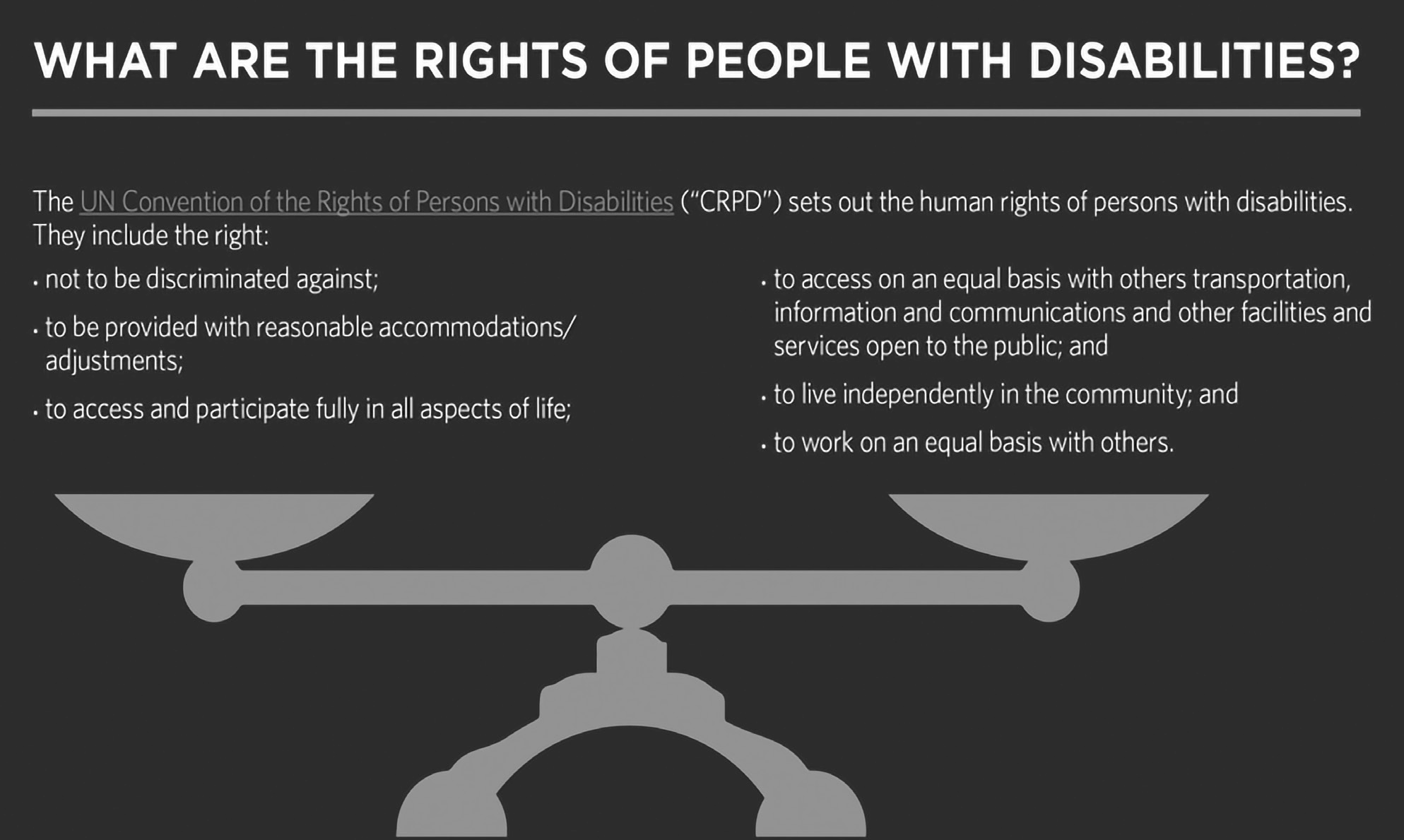
Though the subject of “Disability” figures in the State List in the Seventh Schedule of the Constitution, the Government of India has always been proactive in the disability sector.
As per Census 2011, about 2.68 crore persons are ‘Disabled’ (2.21% of the total population). Out of 2.68 crore, 1.5 crore are males and 1.18 crore are females. Majority (69%) of the disabled population resided in rural areas.
The Convention on the Rights of Persons with Disabilities (UNCRPD) 2006 is an international human rights treaty adopted by the United Nations to safeguard the rights
and dignity of persons with disabilities. Countries that are parties to the convention are obligated to promote, protect, and ensure the full enjoyment of human rights for individuals with disabilities, guaranteeing their equality under the law.
This convention has played a pivotal role in the global disability rights movement, shifting the perspective from viewing persons with disabilities as recipients of charity, medical care, and social protection to recognizing them as full and equal members of society with inherent human rights. It was also the first UN human rights treaty of the twenty-first century.
UNCRPD Guiding principles: There are eight guiding principles delineated in Article 3-
Respect for inherent dignity, individual autonomy including the freedom to make one’s own choices, and independence of persons
Non-discrimination
Full and effective participation and inclusion in society
Respect for difference and acceptance of persons with disabilities as part of human diversity and humanity
Equality of opportunity
Accessibility
Equality between men and women
Respect for the evolving capacities of children with disabilities and respect for the right of children with disabilities to preserve their identities
India has ratified Proclamation on the Full Participation and Equality of People with Disabilities in the Asian and the Pacific Region - adopted at Beijing in December, 1992, and UN Convention on the Rights of Persons with Disabilities (UNCRPD), which came into effect in May, 2008.
Constitutional and Legal Safeguards for Divyang Fundamental Rights under Part IV
The Constitution secures to the citizens including the disabled, a right of justice, liberty of thought, expression, belief, faith and worship, equality of status and of opportunity and for the promotion of fraternity.
• Article 15(1) enjoins on the Government not to discriminate against any citizen of India (including disabled) on the ground of religion, race, caste, sex or place of birth.
• Article 15 (2) States that no citizen (including the disabled) shall be subjected to any disability, liability, restriction or condition on any of the above grounds in the matter of their access to shops, public restaurants, hotels and places of public entertainment or in the use of wells, tanks, bathing ghats, roads and places of public resort maintained wholly or partly out of government funds or dedicated to the use of the general public.
• Women and children and those belonging to any socially and educationally backward classes or the Scheduled Castes & Tribes can be given the benefit of special laws or special provisions made by the State.
• There shall be equality of opportunity for all citizens (including the disabled) in matters relating
to employment or appointment to any office under the State.
• Article 17: No person including the disabled irrespective of his belonging can be treated as an untouchable. It would be a punishable offence.
• Article 21: Every person including the disabled has his life and liberty guaranteed under of the Constitution.
• Article 23: Traffic in human beings (including the disabled), and beggar and other forms of forced labour is prohibited and the same is made punishable in accordance with law.
• Article 24: It prohibits employment of children (including the disabled) below the age of 14 years to work in any factory or mine or to be engaged in any other hazardous employment. Even a private contractor acting for the Government cannot engage children below 14 years of age in such employment.
• Article 25 guarantees to every citizen (including the disabled) the right to freedom of religion. Every disabled person (like the non-disabled) has the freedom of conscience to practice and propagate his religion subject to proper order, morality and health.
• No disabled person can be compelled to pay any taxes for any particular religion or religious group.
• No Disabled person will be deprived of the right to the language, script or culture which he has or to which he belongs.
• The right to education is available to all citizens including the disabled. Article 29(2) of the Constitution provides that no citizen shall be denied admission into any educational institution maintained by the State or receiving aid out of State funds on the ground of religion, race, caste or language.
• Every disabled person can move the Supreme Court of India to enforce his fundamental rights and the rights to move the Supreme Court is itself guaranteed by
Article 32.
• No disabled person owning property (like the non- disabled) can be deprived of his property except by authority of law though right to property is not a fundamental right. Any unauthorized deprivation of property can be challenged by suit and for relief by way of damages.
• Every disabled person (like the non-disabled) on attainment of 18 years of age becomes eligible for inclusion of his name in the general electoral roll for the territorial constituency to which he belongs.
Under Directive Principles of State Policy
• Article 45 of the Constitution directs the State to provide free and compulsory education for all children (including the disabled) until they attain the
age of 14 years. No child can be denied admission into any education institution maintained by the State or receiving aid out of State funds on the ground of religion, race, caste or language.
• Article 47 of the constitution imposes on the Government a primary duty to raise the level of nutrition and standard of living of its people and make improvements in public health - particularly to bring about prohibition of the consumption of intoxicating drinks and drugs which are injurious to one's health health except for medicinal purposes.
Legal Provisions
The Rights of Persons with Disabilities (RPwD) Act, 2016
The Act replaces the Persons with Disabilities (Equal Opportunities, Protection of Rights and Full Participation) Act, 1995. It fulfils the obligations to the United National Convention on the Rights of Persons with Disabilities (UNCRPD), to which India is a signatory.
Salient features of the Act
• Disabilities covered: Disability has been defined based on an evolving and dynamic concept. The types of disabilities have been increased from existing 7 to 21 and the Central Government will have the power to add more types of disabilities. The 21 disabilities are given below:-
• Physical Disability: Locomotor Disability, Leprosy Cured Person, Cerebral Palsy, Dwarfism, Muscular Dystrophy, Acid Attack Victims, Visual Impairment, Blindness, Low Vision, Hearing Impairment, Deaf, Hard of Hearing, Speech and Language Disability, Intellectual Disability, Specific Learning Disabilities, Autism Spectrum Disorder, Mental Behaviour (Mental Illness).
• Chronic Neurological Conditions such as Multiple Sclerosis, Parkinson’s Disease, Blood Disorder, Haemophilia, Thalassemia, Sickle Cell Disease, Multiple Disabilities,
• Persons with “benchmark disabilities” are defined as those certified to have at least 40 per cent of the disabilities specified above.
• Rights and entitlements: Responsibility has been cast upon the appropriate governments to take effective measures to ensure that the persons with disabilities enjoy their rights equally with others.
• Additional benefits such as reservation in higher education (not less than 5%), government jobs (not less than 4 %), reservation in allocation of land, poverty alleviation schemes (5% allotment) etc. have been provided for persons with benchmark disabilities and those with high support needs.
•
Every child with benchmark disability between the age group of 6 and 18 years shall have the right to free education.
• Government funded educational institutions as well as the government recognized institutions will have to provide inclusive education to the children with disabilities.
• For strengthening the Prime Minister’s Accessible India Campaign, stress has been given to ensure accessibility in public buildings (both Government and private) in a prescribed time-frame.
• Guardianship: The Act provides for grant of guardianship by District Court under which there will be joint decision – making between the guardian and the persons with disabilities.
• Establishment of Authorities: Broad based Central & State Advisory Boards, Office of Chief Commissioner of Persons with Disabilities at centre and state levels, Creation of National and State Fund will be created to provide financial support to the persons with disabilities subsuming existing National and Trust Funds with the National Fund.
• Penalties for offences: Any person who violates provisions of the Act, or any rule or regulation made under it, shall be punishable with imprisonment up to six months and/ or a fine of Rs 10,000, or both. Whoever intentionally insults or intimidates a person with disability, or sexually exploits a woman or child with disability, shall be punishable with imprisonment between six months to five years and fine.
• Special Courts will be designated in each district to handle cases concerning violation of rights of PwDs.
Institutional Mechanism for Divyang
Department of Empowerment of Persons with Disabilities (Divyangjan) under Ministry of Social Justice & Empowerment
It was set up in 2012 with the aims to facilitate empowerment and inclusion of the persons with disabilities through inter-disciplinary process, covering various aspects namely, prevention, early detection, intervention, education, health, vocational training, rehabilitation and social integration.
• Vision: To build an inclusive society in which equal opportunities are provided for the growth and development of Persons with Disabilities so that they can lead productive, safe and dignified lives.
• Mission: To empower Persons with Disabilities, through its various Acts/ Institutions/Organizations and Schemes for rehabilitation and to create an enabling environment that provides such persons with equal opportunities, protection of their rights
and enables them to participate as independent and productive members of society.
The Office of the Chief Commissioner for Persons with
Disabilities
• It was set up under Section 57 (1) of the erstwhile Persons with Disabilities (Equal Opportunities, Protection of Rights and Full Participation) Act 1995 and continues to function under Section 74 of the Right of Persons with Disabilities Act, 2016.
• The Chief Commissioner is mandated to coordinate the work of the State Commissioners for Persons with Disabilities, monitor utilization of funds disbursed by the Central Government and take steps to safeguard the rights and facilities made available to the persons with disabilities.
• The Chief Commissioners may also, on his own motion, or on the application of any aggrieved persons or otherwise looks into complaints relating to deprivation of rights of persons with disabilities or non-implementation.
• The Chief Commissioner for Persons with Disabilities has been assigned certain powers of a Civil Court for effective discharge of the functions.
National Handicapped Finance & Development Corporation (NHFDC) 1997
It is a Central Public Sector Undertaking under the aegis of Department of Empowerment of Persons with Disabilities (Divyangjan), Ministry of Social Justice & Empowerment. The Corporation is registered under section 25 of the Companies Act, 1956 (corresponding provisions of section 8 of the Companies Act, 2013) in 1997 as a company not for profit aiming at socio-economic empowerment of Divyangs through loans at concession rates of interest to PwDs for self-employment.
NHFDC functions as an apex institution for channelizing funds for promoting economic development activities and self-employment ventures through the State Channelizing Agencies (SCAs) nominated by the respective State/UT Government(s) and partner Banks (Public Sector Banks & Regional Rural Banks).
There are two flagship schemes of NHFDC for channelizing concessional loan through its partner agencies i.e
• Divyangjan Swavalamban Yojana (DSY), which is individual centric
• Vishesh Microfinance Yojana (VMY), which is for Self Help Groups / Joint liability groups through various partner agencies for PwD welfare and rehabilitation.
Welfare Schemes for Divyangs
• Accessible India Campaign (Sugamya Bharat Abhiyan)
(Ministry of Social Justice and Empowerment)
Scheme: The Sugamya Bharat Abhiyan was launched in 2015 as a nation-wide Campaign for achieving universal accessibility for Persons with Disabilities (PwDs). It has three important components ie.
• Built-Up Environment: An accessible physical environment that aims to eliminate obstacles and barriers to indoor and outdoor facilities like schools, hospitals, workplace etc.
• The transportation sector: enhancing accessibility to roads, airports, railway station etc.
• The ICT ecosystem: It includes enhancing the pool of sign language interpreters, proportion of accessible and usable public documents and websites that meet internationally recognized accessibility standards etc.
Analysis: There has been significant work in enhancing the accessibility of PwDs after the launch of Accessible India Campaign.
Access Audit of 1671 buildings completed.
1630 Government buildings, including 1030 Central Government building have been provided with features of accessibility.
• 35 International Airports and 55 Domestic Airports
have been provided with features of accessibility
• All 709 A1, A & B category railway stations have been provided with seven Short Term Facilities.
• Nearly 627 Central and State/UT government websites have been made accessible.
• 71% of the government aided schools have been made barrier free with the provision of ramps, handrails and accessible toilets.
• Sugamya Pustakalaya
Sugamya Pustakalaya is India ‘s first and largest collection of accessible books.
It is a collaborative effort of TCS, Daisy Forum of India and National Institute for Empowerment of Persons with Visual Disabilities to end the book famine faced by people with print disabilities.
Sugamya Pustakalaya is a facilitating platform for producers of accessible content to jointly work in producing and providing accessible books to people with print disabilities.
• Deendayal Disabled Rehabilitation Scheme
(Ministry of Social Justice & Empowerment)
Scheme: The umbrella Central Sector Scheme of this Ministry called the “Scheme to Promote Voluntary Action
for Persons with Disabilities” was revised in 2003 and was renamed as the “Deendayal Disabled Rehabilitation Scheme.
The aim of the scheme is to create an enabling environment to ensure equal opportunities, equity, social justice and empowerment of persons with disabilities. It also aims to encourage voluntary action for ensuring effective implementation of the People with Disabilities (Equal Opportunities and Protection of Rights) Act of 1995.
The approach of this Scheme is to provide financial assistance to voluntary organizations to make available the whole range of services necessary for rehabilitation of persons with disabilities including early intervention, development of daily living skills, education, skill- development oriented towards employability, training and awareness generation.
• Unique Disability Identification (UDID) Project
(Ministry of Social Justice & Empowerment)
Scheme: “Unique ID for Persons with Disabilities” project is being implemented with a view of creating a National Database for PwDs, and to issue a Unique Disability Identity Card to each person with disabilities.
The project will not only encourage transparency, efficiency and ease of delivering the government benefits to the person with disabilities, but also ensure uniformity.
The project will also help in stream-lining the tracking of physical and financial progress of beneficiary at all levels of hierarchy of implementation from village level to Block, District, State and National level.
Welfare of Marginalised, Destitute and Homeless People
Welfare of Marginalised, Destitutes and Homeless people
Homelessness is a major issue in India. The Universal Declaration of Human Rights defines ‘homeless’ as those who do not live in a regular residence. The United Nations Economic and Social Council Statement has a broader definition for homelessness: The right to adequate housing is about security of tenure, affordability, access to services and cultural adequacy. It is about protection from forced eviction and displacement, fighting homelessness, poverty and exclusion.
Census defines ‘homeless’ as those who do not live in Census houses, but rather stay on pavements, roadsides, railway platforms, staircases, temples, streets, in pipes, or other open spaces. There are 1.77 million homeless people in India, or 0.15% of the country’s total population, according to the 2011 census consisting of single men, women, mothers, the elderly, and the disabled.
Census 2011 does not give data on destitute women in the country.
Furthermore, there is a high proportion of mentally ill and street children in the homeless population. There are 18 million street children in India, the largest number of any country in the world, with 11 million being urban.
As per the 2011 Indian Census, the total count of transgender people in India is about 4.88 lakh. As per the 2011 census, the total literacy rate among transgender persons was 56.1%, against the national average of
74.04%. Only 5,711
transgender individuals received the bank transfer and 1,229 received the ration supplies.
In National Legal Services Authority v. Union of India, the Supreme Court of India laid the foundation for transgender rights in India by identifying ‘transgender’ as the ‘third gender’ and establishing several measures to prohibit discrimination against transgender people and protect their rights. The judgement argued for transgender people to be given preference in occupations and educational institutions, as well as the right of transgender individuals to announce their self-perceived gender identity without undergoing sex reassignment surgery.
Constitutional and Legal Safeguards Under Fundamental Rights
Article 21: It protects life and personal liberty of an
individual. But the judicial intervention expands the scope of Article 21 by which if paves way to include the various types of rights including
right to enjoyment of pollution free and healthy environment,
the right to health and medical care,
emergency aid to medical facilities,
right to livelihood,
right to live a dignified life,
right to social security, and
right to live with proper or just reputation of a person in his valuable asset.
Under Directive Principles of State Policy (Part IV)
Article 41 of the Constitution guaranteed persons› rights to work, education, and public support. It states that the state must preserve the rights in circumstances of disability, old age, or disease.
Article 46 specifies that the government must protect the educational and economic rights of weaker sections.
Article 47 states that the state must promote people›s diet and way of living, as well as their public health.
Under Seventh Schedule
• Item 9 of the State List, as well as items 20, 23, and 24 of the Concurrent List, deal with old age pensions, social security and social insurance, and economic and social planning.
Judicial Pronouncements
• Apart from these above, there are so many landmark judgments, which directly do help to uplift the vulnerable position of the deprived citizen.
• Right to have shelter
• Duty of State to provide food grains be provided to all these who are aged, infirm, disabled, destitute women, destitute men etc.
• Right to electricity is included in right to life and
Legal Provisions
Transgender Persons (Protection of Rights) Act, 2019
It seeks to recognise the identity of transgender persons and prohibit discrimination in, inter alia, the fields of education, employment, healthcare, holding or disposing of property, holding public or private office and access to and use of public services and benefits.
Key Features of the Law
• Definitions: The definitions of transgender persons and people with intersex variation have been made inclusive of males and females, even if the person has not undergone any therapy such as hormone therapy, sex reassignment procedure or any other.
• Non-discrimination: The law is in the strict prohibits of discrimination against transgender persons at educational or professional institutions, healthcare and other public facilities as well as reinforces their right of movement, property and holding of offices.
• Identity Certificate: It administers the right to a gender identity that is self-perceived and further casts a responsibility on the district magistrate for the issuance of a ‘certificate of identity as a transgender person, without undergoing a medical assessment. It also provides for a further change of gender to female or male for any person claiming a change in gender.
• Equal Opportunities: It further administers equal opportunities with regard to policy matters for the transgender community. The law has mandated the formulation of certain specific policy measures that would be inclusive of transgender persons.
•
Complaint Officer: The law requires every establishment to create a specific designation of a complaint officer.
• Healthcare and Medical Facilities: The law also provides for the establishment of separate HIV surveillance centres for transgender persons; the facilities need to be inclusive of healthcare relating to hormone therapies, sex reassignment procedures etc., as well as cover medical expenses by an insurance scheme that is specific to the medical needs of transgender persons.
• National Council for Transgender Persons (‘NCT’): The law also mandates the constitution of the NCT in order to guide and advise government officials for the auditing of existing policies and the formulation of new ones as well as redressal of grievances.
• Offences and Penalties: Offences such as forcing transgender persons into labour; or refusing accessibility to public facilities; mental, emotional, physical and sexual abuse or violence; and other related offences have been included.
Analysis of the Transgender Persons (Protection of Rights) Act
Achievements
• By enacting this law, India has adhered to the international standards for the protection of human rights envisaged by the Office of the United Nations High Commissioner for Human Rights in 2015.
• Although begging will continue to be a major problem that must be addressed, by not criminalizing begging under the Transgender Law, the government has at least tried to minimize the need to earn a living without any other means of earning a living.
• Sexual harassment: The need in the previous law with a requirement of a medical screening and assessment to get an identification certificate has been abandoned from the new Transgender Act of 2019. This would assist in reducing trauma as well as harassment that transgender persons have to experience.
Concerns:
• The definition of “transgender person” is vague and misleading. The gender identity of transgender people is different from the gender identity provided at birth, while “intersex variants” are based on biological characteristics. Although two subtly separate definitions create differences, the definition of “transgender” is too broad to include “people with intersex variation.”
• The penalty for offences include imprisonment of only up to two years with a fine, which appears to be insufficient for heinous crimes like rape, sexual abuse or violence, sexual harassment or criminal assault.
• It fails to provide other associated rights, such as marriage rights, adoption rights, pregnancy rights, and so forth – a missed opportunity to be even more comprehensive.
• Missed providing reservations (affirmative action) for transgender people in educational institutions and employment, it may better attract transgender people, and it will be more comprehensive and effective.
• Issue of gender identity: Though the transgender persons will have the right to a gender identity that is self-perceived, however Gender identity cannot be changed in official documents without the issuance of a certificate of identity by the district magistrate which can only be acquired after evidence of sex reassignment surgery has been provided.
• Right of residence below the age of 18 to live with their natal family has been enforced yet Transgender often face gruesome discrimination and brutality within their own families due to their gender identity.
• Limited Acknowledgement: The Act primarily acknowledges Hijras and transwomen but no emphasis on the gender queer, transmen or even intersex.
Institutional Mechanism
National Council for Transgender Persons (NCTP) 2020
It is a statutory body established in 2020 by the Ministry of Social Justice and Empowerment. It advises the government on all policy matters affecting transgender, intersex persons and people with diverse GIESC (Gender Identity/Expression and Sex Characteristics) identities.
The council is composed of-
• The Union Minister in-charge of the Ministry of Social Justice and Empowerment, Chairperson, ex officio;
• The Minister of the State, in-charge of the Ministry of Social Justice and Empowerment in the Government, Vice-chairperson, ex-officio;
• Various other representatives from different fields.
Role:
• Redressal of the grievances of Transgender Persons.
• To advise, monitor and evaluate the impact of policies made by the Central Government relating to Transgender Persons.
• To oversee the work of various Governmental and Non-Governmental organizations which
are dealing with matters relating to Transgender Persons.
Welfare schemes
SMILE: Support for Marginalised Individuals for Livelihood and Enterprise
(Ministry of Social Justice & Empowerment)
Scheme: Recognising the persisting problem of destitution and beggary, Government of India has formulated ‘SMILE’- a comprehensive scheme meant for beggars.
This scheme covers identification, rehabilitation, provision of medical facilities, counselling, education, skill development for decent job and self- employment or entrepreneurship.
Analysis: The Ministry of Social Justice & Empowerment, Government of India, in the spirit of Azadi ka Amrit Mahotsav, has identified 75 Municipal Corporations to implement comprehensive rehabilitation of persons engaged in the act of begging under ‘SMILE-75 Initiative.
The objective of SMILE- 75 is to make our cities or town and municipal areas begging-free.
Scheme of Shelter for Urban Homeless (SUH)
Objective: The objectives of the Shelter for Urban Homeless (SUH) component of National Urban Livelihood Mission (NULM) scheme are to:
• Ensure availability and access to permanent shelters including the basic infrastructure facilities like water supply, sanitation, safety and security;
• Specially vulnerable segments like the dependent children, aged, disabled, mentally ill and recovering gravely ill, by creating special sections within homeless shelters and provisioning special service linkages for them.
• Provide access to various entitlements, viz. social security pensions, PDS, ICDS, identity, financial inclusion, education, affordable housing etc. for homeless populations.
• Development, management and monitoring of shelters and ensuring basic services to homeless persons, by state and civil society organisations including homeless collectives.
Central Sector Scheme for Comprehensive Rehabilitation for Welfare of Transgender Persons
Scheme: It is a sub scheme of the SMILE initiative. The scheme keeps in mind the social security that is needed through multiple dimensions of identity, medical care, education, occupational opportunities and shelter.
The scheme has provision for Scholarships for Transgender Students studying in IX and till post-graduation to enable them to complete their education.
It also has provisions for Skill Development and Livelihood under Pradhan Mantri Dakshta aur Kushalta Sampann Hitgrahi’ (PM-DAKSH) scheme. Through Composite Medical Health, it provides a comprehensive package in convergence with PM-Jan Aarogya Yojana (PM-JAY) supporting Gender-Reaffirmation surgeries through selected hospitals.
The Housing facility in the form of ‘Garima Greh’ ensures food, clothing, recreational facilities, skill development opportunities, recreational activities and medical support etc. to the Transgender community and the people engaged in the act of begging.
The Provision of Transgender Protection Cell in each state will monitor cases of offences and to ensure timely registration, investigation and prosecution of offences.
Swadhar Greh Scheme:
The Ministry of Women and Child Development implements the Swadhar Greh Scheme for destitute women, which provided shelter to 8,163 women in 2021-
22. The scheme addresses the primary needs of women facing difficult circumstances, including those rendered homeless due to family disputes, crime, violence, mental stress, social ostracism, or those at risk of being forced into prostitution.
The scheme aims to rehabilitate such women both economically and emotionally by offering shelter, food, clothing, counseling, training, as well as clinical and legal assistance. Additionally, the Swadhar Greh Scheme provides vocational and skill development training to support the economic rehabilitation of women in need.
FinancialAssistance to Destitute Children Scheme(FADC) 2014
Sector: Financial Assistance- State Scheme
This is a state-sponsored scheme that provides financial assistance to parents or guardians of children up to the age of 21 who are deprived of proper care due to the death or long-term imprisonment of their parents, prolonged illness, or mental disability. The assistance is provided for a maximum of two children per family, based on eligibility criteria specified in the scheme.
Allowance Rate: Rs. 900 per month per child, with a maximum of two children per family (effective from 01- 11-2017).
The National Social Assistance Programme (NSAP)
It is a welfare programme administered by the Ministry of Rural Development. This programme is well as urban areas. NSAP represents a significant step towards the fulfilment of the Directive Principles of State Policy upon the State to undertake within its means a number of welfare measures.