Introduction and Historical Development
Introduction:
• Democracy is an egalitarian principle in which the governed elect the people who govern over them.
• Democracy, literally, rule by the people. The term is derived from the Greek dēmos (“people”) and kratos (“rule”) to denote the political systems then existing in some Greek city-states, notably Athens.
• In 1863, 16th President of the United States, Abraham Lincoln, said, “Democracy is a government of the people, by the people, and for the people.”
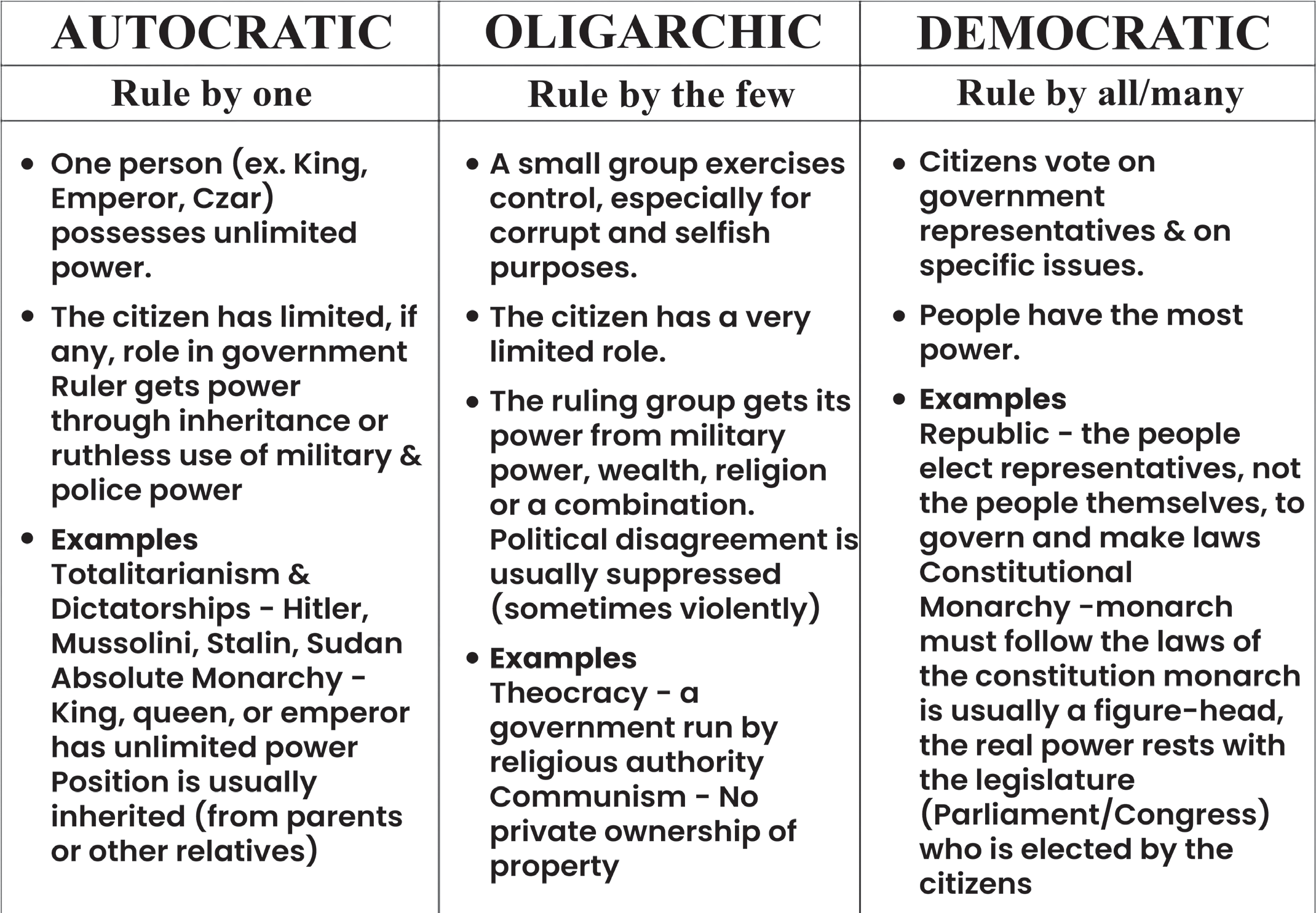
Table: Comparison between Autocracy, Oligarchy and Monarchy
• In a democracy, the civil services play an extremely important role in the administration, policy formulation and implementation, and in taking the country forward towards progress and development.
• They are responsible for the formulation, execution, monitoring, evaluation, and implement rules and regulations of the policies and laws.
• The ‘civil service’ is a collective term for a sector of
government composed mainly of career civil servants recruited on professional merit rather than appointed or elected, whose institutional tenure typically survives transitions of political leadership.
| Civil Servant | Public Servant |
| Civil Service is an organ in the Executive arm of the government primarily responsible for the implementation of the government policies and programmes. Civil Servant is a bureaucrat or official recruited by the government to work in the public sector. “All civil servants are public servants but all public servants are not civil servants.” Civil Servants have desired minimum qualification and recruited by an examination. Civil Servants have certain duties and responsibilities in service of the government. | Public Service is an agglomeration of all organizations that exist as a part of government machinery for the delivery of services. Public Servant can be any person including those in the defence, judiciary, and governance systems, who are currently working to provide security, welfare, and justice to the people. Public Servants may not need specific qualifications to do public service. For example, politicians. Public Servants may be volunteers and other persons who may not be bound by certain duties. |
• In India, the Civil Service is defined as “appointive positions by the Government in connection with the affairs of the Union and includes a civilian in a Defence Service, except positions in the Indian Armed Forces.”
• The members of civil service serve at the pleasure of the President of India and Article 311 of the constitution protects them from politically motivated or vindictive action.
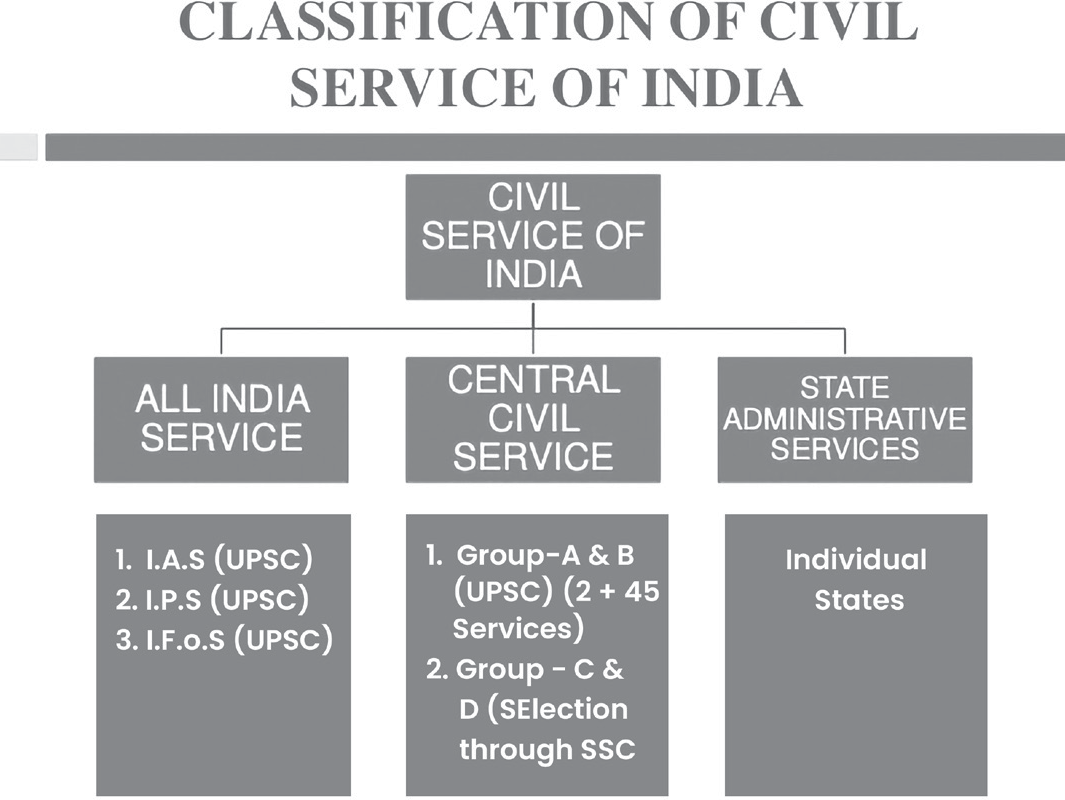
• The Civil Services of India can be classified into three types—
• The All India Services,
• The Central Civil Services (Group A and B)
• State/Provincial Civil Services.
• The recruits are university graduates (or above) selected through a rigorous system of examinations, called the Civil Services Examination (CSE) and its technical counterpart known as the Engineering
Services Examination (ESE) both conducted by the Union Public Service Commission (UPSC). The entry into the State Civil Services is through a competitive examination conducted by every state public service commission.
Historical Development
• In early India, Indian civil service system had its origin in the Mauryan empire period.
• Kautilya’s Arthashastra lays down the following principles:
• Selection and promotion of the civil servants,
• Conditions of loyalty for appointment to the civil service,
• Methods of their performance evaluation
• Code of conduct to be followed by them
• Guptas and Cholas relied heavily on civil servants.
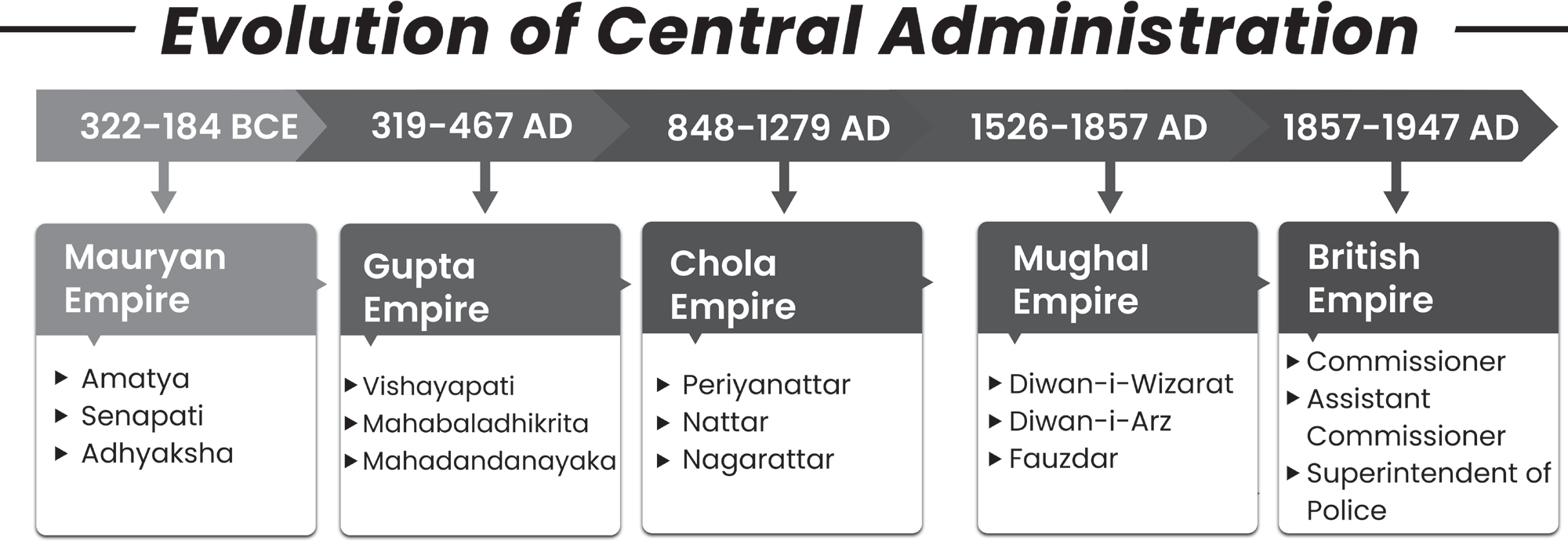
Figure: History of Civil Services in India
• During the medieval period (1000-1600 AD), Akbar had founded and nurtured the civil service. His civil service had welfare and a regulatory orientation.
• In medieval India, the Mughals set up their own civil service systems which centred upon
• Management of land revenue
• Administration of government factories
• Establishment of the patrimonial state
• During the British Colonial Rule in India, the British
civil service came on the Indian scene after the takeover of the East India Company in the 1860s.
Initially the British civil service was a part of a police state, with the major task being that of carrying out law and order and revenue collection functions.
It was separated later as the different provinces had different civil services.
Early British officials were engaged in commerce and started calling themselves as ‘civil servants’ to differentiate themselves from the military and naval personnel.
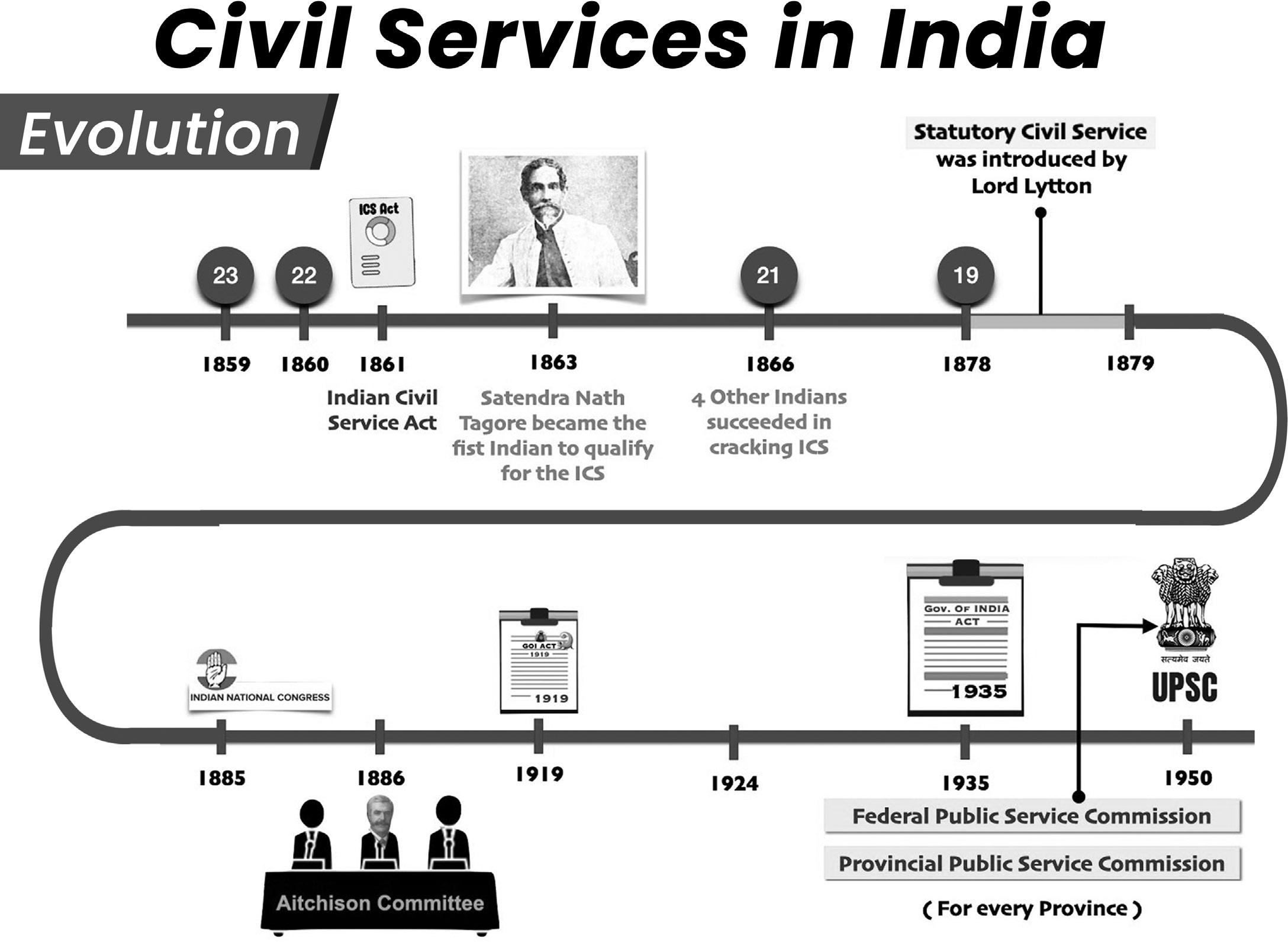
Figure: Evolution of Civil Services in India
• During the British raj, Warren Hastings laid the foundation of civil service and Lord Cornwallis reformed, modernised, and rationalised it. Hence, Lord Cornwallis is known as ‘the father of civil service in India’. Thus, the civil services became the Steel Frame of British Empire in India.
• Lord Cornwallis introduced two categories of services
Covenanted and Uncovenanted Civil Service.
• Covenanted Civil Service (Higher Civil Service)
•
Derived from the Covenants of good behaviour that an employee was obliged to sign, a Covenanted Civil Servant became a member of the cadre of men who administered the government of India.
• The covenanted civil service consisted of only Europeans (i.e., British personnel) occupying the higher posts in the government.
• Uncovenanted Civil Service (Lower Civil Service): Indians were often recruited to work in the more junior positions of the Civil Service.
• In 1800, Lord Wellesely established a college at Fort William in Calcutta to provide training to the civil servants of the company.
• The Charter Act of 1833 attempted to introduce a system of open competition as the basis of selection of the civil servants. However, it could not be implemented.
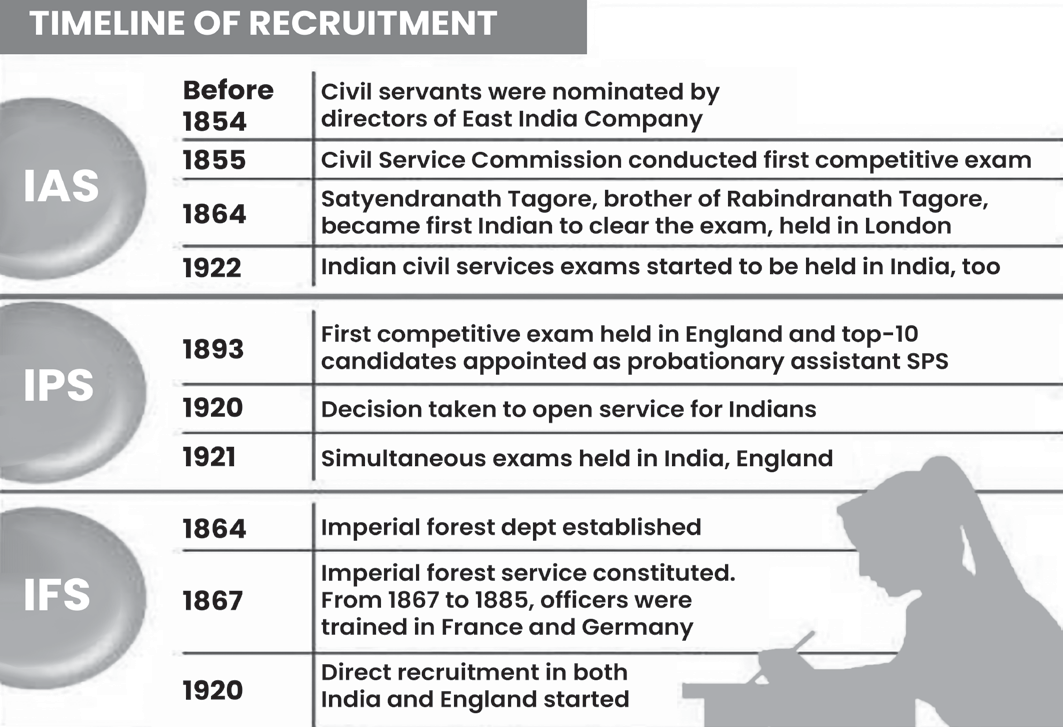
• The Charter Act of 1853 abolished the British patronage system and successfully introduced open competition in India allowing Indians even in the covenanted civil service.
•
Various Committees and Commissions like Macauley Committee, Aitchison Commission, Islington Commission, Montford Report, Lee Commission etc. recommended various reforms in the civil services system, classification, cadres, specialization, minimum and maximum age of entry, its examination, training, share of promotion, salary, pension, allowances, Public Service Commission, protection and privileges of the civil servants and many of them were implemented through various Acts over the years till India’s independence in 1947
Civil Services in A Democracy
Civil Services in a Democracy
Civil Services in a democracy is like ‘life blood to a heart’. Without blood, heart, body and entire life are meaningless. As Max Weber, a German sociologist, says, it is the civil services that makes the State effective and functional.
Max Weber defined Civil Service or Bureaucracy as a highly structured, formalized, and also an impersonal organization. He also instituted the belief that an organization must have a defined hierarchical structure and clear rules, regulations, and lines of authority which govern it.
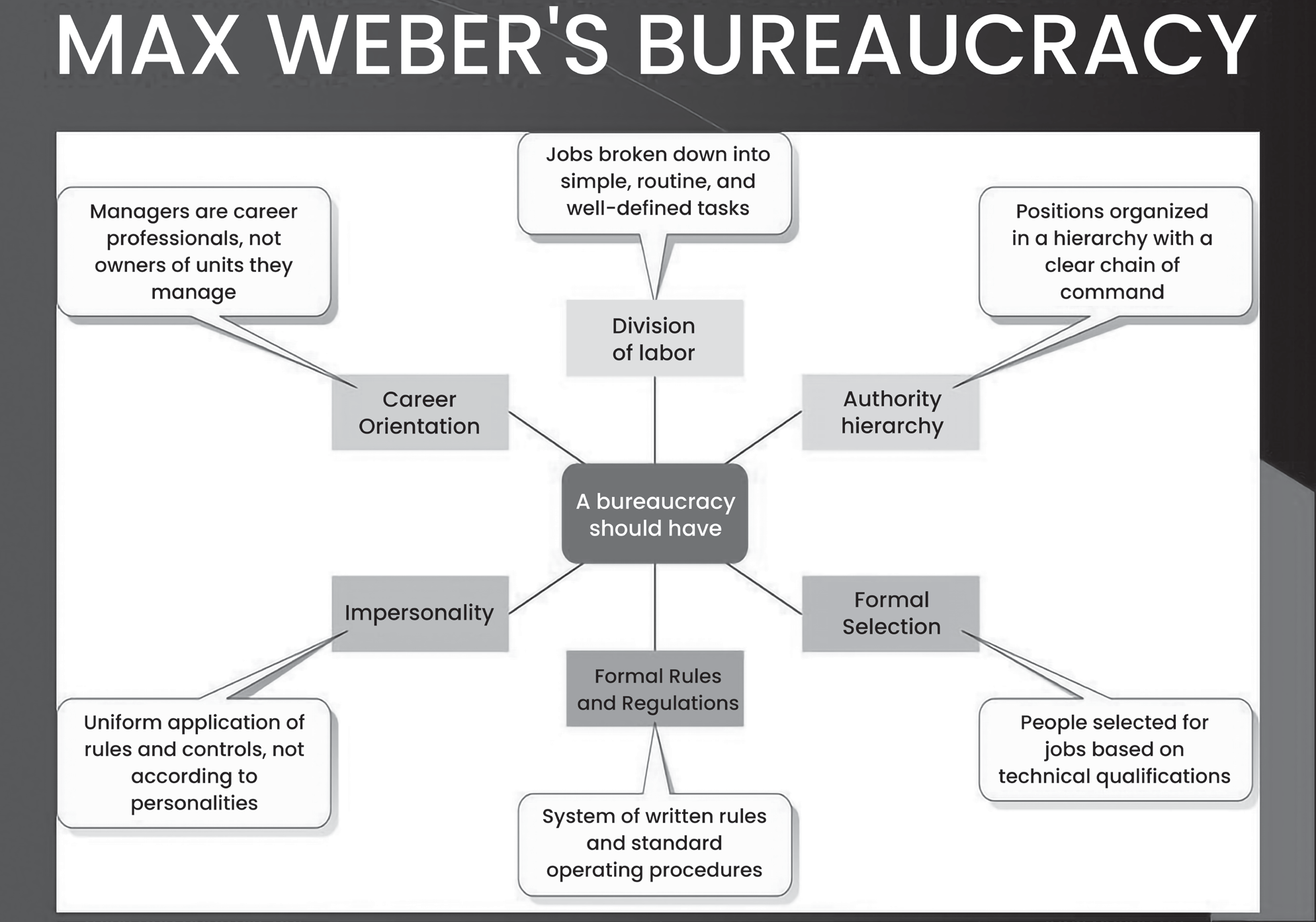
Figure: Aspects of Weber's Bureaucracy
• The term “bureaucracy” originated from the French word “bureau” – desk or office and Greek word “kratos” – rule or political power.
• It simply means ‘government with a small desk’ or office power or office rule, the rule of the officialdom.
• This word comes from the government structure that was developed after the French Revolution.
• Max Weber identified some essential bureaucracy principles:
• It is rule-based decision making.
• It is impersonal, rational and formal.
• It is career-based service.
• It is hierarchical or based on chain of command.
•
It is based on a system of written documents.
• The servants are chosen based on merit.
• Line Agency vs Staff vs Auxiliary Agencies: The functions of modern state have grown in volume and complexity. Chief Executive is the person or body of persons at the head of administrative system of a country like the Prime Minister or Cabinet. To carry out his/her onerous administrative responsibilities, he is assisted by numerous agencies and organizations. Line, staff and auxiliary agencies assist the Chief executive to carry out his/her onerous duties and responsibilities.
• Civil Servants serve in all the three agencies in various capacities and carry out various responsibilities.
| Line Agency The administrative agencies which perform the functions that directly contribute to the achievement of primary or main purpose of Government organization,directing, making decision, command, control and supervision are “Line agencies”. Line agencies have real authority and command the administration to implement the policies. Line agencies perform ‘primary’ functions of implementation. Line function is an ‘end’ in itself. Ministries and Departments, PublicCorporation, IndependentRegulatory Commissionofthe Government are examples of Line Agency. Police Department, for example is responsible for maintenance of law and order. | Staff Agency Staff agencies assist, advise and help the Line agencies to carry out their functions. Staff agencies act as ‘think tank’ of chief executive by thinking, advising, analyzing and preparing the plans and programmes on behalf of the Chief Executive. Staff agencies do not have any authority or power and they do not command the administration but they exercise only delegated authority. Staff agencies perform ‘secondary’ functions of advisory and assistance. Staff function is a ‘means’ to achieve an end. NITI Aayog, Union Public Service Commission, National Development Council, Cabinet Secretariat, Prime Minister’s Office (PMO), are examples of Staff Agency. For instance, Police Department is assisted by staff agencies like Police training college, state intelligence bureau, Police recruitment boards etc. | Auxiliary Agency Auxiliary agency provides commonhousekeeping services to all other agencies. In order for the Line agencies to perform their primary duties, they require certain common services like construction and maintenance of buildings, typing, budgeting, and so on. All these necessary service activities are incidental and not the primary or main activity of any agency. Auxiliary agencies perform ‘helping’ function for the line agencies. Auxiliary agencies have limited authority and operate on behalf of the line agencies. Central Public Works department, and Directorate General of Supply and Disposal in the Government, Finance or Law Department are examples of Auxiliary agencies. |
Both Line and Staff agencies are equally important in administration and are complementary each other. Line units have authority and power to make decisions,issue ordersand command the administrative organisations. But they cannot work without the help and advice of the ‘staff’. Staff units have no authority and power but they have the ‘influence’ and ‘advice’ which is equally important.
Civil Services in India
Civil Services in India
• Post independence, the civil services were reorganized to serve the people as India adopted a Sovereign, Democratic, Republican system of governance.
• Now the objectives of the government were welfare state, social justice and economic development apart from maintaining law and order and revenue collection.
Related Provisions in the Indian Constitution and Rules:
• Articles 53 and 154: The executive power of the Union and the States vests in the President or Governor directly or through officers subordinate to him. These officers constitute the permanent civil service and are governed by Part XIV of the Constitution (Services under the Union and States (Article 308-323)).
• Significance of civil services can be seen in the constitution as having whole Part XIV for the Civil Services at the Union and the States which includes
• Article 309: Parliament and State Legislatures to make rules for Central and State services respectively. For example, the Central Service Rules, 1964.
• Article 310:
• Safeguard provided to the tenure of the civil servants subject to the “Pleasure” of the President or Governor as the case may be.
• Thus, the government is empowered to terminate their services but it is subjected to safeguards mentioned in Article 311.
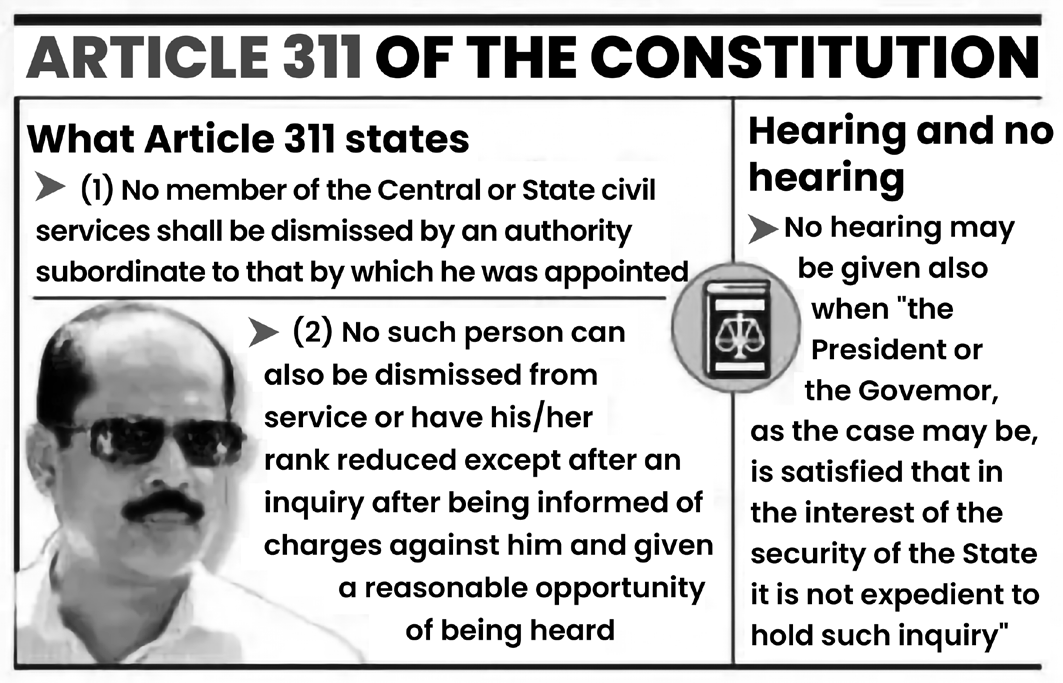
• Article 311: It is also known as the Magna Carta of civil servants and provides safeguard from arbitrary dismissal.
• (1) The civil servants cannot be dismissed by an authority subordinate to the appointing authority. For instance, an IAS officer cannot be dismissed from service by any position below the President. Though action can be initiated by states but it needs the final sanction of the President.
• (2) The servant cannot be removed, except after an enquiry in which he has been informed and given opportunity to prove his/her innocence.
• People Protected under Article 311:
• Civil service of the Union,
• All India Service, and
• Civil service of any State,
• People who hold a civil post under the Union or any State.
• The protective safeguards given under Article
311 are applicable only to civil servants, i.e. public officers. They are not available to defence personnel.
• Exceptions to Article 311 (2):
• 2 (a) - Where a person is dismissed or removed or reduced in rank on the ground of conduct which has led to his/her conviction on a criminal charge; or
• 2 (b) - Where the authority empowered to dismiss or remove a person or to reduce him in rank is satisfied that for some reason, to be recorded by that authority in writing, it is not reasonably practicable to hold such inquiry; or
• 2 (c) - Where the President or the Governor is satisfied that in the interest of the security of the State, it is not expedient to hold such inquiry.
• Article 312: Parliament can create the All-India Services. The procedure includes Rajya Sabha to pass a resolution with two-third majority and after that the Parliament can establish a new All-India service.
• Other Provisions include
• Government of India (Transaction of Business) Rules 1961: The manner in which the officers are required to help the President or Governor to exercise his/her executive functions is governed by these Rules.
• Central Services (Conduct) Rules, 1964 as an outcome of the Santhanam Committee›s recommendation which includes
• Integrity and honesty;
• Political neutrality;
• Promoting the principles of merit, fairness and impartiality in the discharge of duties;
• Accountability and transparency;
• Responsiveness to the public, particularly to the weaker section;
• Courtesy and good behaviour with the public.
• All India Services (Conduct) Rules, 1968 which enumerate similar set of ethical norms for All India civil servants.
Issue regarding the safeguards under Article 311
• Latest context:
• Recently, in 2022, after Punjab and Haryana High Court’s observations, Haryana government has rolled out instructions to stop the practice of
dismissing a government employee without an inquiry.
• Recently Mumbai police commissioner dismissed a police officer under Article 311(2)(b) of the constitution without a departmental enquiry.
• Advantages of safeguards:
• Enhances protection against arbitrary action of the political executive.
• Increases independence of actions
• Upholds the ideals of natural justice through an opportunity of due hearing
• Upholds the hierarchy and discipline
• Challenges according to 2nd Administrative Reforms Commission report:
• Mediocrity in the government performance, since the officers are secure and may lead to incompetence.
• Weakens the control of political executive over the permanent executive.
• Takes very long to take disciplinary action reducing deterrence against corruption and other misconduct.
• Such provisions do not exist in other countries as well.
• Conclusion: The safeguard provisions have been ensured to protect the honest officials and maintain the morale, discipline and integrity within the services. However, care should be taken that in a hurry to implement zero tolerance against corruption, natural justice principles must not be compromised.
All India Services
• All India Services are common for both Union and State governments as they are recruited by the Union but they serve both the Union and the States.
• There are only three All India Services
• Indian Administrative Service (IAS)
• Indian Police Service (IPS)
• Indian Forest Service (IFoS)
Known as India’s ‘Iron Man’, Sardar Vallabh Bhai Patel was also referred to as the ‘Father of Indian Civil Services’ and ‘Patron Saint’ of the Indian Administrative Service (IAS) as he stood for these services calling them the ‘Steel Frame of India’, he envisioned the civil servants as India’s backbone who will ensure good governance after suitable changes according to the needs of the country.
1947: Indian Civil Service (ICS) was replaced by Indian Administrative Service (IAS) and Indian Police (IP) with Indian Police Service (IPS)
1966: Added a new All India Service i.e. Indian Forest Service (IFoS)
Based on the constitutional provisions of Article 312, the Parliament enacted the All India Services Act 1951 governing terms and conditions for recruitment and service of All India Services (AIS) Officers.
Salient Characteristics of Indian Administrative Service (IAS) include
Selection is done by Civil Services Examination (CSE) conducted by the Union Public Service Commission (UPSC).
They are governed by IAS Rules 1954 were enforced.
It is a cadre-based service where they usually spend 20-25 years in the state and 5-15 years at the Central Government.
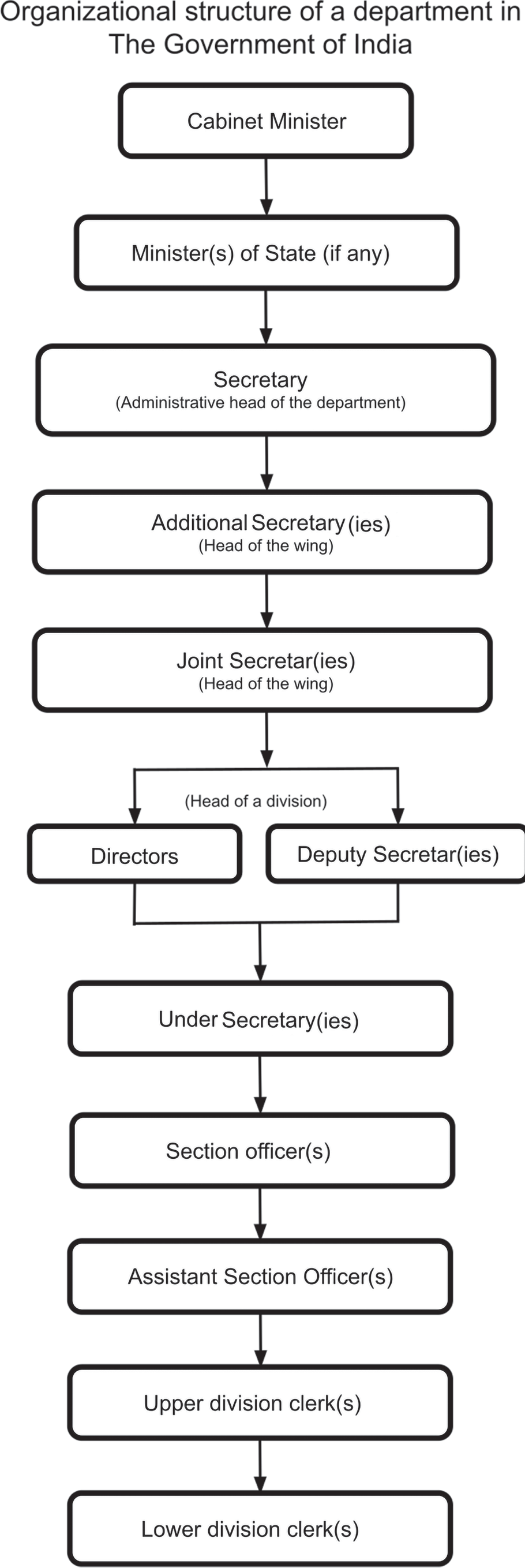
Cabinet Secretary of India is the head of the IAS and the entire Civil Services and he/she is also mentioned in the Order of Precedence
Figure: Organisation Structure of the Department of Government
Role played by All India Services
• Unifying Character: They have a binding character to help national integration as:
• They have an all-India presence usually posted in other states bringing All India outlook beyond
narrow regional, linguistic and communal interests.
• They represent India as a whole.
• They are the source of spreading the best practices and culture throughout India.
• Thus, they unify the nation as well.
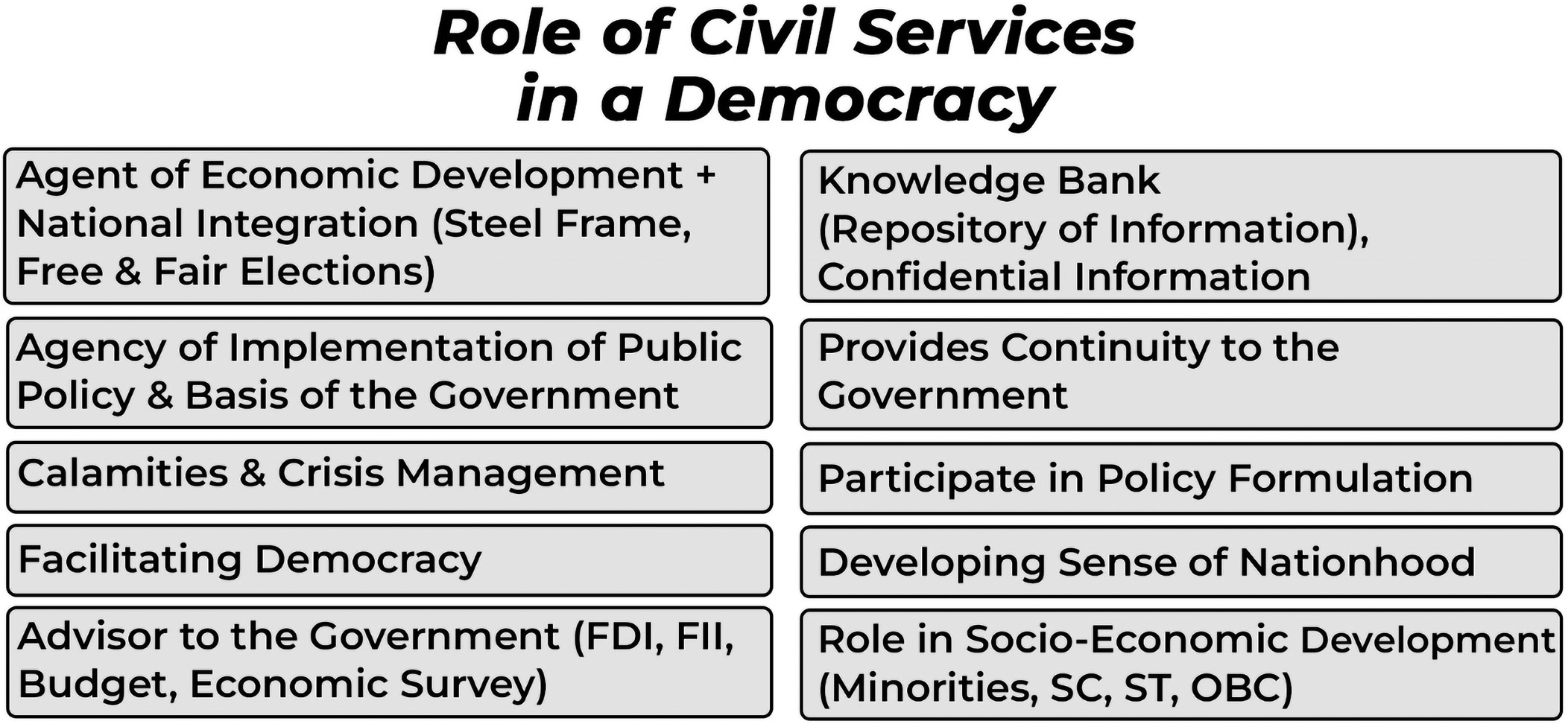
Figure: Role of Civil Services in a Democracy
• Continuity: They provide continuity of administration and democratic practices without any impact of change of government at the Political level as they are the holders of the strategic posts like the Secretaries of the Ministries and departments in the government, Election Commission, Comptroller and Auditor General of India,
• Platform for implementation of policies of the Union in the states. Thus, upholding the Indian constitutional characteristic of Federalism with Unitary Bias.
• Effective Coordination and Efficiency: They ensure effective centre-state and inter-state coordination.
• The permanent nature of services ensures formal and informal relationships within and across departments.
• This brings inter-departmental and inter-sectoral
coordination.
• Thus, they help maintain high standards of administrative efficiency.
• Uniformity in Administration: Throughout the nation as the members of the services are rotated between center and states.
• Cooperative Federalism: Civil servants at the regional level, work in coordination with the political representative.
•
They both are required to serve the common people by bringing development, welfare, well- being and peace to the society.
• They facilitate liaison, cooperation, coordination and joint action on the issues and problems of common interest, between the Centre and the States.
• President’s Rule in States: In such a scenario, the President can depend on their loyalty and cooperation for efficient administration as they are appointed and removed by the President himself/herself.
• Independence: They enjoy the constitutional safeguards, so they are free from the regional and local pressures and influences. Hence, they are able to provide free and frank advice to the Ministers or Political Executive.
• Repository of Talent and Rich Experience:
• They attract the best talent due to high status, prestige and remuneration.
• They facilitate the interchange of rich experience among different states.
• They help states fill their strategic positions.
Issues and Challenges in the Civil Services
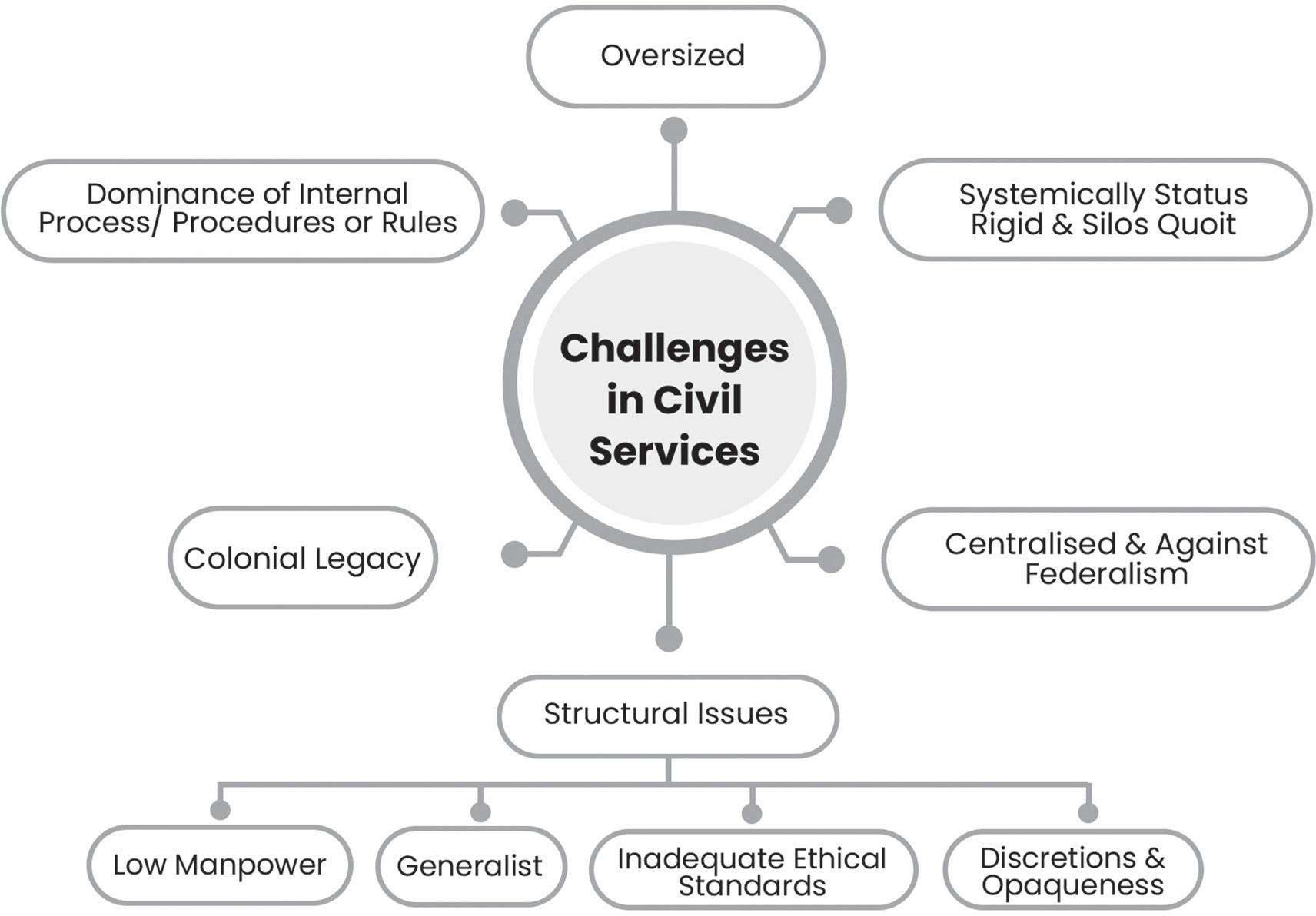
Figure: Challenges in Civil Services
Despite respect, social prestige, work satisfaction, security of employment and goodwill, the services command, Indian civil service was not able to deliver
services according to the expectations of the people or
the founding fathers of the Constitution.
Rapid and fundamental changes like rapid economic growth, urbanization, environmental degradation, technological change and increased local awareness and identity are posing issues for the status-quoist nature of civil services.
With the passage of time, the role of civil society and private sector is increasing in the areas of public services. There is need to shift from pre-eminence of governance to effective governance with a focus on decentralization and citizen-centricity.
• According to the Second Administrative Reforms
Commission 2007, major challenges include
• Rule-Book Bureaucracy (Closed Bureaucracy): Civil Service in India is more concerned with the internal processes than with results.
• Rigid and outmoded rules and procedures that do not allow civil servants to exercise individual judgement and perform efficiently, creating rule-book bureaucracy.
• Due to rule-book bureaucracy, issues like red- tapism, the complication of procedures, and the maladapted ‘bureaucratic’ responses, have emerged.
Over-centralized: Over-centralization in the policy and management structures often acting against Federalism principle:
They restrict the autonomy and patronage of the states causing dissent and demand for autonomy among states from time to time.
Rajamannar Committee 1971 recommended for the abolition of the IAS and IPS.
Rigid and Status Quoist (Disconnected Bureaucracy): The systemic rigidities, needless complexities and within which the civil service functions are too complex and often too constraining.
Working in silos causing disconnect and complexities and inter departmental conflicts.
Status Quoist
Inability to accept changes and adopt new best practices.
They have often resisted changes due to the privileges and prospects, thus becoming ends in themselves. This led to disconnect from the ground reality.
• For example, the vision of 73rd and 74th Constitutional Amendment 1992 making local bodies the institutions of self-government could not be achieved.
• Hierarchical: The structures are based on hierarchies and there are a too many veto points to be negotiated for a decision to eventually emerge.
• Oversized: Big size and the number of ministries and departments have both overloaded the decision-making system and diminished the capacities of the individual civil servants to fulfill their operational responsibilities.
• Reduced possibilities of new ideas and innovations due to lack of agility in the departments.
• Other Major Observations include:
• Colonial Legacy: Colonial structure of the government was unitary and state was authoritarian police state.
•
Post-independence, the scenario was radically altered where the All India Services have no place. This caused a mismatch causing inefficiencies.
Political interference
To better implement the policies of the government, the civil servants have to work closely with the political representatives.
However, to fulfill the populist demands, politicians influence the functioning of officials. Hence, civil servant has to adhere to the will of the political master, evolving Patrimonialism i.e. a form of governance in which all power flows directly from the leader, according to the World Bank report and thus creating ‘committed bureaucracy’ (i.e. loyalty to the political person, parties or ideologies instead of the constitution).
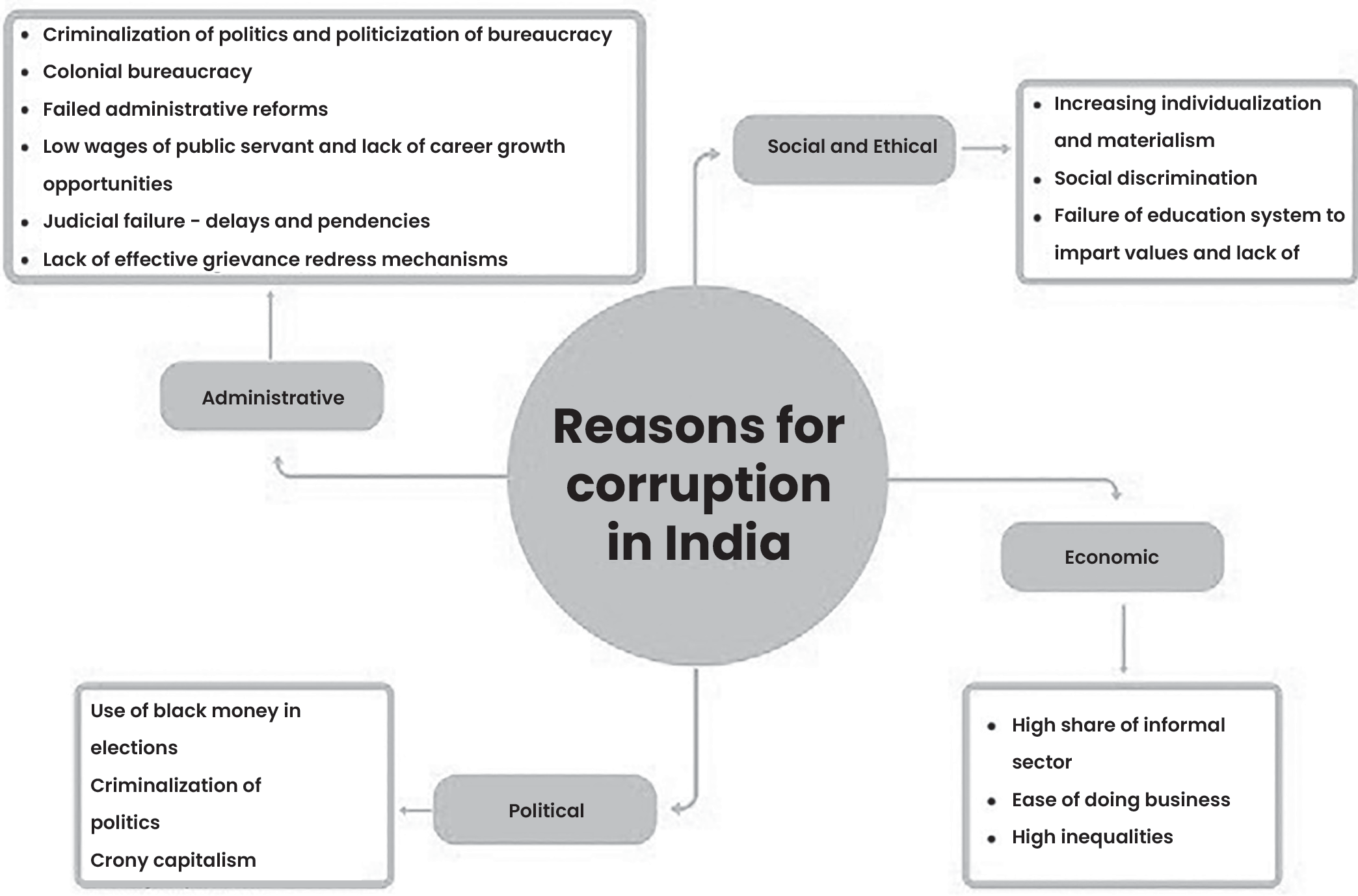
Figure: Reasons for Corruption in India
• This interference sometimes leads to issues like corruption, arbitrary transfers of honest civil servants and
insecurity of tenure causing demoralization.
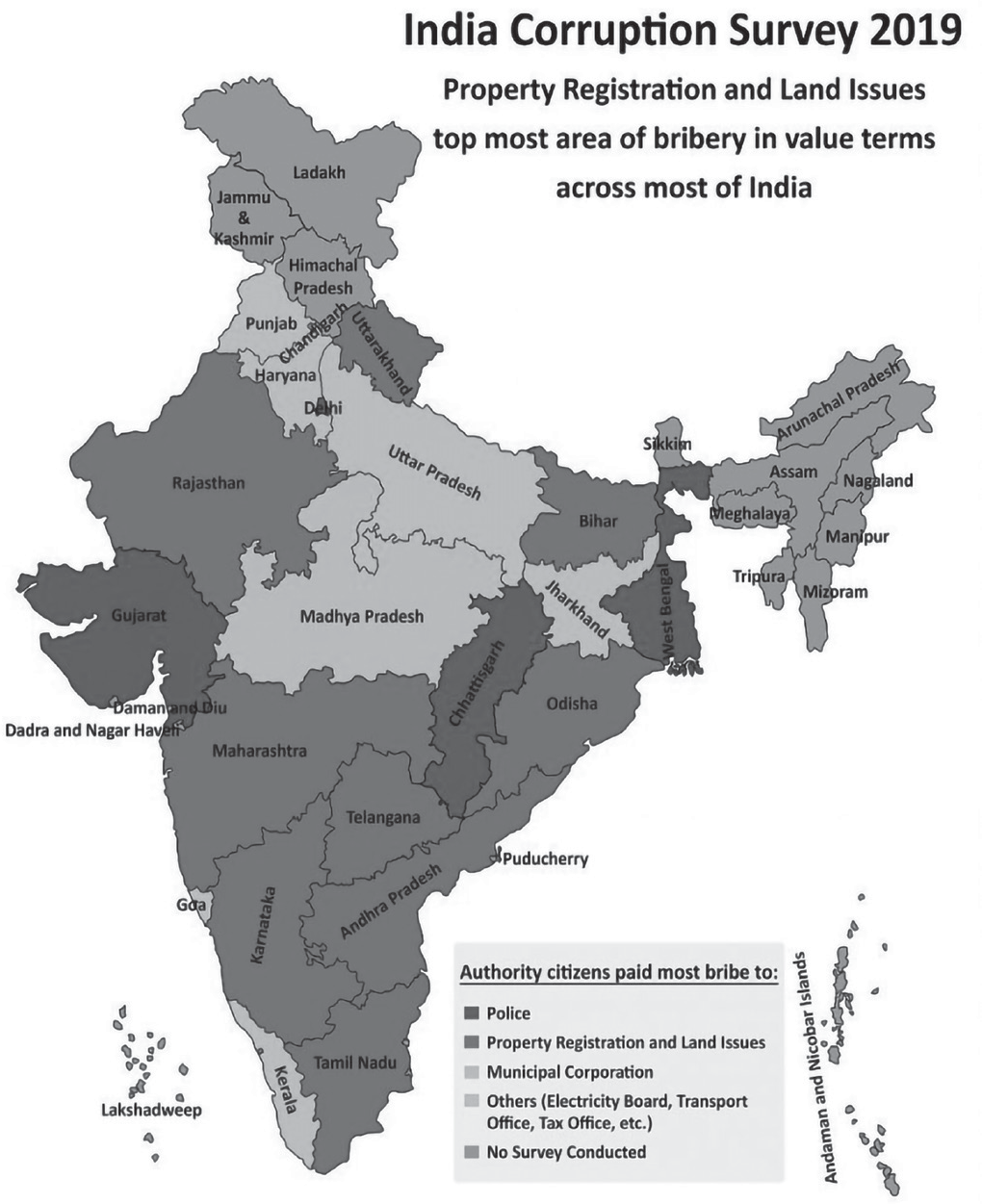
Figure: India Corruption Survey 2019
• It provides a breeding ground for lack of accountability of officers, for waste of public money because of inadequate supervision of programmes under implementation and for large- scale corruption.
•
India ranked at 96 among 180 countries in a Corruption perception index (CPI) of 2024, according to a new report by Transparency International which ranks 180 countries and territories by their perceived levels of public sector corruption according to experts and business people, uses a scale of 0 to 100, where 0 is highly corrupt and 100 is very clean.
• Among those with weak scores are some of the world’s most populous countries such as China (45) and India (40), and other large economies such as Indonesia (34), Pakistan (27) and Bangladesh (25), the report by the anti- corruption watchdog said.
• Also, this led to substantial inefficiency where the vital positions are not held by the best officers and ultimately this can lead to institutional decline.
• Structural Issues:
• Generalist officers: Civil Service are conceived primarily to deliver the core functions of the state such maintenance of law and order and implement government orders.
• However, changing needs with the advent of globalization, technology and economic reforms, the role of the state has changed. Lack of domain knowledge at policy level caused ineffective implementation.
• Inadequate Capacity Development and high vacancies.
• It caused delays and overburdened bureaucracy,
leading to inefficiencies.
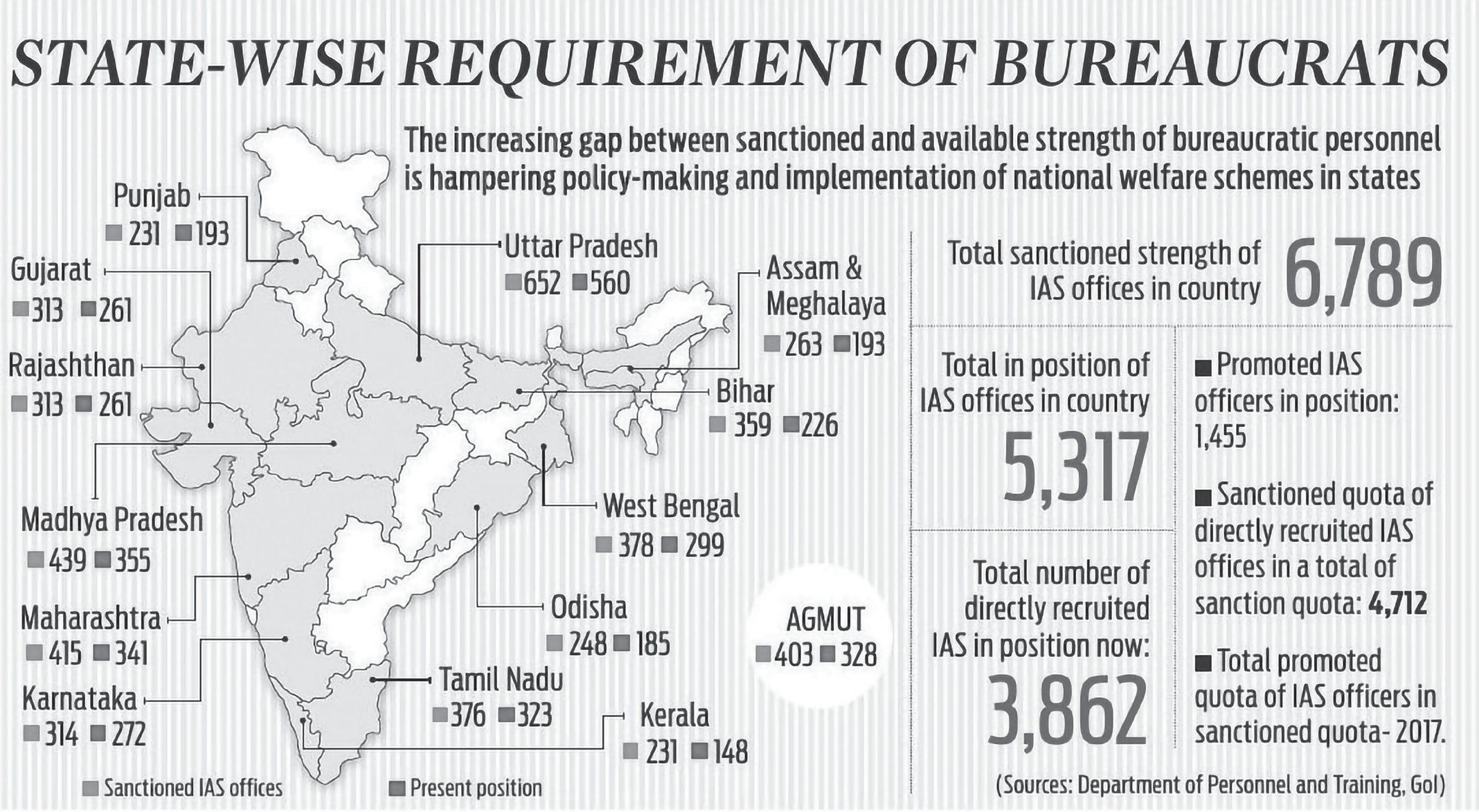
• Inadequate Ethical Standards and an ineffective incentive system that does not reward the meritorious and upright civil servants causing rampant corruption and nepotism. This led to distrust among the citizens and tarnishing of the image of the government.
• Discretion and Opaqueness: Despite new changes in technology, the over three lakh pending cases of Right to Information applications in 2022, indicate the challenge of transparency and accountability in civil services.
• Lack of accountability and transparency procedure, with no adequate protection for whistle-blowers as Whistleblower Protection Act 2014 is yet to be implemented, despite passage.
• This caused the lack of transparency and citizens being uninformed leading to ineffective participatory democracy.
•
Due to rule-book bureaucracy, issues like red-
Civil Services Reforms and Recommendations of 10th Report of the Second Administrative Reforms Commission
Civil Services Reforms in India
Changing times, globalization, technology, and altered socio-political equations have posed newer challenges to Indian civil servants today. These challenges also provide opportunities for modification of older systems for better performance and adaptation of the civil services according to changing times.
• A number of Committees and Commissions were set up to make recommendations on various aspects of civil services. For instance,
• A.D. Gorwala Committee, 1951;
•
Dr. A. Ramaswami Mudaliar Committee Report 1956;
• Report on Indian and State Administrative Services and Problems of District Administration by V.T. Krishnamachari, 1962;
• Santhanam Committee report 1962;
• First Administrative Reforms Commission’s Report on Personnel Administration,1969;
• Report of the Committee on Recruitment Policyand Selection Methods, 1976 – also known as the
D.S. Kothari Committee Report;
• Sarkaria Commission report on Centre-State Relations (1983-1988)
• Satish Chandra Committee Report 1989;
• Report of the Civil Services Examination Review Committee, 2001, also known as Professor Yoginder K. Alagh Committee Report;
• Surinder Nath Committee report 2003;
• Yugandhar Committee 2003;
• Report of the Committee on Civil Service Reforms also known as the Hota Committee Report, 2004.
• Second Administrative Reforms Commission report (2007)
• Punchhi Commission report on Centre State Relations (2007-2010)
• Baswan Committee report 2016;
• Major aspects of Civil Services Reforms in India include
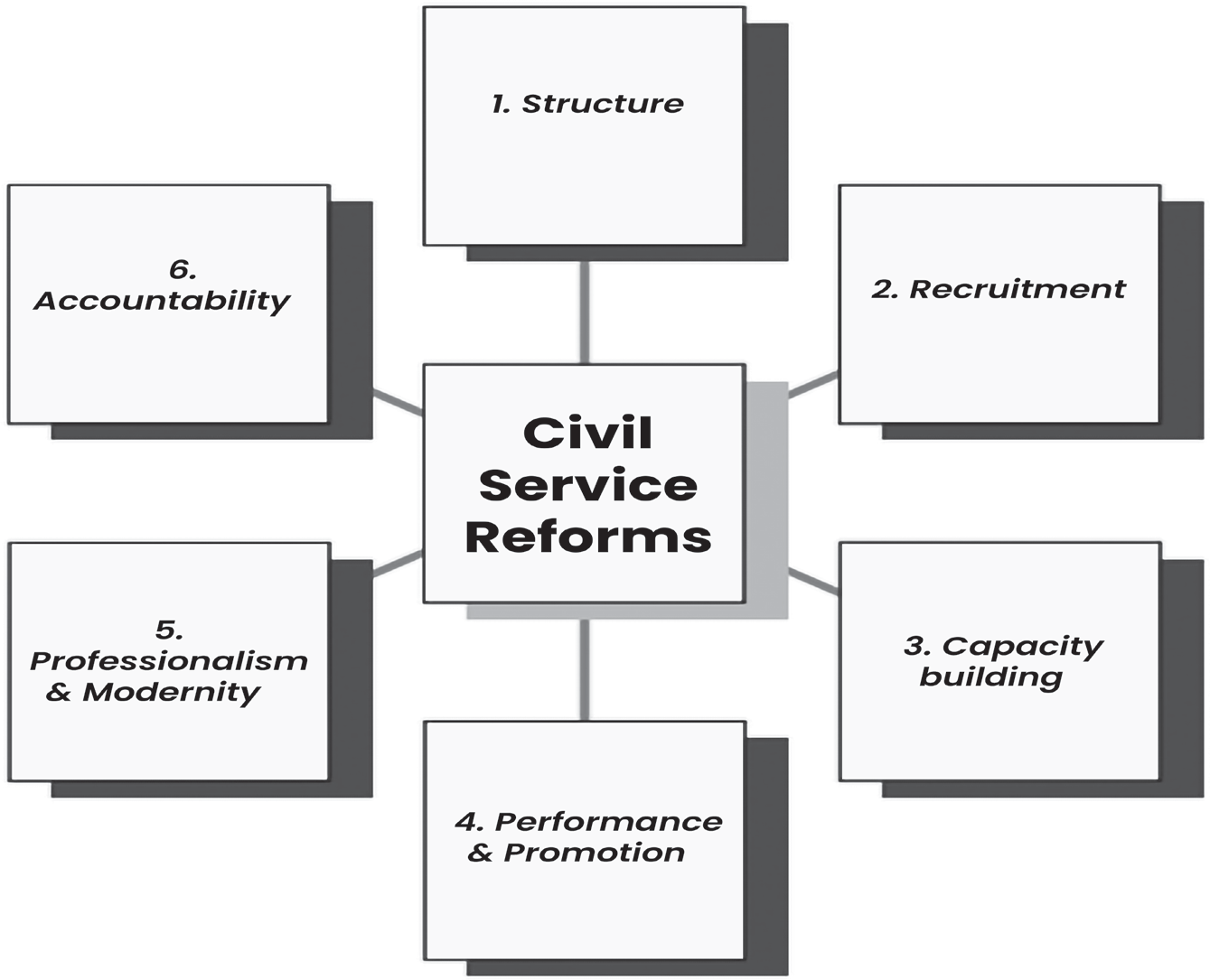
Figure: Key Aspects of Civil Services Reforms
Recommendations of the Second Administrative Reforms Commission, Tenth Report
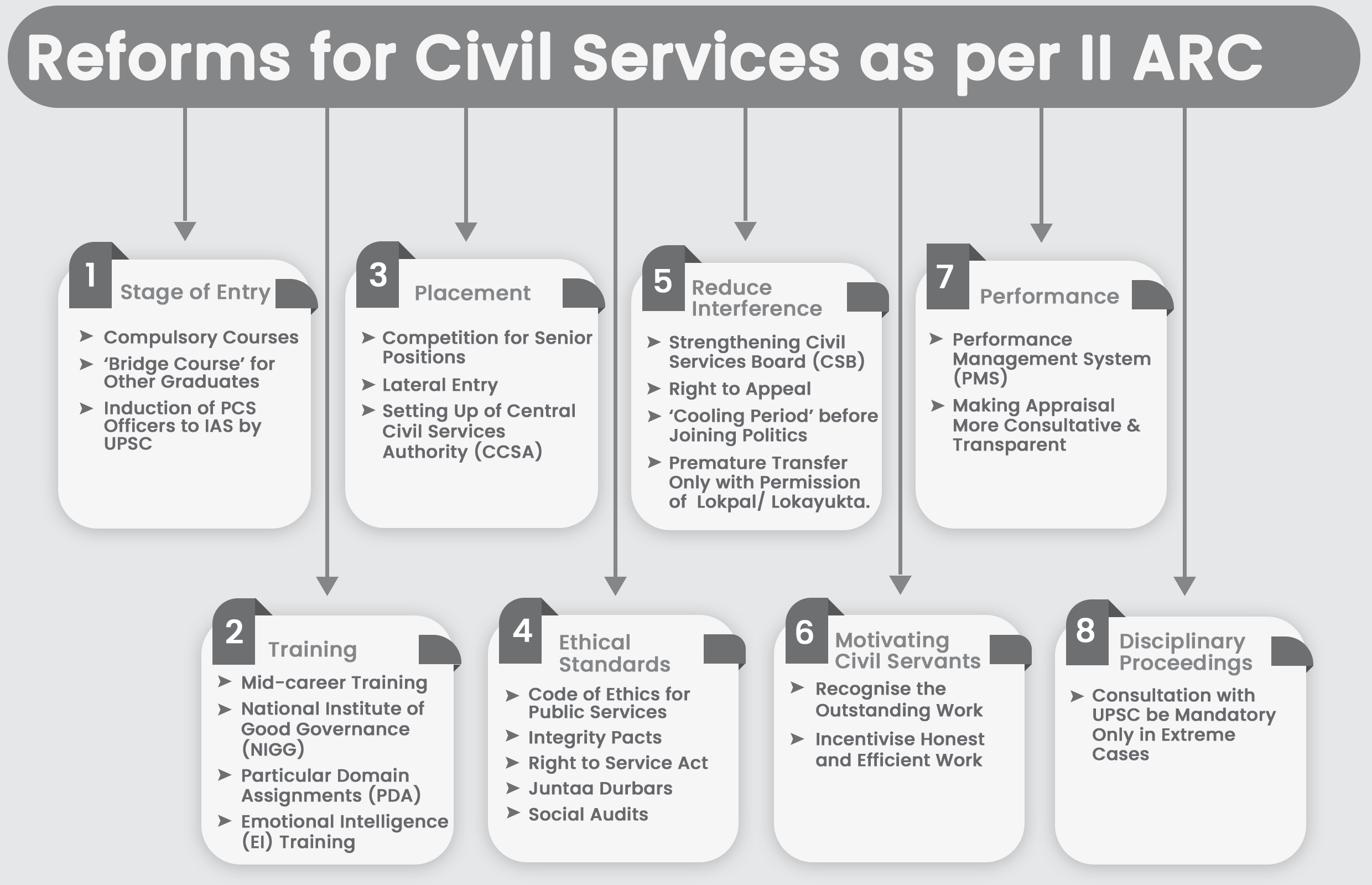
Figure: Reforms for Civil Services as per II ARC Report
• Stage of Entry:
• Compulsory courses in public administration/ governance/ management at National Institute of Public Administration (NIPA) and other universities.
• ‘Bridge Course’ for other graduates in the core subjects mentioned above.
• The induction of officers of the State Civil Services into the IAS should be done by the UPSC.
• Training andCapacity Building (Skilled Bureaucracy):
• Every government servant should undergo mandatory successful training at the induction stage and also periodically for promotion.
• There is a need to set up a National Institute of Good Governance (NIGG).
• The objective of mid-career training should be to develop the domain expertise required and encouraged to obtain higher academic qualifications along with writing research papers for reputed and authoritative journals.
• Greater focus on emotional intelligence (EI) in the wake of recent suicides of officers.
•
Routine work should be done using technology and more constructive roles be assigned to manpower.
• Particular Domain Assignments (PDA) to an IAS officer by Central Civil Services Authority (CCSA), based on their education, training, interest, and interviews by restricting the departments to few domains.
• Placement at Middle & Senior Management:
• A Central Civil Services Authority (CCSA) be established to deal with matters of assignment of domains to officers at middle levels, fixing tenures for senior posts, deciding posts to be advertised for lateral entry etc.
• There is a need to introduce competition for senior positions in government by opening these positions in Government to all Services through lateral entry in an institutionalized, transparent process at both the Central and state levels.
• Performance Management System (PMS):
• Making appraisal more consultative and transparent, Performance appraisal formats to be made job-specific and the scope of the present performance appraisal system of its employees be expanded to a comprehensive performance management system (PMS).
• Reduce Interference:
• Civil Services Board (CSB) needs to be strengthened for promotions and transfers of civil servants to bring down unnecessary interference.
• Expand the ambit of fixed tenure posts to important departmental secretaries like revenue, agriculture and power.
• Premature transfer be done only on the recommendations of Lokpal/ Lokayukta.
• Right to Appeal against transfers be provided to the civil servants.
• There should be a ‘cooling period’ for civil servants before joining politics.
• Motivating Civil Servants
• There is a need to recognise the outstanding work of serving civil servants including through National, State and district level awards.
• There is a need to incentivise honest and efficient work of civil servants.
• Enhancing Ethical Standards and Reduce Corruption:
• The Commission recommended Code of Ethics for public services
• Upholding the constitutional spirit,
• Adherence to the highest standards of Integrity and conduct;
• Impartiality: Making decisions on merit without bias and prejudice.
• Nonpartisanship: Making decisions not based on any political party or group or community, even if one strongly agrees with its ideals.
• Objectivity: Adhering to logical judgments based on data, facts, evidence, law, and established standards, practices, and norms.
• Dedication to public service: Passion to work in the greater good of the public.
• Empathy (capacity to perceive and appreciate other people’s experiences and feelings) and compassion (deeper level of empathy, demonstrating an actual desire to help the suffering person) towards the weaker sections.
• Introduce Integrity Pacts to boost the level of ethical conduct.
• Reducing discretionary power
• Strengthening Grievance redressal mechanisms
• Right to Service Act be put in place in every state for legally binding service delivery in a time-bound manner to raise accountability of officials.
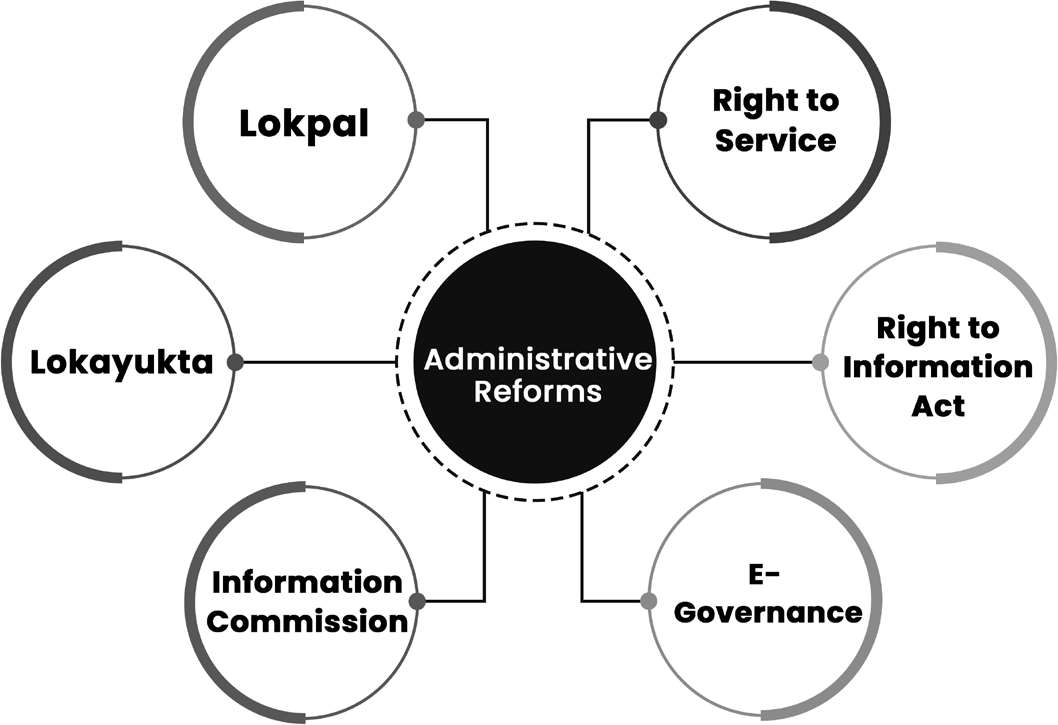
Figure: Aspects of Administrative Reforms
• Proactive monitoring
• Rewarding the honest
• Introduce transparency through extensive use of technology
• Extend competition in sectors where government is having monopoly
• Extend social accountability like Juntaa Durbars and Social Audits
• Disciplinary Proceedings
In the case of disciplinary proceedings, consultation with the UPSC should be mandatory only in cases involving the likely dismissal or removal of a government servant.
Recommendations by the Nolan Committee on Seven Principles of Public Life
Recommendations by the Nolan Committee on Seven Principles of Public Life
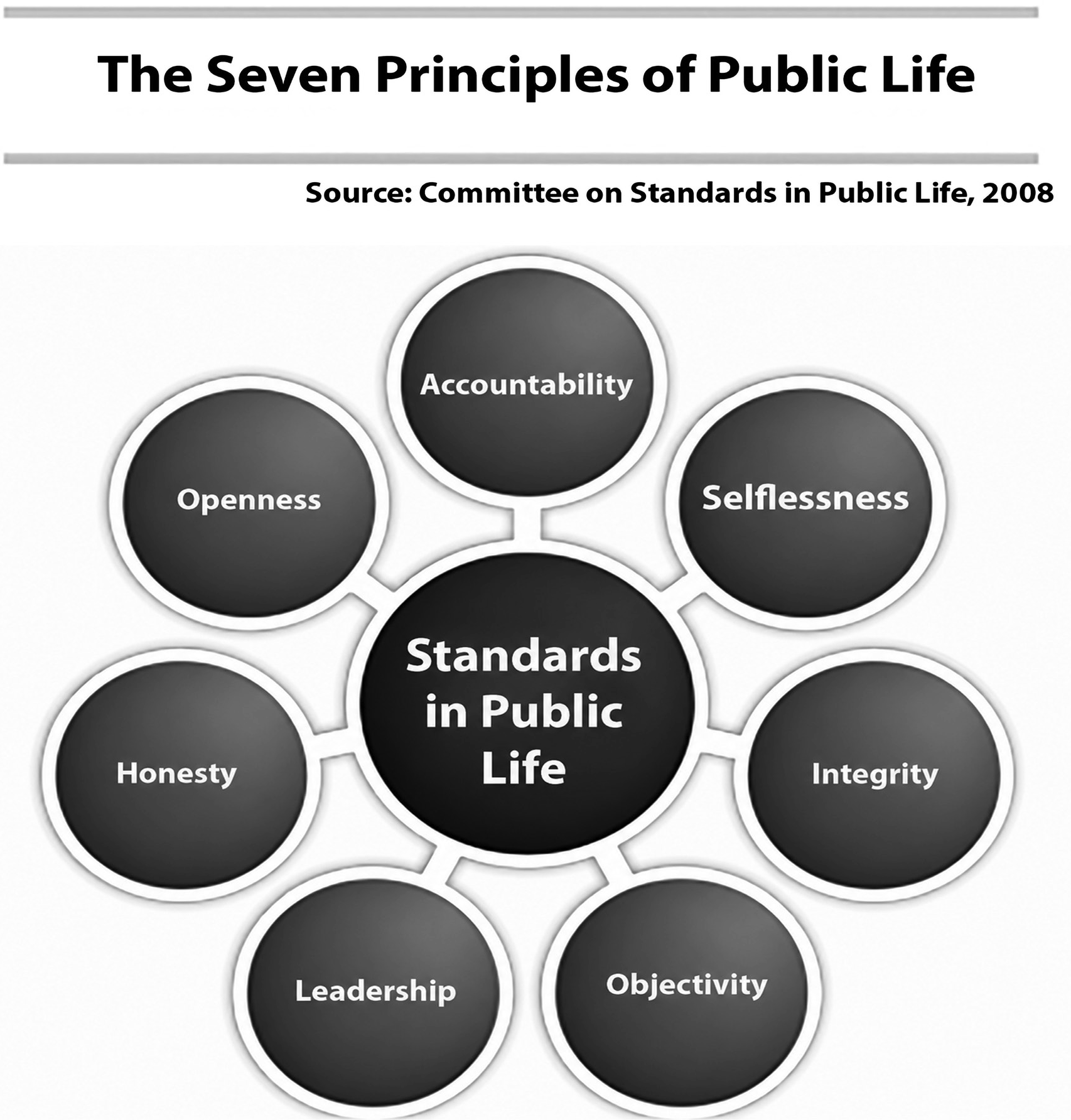
Figure: Nolan Committee on Seven Principles of Public Life
Selflessness: Holders of public office should take decisions solely in terms of the public interest. They should not do so in order to gain financial or other material benefits for themselves, their family, or their friends.
Integrity:
Holders of public office should not place themselves under any financial or other obligation to outside
individuals or organisations that might influence them in the performance of their official duties.
It means to be honest and consistent in thoughts, speech and action. It is a quality of eliminating the gap between ‘what we think, what we say, and
what we do’.
Objectivity: In carrying out the public business, including making public appointments awarding
contracts, or recommending individuals for rewards and benefits, holders of public office should make choices on merit.
Accountability: Holders of public office are accountable to the public for their decisions and actions and must submit themselves to whatever scrutiny is appropriate to their office.
Openness: Holders of public office should be as open as possible about all the decisions and actions that they take. They should give reasons for their decisions and restrict information only when the wider public interest clearly demands.
Honesty: Holders of public office have a duty to declare any private interests relating to their public duties and to take steps to resolve any conflicts arising in a way that protects the public interest.
Leadership: Holders of public office should promote and support these principles by leadership and example
Recent Steps Taken by the Government
Recent Steps Taken by the Government
• Policy Initiatives of the new Reforms
• ‘Rules based’ to ‘Roles based’ Human Resource Management
• Aligning work allocation of civil servants by matching their competencies to the requirements of the post.
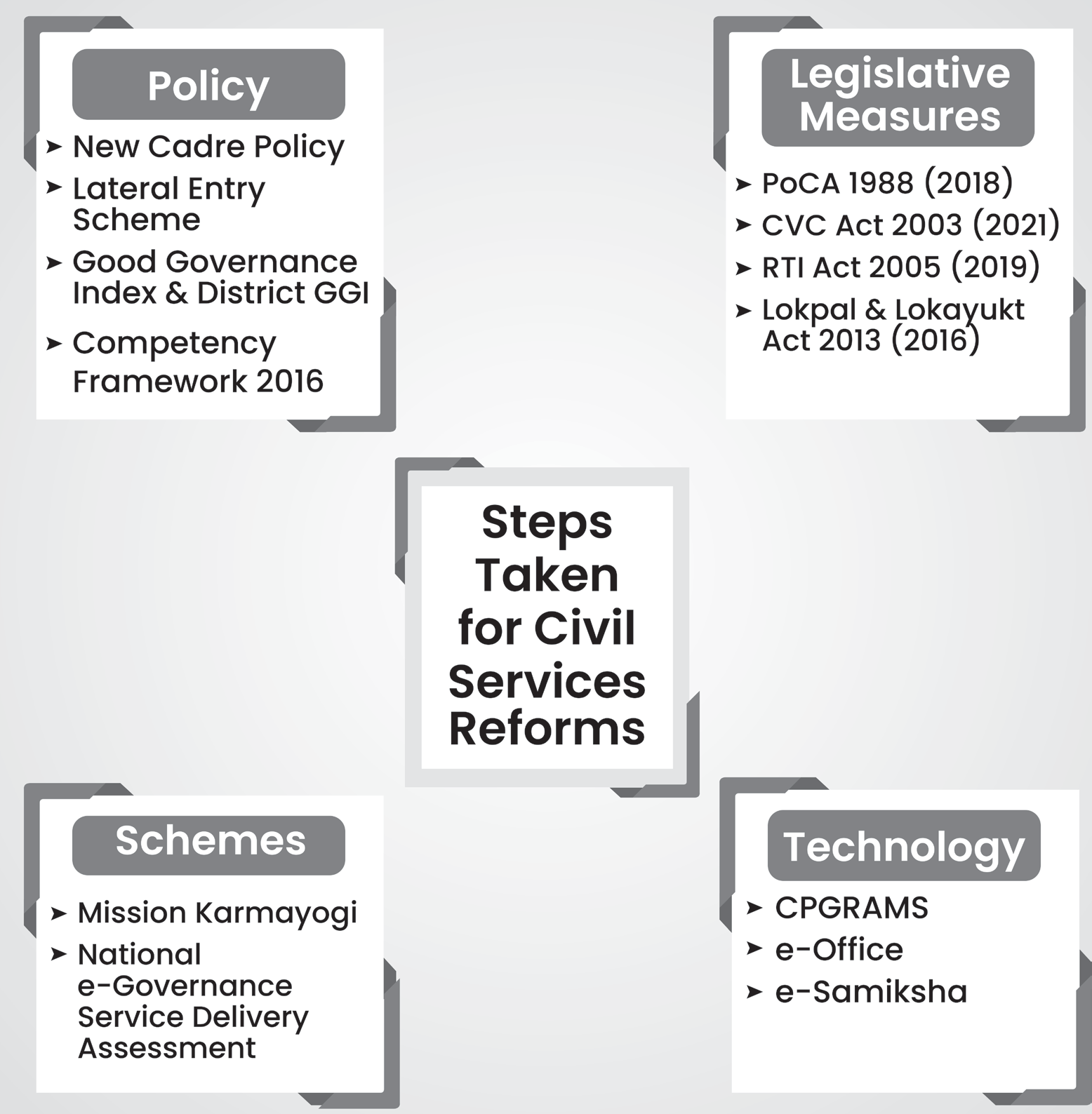
Figure: Steps Taken for Civil Services Reforms
• To emphasize on ‘on-site learning’ to complement the ‘off-site’ learning through shared training infrastructure including that of learning materials, institutions and personnel.
• Framework of Roles, Activities and Competencies
(FRACs) or Competency Framework for Civil Servants 2016: It is an approach to create and deliver learning content relevant to the identified FRACs in every Government entity, based on Kiran Agrawal Committee report 2014.
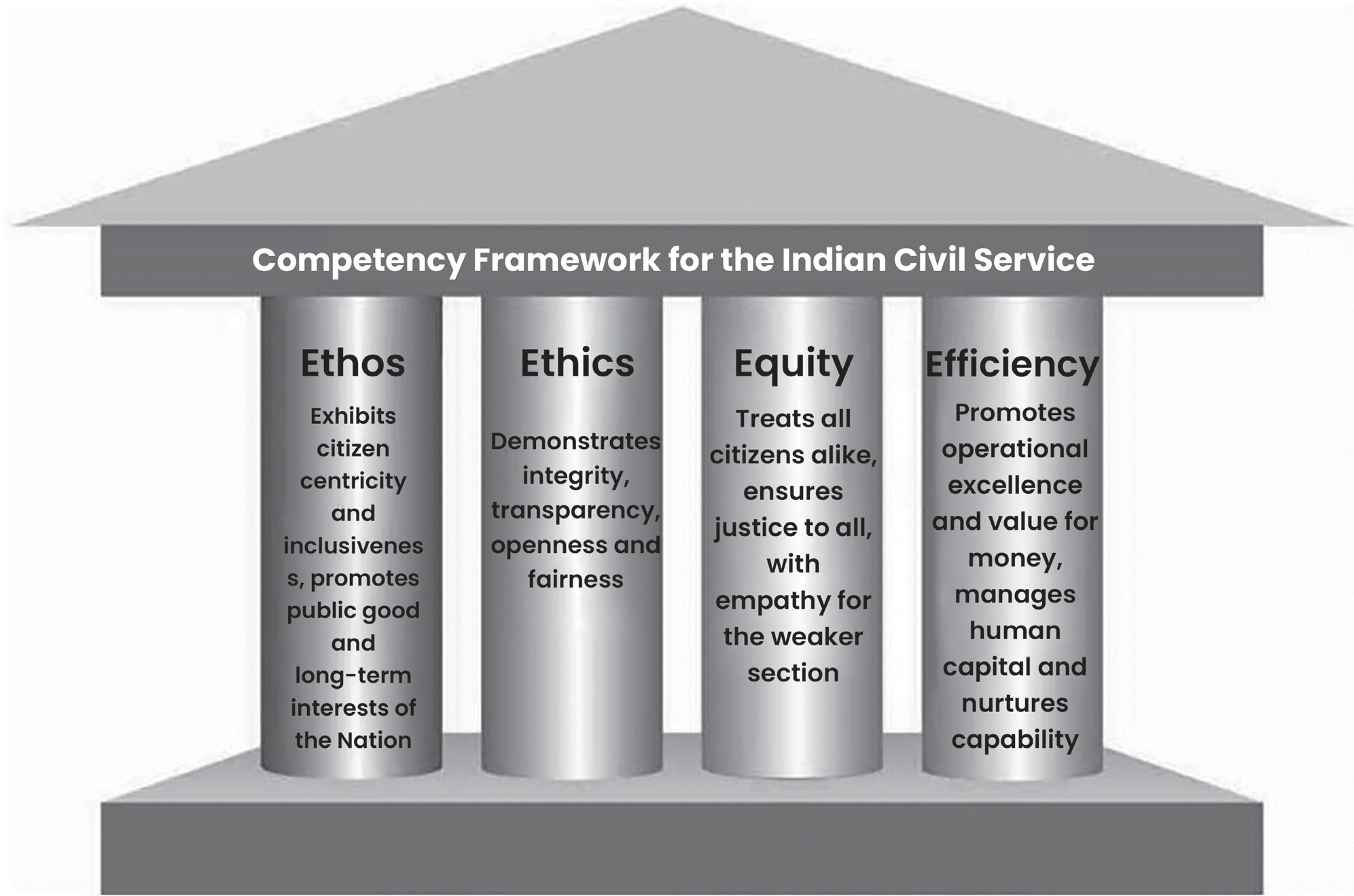
Figure: Competency Framework for the Indian Civil Services
• To help civil servants build and strengthen their Behavioural, Functional, and Domain Competencies in their self-driven and mandated learning paths.
• It was pioneered by Department of Personnel and Training (DoPT) with UNDP. Initially it was introduced at Project Management Unit (PMU) within the Prime Minister’s Office, Ministry of Corporate Affairs and the Department of Personnel and Training, and three departments namely the Police, Social Justice and Scheduled Tribes Development.
• Good Governance Index (GGI) 2019 is a comprehensive and implementable framework by DARPG to assess the state of governance across the states and UTs which enables ranking of states/ districts for developing competitive spirit for improvement.
• District Good Governance Index (DGGI) 2022 represents Next Generation Administrative Reforms in Benchmarking Governance at District Level and helps to identify the impact of various governance interventions at the district level and provide a futuristic map.
• “360 degrees” Performance Appraisal mechanism was introduced in 2015 to supplement the existing system of ACRs for senior bureaucrats, whereby
officers are graded based on comprehensive feedback from their superiors, juniors and external stakeholders to ensure an integrated
analysis of performance.
• New Director General of Police (DGP) Selection
Process:
• Now UPSC to shortlist three candidates for the post of DGP out of a list of senior most officers sent by the state government.
• Criteria to be seniority, performance appraisal, integrity etc.
• Then the state government will choose from the list sent by the UPSC.
• This change was based on the orders of the Hon’ble Supreme Court in 2018 in the spirit of promoting transparency in decision making, reducing excessive interference while adhering to the spirit of democracy by allowing choice to the state governments.
• New Cadre Policy (2017)
• In the new policy, aimed at “national integration”, divides the 26 states into 5 zonal cadres.
• Zone-I – AGMUT, Jammu, and Kashmir, Himachal Pradesh, Uttarakhand, Punjab, Rajasthan, and Haryana
• Zone-II – Uttar Pradesh, Bihar, Jharkhand, and
Odisha
• Zone-III – Gujarat, Maharashtra, Madhya Pradesh
and Chhattisgarh
• Zone-IV – West Bengal, Sikkim, Assam-Meghalaya.
Manipur, Tripura
• Zone-V – Telangana. Andhra Pradesh, Karnataka,
Tamil Nadu and Kerala
Candidates have to give cadre choices in descending order of preference from among the various zones. Candidates can only select one state/cadre from a zone as their first choice.
Their next choice has to be from a different zone. It is only after selecting first choice in all the zones, one can select the second state/cadre from the first zone.
This will avoid the trend of regional bias in their subsequent preferences and promote national outlook within the services.
Establishing New Services: The Govt. of India approved the formation of the
Indian Skill Development Service in 2015
Indian Enterprise Development Service in 2016
Indian Railways Management Service in 2019
Citizen Charters: Government has mandated Citizen Charters for all Ministries/Departments which are updated and reviewed on a regular basis.
Lateral Entry of professionals in Civil Services started in 2019 in the spirit of Open and Skilled Bureaucracy.
The term ‘lateral entry’ means the appointment of specialists and experts, mainly those from the private sector, in government organizations and ministries on a three-year contract basis.
Aim: To recruit outstanding professionals having expertise in revenue, financial services, economic affairs, agriculture, cooperation and farmers’ welfare, road transport and highway, civil aviation, commerce among many other sectors to serve for the benefit of the country.
Right talent for the right role is the principle behind it.
37 officers appointed so far through lateral recruitment — 7 in 2019 & 30 in 2021.
Advantages
Specialisation: The private sector specialisation in the top tier of Indian bureaucracy will address the old concern of generalist bureaucracy.
Seasoned Professionals:
Allowing for lateral entry of seasoned professionals and experts into the service helps improve administrative judgement and capabilities in the IAS.
Filling The Gap:
According to Department of Personnel and Training data, there is a shortage of about 1500 IAS officers. Lateral entry can help bridge this deficit.
Alternative to Meritocracy:
Allowing experts from the professional sphere is expected to shake the IAS out of their comfort zone, through meritocracy.
Participatory Governance:
Presently, in the spirit of participatory and multi-actor approach, the lateral entry provides stakeholders such as the private sector and non-profits an opportunity to participate in governance.
Connected Bureaucracy:
Assess impact of its policy decisions have on various stakeholders like private sector, those who have experienced government from the outside.
Some good case studies prevail:
Good Past experience of Finance Ministry, Reserve Bank of India and even the current NITI Aayog, by hiring Raghuram Rajan, Arvind Subramanian and Arvind Panagariya to name a few.
Limitations
Private and Public work culture:
Lateral entrants from the private sector and academia may not work well with the bureaucracy due to differences in work culture, turf wars and systemic inertia may come in the way.
Privilege v/s Merit:
As the IAS officers coming through one of the hardest open competitive examinations in the world and serving some of the poorest districts in our hinterlands, lateral entrants entering from privileged and private sector back ground may have never seen a village school.
Profit Motive vs. Public Service:
Experts may feel difficult to endure the fundamental transition from a private sector’s profit-oriented approach to Government’s public service approach.
Expertise Available:
There is a difference between bringing expertise and being part of the decision-making process.
Expertise is widely available and used by almost every ministry — expert committees, consultations, think tank engagements, etc.
Exploitation of Newcomers:
It’s important to gauge what processes the Centre has put in place to ease the transition and establish authority to avoid being exploited.
Transparency in Recruitment:
One of the many reasons for the opposition against lateral entry recruitment is the transparency of the lateral entry process It is essential to select the right people in a manner that is manifestly transparent
Schemes Launched for Civil Service Reforms:
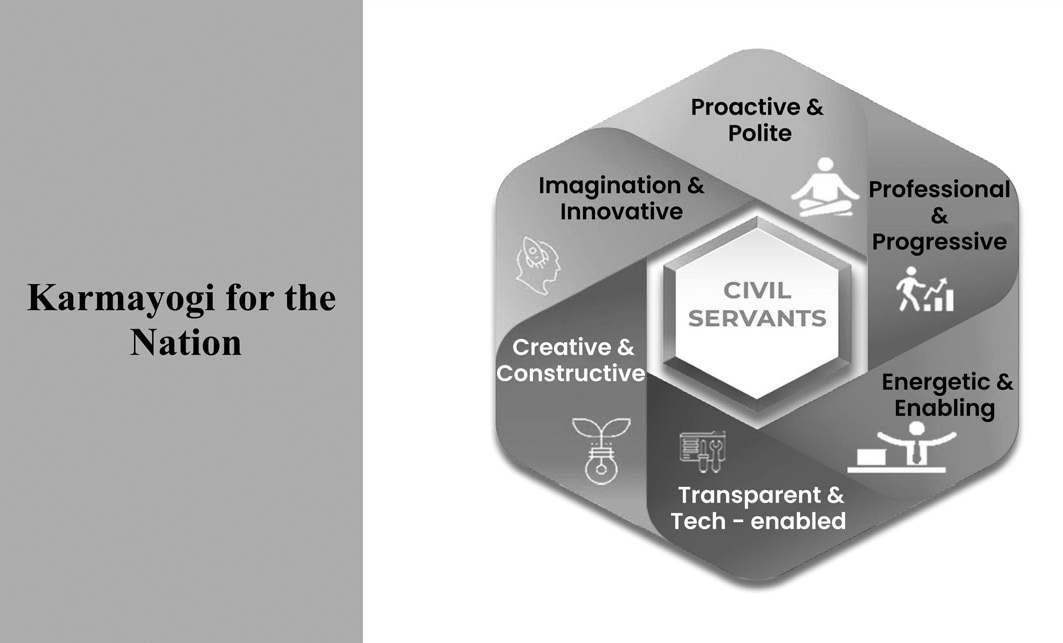
Mission Karmayogi 2020
Mission Karmayogi aims to prepare the Indian Civil Servant for the future by making him more creative, constructive, imaginative, innovative, proactive, professional,
progressive, energetic, enabling, transparent and technology-enabled. (CCIIPPPEETT)
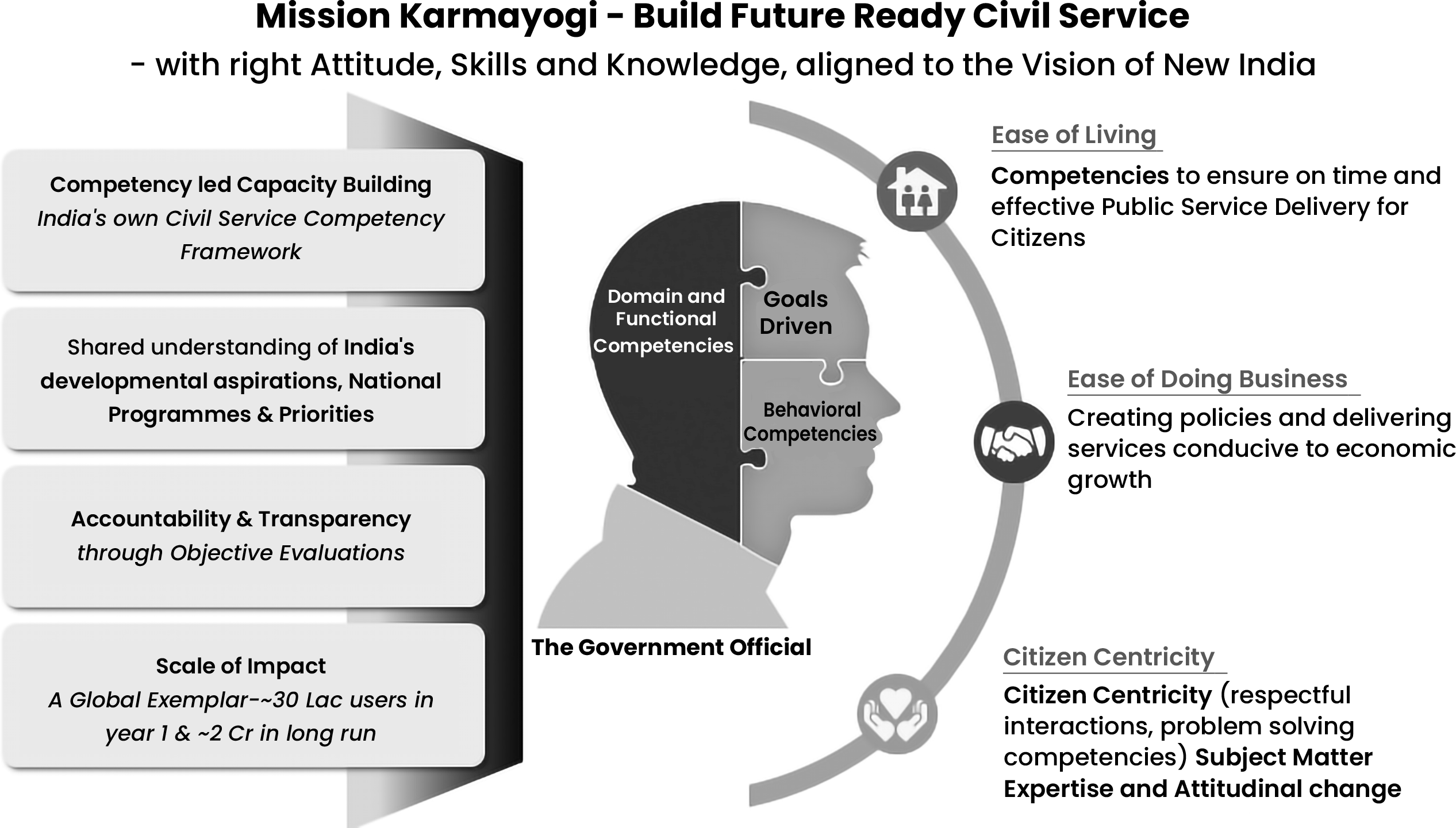
Figure: Mission Karmayogi
Also known as National Programme for Civil Services Capacity Building (NPCSCB) launched in 2020 to be achieved till 2025.
It is a comprehensive reform of the capacity building apparatus at individual, institutional and process levels for efficient public service delivery.
It is focused on “governance, performance, and accountability” and behavioral change.
Converged and Connected Bureaucracy: lt promises a shift from silos to coordination, interdisciplinary movements, and a horizontal
inter-departmental convergence in a vertical hierarchical administration.
• The focus of the reform is the creation of a ‘citizen-centric civil service’ conducive to economic growth and public welfare.
•
Institutional Framework
• Prime Minister’s Public Human Resources (HR) Council
• Capacity Building Commission
• Special Purpose Vehicle (non-profit company) has been set up under the Companies Act 2013 to manage i-GOT (Integrated Government Online Training) for owning and operating the digital assets and the technological platform for online training
• Coordination Unit headed by the Cabinet Secretary
• It aims for learning resources from the best institutions and practices from across the world while retaining Indian sensibilities and culture.
• The mid-career training will now be available to all government staff instead of the top officers alone, and their profile and assessment will be continuous.
• If there is a need for some special appointment, then authorities can do so by looking at the profile of the officers with the help of technology instead of depending on perceptions.
• National e-Governance Service Delivery Assessment: It aims at assessing the States, UTs and Central Ministries on the efficiency of e-Governance service delivery.
• Technology or e-Governance Initiatives:
• e-Office: The e-Office solution of 2018, under National e-Governance Programme (NeGP), enables core operations of the Government at all levels to be performed in a virtual ‘paper-less’ environment. This application is, thus, a major step in realizing the objective of an open and responsive Government.
•
e-Samiksha: A real time online system for monitoring and follow up action on the decisions taken by the Government at the Apex level in respect of implementation of important Government programmes/projects.
• National Conference on e-Governance: It provides a platform for the government to engage with experts, intellectuals from industry and academic institutions to exchange experiences relating to e-Governance initiatives.
• Centralized Public Grievance Redress and Monitoring System (CPGRAMS): It is an online web-enabled system developed by National Informatics Centre (Ministry of Electronics & IT (MeitY)), in association with Directorate of Public Grievances (DPG) and Department of Administrative Reforms and Public Grievances (DARPG).
• The CPGRAMS provides the facility to lodge a grievance online from any geographical location. It enables the citizen to track online the grievance being followed up with Departments concerned and also enables DARPG to monitor the grievance.
• Legislative Measures against curbing corruption:
• Prevention of Corruption Act 1988 (Amended in 2018)
• Provides a definition for corruption and lists out the acts which would amount to as corruption such as bribes, gifts for favors etc.
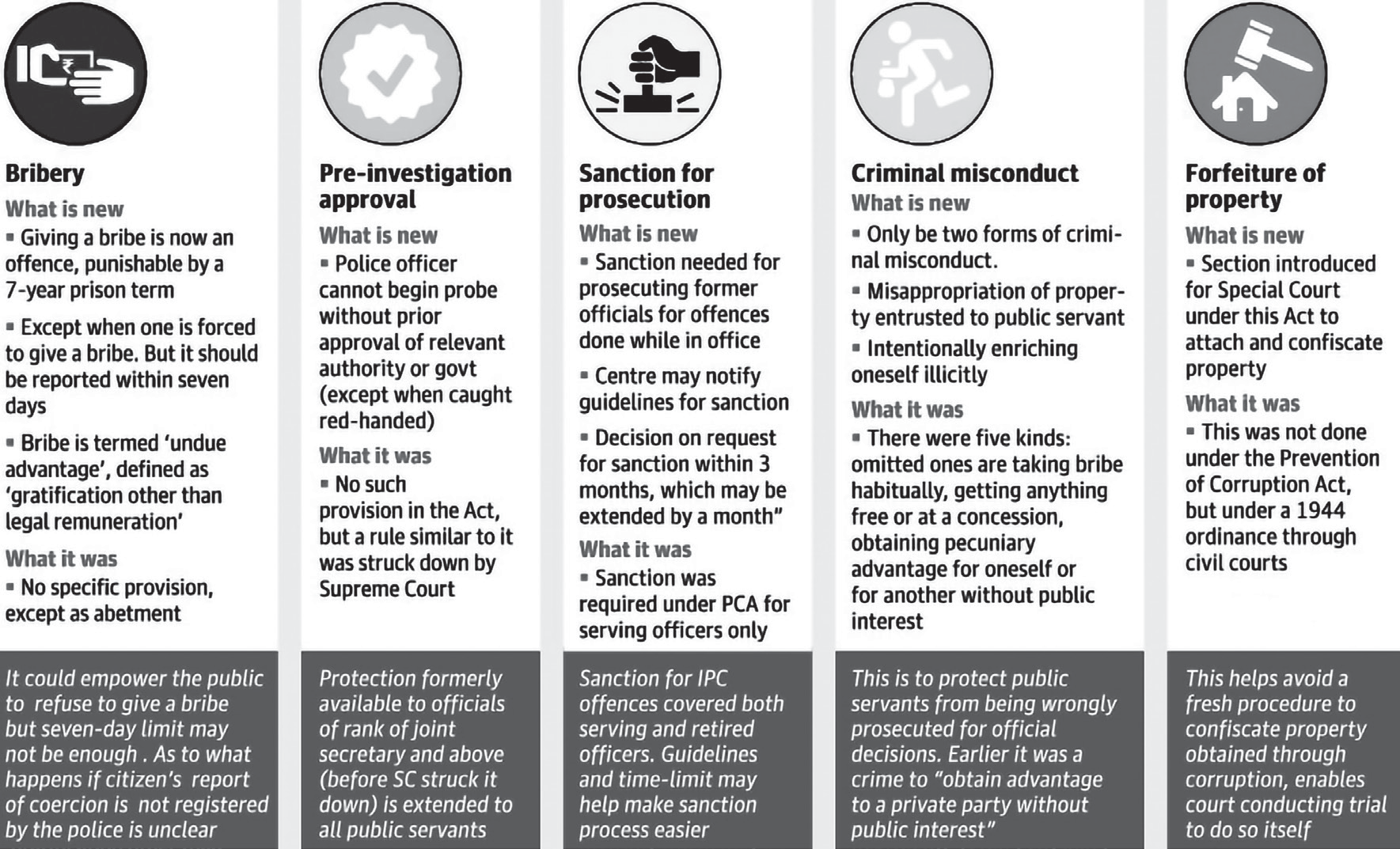
Figure: Prevention of Corruption Amendment Act 2018
• Seeks to create a balance between need to bring corrupt to the books and protect honest officers. Prosecution of an officer requires sanction from the government.
• Includes employees of the central government and the union territories, the employees of public undertakings, nationalized banks etc.
• Special judges are appointed for trial under the act who can order a summary trial in appropriate cases
• The Prohibition of Benami Property Transactions Act 1988 (Amended in 2016)

Figure: Benami Transactions
• Benami: Deal where property is held by real or fictitious persons on behalf of someone who has paid for it.
• Penalty: Property confiscated and persons involved fined or jailed. Property will belong to Centre.
• Redressal: Appellate tribunal to be formed.
• Exceptions: Trusts, temples, mosques among others can hold property in name of other beneficiaries.
• Recent amendments have widened the definition of the benami property and allow the government to confiscate such properties without any hassles of court approvals.
• Central Vigilance Commission Act 2003 (Amended in 2021)
• The 2003 Act provides for the constitution of a Central Vigilance Commission to conduct inquiries into offences alleged to have been committed under the Prevention of Corruption Act, 1988 (PoCA).
• Central Vigilance Commissioner shall be appointed by President on recommendation of a Committee, consisting of the Prime Minister, Minister of Home Affairs(MHA) and Leader of Opposition(LoP) in Lok Sabha.
• Covers All India Service officers, Gazetted officers of Union, senior members of the Public Sector Banks etc.
•
Commission, while conducting the inquiry has all the powers of a Civil Court.
• Recent amendment allows the extension of term of the Director of Enforcement (ED): Directorate of Enforcement is a specialized financial investigation agency under the Department of Revenue, Ministry of Finance to enforce Foreign Exchange Management Act,1999 (FEMA) and Prevention of Money
Laundering Act, 2002 (PMLA)
• Under the 2003 Act, the Director of Enforcement is appointed by the central government, on the recommendation of a committee which is chaired by the Central Vigilance Commissioner, and includes the Secretaries from the Ministries of Home Affairs, Personnel, and the Revenue Department.
• The Director of Enforcement has a tenure of minimum two years. The Amendment adds that the tenure of the Director may be extended by up to one year at a time, till the completion of five years from the initial appointment. Such extensions may be granted in public interest, on the recommendation of the Committee.
• Delhi Special Police Establishment (DSPE) Act, 1946 (Amended in 2019 along with CVC Act)
• The Central Bureau of Investigation (CBI) is not a statutory body. It derives its powers from the DSPE Act, 1946. The CBI is the main investigating agency of the Central Government. It also provides assistance to the Central Vigilance Commission and Lokpal.
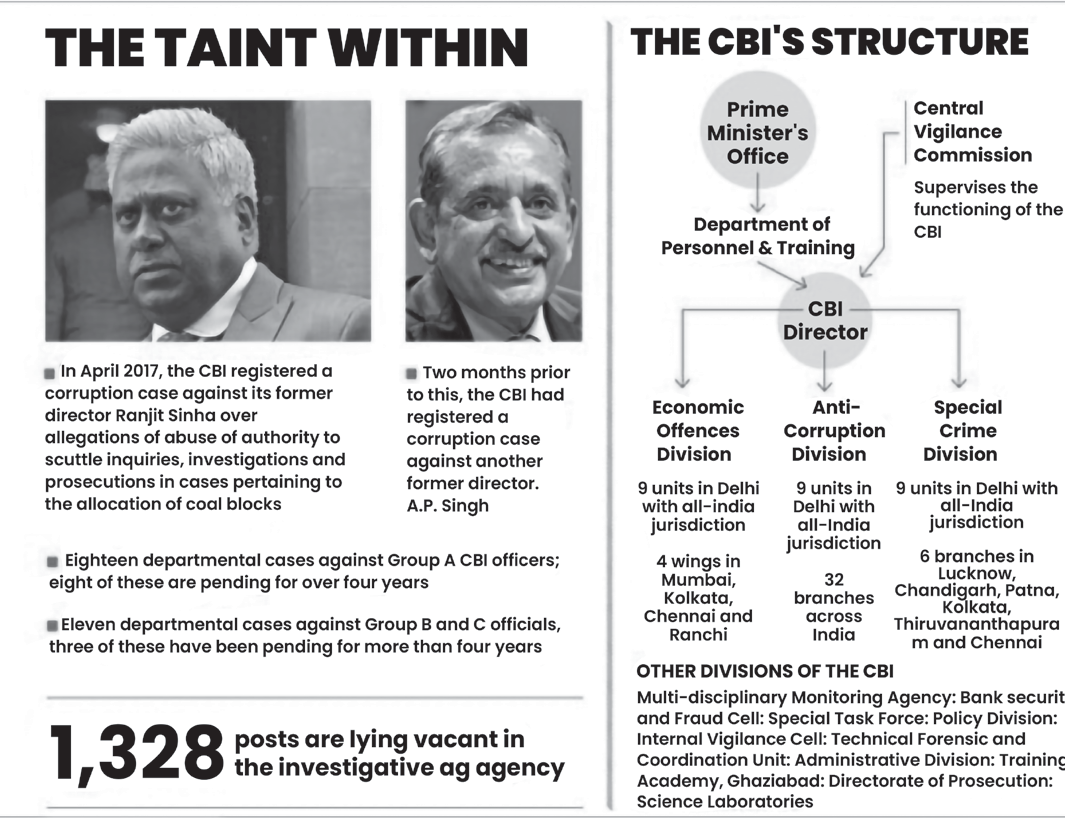
• It is also the nodal police agency in India which coordinates investigations on behalf of Interpol Member countries.
• The CBI is headed by a Director.
• The CBI has jurisdiction to investigate offences pertaining to 69 Central laws, 18 State Acts and 231 offences in the IPC.
• The Central Bureau of Investigation (CBI) was set up in 1963 by a resolution of the Ministry of Home Affairs on the recommendation of Santhanam Committee 1962.
• Now, the CBI comes under the administrative control of the Department of Personnel and Training (DoPT) of the Ministry of Personnel, Public Grievances and Pensions.
• Amendments in DSPE Act: Director tenure may be extended, in public interest, on the recommendation of the Committee (the committee led by the Prime Minister and
leader of Opposition and CJI as members) and for the reasons to be recorded in writing, up to one year at a time.
• Provided further that no such extension shall be granted after the completion of a period of five years in total including the period mentioned in the initial appointment.
• Right to Information Act 2005 (Amended in 2019)
• Makes disclosure of information a legal right
of the public to promote transparency
• Section 4 mandates proactive disclosure of the information and digitization of the records
• Many RTI activists have used it to bring out the irregularities in the functioning of the public authorities e.g. Vyapam scam of MP, Adarsh Housing scam of Maharashtra, etc.
| Differences | 2005 Act | 2019 Amendment |
| Term | Chief Information Commissioner (CIC) and Information Commissioners (ICs) at central and state levels will serve for five years. | Central government will notify the term of office. |
| Salary | At central level, salary of CIC and ICs equivalent to salary of Chief Election Commissioner and Election Commissioners, respectively At state level, equivalent to salary of Election Commissioners and Chief Secretary, respectively. | Salaries, allowances, and other terms and conditions of service of central and state CC and ICs will be determined by the central government. |
| Deductions | At the time of appointment, if CIC and ICs (at central and state levels) are receiving pension or any other retirement benefits for previous government service, their salaries will be reduced by an amount equal to that pension. Previous government service includes service under: (1) the central government, (ii) state government, (i) corporation established under a central or state Law, and (iv)company owned or controlled by the central or state government. | The Bill removes these provisions. |
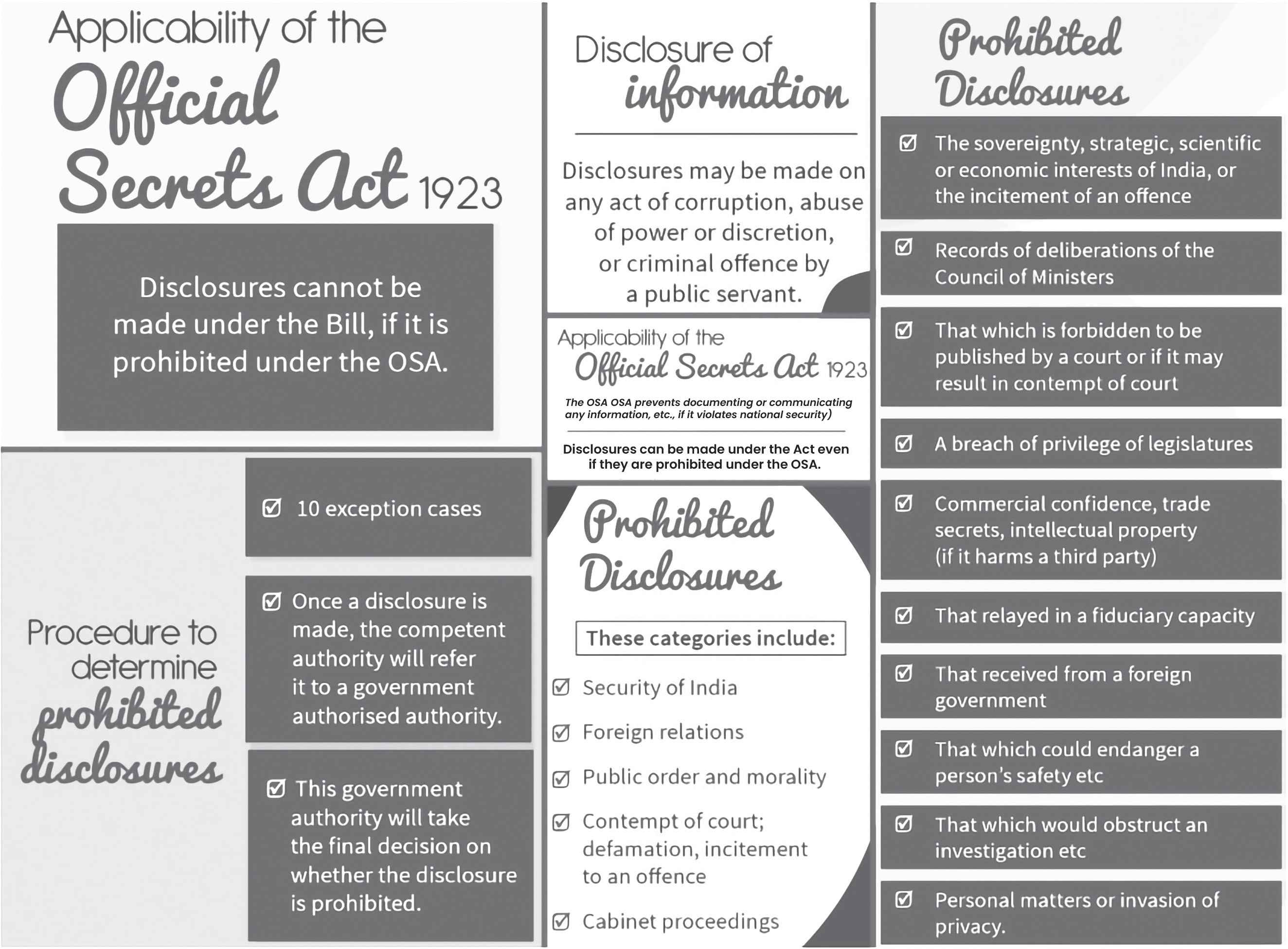
• Whistleblower Protection Act 2014 (WPA)
• More than 50 RTI activists have been murdered between 2007-14 and many more assaulted due to lack of protection according to Accountability Research Center report (2015) on Attacks on RTI Activists.
• WPA accords special protection to the people who disclose the acts of wrongdoing in the government. It provides anonymity and
protection from prosecution under acts such as Official Secrets Act 1923.
• This Act, which provides for a statutory framework for concealing the identity of whistle-blowers and protecting them against victimisation, was passed by Parliament in 2014 but was not yet operationalised as the rules were not framed and the date of the Act coming into force was not notified.
Lokpal and Lokayukta Act 2013 (Amended in 2016)
LOKPAL AND LOKAYUKTA
• Lokpal is an eight member body as ombudsman appointed by the President to work on citizens’ complaints and grievances regarding corruption at the central level by the government servants and MPs (including Prime Minister). Lokpal will be appointed by committee consisting of PM, LoP, CJI, Speaker and an eminent jurist.
• Lokayukta is a three-member body appointed by the Governor at the state level to investigate complaints made by the residents of the state, against the corruption by state government servants or any MLAs.
• Corruption:Insimpleterms,itreferstotheunauthorized use of public power, typically by a public servant or by an elected politician. In India, on the recommendation
of the Administrative Reforms Commission (ARC), bodies like Lokpal and Lokayukta are set up under Lokpal and Lokayukta Act, 2013.
Recent Amendments: It also amended Section 44 of the 2013 Act that deals with the provision of furnishing of details of assets and liabilities of public servants in the form and manner as prescribed by the government, removing the 30 days limit
Remedies to Fight Corruption
There is a need for windfall reforms in each and every section of the system to fight the menace. Every aspect of governance must be improved for efficiency, economy, and effectiveness.
Strengthening of autonomous institutions:
Protecting the autonomy of CIC-giving him a constitutional status.
Provision of required manpower, infrastructure, training of vigilance agencies.
Eliminate overlapping of jurisdiction- e.g., Lokpal and CBI
Administrative reforms:
Establishing the Civil Service Board to curb the excessive political control over the administration
Reducing the hierarchy levels in the governments
Simplifying the disciplinary proceedings and strengthening preventive vigilance within the departments to ensure corrupt civil servant do not occupy the sensitive position
Code of Conduct for different organs of Government
• Setting up Vigilance Cells/Commissions
• Electoral reforms
• Barring the criminals from even participating in the elections as suggested by the Election Commission.
• Imposing limits on the overall expenditure of the political parties.
• Making state funding of elections a reality.
• Governance reforms:
• Social Audits must be effectively implemented at all levels of schemes and programme implementation for ensuring public participation.
• E-governance apart from advancing the good governance objectives of accountability and
transparency also seeks to reduce the manual interface between state and citizen thus preventing the incidences of bribery.
• Enactment of the Right to Service Act. E.g., Rajasthan Social Accountability Bill
• Drives like Digital India projects like Government
e-Marketplace must be expanded.
• Economic reforms:
• Negating legal lacunae in banking, stock market legislations.
• Formalisation of the economy.
• Refining and speedy implementation of GST
Corruption Continuing Despite Measures in India
Corruption Continuing Despite Measures in India
Lack of Strict measures and Judicial Delays: Inordinate Delays in justice delivery (like average case resolution period is 5 years) and culture of impunity against the high and mighty (either they get stay on the case or get quick bail). Lack of accountability among those in public offices due to constitutional protection under Article 309-311. Thus, there is a need for Zero Tolerance policy against corruption at all levels of governance, along with necessary administrative and judicial reforms.
Power Disparity between Common Man and the Politically powerful: Political corruption is not being punished and not turning into convictions. For instance, there are very few convictions in such cases or the cases delay too much due to continuous appeals. There is a need to bring fast tracking of political cases through judicially constituted Special Investigation Team (SIT) and daily hearing of cases.
Lack of Overall Environment: The key issue behind this phenomenon is the lack of pro-ethical environment. The children are not taught to be upright and ethical at home and schools and not expected to be righteous in their daily transactions. Thus, there is a need to utilise Pavlov Conditioning and Operant Conditioning principles to inculcate the habit of honesty among the children and create an atmosphere of integrity and ethical behaviour.
Mindset of Difficulty: Further, there is a misconceived perception that practicing integrity is difficult and disadvantageous. Furthermore, it is considered to be a stupidity to follow probity and integrity especially when there is competition among people in business and daily public transactions because it is considered to be wise to be consequentialist and utilitarian to maximise one’s gains. Thus, there is a need to create an ethics-friendly governance and ensure Ease of Ethical Living.
Lack of Culture of Sharing and Kindness: People in daily life, though appreciate kindness by others like on social media but never practice in their own daily lives. This cognitive dissonance and insensitivity are also visible on traffic lights where poor and beggars are rudely behaved with or ignored vehemently. Thus, there is a need to utilise celebrities and role models to promote kindness, tolerance and philanthropy among the people.
Culture of Consumerism and High Inequality: India is facing higher inequality where some professions and careers are earning excessively high and others are meagrely paid like software domain vs teaching. Also, gap between rich and poor is widening as visible in the Gini Coefficient. High consumerism is also increasing greed for more instead of being content. Therefore, there is an urgent need to promote dignity of labour, implementing policies of Just Distribution and Capability Enhancement apart from the Ethics of Conserving the nature and resources especially among the rich. Circular Economy must be the mantra for the coming generation.
Other Debates Surrounding Civil Services
Other debates surrounding Civil Services Generalist vs Specialist Debate
• Generalist and specialists are the two components of the civil services in India. between the two is important for the efficiency of civil services.
• A generalist civil servant is the one who does not possess a specialized background but is well versed with the administrative procedures, rules and regulations, and hence can be appointed in any field of administration. For example, the Indian Administrative Service (IAS) is a generalist par excellence.
• They perform the Planning, Organising, Staffing, Directing, Coordinating, Reporting and Budgeting (POSDCORB) functions.
• A specialist civil servant is the one who possesses expertise or professional skill or knowledge in a specific field or area of administration. For instance, Indian Engineering Service (IES), Doctors, agriculturists, geologists, etc. come under specialists.
| Case for Generalists More suitable for performing Higher-level Management level jobs due to wide and rich experience. Tenure system of Secretariat staffing is based on district of field experience, which favours generalists. Administration, traditionally, was based on ‘area administration’ i.e. taluqa, district, division and so on, which required a generalist. Generalist acts as a mediator between an amateur Minister and the specialist, People and the government, and pressure groups and public interest. The specialists are narrow minded and parochial whereas the generalists have a broader outlook and flexible approach. | Case for Specialists Generalists are not suitable for many policy making positions due to lack of professionalism and adequate knowledge. With changing times, a generalist civil service established on the principle of ‘intelligent amateur theory’, cannot suitably assess the complex technical proposals and require specialist for the job. An IAS officer is a “Jack of all Trades but Master of None.” A minister is deprived of regular expert advice and specialized knowledge. The policy formulation is unrealistic as the generalists are not fully aware of the problems faced by the specialists in implementation. |
Conclusion
• The Constitution Review Commission 2002 suggested the “need to specialise some of the generalists and generalise some of the specialists”. However, specialisation process needs to be flexible according to the preference of IAS officers along with more predictable and transparent to avoid favouritism. Also, on specialist positions, officers should be provided study and training opportunities for deepening their domain knowledge.
In addition to these, the specialised lateral entrants should be required to “generalise” through field postings.
The nature of policy-making at present demands that specialist expertise has to go with generalist experience. Thus, proper cadre management that provides for a right proportion of generalisation and specialisation can improve the efficiency and relevance of civil services.
Relationship between the Civil Servant and the Minister
• The relationship between political executive and permanent officials i.e. civil servants is important because they together constitute the executive branch of the government. If there are problems in their relationship; the administration does not run smoothly.
• Problems are likely due to their different roles:
• Politicians derive their power from the people through periodic elections to represent the people and their interests;
• Civil servants, on the other hand, derive their power from administrative position and technical expertise and experience and get selected on merit.
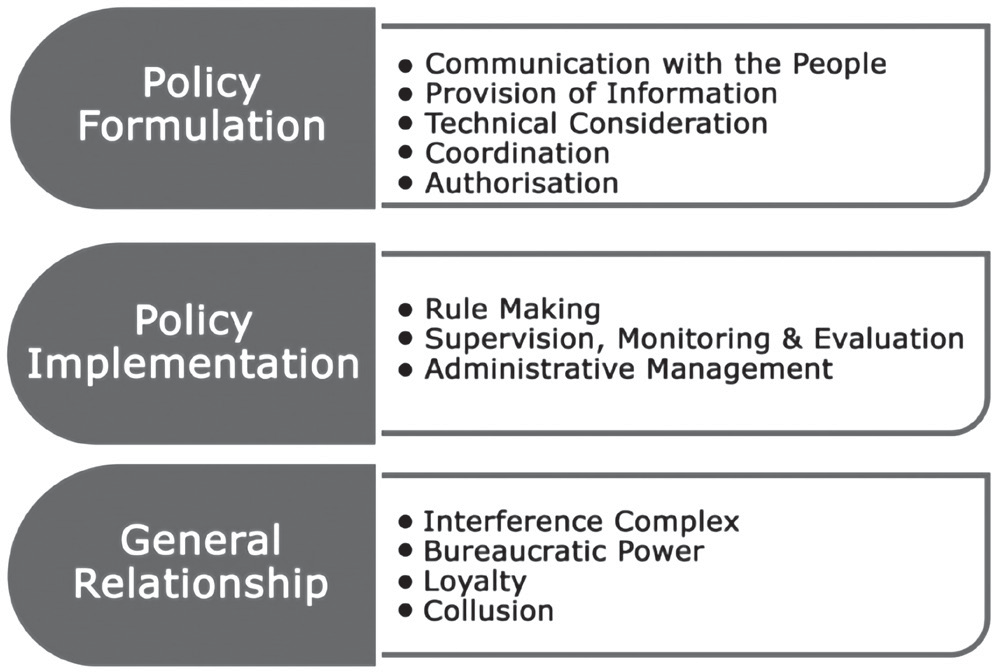
Figure: Relationship between the Civil Servant and Minister
• Relationship dimensions in Policy Formulation: It was earlier believed that while policy was formulated by politicians, it was there is no such separation of functions. This is so in all countries: politicians and the bureaucracy cooperate in the course of both policy formulation and implementation. In developing countries, particularly, it has been found that the bureaucracy plays an important role in policy formulation also.
• Communication with the People:
• Public policy results from the interaction between the people, on the one hand and the politicians and the bureaucracy on the other. They all seek to influence and communicate with each other such as trade unions and associations of farmers, lawyers, doctors. engineers and others.
• Political parties take note of these various interests and try to satisfy all of them as far as justifiably possible. This is known as ‘interest aggregation’.
• However, civil servants sometimes tend to look
upon politicians as mere rabble rousers. While, politicians tend to believe that bureaucrat are unresponsive and insensitive to the problems and needs of the people. This perception is heightened by the cultural and status differences between the higher bureaucracy and the common people.
• Hence politicians and civil servants have to cooperate at all levels, despite their somewhat different roles and viewpoints.
Provision of Information:
Civil servants with their longer experience and command on organisational memory in the shape of files and other records, can provide feedback-information about the programme implementation.
Politicians. on the other hand, are more likely to successfully assess the mood of the people. Thus, for instance, they can tell if people will prefer better services or less taxes.
Politicians are also answerable for mistakes committed by civil servants working under them. Hence, it is also their duty to exercise proper control over the bureaucracy.
Technical Consideration:
Technical examination of policies and programmes is of utmost importance for ensuring that they fulfil the desired goals at the minimum cost.
Analysis of various aspects like substantive aspect of the service through expert advice, practicability aspect through feasibility studies and techno-economic analysis on viability of technology, and social cost-benefit analysis aspect including hidden costs like environment destruction and displacement of people are considered here.
Powerful politicians often over-rule the advice of the bureaucracy in their narrow interests. Sometimes members of the bureaucracy also give recommendations to please ministers or powerful legislators. Such deviations from norms hurt the public interest.
Coordination:
All policies and programmes are to a varying extent interrelated. Thus, agriculture development also requires industrial development for various implements, education to farmers to benefit from new scientific knowledge, good health for productivity.
Thus, harmonization with other policies is essential which requires coordination of a high order, at all levels and stages, as famous
American administrative thinker, Mary Parker Follett, has stressed. So that any inconsistency, gap or duplication is ironed out.
• Authorization:
• The final stage of policy-making is its authorisation. The legislature authorises or approves policies and programmes usually in the shape of laws. Laws are necessary because without their sanction, the government cannot allocate social and monetary resources.
• The significance of the bureaucracy’s contribution is in the legal terminology used in the law which may decide its success or failure.
• For example, The National Commission on Agriculture has noted about the failure of Land Reforms that, “These legislative measures were full of loopholes which were taken advantage of by the bigger landed interests to circumvent the laws”
• Relationship dimensions in the Course of Implementation: While in policy-making politicians have the dominant role, in implementation the bureaucracy has a greater role. While a politician only heads a department as a minister, civil servants’ function at all levels. The minister has to ensure that implementation of policies is done lawfully, effectively and efficiently.
• Rule-making:
• The Laws are made in general terms. The function of filling-in details is left to the executive through the making of rules and regulations under authority given by the legislature which is called delegated legislation.
• As drawing up the rules confers lot of powers upon the bureaucracy. Thus, rules must be laid on the table of the house of the legislature, and scrutinised by members of the legislature. The minister also keeps a check over the bureaucracy in the drawing up of the rules.
• Supervision, Monitoring and Evaluation:
• Supervision over them is exercised by superiors of the department. This supervision generally remains lax in Indian administration as they have little real authority for rewarding or punishing their subordinates.
• So far as punishment is concerned, the cumbersome procedure for taking disciplinary action is also a deterrent.
• The progress achieved is regularly monitored at higher levels through various forms are prescribed for submitting periodic reports. However, such reports are often not even read by the higher official and politicians.
• Overhead (or staff) agencies, like the NITI Aayog, Comptroller and Auditor General of India
(Article 148) with Public Accounts Committee, Estimates Committee make evaluation of policies and programmes whether the work has been done at minimum cost, and in an honest manner.
• Administrative Management:
• Administrative management refers to the management of the organisation as a whole. In India the principal agencies for this purpose are the ministries or departments (in the Union and State Governments respectively) of organizing, finance, planning, personnel and administrative reform or reorganisation.
• For example, maintenance of law and order and dealing with terrorism require a well- managed police force. Unless more attention to personnel administration in regard to the police is paid, it is idle to expect that terrorism can be wiped out.
• Problems in the Relationship: Most of the problems that arise in countries like India are basically related to underdevelopment. The various aspects of underdevelopment are interrelated. Economic, social, political and administrative underdevelopment- influence, and sometimes cause, each other. Hence the solution of administrative problems ultimately lies in development: they can rarely be solved in isolation.
• Interference Complex:
• Politicians charge of “bureaucratic interference”and status quo and countercharges by administrators against “political interference” by patronage in recruitment, transfers, postings, etc.
• The National Commission on Agriculture expressed agreement with this view while dealing with the failure of land reforms. It said, “The question is, who has failed? Is it the legislator or the administrator? In a measure both have failed. However, the major responsibility lies on the shoulders of the enforcement agencies.”
• Solution lies in changes in education, training and testing of candidates on constitutional values at the entry into bureaucracy to help cooperate better in bringing about desirable economic, social and political change, or development and strengthening interest groups and political parties to avoid patronage.
• Bureaucratic Power:
• Democratic administration requires that the bureaucracy should be properly controlled by the elected representatives of the people. The great power of the bureaucracy is part of our colonial heritage.
• Development involves doing away with colonial practices and introducing in their place democratic ones like at the local levels.
• Democratic decentralisation, however, can succeed only if other types of development also take place. For example, the spread of corruption at the local level can be prevented by strengthening associations of the people (or interest groups) and political parties.
• Experience has shown that corruption has been curbed in villages where the people organised themselves.
• In countries like USA or UK, local self- government is very powerful. But in India, the highest official in a district has been a member of an All-India Service like the ICS or the IAS and not an elected politician.
• Loyalty:
• Members of the bureaucracy are expected to be committed to human and constitutional values and national objectives. They are expected to be neutral between political parties. In the recent past, however, there have been complaints that some politicians in power have demanded from the bureaucracy loyalty for their party and themselves like during the emergency in Uttar Pradesh.
• The Shah Commission recommended
institutional safeguards to protect civil servants from politicians who make unjustified demands, as follows: “It is necessary to point out the need to provide certain institutional safeguards to look after the interests of the entire run of officials.
• There have been complaints that some ministers obtain the help of civil servants at election time. While solution to this problem
in the short-run lies in strengthening the election law, in the long-run it can be solved by strengthening political parties.
• Collusion:
• Sometimes politicians and civil servants cooperate in wrong doing.
• The Shah Commission noted that, apart from political level, “In a large number of cases it appears that unscrupulous and over-ambitious officers were prepared to curry favour with the seats of power and position.”.
• It is an accepted fact today that the Indian bureaucracy has a vested interest in the industrialisation of India due to large amount of money and asset movements here. This explains the easy adjustment between bureaucracy and business and industrial pressure groups in the country.
• Apart from anti-corruption bodies like Lokpal and Lokayukta, the ultimate check upon both politicians and civil servants lies in a vigilant public opinion. The public is aided by a free press. Strengthening Right to Information Act is likely to go a long way in giving even more scope to the press for exposing wrong doing in public interest.
• Conclusion
Cooperation between politicians and the bureaucracy is essential for effective and efficient administration. While politicians assess the mood of the people, civil servants obtain valuable feedback. Implementation is done mainly by civil servants, but under the control of ministers. Problems in their relationship can be solved, ultimately by strengthening local self-government, interest groups and political parties through development