Ngo in India
What is NGO?
A non-governmental organization (NGO) is a group that functions independently of any government. It is usually non-profit. NGOs, sometimes called civil society organizations, are established on community, national, and international levels to serve a social or political goal such as a humanitarian cause or the protection of the environment.
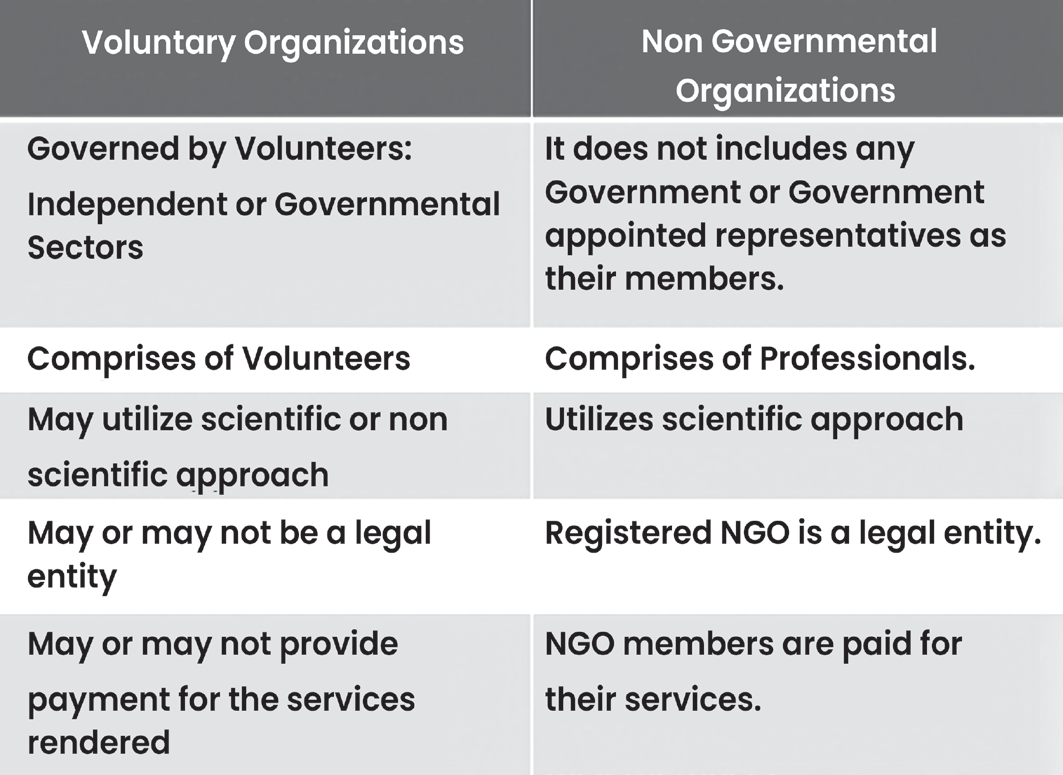
Table: Comparison between Voluntary Organisations and Non-Governmental Organisations
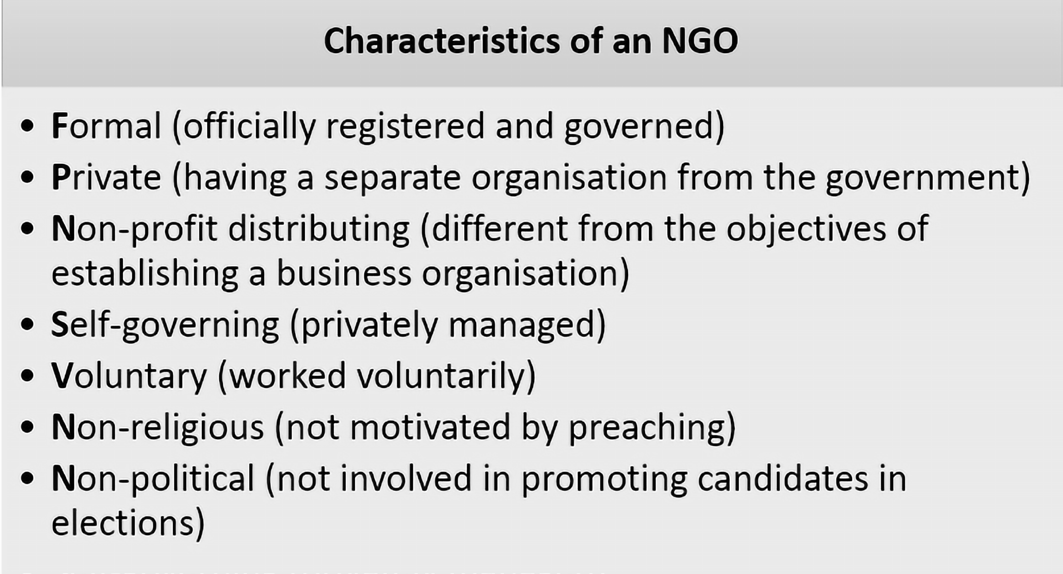
Characteristics of an NGO
Evolution of NGOs in India
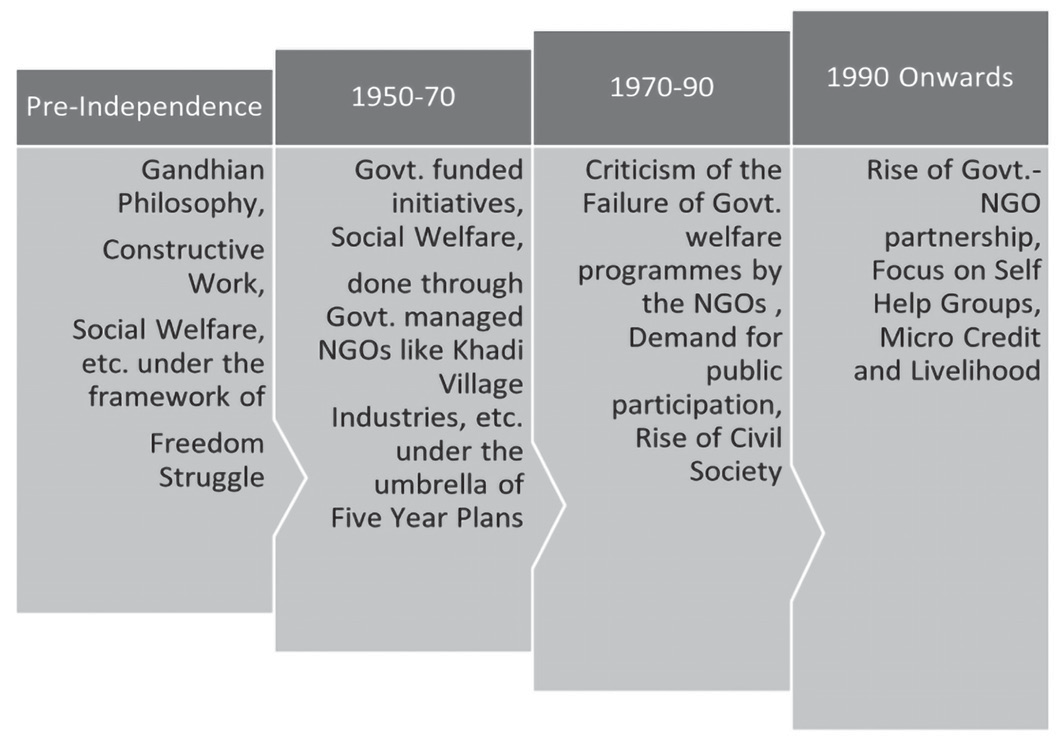
Figure: Evolution of NGOs in India
Pre-independence: Social welfare, Constructive work (inspired by Gandhian Independence philosophy) very much in line with independence movement.
1950-1970: Social welfare, Govt. funded and managed NGO like Khadi Industries. India’s five year’s development plans came into existence, most of the development works were rested with NGO’s.
1970-1990: Civil Society space started increasing from 1970s, NGOs started highlighting that why governments’ programmes were not yielding positive results for poor and marginalized, presented new model for development with people’s participation. With this new model NGO’s covered vast program areas like education, primary health care, drinking water, sanitation, small irrigation, forest regeneration, tribal development, women’s development, child labour, pollution safety etc. later on many of these models were included in govt programme and policies.
1990-till date: NGO-NGO Partnership partnership got a boost in this period; NGO focus is more on Self Help Groups, Micro Credit and Livelihood. NGO participation is ensured in policy formation and programme implmentation.
Types of NGOs
NGOs can be classified under the following heads:
Charity NGOs: Their activities are transitory in nature and believe that giving something to the poor is like giving the same to God.
Relief and Rehabilitation NGOs: Being affected by natural calamities like flood, fire, or epidemic diseases or by man-made catastrophe like war, genocide etc., some NGOs are involved in providing relief and rehabilitation programmes fall under this type.
Service Providing NGOs: Service providing NGOs are inspired by welfare concerns and they largely provide service for the poor and marginalized.
Economic Development NGOs: According to them economic gain is the social gain. These types of NGOs believe that rise in income of the poor and
The marginalized will bring about their economic development.
Social Development NGOs: These NGOs believe that social awareness and people’s involvement will bring about development and, hence, focuses more on the social facets of the community.
Empowerment NGOs: These NGOs enable people to gain power and authority so that they can access and control over resources easily. They try to enhance the number of powerless becoming powerful.
Network NGOs: These NGOs try to unite association of NGOs into a single platform and perform their function collectively.
Supporting NGOs: These are newly emerging NGOs which provide a varied of support functions to different grass-root NGOs.
| Rights NGOs in India Right to Shelter: YUVA and SPARC in Mumbai Right to Information: Mazdoor Kisan Shakti Sangathan (MKSS) Tribal Rights: Samta, Jan Chetna Sansthan | Children and Elderly Akshaya Patra (TAPF): to combat hunger, feeds Mid-Day Meals to children Smile Foundation Kailash Satyarthi Children’s Foundation Pratham CRY: Child Rights and You HelpAge India: for elderly | Environment Assam Science Society Bombay Natural History Society Centre for Environmental Education Centre for Science and Environment Kalpavriksha Narmada Bachao Andolan |
| International Rights NGOs Greenpeace: for environmental rights PETA: for animal rights AmnestyInternational:for human rights Human Rights Watch World Justice Project | Global Developmental NGOs Bill and Melinda Gates Foundation Medicines sans frontiers Oxfam International: against inequality US Aid Save the children TransparencyInternational:against corruption | Miscellaneous Relief International Handicap International International Rescue Committee Redcross Worldwide Fund for Nature Birdlife International Conservation International |
NGO Rules and Regulations in India
Non-governmental organizations come in a variety of shapes and sizes, including trusts, societies, trade unions, cooperative societies, and section 8 corporations. Non- profit organizations were given regulatory authority by state and federal government agencies. Under Section 8 of the Companies Act, 2013, the NGO hierarchy in states
includes the Charity Commissioner (for trusts), Registrar of Societies, and Registrar of Companies. The Income Tax Department and the Ministry of Home Affairs are the various departments and regulatory bodies for NGOs that receive foreign contributions.
Different laws for NGO in India
Trust: It is a public charitable institution that is registered
with the Charity Commissioner’s Office, which has jurisdiction over the entire state. The Bombay Public Trust Act, 1950, was adopted by Maharashtra and has since become a model for other states. The Indian Trusts Act of 1882 is the law that governs trusts.
Societies: States have adopted their versions of the model Societies Act, 1860, according to the Societies Registration Act, 1860. Society is regarded as a self-contained unit of organization. It has a large membership that elects a governing body to manage society’s affairs on a regular basis. Members hold the body responsible.
Charitable companies: They are set up according to section 8 of the Companies Act, 2013. For charitable companies, the compliance requirements are high, as loans and advances are easily available to them compared to a trust or a society. They have to even pay Income tax under IT act 1961.
Trade Union: A Trade Union is defined as a temporary or permanent combination formed to regulate and control the relations between employees and employers, according to the Trade Union Act of 1926.
Cooperative Societies: The Multi-State Co-operative Societies Act of 2002 replaced the previous Act of 1984. Both main and federal cooperatives are required to comply with the Act.
The Foreign Contribution (Regulation) Act of 2010: It governs the reporting of foreign contributions. All non-profit organisations in India, such as public charitable trusts, societies, and Section 8 companies, must obtain registration before accepting any foreign contributions. They must register with the government at the national level.
RTI: In a 2019 ruling, the Supreme Court determined that NGOs receiving "substantial government funding, either directly or indirectly," fall under the definition of a "public authority" under the Right to Information (RTI) Act of 2005. The term "substantial" refers to a significant proportion of funding, although it doesn't necessarily mean more than 50%. This ruling implies that such NGOs are required to maintain records as per the Act, and all Indian citizens are entitled to access information from these organizations.
Role of Ngos in Development
Role of NGOs in Development
In developing countries India, there are numerous gaps left by the government in the development process. These gaps are filled by NGOs.
Work where state is unwilling to work: For example,
caste is an issue that no government wants to fiddle with. The persistence of caste hierarchy suits the vote banks for the politicians. In the process, laws prohibiting discrimination on the basis of caste are often ignored unless there is an NGO working in the area that is willing to take up the cause of those being discriminated against. E.g., Safai Karamchari Andolan is working for the tights and rehabilitations of manual scavengers in India.
Work where state resources are inadequate: Two main such area include education and healthcare. There are not enough government run schools or hospitals, especially in rural areas. Even if they are present, they do not have resources. The NGOs try to complement and complete these initiatives. The mammoth NGO called Kerala Sastra Sahitya Parishad is largely credited for the hundred percent literacy rate in that state.
Implementation of welfare schemes: NGOs due to proximity to general public, work as interface between government and the end users. Thus, NGOs play three roles of implementer, a catalyst and a partner in the implementation of government welfare schemes. E.g., Akshaya Patra NGO is working with governments to implement Mid-day meals in government schools across India.
Fighting social evils: It is due to the efforts of NGOs that the government has banned sex determination of foetus as it leads to evils like abortion of female fetus.
E.g. ‘Girls not brides’ NGO is fighting the social evil of child marriage in Asia and Africa.
Right to Shelter: NGOs such as YUVA and SPARC in cities like Mumbai have repeatedly opposed the demolition of hutments even as they try to improve the quality of life in the sprawling slum clusters
Right to Information: It is because of the efforts of NGOs (Majdoor Kisan Shakti Sangathan) that RTI has become reality in India.
Tribal Rights: As witnessed in the Vedanta vs. Posco case, NGOs have raised voice against the discrimination of tribal by the multinationals. Many of these NGOs have partnered with Gram Panchayat in proper implementation of acts like Forest Rights Act, CAMPA Act etc. e.g., Jan Chetna Sansthan is working for tribal rights in India.
Community Development: Local, national and regional NGOs have emerged as major players and partners in development activities in the region. At the community level, they are in the front line in
providing assistance in the acquisition of basic needs and amenities; in identifying issues, raising awareness, and in articulating the communities’ problems.
Rehabilitation: NGOs did remarkable job post 2004 Tsunami. Besides helping in rescue operations, NGOs also set up vocational training centers. ‘Rapid response’ NGO is working in the field of disaster response, relief and rehabilitation.
Challenges Faced by Ngos in India
Challenges faced by NGOs in India
.
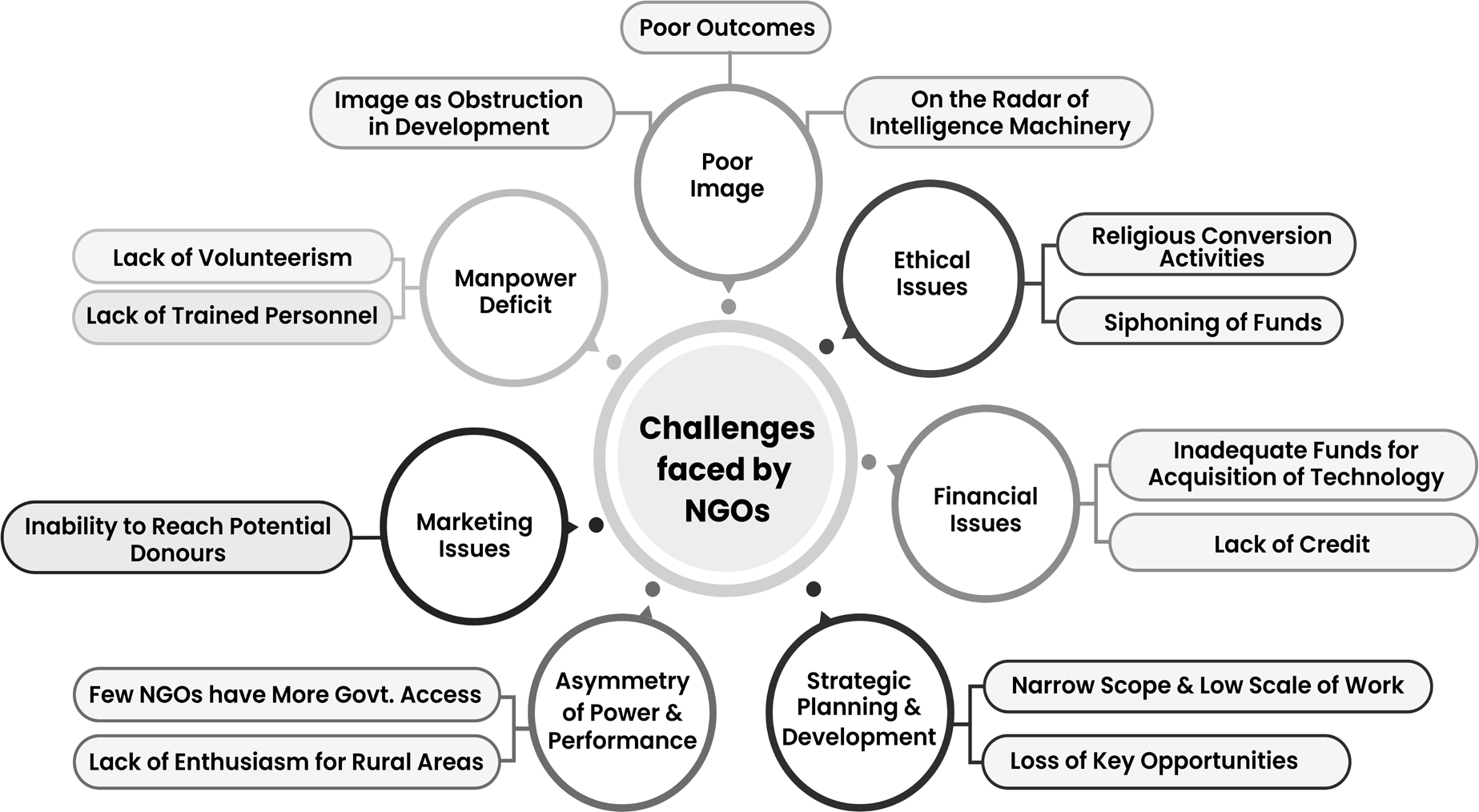
Figure: Challenges faced by NGOs
Lack of Credibility: This is perhaps the most plaguing issue for NGOs operating in India. From last many years, many NGOs are mushrooming in India. In many cases, donation is taken without showing substantial outcomes on ground. They are also not very open about their accounts and finances. Recently, government has taken actions on these kind of fake NGOs as per FCRA and other laws. This has diminished the image of the idealistic ‘voluntarism movement’.
NGOs under Government’s Scanner: With recent Government of India crackdown on Greenpeace and several other NGOs coming under the scanner of Indian government. This has enhanced government monitoring and strictness causing discouragement for budding NGOs.
Asymmetry of power: Some NGOs have acquired character of MNCs because of large scale funding from foreign governments, companies. On the other hand, large chunk of NGOs lacking even operational funding. This has led to the inequality of opportunities and dominance of a few NGOs having more access to the government and resources.
Siphoning of funds: NGOs are becoming safe
heavens to channelise the black money, tax evasion. Such NGOs are causing loss to exchequer by helping others to evade taxes. This has tarnished their noble image and caused serious damage to the voluntary movement.
Get the right people on board: There is no denying the fact that there is a massive crunch of qualified and experienced development sector professionals in India. This has increased their burden and lowered their quality of work. This has lowered their potential to bring about change in society and policies.
Getting people to support an NGO: NGOs often struggle to market themselves. Owing to the challenges discussed above, it’s a daunting task for the NGOs to come up with the right communication to connect with their potential donors. This causes fund crunch and poor pay packages and lack of attraction for best talent.
The Absence of Strategic Planning and Development Approaches: NGOs’ development approaches are either absent or not as flexible, sustainable and relevant to the community. Many NGOs do not maximise the use of current technologies that could
facilitate better communication and networking. This leads to their loss of opportunities, narrow scope and lesser scale of work and influence along with poor access to the targeted sections. This seriously injures the achievement of the social objectives of the
organization.
Lack of Volunteerism/Social Work Among Youth: Young qualified people are motivated to pursue professional education and are not interested in working with NGOs. Their vision has been altered to include an urban lifestyle and professionalisation, which, in their minds, rejects all possibilities of basing their career on working with NGOs and rural India. Consequently, it is becoming increasingly difficult to get trained personnel to work in rural societies, where most NGOs work. This causes mismatched human resource and disinterested work along with lack of spirit among the workers. This reduces the performance in terms of output and outcomes.
Inequality in rural areas: NGOs are more developed in urban areas as compared to rural areas. The backwardness and ignorance of the rural people and lack of enthusiasm among rural social workers along with minimum comforts are the two important reasons. This causes differential efforts and unequal results leading to differential outcomes, especially lower outcomes for the rural areas.
NGOs’ indulgence in religious conversion activities: Government agencies have cracked down on many NGOs, who were forcefully converting tribal populations. This has created distrust among the citizens about the motives of the NGOs, sometimes causing outright rejection of NGOs as an alternative agency of implementation.
NGOs are seen as obstruction in development: The Intelligence Bureau report of 2013 mentioned how the hyper-activism of some foreign funded NGOs are causing damage of 2 to 3 per cent of India’s GDP annually. This has created negative perception about the work of NGOs and brought them on the radar of the law and order and intelligence machinery of the government. This has created hurdles for the genuine NGOs even in doing their day to day tasks reducing ‘Ease of Voluntarism’.
Suggestions to Improve the Working of Ngos
Suggestions to Improve the Working of NGOs
Capacity Building: Capacity building and training can assist in the acquisition of critical new skills. NGO workers can then be more easily trained and the appropriate skills can be developed within the organisation to meet
difficulties. Donors will have more faith in the initiative if they have access to qualified experts.
Information, Communication and Technology: All NGOs should be using a minimum of Internet, email, a basic website and relevant social media platforms.it will help the timely updation.
Timely filing of annual income and expenditure: This will help in improving the image of NGOs in the eyes of the government. NGOs also need to ensure that laws, rules and regulations should be followed.
Monitoring: In terms of monitoring and regulating illicit and unaccountable funds, there should be more collaboration between the Ministries of Home Affairs and Finance. Keeping track of such foreign fundings will enhance transparency in their operations and serve as a deterrent to legislation.
Inculcate the Essence of social work: It is important that participation of people in democracy, for the promotion of social justice, gender equity, inclusion etc. while working with NGOs. NSS and NCC should encourage kids to volunteer from the time they are in elementary school. Universities, colleges and schools have to collaborate with NGOs and conduct campus interviews for the young graduates who are interested in social work.
Increased Role in Rural Areas: In India, 65% of the population belong to rural areas. NGOs must therefore expand their operations in rural regions in order to enlist the help of village residents in improving their lives. Simultaneously, these NGOs must encourage young graduates from rural areas to participate in volunteer work.
National Accreditation Council: To ensure compliance by NGOs, a National Accreditation Council composed of academics, activists, retired bureaucrats, and others should be established.
Improved government coordination: The Ministries of Home Affairs and Finance must work together more closely to enable better surveillance and control of illegal and unexplained cash.
Transparency laws: The government should create norms that require organisations to keep their accounts in specific ways. In addition, when organisations fail to furnish balance sheets, the government should take steps to collect them. The General Financial Rules, 2005 necessitate a regulatory framework for non- governmental organisations, and full legislation in conformity with these rules must be drafted as quickly as feasible.
S. Vijay Kumar Committee on Non-Government Organisations (NGOs) in 2017 recommended
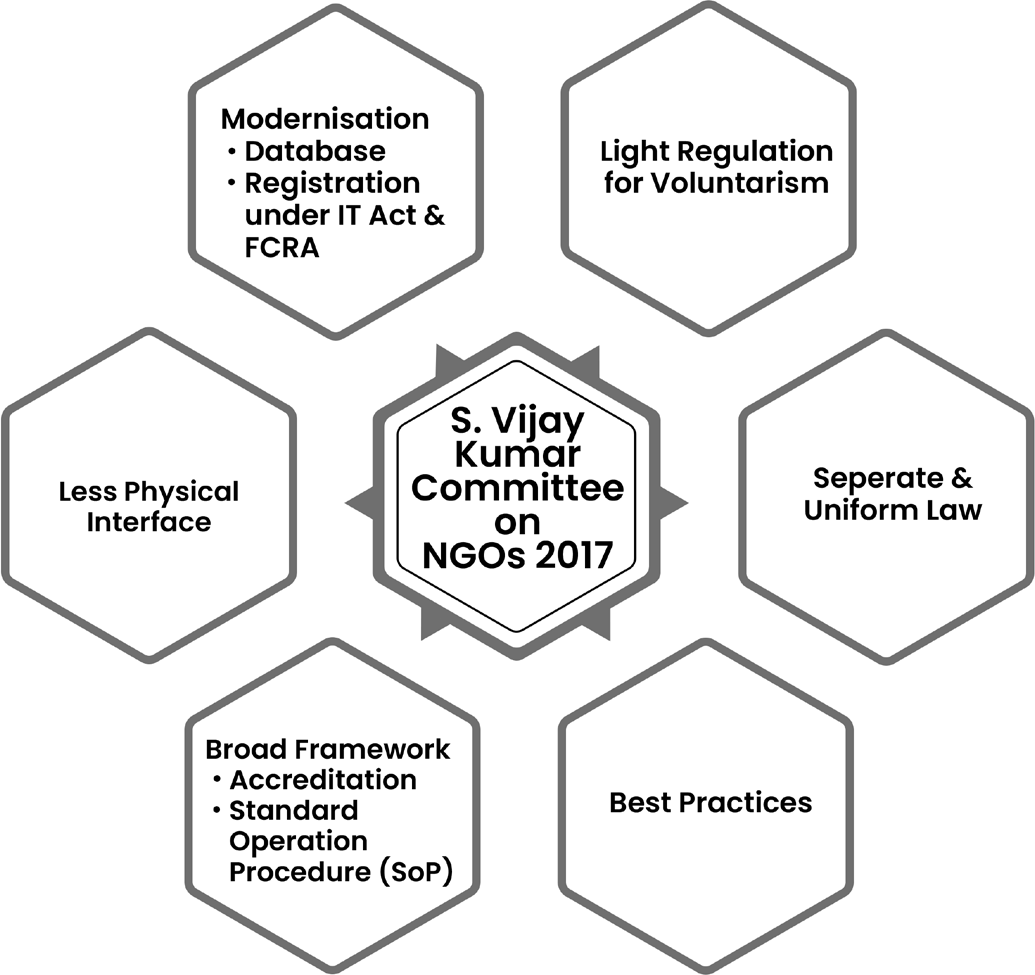
Figure: S. Vijay Committee on NGOs 2017
• Light Regulation: To reduce their harassment and promote culture of ‘voluntarism’.
• Modernization: Registration procedures be modernised so as to facilitate the seamless operation of the applicable provisions of the IT (Income Tax) Act and FCRA with respect to NGOs, without the need for cumbersome and intrusive processes.
• Details of NGOs should be available as searchable database information.
• Less Physical Interface: Reduce the need for a physical interface between NGOs and public officials acting under the IT Act and the FCRA, along with reduction in mutual distrust and scope for misuse.
• Broad Framework: of guidelines for the Accreditation of NGOs, Audit of their accounts, and Standard Operating Procedures (SOP) for recovering grants in case of misappropriation.
• Separate Law: for voluntary agencies of a charitable or “public good” nature to enable more effective and efficient regulation of the sector.
• An overarching legislation with best practices that would replace various State-level and existing Central laws.
• The new framework should enable a “national uniformity” of approach following the principle of “cooperative federalism”.
NGOs and Foreign Contribution Regulation Act (FCRA) rules
What is the Foreign Contribution Regulation Act? About:
FCRA was enacted during the Emergency in 1976 amid apprehensions that foreign powers were interfering in India’s affairs by pumping money into the country through independent organisations.
The law sought to regulate foreign donations to individuals and associations so that they functioned in a manner consistent with the values of a sovereign democratic republic.
Amendments:
An amended FCRA was enacted in 2010 to “consolidate the law” on utilisation of foreign funds, and “to prohibit” their use for “any activities detrimental to national interest”.
• The law was amended again in 2020, giving the government tighter control and scrutiny over the receipt and utilisation of foreign funds by NGOs.
Criteria:
• The FCRA requires every person or NGO seeking to receive foreign donations to be:
• registered under the Act
• to open a bank account for the receipt of the foreign funds in State Bank of India, Delhi
• to utilize those funds only for the purpose for which they have been received and as stipulated in the Act.
• FCRA registrations are granted to individuals or associations that have definite cultural, economic, educational, religious, and social programmes.
Exceptions:
• Under the FCRA, the applicant should not be fictitious and should not have been prosecuted or convicted for indulging in activities aimed at conversion through inducement or force, either directly or indirectly, from one religious faith to another.
• The applicant should also not have been prosecuted for or convicted of creating communal tension or disharmony.
• Also, should not be engaged or likely to be engaged in the propagation of sedition.
• The Act prohibits the receipt of foreign funds by candidates for elections, journalists or newspaper and media broadcast companies, judges and government
servants, members of legislature and political parties or their office-bearers, and organisations of a political nature.
Validity:
• FCRA registration is valid for 5 years, and NGOs are expected to apply for renewal within six months of the date of expiry of registration.
• The government can also cancel the FCRA registration of any NGO if it finds that the NGO is in violation of the Act, if it has not been engaged in any reasonable activity in its chosen field for the benefit of society for two consecutive years, or if it has become defunct.
• Once the registration of an NGO is cancelled, it is not eligible for re-registration for three years
FCRA 2022 Rules:
• In July 2022, the MHA effected changes to FCRA rules which increased the number of compoundable offences under the Act from 7 to 12.
• The other key changes were exemption from intimation to the government for contributions less than Rs 10 lakh – the earlier limit was Rs 1 lakh — received from relatives abroad, and increase in time limit for intimation of opening of bank accounts.
Concern Against the FCRA rules
• The question is why the government wanted to limit administrative expenses to 20% when it could cause inefficiency in the NGO or organization’s working system. The government claims that these changes will avoid the extra expenses and the rest of the money will be used to achieve the organization’s goals.
• Government’s proposal to make Aadhaar an obligatory identification card for all office-holders, despite the Supreme Court’s ruling that Aadhaar is not mandatory.
• The rules are not clear on what will happen with the already sub-granted money to the NGOs, which are not registered under FCRA rules.
•
The tightening of sub-granting of foreign funds will prove detrimental for the survival of small NGOs, who previously were not able to attract domestic funds, too small to attract foreign funds.
• The inclusion of ‘barring public servants receiving foreign funds’ is controversial, as the definition of ‘public servant’ is vague and overarching, which gives government unlimited power to bar any person remotely attached to public service from receiving foreign funds.
• The proposed revisions will raise the cost of doing business for India’s non-profit organizations, perhaps making them even more vulnerable and powerless.
What the government is saying about the rules?
• As per the government’s claim, the bill is intended to 'increase openness' and 'prevent persons from misusing foreign contributions.'
• Government claims that many NGOs were appointing their family members as employee in their NGOs and paying them salary in the garb of “administrative expenses”.
• They also claim that, in the name of administration expenses, many NGOs members were gifting expensive goods and have lavish building as their offices, which as per government, clearly a “violation of volunteerism principle”.
• On the question of making Aadhar mandatory, government justifies its moves as the Aadhar is made mandatory only for identity purpose and the member of NGOs must be abide by Indian laws.
• On the question of barring public servants from receiving foreign funds, government gave many examples of existing rules where public servants’ right to accept foreign gifts are restricted to save them being influenced from foreign powers.