Self Help Groups
Introduction:
The National Bank for Agriculture and Rural Development (NABARD) defines Self-Help Groups as "a homogeneous group of rural poor individuals who voluntarily come together to save a portion of their earnings, as much as they can comfortably afford, and agree to contribute towards addressing mutual credit needs." A Self-Help Group typically consists of 10-20 members, forming a small, economically homogeneous, and affinity-based community.
These people come together to form a group to overcome their common problem to improve their standard of living.
They are most from a similar socio-economic background and are involved in undertaking small savings among themselves, this amount act as a fund in them and from this fund they provide loan to members.
It is vital tool to alleviate people from below poverty level and improve social status through the promotion of self-employment.
Any local individual who has needed education of skills may help initiate the Self-Help Group.
He or she is involved in bringing together all these persons who are facing similar problem and advocating the benefits of SHGs.
They are called Facilitators or Animator. They are well known within the community.
A women animator can play a significant role in women empowerment in rural India. They may be assisted by NGOs/Departments of the state government or banks.
Their function include: Explain the benefits, help initiate the first few meetings of SHGS, encourage group and leaders, provide innovative ideas and solve the problems of SHGs
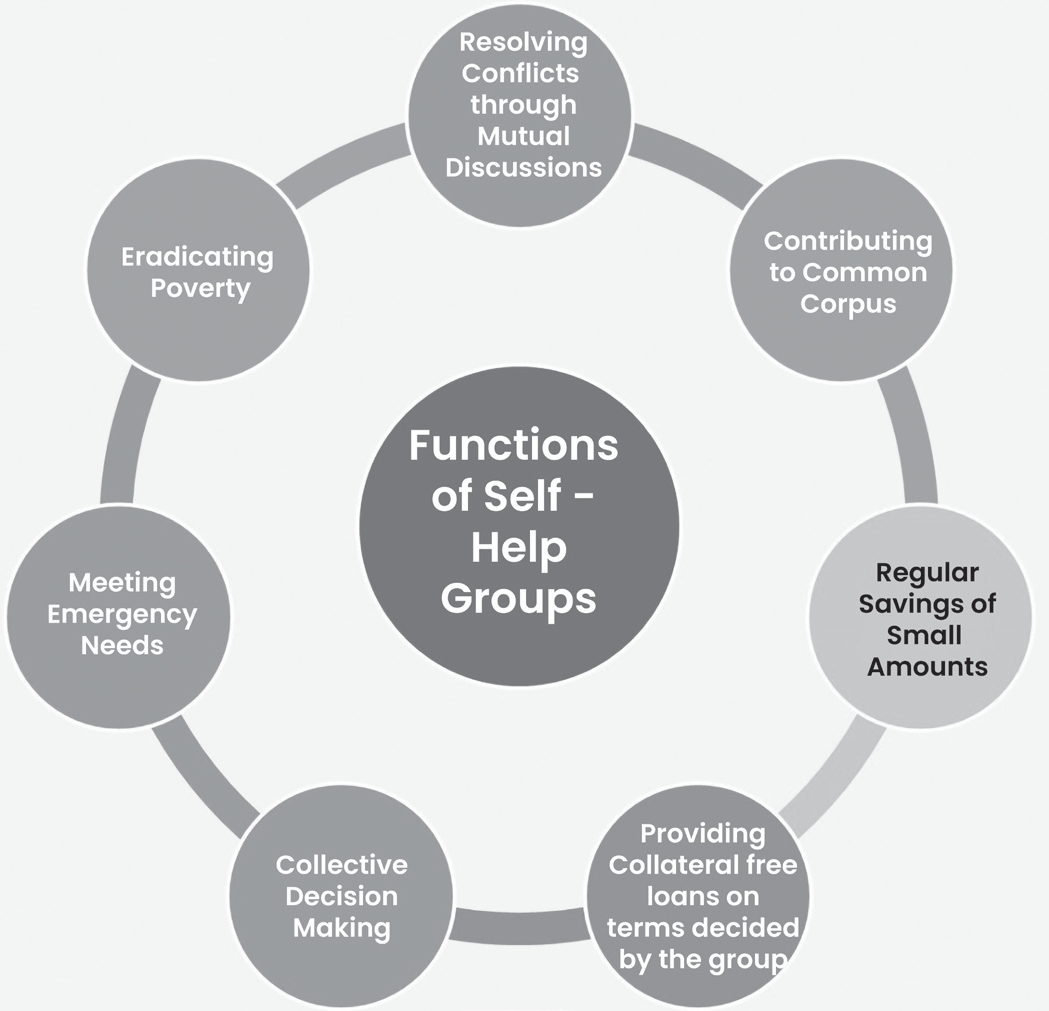
Figure: Functions of Self Help Groups
How does it function?
An ideal SHG should have about 10-20 members. This is because, if the group is bigger, it will be difficult for an individual to undertake equal participation in a large group.
SHG should not have more than one member from a particular family, this allow including of many families.
It would have either only men or only women because it is found that mixed groups are not successful.
It is also found that women SHGs are more successful because the members are better at saving and that they are making use of loans more effectively than men.
The members of the SHG must have similar problem and background for it to be successful.
Meetings
Ideally, the meeting should be held weekly or monthly so that members become closer to each other.
All members must attend the meeting for it become successful.
Membership Register, Minutes register, savings and loan register etc. must be kept upto date so that it is easy to know about the SHG and that there is transparency within the group.
Functions:
• Initiate and maintain saving within the group: All members must regularly save at least a small amount. These savings allow them to get future credit for this group.
• Lending loans: The savings made by the SHGs must be used for provide loans to members of the group. Everything related to loan must be decided within the group.
• Solving common problem: SHG, must consists of individuals who face similar types of problems. The grouping should essentially help the individual to overcome these problems through discussion and interaction with the group and finding a common and united solution to the problem.
• Bank Loan: SHGs must work on getting a collective guarantee system so that they can avail loan from official source.
Why does India need SHGs?
The need to solve problem at the ground level that has diverse culture, traditional and historical background. Therefore, it is difficult for the government to solve economic problems by itself. Thus, bringing together the people who face similar problem may be a game changer in the Indian Economy. Financial Inclusion according to the NSSO data 51.4% of the farmer households are not able to have access to formal credit. This has led to many negative implications such as poverty, farmers suicide. Many in India are not able to obtain loans due to absence of collateral. SHGs can help solve this problem.
Benefits of SHGs
• Combating social evils: The SHGs play a crucial role in overcoming social evils like alcoholism, drug addiction, gambling etc.
• Women empowerment: Women SHGs make it member indulge from social constrains and allow them to make independent decisions. They can actively participate in the gram sabha.
• Active participation in Democracy: SHGs can actively participate in the aspects of local governance. This would mean the inclusion of weaker and marginalised sections of society in the local governance.
•
Increase employment opportunities in rural India: It allows for micro level participation and allows the rural society and reduces too much dependence on agriculture.
• Easier access to Govt Scheme: The Govt schemes most meant for the maginalized sections of the society. The inclusion and identification of these people are highly difficulty. If they are grouped together, it is easier for the Govt to identify those who are in need of assistance quickly and efficiently. It also prevents the exploitation and corruption of the Government at the ground level.
• Improves Standard of living: The collective team effort by the SHGs for financial inclusion allows for the improvement in the standard of living, family planning, health care of the vulnerable sections of the society.
• Financial Discipline: The members of the SHGs are encouraged to open savings account in the banks. This assumes improved living condition, increased spending on education, health etc. SHGs’ bank repayment is more than 96 per cent, underscoring their credit discipline and reliability.
Problems of Self-Help Groups (SHGs):
The SHGs face problems in different areas. The important problems are briefly stated below:
Ignorance of Members/Participants:
Despite awareness efforts, still majority of the group are unaware of the schemes of assistance offered to them. Major reason is illiteracy (literal, digital and financial) especially among rural women of weaker sections of society. This has reduced the offtake of funds and slowed down their development.
Inadequate Training Facilities:
The training facilities given to the members of SHGs in the specific areas of product selection, quality of products, production techniques, managerial ability, packaging, other technical knowledge are not adequate to compete with that of strong units. This has kept their size smaller and limited their potential earnings and profits.
Problems Related with Raw Materials:
Normally each SHG procures raw materials individually from the suppliers in smaller quantities and hence they may not be able to enjoy the benefits of large-scale purchase like discount, credit facilities etc. Moreover, there
is no systematic arrangement to collect raw materials in bulk quantities and preserve them properly. There is no linkage with major suppliers of raw materials. Most are ignorant about terms and conditions. All these causes high cost of raw materials and reduces their bargaining potential, thus profits and growth.
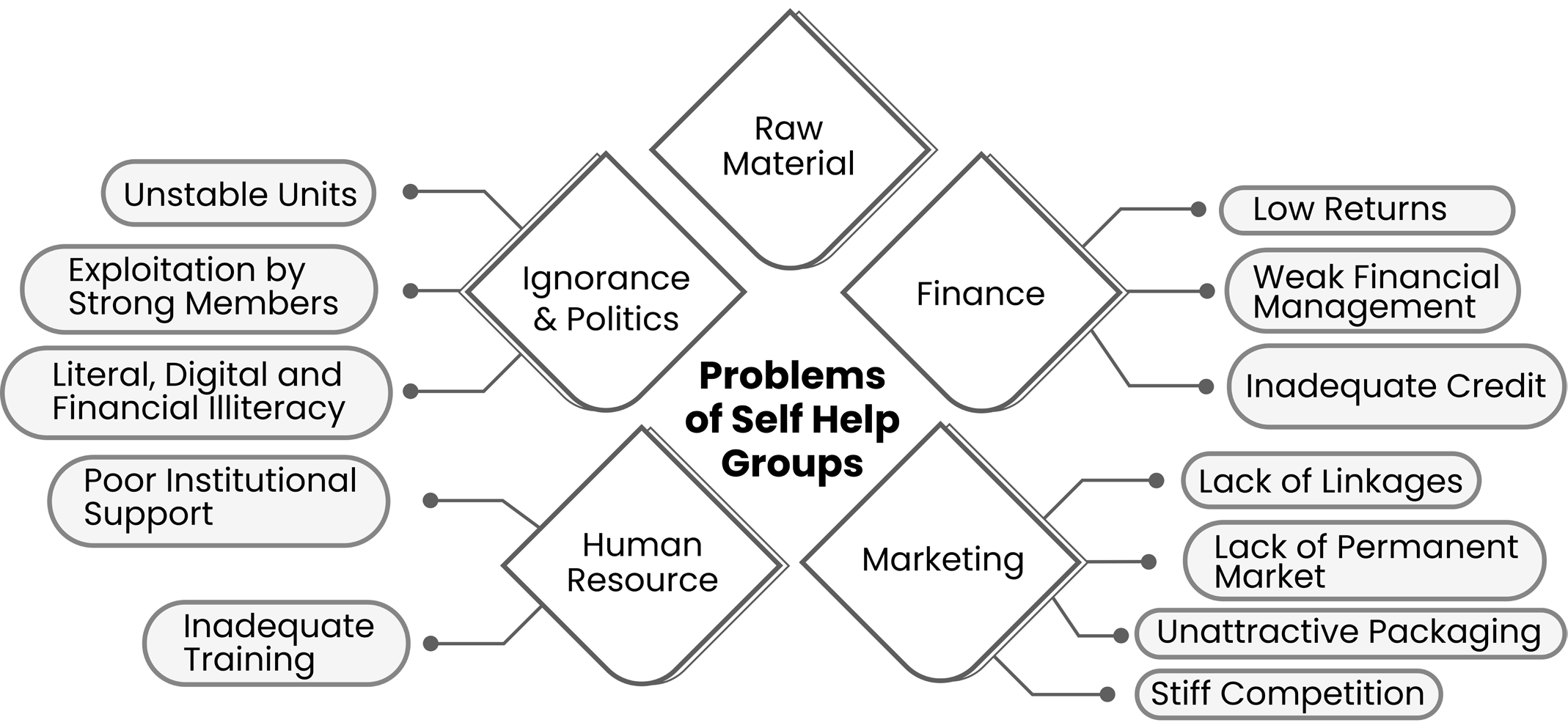
Figure: Problems of Self Help Groups
Problems of Marketing:
Marketing is an important area of functioning of the SHGs. However, they face different problems in the marketing of products produced by them. Following are the major problems relating to marketing.
Lack of sufficient orders.
Lack of linkage with the marketing agencies.
Lack of adequate sales promotion measures.
Lack of permanent market for the products of SHGs.
Absence of proper brand name.
Poor/unattractive packing system.
Poor quality of products due to the application of traditional technology, resulting in poor market,
Stiff competition from other major suppliers.
Lack of a well-defined and well-knit channel of distribution for marketing.
Lack of Stability and Unity Especially among women SHGs:
In women SHGs, it is found that there is no stability
of the units due to the shift of their place after marriage. Moreover, there is lack of unity among women members owing to personal reasons. This has impacted proper development of management expertise through continuous experience.
Exploitation by Strong Members:
It is also observed that in the case of many SHGs, strong members try to earn a lion’s share of the profit of the group, by exploiting the ignorance and illiterate members. This has increased power politics and accelerated their disintegration.
Weak Financial Management:
It is also found that in certain units, the return from the business is not properly invested further in the units, and the funds diverted for other personal and domestic purposes like marriage, construction of house etc. This has reduced savings and prevented investment into expansion of SHGs.
Low Return:
The return on investment is not attractive in certain groups due to inefficient management, high cost of production, absence of quality consciousness etc. This has kept the margins low and made the model unattractive.
Inadequate Financial Assistance:
It is found that in most of the SHGs, the financial assistance provided to them by the agencies concerned is not adequate to meet their actual requirements. The financial authorities are not giving adequate subsidy to meet even the labour cost requirements. This has made the SHGs unviable in the long term and impacted their growth potential.
Non-co-operative Attitude of the Financial Institutions:
The Financial Institutions (FIs) do not consider SHGs seriously while providing finance and other help. FIs consider SHGs to be less able to make profits and consider them as high-risk credit. This makes the SHGs to depend upon self-financing at high rates of interests which again demotivates SHGs.
Inadequate and ill-trained staff to meet the challenges:
The attitude of the staff of the rural development department is not encouraging. They are not well trained to accept the challenges and equip the SHGs with self-reliance. This leads to lack of policy focus and poor institutional support which often reduces
allocation for SHG development
. Measures Taken by the Government
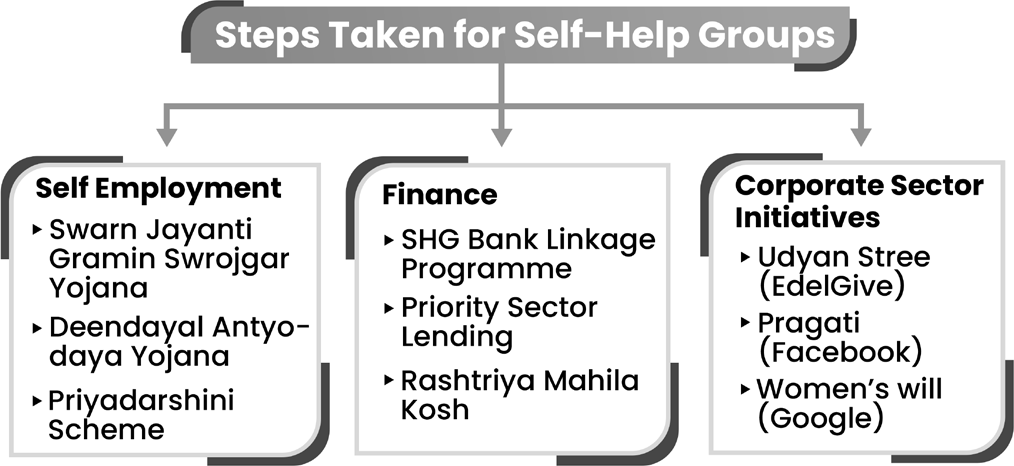
Figure: Steps Taken for Self-Help Groups
Govt plays a crucial role as a facilitator for the SHGs. India has around 1.2 crore SHGs, 88 per cent being all-women SHGs. Success stories include Kudumbashree in Kerala, Jeevika in Bihar, Mahila Arthik Vikas Mahila Mandal in
Maharashtra, and recently, Looms of Ladakh.
a) Micro finance
The various Govt schemes dedicated to the promotion of SHGs. Some of them are as follows:
Swarn Jayanthi Gram Swarojgaar Yojana (SGSY): It seeks to form SHG and develop skills of the members to promote self-employment in rural areas. This programme evolved to be a national movement in
2011 to become the National Rural Livelihood Mission (NRLM) It is the largest Poverty alleviation programme in the world.
Self Help Group-Bank Linkage Programme: On the recommendations of SK Kalia committee, the SHG- Bank Linkage Programme was started at the initiative of NABARD in 1992 to link the unorganised sector with the formal banking sector.
• Under this programme, banks were allowed to open savings accounts for Self-Help Groups (SHGs). Banks provide loans to the SHGs against group guarantee and the quantum of loan could be several times the deposits placed by such
SHGs with the banks.
• With the active collaboration of stakeholders, the SHG-BLP covers 14.2 crore families through 119 lakh SHGs with savings deposits of Rs 47,240.5 crore and 67 lakh groups with collateral-free loans outstanding of Rs 1,51,051.3 crore, as on March 31, 2022.
• SHG-BLP has evolved as a cost-effective mechanism for providing financial services to the unreached and underserved poor households. What started as a pilot project to link 500 SHG in 1992-93, has now become the largest microfinance programme in the world.
• The savings led microfinance model has now become the largest coordinated financial inclusion programme in the world covering almost 100 million households in the country. With more than 84% of the groups being exclusively women groups, the programme has provided the much- needed push to empowerment of women in the country.
Priority Sector Lending: GOI has included SHG as a priority sector to mandate and enhance banks focus on them. Bank credit to members of SHGs is eligible for priority sector advance under respective categories viz., Agriculture, Micro, Small and Medium Enterprises, Social Infrastructure and Others.
SHG, have been allowed to run grain banks to secure the food security in food & care regions.
Priyadarshini scheme, with NABARD as the nodal agency, has aimed at women empowerment and livelihood enhancement through SHGs.
The number of SHGs credit linked has grown at a CAGR of 10.8 percent during the last ten years (FY13 to FY22), while credit disbursement per SHG has grown at a CAGR of 5.7 percent during the same period.
Deendayal Antodaya Yojana – National Rural Livelihoods Mission (DAY-NRLM): It seeks to alleviate rural poverty through building sustainable community institutions of the poor. Mission closely works with the Department of Financial Services (DFS), Reserve Bank of India (RBI) and the Indian Bank Associations (IBA) to provide bank credit to SHGs.
Mahila Kisan Shashaktikaran Pariyojana: In order to promote agro-ecological practices that increase women farmers’ income and reduce their input costs and risks, the DAY-NRLM Mission has been implementing the Mahila Kisan Shashaktikaran Pariyojana (MKSP). It has achieved success by mobilising rural women into 81 lakh self-help groups.
Rashtriya Mahila Kosh (RMK): The Rashtriya Mahila Kosh was set up by the Government of India in March 1993 as an Autonomous Body registered under Societies Registration Act, 1860 under the Department (now Ministry) of Women and Child Development. The objective was to facilitate credit support to poor women for their socio-economic upliftment.
Corporate sector’s initiatives
Observing the crucial role SHGs play, corporations and foundations globally have designed SHG-led programmes to help women achieve economic empowerment.
For example, initiatives such as the UdyamStree campaign by EdelGive Foundation, has focused on women entrepreneurs in Maharashtra and Rajasthan, among other states, by leveraging SHGs such as MAVIM, and other relevant stakeholders.
Facebook’s Pragati and Google’s Women Will, among others, have also moved the needle in fostering a level-playing field for women entrepreneurs.
Suggestions to Minimize the Problems Faced by SHGs:
The following suggestions are offered to minimize the above-mentioned issues of SHGs:
Information about locally available materials and their varied uses should be disseminated to SHGs. Proper encouragement and training should be given to them to make innovative products by using these materials. In order to have a knowledge base about the availability of materials, in panchayat levels, surveys can be conducted under the auspices of local authorities.
In order to solve the various problems relating to marketing of SHGs, the state level organisations should extend the activities throughout the state instead of limiting its operations in a particular area.
Various SHGs functioning in a particular panchayat area can form a co-operative society. This society may be entrusted with the task of marketing the products of different SHGs under a common brand name. Further, the society can undertake sales promotion activities and procure rare raw materials for the benefits of member SHGs.
Non-Government Organisations (NGOs) can play a significant role in empowering women entrepreneurs by providing basic education, motivation training, and financial help and so on.
All the members in the SHGs may not have the same caliber and expertise. NGOs can identify the inefficient members of the group and can impart proper training to them in order to make them competent. For this purpose, short term training programmes can be arranged at the panchayat level.
Frequent awareness camps can be organised by the Rural Development department authorities to create awareness about the different schemes of assistance available to the participants in the SHGs.
Lastly, arrangements may be made by the financial institutions for providing adequate financial assistance to the SHGs strictly on the basis of their actual performance without any discrimination of caste, politics etc.
Success stories of SHGs in India: Case studies
Kudumbashree in Kerala,
It was launched in Kerala in 1998 to wipe out absolute poverty through community action. It is the largest women empowering project in the country. It has three components i.e., microcredit, entrepreneurship and empowerment. It has three tier structure – neighborhood groups (SHG), area development society (15-20 SHGs) and Community development society (federation of all groups). Kudumbashree is a government agency that has a budget and staff paid by the government. The three tiers are also managed by unpaid volunteers.
Prerna Canteen- UP Looms of Ladakh
Patrakaar Didis - Jharkhand 2023
They worked for delivery of essential goods. JEEVIKA in Bihar
The Government of Bihar (GoB), through the Bihar Rural Livelihoods Promotion Society (BRLPS), an autonomous body under the Department of Rural Development, is spearheading the World Bank aided Bihar Rural Livelihoods Project (BRLP), locally known as JEEVIKA with the objective of social & economic empowerment of the rural poor. Subsequently, the Livelihoods Restoration
and Enhancement component of Bihar Kosi Flood Recovery Project (BKFRP) was also taken into the fold of JEEViKA Mahilaarthik Vikas Mahamandal (MAVIM) in Maharashtra:
SHGs in Maharashtra were unable to cope with the growing volume and financial transactions and needed professional help. Community managed resource centre (CMRC) under MAVIM was launched to provide financial and livelihood services to SHGs. CMRC is self-sustaining and provides need-based services. SHGs such as Mahila Arthik Vikas Mahila Mandal, UMED Abhiyan under Maharashtra’s department of rural development’s State Rural Livelihood Mission, and government schemes such as Tejaswani, etc., have proven beneficial in the development of women entrepreneurship for the cause of women’s empowerment.
Mission Shakti in Odisha
“Mission Shakti” is the self-help mission for empowering women through the promotion of Women Self Help Groups (WSHGs) to take up various socio-economic activities which were launched in Odisha on 8th March 2001 on the eve of International Women’s Day. Mission Shakti has the clear objective of empowering women through gainful activities by providing credit and market linkage. Empowerment of women through WSHGs under Mission Shakti is a flagship programme of the Government of Odisha. It envisages that over a period of time more & more women would be part of a WSHG. Nearly 70 lakh women have been organized into 6 lakh groups in all blocks and urban local bodies of the State so far.