
Whatsapp 88106-52225 For Details
Get Free IAS Booklet
Get Free IAS Booklet
FINANCIAL MARKETS
Any market where securities are traded, including stocks, bonds, shares, forex and derivatives markets, is referred to as financial markets. Financial markets are vital to the smooth operation of capitalist economies by allocating resources and creating liquidity for businesses and entrepreneurs. The markets make it easy for buyers and sellers to trade their financial holdings. Financial markets create securities
products that provide a return for those who have excess funds (Investors/lenders) and make these funds available to those who need additional money (borrowers).
Types of financial markets
Broadly speaking, the financial markets are classified as money market and capital market. While the money market deals with short-term credit, the capital market handles long- term credit.
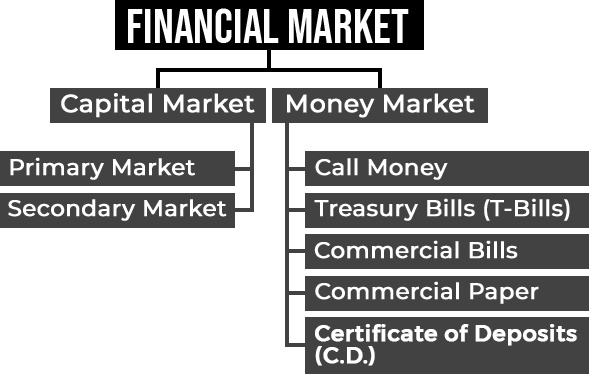
Distinction between Capital Market and Money Market
The Capital Market differs from the Money Market in many ways.
• Firstly, while the Money Market is related to short-term funds, the capital market is related to long term funds.
• Secondly, while the Money Market deals in securities like treasury bills, commercial paper, trade bills, deposit certificates,
etc., the capital market deals in shares, debentures, bonds and government securities.
• Thirdly, while the participants in the Money Market are Reserve Bank of India, commercial banks, non-banking financial companies, etc., the participants in the capital market are stockbrokers, underwriters, mutual funds, financial institutions, and individual investors.
• Fourthly, while the money market is regulated by the Reserve Bank of India, the capital market is regulated by Securities Exchange Board of India (SEBI).
MONEY MARKET
• The money market is a market for short-term funds, which deals in financial assets whose period of maturity is up to one year.
• It should be noted that the money market does not deal in cash or money as such but simply provides a market for credit instruments such as bills of exchange, promissory notes, commercial paper, treasury bills, etc.
• Money market is not related to any specific market place. Rather it refers to the whole networks of financial institutions dealing in short-term funds, which provides an outlet to lenders and a source of supply for such funds to borrowers.
• The unorganised and organised sectors make up the two main segments of the Indian money market. While the unorganised sector consists of the indigenous bankers and the traditional money lenders, the organised sector comprises the Reserve Bank of India (RBI), the commercial banks and the other financial institutions like LIC, GIC UTI, etc. The RBI, which is in charge of overseeing the smooth operation of the Indian money market, is the highest authority in the sector.
Money Market Instruments
Following are some of the important money market instruments or securities.
Call Money
• Call money is mainly used by the banks to meet their temporary requirement of cash.
• They borrow and lend money from each other normally on a daily basis. It is repayable on demand and its maturity period varies between one day to a fortnight.
The rate of interest paid on call money loans is known as call rate.
• The call money market is also known as interbank call money market as the participants in the call money market are mostly banks who are able to use their temporary cash surplus or meet their temporary cash deficits by mutual transactions through this market.
• Of late, the financial intermediaries like LIC, GIC, and NABARD have also started participating actively in the call money market. To start with, they were allowed to act as lenders but later they were also allowed to borrow.
Treasury Bill Market
• In India, treasury bills are a short-term liability of the Central Government as these are mostly issued by the Reserve Bank of India on behalf of the Central Government for meeting its temporary deficits and financing the expenditure.
Treasury bills are usually of three months’ (91-days) duration issued by the RBI.
There have been two varieties of the 91-day Treasury Bills: regular and ad hoc. The ordinary bills are issued by RBI to enable the government to meet its needs for supplementary short-term finance, and the ad hoc bills are created in favour of RBI to replenish government’s cash balances and provide the medium for employment of temporary surpluses of state governments and semi-government bodies. Ad hoc Treasury bills were discontinued on April 1, 1997.
Despite this, they remain highly liquid and secured because the RBI is always willing to buy or discount them and there is no better guarantee of repayment than the one provided by the government.
Repo Market and Reverse Repo Instruments
A money market tool called a repo facilitates short-term, collateralized lending and borrowing by means of sales and purchases of debt instruments.
Securities are sold by holders to an investor in a repo transaction, with the buyer agreeing to buy the securities back at a later date and at a predetermined rate.
An agreement to resell the securities at a specific rate and date may also be included in the purchase of the securities. These exchanges are referred to as reverse repo exchanges.
Earlier, repos were allowed only in treasury bills. But gradually, the RBI allowed repo transactions in all government securities and treasury bills, and so also in public sector bonds and private corporate securities to broaden the repo market.
Trade Bills/Commercial Bills
Normally the traders buy goods from the wholesalers or manufacturers on credit. The sellers get payment after the end of the credit period. But if any seller does not want to wait or in immediate need of money, he/she can draw a bill of exchange in favour of the buyer. When the buyer accepts the bill, it becomes a negotiable instrument and is termed as bill of exchange or trade bill.
This trade bill can now be discounted with a bank before its maturity. On maturity the bank gets the payment from the drawee i.e., the buyer of goods. When trade bills are accepted by Commercial Banks it is known as Commercial Bills. So, a trade bill is an instrument, which enables the drawer of the bill to get funds for a short period to meet the working capital needs.
Commercial Paper
Commercial Paper (CP) is a popular instrument for financing working capital requirements of companies.
• The CP is an unsecured instrument issued in the form of a promissory note. This instrument was introduced in 1990 to enable the corporate borrowers to raise short- term funds.
• It can be issued for a period ranging from 15 days to one year.
• Commercial documents can be delivered and endorsed for transfer. The main participants in the commercial paper market are the well known businesses, or “Blue Chip” companies.
Certificate of Deposit
• Certificate of Deposit (CDs) are short-term instruments issued by Commercial Banks and Special Financial Institutions (SFIs), which are freely transferable from one party to another.
• The maturity period of CDs ranges from 91 days to one year. These can be issued to individuals, co-operatives and companies.
Collateralized Borrowing and Lending Obligation (CBLO)
• A collateralized borrowing and lending obligation (CBLO) is a money market instrument that represents an obligation between a borrower and a lender concerning the terms and conditions of a loan.
• CBLOs enable access to the short-term money markets for individuals prohibited from using India’s interbank call money market.
• The Reserve Bank of India (RBI) and the Clearing Corporation of India Ltd. (CCIL) are in charge of these instruments. Institutions that are members of CCIL have little to no access to the interbank call money market in India.
• It functions similarly to a bond, with the borrower selling it to the lender for interest, and the lender purchasing the CBLO.
Mutual Funds
• Money Market Mutual Funds (MMMFs) were first introduced in India in April 1991 with the goal of giving investors another short-term option and making money market instruments more accessible to the general public.
• Instruments for the short-term money market make up the portfolio of MMMFs. Investment in such funds provide an opportunity to investors to obtain a yield close to short-term money market rates coupled with adequate liquidity.
CAPITAL MARKET
• Capital Market may be defined as a market dealing in medium and long-term funds.
• It is an institutional arrangement for borrowing medium and long-term funds and provides facilities for marketing
and trading of securities. So, it constitutes all long- term borrowings from banks and financial institutions, borrowings from foreign markets and raising of capital by issuing various securities such as shares, debentures, bonds, etc.
The market where securities are traded is known as the Securities market. It consists of two different segments namely primary and secondary market.
Primary Market
The Primary Market consists of arrangements, which facilitate the procurement of long- term funds by companies by making fresh issue of shares and debentures.
It is usually done through private placement to friends, relatives and financial institutions or by making public issue.
In any case, the companies have to follow a well- established legal procedure and involve a number of intermediaries such as underwriters, brokers, etc. who form an integral part of the primary market.
Secondary Market
The secondary market known as stock market or stock exchange plays an equally important role in mobilising long-term funds by providing the necessary liquidity to holdings in shares and debentures.
It provides a place where these securities can be encashed without any difficulty and delay. It is an organised market where shares, and debentures are traded regularly with high degree of transparency and security.
Distinction between the primary market and secondary market
Function: While the main function of the primary market is to raise long-term funds through fresh issue of securities, the main function of the secondary market is to provide a continuous and ready market for the existing long-term securities.
Participants: While the major players in the primary market are financial institutions, mutual funds, underwriters and individual investors, the major players in the secondary market are all of these and the stockbrokers who are members of the stock exchange.
Listing Requirement: While only those securities can be dealt with in the secondary market, which have been approved for the purpose (listed), there is no such requirement in case of primary market.
Determination of prices: In case of primary market, the prices are determined by the management with due compliance with SEBI requirement for new issue of securities. But in the case of the secondary market, the price of the securities is determined by forces of demand and supply of the market and keeps on fluctuating.
Instruments of Capital Market
• Equity Securities: An equity security represents ownership interest held by shareholders in an entity (a company, partnership, or trust), realized in the form of shares of capital stock, which includes shares of both common and preferred stock. Holders of equity securities are typically not entitled to regular payments although equity securities often do pay out dividends. Equity securities do entitle the holder to some control of the company on a pro rata basis, via voting rights. In the case of bankruptcy, they share only in residual interest after all obligations have been paid out to creditors
• Debt Securities: A debt security represents borrowed money that must be repaid, with terms that stipulate the size of the loan, interest rate, and maturity or renewal date. Debt securities, which include government and corporate bonds, certificates of deposit (CDs) etc., generally entitle their holder to the regular payment of interest and repayment of principal (regardless of the issuer’s performance), along with any other stipulated contractual rights (which do not include voting rights).
• Derivative Securities: A derivative is a type of financial contract whose price is determined by the value of some underlying asset, such as a stock, bond, or commodity.
• Asset-Backed Securities: An asset-backed security represents a part of a large basket of similar assets, such as loans, leases, credit card debts, mortgages, or anything else that generates income. Over time, the cash flow from these assets is pooled and distributed among the different investors.
Structure of Indian Securities Markets
• The market in which securities are issued, purchased by investors and subsequently transferred among investors is called the securities market. The securities market has two interdependent and inseparable segments, viz., the primary market and secondary market.
• The primary market, also called the new issue market, is where issuers raise capital by issuing securities to investors.
• The secondary market, also called the stock exchange facilitates trade in already-issued securities, thereby enabling investors to exit from an investment. The risk in a security investment is transferred from one investor (seller) to another (buyer) in the secondary markets.
• The primary market creates financial assets and the secondary market makes them marketable.
Who are the Issuers in Indian Securities Markets?
Issuers are organizations that raise money by issuing securities. They may have short-term and long-term need for capital, and they issue securities based on their need, their ability to service the securities. Some of the common issuers in the Indian Securities Markets are:
Companies issue securities to raise short- and long-term capital for conducting their business operations.
Central and state governments issue debt securities to meet their requirements for short- and long-term funds to meet their deficits.
Local governments and municipalities may also issue debt securities to meet their development needs.
Government agencies do not issue equity securities.
Financial institutions and banks may issue equity or debt securities for their capital needs beyond their normal sources of funding from deposits and government grants.
Public sector companies which are owned by the government may issue securities to public investors as part of the disinvestment program of the government, when the government decides to offer its holding of these securities to public investors.
Mutual funds issue units of a scheme to investors to mobilise money and invest them on behalf of investors in securities.
REGULATORS OF INDIAN SECURITIES MARKETS
Securities and Exchange Board of India (SEBI)
The Securities and Exchange Board of India (SEBI), a statutory body appointed by an Act of Parliament (SEBI Act, 1992), is the chief regulator of securities markets in India. SEBI functions under the Ministry of Finance.
The main objective of SEBI is to facilitate growth and development of the capital markets and to ensure that the interests of investors are protected.
Purpose and Role of SEBI
Protecting investor interests, fostering stock exchange development and maintaining a check on malpractices were the primary goals behind SEBI’s establishment. It meets the requirements of following groups:
Issuers: SEBI offers issuers a platform where they can simply and fairly raise capital.
Investors:Accurate and correct information is supplied by SEBI, and investors are protected.
Intermediaries: SEBI offers intermediaries access to a professional, competitive market.
Functions of Securities and Exchange Board of India (SEBI)
• Protective Functions
Protective functions are those carried out by SEBI to safeguard investor interests and guarantee investment security.
• Examine Price Rigging: Price Rigging is the practice of manipulating the price of securities in order to raise or lower their market value.
• Prohibits Insider Trading: An insider is anyone
who has a relationship to the company, including directors, promoters and others. They possess all of the confidential information about the business that could influence the securities’ price. Insider trading occurs when someone from the company uses their access to confidential information to profit; this type of information is not available to the general public.
• Prohibit Fraudulent and unfair trade practises: Companies are not permitted to make any statements that could mislead the public or persuade someone else to buy or sell securities.
• Educate Investors: In order to enable investors to quickly assess the securities of various companies and choose the most lucrative security, SEBI takes a number of educational initiatives.
• Fair practices and a code of conduct: They are promoted by SEBI under its protective functions in the securities market.
• Developmental Functions
In order to advance and expand stock exchange activities and boost stock exchange business, SEBI carries out developmental tasks.
• It encourages the securities market intermediaries to receive training.
• It makes an effort to publicise stock exchange operations.
• Innovations and Technological use has been done as given below:
• Online trading via registered stock brokers is permitted by SEBI.
What are government securities?
•
SEBI has also made underwriting optional in an effort to lower the cost of issue.
• Finally, it has approved the primary market’s initial public offering via a stock exchange.
• Regulatory Functions
SEBI carries out regulatory duties to control the stock exchange industry.
• In order to govern intermediaries such as brokers and underwriters, SEBI has established a code of conduct in addition to a set of rules.
• It also performs stock exchange audits and investigations.
• Mutual fund operations are regulated by SEBI, which also registers them.
• SEBI has tightened restrictions on private placement and placed intermediaries under regulatory control.
• SEBI controls corporate acquisitions.
• In the end, it registers and oversees the activities of share transfer agents, sub brokers, merchant brokers, trustees, stock brokers, and everyone else connected in any way to the stock exchange.
The Reserve Bank of India (RBI)
The Reserve Bank of India regulates the money market segment of the securities market.
As the manager of the government’s borrowing program, RBI is the issue manager for the government. It controls and regulates the government securities market.

Government-issued debt instruments are known as government securities, or G-Secs. Both the Indian central government and the state governments are able to issue these securities.
Treasury bills (T-bills)
• The only entity that issues Treasury bills, or T-bills, in India is the central government.
• Since their maturity period is less than a year, they are short-term money market instruments.
There are currently three different maturity periods for Treasury bills that can be issued: 91 days, 182 days and 364 days.
The majority of financial products offer interest on investments. Conversely, zero-coupon securities are what are commonly referred to as Treasury bills. There is no interest paid on investments made in these securities. On the maturity date, they are redeemed at face value, but they are issued at a discount.
Cash Management Bills (CMBs)
In 2010, the Reserve Bank of India and the Indian government introduced them.
Similar to Treasury bills, CMBs are zero-coupon securities as well. The only significant distinction between the two categories of government securities is the maturity period.
Cash Management Bills (CMBs) represent an extremely short-term investment option because they are issued with maturities shorter than 91 days.
The Indian government strategically uses CMBs to cover any short-term cash flow needs.
Dated G-Secs
G-Secs are long-term money market instruments with a broad range of tenures, ranging from 5 years to 40 years, in contrast to T-bills and CMBs which are shorter term.
The interest rate, or coupon rate, associated with these instruments can be either fixed or variable.
Interest is paid to you every six months based on the coupon rate, which is applied to the face value of your investment.
• Mostly, commercial banks and other institutions invest in and hold these securities, the former in the form of Statutory Liquidity Ratio (SLR).
• These securities are also tradeable in the stock market. They can be used as collateral to borrow under market repo or even under the Liquid Adjustment Facility (LAF) of the RBI.
• The secondary market for dated government securities is also quite liquid and vibrant. These securities can be traded on the RBI’s Negotiated Dealing System Order Matching system, commonly known as the NDS-OM, NDS-OM Web and Stock exchanges and Over the counter.
State Development Loans (SDLs)
As the name suggests, SDLs are exclusively granted by India’s state governments in order to support their operations and meet their financial requirements.
Dated G-Secs and SDLs are identical except for the fact that the central government issues the former while the state governments of India issue the latter.
Derivatives
A two party contract that has an underlying asset as its basis for price or value is called a derivative.
Initially, an underlying corpus is created, which can consist of a single security or a combination of securities.
The underlying asset’s value will inevitably vary since underlying asset values are dynamic.
For example, any derivative based on gold would adjust to reflect the change in value.
The prices of the derivatives fluctuate according to the value of the underlying asset, in this example, gold.
Derivatives are used for a number of reasons, such as price discovery, leverage, and risk hedging.
The most common types of derivatives are:
Futures Contracts: A futures contract is an agreement between two parties to buy or sell an asset at a predetermined price on a specific future date. These underlying assets can encompass a broad spectrum, including commodities like oil or agricultural products, financial instruments, and even indexes.
Options Contracts: An options contract gives the holder the right, but not the obligation, to buy (call option) or sell (put option) an underlying asset at a specified price (strike price) on or before a predetermined expiration date.
Swaps: Swaps are agreements between two parties to exchange cash flows based on specific financial variables. Common types of swaps include interest rate swaps, currency swaps, and commodity swaps. Swaps are often used to manage interest rate risks, currency risks, or to change the nature of a debt obligation.
Forwards: Although they are not standardised or traded on exchanges, forwards are comparable to futures contracts.
They are customized agreements between two parties to buy or sell an asset at a specified price on a future date.
BONDS
A bond is a debt instrument in which an investor loans money to an entity (typically corporate or government) which borrows the funds for a defined period of time at a variable or fixed interest rate. Bonds are used by companies, municipalities, states and sovereign governments to raise money to finance a variety of projects and activities. Owners of bonds are debt holders, or creditors, of the issuer.
Types of Bonds
Fixed Rate Bonds – These bonds have a fixed coupon rate for the duration of the bond, or until it matures. In India, fixed rate bonds make up the majority of government bond issuance.
Floating Rate Bonds (FRB) – FRBs are securities which do not have a fixed coupon rate. Instead, it has a variable coupon rate which is re-set at pre-announced intervals (say, every six months or one year). India issued FRBs for the first time in September 1995.
Capital Indexed Bonds – These bonds are designed to guard investors’ principal against inflation by having their principal tied to a recognised inflation index.
Inflation Indexed Bonds (IIBs) - IIBs are bonds wherein both coupon flows and Principal amounts are protected
against inflation. The inflation index used in IIBs may be Whole Sale Price Index (WPI) or Consumer Price Index (CPI). Globally, IIBs were first issued in 1981 in UK. In India, Government of India through RBI issued IIBs (linked to WPI) in June 2013.
Bonds with Call/ Put Options – Additionally, bonds may be issued with optional features that give the investor the choice to sell the bond to the issuer at the bond’s currency value, or the issuer the option to buy the
bond issuer will give you a certain amount of interest (as decided before) during the entire lifespan of the bond. Moreover, the issuer will also have to pay the face value of these bonds to you (the investors) upon the maturity of the bonds.
To calculate the coupon rate or the bond yield, you must divide the payment on the coupon by the face value of the bond concerned.
bond back (call option). It may be noted that such bond may have put only or call only or both options.
Coupon Rate =
Annual payment on the coupon
Face value of the bond
Corporate Bonds- Corporate bonds are bonds issued by companies to investors. When a company wants to fund its existing operations or undertake expansion projects, instead of approaching banks for money, it raises funds from the public by issuing bonds for a fixed tenure. After the end of the tenure, investors will receive the bond’s face value along with interest.
Zero Coupon Bonds: When the bond issuer only pays the investor the principal amount upon maturity with no coupon rate It is called Zero-coupon Bonds. An advantage of discount bonds is that they typically offer a higher yield than bonds sold at face value. This is because the bond issuer is essentially borrowing money at a lower interest rate and so they compensate investors by offering a higher yield. Also, if interest rates decline, the market value of discount bonds may increase, providing a capital appreciation potential for investors.
However there are certain cons also associated with them:
Lower interest payments: The main disadvantage of discount bonds could be that they typically pay lower interest payments than bonds sold at face value. This is because the bond issuer is borrowing money at a lower interest rate, and so they do not need to pay as much in interest payments.
Risk of default: Discount bonds are often issued by companies with lower credit ratings, making them comparatively riskier than bonds issued by more financially stable companies. If the issuer defaults on the bond, investors may lose their entire investment.
Higher tax liability: Investors in discount bonds may face higher tax liabilities than investors in bonds sold at face value. This is due to the fact that the bond’s face value less the purchase price is regarded as a taxable capital gain.
Bond Yield
• There is a certain amount of capital that you shall invest in a bond. The return on that invested capital is the bond yield. There are many ways of defining it.
• Suppose you are an investor who is willing to buy a bond. Therefore, to buy it, you must lend some money to the bond’s issuer. Now, after purchasing a bond, the
For Example, the annual payment on any coupon is $2000, and the face value of that coupon is 200 dollars. Then, the coupon rate will be $10.
Note: If the bond is purchased at some discount or a value more than its face value, it will alter the yield on the bond.
The bond yield and bond prices are inversely proportional. The bond yield will eventually drop by increasing the bond price.
Masala Bonds
Masala bonds are rupee-denominated bonds issued by Indian entities outside of India. These bonds target foreign investors seeking exposure to the Indian economy while offering benefits to both issuers and investors. Investors benefit as it offers diversification opportunities, are exempt from capital gains tax and have potential for a higher interest rate. Indian issuer companies also benefit as this lowers their borrowing costs and allows them access to funds for working capital and refinancing.
Currency Risk: Since Masala Bonds are directly issued in Indian rupees, investors bear the risk of fluctuating exchange rates. A drop in the value of the rupee has no effect on the masala bond issuer.
Eligibility: Only investors from countries that are members of the Financial Action Task Force (FATF) and have a securities commission in the International Organisation of Securities Commission (IOSCO) can subscribe. Additionally, members of specific regional and global financial institutions are also eligible.
Maturity: The minimum maturity is 3 years for bonds under $50 million and 5 years for larger issues.
Benefits to India: Currencies like the US dollar, pound sterling, euro and yen have extremely low interest rates. As a result, it makes sense for Indian businesses to issue Masala Bonds in order to raise capital. The Indian rupee is becoming more competitive on a global scale as foreign investors gain more knowledge about the currency, the Indian economy, and its growth prospects. Additionally, as demand for these bonds increases, the amount of external commercial borrowings (ECB) denominated in foreign currencies will decline. The debt market will
therefore be well-positioned in relation to currency risks. Additionally, the growth of domestic bond markets will be aided by competition from foreign investors. Thus, this will open up a new market to regular investors
BLUE BONDS
Blue bonds are a new type of fixed-income security similar to traditional bonds. Investors provide capital and receive interest payments in return, but the funds raised specifically target projects promoting a healthy ocean and sustainable blue economy activities.
Benefits of Blue Bonds
• Financial Return: Blue bonds offer competitive returns on investment, similar to other bonds.
• Environmental Impact: Investors can support ocean sustainability initiatives while earning a return. Fisheries, tourism, aquaculture, wastewater sanitation, shipping, ecosystem management, restoration, etc. are a few of the project categories that are frequently funded under the Blue Bonds
• Lower Risk: Blue bonds may be less volatile than some other themed bonds due to government backing and credit guarantees offered by institutions like the World Bank.
Factors Affecting Bond Prices
• Inflation: When inflation rises, bond prices fall and vice versa. This is because when inflation is on the rise, it erodes your investment’s purchasing power. If inflation is high, the returns you would earn would be less than the value of money.
• Credit Ratings: As said credit ratings reflect the issuer’s ability to pay interest and the principal upon maturity. Generally, higher the rating, higher is the bond’s price. On the other hand, if the rating goes down, the price of bonds also falls.
• Interest Rate: Interest rate also plays a vital role in a bond’s price. When interest rates are high, a bond’s price falls and vice versa. Note that when new bonds with higher interest rates are issued, demand for existing bonds plunges and so do their prices. Alternatively, when new bonds are issued at a lower interest rate, demand for existing bonds will go up and so do their prices.
Sovereign Gold Bond (SGB)
SGBs are government securities denominated in grams of gold. They are substitutes for holding physical gold. Investors have to pay the issue price in cash and the bonds will be redeemed in cash on maturity. The Bond is issued by Reserve Bank on behalf of Government of India.
Features
• The Reserve Bank of India will issue this document on behalf of the Indian government.
The Bonds will be restricted for sale to resident individuals, HUFs, Trusts, Universities and Charitable Institutions.
The Bonds will have a base unit of 1 gram and be valued in multiples of gram(s) of gold.
The bond will have an eight-year tenor, with an exit option that can be exercised on the dates of the subsequent interest payments after the fifth year.
Investment Details
Minimum investment: 1 gram of gold.
Maximum investment
Individuals: 4 Kg per fiscal year.
HUFs: 4 Kg per fiscal year.
Other entities: 20 Kg per fiscal year (as notified by government).
Denomination: Multiples of 1 gram of gold.
Tenure: 8 years with an exit option after the 5th year (on interest payment dates).
Interest: Paid semi-annually, rate determined by RBI at issuance.
Redemption: Principal repaid at maturity along with final interest.
Under Government Securities Act, 2006, the Government of India Stock will be used to issue the Gold Bonds. For the same, a Holding Certificate will be given to the investors. It is possible to convert the Bonds into demat form.
Gold Monetization Scheme
The Gold Monetization Scheme (GMS) aims to monetize and utilise the gold that is presently kept in Indian households.
Objectives of the Gold Monetization Scheme
• Mobilisation of the gold held by the many households in the nation.
• Reduce the amount of gold imported to fulfil the domestic market.
• To offer bank loans for gold in order to support and grow the gold and jewellery industry.
• To provide certificates to depositors detailing the amount and purity of gold they have contributed.
Features of the Gold Monetization Scheme
• Short-term bank deposits (1-3 years), medium-term deposits (5-7 years), and long-term government deposits (12-15 years) are all available under this programme with no maximum investment limit.
• A gold bar, coin, or piece of jewellery weighing at least
30 grams of pure gold may be deposited under this programme.
• Early withdrawal from the programme is allowed after a mandatory lock-in period. It does charge a fee for these kinds of withdrawals, though.
• Additionally, the programme offers the opportunity to continuously redeem short-term deposits for dollars or gold. Under the scheme, gold depositors can earn interest on short-term deposits of one to three years at a rate of
2.25 percent annually.
• Medium and long-term depositors earn interest at a rate of 2.5 percent.
Stock Exchange
It is a safe environment where systematic trading takes place. In this case, securities are purchased and sold in accordance with well-written rules and guidelines. The securities mentioned here include bonds and debentures issued by municipal and public bodies, as well as shares issued by publicly traded companies that are accurately listed on stock exchanges.
The Securities Contract (Regulation) Act, 1956 defines a stock exchange as, “An organisation or body of individuals, whether incorporated or not established for the purpose of assisting, regulating, and controlling of business in buying, selling, and dealing in securities.”
Functions of Stock Exchange
• Economic Indicator: Stock prices act as a sensitive barometer of a nation’s economic health. Significant economic shifts trigger fluctuations in share prices, essentially reflecting the boom-bust cycle. The exchange serves as an “economic mirror” or “pulse” by portraying the current economic state.
• Price Discovery: The stock market facilitates price discovery for securities based on supply and demand. Shares of thriving companies experience higher demand, leading to increased valuations. This valuation is crucial for investors, creditors, and governments. Investors gauge their investment worth, creditors assess company creditworthiness and governments levy taxes based on security value.
• Transaction Security: Only listed securities with verified issuers can be traded on the exchange. Stringent regulatory guidelines are imposed by authorities to ensure the security of transactions.
• Economic Growth Engine: The stock exchange enables buying and selling of various companies’ securities. This allows for divestment and reinvestment in promising opportunities, fostering capital formation and economic growth.
• Enhanced Capital Allocation: Companies with strong performance benefit from the stock exchange as their actively traded shares command higher prices. This facilitates efficient allocation of investor funds towards profitable ventures, deterring investment in struggling businesses.
•
Promotes Savings and Investment: The stock market offers diverse investment options at attractive rates, incentivizing saving and investment. This leads to increased savings and investment in productive assets like company shares, as opposed to less productive options like gold.
Assessment of Company on Stock Exchange: Various measures about a company’s performance are available on the stock market. Some of the key terms are described below:-
Market Capitalization: The total market value of a company’s outstanding shares.
Dividend: A portion of a company’s profits distributed to shareholders.
Earnings per Share (EPS): A company’s profit divided by the number of outstanding shares.
Price-to-Earnings Ratio (P/E Ratio): A stock’s price compared to its earnings per share, indicating its relative value.
Beta analysis: It is a statistical tool used in finance to measure the volatility of a stock or investment compared to the overall market. It essentially tells you how much a particular investment moves in relation to the market’s movements. If Beta is 1 then the investment moves with the market while if it is above 1 it means it is volatile and experiences larger swings compared to market movements.
Bombay Stock Exchange (BSE)
One of the most prominent and established stock exchanges in India is the Bombay Stock Exchange (BSE). In Mumbai, Maharashtra, it was established in 1875 under the name “Native Share & Stock Brokers’ Association.” These days, its official name is BSE Limited.
The main stock market index of the BSE, known as the Sensex (short for Sensitive Index), is well-known for tracking the performance of the 30 biggest and most actively traded companies on the exchange. The development of India’s capital markets and the nation’s economy at large have been significantly shaped by the BSE. It functions within the regulatory framework set forth by the Indian securities markets’ regulatory body- Securities and Exchange Board of India (SEBI).
Features of Bombay Stock Exchange (BSE)
The Bombay Stock Exchange (BSE) offers traders, investors, and listed companies in the Indian market a wide range of features and services. Some of the most notable features of the Bombay Stock Exchange (BSE) are as follows:
Stock Trading: One of the main markets for the exchange of equity, or stocks and shares, belonging to Indian publicly traded companies is the Bombay Stock Exchange (BSE). It is possible for investors to buy and sell these securities during the designated trading hours.
Listing Services: The BSE assists businesses in becoming listed on the stock market through initial public offerings (IPOs) and follow-on public offerings (FPOs). Businesses can make money by listing on an exchange and selling their shares to the general public.
Commodities Trading: BSE also offers a platform for buyers to purchase and sell agricultural commodities, gold, and silver derivatives.
Regulatory Compliance: The Securities and Exchange Board of India (SEBI) and other significant bodies set rules regarding disclosure and other matters, and the BSE ensures that listed companies abide by these regulations.
Corporate Governance: To preserve investor confidence, the exchange promotes transparency and sound corporate governance among listed companies.
National Stock Exchange of India (NSEI or NSE)
One of India’s top stock exchanges, the National Stock Exchange of India (also known as NSEI or NSE) is located at Mumbai and enables traders to transact in a wide range of securities. It began operations in 1994 after being incorporated in 1992. In addition to the futures and options segment that was introduced by the NSE in 2000 for various derivative instruments, the capital market segment was also introduced in 1994. Prominent experts and senior executives from promoter institutions oversee the NSE, which was founded by major financial institutions, banks, insurance providers, and other financial intermediaries.
Objectives of National Stock Exchange of India (NSE)
Its purpose was to create a nationwide trading platform for all kinds of securities.
It was established to meet global benchmarks and standards.
Guaranteeing equitable access to investors across the country via a suitable communication infrastructure.
Allowing book entry settlements and shorter settlement cycles.
It gives traders access to an electronic trading system that offers a securities market that is efficient, transparent, and fair.
Social Stock Exchange (SSE)
• Function: Similar to traditional stock exchanges, SSEs serve as platforms for trading financial instruments. However, unlike typical shares, these instruments represent donations rather than equity ownership.
• Target Issuers: Non-profit organizations (NPOs) working towards social objectives can leverage SSEs to raise capital from the public. This functionality mirrors how companies raise capital through initial public offerings (IPOs) on regular stock exchanges.
• Investment Distinction: A critical difference lies in investor returns and trading mechanisms. Unlike
traditional shares, SSE investment vehicles function as donations. Investors cannot expect financial returns or trade their holdings on the secondary market.
• National Stock Exchange will be setting up first such exchange in India which will help social sector organizations, as permitted under SEBI regulations, to raise funds.
ESG Mutual Funds
ESG funds adhere to a sustainable investing strategy, targeting companies with strong environmental, social, and governance (ESG) practices. It involves three factors: Environmental (E), Social (S), and Governance (G).
Environmental factors focus on reducing carbon emissions, waste disposal, and energy and water conservation.
Social factors consider employee welfare, gender equality, pay parity, and contributing to social causes.
Governance factors emphasize regulatory compliance, whistleblower policies, ethical conduct, and strong internal controls.
Funds invest in companies which are assessed on the ESG criteria and returns are based on the performance of the companies. While ESG investing has gained momentum, financial metrics alone are not enough to evaluate a company’s sustainable practices. For instance, a company facing fraud charges could negatively affect its share price, which could have been avoided with a stronger corporate governance framework. ESG compliant companies drive performance without compromising environmental, social, or governance risks.
Real Estate Investment Trust (REIT)
A REIT is an entity formed solely for the purpose of channelling investible capital into the operation, ownership, or financing of income-producing real estate.
REITs are structured similarly to mutual funds and offer investors an extremely liquid way to invest in real estate.
It is a type of security that offers all types of investors, large and small, an outlet for regular income, portfolio diversification, and long-term capital appreciation. REITs, like any other investment, can be listed on a stock market.
The SEBI launched the REIT in India in 2007.
Infrastructure Investment Trust (InvITs)
InvITs are investment instruments that pool investor funds to finance infrastructure projects. Investors (unit holders) directly bear the proportional burden of InvIT’s income and expenses (pass-through structure). All income distributed by InviTs, including interest, dividend, and rental income, will be taxable in the hands of unitholders under the most recent budget for 2023–2024. The previous tax system only taxed dividend income from InviTs; this is a change from that. They
are also recognized as borrowers under the ‘Securitization and Reconstruction of Financial Assets and Enforcement of Security Interest Act, 2002’ allowing them to raise money backed by the underlying security they possess.
Exchange Traded Funds (ETF)
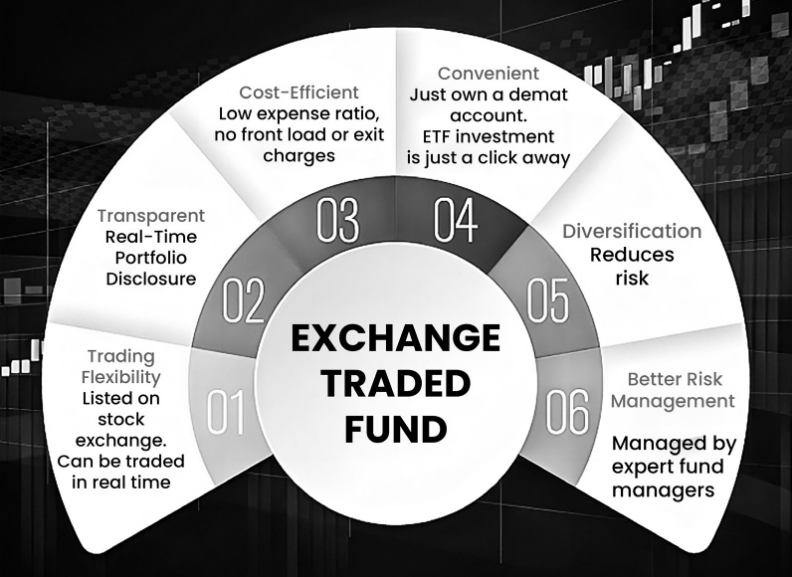
Exchange-traded funds (ETFs) are like baskets of securities that trade on stock exchanges like individual stocks. They offer diversification and flexibility, similar to mutual funds, but with the added benefit of real-time trading throughout the day. It should be mentioned, though, that ETFs differ from mutual funds in the following ways:
Unlike mutual funds, exchange-traded funds (ETFs) are freely traded on a stock exchange and are tradable by investors.
The value of an exchange-traded fund (ETF) varies greatly throughout the day based on supply and demand. Unlike mutual funds, which are assigned a Net Asset Value (NAV) at the conclusion of each trading period, ETFs replicate index returns, which may differ from the actual index.
ETFs are more economical when compared to mutual funds.
Key Features:
Track markets/sectors: ETFs follow specific indexes or sectors, allowing targeted investment exposure.
Variety & Diversification: There are many types of ETFs like Equity, fixed income, commodity, multi-asset, factor, currency and real estate which offer wide variety to investors. .
Cost-effective: Lower management fees compared to mutual funds.
Transparent: Daily holdings disclosure ensures clear understanding of the underlying assets.
Flexible: Easy buying and selling on exchanges for quick portfolio adjustments.
Potentially tax-efficient: Lower portfolio turnover may reduce capital gains taxes.
Investment Considerations
Market risk: ETF value fluctuates with the underlying market performance.
Liquidity risk: Low trading volume ETFs might be difficult to sell quickly.
Tracking error: Minor performance differences may exist between the ETF and its benchmark.
Interest rate risk: Fixed-income ETFs are sensitive to interest rate changes.
Tax implications: Capital gains and portfolio turnover can impact tax liability.
Platform for Trade Receivables Discounting System (TReDS)
It is an electronic platform that enables different financiers to finance or discount the trade receivables of Micro, Small and Medium-Sized Enterprises (MSMEs).
These receivables may be owed by businesses and other purchasers, such as government agencies and public sector enterprises (PSUs).
Goal: To help MSME sellers manage their needs for working capital by enabling them to discount invoices submitted against big businesses. MSMEs can get payments more swiftly thanks to the platform.
Participants:
• Sellers (MSMEs only): Eligible to sell invoices on the platform.
• Buyers: Any corporate entity, government department, PSU, or authorized institution can participate as a buyer.
• Financiers: Banks, NBFC-Factors, and other RBI- approved financial institutions can participate as financiers, bidding competitively to purchase invoices.
• While the participation in TReDS is voluntary, government mandates certain large companies to register on TReDS platforms. However, using the platform for transactions remains optional for these entities.
Transaction Flow:
• Factoring Unit (FU) Creation: MSME seller uploads invoice data onto the platform, creating a standardized FU.
• Counterparty Acceptance: The relevant buyer or seller approves the FU.
• Financier Bidding: Financiers compete by submitting bids (discount rates) for the invoice.
• Selection of Best Bid: The seller or buyer (depending on the agreement) chooses the most favorable financing offer.
• Payment Disbursement: The selected financier disburses funds to the MSME seller at the agreed discount rate.
• Buyer Settlement: The buyer settles the full invoice amount with the financier on the due date.
Credit rating agencies in India
A credit rating agency rates various entities as borrowers based on their repayment ability using a range of metrics and factors. These entities exclude individuals, and the ratings take the form of letters such as AAA, CCC, and so on. Since the amount borrowed by organisations can run into lakhs and crores, those who invest in or lend to these organisations face a comparatively higher risk. Thus, with these credit ratings, investors, or lenders can make better decisions regarding organisational borrowers who may be:
State governments
Local governmental bodies
Companies
Special purpose entities
Non-profit organisations
List of Credit Rating Agencies in India
Credit Rating Information Services of India Limited (CRISIL)
Investment Information and Credit Rating Agency of India Limited (ICRA)
Credit Analysis & Research (CARE)
Onida Individual Credit Rating Agency of India (ONICRA)
Fitch India
Brickwork Ratings (BWR)
SME Rating Agency of India Limited (SMERA)
Functions of credit rating agencies in India
CRAs rate entities based on their ability to repay a loan or service their debt.
CRAs rate financial products offered by financial institutions such as banks, public companies, NBFCs, microfinance institutions and mutual fund companies. They rate debt instruments and short-term investment instruments such as fixed deposits, bank loans, bonds, and hybrid capital instruments.
CRA-approved credit ratings of investments help investors in making informed decisions.
CRAs research the economy as a whole, including industries and companies and offer valuable analysis to their members.
CRAs offer risk solutions and fund evaluation services to the mutual fund industry.
CRAs provide policy and regulatory advice to leading organisations and the government.
Credit Information Bureaus in India
Unlike credit rating agencies, credit bureaus in India assign a credit score to individual borrowers like you, based on your credit worthiness and repayment behaviour. They generate a three digit credit score and credit report after evaluating your credit history. This helps the lenders weed out undesirable loan applications that carry high risk. For instance, the Experian credit score in India is between 300 and 850 and the CIBIL Score range from 300 to 900. In both cases, the higher your score, the stronger is your financial profile.
List of credit information bureaus in India
Experian
Equifax
TransUnion CIBIL
Functions of credit information bureaus in India
CIBs maintain a repository of credit information of individual borrowers.
CIBs offer members comprehensive risk management tools.
• CIBs provide lenders with portfolio reviews of borrowers that help them study a borrower’s credit behaviour and past or existing relationships with multiple lenders.
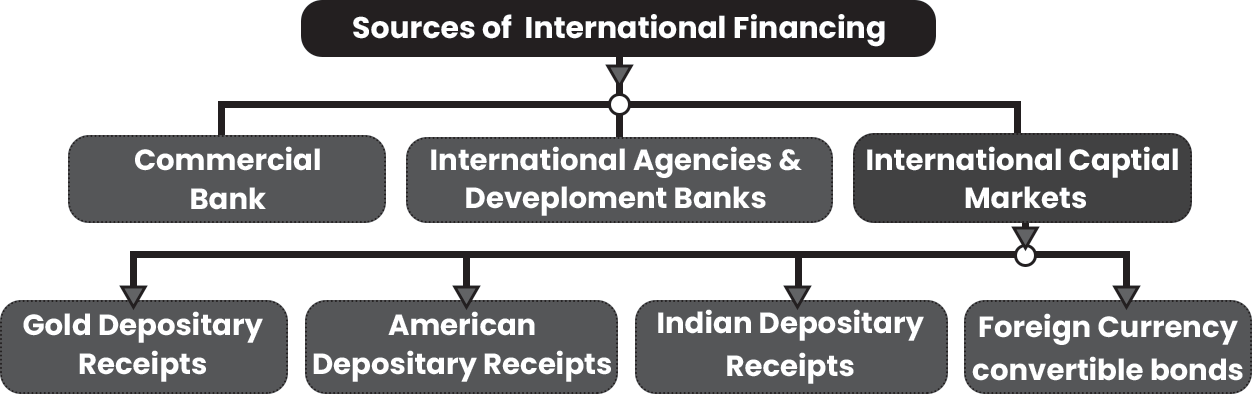
Sources of International Financing
Depository Receipts (DRs)
• Depositary Receipts (DRs) are financial instruments that bridge the gap between international investors and companies seeking capital. They allow companies to raise funds from foreign markets without the complexities of listing shares directly on those exchanges.
Breakdown of the three main types of DRs
• Global Depository Receipts (GDRs): Companies issue shares in their home currency, which are then deposited with a custodian bank. This bank creates GDRs, typically denominated in US dollars, representing ownership of the underlying shares. GDRs are listed on foreign stock exchanges, making them accessible to international investors who benefit from liquidity and ease of trading. Examples of companies that have issued GDRs include ICICI and Wipro, with banks like JPMorgan acting as custodians.
• American Depository Receipts (ADRs): Functioning similarly to GDRs, ADRs are issued in the United States and denominated in US dollars. Companies deposit their local currency shares with a US depository bank, which then creates ADRs. These receipts are traded on American stock exchanges, providing US investors with the opportunity to invest in foreign companies. To ensure transparency, US banks like Citigroup often sponsor ADRs, guaranteeing the accuracy of financial information provided to investors.
• ADRs come in two types: Sponsored (where the company actively participates) and Unsponsored (issued without company involvement).
• Indian Depository Receipts (IDRs): Issued in India and
denominated in rupees, IDRs cater to foreign companies seeking to raise capital in the Indian market. Similar to GDRs, shares are deposited with a custodian bank, in this case, the Indian regulatory body SEBI. IDRs are then listed on Indian stock exchanges, allowing Indian investors to participate by buying and selling them like any other security. This provides a valuable alternative for foreign companies to raise funds and for Indian investors to diversify their portfolios. Notably, Standard Chartered Bank was the first company to issue an IDR.
Central Depository Services (India) Ltd. (CDSL) was setup in 1999 and is the largest in India in terms of the number of demat accounts opened. Its top shareholders are Bombay Stock Exchange and some other banks like Standard Chartered and HDFC.
Foreign Currency Convertible Bonds (FCCBs)
Hybrid: Foreign Exchange Convertible bonds are hybrid financial instruments that combine debt and equity.
Convertible: These bonds are convertible, just like any other convertible securities, which means that they can be converted into any kind of depository receipt or equity shares at a future date after a predetermined amount of time has passed
Investor Flexibility: Holders have the choice to:
Convert their FCCBs into a predetermined number of shares at the conversion price.
Maintain ownership of the FCCBs and receive periodic coupon payments.
Redeem the FCCBs at maturity for their face value.
• FCCBs are always purchased and sold on international financial exchanges.
• They typically have a five-year redemption period.
• Conversion Control: Unlike some convertible bonds, the conversion rate for FCCBs is pre-determined and not under the control of the holder.
• Dilution Risk: Conversion of FCCBs into equity can dilute existing shareholders’ ownership and decrease earnings per share (EPS).
COMPANY
A company is an association of two or more persons in furtherance of a common business objective. A company is a “Separate Legal Entity” having its own identity distinct from its members. As a legal entity, a company can own a property in its own name, can sue and be sued in its own name and also enjoys perpetual succession, among others. Based on the activity/requirement of the promoters, different types of companies can be incorporated under the Companies Act, 2013.
TYPES OF LEGAL ENTITIES IN INDIA
Private Limited Company
• A Private Limited Company is a company whose ownership is private. A private limited company can be formed with a minimum of 2 and maximum of 200 members.
• It cannot issue a prospectus in the open market nor can it make or accept deposits from the public. The shares in a private company are not freely transferable.
• According to the Companies Act, 2013, an investor can choose between the following types of a Private Limited Company in India;
• Company Limited by shares: A company limited by shares means a company is having the liability of its members limited by the memorandum to the amount, if any, unpaid on the shares respectively held by them.
• Company Limited by Guarantee: A company limited by guarantee means a company is having the liability of its members limited by the memorandum to such amount as the members may respectively undertake to contribute to the assets of the company in the event of its being wound-up.
• Unlimited Company: An unlimited company means a company is not having any limit on the liability of its members.
Public Company
• Public Limited Company is a type of company whose securities are traded on a stock exchange.
A Public Limited Company can be formed with a minimum of 7 members. There is no restriction on the transferability of shares.
• A Public Limited Company requires more public disclosures and compliances from the government as well as other authorities like RBI (Reserve Bank of India), SEBI (Securities and Exchange Board of India) etc.
Sole Proprietorship
• The sole proprietorship is the simplest form of business under which one can operate.
• The sole proprietorship is not a separate legal entity. The person who is the owner of the business becomes personally liable for the debts of the business.
• For taxation and legal liability purpose, the owner and the business are one and the same. The proprietorship is not taxed as a separate entity.
One Person Company
• The concept of One Person Company has been introduced by Companies Act, 2013 enabling a sole proprietor form of business to enter into the corporate framework.
• This allows a sole investor to form a company alone with limited liability.
• One Person Company structure is similar to that of a proprietorship concern without the ills generally faced by the proprietors.
• One of the most important features of One Person Company is that the risks mitigated are limited to the extent of the value of shares held by such person in the company.
Partnership
• The Indian Partnership Act, 1932, Section 4, defines partnership as “the relation between persons who have agreed to share the profits of a business carried on by all or any of them acting for all”.
• The partnership is an association of two or more persons who have agreed to share the profits of a business which they run together.
• This business may be carried on by all or any one of them acting for all. The persons who own the partnership business are individually called ‘partners’ and collectively they are called as ‘firm’ or ‘partnership firm’.
• Unlike a company, a partnership is not a separate legal entity distinct from its members. It cannot own a property, incur debts or sue any party in its own name.
• Moreover, the partners of a partnership firm shall be personally and severally liable for the liabilities incurred by the firm.
Limited Liability Partnership (LLP)
• Limited Liability Partnership Act, 2008 governs the principles of Limited Liability Partnership in India.
• It is a combination of a company and a partnership firm
Unlike partnership, the liability of the partners in an LLP is limited and no partner shall be held liable for the acts of the other.
It is a separate legal entity, having a distinct entity of its own separate from its members.
The main disadvantage of an LLP is that it cannot raise capital from the public by issue of an IPO unlike a company.
Section 8 Company
A Section 8 Company of Companies, 2013, is the same as Section 25 company under the old Companies Act, 1956.
Section 8 company is one of the most popular forms of Non- Profit Organisations in India.
A Section 8 company can be established for “promotion of commerce, art, science, sports, education, research, social welfare, religion, charity, protection of environment or any such other object,” provided it “intends to apply its profits, if any, or other income in promoting its objects” and “intends to prohibit the payment of any dividend to its members.”
Sweat Equity Rules: Share Based Employee Benefits and Sweat Equity Regulations, 2021 (SEBI)
The SEBI (Share Based Employee Benefits and Sweat Equity) Regulations, 2021 give the list of employees to whom stock (equity) options may be offered.
Sweat Equity: Sweat equity refers to the non-cash contributions made by a company’s founders or employees in exchange for ownership in the form of shares. This approach
is commonly used by startups facing funding constraints, offering sweat equity as a compelling form of compensation.
Issuance Limits
• Listed companies: Maximum annual issuance of 15% of paid-up capital, with a total cap of 25%.
• Innovators Growth Platform (IGP) companies: Annual cap of 15%, total cap of 50% of paid-up capital (applicable for 10 years after incorporation).
• In order to list issuers that heavily utilise technology, information technology, intellectual property, data analytics, biotechnology or nanotechnology to provide goods, services or business platforms with significant value addition, SEBI launched the Institutional Trading Platform (IGP).
Employees Stock Option Plan
Employee Stock Option is defined under Section 2(37) of the Companies Act, 2013. The employees stock option means the option provided to the directors, employees or officers of the company or its holding or subsidiary company, which gives the right or benefit to subscribe or purchase the shares of the company at a predetermined price on a future date. It is issued by a company when it wants to raise its subscribed capital. Rule 12 of Companies (Share Capital and Debentures) Rules, 2014 regulates the procedure of the issue of ESOP.
However, the shares are not immediately given; they are held in a trust fund during a predetermined vesting period. Eligible employees must remain with the company during the vesting period to receive the shares. If they do, they can buy the shares at the grant price on the vesting date.