Whatsapp 88106-52225 For Details
Get Free IAS Booklet
Get Free IAS Booklet
INDIA’S RISING FOOD PRODUCTION BY FALLING NUTRITION
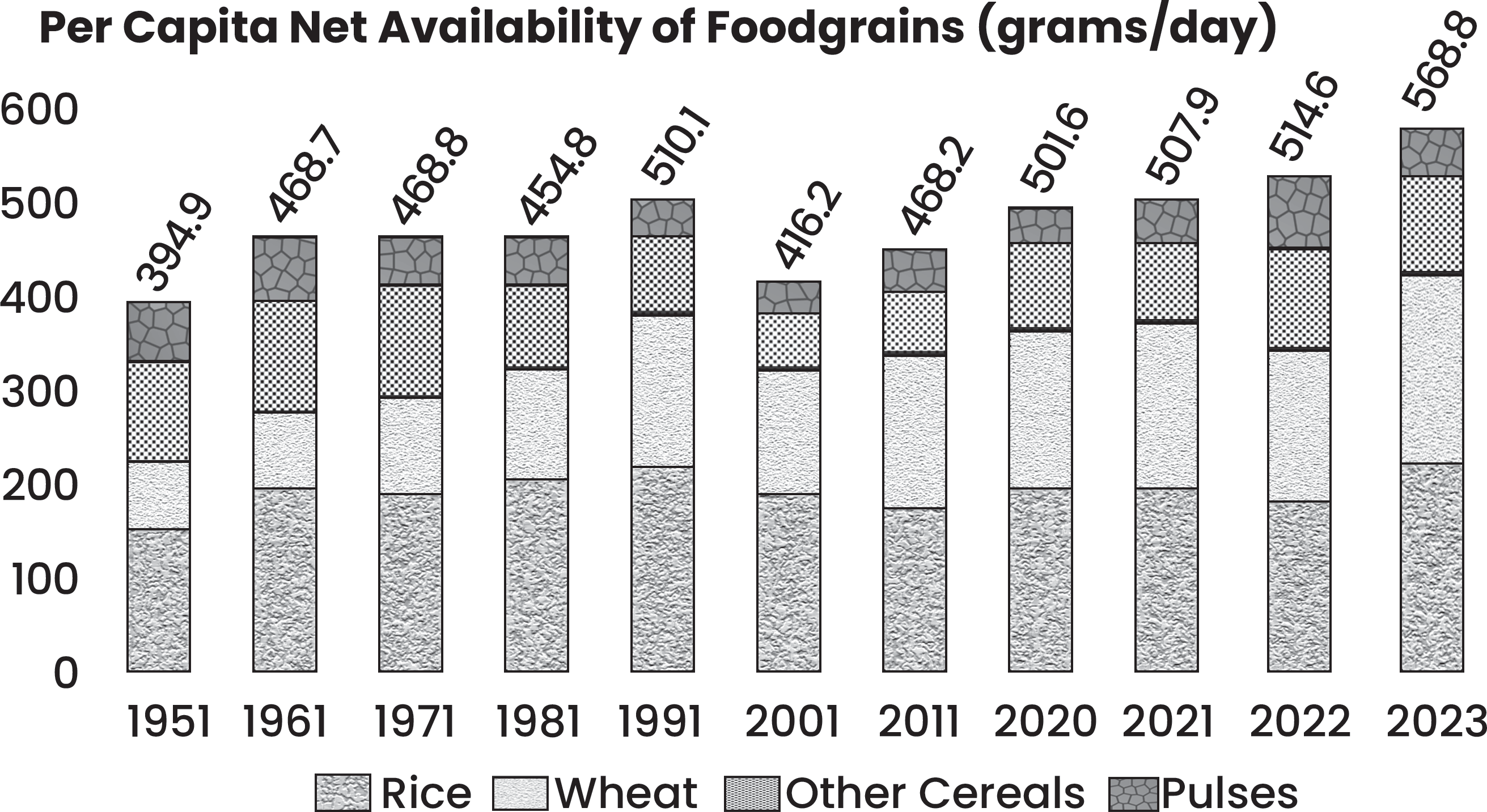
India achieved record highs in food grain and horticulture production in 2021-22. However, food grains have not become any more accessible per capita despite this enormous increase in production. The per capita availability of food grains at
510.1 grams per day in 1991 was the highest achieved and 20 years later in 2021 we are at 507.9 grams per day. And ensuring access to nutritious food for all remains a challenge. Malnutrition indicators highlight the need for a shift in Indian agriculture towards better nutrition, production, and environmental sustainability. The findings from the Fifth National Family Health Survey suggest that nutrition-related indicators have worsened in many of our States. In addition, findings from the Comprehensive National Nutrition Survey (2016-18) have highlighted the role of micronutrient malnutrition. Inflation in cereals, vegetables and spices has
been touching double digits which indicates impediments in access to food for the poor. The use of export restrictions, subsidies, or price controls to reduce the burden of rising food prices may appear attractive but risks adding further upward pressure on global agricultural prices.
According to the UN (FAO–SOFI latest estimates), about 194 million people in India are undernourished, accounting for a significant share of the global hunger burden.
Around 35–36 percent of children in India are undernourished, as reflected in recent national and international nutrition assessments.
India is ranked 68th out of 113 countries in the Global Food Security Index 2023, indicating persistent challenges in food affordability, availability, and nutrition.
According to the Global Hunger Index 2024, India is ranked 105th out of 127 countries, placing it in the serious hunger category.
Governmental Efforts: This year's World Food Day theme, "Leave No ONE Behind," is a principle that NABARD has always supported. Food and nutritional security are the key to attaining the Sustainable Development Goals and is explicitly stated in SDG 2 (‘End hunger, achieve food security and improved nutrition and promote sustainable agriculture’). Good health benefits not only the individual, but the nation
as well. Several steps such as crop diversification to improve affordability and access to nutritious food; emphasis on cultivation of low input and resilient crops such as millets, diversifying the PDS food basket; bio-fortification; emphasis on women’s education which has a positive multiplier effect on nutritional status of children have been taken in recent times. These need to be further strengthened going forward.

Food Security
The term “food security” describes the provision of a sufficient supply of food to individuals, especially the undernourished. India lags far behind in terms of quality protein intake at 20%, which must be addressed by making protein-rich food products such as soybeans, lentils, meat, eggs, dairy, and so on available at affordable prices. According to the Human Rights Measurement Initiative, India is doing 56.8 percent of what should be possible at its income level for the right to food.
Food security has a different meaning as it is something more than getting two square meals. It means accessibility, availability, and affordability of food to all the people at all times whenever there is a shortage of food or crops then the poor household is the most vulnerable to food insecurity because it is depe ndent on the public distribution system.
Four Dimensions of Food Security

From being ‘freedom from hunger’ in the early 1940s, the idea of food security has grown over time to encompass four dimensions.
A physical factor called availability is guaranteed when there is enough food available for people to eat.
A household is considered to be accessible if it has the means to purchase a suitable diet.
Utilisation is reliant on appropriate health care, as well as the biological and social surroundings.
Stability: A population, household, or individual must always have access to enough food in order to be considered food secure. They shouldn’t have to take the chance of losing access to food due to cyclical events like seasonal food insecurity or unexpected shocks like an economic or climatic crisis. Thus, the availability and access components of food security can both be referred to by the term “stability.”
International Organisations Ensuring Food Security
Food and Agricultural Organisation (FAO): Established in 1945 in Rome, Italy. It is the specialized agency that leads international efforts for the reduction of hunger and improved nutrition and food security.
World Food Programme (WEP): One of the largest humanitarian organizations which address hunger and also promotion of food security, in Rome, Italy.
World Bank: It was established in 1944 and the headquarters is situated in Washington, USA.
Initiatives and Programs Introduced by Government of India for Food Security
The important steps which are taken for the food security programs of India are as follows:
Public Distribution System: Major portion of the expenditure of the government is spent on food subsidies through Targeted Public Distribution System.
PM Poshan and Mid-Day Meal Scheme
Integrated Child Development Services Scheme
National Food Security Mission.
Rashtriya Krishi Vikas Yojana (RKVY).
Integrated Schemes on Oilseeds, Pulses, Palm oil, and Maize (ISOPOM).
Pradhan Mantri Fasal Bima Yojana.
National Food Security Act (NFSA).
Public Distribution System (PDS)
PDS was established during the interwar period for essential commodities due to critical food shortages in urban areas. It then spread to tribal blocks in 1970s and areas with high poverty as the country’s agricultural output boomed due to the Green Revolution. It has been the joint responsibility of the Centre and State where centre procures, transports and allocates bulk grains while State governments identify beneficiaries and supply grains to each through Fair Price Shops. Wheat, rice, sugar and paraffin are currently being distributed to the States and Union Territories (UTs) under the PDS. Pulses, edible oils, iodized salt, spices, and other mass-consumption goods are also distributed by certain States and Union territories (UTs) through PDS outlets.
Revamped Public Distribution System (RPDS - 1992):
Launched in 1992, the Revamped Public Distribution System (RPDS) specifically targeted remote, impoverished areas like those under the Desert Development Programme (DDP), Integrated Tribal Development Projects (ITDP), Drought Prone Area Programme (DPAP) and Designated Hill Areas (DHA). RPDS offered subsidized food grains (issued 50 paise below the Central price) up to 20 kg per card. It also ensured better reach through doorstep delivery in these areas, additional ration cards for excluded families, more Fair Price Shops, and even included essential goods like tea, salt, and pulses for distribution.
Targeted Public Distribution System (TPDS - 1997):
It aimed to focus food grain distribution on the poorest. States identified beneficiaries based on 1993- 94 poverty estimates of Lakadwal Committee and received additional allocations beyond their regular PDS quota.
Ration Shops: For the distribution of food around 5.5 lakh Ration Shops have been opened in villages, towns in different regions. Ration shops are also termed Fair Price Shop and keep stock of kerosene oil for cooking, sugar, foodgrains which are sold at subsidies prices. Any family who is having ration card can purchase a stipulated amount of these items.
Ration cards are of three types-
For the poorest of the poor, there are Antyodaya Cards.
For those below poverty, there are BPL Cards.
For all others, they have APL Cards.
FOOD CORPORATION OF INDIA (FCI)
The Food Corporation of India (FCI), established in 1964, plays a key role in India’s food security. It fulfills several crucial objectives
Supporting Farmers: FCI offers farmers “remunerative prices” for their crops, ensuring fair compensation.
Food Distribution: It manages the nationwide Public Distribution System (PDS), ensuring food grains reach all regions.
Buffer Stock Management: FCI maintains adequate buffer stocks of food grains to address potential shortages and stabilize prices. This acts as a safety net during times of food scarcity. The FCI purchases surplus grain produced by farmers at harvest to build up these reserves. The stored food grains are then released at a subsidized price, known as the issue price, to underprivileged communities and regions facing food shortages. This buffer stock plays a crucial role in mitigating food shortages caused by natural calamities or disruptions in the food supply chain.
Food Security: These combined efforts have significantly transformed India’s food security system, moving it from crisis management to a more stable and reliable approach
IMPLEMENTATION OF FOOD SUBSIDY IN INDIA
The Indian government spends a significant amount on food subsidies, channeled through the Department of Food and Public Distribution. This department aims to ensure food security for the country by procuring food grains and distributing them. The subsidy itself is the difference between the cost of buying grain and the subsidized price it’s sold for. The Food Corporation of India and state governments receive these subsidies to help them buy grain from farmers at Minimum Support Prices (MSP). However, there are challenges in delivering these subsidies through the Public Distribution System (PDS) specially leakages of upto 47% in 2011 because of various reasons:-
Damages in food grains during transportation.
Pilferage of the food items.
Diversification of food grains to some non-beneficiaries by the issue of fraud cards.
Exclusion of some people who are entitled food grains but not in the beneficiary list.
Way Forward to Improve Food Subsidy Delivery
Replacement of Targeted Public Distribution System by that of Direct Benefit Transfer.
Automation of process at the fair price shops.
The use of Aadhar and also the introduction of biometrics was useful for the reduction of leakage in PDS.
Digitalization of the ration cards.
Decentralized procurement by states and reduction of expenditure on centralized procurement.
Antyodaya Anna Yojana (AAY)
The Antyodaya Anna Yojana (AAY), launched in 2000, was a significant step towards a more focused and efficient Targeted Public Distribution System (TPDS) targeting 1 crore poorest of the poor families in India from the existing BPL (Below Poverty line) families.
They were provided food grains at a highly subsidized rate of Rs.2/- per kg. for wheat and Rs.3/- per kg for rice.
The States/UTs were required to bear the distribution cost, including margin to dealers and retailers as well as the transportation cost.
National Food Security Act, (NFSA) 2013
The National Food Security Act (NFSA) 2013 also referred to as the Right to Food Act established rights based entitlement to food in India.
Features
Under the Targeted Public Distribution System, the Act provides up to 75% of the rural and 50% of the urban populations with access to subsidised foodgrains. Therefore, under the Act, roughly two thirds of the population are eligible to receive highly subsidised food grains.
Gender Empowerment: The Act requires the oldest woman in the household, who is at least 18 years old, to be the head of the household in order to issue ration cards as a step towards the empowerment of women.
Extensive: The Act is being applied throughout India, in all of the States and Unions.
Life Cycle Approach: Under the Act, pregnant women, nursing mothers, and children between the ages of six months and fourteen years are entitled to a nutritious meal at no cost through a network of widely dispersed Integrated Child Development Services (ICDS) centres called Anganwadi Centres, as well as through schools participating in the Mid-Day Meal (MDM) programme. Children who are malnourished up to the age of six have been prescribed higher nutritional standards. In addition, expecting mothers and nursing moms are eligible to receive a cash maternity benefit of at least Rs. 6,000, which can help with nutrition supplements and partially offset wage loss during pregnancy.
Food security allowance: If eligible individuals under the NFSA are not provided with the appropriate amounts of foodgrains or meals, they are entitled to a food security allowance from the relevant State Government. This allowance must be paid to each individual within the timeframe and method specified by the Central Government.
Responsibilities under NFSA
NFSA defines the joint responsibility of the Centre and State/UT Government.
Centre is responsible for allocation of required foodgrains
to States/UTs, transportation of foodgrains up to designated depots in each State/UT and providing central assistance to States/UTs for delivery of foodgrains from designated FCI godowns to the doorstep of the FPSs.
States/UTs are responsible for effective implemen- tation of the Act, which inter-alia includes identification of eligible households, providing them with ration cards, distributing foodgrain entitlements to qualifying households via fair price shops (FPS), granting licences to Fair Price Shop dealers and overseeing them, establishing a functional grievance resolution process, and necessary fortification of the Targeted Public Distribution System (TPDS).
Coverage and entitlement
Antyodaya Anna Yojana (AAY) and priority households comprise 50% of the urban and up to 75% of the rural populations that are covered by NFSA.
Priority households are entitled to 5 kg of foodgrains per person per month, while AAY households the poorest of the poor are entitled to 35 kg per family per month.
Central Issue Price
For a first three years following the Act’s enactment on July 13, 2013, foodgrains under the NFSA were to be made available at subsidised prices of Rs. 3/2/1 per kg for rice, wheat, and coarse grains, respectively.
After that, prices were to be periodically set by the Central Government, but they could not go above MSP. Government has decided from time to time to continue the above-mentioned subsidized prices under NFSA.
Direct Benefit Transfer- Are now adopted for cash transfers under the National Food Security Act (2013).
Mid Day Meal/ PM Poshan Scheme
The Mid Day Meal Scheme aims to feed students in school from class 1 to 8 with the aim to (i) provide nutrition (ii) increase school enrollment and retention, and (iii) provide food security. It is the biggest school lunch programme in the world with 120 million children being fed. It is administered by the Ministry of Education and is a Centrally Sponsored Scheme (meaning expenses of the scheme are distributed between the Centre and the State). It has now been subsumed under the PM POSHAN Abhiyaan.
• Rights Based: right recognised in the National Food Security Act, 2013 for children upto age of 14 for nutritious food.
• Nutrition Targetting: With Calorie (450g for Primary and 700g for Upper Primary) and Protein (20 gm for Primary and 40 gm for Upper Primary) intake targets specified.
• Extensive Territorial Coverage: All schools run by local bodies, Education Guarantee Scheme (EGS) centres, Alternative and Innovative Education (AIE) centres, government and government aided schools. During summer vacations, even drought affected areas are covered.
• Social Audit: is required to be done under the National Food Security Act, 2013 by stakeholders of the policy (parents and students) to check the records with actual ground implementation of the policy.
In 2018, PM POSHAN Abhiyan was launched which is an extension and expansion of the Mid Day Meal Scheme.
It is an advanced integrated scheme to target nutrition of child and mother during prenatal and post natal stage. It tracks nutrition levels of children on the Poshan Tracker.
Extends provision of nutritious food for Bal Vatikas (for children in pre-primary schools just before class 1).
Provides fortified grains (meaning food grains with enhanced nutritions) from godowns of Food Corporation of India to the schools.
Integrated Child Development Services (ICDS)
One of the premier initiatives of the Indian government and one of the biggest and most inventive early childhood care and development programmes globally is the Integrated Child Development Services (ICDS) Scheme, which was launched on October 2, 1975. It is the most visible symbol of the country’s commitment to its children and nursing mothers, as a response to the challenge of providing pre- school non-formal education on the one hand, and also breaking the malnutrition food cycle, morbidity, reduced learning capacity, and mortality on the other. Children aged 0-6 years, pregnant women, and breastfeeding moms are among the Scheme’s beneficiaries.
Food for Work Programmes
National food for work programme (NFWP) Introduced in 1977-78 initially offered food grains instead of wages to the poorest Indians to battle starvation. The government aimed to both support people in poverty and develop rural areas through infrastructure projects. In 2004, the NFWP was restructured and became part of the National Rural Employment Guarantee Act (NREGA) which guarantees 100 days of manual labor work to rural households.
National Food Security Mission
Launched in 2007, the National Food Security Mission aims to significantly increase production of rice, wheat, pulses, and coarse cereals. It focuses on:
Area Expansion and Productivity Enhancement: Growing crops on more land while also improving yields per unit area.
Soil Fertility Restoration: Rejuvenating soil health for sustainable production.
Farm Income Improvement: Boosting farm profits to
empower farmers.
Major Components of NFSM include
Rice (NFSM-Rice), Wheat (NFSM-Wheat), Pulses (NFSM-
Pulses), (NFSM-Coarse cereals), (NFSM- Nutri cereals) (NFSM-Commercial crops), (NFSM-Oilseeds) & Seed village programme.
Shanta Kumar Committee
The Indian government established a High-Level Committee (HLC) in 2014 to improve the Food Corporation of India’s (FCI) efficiency under Shri Shanta Kumar as the Chairman. It made the following recommendations:
Decreasing the Food Security Act’s beneficiary count from the present 67% to 40%.
Permit players to obtain and stockpile food grains on their own.
Put an end to the bonuses that states give farmers for meeting the minimum support price (MSP) and implement a cash transfer system that allows MSP and food subsidy amounts to be transferred straight into the bank accounts of farmers and those who benefit from food security.
Only in states with inadequate procurement infrastructure should FCI engage in full-fledged grain procurement. The states should handle the procurement in the cases of the high-performing states, such as Punjab, Andhra Pradesh, Madhya Pradesh, Chhattisgarh, and Odisha.
Eliminating levy rice: Under the levy rice policy, the government compulsorily purchases a certain percentage of rice from the mills (varies by state from 25 to 75 percent). This is known as levy rice. Only the remaining portion may be sold by mills on the open market.
Deregulate the fertiliser industry and give farmers a cash subsidy of Rs 7,000 per hectare.
Grain stocking to be outsourced: The committee says a negotiable warehouse receipt (NWR) system should be established. Under the new arrangement, farmers can deposit their produce in these approved warehouses and receive, based on MSP, 80% of the bank’s advance against their produce.
Clear and transparent buffer stock liquidation policy: FCI should be given greater business flexibility; surplus stock should be sold in the open market or exported as needed.
One Nation One Ration Card
The One Nation One Ration Card scheme has been implemented in all 36 States/UTs in India, enabling eligible beneficiaries covered by the National Food Security Act to purchase subsidized food grains from any Fair Price Shop (FPS) across India. The program, which provides rice, wheat, and coarse grains at rates of Rs. 3 per kg, Rs. 2 per kg, and Rs. 1 per kg, respectively, has been made portable throughout the country, and a mobile application called ‘MERA RATION’ has been launched to provide real-time information to beneficiaries in multiple languages. During the Covid-19 pandemic, the ONORC program was instrumental in ensuring
that NFSA beneficiaries, especially migrant workers, have access to subsidized food grains.
Features
Portable Ration Card: A national program making ration cards portable across India.
Increased Mobility: Allows beneficiaries under the NFSA to access subsidized food grains from any Fair Price Shop (FPS).
Reduced Hassle: No need to apply for a new ration card when moving states.
Convenience: The system also allows family members to claim the balance/required amount of food grains on the same ration card from any FPS in their native place or any other location.
Reduced Leakages: Aadhaar seeding and deduplica-tion minimize fraud.
IT-driven System: ePoS devices and Aadhaar integration enable nationwide portability. Integrated Management of Public Distribution System (IM-PDS) portal and the Annavitran portal will host data on food grain distribution through ePoS devices within a state.
Biometric Authentication: Fingerprint or iris scan confirms beneficiary identity at FPS. Beneficiaries can quote their ration card or Aadhaar numbers at any FPS to obtain subsidized food grains without the need to carry or share their cards with the dealer. Aadhaar authentication can be done using fingerprints or iris- based identification at any ePoS-enabled FPS of their choice to receive the entitled food grains.
Right to Food: Ensures access to subsidized food grains regardless of location
Social Impact: Promotes social equality by easing PDS access for all specially migrant labourers who makeup nearly 37% of the population.
Challenges of One Nation One Ration Card Scheme
While Aadhaar seeding aimed to reduce corruption in the Public Distribution System (PDS), it has also led to exclusion errors. Some people still lack Aadhaar cards, making them ineligible for subsidized food grains despite needing them.
Previously, social programs were based on residency, limiting access to benefits in a person’s original location if they moved. ONORC aims to address this, but it might disrupt existing practices. Fair Price Shops (FPS) receive quotas based on the number of assigned individuals. If people migrate, some FPSs might struggle serving more cardholders, while others have fewer customers.
Way Forward
Alternative Delivery Channels: Explore options besides FPSs to ensure vulnerable groups receive food grains during emergencies.
Expanded Mobility: Integrate ONORC with other social programs like Mid-Day Meals and healthcare services to improve overall well-being for migrant populations.
Long-Term Solutions: Consider alternatives like Direct Benefit Transfers or food coupon systems in the future. These could allow families below the poverty line to purchase essential food items at market prices from any store, using the provided coupons or cash.
Millets for Nutrition and Climate Action
Hidden hunger or micronutrient deficiency is one of the major hurdles faced by the nations in achieving SDG2, i.e., to end all forms of hunger and malnutrition by 2030.5
This is especially true for India. A major cause for this deficiency is excessive dependence on fine cereals like rice and wheat and lack of diversity. The need of the hour is to move towards sustainable and diverse food production system which would help achieve food as well as nutritional security. Millets, now known as Nutri-cereals with their superior nutritional profile compared to fine cereals while being climate resilient as well can play an important role in this regard.
C
Climate change and food security in India
Climate change is exacerbating India’s existing food security challenges. While the relationship is complex, it impacts crops, livestock, and fisheries, potentially leading to social and economic hardships like reduced income, lost livelihoods, and health problems. However, it is important to note that the net impact of climate change depends not only on the extent of the climatic shock but also on the underlying vulnerabilities. According to the Food and Agriculture Organization (2016), both biophysical and social vulnerabilities determine the net impact of climate change on food security.
One major concern is the potential for increased variability in monsoon rainfall patterns. This is critical because Indian agriculture heavily relies on predictable monsoon seasons for crop production.
Water scarcity is another major concern. India already struggles with water availability, and climate change is expected to worsen this situation, impacting irrigation and overall food production.
Climate change also amplifies economic factors that contribute to food insecurity. Variations in growing seasons and extreme weather events negatively impact farmer income. Children in vulnerable areas are at particular risk as droughts and floods become more frequent.
Additionally, rising carbon dioxide levels might decrease the nutritional quality of food crops.
Overall, climate change threatens to reduce production and consumption of essential food sources for vulnerable populations, impacting their dietary needs and overall well- being