Whatsapp 88106-52225 For Details
Get Free IAS Booklet
Get Free IAS Booklet
The term "caste" originates from the Portuguese word casta, which refers to a system of social stratification based on factors such as color, creed, blood, race, or kind. Caste is a social institution uniquely associated with the Indian subcontinent. While similar systems have existed in other parts of the world, this specific form has not been found elsewhere. Although caste is primarily linked with Hindu society, it has also spread to major non-Hindu communities within the Indian subcontinent, notably among Muslims, Christians, and Sikhs.
Concept and Nature of Caste System
Caste can be defined as a hereditary, endogamous group that shares a common name, traditional occupation, and culture, and is relatively rigid in terms of social mobility. It maintains distinct status divisions and forms a homogeneous community.
Caste is understood both as a cultural and structural phenomenon. Culturally, it encompasses a system of values, beliefs, and practices specific to a particular group. Structurally, it refers to a network of interrelated social structures and the interactions between different castes, influenced by various restrictions and disabilities.
Historically, caste was not always a closed system. In Vedic times, it was more flexible, with open access to occupations and even inter-caste marriages. Women also had property rights during this period. It was only in the later Vedic period that caste became a more rigid and institutionalized system.
Varna vs Caste
It can be mainly understood through two models: Varna model:
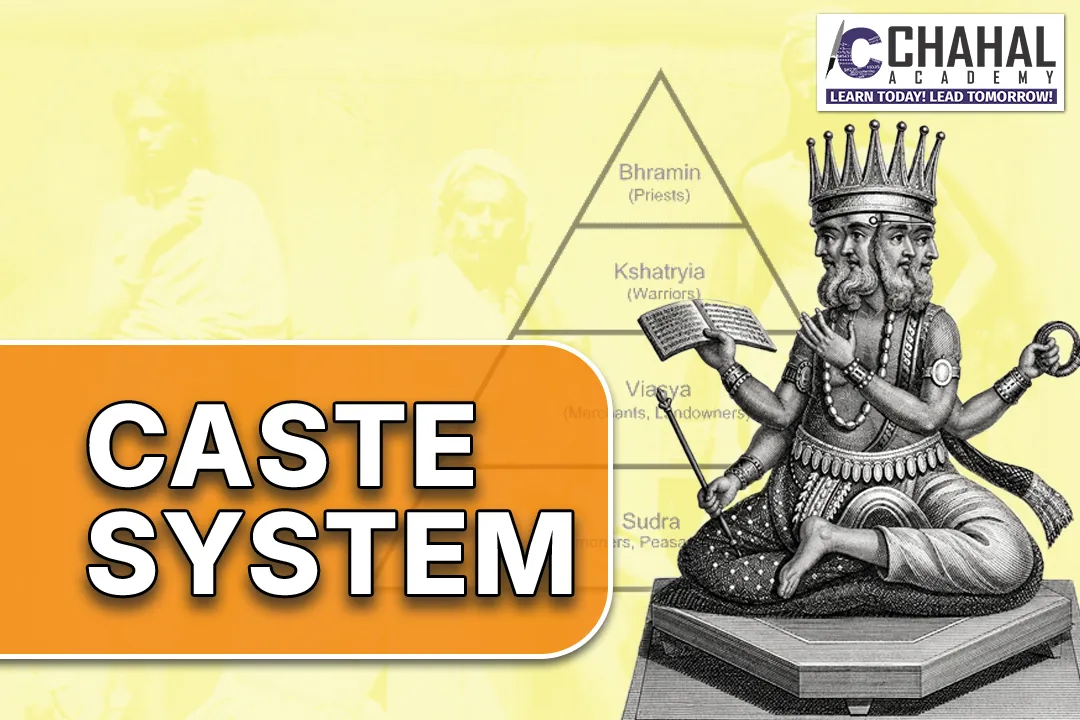
The origin of the caste system (Varna) cannot be traced to a specific point in time or a single source. The ‘Divine Origin Theory’ suggests that the caste system has a divine foundation. According to this theory, as described in the Purush Sukta hymn of the Rigveda, the four varnas emerged after Purusha (Brahma) sacrificed himself to establish a
proper social order. The Brahmins are said to have emerged from his mouth, the Kshatriyas from his arms, the Vaishyas from his thighs, and the Shudras from his feet, symbolizing their roles within the societal structure.
The Purush Sukta hymn of Rigveda tells us of the emergence of four varnas after the Purusha (Brahma) resorted to self-destruction so that a proper social order could come into existence. Thus, the Brahmins came out of the mouth, the Kshatriyas from the arms, the Vaishya from the thighs and finally the Shudras from the feet of the primordial being, the Mahapurush.
Jati or Caste Model:
In an honest assessment, sociologist M.N. Srinivas argues that the varna model has led to a distorted and inaccurate understanding of caste. He suggests that the varna system was more of an idealized concept of Indian social stratification rather than an actual representation. With the rise of the Jati model, the system became more rigid and closed. Jati, therefore, symbolized a clear-cut division of society with strict rules governing its structure. The relationship between varna and jati has been widely debated among scholars. The most common interpretation is to view varna as a broad, all-India classification, while jati is seen as a regional or local sub-classification, involving a far more intricate system
Theories of the Caste System
Herbert Risley’s The ‘Racial Theory of Varna’:
According to the racial theory, the caste system originated in India due to the emigration of Indo-Aryans from Persia who considered themselves superior to the original inhabitants (dark in colour), both in cultural and racial features. The term varna literally means colour and it was originally used to refer to the distinction between Arya and Dasa, in ancient India.
Occupational Theory:
Nesfield, a sociologist, viewed the caste system as a natural outcome of the occupational division in Hindu society. According to him, "Function and function alone is responsible for the origin of the caste system." He believed that in the early stages, when the system was not rigid, individuals were free to choose their occupations. However, as the system became more rigid, occupational mobility ceased.
With economic development and modernization, people began to specialize in specific fields of work. For instance, oil pressing was associated with the term 'teli,' and over time, it became linked to a specific caste. Similarly, other occupations like those of the Mali, Nai, Lohar, and Sonar came into being. Occupations deemed more respectable or prestigious elevated those who practiced them, leading to their identification with higher castes.
Characteristics of Caste System:
The Innate Nature : Jati membership is determined by birth. A person remains in the same caste throughout their life, and it is this caste that dictates their social status, making caste an ascribed status.
Endogamy: A key characteristic of the caste system is strict endogamy, where marriage is permitted only within one's own caste or sub-caste. The system has been so rigid that inter-caste marriages were traditionally forbidden, and even today, endogamy is widely practiced.
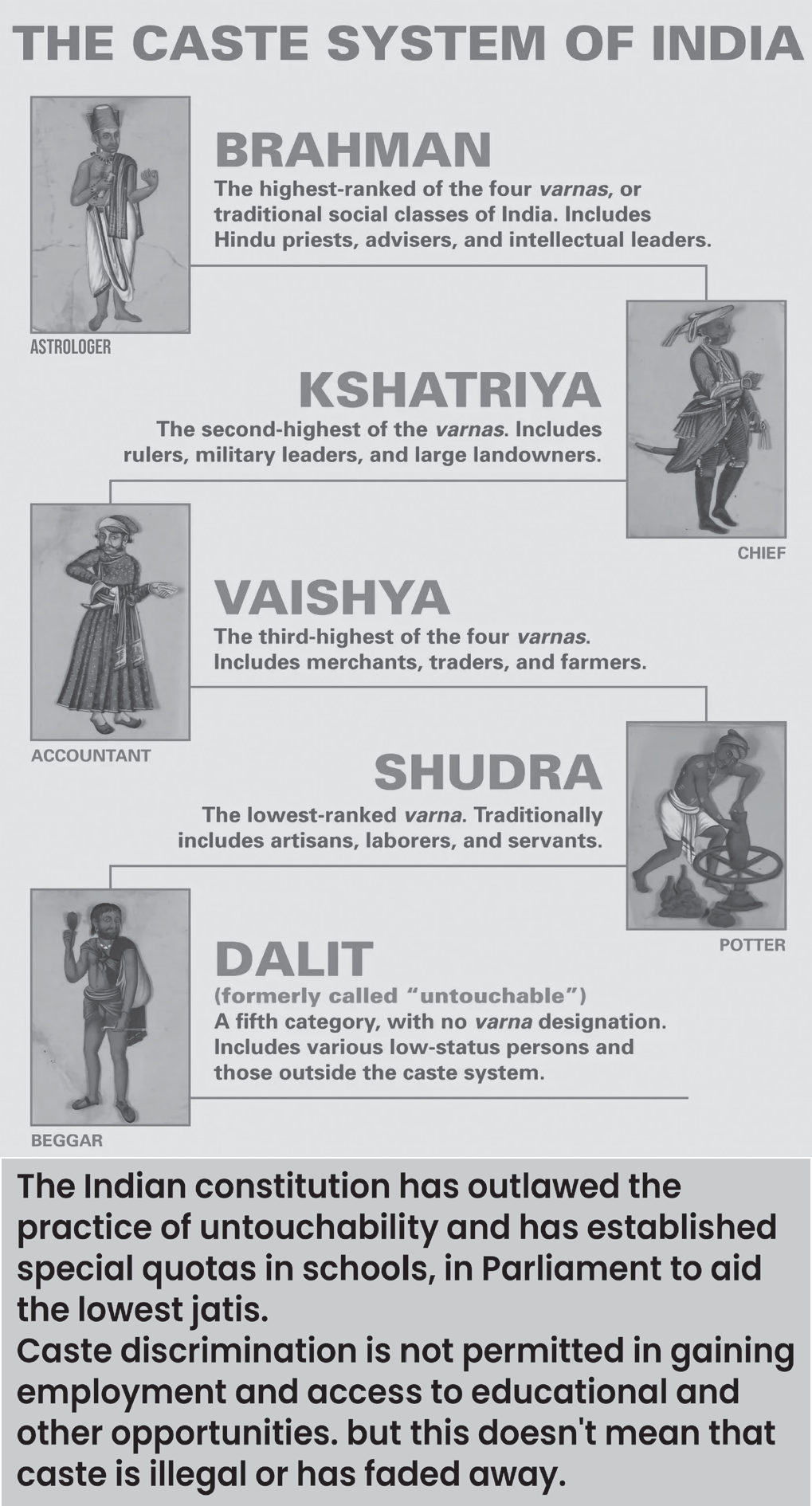
Hierarchy: Caste groups are ranked based on the perceived purity or impurity of their occupations. Like a ladder, castes are arranged from higher to lower positions, with the purest caste at the top and the impurest at the bottom. In this hierarchy, Brahmins occupy the highest rank, while the untouchables are positioned at the lowest level.
The hierarchical ordering of castes is based on the distinction between ‘purity’ and ‘pollution’. This is a division between something believed to be closer to the sacred (thus connoting ritual purity), and something believed to be distant from or opposed to the sacred, therefore considered ritually polluting.
Further, castes are not only unequal to each other in ritual terms, but they are also supposed to be complementary and non-competing groups. Each caste has its own place in the system which cannot be taken by any other caste.
Occupation-based System: Castes were historically linked to specific occupations, and individuals born into a caste were expected to follow the occupation associated with it. As a result, occupations were hereditary, passed down from one generation to the next.
Commensality: The sharing or acceptance of food and water within castes was governed by strict rules, with severe restrictions on eating and social interactions between different castes.
Disabilities and Privileges: Higher castes, such as Brahmins and other "twice-born" castes, enjoy numerous privileges in both religious and secular matters. In contrast, untouchables face significant social disabilities and discrimination.
Caste Councils: Caste panchayats, or councils, hold authority over their members and enforce adherence to caste rules. These councils have the power to punish violations of caste taboos, and through their socio- political authority, they can outcast or excommunicate members who defy the system.
Functions of the Caste System
The caste system may be seen traditionally as performing the following functions:
• It minimises economic competition by determining the occupation of various caste groups.
• By restricting and limiting the range of choosing a spouse, helps its members in their endeavour of choosing a life partner. The rules of endogamy are, traditionally, very strict and violations are taken seriously with punishments.
• The economic basis of the caste system is the Jajmani system. It is an elaborate division of labour governed by a well-defined system of exchange of goods and services.
• The higher landed castes, and the lower occupationally specialized castes or ‘service castes’ are traditionally bound by certain Jajmani obligations. The patrons (jajmans) or higher castes who control land ownership exchange the land produce against the services provided by service castes (kamins).
• Caste may also be seen as a social and psychological resource for its members. Because of a sense of solidarity and common consciousness that the members of a caste come to the rescue of fellow caste men.
Evil Facets of Caste System
• Untouchability: Many villages are separated by caste and they may not cross the line dividing them from the higher castes. They also may not use the same wells or drink in the same tea stalls or smoke from the same cigarette, or enter the same temple, leave alone same utensils, as higher castes.
• Discrimination: Lower castes often do not have the facility to electricity, sanitation facilities or water pumps in lower caste neighbourhoods. Access to better food, education, housing and medical facilities than that of the higher castes is denied. Ban on cultural practices like ‘Riding a Mare’ in marriages, ban on wearing chappals (sleepers) in high caste area of village, ban on wearing Pagdi, ban on covering various body parts by dalit women, entering a temple, even picking up a cricket ball, etc.
• Division of Labour: They are restricted to certain occupations like sanitation work, plantation work, leather works, cleaning streets, etc. Even today, most of the sanitation workers come from Scheduled Caste category including in the government.
•
Slavery: They are subjected to exploitation in the name of debt, tradition, etc., to work as labourers or perform menial tasks for generations together. Bonded labour due to debt trap was much prevalent in Dubla- Hali system of Gujarat, ‘sepadari’ or ‘sajhi’ system
of Punjab. ‘siri’ system of Haryana ‘jitu’ system of South India, goti’ or ‘gotia’ system of Bihar and Eastern India.
Colonialism and the Caste System
In comparison to ancient times, we have a much clearer understanding of caste in more recent historical periods. If we consider the 19th century as the start of modern history, then India’s Independence in 1947 serves as a natural line dividing the colonial era (approximately from 1800 to 1947) and the post-Independence or post-colonial era (from 1947 onwards). The caste system, as it exists today, has been significantly influenced by developments during British colonial rule and the significant transformations that followed independence.
Historians and scholars agree that all major social institutions, particularly caste, underwent notable changes under colonial rule. In fact, some argue that the caste structure we recognize today is more a result of colonial processes than ancient Indian customs. It’s important to note that many of these changes were not always intentional. Initially, British administrators sought to understand India's complex caste dynamics to govern the country more effectively. This led to detailed and systematic surveys documenting the traditions and practices of various castes and tribes. Many British officials, who had an amateur interest in ethnology, were enthusiastic about conducting such studies.
However, the most significant official attempt to document caste came through the census. Starting in the 1860s, censuses became a regular decennial activity from 1881 under British administration. The 1901 Census, supervised by Herbert Risley, was especially influential. It aimed to classify castes based on a hierarchical social order specific to different regions, determining the relative rank of each caste. This process deeply influenced social understanding and perception of caste. Numerous caste groups submitted petitions to the Census Commissioner, requesting a higher status in the social hierarchy, often providing religious or historical justification for their claims. Many scholars believe that this effort to officially categorize and quantify caste fundamentally altered its nature. Previously, caste identities had been more flexible and adaptable. But with formal documentation and classification, caste distinctions became more fixed and rigid.
The colonial government also began focusing on the upliftment of marginalized communities, known during that time as the 'depressed classes.' One major step in this direction was the Government of India Act of 1935, which officially recognized certain castes and tribes by placing them on special lists for state-sponsored benefits. This led to the introduction of the terms ‘Scheduled Castes’ and ‘Scheduled Tribes.’ Communities that were historically discriminated against, including those labeled as ‘untouchables,’ were included under the Scheduled Castes category. (Further details on untouchability and social exclusion are discussed in Chapter 5.)
Therefore, colonialism significantly reshaped the caste system in India. It would be more accurate to say that caste as a social institution underwent deep and lasting transformations during this period. These changes were also part of a larger global context marked by the spread of capitalism and modernity, which brought about wide- ranging shifts across societies worldwide.
Caste in the Present Times
India's independence in 1947 marked a significant, though incomplete, break from its colonial past. Caste dynamics played an undeniable role in the mass mobilizations of the nationalist movement.
Efforts to address the issues of the "depressed classes," particularly the untouchable castes, had begun before the nationalist movement. These efforts came from both ends of the caste spectrum – progressive upper-caste reformers as well as leaders from lower castes, such as Mahatma Jotiba Phule and Babasaheb Ambedkar in Western India, Ayyankali, Sri Narayana Guru, Iyotheedass, and Periyar (E.V. Ramaswamy Naickar) in the South.
Both Mahatma Gandhi and Babasaheb Ambedkar initiated protests against untouchability from the 1920s onwards. Anti-untouchability campaigns became a crucial part of the Congress agenda, and by the time independence was imminent, there was widespread consensus within the nationalist movement to abolish caste-based distinctions. The dominant view was to regard caste as a social evil, used by colonial powers as a tool to divide Indians.
Conundrum in Front of the State Post-Independence
The post-Independence Indian state inherited and reflected these contradictions.
On the one hand, the state was committed to the abolition of caste and explicitly wrote this into the Constitution. On the other hand, the state was both unable and unwilling
to push through radical reforms which would have undermined the economic basis for caste inequality.
The state assumed that if it operated in a caste-blind manner, this would automatically lead to the undermining of caste-based privileges and the eventual abolition of the institution. In the decades immediately after Independence, the state did not make sufficient effort to deal with the fact that the upper castes and the lower castes were far from equal in economic and educational terms. The only exception to this was in the form of reservations for the Scheduled Castes and Scheduled Tribes.
The development activity of the state and the growth of private industry also affected caste indirectly by speeding up and intensifying economic change. The modern industry created all kinds of new jobs for which there were no caste rules. Urbanisation and the conditions of collective living in the cities made it difficult for the caste- segregated patterns of social interaction to survive.
At a different level, modern educated Indians attracted to the liberal ideas of individualism and meritocracy, began to abandon the more extreme caste practices. On the other hand, it was remarkable how resilient caste proved to be. Recruitment to industrial jobs, whether in the textile mills of Mumbai (then Bombay), the jute mills of Kolkata (then Calcutta), or elsewhere, continued to be organised along caste and kinship-based lines.
The middlemen who recruited labour for factories tended to recruit them from their own caste and region so that particular departments or shop floors were often dominated by specific castes. Prejudice against the untouchables remained quite strong and was not absent from the city, though not as extreme as it could be in the village.
Changes in the Cultural Aspect of the Caste System
It was in the cultural and domestic spheres that caste proved strongest. Endogamy, or the practice of marrying within the caste, remained largely unaffected by modernisation and change. Even today, most marriages take place within caste boundaries, and there are very few inter-caste marriages.
While some boundaries may have become more flexible or porous, the borders between groups of castes of similar socio-economic status are still heavily patrolled. For example, inter-caste marriages within the upper castes (eg., brahmin, bania, Rajput) may be more likely now than before; but marriages between an upper caste and a backward or scheduled caste person remain rare even today.
Changes in the Political Aspect of the Caste System
The most eventful and important sphere of change has been that of politics. From its very beginnings in independent India, democratic politics has been deeply conditioned by caste.
While its functioning has become more and more complex and hard to predict, it cannot be denied that caste remains central to electoral politics. Since the 1980s we have also seen the emergence of explicitly caste-based political parties.
Changes in the Economic Aspect of the Caste System
When we look at the traditional Indian society, we find that the caste system formed the basis of the village economy and the jajmani system was the economic basis of the caste system. With the introduction of technological innovations, market economy and backward class and Scheduled Caste mobilization, the jajmani system declined. Thus, caste as a system broke down in most of the villages in India though castes survived as social groups with their concomitant caste consciousness.
In the urban areas, because of new occupational structures, an ‘occupation-free caste structure’ emerged. Caste and occupation were delinked because recruitment to the new occupations was based on technical skills which could be acquired through formal, modern education.
Moreover, of late, a new phenomenon may be observed.
A number of caste groups have joined hands to protect their ‘class interests’. The examples of Bhartiya Kisan Union (BKU) in Uttar Pradesh and Kshetkari Sangathan in Maharashtra go to prove that the economic functions of caste have undergone a transformation, but caste as a unit of social organization has survived because of its adaptive capabilities.
Changes in the Ritual Aspect of the Caste System
Traditionally, caste hierarchy has been a ritual hierarchy in terms of one’s status on the basis of the degree of purity or impurity. The secular or material attributes or determinants of the status ranking were secondary in nature. These secular attributes were wealth or ownership of land, access to political power etc.
However, certain processes of change which began during British rule but acquired momentum after independence have promoted changes in the system of ranking of castes. Urbanisation gave a serious blow to the ritual dimension of caste. With the manifold increase in the secularization of inter-caste and inter-personal relations, the ritual and social distance between castes narrowed down.
Further, Democratic Decentralisation of power right up to the grassroots level has led to increased participation in the political process and besides economic success, access to political power has become another means of status enhancement.
Factors Responsible for the Transformation in the Caste System
Industrialisation and
Growing importance
Urbanisation
Constitutional and legal provisions
Globalization
Sanskritisation and Westernisation
to wealth
Modern Education
Social and religious reform movements: Several religious and social reform movements played an important role in the transformation of the caste system. The Bhakti Movement and Sufi Movements laid emphasis on the oneness of mankind and
exposed the idea-of inequality as ‘man-made’, rather than ‘god-made’. Though they could not eliminate the caste system, they definitely facilitated the relaxation of caste rigidities. Social reform movements such as Arya Samaj and Brahmo Samaj movements made direct attacks on the caste system, especially on its ritual aspect of purity and impurity and inequality.
Westernisation: The process of Westernization introduced a new social philosophy and value system oriented towards social equality and increased emphasis on rationalism. It also promoted gender rights and gender justice. The Westernized sections of Indian society reinterpreted Hinduism and had a new look at the caste system. They also did not have any problem choosing a spouse from outside the caste. By and large, westernization promoted the cultural modernization of Indian society.
Industrialisation: The process of industrialization has affected caste structure to a remarkable extent.
Industrial growth has provided new sources of livelihood to people and made occupational mobility possible. People migrate to urban areas which witness less adherence to caste rules.
Urbanisation: The process of urbanization accompanied by secularization reduced the ritual and physical distance between the higher and the lower castes largely because of reduced physical segregation between castes and a more secular settlement pattern peculiar to urban centres.
Sanskritization: M.N Srinivas defines Sanskritization as “the process by which a low Hindu caste or tribal or any other group changes its customs, rituals, ideology and way of life in the direction of a high and particular ‘twice-born’ caste”.
Srinivas argued that the Sanskritization of a group has usually the effect of improving its position in the local caste hierarchy. It normally presupposes either an improvement in the economic or political position of the group concerned or a higher group self-consciousness.
Rise of new social classes: Industrialization has given rise to the emergence of new social classes. These social classes are replacing the traditional castes. Trade Unions, Merchants Associations and Political Parties are replacing the old caste loyalties. An increase in class consciousness leads to a decrease in caste consciousness. Dalit Chamber of Commerce has been established for better articulation of their demands from the government on issues of capital, regulations, business incentives, etc.
Role of state: Of all the factors enumerated above the role of the State was most crucial, especially after independence. When the Constitution of India proclaimed equality, it derecognized caste inequalities and caste superiorities in one stroke.
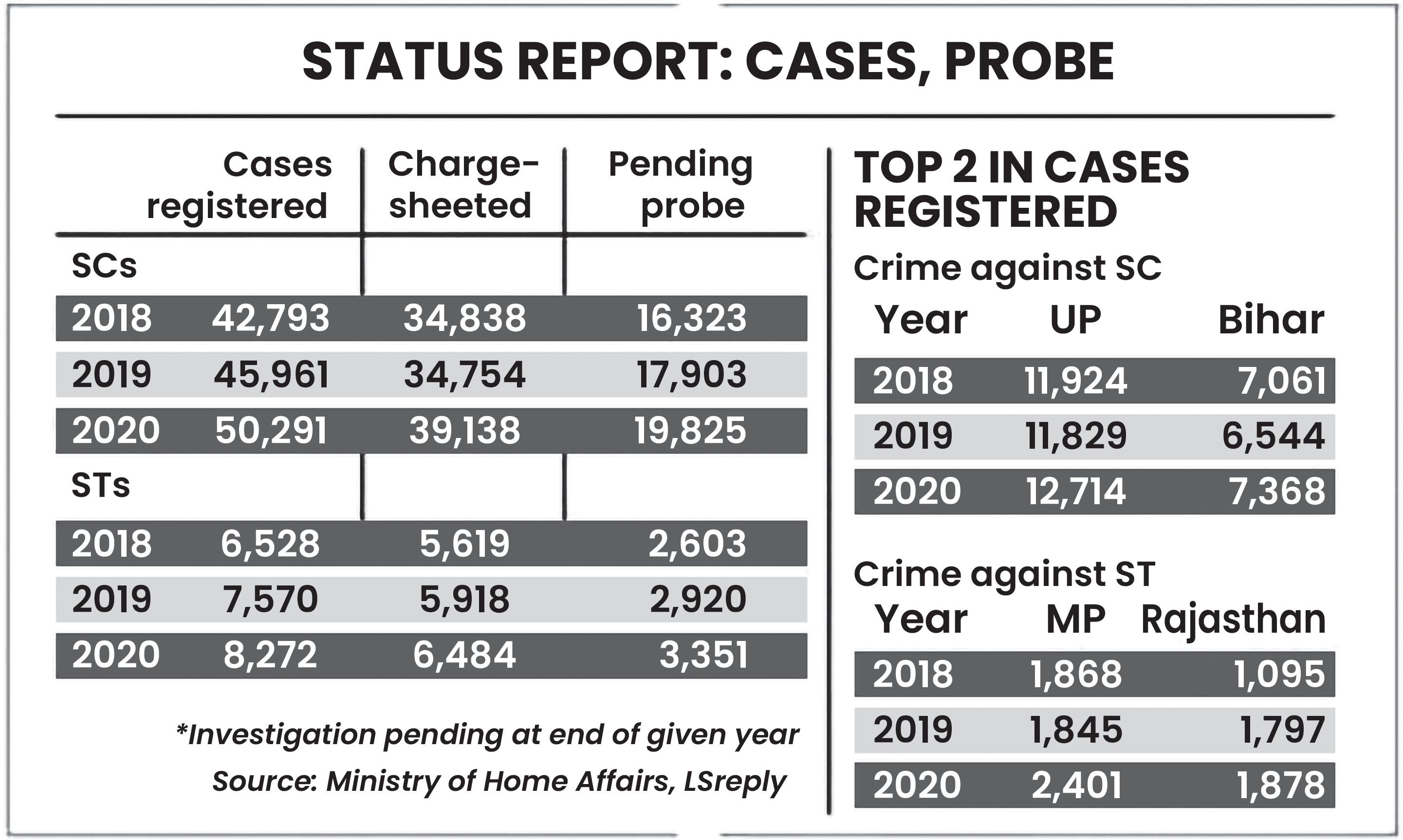
The practice of untouchability, an integral part of the caste system was made a cognizable offence under Article 17 of the Constitution and under prohibitive laws like Scheduled Caste/Scheduled Tribe Prevention of Atrocities Act 1989, Civil Rights Act 1955, etc.
Right to Equality has been enforced through equality in matters of public employment under Article 16 along with affirmative action or reservation for the weaker sections. Similarly, Article 15 enforces no discrimination on the basis of caste while simultaneously providing special provisions of affirmative action for the weaker sections in public education. At the political level, Seats have been reserved for Scheduled Castes in Lok Sabha, State Legislative Assemblies and Panchayati Raj Institutions.
Article 46 of the Directive Principles of State Policy in the Constitution also promotes the educational and economic interests of SCs, STs and other weaker sections of the society and seeks to protect them from social injustice and exploitation.
Democracy and Adult Franchises were great steps forward toward social justice, equality and empowerment of disadvantaged groups in Indian society.
Concept of Dominant Caste
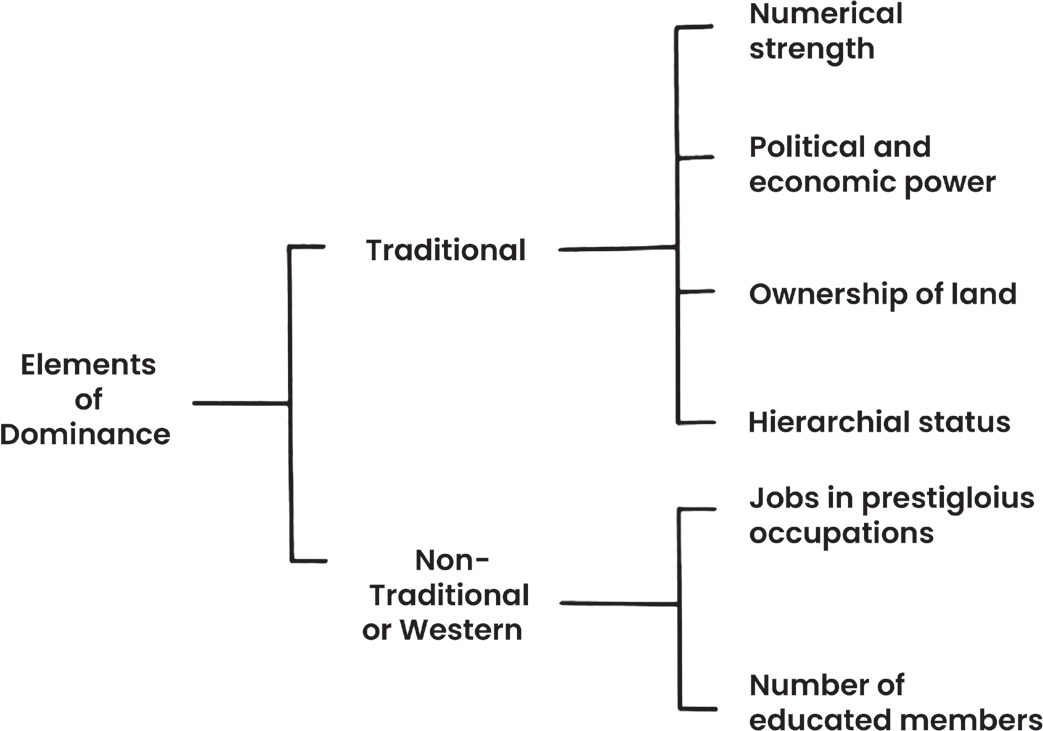
‘Dominant caste’ is a term used to refer to those castes which had a large population and were granted land rights by the partial land reforms effected after Independence. Famous Sociologist, M N Srinivas first defined the term ‘dominant caste’ to refer to the caste in the village which is numerically strong and also wields the greatest economic and political power (Srinivas 1987). The status of a dominant caste is governed by the following criteria:
The control of land and economic resources;
Numerical strength;
A relatively high ritual status in the caste hierarchy; and Educational status of its members
The land reforms took away rights from the erstwhile claimants, the upper castes, who were ‘absentee landlords’ in the sense that they played no part in the agricultural economy other than claiming their rent.
These land rights now came to be vested in the next layer of claimants, those who were involved in the management of agriculture but were not themselves the cultivators. These intermediate castes, in turn, depended on the lower castes’ labour, especially the untouchable castes for tilling and tending the land.
Once these intermediate castes got land rights, they acquired considerable economic power. Their large numbers also gave them political power in the era of electoral democracy based on universal adult franchises.
Thus, these intermediate castes became the dominant castes in the countryside and played a decisive role in regional politics and the agrarian economy. Examples of such dominant castes include the Yadavas of Bihar and Uttar Pradesh, the Vokkaligas of Karnataka, the Reddys and Khammas of Andhra Pradesh, the Marathas of Maharashtra, the Jats of Punjab, Haryana and Western Uttar Pradesh and the Patidars of Gujarat
The Caste System as a Discriminatory System
The caste system is a distinct Indian social institution that legitimises and enforces practices of discrimination against people born into particular castes. These practices of discrimination are humiliating, exclusionary and exploitative.
Historically, the caste system classified people by their occupation and status. Every caste was associated with an occupation, which meant that persons born into a particular caste were also ‘born into’ the occupation associated with their caste. Caste also had a specific place in the hierarchy of social status. There was also a fairly close correlation between social (i.e., caste) status and economic status. The ‘high’ castes were almost invariably of high economic status, while the ‘low’ castes were almost always of low economic status.
In modern times, and particularly since the nineteenth century, the link between caste and occupation has become much less rigid. Ritual-religious prohibitions on occupational change are not easily imposed today, and it is easier than before to change one’s occupation. Moreover, compared to a hundred or fifty years ago, the correlation between caste and economic status is also weaker – rich and poor people are to be found in every caste.
Although things have certainly changed, they have not changed much at the macro level – it is still true that the privileged (and high economic status) sections of society tend to be overwhelmingly ‘upper’ caste while the disadvantaged (and low economic status) sections are dominated by the so-called ‘lower’ castes. Moreover, the proportion of the population that lives in poverty or affluence differs greatly across caste groups, yet a large portion is of the scheduled castes.
Untouchability
Untouchability is one of the most extreme and harmful aspects of the caste system, subjecting individuals in the lowest caste ranks to severe social discrimination. Those identified as ‘untouchables’ are considered outside the
caste hierarchy, deemed so "impure" that their very touch is believed to pollute members of higher castes. As a result, untouchables face harsh punishments, while individuals of higher castes are often required to undergo extensive purification rituals.
In some regions, particularly in the south, the concept of "distance pollution" existed, meaning that even the presence or shadow of an untouchable was seen as polluting.
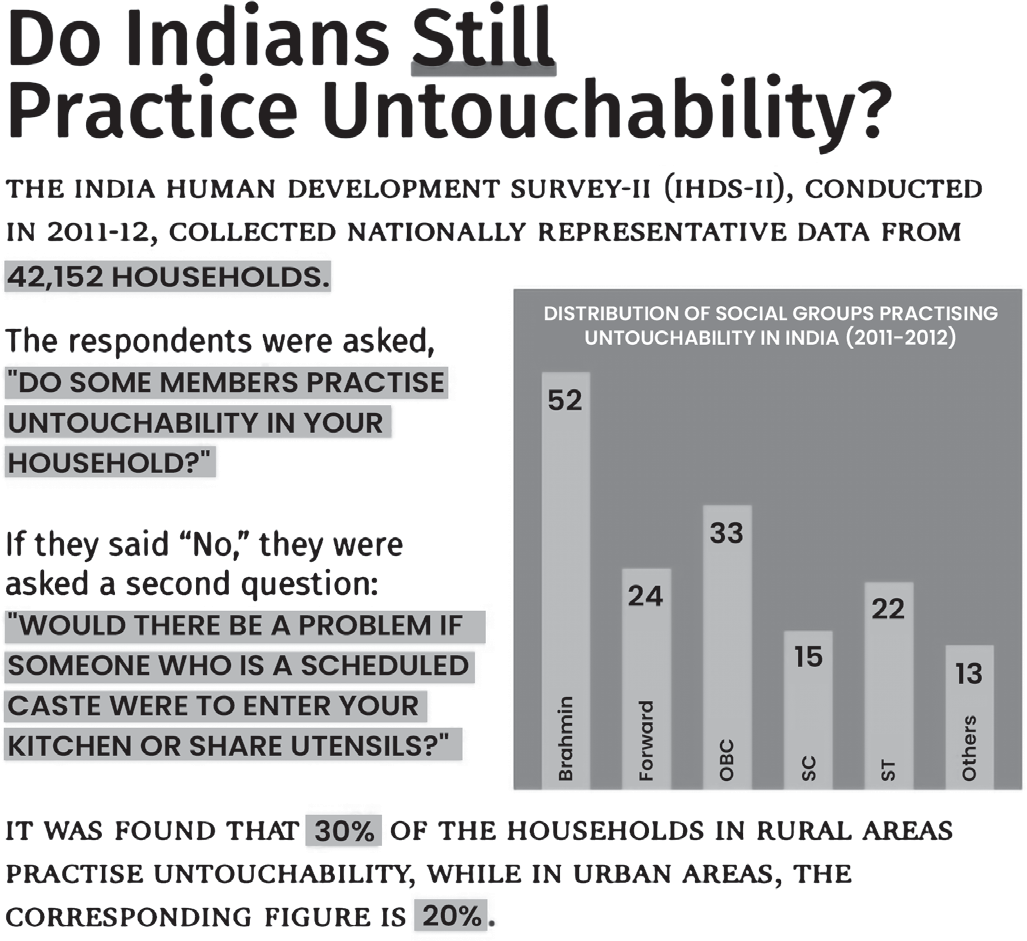
Untouchability manifests in three primary ways: exclusion, humiliation-subordination, and exploitation. While other lower castes (referred to as "touchable") also face subordination and exploitation to varying degrees, they do not endure the extreme levels of exclusion faced by the untouchables.
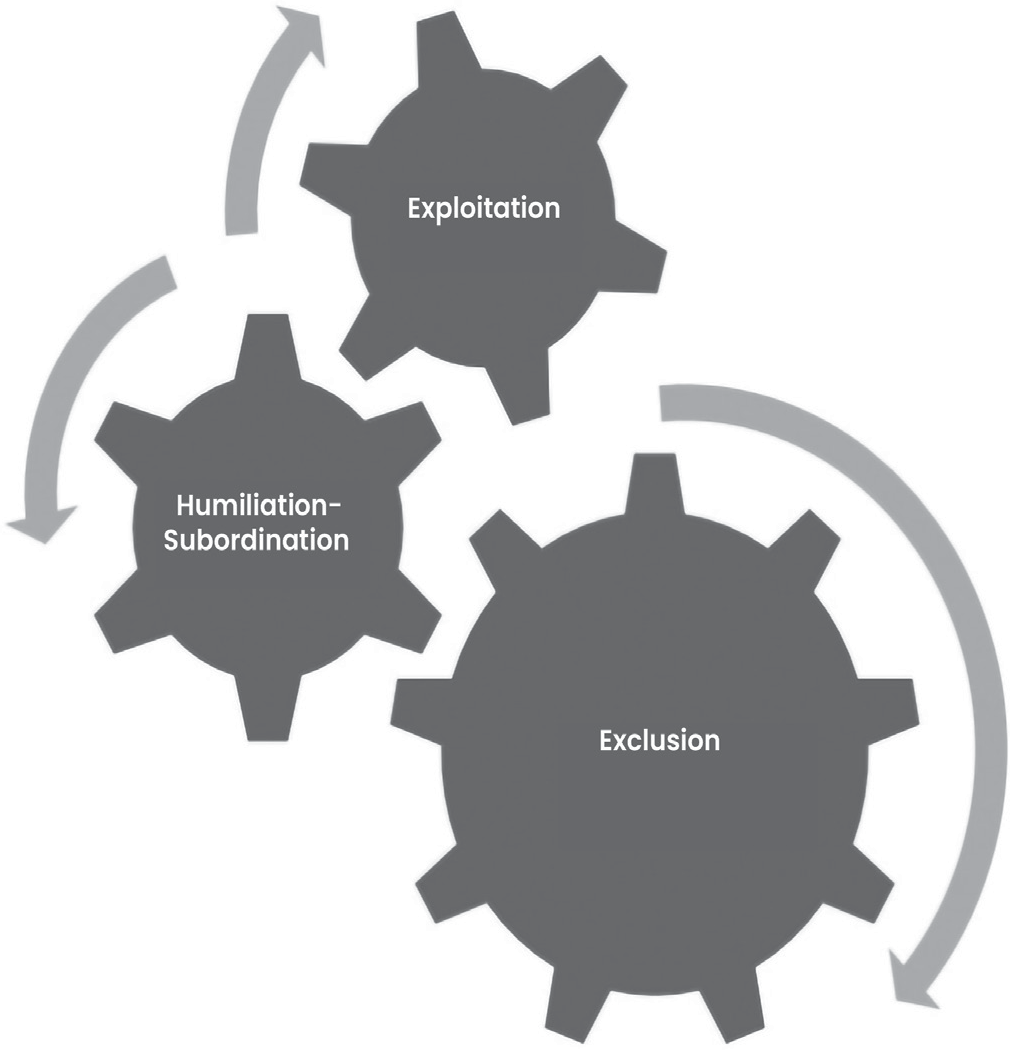
Three Key Dimensions of Untouchability
Scheduled Castes experience forms of exclusion that are unique and not practised against other groups – for instance, being prohibited from sharing drinking water sources or participating in collective religious worship, social ceremonies and festivals.
The performance of publicly visible acts of self-humiliation and subordination is an important part of the practice of untouchability. Common instances include the imposition of gestures of deference. (Such as taking off headgear, carrying footwear in the hand, standing with a bowed head, not wearing clean or ‘bright’ clothes, and so on).
Finally, untouchability is a pan-Indian phenomenon, although its specific forms and intensity vary considerably across regions and socio-historical contexts.
Over the centuries, the 'untouchables' have been known by
various names. In the 1930s, Mahatma Gandhi popularized the term ‘Harijan’ (meaning "children of God") to counter the derogatory connotations of caste labels. However, the communities once known as untouchables, along with their leaders, have embraced the term ‘Dalit,’ which has become widely accepted.
‘Dalit’ means ‘downtrodden,’ capturing the experience of oppression. Although Dr. Ambedkar did not coin the term and did not use it frequently, it aligns with his philosophy and the movement for empowerment he led. The term gained significant traction during the caste riots in Mumbai in the early 1970s. The Dalit Panthers, a radical group formed in 1972, adopted the term as part of their fight for rights and dignity. The rise of Dalit leaders, such as Jignesh Mevani of the Rashtriya Dalit Adhikar Manch in Gujarat, Chandrashekhar Azad Ravan of Bhim Army in Uttar Pradesh, and Prakash Ambedkar of Vanchit Bahujan Aaghadi in Maharashtra, demonstrates the ongoing struggle for Dalit rights across India.
The Paradox in the Contemporary Caste System
One of the most significant yet paradoxical changes in the caste system in the contemporary period is that it has tended to become ‘invisible’ for the upper caste, urban middle and upper classes while all too ‘visible’ for the lower castes and classes. For these groups, who have benefited the most from the developmental policies of the post-colonial era, caste has appeared to decline in significance precisely because it has done its job so well.
In particular, the upper caste elites were able to benefit from subsidised public education, especially professional education in science, technology, medicine and management. At the same time, they were also able to take advantage of the expansion of public sector jobs in the early decades after Independence.
As their privileged status got consolidated in the second and third generations, these groups began to believe that their advancement had little to do with caste. For this group, it now seems that caste plays no part in their public lives and is limited to the personal sphere of religious practice or marriage and kinship. However, a further complication is introduced by the fact that this is a differentiated group. Although the privileged, as a group, are overwhelmingly upper caste, yet not all upper caste people are privileged, some being poor.
For the so-called scheduled castes and tribes and the backward castes – the opposite has happened. For them, caste has become all too visible, indeed their caste has tended to eclipse the other dimensions of their
identities. Because they have no inherited educational and social capital, and because they must compete with an already entrenched upper caste group, they cannot afford to abandon their caste identity for it is one of the few collective assets they have. Moreover, they continue to suffer from discrimination of various kinds.
The policies of reservation and other forms of protective discrimination instituted by the state in response to political pressure serve as their lifelines. But using this lifeline tends to make their caste the all-important and often the only aspect of their identity that the world recognises.
Caste vs Class
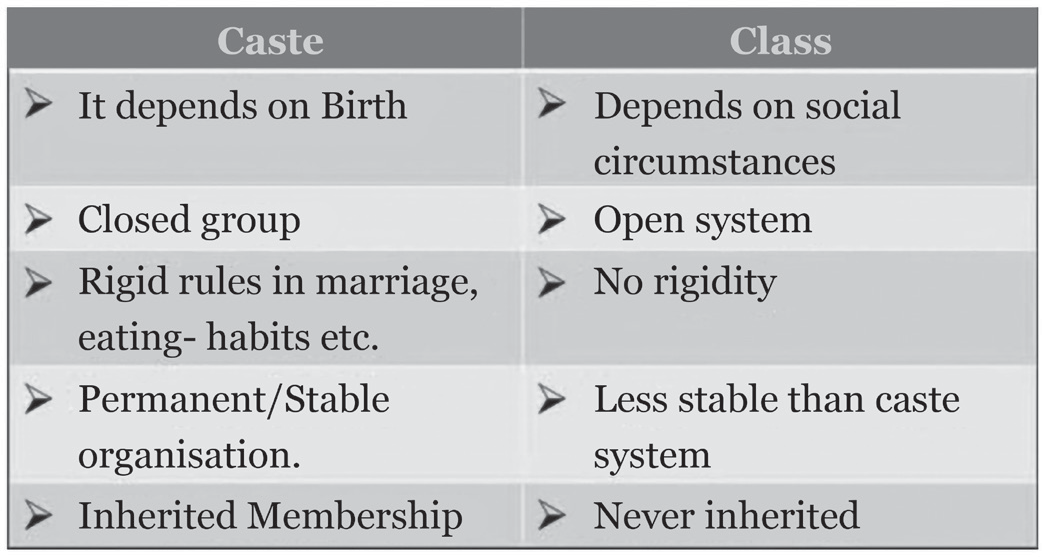
Caste and Class are both ‘status groups’ in Max Weber’s phraseology. A ‘status group’ is a collection of persons who share a distinctive style of life and a certain consciousness of kind. While caste is perceived as a hereditary group with a fixed ritual status, a social class is a category of people who have a similar socio-economic status in relation to other segments of their community or society.
A class system, allows both exogamy and endogamy, permits mobility either up or down the system, and also allows an individual to remain in the status to which he was born.
There are three major classes found: Upper, Middle, and Lower. Each class is divided into two sub-divisions. They are upper-upper, and lower upper; upper-middle and lower-middle; and, upper-lower and lower-lower.
A class is more open than the caste in the sense that mobility is allowed in the class system. It is not allowed that openly in the caste system.
Further, caste system is based on ritual criterion whereas, class is based on secular criterion. Ritual criterion means it is based on religious myths, secular means non-religious criterion like economic, political and social criterion of wealth and power.
• Caste system is characterised by ‘cumulative inequality’ but class system is characterised by ‘dispersed inequality’. The members of a class have a similar socio-economic status in relation to other classes in the society, while the members of a caste have either a high or low ritual status in relation to other castes.
• Caste is a uniquely Indian phenomenon found in India but class is a universal phenomenon found all over the world. Caste works as an active political force in a village but not the class.
• Caste has an organic character but class has a segmentary character. In caste system, upper castes compete with each other for the services of the lower
castes but in the class system, lower classes compete with each other for the favour of the upper classes.
However, in changing circumstances, caste is also adapting to secular criteria. Consciousness is found in the class but not necessarily in the caste. However, today castes are also changing into classes in urban areas particularly in terms of economic criterion.
Caste, Power and Politics
The core factors of the caste system are caste panchayats and leadership. These power structures are highly designated in certain caste groups and informal in others. The word ‘Panchayat’ literally means a group or council of five. In a village, it includes a group that presides over and resolves conflict, punishes people for violating customs and initiates group enterprises. For example, Khap panchayats in Haryana have caste power.
Local power flows mainly from land, which is the major source of wealth. Power is protected if it is restricted to a unified and numerically superior caste group. Numbers alone do not warrant power. Caste groups are numerically dominant, but with divided loyalties, creating factions, may not wield power. It is only if a caste group became politically united that it could establish its political force. This is essential because, in the new democratic political system in which every vote counts, the numerical preponderance of a caste group develops an additional meaning.
Among both the elite and middle-status castes, a process of caste succession had begun before independence and was intensified after it with the adoption of the adult franchise by which during elections new leaders from previously unrepresented or underrepresented castes began to emerge and begin to mobilise castes.
The intermediate castes acquired increased voting power, through adult suffrage and increased economic power through zamindari abolition. Intermediate castes with economic resources sought not only political power but educational benefits and urban jobs for their children. As they acquired such opportunities, they came increasingly into conflict with persons from upper caste groups represented in far greater proportion and often- absolute numbers in educational and political institutions.
Rajani Kothari has made an analysis of the relationship between caste and politics:
• Describing politics in India as an enterprise, he dubs the politicians as entrepreneurs. Like any intelligent and skilful entrepreneur, they know their resources and how to utilise them effectively. They know that the vast multitude of Indian masses lives along their
respective castes, have primordial caste loyalties and a strong caste consciousness and hence can be easily mobilized.
• This intimate interaction between caste and politics has changed the face of both. Kothari describes it as the “politicization of caste”. However, for the traditionally deprived and underprivileged castes, this is a case of democratic assertion of their due rights.
For other scholars of caste, the role of Caste Associations is also an important factor. A caste association is a voluntary organization consisting of members of a single caste. It plays an important role as a political instrument. Caste associations link members of a caste within a region and influence the political process, especially electoral politics, significantly.
For the past seven decades, the horizontal unity of the caste has increased and the demarcation between the sub- castes has begun to break up. This is primarily due to two factors:
• Since numbers are important in a parliamentary democracy, horizontal unity of caste provides a better ‘vote bank’ than a wide area and this can ensure the election of a candidate from one’s caste.
• The necessity to seek educated life partners for one’s children and the demand for dowry, particularly among the higher castes, has stretched the endogamous circle and speeded up the horizontal spread of caste ties. The horizontal spread of caste ties hugely grew during British rule and since Independence, it linked the village to a much wider area.
Gandhi vs Ambedkar: Perspectives on the Caste System
Gandhiji’s perspective:
Gandhiji supported the principles of Varna Vyavastha and Ashram Vyavastha as the foundation of Indian society, but he strongly condemned the existing caste system. He believed that ‘untouchability has made Indians untouchables in the entire world.’ In his view, while Varna Vyavastha unified the society, untouchability was inherently exploitative.
Gandhiji argued that the persistence of untouchability was leading to the gradual destruction of Hinduism. He believed that true ‘swaraj’ could not be achieved without the integration of the Depressed Classes into Hindu society and the abolition of untouchability.
Through articles like ‘Caste Must Go’ and ‘Untouchability as a Crime,’ Gandhiji advocated for a reformative approach—one that sought to reform Hinduism from within by eradicating the evil of untouchability. He viewed untouchables as equal children of God, referring to them as ‘Harijans’ (children of God).
Dr Ambedkar’s perspective:
Dr. Ambedkar held a radical view of the caste system, calling for its complete annihilation. He criticized the Gandhian approach, which he saw as utopian, believing that expecting castes to voluntarily bridge their differences was unrealistic. He argued that attempts to align the caste system with the Varna model would only strengthen it further. For Ambedkar, legislative action and political empowerment were essential to eliminating untouchability.
In his vision of a liberal society, where merit and equality are the core values, there was no room for hereditary status. Ambedkar critically examined the impact of the Varna system on Hindu social order, arguing that it had failed to uphold the principles of liberty, equality, and fraternity—three essential elements of a free society
Dr. Ambedkar sought to reconstruct Indian society based on the fundamental principle of human equality. To achieve this, he advocated for the promotion of education, industrialization, urbanization, inter-caste marriages, and the dismantling of traditional religious practices. He called for the abolition of hereditary priesthood and the introduction of a system where priests would be selected based on merit through exams.
Ambedkar firmly believed that education was the key tool to break the chains of social slavery. He saw it as the means through which the marginalized could rise, achieve social status, improve their economic condition, and attain political freedom. As a prominent leader of the Scheduled Castes in pre-independence India, he played a crucial role in raising Dalit consciousness, and his influence remains central to their struggle for equality.
Relevance of Caste to understand Indian Society
Caste still remains as a tool to understand social, economic, political and cultural aspects of diverse Indian society. Caste is one such characteristic which runs through almost all societies in Indian context.
• All major religious communities have caste as their basic organizational and hierarchical structure like Christianity, Islam, Sikhism, Hinduism, etc.
• Similarly, Caste is also a key to deciding rules of social interaction and behaviour among various communities regarding interdining practices and intermingling defining their relationships at a broader level.
• Another aspect of caste is the rules of marital relationships among various communities. Various Indian communities mostly follow marriage within caste i.e., practicing endogamy.
Similarly, another associated concept known as Gotra (imaginary distant ancestry) lineage system is also widely followed which again sets the divisions between the communities.
• Caste has an economic aspect of Jajmani system which is still followed in various parts of the country especially in the rural areas. It decides the ownership of assets and superior-subordinate relationship among various communities.
Falling Relevance of Caste:
• With the rise in urbanization, globalization, commercialization, industrialization and forces of privatization and liberalization have set the stage of open relations, expansion in employment opportunities and rapid change in the economic and social relations.
• Increase in the status of the depressed classes has weakened the caste system, especially in the urban areas.
• Similarly, rise in love marriages, breakdown of joint families, increase in inter-caste and inter-faith marriages and rise of nuclear families has given more freedom as seen in rising live-in relationships in Metro cities like Mumbai, Bengaluru, etc.
• Constitutional prohibitions on caste-based discrimination and untouchability has also reduced the control of caste over social behaviour.
However, Caste still remains relevant with the affirmative actions by the government to uplift the weaker sections of society and the rapidly rising importance of caste in politics to gain votes to come into power. However, it may reinforce caste in social aspects as well because caste is becoming a useful tool of identification for success of welfare schemes and ensuring a representative democracy in India.
Future of Caste System
There are three distinct views on the future of caste system in India, post-independence in the modern democratic secular political setup and in the rapidly changing social environment due to dynamic forces of industrialisation, urbanization, globalization, modern education and westernisation etc.
• One view suggests that caste system has degenerated and traditional varna system must be reinstated. However, it is impractical in today’s scenario of
multiple occupations within one family and inability to
accommodate untouchables in any of the four varnas apart from the marriage and dining restrictions. It was propagated by the likes of Gandhiji.
• Another view suggests that caste is an evil and must be abolished and uprooted. However, many scholars opposed it and called for removing the untouchability, not the whole system. It was promoted by radicals like Dr. Ambedkar.
• Third view called for continuation of caste system, but be reinstated in totally different conditions where various sub-castes will be amalgamated which have cultural and economic similarities, so as to gradually evolve a casteless society. However, there is no guarantee of consolidation and it may also raise caste-patriotism.
How has Hindutva populism blurred the line between caste and religion in Indian democracy
• Caste and religion have historically been two of the most prominent divides in India’s democracy. Before 2014, upper-caste individuals largely aligned with Hindu nationalism.
• However, since 2014, there has been a rise in both Hindu nationalism and the socio-political mobilization of lower-caste communities, both gaining significant public support.
• In contemporary India, populism is now inseparable from caste, religion, and democracy. The distinctions between castes have blurred, leading to the emergence of "Hindu nationalist populism" that now influences voting patterns.
• This shift carries profound implications for Indian democracy, especially when examined through the lens of populism.
• The Ram Temple movement, which played a pivotal role in the rise of both the BJP and Hindu nationalism, marked a significant turning point in Indian politics. Despite its growth, the BJP was traditionally seen as a party representing the Brahmin and Bania castes (the upper and more privileged groups within the Hindu community).
• The surge of Hindu nationalism and the political mobilization of lower-caste communities largely occurred in the last decade. Under the banner of Hindutva, Narendra Modi skillfully employed the ‘politics of presence’ to engage with castes that had long felt politically marginalized, particularly during the era of caste-based populism.
• The BJP, led by Narendra Modi, effectively rallied lower-caste support against the Yadav community in Uttar Pradesh, tapping into their aspirations for greater political power.
• While the party's 2014 campaign focused on promises of employment and social and economic development, by 2019, its agenda shifted to aggressive nationalism, the construction of the Ram Temple, and the revocation of Article 370. This strategic shift has influenced the Yadav community, with over 50 Yadav MLAs aligning with the BJP.
Hindu nationalist populism has blurred the distinction between caste-based populism, with a significant portion of the population now identifying more strongly with religion than caste. The BJP-NDA alliance has secured over 50% of the total MLAs in the Bihar state assembly, reflecting the party's ability to tap into these evolving aspirations and forge new social identities within the framework of Hindu nationalism.
• This shift in the caste dynamics of Indian democracy has led political parties to focus more on Hindu and Muslim identities, altering power structures and challenging traditional social hierarchies. While democracy has improved the status of lower castes, it has also left other marginalized groups, such as Muslims, Tribals, and women, further behind. Ultimately, the solution lies within democracy itself, which offers a platform for these groups to gain protection and representation.
Persistence of Caste System
Why does caste continue to play such an important role in Indian life?
• Historical: One explanation is that ancient inequities and prejudices are slow to change. The higher castes, which exploited the lower castes for centuries, continue to discriminate against them both socially and economically today.
• Economic Support: Second, many forms of economic support that the caste provides to its members. Though, market is assumed to provide insurance and credit apart from jobs, yet in the real world, especially a developing economy, markets do not function in this way.
• Market insurance is unavailable to a large section of the population.
• Bank credit is also unavailable without collateral, either because
• banks cannot observe whether borrowers are creditworthy or
• because they will refuse to repay their loans even when they can.
• Finally, many individuals do not get the jobs they deserve, either because
• they don’t have the money to invest in costly education or
• because potential employers have no way of knowing how able they really are and so will be reluctant to hire them.
• In such an economy, social networks will often emerge in response to market failures. Members of a tightknit social group, living in the same neighbourhood or sharing kinship ties, are well aware of the creditworthiness and the ability of each other. Members of such groups can also be sanctioned for reneging on their commitments.
This allows social groups to form informal ‘mutual insurance arrangements’and to provide loans to their members. Employed workers can also help capable unemployed members of their group find a job by providing referrals. Social networks thus work in parallel with the market economy, supporting the economic activity of their members in many different ways.
• Endogamy: In India, people largely marry within their own (sub)caste or jati. Due to the ongoing segregation along caste lines, especially in rural areas, most social interactions also take place within these groups. As a result, the jati naturally becomes the central social unit around which networks form in India.
• Affirmative Action: Fourth argument, which has been the subject of intense public debate, is that caste reservation in higher education and public employment by government has been alleged to be perpetuating a system that would otherwise may have withered away.
• Cultural Comfort: The joint family and caste system offer individuals in our society certain benefits similar to those provided by a welfare state in industrially advanced countries. Caste fosters a sense of cultural homogeneity.
• Regionally, the advent of modern communication has expanded the "horizontal reach of caste." Distant caste groups can now connect and communicate,
discovering shared interests and commonalities, which has led to greater caste solidarity within regions.
Politically, universal adult franchise has contributed to a stronger caste consciousness. Political parties prioritize selecting candidates with a solid social base, often drawn from locally dominant caste groups.
A small section of Indian population, comprising the powerful and urban educated elites, desires that caste system ought to go but for a vast majority of the Indian population, especially the Hindus envisaging a social system without caste is impossible. Caste is part of their social identity and existence.
As long as caste performs the functions of a welfare state in India and provides for the common bonds of kinship ties, political groups and alliances, it can be assured of a continued existence in modern India.
Scholars like Rajni Kothari have concluded that twin factors of ‘casteisation of politics’ and ‘politicisation of caste’ have been embedded in Indian psyche of the masses. Casteisation started with caste-based political parties and caste-based vote banks. Especially the intermediate and lower castes have started to assert themselves. Politicisation of caste is considered to be started with the rise of Dalit parties coming to power. Thus, till this psyche survives, the caste will remain in existence.