Whatsapp 88106-52225 For Details
Get Free IAS Booklet
Get Free IAS Booklet
INTRODUCTION
The word RELIGION derived from the Latin word religare (“to tie” or “to bind”) and religio (“conscientiousness,”“respect,” “awe,” or “sanctity”). The term "religion" refers to the concepts of re-binding, reconnecting, and renewing. It implies that two entities were originally united and are only temporarily separated. Religion is therefore based on the belief in the ultimate unity between humans and God. Any religion that aims to unite humans with anything other than the divine is destined to remain incomplete.
Key Definitions
• Religion: Tylor (1871), a renowned anthropologist, defined religion as the 'belief in supernatural beings.' Durkheim (1912) explained that the 'sacred' is distinct and separate from the profane.
• The term 'profane' refers to the unholy, secular, or mundane aspects of life. Rituals, on the other hand, are events that create a space for communication between the sacred and the profane.
• Casteism: It is the prejudice or discrimination one shows on the grounds of another person’s caste (which is often based on one’s traditional occupation or scripture based varna system).
• It can manifest in the form of discrimination in marriage and dining, use of caste-based slurs, honour killings, perceiving reservations as ‘stealing’, stereotyping and profiling people on the basis of their caste endogamy, refusing ‘jeetha’
food/utensils, among many others.
• Racism: It is a belief or doctrine that groups of humans possess different behavioural traits corresponding to inherited attributes and can be divided based on the superiority of one race over another.
• It is often associated with colour or ethnic prejudice.
• It can manifest in the form of nativism, xenophobia, otherness, segregation, hierarchical ranking, supremacism, etc.
• Fundamentalism: This term emphasizes the absolute authority of scripture in matters of faith and doctrine.
• Certain groups interpret this to adopt a militant approach, asserting territorial sovereignty based on these principles.
• Extremism: It refers to "the quality or state of being extreme" or "the advocacy of extreme measures or views."
• The term is commonly used in political or religious contexts to describe an ideology that is seen (either by the speaker or a broader social consensus) as being far outside mainstream societal attitudes.
• Extremist views are usually contrasted with those of moderates.
• Political agendas deemed extremist often include far-left or far-right ideologies, along with radicalism, reactionism, fundamentalism, and
fanaticism.
• Communalism: It is a political ideology or political doctrine which makes use of religious and cultural differences to achieve political ends.
• This is a situation wherein religion and religious communities view each other with hostility and consider their interests as antagonistic to each other.
• They may often come out in open conflict such as in communal riots.
• Secularism: This principle advocates for the separation
of religious faith from other spheres of interaction, such as economic, political, and administrative fields. By doing so, it aims to foster a harmonious and unified nation-state.
• Regionalism: Regionalism is a political ideology that seeks to increase the political power, influence and self-determination of the people of one or more subnational regions.
• It can be based on language, ethnicity, development, or any other distinct factors of the region.
Key Characteristics of Religion
Religious belief is a system of knowledge about the divine and its relationship with the human. It is simply not enough to believe in the existence of a supernatural force. The knowledge of its existence must be explained to people and to generations to come.
• Religion claims to provide answers to some of the most fundamental questions about existence, nature, and reality.
• It provides a higher purpose that ought to guide our life by addressing the questions on meaning of life, death, continuity after life, and true nature of human life.
• It offers general moral principles to guide one’s actions on right and wrong, good and evil, virtue and sin, sacred and profane etc. as divine commandments.
• It provides faith to be subscribed to i.e. set of beliefs treated as truth without seeking reasoned justifications for having them, instead religious justifications are applied.
• Revelation as source of ultimate knowledge. They may be divine revelations or from some authority like scriptures, prophets or inscriptions.
• Religion is a Social Phenomenon. Every society has religious beliefs, rites and organisations. Religion very often affects our understanding of the everyday life. The way in which we relate to each other is very often influenced by our religious beliefs.
• Religion is a shared system of beliefs and practices. Every religion emphasises the need for collective worship. Festivals and rituals are occasions which bring people together.
• Religious rituals help human beings to communicate with each other. When human beings define their relationship with the ‘sacred’, they also define their relationship with fellow human being. Some behavioural patterns are prescribed as compulsory before one can relate to God. This is how morals are born out of religion.
• Religion is powerful force of group identity. These groups are an integral part of any political process.
Integration and conflict, thus, are the two apparently opposite forces that constitute the process of politics.
• Religion is also related to politics, and to economic activities like production, distribution and consumption.
• Religion can unite human beings together, but also sow hatred among them.
• Religion may produce differing impacts in different places. At one end of the globe, it serves to justify oppression and unequal distribution of resources. The same religion, you may find, serves as a reason to resist and struggle against oppression, at the other end of the globe.
• All religions teach love and universal brotherhood.
Sect vis a vis Religion, Caste and Region
Sect vs Religion:
• Sects are minor subset of a larger tradition having unique religious principles within the broad umbrella of the larger faith, such as Christianity, Hinduism, Islam, Buddhism, and others.
• For instance, Saivism, Shaktism, Vaishnavism and Smartism are four sects of Hinduism.
• Sects can also refer to organised religious traditions that have broken away from a mainstream religion and established their own practices and beliefs to achieve an honour and respect for their deeply held beliefs.
• For example, Lingayats emerged as a reactionary force against Hinduism in the twelfth century and opposed the dominance of Brahmanical Hindu values and a feudal economy by absorbing ideas from other traditions like Jainism and Vaishnavism.
• Sometimes sects are evolved to change their practical ways of living without abandoning the religion like Mahayana and Hinayana in Buddhism, Digambar and Shvetambara within Jainism, etc.
• Some sects develop as a result of reform movements against the evils within the religion or revive the original doctrines. For example, Nirankaris vs Namdharis within Sikhism, Sufism and Wahabism within Islam.
Sect vs Caste:
• Various sects in India have become a way of getting free from the rigid and discriminatory caste system.
• For instance, Lingayats still remain staunch worshippers of the Hindu God Shiva, they strongly protest against Hindu social practices such as caste discrimination and wearing of the sacred thread.
• Similarly, Ravidassia sect within Sikhism has established its own separate existence in 14th century based on teachings of Guru Ravidas
and Guru Nanak to ensure dignity to the Dalit followers of Sikhism.
• Such sects often get the Scheduled Caste status under the Constitution due to their caste, like Ravidassia- Ramdassia and the Ad-Dharmis in Punjab.
• Further, sects may emerge in upper caste groups as well to fulfil their spiritual aspirations like Hare Krishna Movement.
Sect vs Region:
• Emergence of Sects is always affected by the local political, social, economic and demographic conditions.
• For example, under Chola patronage, Alwars and Nayanar sects emerged in South India.
• Navayana Buddhism became popular in Maharashtra after Dr. Ambedkar embraced it in Nagpur.
• For instance, Vaishnavism developed in Manipur after migration of Brahmins into Imphal Valley and mingling with Meiteis.
Thus, sects not only bring respect and honour to the marginalized sections within a larger religion but also modify the traditions according to the changing needs of the society.
Fundamentalism
Fundamentalism refers to a commitment to ideas and values that are seen as basic or foundational which has an enduring and unchanging character. It is therefore seen as opposite of relativism.
Fundamentalism is variously described by different scholars while emphasizing its one aspect or the other. This is why fundamentalism is religious as well as non-religious.
• Ideological Fundamentalism may also be stated as one form of fundamentalism. Andrew Heywood defines fundamentalism as “a belief in the original or most basic principles or creed, often associated with fierce commitment and sometimes reflected in fanatical zeal”.
• Religious Fundamentalism would mean the belief in the original creed (If creed is taken as a religious concept) or in the basic principles of the creed together with the commitment to them about touching the boundaries of fanaticism.
Religious Fundamentalism
Religious fundamentalists try to impose their religious practices on others (members of own religion or members of other religion).
• This often leads to communal conflict and antagonism between members of same or different religious communities.
•
Religious fundamentalism can lead to, acts of terrorism which can create a fear psychosis in the minds of people.
In the case of religious fundamentalism, the ‘fundamentals’ have usually but not always derived from the content of sacred texts. Fundamental tendencies are identified in all the world’s major religions (Heywood, 2000).
Fundamentalism stresses the infallibility of a scripture (e.g. the Bible, Granths, the Gita or the Quran) in all matters of faith and doctrine. The believers accept it as a literal historical record. The result is that:
• A militant stand is taken by the followers;
• Often preceded or followed by a desire for a separate homeland like Khalistan movement.
• At times, this too is taken as a prophecy in the scriptures like Islamic State of Pakistan.
• Fundamentalism thus separates a certain community from the mainstream.
Society, through various institutions like the police and military, often seeks to suppress or eliminate fundamentalists, especially when they act outside the law. Communalism is often linked to outbreaks of violence and riots, which may not have any specific objective other than communal dominance or supremacy.
Fundamentalism, on the other hand, is an organized, all- encompassing movement aimed at promoting societal goals based on religious principles. Its strategy can involve both peaceful efforts and war-like actions.
Communalism
Clifford Geertz, an American anthropologist, noted the varying nature of communalism across different regions in his analysis of politics in newly independent states in Africa and Asia. He wrote, "When we talk about communalism in India, we refer to religious differences; in Malaya, we primarily focus on racial distinctions; and in the Congo, it is centered around tribal divisions."
Key Characteristics of Communalism:
Communal and Political Loyalties: Communalism is often seen as the exploitation of social traditions to serve as a tool for political mobilization. This is done to advance the interests of dominant groups.
Casteism vs Communalism
Thus, communalism acts as an ideology aimed at fulfilling the socio-economic and political aspirations of a particular community or social group. Communal organizations typically leave little space for democratic practices.
Secondly, they may also involve racial, ethnic, caste, or linguistic divisions, often reinforcing these differences.
They view egalitarianism as unnatural and uphold patriarchy as a fundamental social and familial norm.
Communalism as a Belief System and Social Phenomenon: Communalism stems from a belief system and fosters a sense of strong unity within a community, though this solidarity is not always accurate, as intercommunity conflicts are common.
Additionally, communalism's proponents often present a specific view of history, emphasizing how a community has collectively endured suffering and shared goals.
The exclusivity of the community is highlighted in contrast to other communities, leading to the belief that it is logical to fight for one’s rights in a direct manner.
In India, communalism is a colonial legacy, as the British rulers exploited religious divisions between communities to their advantage, using the "Divide and Rule" policy to elevate certain groups.
Casteism vs Communalism
Casteism
• Casteism refers to loyalty to one’s own caste (within the same religion) before loyalty to nation.
• For instance, brahmin priest of Varanasi calling the constitution as anti-caste due to the provision of allowing entry of Dalits inside temples (Article 17).
• Casteism considers their caste as separate and at a particular position (higher or lower).
• Like Brahmins consider themselves separate and higher from Vaishyas and Vaishyas respect brahmins due to their ritual position.
• It follows the religious or social or occupational hierarchy as per the scriptural source or religious or local beliefs.
• For instance, Kurmi caste person considers himself higher than Teli caste in Gujarat.
• In Casteism, various castes coexist often without much struggle. Like within a village, most castes live together peacefully and have social relations like Jajmani system.
• Caste violence may occur often when the local caste rules are breached or attempt to claim higher caste status.
• For example, intercaste marriage often leads to honour killings in Haryana or Mirchpur violence against prosperous Dalits.
• Caste ties may lead to caste members protecting their own caste group through social service, education, medical and other welfare schemes.
• Various caste-based organizations like brahmin samaj, Rajput samaj etc honour the young achievers of their community.
• Casteism leads to excessive caste-based loyalty, particularly evident at the time of elections, which leads to caste- based vote banks.
• For instance, UP elections are mostly on caste lines.
Communalism
• Communalism refers to loyalty to one’s own religion (against other religion), before loyalty to the nation.
• Advocates of Hindu Rashtra or Islamic State are considered communalists.
• Communalism considers their religion as one monolithic system of beliefs. They reject the variations and internal conflicts as non-important.
• Like Hindus of North India have different beliefs than Hindus of South or Northeast India.
• It treats other religions not according to any hierarchy but based on their economic and political interests to be fulfilled.
• Like Hindu communalists try to claim their hegemony over Muslims by glorifying past rulers like Shivaji.
• Communalists consider their religious community’s interests as antagonistic to other community’s interests and believe that both interests cannot coexist.
• Like Hindu communalists consider concessions to Muslims as minority appeasement.
• Their Muslim counterparts consider themselves as alien and insecure as a minority.
• Communal violence may occur when one community feels insecure and its political interests are jeopardised.
• Like 1946 riots due to Direct Action Day called by Mohammad Ali Jinnah.
• Communalists gather masses often based on promotion of their narrow political ideology to gain power, instead of any social service.
• They instead try to brainwash the person towards their political doctrine through distorted version of religion
as done by ISIS etc.
• Communal conflict weakens democracy, for example, Mumbai riots or riots during India Pakistan partition.
Communalism vs Regionalism vs Secularism
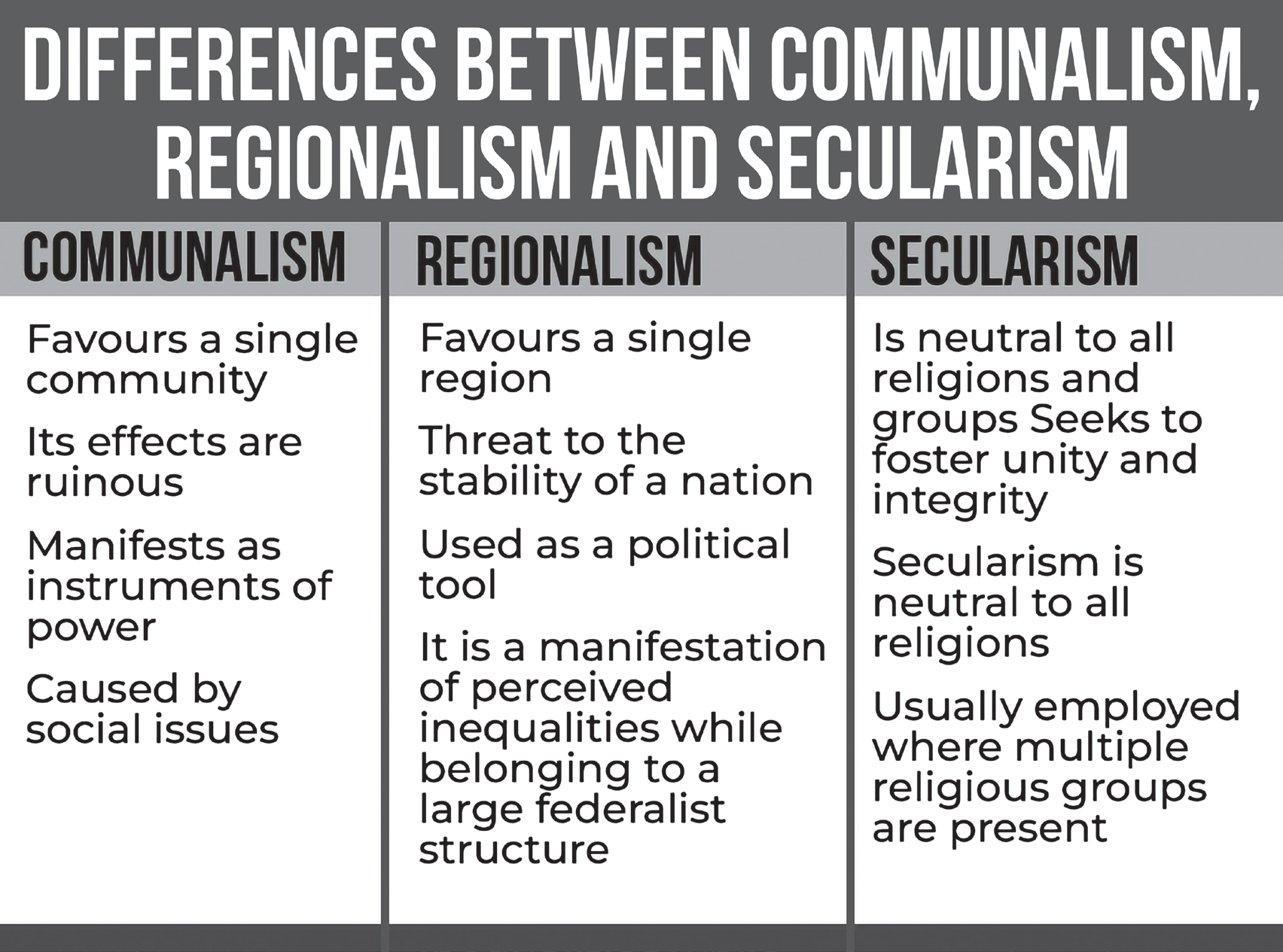
Communalism in India
Communalism became deeply entrenched in Indian politics during the later stages of the national movement, a development that was encouraged by the colonial rulers. This trend continued due to the weaknesses and limitations of secularism as it was practiced during the anti-colonial struggle.
Underlying all these theories is the assumption that:
• The rise of Hindu-Muslim tensions was neither natural nor an inevitable outcome of changes in Indian society.
• Partition was the culmination of this conflict, which could and should have been prevented.
• Nation-building, in essence, requires the dismantling of communal divisions and the creation of a shared identity, one that rejects the existence of separate groups based on religion, caste, or language.
• Communal forces are thus seen as a source of division and a reflection of political underdevelopment.
Characteristics of Communal Incidents:
• Communalism arises when one or two characteristics of an ethnic identity e.g. religious beliefs, are taken and emotionally surcharged.
• Communal movements are often brief and exist in a dyad, comprising an opposing force or ideology which has to be countered.
• Unlike fundamentalism, communalism can only exist dyadically. Hindu-Muslims riots reflected the religious fears and socio-economic aspirations of the Hindus and Muslims.
• Sometimes these riots occur for very minor reasons such as quarrels between Muslim and Hindu shopkeepers.
• These are often not isolated acts but often deliberate mechanizations of various socio-religious organisations.
• Recurrent collisions were engineered on festivals by stopping them and various religious occasions by interfering in their process. This was done to inflame communal passions and bitterness.
History of Communal Riots in Pre and Post Independence
According to Ghosh (1981), the peak of communal violence occurred in August 1946 in Calcutta when the Muslim League declared a 'Direct Action Day.' Bombay followed suit the next month. As a result, independence was built upon the lives of countless individuals who lost their lives in the violence.
During the late 1960s and 1970s, large-scale communal riots erupted in cities like Ahmedabad, Baroda, Ranchi, and Jamshedpur, casting doubt on earlier predictions and beliefs about the future of workers' unity.
In Bhiwandi, where a violent massacre took place in 1969, leftists were particularly shaken. Despite the grassroots movement among handloom workers, led by dedicated communists, the rising tide of communal violence proved unstoppable. That same year, a communal riot also occurred in Ahmedabad.
The first nine years of the eighties saw an upward incline in the riot-graph. Key inflammatory factors included:
• Insults to holy scriptures and sacred cows.
• Political factors underlying religion-based tensions and confrontations.
In the mid-1970s, communal riots slowed down, partly due to the Emergency and the Janata regime. The first imposed strict control and discipline, while the second raised the hopes of both Hindus and Muslims.
Post-independence India is a diverse nation with a rich range of religious traditions, including Hinduism, Islam, Christianity, Sikhism, Buddhism, and others. However, in some instances, religiosity has been exploited for political or divisive purposes, leading to communalism.
• Communalism refers to the division of society along religious lines, often resulting in hostility, tension, and conflict between different religious communities.
Factors contributed to the transformation of religiosity into communalism in post-independence India are:
• Legacy of partition: The partition of India and the creation of Pakistan along religious lines led to widespread violence and displacement, particularly between Hindus and Muslims. This traumatic event left deep scars on the collective memory of the people and fueled religious tensions and mistrust between communities.
• Political factors: Some politicians have exploited religious sentiments for their electoral gains by promoting identity politics and stoking communal divisions. Communal violence and riots have occurred in various parts of the country, often triggered by political manipulations or disputes over religious sites.
• For example, the recent demand for right to worship Hindu Idols inside Varanasi’s Gyanvapi Mosque complex indicates an attempt to disturb the communal peace and harmony under the garb of religiosity along with an attempt to violate both 1991 Places of Worship Act and 1942 Allahabad High Court ruling which settled Gyanvapi’s status as a mosque.
• Through adherence to Places of Worship Act, the State must uphold the equality of all religions and secularism which is a part of the basic features of the Constitution. Thus, status quo on the mosque needs to be maintained.
• Socio-economic factors, such as poverty, inequality, and lack of access to resources, have also contributed to communalism. In some instances, marginalized communities may perceive their religious identity as a source of strength and solidarity, leading to the formation of communal groups that seek to protect their interests and assert their rights.
It is important to note that communalism is not a characteristic of all religious communities or individuals in post-independence India. The country is home to numerous examples of interfaith harmony, coexistence, and peaceful religious practices. Many organizations and individuals actively work towards fostering communal harmony and promoting religious tolerance.
The Indian Constitution guarantees the right to freedom of religion and prohibits discrimination based on religion. The secular principles enshrined in the Constitution aim to safeguard the rights and interests of all citizens, irrespective of their religious beliefs.
Efforts to address communalism in India include promoting interfaith dialogue, strengthening law enforcement to prevent and address communal violence, and encouraging education and awareness programs that foster a culture of inclusivity and religious harmony.
Causes of Communalism and Communal Violence
The causes are flimsy such as playing music before a mosque, insulting the Prophet or the Holy Quran. This is sufficient to provoke violence among some of the Muslims. So also disturbing by Muslims of a religious yam is enough to rouse Hindu ire.
Political Dimensions:
• Riots are part of progress in an under developed country. The class struggle is converted into a communal struggle weakening the solidarity of the proletariat class.
• Further the middle and backward classes have acquired greater political and economic strength and influence and these often assert themselves. Economic conflicts lead to riots as in Bihar Sharif and Bhiwandi.
• Electoral politics determine the objectives and direction of communal violence e.g., Delhi 1986 violence.
• Often economic reasons emerge after (not before) the rioting has begun. Again, in a developing society, economic factor where competitive one or one lagging behind the other can lead to a riot.
• The same applies to reductionist political causes. The idea of behind-the-scene political manipulation may not be valid.
• These explanations cannot be binding as they can’t be held necessary and sufficient.
Economic and Social Dimensions:
• Regarding gaining economic benefits after the eruption of communal riots we find that in Godhra, Hindu Sindhi refugees from Pakistan gave competition to Hindu merchants.
• But riots have frequently emerged between Sindhis and Muslims.
• Again, in Punjab, while Ramgarhia and other Sikhs have gone beyond the Hindu Khatris in commerce, there have been no riots because of this.
• Lastly, the Punjab tragedy, the terrorist acts by Sikhs are not considered to be the acts of the Sikh community as a whole.
• Hindu-Muslim riots in recent times have been mostly confined to medium sized towns and cities. These include areas like Meerut, Aligarh, Moradabad, Pune etc.
Inter-Community Dynamics:
• Medium sized towns/cities are being divided on communal lines. We find that the workers don’t have class consciousness. The educated middle-class act as a bridge between Hindus and Muslims.
• During pre-partition, there were Muslim doctors, lawyers etc. who also attracted Hindu Clients. Similarly Hindu professionals were patronized by Muslim Clients. Thus
• Common bonds developed.
• There were common networks and patronization.
• Again, the existence of Muslim professionals’ administrators etc. created a positive image for the Muslims.
• However, post-partition, mass migrations saw these advantages vanishing. Many trade and economic activities are run by Hindus and there were no problems so long as the Muslims were not competitive.
• There was an interdependence between Hindu employers and Muslim artisans.
• In recent times, economic competitiveness come from Muslims and has turned into a religious threat to Hindus.
• Again, channelling of Arab money into mosque renovation and lavish festival celebrations has resulted in an admixture of economics and religion which creates intercommunity tensions and eruptions of violence.
• Biharsharif owes its name to the mazar (tomb) of a Muslim saint. It is considered a cultural heritage in Bihar on the lines of Lucknow in Uttar Pradesh. Trouble began over a piece of land near a mosque called ‘Mughal Kuan’. Muslims claimed that piece of land as its own. The Hindus planted a tulsi sapling and installed an idol on it. The dispute worsened by 1979 and led to the death of a harijan.
Some Infamous Cases of Communal Violence in India
Partition of India, 1947-Following partition, millions of people was compelled to relocate from both sides of the border. Hindus in Pakistan and Muslims in India were massacred in large numbers, women were raped, and many children were orphaned.
There was hatred everywhere, and violence saw nothing but bloodshed. Later, it became a refugee problem, and their rehabilitation became one of the most difficult challenges for independent India.
In 1961 when the Jabalpur riots rocked the country more because of the economic struggle between a Hindu and a Muslim bidi producer than any electoral competition.
In the 1960s, a series of riots erupted in the eastern section of India, mainly in Rourkela, Jamshedpur, and Ranchi, in 1964, 1965, and 1967, in areas where Hindu refugees from then-East Pakistan were being placed.
In April 1974, violence erupted in a chawl, or tenement, in Mumbai’s Worli district as police attempted to disperse a ‘Dalit Panthers’ gathering that had become violent after fights with the Shiv Sena.
After Indira Gandhi’s death in October 1984, anti- Sikh riots erupted in Delhi, Uttar Pradesh, and other regions of India, killing around 4000 Sikhs.
• Other recent riots include Bombay bombing in 1993, Lashkar-e-Toiba attack on Akshardham in 2002, and Varanasi bombing in 2006 are only a few examples of anti-Hindu incidents.
One thing is consistent in all of these and hundreds of previous riots: the vast majority of casualties had nothing to do with community animosity. In summary, perpetrators of violence and victims of violence are distinct individuals.
Steps taken to bridge the Communalism and fissiparous tendencies:
Practical Administrative Steps to handle Law and Order Issues:
• Preventive measures by the District Magistrate like
• Imposition of Curfew in the sensitive areas through Section 144 of CrPC 1973,
• Shut down of internet and other communications under Indian Telegraph Act 1885.
Constitutional Provisions to preserve communal harmony:
• Under Article 19(1)(a) of the Constitution, Fundamental Rights grant citizens the freedom of expression. However, the provisions of this article also allow the government to impose reasonable restrictions to protect the unity and integrity of the nation.
• Article 51A of the Constitution outlines the Fundamental Duties, which include promoting harmony and fostering a spirit of brotherhood among all people of India, transcending religious, linguistic, regional, and sectional differences. It also calls for the renunciation of practices that are derogatory to the dignity of women.
• Legal Provisions of the Indian Penal Code to take action against the rioters include:
• Section 153A: This section addresses the offense of promoting disharmony, enmity, or hatred between different groups based on religion, race, place of birth, residence, language, etc., and engaging in actions harmful to the maintenance of harmony.
• Section 153B: This section protects the interests of specific groups and, most importantly, ensures national integration by prescribing punishment for actions that make statements or assertions detrimental to national unity
• Section 295A: This provision is a form of 'blasphemy law' that permits the punishment of deliberate and malicious acts intended to insult the religion or religious beliefs of any particular group. Offenses under Section 295A are cognizable, non-bailable, and non-compoundable.
• Section 505: This section aims to prevent and punish the spread of false and malicious news that is designed to disturb public peace and tranquility.
• Laws passed by various states to curb communal violence: Some of these laws are based on Nariman Committee on extraction of damages for destruction:
• Haryana Recovery of Damages to Property During Disturbance to Public Order Act, 2021 for recovery of damages to properties caused
by persons during disturbances to public order by
an assembly, lawful or unlawful, including riots and violent disorder.
• It also ensures compensation to the victims.
• The power to attach property or bank account of any person against whom an award has been passed by the Claims Tribunal to pay compensation.
• No civil court shall have the jurisdiction to entertain any question relating to the claim for the compensation
• Uttar Pradesh Recovery of Damages to Public and Private Property Act, 2020.
• Karnataka invoked a 2009 Supreme Court order that permits a High Court (HC) to constitute machinery to investigate losses and award compensation in riots.
•
Inter-state communication and dialogue be increased through national level bodies like National Integration Council (NIC), Zonal Councils, National Development Council (NDC), etc. to curb communal tendencies.
• Communal Harmony Committees can be formed to facilitate coordination and cooperation among people of different castes, sects, denominations or religions.
• Further the Freedom of Press should not be allowed to spread communalism.
• Constitutionally mandated Freedom of religion, conscience, protection for minorities etc. must be enforced through strong measures.
• Nationalism and National Integration needs to be promoted by political leaders and all leading citizens and keep the various ‘sectional and communal interests’ peacefully coexisting within the umbrella of Constitution and National Interest.
• Measures should be taken for raising the economic lot of the underdeveloped sections especially minorities and preserving and developing the cultures of the various sects to pacify their aspirations;
• Ethos of peace and harmony between communities must be cultivated eliminating the roots of communal, caste and linguistic violence.
• Community leaders should explain the situation to the community and defuse tensions.
• India has specialized battalions within the Rapid Action Force, a unit of the CRPF, tasked with handling riots, riot-like situations, crowd control, rescue and relief operations, and other forms of civil unrest.
• The National Human Rights Commission also provides recommendations for the welfare, rehabilitation, and resettlement of riot victims, urging government action to control the riots, provide shelter to the affected, and prosecute those responsible for the violence, as seen in the case of the Gujarat riots.
Objectives of NIC include
• Resolve unrest in the north-eastern region;
• need for a new education system;
• Punjab problem;
• Kashmir problem;
• violence by secessionists;
• maintaining communal harmony;
• preserving national integrity;
• Promotion of education among minorities, scheduled castes and scheduled tribes;
• elements contributing to national integration;
• removal of regional imbalances, caste and identity divisions;
• prevention of extremism, casteism and regionalism;
• promotion of communal harmony;
• security among minorities;
• equitable development
• how the state and the police should handle civil disturbances;
• how to curb radicalisation of youth in the name of religion and caste;
NATIONAL FOUNDATION FOR COMMUNAL HARMONY
The National Foundation for Communal Harmony (NFCH) was set up in 1992. It is an autonomous body under the administrative control of the Union Home Ministry. It promotes communal harmony, fraternity and national integration. The vision and mission of the NFCH are as follows:
Vision: India free from communal and all other forms of violence where all citizens especially children and youth live together in peace and harmony.
Mission: Promoting communal harmony, strengthening national integration and fostering unity in diversity through collaborative social action, awareness programs, reaching out to the victims of violence especially children, encouraging interfaith dialogue for India’s shared security, peace and prosperity.
The activities undertaken by the NFCH are mentioned below:
• To provide financial assistance to the child victims of societal violence for their care, education and training, aimed at their effective rehabilitation
• To promote communal harmony and national integration by organising variety of activities either independently or in association with educational institutions, NGOs & other organisations
• To conduct studies and grant scholarships to institutions / scholars for conducting studies
• To confer awards for outstanding contribution to communal harmony and national integration
• To involve Central / state governments / UT Administrations, industrial / commercial organisations, NGOs and others in promoting the objectives of the Foundation
• To provide information services, publish monographs and books, etc. on the subject
Thus, communalism has an ugly aspect and goes against national integration. Religion should not become the whipping boy of political ambitions.
Fighting Fundamentalism and Communalism
Through the judicious use of the philosophy of secularism, fundamentalism and communalism can be curbed. On combating fundamentalism and communalism through secularism there are three views that can be presented. These are:
• An ideological campaign against communalism can be waged to de-communalize people at all levels. The logic of this approach is that communalism will die out only if the communal ideology is removed.
• Grassroot politics is another approach mooted for the eradication of communalism along with democratic rights approach. That is to say there has to be an awakening at the grassroots level.
• The problem however is that unless this grassroots approach has an All-India spread and a unity within it, we do not find it likely ‘to do well.
• Approach religion in a secular view:
• Firstly, we should not dismiss any religion or pronounce them to be false.
• Second, we should try to locate the democratic and the secular in the social basis of religion.
Thirdly, the Doctrines of various religions should be rationally approached
Suggestions which can remedy the Religious Communal Divide in India
From time to time, respective governments have constituted various committees, to give recommendations to solve the issue of communal violence. Prominent among them are:
• Nanavati-Mehta commission, set up by Gujarat government in 2002 to enquire about Gujarat violence.
• Sachar Committee, appointed in 2005, recommended to set up Equal opportunity commission (EOC) in 2010.
EOC was to set up a grievance redressal mechanism for all individual cases of discriminations- religion, caste, gender & physical ability among others.
• The Ranganath Misra Commission was entrusted by the Government of India to suggest practical measures for the upliftment of the socially and
economically backward sections among religious and linguistic minorities and to include the modalities of implementation for the same.
• It recommended that 10% should be reserved for Muslims and five% for other minorities in central and state government jobs in all cadre and grades.
• ‘Prevention of Communal and Targeted Violence (Access to Justice and Reparations) Bill, 2011’ (lapsed) which provided for a seven- member National authority for communal harmony, justice and reparations. It attempted to safeguard the minority sections. It had provisions for ensuring accountability of the district administration.
Some Suggestions include:
At Political level
• Religion should be separated from politics. Model Code of Conduct should be strictly implemented. Election Commission must be sufficiently empowered to take action and put penalties and deregister parties which violate code.
• Communal bodies which have insidious agenda and stoke communal fires, should be banned. Strong intelligence gathering and monitoring of such activities be done.
• Communalism needs to be denounced by political leaders and all leading citizens in clear terms and strict legal action be taken against those spreading communalism.
• Abolishment of Communal Parties: The government should ban or dissolve all political parties that rely on religious loyalties. In order to stop preaching communalism even non-political cultural organisations should be actively monitored.
At Economic level
• Measures should be taken for raising the economic lot of the minority community; Like Rajinder Sachar committee clearly indicated the poor and backward conditions of the Muslims in India.
At Social level
• Ethos of peace between communities be cultivated eliminating the roots of communal violence. Such ethos must be embedded from the school time through multireligious, fact based and tolerant educational curriculum.
•
Community leaders should explain the situation to the community and defuse tensions. Local-level Harmony Committees must be formed so that any misunderstandings can be tackled and avoid any mishap and suppress any conspiracy.
• Past heritage transmission: Feelings of nationalism should be inculcated into people’s minds by reminding the public of Hindus and Muslims and Sikhs’ glorious historical moments in order to protect their country’s interest.
• Opinion of the general public: Efforts to shift people’s attitude to other cultures should be made through the mass media. The evils of communalism must be understood among citizens.
• Further the Freedom of Press should not extend to spreading communal ideas. Those stoking communal fears must be blocked from broadcasting.
• Civil society and non-governmental organizations must work together with the government to dispel myths and break the ice between communities to start healthy dialogues between the communities.
• Inter-religious Marriage: Youth groups and other associations like National Cadet Corps (NCC), National Service Scheme (NSS), National Scout and Guide (NSG), etc. should come together and to get to know each other. This will encourage them to practise inter-religious marriages that reduce the social divide between members of religious groups.
CONCLUSION
Communalism has taken a toll on Indian residents and has, directly and indirectly, harmed many families. The communal problem should be addressed via communication and understanding. Steps should be taken to encourage unity through cultural exchange programmes.Globalization has also brought the world closer together and contributed to the reduction of communalism in several nations, including India
Secularism
If we were to look for a definition of secularism in the context of the wider world, then the most acceptable one would be: it is a principle which advocates the separation of religion from politics (what in India we call dharma- nirapekshataa).
However, Indian Constitution uses the term ‘panth nirapekshata’ (non-sectarian). Panth means ‘sect or denomination’. The word ‘panth-nirpeksh’ thus means that as a state India is not wedded to any sect or denomination, which could also be religion.
That secularism can be defined in various ways has been pointed out earlier. However, we can say now that secularism implies the separation of religion from state and its relegation to the sphere of personal belief and private commitment.
The key term here is separation. On the face of it, this seems a simple, uncomplicated principle. But on a closer examination, it will be seen that it is not. Separation can mean many different things and can pose difficulties, if we work with a single meaning, it can mean different things in different societies.
Their argument goes like this: our traditions are pluralistic and flexible and can therefore, be a better source of toleration; it is a resource with us in our own history. We do not therefore, require imposing secularism, an alien concept, on our society. While we all agree that our traditions are plural and flexible, we require to understand that the view that secularism is unnecessary in India is
deeply mistaken, because these plural traditions cannot sustain democracy under the present circumstances.
Historically, Secularism came to be the principle which enunciated separation between the State and the Church. The other thing of importance was the transformation of religion into a personal matter, which then, went on to reinforce the separation principle. In other words, religion was to be kept out of public affairs and policy making, which were to be the exclusive domain of politics and the state.
Secularism Across the World
It is important to point out at this stage that this description is not true of any society as this separation happens to be analytical rather than actual. As things stand there are:
• Some polities with an anti-religious stance like China, etc.
• Other are natural towards religion, like Iran.
• Finally, there are secular polities which falls between these extremes, like India.
Aspects of Secularism
While fundamentalism and communalism are widely held to the problematic and disintegrative, the ideology of secularism is held to be a palliative solution to the above.
Although there is no single definition of secularism which could be applied world-wide, yet it was first applied to separate the Church from the King. This was the political dimension.
In the social context, secularism signifies freeing individuals from the dominant influence of religion in their personal lives. In India, it emphasizes the presence of spiritual values, which can be expressed in diverse ways. Therefore, the term "secularism" holds multiple meanings and interpretations in the Indian context.
Secularism in India
The conceptual construct of secularism is adopted in India by way of a solution to the problems, posed by fundamentalism and communalism. Ideally speaking, it denotes a situation where there is a clear distinction of religion from such spheres of life as political and economic systems. Each religion is to be respected and practiced in private. Throughout India, there is a principle of positive
secularism (equal treatment of all religions by the state and active state interventions to eradicate unconstitutional religious practices) as distinct from the theory of negative secularism (complete separation of state from religion and non-interference in religion-related matters) adopted by United States as well as the European States, i.e. there is a wall of separation between religion and state.
In India, the relationship between the State, society, and religion remains unclear, with personal laws differing across religions. The vulnerable status of religious minorities and the alignment of certain political groups with religious fundamentalists present significant challenges to the sustainability and future of secularism.
It is clear that secularism in India has become heavily politicized, and there is a need to find ways to separate it from political agendas and strengthen its presence within civil society.
Ideologically, secularism is not about blending religious beliefs and practices with political ideologies to appeal to a particular community for votes. Rather, it emphasizes the separation of religion from politics, advocating for equal opportunities for all communities, as provided by the state.
Secularism also opposes religious education and encourages a rational approach to all religious beliefs, where the positive and progressive aspects are embraced, and the regressive, socially harmful elements are rejected. It advocates for an egalitarian approach to social life, ensuring fairness and equality for all.
Secularization, on the other hand, is the process through which various sectors of society are freed from the dominance of religious symbols and institutions. While religious symbols and institutions may still exist, their public influence is diminished, making religious matters more personal and private.
After India came under colonial rule, two changes closely connected to each other, took place in the Indian society. One pertained to the kind of structural changes that came about and the other to the way our social life was organ- ised. Both had far reaching consequences.
History of Secularism in India
Secular policy in the pre and post-independent India:
• “Liberal-Plural” theory was advanced by the moderate nationalists of late 19th century.
• This approach believed that religion should not be mixed with politics.
• Its proper sphere was that of private belief.
• This would preserve both religious and national sentiments would remain intact.
• This theory demanded sophisticated understanding but the wider society could not grasp it, thus was not much popular.
• “Orthodox Plural” theory of secular nationalism was forwarded by Gandhi replacing the Liberal-Plural theory.
• He viewed religion as fundamental to political action and national identity.
• Gandhi argued that the emerging nation should draw from all communities, including Hindus, Muslims, and others.
• The aim was to integrate popular symbols into the political mainstream, thus shaping a unified national identity.
• While this ideology proved effective in political mobilization, it led to challenges in the post- independence era, particularly after 1947.
• Gandhi’s Orthodox Pluralism theory, which suggested that religious divisions could be addressed through religious loyalties to foster nationhood, was ultimately flawed.
• Instead of healing the divisions, this approach exacerbated the rift between different religious communities.
• Additionally, the ideologies of the time attracted the elite and powerful to the national movement, ensuring their dominance in post-independence India.
• Radical Socialist theory which dreamt of a secular polity which reflected the dream of the poor masses, both in rural and urban areas.
• Religious loyalties were relegated away from national identity. National identity it was felt could only be based upon politics, which linked socioeconomic facts with the reality of nationhood.
• Religion was to be a private thing and not to trade upon the domain of politics.
• It was followed by Bhagat Singh and his comrades.
| Failure of Radical Socialists | Popularity of Orthodox Plural Theory |
| Radical socialists focused on the poor, advocating for the redistribution of wealth to address social inequalities. This theory of radical socialist secular nationalism gained prominence in the second quarter of the 20th century but was short-lived. Despite its focus on poverty and wealth redistribution, the theory struggled to sustain itself in the face of Gandhian principles and ideas. | Gandhi’s orthodox plural theory of secular nationalism was popular due to various reasons: Gandhi harnessed the strong religious sentiments across various classes and communities to build a broad base for nationalism. While aiming to uplift the oppressed, his approach did not diminish the power of the wealthy industrial and commercial classes over social and economic affairs. This theory killed two birds with one stone: It mobilized mass support for nationhood; It also left alone the theory issue of capital and property. The wealthy felt that the theory did not challenge their position. However, Gandhi never implied that he sought to sacrifice the interests of the poor to satisfy the greed of the rich. |
In India, the orthodox plural theory of secular nationalism, combined with the communal tensions that emerged in the post-independence era, particularly with the rise of right-wing politics, offers valuable insights into national integration.
Therefore, community or religion-based theories of secular nationalism are not conducive to a healthy political environment. On the other hand, secularism that clearly distinguishes between religion and politics is the most suitable approach for political stability.
Western Version of SecularismS
In western society, secularism refers to the complete separation between the state and religion and freedom of religion for all people, to emphasise the separation between church and state.
Key characteristics of the western model:
• Complete separation of religion from the state (Negative Secularism):
• The state cannot financially support educational institutions operated by religious groups.
• The state does not interfere in religious matters as long as religion operates within the boundaries of the law.
• The Western model prohibits the formulation of public policies or laws based on religious principles.
• The state maintains complete separation from the religious activities and practices of its citizens.
• A uniform legal code is applied to ensure justice, irrespective of an individual's religious background.
• Religious organizations play a minimal role in politics.
• Religion is relegated entirely to the private sphere and has no place in public life whatsoever.
•
No public display of religion except for places of worship like hijab ban in France.
• It is concerned with liberty and equality among the individuals of the particular religion and often neglected the equality of other religious minorities.
• Focus is more on intra-religious domination than inter-religious due to religiously homogeneous nature of the State.
• For example, the reformed Christianity is the dominant in the West.
Indian Version of Secularism Post-Independence
India's core values have always centered on unity, tolerance, and the blending of religions. Throughout history, despite occasional conflicts driven by religious uprisings, economic exploitation, and social suppression, millions of Indians from diverse religious backgrounds have coexisted peacefully.
India is the birthplace of four major world religions: Hinduism, Jainism, Buddhism, and Sikhism. Yet, it remains one of the most religiously diverse nations in the world. Many scholars and intellectuals argue that Hinduism, the predominant religion in India, has been inherently tolerant. The country itself is built on the foundation of a civilization that, at its core, is fundamentally non-religious.
Features of Secularism as contemplated by the Constitution:
• The state will remain neutral, neither aligning with nor being influenced by any particular religion.
• While the state ensures the right of individuals to practice any religion of their choice, it will not give preferential treatment to any one religion.
• The state will not discriminate against any individual based on their religion or belief system.
• The right of every citizen, subject to general conditions, to access any state office, along with religious tolerance, lies at the core of secularism as outlined by the Constitution.
This ensures the creation of a unified Indian fraternity that upholds the dignity of the individual while fostering national unity.
Challenges to Cultural Practices in the Name of Secularism
In India, the concept of secularism refers to the principle of state neutrality towards religious beliefs and practices. While secularism aims to ensure equality and protect individual freedoms, there have been instances where it has posed challenges to certain cultural practices.
Some of challenges faced by cultural practices in the name of secularism in India are:
• Uniform Civil Code (UCC): One of the long-standing debates in India is the implementation of UCC, which would replace personal laws based on religious practices with a common set of laws for all citizens.
• While proponents argue that a UCC would promote gender equality and social justice, opponents claim that it would undermine cultural and religious diversity.
• Anti Cow Slaughter laws: The cow is considered a sacred animal in Hinduism, and there have been instances of restrictions on cow slaughter and beef consumption in various states of India.
• However, these restrictions have faced criticism for infringing upon the dietary preferences and cultural practices of religious and ethnic minorities who consume beef.
• Religious Conversion Laws: Some states in India have enacted laws that regulate or restrict religious conversions, particularly conversions from Hinduism to other religions.
• These laws, intended to prevent forced or fraudulent conversions, have been criticized for impeding the individual’s right to choose and practice their religion freely.
• Control over Places of Worship: The management and control of religious places of worship have been a contentious issue. In some instances, the state has taken control of temples, mosques, and other religious institutions to ensure fair governance and prevent misuse of funds.
• However, this has been seen as an infringement on the autonomy and religious practices of these institutions.
• Festivals and Celebrations: There have been debates surrounding the celebration of religious festivals in public spaces, especially when they involve religious symbols or rituals.
• For example, there have been debates about the use of religious symbols in educational institutions or restrictions on religious processions or ceremonies that might disrupt public order.
• Secularism calls for a separation of religion and state, leading to concerns about the appropriateness of certain practices and displays in public spaces.
It is important to note that these challenges are complex and often evoke passionate arguments from various perspectives. Striking a balance between preserving cultural practices and ensuring secular principles can be a delicate task in a diverse and pluralistic society like India.
Role of State in Indian Secularism
• Doctrine of Principled Distance: In India, the principle of separation between religion and politics must have distance in principle which has to be seen as independence of politics from religion, but not necessarily vice versa.
• This means that state activity, political decision making and policy choices are free of the interference of religion.
• But this does not mean that politics and state action will have nothing to do with the need of religious reforms.
•
One way Separation has to be guaranteed. This allows for both intervention and abstention. Intervention has to be prudently decided on the basis of issues involved.
• All harmful practices or beliefs must be immediately banned, even if they are justified by religion, such as untouchability, caste discrimination, polygamy, and the exclusion of women from public life.
• These practices are in direct contradiction to the fundamental values of the Constitution, which were shaped by the collective efforts and participation of the people during the freedom struggle.
• Many, which are mildly offensive like the Dwijas only wearing the sacred thread, women not being allowed to plough the fields, etc., may be tolerated for some time to come and people can be persuaded to give these up.
• The state here should be interventionist but in a neutral sense, that it takes the standpoint of the entire Indian humanity and not the viewpoint of any one religion or community.
• The state should not favor or provide any advantage to any religion. Its role is solely to uphold the principles of the Constitution, which was established for this very purpose.
• Its neutrality must be guaranteed through a framework of 'Equality, Rights, and Dignity,' ensuring equal treatment for all. The Indian Constitution has designed a genuinely secular state to foster peaceful coexistence among its citizens, as highlighted earlier.
Key Takeaways:
• religion from the state and politics; however, this separation is not a one-size-fits-all concept.
• It must be interpreted and implemented according to specific contexts and practices inherent in each society. Every context has its own unique needs and challenges, which must be considered.
• As we have seen, secularism is not an external imposition on Indian society, but rather an internal necessity for its functioning.
• What, however, is alien is the uncritical tendency to extract the history and meaning of secularism from the West and to pose that as the only model applicable to the rest of the world.
Concept of Indian Secularism and its Key Constituents Former President Pranab Mukherjee said that
Pluralism and Tolerance are hallmark of Indian civilisation. Plurality of our society has come through assimilation of ideas over centuries. The multiplicity in culture, faith and language is what makes India special. We derive our strength from tolerance. It has been part of our collective consciousness for centuries. There are divergent strands in public discourse. We may argue. We may not agree. But we cannot deny the essential prevalence of multiplicity of opinion. Otherwise, a fundamental character of our thought process will wither away.
The people of India established a Republic that is Sovereign, Socialist, Secular, and Democratic, built on a constitutional framework centered around Justice, Liberty, Equality, and Fraternity. These principles are reflected in a system of institutions, laws, conventions, and practices.
Supreme Court in the ‘S.R. Bommai vs. Union of India (1994) case,’ explained Secularism:
Secularism encompasses both positive and negative aspects. The Constitution maintains a balance by allowing individuals to profess, practice, and propagate their religion, subject to public order, morality, and health.
• The positive aspect of secularism is entrusted to the state, which has the responsibility to regulate it through laws or executive orders.
• The negative aspect prohibits the state from endorsing any specific religion as the state religion and mandates that the state remain neutral.
The State strikes a balance to ensure an atmosphere of full faith and confidence among its people to realise full growth of personality and to make him a rational being on secular lines, to improve individual excellence, regional growth, progress and national integrity… Religious tolerance and fraternity are basic features and postulates of the Constitution as a scheme for national integration and sectional or religious unity. Programmes or principles evolved by political parties based on religion violates the basic features of the Constitution and against Positive secularism.’
Key Constituents of Indian Secularism:
India is a diverse country with multiple religions, languages, and cultures. The idea of secularism has been an integral part of the Indian ethos since its inception. India’s Constitution guarantees the freedom of religion to all citizens, and the government is expected to remain neutral in matters of religion. However, the concept of secularism in India is different from the Western notion of secularism.Tolerance, assimilation, and Pluralism are all key elements in the making of an Indian form of secularism.
Tolerance: It is the acceptance of the beliefs and practices of others, even if they differ from one’s own.
• In the context of Indian secularism, tolerance is important because it allows to respect and accept differences among people of different religions, cultures, and beliefs.
• Tolerance allows people to live together harmoniously without fear of persecution or discrimination.
• Assimilation: It is the process by which people of different cultures, religions, and beliefs come together to form a distinct common national identity.
• One of the best examples of assimilation is Indian cuisine, which is a blend of various regional cuisines.
• Indian music, dance, and literature are also the result of assimilation, where different cultures have come together to create a unique Indian identity.
• Pluralism: It is the recognition and acceptance of diversity within society. India is a country with multiple religions, languages, and cultures.
• Pluralism recognizes and respects this diversity and provides equal opportunities to all communities.
• The Indian Constitution provides for the protection of minority communities, and it ensures that they have equal rights and opportunities
• Pluralism is not just accepting but also celebrating it.
Thus, tolerance, assimilation, and pluralism are integral to the Indian form of secularism. Mahatma Gandhi also said, “Religion is a force for unity; we cannot make it a cause of conflict”. The diversity of India’s religions, languages, and cultures is a strength that has been fostered through these elements, allowing for peaceful coexistence and a unique national identity. The Indian Constitution guarantees the freedom of religion and equal opportunities for all communities, while also ensuring the protection of minority communities.
Concept of National Integration: Conceptually and practically, integration is not synonymous with assimilation or homogenization. Political scientist Rasheeduddin Khan has observed, ‘In the semantics of functional politics the term national integration means,
and ought to mean, cohesion and not fusion, unity and not uniformity, reconciliation and not merger, accommodation and not annihilation, synthesis and not dissolution, solidarity and not regimentation of the several discrete segments of the people constituting the larger political community… Obviously, then, Integration is not a process of conversion of diversities into a uniformity but a congruence of diversities leading to a unity in which both the varieties and similarities are maintained
Issue of Uniform Civil Code (UCC)
The Article 44 of the Directive Principles of State Policy under Part IV of the Constitution, states that it is the duty of the state to secure a Uniform Civil Code (UCC) for the citizens throughout the country. And since these are non- justiciable, they cannot be enforced in the courts.
UCC seeks to govern the personal matters of all the citizens irrespective of religion. Personal laws are different from public laws as they cover marriage, inheritance, adoption, divorce and maintenance and the India practices a model of secularism in which it has made special provisions for people of different religions and the main idea behind UCC is to treat everyone equally irrespective of religion. The secularization process is closely linked to the goal of the uniform Civil Code as a cause and effect.
Benefits of UCC:
• There are differences and discrepancies within the
personal laws. There is no uniformity.
• Countries which have adopted UCC are - France, Italy, Portugal, Spain, The USA and Sudan.
• Thus, codification of personal laws will make them systematic and streamline their implementation, thereby reducing the litigation and disputes.
• It will promote positive secularism model of India as it promotes implementation of constitutional rights through state intervention.
• It may reduce vote bank politics as there will be lesser political issues related to religious personal laws and reduce the importance of religion in society.
• Promotes national integration, as it will create a uniform nation-wide law irrespective of all religions.
• UCC will enable gender justice in India, as there have been instances where the personal laws denied the rights of women or did not even give them rights.
• UCC will lay the grounds for women to overcome various social evils that exist in the society such as
the bigamy system and the dowry system which make women feel inferior and degraded.
Challenges in Implementation:
• In India, the main cause for communal conflicts among the common people are the personal laws and thus, it may cause law and order situation.
• Right to Religion (Article 25 and 26) may go against Right to Equality (Article 14), which may lead to protracted legal struggle in courts.
• It has been strongly opposed because it is considered violative of Article 25 of the Constitution since it does not let people enjoy the personal laws.
• UCC for things such as marriage, divorce, inheritance and any such ritual are themselves going against the article 26(b) of the Indian constitution that states that: Subject to public order, morality and health, every religious domination or any section thereof shall have the rights manage its own affairs in the matters of religion.
• UCC may not bring secularism as even secular western countries having UCC show biasness towards Christianity and the countries in the middle east show biasness towards Islam despite claiming to be secular.
Way Forward:
• Having a UCC in a country is not just a matter of justice but it is also a matter of how a country accommodates the diverse population residing within it.
• In India, the freedom of religion coexists with right to equality. India has taken a route to accommodate these diverse sections of people by letting them practice their religious traditions by provisions of personal laws that on the other side results in inequality.
• It is also very clear that a uniform civil code does not violate the article 25 and article 26 of the constitution of India as the objective of UCC is to bestow uniform laws concerning marriage, lawful separation, succession, etc., and not to provide a uniform method of practising religion, hence UCC cannot conflict with the right to religion.
• The UCC should rather be introduced as a new law and not just be introduced as a blend of personal laws
to avoid scope of arbitrariness to arise like the Special Marriage Act of 1954 that will not favour or show any bias towards any religion.
Conclusion vis-à-vis UCC:
The people need to understand that law and religion are different because the Constitution of India allows the people to follow their religion that will also continue even after UCC as the UCC is not going to take away anyone’s rights to practice religion. Having a uniform civil code will focus on equal empowerment of people of all sections and hence it will be beneficial for the country and also will not violate the secular nature of the constitution. Thus, having a uniform civil code is the urgent need of the hour.
CONCLUSION
The objectives and parameters of a secular, socialist, democratic republic had to be expressed in such flexible, yet firm, which would harmonize not antagonize religious
minorities, integrate not acerbate hostile strata, abolish not accentuate the socio-religious discrimination endured by the weaker human sector and generate a system and society where secular unity would comport with cultural diversity. Secular politics can use either the rich or the poor as a base for their activities. But education of the masses, both rich and poor, is the way to secularism. Being educated, they would eschew all fundamental and communal paths and seek to achieve a truly Indian democratic republic
Regionalism
When we think of a region, we imagine a space with a common language, particular people and their attachment to that space. The culture of a region distinguishes it from other forms of spatial and political forms.
Meaning
The word “regionalism” has two meanings.
• In its positive form, regionalism refers to a political quality rooted in people's deep connection to their territory, culture, language, and other elements that help preserve their independence.
• Positive regionalism is beneficial as it fosters a sense of unity and camaraderie among individuals, built on common language, religion, or shared historical experiences.
• In its negative form, regionalism refers to an intense, often divisive loyalty to one’s home region, sometimes at the expense of the larger nation or state.
• This negative aspect of regionalism can pose a significant threat to national unity and integrity.
• In India, regionalism is generally viewed in a negative light.
The feeling of regionalism might arise as a result of the authorities’ continued neglect of a particular area or region, or as a result of increased political awareness of people who have been discriminated against.
Some political leaders deliberately and frequently create feelings of regionalism to keep control over a specific territory or group of people.
Characteristics of Regionalism
• Politico-geographical concept: Region is always interpreted on the basis of geography, culture and so on. It is also linked to state, political parties, leaders and other institutions.
• It is asserted that the people who are the citizens of a nation- state demand recognition for the separate region due to marginalization, feeling of alienation from the larger spectrum of the state, lack of access to resources, absence of dignity and so on.
• Integrative Concept: In global politics, regionalism refers to efforts by countries within a specific geographical region to enhance cooperation and support across various areas, including military, political, economic, and socio-cultural activities.
• Often, this need for cooperation evolves into the demand for establishing regional organizations, a concept known as Regional Integration.
• Therefore, regionalism frequently fosters regional integration and collaboration among states within a particular region.
• This trend has been observed in nearly every region worldwide and has gained increased emphasis since the 1990s.
• Controlling Ideology: Regionalism refers to the emphasis on the authority or influence of a specific region, which can manifest in political, cultural, or emotional forms.
• This sentiment or ideology is often seen in individuals who have a deep attachment to their region, as well as in political leaders who seek to gain support through such sentiments.
• Regionalism is not just an expression of love for one's region, but can also be reflected in art, literature, and historical artifacts.
• A strong connection to one's language, beliefs, and cultural practices often serves as the foundation for promoting regionalism as an ideology.
• Both a Process and a Condition:
| Regionalism is a condition in the realm of ideas and sentiments when countries belonging to a region share a sense of affinity and belonging on the basis of such shared attributes as Historical experiences (such as colonialism in Asia and Africa) Economic conditions (economic underdevelopment in Latin America) Geographical contiguity Cultural similitude (tribal or linguistic affinity) Shared perception of threat from a dominant power These are some of the conditions that encourage regional affinity and sentiment leading to formation of a regional organization. | Regionalism is a process when certain efforts in a region are driven at tapping and consolidating the latent affinities among the members to further the cause of closer cooperation and integration, the process of drawing up a blue print of regional organization. The Import Substitution Industrialization (ISI) model of development followed in Latin America in the 1950s convinced all the countries to go for closer economic integration. |
Hence, regionalism as a phenomenon denotes both a condition and process, both leading to bonds of cooperation and belonging.
Causes of Regionalism
• Geographical Factors: India has a diverse geography. There are different types of climates throughout the country. This change in geography affects the regional practices, food habits, and way of life.
•
Ethnic Factors: India has many ethnic differences. India is home to as many as 645 Scheduled tribes as recognised by the constitution.
• These ethnic differences formed the base for demands for political autonomy and secession. For example, the Nagas of Nagaland are demanding a nation based on their ethnic identity.
• Some demands have taken the form of violent armed struggle with established governments. All these factors pose a threat to India’s unity.
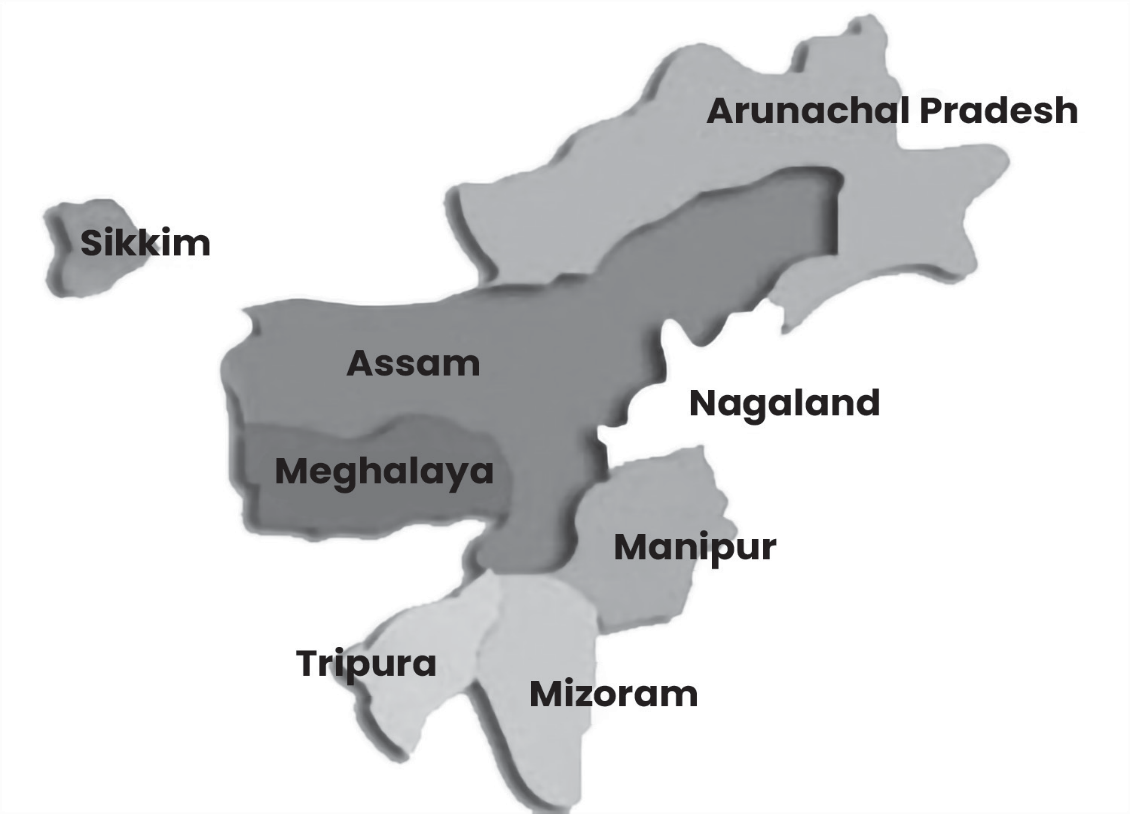
Demands for autonomy in North East:
After Independence, the entire N-E region consisted of three states Manipur, Tripura, and Assam. Except for these two states, the entire N-E region comprised the state of Assam.
• There were different cultures and tribes present in Assam at that time but all the non-Assamese felt outsiders.
• Moreover, instead of working for them, the Assam government imposed the Assam language on them to which these people protested violently.
• The leaders of these tribes started demands for separation from Assam.
• These demands were later fulfilled and several states were formed out of Assam, like Meghalaya, Mizoram, Tripura, etc.
• The fulfillment of demands for separate states was not enough for some tribal communities like Bodos, Karbi, and Dimasas.
• They wanted a separate state only for their tribes.
• They succeeded in getting the center’s attention with popular movements and insurgency
• However, still, it was not possible to form smaller and smaller states for such demands.
• Hence, the Central Government came up with an alternative to take care of these demands and granted
Autonomous District for such tribes.
• Recently, TIPRA Motha Party demanded a separate state of Greater Tipraland.
Linguistic Factors: India enjoys a large number of languages, but this can also cause one to feel more connected to a region than the country, thus promoting regionalism.
• Steps such as making Hindi the national language affected non-Hindi speakers and increased regionalism.
• Linguism refers to a strong attachment to one's own language, often accompanied by animosity toward speakers of other languages. Similar to regionalism, communalism, or casteism, linguism is also a product of political processes.
• It has two dimensions:
•
the reorganisation of states on the basis of language; and
• the determination of the official language of the Union.
The formation of Andhra Pradesh as the first linguistic state from the former Madras state in 1953 sparked nationwide demands for the reorganization of states based on language.
As a result, the States Reorganisation Commission (1953–1955) led to the large-scale reorganization of states in 1956 based on language.
More recently, linguistically-based political parties such as the Telangana Praja Samiti, ADMK of Tamil Nadu, and the Gorkha League of West Bengal have also emerged.
The "Sons of the Soil" theory is a form of regionalism that asserts a state belongs primarily to its dominant linguistic group. According to this theory, the state is considered the exclusive homeland for the speakers of its main language, who are regarded as the "sons of the soil" or local inhabitants. An example of this ideology can be found in the Mulki rules outlined in Article 371(D) of the Indian Constitution.
Why Son of the Soil?
• There is ongoing competition for jobs between local and migrant educated middle-class youth.
• This issue is more prominent in cities, where outsiders also have access to education and other opportunities.
• The growing involvement of people in such issues is driven by rising aspirations.
• The failure of the economy to generate sufficient employment opportunities further exacerbates the situation.
Impact of Sons of the Soil
• It may lead to balkanization of the country and harm national integration.
• India is broadly a country of immigrants, like the US.
• About 92-93% people living in India today are not the original inhabitants of India.
• The original inhabitants are only the pre-Dravidian tribals known as adivasis like Bhils, Gonds, Santhals, Todas, etc; they form just 7-8% of the Indian population today.
• Theory may be fine for capturing votes, but it would lead to chaos and disaster if any serious attempt is made to implement it.
• Rumours in 2013 created panic among people from the Northeast living in Bangalore and elsewhere.
• Also, the unity of India is required if our country is to prosper economically. Article 301 of the Constitution states that trade and commerce shall be free throughout the territory of India.
• This provision guarantees the economic unity of India, and political unity depends on economic unity.
• Illegal: It could also be said that the ‘son of the soil’ theory offends
• Section 2 of the Prevention of Insults to National Honour Act, 1971, disrespecting or bringing into contempt the Constitution of India is a criminal offence punishable by up to three years imprisonment or fine or both.
It is also an offence under section 153A of the IPC as it amounts to inciting enmity between groups of people.
Unconstitutional: Not just does the theory disrespect and bring into contempt Article 19 (1) (e) of the Constitution hence becoming unconstitutional.
Religious Factors: This factor can be seen in partition of India. India was united with Pakistan before its independence. The differences based on religion has led to the creation of Pakistan.
• Religious orthodoxy led to creation of organizations like Hindu Mahasabha, Ramrajya Parishad, Shiromani Akali Dal, Muslim League, etc.
• The violent demand for an independent country of Khalistan in the 1980s was based on the Sikh religion.
• Historical Factors: India has faced the authority of many. The control of regions was sometimes done separately and sometimes together, like by Akbar.
• As India faced colonization, the British policy of divide and rule led to growing regionalism.
• Ideological/Political Factors: Regional parties are mostly confined to a single state. They work based on the interest of the state. For example, Trinamool Congress in West Bengal and Shiv Sena in Maharashtra.
• The political aspirations of leaders remain a major source of regionalism. For example, regional political parties have used regional and linguistic identities to secure votes.
Smaller States: Advantages and Disadvantages
•
They have created an imaginary threat from outsiders and promise their vote bank for securing their land for themselves and to eliminate outsiders.
• Regional parties and fringe elements in various states have campaigned for this agenda.
• Economic Factors: The discrimination or neglect faced by areas such as North East have caused feelings of regionalism.
• Regional leaders try to gain support by promoting regionalism. Political parties like DMK, ADMK, National Conference of Jammu and Kashmir, etc. promoted regional interests.
• Those regions that have been discriminated against have begun to recognize themselves as part of a region, not a nation.
• Jharkhand or Telangana movement can be an example.
| Advantages of Smaller States | Disadvantages of Smaller States |
| Local needs and aspirations are taken care of. Geographical, linguistic and cultural homogeneity allows for customised specific policies and targeted regional schemes which makes governance easier. Promotes devolution of funds, functions and functionaries and ensures decentralization of powers for better local participation in decision-making in smaller regions. Efficient and optimum utilization of resources: Chhattisgarh and Jharkhand performed better after separation in the 10th Five-Year Plan. In the pre-birth years, Uttarakhand and Chhattisgarh clocked an average growth rate of approximately 3% during the pre-birth periods. In the post- birth period, these states improved their growth rates dramatically too approximately: Uttarakhand 11%, Chhattisgarh: 9% – a good 200% increase in the growth rates. Contrast this with the mother states – UP accelerated 20% from 4.7% to 6%, MP from 6% to 7%. States like Rajasthan, UP, MP, Bihar, Maharashtra, Karnataka, Gujarat, Odisha, and even Bengal are too big to be properly administered. E.g: If UP were a separate country, it would be the fourth largest by population. But its per capita GDP is closer to Kenya’s. Research studies suggest that smaller states mostly tend to do better. Good governance requires lesser and quicker government, which is possible in smaller states. | More states may lead to more inter-state disputes and increased complexities. For example, Telangana asking for re- assessment of Krishna River Water Tribunal Award. Smaller states may not mean better governance. For instance, larger states like Tamil Nadu and Maharashtra are better developed than smaller states. In Human Development Indicators, there is a mixed result. Here, smaller states like Haryana, Punjab, Kerala and bigger states like Tamil Nadu, Karnataka, etc. top the list, indicating that Good Governance and not size, determines development. Smaller states may not lead to democratic decentralization. Rather, it can cause concentration of power in the hands of a few. It is very expensive to build new capitals and establish administration in new states like Amravati as the capital of Andhra Pradesh. Smaller states may be slow to respond to disasters due to low capacity. For instance, the Uttarakhand floods needed external help. It can lead to dominance of few castes or religions due to homogeneous nature of demography. |
Forms of Regionalism
In India, regionalism has taken many forms, including:
• Demand for State Autonomy: Regionalism has often led states to demand greater autonomy from the central government. As the Centre becomes more involved in state affairs, regional tensions have surfaced. This demand for autonomy or self-reliance has been particularly evident in certain regions within states, such as the Telangana movement.
• Secession from the Union: This is a sort of regionalism that is extremely dangerous. It appears when states want independence from the Centre and attempt to create their own identity separate from the nation, like in the case of Naga issue.
• Disputes between states over the distribution of river water, as well as the importance given by states to the majority language and person from their states in job possibilities, have also caused regionalism. Like in the case of Kaveri River water dispute.
• Discrimination against migrants (from a developing state to a developed state for job opportunities) has
often resulted in a discriminatory attitude towards the migrants, as seen in Karnataka and Andhra Pradesh.
Development of Regionalism in India
• Regionalism has been a longstanding issue in India’s political landscape, with roots going back to the British colonial era.
• During British rule, the British encouraged regional identities over national unity to maintain control over India during the national movement.
• After independence, Indian leaders worked to foster a sense of national unity among the people. The Constitution's framers aimed to establish universal citizenship to promote this unity.
• To further this goal, they introduced an integrated judiciary, pan-Indian services, and a strong central government.
• However, the country's vast diversity in cultures and traditions led to the emergence of regionalism, despite these efforts to consolidate unity.
The push for linguistic reorganization of states marked the beginning of regionalism, with a significant turning point being the DMK's victory in Tamil Nadu during the 1960s.
• Initially, the central leadership saw regionalism as a minor political trend confined to Tamil Nadu and believed it wouldn't threaten national unity.
However, the Akali movement in Punjab soon gained momentum, and Sheikh Abdullah revived the National Conference in Jammu and Kashmir.
During this period, Indian political parties attempted to engage with these regional groups, hoping to integrate them into their broader organizations.
Despite these efforts, new demands for separate states, such as Ladakh and Gorkhaland, continued to surface.
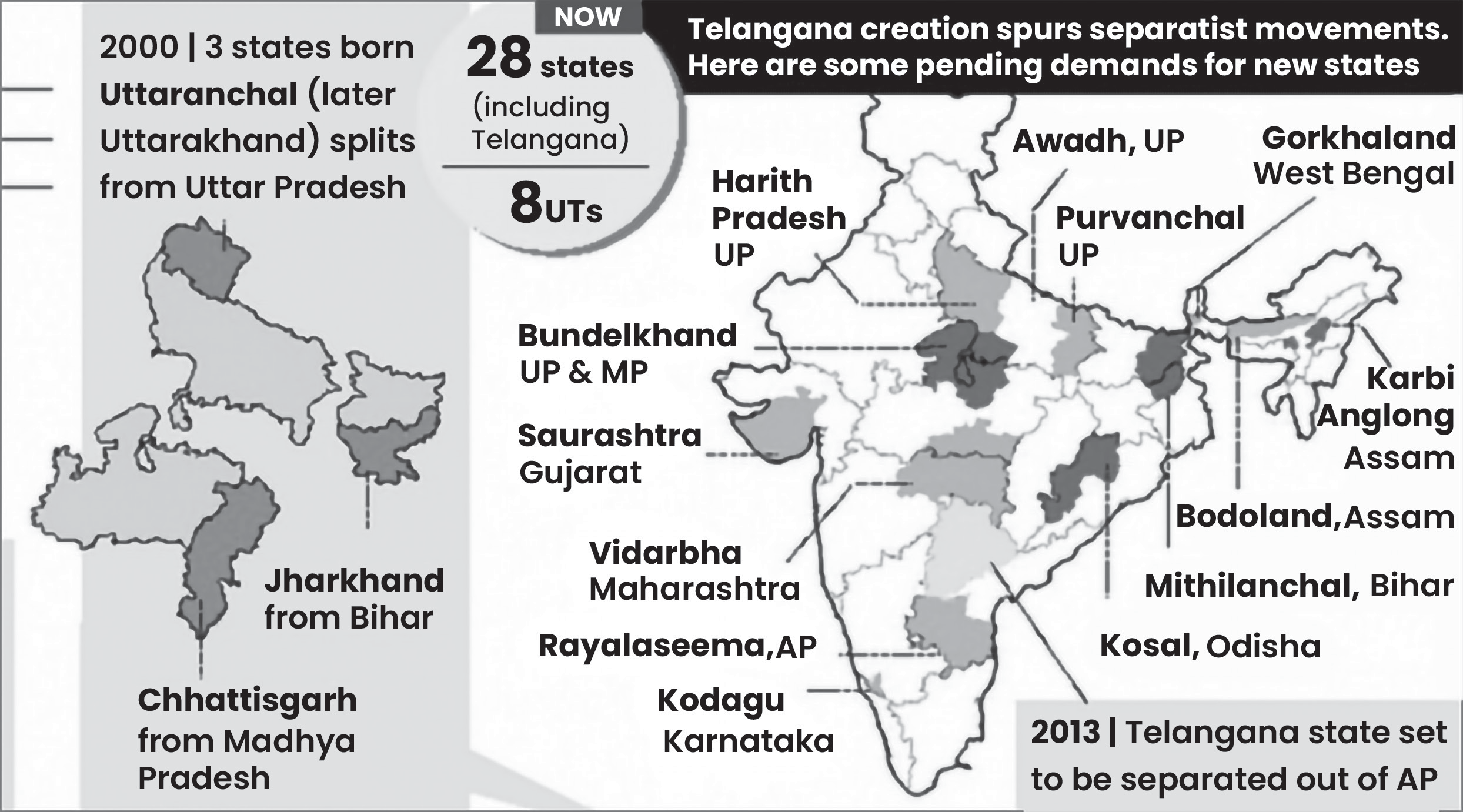
• Early Union Government Policy of going ‘back and forth’ with regional forces, contributed to the rise of regionalism in India.
• To boost their power, local leaders supported the expansion of regionalism and tightened their influence over local party organisations.
• The central and regional leadership built a strong bond. The development of regionalism was aided by the close relationship between the central and regional authorities.
Arguments against Regionalism Leading to Demand for Separate State:
• Though it is not always necessary that regional aspirations give rise to demand for separate states. For instance, regions like Saurashtra of Gujarat, or Marwar of Rajasthan or Mewat of Haryana have unique regional identity, yet they never demanded separate state.
• Similarly, regional aspirations may take the form of demand for separate district for better local administration and development of the region according to its unique needs and requirements. For instance, newly formed district of Charkhi Dadri in Haryana as the result of local demands for development of the backward region.
• Further, instead of demanding separate state, regional aspirations may demand only special privileges like demand for inclusion in the Fifth Schedule of the Constitution like in case of tribal areas of states like Ladakh or Madugula of Vishakhapatnam, etc. for better regional development.
• Another kind of regionalism emerges which is based on the unique location and special strategic characteristics of the region causes the development of regionalism
but it does not lead to demand for separate state like the Tawang Regional Movement within Arunachal Pradesh due to Chinese clashes in the region and backward and remote characteristics of the region.
• Furthermore, instead of demanding separate state, regional aspirations may take the form of opposing the government, insurgency, violence and demand for autonomy or secession.
• For example, the alienation faced by the tribal communities in tribal dominated, resource- rich and simultaneously backward regions of central India, and states like Jharkhand, Odisha,
Chhattisgarh, Maharashtra, etc. that is being exploited by the Naxals or Maoists has a social, communal and regional dimensions.
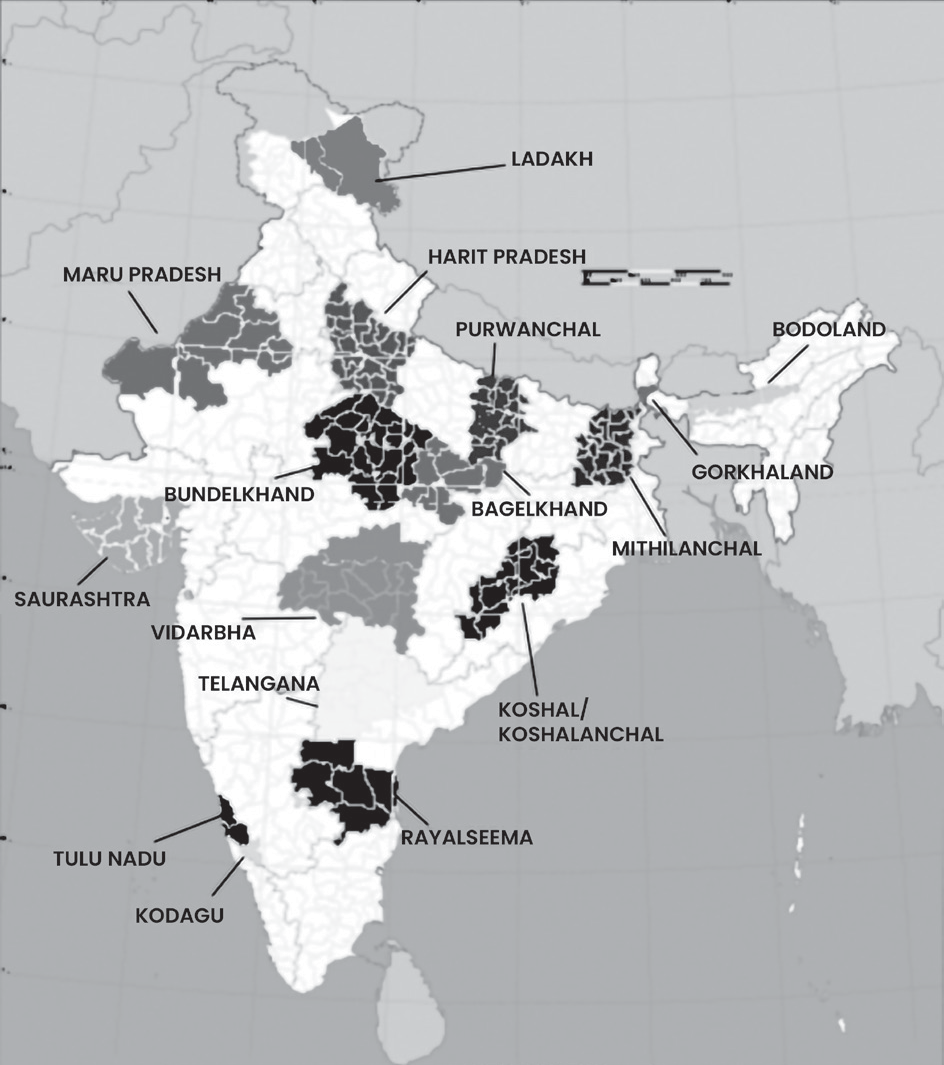
Advantages and Disadvantages
| Advantages of Regionalism | Disadvantages of Regionalism |
| An increase in regionalism helps to manage states easily and gives a voice to smaller, poor or less politically prominent states. Like Manipur demanding development or Arunachal Pradesh demanding isolation or poor states like Bihar demanding special status. It encourages regional governments to collaborate, pool resources and deal with challenges more effectively like climate crisis or boost the political stability and security of a region. Like in 2022, QR coded PVC Aadhaar to fishermen for recognition and coastal security in southern states decided in Southern Zonal Council. Can provide benefits to citizens, such as freedom of regional movement. Like Goods and Service Tax (GST) which aims at one nation one tax. | Regionalism can create dividing lines between the cultural, political and economic identities. Like between the Marathi and Bihari, Tamil and Telugu, etc. Despite representing many states, regional bodies can become dominated by a region’s largest and richest states. Like Maharashtra in Western Regional Council. Despite belonging to same region, states can disagree on key political, economic and cultural decisions. This can result in deadlocks and inaction. Like recent Karnataka-Tamil Nadu tussle on Kaveri waters. Son of the Soil ideology where reservation is given to local residents, can harm state and national economy, apart from larger interests of national integration like recently done in Haryana for 75 percent reservation for locals in private jobs or attempted by Maharashtra for Maratha reservation. |
Steps taken by the Government to pacify regional demands:
• Special provisions with respect to states in Part XXI of the Constitution for States or regions of States that are socio-economically backward, have internal security challenges, difficult geographical conditions, predominance of tribal populations with distinct identity and cultures, etc.:
• Article 370 - provisions with respect to the State of Jammu and Kashmir. It was abrogated in 2019.
• Article 371 - provisions with respect to the States of Maharashtra (Vidarbha and Marathwada) and Gujarat (Saurashtra and Kutch).
• Article 371A - Special provisions with respect to the State of Nagaland (Naga hills, Tuensang area). It was inserted into the Part XXI of the Indian Constitution in the year 1962.
• Article 371B - Special provisions (administration) with respect to the State of Assam (Bodoland territorial area).
• Article 371C - Special provisions (administration) with respect to the State of Manipur.
• Article 371 D - Special provisions with respect to the State of Andhra Pradesh.
• Article 371E - Establishment of Central University in Andhra Pradesh.
• Article 371F Special provisions with respect to the State of Sikkim.
•
Article 371G - Special provisions with respect to the State of Mizoram.
• Article 371H -Special provisions (law and order) with respect to the State of Arunachal Pradesh.
• Article 371I -Special provisions with respect to the State of Goa (Portuguese culture).
• Article 371J - Special provisions with respect to the State of Karnataka.
• The Fifth Schedule safeguards tribal interests in the eleven states of Andhra Pradesh, Telangana, Gujarat, Jharkhand, Chhattisgarh, Himachal Pradesh, Madhya Pradesh, Maharashtra, Odisha, and Rajasthan.
• In the Fifth Schedule areas, the Governor of the state has special responsibilities with respect to tribal populations in the areas including issuing directives to the state government and limiting the effect of acts of the central or state legislature on the areas.
• Sixth Schedule envisage special provisions for autonomy to tribal areas lagging in social development in four North Eastern states - Assam, Meghalaya, Tripura, and Mizoram.
• It is done in the interests of the nation’s unity and integrity, resentment of some historically backward or indigenous population dominated States to avoid separatist tendencies.
• Emphasis is on self-rule; tribal communities are granted considerable autonomy, including
powers to make laws and receive central government funds for social and infrastructure development.
• To enable local control, the role of the Governor and the State are subject to significant limitations in the areas.
• Special Category Status (SCS) is granted to 11 states to provide financial assistance, addressing their relatively slower industrial and economic development due to various challenges.
• The 11 states that have been given Special Category Status include Assam, Nagaland, Himachal Pradesh, Manipur, Meghalaya, Sikkim, Tripura,
Arunachal Pradesh, Mizoram, Uttarakhand, and Telangana.
• Parameters (Based on Gadgil Formula):
• Hilly Terrain;
• Low Population Density and/or Sizeable Share of Tribal Population;
• Strategic Location along Borders with Neighbouring Countries;
• Economic and Infrastructure Backwardness; and
• Nonviable Nature of State finances.
• Andhra Pradesh under Section 371(d) has powers to have “direct recruitment of local cadre” in specified areas.
• In Uttarakhand, class III and class IV jobs are reserved for locals.
• Centre issued a notification reserving jobs for J&K domiciles expanding the definition to central government employees who had served in the erstwhile state for over 10 years.
• In Assam, a committee has submitted its report for implementation of a key provision of the 1985 Assam Accord, recommending reservation in jobs for those who can trace their ancestry in the state before 1951.
Judicial Pronouncements on the Region based laws: The Supreme Court has ruled against reservation based on place of birth or residence.
• In 1984, ruling in Dr Pradeep Jain v Union of India, the issue of legislation for “sons of the soil” was discussed. The court opined that such policies would be unconstitutional.
• In Sunanda Reddy v State of Andhra Pradesh (1995), the Supreme Court struck down a 5% extra weightage to candidates who had studied with Telugu as the medium of instruction.
•
In 2002, the Supreme Court invalidated Rajasthan’s appointment of government teachers giving preference to “applicants belonging to the district or the rural areas of the district concerned”.
• In 2019, the Allahabad High Court struck down a UP recruitment notification by the UP-Subordinate Service Selection Commission which prescribed preference for women who are “original residents” of the UP alone.
• Supreme Court in 2021 quashed 100% reservation to locals of 13 scheduled areas in public jobs by Jharkhand government in 2016 as it violated Articles 14, 15 and 16 of the Constitution.
• In 2021, Supreme Court, struck down reservations for the Maratha community in college admissions and jobs in Maharashtra, saying that there were no exceptional circumstances to justify the breach of the 50 percent ceiling on overall reservations.
Factors which can remedy the Regional Divide in India
Some suggestions have been given which include:
• Inter-regional communication and dialogue to be increased through national level bodies like National Integration Council (NIC), Zonal Councils, National Development Council (NDC), etc.
• Inter-regional Linguistic Harmony Committees can be formed to facilitate coordination and cooperation among people of different languages.
• Further the Freedom of Press should not be allowed to spread regionalism.
• Constitutionally mandated Freedom of mobility, residence, occupation and leisure must be enforced through strong measures.
• Nationalism and National Integration needs to be promoted by political leaders and all leading citizens and keep the various ‘regional interests’ coexisting within the umbrella of National Interest.
• Measures should be taken for raising the economic lot of the underdeveloped region and preserving and developing the cultures of the various regions to pacify their aspirations;
• Ethos of peace and harmony between communities must be cultivated eliminating the roots of regional and linguistic violence.
• Community leaders should explain the situation to the community and defuse tensions.
ZONAL COUNCIL
The idea of creation of Zonal Councils was mooted by the first Prime Minister of India, Pandit Jawahar Lal Nehru in 1956 as a high-level advisory forum ‘to develop the habit of cooperative working” and create healthy inter-State and Centre-State environment for balanced socio-economic development, at a time when linguistic hostilities and bitterness as a result of re-organisation of the States on linguistic pattern were threatening the very fabric of our nation.
Five Zonal Councils were set up vide Part-III of the States Re-organisation Act, 1956. The present composition of each of these Zonal Councils is as under:
• The Northern Zonal Council,
• It comprises the States of Haryana, Himachal Pradesh, Jammu & Kashmir, Punjab, Rajasthan, National Capital Territory of Delhi and Union Territory of Chandigarh;
• The Central Zonal Council,
• It comprises the States of Chhattisgarh, Uttarakhand, Uttar Pradesh and Madhya Pradesh;
• The Eastern Zonal Council,
• It comprises the States of Bihar, Jharkhand, Orissa, Sikkim and West Bengal;
• The Western Zonal Council,
• It comprises the States of Goa, Gujarat, Maharashtra and the Union Territories of Daman & Diu and Dadra & Nagar Haveli;
• The Southern Zonal Council,
• It comprises the States of Andhra Pradesh, Karnataka, Kerala, Tamil Nadu and the Union Territory of Puducherry.
North Eastern Council was established by the separate 1972 Act for all seven northeast states. The State of Sikkim was also included in 2002.
The main objectives of Zonal Councils include:
• Promoting national unity and cohesion.
• Curbing the rise of intense state consciousness, regionalism, linguistic divides, and narrow interests.
• Facilitating cooperation and exchange of ideas and experiences between the Centre and the States.
• Fostering a collaborative environment among States to ensure the successful and timely implementation of development projects.
CONCLUSION
Regionalism refers to the promotion of regional identity over national identity. While it can have positive aspects, it often becomes problematic when taken to extremes. In India, regionalism is generally viewed negatively because it can threaten national unity. Various factors— geographical, historical, linguistic, and political—have contributed to the rise of regionalism in the country. It manifests in different forms, such as secessionism, state disputes, and demands for greater autonomy. Political leaders, in their pursuit of power, have sometimes fostered regional sentiment. To ensure national unity and a shared identity, this issue needs to be managed effectively