Whatsapp 88106-52225 For Details
Get Free IAS Booklet
Get Free IAS Booklet
INTRODUCTION
The word ‘globalisation’ has become a buzzword popularized by media since late 1980s. After first appearing in the 1960s, the term ‘globalisation’ has often been described variously as a process, a condition, a system, a force, and an age.
Globalisation is a complex and multi-dimensional concept which covers areas like politics, economy, society and culture, and technology. It is not a single process but a combination of processes which could overlap and be contradictory at times.
In the globalising” world, the role performance of the new actors encompasses a relatively large field because of the growing number of economic, political and communication networks. To that extent, these networks have made nation-state boundaries porous and permeable to the movement of people, goods, services, ideas and information.
Globalisation is based on the principle of Universalism as against protectionism. It is guided by the rationale of capitalism which calls for free market, free competition and survival of the fittest. Modern phase of globalisation has been brought about or has been necessitated, by the processes of liberalisation and privatisation in the various countries of the world including India.
Defining Globalization
The most common definition of present-day globalisation refers to the growing integration of various countries to the world economy. It results mostly from a freer movement of capital, products and information, which affects not just the economy, but also, as we said earlier, the political, cultural, social and environmental arenas.
Different disciplines such as Economics, History, Political Science, Sociology, etc. employ different criteria for elaborating and defining the concept of globalisation.
Anthony Giddens, a sociologist, defined globalisation as an intensification of worldwide social relations, via which faraway places are linked together in such a way that events in one place are affected by a process taking place many miles away and vice versa (Giddens 2000).
David Henderson (1999), an economist, views globalisation as a model of fully internationally integrated markets meeting the two conditions of
• The free movement of goods, services, labour and capital resulting in a single market in inputs and outputs.
• Full national treatment for foreign investors as well as nationals working oversees, so that economically speaking there are no foreigners.
For Meghnad Desai (2004) globalisation is the growing reciprocal interdependence and integration of various economies around the globe.
Malcolm Waters (1995) finds globalisation as a social process in which the constraints of geography on social and cultural arrangements recede and in which people become increasingly aware that they are receding. For him globalisation implies greater connectedness and de- territorialisation.
Pieterse (2001) calls the contemporary globalisation as accelerated globalisation. Current accelerated globalisation is shorthand for several major interwoven trends.
• Informatisation, which means the role of information and communication technologies
• Flexibilisation that means changes in production systems towards flexible production
• Reconfiguration of states and Regionalisation.
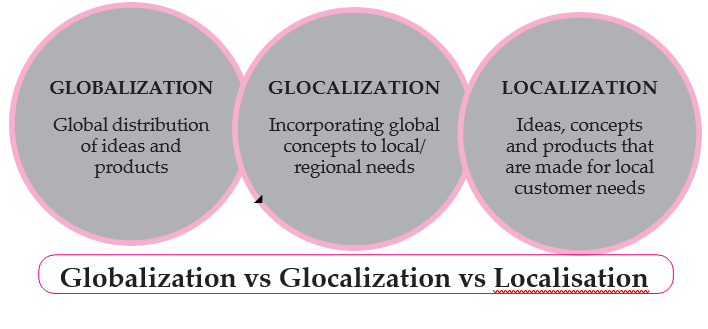
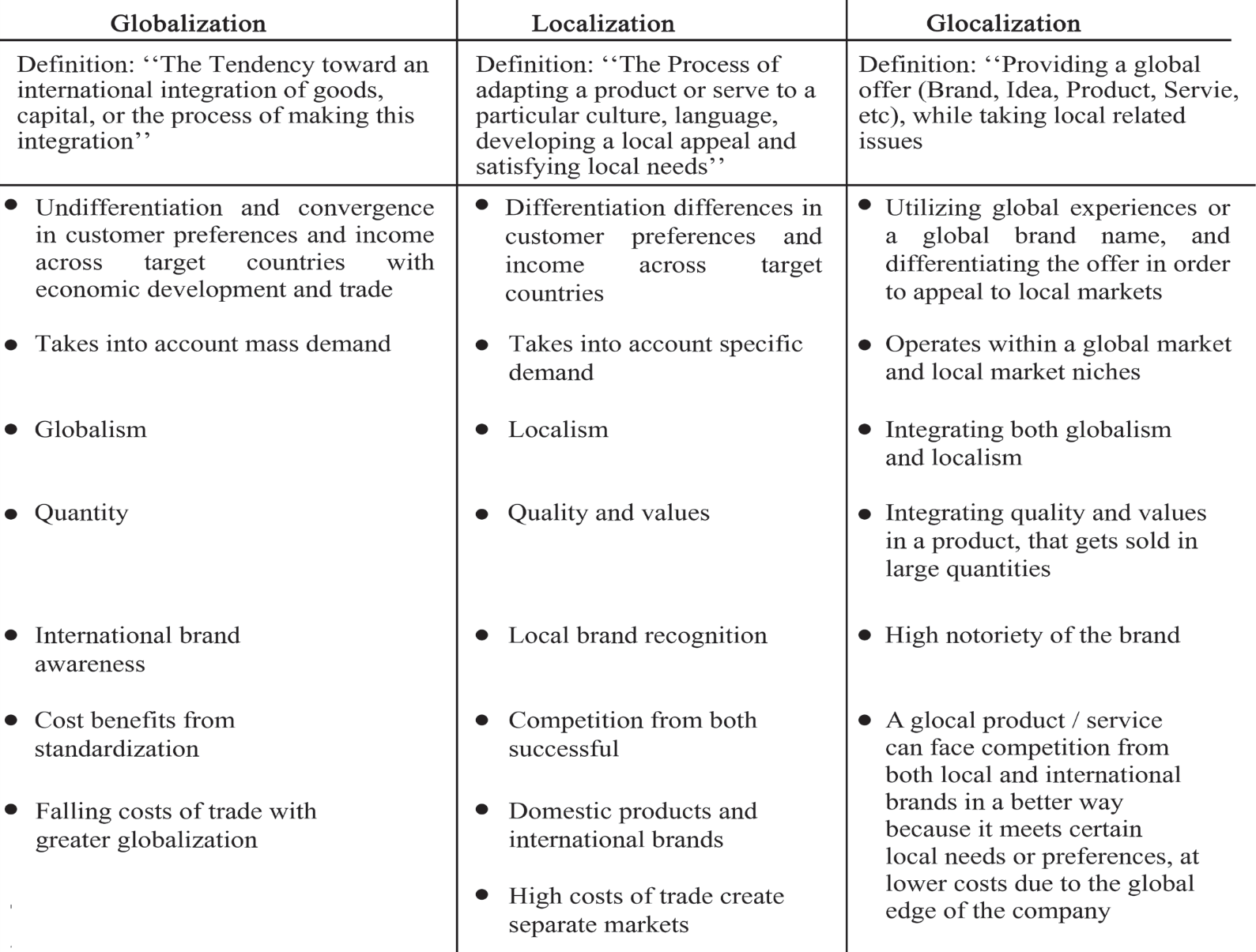
Globalization vs Localisation vs Glocalization
• Globalization refers to the process of increasing
interconnectedness and interdependence among countries through the exchange of goods, services, and ideas.
• Finest example of globalization is the intercontinental manufacturing of smart phones and sale across the world.
• Localization is the process of adapting products, services, and marketing to meet the specific needs of local markets.
• For instance, use of regional/tribal languages to provide education in tribal areas or use of bartar system in remote areas to boost trade and economy.
• Localization is also about use of local resources to boost the local economy and society.
• For example, the recently launched Atma Nirbhar Bharat campaign and Performance Linked Incentive Scheme for manufacturing, using local expertise and local products for generating local employment benefiting local people.
•
Another aspect of Localization is the spatial location of the organization or products or services or other utilities to be local or within the domestic territory.
• For instance, companies like Apple opening their stores in Mumbai enhancing their local presence in India.
• Similarly, Localization of Data of the e-commerce companies and global multinational web services companies, i.e. storage of Indian data to be located within India for security and privacy of the Indian users.
• Glocalization refers to the adaptation of global products and strategies to local markets and cultures. Glocalisation is the combination of ‘globalization’ and ‘localization’. It is the “simultaneous occurrence of both universalizing and particularizing tendencies in contemporary social, political, and economic systems”.
• It is when an international corporation modifies some of its offerings in order to accommodate local consumer tastes or preferences. Starbucks is a successful example of glocalization. Pork or beef are not offered by Starbucks in India. To cater to the tastes of their Indian clients, the majority of whom refrain from eating beef or pig due to religious beliefs, they mostly provide vegetarian options.
Characteristics of Globalization
Admittedly, these different definitions reflect the variations in the range of phenomena encompassing the term “globalisation”. Based on these variations in the characterisation of globalisation, it is possible to identify at least five distinct features of the term:
• Deterritorialization: The significance of geographical borders diminishes as the internet and media bring global events directly to our homes. What happens in one country is instantly shared worldwide through TV and online platforms.
• Interconnectedness: With the erosion of geographic boundaries, there is an increasing web of connections between individuals and organizations at the local, regional, and global levels. For example, ISIS used online platforms and social media to recruit young people from across the globe. Even from their homes, recruits could easily communicate with their leaders, facilitated by the growing interconnectedness driven by globalization.
• Homogenization: Political, cultural, economic, and social diversity is being replaced by uniformity through globalization from above. However, there is also a countertrend toward Indigenization, where Western products and cultural symbols are integrated into traditional practices, reflecting a form of globalization from below.
• Speed: The rapid movement of people, information, goods, and services accelerates social activities and global interactions.
• Long-term Process: Experts agree that globalization is not a new phenomenon; its features have been present throughout human history, though there is debate about when it actually began.
• Multi-dimensional: Globalization affects various sectors simultaneously, including politics, economics, culture, and technology, making it a complex and multifaceted process.
Causes of Globalization
There are two views about what causes globalisation.
• According to George Ritzer, the Materialist View believes that capitalism in general or the multinational companies are the main factor behind globalisation. Ritzer argues that globalisation is a result of both material and ideal factors.
• In contrast, the Ideal View says that globalisation is a result of changes in thinking and ideas, information and knowledge. In terms of thinking, there is a shift from local and national to global. Our knowledge base has also become global in scope.
If globalisation is about the flows of ideas, capital, commodities, and people, it is perhaps logical to ask if there is anything novel about this phenomenon. Globalisation in terms of these four flows has taken place through much of human history.
Also debate about the starting point of globalisation has three points of view:
• The first view says that globalisation is a historical process that has occurred in cycles.
•
Second group also believes that globalisation is a historical process but it is linear not cyclic.
• While the last group believes it is a new phenomenon.
Major Phases of Globalisation
A G Hopkins in his book, Globalisation in World History has talked about four phases of globalisation in history.
• First is archaic globalisation which occurred before the era of industrialization and rise of modern nation states. This type of globalisation was brought about by agents like tribal leaders, seafaring merchants and land traders. They helped in expansion of European and American hold over world economy.
• Next phase is proto-globalisation, a period between 1600 and1800 when state system emerged. The globalizing agents in this phase were merchants and slave traders.
• From 19th century, the modern or the West-centric phase started which related to industrialization, imperial and colonial trends, science community and government organizations.
• The Post colonial phase began with the demise of colonialism in 20th century marked by emergence of supranational bodies. This phase is the result of political and business elites, immigrants and networking through Internet. The present phase of globalisation was facilitated by the onset of the Third Industrial Revolution. The era of internet and rapid transport and communication dawned in the 1980s.
According to Richard Baldwin, there are four major phases of globalization as follows:
• Globalization 1.0 was pre-World War 1 globalization, which was launched by a historic drop in trade costs when steam and other forms of mechanical power made it economical to consume goods made faraway. This globalization came with almost no government support.
• Globalization 2.0 is the post-World War II phase where trade in goods was combined with complementary domestic policies that helped share the pains and gains of globalization (and automation). The market was in charge of efficiency; the government was in charge of justice.
• Internationally, Globalization 2.0 saw the establishment of institute-based, rule-based international governance, specifically the UN, IMF, World Bank, GATT/WTO and many specialized agencies like the Food and Agricultural Organisation and International Labour Organisation.
• Globalization 3.0 is what I called the second unbundling, or the New Globalization. Arvind Subramanian called it hyperglobalization, Gary
Gereffi called it the global value chain revolution, and Alan Blinder called it offshoring.
• The key is that globalization now meant factories crossing borders, and - critically - the know-how of G7 firms along with them.
• This created a new world of manufacturing in which high-tech was combined with low wages.
• Globalization 4.0 represents what I refer to as the "third unbundling." This phase will emerge as digital technology enables the arbitrage of international wage disparities without requiring the physical relocation of workers. While Globalization 1.0, 2.0, and 3.0 primarily focused on industries centered around manufacturing (since previous waves of globalization dealt with the production of tangible goods), Globalization 4.0 will target the service sector.
• We are now entering a new, digital-driven phase of globalization, often called Globalization 4.0, where the frontier shifts to the cyber world.
• The digital economy has arrived, fueled by e-commerce, digital services, and innovations like 3D printing. Emerging technologies from the Fourth Industrial Revolution, such as Artificial Intelligence (AI) and robotics, are powering this latest wave of globalization.
Key Dimensions or Factors of Globalisation
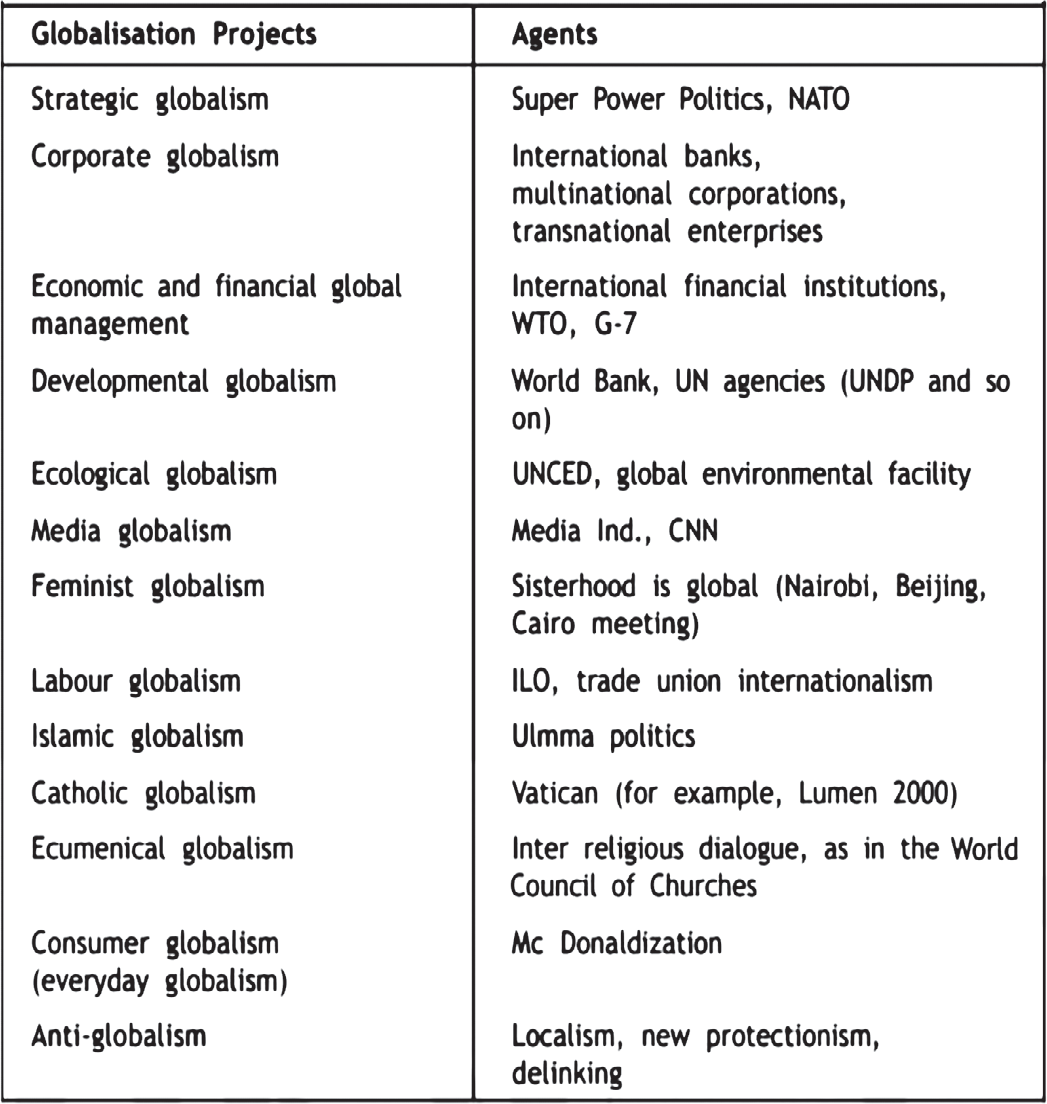
According to Andrew Heywood, the most significant forms of globalisation are economic, cultural and political.
• Economic Globalization: This concept highlights the interconnectedness of global economies, emphasizing that no economy operates in isolation today. Instead, there is a unified global market that incorporates various national economies.
• The Walmartization phenomenon is reshaping economies, where large, multinational, and powerful big-box retail stores are pushing small, traditional businesses out of the market.
• Economic globalization has diminished the ability of national governments to control their economies, making it more difficult for them to resist restructuring along free-market principles.
• Cultural Globalisation: This process involves the dissemination of images and information from one part of the world that reduces cultural differences between individuals, nations, and regions by becoming part of the global flow. It is often described as the phenomenon of McDonaldization.
• However, culture may also constrain forces of globalisation instead of serving them as sensitivity towards local cultures is required to become a global business brand.
•
Political Globalisation: This is evident in the increasing influence of international organizations that operate across national borders, such as the United Nations and the European Union. Most of these organizations emerged after 1945.
The focus on state-to-state relations in political globalization sets it apart from economic and cultural globalization, which emphasize the roles of non-state actors and market-driven forces.
Ecological Globalisation: Manfred Steger argues that there is an inexorable link between all humanity and the planet Earth.
• The Industrial Revolution has caused many ecological problems, including resource and food shortages, overpopulation, reduced biodiversity, pollution, Understanding Globalisation and climate change.
Religion, Science, Sports and Military aspects are also being claimed as additional dimensions of globalisation.
Effects of Globalization on Indian Society
Globalization is a phenomenon driven by advancements in science and technology, and their application across society, culture, politics, industry, and commerce. As a result, countries must adapt to this new reality in order to harness its benefits and mitigate its negative impacts.
This adaptability is all the more important for the developing societies which do not have a strong politico-economic background to absorb the impact of globalisation.
The social dimension of globalization refers to the impact of globalisation on the life and work of people, on their families and their societies. It encompasses security, culture and identity, inclusion or exclusion and the cohesiveness of families and communities etc
Impact on Indian Culture through Media
With the phenomenal increase in the reach of the media, happenings in any corner of the world are brought to the knowledge of all in no time.
| Positive Aspects The reaction and the position of the world community, too, gets easily conveyed to the concerned people. Live videos of issues get viral easily like Syrian migrant crisis. Rural areas people are also getting global ideas of technology and taking financial benefits of the social media like Youtube, TikTok, Facebook etc. Youtube channels like My Kisan Dost on agriculture, vloggers (video loggers) like Pramod’s Life, Channels on Innovation, Gaming, etc. have come up. The cases of Human Rights violations and ‘ethnic cleansings’, etc. no longer go unnoticed like ISIS terror videos led to the global War against Terror in Syria in 2014. In several cases, pressure of the world community has successfully managed to get redressals and reparations for wrongdoings. For instance, apology by Japan for World War II excesses, Belgium apology for colonial era horrors in Africa, etc. Further, various inherently oppressive systems (South Africa, Namibia, etc.) have changed to liberal ones for which globalisation had played an important role. Arab Spring of 2011 had its roots in the global social media like Facebook. | Negative Aspects Through Cable TV and Internet, the MNCs are successfully promoting consumerism and even Western values, like Americanization of Corporate culture in Bengaluru. It has been found that 51per cent of the male rural youth and 29per cent of the female rural youth in India suffer from mental tiredness due to over utilization of social media. Aggressive promotion of expensive brands has led to frustration, adjustment problems and materialist approach to life. For instance, violence and abuse against elderly in metros like Chennai, Bengaluru, Delhi etc. The desire for Coke and Pepsi or famous Western brands of clothes, mobile phones, cars or cosmetics are all creation of electronic media. It is visible in rising Juvenile criminals in cities due to stark inequalities and poverty. |
Impact on Family Structure and Role of Women in Family
Family is a primary social group that came into existence to satisfy the need for reproduction, to provide for the rearing of children, to provide a sense of identity or belonging among its members and to transmit culture between generations. It is not of a sudden origin and has evolved over times and passed through different stages.
The most striking feature of the Indian Family system is the existence of joint family system. The joint family exhibits joint property, sharing of common residence, practicing of common religion and mutual rights and obligations.
| Positive Aspects Globalisation diversified the past family occupation types depending on skills, opportunity and the economic benefits. Like Family tradition of Saree making in Varanasi changed to entry of city employment through migration. The Couple are mostly employed thus raising the standard of living and women getting equal say in decisions, thus improving gender equality. Globalisation has led to increase in social gatherings in place of religious gatherings. Like Kitty parties, pajama parties, Bachelor parties, etc. Globalisation has changed the decision- making hierarchy, as even the opinion of children is seldom ignored. Like United Nations allowed Malala Yusufzai to speak on rights of children. Corporal punishment to children has been banned in most countries. | Negative Aspects Globalisation has led to migration pushing them towards nuclear families at the expense of joint family and traditional family values. For example, urban born child doesn’t want to go to visit rural relatives and feeling class difference. Children are spending less time with family but more time with electronic gadgets making them individualistic and self-centred. Surveys show some kids even spend around 49 hours per week with devices which is more than with their parents! Family has ceased to be unit of production and the voice of elderly in the family matters have decreased. This has led to independent decisions and elderly often being abandoned to left to Old Age homes. Increased mobility of the younger generation in search of new employment and education opportunities has weakened the family bonding due to physical distance. Like the youth living independently demands freedom and personal space. Not only the structural but also functional transformation is taking place in the family system due to Globalisation. Today many functions like education of children are taken by other institutions like school, Creche are taking care of preschool children, etc. |
Family who used to take care of its vulnerable members is no more in a position to serve but the values of the family are still strong in India and the acceptance and rejection of traditional values of hierarchy depends on the experience shared by each family.
The joint family which had been the basis of traditional Indian families has undergone serious changes:
In metropolitan cities, where compact living spaces dominate, the nuclear family structure is becoming more common.
We have lost the opportunity to benefit from the wisdom of older generations and to raise children with the guidance and presence of their grandparents.
Children now often view their grandparents as visitors or guests, which has contributed to the rise of old-age homes. Many young adults start seeing their own parents as burdens in their later years.
While men and women are legally equal, and the push for gender equality is evident, distinct roles for men and women still persist in Indian society.
Woman’s role within the society is usually to perform family and household related activities. However, with the change in time, men and women are gaining equal right to education, to earn, and to articulate.
Impact on Marriage System and Values
Since time immemorial, marriage has always been regarded as a highly sacred institution which involves meeting of minds of two people. However, with changing features of society, very institution is in conflict with each other, for example the patriarchy is in increasing conflict with the independent agency / autonomy of women’s right. Globalisation has led to many positive as well as many negative impacts. Some of them are as under:
| Positive Effects With rising Globalisation, family members, especially elders have begun to accept and appreciate love marriages similar to arranged marriages. Parents often accommodate children’s wishes through love cum arranged marriage. With more integrated economy, increased education and enhanced awareness along with economic independence, people from different caste and faiths are intermingling, weakening rigidities. Interfaith marriages are on the rise in India. Globalisation has broadened the mindset as people tend to avoid child marriages unlike the past. It has helped in intensifying the fight against child marriages, rise in widow remarriages. With widespread acceptance of gender equality, the institution of marriage is becoming more egalitarian as compared to the earlier male dominated structure. | Negative Effects Due to Globalisation, sacred character of marriage has reduced, weakening the institution, through avoidance of rituals and commitments. Today conjugal relationship is shifting from romantic love (forever for each other) to confluent love (relationship for mutual benefit). In a global world, people see marriage as a civil contract, not religious sacrament. This would expose the institution of marriage to whims of human mind and making it temporary. For instance, as per recent reports, India is witnessing a rise of 50per cent to 60per cent in divorce rates, especially in the urban areas. Couples are becoming more open to live-in relationships, which is viewed, by many, as against the culture of India. This has caused isolation and lack of family support, increasing stress and anxiety. Other issues like unrest and violence caused by various communities against intercaste and interfaith marriages in the name of saving their honour. According to NCRB data, there has been a tremendous rise of 792per cent in honour killings in 2015. |
Marriage, as an institution, today is modifying itself to new norms. Additionally, marriages are losing their values and morality. It is visible in rising divorce cases and extra-marital affairs reported. About 55per cent of married Indians have been unfaithful to their partner at least once, of which 56per cent are women, according to latest survey by Gleeden, India’s first extra marital dating app, in 2020.
Marriage used to be considered as bonding of souls till the hereafter; yet today marriage resembles a temporary bond or a purposeful pledge to share existence without
bargaining their self-interests. The ‘sense of self’ factor into the Indian youth is again a result of globalization.
Impact on Festivals and Social Values
Festivals have got a vital place in Indian heritage. Indian cultural values of ‘Atithi Devo Bhava’ (treating the guests as God), ‘Vasudhaiva Kutumbakam’ (Whole world is one family), warm-hearted welcoming, greeting elders with ‘Namaste’ (salutation to the soul in another), Touching Feet of elders with due respect and a celebrating every small festival with great colour of enjoyment and
togetherness. Such a gathering with vigour has reduced and often considered a burden on the independent individualistic existence today.
Social collaboration has reduced while isolated existence is rising. Relationships in the current generation are often limited by a focus on material wealth, financial status, and possessions. As a result, we are gradually losing sight of our social values and ideals such as respect, care, collectivism, and the simple joys of harmony and peace.
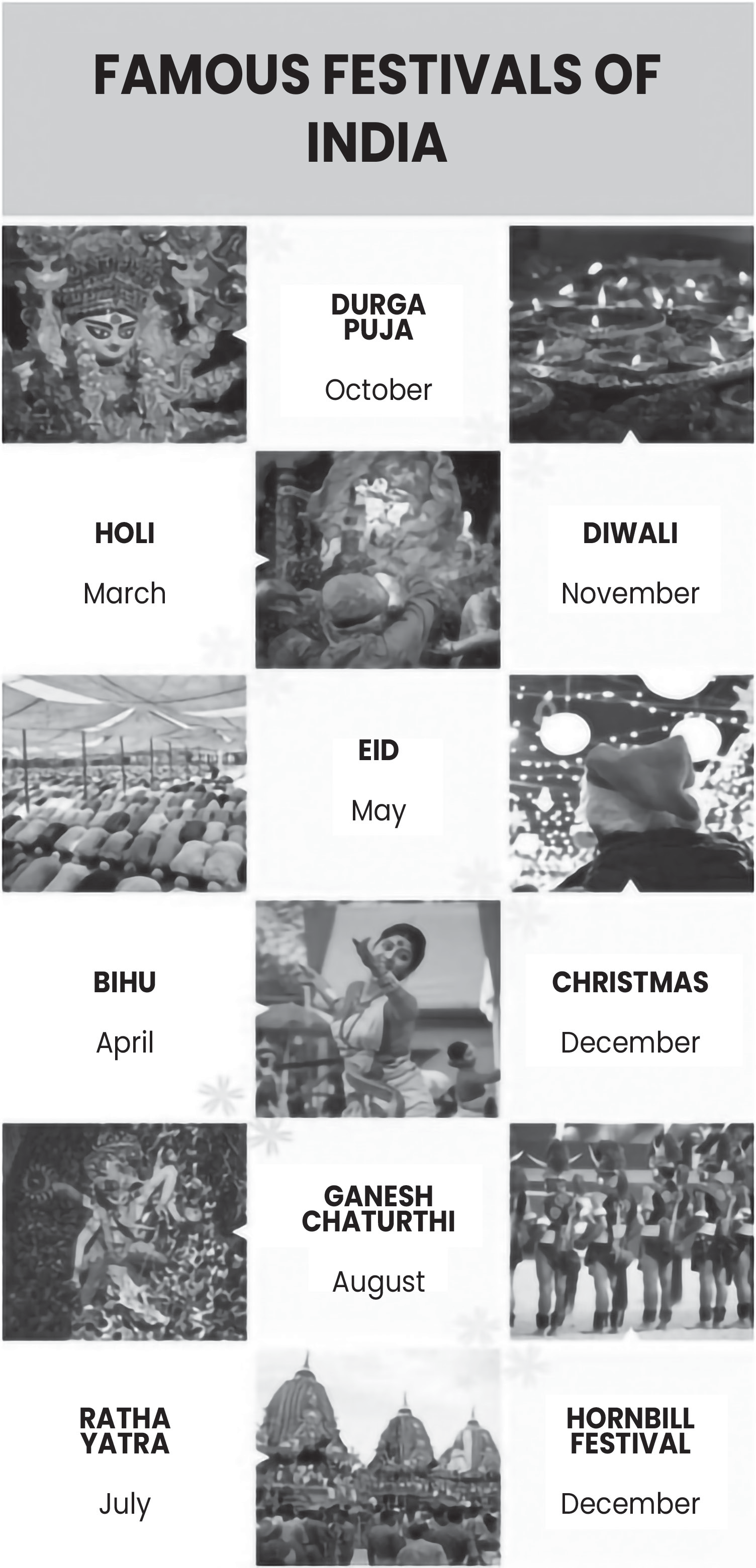
Now a days, Valentine’s Day, Christmas, Halloween and Friendship Day is celebrated more than Makar Sankranti, Holi and Diwali. Decline in the sacred component and rise in secular component of the festivals is the latest trend.
Traditionally, greetings like "Namaste," "Namaskar," or the act of touching the feet of elders were common in the Indian subcontinent. However, in modern times, greetings like "Hi" and "Hello" have largely replaced these traditional expressions.
Impact on Food, Clothing and Dialect
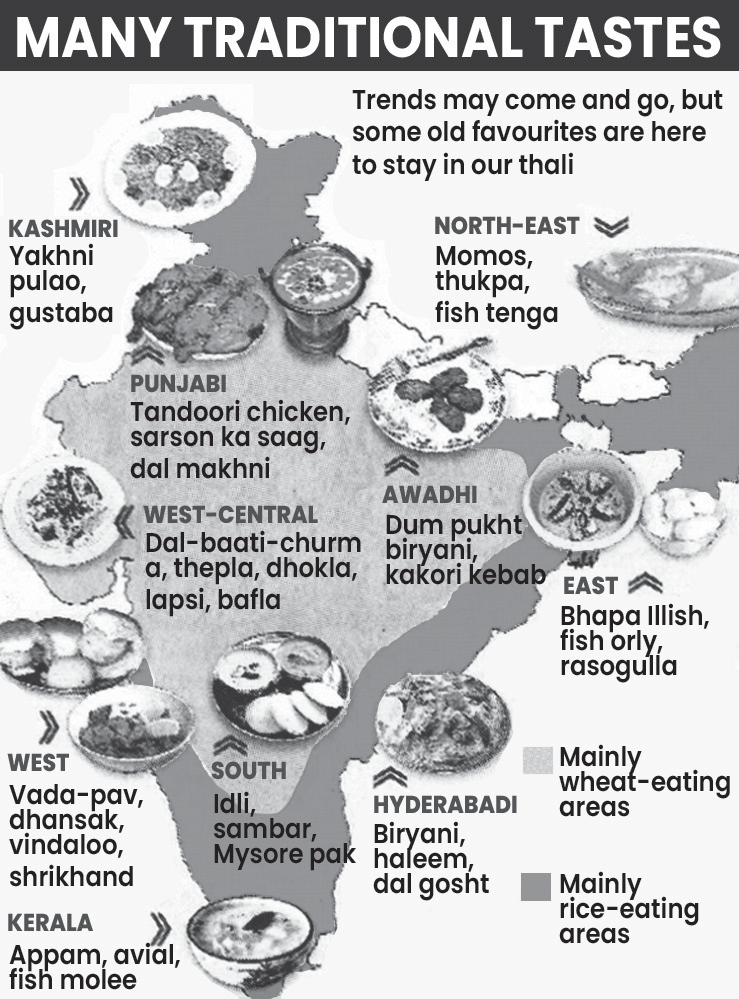
Indian food, clothing, and dialects vary greatly across states. Each region has its own distinctive flavors, nutritional values, and traditional remedies. While global cuisines offer unique tastes, the popularity of junk food— such as pizza, burgers, Chinese food, and other Western fast foods—has led to a rise in health issues like obesity,
hypertension, cardiovascular problems, and liver damage, particularly among children and young adults. A survey by Ipsos revealed that about 79% of Indians now prepare Western dishes at home.
Indeed, even the attire fluctuates in various states which are especially specific in keeping up the nobility of lady. However, the dressing like the Shirts, Pants, Coats in hot regions of North India or extreme hot and humid south India for the males are a discomfort. Many clothes of foreign brands are available in Indian Markets. Male and female dress distinction is blurred. Fusion of Indian and western clothing is the latest trend like wearing western jeans clothing with traditional Indian Kurta etc.
Indeed, even the Indians are not in favour and feel disgraceful in promoting their mother tongue or our national language. Foreign languages are getting common in India like the French, German and Spanish, right from the school level.
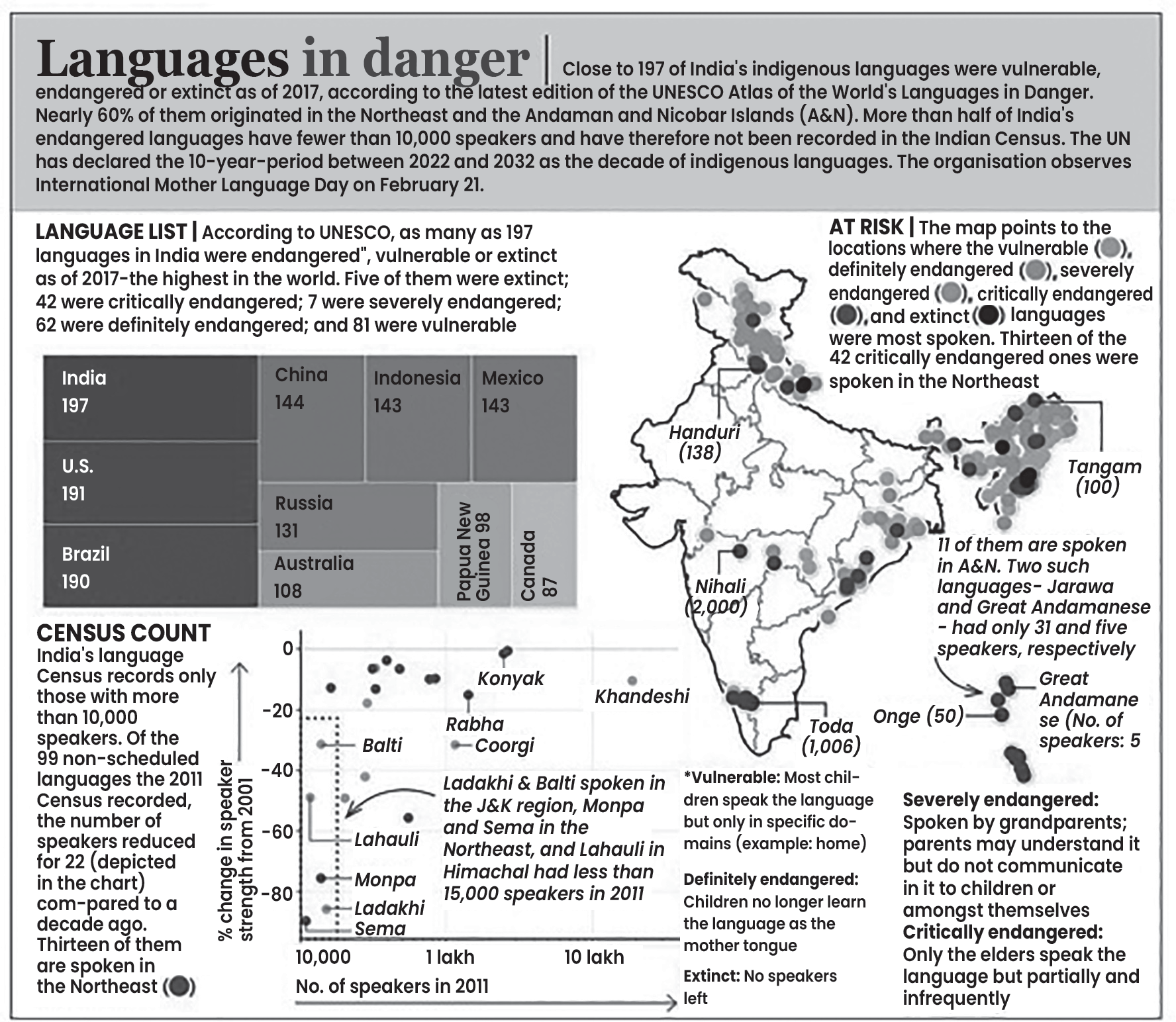
Impact on Music, Dance and Entertainment
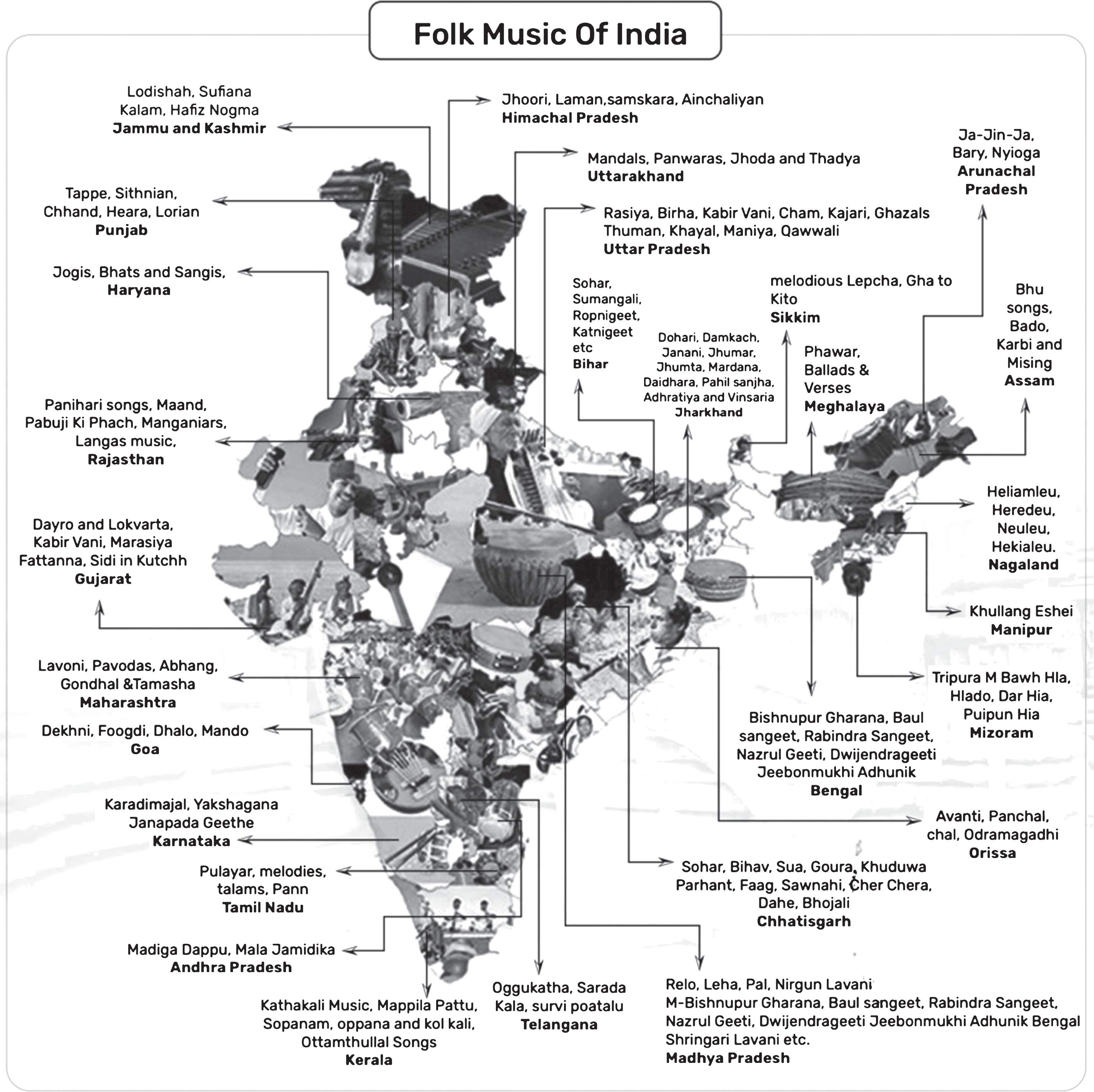
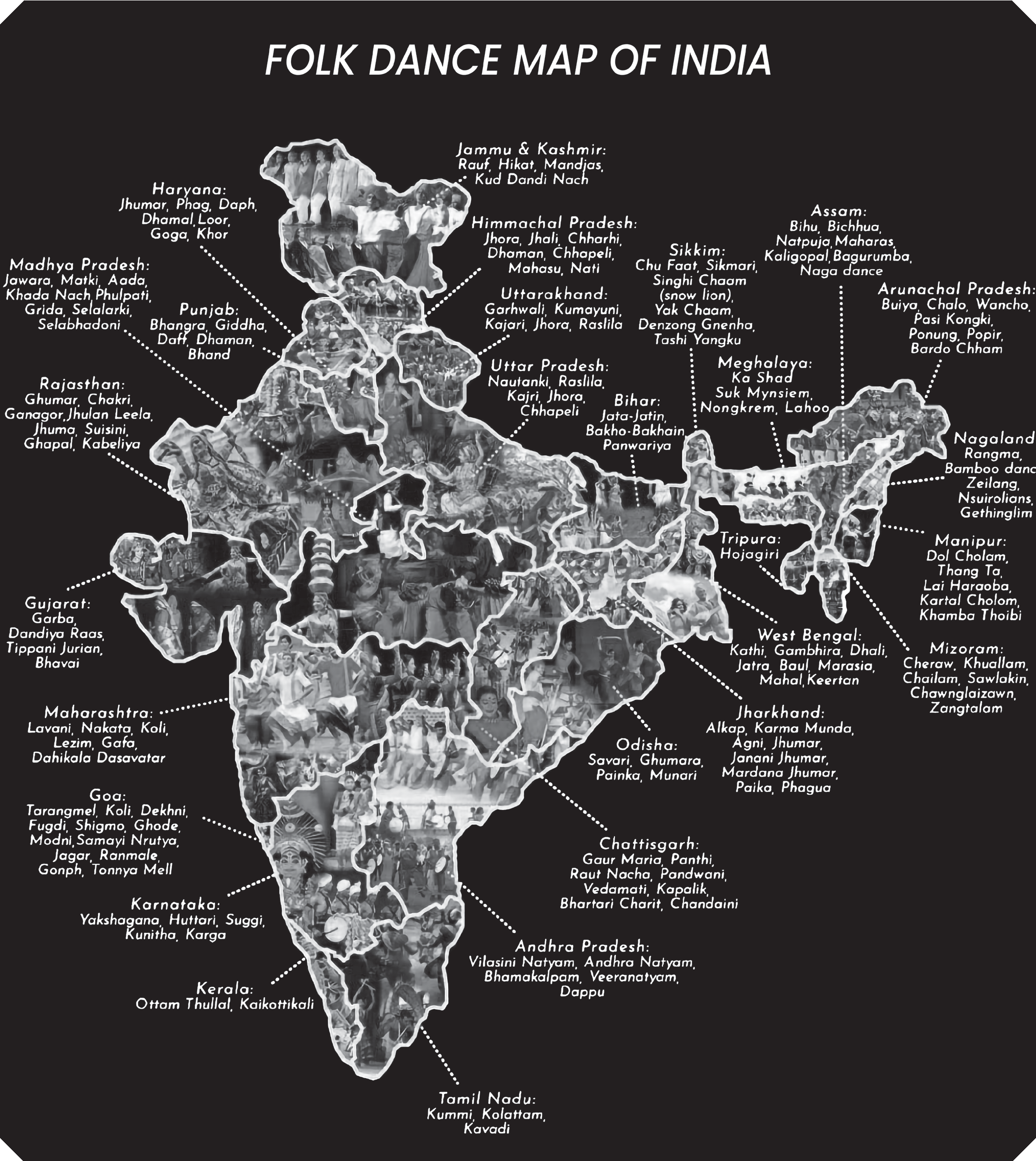
Impact on Religion
Globalisation flattens out cultural differences, erodes local customs and beliefs, and spreads a secular way of life
that is at odds with religion. Relationship between religion and Globalisation has often been found to be antagonistic.
Impact on Political and National Identity
• The rise of populism across the globe may be an inevitable result of relentless globalization. Hyper- globalization leads to increasing fissures in society as it picks winners and losers like between capitalists and labour, regions, languages, etc. When the majority starts to feel insecure, its ire could be against the elites or minorities, visible in left-wing populism in Latin America, Spain and Greece, but right-wing populism as in India or any other European countries, respectively.
• A form of Neo-Traditionalization (neo-traditionalism is an approach using the deliberate application of old
practices and institutions, modified to accommodate the modern context) thus proceeds along with Modernization (Modernization is a value neutral approach of change in traditional society into a modern society characterised by industrialisation, urbanisation and mass society)”.
• The adaptive capacity of microstructures like caste, family and village community has shown the unexpected elasticity and latent potential of Indian social institutions. Consequently, many structural inconsistencies are arising out of the process of globalization in India.
• Country’s level of globalisation is related negatively to patriotism, the willingness to fight for the country and ethnic conceptions of membership in the nation. It is creating some forms of supra-national or denationalised states. For instance, United Nations as a supranational entity or non-recognition of new currency like cryptocurrencies like Bitcoin indicate denationalisation. Similarly, virtual nations and communities have developed online which are anonymous and have their own rules.
Signs of Revival of Indian Culture
• Celebration of International Yoga Day across the world has been a key moment for India.
•
Local handicraft products exports are rising globally, such as Chikankari or Gota or embroidery or bandhani.
• With rising tourism, locals are promoting their diversity by reviving their traditions. Like village tourism or Homestay tourism.
• There has been a revival of ayurvedic medicines in the country as well as outside it.
Way Forward
These changes have had a profound impact on Indian culture, particularly in urban areas, though rural regions are quickly catching up. Western culture is influencing
India, not by replacing it, but by blending with it, creating a fusion of both traditions. Globalization is not only fostering new local traditions but also shaping global ones. As India rapidly integrates into the global economy, with shifts in food, culture, language, and lifestyles, the challenge is to ensure that our youth retain the richness of their Indian heritage. While it's valuable to have a broad understanding of global culture and events, we must proceed cautiously with globalization, preserving our nation's pride and cultural integrity.
Effect Globalization on Various Sections of Society
Globalisation has a huge impact on cultural, social, monetary, political and communal life of India, even it started to influence the value system also. The impact
of the process of globalization is not even and impacts some sections of society more than others like women, Scheduled Castes, Scheduled Tribes, Divyangs, etc.
Impact on Women
The wave of globalization has significantly improved the lives of women worldwide, especially those in developing countries. However, women continue to face disadvantages in areas such as education, employment, health, and civil rights. Globalization has had a profound impact on women's economic and social lives, opening up numerous opportunities that have contributed to their empowerment. A positive approach to cultural and economic migration can provide women with greater exposure to better prospects on the international stage.
Positive Impact on Women
There is rising level of work force participation by women.
As per latest annual PLFS Report, the estimated Labour Force Participation Rate (LFPR) for women (age 15 years and above) is at 32.8 percent during 2021-22.
In the formal sector, various MNCs and industries are providing opportunities for women thus making them economically independent.
Current estimates place India’s rate of female participation in the formal labour force at 24 per cent.
In the informal sector, it has helped handicraft and cottage trade thus increasing the absorption of women in the economy.
As per Indian Handicrafts Census, 56.13 percent of artisans are women.
For example: Kumaon valley weavers, Lambani embroidery craft of Karnataka, Tuma Fruit Craft of Chhattisgarh, Kutch craft (an association of 110 crafts women’s groups) has helped in generating lakhs of new jobs and self-employment in self-help groups.
• Globalisation has brought ideas of gender equality bringing awareness and promoted equal rights and opportunities.
• Globalisation is uplifting the status of women in family and social settings. Changing role of women in family has
weakened old institution of patriarchy in India.
• With rise in nuclear families, it has become easier for women to claim their rights. It has boosted feminist movement in India.
• E.g. various women led movements include Nirbhaya protest, Shaheen Bagh and anti-CAA protests in Delhi, Chipko Movement in Uttarkhand, Narmada Bachao Andolan under Medha Patkar.
• With the advent of global communication networks and cross-cultural exchanges, there seems to be a change in attitude towards women especially in urban areas is a big positive.
• Globalization has led to mindset change which has caused progressive demographic change in Sex Ratio, Fertility Rate, Maternal mortality, etc. which has improved the living condition of women.
Negative Impact on Women
• Despite several positives, glass ceiling still exists in terms of sectoral and income limitations like women were still
not preferred in hazardous roles like combat roles, firefighting, driving, etc.
• As per International Labour Organisation (ILO), gender pay gap in India was 28per cent in 2018-19.
• Moreover, unemployment, underemployment and temporary work are more common in women due to public safety issue, limitations of family chores, social limitations on type of work, unpaid child care, marriage, pregnancy, etc.
• According to a study done by TeamLease, 1.1 to 1.8 million women (across 10 key sectors) might not even get jobs.
• Survey by JobsForHer found that around 14per cent of Indian companies—including large enterprises, SMEs and start-ups—don’t have any paternity leave policies at all.
• Particularly in the unorganized sector, women work for twelve hours a day causing health issues like respiratory problems, pelvic inflammatory diseases etc.
• E.g., women as beedi workers and also in garment industry.
• The patriarchal attitude and cultural norms backlashed in form of violence, domestic and workplace harassment, etc.
• Like seen in honour killing cases in Haryana against intercaste marriage or 2012 Nirbhaya incident.
• Various sectors like handloom and food processing are being mechanised causing loss of employment for women in the sector.
• The employment opportunities have put double burden on women of earning as well as caring of children and household chores.
• As per NSSO 2019, only 27 per cent men in India participate in household chores, though there is significant variation across states.
• Commodification of women, pornography and vulgar reality shows have also led to increasing gender violence, molestation, harassment, rapes and dowry deaths.
Feminization of Labour
It is a term used to describe the emerging labour relations, especially in Agriculture sector and rural areas due to willingness to work on lower wages and the willingness to take on flexible and part time employment.
In Agriculture:
• In 2018-19, as per Periodic Labour Force Survey (PLFS) data, 71 per cent female workers are employed in agriculture, followed by manufacturing (9 per cent), construction (6 per cent) and hospitality (4 per cent).
• India is an agrarian economy with about 54.6 per cent of total workforce engaged in agricultural and allied sector activities (Census 2011).
• The workforce participation rate for rural females is significantly higher at 41.8 per cent against urban women participation rate of 35.31 per cent (MoSPI, 2017).
In Industry:
• Women have entered the labour force in large numbers in countries that have embraced liberal economic policies. Industrialisation in the context of globalisation is as much female-led as it is export-
led (UN 1999). The overall economic activity rate of women for the age group 20-54 approached 70per cent in 1996 in developed nations.
• The highest absorption of women has been witnessed in the export oriented industrial sector like in export processing zones and special economic zones and, in those labour-intensive industries that have relocated to developing countries in search of cheap labour (Hillary 1999).
• Investors have demonstrated a preference for women in the soft industries such as apparel, shoe- and toy- making, data processing, semiconductor assembling
industries that require unskilled to semi-skilled labour.
In Services:
• Though women’s urban labour force participation for all ages has risen slightly from 15.5 per cent in 2011- 2012 to 15.9 per cent in 2017-2018.
• Large numbers of women workers are overcrowded into a small number of ‘female occupations,’ driving female wages down mostly related to childcare, nutrition, pre-school, and crèches apart from nursing, teaching, receptionists, shop floor workers,
• This once again reiterates the gendered assignment of roles.
• In call centres in India, women comprise an estimated
40per cent of the workforce.
Commodification/Objectification
The commodification of women is a term which describes women as objects. Marketers target traditionally specified “feminine” roles and occupations, thus highlighting the subordination of women to men like in ads of toys, beauty products, Barbie dolls and others. We all must have seen the deodrant’s advertisement on television. They usually portray women as nymphomaniac. Commodification and unquestioned gender stereotyping of women and their roles is one of the primary reasons for the failure of women empowerment schemes in India.
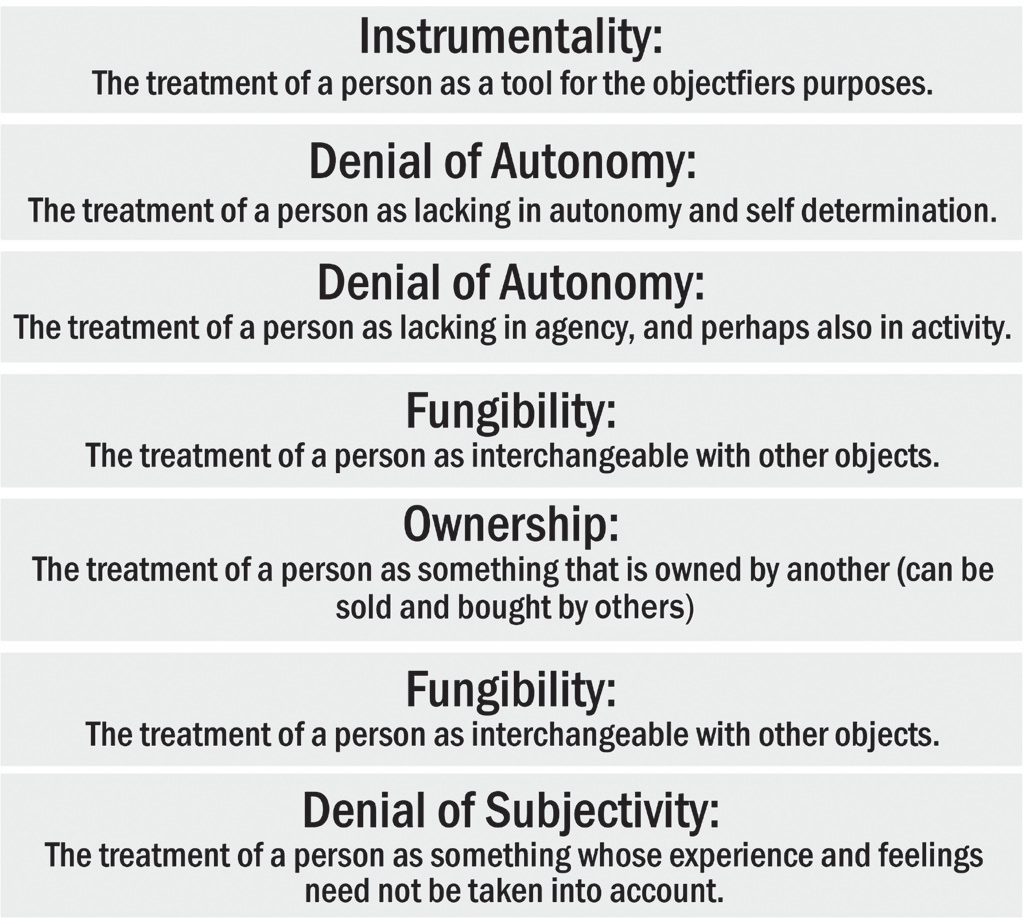
Figure: Seven features of Objectification as per Martha Nussbaum.
•
Women portrayed in Serials and movies as animals.
• Mostly reptiles as creatures to be tamed or conquered.
• Like Nagin or Mermaids, or Cows, Bitches, etc. are much popular in the media.
• Women as an object to be owned.
• Resultantly, we are afraid in granting her the right over her own body. Granting these rights is considered to be destructive for institutions like marriage and family.
• Traditionally, women were considered as an item to be sold.
• The wedding ceremonies like “kanyadan” and Bride Price signified the gift of virgin daughter to an unquestioned male.
• Moreover, once married to a man she had to follow and obey every command of the master who was her own husband.
• It was due to this notion that the concept of marital rape was never discussed. Even if it is a pious bond of marriage, a crime is still a crime.
• Market stereotypes like ‘Beauty Queens’ and ‘Item Songs’ in cinema.
• Justification forwarded for include ‘freedom of expression’ and ‘demand-supply law of the market’.
• Both these justifications stem from the same ideological roots of Western concept of liberty and choices.
• However, it reduces women to sexual objects and sends a message that women’s bodies are for male consumption.
• This leads to gender-based violence, harassment, and discrimination.
• Objectification of women in pornography and vulgar reality shows.
• It has further deteriorated the dignity of women.
• This has created unrealistic expectations and prejudices among the male youth about the character, body, and image of women.
• This has led to juvenile crimes and marital rapes.
Way Forward:
Thanks to Globalisation, women in India are now emerging from the shadows of past traditions into the new era of freedom and rights. Indecent Representation of Women (Prohibition) Act, 1986 has been passed by the Parliament. Further state governments like West Bengal and Karnataka have taken initiatives for betterment of working conditions and implementation of minimum wages under Four Labour Codes, which includes Beedi
workers as well. In the long run, it becomes necessary to mitigate the negative consequences of Globalisation through enhancing of women’s skills with the help of innovative policies to create an enduring environment for their economic and social empowerment.
Impact on Elderly
According to the 2011 Census, India is home to approximately 104 million elderly individuals (aged 60 and above), with 53 million females and 51 million males. A report by the United Nations Population Fund and HelpAge India projects that the elderly population will rise to 173 million by 2026. This demographic is significantly impacted by globalization.
Positive Impacts of globalization on the aged population:
• Globalization has reduced costs and expanded access to advanced healthcare technologies, contributing to increased life expectancy and improved health outcomes through better technology, medical facilities, and living standards.
• The rapid development of communication technologies has made the world feel much smaller. Older individuals, who may not be able to live with their children due to the pressures of work, can now easily connect with them through platforms like Skype and Zoom.
• Remittances: Around 18 million Indians living abroad send money back home, enhancing the quality of life for their families.
• The longevity dividend: People are becoming more economically prosperous due to better global employment opportunities, allowing them to save more for their retirement and old age.
Negative Impacts of globalization on the aged population:
Society is becoming more and more materialistic with the rise of globalization and western culture is becoming dominant in Indian society.
Economic impact:
• Elderly were considered as a socio-cultural obligation and responsibility but now considered as an economic burden as their earning capacity declines after retirement and productivity is reduced.
• They also face rise in health expenses often due to life style diseases like cardiovascular issues, diabetes, blood pressure, etc.
• According to a 2021 survey by GOQii, lifestyle diseases such as diabetes, cholesterol, and blood pressure were higher among older adults and seniors in India. Among seniors aged 60 years and above, 57 percent were suffering from high blood pressure.
Political impact:
• As the senior citizens as a section of society is unorganised, they are unable to realise their political rights and thus, their life satisfaction is lower with higher alienation in India.
• They are not considered a vote bank for any political party in India but rather a section of society as a receiver of welfare benefits.
• Elderly have 13 percent share in Indian electorate, however, recently senior citizens were denied railway concessions.
Social impact:
• There is a constant conflict between caretakers and elderly. With the rise of economic and materialistic mindset, the elderly are exploited by the family and society.
• The caretakers keep them as gate watchers, or make them work against their will and often provide poor living conditions like out-house or abandoned rooms with less sanitation and no pocket money.
• As per the website dadadadi.org, there are 728 Old Age Homes in India in 2021 rising from 500 in 2016 indicating a rise of about 25 percent annually.
Psychological impact:
• Empty Nest Syndrome is a feeling of grief and loneliness parents may feel when their children leave home for the first time, such as to live on their own or to attend a college or university.
• In the era of globalization, this syndrome is getting a permanency resulting in loneliness for parents.
• Survey by Delhi-based NGO Agewell Foundation found that almost every fourth Indian elderly was living alone in 2018.
• Data from a recent epidemiological study indicated an average of 20.5per cent mental health morbidity in older adults.
Way Forward:
Elders have formal, technical and tacit skills which they’ve accumulated through long service. They can also help younger ones find pathways into secure and well-paid work through mentoring and job sharing as envisaged by National Mission for Mentoring. Pension Schemes like Vay Vandana Yojana and Schemes providing Assistive Aids like Vayoshri Yojana are helping the elderly in the right direction. Another initiative is the launch of country’s first pan- India toll-free helpline— 14567 called the ‘Elder Line’. The Maintenance and Welfare of Parents and Senior Citizens Act mandates children to take care of their parents. Now many young couples are understanding significance of older people for social and psychological security, looking after grandchildren. Thus, with increasing life expectancy, taking care of the Longevity Dividend is the need of the hour.
Impact on Children
Children are one of the most vulnerable sections of the society. Children are highly receptive to new technologies, new openings and new horizons, in times of Globalization.
| Positive Impacts | Negative Impacts |
| Early exposure to digital devices is spreading digital literacy among the children. Enhancement of knowledge and better grasping of education due to global sources of audio-visual aids like Khan Academy and open online courses. Early development of expertise on technology related aptitude helping them adapt to the upcoming technology disruption caused by the Fourth Industrial Revolution. Like Artificial Intelligence, Internet of Things, Cloud Computing, Blockchain etc. Better grasp of global ideas and upcoming changes in the world. Like climate change, child rights, consumer goods, etc. | Due to rise in dual career families, the primary group of children has changed. Early exposure to digital gadgets is impacting their health as they are getting affected by poor vision, early onset of diabetes due to poor eating habits, sedentary life style, depression and anxiety due to social isolation caused by excessive time spent on such devices. Problem of early exposure to inappropriate content like pornography, terror, violence, communal ideology, caste, region, etc. on social media which is causing issue of early maturity, stealing their childhood innocence. Now the interaction generally takes on virtual mode, resulting in epidemic of online games which is impacting a child’s social development. Further, the problems of relocation by parents, decreases the social bonding, as the peer-group of children changes continuously. Decline in the cultural understanding and problem of cultural maladjustment due to western ideas influence like materialism. Globalisation increases child labour: As child labour is also unskilled labour, trade liberalisation increases child labour. This is known as substitution effect of trade liberalisation. |
Way Forward:
There is a growing need to reconnect children with Indian culture. While an understanding of global lifestyles is crucial for raising well-rounded individuals who can tackle global challenges, it’s important to draw a line. Parents must provide proper guidance and care at every step, helping children navigate the positive aspects of globalization while shielding them from its negative influences. Additionally, parents themselves require training, guidance, and counseling to effectively support their children in this new era.
Impact on Youth
As per the National Youth Policy in India, the youth age group is defined as those between 13 and 35 years. India currently has the largest youth population in the world, with over 50% of its population under the age of 25 and more than 65% under the age of 35. Globalization has created new opportunities for employment, education, improved lifestyles, and higher salaries for the youth. However, significant social challenges often disproportionately affect young people.
| Positive Impact | Negative Impact |
| Globalisation has provided youth access to lot of education, training and requisite skill sources including internet, media-print and social, and radio making them ready for the labour market e.g., open courses, online videos on you tube. Global understanding allows the youth to take independent, rational and unbiased decisions. They become better at professional management. Globalisation has led to the formulation of national policies and laws that promote youth development and protect young people from abuse and exploitation. National Youth Policy talks about holistic development of youth as a resource. With more awareness about their socio-political rights through social media and internet, youth are more vocal towards their right. Consequently, more participation of people in policy is visible, etc. In 2014, 14 MPs are between 25-40 years. | Drifting away from great values of Indian culture like respecting the elders, taking care of the old age parents, etc. Sedentary lifestyle and unhealthy health practices like smoking, drinking and drug abuse leading to health disorders like depression, obesity etc. increases the problem. Lack of family and social bonding has given rise to issues of depression and anxiety. It leads to increasing level of suicidal tendency especially among educated and unemployed youths. |
Way Forward:
There is an emerging need to connect the youth to Indian culture. Comprehensive policy is essential to turn the youth into the productive and meaningful participants of society. Need is to create an ecosystem of awareness and connect the youth into constructive and healthy physical activities like sports apart from the psychological counselling infrastructure. Further,
employment opportunities must be created along with skill upgradation of the youth.
Impact on Scheduled Castes (SC)
The process of Globalisation has impacted almost all sections of society, especially the under privileged like Scheduled Castes. along with highlighting the need for promoting socio-economic justice for them.
Negative Impact
• Globalisation has led to Double Marginalisation of Dalits (marginalization of the already marginalized) due to
lack of skills to compete in an open economy, which has led to social and economic marginalisation.
• The literacy rate among Dalits is 73.5 percent, which is lower than the national average of 80.9per cent (Census of India, 2020)
• Globalisation process has directly hit the traditional rural occupations of Scheduled Castes, replacing with global capitalistic tech-led mass production. Like machine made colours, designs, looms, etc are much cheaper than handmade crafts. As per Census 2011, 79.6per cent of the total Dalit population was rural.
• With privatization, the early benefits of reservation have also started to disappear as government is not the dominant employer.
• As per official data of 2022, in the past eight years since 2014, only 7.22 lakh have got jobs.
• Difficult to access quality education and cost-efficient healthcare due to increasing commercialization of services.
• Out-of-pocket expenditure (OOPE) in total health expenditure still at 47 percent in 2019-20, while budgetary allocation for education has dropped over the past seven years to 9.5per cent as per Economic Survey 2022-23.
• Mechanization of agriculture has led to declining work opportunities for the SCs which has led to rural to urban migration leading to slum proliferation.
• The 2011 Census showed that 12.6per cent of the population in urban India were Dalits. Recent data shows that Dalits constituted 20.3per cent of the slum population.
• The pro-market stance of Globalisation has led to class divide between privileged few and the large mass of the marginalized sections of the society including the Scheduled Castes.
• As per latest Multidimensional Poverty Index 2021, almost 100 million Dalits in India – or one third of their total number are multidimensionally poor.
• Rise of Dalit capitalists, prosperity and enhanced awareness among the Dalits has drawn the ire of upper castes
which has perpetuated exclusion, violence and discrimination against Dalits.
• For instance, 2010 Mirchpur violence in Hisar, Haryana.
Way Forward:
The shift in India from a state-regulated economy to a market-driven economy, marked by the privatization of industries and the removal of policies and controls in economic planning, has had a particularly strong impact on Dalits. In fact, the reform process led to the rise of a new middle class that has reaped the benefits of economic growth, largely due to their economic, educational, and social advantages, often at the expense of the poor and marginalized communities. While globalization has brought some benefits to Dalits, they still require protection and support from the state to ensure their continued prosperity and development.
Impact on Tribals or Scheduled Tribes (ST)
India is home to second largest tribal population in the world, next only to Africa. The tribes in India are spread over the length and breadth of the country. Since the emergence of liberalization, privatization
and Globalisation (LPG), the tribal areas subjected to various protests due to forced displacement in the name of economic development. In the name of better lifestyle
to poor indigenous tribal people, the market forces have
created wealth, many a times, at the cost of livelihood and security of these tribes in such areas.
| Positive Impact | Negative Impact |
| The exposure to media and other resources of mass communication have helped them in raising the voice against the injustice. It has also led to creation of separate Ministry of Tribal Affairs in 1999 and withdrawal of POSCO steel plant from Odisha in 2016. Improved employment opportunities, education and lifestyle have challenged the caste rigidities and thus helped in improving the overall condition of the tribal population. According to 2019 official data, STs comprise 8.47 percent of central government jobs. According to 2020-21 data, 5.8 percent of higher education seats belong to SCs. Improving health benefits through better medicines and lifesaving drugs have helped in improving the overall life expectancy of the tribals. As per Lancet 2016, show that life expectancy at birth for ST population in India is 63.9 years, as against 67 years for general population. | There have been challenges to their culture, traditional employment and livelihood due to coming of various MNCs. E.g., possible displacement to land acquisition for bullet train in Palghar, Maharashtra. Lack of effective legal protection to the tribals and their involuntary displacements has eroded their traditional knowledge and cultural heritage in the form of language, community and religion. E.g. Dogria Kondhs were evicted by Vedanta group in Niyamgiri hills of Odisha where the hill itself was considered a deity by the tribe. Patenting of their long use plants for medicinal purpose has increased the cost of health maintenance. Like Neem, Tulsi, Turmeric etc. Due to environmental degradation, they are getting affected badly and in result there has been ban on some of their traditional practices like shifting cultivation. In 2011 a New Land Use Policy aimed at discouraging shifting cultivation in northeast states like Mizoram, without providing feasible alternative livelihoods. Various propaganda based tribal protest movements against development projects like by International NGOs and even internationally supported separatist movements. Like Chinese supported Naga rebels or global Maoist supported Naxal movement have often created law and order issues. |
Way Forward:
A large chunk of tribal population is still leading a marginalized life and globalisation has only led to increase in their hardships. Thus, they need effective support from the government so that they are able to strike a balance between preserving their right to ethnic identity along with becoming a part of the mainstream in a peaceful manner getting the benefits of development in remote areas.
Impact on Transgender
Globalisation has its effect on all aspects of life, including the construction, imagination and regulation of sexuality of transgenders. In issues of sexuality, as in other spheres, globalisation is perceived to have increased inequalities. Some of the impacts of Globalisation on transgenders are as under:
| Positive Impact | Negative Impact |
| Globalisation has helped in giving them voice through transmission of ideas from outside India. Their concerns are being heard by the authorities through social media like Twitter. The growing recognition of social movements abroad has impacted similar movements in India. This is evident in the NALSA judgment, where the Supreme Court acknowledged the rights of transgender individuals. It has also helped in moving away from the binary system of gender prevalent in the past. It will help in mainstreaming of transgenders. E.g., Manabi Bandhopadhyay is the 1st transgender college principal. Shabnam “Mausi” Bano is the first transgender MLA in India. Globalization has raised acceptance of the transgender community in India. Transgender Persons (Protection of Rights) Act, 2019 was passed by the Parliament. In 2021, Karnataka became the first Indian state to allocate 1 per cent reservation in public employment. | The transgenders are facing marginalisation even from the MNCs and private sector. As per 2018 National Human Rights Commission (NHRC) data, only 6 percent transgenders were employed in private sector or NGOs and 23 percent were forced into prostitution, even if qualified. Rising number of transgenders are coming out due to globalization and support from abroad, but it has created rise in violence. In 2020, the National Crimes Report Bureau reported only 236 cases of violence against trans people. In fact, there is major underreporting of cases due to insensitive treatment by the police. |
Way Forward:
Inclusive workspaces, protection of identity and support for development of transgender community through health, education and affirmative action policies are the need of the hour. Rights related to the personal laws must be opened for transgenders in the spirit of equal citizenship and human rights under the Constitution. Greater sensitization is needed among the officials and the local police to understand their issues and provide transgender- friendly atmosphere of law and order for their holistic development without discrimination.
Impact on Refugees
International migration has always consisted of the ‘structured’ movements of individuals in response to changes in economic, political and social conditions. Despite the number of asylum seekers in Europe and North America, African and Asian countries bear the greatest burden of refugees. Some of the impacts on society due to globalization on the refugees are as under:
| Positive Impact | Negative Impact |
| Globalization has helped in giving recognition and protection to refugees and understanding these issues like through United Nations Refugee Convention 1951. The cultural transformations brought about by international migration leads to cultural intermingling and greater understanding among cultures. Like Afghani refugees in Delhi. It leads to better understanding of humanitarian values and rise in foreign aid and opposition of foreign intervention like in case of Syria or Libya. It has led to better economic opportunities thus improving their standard of living. E.g., Germany has accepted many refugees and extended all the benefits to them. | It has created socio-economic problems in the destination country and thus they face the wraths of the native population. For example, Rohingya refugees in Assam and Bangladesh. Global sentiment against refugees is causing stereotyping, sanctions and opposition against specific communities. Like rise in Islamophobia in west as many migrants are muslims. |
Way Forward:
Refugees are among the most vulnerable section of population who are uprooted from their original country or nation, due to persecution, war, calamities, discrimination, poverty etc. Need of the hour is to ensure refugees get their rights through funding and expansion of international bodies’ network which can help them in times of need. Universalisation of refugee convention must be promoted based on humanitarian considerations
Impact of Globalization on Various Social Sectors
Several globalization-related pathways to health
exist, two key ones of which are described: globalized diseases and economic vulnerabilities. The concept of globalization in education has embedded the practical aspect of understanding other cultures and empathy among students.
Impact on Education
Knowledge attained through education empowers everyone to mitigate most challenges and opens doors to a lot of opportunities for better prospects in employment and income growth. Globalisation has impacted education in India in many significant ways:
| Positive Impact | Negative Impact |
| Massive Open Online Courses (MOOCs), Online free books, modules and skill training has increased due to Globalisation. This has helped employability. Internet of Things (IoT), Artificial Intelligence, Cloud Computing, etc. are some cutting edge technologies. Scientific and technological innovations have made education enjoyable for students. Audio visual aids, interactive live classes, experimental modules, 3D models etc help learn better. Increased access to quality education enabling higher social status and mobility. E.g., collaboration between foreign and Indian university as IITs and Cambridge, Harvard, Oxford etc. It highlights the potential benefits to the economy and possibilities of new patents and intellectual property. Like crowd sourcing and online networked research, open-source platform development. Like Open Network Digital Commerce (ONDC) recently launched in India. | Exorbitant cost factors have higher and specialized education created a class divide between the rich and poor. Though the MOOCs are free yet the hidden cost of having a high end smart phone, continuous stable electricity and a high speed internet are a must to access that “free”content. According to ASER survey, the availability of smartphones in rural India was only about 75% in 2021. Collaboration with Foreign universities or use of new technologies has increased the fees of professional courses and even schools. IIM fees has risen from 7 Lakh in 2007 to 27 lakh in 2023. This has caused brain drain or high drop out rates. Ideology of Commodification/ contractualization/ commercialization of education has reduced its quality and lowered its moral high standing, due to fall in the teacher salaries to gain more profits/revenue. UNESCO’s State of the Education Report for India 2020, found that 42 per cent of the teachers across private and government earn below Rs 10,000 a month. |
Way Forward:
Globalization has brought many advantages but need is for the government to intervene so as to bring the benefits of globalization to the poorest of the poor. Abhyuday Yojana of Uttar Pradesh is one such scheme which gave free tablets to the competitive exam aspirants. Similarly, Rajasthan, Punjab and Manipur governments have provided free smartphone to the BPL families as an enabling measure.
Impact on Health
Today, International organizations complement national governments to solve health issues. Globalisation has had many positives as well as few negatives. Some of them have been mentioned as under:
| Positive Impact | Negative Impact |
| There has been increase in accessibility to quality health like e-health or telemedicine, tele-diagnostics and tele-radiology services, to reach remote and tribal areas like e-Sanjeevani. Globalization has raised knowledge of traditional Indian medicine like Ayurveda, Unani, Siddha, Homeopathy, etc. through platforms like YouTube etc. in India and abroad. The quality of research, medicine and treatment has gone up as evident by foreign investment and rising multinational companies in India. For instance, Sanofi of France, Pfizer of USA etc. Medical tourism has seen a rapid rise like in India where quality treatment is relatively cheap unlike many western countries. Like alternative medicine, bone-marrow transplant, cardiac bypass, eye surgery, and hip replacement are cheaper in India. | Entry of multinational companies has led to high cost of medicines which has raised expenditure raising poverty. Out-of-pocket expenditure remained marginally higher at 48.2%. Globally popular beverages and fast foods has contributed to the global epidemic of obesity. For example, MacDonald and KFC fast food chains. Recent data suggests morbid obesity affecting 5% of the country’s population. Trans-nationalisation of health risks: Pandemic risks are higher in the era of globalization. E.g Zika virus, COVID19. |
Way Forward:
Globalization has come with its own opportunities and challenges in health sector. The global companies are making health services availability better yet the need is to bring the services to the last mile through targeted interventions like Generic medicines, free health check- ups and insurance. The need is to reduce out-of-pocket expenditure of the poor so that they are able to improve their standard of living and spend on education, sanitation
and improve their income and become productive contributors of the economy.
Globalization and New Technology
Globalisation and technology are interrelated. Globalisation has led to need for more technology while technology hasecome an important facet of Globalisation as it connects more and more people. We are moving towards an increasingly border less world enabled by technology. Some of its impacts are as under:
Positive Impact
• It has helped in the spectacular success of Information and Technology industry by dismantling the barriers of technology.
• Single purpose equipment for mass production is being replaced by flexible tools which can do ‘Multi Task Production’. It has allowed industries to produce a variety of products efficiently in small batches.
• For example, in a modern car, various components made elsewhere and get assembled somewhere else. In
Maruti Suzuki cars, engine is from Japan, while assembly is in Manesar, Haryana
• It has brought revolution in other fields like media, agriculture, services and others. It has also helped in producing
new and better employment opportunities. Today we can easily see Jobs which remain open for 24 hours.
• More sophisticated transportation systems and vehicles have enabled us to work in areas that aren’t within walking distance of home like metro services has reached to all major areas in Delhi.
• Technology has allowed greater connectivity, especially for families who stay miles away but are connected through better internet connectivity like skype video chatting and rational pricing of phone calls.
Negative Impact
• Globalization has amplified the phenomenon of 'Cultural Lag' across India. Cultural lag refers to the difficulty society faces in keeping pace with technological advancements. It occurs when social systems, such as laws, ethics, and norms, struggle to adjust to technological changes, leading to a 'period of maladjustment' and an inability to effectively manage new risks.
• For example, with the advancement in medical technology, child sex ratio became adverse in India owing to sex selective methods. This manifests traits of cultural lag as law, ethics are not able to catch-up with changing technology.
• With the advancement of technologies, there are ongoing debates of automation vs. jobs which have created a perceived threat of unemployment, especially among the unskilled labourers.
Alternatives to remedy the impact of Globalization on Indian Society
Need for a healthy debate over the desirability of developed socio-cultural systems brings about three major views:
“ldeal Types” or adoption of the most desirable socio-political and cultural traits shedding the pre- modern traits.
“Particular Types” i.e. right of every group to preserve its own socio-cultural and political characteristics.
A third group wants best of both worlds and avoid backward traditions like ‘Sati’, ‘animal sacrifice’, ‘Johar’, etc.
Moreover, despite differences, they all agree on the desirability of equality, liberty and justice becoming the basis of any socio-cultural and political system.
Role of Civil Society is crucial in the development of consensus and supporting environment to lead the society in the desirable direction of social change according to the needs and demands of a progressive society.
Economic and regulatory measures by the government are essential to ensure limits upon the exploitation by the Multi-National Corporations (MNCs).
Like pollution limitation and effective Corporate Social Responsibility (CSR) implementation.
• There should be awareness campaigns in rural and urban areas by Government and Non-government organizations about the various harmful effects of Globalization to help the citizens take informed decisions. Like Nukkad Nataks in local language.
• Comprehensive policy should be formulated to enhance its positive outcomes and minimise its negative effects along with promoting sustainable development.
• Furthermore, specific infrastructure interventions are needed to mitigate negative outcomes. Like electronic deaddiction centres, strong cyber security and content regulations, platforms for grievance redressal, etc.
CONCLUSION
There is a need for taking Globalization and its effects in a manner which strikes a balance between optimum competition and efficient utilization of resources and minimizing the harmful effects of globalization. Policy should be such that benefit of globalization occurs to the citizens in terms of employment generation and equitable distribution of resources. Ecosystems approach with circular economy model must be employed apart from integrated interdisciplinary manner of policy making along with preserving Indian Constitutional ethos as well, to ensure effective outcomes