Whatsapp 88106-52225 For Details
Get Free IAS Booklet
Get Free IAS Booklet
Kinship
Kinship is a method or a system by which individuals, as members of society, associate themselves with other individuals of the same society. The kinship system includes society-recognised relationships based on supposed as well as actual genealogical ties.
The kinship system represents one of the basic social institutions. Kinship is universal and, in most societies, plays a significant role in the socialisation of individuals and the maintenance of group solidarity. It is important in primitive societies and extends its influence on almost all their activities - social, economic, political, religious, etc.
There are two types of kinship bonds:
Consanguineal Kinship: Consanguine ties are created by the bond of blood, like the one between mother– daughter, mother–son, father–daughter, etc.
Affinal Kinship: Affinal ties are formed through marriage like those of husband and wife, a man and his wife’s brother, etc.
Functions of Kinship:
It set rules for governing the relationship between Kin.
It set rules for marriage relationship between people and decides who can/cannot marry whom.
It establishes rights and obligations of the members practices right from the birth to the death of the person.
It helps to maintain harmony between the relationship.
It helps easy succession, transfer of property to descendents.
Regional differences regarding kinship systems:
North India: In North India, there are mostly patrilineal groups, with descent traced in the male line from father to son. Members of a patrilineage cooperate in ritual and economic activities. Caste endogamy is strictly practised. Further, marriage is prohibited within the same gotra or clan and village exogamy is commonly preferred. Thus, marriage prohibitions tend to bar marriage over a wide area in terms of kinship as well as space.
South India: The Southern zone presents a very complicated pattern of kinship system and family organization. While there is the dominance of patrilineal and patrilocal systems, simultaneously matrilineal (descent from the maternal line) and matrilocal systems also exist. Rules of marriage also vary in South India. This is also evident from the historical evidence from Satvahana period where king would carry his matrilineal name, for eg. Gautamiputra Satkarni
Marriage
‘Marriage is a socially acknowledged and sometimes legally ratified union between an adult male and an adult female’. It is also a set of cultural mechanisms which ensure the continuation of the family. It is more or less a universal social institution in India. It is a legitimate and most accepted way of establishing the most fundamental social unit called ‘family’.
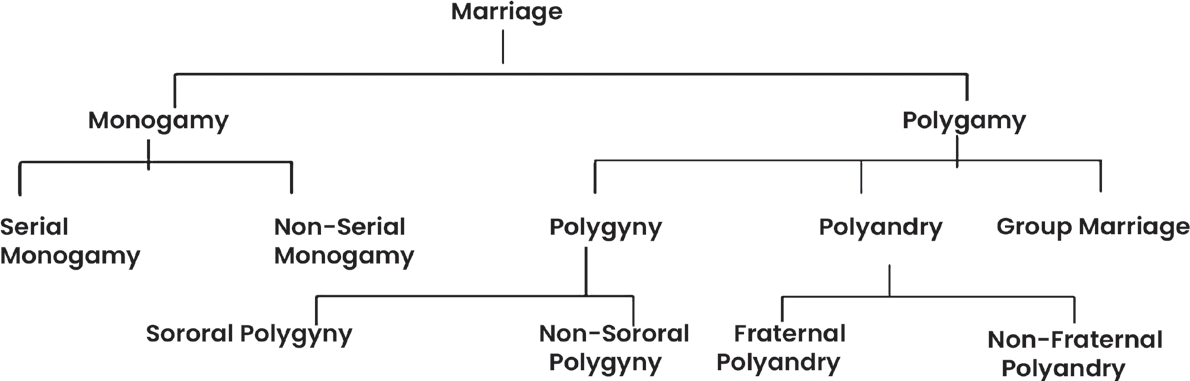
Monogamy: It is the practice of marrying or the state of being married to one person at a time. It is a general practice among all sections of society.
Non-Serial Monogamy: It is a practice where the couple marries for life and never marries again, even after divorce or death of a spouse, like in traditional Hindu families.
Serial Monogamy: It is a practice where the couple marries, but marries again after divorce or death of a spouse, like in American society.
Polygamy: It is the practice of marriage to more than one spouse at a time.
Polygyny: It is the marriage of a man to several women at a time. In Islam, polygyny is allowed. Some Hindus also practice polygyny. If the women are sisters, then it is called sororal polygyny, otherwise it is non-sororal.
Polyandry: It is the marriage of a woman to several men at a time. Polyandry is less common than polygyny. A few Kerala castes like Nayars practised non-fraternal polyandry (group of men, who are not related, marry a woman) until recently. The Toda of the Nilgiris in Tamil Nadu practice fraternal polyandry (group of men who are brothers marry a women).
Polygynandry: It is the marriage of several woman to several men at a time. It is also known as Group Marriage. It is practiced by Khasa of Jaunsar Bawar in the Dehradun district of Uttarakhand.
Marriage has traditionally been seen as the cornerstone of society, as old as the institution of family itself. It provides a sacred framework for expressing interpersonal emotions. However, in recent times, evolving patterns in intimate relationships are challenging this long-standing institution.
In recent times Marriages are evolving in many ways:
• Societies that once practiced plural marriages are increasingly shifting toward monogamy. This shift has been further influenced by the Western concept of romantic love as the foundation for marriage.
• Legislation has also contributed to this change. For example, the Special Marriage Act of 1954 in India facilitates secular and inter-religious marriages, while the Hindu Marriage Act of 1955 prohibits polygamy.
• Judicial Pronouncements like Seema vs. Ashwini case (2005) on compulsory registration of marriages, Karnataka High Court upholding Marital Rape as crime under Section 375 of IPC, decriminalization of adultery under Section 497 of the IPC, Right to marry a person of one’s choice as fundamental right, Puttaswamy judgement upholding Right to Privacy as fundamental right, etc. have significantly altered
the scenario of marriages in India and significantly empowered the women in Indian society.
• The goals of marriage are evolving, particularly among the urban and educated segments of the population. A clear preference for smaller families has replaced the traditional view that larger families, especially those with many sons, were a source of status for parents. For younger couples, marriage is increasingly seen as a "relationship for self-fulfillment," rather than solely for procreation.
• Live-in relationships are steadily growing in India, especially among youth in metropolitan cities. This institution has gained legal recognition, as the Supreme Court noted in 2010 that a man and woman living together without marriage cannot be considered an offense. Furthermore, female partners and children born from such relationships are legally recognized and entitled to all associated rights.
• The economic dynamics within the marriage relationship have proceeded towards more equality with gradual improvement in the status of women in society. Bilateral decision-making in the family has challenged traditional notions like ‘the man is the head of the family’ and other notions like ‘man is the bread earner and the woman, the homemaker’.
However, Some Negative Trends and Problems with Marriage have also been noticed:
• Dowry has become more deeply ingrained in society, with groom prices rising in line with education.
• Child marriage still persists in certain regions, particularly among Rajputs in Rajasthan and in states like Bihar. Polygamy remains common among some Muslim communities and various tribes.
• As traditional values erode, instances of divorce and marital breakdowns are on the rise. The internet has exposed people to global social trends, significantly influencing the institution of marriage in India’s traditionally conservative society.
• Recently, lavish and extravagant celebrations of marriage have become a widespread trend.
• To some extent, marriage has lost its sacredness and sanctity, with greater emphasis placed on extravagant celebrations rather than adhering to customs and traditions.
These changes in the institution of marriage can be attributed to multiple economic and social factors:
• Urbanization has significantly impacted social institutions like marriage and family. For instance, in urban areas, men and women are increasingly opting to choose their own life partners, leading to a decline in the popularity of arranged marriages.
• Globalization has brought about cultural homogenization and hybridization, influencing traditional customs, values, and practices surrounding marriage.
• Modernization has shifted societal attitudes towards inter-caste marriages and widow remarriages, fostering greater acceptance.
• Legal frameworks and court rulings related to marriage age, choice of life partner, number of spouses, marriage dissolution, dowry, and remarriage have also played a crucial role in transforming the marriage system.
Family
A family is a group of individuals united by either conjugal bonds through marriage or consanguineal ties based on blood relations among kin. It is regarded as a universal social institution, an integral part of society. Despite significant societal changes, the family continues to exist in all known cultures, whether in tribal, rural, or urban settings, and across different religions and communities. The family remains one of the most enduring forms of relationship.
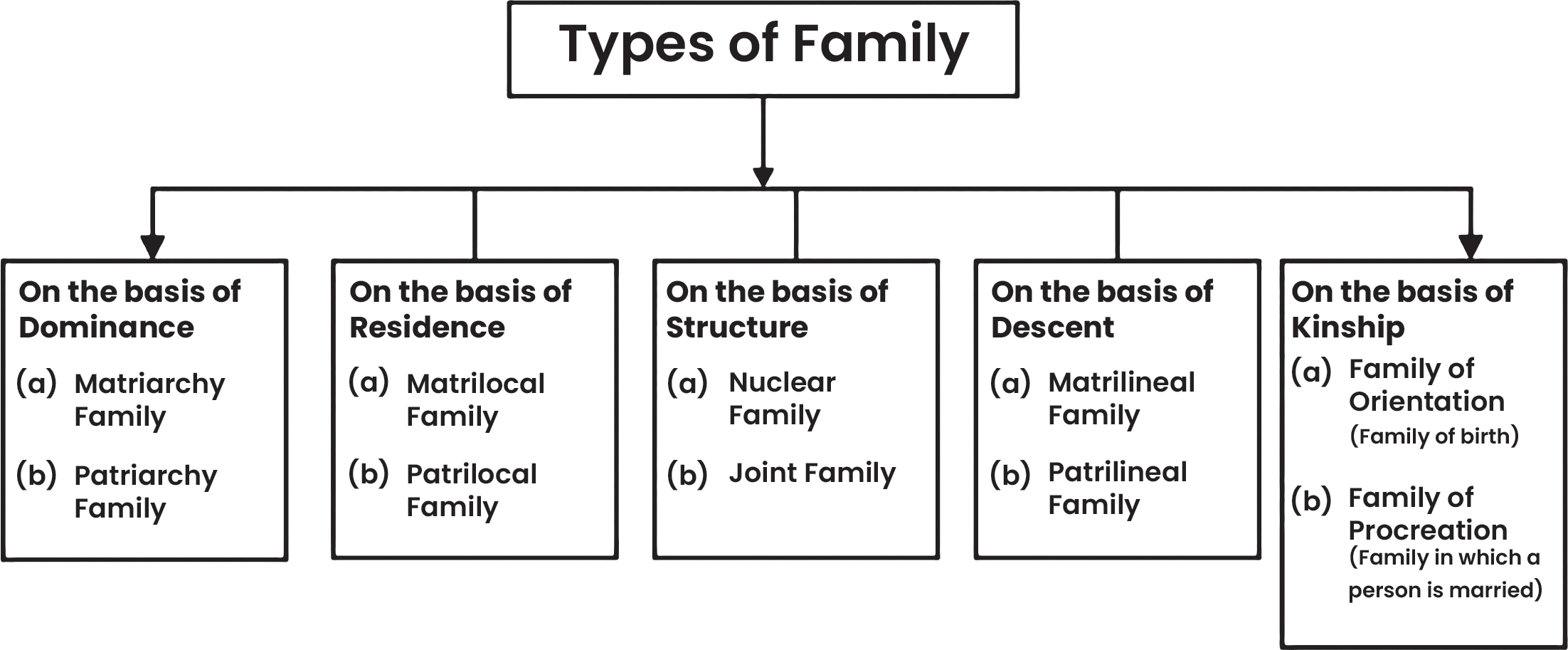
Joint or extended family system: A joint family, also known as an undivided family, is an extended family arrangement consisting of many generations living in the same household, bound by common relationships.
A Joint Family is a type of Extended Family, in which there are at least two nuclear families; at least three generations; and the joining of the nuclear families as per the rules of residence of that society.
The eldest male member is the head of the family.
It is characterised by
Common residence
Common kitchen
Commensality (practice of eating together)
Sharing of property
Performance of ritual bonds
Reciprocal obligations and sentiments
Nuclear family: It can be defined as a small family composed of a single couple and their offspring, that constitute a unit. The size of a nuclear family is very small and it is an autonomous unit due to no control of the elders.
Diverse form of the family:
According to the rules of residence:
• Patrilocal family:
• In this type of family, the wife moves to the husband's village or household after marriage, which is known as a patrilocal family. These families are typically patriarchal and patrilineal in nature.
• This practice is also why daughters were historically denied the right to inherit property, as any property they received would be transferred to their husband’s family upon marriage. Instead, daughters were given movable property, such as jewelry and household items, which became known as 'stree dhan' and contributed to the harmful custom of dowry (the demand for valuables and cash from the groom’s family).
• Matrilocal family:
• A family in which the husband comes to reside in the house/village of the wife upon marriage is termed a matrilocal family.
Traditional Indian Family:
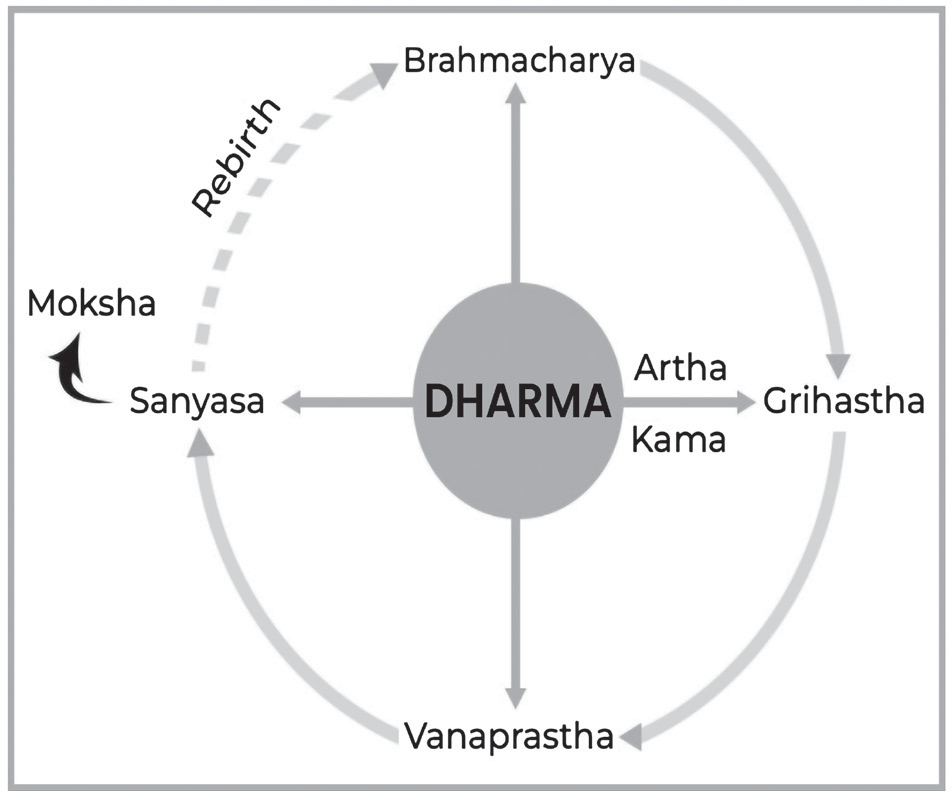
Traditionally, a ‘family’ in India is understood as a joint family. In various religious scriptures, family and marriage are considered essential for the fulfilment of Dharma. It is considered one of the stages of life – viz – Grihastha Ashrama – where procreation and sexual gratification are considered essential functions.
Under the influence of various factors, the conception of family in India has changed. Instances of traditional joint families are coming down and instead, new forms of jointness are emerging.
Reasons for the Breakdown of the Joint family system:
• Both the State and the market have contributed to the decline of the joint family system in India. Legally, the Land Ceiling Act required family lands to be registered under individual family members' names to maintain control, whereas previously, sole control rested with the 'Karta' (the head of the joint family and its properties).
• As a result, family disputes became easier to resolve through divisions, leading to the breakdown of the traditional family structure.
• Recently, the joint family system is no longer the central feature of Indian society, mainly due to the mass migration from rural to urban areas, the shift from
agriculture to non-agriculture, and the transition from localized to globalized living.
• Job transfers, postings, livelihood opportunities, and business ventures have become key factors leading to the disintegration of joint families in contemporary India.
• The rise of new occupations that require greater mobility has also contributed significantly to the shift from joint families to nuclear units. Additionally, increased family incomes have made it more feasible to maintain separate households.
• Industrialization and urbanization have created a need for smaller, more mobile family units rather than large joint families. Furthermore, the high cost of living in urban areas has made it more practical for families in cities to remain small.
• The functions traditionally performed by the joint family, such as providing economic security in times of loss, caring for the elderly, and child care, are now carried out by house-help, social security, pensions, old age homes, schools, and childcare centers.
However, this situation is not universal as there are instances of increasing joint families in urban areas. Also, the families have shown “functional jointness” wherein they come together in times of need despite living in different places.
Counter-evidence on Joint Families
The counter evidence comes from the last Census 2011 which curiously shows 26 per cent rise in joint families in urban areas and 2 per cent rise in rural areas.
This indicates the rising relevance of joint families in urban areas due to various reasons like
• Rising cost of land
• Need for psychological and social security
• Taking care of the children
• Getting valuable advice based on experience of elders
Impact of Disintegration of Joint Families:
• Change in authority structure: Once the family splits into several units, new authority centres emerge there, with the respective eldest male member as the head of each nuclear unit. Informal controls of family have been replaced by legal ones.
• More liberty to women: After the split in a joint family, women, who earlier had no say in the family affairs, also emerge as mistresses of the nuclear households. Feminist movement has led them to demand equality between sexes, equal legal rights and cultural freedom, making them equal partners with their husbands.
•
Impact on weaker members of the family: With the breakdown of the joint family system, the aged, widow, widower and other dependents in the family face severe problems.
Impact of New Working Conditions and Occupations on Family
Case of Work from Home (WFH):
The COVID-19 pandemic has changed the way we work and live. We are now transitioning from traditional office hours to a new work-from-home culture. As companies grapple with the challenges of social distancing, they’re increasingly focusing on telecommuting and remote working.
| Positive Effects on Family Increased Family Time: One of the key advantages of working from home (WFH) is the extra time families can spend together. With the removal of daily commutes, families can enjoy a more flexible routine and spend more quality time with one another. Improved Work-Life Balance: Working from home enables individuals to manage their work and personal life more effectively. They can handle household chores and personal tasks during the day, which helps reduce stress and enhances overall satisfaction with their work- life balance. More Flexibility: Working from home offers individuals the freedom to work from any location and at any time. This flexibility promotes a more relaxed schedule, reducing stress and boosting overall happiness. | Negative Effects on Family Increased Stress : Although working from home has its advantages, it can also result in increased stress. The line between work and personal life can become blurred, leading to longer work hours and the expectation to be available at all times. Decreased Quality of Family Time: While WFH offers more family time, it can also diminish the quality of that time. With work always lingering in the background, it becomes challenging for individuals to fully disconnect and truly enjoy quality moments with their families. Isolation and Loneliness: Working from home can contribute to feelings of isolation and loneliness, particularly for those who are accustomed to a social work environment. The absence of face-to-face interactions with colleagues and clients can negatively impact mental health and overall well-being. |
CONCLUSION
It is important for individuals to find a balance between work and personal life, setting clear boundaries and prioritizing their mental health and well-being. Overall, the impact of WFH on family relationships is complex and varied, and it is up to each individual to make the best of the situation and find a balance that works for them and their family