Whatsapp 88106-52225 For Details
Get Free IAS Booklet
Get Free IAS Booklet
INTRODUCTION
Urbanisation refers to a social process which is popularly defined as the rise of population in urban areas. United Nations perceives urbanization as movement of people from rural to urban areas.
Mishra (1998) defines it as “Urbanization is not a product. It is a process by which a people, instead of living in predominantly dispersed agricultural villages, start living in towns and cities dominated by industrial and service functionaries. It involves multiplication of urban places and/ or an increase in size of cities. Growth of urban population is only one of dimensions of urbanization.” Urbanisation: Demographically, it refersto the proportion of a total population living in towns and cities. Sociologically, this process refers to a way of life associated with living in the city.
Dimensions of Urbanization
There are mainly two aspects of urbanization: Demographic and Social.
Demographic: The demographic process of urbanisation denotes population growth of the cities and towns. The term “urbanisation” is largely used to explain the process of urban growth which refers to the proportion of a total population living in cities and towns at a given point of time.
The rapid growth of urban population in the third world countries has led to the availability of public utilities becoming scarce.
In India, such a situation in big cities has made it very difficult for the local administration to cope with the increasing population and arrive at any enduring solution.
In social science, this has led to formulation of the controversial notion of ‘over-urbanisation’.
The main features of over-urbanisation in India are as follows:
There is a seeming imbalance between the levels of industrialisation and urbanisation in India.
The process of urbanisation takes away a large share of national resources and, thus, impinges upon the rate of economic growth in society.
There has been excessive population pressure
on the civic amenities and housing.
Social or Sociological: It also denotes the spread of urban way of life to the country-side. In social terms, the term urbanisation is also used to denote a distinct way of life, which emerges in cities due to their large, dense and heterogeneous population. Such a life is distinct from the life and activities of the people living in villages.
Louis Wirth’s formulation of ‘urbanism as a way of life’ explains that the city, characterised by a relatively large, dense and permanent settlement of socially heterogeneous individuals, gives rise to various kinds of social relationships and patterns of behaviour among the city-dwellers. Urbanism as a way of life is not peculiar to city-dwellers alone as the influences of the city (i.e., impact of urbanisation) stretch far behind its administrative boundaries.
Primary and Secondary Urbanisation:Robert Redfield and Milton Singer elaborate the role of cities in the light of the impact of urban growth and urbanisation on a culture. They describe the city as a centre of cultural innovation, diffusion and progress. They have classified the process of urbanisation into two categories:
According to them, “the trend of Primary Urbanisation is to coordinate political, economic, educational, intellectual and aesthetic activities to the norms provided by Great Tradition (Culture of the Dominant Community).
The process of Secondary Urbanisation works in the industrial phase of the city, and is characterised by heterogenetic development, causing disintegration of local cultures.
Thus, the first type carries forward the regional tradition, and the city becomes its epi centre, the second type bring external elements to the city.
Process of Urbanization
One of the eminent demographers Kingsley Davis has classified the Process of Urbanization into three stages:
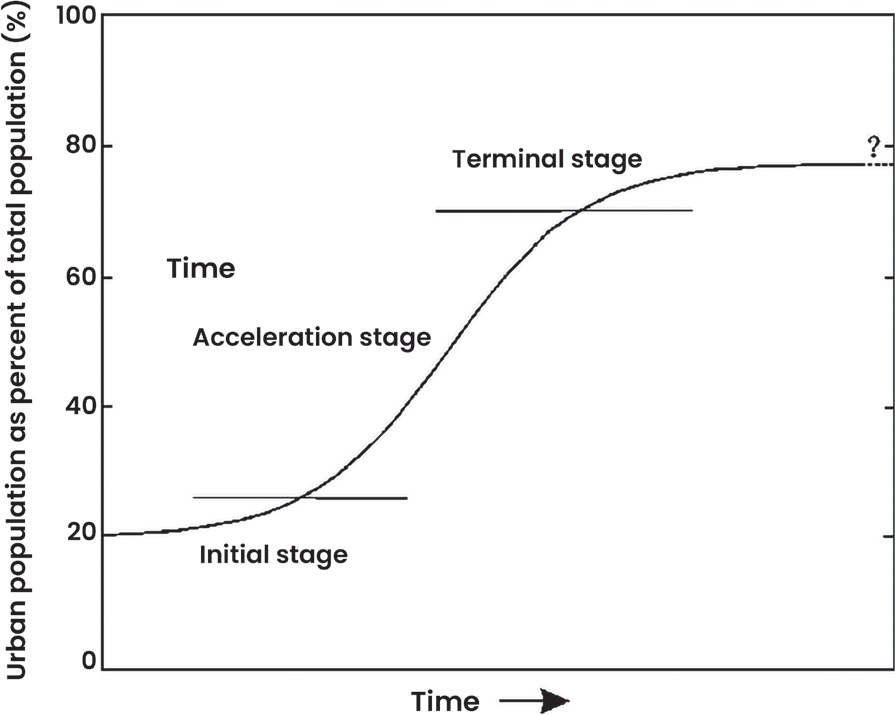
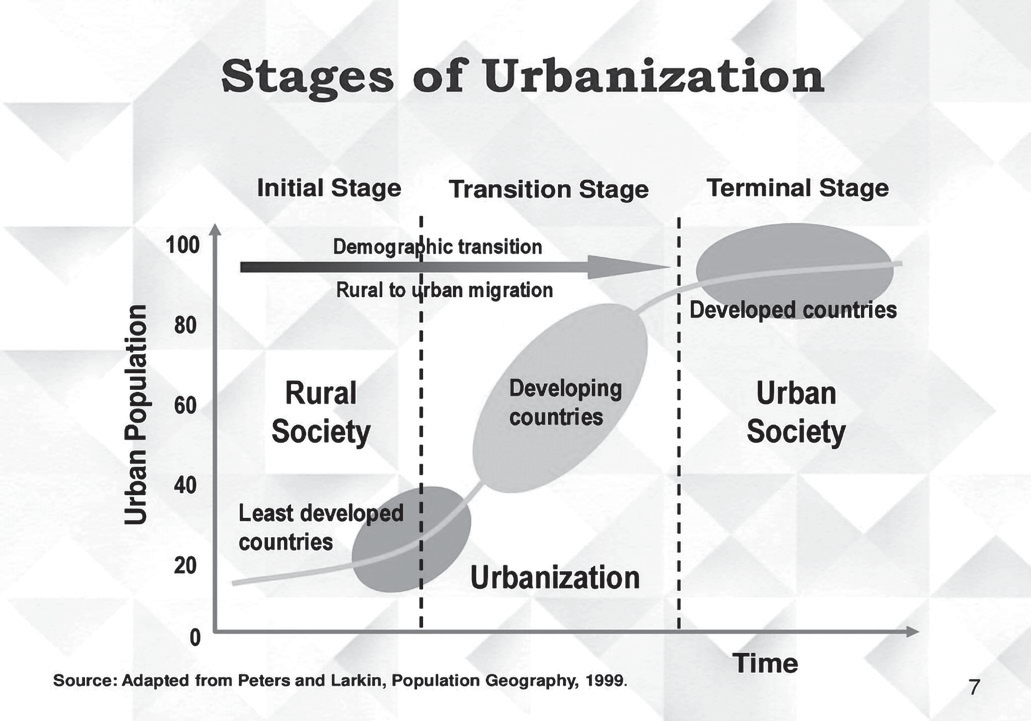
The Stage-I is the Initial Stage, characterized by traditional rural society with predominance in agriculture and dispersed pattern of settlement.
The Stage-II is where proportion of urban population gradually increases from 25per cent to 40per cent, 50per cent, 60per cent and so on. This is otherwise called as the Stage of Acceleration where basic restructuring of the economy and investments in social overhead capitals including transport, communication take place.
The Stage-III is known as the Terminal Stage, where urban population exceeds 70per cent or more. According to Davis, at this stage, the level of urbanization remains more or less same or constant. Urbanization is derived from the Latin “Urbs” a term used by the Romans to a city.
Causes of Urbanization
The causes of urbanization are many; however, a few important reasons of urbanization are narrated below:
Agricultural Development: The mechanization of agriculture has reduced the demand for labor in the farming sector, leading to surplus workers who typically migrate to urban areas in search of employment and livelihood opportunities. These migrant workers are often employed in construction, low-skilled labor, and self-employed activities.
In Punjab, agricultural development has particularly contributed to the migration of rural populations, not only to various cities across India but also to cities in other countries.
Industrialization: Industrialization typically occurs in and around urban areas, where it enables the addition of value to products. This, in turn, creates more livelihood opportunities, encouraging people to settle in the outskirts of cities. The industrial workforce in these cities is primarily made up of migrants from rural regions.
Market Forces: The rise of consumer goods industries, driven by market forces, enhances the significance of market-oriented locations.
Towns serve as ready-made markets for consumer goods, attracting new industries focused on manufacturing these products.
As these industries grow, they increase the supply
of labor and expand the potential market.
This sets off a "snowball effect," where urban growth becomes self-sustaining.
Growth Services Centres: With the growth of cities, the living standards of the city dwellers rises and along with these trading increases and the tertiary sector
services by their very nature, tend to be centralized in towns providing retailing, entertainment, catering, banking, insurance and administration.
As more and more services are required, it attracts more and more people and gradually the urban area grows.
Emergence of Towns as Socio-Cultural Centres : Towns equipped with amenities such as cinemas, theaters, art galleries, museums, and parks attract people from surrounding areas. Many individuals are drawn to the vibrant urban lifestyle, enjoying the proximity to cultural and social activities.
Urban areas, with their concentration of socio- cultural opportunities, have become places of immense potential.
As success in urban settings appears more achievable, people increasingly flock to cities, lured by the allure of urban living, which often seems more glamorous compared to rural life. This influx leads to overcrowding in urban areas.
Improvement in Transport and Communication: The development of a nation-state emphasizes the enhancement of infrastructure and improved connectivity between rural and urban areas through roads, railways, and other modes of transport. This facilitates faster and easier migration.
With more job opportunities in urban areas compared to rural regions, an increasing number of people opt to move to cities, contributing to the rise in urban population.
The expansion of rail networks in previously underdeveloped areas has further encouraged migration from rural regions to towns, cities, and metropolitan centers.
Natural Increase of Population : While urban areas tend to have lower fertility rates among the upper- and middle-classes, the overall population in cities continues to grow due to a natural increase. These combined factors contribute significantly to the process of urbanization
Key Definitions and Classifications related to Urban Settlements
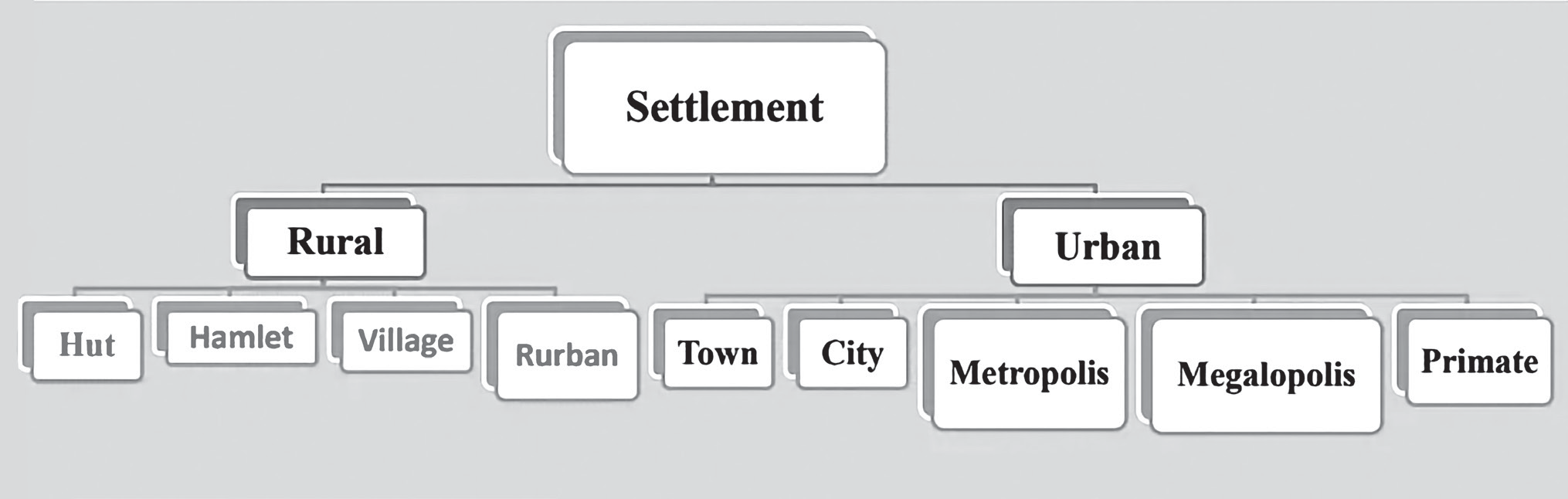
Division on basis of rural urban settlements
Sub Urbanization: It is a new trend of people moving away from congested urban areas to cleaner areas outside the city in search of a better quality of living. Important suburbs develop around major cities and everyday thousands of people commute from their homes in the suburbs to their work places in the city.
Statutory Towns: As per the Census, all places with a municipality, corporation, cantonment board, notified town area committee, or any other authority legally constituted by a state law for urban governance are classified as statutory towns.
• Urban area or Census Town: A habitation is classified as urban (excluding municipalities, corporations, cantonment boards, and notified town area committees) if it meets the following criteria:
A minimum population of 5,000 people.
At least 75% of the male working population is engaged in non-agricultural activities.
A population density of at least 400 people per square kilometer.
Metropolitan City: As per Census are those Indian cities having a population of more than 4 million.
Metropolitan Area As per 74th Amendment 1992, is an area specified by the Governor by public notification to be a Metropolitan area having
a population of 10 Lakh or 1 Million or more,
comprised in one or more districts and
consisting of two or more Municipalities or Panchayats or other contiguous areas.
Million City: A city with one million (or more) inhabitants is defined as a Million City. As per 2011 Census, Mumbai is the most populous Indian Million city, and Kota is the least populous one. The number of million cities in
the world has been increasing as never before. London reached the million mark in 1800, followed by Paris in 1850, New York in 1860, and by 1950 there were around 80 such cities. There were 162 million cities in mid 70’s and there was threefold increase in 2005 and the number reached to 438. In 2016, there were 512 cities with at least 1 million inhabitants globally. By 2030, a projected 662 cities will have at least 1 million residents.
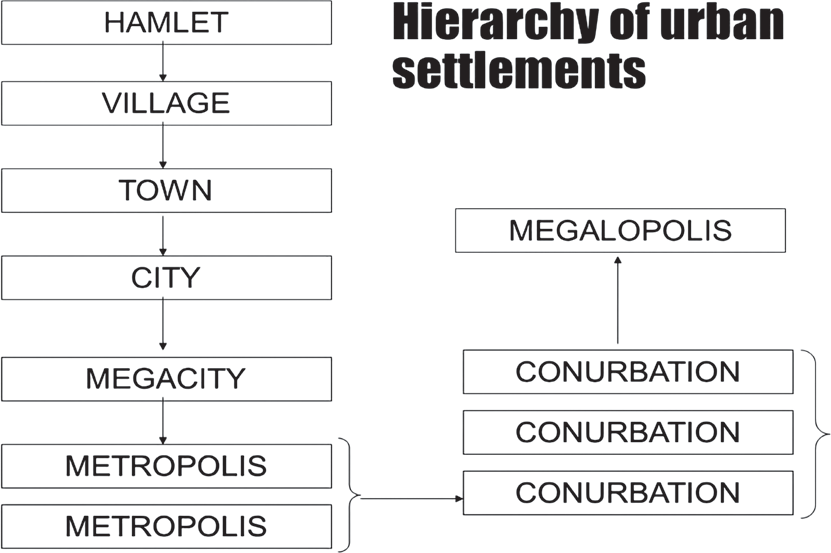
Urban Agglomeration: As per Census 2011, it is a continuous urban spread constituting a town and its adjoining outgrowths (OGs) or two or more physically contiguous towns together with or without outgrowths of such towns with population of not less than 20000.
Urban Growths (OGs): Areas around a core city or town, such well recognized places like railways colony, university campus, port areas, etc. lying outside the limit of town.
Mega City: United Nations Department of Economic and Social Affairs in its 2018 “World Urbanization Prospects” report counted urban agglomerations having over 10 million inhabitants.
The terms conurbation, metropolis, and metroplex
are also applied to them.
A megacity is hierarchical with an indisputable single dominant urban core.
The world had 33 according to the UN (in 2018) and about half these urban agglomerations are in China and India.
• Bengaluru, Chennai and Delhi are some of the mega cities of India.
Conurbation: The term conurbation was coined by Patrick Geddes in 1915 and applied to a large area of urban development that resulted from the merging of originally separate towns or cities. Delhi-NCR, Greater London, Manchester, Chicago and Tokyo are examples.
• It comprises number of metropolises, cities, large towns, and other urban areas which through population growth and physical expansion, have merged to form one continuous urban or industrially developed area.
• In most cases, a conurbation is a polycentric urbanised area in which transportation has developed to link areas. Here, no single urban centre has the dominant role over all other centres.
• They create a single urban labour market or travel to work area.
Megalopolis: This Greek word meaning “great city”, was popularised by Jean Gottman (1957) and signifies ‘super- metropolitan’ region extending, as union of conurbations. The urban landscape stretching from Boston in the north to south of Washington in U.S.A. is the best-known example of a megalopolis.
• In a megalopolis the urban areas are close but not physically contiguous, and the merging of labour markets has not yet developed.
Primate City: It is the largest and most prominent urban settlement in a country that has grown disproportionately compared to other cities due to factors such as economic opportunities, political power, industrial growth, and the agglomeration effect.
• The Law of Primate City was first proposed by Mark Jefferson in 1939. He defined primate city as the largest city which is at least twice as large as the second largest city and more than twice as significant, socially and economically.
It may have a population between a third and a half of that of the whole country. Classic examples of primate cities include Bangkok in Thailand and Seoul in South Korea.
Census Classification or Urban Areas vs Municipal Law classification of Urban Areas
| Types of Urban Units as per Census Towns Statutory Towns Census Towns Urban Agglomerations Urban Out Growths (OG) | Types of Urban Units as per Municipal Law Nagar Panchayats having 5000 – 10,000 population Municipal Council with 1 to 3 lakh population A or Class-I 1 to 3 lakh B or Class-II 50,000 to 1 lakh C or Class-III 25,000 to 50,000 D or Class-IV 10,000 to 25,000 Municipal Corporation having population about 3 lakh |
Reserve Bank of India (RBI) Classifications
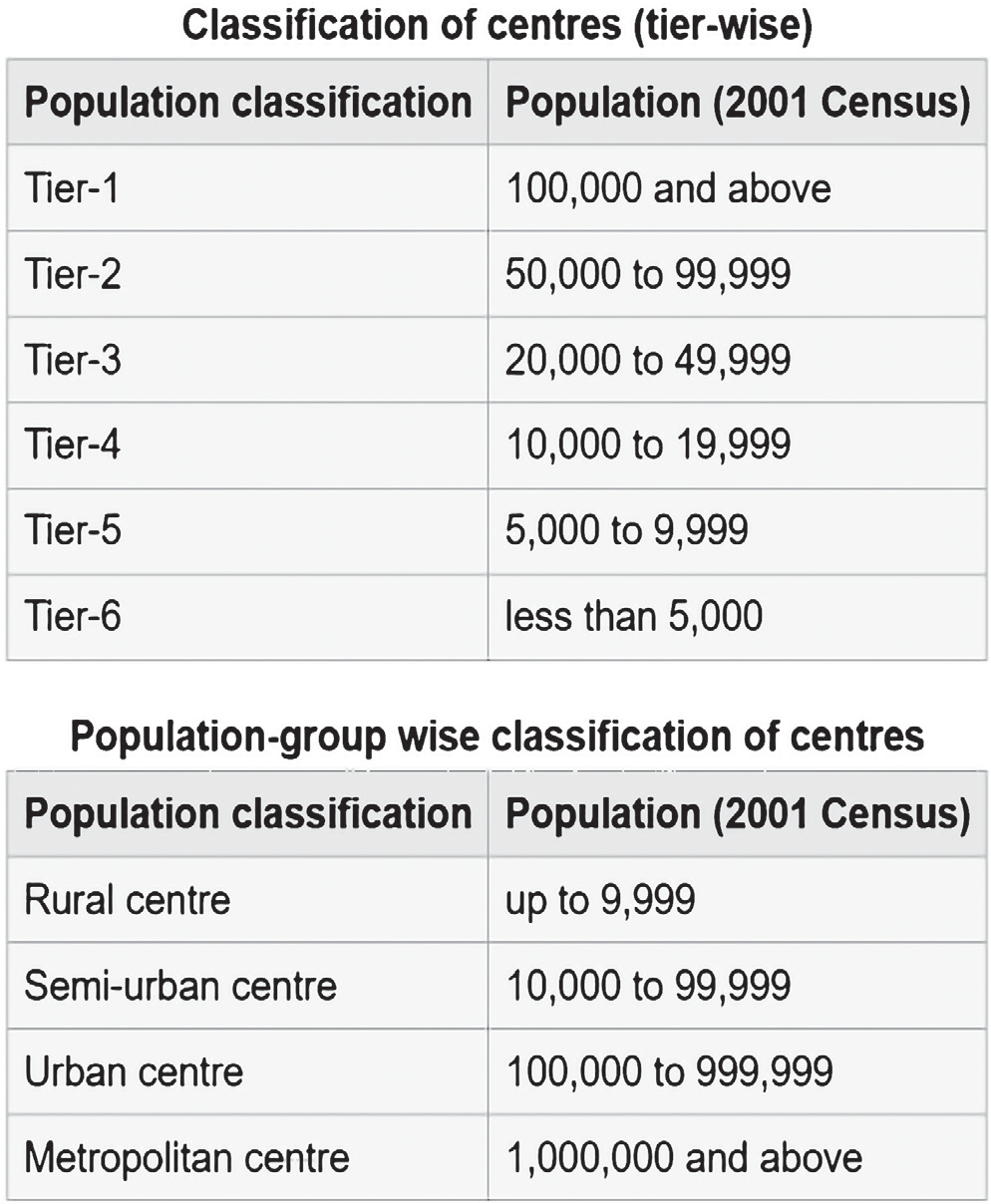
The Reserve Bank of India (RBI) classifies centres into six tiers based on population. The table below show the classification -
Global Population Trends
The 2005 data forecasts a continued trend of urbanization, with 60% of the global population expected to live in cities by 2030. The UN estimates that the world population will grow by 72% by 2050, rising from 3.6 billion in 2011 to 6.3 billion by 2050.
Urbanization is occurring worldwide, with developed countries experiencing faster rates of growth compared to developing nations. According to data, the urbanization rate in developed countries is 76%, while in developing countries it stands at 40%.
The Asian Development Bank highlights that national population growth and net migration are the primary drivers of urban growth.
Key Population Trends in Developed Countries
The important trends in urbanization in the developed countries are suburbanization, urban renewal, gentrification and megalopolitan development.
Suburbanization: In the twentieth century, developed countries experienced the growth of suburbs, typically emerging on the outskirts of major towns and cities. A suburb is primarily a residential area, consisting mainly of houses, in contrast to the mixed land-use neighborhoods found in the city center.
Suburbanization has largely been driven by people moving to the countryside in search of relief from the challenges of urban life.
Traditionally, suburbanization involves a separation between home and workplace. A key factor in this trend is the availability of affordable transportation, which allows suburbs to expand further from the central city due to improved connectivity.
• Since 1945, the rate of suburban growth in the USA has been tremendous.
• Urban Renewal: Urban renewal is an ongoing process aimed at revitalizing urban areas through rehabilitation, conservation and redevelopment efforts. The focus is primarily on sections of the city that no longer meet current public standards or expectations.
• These areas are typically found in the residential zones of the inner city, as well as in its central areas. They often face challenges such as substandard housing, environmental degradation, social issues, and the presence of incompatible land uses.
• The central business district also grapples with issues like traffic congestion, outdated infrastructure, and the deterioration of buildings and sites.
• Gentrification: Gentrification refers to the transformation in the social fabric of a neighborhood, driven by the influx of higher-income professionals moving into central city areas. It plays a significant role in drawing middle to high-income residents back to urban centers.
• Gentrification is selective, both in the populations it attracts and the specific conditions that facilitate its occurrence.
• In the USA, many major cities are currently witnessing varying degrees of gentrification in their central neighborhoods.
• In Britain, the process has occurred in a few cities namely Bristol and London.
a) Megapolitan Development: One of the most important facets of urbanization in the developed countries is the growth of cities not in terms of population but in terms of area.
• Here the cities expand physically and the same number of people is living in the cities but at low densities.
• The examples of megapolitan type of development are characteristics of Atlantic Sea board of USA, and in Japan it has appeared naturally and, in the Netherlands, it has appeared by design and planning.
• The United States megapolis extends over 600 miles from Boston to Washington D.C., the Tokaido megapolis extends from Tokyo, Yakohoma to Osaka-Kobe-Kyoto and the Ransted megapolis comprises of three major cities of Amsterdam, Rotterdam and The Hague.
• This process has also started in developing countries
Key Population Trends in the Developing Countries
Some of the trends of urbanization in developing countries are as follows:
Urbanization is more advanced in developed countries compared to developing countries. According to UN statistics, 79.1% of the population in developed countries resides in urban areas, while only 46.8% of the population in less
developed countries lives in cities.
In the African region, urbanization rates are slightly higher than in Asia. However, both regions still lag behind Europe and the USA in terms of urbanization levels
In many developing countries, urbanization occurs without significant industrialization or a strong economic foundation. This has led to the expansion of the informal sector, which is marked by low wages and poor working conditions, negatively impacting the quality of life in urban areas.
Unplanned urban growth in developing countries has resulted in the proliferation of urban slums, where residents often face inadequate housing, poor sanitation, and limited access to safe drinking water.
The current pattern of urbanization in developing countries is alarming if viewed from a historical, spatial and cross- country perspective. The unplanned urbanization greatly concerns most of the government in these countries.
State of Urbanization in India
Urban population (percent of total population) in India was reported at 35.39 per cent in 2021, according to the World Bank which increased by 2.05% in 2022 resulting in overall 35.87% urban population.
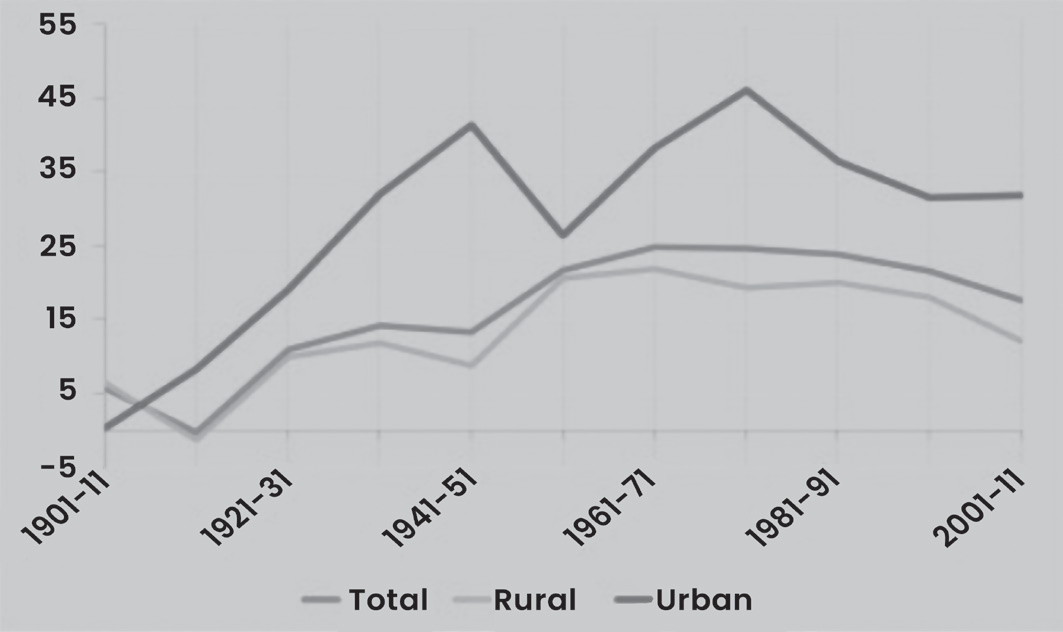
According to a 2010 McKinsey Global Institute study, Indian cities, covering just 3% of the country's land area, have the potential to generate:
70% of net new jobs
Around 70% of India's GDP
• A nearly fourfold increase in per capita incomes
• A rise in urban population from 340 million in 2008 to 590 million by 2030, achieving this growth in half the time it took prior to 2008.
• The study further estimates that India will need to invest $1.2 trillion in capital expenditure for its cities over the next 20 years—nearly eight times the current level of investment.
Additionally, the UN Department of Economic and Social Affairs' 2018 World Urbanization Prospects report projects that India, China, and Nigeria will collectively account for 35% of the global urban population growth. By 2050, India is expected to add 416 million urban residents.
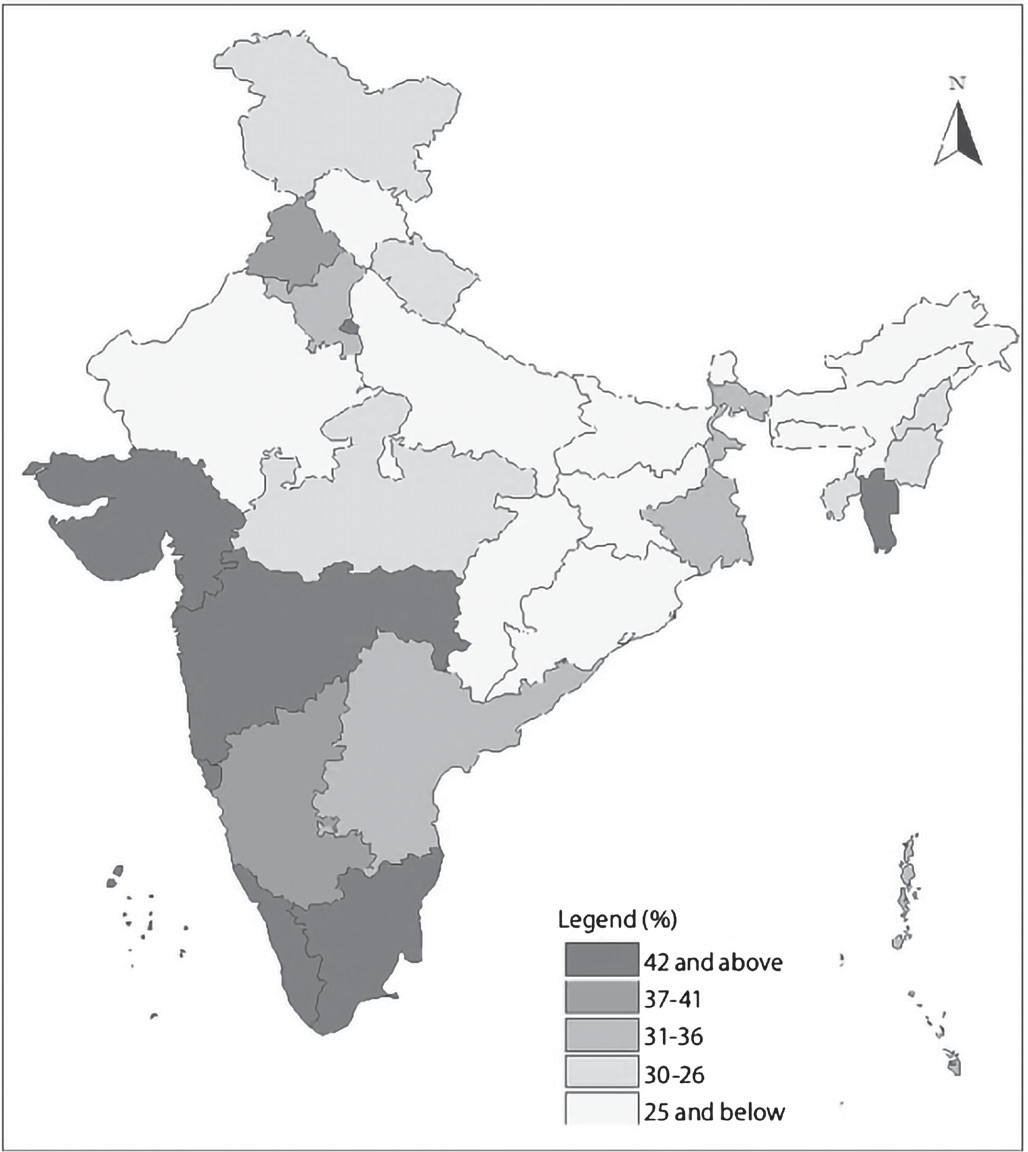
According to Census 2011, India’s had an urbanisation level is 31.1per cent. Over 75per cent of the urban population of the country is in 10 States: Maharashtra (highest 13.5per cent), Uttar Pradesh, Tamil Nadu, West Bengal, Andhra Pradesh, Gujarat, Karnataka, Madhya Pradesh, Rajasthan, and Kerala.
Key Issues and Challenges due to Rapid Urbanization
Urbanization and Culture of Consumption
Urbanization is expected to continue at a steady pace throughout this decade. Cities tend to be more prosperous than rural areas, fostering innovation and creating economies of scale. Higher population density in urban areas enables the production of goods and services at a larger scale, reducing costs and benefiting everyone. This is one reason why the majority of the global consumer class now resides in cities.
The culture of consumption has become a lifestyle defined not only by what people consume but by an ever-increasing appetite for consumption. This culture often encourages the demand for Veblen goods—items for which demand rises as their price increases. Luxury brands, high-end cars and superbikes, superyachts, and designer clothing are all symbols of consumer culture focused on conspicuous consumption and social status.
According to the World Economic Forum, India is the most dynamic market for urban consumers. Although rapidly urbanizing, India remains relatively rural in nature. Private consumption in India makes up nearly 60% of the GDP, and since 2000, growth in private consumption has driven 70% of India’s economic growth.
Factors of Rising Consumption and Middle Class:
Rising Migration: People are moving from villages to cities to find better education, health care, and jobs.
Rise of Peri-Urban areas: Additionally, in emerging markets like India, former villages are contributing
to urbanization as they grow rapidly to the point that they represent a peri-urban segment. These are often the new suburbs of the megacities like Mumbai.
Rise in Materialistic Tendencies: Due to rising consumer culture, rising incomes, peer pressure on social media, forces of globalization, use of Artificial Intelligence (AI)-enabled consumer behaviour- oriented marketing of goods and services like food, entertainment, clothing, etc., the average consumption has increased.
Rapid Growth of Urban Consumers: Today India has an estimated 208 million urban consumers, which will rise to an estimated 374 million. This represents an annual growth of 6 percent, which is six times global population growth, almost double growth of the global consumer class, and substantially larger than the average global urban and Asian consumer class growth.
Easy Credit Availability: Thanks to easier funding
via affordable EMIs, consumer finance companies are fulfilling the dreams of millennial and other youthful cohorts, including those lacking credit history.
Higher Disposable Income: India’s 63 biggest cities are now home to more than a quarter of its middle class. They also generate 29% of the country’s disposable income that drives the demand and consumption of goods and services, fuelling an economic boom.
Textile city of Surat has shown the sharpest growth in the number of super rich households between 2015-16 and 2020-21 according to the People Research on India’s Consumer Economy (PRICE)
survey.
According to PRICE survey, the share of the middle class, with an annual household income of 5-30 lakh, more than doubled from 14% in 2004-05, to 31% in 2021 and is projected to double to reach 63% by 2047.
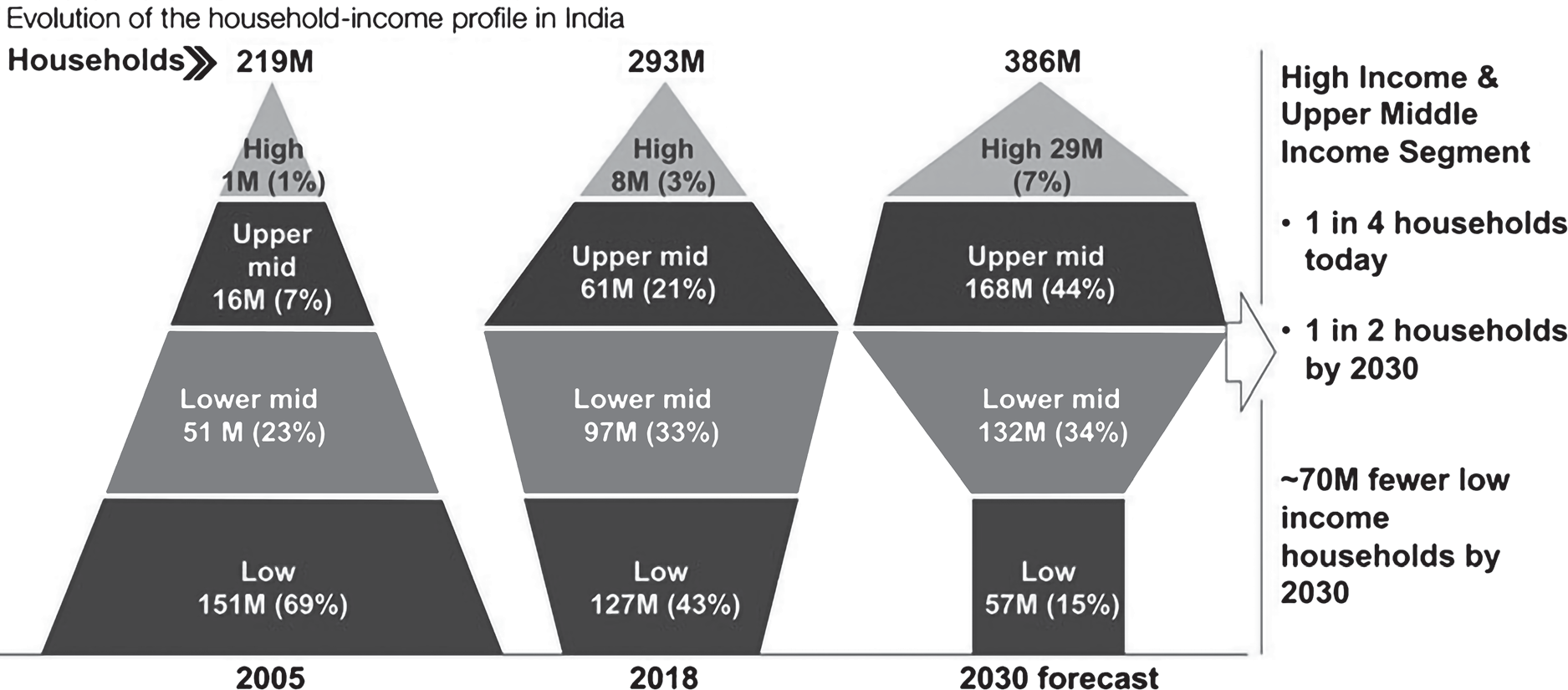
Many of us will enjoy the festive season of the year looking back at two difficult years dominated by the COVID-19 pandemic. India’s middle class shrank by 32 million in 2020, says Pew Research Centre report 2021. Despite the massive economic impact of COVID-19 in 2020, its impact has only been temporary.
World Economic Forum report of 2019 shows additional 500 million middle- and high-income earners added to the economy to 2030, with 50 million fewer in the low case scenario – pushing the share of upper-middle and high- income earners to 48% of the total population.
Urbanization and Poverty
One of the most prominent and pressing urban issues in developing countries is the high number of poor and unemployed individuals residing in cities. The International Labour Organization (ILO) reports that around one-third of the world’s urban population, or approximately 400 million people, are living in poverty.
Poverty-related challenges such as overcrowding, hunger, disease, crime, and malnutrition are becoming increasingly widespread in cities across both developing and developed nations.
Economic development and urbanization are closely linked. In India, for example, cities contribute 55% to the country's GDP, making urbanization a crucial driver of economic growth.
• However, it is notable that urban poverty in some megacities surpasses rural poverty, a phenomenon known as the “Urbanization of Poverty.”
• Urban poverty is a major contributor to various issues in cities, including inadequate housing, lack of access to clean water and sanitation, limited healthcare, poor education, inadequate social security, and unstable livelihoods.
• As poverty and slums continue to rise, Indian cities face the growing challenge of becoming sustainable— ensuring they are inclusive, productive, efficient, and manageable. Addressing urban poverty remains a significant challenge for the government.
Thus, urban poor constitute nearly 20 per cent of urban population. Thus, unplanned urbanization has escalated the size of urban poverty.
Urbanization and Unemployment
Generating employment for the increasing urban population is a challenge for the government. It is said that nearly 45 per cent of the urban households are engaged in unorganized sector.
•
The urban underemployment and casual employment are other problems which have resulted in poor quality of living among the urban poor.
• The International Labour Organization (ILO) has remarked that most urban unemployment in developing countries takes the form of underemployment, in which people are obliged to undertake any available economic activity, however, productive and unproductive, because these are no social-safety nets and no alternatives in the form of unemployment insurance or job training in the formal sector.
• In sub-Saharan Africa, the urban informal sector is estimated to employ more than 60 per cent of the urban labour force at extremely low incomes.
• In Latin America and the Caribbean, more than 80 per cent of all new jobs created were in the informal sector, the bulk of these jobs are poorly remunerated, unsafe and of low productivity. The large majority of Latin America’s urban poor work in the informal sector.
Urbanization and Health
The World Summit on Sustainable Development (WSSD) identified health as an integral component of sustainable development and called for a more efficient, equitable, accessible and appropriate health care system for the population that rely on them.
• Overcrowding combined with poor sanitary conditions and inadequate waste disposal creates conditions favourable to spread of infectious diseases like pneumonia, tuberculosis and diarrhoea.
• Vulnerable Sections of Society, like the children, women and particularly pregnant women are vulnerable to environmental contaminants.
• Children in particular are more susceptible to diseases when they are born and brought up in an environment characterized by overcrowding, poor hygiene, excessive noise and lack of space for recreation and study.
• Pregnant women’s exposure to filthy environment increases the risk of abortion, birth defects, foetal undergrowth and perinatal death.
• Many studies have shown that exposing pregnant women to carbon monoxide can damage the health of the foetus.
• Deadly diseases like HIV/ AID, tuberculosis, yellow fever and dengue, etc. are often found occurring in the slums of the cities.
• Range of disorders and deviances associated with urbanization include psychoses, depression, sociopathy, substance abuse, alcoholism, crime,
delinquency, etc. such negative impact often results in unreasonable means which may result in communal violence.
WHO has rightly remarked that “while urban living continues to offer many opportunities, including potential access to better health care, today’s urban environments can concentrate health risks and introduce new hazards”.
Urbanization and Urban Administration
• Unbridled urbanization can pose insurmountable challenge before the administration and municipal governance. Problem will arise as
• how to organize new administrative structure and manpower development,
• how to prevent uncontrolled expansion,
• how to organize transport and communication system,
• how to finance public services,
• how to prepare master plans etc.
• Prioritizing the needs amidst socio-political pressure is a challenge before the district administration.
• Besides civic problems, other problems like people resentments and disregarding rules and regulations, spoil public and private property and showing utter disregard for the rights and feelings of fellow citizens etc have to be dealt with.
• Other issues like illegal migration, trafficking, etc. can pose problems for urban administration.
Urbanization and Environment
Problems like urban floods, Heat Island effect, congestion, pollution and poor infrastructure emerge as a prominent issue in this regard. IT Hubs like Gurugram, Noida, Bengaluru, Hyderabad, etc. are among the most prominent mega cities which are facing such issues.
• Unbalanced Development: Success of cities vastly improves the investment and GSDP of a state but may also skew the priorities of the policy makers, resulting into neglect of other sectors of the economy and imbalanced regional development.
• E.g., Erstwhile United Andhra-Pradesh: IT- sector led growth improved the infrastructure around Hyderabad city but many other cities of Andhra / Telangana appear far backward and underdeveloped in comparison.
• The real estate prices escalate in these cities with the entry of big IT companies and their high- salaried executives.
• The demand for drivers, maids and cooks brings additional migrants to the cities, but they can’t afford the homes on purchase or rent– be it Bengaluru, Gurugram, Noida in India.
•
Urban Floods: The rampant and unplanned construction destroys the natural drainage channels and blocks the artificial drainage channels for rainwater and storm water. Then, even normal rain causes urban floods.
• There has been an increasing trend of urban floods in India over the past several years whereby major cities in India have been severely affected. The most notable amongst them are Hyderabad in 2000, Ahmedabad in 2001, and Delhi in 2010.
• Storm surges can also affect coastal cities/ towns.
• Sudden release or failure to release water from dams can also have severe impact.
• In addition, the urban heat island effect has resulted in an increase in rainfall over urban areas.
• Overburdened drainage, frenzied and unregulated construction, no regard to the natural topography and hydro-geomorphology enables urban flooding.
• Encroachments and poor maintenance are also a major problem in many cities and towns.
• Natural streams and watercourses have formed over thousands of years due to the forces of flowing water in the respective watersheds.
• Habitations started growing into towns and cities alongside rivers and watercourses. As a result of this, the flow of water has increased in proportion to the urbanization of the watersheds.
• As the natural drains were not widened (similar to road widening for increased traffic) to accommodate the higher flows of stormwater. Consequently, the capacity of the natural drains has decreased, resulting in flooding.
• Improper disposal of solid waste, including domestic, commercial and industrial waste and dumping of construction debris into the drains also contributes significantly to reducing their capacities. It is imperative to take better operations and maintenance actions.
urban flooding. The requirement should consider all cities/ towns which are particularly located on river banks, upstream and downstream of major and medium dams and island cities. Based on that assessment, CWC will initiate the process to prepare a plan and implementation strategy.
• Use of Doppler Weather Radars, high bandwidth communication channels, State-of-the-art automatic water level recorders, Flood Forecasting and Warning systems, inventory of the existing storm water drainage system, Contour mapping of urban areas, Flood hazard assessment, Ward level Information System etc. be done using latest technology.
• Coordination mechanism to be established among all agencies for deriving maximum benefit from the efforts of each individual organization.
• Pre-monsoon desilting, use of traps, communitors, trash racks in storm sewers, rainwater inlets, rainwater harvesting in buildings, Rain Gardens in public parks, designation of Flood Shelter buildings, etc. must be done.
• Encroachments on the natural drainage and unrestricted and haphazard urban sprawl should attract penal action.
• Public Private Partnerships be used to develop appropriate micro-insurance schemes targeted at low-income groups.
• The database of the National Urban Information System (NUIS) will be expanded to cover infrastructure facilities at community level integrated with socio-economic data.
• Urban Flooding has to be dealt as a separate disaster, de-linking it from riverine floods which affect the rural areas.
• Storm water drainage concerns will be made a part of all EIA norms.
• The central government in India has also launched urban development-specific schemes wherein stormwater drain management and encroachments are addressed. Examples of some of them are the Atal Mission for Rejuvenation and Urban Transformation (AMRUT), Smart Cities Mission and the Swachh Bharat Mission (SBM).
• Corporate houses have also already shown interest in the carbon-offset sector, with promising and increasing investments. NGOs like India Climate Collaborative and the Center for Science and Environment are engaged in creating greater awareness of Nature Based Solution (NBS) issues and mobilising plans and resources for their implementation.
Global Models to Curb Urban Flooding:
• The Union government should launch a national mission on the lines of Sponge Cities Programme of China to tackle Urban Flooding.
• Water Sensitive Urban Design (WSUD) in Australia
• Low Impact Development (LID) /Green Infrastructure (GI) in the United States
• Sustainable Urban Drainage Systems (SuDS) in the
United Kingdom
• Decentralized Rainwater/ Stormwater Management
(DRWM) in Germany
• Sound Water Cycle on National Planning (SWCNP) in Japan
• Smart Watergy City, U-Eco City (SWC) in South Korea
• Low Impact Urban Design and Development (LIUDD) in New Zealand
• Several cities worldwide have devised sustainable water adaptive urban designs, keeping in mind Sustainable Development Goal 13 of United
Nations- Climate Action.
• These nature-based solutions are socio-ecologically sound to reduce the loss of lives and livelihoods from urban floods. These measures can be exercised at both ends of the system, from individuals in households to local government bodies.
• They include setting up components like urban forests, terraces and slopes, open green spaces and corridors.
• Some other components are urban farming and bio-retention areas, natural or constructed inland wetlands, river and floodplain
restoration, riparian buffer formation or rejuvenating and installing mangroves and salt marshes, based on space availability and the nature
of the ambient topography, city site and size and its
socio-economic profile.
Indian Success Models for Emulation
• Mumbai: A sustainability drive called The City Fix Lab: Accelerating Nature Based Solutions addresses acute urban issues such as water availability, floods, heat waves, air pollution and urban greenery loss by involving citizens and local action groups.
• Heat Island Effect: IT data centres require centralized air conditioning to keep the server infrastructure cool. But large number of such AC units turn the city into an ‘urban heat island ‘. Due to the resultant oppressive heat, it becomes impossible to travel in public buses or bicycles.
• Thus, more people are motivated to commute by AC cars– further aggravating the problem of congestion, air pollution, road rage and global warming.
• Various Types of Pollution:
• Increase in vehicular pollution during commuting.
•
Increased electronic waste generation due to IT industries, and young professionals with large disposable incomes.
• Rise of slums with unhygienic conditions like Slums of Delhi, Noida, etc.
• Open dumping of waste causing land pollution and ground water pollution.
• Ground Water pollution due to excessive extraction by the city dwellers.
• Poor Quality of Drinking Water: The water supply is vastly inadequate to population pressure. Private companies, and residents depend on borewells that drain the underground aquifer and bring saline water ingress.
• Bengaluru’s Bellandur lake is contaminated by the flow of raw sewage, detergents, grease, oil and other chemical waste- which mix together and generate the toxic foam. This foam destroys the aquatic lifeforms, creates foul stench, blocks the roadways, causes poor visibility and road-accidents.
• Air pollution due to rise in use of diesel generators.
• Impact on Biodiversity:
• Open Waste dumping kills various animals and birds who feed on them due to high plastic content of the waste.
• Corporate culture is leading to build futuristic looking glass-buildings. This is harmful to the biodiversity of birds in two ways:
• Glass-buildings don’t have any window- cavities for the birds’ nesting.
• Due to glass reflection migrant birds collide and die.
• IT hubs require round the clock Wi-Fi, Internet and mobile telephony. This generates electro- magnetic radiation, which is harmful for birds, insects and small animals.
• Constant building lights, vehicular sounds disturb the body-clocks and movement patterns of nocturnal animals. They become more vulnerable to starvation, road-accidents, predators and poachers.
Urbanization and Globalization
Globalization refers to the growing interconnection between nations worldwide, largely facilitated by advancements in technology, transportation, and communication. However, its impact extends beyond these areas, encompassing several key dimensions:
The driving force behind globalization is economic integration, where transnational businesses bring
together capital, labor, and resources from across the globe into a unified network for production and marketing.
This process also involves a transformation of national roles and borders, reshaping the influence and interaction of countries within the global framework.
Additionally, globalization leads to a blending of local and global cultures, resulting in a diverse yet increasingly unified cultural hybrid.
Debates about Globalization: Some scholars perceive globalization as a process through which capitalist forces are deeply embedded within the geographies of the Global South, while others consider it a more multilateral phenomenon.
However, it is now evident that globalization is highly uneven, creating disparities where some areas gain value while others are left behind. This unevenness is particularly significant for cities. Around the world, cities are increasingly becoming the focal points of globalization, progressively connecting to a global network of urban centers.
In this system, certain cities emerge as hubs of command and strategic control, often referred to as ‘World Cities’ (Friedman, 1982) or ‘Global Cities’ (Sassen, 1994).
Additionally, there are cities that function as regional command centers, while others take on specialized roles, such as production hubs for specific industries or financial centers.
| Benefits for Cities due to Globalization | Issues for Cities due to Globalization |
| Globalization has also meant sharing of knowledge across borders. It has meant availability of resource support across these boundaries too. This makes it possible to create new linkages and learn from each other. We can thus learn how Porto Allegre in Brazil created a participatory budgeting process which led the path for more inclusive and accountable governance of the city. Similarly, Bogota brought about a change in its transportation system towards creating a public bus transport system. | Locating an economic niche has become an increasingly important challenge for cities as they have to compete with each other for resources and investment. Mumbai thus has to compete with other financial centres of the world or Bangalore (now, Bengaluru) has to compete with Chennai and Singapore for location of IT industries. Need to develop entrepreneurial capacities and economic strategies; it calls for a sea change in orientations of local governments of cities, which till now were oriented towards their internal issues and services. Fragmentation within cities due to external orientations of cities causes some parts of the city to get benefited and get linked to these external processes, there are others who get neglected. Some population segments also get neglected. The process of global unevenness thus gets recreated within cities. City governments also need to manage this unevenness and the discontent arising from it. |
Such lateral learning, (whether across national borders or within them) has a tremendous potential for generating the need for new knowledge required for meeting current challenges of urbanization. It presents opportunities as well as creates new challenges for urban governance and planning.
Other Key Issues due to Rapid Urbanization
• Over Crowding: According to United Nations, the urban population of the world has grown from 751 million in 1950 to 4.2 billion in 2018. In India, many metropolitan cities like Delhi, Mumbai, Bangalore are suffering due to uncontrolled rural to urban migration. Further, there has been an increasing concentration in million plus cities instead of expansion in smaller cities indicating top-heavy and skewed urbanization.
•
Growth of slums: The World Bank reported that in 2018, 35.2% of India's urban population lived in slums. These areas are marked by inadequate housing, overcrowding, and a lack of basic civic services. Slums often face issues such as disease outbreaks, environmental pollution, crime, and social unrest. Dharavi, located in Mumbai, is recognized as the largest slum in Asia. The primary driver of slum growth is the unregulated, unplanned, and exclusionary nature of urbanization.
• Rapid Migration: People move from rural to urban areas in search of better employment opportunities and civic facilities of health, education and sanitation.
• Problem of Law and Order: Communal, Caste, regional and ethnic tensions are often seen like Nido Tania case, Delhi Riots, etc. apart from the crimes against women and elderly in urban areas like Nirbhaya case.
• SocialProblemsofCrime,IsolationandMaladjustment: Today, developing societies are increasingly reflecting the social challenges seen in developed countries, including crime, juvenile delinquency, rape, murder, prostitution, gambling, suicide, and alcoholism. Furthermore, the rapid urbanization and resulting high population density, coupled with the anonymity of urban life, have led to socio-psychological issues, particularly for migrants adjusting to life in their new cities.
• Crime: As urbanization grows, the incidence of crime intensifies. Limited opportunities for legitimate success, combined with the anonymity of urban life, often lead individuals to engage in illegal activities. This is further fueled by the erosion of traditional systems of social control and law enforcement.
• Recent studies highlight that high crime rates in urban areas are a reflection of the city's failure to effectively integrate all its members and manage those who reject this integration.
• While crime is often linked to the Blue Collar (working class), it’s important to note that deviant behavior is not confined to this group. White-collar crimes, which involve violations of business, trade, or professional rules, are also widespread.
• Isolation: Social interaction with others is a basis of all forms of social relationships and social groupings. It plays a very vital and meaningful role in all forms of social life: rural, urban or tribal. Cities due to the large, and heterogeneous population, the possibilities of such relationships are considerably minimised, creating a situation of relative isolation especially for elderly, migrants, socially rejected etc.
• The swift increase in urban population results in a more pronounced division of labor and work specialization, leaving very little opportunity for sharing collective experiences and social interactions.
• The heterogeneity of population, especially in matters of social status, caste, class, religion, income, occupation, etc., creates partial isolation reinforced by social distance.
• Maladjustment: Due to scarce opportunities, urban anonymity and isolation, resulting maladjustment creates victims of frustration, inferiority complex and loss of a meaningful integration with the totality of city-life, especially seen among the recent migrants. “Marginal Man” or ‘Transitional Man’–a concept developed by Robert E.Park, is said to be one who is in the process of changing from one culture to another. Unable to completely change, s/he experiences internal
conflicts, intense anxiety and socio-psychological tensions.
• Further, family, kinship and community disorganisation like divorce and break down of jointness in the joint-family, withering away of kinship obligations, etc. endangers the cohesive and integrated social life.
• Critical infrastructure shortages and major service deficiencies: poor education, lack of health facilities, erratic power and water supply, poor solid waste management system, poor sewerage system, lack of housing, inadequate transport systems etc causing high out of pocket expenditure and rise in urban poverty. In India, more than half of the urban households occupy a single room, with an average occupancy per room of 4.4 persons.
• Deteriorating environment: According to World Health Organization, 14 Indian cities are among Top 20 worldwide with worst air quality. Noise pollution and water and land pollution are rampant as visible in polluted Yamuna in Delhi and waste mountains of Bhalaswa, Ghazipur and Okhla in Delhi.
Steps Taken by the Government
Various efforts include legislative measures for the removal of urban poverty and unemployment as well as measures of slum clearance and urban community development programmes. From the Sixth Five Year Plan onwards, special attention is being paid to the socio- economic development of small towns and cities to divert the flow of the rural migrants.
In addition to these planned efforts, social legislation relating to suppression of immoral traffic in women and girls, prevention of beggary, prevention of alcoholism and drug abuses, correctional programmes for criminals and juvenile delinquents, and rehabilitation schemes for deviant persons under the programmes of social defence are equally significant steps taken towards the amelioration of these problems of urban living.
• Social Legislation Relating to Urban Land and Housing: The Constitution of India grants every citizen the fundamental right to freedom of movement; however, it does not guarantee the right to housing for either urban or rural residents. Responsibility for urban development and related welfare programs has been delegated to state governments. Two key pieces of social legislation that regulate rent and the sale of land and housing are the Rent Control Act (RCA) of 1948 and the Urban Land Ceiling and Regulation Act (ULCRA) of 1976
• The Rent Control Act, 1948: The Rent Control Act was introduced to regulate and manage house rents. Initially enacted in the Bombay State in 1948, it was later adopted by several other states. The Act safeguards tenants from exploitation by landlords, ensuring that the landlord cannot arbitrarily evict tenants or increase rents. Additionally, the Act places the responsibility for house repairs on the landlord, not the tenant residing in the property.
•
Urban Land Ceiling and Regulation Act , 1976: An important step in urban land management was the enactment of the Urban Land Ceiling Act in 1976, which aims to achieve three primary objectives:
• Redistribution of land
• Prevention of land speculation
• Regulation of construction on vacant land
• According to the provisions of this Act, land beyond the prescribed plot size can be acquired by local authorities or the state government for the greater public good.
• Typically, excess land acquired under this Act is used to build housing for the urban poor and low-income groups.
• Additionally, the Act imposes restrictions on the sale of excess land to prevent speculation in urban areas.
2. Programmes of Slum Clearance and Construction of New Houses:
This scheme provides low-cost housing equipped with essential amenities like latrines, bathrooms, water taps, sanitation, and drainage facilities, which are made available to low-income individuals who can pay a minimal rent from their limited earnings.
Additionally, as part of the slum clearance initiative, entire areas inhabited by economically and socially disadvantaged communities are provided with shared common utilities for all residents.
These slum clearance programs are subsidized, offering financial assistance to state governments for the construction of 1.4 million new homes, with a subsidy of Rs. 5,000 per house, aimed at benefiting the urban poor and low- to middle-income groups.
Moreover, state governments and local municipal bodies contribute necessary funds to help implement these projects.
The following schemes have been executed in several cities with financial and other support from the state governments and local bodies for the construction of new houses:
• In 1952, a scheme for the construction of houses for the industrial workers came into existence.
• A scheme was introduced, in 1954, for the construction of houses for the low-income groups.
• Since the implementation of the Second Five Year Plan (1956), the scheme of slum clearance and improvement came into existence on a regular basis.
• The Life Insurance Corporation of India started giving loans since the Second Five Year Plan to the middle-income groups for the construction of houses.
• Since the Fifth Five Year Plan, the programme of building houses for the higher-income groups were taken on hand with the objective that profit earned through such projects will be diverted for the construction of houses for the urban poor and the low-income groups. Special instructions were issued to the Housing Urban Development Corporation (HUDCO) in this respect.
• Development of infrastructural facilities in rural and semi urban areas: Focus on idea of PURA (Provision of Urban Amenities in Rural Area) given by Dr APJ Abdul
Kalam, now taken up under Shyama Prasad Mookherji RURBAN Mission to provide education, health, water, sewage, power, proper transport planning and investment in public transport sector and pedestrian pavements.
• The 15th Finance Commission’s report, ‘Finance Commission in Covid Times Report for 2021–26’ (2020), noted that cities are engines of economic growth
and adopted a differentiated and conditional approach
in the allocation of grants to urban local bodies (ULBs).
• Conditions include
• setting up of State Finance Commissions in States,
• having both provisional and audited accounts online in the public domain and,
• fixation of minimum floor for property tax rates
• 60 per cent of the grants to rural local bodies and for urban local bodies in non-Million-Plus cities should be tied to provision of two basic services:
• Sanitation, maintenance of ODF status (for Rural Local Bodies), solid waste management and attainment of star ratings as developed by mohua (for non-million plus cities/Category-II Cities/ Towns;
• Drinking water, rain water harvesting and water recycling (both for Rural Local Bodies and Urban Local Bodies).”
• Million-Plus cities to get 100 per cent of the grants are performance-linked through the Million-Plus Cities Challenge Fund (MCF).
• Separate grants for incubation of new cities and for facilitating shared municipal services.
• Major Urban Policies like One Nation One Ration Card scheme, Swachh Bharata Mission (Urban) 2.0, AMRUT 2.0, PM Awas Yojana (Housing for All by 2022), Smart City Mission, National Urban Livelihood Mission and Master Plans for Mega Cities like Delhi Master Plan 2031.
• Ensuring Evidence based Good urban Governance: NITI Aayog has launched SDG India Index and a separate SDG Urban Index for measurement of performance on the key indicators of sustainable urban development.
• Reviving Underdeveloped Cities:
• Second phase of City Investments to Innovate, Integrate and Sustain (CITIIS2.0) 2023, this project aims to transform urban areas in India into sustainable and resilient cities, promoting integrated waste management and climate-oriented reform actions.
• Recently, Maharashtra has launched Aspirational Cities Programme (ACP) modelled on the Aspirational District Programme of the NITI Aayog.
• The major Social Awareness campaigns conducted this year are the Swachhatam Connect, Lakshya Zero Dumpsite, Swachhata Anthem, beautification of roundabouts to commemorate AKAM, Clean and Green, Promotion of Source Segregation and Toilets 2.0 to refurbish community and public toilets
• The initiatives for capacity building include the launch of the National Capacity Building Framework for Garbage-Free Cities, the National Behaviour Change Communication Framework for Garbage-Free Cities, and updated Swachh Certification Protocols. The mission has carried out various activities to raise awareness among states and cities on key issues such as COVID-19, Single-Use Plastics, and Solid and Liquid Waste Management, with the support of local influencers. Targeted campaigns and guidelines for special interest areas have been introduced, such as Swachh Teerth guidelines for pilgrimage sites, AKAM parks, branded chaurahas, and Waste-to-Wealth installations.
. The initiatives for capacity building include the launch of the National Capacity Building Framework for Garbage-Free Cities, the National Behaviour Change Communication Framework for Garbage-Free Cities, and updated Swachh Certification Protocols. The mission has carried out various activities to raise awareness among states and cities on key issues such as COVID-19, Single-Use Plastics, and Solid and Liquid Waste Management, with the support of local influencers. Targeted campaigns and guidelines for special interest areas have been introduced, such as Swachh Teerth guidelines for pilgrimage sites, AKAM parks, branded chaurahas, and Waste-to-Wealth installations.
• ‘Green City’ concept of Ministry of New and Renewable Energy, targeting one city in each State to be developed as a green city, which would meet all its energy requirements from renewable sources.
• The National Mission on Electric Mobility aims to promote the adoption of electric vehicles across the country, including e-buses, e-3 wheelers, e-4 wheeler passenger cars (including strong hybrids), and e-2 wheelers. The mission seeks to provide affordable and environmentally friendly public transportation alternatives.
The policy of decentralization in national planning has recently proven effective in addressing urban development issues.
The Five-Year Plans on Urbanization
• The First Five Year Plan did not focus specifically on urban problems but acknowledged the severe shortage of housing and the sharp rise in land prices in major cities. By its conclusion, several institutional frameworks were established to address these challenges.
• For instance, the Ministry of Works and Housing was created, later renamed the Ministry of Urban Affairs. The National Building Organisation was also set up to design low-cost housing, and efforts were made to train professionals in town planning.
• The Second Five Year Plan placed significant emphasis on the planned development of cities and towns, advocating for an integrated approach that linked rural and urban planning within a regional framework.
• During this plan, the Urban Development Authority was established, and the first master plan for Delhi’s development was prepared. This was a key milestone in urban planning, followed by similar initiatives in other major cities
• The Third and Fourth Five Year Plans continued to prioritize town planning, transferring responsibility from the central government to the states. In 1957, the Town and Country Planning Organisation in Delhi created a model town-planning act, which led to the implementation of similar laws in other states.
• The Third Five Year Plan provided financial assistance to prepare master plans for urban development across states, resulting in nearly 400 master plans being developed.
• Additionally, the Third Plan introduced urban community development schemes in selected cities to address social issues in urban slums.
• The Fourth Plan highlighted the importance of financing urban development projects. During this period, the Housing and Urban Development Corporation (HUDCO) was established to provide funding for metropolitan authorities, state housing boards, and urban institutions to support housing construction in cities.
• The Fifth Plan document, in a separate chapter on urban and regional planning, laid down the following objectives of its urbanisation policy:
• to augment civic services in the urban centres,
• to tackle the problems of the metropolitan cities on a regional basis,
• to promote the development of small towns and new urban centres,
• to assist inter-state projects for the metropolitan projects, and
• to support industrial townships under government undertakings.
• The Sixth Plan also had a special chapter on urban problems but greater emphasis was given to the problem of housing both urban and rural areas.
• In this plan, necessary attention was drawn, for the first time, to regional variations in the levels of urban development.
• It should also be mentioned here that, during the Sixth Plan, provisions were made to develop adequate infrastructural and other facilities at the small, medium and intermediate towns so as to make them ‘growth centres’ in promoting rural development.
• Further, 200 towns were to be identified for integrated development of water supply schemes in 550 towns, and sewerage projects in 110 towns in the country.
• Thus, the Sixth Plan recognised the problems of basic needs of the urban dwellers and took some concrete steps towards amelioration of their conditions.
• The Seventh Plan, on the one hand, stressed the need for integrated development of small and medium towns and, on the other, minimising the growth of the metropolitan cities.
• To attain this objective, special incentives are offered for the establishment of industries in small and medium towns.
• It also advocates for greater financial support to
local bodies by the state governments.
• In terms of institutional set up, the Seventh Plan recommended the establishment of the National Urban Infrastructure Development Finance Corporation, to provide capital for the development of infrastructure in small and medium towns.
• Apart from these steps, the emphasis on housing for the urban poor and the low-income groups, integrated development and provisions for promotion of basic amenities for the urban-
Major Flagship Schemes of the Government
• Swachh Bharat Mission – Urban (SBM-U) was launched during October, 2014 with the objectives of making entire urban areas of the country Open Defecation Free (ODF) and for scientific management of the entire Municipal Solid Waste (MSW) generated.
• In order to carry forward the progress made under SBM-U, the next phase i.e., SBM-U 2.0 has been launched in 2023. Under SBM – Urban 2.0, Central Share funds are released for construction of Individual Household Latrines, Community Toilets/Public Toilets, Used Water Management, Solid Waste Management, Information, Education and Communication & Behaviour Change and Capacity Building, Skill Development & Knowledge Management components.
• The key components of the Mission comprise
• Sustainable Sanitation
• Sustainable Solid Waste Management and
• Used Water Management.
• In addition, Information Education Communication/ Behaviour Change Communication and Capacity Building are provisioned as cross cutting components.
• The focus on Garbage Free Cities has already resulted in the preparation and implementation of City Sanitation Action Plans, City Solid Waste Action Plans, Used Water Management Plans and IEC and Capacity Building Plans by ULBs across the country.
• For Basic Amenities: Schemes like Atal Mission for Rejuvenation & Urban Transformation (AMRUT) 2.0 Mission 2021: The mission aims to create water-secure
cities in line with the Aatma Nirbhar Bharat initiative.
• It targets the installation of 2.68 crore new water tap connections in approximately 4,800 statutory towns, ensuring consistent access to water for all.
• Additionally, the mission aims to provide universal coverage for sewerage and septage services in 500 AMRUT cities, with the goal of connecting 2.64 crore households to new sewer systems.
• The rejuvenation of water bodies, green spaces, and parks is also an integral part of the mission.
• A key feature of this initiative is outcome-based funding, focusing on results-driven investments.
• The mission’s ultimate goal is to provide functional water tap connections to every household in statutory towns across the country.
• Both AMRUT and AMRUT 2.0 play a crucial role in reducing the burden on the urban poor by improving access to essential services. By providing tap connections, the mission eases daily hardships, while the improvement of sewerage and septage systems lowers health risks and improves the overall quality of life for urban residents.
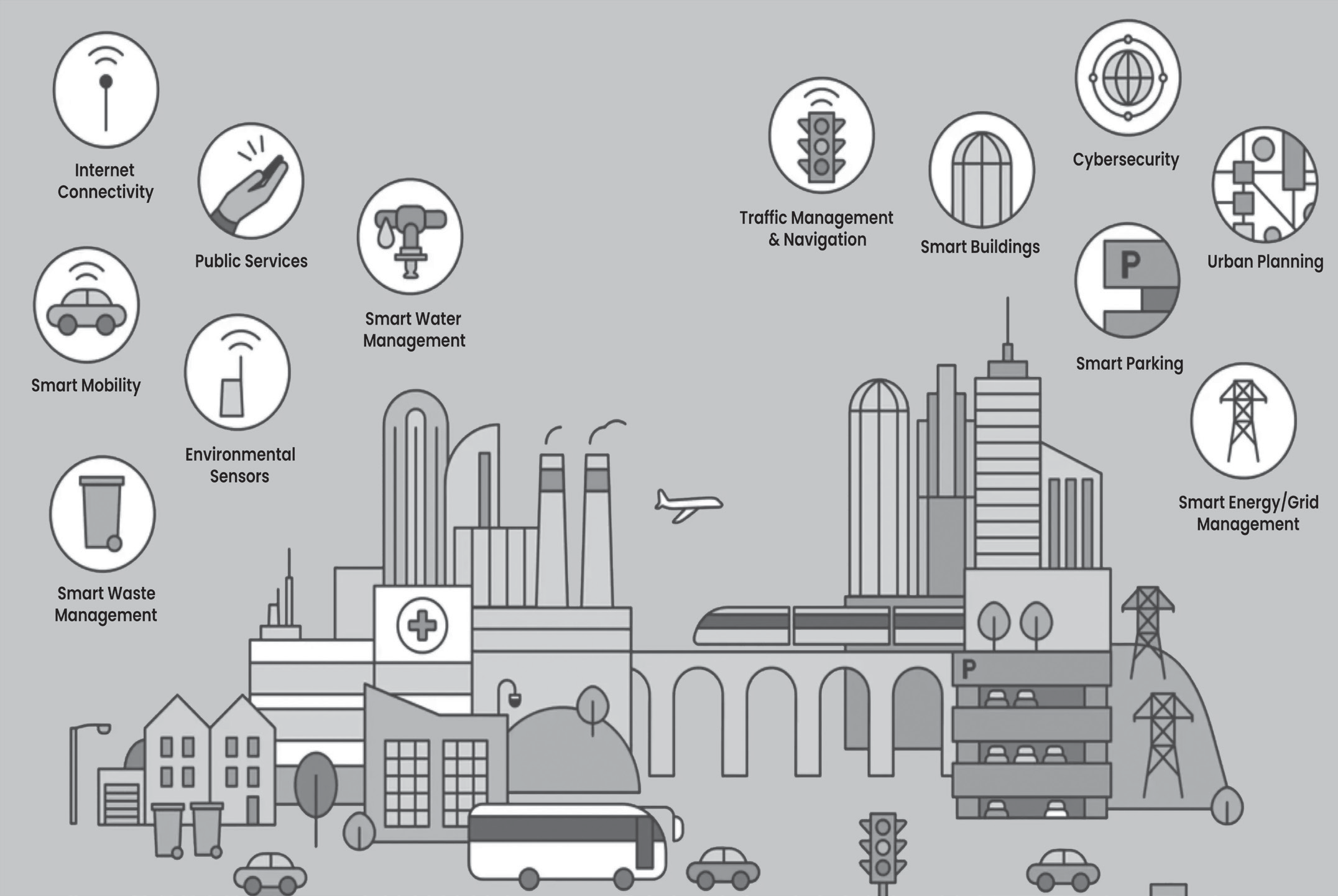
• Launched in 2015, the Smart Cities Mission aims to develop cities that offer essential infrastructure, a high quality of life for residents, a clean and sustainable
environment, and the integration of 'Smart' solutions to enhance urban living.
The Government of India launched the Smart Cities Mission (SCM) on June 25, 2015. Over four rounds of competition held between January 2016 and June 2018, 100 Smart Cities were selected.
The mission aims to foster cities that provide essential infrastructure, enhance the quality of life, and offer a clean and sustainable environment through the application of smart solutions.
The focus is on sustainable, inclusive development, targeting compact areas and creating replicable models that can serve as examples for other regions, both within the city and in other aspiring cities.
All 100 Smart Cities have operationalized Integrated Command and Control Centers (ICCCs), which serve as the central hub for managing city operations, utilizing decision support systems to improve the quality of life for citizens.
The Strategic Components of area-based development in the Smart Cities Mission are
City improvement (retrofitting),
City renewal (redevelopment) and
City extension (greenfield development)
Pan-city initiative in which Smart Solutions are applied covering larger parts of the city.
The Smart City Proposal (SCP) of each city, has been prepared through extensive citizen engagement. Since the needs and aspirations of citizens in different cities are different, the priorities and projects contained in such SCPs vary from city to city. Ensuring connectivity through airports was not envisaged as a mandatory objective under SCM.
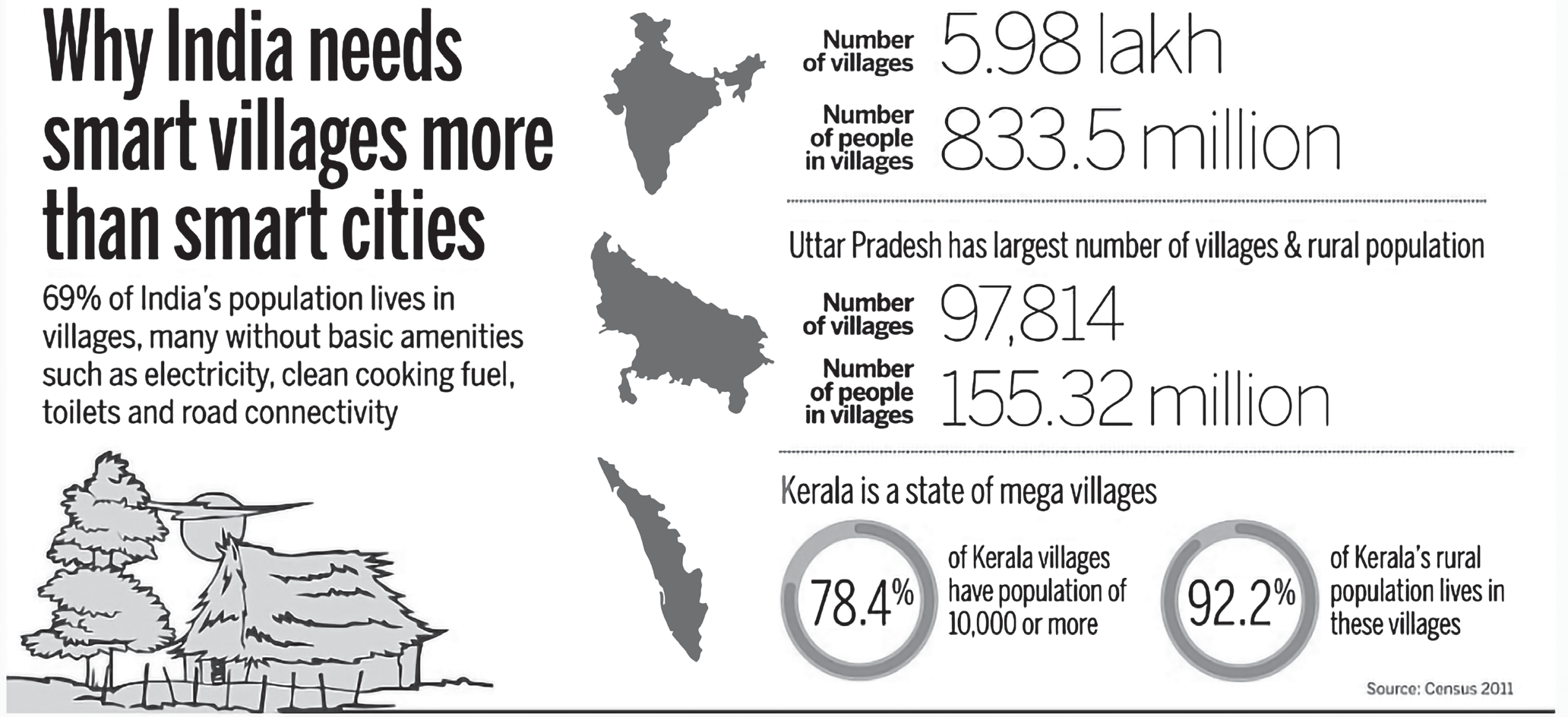
Smart Cities and Smart Villages
• Smart Villages Through Shyama Prasad Mukherji Rurban Mission (2015): Government aims to combine the spirit of villages and facilities of cities. This scheme would complement the Smart Cities initiative by creating Smart Villages.
• Vision of “Development of a cluster of villages that preserve and nurture the essence of rural community life with focus on equity and inclusiveness without compromising with the facilities perceived to be essentially urban in nature, thus creating a cluster of “Rurban Villages”.
• The objective of the Rurban Mission (SPMRM) is to stimulate local economic development, enhance basic services and create well planned Rurban clusters.
Various Global Standards on Urbanization
United Nations Sustainable Development Goals 2015- 2030:
Sustainable Development Goal 11 (Make Cities and Human Settlements Inclusive, Safe, Resilient and Sustainable): The world’s population is constantly increasing. Today, more than half the world’s population
live in cities. By 2050, an estimated 7 out of 10 people will likely live in urban areas. Cities are drivers of economic growth and contribute more than 80 per cent of global GDP.
However, they also account for more than 70 per cent of global Greenhouse Gas Emissions. If well-planned and managed, urban development can be sustainable and can generate inclusive prosperity. The deep inequalities exposed by the COVID-19 pandemic and other cascading crises highlight the importance of sustainable urban development. Strengthening the preparedness and resilience of cities is crucial in responding to future crises.
By the definition and targets set within the goal, it has high correlation and dependency with the other SDGs such as
• Goal 1, No poverty, which aims at reducing the exposure and vulnerability of the marginalized to the economic, social and environmental shocks and disasters
• Goal 9, Industry, Innovation, and Infrastructure, which aims at providing and developing quality infrastructure
• Goal 12, Sustainable Consumption and Production, which aims at the development of technologies and management system for waste to minimize their adverse impact on the environment.
To accommodate everyone, we need to build modern, sustainable cities. Thus, SDG 11 is unique being the only goal that is location-specific at a manageable scale.
The SDG11 Targets:
Safe and Affordable Housing: By 2030, ensure universal access to safe, adequate, and affordable housing, along with basic services, while working to improve and upgrade slums.
Affordable and Sustainable Transport Systems: By 2030, provide equitable access to safe, affordable, and sustainable transport systems for all, enhancing road safety and expanding public transportation. Special attention will be given to the needs of vulnerable groups, including women, children, persons with disabilities, and older adults.
Inclusive and Sustainable Urbanization: By 2030, promote inclusive and sustainable urban development, strengthening capacity for participatory, integrated, and sustainable human settlement planning and management worldwide.
Protecting Cultural and Natural Heritage: Increase efforts to protect and preserve the world’s cultural and natural heritage for future generations.
Reduce the Adverse Effects of Natural Disasters: By 2030, significantly decrease the number of deaths, people affected, and economic losses related to disasters, particularly water-related disasters, with a focus on safeguarding the poor and vulnerable populations.
Reduce the Environmental Impact of Cities: By 2030, minimize the environmental impact per capita of urban areas, with special emphasis on improving air quality and enhancing municipal and waste management practices.
Provide Access to Safe and Inclusive Green and Public Spaces: By 2030, provide universal access to safe, inclusive and accessible, green and public spaces, in particular for women and children, older persons and persons with disabilities.
Tools to Achieve Targets:
Strong National and Regional Development Planning: Support positive economic, social and environmental links between urban, peri-urban and rural areas by strengthening national and regional development planning.
Implement Policies for Inclusion, Resource Efficiency and Disaster Risk Reduction: By 2020, substantially increase the number of cities and human settlements adopting and implementing integrated policies and plans towards inclusion, resource efficiency, mitigation and adaptation to climate change, resilience to disasters, and develop and implement, in line with the Sendai Framework for Disaster Risk Reduction 2015-2030, holistic disaster risk management at all levels.
Support Least Developed Countries in Sustainable and Resilient Building: Support least developed countries, including through financial and technical assistance, in building sustainable and resilient buildings utilizing local materials.
Sustainable Development Goal 11 in Indian Context:
The SDG 11 holds special significance in the Indian context. With Mumbai housing one of the largest urban slums in the world at Dharavi, Delhi topping the air
pollution charts, Chennai with unseasonal flooding in recent past, etc. highlight the consequences of outdated and short-sighted urban and regional planning. It results in economical and resource challenges leading to poverty, hunger, violence against women and children and political instability. Thus, SDG 11 aims to provide urban populations a safe productive environment through carefully planned amenities and public spaces for sustained development.
Census 2011 estimated an urban slum population of 6.5 crores i.e. 1 in 6 city residents in India lived in slums. With increasing urbanization and rural- urban migration in search of employment, the pressure on the resources of the cities is expected to increase significantly. Resultantly, India must manage it sustainably so that the opportunity to integrate these marginalized populations with that of national development is not lost
| INDICATORS | TARGET | ACHIEVEMENT 2022 | |
| Percentage of wards with 100% door to door waste collection (SBM(U)) | 100% | 96.77% | |
| Percentage of individual household toilets constructed against target (SBM(U)) | 100% | 105% | |
| Percentage of wards with 100% source segregation (SBM(U)) | 100% | 78.03% | |
| Percentage of urban households living in katcha houses | 0% | 0.8% | |
| Installed sewage treatment capacity as a percentage of sewage generated in urban areas | 100% | 38.86% | |
| Percentage of urban households with drainage facility | 100% | 87.6% |
New Urban Agenda
Cities pccupy only 3% of the earth's surface but more than 4.3 billion people live in them, according to data from the United Nations (UN) and the World Bank. This figure is increasing rapidly, especially in Africa and Asia, making it ever more difficult for urban centres to offer prosperity to its inhabitants, who suffer problems including pollution, inequality, restricted mobility, poor access to housing or a lack of infrastructure and services.
The United Nations Conference on Housing and Sustainable Urban Development (UNCHSUD), took place in Quito, Ecuador in 2016, and was the first UN global summit on urbanization since the adoption of the 2030 Agenda for Sustainable Development.
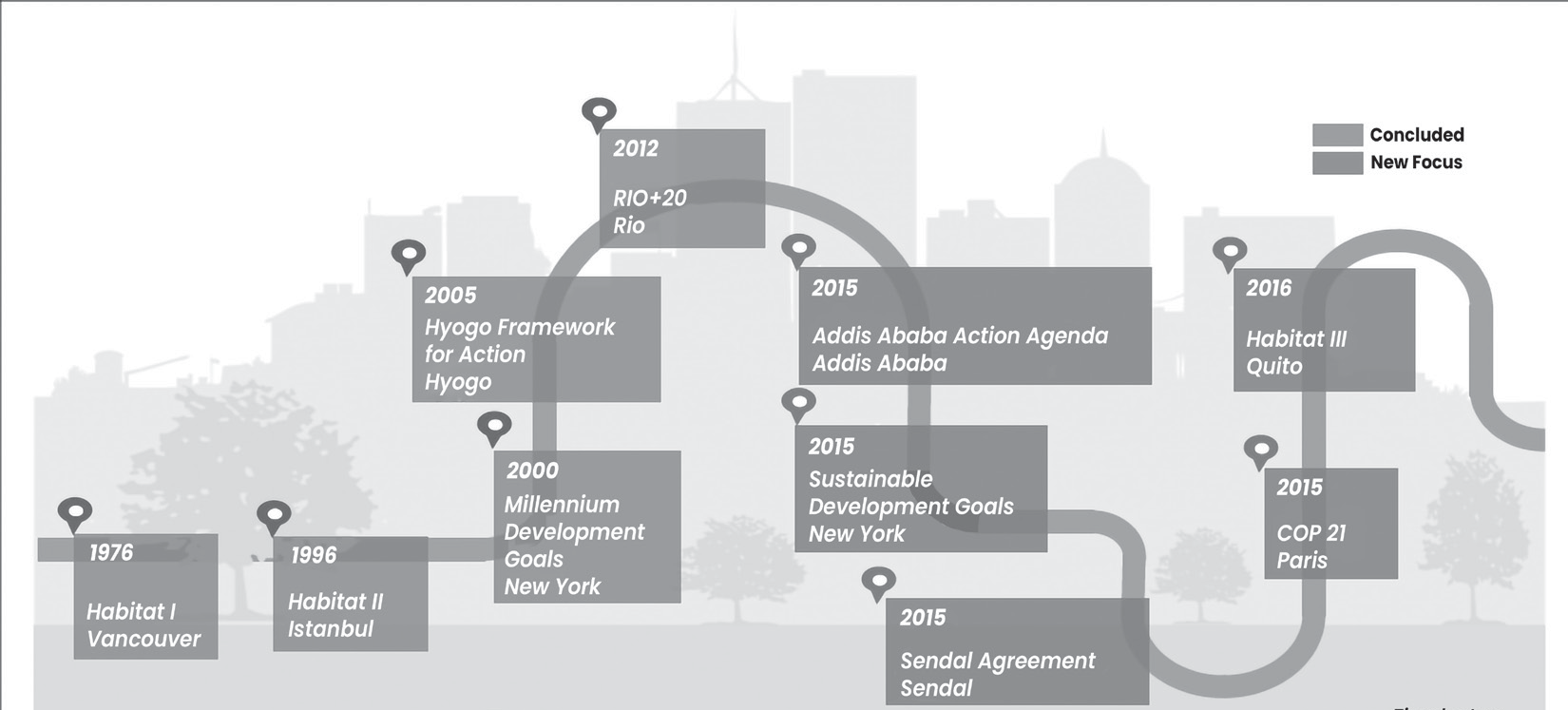
• Habitat III discussed their role as drivers of sustainable development, and how they can shape the implementation of the Sustainable Development Goals and the Paris Agreement on Climate Change.
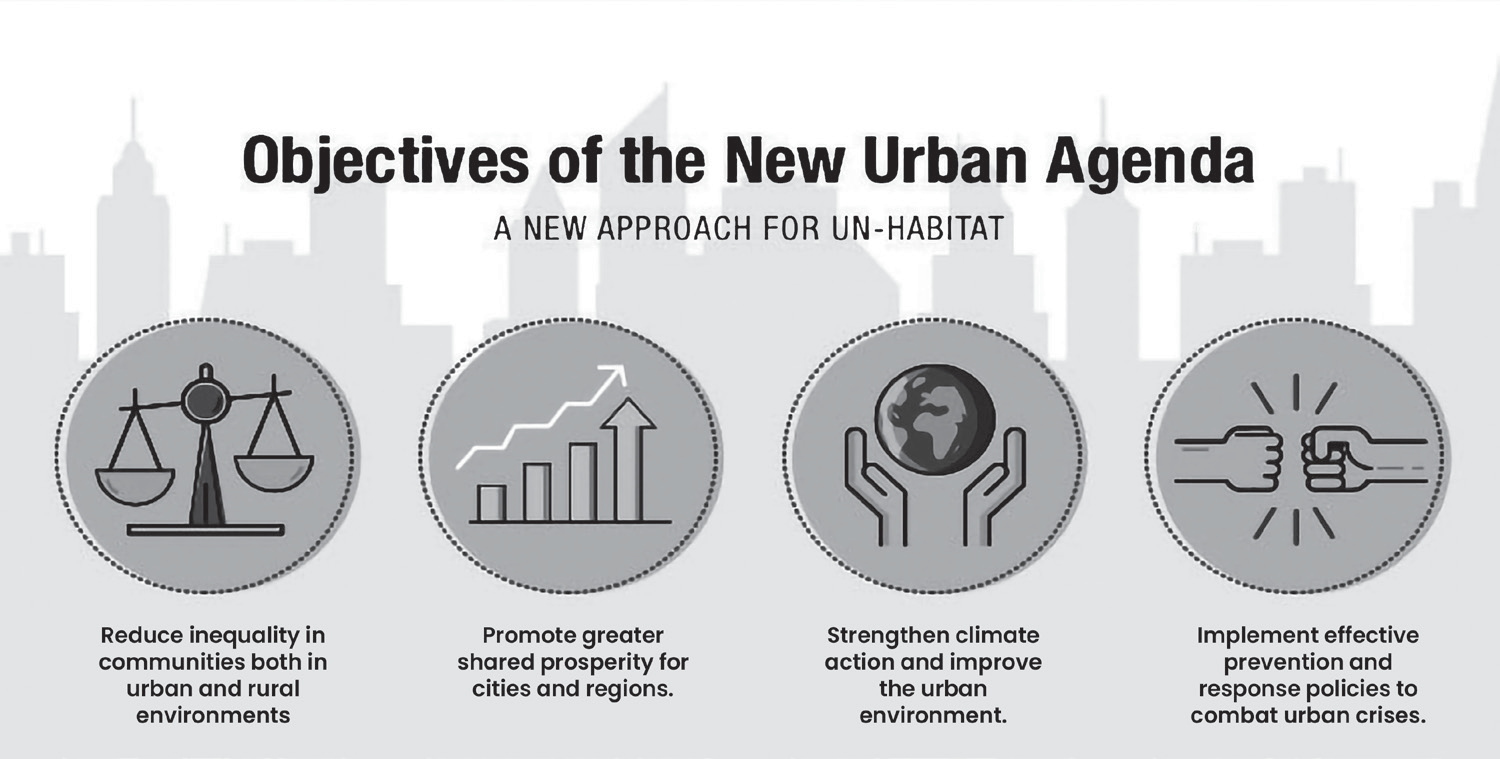
• In Quito, world leaders adopted the New Urban Agenda which set global standards in sustainable urban development, drawing together all levels of government (regional, national and local) as well as the civil society and private sector on issues of awareness and advocacy, availability of financial resources, capacity development, innovation and engagement.
• New Urban Agenda has included “Spatial Sustainability” as its fourth dimension in addition to -social, economic and environmental sustainability.
• The UN-Habitat (2020) mentions that: Spatial sustainability, as a concept, suggests that the spatial conditions of a city can enhance its power to generate social, economic and environmental value and well-being. Governments can achieve spatial sustainability by guiding the physical form of urban environments to create equitable access to jobs, housing and social interactions; enable agglomeration economies and encourage sustainable relationships to ecosystems and
natural habitats. The physical form of a city, which is the result of intentional planning and development, is critical to urban social, economic and environmental well-being. (p.45)
• Localization of SDGs: It is increasingly understood that achieving the SDGs requires their localization, and collaboration with local actors, including regional and local governments, and all the stakeholders to ensure the most effective SDGs localization. Integrated urban planning, access to basic services, slum upgrading, and decent and affordable housing reduce non- communicable diseases and limit environmental impacts, provision of regional and urban infrastructure, boosts markets and value chains, creating better rural-urban interlinkages, improved nutrition, and sustainable agriculture, responding to goals on
• Health and wellbeing (SDG 3)
• Energy (SDG 7)
• Climate (SDG 13)
• Infrastructure goal (SDG 9)
• Decent work and economic growth (SDG 8)
• Sustainable consumption and production (SDG 12)
• Food security (SDG 2)
• World Commission on Environment and Development (WCED) declared that “all human being have the fundamental right to an environment adequate for their health and well-being. There has to be sustainable development which will be durable and beneficial to the present and future generations.”
Sustainable City Concept
The United Nations Conference on Human Settlement (UNCHS) defined Sustainable City is a city “where achievements in social, economic and physical development are made to last”.
• A Sustainable city has lasting supply of the natural resources on which its development depends and a lasting security from environmental hazards which may threaten development achievements.
• Sustainable urban development is important due to their rising contribution to the Gross Domestic Product, exports and capital formation.
• Cities offer quality education and health care; arts and science; technology and innovation and transport and communication.
The Agenda 21 of World Commission on Environment and Development (WCED) held in 1992 in Rio-de- Janerio for promoting Sustainable Human Settlement Development is:
• Providing adequate shelter to all
• Improving human settlements management
• Promoting Sustainable land use planning and management.
•
Encouraging the comprehensive delivery of environmental infrastructure, including water, sanitation, drainage, and both hazardous and solid waste management.
• Supporting the development of sustainable energy and transportation systems within urban areas.
• Advocating for effective human settlement planning and management in disaster-prone regions.
• Fostering sustainable practices within the construction industry.
• Enhancing human resources and building capacity for the advancement of human settlement development.
The 2016 Paris Agreement, under the United Nations Framework Convention on Climate Change (UNFCCC), is based on the commitments made by countries, known
as Nationally Determined Contributions (NDCs). India’s
NDC aims to reduce the emission intensity of its GDP by 33 to 35 percent by 2030, compared to 2005 levels (Lok Sabha Secretariat, 2017). Urban areas play a crucial role in achieving these significant emission reductions.
To summarise, the aim of sustainable urban development is to ensure a sustainable city to the urban dwellers for improving the wellbeing and quality of life.
Healthy City Concept
World Health Organisation (WHO) suggests that, among other things, a ‘Healthy City’ must have: A ’Clean’ and ‘Safe’ environment, meets the ‘Basic Needs’ of ‘All’ its inhabitants, involves the ‘Community’ in local government and provides easily accessible ‘Health’ service. ‘Urban Strategy’ under the United Nations Development Programme (UNDP) outlines these priorities:
• Increasing ‘Shelter’ for the urban poor.
• Provision of basic urban services such as ‘Education’, ‘Primary Health care’, ‘Clean Water and Sanitation’.
• Improving women’s access to ‘Basic Services’ and government facilities.
• Upgrading ‘Energy’ use and alternative ‘Transport’ systems.
• Reducing ‘Air Pollution’.
Recent Global Response Framework to COVID-19 for the Cities
Cities are on the front line of coping with the pandemic and its lasting impacts. Across the globe, COVID-19 is threatening cities and communities, endangering not only public health, but also the economy and the fabric of society.
• UN-Habitat, the UN agency for housing and urban development, is working with national and local governments to help them prepare for, prevent, respond to and recover from the COVID-19 pandemic. The UN Habitat COVID-19 Response Plan aims to:
• Support local governments and community-driven solutions in informal settlements
• Provide urban data, evidence-based mapping and knowledge for informed decision
• Mitigate economic impact and initiate recovery
• UN-Habitat's COVID-19 Policy and Programme Framework offers guidance for action at the global, regional, and national levels.
• The UN Economic Commission for Africa has recommended targeted support for city governments to address and mitigate the economic impact of COVID-19. African cities contribute over 50% of the region’s GDP, and the pandemic is expected to severely affect these cities, leading to significant declines in productivity, employment, and revenues.
Indian Experience and Global Success Models
India's rapid economic growth, particularly since the 1990s, is closely tied to its urbanization process. The structural shifts in the economy and efforts in poverty reduction have both fueled and resulted from this urbanization. This growth has contributed positively to India’s GDP and created job opportunities for the young population. Currently, Indian cities contribute two-thirds of the country’s GDP, account for 90% of tax revenue, and
provide the majority of employment, despite housing only one-third of the population (New Climate Economy, 2014). Projections suggest that by 2030, the urban population will rise to 40.76%, while urban areas will generate around
70% of GDP (NHB, 2013). However, challenges remain in enhancing the overall quality of life for urban residents. Growth rates in major cities have slowed since 1991, with faster growth now occurring in the surrounding districts.
India’s Unique Urbanization Experience
Urbanization is the key to India’s future. Our cities occupy just 3% of land, but contribute a whopping 60% to the GDP. India is swiftly moving forward for becoming half urban in a couple of decades. Of the 7933 towns that are accounted as urban, almost half have a status of census towns and they continue to be governed as rural entities.
The process of suburbanization in India is reshaping large cities into sprawling metropolitan areas. Unlike in developed economies, where suburban communities thrived due to low-density zoning regulations, India's suburban growth is characterized by different dynamics. There has been a notable rise in the number of classified towns and urban agglomerations across the country. The most significant growth has occurred in census towns— areas that exhibit urban characteristics but lack formal governance structures such as municipal bodies or
cantonment boards.
•
The High-Powered Expert Committee report on Infrastructure 2011 notes that smaller cities suffer from higher per capita investment costs than larger cities like water (production + distribution), sewerage (network + treatment), etc.
• The size of cities is therefore understandably correlated with higher costs of distribution and is an additional challenge in the Indian urbanisation scenario that is showing trends of low-density outgrowths.
• The pattern of urban expansion or suburbanization in India is highly uneven and fragmented. States like Goa, Tamil Nadu, Kerala, Maharashtra, and Gujarat have achieved over 40% urbanization, while others like Bihar, Odisha, Assam, and Uttar Pradesh remain below the national average of 31.1%. Over 75% of India's urban population is concentrated in just 10 states: Maharashtra, Uttar Pradesh, Tamil Nadu, West Bengal, Andhra Pradesh, Gujarat, Karnataka, Madhya Pradesh, Rajasthan, and Kerala. The Union Territories of Delhi, Daman and Diu, Chandigarh, and Lakshadweep also report urbanization rates above 75%, according to the 2011 Census. Traditionally dense, monocentric cities are gradually evolving into polycentric models, with independent or semi- dependent job hubs, residential areas, and satellite cities.
• The spatial expansion of Indian cities has been driven by the development of both radial and orbital highway networks.
• Radial highways have played a crucial role in the growth of urban areas, transforming them into metropolitan regions. Households tend to settle along these highways to maintain easy access to central city job opportunities. As additional radial highways are constructed, new residential areas emerge along these routes, with residents commuting to work, as seen in cities like New Delhi, Ahmedabad, and Nagpur.
• In contrast, cities like London introduced the Metropolitan Green Belt Act in 1938, which limited urban expansion by designating natural green belts as protected areas.
• Similarly, the 1947 Copenhagen Finger Plan guided the city’s development along suburban commuter rail corridors, shaped like fingers extending from the dense city center. The spaces between these corridors were preserved for agriculture and recreation.
The New Climate Economy report 2014 notes that the fastest growth is occurring in cities of population 1 to 5 million followed by cities of population 5 to 10 million, mainly in the urban areas on the periphery of the existing big cities.
World Bank estimates that suburbanisation patterns in India reflect the international trends; the main difference being in the levels of per capita GDP (gross domestic product) at which the they are occurring. India is experiencing suburbanisation at a far lower per capita GDP (Vishwanath, et al., 2013).
• The top 10 cities of India are home to 8% of India’s population, which produce 15% of total economic output yet occupy an urban land footprint of only 0.1% (IIHS, 2012). This indicates very dense urban structures and presents a huge opportunity for public transportation investments within the cities.
• India’s largest cities show low-density sprawl with the percentage of built-up area outside the administrative boundaries of the ULB (Urban Legal Body) exceeding the percentage of population outside. The built-up area has been growing faster than the population for the last two decades (1990- 2010) in most of India’s largest cities (IIHS, 2011).
• The drop in built-up densities from core to peripheral areas in the top 100 cities is greater compared to the rate in the top 10 (or million plus) cities. Therefore, overall sprawl is occurring in all Indian cities (IIHS, 2012).
• The Suburbs and the Peripheral Areas in Indian cities are gaining job shares in manufacturing at the expense of the metropolitan core areas. The largest seven Metropolitan Cores (defined as areas within 10 km of the city centre) lost manufacturing jobs by 16% between 1998 and 2005 while the employment grew in the suburbs and immediate peripheries at twice the national average. High tech and export manufacturing saw the biggest shifts, about 60% (World Bank, 2013).
• The Urban Agglomerations now expand to metropolitan levels as the originally planned new towns evolved into self-sufficient cities with jobs, housing and amenities.
• The Mumbai Metropolitan Region (population about 18 million) and National Capital Region in Delhi (population about 25 million) are examples of urban agglomerations resembling Seoul, New York etc. in their spatial extents.
•
The new towns continue to drive the growth of population and jobs in metropolitan regions especially those that are less than 50 km (World Bank, 2013) away from the core city. In fact, one- third of India’s new towns are like this having population of more than 1 million (World Bank, 2013).
• Polycentric Urban Structure is found in Indian Cities in two major forms like
• Within the City Limits: Within Greater Mumbai, key employment hubs include areas such as Bandra Kurla Complex, the Fort area, and the Andheri-Seepz economic zone.
• Across the Metropolitan Region: Externally, the employment landscape extends across the broader metropolitan regions, such as the Mumbai Metropolitan Region (encompassing Mumbai, Navi Mumbai, Thane, Kalyan/Dombivli, Mira/Bhayander, Bhiwandi, and Vasai/Virar) and the National Capital Region (covering Delhi, Gurgaon, Noida, Faridabad, Ghaziabad, Sonepat, Bhiwani, and Narnaul).
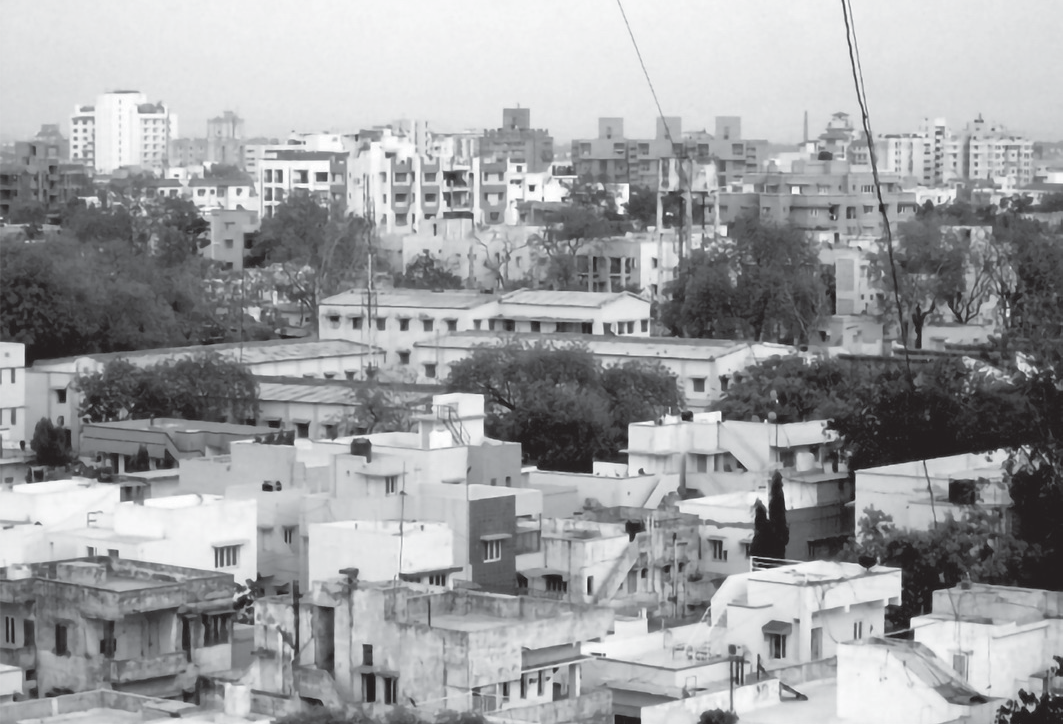
It is clear that suburbanization on the outskirts of major cities, along with the growth of second-tier towns, will likely dominate urbanization trends in India unless addressed. As incomes rise and aspirations grow, coupled with the lack of public transportation options in these expanding areas, the ownership and usage of cars and two-wheelers for mobility will continue to increase. This growing reliance on private automobiles will lead to negative consequences, such as worsening air quality, rising congestion, and productivity losses, unless proactive measures are taken. A more sustainable model, based on the expansion of railways and Bus Rapid Transit (BRT)
systems, has proven successful in regions like Europe and East Asia. Indian cities can benefit by learning from these examples. Advancements in transport technology
and the decreasing cost of personal automobiles relative
to incomes have enabled cities to spread out and expand horizontally.
Polycentric New Town Development Model in East Asia
The design and building of new satellite towns and cities have also dominated decongestion and urban management policies in Asia. Seoul, Shanghai, Singapore and Hong Kong (now part of China) have also adopted the polycentric new towns model to accommodate the burgeoning urban population.
• Seoul has 10 satellite towns accompanied by a greenbelt policy. To offset the rising housing costs, five new towns were built outside the outer edge, rising congestion saw rapid investments in subway expansion and bus rapid transit (BRT).
Singapore which now has about 22 new towns, public housing, policy of high automobile ownership license fees and usage costs to discourage automobile usage and encourage the use of its highly efficient metro and bus transit systems.
• Hong Kong’s unique development pattern was the involvement of rail agencies in property development known as “R+P” model, for development of new towns to accommodate the burgeoning population growth
The East Asian cities have focused on integrating high densities in new towns,high costs of vehicle ownership and high-quality transportation networks to evolve an urban form that is polycentric and offers within these towns, a quality of life, normally associated with the core central city.
Urban Mass Transport and Transit-Oriented Development
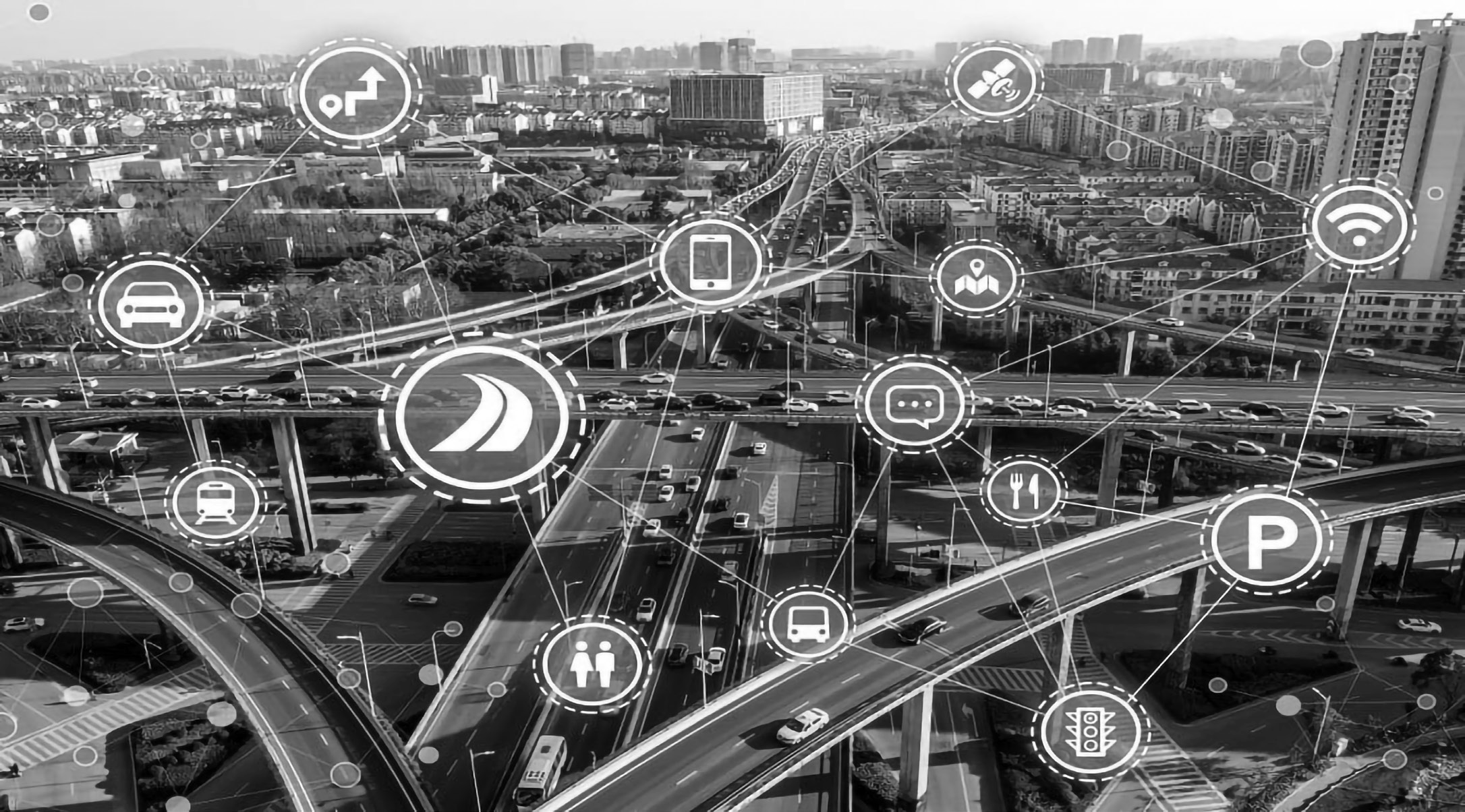
• One such example is the introduction of the Transit- Oriented Development (TOD) model, a new city planning approach that emphasizes the creation of small, walkable, self-sustaining nodes within urban areas. In this system, all essential services such as schools, healthcare, residences, offices, and commercial spaces are within a short walking distance from each node.
• The focus should be on building Integrated Systems that offer seamless connectivity for all residents. Cities should identify hub points that link multiple public transport options, ensuring each node is well- connected to others across the city. This creates a
network that facilitates efficient, hassle-free movement, which is crucial as cities continue to grow and attract new residents.
• Additionally, implementing an Integrated Traffic Management System that utilizes technology can enhance mobility, helping people save time and improve their quality of life.
• To address space limitations, cities can adopt Multi- Level Car Parking Systems, utilizing basement spaces and other underused areas for parking. A robust transportation system is key to creating well-planned city centers for the future.
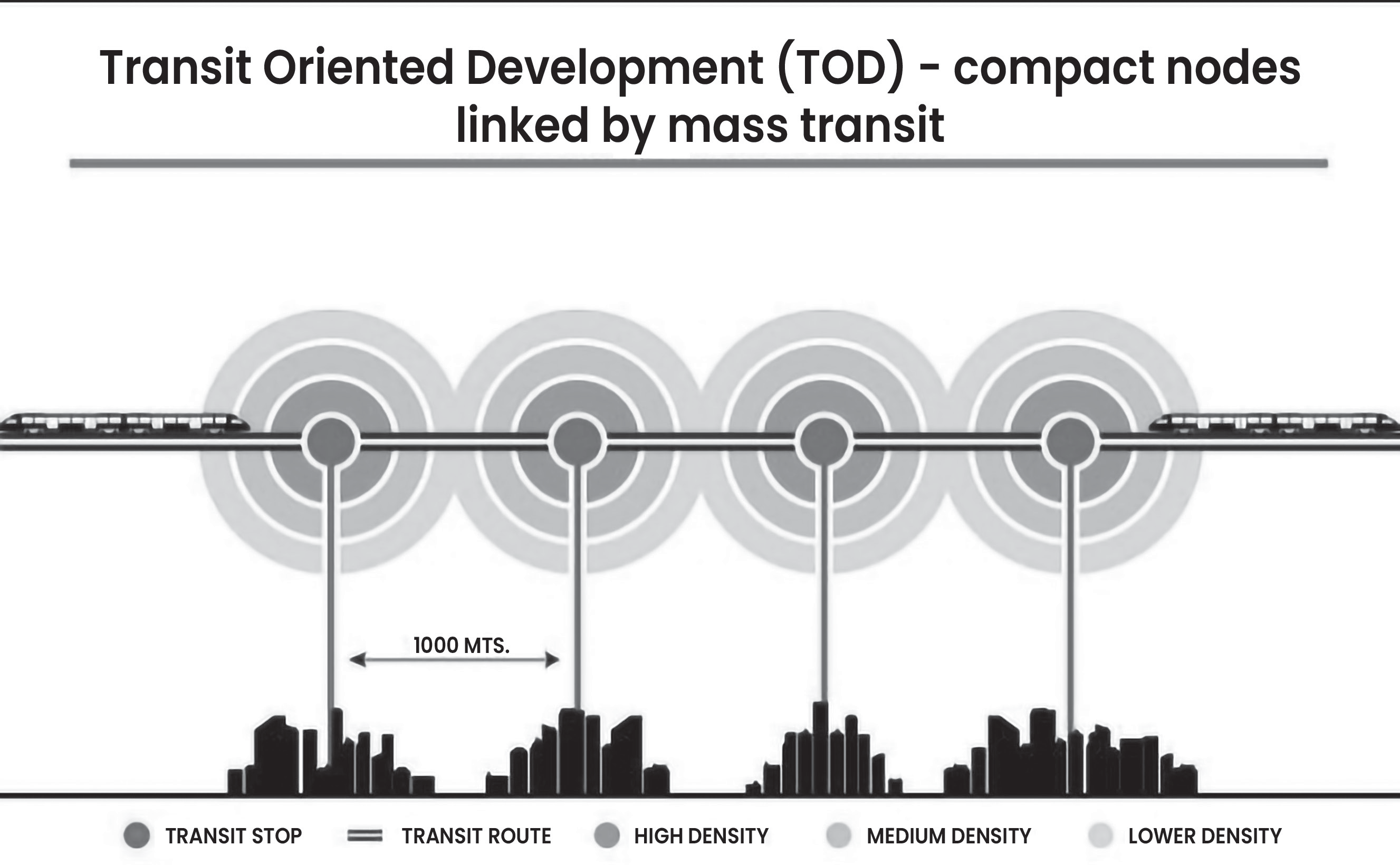
• An aspect that is essential to be considered in the planned expansion of the cities is to cater to the economically weaker sections of the society. Slums are a manifestation of this unplanned urbanization and about 29.4% of the urban Indian population resides in the slums. To this effect, the Government of India has mapped out policies such as Pradhan Mantri Awas Yojana (Rural and Urban), to provide for affordable housing in the urban areas.
China’s Concentric Ring Road Model
Concentric ring roads around cities which are connected to each other can offer cities and their citizenry the best of both worlds. Most Indian cities, apart from the coastal cities like Mumbai and Chennai, have the luxury to grow concentrically. Indeed, cities like Hyderabad and Bengaluru have taken this approach to development. The approach needs to be the cornerstone of city planning so cities do not expand in a haphazard, organic manner. Beijing’s density map: more than half its population lives beyond its fifth ring road. For India, urban planning must focus on building attractive and enabling infrastructure further away from city centres to de-densify traditional hubs. Urban planning in India
must focus on building enabling infrastructure away from city centres.
CONCLUSION
In conclusion, urbanization is crucial for economic growth, but when it is unsustainable and unplanned, it can lead to significant socio-economic challenges. While these issues may not be fully resolved, they must be addressed through thoughtful, strategic planning. Urbanization contributes to national financial growth, but it requires careful planning to ensure cities provide basic amenities for healthy living. It is important for society to collaborate with authorities to make urbanization a positive and sustainable force. Urban areas are vital growth hubs, and they must remain healthy and sustainable. Efforts should focus on improving infrastructure in Tier 2 and Tier 3 cities and enhancing connectivity to larger cities to create a balanced ecosystem and prevent over-migration. Additionally, bringing employment opportunities and essential services to rural areas will be crucial in achieving Sustainable Development Goal 11 (Sustainable Cities
and Communities) for India.