Black Money
Black money is a phrase that we often see in the news, whether political-related or big business scams. There is no classic definition of black money, but black money can generally be defined as all the funds collected through illegal activities. These are the funds that are not recorded for tax purposes.
Black Money Defined
Different people define it different ways with different terms such as ‘unaccounted income’, ‘underground income’, ‘black wealth’, or at economy level it is
known as ‘parallel economy’, ‘black economy’, ‘shadow
economy’ and ‘unofficial economy’.
The word ‘black money’ is not defined under the Income Tax Act, 1961, Customs Act, 1962, CGST Act, 2017, Central Excise Act, 1944 and erstwhile Chapter V of Finance Act, 2017 (related to Service Tax).
• Finance Ministry’s 2012 white paper defined black money as “the aggregates of incomes which are taxable but not reported to the tax authorities”.
• It includes the concealment of legal income:
• To evade payment of taxes (income tax, excise duty, sales tax, stamp duty, etc);
• To evade payment of other statutory contributions;
• To evade compliance with the provisions of industrial laws such as the Industrial Dispute Act
1947, Minimum Wages Act 1948, Payment of Bonus Act 1936, Factories Act 1948, and Contract Labour (Regulation and Abolition) Act 1970;
• To evade compliance with other laws and administrative procedures.
• Also includes money derived from corruption and other illegal ways—to include drug trafficking, counterfeiting currency, smuggling, arms trafficking, etc.
• A lot of black money is thought to have been
converted into gold, and held domestically.
• It includes sham transactions. It is a business transaction that is entered into for the sake of avoiding tax.
• International debit or credit cards issued by offshore banks are used to create black money.
Estimating Black Money
There are neither reliable estimates of its generation, nor is there any accepted methodology for making such estimation.
Even if an estimate is made it would be an assumption only. As by the definition of black money, it is unaccounted money, thus all attempts to estimate it will fail.
Black money in the system is estimated with a wide variance i.e., 7% to 120% of GDP.
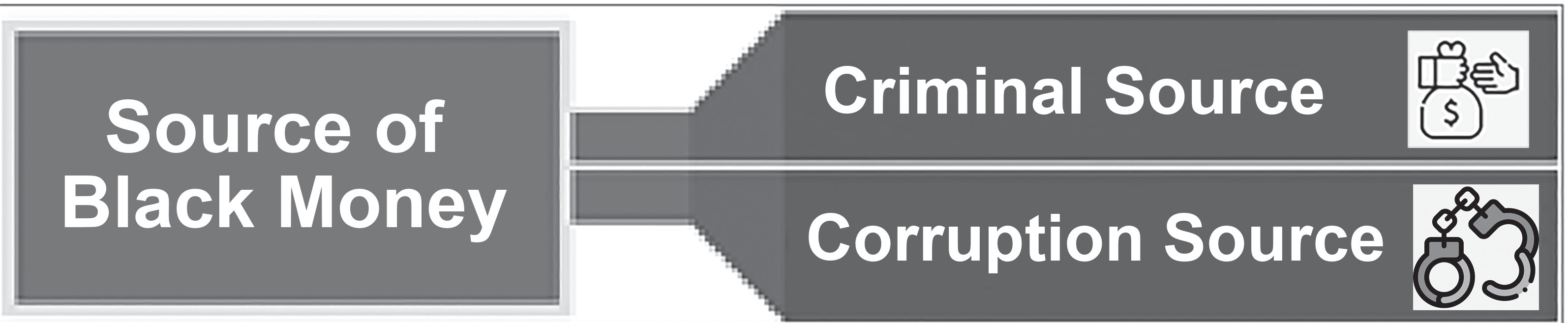
Figure: Sources of Black Money
• Sources of Black Money—
• Crime - The ‘criminal’ component of black money would normally include proceeds from a range of activities, including racketeering, trafficking in counterfeit and contraband goods, forgery, securities fraud, embezzlement, sexual exploitation and prostitution, drug money, bank frauds and illegal trade in arms
• Corruption and business - The ‘corruption’ component of such money would stem from bribery and theft by those holding public office, such as by grant of business, bribes to alter land use or to regularise unauthorised construction, leakages from government social spending programmes, ‘speed money’ to circumvent or fast-track procedures, black marketing of price-controlled services, etc.
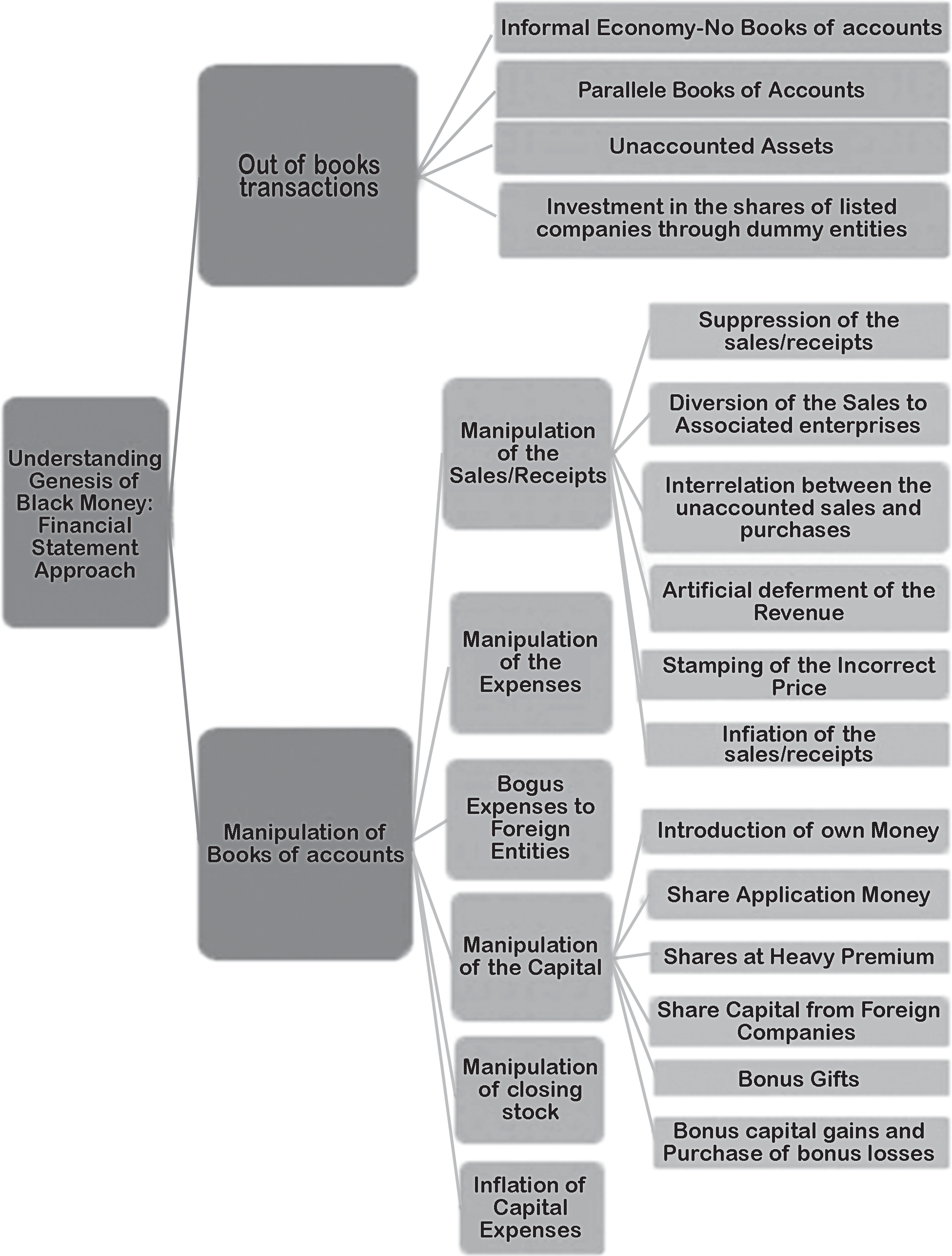
Figure: Generation of Black Money
Causes of Creation of Black Money
• Corruption:
• Corrupt practices such as taking or giving bribes, transactions in black money done by bureaucrats, politicians, civil servants and high-profile businessman leads to the creation of black money.
• Hundreds of cases were registered regarding admission through forged certificates and documents in Delhi
University because of which the University came up with an idea of hiring forensic experts for verifying the certificates and documents produced by the students during admissions.
• High Taxes
• Higher rate of taxes has forced the earning population for not paying taxes and keeping that part of their income illegally with them which is later termed as black money.
• Tax evasion has led to the generation of a huge amount of black money in India. A middle-class person cannot survive under high-rate tax laws because of which tax evasion is quite common.
• Foreign Banks
• Foreign banks are safety lockers for the hoarders of black money. Especially the Swiss Banks help avoid taxes and hide income. Moreover, such banks have encouraged more and more people to generate black money.
• The recent cases such as Nirav Modi and Vijay Mallya who are apparently bankrupt but actually have crores of rupees in the different banks of the world.
• Election Campaigns
• Campaigns conducted by the candidates for elections of parliament or assembly elections or any other elections at the local level has led to the generation of crores of black money.
Economic, Social and Political Impacts of Black Money
During the campaigning for Lok Sabha Elections, 2019 more than Rs 3,166 crore worth of cash, liquor, drugs, jewellery etc. was seized by the Election Commission of India and all of which was unaccounted.
• Donations or Funds
• Donations for admissions are never paid by cheques, even the institutions don’t include it in their official accounts, neither any proper receipt is issued for the made transactions. Nowadays almost all the educational institutions have fixed seats for admission in quota management.
• Exam paper leak and unfair ways of cheating also circulate black money causing weak educated youth.
• In the 2019 CBSE Board examination, CBSE used various measures such as live web-streaming from test centres, accountability of centre superintendents and encrypted question papers in some of the subjects for checking paper leaks before the examination.
• Other Factors
• There are many other factors such as corrupt tax officials, chit funds, money laundering financial companies, corrupt charitable trusts and societies, smuggling and commissions etc.
• It is not always the government but Non-Governmental Organizations (NGOs) are also reported to be corrupt and fraud.
| Economic Impacts | Social and Political Impacts |
| Loss of revenue to the government and running of parallel economy in the country. Vicious Circle of Black Money and Corruption–Black money has added to corruption by the illegal transactions to hide the black money. Speed Money goes to the unaccounted books. Therefore, black money and corruption form a vicious circle. Mass Poverty: The distribution of wealth and income is affected as tax evaders are keeping the money away from the deserved investment and development. Revealing low income to the government results in low national income which will reduce the public spending on the quality of life for the whole country. Decrease in the quality of public goods & services–Bribe to the producers and marketing staff or the services provider causes decrease in quality and speed of delivery of goods and services for the poor. Higher Taxation and Inflation– Lower revenues, due to tax evasion, lead to higher taxes. Similarly, rising prices are the result of too much money in circulation in the market. Reserve Bank of India itself has admitted it. Monetary And Fiscal Policy problems– As not being able to count the exact national income government estimates and resulting policies become unrealistic and not aligned to the needs of the people. | Higher Crime Rate– The illegally earned or the black usually gives rise to various illegal activities in society and corruption is one of them. Drug Menace: Drugs are the biggest enemy for the youth of the country. The smuggling of drugs in various colleges, hostels, hotels, clubs and bars is done with the help of black money which further leads to various criminal activities. Consumerism and Demonstration Effect: This black money is a type of excessive money which is spent carelessly and lavishly by the owners of this money, in peer pressure and media influence, to emulate the rich. Electoral Spending: The duration of elections is also the time when the illegal use of black money can be seen. Terror Activities: Various terrorist activities have backup power of hoarders of black money which is even harmful to the whole country. Social Unrest: Unsocial elements are usually bought up by the use of black money to exploit volatile social situation. |
Challenges of Tackling Black Money
• Differences in perceived interests and objectives of taxpayers and the tax authority. Theoretically, one can postulate a particular level of regulation and tax that creates appropriate balance between the three different but related objectives, namely:
• Ensuring efficiency of a market economy
• Ensuring efficiency of the state with respect to its goals of providing requisite public goods and promoting equity, or what is often referred as good governance
• Ensuring that the incentives for compliance are not distorted in a self-defeating manner. However, in practice it may be difficult to bring about this balance and convergence in the interests of the stakeholders.
• Lack of awareness and understanding about the lack of any universal panaceas or magic remedies for this complex socio-economic problem.
• Lack of adequate and reliable data on black money: Several estimates have been floated, often without adequate factual basis on the magnitude of black money generated in the country and the unaccounted wealth stashed aboard. The Standing Committee on Finance released a report in 2019, estimated economy’s black money to be from 7% to 120% of India’s GDP, demonstrating the huge variation in the approaches for estimation.
• Poor Implementation of Laws and Regulations: Studies indicate that countries with relatively poor implementation of regulations tend to have a higher share of unaccounted economy, whereas countries with properly implemented regulations and sound deterrence have smaller ‘black’ economies.
Steps Taken to Tackle Black Money
• The strategy to tackle black money includes, preventing generation, discouraging use, effective detection of black money along with effective investigation and adjudication of related cases and ensure regulate the use of large denominations.
• Government has formulated a five-pronged strategy to tackle the menace of black money which is as below:
• Joining the global crusade against black money.
• Creating an appropriate legislative framework.
• Setting up institutions for dealing with Illicit Funds.
• Developing systems for implementation (new manpower policy).
• Imparting skills to the manpower for effective action (constant training for skill development).
Legislative Measures
• The Prevention of Corruption Act (PoC Act) 1988:
• It changed the legal measures to tackle corruption in the governmental and public offices.
•
The PoC Act has two objectives:
• The law aims to prevent misconduct in government offices.
• The law finds the bad actors, prosecute and punish
them.
• The Act has several provisions as follows:
• Undue Advantage: If a public official accepts (or almost accepts) undue advantage for their or others’ benefit, their punishment will be imprisonment (minimum three years, maximum seven years). Undue advantages are remunerations that are other than legal. Giver is also prosecuted.
• Criminal misconduct can be categorized in three ways:
Use dodgy/illegal means to gain something valuable and monetarily reward
Abuse their authority to gain valuable or monetary rewards.
Obtain valuable or monetary rewards that exclude public interests.
• The law required sanctions before the appropriate government to prosecute the public officials in office.
• Furthermore, person’s guilt is presumed for the offenses of accepting an undue advantage, being a habitual offender, or aiding and abetting an offense.
• The Amendment Act 2018 is compatible with the UN Convention against Corruption 2005. India ratified the latter in 2011. The amendment replaced with new definitions:
• Any property which is owned is misappropriated or conversed for public official’s use.
• Any assets that are amassed are disproportionate to known income sources.
• Further protection through sanctions for investigation pre-prosecution. It also applies to ex- public officials. Section 19(1) gives a directory period of three months for the appropriate government to give its decision.
• Attachment and administration of property obtained through the commission of a PoCA offence under the Prevention of Money Laundering Act 2002 and the
Criminal Law Amendment Ordinance 1944.
• Special Judge to complete the trial within two years. At the same time, the trial period can be extended from six months to four years. It is necessary, not mandatory, to document the reason for the extension.
• Penalty has been increased from a minimum of 6 (six) months to 3 (three) years, with or without a fine, and from a maximum of 5 (five) years to 7 (seven) years. The penalty for aiding and abetting crime has also been increased by the same amount.
• Overall, the PC Amendment Act has improved the corruption situation in India. It has become a positive
development. It changed the definitions and penalties of corruption conducts for the better. It became a deterrent for
the offenders to commit the offense.
• The Fugitive Economic Offenders Act, 2018
• - The law aims to seize the assets of economic offenders who have fled the country to evade criminal prosecution or refuse to return for legal proceedings. These assets include proceeds of crime, Benami properties, and any other property located in India or abroad.
• Fugitive Economic Offender: An individual against whom an arrest warrant has been issued for committing an offense specified under the Act, with a minimum value of ₹100 crores.
• Upon reviewing the case, a special court (designated under the PMLA, 2002) can declare a person a fugitive economic offender.
• Offenses covered under the Act include:
Counterfeiting government stamps or currency
Cheque dishonor
Money laundering
Fraudulent transactions to deceive creditors
• Goods & Services Tax Act, 2017
• Mandatory maintaining of books of sales for which proper bills will be generated for traders, due to which black money reduces automatically.
• The dual monitoring structure involving the Centre and the states will also curb income tax evasions.
• GST is also designed to create an all-India market and promote ease of business. That would surely make more people pay tax voluntarily that would lead to greater collection of revenue and improve the tax GDP ratio and growth.
• Black Money (Undisclosed Foreign Income and Assets) and Imposition of Tax Act, 2015
• It criminalises tax evasion or concealment with respect to foreign income.
• The Act gave a one-time opportunity to residents to disclose foreign income and assets and pay tax at the rate of 30% and an equal amount by way of penalty.
• Otherwise, the provisions include tax rate of 30% along with a penalty equal to three times the amount of tax evaded or 90% of the undisclosed income or the value of the asset.
•
The Act provides for punishment of jail for 3-10 years for the willful evasion.
• It aims to effectively tackle the cases involving black money stashed abroad.
• Benami Transactions (Prohibition) Amendment Act, 2016
• To effectively deal with domestic black money cases.
• Benami transaction is defined as a transaction where:
A property is held by or transferred to a person, but has been provided for or paid by another person.
The transaction is made in a fictitious name,
The owner is not aware or denies knowledge of the ownership of the property,
The person, holding the property, is not traceable.
• Four authorities to conduct inquiries or investigations regarding benami transactions: Initiating Officer, Approving Authority, Administrator and Adjudicating Authority.
• An Appellate Tribunal is designated to review appeals against decisions made by the Adjudicating Authority. Any appeal against the Appellate Tribunal's orders can be taken to the High Court.
• The Special Court is required to complete the trial within six months from the date the complaint is filed.
• The amended law grants authorities the power to provisionally seize benami properties, which may later be confiscated.
• 648 disclosures involving undisclosed foreign assets worth Rs. 4,164 crores were made in the one-time three months compliance window, under BMA, 2015, which closed on 30th September 2015.
• Prevention of Money Laundering Act, 2002 (PMLA)
• Designated the offence of willful attempt to evade tax, etc. in relation to undisclosed foreign income/assets as a Scheduled Offence regarding which suitable action is taken by Directorate of Enforcement (ED) for identification of proceeds of crime generated, provisional attachments and filing of prosecution complaints in suitable cases.
• Other Acts and Bills like Lokpal and Lokayukta Act, the Whistle Blowers Protection Act 2014, the Grievance
Redressal Bill and the Public Procurement Bill were brought to curb corruption and black money.
Administrative Measures
• Constitution of the Special Investigation Team (SIT) on Black Money.
• Constitution of Multi-Agency Group (MAG) for coordinated and effective investigation in ‘Panama paper leaks’ cases and Paradise Leaks cases.
• Task Force (TF) on Shell Companies constituted.
• Income Tax Department conducted searches on 900 groups in 2016-17.
• Operation Clean Money initiated by the Income Tax Department (2017).
• Taxation Laws (Second Amendment) Act, 2016 was enacted, which enabled levy of tax at a higher rate on the undisclosed income under which a person could declare his undisclosed cash by paying tax, surcharge & penalty totaling to 50% of the undisclosed income.
• Besides, he would have to keep 25% of the undisclosed income in Pradhan Mantri Garib Kalyan Deposit Scheme, interest free for 4 years.
• Place of Effective Management (POEM): for determination of residence of a company and assess taxation accordingly.
• The FICN Coordination Group facilitates the exchange of intelligence and information between state and central security agencies.
• The Terror Funding and Fake Currency Cell within the National Investigation Agency (NIA) is responsible for conducting specialized investigations into cases related to terror financing and counterfeit currency.
• Proposed Gold Amnesty scheme:
• This is similar to the Voluntary Income Disclosure scheme to tap black money in income taxes.
• The tax will have to be paid on entire value of gold declared by an individual that has been purchased without any receipt.
• The move is meant to cut down tax evasion and lower the dependence on imports.
• Cash Transaction Restrictions and Making Transactions Formalised
• Quoting of PAN made mandatory for sale or purchase of any goods/services above Rs. 2 Lakh and all cash deposits above Rs. 50,000.
• Restriction on cash transaction of Rs. 2 lakh or more.
• Restriction on donations of Rs.2000/- or more to political parties otherwise than by a bank account or through electoral bonds.
• Linking of Aadhar with PAN has been made mandatory for filing Income Tax Returns and for applying for new PAN.
• Integration of PAN and TAN with MCA Portal.
•
International Cooperation:
• Double Taxation Avoidance Agreements (DTAAs):
• India is proactively engaging with foreign governments with a view to facilitate and enhance the exchange of information under Double Taxation Avoidance Agreements (DTAAs)/Tax Information Exchange Agreements (TIEAs)/Multilateral Conventions.
• Automatic Exchange of Information:
• India has been a leading force in the efforts to forge a multilateral regime for proactive sharing of financial information known as Automatic Exchange of Information which will greatly assist the global efforts to combat tax evasion.
• The Automatic Exchange of Information based on Common Reporting Standard has commenced from 2017 enabling India to receive financial account information of Indian residents in other countries.
• Foreign Account Tax Compliance Act of USA:
• India has entered into an information sharing agreement with the USA under the act.
• Financial Action Task Force (FATF):
• India is a member of the FATF.
• Global Agreements to Tackle Black Money: Government of India has entered into Double Taxation Avoidance Agreements /Tax Information Exchange Agreements
/Multilateral Convention on Mutual Administrative Assistance in Tax Matters/SAARC Multilateral Agreement (“tax treaties”) with other countries which provide for exchange of information, which is foreseeably relevant for administration and enforcement of domestic laws concerning taxes. India has been proactively engaging with foreign governments, for exchange of information under these tax treaties.
• Amendment in DTAA (Double Taxation Avoidance Agreements): with Mauritius, Singapore and Cyprus.
• Joining the MCAA (Multilateral Competent Authority Agreement): for Automatic Exchange of Information as per Common Reporting Standards (CRS).
• Tax Treaty frameworks signed with approx. 150 foreign jurisdictions.
• To facilitate and enhance exchange of information under the Tax Treaties.
• E.g., Foreign Account Tax Compliance Act with the US.
• Egmont Group: FIU-India is a member
• An international organisation for exchange of information and Co-operation amongst Financial Intelligence Units (FIUs).
• FIUs can exchange freely information on real time basis through a highly secured network - Egmont Secured Web (ESW) - on various matters as per their roles and functions.
• FIU-India has also entered into Memoranda of understanding (MoUs) with 48 countries to strengthen bilateral relationships with its foreign counterparts since 2008 upto 2022 for exchange of intelligence.
Demonetisation Against Black Money
• Demonetization is the act of stripping a currency unit of its status as legal tender to ambush black market currency and unaccounted money.
• Demonetization undertaken twice in the past miserably failed, with less than 15 percent of high currency notes being exchanged, leaving more than 85 percent of high value currencies untouched as the owners suspected penal action by the government agencies.
• On 8 November 2016, the Government of India announced the demonetisation of all D500 and D1,000 banknotes and issuance of new D500 and D2,000 banknotes in exchange for the demonetised banknotes.
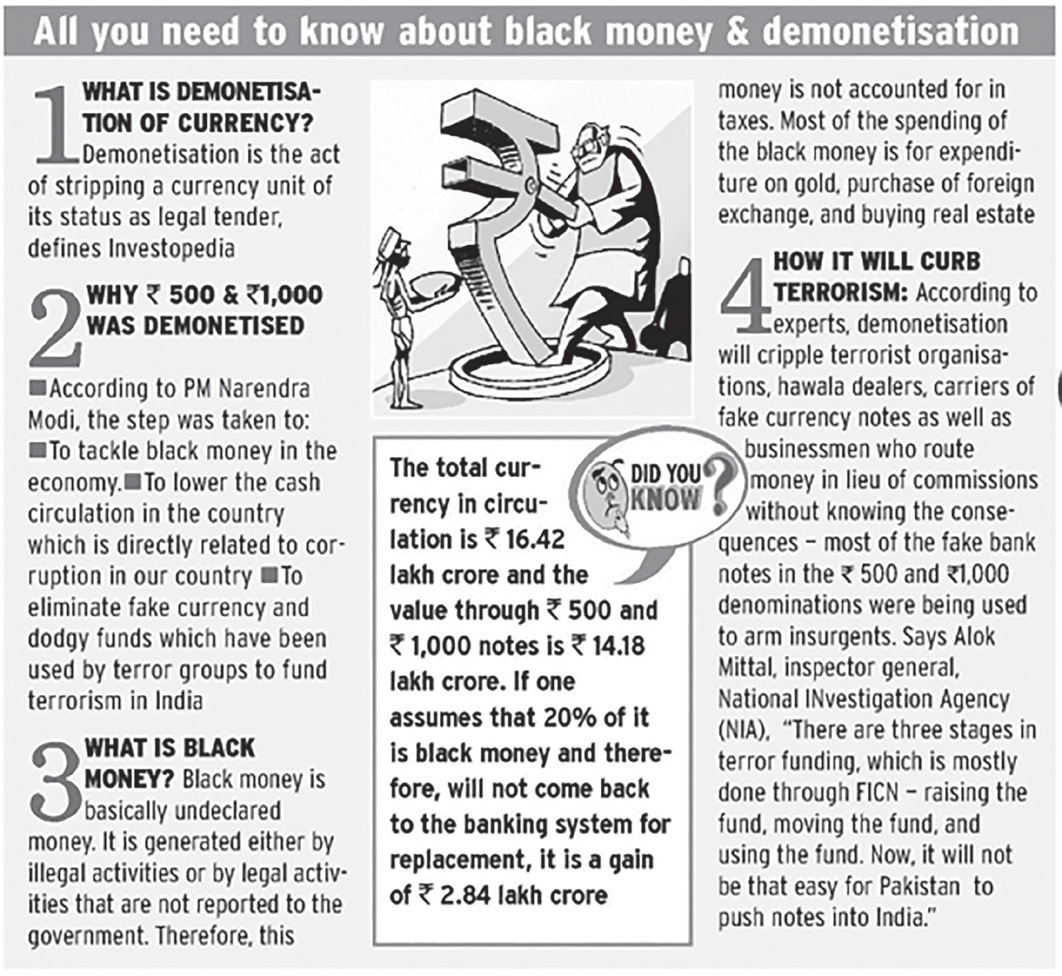
Figure: Black Money and Demonetisation
What is Demonetisation?
• It is the act of stripping a currency unit of its status as legal tender.
• It occurs whenever there is a change of national currency and the current form or forms of money is pulled from circulation and retired, often to be replaced with new
notes or coins.
• Aim
• To discourage the use of high-denomination notes for illegal transactions and thus curb the widespread use of black money.
• To encourage digitisation of commercial transactions, formalise the economy and so, boost government tax revenues.
Impact
• Currency with public stood at Rs. 17.97 lakh crore on 4th November 2016 and declined to Rs 7.8 lakh crore in January 2017 after demonetisation.
• Demand fell, businesses faced a crisis and gross domestic product (GDP) growth declined nearly 1.5%, with many small units and shops being shut down and it also created a liquidity shortage.
Liquidity shortages or crises arise when financial institutions and industrial companies scramble for, and cannot find the cash they require to meet their most urgent needs or undertake their most valuable
projects.
Criticisms
• Impact on Poor: Demonetisation will only affect those who conduct transactions in cash, are not a part of the formal banking system or have not already converted their cash into assets.
• Does not Target Problem: In the absence of steps to curb the generation of black money, demonetization is a futile exercise, as it proved to be in 1978. It does nothing to alter the incentives which spawn the black incomes.
• Penalties only Limited to Cash Holders, who use various avenues for converting high denomination notes into lower valued ones, at a discount, through intermediaries.
• Temporary Measure: Also, since cash is the principal vehicle for conducting black transactions, there is undoubtedly a temporary dislocation in such activities. The point is that the dislocation is temporary.
• Does not prevent reintroduction of FICN.
Way Forward/Suggestions for Tackling Black Money
• MC Joshi Committee 2012 on Black Money: Its key observation and recommendations were:
• The two major national parties, Indian National Congress and Bhartiya Janta Party, claim to have incomes of merely D5 billion and D2 billion. But this isn’t “even a fraction” of their expenses. These parties spend between D100 billion and D150 billion annually on election expenses alone.
• Change maximum punishment under Prevention of Corruption Act from the present 3, 5 and 7 years to 2, 7 and 10 years rigorous imprisonment and also changes in the years of punishment in the Income Tax Act.
• Taxation is a highly specialised subject. Based on domain knowledge, set up All-India Judicial Service and a National Tax Tribunal.
• Ensure reporting of all global financial transactions above a threshold limit on the lines of USA Patriot Act under which global financial transactions above a threshold limit (by or with Americans)
• Consider introducing an Amnesty Scheme with reduced penalties and immunity from prosecution to the people who bring back black money from abroad.
Other Recommendations include
• Mandatory digitisation of all land and property records.
• Tax on agricultural income based on farm holding, leaving small and marginal farmer untouched and unaffected.
• Small and marginal farmers be provided one-time state assistance to rid their personal debts taken from local money lenders at exorbitant rates.
• The money so given as assistance must be recorded as interest-free loan from state payable only in case the land is sold by these farmers.
• The land shall not be allowed to be mortgaged to anyone except banks for crop loan only.
• Plastic money should be encouraged.
• A charge may be introduced for cash withdrawal beyond a limit.
• Cash transaction fee must be introduced.
• To encourage credit/debit card payments, the settlement cycle must be reduced from monthly to fortnightly on a mandatory basis.
• Capital gains tax on traded security should be calculated by the tax department by linking PAN and demat accounts.
• The assessee should be required to only file for exemption, if any, from the tax assessed.
• Funding to political parties should come under the
purview of RTI and income-tax authorities.
• And, eventually the country should move towards
state funding of elections.
CONCLUSION
• White Paper on Black Money in May 2012 (Ministry of Finance, 2012), presenting the different facets of black
money and its complex relationship with policy and administrative regime in the country which also reflected upon the policy options and strategies, the Government has been following to address the issue of black money and corruption in public life.
• Prevention and control of black money is pre-requisite for establishing an equitable, transparent and efficient economy. Otherwise, black money will paralyse the economy and the country will be in doldrums. It becomes a hurdle in the development of the economy and will definitely destroy the same.
• The fight against generation and accumulation of black money and curbing black money is far more complex and prolonged requiring new strategies and stronger intervention of the state, which, in turn, needs a hardy legal framework, coextensive administrative setup and a very strong determination to fight the threat. Effective implementation of the tax laws can arrest tax evasion.
• Relaxation in tax laws, simplification of tax laws,
removal of drawbacks in the tax system, proper processing of information available can be the best tool for the betterment of Indian tax compliance.
• Prevention and control of black money is pre-requisite for establishing an equitable, transparent and efficient economy.
• As economy is the backbone of a country, black money will paralyse the economy and the country will be in doldrums. It becomes a hurdle in the development of the economy and will definitely destroy the same.
• Educating the people about the tax laws is vital as it will create an atmosphere to perform their duties to the nation.
• A multi-pronged strategy is essential to deal with the issue of generation of black money and its illicit transfer outside the country and for bringing back to India.