Types of Security and Threats
INTRODUCTION
Security is the most essential component of the national interest. Security is not merely the protection of territorial integrity and sovereignty of the state. It is also vitally concerned with the economic development, which in turn enables a country to increase its power and to use it to secure a place of respect in the world community.
• Concept of security is directly related to national interest. The entire state system is the product of the desire of man to protect himself against threats from various quarters. Security of the state is the objective of every government.
• As per the 43rd Parliamentary Standing Committee Report on Internal Security, 210 out of 535 districts in the country are affected by serious internal security threats and 40% of areas are facing serious disorders of one or the other kind.
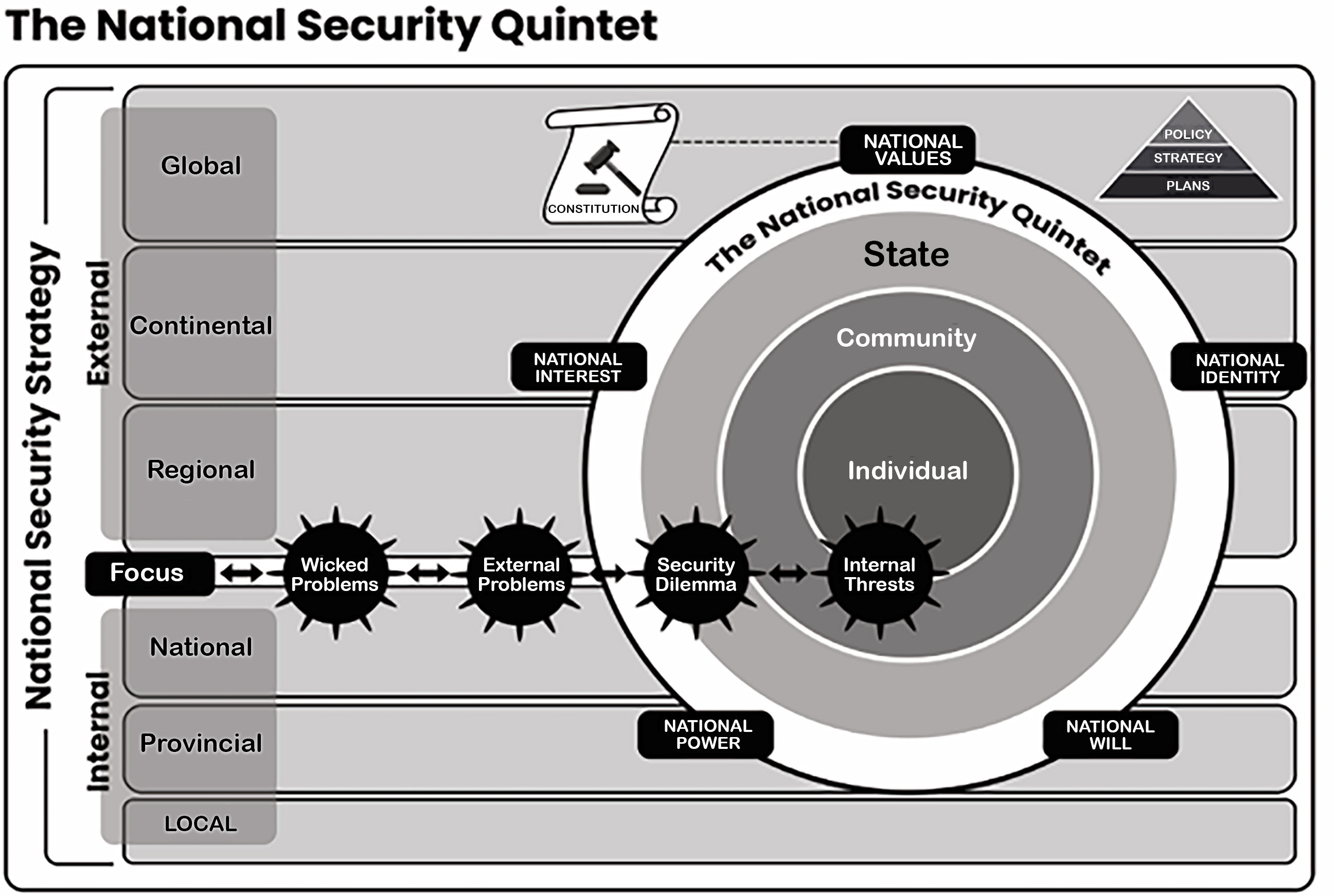
Figure. National Security Quintet Model
• National Security implies the protection, preservation and promotion of our national interests against internal and external threats and challenges.
• National security is the protection of state and citizens from all kinds of national crises using political, military, economic or diplomatic power.
• The concept of national security is not merely the preservation of sovereignty, territorial integrity and internal stability with the focus on the coercive power of the state. In today’s complex and interdependent world faced with many non- traditional threats like pandemics, climate change, etc. it must, however, be seen in a more holistic manner.
• A comprehensive approach to National Security Management would include securing employment, food water and shelter, along with ensuring fiscal and economic stability, energy security, advancements in science and technology, environmental protection, and cybersecurity, among other aspects.
• National security is effectively maintained through a strategic and proactive combination of political stability and adaptability, a well-developed human resource base, a strong economic framework, technological expertise, a robust industrial sector, access to essential natural resources, and ultimately, military strength.
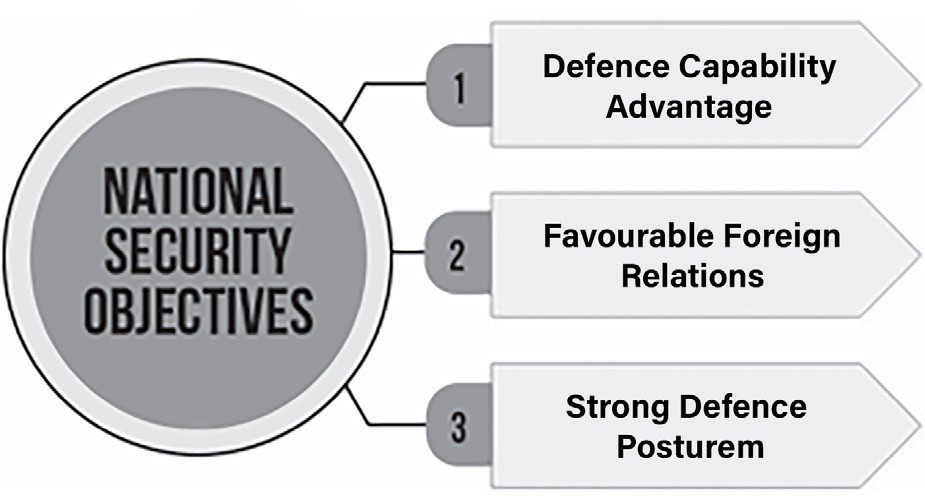
Figure. Objectives of National Security
• National Security: It is a general word that includes both foreign policy and national defense with the aim of obtaining
•
A strategic military or defense superiority over any foreign nation or alliance.
• An advantageous standing in international relations.
• A defense strategy strong enough to effectively counteract any hostile or destructive threats, whether internal or external, overt or covert.
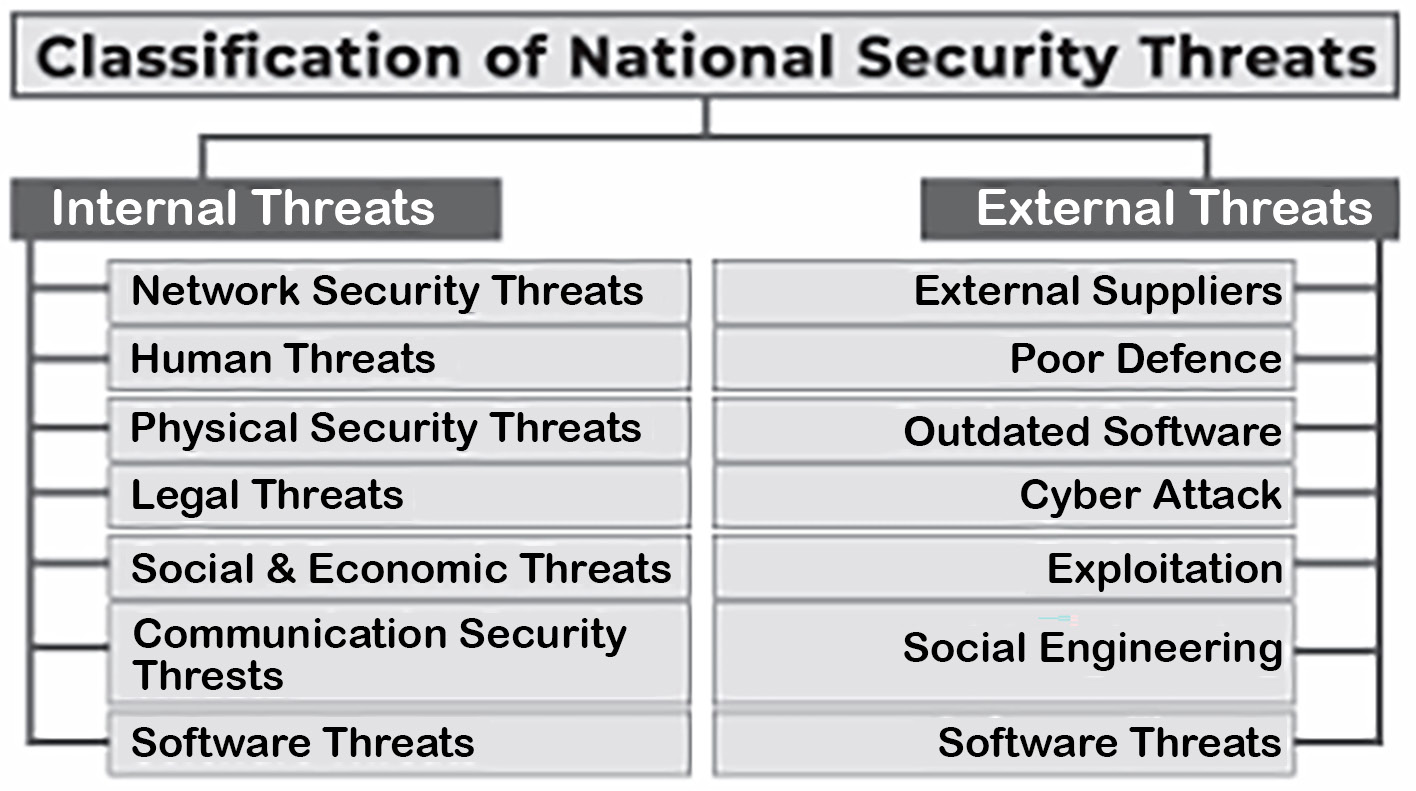
Figure: Classification of National Security Threats
TYPES OF SECURITY
• In a broad sense, National security encompasses external security, which involves protecting the nation from external threats, and internal security, which focuses on maintaining stability and safety within the country.
• National security consists of two key components: Internal Security and External Security.
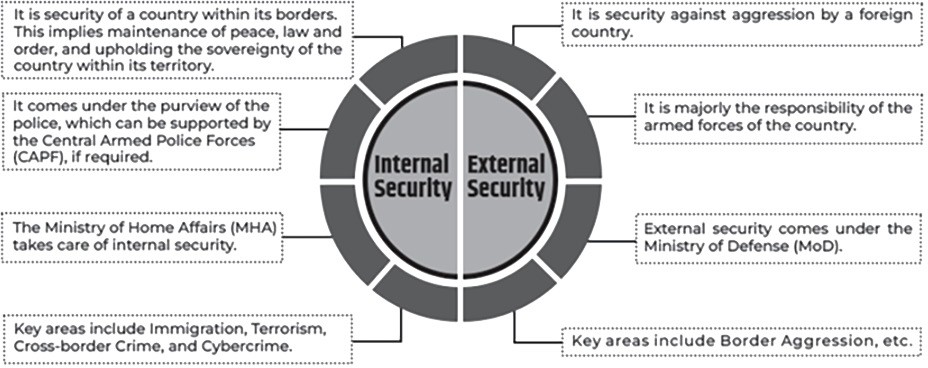
Figure: Aspects of National Security
Constituents of Internal Security
• Maintenance of Law and Order
• Safeguarding Sovereignty of the Nation
• Ensuring Domestic Peace and Tranquility
• Equality
• Freedom from Fear
• Social Harmony and Fraternity
• Non-discrimination
TYPES OF SECURITY THREATS
• India’s security environment is defined by a complex interplay of regional and global imperatives and challenges. It is impacted concurrently by the positive forces of global connectivity like economic and social integration, on one side, and on the other by the obstructive consequences of unpredictability, instability and volatility that connectivity brings.
Security Threat: It is defined as an event or condition that has the potential for causing asset loss and the undesirable consequences or impact from such loss.
• Classification of Security Threats includes Internal and External Security threats:
• Internal Security Threat refers to threat to maintenance of peace, law and order within a country’s territory. Internal Security comes within the realm of Ministry of Home Affairs in India. For example, radicalisation of youth, proxy war with Pakistan, insurgencies and organised crime apart from illegal cross border migrations, terrorism supported from outside etc.
•
External Security Threat refers to security threat of aggression by foreign countries. External security comes under Ministry of Defence. It includes issues arising out of the border disputes with the neighbours. It can be traditional and non-traditional.
Traditional Threats are the military threats that are faced by a nation from another nation that that has a negative effect on its sovereignty, integrity, trade, etc. They affect only the state. For instance, issues arising out of disputed borders with our neighbours.
Non-Traditional Threats affect the state, individual and the entire humanity. They cover other aspects like terrorism, piracy, natural disaster, drug trafficking, illegal migrants etc.
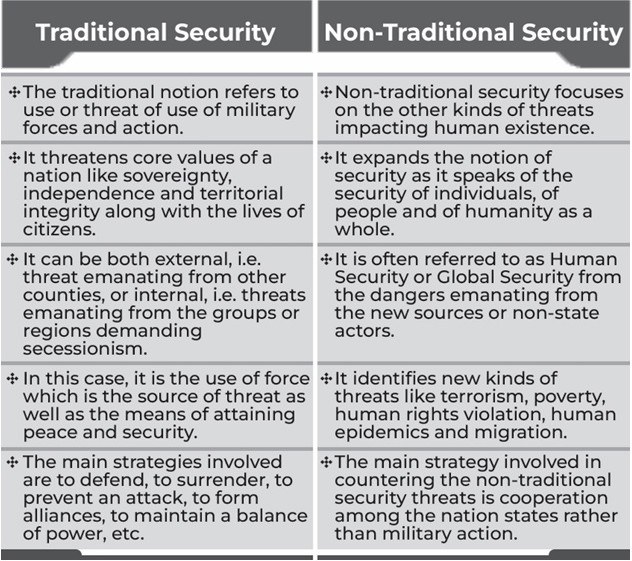
Figure: Difference between Traditional and Non-Traditional Security
Threats to National Security
• In his Arthashastra, Kautilya wrote that a state can be at risk from four threats:
• Internal Threat (like a revolt or rebellion or separatism of Nagas)
•
External Threat (such as on the border from enemies during war)
• Internally-Aided-External Threat (like domestic support in India for Khalistani terrorists in Canada)
Externally-Aided-Internal Threat (Most dangerous, like sleeper cells in India acting on the support of Lashkar-i-Toiba in Pakistan)
• According to the Institute of Defence Studies and Analysis (IDSA), India is currently facing four major threats viz. Separatism in Jammu and Kashmir; Insurgency in North East India, Left Wing Extremism and Terrorism in the Hinterland.
• Out of them, the first and the last are a direct manifestation of Pakistani influence, which includes the ISI and Pak military. In recent times, these two threats also getting sharper due to rise of ISIS in Middle East. The insurgents in north east get direct and indirect support from neighbours of India around its porous north east border. The Left-Wing Extremism has direct and indirect support from Nepal, China and other countries of South East Asia.
Internal & External Security Interrelated
INTERNAL & EXTERNAL SECURITY: INTERRELATED
• The relationship between external and internal security has been made much more visible and tangible in recent years, especially by terrorist attacks, internationally operating criminal networks and an increase in immigration flows. In addition, the number of cyber- attacks has also increased rapidly in recent years, just as the number of natural disasters is on the rise.
• The interrelatedness of external and internal security is not a new phenomenon. A relationship between conflicts such as those that occurred in the Balkans and internal security, a relationship that manifested itself in the form of, for example, illegal immigration and an increase in cross-border crime, was also clearly visible in the 1990s.
• There is a narrowing gap between internal and external security and new dimensions of threats are being added with evolving times, that are difficult to classify. For instance, terrorism, which generally falls into internal security, is now classified in the category of external security, as training, funding and arms support of such organisations is being carried out from outside the country.
• Nevertheless, the 9/11 attacks in the United States in 2001 and the attacks on civilian targets, particularly the 2004 Madrid train bombings, 7/7 London bombings of 2005, 26/11 Mumbai attacks truly brought foreign-bred terrorist violence into the domestic sphere. The shock caused by these attacks made the relationship between external and internal security that much more tangible and made everyone more aware that external and internal security were part of single whole rather than separate dimensions.
• The external security policy is dominated by diplomacy and military working methods, whereas the internal security policy is dominated by an approach based on law enforcement by the police and the administration of justice by courts.
Immigration
Immigration is a phenomenon that is affected by internal and external factors through all layers of society. The further development of the issue therefore depends on social, economic, political and cultural factors.
India's national security faces a serious threat from Illegal migration that happens across the borders of China, Pakistan, Bangladesh, etc. Since the independence of India, millions of migrants have entered India as illegal immigrants from countries like Bangladesh, Myanmar, Nepal, Pakistan, etc.
According to Indian security agencies, some Rohingyas who have migrated from Myanmar to India are being contacted by Pakistan-based terrorist organizations, like Lashkar-e-Toiba, whose infamous terrorist Hafiz Saeed has planned to link Rohingyas with his organization and attack them on India's chosen hideout.
Indo-Nepal open international border is also a safe passage for the illegal migrants to enter India.
Cross-border Crime:
The threats posed by transnational crime are unlikely to recede in the coming decade. There are two dominant factors in this regard: increasing flexibility and mobility and a further shift from the physical to the virtual world.
There is a direct link, for example, between human trafficking, drug trafficking and other forms of organised crime and volatile countries and regions, particularly in the Middle East and Africa.
Terrorism:
In terms of terrorism’s external source, the risk of further geographic spread is high. Moreover, the action taken by government authorities will likely cause high security risks. The degree and success of effective international cooperation are therefore of vital importance.
Furthermore, it is striking that the size and geographic reach of internationally operating criminal gangs are increasing, whereas efforts to bring them down remain fragmented across individual states, particularly smaller ones that may or may not be fighting transnational crime in the context of joint projects.
Cyber Crime:
In era of information and digital age, security threats (internal and external) are interrelated and cannot be seen in isolation from each other.
Cyber espionage, cyber terrorism and cyber crime will inevitably increase. Growing internet dependency is becoming more of an issue in this context. The value of information is increasing without being paralleled by an increasing level of protection. This problem is not given enough attention in ICT education, as a result of which there are not enough specialists who can guarantee ICT
security. A continuing lack of awareness of basic cyber threats (more advanced polymorphic malware, for example) in the public, private and civil sectors is making societies more vulnerable.
Way Forward
• There is a need to optimise the approach through Integrated Security Strategy that serves as a guide for all actors involved in domestic and foreign activities.
• Further, concerted international efforts with a deepening of cooperation between external and internal security actors is required at both policy and operational levels, and also in terms of organisational structures needed to counter emerging threats like cyber- attacks & information warfare.
• Strengthening civil-military capacity, planning, purchasing and operating at national and regional levels to improve interoperability and achieve standardisation and reduction in expenditure.
• There is a need for an active national and international policy aimed at resolving conflicts and achieving stability in regions of origin.
• Regional solidarity with respect to border control and preventing or limiting large flows of immigrants from areas of conflict.
• Strengthening the relationship between the National Cyber Security Centre and the Defence Cyber Command.
Conclusion
• Risks and threats will remain and rise in the future in all four of the areas discussed (immigration, terrorism, cross- border crime and the cyber domain). This increase will not be linear, however. In each area, changes will occur in the nature and scope of the security risks. In addition, the four areas are linked directly or indirectly.
• Other interrelated areas in the context of external and internal security include disasters, maritime, environmental and energy security. Currently unforeseeable developments in these areas may affect priorities with respect to the external-internal security nexus. A sudden interruption in the energy supply as a result of external conflicts, for example, could cause a shock in terms of internal security.
Relationship Between National Security and Foreign Policy
RELATIONSHIP BETWEEN NATIONAL SECURITY AND FOREIGN POLICY
• Clausewitz famously noted that while the essence of war remains constant, its characteristics transform in response to shifts in technology, society, economics, and politics. The 21st century has seen a significant transformation in the nature of conflicts and how states approach security. This fundamental shift in human conflicts spanning both inter-state and intra-state wars has led to the creation of a series of Comprehensive National Security Strategy documents. These documents represent an effort to formalize the approach to national security challenges.
•
For any nation, foreign policy and national security go hand in glove. Both are aimed at enhancing national interests. National interests, apart from being enduring, also have geographical content, and vary from nation to nation. The task of any government in power is to employ all its elements of power for furtherance of its national interests.
• A National Security Strategy is typically grounded in established traditions, common law, political directives or declarations, and relevant white papers. However, it is primarily shaped by the foreign policy adopted by the governing administration or leadership.
• Foreign policy is based on a country's long term national interests and takes into account both domestic and external factors. Strategic and security interests of a country do not change when governments change but the style of functioning and inter-se priorities in foreign policy undergo changes.
• While foreign policy is handled by the diplomatic corps on the guidelines of the government in power, whereas there are multiple players involved in national security like intelligence agencies, economic experts and the armed forces. These are elements of National power, which together need to find solutions to enhancing national interests and ensuring national security. Diplomacy is just one of the elements employed.
• The foreign policy of a country is influenced by a number of factors.
• from the global system to its internal political demands to the underlying cultural elements
• its society to the individual decision-makers' perceptions and personal traits On the other hand, National Security imperative is decided by the nature and scope of threats posed to the nation and national interests.
• In case of developing countries like India, the umbilical relationship between foreign policy and military capabilities is often lost sight of in resource allocations by countries as they try and balance growth and national security with social sectors vying for greater allocations.
• The Foreign Policy and Security pillar cooperates closely with the other pillars to advance a comprehensive and integrated approach to assess and analyse:
• Urgent risks and contingencies;
• Trends in key national, regional and bilateral relationships;
• National military and paramilitary capabilities and strategies;
• Global perception of the nation.
• Thus, domestic political, economic, technological, environmental, and societal developments affect the country’s foreign and military policies, and how the politics and policies our international counterparts impact the country’s internal transformation.
RAJA MANDALA THEORY OF KAUTILYA ON SECURITY AND FOREIGN POLICY
• Mandala is a Sanskrit word which means circle. Kautilya used the shape of mandala to develop a political geometry that accounts for different political realities. In the seventh book of Arthashastra, Kautilya gave a comprehensive theory of mandala for security and survival of state.
• Kautilya argued that acquiring power and its expansion is the main aim of any state. He gave importance to geography and economic foundations of a state. Kautilya strongly believed that the states are always at war and seek power, hence it is necessary to have hostile foreign policy towards few states which are either equal in power or subordinate in power.
• He elucidates three primary categories of yuddha or warfare, namely:
• Prakashayuddha (open warfare) Kootayuddha (concealed warfare) Tushnimyuddha (silent warfare)
• Kautilya listed Six Guiding Principles of Foreign Policy as listed below -
• A king would enhance resources and power of his kingdom to embark upon a campaign of conquest
• Enemies to be eliminated
• Cultivation of allies
• Adoption of prudent course of action
• Peace to be preferred to war
• King must behave as just in both, victory and defeat
• The central premise of the Mandala theory lies in locating the position of a kingdom as an enemy or ally with respect to the intending conqueror and the kingdom’s spatial placement in the mandala.
• Mandala theory would consist of four primary circles of states, 12 kings, 60 elements of sovereignty and 72 elements of states.
The 12 kingdoms are shown in the figure below-
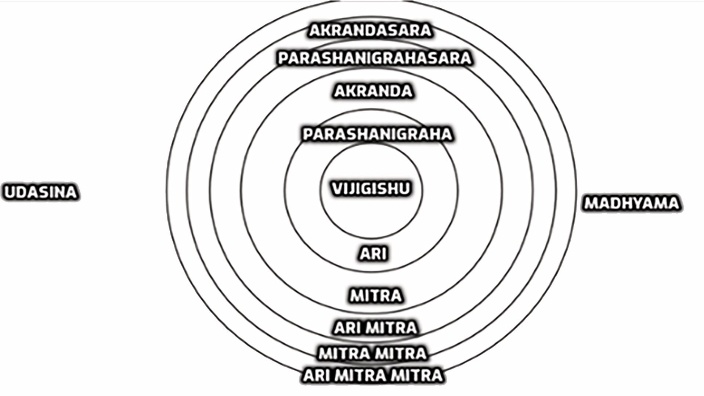
• Vijigishu: The king who aspires to be the conqueror
• Ari: Shares border with Vijigishu, an enemy
• Mitra: Friend or an ally of Vijigishu, shares border with ari
• Ari-Mitra: Friend of ari, shares border with mitra
• Mitra-Mitra: Friend or an ally of friend
• Ari Mitra-Mitra: Friend of enemy’s friend
• Parshnigraha: Enemy in the rear of the Vijigishu
• Aakranda: Friend in the rear behind Parshnigraha
• Parshnigraha-asara: Friend of Parshnigraha behind Aakranda
• Aakranda-asara: Friend of Aakranda behind Parshnigrahasara
• Madhyama: Indifferent kingdom
• Udasina: Neutral Kingdom
The four circles are explained as below
• The mandala theory argues that a direct neighbour is an enemy and an indirect neighbour is considered a friend. To sum it up, as a proverb commonly used is, enemy of my enemy is my friend. However, the case might not be true in all circumstances. For security of the state, the goal should be to strengthen the position by larger alliance building.
• Circle 1: Vijigishu, his friend, friend’s friend
• Circle 2: Ari (enemy of vijigishu), his friend, friend’s friend
• Circle 3: Madhyama (the indifferent king), his friend, friend’s friend
• Circle 4: Udasina (the neutral king), his friend, friend’s friend
Mandala Theory’s Limitations -
• In Kautilya’s time, land was the primary source of wealth & territorial expansion was the primary method of gaining wealth. But today, the world is filled with nuclear powers & waging war for territorial expansion is not a smart move.
• Collective security & collective defence are relevant & an attack against one country will draw the others to take necessary action.
• World is globalized & due to low logistic costs for trading, neighbours are the biggest assets. "For instance" and make t of though in. Though India & China are in a territorial conflict, the trade between them is nearly $90 billion, also India imports 70% of API (Active Pharmaceutical Ingredients) from China for its pharmaceutical industry.
• Energy needs & security needs also bring countries together. For instance, to deal with. common threat of terrorism, countries have already joined hands to fight against it. There is no scope in Mandala theory for all these national interests.
• Also, Kautilya wants the king to go on a conquest & conquer territory, which is not relevant.
Conclusion
There were incidences when a portion of this theory was relevant, such as annexation of Kuwait by Iraq, annexation of Crimea by Russia, Tibet occupation by China etc. But altogether, today, the world is more dynamic & also nations are joining hands to fight against terrorism, leaving little room for conducting expansionist policies against each other.
Relationship Between National Governance and Internal Security
RELATIONSHIP BETWEEN NATIONAL GOVERNANCE AND INTERNAL SECURITY
National Governance and Internal Security are deeply interconnected. Without maintaining Internal Security, effective governance becomes unattainable, posing significant threats to the nation’s unity and integrity Similarly, Internal Security cannot be upheld if governance is managed by an incompetent or corrupt administration.
Governance involves the efficient administration of national affairs at all levels, ensuring national unity, integrity, public safety, and overall well-being. To achieve these objectives, political, economic, executive, and judicial powers must be exercised in a way that enables citizens to enjoy their rights, fulfill their responsibilities, and resolve disputes within the framework of the Constitution and the Rule of Law.
The Preamble of the Constitution embodies its core philosophy, affirming the sovereignty of the people and establishing India as a socialist, secular, and democratic republic founded on justice, liberty, equality, and fraternity. Article 37 of the Directive Principles declares that these provisions are "fundamental to the governance of the country" and mandates the State to apply them in formulating laws.
According to the Constitution, matters related to Public Order and Police fall under the State List (List II, Seventh Schedule). As a result, the responsibility for maintaining internal security primarily rests with the states, which have exclusive powers under Article 246(3) to legislate and take executive action on these matters under normal circumstances. The persistence of widespread poverty, illiteracy, unemployment, inadequate housing, lack of clean drinking water, insufficient sanitation, and inadequate healthcare, nutrition, and food security signifies the failure to achieve social and economic justice. These issues stem from significant shortcomings in national governance.
Reasons for the continuing failures of Governance:
Political Instability in the States and at the Centre: Since the late 1960s, political instability has been a recurring issue in various states, and over the past decade and half, it has also affected the central government. Between 1989 and the late 1990s, six different governments came to power at the Centre within a decade, yet they failed to provide effective governance.
Politicization of Caste and Communal Identities: The exploitation of caste and religious divisions has led to societal fragmentation, weakening the national ethos. The electoral system has been unable to prevent the participation and victory of anti-social, communal, and even criminal elements in elections. This has resulted in a steady decline in the political landscape, impairing the ability of State Assemblies and Parliament to fulfill their constitutional responsibilities effectively.
Nexus Between Politicians, Bureaucracy, and Crime Syndicates: The Vohra Committee Report (1993) highlighted the growing collusion between criminal gangs, law enforcement, government officials, and politicians in various parts of the country. Some political figures have directly associated themselves
with these criminal networks, leading such groups and securing positions in local bodies, State Assemblies, and even Parliament. Over the past decade and half, this nexus has not only persisted but has also expanded its influence across multiple sectors.
Narrow, Sectarian and Partisan Interests of their Parties: It has led to gross delays, inefficiency, insensitivity, unaccountability and pervasive corruption.
Judicial Issues: Besides the enormous logistical inadequacies in the justice delivery system, the integrity of the magistracy and the subordinate judiciary is seriously tainted.
Neglect of Ethnic and Tribal Communities: Failure to timely and sensitively respond to the felt needs and aspirations of ethnic and tribal communities, most of whom live in remote, difficult and harsh areas.
External Interventions: The continuing determined efforts of adversary external agencies to destabilize India by spreading religious fundamentalism, inciting tensions which lead to conflicts, and perpetrating violence and subversion, have generated challenges which impinge on issues of internal and external security
Way Forward:
Holistic Approach: Recognising that internal and external security have got inextricably interwoven, Centre would need to evolve a holistic approach to internal security management, in close coordination with the States.
Upholding the Constitution: Internal security cannot be maintained satisfactorily in the country unless the States effectively discharge their constitutional duty of maintaining peace and public order in their realms.
Capacity Building: It is essential that every State undertakes a time-bound programme to enlarge, train and equip its police to effectively manage the existing and emerging challenges as well as to provide very strong support for the implementation of the Centre’s initiatives to maintain public order in the entire country.
Delivery of Justice: It must be particularly ensured that no injustice is done to the poor and the disadvantaged segments of society.
Awareness: It may be noted that a stable security environment cannot be engendered merely by promulgating new laws. In the ultimate analysis every citizen must discharge his duty to uphold and protect the sovereignty, unity and integrity of the country.
Conclusion
As Late President Abdul Kalam had stated in 2006, “National security is born out of two important components. One is the economic growth and prosperity; the second one is the capability to defend the nation against all types of threats.”
State of India’s Internal Security
STATE OF INDIA’S INTERNAL SECURITY
• Global Terrorism Index (GTI):
GTI report is produced by the Institute for Economics & Peace (IEP).
According to the report to latest GTI 2026,
Most Terror affected state: Pakistan ranked 1st followed by Burkina Faso, Nigeria, Niger, and the Democratic Republic of the Congo.
Least Terror Affected State: Over 80 states have been recorded as least affected states from terrorism.
India ranked 13th out of 163 countries.
• Global Peace Index (GPI):
Produced by the Institute for Economics and Peace (IEP).
The GPI covers 99.7% of the world’s population, using 23 qualitative and quantitative indicators from highly respected sources, and measures the state of peace across three domains:
The level of Societal Safety and Security,
The extent of Ongoing Domestic and International Conflict,
The degree of Militarisation.
Highlights of latest global peace index 2025 report:
The average level of global peacefulness deteriorated by 0.36% per cent.
Most peaceful countries: Iceland is the most peaceful country in the world – a title it has held since 2008. It is accompanied at the top by Ireland, New Zealand, Austria and Switzerland.
Least peaceful countries: Russia is the least peaceful country in the world followed by Ukraine, Sudan, Democratic Republic of Congo and Yemen.
India has secured a rank of 115th out of 163 countries, in 2024 it was at 116th position.
The report stated that India experienced an improvement of 0.58% per cent in overall peacefulness over the past year, owing to improvements in violent crime, neighbouring countries’ relations, and political instability.
• Global Cybersecurity Index
With a remarkable score of 98.49 out of 100, India joins the rank of 'Role-modelling' countries and has achieved the Tier-1 Status in the Global Cybersecurity Index (GCI) 2024.
By ITU (International Telecommunication Union).
It is measured based on five parameters of cybersecurity: organisational measures, legal measures, capacity development, technical measures, and cooperation.
The GCI 2024 evaluated 194 countries and highlighted threats such as ransomware attacks, breaches in critical industries, system outages, and privacy violations.
• India ranks in Tier 1 with countries like the US, Japan and Australia.
• India scored 98.49/100, an improvement from 97.5 in the 2020 edition due to its robust legal framework like the Information Technology Act (2000), the Digital Personal Data Protection Act (2023).
• Cyber Defence Index (CDI)
• Published by the Massachusetts Institute of Technology.
• It is a 'first-of-its-kind' annual comparative ranking of the world’s 20 largest and most digital economies on their preparation against, and response and recovery from, cybersecurity threats.
Australia has been placed first and this reflects efforts to make robust digital infrastructure widely available.
India has been placed at No. 17. The report says: "India struggles, despite a digitally forward government and the world’s largest IT-enabled service sectors. This powerful tech force lacks critical infrastructure, has poor national digital economy adoption, and weak cybersecurity regulation.”
ROOT CAUSES OF INTERNAL SECURITY PROBLEMS
There are various geographical, social, economic, political, strategic and governance causes which lead to the various internal security challenges facing the country as shown in the diagram below:
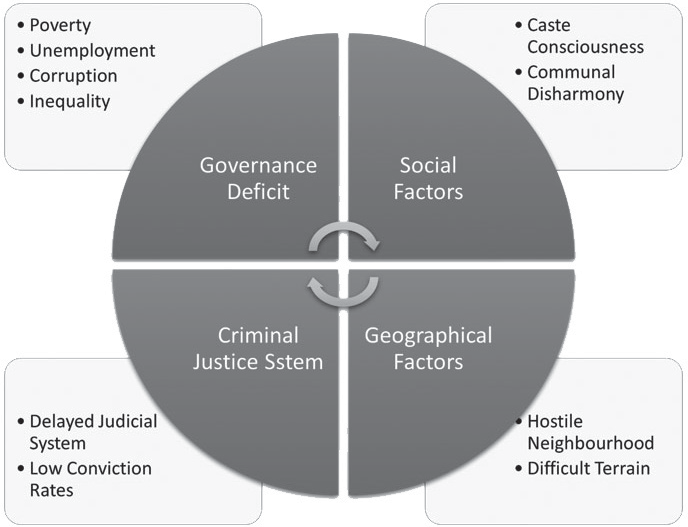
Figure: Major Causes of Internal Security Problems in India
Poverty:
• There is a positive correlation between poverty and law and order problems.
• Various studies indicate that falling national income, low GDP per capita, resource dependence, and slow economic growth increase the risk of unrest and conflict.
• It may also weaken state capacity to provide essential human services, and thereby, render states more vulnerable to terrorist networks.
• Citizen Disenchantment with the political and administrative systems may arise.
• For instance, most backward and poor districts in India are facing the menace of Naxal violence.
Unemployment:
Unemployment leads to energy of the work-force go unutilised which could have been used for the economic development instead. According to data from the Centre for Monitoring Indian Economy (CMIE), the unemployment rate in India was approximately 6.6% in June 2023, 9.2% in June 2024, and 6.85% in May 2026
The more worrying sign is the quality of jobs on offer to graduates, about 60 per cent of 8 lakh engineering graduates remain unemployed.
The dissatisfaction among youth may lead to expression of anger, frustration and may cause social unrest.
Inequitable Growth:
Income of Indians is becoming more and more inequitable.
India’s Gini coefficient rose to 0.51 by 2013, from
0.45 in 1990, mainly on account of rising inequality between urban and rural areas as well as within urban areas.
The richest 1% of Indians now own around 40% of wealth while the bottom half of the population together share just 3 per cent of wealth, according to Oxfam International report.
Resource Distribution:
• Uneven distribution of fruits of economic growth, where only selected few reaping the benefits, and a large population gets left behind in the process.
• For instance, while industries developed in mineral rich areas in central India, yet the economic development in these areas is not at par with the rest of the country. These areas have now become what is called as the ‘Red Corridor’ as the local population is involved in Left wing Extremism, primarily owing to lack of socio-economic development of the people.
Corruption:
• Corruption is well known as a threat to peace and security in the nation. Entrenched corruption undermines the development, leaving a weak state with potentially more space for insurgents to operate.
• While the poor often suffer the most, this cycle of impunity causes disempowerment, denial of justice and accountability, sowing the seeds of dissent and conflict.
• The pervasive misuse of public office for private gain is an evil eating into the vitals of the state, sapping India’s strength. Ultra Left forces were thriving as they are providing justice and governance at local levels.
Delayed Judicial System:
• The Malimath Committee on Criminal Justice System Reforms noted: “It is common knowledge that the two major problems besieging the Criminal Justice System are huge pendency of criminal cases and the inordinate delay in disposal of criminal cases.”
• About 55 million cases are pending in various courts across the country. Of them, 87.4% are pending in subordinate courts, and 12.4% in High Courts.
• People get disenchanted when they do not get quick and affordable justice. Such pendency of cases is detrimental to the national security as criminals acquire notion of impunity.
• Low Conviction Rate: On an average, the judges have 2 to 6 minutes to hear the case. Consequently, there is very low rate of conviction in cases involving serious crimes (only 47% in 2015). This has encouraged crime
and citizens have lost confidence in the Criminal Justice System.
Other Key Reasons behind Internal Security Issues:
Lack of Strategic Vision and Strategic Culture
Although India had ancient strategic texts like Kautilya’s Arthashastra, comparable to Sun Tzu’s The Art of War, and the Mahabharata with its Bhisma and Shanti Parva chapters dedicated to principles of warfare, the broader civilizational focus leaned more toward spiritual and moral values with special emphasis on shanti and ahimsa rather than on statecraft or the art of fighting. No wonder, the Mughals and the British were able to conquer the country in the absence of a strong central authority and any long-term strategy of its rulers. As Clausewitz said, “wars are lost or won by their strategists, even before they are begun”.
Neglect of Comprehensive National Power
Comprehensive National Power is the combined overall strength of a country in all factors such as territory, availability of natural resources, military strength, economic clout, social conditions, domestic government, foreign policy and its initiatives, and finally the degree of wielding international influence. However, in India, it couldn’t develop due to lack of political will and the unwillingness or the reluctance to take risks and make sacrifices.
Absence of Internal Security Doctrine
Henry Kissinger has said that the purpose of a doctrine is to translate power into policy. It is strange that even after more than seven decades of Independence we have not evolved or cared to codify our Internal Security Doctrine. The US National Security Strategy clearly states that “what takes place within our borders will determine our strength and influence beyond them”. The doctrine would necessarily have inter alia political, socio-economic, intelligence and border management angles to ensure constitutional solutions, intelligence sharing, developing defensive and offensive capabilities, border management and capacity building apart from ensuring comprehensive development and welfare.
Key Challenges to India
KEY CHALLENGES TO INDIA’S INTERNAL SECURITY
Since independence, India has raised numerous insurgencies in different parts of the country, particularly in Jammu and Kashmir, the North East and Central India, Khalistan, cross-border infiltration, terrorism, organised crime, human trafficking, drug trafficking, inflow of refugees, interstate disputes, natural disasters, pandemic, disinformation campaigns, mass protests etc. Today, the rise of social media, dark net, crypto currency has given rise to new challenges. Some of the key challenges include:
Terrorism
According to the Unlawful Activities (Prevention) Amendment Act, 2012, a terrorist act is defined as an action carried out with the intent to threaten or potentially threaten India's unity, integrity, security (including economic security), or sovereignty, or with the intention or likelihood of causing terror or fear among the people, or any specific group of people, either in India or in any other country.
It is the use of or threat to use violence to strike terror amongst the people. Terrorism can be used as an instrument of an insurgency or extremist political ideology.
Terrorism is the planned, organized and systematic use of violence as a means of coercion for political, religious or ideological purposes.
Hinterland terrorism (International and Domestic): in Punjab, Mumbai etc.
J&K militancy: The 1990s saw the beginning of militancy in Kashmir which has slowly become a pan-India phenomena with the onslaught of international terrorism in the hinterland during the past decade.
Insurgency in North-East India: The 1950s saw the North-east going up in flames, when in 1954 Angami Zapu Phizo raised the banner of revolt in Nagaland and the fire spread to Mizoram, Manipur and Tripura.
Left-Wing Extremism
The latter part of the 1960s saw the rise of Naxalism. The development deficit in these areas led to poverty, unemployment and under-development which was exploited by various anti India elements to pose a very dangerous challenge to the country’s internal security in the form of Maoism/ Naxalism/ Left-wing Extremism.
•
The term 'Naxal' is derived from a village named Naxalbari in West Bengal, where the movement originated. Naxals are regarded as extreme left-wing radicals who align with Maoist political ideology.
• Maoism originated in China as a form of Communist theory derived from the teachings of the Chinese political leader Mao Zedong. It was widely applied as the political and military guiding ideology of the Communist Party of China till 1977-78. It emphasised the advancement of people’s social and economic life by establishing a classless society through armed revolution. It was rooted in the anti-imperialist struggle and supported armed revolution in order to achieve political transformation. Naxalism is actually based on the principles of Maoism to achieve a similar transformation in India.
• The movement originated from a split within the Communist Party of India (Marxist) in 1967, which resulted in the creation of the Communist Party of India (Marxist-Leninist).
• Initially, the movement was centered in West Bengal, but it later expanded into the less developed rural areas of central and eastern India, including Chhattisgarh, Jharkhand, Odisha, and Andhra Pradesh, through the efforts of underground groups such as the Communist Party of India (Maoist).
Radicalisation
• Radicalization is the social and psychological process where individuals gradually become committed to extremist political and religious beliefs.
• This does not automatically imply that those involved will engage in violence. However, when individuals conclude that fear, terror, and violence are acceptable means to bring about ideological, political, or social change, radicalization can result in violent extremism.

Figure: Continuum of Radicalisation
E.g. Students Islamic Movement of India (SIMI) and the Indian Mujahideen (IM) are examples of ideologically radicalised groups.
Organised Crime
• Organized crime refers to unlawful activities carried out by groups or networks working together, often using violence, corruption, or other illicit means to gain financial or material benefits.
• The primary goal of such criminal enterprises is to provide illegal goods and services to a large number
of consumers. Their funding and modus operandi has mainly been arms smuggling, drugs trafficking, hawala transactions, money laundering and pumping of Fake Indian Currency Notes (FICN) to different parts of the country.
Communalism
• It is a political ideology or political doctrine which makes use of religious and cultural differences to achieve political ends.
• Communalism is a term used to describe an ideology
that emphasizes the interests and identity of a particular religious community over those of the larger society.
• This is a situation wherein religion and religious communities view each other with hostility and consider their interests as antagonistic to each other.
• It is often characterized by a belief in the superiority of one's own religious community and a hostility towards other religious communities. Some notable instances in India are- partition in 1947, anti-Sikh riots in 1984, anti- Muslim riots in Gujarat in 2002, Nuh violence in 2023 etc.
Caste and Ethnic Tensions
• Casteism is the prejudice or discrimination one shows on the grounds of another person’s caste (which is often based on one’s traditional occupation or scripture based varna system).
• Racism is a belief or doctrine of dividing people based on the superiority of one race over another based on inherited attributes. It is often associated with colour or ethnic prejudice. It can manifest in the form of nativism, xenophobia, otherness, segregation, hierarchical ranking, supremacism, etc.
• They have existed between the diverse sections of population in India. E.g. Kuki-Meitei violence 2023 in Manipur, Bhima Koregaon violence in 2018 in Maharashtra, Mirchpur caste violence of 2010, etc.
Regionalism and Inter-state Disputes
• Regionalism is a political ideology that seeks to increase the political power, influence and self-determination of the people of one or more subnational regions.
• It can be based on language, ethnicity, development, or any other distinct factors of the region.
• When regionalism creates competition or conflict between different regions, it is considered a significant threat to a nation's development, progress, and unity.
• It can also give rise to internal security issues, as insurgent groups may exploit regional sentiments to oppose the country's mainstream political and administrative framework.
Cyber Crime and Cyber Security
• Cyber Crime may be defined as any act of destroying, altering or stealing computer system/network or deleting data with malicious intentions without authorization from owner of the computer. To put it in simple terms ‘any offence or crime in which a computer is used is a Cyber Crime’.
• Sectors such as energy, transport, public sector services, telecommunications, critical manufacturing industries and interconnected financial systems are prone to cyber threats.
• Cyber-radicalisation is undertaken to recruit troops from across the border to create cybersecurity related challenges.

Figure: Rise in Cyber Threats
Psychological Wars
• This could be termed Fourth-Generation Warfare where the battleground would be the civil society with the aim to recruit, destroy and subvert the civil society itself.
• Now, the concept of conquering land is being replaced by the concept of controlling the minds of the civil society using Psy-Ops (Psychological Operation) and the one who controls the civil society would ultimately rule the world.
Border Management
• Border management maintains state presence in shared borders by surveillance, patrolling, countering illegal entries, and cooperating with pol ice and officials in neighbouring countries.
• Border management is important for containing threats to our internal security.
• A weak border management can result in infiltration of
terrorists and illegal immigrants from various borders and smuggling of contraband items such as arms, drugs and counterfeit currency.
Coastal Security
• India’s long coastline of over 7500km is vulnerable to criminals and anti-national activities.
• Over the years, there have been numerous reports of smuggling involving goods, gold, narcotics, explosives, and weapons, along with the infiltration of terrorists into the country through these coastal routes.
Information War is the use of social media to spread competing narratives has increased now as witnessed in Ukraine-Russia conflict.
Challenges to India
CHALLENGES TO INDIA’S EXTERNAL SECURITY
With India's expanding economic and military presence in the broader Indo-Pacific region, it encounters various intrastate and interstate security challenges that it must address.
• Lack of National Security Doctrine: India still does not have a well-defined and officially articulated National Security Doctrine. The absence of consensus among policymakers, inadequate coordination between different security agencies, and limited allocation of resources for long-term planning have created gaps in preparedness. This hampers India’s ability to anticipate threats, formulate proactive strategies, and prioritize defense modernization.
• Modernizing the Military: India's initiatives to reform and modernize its military in response to security challenges focus on fulfilling the requirements of all three armed services while ensuring transparency and integrity in the procurement of weapons.
• China: China is India's biggest external threat. China is a rising military power with a growing presence in the Indian Ocean region. China has also been assertive in its territorial claims along the Sino-Indian border. Eg. Incursions by China in Ladakh region in June 2020.
• Pakistan: Pakistan is another major external threat to India. Pakistan has a long history of sponsoring terrorism against India. It has a nuclear arsenal, which poses a significant threat to India's security.
• Terrorism: India faces a serious threat from terrorism. Pakistan based terrorist groups such as Lashkar-e-Taiba and Jaish-e-Muhammad have carried out a number of attacks on India in recent years. E.g. Mumbai 26/11 attacks.
• Cybersecurity: India faces a growing threat from cyberattacks. Cyberattacks can target India's critical infrastructure, government agencies, and businesses.
• Climate change: Climate change is a major threat to India's security. Climate change can lead to natural disasters such as floods, droughts, and cyclones. These natural disasters can displace people and damage infrastructure, which can lead to instability & conflict.
• Maritime Security: Threats from piracy and smuggling across India’s long coastline create challenges for our security.
•
Transnational Crimes: India is sandwiched between the Golden Crescent and the Golden Triangle and faces onslaught of human trafficking and drug trafficking.
NEED FOR A NATIONAL SECURITY POLICY AND DOCTRINE
• National Security Policy as per Joint Doctrine of Indian Armed Forces 2017
National Security Policy is based on our National security objectives and the components of National Power, weighed against the prevailing and assessed future domestic and global environment. It shall entail inherent right of self-defence, possession of deterrence capability, strategic autonomy, self-reliance, cooperation, security and friendly relations with countries.
• National Security Objectives
As per Joint Doctrine of Indian Armed Forces 2017, National Security Objectives flow from and are designed to safeguard our National Interests. National Security Objectives, like interests, influence our political, military, and economic dimensions. They provide a framework for the formulation of National Security Policy and ensuing strategies. India’s National Security Objectives are:
Maintain a strong and credible deterrence to protect national interests.
Safeguard the country's territory, airspace, maritime zones, trade routes, and cyberspace.
Ensure internal security to counter threats that could disrupt national unity and development.
Enhance and deepen "Constructive Engagement" with other nations to support regional and global peace, as well as international stability.
• A National Security Doctrine (NSD) usually describes the internal and external challenges facing a country, outlines its core interests, and sets guidelines for addressing current and prospective threats and opportunities.
• Developed countries like United States, France, Russia, Japan etc. have such doctrines. National Security Strategy (NSS) details specific steps that need to be undertaken to achieve doctrinal objectives. Countries opt to release such documents for a variety of reasons.
• Signal strategic intent and military preparedness to their allies and adversaries.
• Convey any change in their strategic posture in light of an evolving geopolitical situation.
• Others like China publish a defence white paper aimed primarily at an external audience.
• India’s Policies of Strategic Ambiguity and Strategic Autonomy, opting for a doctrinal approach would allow policymakers greater manoeuvring space in choosing an appropriate course of action to achieve stated objectives. There are several reasons for India to formulate an NSD.
| NSD Serves as a Foundation Document | Commitment Traps and Bureaucratic Inertia? |
| First, developing such a doctrine requires an analysis of all external and internal threats would necessitate cooperation and coordination between various ministries, armed forces, and state governments. This will improve efficiency by cultivating a common understanding and deeper comprehension among different national security actors. Second, an NSD would serve as a foundational document, outlining guiding principles for security, foreign, trade and investment, science and technology policies etc. This will facilitate continuity and coordination across the government departments to achieve stated national security objectives. Third, an NSD would also provide conceptual clarity on threats to national security in a world where everything is becoming securitised. It ensures that the state does not overreach in the name of security and save scarce resources by over-securitising, which in turn can hurt India’s developmental imperatives. Fourth, an NSD would provide an impetus for implementing regulatory and military reforms. For example, an NSD can help guide the theaterisation reform underway in the Indian military. This would also improve the accountability of the government to the people. | One of the arguments against an NSD is that it would bind India into a commitment trap, where the asymmetry between the scale of the security challenge and resources at disposal may pressure the government to prioritise defence and security at the cost of developmental imperatives. Though, the purpose of an NSD is to provide a comprehensive framework. But specific steps that need to be taken would be at the discretion of the policymakers and contingent on factors such as economic growth, domestic and international environment, resource constraints etc. Furthermore, due to the comprehensive and broadnature of an NSD, there will likely be significant bureaucratic and administrative inertia, risk of turf wars between departments and few ministries dominating the consultative process. Therefore, special efforts would have to be made to ensure a robust internal debate to make such an exercise a success. |
According to Takshashila Foundation, India’s National Security Doctrine could have the following key points:
• To create and defend a conducive environment for Yogakshema (well-being, prosperity, and happiness) of all Indians i.e. protecting and As a Swing Power, we must seek to shape the world’s political, economic, and technological order.
Defend India’s interconnectedness with the world.
• Protect the constitutional order, individual liberty, territory, social cohesion and national resources.
Securing the Republic of India and its institutions.
Protecting the rights of all Indians.
Comprehensive view of territory including land, sea, air, space and cyberspace.
Social cohesion.
Sustain and enhance natural, environmental, and social capital.
Amass and project power across all domains.
Develop both continental and maritime power projection capabilities.
Humane and effective management of internal security.
Develop intelligence as a credible instrument of statecraft
Reimagine national security capacity.
Boost the fighting spirit of the armed forces.
Federal “whole of government” approach to national security management.
Nurture a globally competitive defence technology industry.
Build leadership in government for prudent use of power.
NATIONAL SECURITY STRATEGY AND OTHER DOCTRINES
• In 2018, India’s Defence Planning Committee was tasked with formulating a National Security Strategy (NSS).
• Indian government needs to formulate a National Security Strategy to provide clarity on the country’s external security threats and how the Centre aims to address them.
• It is essential for a country to provide clearer guidance to its military, step up military reforms and prevent ad hoc decisions by government departments dealing with national security.
• The NSS emerges from a complex process of iteration, evaluation and assessment of competing interests, which determines the type and quality of inputs received, the factors considered, deductions arrived at, and the varied options presented to the appropriate decision-making authority.
• Currently, the political direction to the Armed Forces is through:
• Defence Minister’s Operational Directive 2009
• Joint Doctrine of Indian Armed Forces (JDIAF) 2017
by Integrated Defence Staff (IDS)
• Indian Army’s Land Warfare Doctrine, 2018 (LWD)
• National Security Strategy as per Joint Doctrine of Indian Armed Forces
• Our National Security Strategy (NSS) primarily revolves around safeguarding our Nation from any type of internal and external threats/aggression.
• In addition, our NSS encompasses preservation and strengthening of India’s democratic polity, development process, internal stability and unity in its unique multi-cultural settings.
• Our NSS also addresses the general well-being of our vast population, the vitality of our economy in context of globalisation and the rapidly advancing technological world.
• A regional and an international environment of peace and cooperation will facilitate the safe guarding of our interests.
• though we have no formally articulated National Security Policy and Strategy, it does not imply that they do not exist or are not sufficiently understood.
• Central to our NSS is to maintain an effective conventional and nuclear deterrent capability.
JOINT DOCTRINE OF INDIAN ARMED FORCES 2017
• India’s National Military Objectives
• National Military Objectives (NMOs) accruing out from National Security requirements are as follows:
• Prevent conflict by maintaining strategic and conventional deterrence across all levels of military engagement, ensuring the defense of India, its national interests, and sovereignty.
• Conduct military operations to safeguard territorial integrity and secure a favorable outcome in war, aligning with stated or implied political objectives.
• Assist in maintaining internal security when required.
• Be prepared to respond to domestic and international contingencies by providing Humanitarian Assistance and Disaster Relief (HADR), supporting civil authorities, and participating in international peacekeeping missions when called upon.
• Achieve a high level of self-reliance in equipment and technology through indigenization, aiming for technological independence by 2035.
• The Joint Doctrine of Indian Armed Forces (JDIAF) issued under the aegis of the HQ Integrated Defence Staff (IDS) in April 2017 lays down for itself key Military objectives with the following provisions :
• Special Forces units will be “tasked to develop area specialization in their intended operational theatres” to achieve an optimum effect.
• Surgical strikes - These are attacks aimed a particular legitimate military target and not intended to cause any collateral damage to person or property in the adjacent areas of the target. These have been recognized as a major retaliatory toolkit against any sort of terror provocations.
•
Shift in Nuclear strategy - There has been a shift of nuclear strategy from credible minimum deterrence to credible deterrence.
It adds that conflict will be determined or prevented through a process of credible deterrence, coercive diplomacy and conclusively by punitive destruction, disruption and constraint in a nuclear environment across the Spectrum of Conflict.
• Expanding overseas operations – The document provides for complete and effective inter-operability with countries both big and small. These involve logistics, communications and intelligence collaboration with the countries like USA, Australia and Japan. It has made reference to the 2015 Maritime Security Strategy wherein the emphasis has been on the position and role of Indian diaspora mostly in the Middle East or North African regions that are connected through the seas.
• Integrated Theatre Battle - The doctrine provides that Integrated Theatre Battle shall be undertaken for ensuring decisive victory in the network centric environment.
• Self Sufficiency - The National Military Objective under it provides that India must work towards achieving self-sufficiency in defence equipment and technology and target for technological independence has been set at 2035. The Make in India initiative can play a great role in this regard.
Key Issues in the Doctrine:
• Lack of a codified national security strategy continues to hobble both jointness and defence planning.
• Nuclear doctrine shift – By indicating the shift in nuclear doctrine, an anomaly has been created between the Nuclear Doctrine and the new Joint Armed Forces Doctrine.
• Pakistan looms large in Indian defence thinking and connects the joint doctrine to India’s recently-avowed proactive, limited-aims strategy designed to address a Pakistan-related contingency.
• Incomplete and conflicting signals regarding a putative “limited-aims strategy”.
• Continental view of threats is an “army-centric doctrine” with insufficient role of the other two services.
• Unclear on Indian nuclear command and control and force posture.
• Near-absence of force projection and interoperability with friendly foreign countries.
Conclusion
• The doctrine document merits close analysis, including potentially a new portrait of how India separates the control of its nuclear weapons between military and civilian authorities. Moreover, how the Indian armed forces envision future conflicts (in short, “unrestricted, unpredictable, and hybrid”) and civil-military relations.
• The Joint Armed Forces Doctrine of 2017 is an effort towards integrating the various groups of armed forces.
The doctrine is a bold announcement, but without the necessary elements in place, it will remain just another document like the policy formulations enunciated earlier.
LAND WARFARE DOCTRINE 2018
• The Indian Army today is engaged in the management of complex and active land borders coupled with ongoing Counter Insurgency (CI)/ Counter Terrorism (CT) operations leading to a ‘No War No Peace’ Scenario. The primary role of the Indian Army is to preserve National interests and safeguard sovereignty, territorial integrity and unity of India against external threats and internal subversion by deterrence or by waging war.
• The primary approach of our Nation is to resolve disputes
in an amicable manner, with National Objectives being achieved through a mix of Politico-Diplomatic initiatives. However, the Indian Army will continue to undertake a 360-degree overview of the security environment and shall be prepared to prosecute military operations in a multi- front scenario in all dimensions, to achieve Politico- Military objectives. We will fight as we are, at the time and place of our choosing, utilising all resources, after prioritising the options based on our capabilities and emerge victorious, while continuing to upgrade our capabilities.
• This doctrine provides broad tenets for the prosecution of operations by the Indian Army across the entire spectrum of conflict. The focus will be on force modernisation, resource optimisation and innovative conceptual processes leading to winning strategies for future wars.
The 2018 Doctrine covers:
• Geostrategic Environment – environmental realities and future security challenges;
• Spectrum Of Conflict and Force Application - current dynamics of no war, no peace, conflict scenarios, noncombat and hybrid warfare, military operations other than war (MOOTW), enhancing defence capability, military diplomacy;
• Capacity Development – focus areas, multifront capability, ISR and precision strike, theaterisation of critical assets, information warfare (IW), techno-centric warfare, space warfare, special forces capability, force projection capability, operational readiness, nuclear environment and training. It has been stated that a pragmatic mix of both, capability and threat-based approaches, will enable a greater span of responses to plausible scenarios for force developers to work on.
• Effective Integration - of soldiers, artificial intelligence
and Robotics into warfighting systems that exploit existing capabilities for success in battle.
• Integrated Battle Groups (IBGs), which is also planned in the restructuring of the Army, will be deployed.
• The Indian Army shall be prepared to address collusive threats in all.
• This doctrine is to “lay the foundation for formulation of strategies for the Northern and Western Fronts and Operational Directives”.
Criticism:
• Vague and Generic Terms: Strategy, concept or doctrine must be explained in clear terms and send a message that we mean business.
• Lack of Clarity: It is not clear whether Integrated Battle Groups (IBG) will be applicable in Northern and Eastern Army or how do we address collusive threat with the exercise of reducing Army’s manpower by 1,00,000-1,50,000.
• Ambiguous Approach: We need more clarity on threat- based versus capability-based approach.
• Missing Issues: However, it is too crisp, missing some important issues like operational art, manoeuvre-warfare etc.
Lack of Assessment of Progress: When a doctrine is published after a gap of about eight years, one looks for changes that have taken place since the last one. Those should be clearly brought out.
• Missing Synergy: Appropriate application of tri-service force is also mentioned but the missing synergy between the three services is a well-documented fact.
• Lack of Budget: In addition, the Army’s quest for capacity building for network centric warfare is in state of semi rigor mortis due to various factors including poor defence budget allocations.
• Army Centric Approach: Finally, the doctrine states that the Army shall be the primary instrument of the overall deterrence capability of the nation.
• Missing Connect: Apparently, connect between theaterisation and ‘theatre specialisation’ is missing, especially where SF need time to develop own sources.
• Poor Border Infrastructure: Similarly, issues like quick mobilisation, inter-theatre reserves with interoperable equipment/assets can hardly be effective in areas where border infrastructure continues to be woefully inadequate
– especially in the northeast.
Way Forward:
• In this context it is reiterated that India continues with a strategic asymmetry vis-à-vis China and Pakistan in terms of sub-conventional warfare, which needs to be addressed.
• There is urgent need for India to develop publicised overt capabilities and deniable covert capabilities as deterrence against irregular war thrust upon us and we must have the will to selectively demonstrate such capability to ensure its credibility.
• Proper funding, infrastructure and greater clarity on future warfare challenges and responses will be a great boost to the strength of the armed forces.
CONCLUSION
Integrated effort is needed to ensure success in the battleground. Global Best Practices and global military defence strategies must be employed in India’s unique context to ensure better response to various security challenges and a respectable, secure and responsible place in the comity of nations.