Linkages Between Development and Spread of Extremism
INTRODUCTION
Development and internal security are deeply interconnected, each playing a vital role in sustaining the other. The absence of development and limited opportunities for progress often create an environment where extremist ideologies can take root, and conversely, instability hinders economic and social growth.
A significant number of individuals who join extremist groups come from marginalized or underprivileged backgrounds or reside in regions that appear to have been left out of the overall progress witnessed in other parts of the country.
Extremism
Simply defined, it is an opinion/belief/attitude or state of being extreme or the advocacy of extreme measures or views.
It involves actively opposing core values such as democracy, the rule of law, individual freedom, and respect and tolerance for diverse religions and beliefs etc.
As a result of this opposition, the extremist tries to impose one’s own opinion and value system on others.
Extremism becomes problematic when it endangers democratic values, challenges societal tolerance, or advocates for violence as a means of coercion and goal attainment.
LEFT WING EXTREMISM (LWE) IN INDIA
Definition
Left-wing extremism is a form of armed insurgency against the State motivated by leftist ideologies.
It is a collective term for all efforts directed against the free democratic order that are based on treating the values of freedom and social equality as absolutes, especially as they are found in anarchist and communist ideas.
Ideology
Left-wing extremists seek to do away with the existing state and social order, and therefore with the free democratic order.
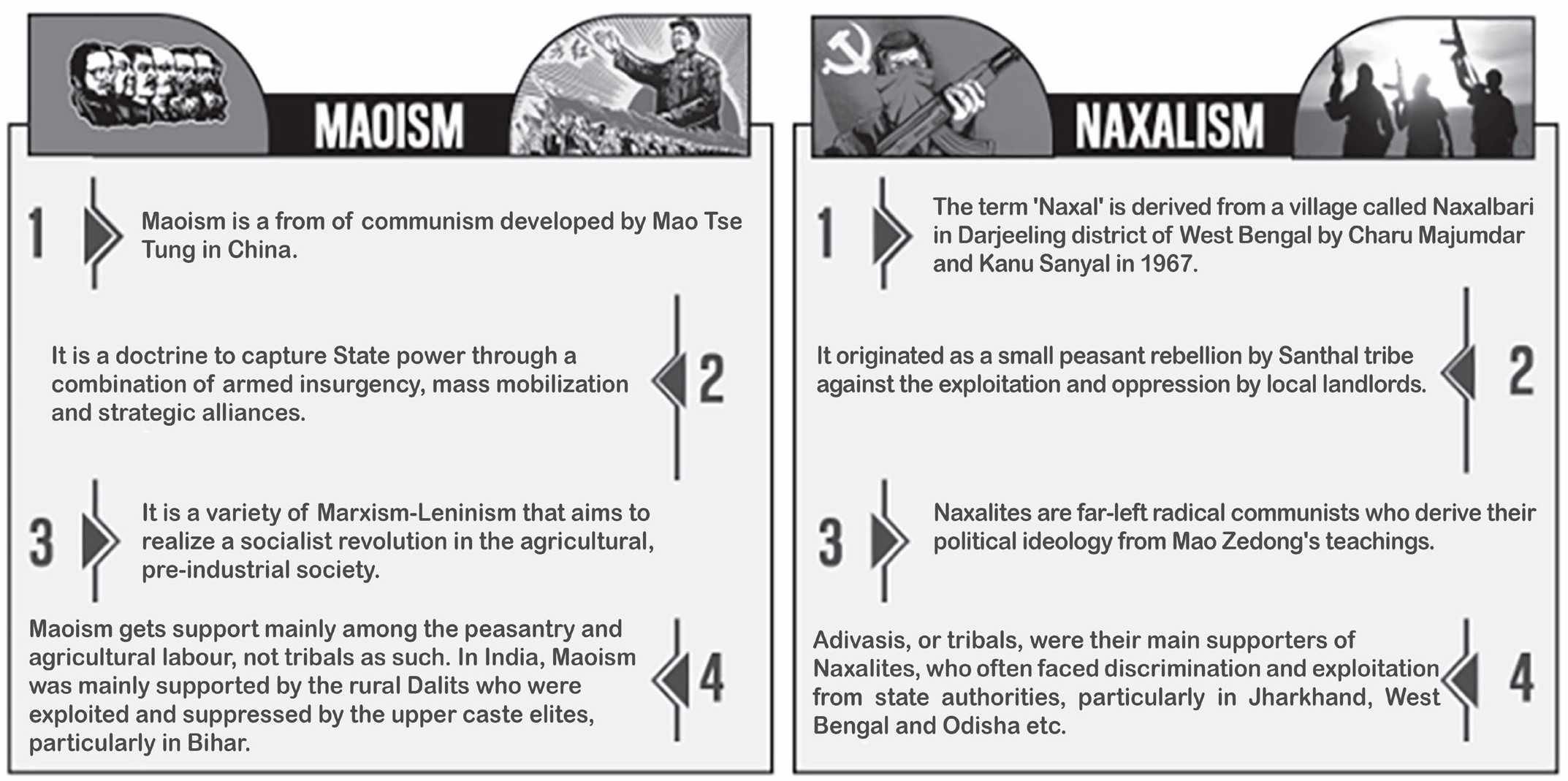
Figure: Maoism v. Naxalism
• Depending on their ideological orientation, they want to replace it with a communist system or an anarchist society “without rulers”.
• All left-wing extremists agree that “capitalism” as the “root of all evil” has to be fought and eliminated.
• Left-wing extremists believe that overcoming “capitalism”, which they regard as necessary, is not possible through political reforms, but can only be achieved by overthrowing the existing state and social order through mostly violent means.
• The ideology of Naxalism is a deadly combination of the ideology of Marxism, Maoism and Leninism.
Methods
• Violence: They reject parliamentary democracy and are aiming at waging an armed revolution against the government.
•
Political Participation: Some groups also engage in parliamentary politics while at the same time, maintaining underground cadres. Examples of such groups: Communist Party of India (Marxist-Leninist) Liberation and the Communist Party of India (Marxist-Leninist) Janashakti.
• Mass Movement: They try to get the support of the marginalised people in rural areas by espousing their cause and projecting their real and perceived grievances.
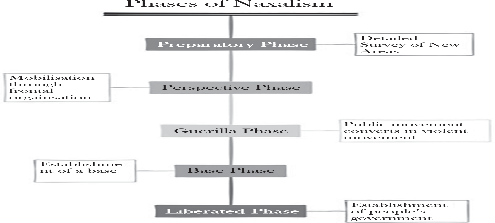
Stages of Naxalism Expansion
Figure: Phases of Naxalism
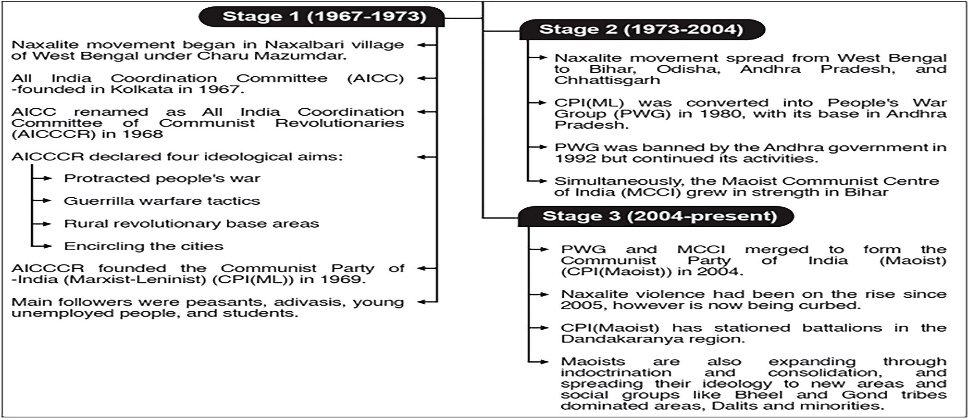
Figure: Stages of Expansion of Naxalism
Factors That Led to Spread of Naxalism in India
Left-wing extremists aimed to establish their own vision of the State through a "revolution," which they sought to achieve by gaining the support of marginalized and oppressed communities, especially in tribal regions where these groups formed a substantial portion of the population.
As per the Expert Group on Development and the Causes of Discontent, Unrest, and Extremism under the Planning Commission, several factors contribute to this issue, including:
• Land-Related Issues
• Circumvention of land ceiling regulations.
• Presence of special land tenures that are exempt from ceiling laws.
• Unlawful occupation of government and community- owned land, including water bodies, by influential groups.
• Absence of legal ownership for public land cultivated by landless individuals.
• Weak enforcement of laws that restrict the transfer of tribal land to non-tribals in Fifth Schedule areas.
• Failure to recognize and regularize traditional land
rights.
• Displacement and Forced Evictions
• Forced removal of tribal communities from their ancestral lands.
• Displacement due to irrigation and power projects without adequate rehabilitation measures.
• Large-scale land acquisition for ‘public purposes’ without fair compensation or proper resettlement.
• Economic and Livelihood Challenges
• Food insecurity exacerbated by corruption and inefficiency in the Public Distribution System.
• Loss of traditional livelihoods with no viable alternative employment opportunities.
• Denial of customary rights over common property resources.
• Poverty, joblessness, lack of education, and wealth disparities serve as key factors driving extremism.
• Social Exclusion Challenges
• Denial of dignity and respect.
• Persistence of untouchability in various forms in certain regions.
• Ineffective enforcement of special laws aimed at preventing atrocities, safeguarding civil rights, and
abolishing bonded labor.
• Social fragmentation, marginalization, relative deprivation, and unmet aspirations for upward mobility are key contributors to extremism.
• For example, in India's northeastern region, many tribal communities support extremist movements due to a perceived threat to their cultural identity from migration both internal and external into their territories.
• Governance Deficiencies
• Corruption and inadequate or non-existent delivery of essential public services, such as primary healthcare and education.
• Inefficient, untrained and demotivated public officials who are frequently absent from their designated posts.
• Abuse of power by law enforcement agencies and violations of legal norms.
• Manipulation of electoral politics and ineffective functioning of local governance structures.
• Governmental neglect can create resentment and anger among people allows extremists group to prey on the marginalised. Further, it creates an air of impunity for extremists who are able to have a free run without adverse actions from the state.
• Tri-Junction Theory: areas situated around the tri- junction of borders of three states have governance- deficit as they lack transport, communication and other infrastructure. E.g., Dandakaranya—the worst affected Maoist area in the country is an appropriate example.
• Cultural Issues
• Another important factor to consider is the disruption of the long-standing relationship between tribal communities and forests. Traditionally, tribal life was deeply intertwined with forest ecosystems, but legislative measures and governance policies over the past century have significantly altered this balance. Laws such as the Forest Act of 1927 and the Forest Conservation Act of 1980, along with strict Supreme Court rulings, have effectively restricted tribal access to forests, severely impacting their way of life and livelihoods. As a result, many tribal groups have grown disillusioned with the government's approach to forest management, leading to broader resentment toward the authorities.
• Jal-Jangal-Jameen Issue: Tribals feel alienated if a specific model of development is imposed upon them. Further, such imposition without their consent have led to deprivation of their livelihood and large- scale displacement from their native lands.
• Political Issues: Where human rights and democratic values are lacking, disaffected groups are more likely to opt for a path of violence to oppose the severe restrictions on civil liberties and political rights they experience.
• Unmet Constitutional Mandate
• The provisions of the Fifth Schedule of the Indian Constitution are designed to protect and promote the
interests of Scheduled Tribes (STs) living in scheduled areas, which are predominantly tribal regions. Article 244 provides for setting up Tribal Advisory Councils in Scheduled Areas of which 3/4th representatives shall be Scheduled Tribes. The council shall advise on welfare and advancement of Scheduled Tribes.
• However, the development policies like mining, large hydroelectric projects, industrialization, rails, roads causing evictions and forced migration from forest land are the main alienating sources of tribal populations.
• E.g., Dogria Kondhs were evicted by Vedanta group in Niyamgiri hills of Odisha where the hill itself was considered a deity by the tribe and land was seized without the prior consent of the Scheduled Tribes.
• Failure of Implementation
• Despite the enactment of various laws aimed at addressing land-related challenges such as imposing land ceilings, redistributing surplus land, consolidating holdings, preventing land fragmentation, safeguarding tenant rights, and settling wastelands their actual impact on the ground remains minimal due to sluggish and ineffective implementation.
For instance, in Andhra Pradesh, there is a
widespread belief that land officially allotted to the landless through pattas is, in reality, controlled by influential and wealthy individuals. As a result, even tribal leaders often end up working as agricultural laborers on these lands instead of owning and cultivating them.
• Panchayats (Extension to the Scheduled Areas) Act, 1996 (PESA) was passed to empower local self-
governing institutions, particularly the Gram Sabhas (village assemblies), in these Scheduled Areas to take control over their own resources and manage their affairs more effectively. Rights over Minor Forest Produce (MFP) are inherent in statute for all Gram Sabhas without the need to claim rights. PESA, by section 4 (m) (iii), gave to Gram Sabhas the power to not only prevent alienation of land but also to restore illegally alienated land.
• E.g., Sub-Divisional Level Committees (SDLC) and District Level Committees (DLC), especially in Scheduled Areas, are rejecting the claims of OTFDs, despite Gram Sabha’s approval stating falsely that FRA applies only to STs.
• In Niyamgiri Hill case, PESA was also violated as land was acquired by force and corruption.
• Poor implementation has resulted into:
Lack of autonomy: The Fifth Schedule provides for a certain degree of autonomy to the tribals in the Scheduled Areas. However, this autonomy has not been fully realized in many cases leading to a sense of alienation and marginalization among the tribals, making them more susceptible to LWE propaganda.
Lack of inclusive policies.
Lack of adequate dispute resolution mechanisms
– leading to conflict escalation.
Increased exploitation and marginalization.
Challenges in Handling LWE
Lack of clarity, legal infirmity, bureaucratic apathy, absence of a political will.
No specific rule-making powers or time period for rule making.
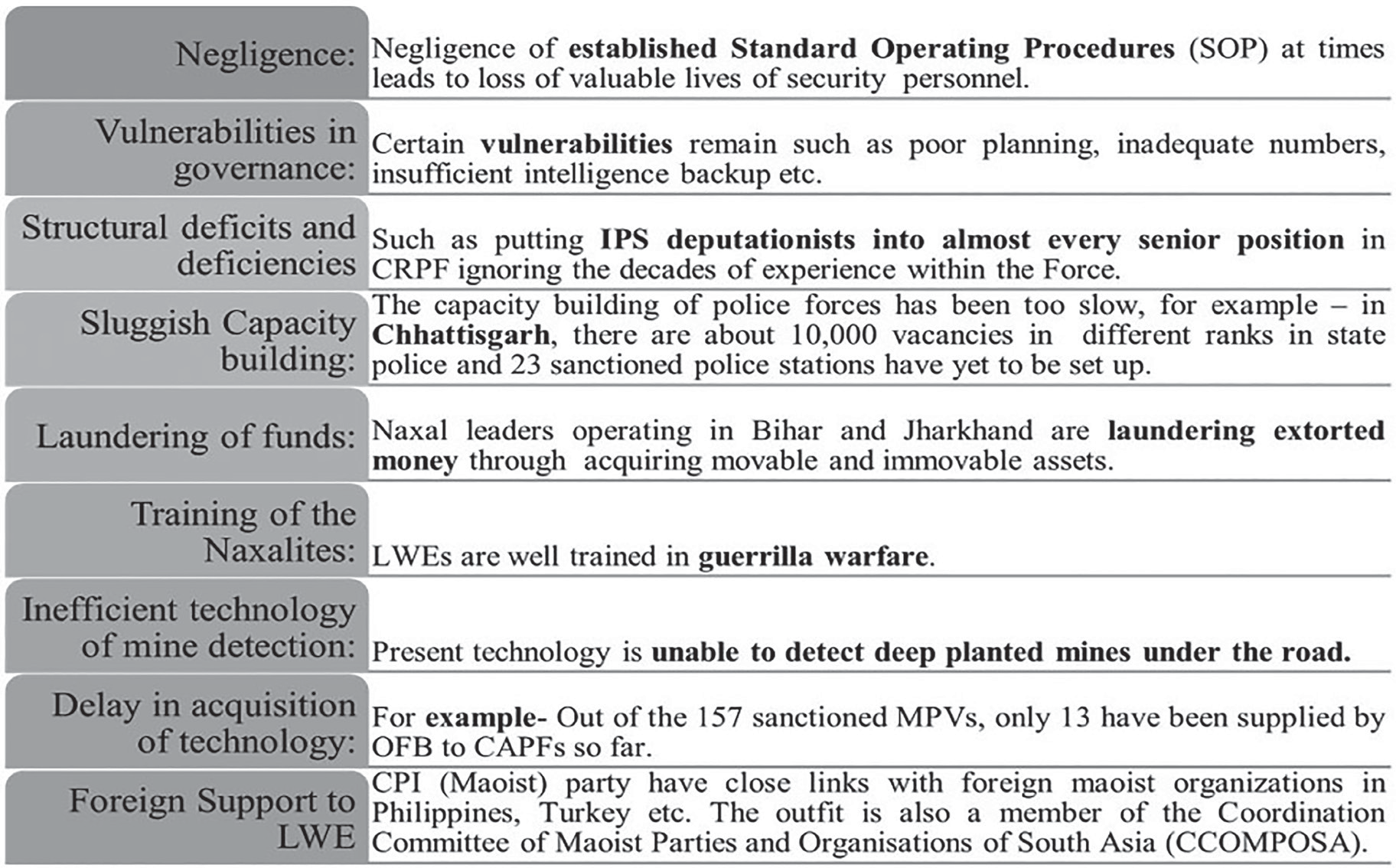
Figure: Challenges in handling Left-wing Extremism
Government Initiatives
• Although 'Police' and 'Public order' are State subjects, Centre supplements the security efforts of the State Governments through various schemes.
• Naxals' Financial Choking
By creating a special vertical inside the NIA that confiscated assets valued at more than ₹40 crore, states seized more than
₹40 crore, while the Enforcement Directorate seized ₹12 crore, the Central Government effectively blocked Naxal financing.
• Capacity Building of States by Central Government
Road Connectivity in LWE Areas:
The Central Government has built 12,000 km of roads in areas afflicted by Left Wing Extremism between May 2014 and August 2025, and projects totaling 17,589 km have been approved at a cost of ₹20,815 crore, guaranteeing all-weather connectivity and mobility in hitherto unreachable places.
• Mobile Network Expansion:
8,527 (4G) towers have been approved under the Aspirational Districts and 4G Saturation plans, with 2,596 and 2,761 towers, respectively.
• Financial Inclusion in Affected Districts
The Central Government has ensured deep financial inclusion
in LWE-affected districts by establishing 1,804 bank branches, 1,321 ATMs and 37,850 banking correspondents.
• Educational Empowerment (Skill Development in 48 Districts)
By approving 61 Skill Development Centers (SDCs) and 48 Industrial Training Institutes (ITIs) with an investment of ₹495 crore, the Central Government has initiated skill development programs in 48 districts impacted by LWE. Of them, 46 ITIs and 49 SDCs are currently operational, offering young people in the community job opportunities and vocational training.
• Surrender and Rehabilitation Scheme
All surrenderers receive a monthly stipend of ₹10,000 for 36 months of professional training, while high-rank LWE cadres receive ₹5 lakh and middle/lower-rank cadres receive 2.5 lakh. Consequently, 521 LWE cadres turned themselves in this year alone; after the new state government took charge, the number increased to 1,053.
• Good Governance
• Forest Clearances: To accelerate development in Left- Wing Extremism (LWE) affected states, the Ministry of Environment and Forests had previously granted general approval under the Forest (Conservation) Act, 1980, allowing the diversion of up to 40 hectares of
forest land for infrastructure projects across 14 sectors, including schools, dispensaries, and hospitals.
Skill Development and Employment
ROSHNI: A placement-linked skill development scheme targeting rural men and women, mostly the tribal population (especially PVTGs), in 24 worst affected districts.
National Rural Employment Guarantee Programme (NREGP) is being implemented in 330 districts affected by Naxalism so as to universalize the demand-driven programme for wage- employment.
Civic Action Programme (CAP): Under this initiative, funds are allocated to Central Armed Police Forces (CAPFs) deployed in LWE-affected areas to carry out various civic activities aimed at improving the welfare of local communities.
Media Plan: Efforts such as Tribal Youth Exchange programs conducted by Nehru Yuva Kendra Sangathan, along with radio jingles, documentaries, pamphlets, and other outreach initiatives, are being undertaken.
Ban on CPI(M): The Communist Party of India (Maoist), the primary Left-Wing Extremist group responsible for a significant number of violent incidents and casualties, has been classified as a terrorist organization. It, along with its affiliated groups and front organizations, has been listed under the Schedule of Terrorist Organizations in accordance with the Unlawful Activities (Prevention) Act, 1967.
Armed operations
Operation Steeplechase, 1971: Indira Gandhi took advantage of President's rule to mobilise the Indian Army.
Salwa Judum: Chhattisgarh government in 2005 constituted a non-state militia, comprised of surrendered Naxalites and local tribal youth trained for carrying out anti Naxalite operations. However, in 2011, Supreme Court declared such militia as unconstitutional and ordered for its disbandment. However, still parts of it can be found in Armed Auxiliary Forces, District Reserve Group and similar organisations.
Successful Initiatives in Dantewada in Bastar Region
• As per 2023 data, the incidents of Left-Wing Extremism (LWE) have declined by 52 per cent in Chhattisgarh in the last five years and 589 villages have been freed from clutches of the menace. Separate women police stations and special women cells have been established. Famous initiatives in Dantewada include:
• Solar Powered Education City:
It aims to establish Dantewada as an education hub
• Sanctioningof new Specialized India Reserve Battalions (SIRB).
• Operation Green Hunt, 2009: The "all-out offensive" against the Naxalites.
Strengthening Intelligence
• Multi Agency Centre (MAC) at the Central level and State Multi Agency Centre (SMAC) at the State level on 24x7 basis collect and analyse intelligence.
• Additional measures to enhance the intelligence framework include the establishment of Joint Command and Control Centers in Jagdalpur and Gaya, reinforcement of both technical and human intelligence, improved coordination between Security Forces, district police, and intelligence agencies, emphasis on real-time intelligence gathering, and the creation or strengthening of State Intelligence Bureaus (SIBs) in LWE-affected states.
SAMADHAN DOCTRINE 2017
Key Highlights of Samadhan include:
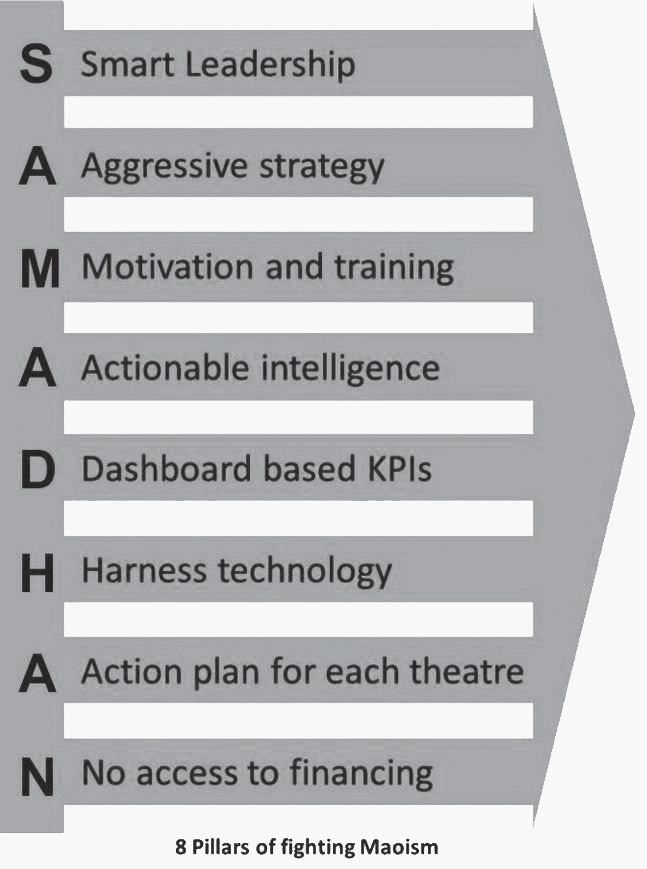
Figure: Pillars to fight Maoism as per SAMADHAN initiative
• Technology: Use trackers and biometric ids in weapons, use of Unique Identification number (UID) will be used to identify the logistics system, deployment of UAVs (Unmanned aerial vehicle), Mine Protected Vehicles, Helicopters for aerial support such as delivering supplies, delivering reinforcements and airlifting the critically injured.
• Joint Task Forces for operations along inter-State boundaries will be established. This will result in better inter-state coordination and intelligence sharing, while at the same time it will deprive the insurgents of any hiding place should they escape their geographic confinement.
• Certain acts under the Indian Penal Code such as the Prevention of Money Laundering Act (PMLA) to be reviewed to ensure effective choking of fund flow to LWE
groups.
• Fast-tracking building infrastructure, with a focus on solar lights, mobile towers with 3G connectivity, and road-rail connectivity.
• National Security Guard (NSG) hubs have been established in Chennai, Kolkata, Hyderabad, and Mumbai.
• The Multi-Agency Centre, responsible for coordination among various stakeholders, has been strengthened and reorganized to operate round the clock.
• New Specialized India Reserve Battalions (SIRBs) have been approved to combat Naxalism effectively.
• The Unlawful Activities (Prevention) Act, 1967, has been amended to enhance punitive measures, allowing the government to designate individuals as terrorists.
Strengthening the Forces
• National Policy and Action Plan, 2015:- Security initiatives include support to LWE-affected states through the deployment of Central Armed Police Forces (CAPFs), provision of helicopters and UAVs, construction of fortified police stations, financial assistance for modernizing state police forces, procurement of arms and equipment, training support, and intelligence sharing.
• Police Modernization Scheme aimed at enhancing law enforcement capabilities in Naxal-affected regions.
• Mine Protected Vehicles (MPVs) deployed to minimize casualties caused by Naxalite use of improvised explosive devices (IEDs).
• Special Infrastructure Scheme provides financial assistance to Bihar, Chhattisgarh, Jharkhand, and Odisha for establishing Special Task Forces to combat LWE.
• Security Related Expenditure (SRE) Scheme: Under this initiative, the central government reimburses state governments for security-related expenses incurred in LWE-affected areas relating to :
• Meeting the training and operational requirements of security forces.
• Providing ex-gratia payments to the families of civilians and security personnel killed or injured in LWE-related violence.
• Offering compensation to individuals who surrender under the respective state government’s Surrender and Rehabilitation Policy.
• Promoting community policing initiatives.
• Developing security infrastructure for Village Defence Committees and disseminating awareness through publicity materials.
• Fortified Police Stations Scheme: The Ministry of Home Affairs approved the construction of 400 fortified police stations across 10 LWE-affected states.
• Assistance to Central Agencies for LWE Management
(ACALWEMS): Financial support is provided to the CRPF to aid in counter-LWE operations.
Decline In LWE Activities
• The consistent implementation of the National Policy & Action Plan to address Left-Wing Extremism (LWE) - 2015 has led to a steady decline in LWE-related violence.
• From 2004–2014 to 2014–2024
• Violent incidents declined 53% from 16,463 to 7,744
• Security force deaths fell 73%, from 1,851 to 509
• Civilian deaths dropped 70% from 4,766 to 1,495
• By 2025, the total number of LWE-affected districts had dropped from 126 to only 11, and the number of Naxal-most-affected districts had decreased from 36
(2014) to just 3.
• Operational Achievements in 2024–2025
• Notable victories include the deaths of 27 ardent Naxals during Operation Black Forest, the surrender of 258 in October 2025, and the surrender of 24 in Bijapur on May 23, 2025.
• Target
• By March 2026, the government aims to eradicate all Naxal-affected areas, based on the unambiguous principles of dialogue security cooperation
• The Communist Party of India (Maoist) remains the dominant force among LWE groups, responsible for over 90% of LWE-related violent incidents and 95% of the resulting deaths.
Causes for the decline:
Decline in ideological appeal: The ideology of revolution has lost its old appeal among locals, as evident in the lack of interest to join the militia.
Loss of strongholds: The Naxalites have lost control of many of their strongholds due to government operations.
Leadership crisis: The Naxalites are facing a leadership crisis, with many key leaders having been killed or captured in recent years.
Improved socio-economic conditions: The affected states have made significant progress in terms of socio-economic development, which has reduced the appeal of the Naxalite ideology. India's Gini Index showed steady progress toward social justice, falling from 28.8 in 2011 to 25.5 in 2022
Government's Multi-Pronged Approach: The government has adopted a multi-pronged approach for tackling the Naxalite insurgency, combining soft (awareness and development) and hard tactics (security forces).
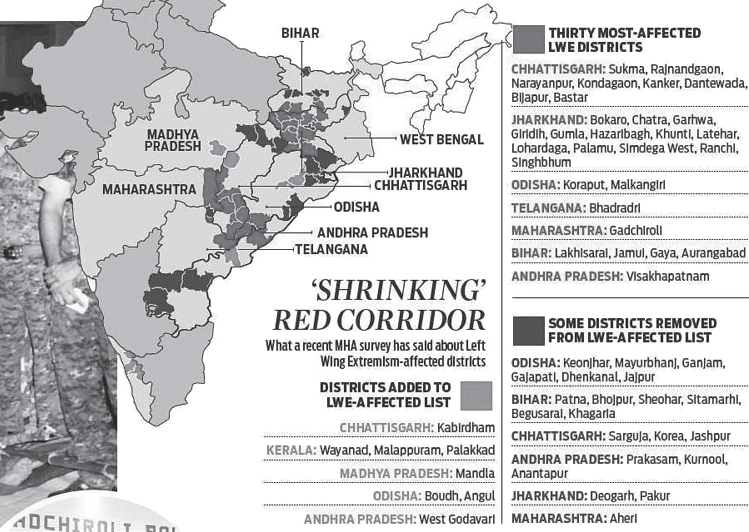
Figure: New areas where Maoist are making in-roads
URBAN NAXALISM
• Urban Naxalism is a term used to describe the activities of communist groups specifically CPI(M) and naxal sympathizers in urban areas.
• It aims to mobilise urban poor like industrial workers etc.
• The term came into prominence in 2018 in the wake of the Elgaar Parishad case in Maharashtra, in which several left-wing activists were arrested on charges of sedition and conspiracy.
Distinction between Urban Naxals and civil rights activists:
• Civil rights activists work to protect and promote the Rights of Marginalized Groups. They use democratic methods such as protests, rallies, and petitions to achieve their goals.
• Urban Naxals, on the other hand, are accused of using violence and other illegal means to achieve their goals.
• The label “urban Naxal” has also come to be attached to Delhi University professor GN Saibaba, who was arrested in 2014 after the police alleged he was a contact for Maoists. His supporters pointed out he is a paraplegic unable to move without a wheelchair. Nonetheless, in March 2017, he was sentenced to life in prison.
• Anand Teltumbde, a former Bharat Petroleum executive, regular contributor to the Economic and Political Weekly (EPW), professor at the Goa Institute of Management and author of a number of books, including Republic of Caste. Gautam Navlakha, an ex-editorial consultant of the EPW and member of the People’s Union for Democratic Rights. They were accused under the draconian anti-terror law, the Unlawful Activities Prevention Act, of a conspiracy aimed at overthrowing the government and assassinating the Prime Minister.
• Stan Swamy, an 83-year old Jesuit priest who has worked amongst the tribals of Jharkhand, was sent to judicial custody in the Bhima Koregaon case. He has been booked for alleged criminal conspiracy and sedition, and under the Unlawful Activities (Prevention) Act, among other charges.
STRENGTHENING FRAMEWORKS TO COUNTER EXTREMISM
Role of Online Service Providers
• Terms of Use: Online service providers (OSPs) should have clear and concise terms of service that prohibit extremist content and activities. These terms of service should be enforced consistently and transparently.
• User Reporting of Extremist Content: OSPs should make it easy for users to report extremist content. They should also have a process in place to review and remove reported content promptly.
• AI based detection and removal: AI can be used to detect
and remove extremist content by identifying patterns in language, images, and videos. AI can also be used to identify and block the accounts of extremist users.
Role of Government and Civil Society
• Shared Technological Development: This could include developing new AI tools to detect and remove extremist content, or developing new platforms to promote tolerance and understanding.
• Crisis Protocols and disaster management: to deal with the aftermath of extremist attacks. These plans should help to minimize the loss of life and property, and to prevent the spread of extremism.
• Education and awareness: among people about the dangers of extremism and to promote tolerance and understanding. This could be done through public awareness campaigns, school programs, and interfaith dialogue.
• Global Internet Forum to Counter Terrorism (GIFCT): GIFCT is a global initiative that brings together OSPs, government agencies, and civil society organisations to counter extremism online. GIFCT develops shared industry standards and best practices for countering extremism, and it provides resources and training to OSPs.
Role of Religious Leaders
• Because of their unique positions of authority, credibility, institutional resources and ties with communities, religious leaders can play a vital role in countering extremism by promoting tolerance and understanding, and by speaking out against violence and extremism.
WAY FORWARD
• D Bandyopadhyay Committee on Development Challenges in Extremist Affected Areas was set up by the Planning Commission in 2006.
• Admitting that the rise of Naxalism was a "political movement with a strong base among poor peasantry and adivasis", the committee has ascribed its growth to land alienation, poverty among Scheduled Tribes and Dalits, and lack of access to basic forest resources, people’s discontent and complete failure of the system.
• Large swathes of tribal territory have become the hunting ground of left-wing extremists. Exploitation, artificially depressed wages, iniquitous socio-political circumstances, inadequate forest-based employment opportunities, lack of access to resources, under- developed agriculture, geographical isolation, lack of land reforms – all contribute significantly to the growth of the naxalite movement. All these factors have to be taken into consideration as we evolve solutions for facing the challenge of naxalism.
• Despite initial efforts like Salwa Judum (local resistance), today the poor tribals have been caught between the legitimate sovereign power of the State and the illegitimate coercive power of the extremists who deliver instant justice through peoples’ courts and other informal devices.
• It is clear that a judicious mix of development and welfare initiatives coupled Left Extremism with land reforms and well-planned counterinsurgency operations is required to restore peace, harmony and confidence in the administration in such areas. Dantewada Success Model and ‘Common Minimum Programme’ (CMP), for instance, recognised the multi-dimensional nature of this problem.
• Key steps would include
Address the root causes of the problem, such as poverty, lack of development, and alienation of the tribals. Implement inclusive and sustainable development schemes that benefit the tribals directly.
Strengthen Centre-state cooperation and ensure that the central and state governments work together to tackle the Naxalite insurgency, particularly at the trijunctions of state borders.
Build trust with the tribals by engaging with them and addressing their concerns on rights under 5th and 6th Schedule, Panchayats Extension to Scheduled Areas Act (PESA) 1996, Forest Rights Act (FRA) 2006, etc.
Undertake awareness and outreach programmes to educate the tribals about the dangers of Naxalism and the benefits of development.
Empower the tribals economically by providing them with opportunities for livelihood generation and introducing measures to encourage the formation of Self-Help Groups (SHGs) and skill development.
Implement large infrastructure projects with the help of specialized government agencies like the Border Roads Organisation instead of local contractors through Environment Impact Assessment (EIA).
Adopt the Best Practices of the Chhattisgarh administration and police, who have successfully tackled the Maoist insurgency in Bastar.
Undertaking Technological Solutions: Such as use of micro or mini-UAVs or small drones to minimize loss of lives of security personnel.
Choke funding: The nexus between illegal mining/ forest contractors and transporters and extremists which provides the financial support for the extremist movement needs to be broken through establishment of special anti- extortion and anti-money laundering cells by State Police.
CONCLUSION
• It is important to note that there is no one-size-fits-all solution, and the approach will need to be tailored to the specific needs of each affected area. As the naxal problem has arisen on account of real and perceived neglect, deprivation and disaffection, mainly towards the downtrodden, the solution should aim at providing gainful employment and entrepreneurial opportunities to the surrendered Naxalites, so that they are encouraged to join the mainstream and do not return to the fold of naxal movement.