Militarisation of Space
MILITARISATION OF SPACE
INTRODUCTION
• The militarization of outer space refers to the use of space technology, infrastructure, and assets for military purposes. This includes the deployment of military personnel and equipment in space, the development and deployment of space-based weapons systems, and the use of space assets for Intelligence, Surveillance, and Reconnaissance (ISR) activities.
• Space warfare involves combat outside the Earth’s atmosphere, including Ground-To-Space warfare (attacking satellites from the Earth) and Space-To-Space warfare (satellites attacking other satellites). However, it does not encompass Space-To-Ground warfare, where orbital objects attack the Earth’s surface.
International Frameworks for Space
• Outer Space Treaty of 1967 (OST)
• The OST has been ratified by 110 countries including India and is considered the cornerstone of international space law.
• It establishes outer space as a Global Commons, open to exploration and use by all nations, but not subject to national sovereignty. Provides for legally binding rules governing the peaceful exploration and use of Space.
Bans
• Placing of nuclear weapons and weapons of mass destruction (WMD) in outer Space.
• Military activities on celestial bodies.
Lacunae
• Does not define “weapons of mass destruction”. It is paradoxical that the term weapon remains elusive to definition in the context of space, because any object traversing through space can become a weapon subject to the intention of the user.
• Does not prohibit the launching of ballistic missiles, which could be armed with any type of warheads. This lacunae or omission allows the use of space by transitory vehicles armed with nuclear weapons, WMD, electronic systems, energy platforms or kinetic systems.
• Does not prohibit the deployment of conventional weapons in the outer space.
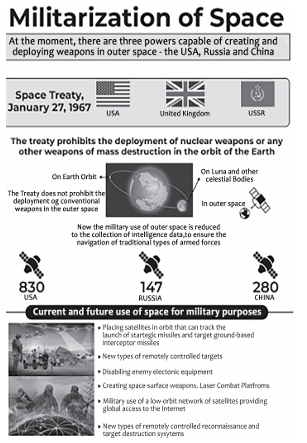
Figure: Militarization of Space
• Convention on Registration of Objects Launched into Outer Space (1975) –
• This convention requires space-faring nations to register their space objects with the UN.
• Treaty on Principles Governing the Activities of States in the Exploration and Use of Outer Space, including the Moon and Other Celestial Bodies (1979) –
• This treaty expands upon the Outer Space Treaty by prohibiting the testing and deployment of any type of weapon in outer space. India has signed the treaty but not ratified it.
• The Prevention of an Arms Race in Outer Space (PAROS) –
This UN agenda aims to establish a legally binding agreement to prohibit the militarization of outer space.
Its objective is to ensure that no country gains a military advantage in space.
The proposed treaty is currently under discussion at the Conference on Disarmament (CD).
• International Code of Conduct for Outer Space Activities (ICOC) –
• This is a proposed code of conduct that aims to promote responsible behavior in space and prevent the weaponization of outer space.
• Other Agreements and Conventions (Signed and Ratified by India)
• Rescue Agreement (1968): An agreement concerning the rescue and return of astronauts, as well as the recovery of objects launched into outer space.
• Liability Convention (1972): A convention outlining international liability for damages caused by space objects.
• Registration Convention (1976): A treaty governing the registration of objects launched into outer space.
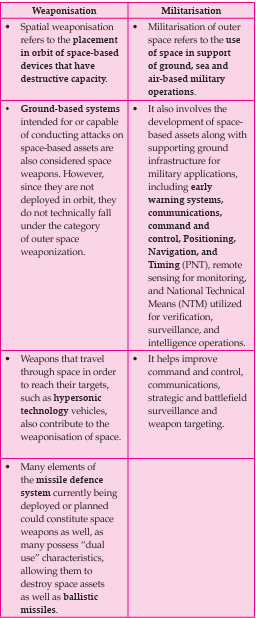
Concept of Weaponisation of Space
• So far only China, Russia, India, and USA have successfully test fired Anti Satellite (ASAT) weapons while many other nations are in the process of developing ASAT weapons of their own.
• ASAT is a ground-based weapon that is meant to target enemy satellites in space, specifically in Lower Earth Orbit, which would cripple the enemy’s military ability to operate in the battlefield.
• These weapons could be used to target civilian satellites as well, the consequences of which in today’s modern world would be catastrophic.
• Other forms of space weapons that have already been developed include lasers targeted towards enemy satellites, jammers, plasma attacks, and orbital ballistic missiles.
Militarisation Vs Weaponisation of Outer Space
• Weaponisation is, a subset of militarisation and there is only a subtle difference between the two
Types of Weaponisation
• Two subsets of weaponisation of space are
• Space control
• Space force application
| Space Control | Space Force Application |
| Space control/denial (or space dominance) operations focus on safeguarding the orbital assets of one's own and allied nations, targeting enemy assets, and preventing adversaries from accessing space. | Space force application involves using space- based weapons to strike ground targets, which would shorten response times, lower the cost of human casualties, and mitigate other challenges associated with targeting strategic objectives. |
| The primary means of achieving these tasks are either launch suppression, or destroying or degrading the performance of the enemy satellites. | The idea of having satellites/space planes orbiting overhead, awaiting a signal to rain down weapons constitutes a part of space force applications of weaponisation of space. |
| These actions can be either defensive, aimed at safeguarding friendly assets, or offensive, focused on preventing the enemy from utilizing space-based resources. | |
| This concept is similar to sea and air control/ denial, which also involves ensuring access for friendly forces while denying it to the opponent. |
The Threat of Weaponisation of Space
• In its most advanced form, space weaponization would involve the deployment of a comprehensive array of space weapons, such as satellite-based systems for Ballistic Missile Defense (BMD), space-based Anti- Satellite (ASAT) weapons, and various Space-to-Earth Weapons (STEWs).
• Satellites in Space
“Strategic Defence Initiative” (SDI) of the United States intended to put a large number of satellites into orbit that would detect the launch of enemy missiles and then shoot them down. It was a multi- layered defence which also included sea-based interceptors that are carried onboard ships and the ground-based Terminal High Altitude Area Defence (THAAD), the system designed for the engagement of the short and medium range missiles.
Orbital or Space-based systems are satellites that can deliver temporary or permanent effects against another spacecraft.
These systems could include payloads, such as kinetic kill vehicles, radio-frequency jammers, lasers, chemical sprayers, high-power microwaves, and robotic mechanisms.
Some of these systems, such as robotic technology for satellite servicing and repair and space debris removal, have peaceful uses, but can also be used for military purposes.
• Threat from Ground
• The Anti-Satellite Missiles (ASAT) capabilities demonstrated by four nations recently did not need any system in orbit; these were ground-based missiles launched to destroy satellites in orbit.
• Hence, ground-based systems that can attack, disable, divert or blind Space-based assets also constitute Weaponization of Space.
• Another grey area is the Dual-Use Systems which can be used for offensive and defensive purposes.
• Threat From Cyber Capabilities
• Further, nations can use offensive cyberspace capabilities to enable a range of reversible to non- reversible effects against Space systems, associated ground infrastructure, users, and the links connecting them.
• Electronic warfare includes using jamming and spoofing techniques to control the electromagnetic spectrum.
Uplink jamming is directed toward the satellite and impairs services for all users in the satellite reception area.
Downlink jamming has a localized effect because it is directed at ground users, such as a ground forces unit using satellite navigation to determine their location.
Spoofing deceives the receiver by introducing a fake signal with erroneous information.
• Other Technology
• Directed Energy Weapons (DEW) can use directed energy to disrupt, damage, or destroy enemy equipment and facilities, these effects can range from temporary to permanent, and may include lasers, high-power microwaves, and other types of radio- frequency weapons.
• Kinetic Energy Threats, or ASAT, are designed to destroy satellites without placing the weapon system or any of its components into orbit.
These systems typically consist of a fixed or mobile launch system, a missile, and a kinetic kill vehicle.
These weapons could also be launched from aircraft.
Impact of Weaponisation of Space
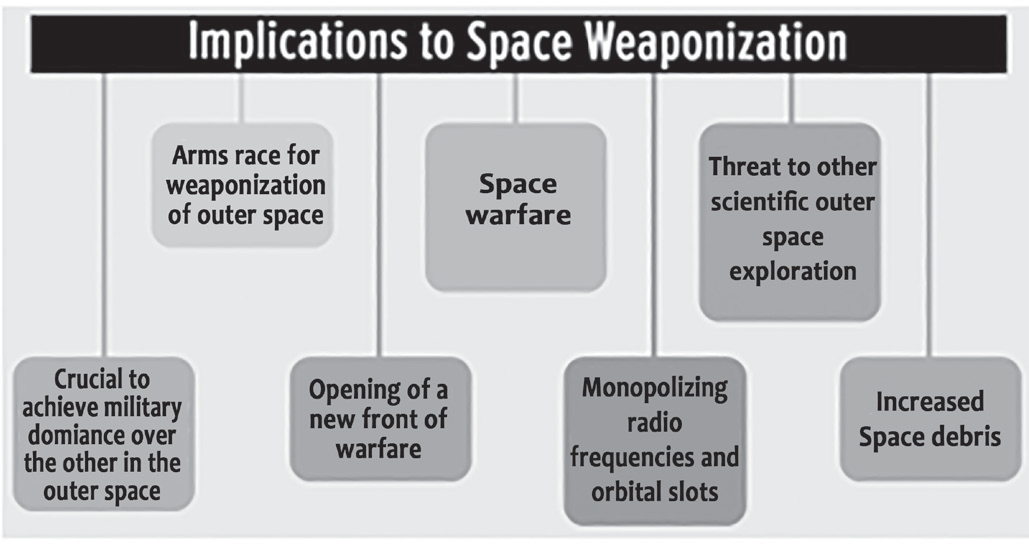
Figure: Implications to Space Weaponization
• Space Debris: These are defunct human-made objects in space – principally in Earth orbit – which no longer serve a useful function.
• In addition to derelict human-made objects left in orbit, other examples of space debris include fragments from their disintegration, erosion and collisions or even paint flecks, solidified liquids expelled from spacecraft, and unburned particles from solid rocket motors.
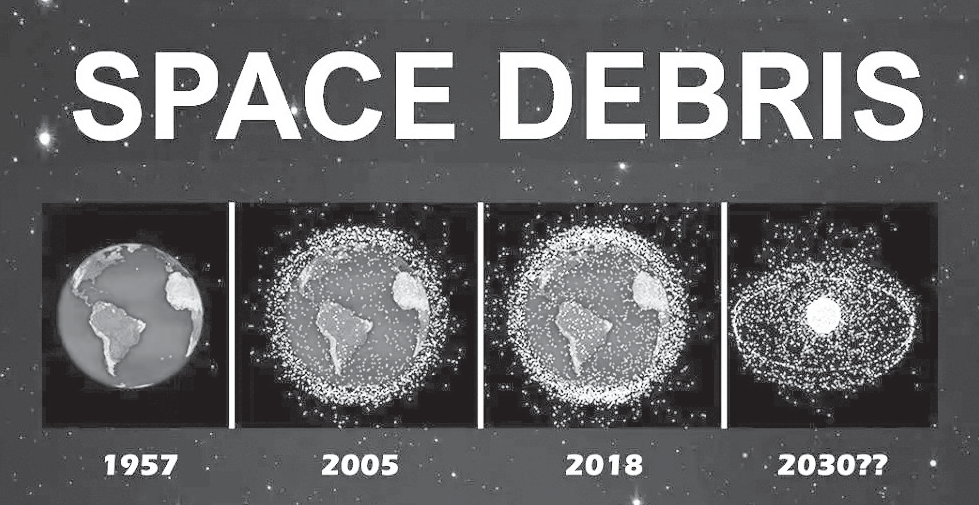
Figure: Space Debris
• Over 7,500 items of space junk that are at least 4 inches wide are currently in orbit, according to the European Space Agency. For operational satellites, this free-floating space debris poses a risk, and hitting it can render the satellites inoperable.
• The Kessler Syndrome is a phenomenon in which the amount of junk in orbit around Earth reaches a threshold point where it just creates more and more space debris, until Earth’s orbit is rendered useless – a Domino Effect, causing big problems for satellites, astronauts and mission planners.
Methods to Tackle Space Debris
• Orbit changes: A lot of contemporary satellites are launched into elliptical orbits with perigees inside the Earth’s atmosphere, which eventually leads to their disintegration.
• Self-destruction: Consists of programming the satellite to
leave its orbit at the end of its useful life and be destroyed when it comes into contact with the atmosphere.
• Passivation: It is the removal of any remaining internal energy in the vehicle at the end of its useful life. Although the chassis remains in orbit, the risk of explosions is reduced. The same is true for the rocket stages.
• Reuse: These rockets return to Earth intact. These are used by Space X, the aerospace company owned by Elon Musk.
• Laser: consists of stopping the fragments by using a strong laser to vaporize their surface, stopping them and causing them to fall
• Use of nontoxic materials for building satellites: Even wooden spacecraft are being tested by Japanese researchers in an effort to reduce the amount of toxic debris that is released into Earth’s upper atmosphere when spacecraft deorbit.
• Protection of satellites: The goal of protection is to shield spacecraft and employ clever design techniques to reduce the effects of debris impact.
Recent Developments
• Recently, US proposed to create a new US "Space Force".
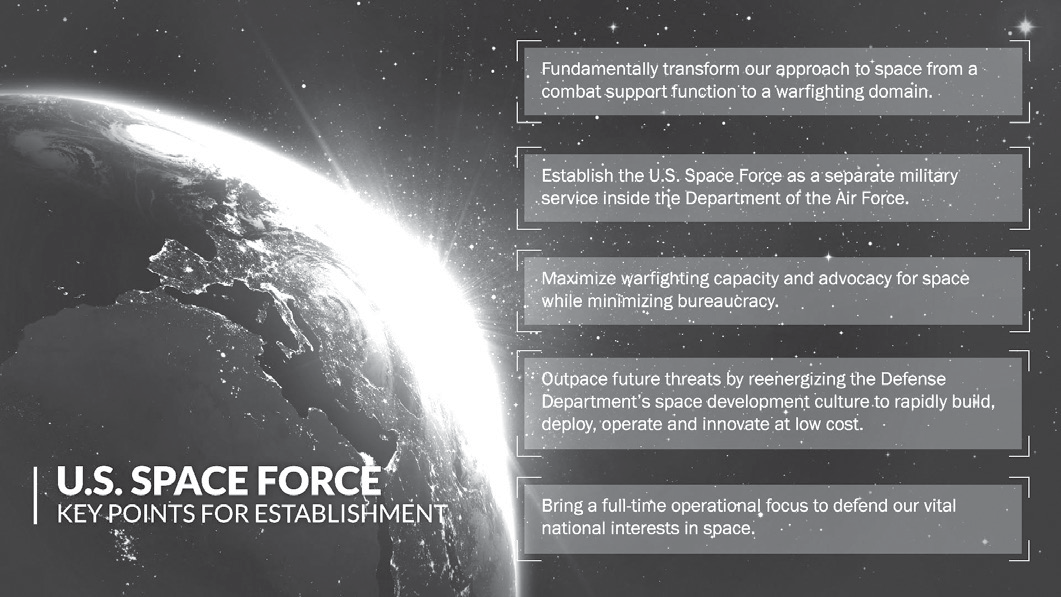
Figure: U.S. Space Force
• 2020: Russia conducted an anti-satellite test of its direct- ascent anti-satellite (DA-ASAT) missile test.
• It is designed to intercept satellites in low Earth orbit.
• NEO-01:
• China has launched the “NEO-01” prototype of a low- Earth orbit robot. It has a large net that allows it to collect space debris left over from another spacecraft.
• Remove the DEBRIS Mission:
The goal of this satellite research project was to showcase different space debris removal techniques. The mission was overseen by the Surrey Space Center from the University of Surrey, and Surrey Satellite Technology Ltd. produced the satellite’s platform (SSTL).
• Kounotori Experiment: It is a Japanese experiment using an innovative technique to remove space debris that is orbiting the earth.
India and Militarisation of Space
• India’s Stand on Weaponisation
• India has no plans to participate in an arms race in outer space and firmly believes that space should be used exclusively for peaceful purposes.
• India opposes the militarization of outer space and actively advocates for global initiatives aimed at ensuring the security and protection of space-based assets.
• India considers outer space a collective heritage of humanity and emphasizes that all space-faring nations have a duty to preserve and promote the benefits derived from advancements in space technology for the welfare of all.
• India’s Support, Cooperation and Implementation in Making Space Safe
• Space Situational Awareness (SSA) refers to keeping track of objects in orbit and predicting where they will be at any given time. India is a party to all the major international treaties connected with Outer Space and Space awareness.
• Transparency and Confidence Building Measures (TCBMs)
• This includes registering space objects with the United Nations (UN) registry, issuing pre-launch notifications, implementing measures aligned with the UN Space Debris Mitigation Guidelines, and actively participating in Space Object Proximity Awareness (SOPA) and Collision Avoidance (COLA) initiatives.
• UN Committee on the Peaceful Uses of Outer Space:
• The General Assembly established it in 1959 with the goal of regulating space exploration and utilization for peace, security, and economic development for the entire human race.
• Inter-Agency Space Debris Coordination Committee (IADC):
• IADC is an intergovernmental forum that was established in 1993 with the purpose of coordinating actions to deal with debris in Earth’s orbit.
• India endorsed UNGA Resolution 69/32, advocating against the first placement of weapons in outer space.
• India also supports meaningful discussions on the Prevention of an Arms Race in Outer Space (PAROS) within the Conference on Disarmament, where the issue has been a part of the agenda since 1982.
• Defence Space Agency - Created in 2019, would be supported by the defence space research organization and has been tasked with operating the space-warfare and Satellite Intelligence assets of India.
• Defence Space Research Organization (DSRO) - Created in 2019 is geared toward facilitating the development of civilian space technology for military purposes.
• First Integrated Space Warfare Exercise - It was a tri- service exercise which focused on using communications and reconnaissance satellites to integrate intelligence and
fires across the range of Indian military assets, against the background of existing threats.
• Mission DefSpace was launched in 2022 for the development of innovative solutions in the space domain by the industry.
• Indian DefSpace Symposium, organised by the Indian Space Association (ISpA) and the DRDO under Mission DefSpace, to create a platform for all stakeholders who have a keen interest in boosting India’s military space capability and plans.
• Indian Space Association (ISpA) is a voluntary association of leading space industries established with the objective of providing advisory and advocacy support to the space industry in India.
• Indian Ballistic Missile Defence Programme
• An initiative to develop and deploy a multi-layered ballistic missile defence system to protect India from ballistic missile attacks.
• It was launched in 2000 after Kargil War.
• It has two broadly defined target tiers:
Endo-atmospheric.
Exo-atmospheric: Mission Shakti.
• Mission Shakti
• Recently, India carried out an anti-satellite (ASAT) test using an interceptor missile (as a kinetic kill vehicle) to neutralise a target satellite in a Low Earth Orbit (LEO) at an altitude of around 300 km.
• 2019: India tested its first anti-satellite (ASAT) missile as part of "Mission Shakti" to destroy a "live satellite".
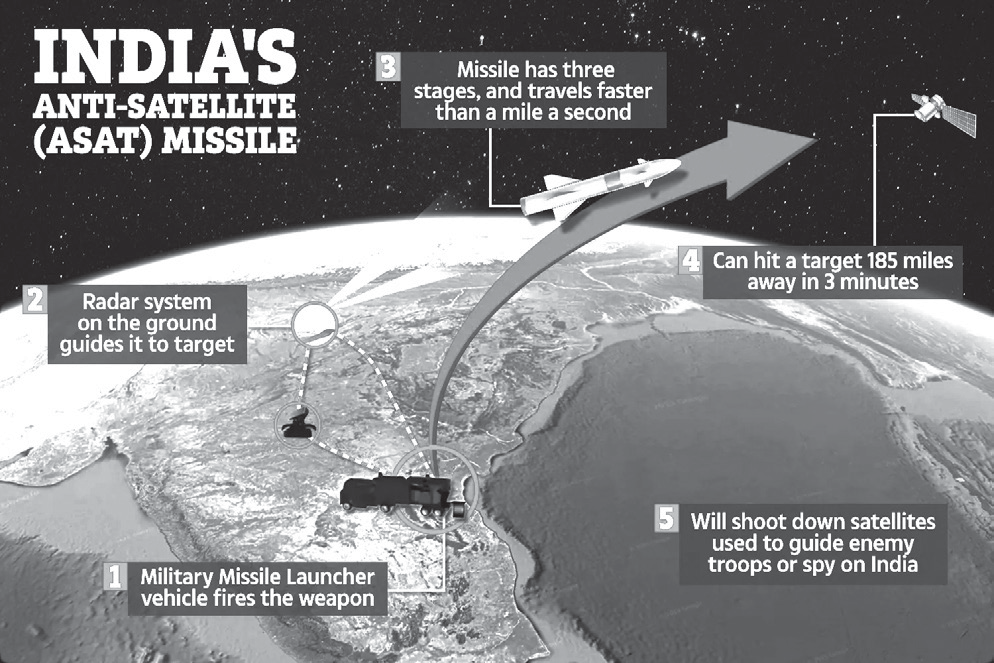
Figure: India’s Anti-Satellite Missile
Way Forward
• Miniaturisation Of Satellites and Reusable Launch Platforms to mitigate cost challenges and accelerate the pace of augmenting India’s space-based capabilities.
• Enhancing Space Situational Awareness (SSA) capability to safeguard assets with counter space capabilities. Building resilience and reduce redundancy in a space- based infrastructure.
• A new Concise and Detailed Treaty, which lays down specific provisions for arms control and demilitarization should be brought into force.
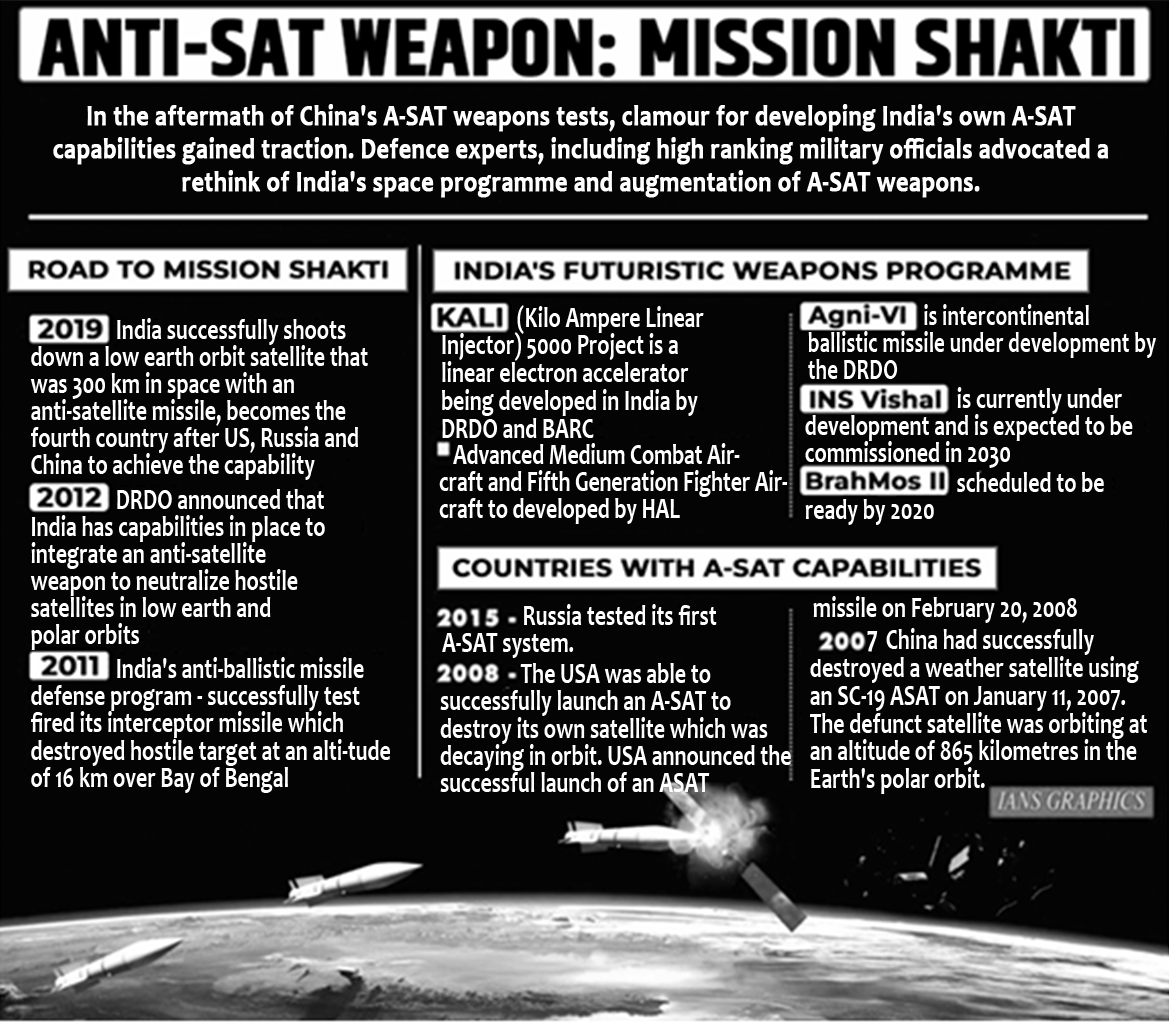
Figure: India’s Anti-Sat Weapon
• This endeavour was taken up by China and Russia, who together submitted a draft treaty in 2008 to the Conference on Disarmament, which was called Prevention of the Placement of Weapons in Outer Space and of the Threat or Use of Force against Outer Space Objects (PPWT) in an effort to stop further militarisation of space.
• The PPWT defined what constitutes “Space weapons” and even the ‘intention to harm’ which would differentiate military and civilian technology as most of the civilian satellites can have military applications.
• In 2014, a revised draft of the PPWT was submitted by the two countries but as was the case in 2008, USA rejected the draft on the pretext that since there is no arms race in space at the moment, there was no need for an arms control treaty.
• United Nations (UN) has also proposed a new treaty in its Policy Brief titled ‘For All Humanity’: The Future of Outer Space Governance 2023, in order to maintain peace and security and avoid an arms race in space.
• A long-term sustainable model for effective governance of space and restoring its position as a global common, is building a global governance system which can keep a check on space activities of all member states.
• This governance system could be founded on global understanding of the Earth orbit as a global common, which would have a centralised accountability mechanism that allows effective enforcement.
• This would help not just in demilitarising space, but also help the issues like growing space debris, decommissioning satellites, and even boost space exploration.
This may appear to be a pipe dream, but history has shown us that countries can indeed come together to effectively manage other global commons. The Convention on Long-Range Transboundary Air Pollution and subsequent protocols are great examples of the same.
CONCLUSION
• In light of increasing space weaponization as mutual suspicion, threats to scientific missions and the threat of space debris are on a rise, India should partner with like-minded countries to outline the rules for global space governance.
• India should also articulate its Indian Space Security Policy to harness the country’s immense defence potential.
• We need coordinated, cooperative multi-pronged efforts to both remove present debris and stop the generation of future debris in order to keep space junk to a minimum and enable us to effectively use Low-Earth orbit for future exploration.
• International Space Law also points out that if a satellite becomes dysfunctional, then the satellite should deorbit and its re-entry into the earth should be carried out.
• For the welfare on the entire mankind, it is imperative that the notion of space as a Global Common is restored.
• A Global Space Governance System is only the next logical step towards the advancement of humans beyond this earth. A centrally controlled governance system which ensures a responsible and safe ecosystem for space exploration and unhindered access to a peaceful space for our future generations is the need of the hour.