Money Laundering
MONEY LAUNDERING
INTRODUCTION
Money laundering refers to the process of converting illicit funds and assets, whether movable or immovable, into legitimate ones.
• It involves disguising illegally obtained money, often referred to as black money, to make it appear as lawful income, ultimately presenting it as white money.
This is typically achieved by moving the funds through multiple channels, involving various stages of conversion and transfer. The goal is to create a false sense of legitimacy, allowing the laundered money to integrate into a legally recognized financial institution, such as a bank.
Money obtained from certain crimes is “dirty”.
• Eg. By extortion, insider trading, drug trafficking,
and illegal gambling.
• It needs to be “cleaned” to appear to have been derived from legal activities.
Money laundering involves three steps:
• Placement: Introducing cash into the financial system by some means.
• Layering: Carrying out complex financial transactions to camouflage the illegal source.
• Integration: Acquiring and returning the wealth generated to the launderer.
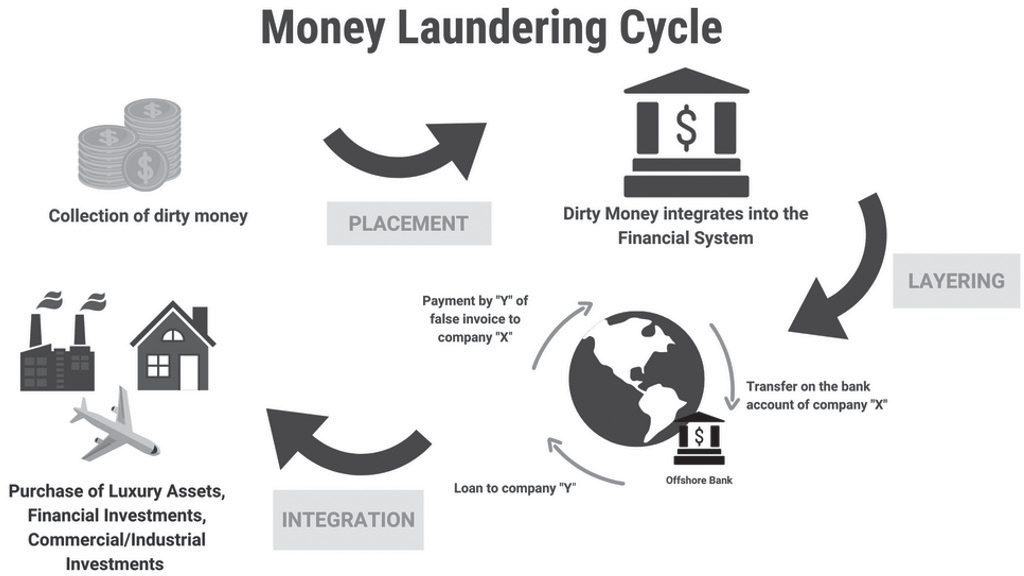
Figure: Money laundering Cycle
Technologies contributing to Money Laundering –
Crypto-Currency – A cryptocurrency is a digital currency, which is an alternative form of payment created using encryption algorithms. This currency uses a blockchain which is a digitally distributed, decentralized, public ledger that exists across a network. The use of encryption technologies means that cryptocurrencies function both as a currency and as a virtual accounting system. It is outside control of the financial system.
Social Media – Criminals often use radical ideologies to collect money. Also, money launderers can make fake money-making programs or identities through social media and try to involve people in these programs to withdraw money from their accounts.
Identity Theft – Financial information is obtained by Phishing (attackers attempt to trick users into doing ‘the wrong thing’, such as clicking a bad link that will download malware, or direct them to a dodgy website). Identity Fraud is also when a criminal uses your personal data to open a new account or take out a new financial product.
Online Gambling - Criminals convert dirty money into physical or digital chips relatively easily with little to no checks, gamble for a short time, and then cash out, with fresh, laundered money.
Lottery Scams - With this method, criminals buy the ticket by paying cash to the lottery winner. In this way, they make money they earn illegally as if they won the lottery. This method has been tried many times before.
Business Email Compromise – It is a form of phishing attack where a criminal attempts to trick a senior executive (or budget holder) into transferring funds, or revealing sensitive information. It is activated when opened and prompted to transfer money to legitimate looking accounts.
Encrypted conversations – They facilitate secure exchange of information about money laundering such as EncroChat.
Evading Scrutiny - Large volume of digital transactions at online market places is used to disguise the structured chunks of layered money.
Methods Of Money Laundering
• The traditional forms of laundering money are smurfing, using mules, and opening shell corporations. Other methods include buying and selling commodities, investing in various assets like real estate, gambling, and counterfeiting.
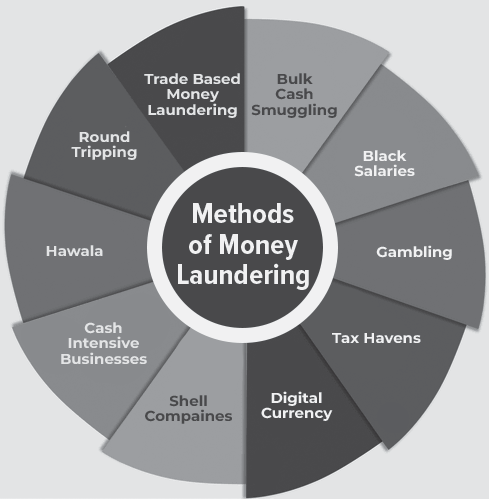
Figure: Methods of Money Laundering
•
Smurfing
• Smurfing refers to a money laundering tactic by which individuals break up large sums of money into smaller, less noticeable amounts. These smaller amounts are then laundered separately, with the intention of avoiding detection.
• For example, a group of smurfs depositing amount below legal threshold, which is illegally-obtained, into multiple bank accounts over the course of a week.
• Cuckoo Smurfing
• When a criminal syndicate arranges for cash sums of under legal limits to be transferred in or out of a country using the bank account details of an unwitting third party. The word ‘cuckoo’ in cuckoo smurfing comes from the cuckoo bird. It lays its eggs in the nests of other birds. These syndicates lay their illicit cash in the accounts of other innocent people.
• For example, often bank employees will be recruited to find accounts that are most susceptible to this. Individuals will be recruited to deposit the small amounts at different locations or ATMs or bank branches. That money is then saved in bank accounts that seem innocent and ordinary. Usually, the innocent bank customer will be awaiting an overseas transfer which allows a second concurrent transaction to occur. In this way, there will be one legitimate transfer and another transfer of illegal money. The illegal transfer will be made using the details of the innocent bank customer. However, the monies in these other transactions are sent to a different beneficiary. That beneficiary will be an overseas bank account that the criminal syndicate controls.
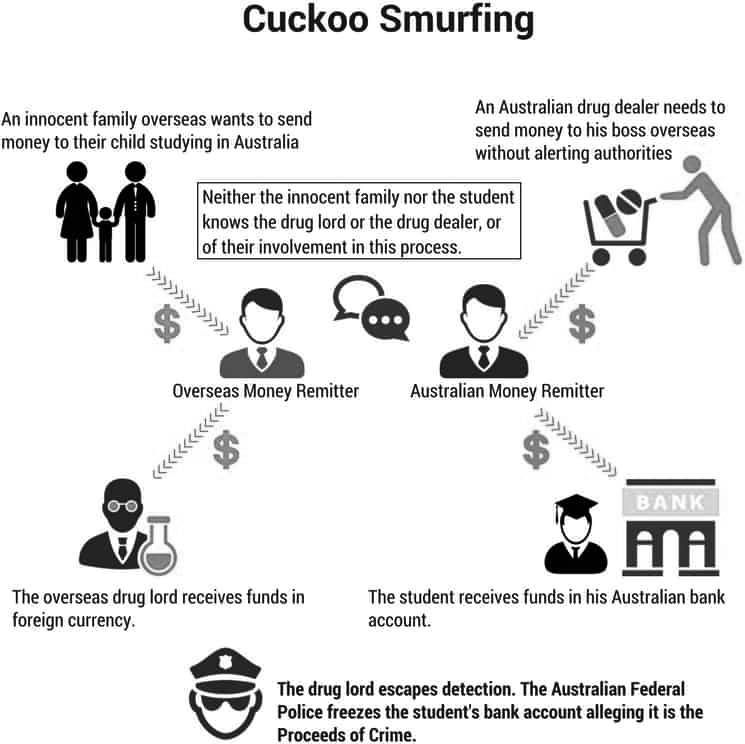
Figure: Cuckoo Smurfing
• Money Muling
• Money Muling is a type of money laundering. A money mule is a person who receives money from a third party in their bank account and transfers it to another one or takes it out in cash and gives it to someone else, obtaining a commission for it.
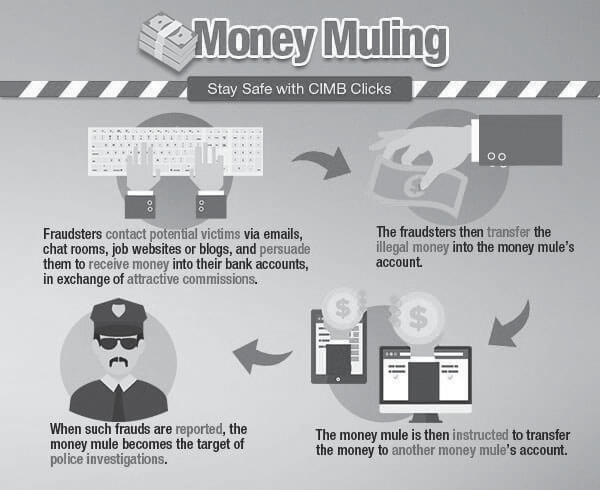
Figure: Money Muling
• Loopholes
• Placement of money in global financial system creates problems of coordination between multiple jurisdictions.
• Cash Intensive Businesses
• Some businesses like restaurants, laundromats, landscaping services, and delivery providers operate primarily through cash transactions. Criminal organizations can launder money through these entities by padding the amounts of the business’s daily bank deposits.
• Shell Companies
• These companies exist within the sovereign borders but lack genuine business operations. They operate under the pretense of legitimate transactions using falsified invoices and balance sheets, serving as a conduit for directing laundered funds into unlawful enterprises.
•
For example, a real estate firm named Unitech Group’s promoters allegedly started, controlled, and managed over 52 shell companies using their confidants to launder money.
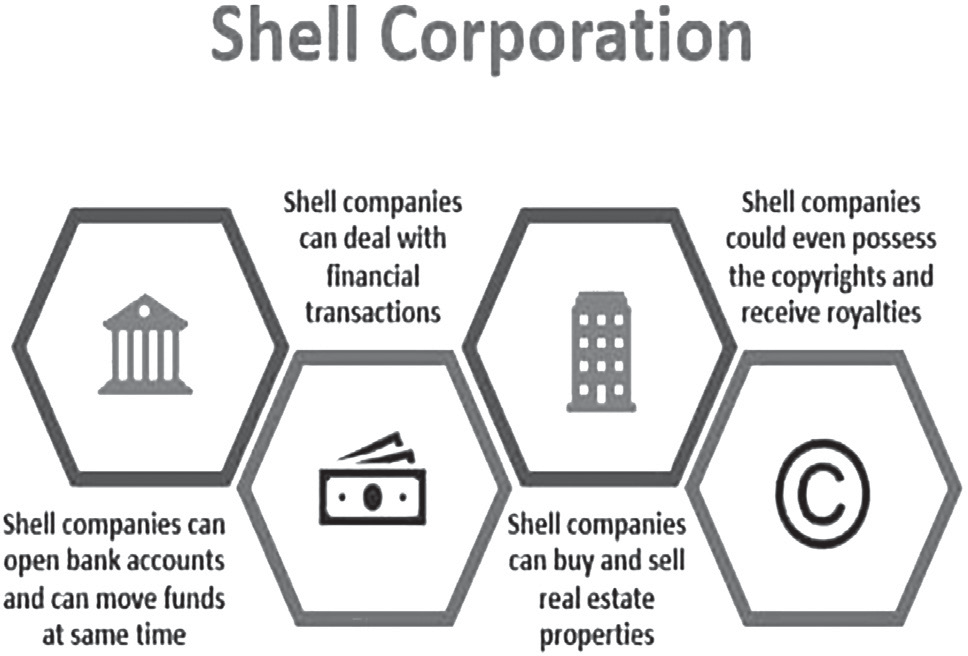
Figure: Shell Corporation
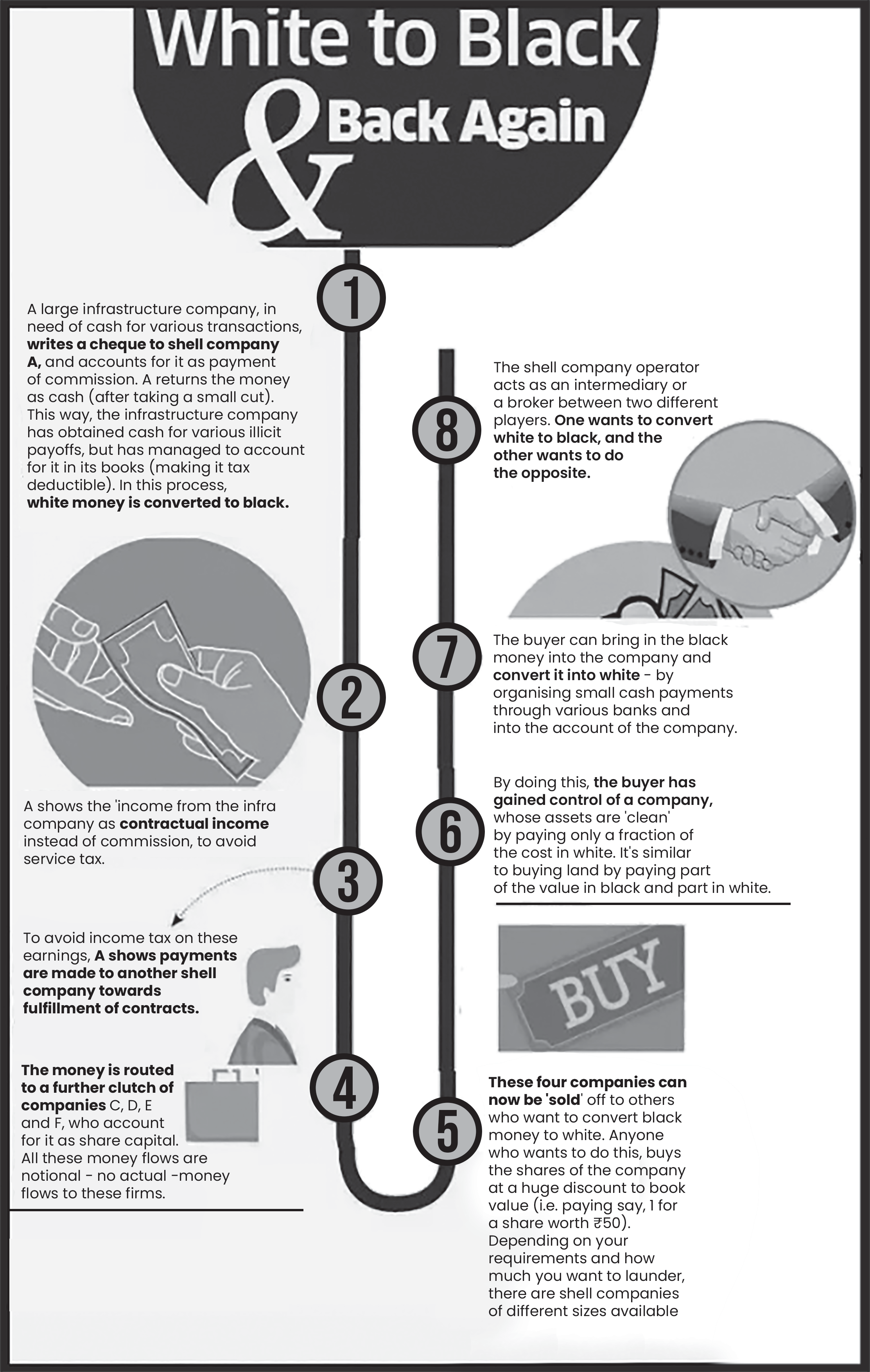
Figure: Conversion of black Money to White money
• Tax Haven
• Countries like Cayman Island, Panama etc. have structured their economies around assistance in tax evasion. They legalize unreported assets and cash in tax havens.
• The Principle of Bank Secrecy is sometimes considered one of the main aspects of private banking. However, it has also been accused as one of the main instruments of underground economy and organized crime, in particular following the Class action suit against the Vatican Bank in the 1990s, the Clearstream scandal etc.
• Also, Base Erosion and Profit Shifting (BEPS) tools (and structuring) are also increasingly used in money laundering/ regulatory avoidance.
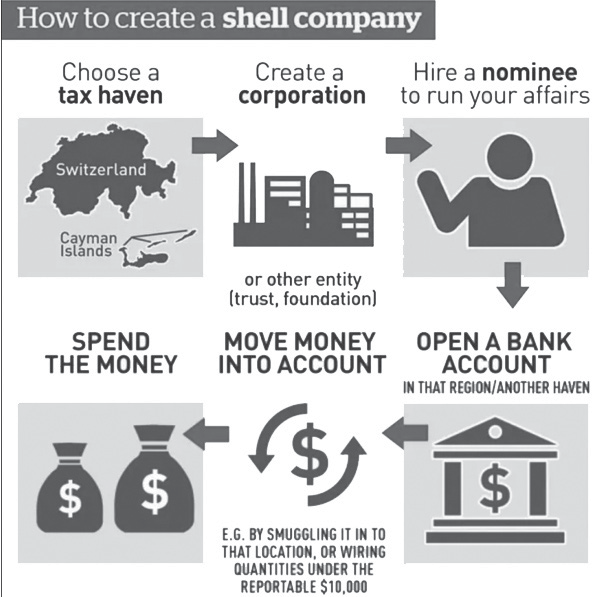
Figure: Creating a Shell Company
• Black Salaries
• A company may have unregistered employees without written contracts. Dirty money might be used to pay them cash salaries.
• Base Erosion and Profit Shifting (BEPS)
• BEPS refers to corporate tax planning strategies used by multinationals to “shift” profits from higher- tax jurisdictions to lower-tax jurisdictions or no-
tax locations where there is little or no economic activity, thus “eroding” the “tax-base” of the higher- tax jurisdictions using deductible payments such as interest or royalties. They “exploit gaps and mismatches in tax rules”.
Tax evasion by wealthy persons is often found to be linked to wider issues of money-laundering, terrorist financing and capital flight.
• Disguised Ownership
• Increasingly, criminals want to own legitimate businesses. It could be to earn a return or to convert black money into white.
• Mixed Sales
• Mixing illicit money sources with legit ones is a popular method because it›s hard to detect, especially if there is a large cash component in the legal business.
• Transaction Laundering
• This growing problem in the e-commerce sphere occurs when illicit businesses hide illegal online sales and purchases through legitimate merchants, who are either complicit or unknowingly been exploited.
• Digital currency
• Cryptocurrency is a digital currency in which transactions are verified and records maintained by a decentralized system using cryptography, rather than by a centralized authority. It is not issued by any central authority, rendering it theoretically immune to government interference or manipulation. According to blockchain analytics firm Chainalysis, criminals laundered $2.8bn in 2019 in Bitcoin to exchanges. Criminal actors exploit the anonymity of the blockchain (since the public keys engaging in a transaction cannot be directly linked to an individual)
to launder profits from both off-chain and on-chain crimes to obfuscate the sources of illicit funds and convert them into cash, which can then be moved into the legitimate banking system.
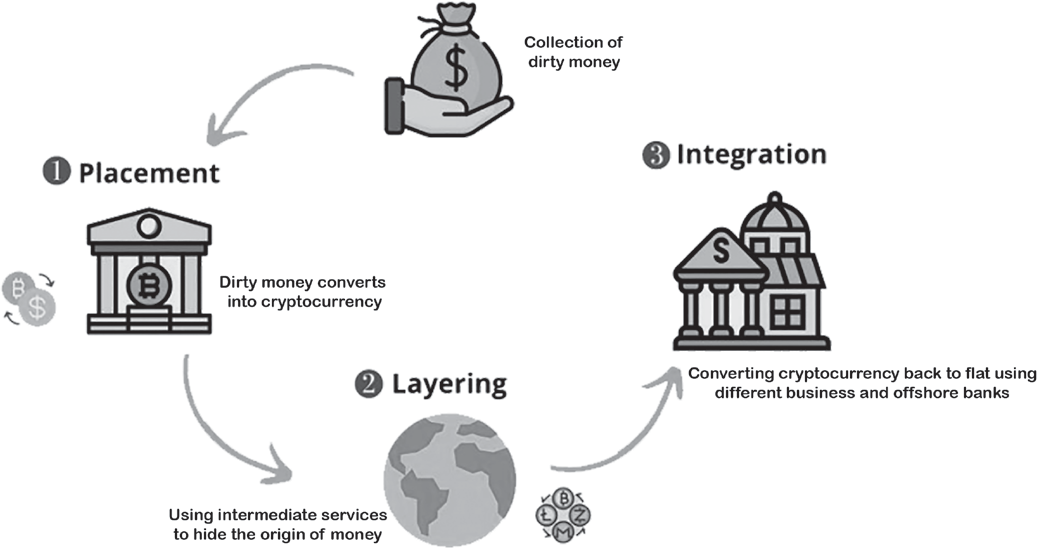
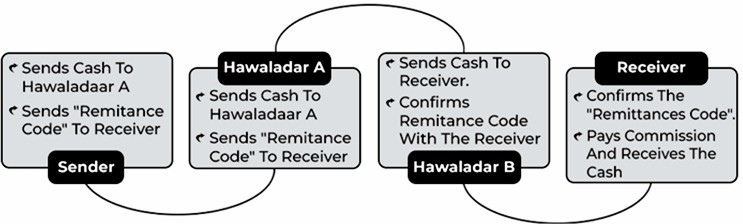
Figure: Hawala Transactions
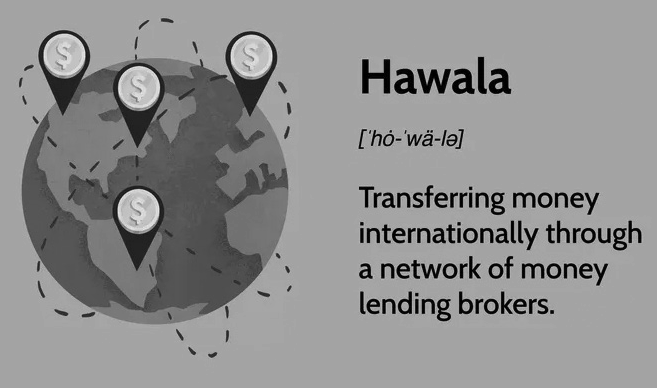
Figure: Definition of Hawala
• Hawala Transactions
• Hawala is an unofficial system of transferring money where no physical cash is exchanged. It is often referred to as a "money transfer without the actual movement of money." Another way to define it is simply as a system based on "trust."
• This method operates as an alternative network that bypasses conventional banking channels.
• Hawala networks have been used since ancient times. Today they are found among expats of developing countries sending remittances home.
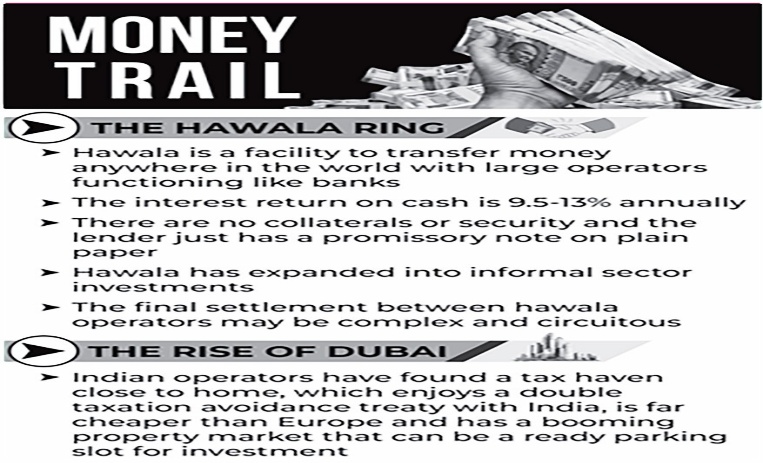
Figure: Money trail
• As these transactions are not routed through banks, the government agencies and the RBI cannot regulate them.
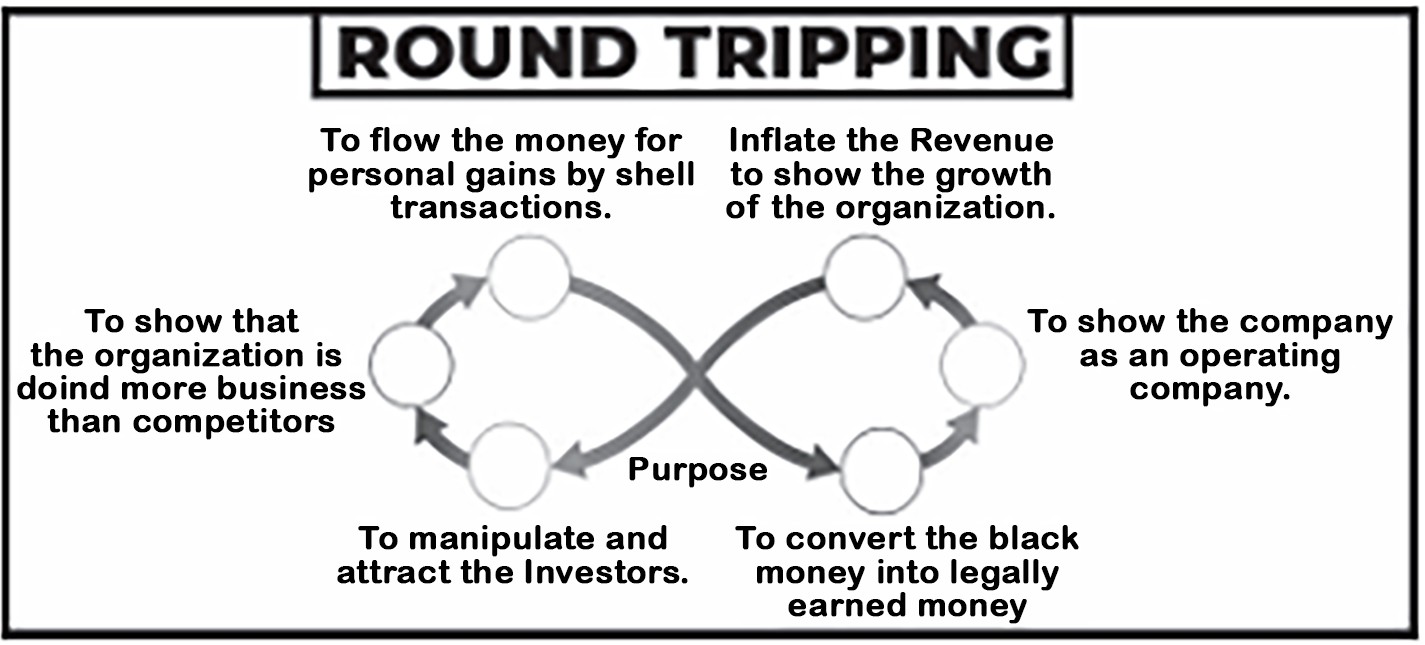
Figure: Round Tripping
• Hawala is illegal in India, as it is seen to be a form of money laundering.
• Round Tripping: Laundering of Black Money
• Money Laundering is different from Black money. Black money is money on which tax is not paid to the government.
•
In Round Tripping, the black money generated in India is transferred to tax-haven countries.
• Tax- haven countries are those countries which have very weak corporate laws and no/very low tax rates.
• Then a company is set up in the tax haven with the black money.
• This black money is now shown as ‘white money’ and sent back into India as ‘foreign investment’.
• The profits earned in India with this investment are taken back to the tax heaven without paying any taxes in India.
• This is because such investment is exempt from taxation under ‘Double Taxation Avoidance Agreement’.
• This method of money laundering makes use of loopholes in the capital/stock markets and investments are made via P-Notes (Participatory Notes).
• Bulk Cash Smuggling
• Bulk cash smuggling often involves the transfer of large amounts of money that make up the proceeds of an illegal activity. In many cases, the money that is being smuggled is used to fund an unlawful organization.
• For example, hiding cash inside a secret compartment in a car or truck, or sewing cash into the lining of luggage, or stuffing money into a woman’s bra etc.
• Real Estate Laundering
• Here, criminals invest illicit funds into the property market, disguising the true origin of their wealth, through buying, selling, or renting real estate properties to create the appearance of legitimate financial transactions.
• Criminals often exploit loopholes in property transactions, using shell companies, offshore accounts, or third-party intermediaries to obscure their identity and the source of their funds.
• Trade-based Money Laundering (TBML)
• The Financial Action Task Force (FATF) defines Trade-Based Money Laundering (TBML) as the method of concealing illicit funds and transferring value through trade transactions to give the appearance of legitimate origins.
• In practice, this is carried out by manipulating the price, quantity, or quality of imported and exported goods.
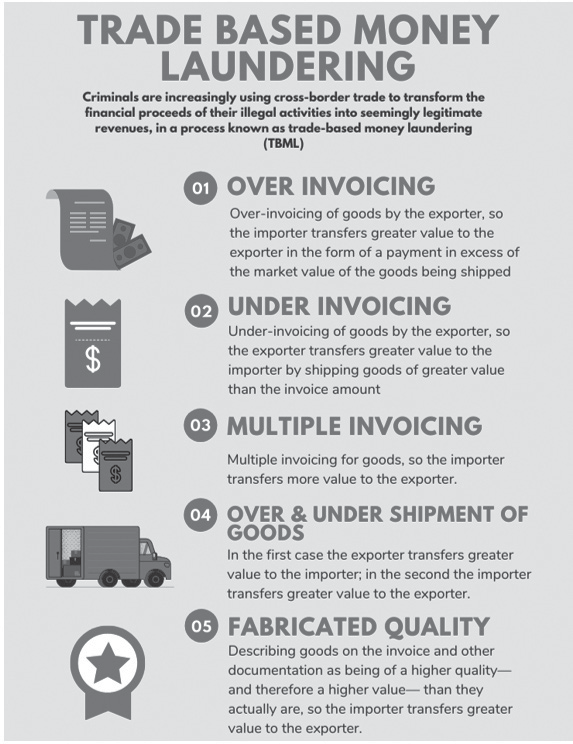
Figure: Trade based Money Laundering
Impact of Money Laundering
Anti-Money Laundering (AML) Basel Index, 2020: Out of 141 countries, India has been ranked 70th highest risk country.
It is a major threat to economic sovereignty:
• Destabilizes economy of the country causing financial
crisis.
• Encourages tax evasion culture and corruption.
• Leads to exchange and interest rates volatility
• Policy distortion: Policy distortion occurs because ofmeasurement error and misallocation of resources
• Criminal activities: It supplements criminal activities.
Global impact
• Damage to reputation of governments, financial institutions and market.
• Rating Downgrade: Rating agencies degrade the rating.
• Investments Hit: Discourages foreign investors from investing in the country.
• Poor access to the world market: It may get narrower due to overly cautious inspections and system controls.
Challenges In Tackling Money Laundering
• Interlinked offence: Money laundering is associated with larger offence like terrorism, drug trafficking, corruption etc.
•
Lack of convergence among enforcement agencies: Many law enforcement agencies are dealing with it. Transnational character of the offence of money laundering.
• Lack of Clarity: Confusion in Money Laundering and Terrorist Financing. Money laundering is concerned with source of funds; while terror financing is concerned with destination of funds.
• Rising Costs: Anti-ML regulations are costly to implement.
• Privacy concerns: When financial institutions turn into agents of surveillance state, privacy is transgressed.
• Inadequate Measures-
• Loopholes: Since Hawala transactions do not pass through banks, they remain beyond the regulation of government agencies and the Reserve Bank of India (RBI).
• Tax Haven Countries: These nations have strict financial secrecy laws that enable the establishment of anonymous accounts while restricting the disclosure of financial details.
• Black Markets (Chor Bazaar): These markets facilitate the sale of smuggled goods, such as electronic items.
• Advancement of Technology: Law enforcement agencies struggle to keep pace with rapidly evolving technological developments.
• Lack of skilled personnel: Getting skilled resources with in-depth knowledge of AML can be a challenge.
• Weak enforcement: under PMLA, only 19% of prosecution complaints converted into cases.
Steps Taken To Prevent Money Laundering
• Starting in 2002, governments around the world upgraded money laundering laws and surveillance and monitoring systems of financial transactions.
• Fines on major banks: For breaches of money laundering regulations during 2011-2015. Eg. HSBC was fined $1.9 billion in 2012.
• Control on trans-border movement of cash
• Central transaction reporting systems wereintroduced to record all financial transactions electronically.
• Prevention of Corruption Act, 1988 (PCA): The PCA prohibits public servants from engaging in corrupt practices, such as accepting bribes and misusing their official position for personal gain. It also contains provisions to seize and confiscate the proceeds of corruption.
• Securities and Exchange Board of India Act, 1992 (SEBI Act): The SEBI Act regulates the securities market in India. It also contains provisions to prevent money laundering through the securities market.
• Narcotic Drugs and Psychotropic Substances Act, 1985 (NDPS Act): The NDPS Act bans the cultivation, manufacturing, possession, distribution, sale, purchase, import, export, consumption, and transportation of narcotic drugs and psychotropic substances. Additionally, it includes provisions for the seizure and confiscation of assets acquired through drug trafficking.
• Foreign Exchange Management Act, 1999 (FEMA): The FEMA regulates the flow of foreign exchange into and out of India. It also contains provisions to prevent money laundering through cross-border transactions.
• Reserve Bank of India (RBI) has issued a number of guidelines to banks and other financial institutions on how to prevent money laundering.
• Foreign Contribution Regulation Act (FCRA), 1976: was amended in 2020 for tighter control and scrutiny over receipt and utilisation of foreign funds by NGOs.
Prevention of Money Laundering Act (PMLA) 2002 Act
• The Prevention of Money Laundering Act, 2002 (PMLA) was established to combat the criminal act of legitimizing income or profits derived from illegal sources. It empowers the government or relevant authorities to seize property acquired through unlawfully obtained funds.
• Objectives of the Act are:
• To prevent and control money laundering.
• To confiscate and seize the property obtained from the laundered money.
• To penalise the offenders with the offence of money laundering.
• For appointing the adjudicating authority and appellate tribunal for taking in charge of matters related to money laundering.
• To make it obligatory for banking companies, financial institutions and intermediaries to preserve records or documents relating to financial transactions.
• Defines Money Laundering: Sec. 3 of PMLA defines offence of money laundering as whosoever directly or indirectly attempts to indulge or knowingly assists or knowingly is a party or is actually involved in any process or activity connected with the proceeds of crime and projecting it as untainted property shall be guilty of offence of money-laundering.
• Obligations for Financial Entities: It prescribes obligation of banking companies, financial institutions
and intermediaries for verification and maintenance of records of the identity of all its clients and also of all transactions and for furnishing information of such transactions in prescribed form to the Financial Intelligence Unit-India (FIU-IND).
• Under Section 45 of the PMLA, every offence punishable under the Act will be cognizable. Any individual who has been arrested for the offence of money laundering will not be released on bail or bond, unless a change has been provided to the public prosecutor to oppose the application of such a release.
• Several offences listed under the said acts are enlisted:
• Indian Penal Code 1860/Bharatiya Nyaya Sanhita (BNS)-2023
• The Narcotics Drugs and Psychotropic Substances (NDPS) Act, 1985;
• The Prevention of Corruption Act, 1988;
• The Antiquities and Art Treasures Act, 1972;
• The Copyright Act, 1957;
• The Trademark Act, 1999;
• The Wildlife Protection Act, 1972 and
• The Information Technology Act, 2000.
Enforcement Bodies Empowered under PMLA-
• Enforcement Directorate: The enforcement directorate in the Department of Revenue, Ministry of Finance, the Government of India, has the authority to investigate matters of money laundering in India under the PMLA.
• Financial Intelligence Unit-India (FIU-IND): Authorized to impose penalties on banks, financial institutions, or intermediaries if they or their officials fail to adhere to the provisions of the Act.
• Appellate Authority: Responsible for hearing appeals against the decisions made by the Adjudicating Authority and officials such as the Director of FIU-IND.
• Special Courts: Under the PMLA, certain session courts are designated as Special Courts to handle cases related to offenses punishable under the Act.
Amendments in 2012
• It was amended to widen the definition of “proceeds of
crime” and to remove the grey areas and ambiguity in the Act.
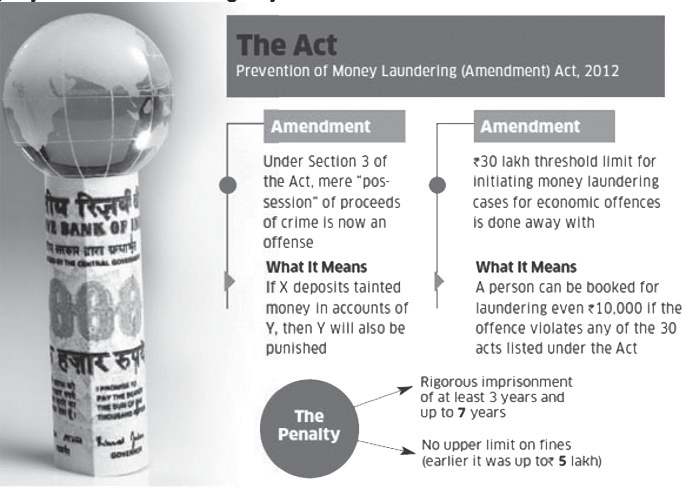
Figure: Prevention of Money Laundering Act, 2012
Amendment in 2019
• Treat money laundering as a stand-alone crime rather
than a schedule offence.
• Authorized to conduct search and seizure of property and persons without registration of any FIR or chargesheet. A formal warrant is required from appropriate authorities.
Amendment in 2023
• Non-governmental organizations (NGOs) must report their funding sources to financial institutions, banks, or intermediaries.
Additionally, all reporting entities are required to register the details of any non-profit organization clients on the DARPAN portal of NITI Aayog.
• Practicing chartered accountants, company secretaries, and cost and works accountants involved in financial transactions on behalf of their clients are now included under the scope of the money laundering law.
• Politically Exposed Persons (PEPs) are individuals entrusted with significant public responsibilities by a foreign nation, such as heads of state or government, senior politicians, high-ranking officials in the
government, judiciary, or military, top executives of state- owned corporations, and key political party members.
Concerns with the Act
• Vast Powers:
• Harsh steps and vast powers with the authorities for combating the issue of black money, however, in public interest.
• Lack of Transparency:
• ED’s Enforcement Case Information Report (ECIR), equivalent of the FIR, is said to be an ‘internal - The Enforcement Case Information Report (ECIR), which
is the Enforcement Directorate’s (ED) equivalent of an FIR, is considered an internal document and is not provided to the accused. Unlike the guidelines established under criminal procedure law, the ED has the discretion to file an ECIR based on its own judgment.
• Bail:
• Section 45(1) of the Act governed bail provisions. However, in the landmark case Nikesh Tarachand Shah v. Union of India (2017), this stringent clause was deemed unconstitutional as it violated Article
14 and Article 21 of the Indian Constitution
and contradicted the principle of “bail, not jail.” Consequently, Section 45(1) was struck down.
• Attachment of Property:
• Property belonging to an individual other than the accused under this Act can also be seized and attached.
• Additionally, the court has the authority to confiscate assets acquired through unlawful means, even if obtained before the Act was enacted.
• The presumption of guilt under Section 23 contradicts the legal principle of presuming innocence until proven guilty.
• Application to Ordinary Crimes:
• Concerns have been raised that the PMLA is being misused in routine criminal investigations, leading to the seizure of assets belonging to individuals who are not guilty.
• Compromised Rights:
• While the PMLA was enacted in line with India’s international commitments, including the Vienna Convention, to combat money laundering, it has been
criticized for excessively restricting individual rights.
National and International Mechanisms
FIU-IND, Enforcement Directorate (ED), Indian Income
Tax Department, Economic Offences Wing, CBI etc.
• Most money laundering activities in India are through political parties, corporate companies and the shares market. These bodies investigate and monitor money laundering in the country.
• Empowered regulators like RBI, SEBI, IRDAI etc.
• International Collaborations
• Financial Action Task Force (FATF)
• It is an inter-governmental organisation founded by G7 in 1989 to combat money laundering.
• Later, its mandate expanded to include terrorism
financing.
• It checks the threats to the integrity of the international financial system.
• It monitors through “peer reviews” of member countries.
• It maintains FATF blacklist and the FATF greylist.
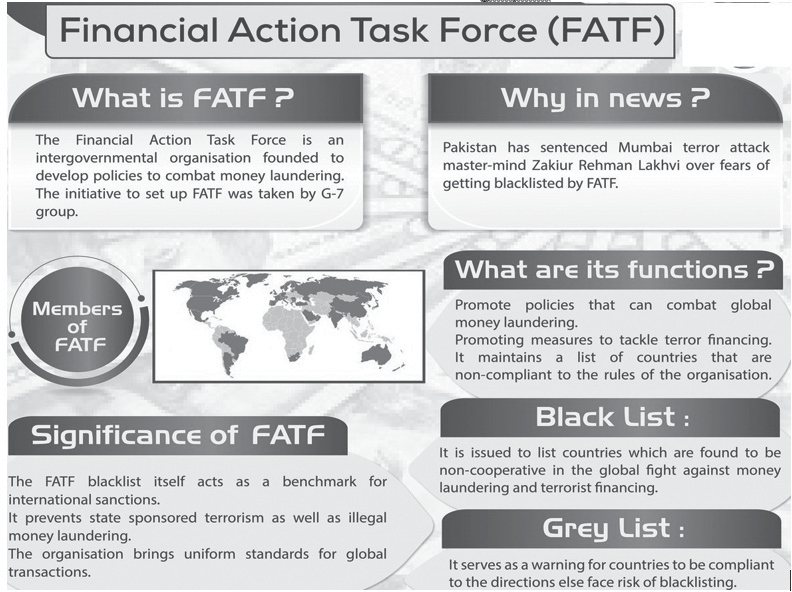
Figure: Financial Action Task Force (FATF)
• Asia Pacific Group on Money Laundering: It works as regional anti-money laundering body.
The purpose of the APG is to facilitate the adoption, implementation and enforcement of internationally accepted
anti-money laundering and anti-terrorist financing standards set out in the recommendations of the Financial Action Task Force (FATF).
• The United Nations Office on Drugs and Crime maintains the International Money Laundering Information Network.
• Bilateral Conventions:
The Financial Intelligence Unit (FIU-IND) signed bilateral MoUs with three countries namely Mauritius, Philippines and Brazil to facilitated exchange of intelligence for cooperation to gather information concerning financial transactions suspected of money laundering and from terrorist financing.
• Membership of World Customs Organisations allowing information sharing.
• India has entered into Customs Mutual Administrative Assistance Agreement with EU, Israel, Russia, UK, Hongkong, Maldives, Uzbekistan, Iran, Egypt, USA, China, SAARC Countries, South Korean, Australia and Brazil. These allow information sharing to maintain surveillance over suspect goods, persons or means of transport.
• Action on Tax Havens
• OECD Guidelines 1998 on Harmful Tax Competition
• It considered as meeting “three of four” criteria to be a tax haven. But later it was amended to be “two of three” criteria.
• The 1998 report also promulgated a list of policy recommendations
to assist offending nations in reforming their practices
defensive measures to protect from the effects of harmful tax competition.
• Listing of Tax Havens: At the London G20 summit in 2009, G20 countries agreed to define a blacklist for tax havens, to be segmented according to a four-tier system, based on compliance with an “internationally agreed tax standard”Those that have substantially implemented the standard (includes most countries but China still excludes Hong Kong and Macau).
• Tax havens that have committed to – but not yet fully
• At the 2012, G20 summit, OECD as assigned to combat Base Erosion And Profit Shifting (BEPS) activities by corporates. An OECD BEPS Multilateral Instrument, consisting of “15 Actions” designed to be implemented domestically and through bilateral tax treaty provisions, were agreed at the 2015 G20 Antalya summit. The OECD BEPS Multilateral Instrument (“MLI”), was adopted on 24 November 2016
• The OECD G20 Base Erosion and Profit Shifting Project (or BEPS Project) is an OECD/G20 project to set up an international framework to combat tax avoidance by multinational enterprises («MNEs») using base erosion and profit shifting tools. The BEPS
2.0 Project 2020 aims to ensure that multinational enterprises pay a fair share of tax wherever they operate by introducing a global minimum corporate tax rate that countries can use to protect their tax bases.
• After announcing the 15 actions in the OECD BEPS package to deal with various measures tackling profit shifting and tax avoidance, the OECD and the G20 Inclusive Framework continued directing their efforts to address the tax challenges arising from digitalisation. This OECD initiative is referred to as the BEPS 2.0.
• BEPS 2.0 has two parts or pillars, namely, Pillar One and Pillar Two.
• Pillar One is focused on the reallocation of (a portion of) the consolidated profit of a multinational enterprise
• Pillar Two, on the other hand, introduces a global
minimum effective tax rate of 15 %.
• International Conventions: India is signatory to the following:
• International Convention for Suppression of Financing of Terrorism (1999)
• United Nations Convention against Transnational Organised Crime (the Palermo Convention) 2000
• United Nations Convention against Corruption 2003
• SAARC Convention Against Illicit Traffic in Narcotic Drugs and Psychotropic Substances.
Vienna Convention
• United Nations Convention against Illicit Traffic in Narcotic Drugs and Psychotropic Substances, 1988.
• Basel Principles Statement, 1989.
• Financial Action Task Force (FATF) Forty Recommendations on Money Laundering, 1990.
• Political Declaration and Global Program of Action, adopted by the United Nations General Assembly in 1990.
• The Basel Anti Money Laundering Index
• It is an independent annual ranking that assesses risks of money laundering and terrorist financing (ML/TF) around the world.
• Published by the Basel Institute on Governance since 2012, the Basel AML Index provides risk scores based on data from 17 publicly available sources such as the Financial Action Task Force (FATF), Transparency International, the World Bank and the World Economic Forum.
• The risk scores cover five domains:
• Bribery and Corruption
• Quality of ML/TF Framework
• Financial Transparency and Standards
• Public Transparency and Accountability
• Legal and Political Risks
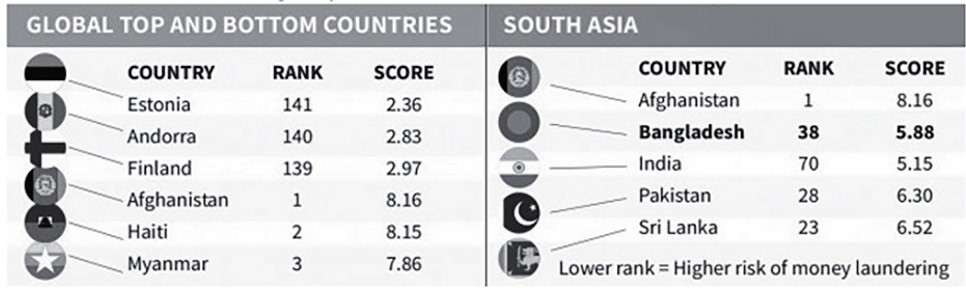
Way Forward to Tackle Money Laundering
• Identify
• Promotion of the Vienna Convention: It creates an obligation for signatory states to criminalize the laundering of money from drug trafficking.
• Basel Committee recommendations: To ensure that banks are not used to hide or launder funds acquired through illegal activities.
• Enlist common predicate offences
• International laws: Countries should criminalise it on the basis of the international conventions like UNCC, 2003 and UNTOC, 2000
• Awareness and education: To infuse a sense of watchfulness among masses.
Public is both the frontier and battlefield to tackle it.
Controlling Hawala transactions
•
Monitor
• Global coordination: with INTERPOL and other international organisations.
• Promote a regional approach: To address problems, develop and maintain strategic relationships with other organisations
• Strengthening KYC norms: To know the identity of the customer and understanding the kinds of transactions in which the customer is likely to engage
• Use of AI and software to analyse transactions.
• To create a Special cell for money laundering.
• Measures must be taken to address the risks posed by
cryptocurrency in money laundering cases.
• Raising awareness about the negative impacts of money laundering is crucial for society.
• Financial institutions can adopt safeguards such as conducting risk assessments before introducing new products, business practices, or emerging technologies.
CONCLUSION
• The Prevention of Money Laundering Act (PMLA) is a dynamic legislation that will continue to evolve over time, adapting to societal changes and increasing public awareness.
•
Banks, financial institutions, and other intermediaries play a significant role in economic crimes, making it essential for them to receive proper training and guidance to identify and combat money laundering.
Employees in banks and financial institutions are typically trained to recognize and address money laundering activities.
• Additionally, banks are legally required to report any suspicious transactions, whether individual or part of a series.
• Moreover, with the support of technology, including specialized compliance platforms, companies and organizations can efficiently conduct customer due diligence and ensure no illicit activities take place.
•