Nuclear Security
INTRODUCTION
Nuclear Security is the prevention and detection of, and response to unauthorised removal, sabotage, unauthorised access, illegal transfer or other malicious acts involving nuclear or radiological material or their associated facilities.
• Nuclear security thus differs from Nuclear Safety, which involves prevention of and protection against accidents involving such material or related facilities that could give rise to radiation risks.
• As per International Atomic Energy Agency (IAEA), Nuclear Security refers to the prevention and detection
of, and response to, theft, sabotage, unauthorized access, illegal transfer or other malicious acts involving nuclear material, other radioactive substances or their associated facilities.
• As of December 31, 2007, the IAEA Illicit Trafficking Database contained 1340 confirmed incidents reported by participating states. Of the 1340 confirmed incidents,
303 involved unauthorized possession and related criminal activity, 390 involved theft or loss of nuclear or other radioactive materials, and 570 involved other unauthorized activities.
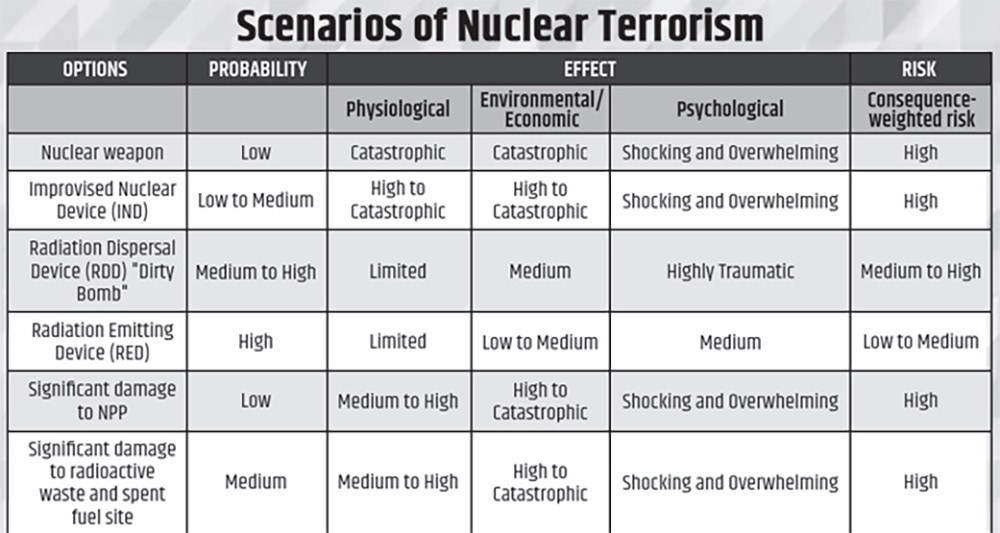
Figure: Scenarios of Nuclear Terrorism
• The scale and scope of India’s Civil Nuclear Programme is unique for a developing country. India has twenty operating nuclear power plants, a range of fuel cycle facilities from mining of Uranium and Thorium to reprocessing plants and fast reactors, and a large, expert human resource in nuclear science and technology spread over a variety of research labs and institutions. Nuclear energy is slated to play an increasingly important role in India’s Energy
Security and sustainable development plans.
• The country is looking at a target of 60,000 MW of electricity production by 2030 from a range of reactors
— indigenous Pressurised Heavy Water Reactors (PHWRs), now standardized at 700 MW per reactor Light Water Reactors (LWRs), in foreign technical collaboration like at Kudankulam which achieved criticality in 2013.
• Indigenous Fast Breeder Reactors (FBRs) can generate more fuel for the future and create the base for the utilization of the country’s abundant thorium resource. This strategy calls for a significant set of measures, such as civil nuclear cooperation agreements with international
partners, Uranium supply arrangements, fabrication of a variety of fuels, construction of new facilities and human resource development, which are moving apace.
India’s Nuclear Security
• India has long been familiar with nuclear security. When India's Nuclear Power Programme was initiated, Prime Minister Nehru emphasized that nuclear energy source materials were not ordinary commodities and required careful handling.
• India’s Nuclear Weapon Programme was aimed at the peaceful utilization of atomic energy at a time when the pioneering activities in this field were geared essentially toward military use.
• India participated actively in international discussions on safeguards for the peaceful uses of nuclear energy and became a founder member of the IAEA in 1957, a year after its first reactor went critical.
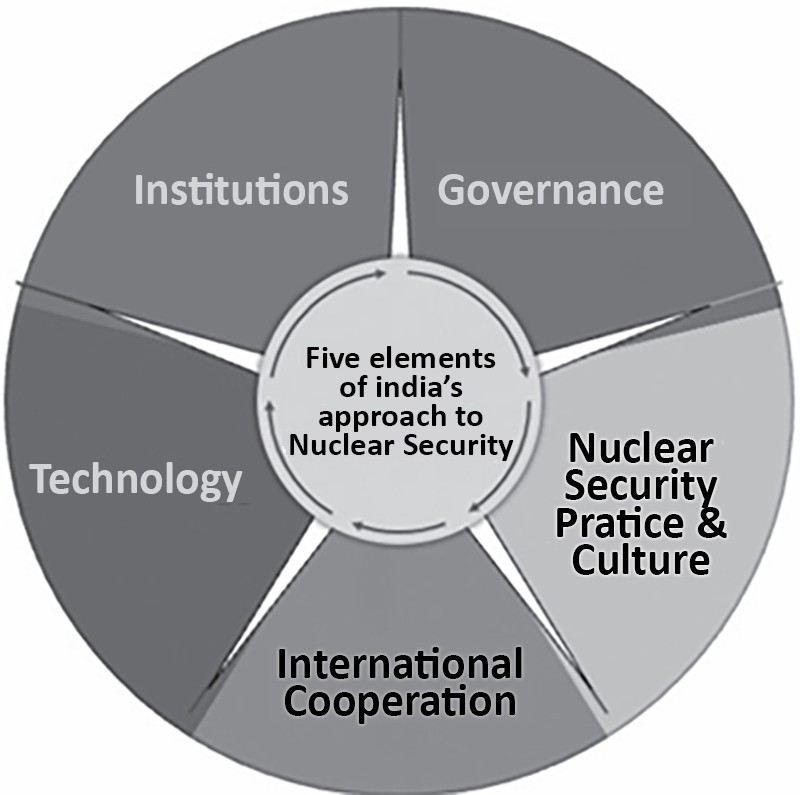
Figure: Five Elements of India’s Approach to Nuclear Security
• India has been implementing IAEA safeguards on its civilian nuclear facilities for more than four decades as party to IAEA Conventions on Nuclear Safety and Security, in particular the 1980 Convention on the Physical Protection of Nuclear Material and its amendment in 2005, Code of Conduct in Safety and Security of Radioactive Sources, 2006 it has also been following the highest international standards on nuclear and radiological safety and security.
• India’s Approach
India’s Nuclear Doctrine
• India conducted its first nuclear test in 1974 and the second nuclear test in 1998.
• India declared herself a nuclear weapon state in 1998
and came forward with Nuclear Doctrine in 2003.
• In 2003, the Cabinet Committee on Security (CCS) decided to publicly disclose key aspects of India’s nuclear doctrine and operational framework governing its nuclear assets.
• India's nuclear doctrine is based on the following principles:
• Maintaining a Credible Minimum Deterrent to ensure security.
• Adopting a No First Use policy, meaning nuclear weapons will only be deployed in retaliation to a nuclear attack on Indian territory or its forces anywhere.
• Any nuclear retaliation in response to a first strike will be massive, aiming to cause unacceptable damage.
• The authority to authorize nuclear retaliatory attacks rests solely with the civilian political leadership through the Nuclear Command Authority.
• Committing to non-use of nuclear weapons against states that do not possess nuclear capabilities.
• Retaining the option of nuclear retaliation if India or its forces face a significant attack using biological or chemical weapons.
• Enforcing strict controls on the export of nuclear and missile-related technologies and materials.
• Engaging in Fissile Material Cutoff Treaty negotiations and upholding the moratorium on nuclear testing.
• Reaffirming commitment to achieving a Nuclear Weapon-Free World through global, verifiable, and non-discriminatory nuclear disarmament.
• Critical Analysis of No First Use (NFU) Doctrine
• In India, the NFU policy has been called into question by critics, on the grounds that it allows Pakistan to take the initiative while restricting India’s options militarily and puts India in a disadvantageous position.
• Pakistan’s low nuclear thresholds and its policy of using its nuclear umbrella to foment sub- conventional conflict in India is the principal reason behind the debate around India’s ‘no first use’ policy.
• NEW (UNOFFICIAL) IDEAS IN INDIA’S NUCLEAR DOCTRINE
• Cold Start Doctrine: Though officially denied, it is a military doctrine that was developed by the Indian Armed Forces for use in a possible war with Pakistan.
• It involves the various branches of India’s military conducting offensive operations on the western border as part of unified battlegroups within 48 hours without risking a nuclear conflict.
• It is a limited war strategy to swiftly seize Pakistani territory and take the opponent by surprise.
• Policy of Defensive Offence and Double Squeeze: This policy as enunciated by National Security Advisor Ajit Doval, aims to make it costly for Pakistan to continue its policy of supporting terror against India.
• Defensive Offence is when you go and attack the place where the offense is coming from.
•
It is a middle path between the two extremes of pure defence and an offensive attack.
• Pure Defence is ineffective because terrorists could always find a way of breaching defences and sneaking in. An Offensive strategy is not preferable because an all-out war could lead to the nuclear threshold being crossed.
• Under Double Squeeze, most terrorists are driven by money and they can be contained by showering them with more money than what has been given to them by their handlers in Pakistan.
Governance Framework
• Laws such as the Atomic Energy Act of 1962 and Rules on Safe Disposal of Radioactive Waste (1987) and Radiation Protection (2004) form the backbone of India’s framework for governance of nuclear activities.
• The Foreign Trade Development & Regulation Act (FTDR) of 1992 and the Weapons of Mass Destruction (WMD) Act of 2005 provide additional legal authority for controlling nuclear trade and transfers.
• The FTDR has been amended in 2010, inter alia, to strengthen safeguards against leakage of technology and Guidelines for Nuclear Transfers have been issued in July 2010 under the Atomic Energy Act to regulate trade by authorized entities, including foreign partners.
• While this is not strict sensu a nuclear security issue, AERB guidelines for use of radioisotope-based scientific devices have been strengthened following a safety incident involving a_ disused device in the Mayapuri area of New Delhi in 2010.
Institutional Framework
• Cabinet Committee on Security (CCS)
• It is the apex body responsible for political oversight, decision making and executive action on matters of national security headed by the Prime Minister.
• CCS is a cabinet committee of the Union Government that discusses, debates and is the final decision-making body on senior appointments in the national security apparatus, defence policy and expenditure etc.
• The composition of the CCS is:
• Prime Minister of India
• Minister of Defence
• Minister of Home Affairs
• Minister of Finance
• Minister of External Affairs
• The National Security Adviser, the Cabinet Secretary and the Defence Secretary have also been attendees of the CCS meetings.
• It will review:
• The existing command and control structures,
• The state of readiness, the targeting strategy for a retaliatory attack, and
• Operating procedures for various stages of alert and launch.
• Approved the arrangements for alternate chains of command for retaliatory nuclear strikes in all eventualities.
• National Security Council (NSC)
• The National Security Council (NSC) serves as an advisory body to the Prime Minister’s Office on matters concerning national security and strategic interests. It was established in November 1998.
• The NSC operates within a three-tier structure, comprising:
• Strategic Policy Group (SPG), National Security Advisory Board (NSAB), National Security Council Secretariat (NSCS)
• The council is headed by the National Security Advisor (NSA).
• It shares common members with the Cabinet Committee on Security (CCS), facilitating streamlined decision-making and implementation.
• Nuclear Command Authority (NCA) – 2003
• The Nuclear Command Authority (NCA) is responsible for overseeing command, control, and operational decisions related to India’s Nuclear Weapons Programme. It consists of two key components:
• Political Council – Chaired by the Prime Minister, this is the only body authorized to sanction the use of nuclear weapons.
• Executive Council – Led by the National Security Advisor (NSA), this council offers strategic recommendations to the Political Council and ensures execution of its directives.
• Department of Atomic Energy (DAE)
• DAE was established in 1954 with Jawaharlal Nehru
• The Department of Atomic Energy (DAE) was established in 1954 by Jawaharlal Nehru with its first minister and Homi Bhabha as its secretary. It operates under the Prime Minister’s Office (PMO).
• DAE is actively involved in the advancement of nuclear power technology and the application of radiation technologies across various sectors, including agriculture, medicine, industry, and fundamental research.
• The department consists of:
Five research centers
Three industrial organizations
Five public sector undertakings (PSUs)
Three service organizations
The DAE headquarters is located in Mumbai, Maharashtra, India.
• Atomic Energy Commission of India (AEC)
• The Atomic Energy Commission (AEC) serves as the
governing body of the Department of Atomic Energy (DAE), which operates under the direct supervision of the Prime Minister of India.
• Initially established in 1948 under the Department of Scientific Research, it was later replaced by the Department of Atomic Energy in 1954. Homi J. Bhabha was appointed as its secretary, and the department was granted greater financial and executive authority. The headquarters is located in Mumbai, Maharashtra.
• The primary responsibilities of the commission include:
• Organizing research in atomic science within the country.
• Training scientists in the field of atomic energy.
• Promoting nuclear research in the commission's laboratories.
• Conducting exploration for atomic minerals and facilitating their extraction for industrial use.
• There are five key research centers under its jurisdiction:
Bhabha Atomic Research Centre (BARC) in Mumbai.
Indira Gandhi Centre for Atomic Research (IGCAR) in Kalpakkam, Tamil Nadu.
Raja Ramanna Centre for Advanced Technology (RRCAT) in Indore.
Variable Energy Cyclotron Centre (VECC) in Kolkata.
Atomic Minerals Directorate for Exploration and Research (AMD) in Hyderabad.
• Atomic Energy Regulatory Board (AERB):
• Set up under the Atomic Energy Act, AERB has been functioning independently of the nuclear power operator in India since 1983.
• AERB’s focus has been on both nuclear safety and security of civilian facilities. Separate institutions and operating procedures exist for nuclear security at India’s strategic facilities.
• A Nuclear Controls & Planning Wing (NC&PW) has been created in the Department of Atomic Energy (DAE) as of 2013 to integrate DAE’s — safeguards, export controls and nuclear security related activities. The NC&PW takes the lead on international cooperation on nuclear security in collaboration with the Ministry of External Affairs.
• The increasing reliance on information technology across various systems, along with rising concerns over potential cyber threats, is being addressed by the Computer Information and Security Advisory Group (CISAG). This group conducts periodic audits of information systems to assess vulnerabilities. Additionally, it has established plans and guidelines to counter cyber-attacks and minimize their impact. To
further strengthen cybersecurity, specific guidelines are being developed to manage network-related risks associated with control and instrumentation systems used in different installations.
• Authorities like Commander-in-Chief, Strategic Forces Command will manage and administer all Strategic Forces.
Nuclear Defence and Nuclear Triad
• Strategic Nuclear Command (SNC)
• India’s Strategic Nuclear Command or Strategic Forces Command was formally established in 2003, forms part of India’s Nuclear Command Authority (NCA).
• It is responsible for the management and administration of the country’s tactical and strategic nuclear weapons stockpile.
• The joint services SNC is the custodian of all of India’s nuclear weapons, missiles and assets.
• Nuclear Triad
It is a three-pronged military force structure of land- based intercontinental ballistic missiles, submarine- launched ballistic missiles, and strategic bombers
with nuclear bombs and missiles i.e. capabilities of a nuclear strike from land, air, and water.
Land: Prithvi and Agni Series nuclear capable ballistic missiles.
Air: Dassault Mirage 2000s and SEPECAT Jaguars. (Free-falling and un-guided method).
Sea: Sagarika K-15 missile in Arihant Submarine; Ship: Dhanush missile from ships like INS Subhadra or INS Rajput.
Nuclear Triad is critical for Policy of ‘No First Use’. The Nuclear arsenal is only to be used if India is attacked. That is called the Second-Strike Capability. It is a country’s ability to respond to a nuclear attack in equal measure.
• The ability to fire nuclear missiles from under the sea is particularly important. Submarines, unlike fighter aircraft and land-based missile systems, are harder to track and destroy. Launching a nuclear weapon through land-based systems is the most common method, but it carries the risk of being detected and attacked. Hence, launching from underwater can prove to be the biggest threat in case of war.
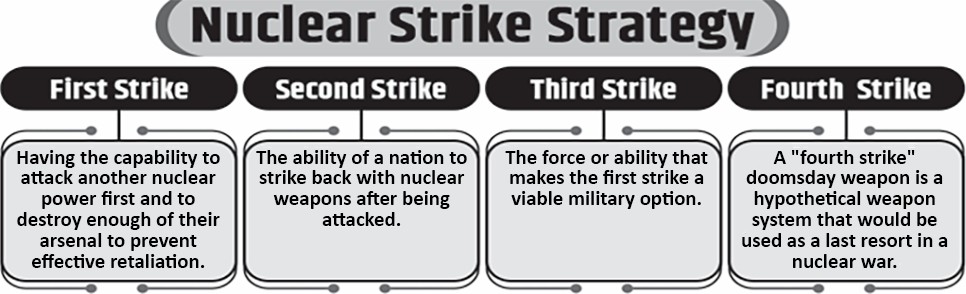
Figure: India’s Nuclear Strike Strategy
• Here, the Submarine Launched Ballistic Missiles (SLBM) would act as the ace in the hole if the other two were to fail.
• India recently completed its nuclear triad. Indigenous ballistic missile nuclear submarine INS Arihant achieved a milestone by completing its first deterrence patrol.
• The US, France, Britain, China, and Russia currently have such capabilities.
• The SSBN is the most dependable platform for a second-strike. Because they are powered by nuclear reactors, these submarines can stay underwater indefinitely without the enemy detecting it.
India’s Engagement with International Players in Nuclear Energy
• India-Australia Civil Nuclear Cooperation
• A Civil Nuclear Cooperation Agreement between the two countries was signed in September 2014.
• The Australian Parliament passed the “Civil Nuclear Transfer to India Bill 2016” which allows that Uranium mining companies in Australia to fulfil contracts to supply Australian uranium to India for civil use.
• Exports would not be hindered by domestic legal action challenging the consistency of the safeguards
applied by the IAEA in India and Australia’s international non-proliferation obligations.
It also ensures that any future bilateral trade in other nuclear-related material or items for civil use will also be protected.
• India-USA Civil Nuclear Agreement 2008
• Also called “123 Agreement”, it is a bilateral agreement for peaceful nuclear cooperation which governs civil nuclear trade between American and Indian firms to participate in each other’s civil nuclear energy sector.
• India-France Civil Nuclear Cooperation 2008
• An agreement on civil nuclear cooperation was signed between India and France in 2008. In 2018, the two countries signed several agreements, including a pact on the development of six nuclear reactors at Jaitapur in Maharashtra. The Jaitapur Nuclear Agreement is expected to be the largest nuclear power project in the world, with a capacity of 9.6 MW.
• India-Russia Civil Nuclear Cooperation 2009
• India and Russia signed a civil nuclear cooperation agreement that was free from any curbs on India and guaranteed it against any limitations in the future.
• As part of the nuclear agreement, Russia will establish additional nuclear reactors in India, share a comprehensive range of nuclear energy technologies, and guarantee a continuous supply of fuel.
• During the inauguration, both sides noted the cooperation in the area of civil nuclear energy between India and Russia, which is reflective of their Special and Privileged Strategic Partnership.
• A total of 6 Nuclear Power Plants of 1000 MW capacity are being constructed in Kudankulam, Tamil Nadu having total installed capacity of 6000 MW.
• India-Japan Civil Nuclear Cooperation 2017
• This Agreement is a reflection of the strategic partnership between India and Japan and will pave the way for enhanced cooperation in energy security and clean energy.
• The Agreement seeks to promote full cooperation between the two countries in the development and uses of nuclear energy for peaceful purposes on a stable, reliable and predictable basis.
International Nuclear Non-Proliferation Frameworks and Treaties
• Non-Proliferation Regime refers to the complex of
international agreements and organizations, the participants of which are nuclear as well as non-nuclear states, and domestic legislations of member states, the aim of which is to prevent those nations from acquisition of nuclear status that had not had it till 1967.
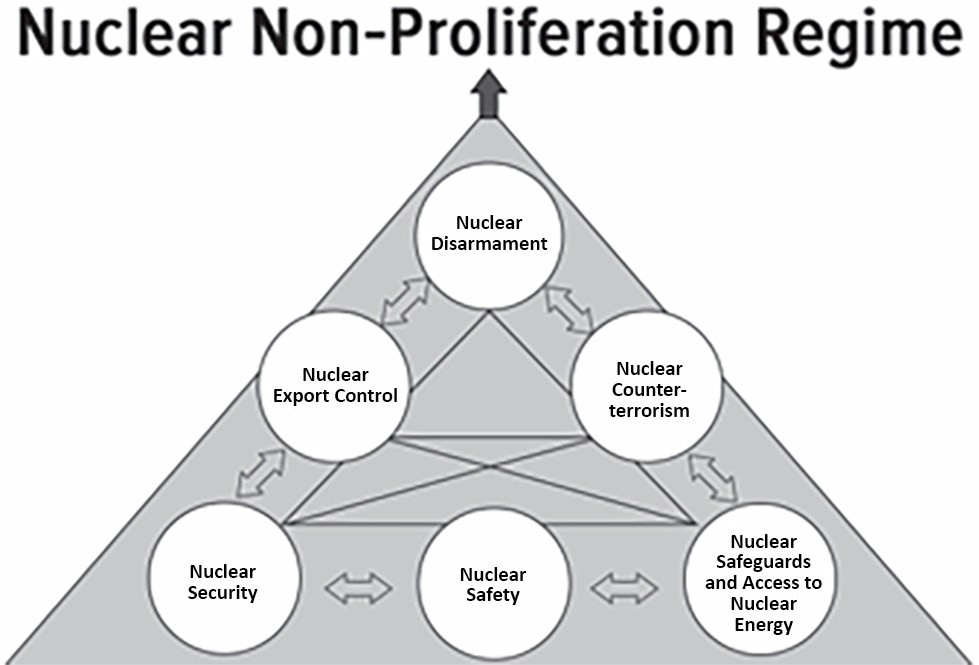
Figure: International Nuclear Non-Proliferation Frameworks
Nuclear-weapon nations and their allies don’t want any other nations or entities to get the technology, and those threatened by or otherwise hostile to these nations (or any other nations) often want to have it. Meanwhile, peaceful people across the world want no one to have nuclear weapons.
• In the 1950s, it became clear what the consequences of nuclear weapon uses could be; people began to realize that nuclear weapon was of a little use for such traditional military purposes as acquisition of a territory, achievement of limited political goals etc. because of its huge destructive force; prohibitive expenses; There was a global mass movement against nuclear weapons. Thus, group of nuclear states was ready to prevent the appearance of new nuclear
nations.
• A growing number of states began to refrain from acquiring of nuclear weapon upon condition of certain security guarantees, first of all guarantee that their neighbors and potential enemies would also be non-nuclear.
• On the other hand, nuclear states did not show their desire to eliminate nuclear arsenals, at least in the nearest future (complete nuclear disarmament was declared by them as long-term objective). Therefore, attempts of the most of countries to prevent nuclear aggression by means of creation of nuclear-free world could not have been realized completely.
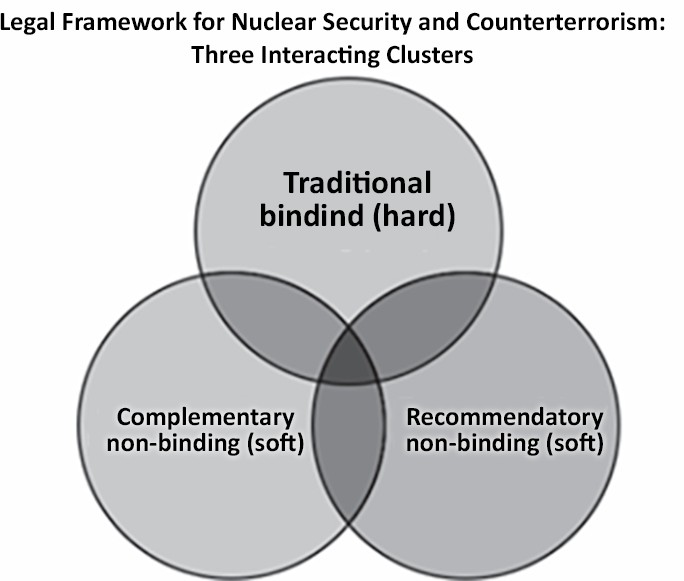
Figure: Nuclear Strategy and Counterterrorism
• Traditional Binding Instruments
• Under IAEA auspices:
1980 Convention on Physical Protection of Nuclear Materials (CPPNM)
2005 Amendment to CPPNM (not in force, 45 ratifications)
1986 Convention on Assistance in the Case of a Nuclear Accident or Radiological Emergency (other safety related instruments)
• Under UN General Assembly auspices:
• 1997 International Convention for the Suppression of Terrorist Bombing
• 2005 International Convention for the Suppression of Acts of Nuclear Terrorism (12 others under UNGA and specialized agencies)
• Under UN Security Council auspices (Chapter VII)
UNSCR 1373 (2001)
UNSCR 1456 (2003)
UNSCR 1540 (2004)
• International Atomic Energy Agency (IAEA)
• IAEA is an intergovernmental organization that seeks to promote the peaceful use of nuclear energy and to inhibit its use for any military purpose, including nuclear weapons.
• It is designated as a ‘related organisation’ of the United Nations. It was established in 1957 as an autonomous organization within the United Nations system.
• Its headquarters is in Vienna, Austria.
• Following the ratification of the Treaty on the Non- Proliferation of Nuclear Weapons in 1968, all non- nuclear powers are required to negotiate a safeguards agreement with the IAEA.
• Through this, the IAEA is given the authority to
monitor nuclear programs and to inspect nuclear facilities.
The functions of the IAEA are discussed below.
Promoting and assisting the research, development and practical applications of peaceful uses of nuclear technologies.
Establishing and administering safety guards to ensure that such research/development, etc., by the IAEA is not used for military purposes.
Under the Nuclear Non-Proliferation Treaty (NPT) and other international agreements, comprehensive safeguards are mandatory for Non-Nuclear-Weapon States (NNWS) that are party to such treaties. For example, the Joint Comprehensive Plan of Action (JCPOA) signed in 2015 between Iran and six global powers (P5+1, including the US, Germany, France, the UK, China, and Russia) assigned the International Atomic Energy Agency (IAEA) the responsibility of overseeing Iran's nuclear facilities.
• The IAEA is funded by contributions from member states and donations from non-members.
• IAEA Governance: The IAEA has two policymaking bodies. They are:
General Conference
Board of Governors
• General Conference
It consists of all the member countries of the IAEA.
It meets in a regular annual session.
The annual general conference usually takes place in September.
• Board of Governors
Here, there are 35 members.
• India is a founding member of the IAEA. As of 2023, India has put 26 reactors under IAEA safeguards. Also, India joined the IAEA Response and Assistance Network (RANET) in January 2020. RANET is a group of countries that provide assistance to reduce the consequences of nuclear or radiological emergencies.
United Nations Security Council (UNSC)
• UNSC has established legal framework for strengthening nuclear security and combating nuclear terrorism under UNSC Resolution 1540 adopted in 2004.
• Resolution 1540, adopted under Chapter VII of the United Nations Charter, asserts that the spread of nuclear, chemical, and biological weapons, along with their delivery mechanisms, poses a threat to global peace and security. The resolution mandates that states must not, by any means, assist non- state actors in developing, acquiring, producing,
possessing, transporting, transferring, or using such weapons and their means of delivery.
It also emphasizes support for multilateral treaties aimed at preventing the proliferation of weapons of mass destruction and underscores the necessity for all states to fully implement these agreements. Additionally, the resolution reaffirms that its provisions do not conflict with or modify the rights and obligations of states under the Treaty on the Non-Proliferation of Nuclear Weapons (NPT), the Chemical Weapons Convention (CWC), or the Biological Weapons Convention (BWC), nor do they affect the responsibilities of the International Atomic Energy Agency (IAEA) and the Organisation for the Prohibition of Chemical Weapons (OPCW).
• Nuclear Non-Proliferation Treaty (NPT) 1968
• The Nuclear Non-Proliferation Treaty (NPT), signed in 1968 and coming into effect in 1970, currently has 190 member states. It mandates that nations must relinquish any existing or future ambitions to develop nuclear weapons in exchange for access to nuclear
energy for peaceful purposes.
• The treaty is built on three core principles: non- proliferation, disarmament, and the right to utilize nuclear technology for peaceful applications.
• India is among the five countries that either never signed the NPT or signed and later withdrew, alongside Pakistan, Israel, North Korea, and South Sudan.
• India has consistently regarded the treaty as discriminatory and has refused to be a signatory.
• It has opposed international non-proliferation agreements, arguing that they are selectively enforced against non-nuclear states while reinforcing the dominance of the five recognized nuclear-armed nations.
• Limited or Partial Test Ban Treaty 1963
• It allows nuclear tests only underground thus, prohibits the nuclear experiments on ground, underwater and in outer space.
• It prohibited all test detonations except underground.
• US, UK and USSR in 1963, signed this treaty. India has also ratified the treaty.
• Treaty on Outer Space 1967
• The Outer Space Treaty, officially known as the Treaty on Principles Governing the Activities of States in the Exploration and Use of Outer Space, including the Moon and Other Celestial Bodies, serves as the foundation of international space law.
• It prohibits the deployment of Weapons of Mass Destruction (WMD) in outer space, bans military operations on celestial bodies, and establishes legally
binding regulations for the peaceful exploration and utilization of space.
• The treaty also forbids countries from conducting nuclear weapon tests in orbit or on celestial bodies such as the Moon.
• As of August 2023, the treaty has been ratified by 114 countries, with an additional 22 nations having signed but not yet completed the ratification process.
Comprehensive Test Ban Treaty (CTBT) 1996
• The Comprehensive Nuclear-Test-Ban Treaty (CTBT) is a multilateral agreement aimed at prohibiting all nuclear test explosions, whether for civilian or military purposes, in every environment. A total of 187 countries have signed the treaty, with Sri Lanka being the most recent to ratify it on July 25, 2023.
• For the treaty to come into effect, all 44 countries listed in Annex 2—nations that possessed nuclear facilities when the treaty was drafted and adopted— must ratify it.
• Currently, 36 of these states have completed ratification, while eight countries, including China, North Korea, Egypt, India, Iran, Israel, Pakistan, and the United States, have yet to do so.
• Notably, India, North Korea, and Pakistan have not signed the treaty.
The Fissile Material Cut-off Treaty (FMCT)
• It is a proposed international agreement aimed at banning the production of highly enriched uranium and plutonium, the key materials used in nuclear weapons.
• If enacted, the FMCT would impose new restrictions on the five officially recognized nuclear-armed states—namely, the United States, Russia, the United Kingdom, France, and China—as well as the four nations that are not signatories to the Nuclear Non- Proliferation Treaty (NPT), which include Israel, India, Pakistan, and North Korea.
Nuclear Suppliers Group (NSG) 1974
• The Nuclear Suppliers Group (NSG) was established in response to India’s first nuclear test, "Smiling Buddha" (Pokhran-I), conducted in 1974. The group held its first meeting in 1975 in London, earning it the informal name "London Club."
• NSG is an alliance of nuclear-supplying nations aimed at preventing the proliferation of nuclear weapons by enforcing two sets of guidelines governing nuclear and nuclear-related exports.
• The group comprises 48 member countries, including the five recognized nuclear-armed states: the United States, the United Kingdom, France, China, and Russia. However, it is not a formal organization, and its guidelines are not legally binding.
• Since NSG membership requires adherence to the
Nuclear Non-Proliferation Treaty (NPT), non-NPT signatory states, including India, are excluded from joining the group.
• Missile Technology Control Regime (MTCR) 1987
• The Missile Technology Control Regime (MTCR) is a multilateral export control framework that operates as an informal political agreement among 35 member states, aiming to curb the spread of missiles and missile-related technology. Established in 1987 by the G-7 industrialized nations—Canada, France,
Germany, Italy, Japan, the United Kingdom, and the United States
• The regime was initially focused on restricting unmanned delivery systems capable of carrying a 500 kg payload over a distance of 300 km, particularly for nuclear weapons.
• Members are required to implement national export control measures for ballistic missiles, cruise missiles, unmanned aerial vehicles (UAVs), space launch vehicles, drones, remotely piloted aircraft, sounding rockets, and related components and technologies.
• Additionally, they must assess whether the recipient country is actively seeking or has ambitions to develop Weapons of Mass Destruction (WMD).
• Key considerations include evaluating the recipient's missile and space program capabilities
• The potential role of transferred technology in developing delivery systems for WMDs
• The credibility of the recipient's stated intentions, and ensuring compliance with international treaties.
• India became the 35th full member of the MTCR in July 2016,
• MTCR membership benefits India:
• Including access to advanced missile technology such as Israel’s Arrow II system,
• Reinforcement of its export control regulations
• Improved capabilities for the Indian Space Research Organisation (ISRO) in acquiring high-end technology for cryogenic engine development. - Additionally, MTCR membership boosts India’s defense exports, enabling sales of systems like the BrahMos missile to nations such as Vietnam
• Grants access to surveillance drones from the United States.
• This will be a boost to the ‘Make In India’ programme.
• Supports India’s bid to become the member of
Nuclear Supplier Group (NSG).
• Australia Group 1985
• The Australia Group is an informal coalition that regulates the export of materials that could be used in the production of chemical weapons.
•
It serves as a multilateral export control mechanism, assisting member nations in identifying exports that require restrictions to prevent the proliferation of chemical and biological weapons.
• India became the 43rd member of the group in 2018.
• Membership enhances India's standing in non- proliferation efforts and facilitates access to crucial technologies. Additionally, it bolsters India's prospects of securing membership in the Nuclear Suppliers Group (NSG).
Wassenaar Arrangement on Export Controls for Conventional Arms and Dual-Use Goods and Technologies 1996
• The arrangement was established to enhance regional and global security by ensuring transparency in the transfer of conventional arms and dual-use goods and technologies, thereby preventing destabilizing stockpiles. It regulates the sale and distribution of weaponry, as well as materials and technologies that could contribute to nuclear weapon development.
• Comprising 42 member countries, India became the most recent member in 2017. Except for China, all permanent members of the United Nations Security Council are part of this initiative.
• Membership enables India to gain easier access to dual-use technologies, materials, and military equipment that are restricted for non-members.
• Additionally, it allows India to export its domestically developed nuclear reactors, materials, and equipment without facing negative international responses.
• The Hague Code of Conduct Against Ballistic Missile Proliferation, adopted in 2002-
• It is a voluntary initiative aimed at curbing the development, testing, and deployment of ballistic missiles.
India’s Stand on Disarmament and International Security Affairs
• India actively engages in multilateral forums and collaborates with partner nations on matters related to disarmament, non-proliferation, and international security. This engagement is driven by India’s longstanding commitment to achieving universal and non-discriminatory nuclear disarmament, as well as the prevention of the proliferation of weapons of mass destruction and their delivery systems.
• First Committee of the United Nations General Assembly
India actively contributes to discussions on disarmament and international security within the First Committee of the UN General Assembly. The country remains dedicated to the objective of global, non-discriminatory, and verifiable nuclear disarmament.
India annually introduces a resolution titled "Measures to Prevent Terrorists from Acquiring Weapons of Mass Destruction, "which is consistently adopted without a vote. This resolution urges UN member states to implement measures to prevent terrorist groups from obtaining weapons of mass destruction and encourages support for international efforts in this regard.
• Additionally, India presents two other resolutions:
• (a)"Convention on the Prohibition of the Use of Nuclear Weapons" – Calls upon the Conference on Disarmament to initiate negotiations on an international convention that would prohibit the use or threat of use of nuclear weapons under any circumstances.
• (b) "Reducing Nuclear Danger" – Emphasizes the necessity of reviewing nuclear doctrines and taking immediate measures to minimize the risk of accidental or deliberate nuclear weapon use. It also advocates for steps such as de-alerting and de-targeting nuclear weapons. These resolutions receive broad support from UN member states.
• India also sponsors a resolution on "The Role of Science and Technology in the Context of International Security and Disarmament," which is adopted by consensus. This resolution promotes outreach initiatives at national, regional, and international levels to facilitate dialogue on scientific and technological advancements and their implications for global security and disarmament efforts.
• Conference on Disarmament
• India actively participates in the Conference on Disarmament (CD), articulating its stance on various issues, including nuclear disarmament, negative security assurances, prevention of an arms race in outer space, emerging weapons of mass destruction, and transparency in armaments. India contributes to discussions during the CD's annual sessions, held from January to September.
• India has reiterated its support for the commencement of negotiations in the CD on a non-discriminatory and internationally verifiable Fissile Material Cut-off Treaty (FMCT), in line with its broader commitment to achieving global nuclear disarmament.
• United Nations Security Council
As part of the 2021 Comprehensive Review, the UNSCR 1540 Committee evaluated India’s submission to the committee concerning weapons of mass destruction. The assessment confirmed that India has effectively implemented UNSCR 1540 provisions at the national level, ensuring legal compliance in terms of regulations, enforcement, prohibitions, measures, and controls related to weapons of mass destruction, their delivery systems, and associated materials, equipment, and technologies.
During its tenure as a UN Security Council member in 2021-22, India actively participated in discussions on international security issues. Additionally, India collaborates with relevant UN committees on specific matters concerning non-proliferation measures for weapons of mass destruction as determined by the UNSC.
• Export Control Regimes
• India actively participates in multilateral export control regimes to support non-proliferation objectives by adhering to guidelines for export controls and maintaining lists of specific goods and technologies of concern. The country became a member of the Missile Technology Control Regime (MTCR) in June 2016, the Wassenaar Arrangement
(WA) in December 2017, and the Australia Group (AG) in January 2018.
• India enforces a law-based export control system through well-established mechanisms for licensing, enforcement, and outreach. The country's export control list, known as Special Chemicals, Organisms, Materials, Equipment, and Technologies (SCOMET), is periodically updated to align with the guidelines and control lists of relevant multilateral export control regimes and the Chemical Weapons Convention.
• International Atomic Energy Agency (IAEA)
• India takes part in the IAEA General Conference (GC) and various meetings of its Board of Governors. A total of 31 declared facilities in India are under IAEA safeguards.
• The Global Centre for Nuclear Energy Partnership (GCNEP) serves as a platform for collaboration on the peaceful utilization of nuclear energy. India also contributes to initiatives supporting the application of radiation technologies in fields such as healthcare and agriculture.
• As an Associate Member of CERN since 2017, India participates in the sessions of the European Organization for Nuclear Research (CERN) Council
and its Committees. Additionally, India engages in bilateral agreements and arrangements with various countries to promote the peaceful use of nuclear energy.
• Outer Space
• In addition to participating in outer space discussions within the Conference on Disarmament, India takes part in meetings of the United Nations Committee on the Peaceful Uses of Outer Space (COPUOS) in Vienna and its subsidiary bodies. India also engages in bilateral cooperation with various countries to promote the peaceful use of outer space through diverse initiatives and the provision of space-related services.
As a member of the Hague Code of Conduct (HCoC) since June 2016, India adheres to its provisions on transparency and confidence-building measures, including pre-launch notifications for ballistic missile and space launches. India also participates in HCoC meetings and submits its annual declaration under the framework.
• Maritime Security Affairs
• India has a strong interest in collaborating to strengthen maritime security both in the Indo-Pacific region and globally. To achieve this, India actively engages with partner nations through bilateral, plurilateral, and regional mechanisms.
• The Information Fusion Centre-Indian Ocean Region (IFC-IOR) has emerged as a key platform for maritime security cooperation with friendly nations, contributing to collective maritime domain awareness.
• India also participates in regional initiatives such as the Djibouti Code of Conduct-Jeddah Amendment (DCOC-JA), the Friends of the Gulf of Guinea
(G7+FoGG), and the Contact Group on Piracy off the Coast of Somalia (CGPCS).
• As an active member of the Co-operative Mechanism established in 2007 for the Straits of Malacca and Singapore (SOMS) under the International Maritime Organization’s (IMO) “Protection of Vital Shipping Lanes” initiative, India contributes to and takes part in meetings of the Aids to Navigation Fund (ANF) Committee in the region.
• Additionally, India engages in regional security forums such as the Conference on Interaction and Confidence Building Measures in Asia (CICA), the ASEAN Regional Forum (ARF), and the ASEAN Defence Ministers' Meeting Plus (ADMM+), actively contributing to their initiatives and activities.