Organised Crime
ORGANISED CRIME
INTRODUCTION
Organized Crime is a complex of highly centralized enterprises set up for the purpose of engaging in illegal activities. Such organizations engage in offenses such as cargo theft, fraud, robbery, kidnapping for ransom, and the demanding of “protection” payments.
According to Gordon Hawkins organized crime involves:
Crime Group: association of a small group of criminals for the execution of a certain type of crime,
•
Planning: chalking out plans by which detection may be avoided,
• Funds: development of a fund of money for organizing criminal activities and providing protection to members, and
• Political Dominance: maintaining political connections by means of which immunity may be secured in case of detection.
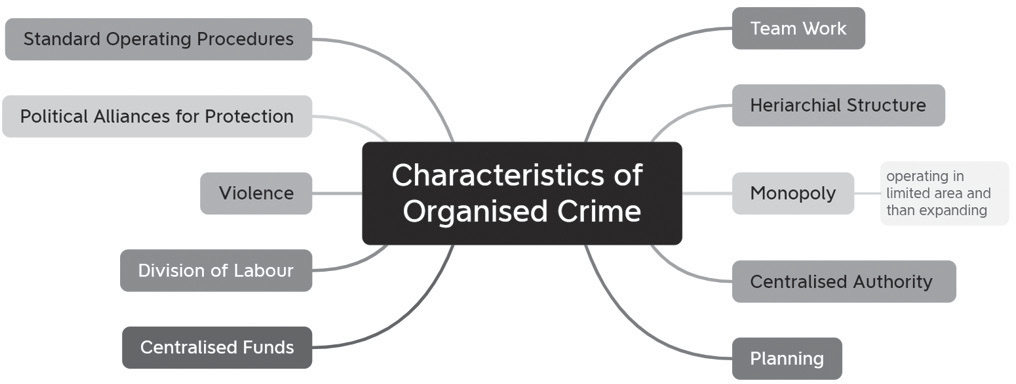
Figure: Characteristics of Organised Crime
Categories of Organised Crime:
• Types of Organised Crime: Organized crime has three major types/forms: gang criminality, racketeering, and syndicate crime. The first has simple characteristics while the last one has a fully developed form because of which it is considered to be most dangerous to society.
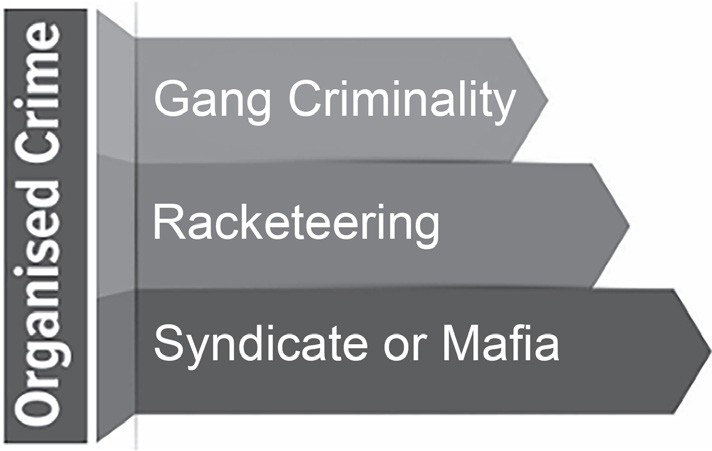
Figure: Types of Organised Crime
• Gang Criminality: This type of criminality includes kidnapping, extortion, robbery, vehicle theft, etc. on a large scale. The Tyagi gangs in Delhi, the Radha Yadav gang in Champaran district Bihar, the Arun Gandhi gang in
Bombay, the Vikram Singh and Vikas Dubey gang in
Uttar Pradesh, are some of the notorious gangs operating in different part of our country.
Racketeering: This is an activity of an organized criminal gang engaged in extortion of money from both legitimate and illegitimate business through intimidation of force. It also involves dishonest way of getting money by deceiving or cheating people, selling worthless goods
and articles, adulterated commodities, spurious drugs and so forth the racketeers, unlike organized criminal gangs do not take away all the profits but allow the owners of the illegitimate business to continue their operations like prostitution, gambling, liquor trafficking, drug peddling etc., but give them regular fixed money.
Syndicate Crime: This is furnishing illegal goods and services by an organized criminal gang, often called ‘Mafia’. The illegal goods could be drugs, liquor, etc. while the illegal services could be call-girls, gambling and so forth. The syndicates create their own ‘business’ procedures, usually operating from established headquarters. They avoid using violence which differentiates them from organised criminal gangs, who frequently use violence or threat of violence.
Traditional Organised Crime includes
• Illicit liquor trade
• Betting/Gambling
• Kidnapping/Contract Killing
• Extortion
• Robbery
• Blackmailing
• Prostitution rackets/Pornography
• Sand Mafia & Mining Mafia
Non-traditional organised crime includes transnational
crime like -
• Money Laundering,Pumping Fake Indian Currency Notes (FICN),Hawala Transfer
• It is a method used to disguise illegally acquired money from activities like drug trafficking and human trafficking, making it appear as if it originates from legitimate sources. Many criminals facilitate this process by assisting individuals with illicit earnings in converting them into legally acceptable income.
• It is governed by the Prevention of Money Laundering Act, 2002.
• Hawala: It is a traditional system of transferring money, used in Arab countries and South Asia, whereby the money is paid to an agent who then instructs an associate in the relevant country or area to pay the final recipient.
• Cybercrime
• Includes fraud, hacking, malware creation and distribution, DDoS attacks, blackmail, and intellectual property crime such as the sale of counterfeit or falsified trademarked products.
• Smuggling and trafficking
• Smuggling involves covert activities that result in unregistered trade and constitute a significant economic offense. With a vast coastline of approximately 7,500 kilometers and open borders with Nepal and Bhutan, India is highly vulnerable to large-scale smuggling of contraband and other consumer goods.
• Primarily governed by the Customs Act, 1962.
• Drug Trafficking involves network of supplying drugs across countries. The need for organisation, contacts, and large sums of money puts the business
outside the reach of most individuals and small criminal groups.
• Arms Trafficking: States in the North-East, Kashmir, Punjab, Bihar, Bengal, and Tamil Nadu are sonic of the areas where insurgents, terrorists, naxalites, and agitators are engaged in lighting the police and the military and threatening the masses for achieving their political goals. They get the required weapons from organised criminal groups who get them from neighbouring countries at cheap rates
• Human Trafficking: Article 23 of the Indian Constitution explicitly prohibits human trafficking including women trafficking, child trafficking, trading in sex workers, etc.
Organised Crime and Terrorism
• Difference between Organised Crime & Terrorism
Organized crime and terrorism result from ineffective governance and have developed a symbiotic relationship. Neither are all terrorist acts organized crime, nor are all organized criminal acts terrorism.
| Terrorism | Organised Crime |
| Terrorism aims to overthrow the existing government by altering the status quo. | Organised crime aims to form a parallel government (parallel economy) while co-existing with the existing one. |
| Terrorism primarily uses violent means. | Organised crime prefers to be non-violent notwithstanding the odd resort to belligerence. |
| Terrorism is driven purely by political objectives despite sometimes resorting to exploitation of regional, national and religious sentiments to achieve their ends. | Economic objectives are the operational determinants of organised crime. |
Linkages between Organised crime and Terrorism
| Traditional | Modern | |
| Organised crime | Based on power over local communities. | Based on expansion of global markets. |
| Family organisation. | Networks of entrepreneurs. | |
| Terrorism | Based on support in oppressed communities. | Based on sympathisers in several countries. |
| Military model of top-to- bottom organisation. | Networks of ideologically committed operatives. |
• Linkages between terrorism and organized crime are convoluted and multitudinous, resulting in a serious threat to not only national peace and security but also international harmony.
Reciprocal Benefit: Their connections exploit immediate opportunities especially regardless of planning or principle and are based on reciprocated interest where terrorists derive benefit from
organized crime, together with trafficking in persons and migrant smuggling; trafficking in drugs, firearms, cultural property and other goods; kidnapping for ransom; robbery; and other illicit acts. These groups may provide smuggled arms and explosives to terrorist groups in exchange for drugs or diamonds, etc.
• Same Networks: Organised crime groups and terrorists often operate on same network structures. With terrorist groups hiding under garb of organized crime to move operatives through established networks.
• Thrive in Absence of Government: Both organised crime groups and terrorist groups operate in areas with little governmental controls, weak enforcement of laws and open borders.
• Client and Courier Relationship: Terrorist groups need arms and money for their fight against the security forces. Organised crime needs a client and couriers who can smuggle drugs, arms and human beings across countries and regions.
• These relationships have helped terrorist groups to be less dependent on state sponsors, and on their domestic and international supporters.
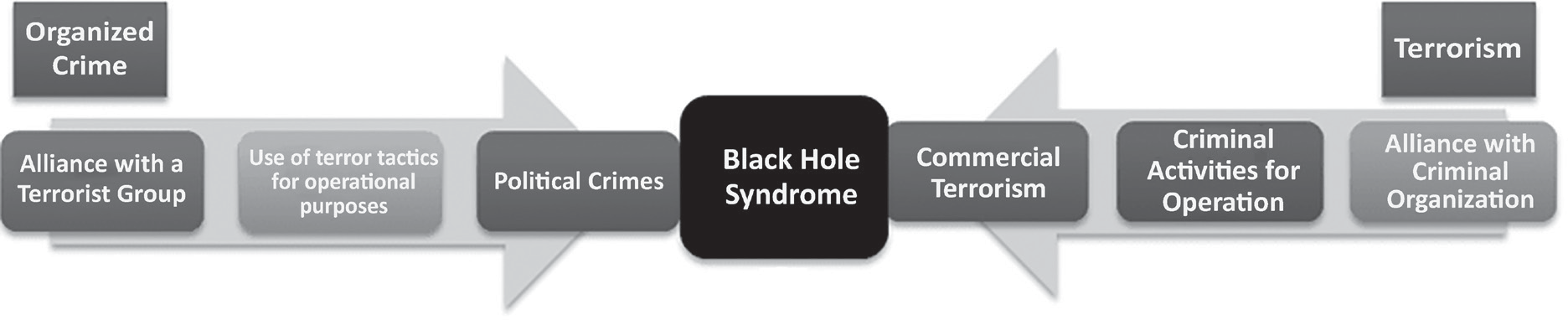
Figure: Black Hole Syndrome
In the Northeast, extortion is the fundamental basis for funding all forms of terrorism. In addition to this, kidnapping has been used extensively for spreading terror and raising funds. Human trafficking, drug trafficking and gun running are some of the criminalactivities that have been common in these areas.
Link Between Terrorism and Organised Crime in India
• There is a potential strong connection between crime and terrorism. Terrorist groups may exploit organized crime for funding and logistical support, utilizing illegal trade in weapons, human trafficking, drugs, artifacts, and cultural property.
• But terrorist groups can also benefit from the illicit trade in natural resources and wildlife, the abuse of legitimate commercial enterprise, donations, and
proceeds of criminal activity, including kidnapping for ransom, extortion, bank robbery, and piracy.
• Tackling the connection between terrorism and organized crime has become a growing priority for the global community. The United Nations has passed multiple resolutions aimed at addressing this concern.
criminal activities that have been common in these areas.
• In Jammu & Kashmir, counterfeit currency has been a major source of funding terrorism.
• In the Maoist terror movements, extortion is yet again a common phenomenon. They have also indulged in robberies of banks to fund their movement. There have also been reports of cuts being enforced on drug yielding crops in the region.
• The Indian Mujahideen has also resorted to crime to raise funds. This includes robberies, kidnappings, etc.
• There are also a number of insurgent groups which over a period of time have morphed into crime syndicates. What began as an ideological movement is now merely a means of generating profit. This is especially the case with insurgent groups in Northeast India.
• Collaborate and appropriate shared tactics by bolstering each other’s’ capabilities.
• Enhances their organizational infrastructure – Mumbai attacks of 1992, 2008 used the routes used for smuggling, Insurgency in North East.
• Helps terrorists with improved access to resources – ISI using established channels for smuggling of arms and explosives.
• Expands their geographic reach.
• Both Take place in with weak political control ex – Taliban – Afghanistan.
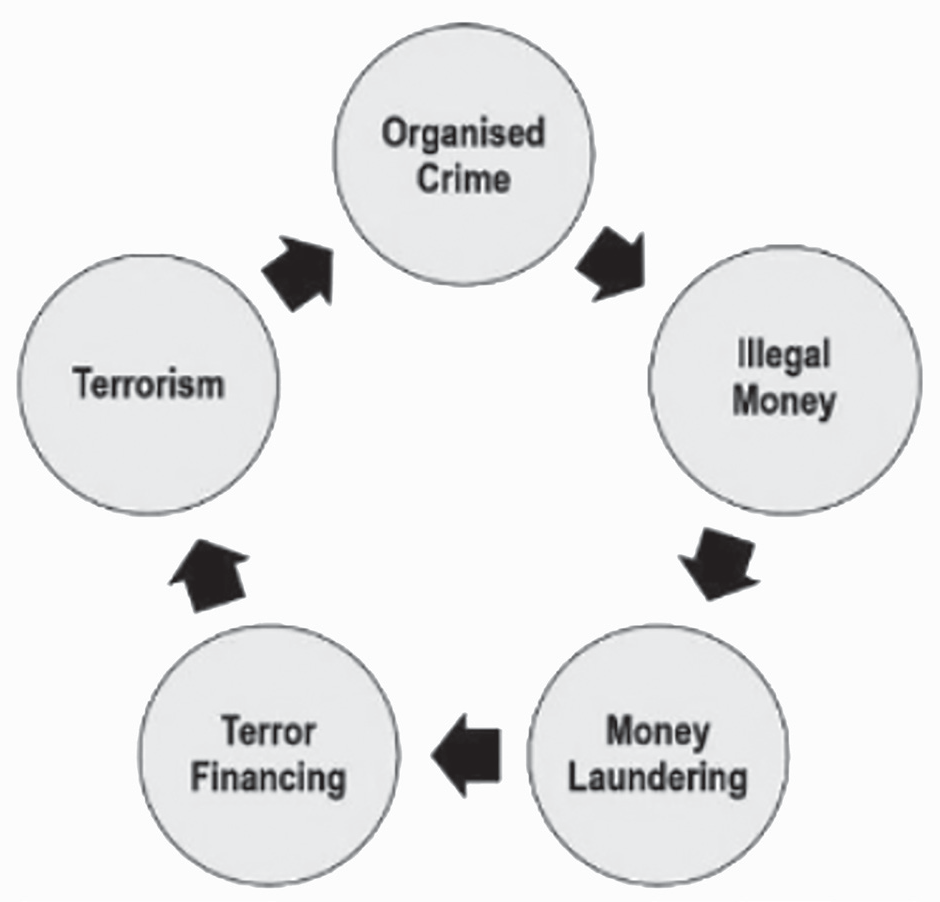
Figure: Linkage between Organised Crime and Terrorism
• These linkages can be understood in context of various regions of India:
• Linkages in the North-east
• Linkages in Kashmir
• Linkages in remaining parts of India
Link Between Terrorism and Organised Crime in the North- east
• The linkage between arms, drugs and insurgency is an interdependent nexus. To oppose and fight the government the insurgents need weapons. For this funding needs to be secured.
• Illicit trade in narcotics is the best source to raise funds. Some of the infamous entry points from South-east Asia include Moreh and the entire Chittagong Hill tracts, especially Cox’s Bazaar.
• In Nagaland and Manipur insurgent groups routinely collect taxes from each household, government contractors and employees, transporters, businessmen and even government officials including ministers.
• Much of the government funds reach the militants
indirectly due to mal-governance.
•
In conflict zones, government officials are either intimidated or bribed to grant contracts to individuals backed by militant groups.
• Essential goods such as rice and fuel are directly acquired by militant groups, who then resell them to the public at significantly inflated prices.
Link Between Terrorism and Organised Crime in Kashmir
• Unlike the Northeast, dependence on extortion and similar sources of funding is limited. There is no parallel government in Kashmir, and state resources do not fall into the hands of militants.
• However, external funding makes up for the lack of internal financial sources.
• Funds mobilised in Pakistan and other Muslim countries,especially in the Gulf, are channelled through various organisations in Pakistan to Kashmir.
Markazdawaal Irshad, for example, mobilises funds from inside and outside Pakistan to support its militant wing, Lashkar-e- Taiba.
• Additionally, external funds are funneled through specific organizations and individuals in Kashmir, eventually reaching militants through money laundering.
• Hawala networks facilitate rapid and efficient transactions.
• It is also suspected that the ISI finances militant activities in the region using drug money.
• Terrorists act as primary couriers of counterfeit Indian currency within Kashmir, which later circulates across the country.
Link Between Terrorism and Organised Crime in remaining parts of India
Bombay Blast
• Bombay Blasts 1993 was a classic example of organised crime cartel’s planning and executing terrorist activities.
• The attacks were orchestrated by Dawood Ibrahim, the leader of D-Company, a globally operating organized crime syndicate based in Bombay. He is engaged in various criminal activities, including drug trafficking, gold smuggling, contract killings, and match-fixing.
Steps Taken To Tackle Organised Crime
UN Convention Against Transnational Organised Crime (UNTOC), 2000
• UNTOC oversees the United Nations Convention against Transnational Organized Crime (Organized Crime Convention) along with its three supplementary protocols on Human Trafficking, Migrant Smuggling,
and Firearms Trafficking.
• This is the only international convention, which deals with organised crime.
United Nations Security Council Resolutions
• In 2019, the Security Council passed Resolution 2482, calling on Member States to implement policy measures to tackle the connection between terrorism and organized crime.
• In February 2023, the United Nations Office on Drugs and Crime (UNODC) and the United Nations Interregional Crime and Justice Research Institute (UNICRI) jointly launched a project titled Strengthening Capacities to Address the Nexus between Terrorism and Organized Crime in Africa. This initiative aims to evaluate the link between terrorism and organized crime in Africa, increase awareness among law enforcement and criminal justice officials, provide technical and legislative support, and strengthen cooperation.
Maharashtra Control of Organised Crime Act (MCOCA), 1999
• The Act provides the State Government with special
powers to tackle organized crime and terrorism, including powers of surveillance, relaxed evidentiary standards and procedural safeguards, and prescribing additional criminal penalties, including the death penalty.
• It applies to state of Maharashtra and National Capital Territory of Delhi.
Prevention of Illicit Traffic in Narcotic Drugs and Psychotropic Substances Act, 1988
• Prevention of Illicit Traffic in Narcotic Drugs and Psychotropic Substances Act is another preventive law enacted with the aim of controlling the actions of people engaged in the illicit trafficking of drugs and other narcotic substances. Under this law, a person can be detained for upto one year if found to be engaged in drug trafficking. In certain cases, this period can be further extended to one more year depending on the severity of the case.

Figure: Maharashtra Control of Organised Crime Act
National Security Act, 1980
• Provides for the detention of individuals “acting in any manner prejudicial to the defence of India, the relations of India with foreign powers, or the security of India”. The scope of the term ‘defence’ is very wide and it includes operations carried out by gangsters and since the preventive detention is carried out by the executive, there is very little role of courts to play.
Indian Penal Code 1860 / Bharatiya Nyaya Sanhita (BNS)
- 2023
• IPC Section 120A (BNS 61) of the Indian Penal Code 1860/Bharatiya Nyaya Sanhita (BNS) deals with criminal conspiracy. Where two or more persons agree to commit a crime, then they can be punished for criminal conspiracy. The exception clearly provides that it is immaterial whether the object of such crime committed is the main intention or incidental. Hence, organised crimes shall definitely be governed by this provision.
• Further, IPC Section 120B (BNS 61) imposes criminal liability which can extend up to death punishment and even heavy fines.
•
Additionally, these organised criminals shall also be charged for the specific crime which they have committed. For instance, criminals engaged in contract killings shall be liable under IPC Section 300 (BNS 101) and IPC Section 300 (BNS 103) which deals with murder.
• Similarly, an organised criminal engaged in kidnapping shall be dealt with under IPC Section 360 (BNS 137), IPC Section 363 (BNS 137) and IPC Section 364A (BNS 140). A person engaged in human trafficking shall be charged under IPC Section 370 (BNS 143)and IPC Section 370A
(BNS 144).
The Bharatiya Nyaya Sanhita Bill, 2023
• It proposes specific provisions to deal with organised crime and terrorism by prescribing harsher punishments, attachment of proceeds of crime, fine up to Rs 10 lakh and trial in absentia.
• Clause 109(1) of the Bill defines organized crime as “any unlawful activity, including kidnapping, robbery, vehicle theft, extortion, land grabbing, contract killing, economic offences, cyber-crimes having severe consequences, trafficking in people, drugs, illicit goods or services and
weapons, human trafficking racket for prostitution or ransom, corruption or related activities shall constitute organised crime.”
• It also defines what an ‘organised crime syndicate’ is. Clause 109(2)(i) provides for the death penalty or imprisonment for life as punishment in case the unlawful act results in the death of any person. In other cases, minimum punishment for five-year (extendable to life imprisonment) has been prescribed for members of the syndicate.
Other Laws
• Apart from these laws, there are various other laws that govern certain specific organised crimes. To exemplify, the Narcotics Drugs and Psychotropic Substances Act, 1988 governs cases relating to trafficking of different narcotic substances; Customs Act, 1962 governs and imposes liability for cases related to smuggling; Prevention of Money Laundering Act, 2002 governs the cases relating to money laundering. Apart from these, there are many other laws such as the Immoral Traffic (Prevention) Act, 1956; the Foreign Exchange Regulation Act, 1973, the Public Gambling Act, 1867 etc.
Challenges in Tackling Organized Crimes
• Multiple Laws and Weak Enforcement- There is no central law to tackle organized crime in India. Different organized crimes are dealt under different laws. Poor conviction rates indicate weak enforcement. For example, UAPA conviction rate between 2015 and 2020, on the basis of number of cases is 27.57%. But it drops to 2.8%, when calculated on the basis of arrests made.
• Delayed Judicial Process– Process of trials is very slow and due to such a long period, money and muscle power influence and threaten witnesses and often, the crucial evidences are lost. Average time period of cases is about five years.
• Obtaining proof- Due to poor witness protection and open attacks on witnesses, criminals are often acquitted because of insufficient evidence such as attacks on the witnesses of Asaram case.
• Lack of resources- The lower-ranked police officers are not given sufficient powers and a statement before them is not admissible evidence. Further, these officers do not have sufficient equipment to tap these criminals. As seen in the Vikas Dubey case in Kanpur, where criminals were highly equipped as compared to Uttar Pradesh Police constables.
• Multiple Agencies- Not just there is turf war among the various state police departments but also lack of coordination among state and central agencies.
• Use of new technologies- Use of Darknet, Blockchain and Cryptocurrencies to indicated lack of awareness and training among state police personnel.
• Transnational and Interlinked nature: There is not only cross-border criminal links in the global world but also
various crimes like drugs, human trafficking, etc. are interlinked.
• Political-Bureaucratic-Criminal Nexus: There is a well- known nexus among politicians, officials and criminals to bring funds for elections where black money rules the roost, which ultimately results in criminalisation of politics and politicisation of crime. According to Association for Democratic Reforms (ADR) report, in 2004, 24% of parliamentarians had pending criminal cases, which rose to 43% in 2019. Mohammad Shahabuddin was a criminal, politician and former Member of Parliament from Bihar.
Way Forward
• Political Will- There is a need for national political consensus to remove criminals from not just politics but also ensure they are brought to justice.
• Global Cooperation- Agencies like INTERPOL, FATF, global intelligence agencies can cooperate to play an important role to tackle transnational crimes.
• Inter-state coordination-Cooperative Federalism principle must be applied to take faster and more effective actions against criminals, through Inter State Councils and National DGP Conferences.
• Technology Upgradation: Infrastructure and training are essential to combat high tech crimes. E.g., CCTNS and Kerala police’s Cyberdome.
• Comprehensive National Law- It is the need of the hour to ensure stringent action to deter criminals. Moreover, the enforcement should also be stringent and swift.
Key recommendations of Vohra Committee Report 1999
• The Vohra Committee was a high-level committee appointed by the Government of India in 1993 to examine the problem of the criminalization of politics
in India.
• Creation of a National Database of Criminals: The committee recommended that all law enforcement agencies should be connected to this database and should have access to information on the criminal history of individuals. This would help in preventing criminals from entering politics and also in identifying and prosecuting politicians with criminal backgrounds.
• Disqualification of Politicians with Criminal Backgrounds: The committee recommended that all political parties should be required to provide information on the criminal background of their candidates at the time of nomination. Candidates with criminal records should be disqualified from contesting elections and holding public office.
• Establishment of Special Courts: It is to expedite the trial of cases involving politicians and organized crime. The committee suggested that these courts should have the power to confiscate the assets of convicted criminals and use the proceeds to compensate victims.
• Set Up Top Secret Cell in the Intelligence Bureau: It
is to function as the Nodal Group for receipt of inputs from various security/revenue agencies which reveal a politician-bureaucrat-underworld nexus.
• Some recommendations by CBI Director
• Identification of offences and award of deterrent punishments, including preventive detention.
• Trial procedures should be simplified and hastened.
• Surveillance should be carried out through finger printing, photographs and dossiers.
• Monitoring mechanisms should be established at the State and Central levels.
• Establishment of Special Cells in the States CIDs and CBI.
• Suitable amendments should be introduced in the existing laws to more effectively deal with the activities of Maixa organisations, etc.; this would also include review of the existing laws.
• A detailed case study of 10-15 cases would provide useful information regarding the administrative/
legal measures, which would be required to be taken to effectively tackle the functioning of Mafia organizations. The CBI can do this within a short period.
CONCLUSION
• Organised crime is where the ultimate intention of the criminals is not to harm someone but rather make profits, however, some form of injury is caused. Such crimes occur in various forms including drug trafficking, human trafficking, money laundering, contract killings, etc.
• Despite the existence of various legislation, the State has not been successful in curbing these crimes to a considerable extent due to lack of proper enforcement, lack of resources, slow trials, difficulty in obtaining proof, etc.