Role of External State and Non-state Actors in Internal Security
ROLE OF EXTERNAL STATE AND NON-STATE ACTORS IN INTERNAL SECURITY
• India's internal security challenges stem from both domestic vulnerabilities and external efforts to wage a proxy war.
• Factors such as inadequate socio-economic development, neglect of legitimate public grievances, and political opportunism have contributed to deep-rooted internal conflicts persisting for over five decades.
• Additionally, many of the security threats India faces today are orchestrated and supported by Pakistan. The use of non-state actors serves as a means of proxy warfare, allowing Pakistan to maintain a level of plausible deniability.
• India faces various challenges to its internal security including Naxalism, Terrorism, insurgency, secessionist
movements, illegal migration, cyber-crimes, drug trafficking, communalism and regionalism, money laundering, etc.
• Further, globalization has increased the influence of the private sector with mixed results for the enjoyment of economic, social and cultural rights. Transnational Corporations, with operations in various countries, wield enormous power (even over countries’ domestic economic policies) that challenges traditional state- based mechanisms of accountability. In addition to direct violations of human rights, corporations and banks risk becoming complicit in violations of law when they invest in countries facing violent conflict, struggles over resources, and governmental corruption and abuses of power.
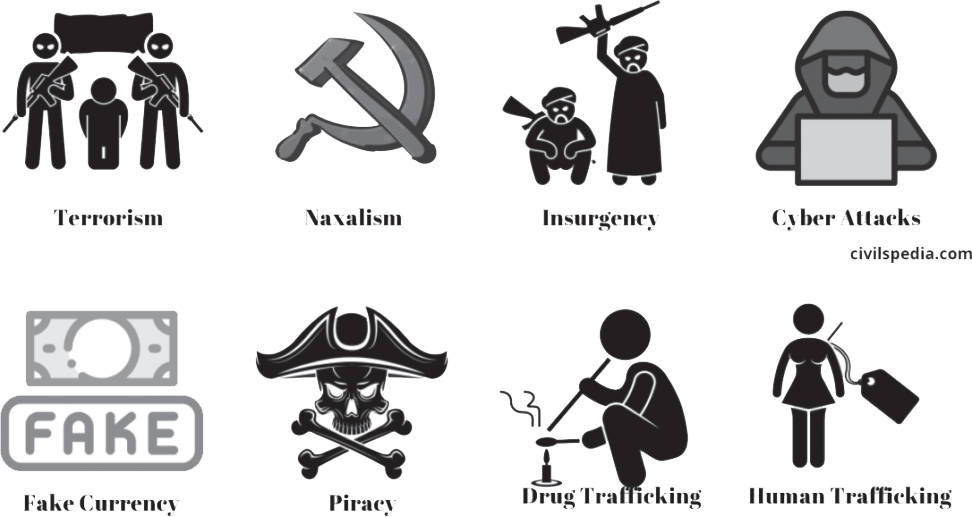
Figure: Challenges to India’s Internal Security from Non-State Actors
Role of external state and non-state actors in creating challenges to internal security
Non-State Actors
• Organisations and individuals not connected with, directed by, or funded through the government are Non-State Actors.
• They can be corporations, NGOs, and even paramilitary and armed resistance groups.
• Non-state actors typically operate without any direct or indirect affiliation with a government or its agencies while advancing their objectives. However, the possibility of indirect connections cannot be entirely dismissed.
• Prime Minister Narendra Modi while addressing Rajya Sabha in 2021 has coined the term ‘Foreign Destructive Ideology’ (FDI) to highlight the foreign individuals who have indirectly contributed to the law-and-order problem within India.
• All such foreign contributions that are illegally used to destroy India’s democracy and threaten the sovereignty and integrity of the nation.
Challenges Posed by Non-State Actors
• Utilised by State Actors:
• Many important terrorist groups such as Lashkar-e- Taiba (LeT) and Indian Mujahideen (IM) also claim to be non-state actors but have de facto support from Pakistan’s state apparatus.
• Influencing politics at a national and sometimes international level.
• Terrorist organisations attack security forces, disturb law and order and brainwash people with their toxic fundamentalist ideology which impacts political environment. Ex – LeT in Kashmir.
• Data Theft and Surveillance:
• Multinational Corporations (MNCs) may pose a threat to national security, particularly in the areas of data security and cyberspace, as well as by influencing the laws of the countries in which they operate. This is why India banned Chinese apps.
• Illegal Migration:
• Persons in India without either a valid Indian citizenship or a Visa are considered as illegal immigrants, subject to The Foreigners Act, 1946. They often cause insecurity in local population, violence and conflict as seen in Northeast Region.
• Terrorism:
• Various terrorist groups, such as Lashkar-e-Taiba (LeT), Jaish-e-Mohammed (JeM), and Hizbul Mujahideen, operate in India. These groups have links to external state actors and are responsible for attacks on Indian soil. They aim to create instability and undermine India’s security.
• Insurgency and Separatist Movements:
• India faces several domestic insurgency movements in states like Jammu and Kashmir, the Northeastern states, and areas affected by Left-Wing Extremism (Naxalism). These movements often receive support or inspiration from external non-state actors and benefit from cross-border sanctuaries. Naxalites, LTTE and North-east insurgents are some examples of non-state actors like Naga insurgency by NSCN- IM.
•
Cyber Threats:
Non-state actors, including hacktivists and cyber criminals, can pose a significant security threat in the digital domain. Cyberattacks, data breaches, and disinformation campaigns can have wide-ranging implications for India’s internal security.
• Transnational Organised Crime:
• The deep-rooted nexus between drug mafias, arms dealers, and money launderers for financing terrorism also comes under non-state actors. Insurgency, illegal migration from Bangladesh and smuggling activities reflects the porosity (concern highlighted in Kargil Review Committee) of our borders.
• These criminal networks often operate across borders and can be difficult to counter.
• Religious and Communal Extremism:
Extremist groups promoting religious or communal violence can pose internal security challenges. Some of these groups have ideological or financial ties to external entities.
• Civil Society Organisations:
Allegations of fund misappropriation and misuse of grants received from governments and foreign donors, along with their role in inciting discontent within local communities against developmental projects, have led to concerns about these organizations functioning as instruments of foreign policy. For instance, NGOs like the US-based Greenpeace opposing the Kudankulam power plant or UK-based organizations protesting against Sterlite Copper in Tamil Nadu.
• Other Natural Actors:
While not typically considered non-state actors, environmental changes and natural disasters can also have security implications. Climate change-induced events, such as floods, droughts, and resource scarcity, can lead to social unrest and displacement, creating security challenges.
Illegal Immigration
• Migrant – This term serves as a broad, informal classification rather than a legally defined concept under international law. It generally refers to individuals who leave their usual place of residence, either within their own country or across international borders, for various reasons, whether on a temporary or permanent basis. The term includes migrant workers, smuggled migrants or international students.
Note: At the international level, no universally accepted definition for “migrant” exists. The present definition was developed by International Organisation of Migration (IOM) for its own purposes and it is not meant to imply or create any new legal category.
Illegal Immigrants vs Refugees vs Asylum Seekers
Refugees
• Under the 1951 UN Convention on the Status of Refugees and the subsequent 1967 Protocol, the word ‘refugee’ pertains to any person who is outside their country of origin and unable or unwilling to return owing to well-founded fear of persecution for reasons of race, religion, nationality, membership of a particular social group or political opinion.
• Refugees who flee persecution, torture, rape, killings
– such as the Rohingyas who fled Myanmar – are not criminals. They may cross the border and go into another country without a visa but they are not breakers of the law. The mere fact that they come without a visa doesn’t mean that they are illegal migrants.
• Stateless individuals can also be considered refugees in this context, where their country of origin, in terms of citizenship, is recognized as their "former habitual residence." (Oxford Handbook of Refugee and Forced Migration Studies)
The United Nations has said the flight of the Rohingya following the Myanmar military crackdown in Rakhine state in 2017 had created the world’s biggest
refugee crisis. Cox’s Bazaar in Bangladesh is the biggest refugee camp in the world today.
• They cross national borders to seek safety in nearby countries and become recognised as refugees with access to assistance from states and aid organisations. Refugees are protected by international law, specifically the 1951 Refugee Convention.
• Illegal Migrants
• Migrants choose to move not because of a direct threat or persecution but mainly to improve their lives:
• Finding work
• Seeking better education
• Reuniting with family
• Unlike refugees who cannot safely return home, migrants can return home if they wish. This distinction is important for governments, since countries handle migrants under their own immigration laws and processes.
• Illegal migrant crosses international borders voluntarily, and the refugee does it due to no choice.
• An illegal migrant comes on account of economic and other reasons, therefore if you are an illegal migrant only, then you can be arrested and sent back.
• Refugees are a matter of human rights, not of policing, unlike illegal migrants.
Asylum Seeker
• An asylum seeker is an individual who is seeking international protection and claims to be a refugee but whose claim hasn’t been evaluated. This person would have applied for asylum on the grounds that returning to his or her country would lead to persecution on account of race, religion, nationality or political beliefs.
Someone is an asylum seeker for so long as their application is pending. So, not every asylum seeker will be recognised as a refugee, but every refugee is initially an asylum seeker.
United Nations Department of Economic and Social Affairs (UN DESA) defines “international migrant” as “any person who changes his or her country of usual residence”. It excludes movements that are due to “recreation, holiday, visits to friends and relatives, business, medical treatment or religious pilgrimages”.
A Migrant emigrates from their old country, and immigrates to their new country.
Emigration is the act of leaving a resident country or place of residence with the intent to settle elsewhere. From the perspective of the country of departure, the act of moving from one’s country of nationality or usual residence to another country, so that the country of destination effectively becomes his or her new country of usual residence.
Immigration describes the movement of people into one country from another. From the perspective of the country of arrival, the process of relocating to a country different from one's nationality or usual residence, resulting in the destination country becoming the individual's new place of habitual residence.
The foreign nationals who enter the country without valid travel documents are treated as illegal migrants. Illegal immigrants are subject to The Foreigners Act, 1946 which defines a foreigner as a person who is not a citizen of India.
The Government of India can declare any set of refugees as illegal immigrants — as has happened with Rohingya despite the UNHCR verification — and decide to deal with them as trespassers under the Foreigners Act or the Indian Passport Act.
India has welcomed refugees in the past, and on date, nearly 300,000 people here are categorised as refugees. But India is not a signatory to the 1951 UN Convention or the 1967 Protocol. Nor does India have a refugee policy or a refugee law of its own.
Major Causes of Migration
The causes can be categorized into Push Factors and Pull Factors.
| Push Factors | Pull Factors |
| Push factors are things that are unfavorable about the area where someone lives. | Pull factors are things that attract someone to another area. |
| Not enough jobs, Lessopportunities, Inadequate conditions, Desertification, Famine or drought, Political fear or persecution, Slavery or forced labor, Poor medical system, Loss of money, Natural disasters, Fear of death, More of political or religious freedom Desire, Pollution, Poor housing system,Landlord/ tenant issues, Bullying or intimidation, Mentalism, Discrimination,Less chance of getting married, Poor accommodation, War, Radiation, Disease | Employment opportunities, Better living conditions, More sense of political or religious freedom, Enjoy, Education, Better medical care, Attractive climate, Safety, Family link, Industry, Better chances of getting married. |
• For example, illegal Bangladeshi migration, which occurred during 1971 war, has been causing sectarian and ethnic conflicts along with various social and economic issues in the northeast and elsewhere. For example, communal rioting in Assam and an increase in crime in various other parts of the country.
In 2016, Kiren Rijiju, the then Minister of State for Home Affairs, told India’s Parliament: “According to available information, there are about 20 million
•
Foreigners Act, 1946:
• This act prevents illegal migrants from entering India including by the use of force.
• The concept of ‘burden of proof’ lies with the person, and not with the authorities.
• Foreigner’s tribunals having powers of civil court, can be established.
• Recent amendments (2019) to the Foreigners (Tribunals) Order, 1964 empowered even district magistrates to set up tribunals to decide whether a person is a foreigner or not.
• The Registration of Foreigners Act, 1939:
• Registration under Foreigners Regional Registration Officer (FRRO) is a mandatory requirement under which all foreign nationals (excluding overseas citizens of India) visiting India on a long term visa (more than 180 days) are required to register themselves with a Registration Officer within 14 days of arriving in India.
• Pakistani nationals visiting India are required to register within 24 hours of arrival regardless of the duration of their stay.
• The Citizenship Act, 1955:
• It provides for the acquisition and determination of Indian citizenship for citizens, Overseas Citizens of India (OCI), Non-Resident Indians (NRI), and Persons of Indian Origin (PIO).
illegal immigrants from Bangladesh in India.” However, he did not give a source for this, and since then the government has conceded that it does not have accurate data regarding the numbers of illegal immigrants in India.
Also, to escape discrimination and violence in Myanmar, minority Rohingya Muslims have for decades fled from the Buddhist-majority Myanmar to neighbouring Bangladesh and other countries, including India. Around 40,000 Rohingya refugees are believed to be in India, though only 18,000 have registered with the United Nations High Commissioner for Refugees (UNHCR).
Legal Framework
The Passport (Entry into India) Act, 1920:
It authorized the government to formulate and enforce rules requiring persons entering India to be in possession of passports and remove any person who entered without a passport.
Rohingya Refugee Crisis
• Since 2017, more than 7,00,000 Rohingya refugees have
fled violence and persecution in Rakhine State, Myanmar.
• The Home Ministry has labelled them “illegal immigrants” and pushed for their deportation in an affidavit submitted to the Supreme Court.
Security Threat
• Security agency reports suggest that Rohingya individuals have been involved in fund mobilization through hawala networks, human trafficking, and obtaining fraudulent Indian identity documents.
• Intelligence assessments have also indicated symbolic affiliations between the Rohingya and groups like ISI and ISIS, which could incite communal tensions and destabilize the northeastern region.
Human Rights Organisation’s Call to Not Deport
• Human Rights Watch said that “deporting these men will place them at severe risk of torture and abuse”.
• Amnesty International said their deportation “violates customary international law”.
Constitutional and Legal Status of Refugees in India
• Article 19 of the Indian Constitution is only available to the citizens of India- right to reside and settle in any part of India and is not available to the Rohingyas.
• Article 21 (Right to Life) is applicable for Indian citizens and non-citizens alike. It’s applicable to all those within the territory of India.
• Rohingya cannot claim the residence on legal grounds, as India is neither a signatory to the 1951 Convention relating to the Status of Refugees nor the 1967 Protocol Relating to Status of Refugees and thus provision of non-refoulement does not extend to illegal migrants.
• Moreover, Foreigners Act of 1946, statutorily empowers the Central government to deport a person who is an illegal immigrant.
• Further, thereare nearly 11,000 Afghan refugees registered with the UNHCR in India. There are an estimated 50,000–100,000 Burmese Chin illegal immigrants are stated to be residing in India, mostly in the Indian state of Mizoram, Manipur and a small number in Delhi. About 7,600 illegal immigrants from Pakistan resided in India in 2010. Many of the migrants are Hindus and Sikhs, who have overstayed, attempting to gain citizenship.
State Actors
• State actors refer to those who have the formal backing of a sovereign state to carry out their desired actions. State actors include the foreign government representative and their agencies.
• ‘State actor’ is used in the context where one government supports an actor in the performance of an act or acts
of terrorism against the other often deemed as a ‘state sponsor’.
• Examples include
Increasing activities of Pakistan’s Inter-Services Intelligence (ISI) in Nepal changed the nature of the border completely. It has ties with the Taliban and other radical terror groups.
China’s People’s Liberation Army uses spider excavators to build roads in the border areas and setting up villages in uninhabited tri-junction of Doklam which stretches between India, Bhutan and China.
Challenges Posed by State Actors
• Sovereignty and Territorial Integrity
• Foreign countries illegally capturing and occupying national territory– Pakistan occupies 78000 square kilometers in Jammu and Kashmir including Azad Kashmir and Gilgit-Baltistan, or like China occupies 5,180 square kilometers in the Shaksgam Valley (or Trans-Karakoram Tract) in addition to approximately 38,000 square kilometers in Aksai Chin and part of the Demchok sector.
• State-Sponsored Terrorism:
• Providing financial, military, and logistical support to terrorist and insurgent groups: This can include providing weapons, training, and funding to these groups.
• Pakistan sponsored terrorism to destabilise J&K and Punjab Insurgency.
• For example, Pakistan has been providing support to terrorist groups such as Lashkar-e-Taiba and Jaish-e- Mohammed, which have carried out attacks in India.
• Exploiting Ethnic and Sectarian Divisions: External state actors may try to exploit existing ethnic and sectarian divisions within India to create conflict and instability.
• For example, China has been accused of providing support to separatist groups in Northeast India, such as the NSCN and ULFA. This is evident from the seizure of multiple Chinese-made weapons, including rifles, pistols, grenades, and other ammunition.
• Investigations by the National Investigation Agency (NIA) have revealed that groups like the National
Socialist Council of Nagaland (NSCN-IM) and the National Democratic Front of Bodoland (NDFB) have been procuring arms from Norinco, a state-
owned Chinese weapons manufacturer.
Likewise, in the 1960s, Pakistan’s Special Services Group (SSG) trained Naga insurgents at its bases in East Pakistan, now Bangladesh.
• Proliferation of Nuclear Weapons and Missiles
Pakistan’s nuclear bomb, in fact, is widely believed to be based on Chinese blueprints. Also, in 1990 and 1992, China provided Pakistan with nuclear-capable M-11 missiles that have a range of 186 miles. Thus, it is widely believed that China has violated NPT by exporting nuclear weapons technology to Pakistan.
• Spreading Disinformation and Propaganda: External state actors may use propaganda and disinformation to sow discord and distrust within Indian society.
Alleged Chinese involvement in spreading misinformation during the India-China border standoff is one such instance.
• Carrying out Cyberattacks: External state actors may carry out cyberattacks on Indian infrastructure and critical systems.
For example, alleged Chinese cyberattacks on Indian power grids and government agencies.
• Diplomatic and Border Tensions: Border disputes and diplomatic tensions can escalate into security challenges.
The India-China border standoff in Galwan Valley in 2020 is a recent example, which led to clashes and casualties.
Link of State and Non-State Actors with Naxalism
• Since its inception, the Maoist/Naxalite movement has been backed by China in various ways, including philosophical, moral, financial, and intellectual support.
• The CPI(M) maintains strong ties with several insurgent groups in the Northeast, particularly the RPF/PLA of Manipur and the NSCN-IM of Nagaland, to procure weapons. Many of these groups have connections with foreign entities that are hostile to India..
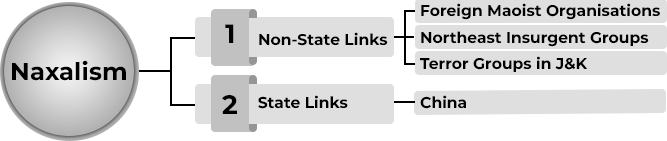
Figure: Link of State and Non-State Actors with Naxalism
• The CPI(M) has also shown solidarity with the terrorist groups of Jammu and Kashmir. These ties are part of their “Strategic United Front” against the Indian state.
• CPI(M) also has close links with non-state foreign Maoist organisations.
The Coordination Committee of Maoist Parties and Organisations of South Asia (CCOMPOSA)
Difference between Terrorism, Insurgency and Naxalism
is an umbrella organisation of various South Asian Maoist parties and movements and its purpose is to coordinate their activities throughout South Asia.
• Its main aim is to resist not only US imperialism and globalisation, but also the centralized Indian state and its alleged internal repression of minority people.
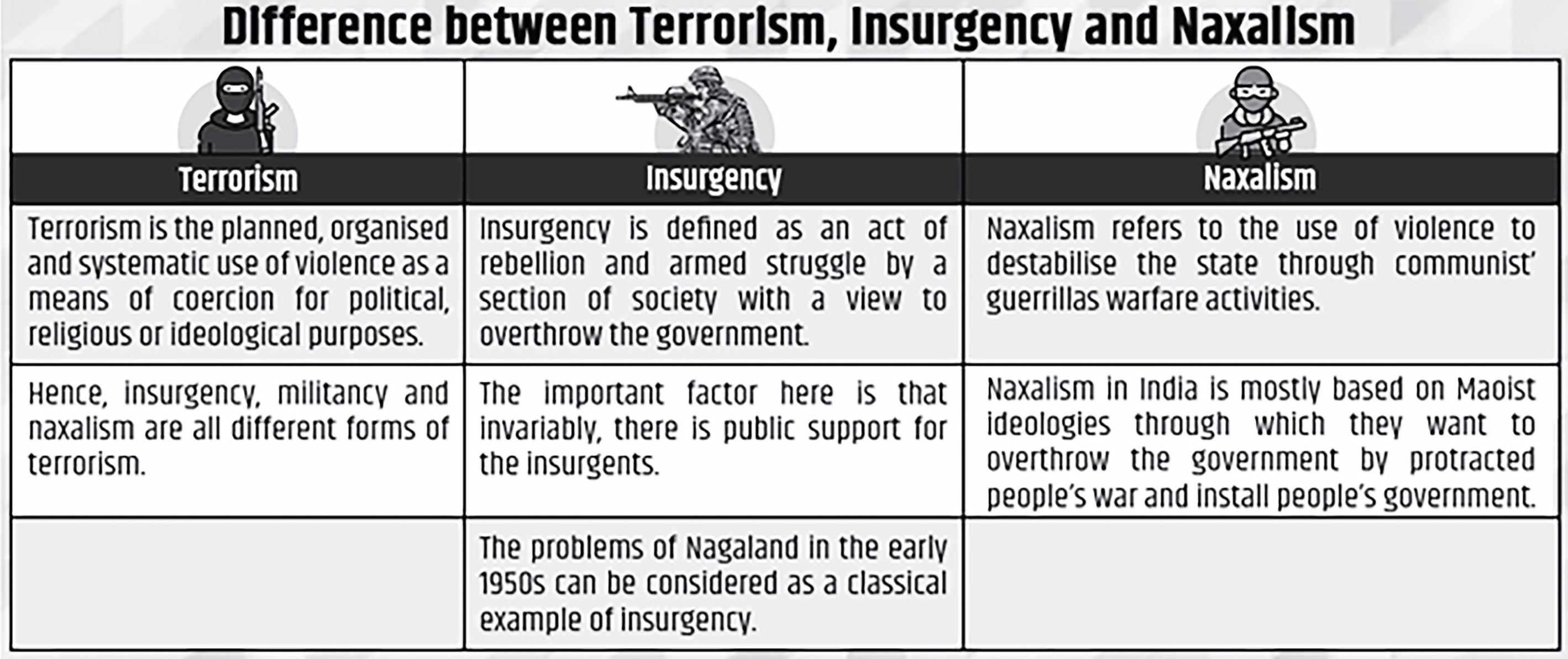
#Note: Insurgency and Naxalism are different forms of terrorism but all terrorism is not Insurgency or Naxalism.
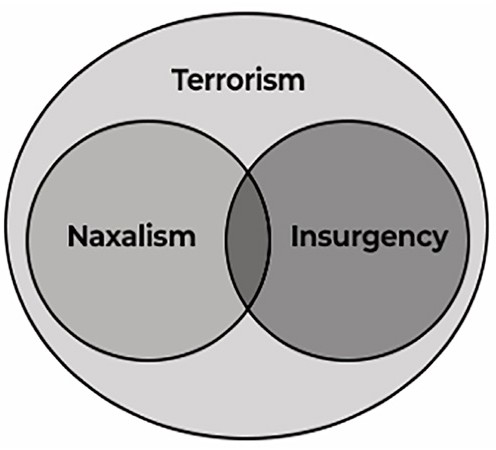
Figure: Difference between Terrorism, Insurgency and Naxalism
Measures to Tackle External State and Non-State Actors
Tackling internal security threats from external state and non- state actors requires a comprehensive approach.
• Securing our Borders
• Effective Border Management: Through ‘smart borders’ ensuring quick and easy, legal flow of people and goods and prevent terrorists and illegal migrants from entering the country like in J&K and Northeast.
• Cooperation with neighboring countries - Joint Training and operations can help the armed forces to combat terrorism.
• The joint military exercise ‘Hand in Hand’ conducted with China.
• ‘Operation Sampriti,’ a collaborative initiative between India and Bangladesh.
• Bhutan carried out ‘Operation All Clear’ (2003-
04) and ‘Operation Bajarang’ (1990-91) to counter insurgency.
The Indian and Myanmar armies recently executed a coordinated mission, ‘Operation Sunrise 2,’ along their border regions to target militant groups active in Manipur, Nagaland, and Assam.
Global Diplomatic Collaboration
• Increasing the effectiveness and representativeness of bodies like Financial Action Task Force (FATF), UNSC, G20, World Bank, International Monetary Fund (IMF),
Eurasian group, etc.
• Increasing diplomatic and global pressure on countries which are havens of terror organisations, such as Pakistan.
• Promoting global consensus of United Nations Comprehensive Convention on International Terrorism.
• Engaging citizens, civil society and media in fight against terrorism.
Good Governance
• Sensitizing people: Increase cultural exchanges, tourism, and people to people contact, including provision of job permits and work visas to end isolation of ‘troubled’ areas. For instance, Adventure Tourism initiatives of Indian Army in the Northeast.
• Sustainable economic development in the region with participation of locals will help them in preservation of their identity as well as will provide them with more livelihood opportunities such as the Super 30 Coaching Initiative by Indian Army for children of the northeast and by Petronet in Kashmir.
• Improvement in infrastructure and connectivity of the region would have multiplier effect and solve various problems of people as well as government authorities.
• Northeast Gas Grid Project by MoP&NG: Natural gas pipeline using the Horizontal Directional Drilling (HDD) method to go under the Brahmaputra River with the aim to provide clean and affordable energy to the Northeastern states of India.
• North Eastern Space Applications Centre (NESAC): Aims to provide an operational remote sensing and Geographic Information System (GIS) aided natural resource information base to support activities on development / management of natural resources and infrastructure planning in the region.
• Strengthening governance and enhancing welfare delivery systems will contribute to more effective administration and foster public trust.
• Addressing the political aspirations of various groups by granting them autonomy.
Enforcing the provisions of the 6th Schedule in these regions will enable them to safeguard their cultural identity while ensuring greater self- governance.
• Decentralization with alertness, improving administrative efficiency, pro-people governance and coping up with regional aspirations.
• For instance, efforts are being made to hold panchayat elections in 2023 to 39 Urban Local Bodies (ULBs) across Nagaland with 33% reservation of seats for women after 20 years.
• Panchayat Elections were held in Assam in 2018.
Military and Legal Actions
• Repressive laws like AFSPA should be abolished, as they contribute to escalating insurgency in the Northeast.
• Insurgent groups should adopt a more pragmatic approach by seeking greater autonomy within the constitutional framework rather than pushing for the creation of new states or regions.
Offering rebel groups the opportunity to benefit from the Surrender and Rehabilitation Policy.
• State police and central forces should cooperate on
intelligence sharing, investigation and operations against militants.
Efficient spending on Security Related Expenditure Scheme.
• Stringent law and fast criminal justice system for quick disposal of insurgents’ attack cases.
Developing Deterrence
• Defence Modernisation – Hypersonic missiles, S–400 missile defence system etc.
• Boosting Nuclear capability – Nuclear Triad
• Geo – political collaborations – QUAD, MALABAR Exercise etc.
• Resolution of Border disputes with Pakistan and China.
Controlling Terror Financing
• Strengthening Prevention of Money-Laundering Act, 2002 (PMLA)
• Empowering agencies like ED, FIU, NIA etc.
• Formalizing Economy
• Improvingcyber security and regulating Cryptocurrency etc.
Strengthening Security Architecture
• Intelligence gathering, Training, counter terror Operations.
• Securing key installations. E.g., Uri and Pathankot attacks.
• Speedy and effective Investigations, Prosecution and convictions.
Civic Action Programme:
• To gain the trust of the local population and enhance the reputation of the armed forces among civilians, the Army and Central Paramilitary Forces implement the Civic
Action Programme.
• This initiative includes various welfare and developmental activities such as organizing medical camps, conducting sanitation drives, hosting sports
events, distributing study materials to children, carrying out minor repairs of schools, roads, and bridges, and operating adult education centers.
Education and awareness efforts are prioritized to promote a more harmonious and cohesive society in the long term