Introduction to Terrorism
INTRODUCTION
• Terrorism is the planned, organized and systematic use of violence as a means of coercion for political, religious or ideological purposes.
• Terrorism includes acts committed with the objective of seriously intimidating a population, destabilising or destroying structures of a country or international organisation or making a government abstain from performing actions.
• As per the Unlawful Activities (Prevention) Amendment Act, 2012, a terrorist act is an "act with intent to threaten or likely to threaten the unity, integrity, security [economic security] or sovereignty of India or with intent to strike terror or likely to strike terror in the people or any section of the people in India or in any foreign country by...".
• It is the use of or threat to use violence to strike terror amongst the people. Terrorism can be used as an instrument of an insurgency or extremist political ideology.
• Terrorism may be defined as premeditated, politically motivated violence perpetrated by groups or individuals and usually intended to influence an audience wider than that of its immediate victims.
• The UN Secretary-General’s High-level Panel on Threats, Challenges and Change has described terrorism as:
• any action, in addition to actions already specified by the existing conventions on aspects of terrorism, the Geneva Conventions and Security Council resolution 1566 (2004), that is intended to cause death or serious bodily harm to civilians or non-combatants, when the purpose of such an act, by its nature or context, is to intimidate a population, or to compel a Government or an international organisation to do or to abstain from doing any act.
• It is somewhat surprising that despite terrorism being recognised as a global phenomenon, attempts in the past for arriving at an internationally accepted definition of terrorism have proved futile. According to some observers, this ambivalence is primarily due to two reasons:
• firstly, a ‘terrorist’ in one country may be viewed as a ‘freedom fighter’ in another;
• secondly, it is known that some States resort
to or encourage various kinds of criminal acts, clandestinely, through their own agencies or hired agents to subvert or to otherwise destabilize another lawfully established government or in extreme cases get important political or governmental personalities of another State assassinated. History is replete with instances of acts of this nature.
A multi-cultural, liberal and democratic country like India, given its geopolitical situation, is particularly vulnerable to acts of terror with statistics showing that Indians have suffered the maximum casualties at the hands of terrorists. The menace of terrorism is thus a threat which requires extraordinary and multi-pronged action by all organs of government and society.
Data compiled by the US State Department shows that India faced more terrorist attacks in 2020 than the previous year. The US data reveals that the states in India that experienced the most terror incidents were Jammu and Kashmir with 257 incidents (37.8%), Chhattisgarh with 145 incidents (21.4%), and Jharkhand with 69 incidents (10.2%).
REASONS FOR RAPID SPREAD OF TERRORISM
• Technological Innovation: Terrorists now have access to more sophisticated technology than ever before, which makes it easier for them to carry out attacks. This includes weapons, explosives, and communication devices.
• Use of social media: Terrorists use social media and the internet to spread their ideology, recruit new members, and plan attacks. They also use it to communicate with each other and coordinate their activities.
• Globalisation: Globalisation has made it easier for terrorists to travel and operate across borders. This has made it more difficult for governments to track and prevent terrorist attacks.
• International Support: Some states and non-state actors provide financial, military, and logistical support to terrorist groups. This support helps terrorist groups to carry out attacks and expand their operations.
• Links between Terrorism and Organized Crime: Terrorist groups often collaborate with organized crime groups to earn money and acquire weapons
and other resources. This collaboration makes it more difficult for law enforcement to combat terrorism and organized crime.
• Easy access to weapons: Terrorists often have an easy access to weapons, either through the black market or through legal means. This makes it easier for them to carry out attacks.
• Failed states: Failed states provide a safe haven for terrorist groups to operate and train. These states often have weak governments and institutions, which makes it difficult for them to combat terrorism. E.g. States like Afghanistan, Pakistan etc.
• Intolerance in society: Intolerance and hatred towards certain groups can create an environment in which terrorism thrives. This intolerance can be based on religion, ethnicity, race, or political beliefs.
• Economic inequality: Economic inequality can create a sense of desperation and hopelessness, which can make people more susceptible to radicalization and terrorism.
• Lack of education and opportunity: Lack of education and opportunity can also make people more susceptible to radicalization and terrorism. This is because education and opportunity can provide people with hope for the future and make them less likely to turn to violence.
Terrorism as a Competitive Industry
According to a 2015 statement by former President Dr. Pranab Mukherjee, Terrorism is today an industry of evil. It is not just a threat to peace and security but an attack on humanity as a whole and civilisation as we understand. The international community must assert itself and tackle the problem by taking concerted, coordinated and determined action. Killings of innocent hostages in Syria, the 2015 Charlie Hebdo shooting in Paris and the tragic killing of 150 school children and their teachers in Peshawar in 2014 are horrific. India is one of the oldest victims of terrorism. There is no good terrorism or bad terrorism. Terrorism respects no religion, ideology or nation.
The global outlook for terrorism since the last few decades shows that it has several characteristics of a competitive industry as:
Rapid Increase of numerous terror outfits spreading terror, akin to numerous industries producing the same goods.
Control over factors of production such as:
• Land – IS and Taliban occupy substantial land in Iraq-Syria and Afghanistan respectively.
• Labour – by recruiting people.
•
Capital – by state-sponsored funding (Hezbollah and Houthis by Iran, Syrian rebels by US and Saudi Arabia etc.) or by selling goods such as oil from the land controlled by them.
• Entrepreneurship – emergence of leaders which set up new terror outfits, akin to employees leaving the industries to start their own ventures.
Diversifying sources, tools and Acts of Terror from IEDs to vehicular bombs, suicide bombers and fidayeen-type attacks.
Franchising terror – Al Qaeda and ISIS are spread across the world and have regional/ national bases. E.g., Boko Haram, a Nigerian terror outfit, has pledged it’s allegiance to Islamic State (IS).
Use of Technology: Leveraging social media for marketing their ideologies (brainwashing), recruiting and training leading to “lone-wolf” attacks.
Long Term Employment: e.g., sleeper cells.
CLASSIFICATION OF TERRORISM IN INDIA
As per the Ministry of Home Affairs’ Annual Report 2021-22, Internal security issues in the country can broadly be categorized as follows:
Terrorism in the Hinterland of the country like Hindu and Muslim Radical Terrorism, Khalistan Movement, etc
Left Wing Extremism (LWE) in certain areas
Insurgency in the North Eastern States
Cross-Border terrorism in Jammu & Kashmir
According to Second Administrative Reforms Commission report 2007, terrorism in India is subdivided into five major groups:
Ethno-nationalist Terrorism
Religious Terrorism
Ideology Oriented Terrorism
State-sponsored Terrorism
Narco-terrorism
Ethno-nationalist Terrorism
This type of terrorism primarily aims at either
• establishing a separate state within India, independent of India, or in a neighboring nation, or
• promoting the interests or reactions of one ethnic group against another.
Examples of ethno-nationalist terrorism include violent Tamil nationalist groups from India advocating for the rights of Tamils in Sri Lanka and insurgent tribal groups operating in Northeast India.
Religious Terrorism
• This type of terrorism is driven by religious motives, a perceived obligation, or solidarity with a particular religious group against one or more other religious groups.
As per Hoffman, terrorists influenced wholly or partially by religious beliefs view violence as a sacred duty or a divine act. Unlike other terrorist groups, religious terrorism relies on distinct forms of justification and legitimization, making it inherently more destructive.
• Mumbai 26/11 terror attack in 2008 from an Islamic group in Pakistan is an example of religious terrorism in India.
• Terrorist attack in Pahalgam on April 22, 2025, which killed 26 innocent civilians mostly Hindu tourists
Ideology Oriented Terrorism
• Any ideology can be used to support the use of violence and terrorism. Ideology-oriented terrorism is generally classified into two: Left-wing and Right-wing terrorism.
Left-wing Terrorism-
• Violence directed at the ruling elite, primarily by the peasant class, is often driven by leftist ideologies centered on economic principles. These ideologies view existing socio-political structures as inherently exploitative in economic terms and advocate for revolutionary change through force. The theories of Marx, Engels, Mao, Lenin, and others are regarded as the sole legitimate economic framework.
• In India, Maoist insurgency in Jharkhand and Chhattisgarh is considered an example of left-wing terrorism.
Right-wing Terrorism-
• Right-wing groups generally seek to maintain the status-quo or to return to some past situation that they feel should have been conserved. Sometimes, groups espousing rightist ideologies might assume ethnic/racist character too.
• It is to be noted here that religion can play a supportive role to rightist violence (like in case of Hindu vs Muslim violence). The idea of return to an imaginary Hindu Rashtra is one such right wing idea.
• Examples of these are: Nazism in Germany, Fascists in Italy, White supremacy movements in the US known as Ku Klux Klan (KKK), the Green Jackets of Denmark in the 1980s etc.
State-sponsored Terrorism
• State-sponsored terrorism, also known as proxy warfare, has been a part of military conflicts
In recent times, some countries have embraced terrorism as a deliberate ‘Instrument of Foreign Policy’ to obtain certain clearly defined foreign policy objectives rather than grabbing media attention or targeting the potential audience.
In a cost-benefit analysis, state-sponsored terrorism is the most effective means of terrorism from the perspective of the perpetrator.
E.g., In the 19th century, Russia backed its fellow Slavs in the Balkans. Following World War I, Bulgaria utilized Macedonian revolutionary terrorists against Yugoslavia. Nations such as Iran, Iraq, Sudan, Libya, and North Korea have been involved in sponsoring political violence in rival countries. India has grappled with this issues from Pakistan since gaining independence.
Narcoterrorism
This form of terror focuses on creating illegal narcotics traffic zones. Drug violence in northwest India is an example of narco-terrorism in India. In 1983, it started with campaigns by drug traffickers using terrorist methods such as the use of car bombs, assassinations and kidnapping in Columbia and Peru, and later in Central and South-East Asia.
Narcoterrorism is primarily driven by economic factors, as it enables terrorist organizations to generate substantial funds at minimal expense for their operations. As a result, the political, ideological, religious and ethno-nationalist motivations typically linked to terrorism take a secondary role compared to the financial benefits it provides.
In a survey conducted by the United Nations, links between drug traffickers and terrorist groups were observed in 19 out of 38 countries. These countries include Algeria, Colombia, Comoros, Ecuador, Germany, Guernsey, India, Italy, Japan, Kenya, Kyrgyzstan, Lithuania, Mauritius, Saudi Arabia, Turkey, the United Kingdom, the United States of America, Uzbekistan and Yemen.
Prominent terrorist groups operating in these regions include Al-Qaeda, the Colombia-based AUC (United Self- Defense Forces of Colombia), ELN (National Liberation Army) in Colombia, and FARC (Revolutionary Armed Forces of Colombia). Other groups include the Tri- Border Islamic Group in Argentina, Paraguay, and Brazil, the Shining Path in Peru, the PKK (Kurdistan Workers' Party) in Turkey, IMU (Islamic Movement of Uzbekistan) in Uzbekistan, Islamic Jihad in Palestine, Hezbollah in Lebanon, and the RIRA (Real Irish Republican Army) in Northern Ireland.
In India, Islamist terrorist groups backed by Pakistan's ISI are reportedly involved in drug trafficking, particularly in the Kashmir Valley and other regions of the country.
New Terrorism or Modern Terrorism
• Terrorism, the latest scourge that has infested geopolitics with violence organised by both state and non-state actors, has defied definition because of its complexity.
• The rise of the Islamic State of Iraq and Syria (ISIS) and its ruthless form of fundamentalist terrorism signifies the emergence of the era of ‘New Terrorism.’ Rather than the vicious yet calculated application of violence, the world was now confronted with terrorists whose aim was ‘to liquidate all satanic forces [and destroy] all life on earth.
• Major forms of New Terrorism include:
• As an element of insurgency.
• As a tool to achieve objectives short of the overthrow of the state.
• As a Foreign Policy Strategy by one state against another.
• Key Characteristics of New Terrorism
• First, contemporary terrorist organizations are decentralized and operate covertly. Their structures resemble interconnected networks rather than a clearly defined hierarchy.
• Second, they have become increasingly transnational, with shifting operational hubs and constantly evolving recruitment bases.
• Third, their ideological motivations are rooted in religious fundamentalism, using radical extremism to pursue political goals, despite the fact that no religion endorses violence.
• Fourth, modern terrorism is significantly more brutal than its earlier forms. The strategy has shifted from seeking widespread attention to causing mass casualties, aiming to exert pressure on governments and societies.
It hit India with the Mumbai serial bomb attacks of March 1993. In the same year, a group of Islamist extremists led by Ramzi Yousef launched the first attack on the World Trade Center in New York. In 1995, Aum Shinrikyo attacked the Tokyo underground with Sarin gas. Soon after that, a large truck bomb killed 168 people in Oklahoma City and visions of apocalypse through terrorism began to haunt the world. The London and Madrid train bombings further heightened the pervasive fear psychosis.
TERRORISM IN HINTERLAND OF INDIA
• Terror strikes by groups in regions other than the border areas are often described as Terrorism in the Hinterland.
• ‘Hinterland’ refers to areas in the interiors, which are usually away from the coast. In the Indian context, insurgency in the Naxal-hit areas can be associated with this description.
• Terrorism in the Indian hinterland is the result of a complex set of inter-related factors. In some cases, this can also happen in urban areas as evident from bomb blasts in cities such as Varanasi, New Delhi and Ahmedabad. In that sense, urban terrorism becomes a subset of hinterland terrorism.
Religious Radicalisation and Communalism
• On one hand, the development of a jihad culture in Pakistan during the course of the Afghan conflict in the 1980s led to the subsequent Pakistani decision to employ jihad against India as a strategy.
• On the other hand, the mobilisation of the Hindu Right in India and ensuing communal violence led to the radicalisation of Muslim youth and the resort to terrorism by both Indian Islamists and Muslim criminal networks with help from Pakistan. Terrorist attacks by Pakistani jihadists and Indian Islamists, in turn, radicalised
elements within the hindu right and set the stage for their turn towards terrorism in the last few years.
Urban Terrorism: In India, since 2005 revealed that a total of 17 terror attacks, including two shoot-outs, had targeted various Indian cities. 11 of these were allegedly carried out by the proscribed Student’s Islamic Movement of India (SIMI) and other local groups, some with the support of the Lashkar-e-Toiba (LeT) and the Harkat-ul-Jihad Islami-Bangladesh (HUJI-B). There were approximately 550 casualties, with an average of 30 casualties in each instance. An analysis of the attacks also reveals the defining features of urban terrorism in India
– such terrorism is aimed at destabilizing the nation, is rather unpredictable, targets innocent civilians and hubs of economic activities and often has overt religious motivation.
Later, in Malegaon Bombings 2006 and 2008, Makkah Masjid Blast 2007, Ajmer Sharif Dargah Bombings 2007, Samjhauta Express bombings 2007, etc. there was involvement of a Hindu extremist group, Abhinav Bharat.
According to 2011 Annual DGP Conference speech in New Delhi, by a senior official of the Intelligence Bureau, Hindutva activists are suspected or under investigation in at least 16 bomb blasts in the country.
• Mob Violence/Lynching: The thin line between culpable homicide and murder under Indian penal law is a subject of endless analysis, but it is not easy to accept this nuanced distinction in a case of mob lynching. From 2015-2019, 134 mob lynching incidents occurred, where 50% were poor muslims. Mob lynching is not defined in Indian Penal Code.
• E.g., various Muslim victims include 2017 murder of Pehlu Khan and Junaid Khan, who was also a victim of cow vigilantism, Rakbar Khan, Muhammad Akhlaq in 2015, Muhammad Wajid in 2023 etc.
• E.g., similarly, Hindu victims in different lynching incidents include Vishnu Goswami in 2019, V Ramalingam, Dhruv Tyagi, Chandan Gupta, etc.
• Organised cow vigilantism, particularly poses a major threat to the safety and security of minorities, as well as to the maintenance of the rule of law and internal security.
• Despite the Supreme Court deprecating the bigotry and hate propaganda that underlie such activities, incidents of sectarian violence and vigilantism seem to go on. Both preventive and punitive measures are needed to arrest the trend, and one cannot emphasise enough the need for efficient investigation and prosecution.
• Manipur, Rajasthan, Jharkhand, West Bengal, etc. brought bills against Mob violence. In 2018, the Supreme Court asked Parliament to make lynching a separate offence.
Isolated Individual Killings:
• Killing of minorities by radicalized Hindu youth is another threat to internal security of India like the cases of killers like Shambhu Lal Regar on the pretext of ‘love jihad’ in 2017 or Railway Protection Force Constable Chetan Singh Chaudhary in 2023.
• Love Jihad: ‘Love Jihad’ has been a conspiracy claim that Hindu girls are being deceived into marriage with Muslims for the purpose of religious conversion.
• National Commission on Women (NCW) and the Union government has said that there exists no
recorded data of Love jihad cases. Similarly, Special Investigation Team (SIT) in Uttar Pradesh and National Investigation Agency’s (NIA) found no evidence of ‘Love Jihad’. Yet, almost 12 states have already passed anti-conversion laws.
Khalistan Movement
During partition of India in 1947, Punjab was divided between India & Pakistan.
In 1966, Punjab was created as a separate state with Chandigarh as its joint capital and a Union Territory along with Haryana, based on Sikh Suba Movement of Akali Dal.
In 1973, through Anandpur Saheb Resolution, Sikh leaders of Akali Dal demanded excessive autonomy for Punjab, full transfer of Chandigarh to Punjab along with separate recognition to Sikhism.
In 1981, Akali Dal joined hands with Jarnail Singh Bhindranwale in Anandpur to formally demand a separate autonomous state within India, named ‘Khalistan.’ Jarnail Singh Bhindranwale took reigns of this moment and made Golden Temple his headquarters. The Khalistanis also found support from Pakistan.
Armed Forces Special Powers Act (AFSPA) was applied in Punjab and Chandigarh in 1983 due to secessionist movements and lasted for 14 years until there 1997.
Operation Blue Star 1984: Finally, Bhindranwale was ousted with Operation Blue Star by the Indian Army. However, Operation Blue Star was seen as desecration of the holiest Sikh shrine and invited condemnation from
the Sikh community across the world. This led to spate of violent incidents like assassination of Prime Minister Indira Gandhi in 1984, 1984 anti-Sikh Riots, bombing of Air India Flight 182 in 1985, Punjab insurgency till mid- 1990s etc.
The Rajiv–Longowal Accord 1985 was an accord signed by Indian Prime Minister Rajiv Gandhi and the Akali leader, Harchand Singh Longowal, on 24 July 1985. The government accepted the demands of Shiromani Akali Dal, which, in turn, agreed to withdraw its agitation. The following were the provisions of the accord:
| S. No. | Provision | Status |
| 1 | Compensation to the families of the innocent persons killed in agitation or any action after 1 August 1982. Plus, compensation for property damaged. | Compensation was given to a number of victims and their families. There were a few cases in which the victims complained that they were denied compensation or were not paid the full amounts. |
| 2 | Army recruitment: Merit will remain the sole criteria for selection in the Indian Army. All the citizens have the right to enrol in the Army. | The Defence Ministry clarified that Sikh Regiment and the Sikh Light Infantry regiments are entirely reserved for the Sikhs and 50% reservation in the Punjab Regiment, besides a sizable representation in other units. |
| 3 | Enquiry into the 1984 killings | In February 1987, the Justice Ranganath Mishra Commission absolved Congress (I) of responsibility for the riots, placing the guilt on Delhi police. However, the Nanavati Commission 2000, a special commission created to investigate the riots, concluded that INC leaders (including Jagdish Tytler, H. K. L. Bhagat, and Sajjan Kumar) had directly or indirectly taken a role in the rioting incidents. |
| 4 | Rehabilitation: Those discharged from the Army for desertion will be rehabilitated and provided employment. | By August 1985, 2,606 deserters had been identified, out of which 900 had been rehabilitated. |
| 5 | All-India Gurdwara Act for structured governance of the Sikh shrines in India. | In December 1999, the Draft Bill on All India Sikh Gurdwara Act (AISGA) was introduced, but it was severely criticized as head priests of Akal Takht and four other superior Takhts were be appointed by a Central board. |
| 6 | Disposal of pending cases: Notifications applying AFSPA in Punjab will be withdrawn, and the special courts will try only for cases of: (1) Waging War (2) Hijacking. | Limited releases were made |
| 7 | Territorial Claims: Chandigarh will be given to Punjab, overruling the Shah Commission's suggestion that it should be given to Haryana. In lieu of Chandigarh, the Hindi-speaking villages of Punjab will be given to Haryana, based on a Commission, with binding powers. Another commission will be for other boundary disputes. | A Commission headed by E.S. Venkataramiah was appointed in 1986 recommended the transfer of 70,000 acres of land from Punjab to Haryana. However, the actual transfer never took place due to disagreements. Three commissions (Matthew, Venkatarmiah and Desai) failed to provide an agreement. In July 1986, the Union government suspended the transfer for an indefinite period. |
| 8 | Centre-State relations: The part of the Anandpur Sahib Resolution dealing with the Centre-State relations will be referred to the Sarkaria commission. | Sarkaria Commission Report (October 1987) rejected the Anandpur Sahib Resolution approach to Center-State relations. |
| 9 | Sharing of the River Waters: A tribunal headed by a Supreme Court judge will verify the river water claims of Punjab and Haryana; its findings will be binding. The construction of the Sutlej Yamuna link canal will continue, and will be completed by 15 August 1986. | In 1987, the Eradi Tribunal decided: Punjab -5.00 million acre ft (6.2 billion m3) Haryana-3.83-million-acre ft (4.7 billion m3) It also stated that the above allocated shares may be increased or decreased in case of fluctuations in the river water availability. |
| 10 | Representation of minorities: The Prime Minister will re-instruct the Chief Ministers of the various states to protect the interests of the minorities. | Circular sent to all the Chief Ministers. |
| 11 | Promotion of Punjabi: The Central Government may take steps to promote the Punjabi language. | Punjabi language was granted the secondary official status in Delhi and Haryana. Punjabi Academy (Delhi) is engaged in promotion of the language. |
Khalistan Revival: In 2020, these flames were reignited by actor Deep Sindhu and his ‘Waris Punjab De’. After the death of Deep Sidhu in a road accident, Amritpal Singh took over the command of the organisation. Soon, he rose
to prominence and was referred to as ‘Bhindranwale 2.0’ in Punjab. Thousands of Amritpal’s supporters stormed a police station in Ajnala in Punjab for the release of one of their comrades.
Some of the prominent Sikh militant groups include organizations like Babbar Khalsa International, International Sikh Youth Federation (ISYF), Khalistan
Zindabad Force (KZF), Dal Khalsa, Khalistan National Army (KNA), and several others.
International Movement: The Sikhs across the globe took to the streets when the Indian security forces launched an operation to arrest absconding Khalistani sympathiser Amritpal Singh. The US based Sikh for Justice is organizing a referendum across the globe to get the opinion and support of the Sikh diaspora for an independent Sikh state, Khalistan.
In June 2023, Hardeep Singh Nijjar, a pro-Khalistani and wanted terrorist was killed in a shootout in Canada. Settled in the province of British Columbia, he was a vocal advocate for Khalistan. He had been labelled a terrorist by India, accused of, among other activities, being the "mastermind" behind the Khalistan Tiger Force (KTF), a banned militant group in India.
Reasons for Revival
• Political instability and leadership deficit in Punjab with successive government changes.
• Economic Challenges: unemployment rate higher than the national average.
• Social Challenges: the farmer’s protests led by Sikhs from Punjab.
• There has also been rising communalism in the state with people disrespecting the Holy Book.
• The state is also marred by a huge drug addiction problem.
• External Involvement: Pakistan’s ISI fans separatism to continue the drug trafficking in the region. Sikh diaspora and use of social media have spread misinformation.
MEANS OF TERRORISM
Traditional terrorist tactics include attacks on individuals and property using weapons, bombs, improvised explosive devices (IEDs), grenades, and landmines. Additionally, methods such as hostage-taking, hijacking, and forcibly seizing government or public buildings are commonly employed, falling under conventional terrorism. Furthermore, there is a growing reliance on suicide attacks and kidnappings. Emerging threats include the potential acquisition of Weapons of Mass Destruction (nuclear, chemical, or biological) by terrorists, along with the rising dangers of cyber terrorism and environmental terrorism.
Environmental Terrorism
Eco-terrorism is a form of protest against the destruction of the natural environment, whereas environmental terrorism involves deliberate harm to the natural world. An example of this occurred during the Gulf War of 1991, when Saddam Hussein commanded the detonation of
over 1,000 oil wells, resulting in Kuwait being engulfed in smoke.
Weapons of Mass Destruction (WMD)
The term WMD has been in use for some time, the potential for terrorist groups to acquire such weapons, the suspected possession of them by Iraq, and the subsequent US-led invasion of Iraq brought WMDs into the global spotlight. According to the NATO Glossary of Terms and Definitions, a WMD is a weapon capable of causing massive destruction and being used in ways that can obliterate people, infrastructure, or other vital resources on a large scale. Most definitions categorize WMDs as nuclear, biological, and chemical weapons (NBC).
Chemical Weapons: The Chemical Weapons Convention, signed in 1993, defines any toxic chemical, regardless of its source, as a chemical weapon if it is used for prohibited purposes. Examples include toxins like ricin, botulinum toxin, nerve agents, lewisite, and sarin. A recent example of a chemical attack is Aum Shinrikyo's use of sarin in a Tokyo subway. More recently, Al-Qaeda has claimed to have obtained chemical weapons capable of inflicting severe damage on its enemies.
Nuclear Weapons: It is argued that the basic engineering skills and equipment required to build a simple nuclear weapon, such as a "gun" style bomb using highly enriched uranium (HEU), are not particularly complex; any well-organized group could potentially develop such a weapon. However, the challenge for terrorist organizations and non- state actors lies in the scarcity and complex process of uranium enrichment, along with the high costs involved. While there have been no reported incidents of terrorist attacks using nuclear weapons, there are clear signs that since the late 1990s, Al-Qaeda has been actively seeking to acquire them, often with the assistance of various state agencies.
Biological Weapons: Bio-terrorism is a relatively recent form of terrorism that has emerged due to advancements in biotechnology becoming accessible to terrorist groups. The American Center for Disease Control and Prevention (CDC) defines a bioterrorism attack as "the intentional release of viruses, bacteria, or other microorganisms (agents) designed to cause illness or death in people, animals, or plants." These natural agents are altered to "enhance their ability to cause disease, make them resistant to existing medications, or increase their potential to spread in the environment." They can be disseminated through air, water, or food. Terrorists favor biological agents "because they are often extremely hard to detect and may not cause symptoms for hours or even days."
A doctor and two other people were charged by the NIA in May 2026 with participating in a bio- terror plan connected to ISIS. To propagate the evil agenda of ISIS, they intended to employ ricin,
a highly poisonous chemical derived from castor seeds and listed under Schedule I of the Chemical Weapons Convention.
Suicide Terrorism
• One of the most concerning aspects of emerging terrorist tactics is suicide terrorism. The first notable instance of this tactic in recent times occurred in 1984, when a vehicle- borne suicide bomber attacked US Marine barracks in Beirut. Subsequently, the LTTE began using the same approach. Notably, the assassination of Shri Rajiv Gandhi took place on May 21, 1991, followed by the assassination of Sri Lankan President Premadasa in 1993.
• Jehadi terrorists began using suicide terrorism in the 1990s, primarily targeting police and security forces.
Cyber Terrorism
• The Second ARC Report defines cyber terrorism as illegal attacks or threats of attacks on computers, networks, and the information they contain, intended to intimidate or coerce a government or its citizens to achieve political or social goals.
• Cyberattacks are conducted due to different ideological beliefs and due to wanting to get personal revenge and outrage towards company or individual. Other motivations for cybercriminals include:
• Political goals
• Competition between companies
• Cyberwarfare between two countries
• Money
• Three basic attack categories:
• An attack on the gateway of an organisation, mainly its Internet sites, through direct attacks, denial of service, or the defacement of websites;
• An attack on an organisation's information systems; and
• An attack on an organisation’s core operational or Critical Infrastructure systems for example, industrial control systems.
• According to the U.S. Commission on Critical Infrastructure Protection, possible cyberterrorist targets include the banking industry, military installations, power plants, air traffic control centers and water systems.
• Methods used for cyberterrorism: The intention of cyberterrorist groups is to cause mass chaos, disrupt critical infrastructure, support political activism or hacktivism, or inflict physical damage and even loss of life. Cyberterrorism actors use various methods. These include the following types of attacks:
• Advanced persistent threat (APT) attacks use sophisticated and concentrated penetration methods to gain network access. Once inside the network, the attackers stay undetected for a period of time with the intention of stealing data. Organisations with high-value information, such as national defence, manufacturing and the financial industry, are typical targets for APT attacks.
•
Computer viruses, worms and malware target IT control systems. They are used to attack utilities, transportation systems, power grids, critical infrastructure and military systems like Mirai Botnet Malware in India, Stuxnet worm in Iran, etc.
• DoS attacks attempt to prevent legitimate users from accessing targeted computer systems, devices or other computer network. These attackers often go after critical infrastructure and governments, like HTTPS DDoS attack in India, etc.
• Hacking, or gaining unauthorized access, seeks to steal critical data from institutions, governments and businesses.
• Ransomware, a type of malware, holds data or information systems hostage until the victim pays the ransom. Some ransomware attacks also exfiltrate data. Major attacks include WannaCry, TeslaCrypt, Petya, etc.
• Phishing attacks attempt to collect information through a target's email, using that information to access systems or steal the victim's identity. Phishing email statistics suggest that nearly 1.2% of all emails sent are malicious, which in numbers translated to 3.4 billion phishing emails daily.
Rapid Spread:
• With the advent of widespread use of internet and modern communication technology, both open and clandestine (deep web, dark web etc.) terrorists can easily recruit and train candidates.
• It is difficult to regulate social platforms due to their inherent advantages of greater anonymity and transnational reach.
• Online radicalisation and recruitment of Indian youth by ISIS is a major threat to the nation’s sovereignty, security and integrity.
US Army Training and Doctrine Command Handbook points out the outcome of cyber-attacks in four categories:
Loss of Integrity- Unauthorized changes made to the data or IT system can result in inaccuracy, fraud or erroneous decisions that bring the integrity of the system under suspicion.
Loss of Availability- An attack on a mission-critical IT system makes it unavailable to the end users.
Loss of Confidentiality- The consequences of unauthorized disclosure of information ranges from loss of public confidence to national security threats.
Physical Destruction- Ability to create actual physical harm or destruction through the use of IT systems.
Incidents of Cyber Attacks:
In October 2000, some Israeli youngsters launched DoS (Denial of Service) attacks against the computers maintained by the terrorist groups in Palestine, and this was reciprocated by attacks on websites belonging to the Israeli Parliament,
Defence Forces, the Foreign Ministry and the Bank of Israel.
In 2001, Chinese and American groups engaged in a series of cyber attacks against each other.
The reported cyber-attacks emanating from China are nowadays posing a major threat.
Use of Technology in Propagating Terrorism
Faceless and borderless: Technology allows terrorists to operate without being easily identified or tracked.
Recruitment: They can use the internet to communicate with each other and recruit new members from all over the world.
Dark web: The dark web is a hidden part of the internet that is not indexed by search engines. It is often used by terrorists to sell illegal goods and services, and to communicate with each other without being tracked.
Propaganda: Terrorists use social media and other online platforms to spread propaganda and recruit new members. They also use propaganda to instill fear and hatred in the population.
Financing: Terrorists use online payment systems to raise money and to finance their activities. They also use online platforms to launder money and to hide their assets. Crypto currency is also being used.
Training: Terrorists use online resources to learn how to make bombs, build weapons, and carry out attacks. They also use online platforms to train new recruits.
Planning: Terrorists use online tools to plan their attacks, including mapping software, communication platforms, and social media. E.g., The perpetrators of the 2015 Paris attacks used social media to communicate with each other and plan their attack.
Execution of physical acts of terror: Terrorists use technology to carry out physical acts of terror, such as using drones to deliver bombs or using social media to coordinate attacks.
Cyberattacks: Terrorists use cyberattacks to disrupt infrastructure, steal information, and spread fear and chaos.
Reasons for Use of Technology for Extremism
• To instill fear: Terrorists use technology to spread images and videos of their attacks, which can have a wide audience and instill fear in the population.
• Convenient way: Technology provides terrorists with a convenient way to find resources, make plans, and communicate with each other.
• Global reach: Technology allows terrorists to
reach a global audience with their propaganda and recruitment efforts.
• Anonymity: Technology can help terrorists to maintain their anonymity, which makes it more difficult for law enforcement to track them down.
• Ease of use: Technology is becoming increasingly easy to use, which makes it accessible to a wider range of people, including terrorists.
Terror Organisations
TERROR ORGANISATIONS
The UAPA, India’s main law against terrorism and terrorist activities, allows the government to declare an organisation an “unlawful association” or a “terrorist organisation”, which is often colloquially described as a “ban” on the organisations.
Section 2(1)(m) of the UAPA defines a “terrorist organisation” as “an organisation listed in the First Schedule (to the UAPA) or an organisation operating under the same name as an organisation so listed” in the Schedule.
The First Schedule currently lists 44 organisations,
13 other entities have been declared as “unlawful associations” under the UAPA, and 54 individuals have been listed as “terrorists” under Schedule Four of the Act, the government told Rajya Sabha in 2023.
• PAFF is a proxy outfit of terrorist organisation Jaish-e- Mohammed and came into existence in 2019.
• JKGF surfaced in 2020 It has been involved in infiltration bids, narcotics and weapon smuggling and carrying out terror attacks in the Union territory of Jammu and Kashmir.
• The KTF came into existence in 2011 as an offshoot of Babbar Khalsa International, a proscribed terrorist organisation under the UAPA.
• JeI propagates anti-national and separatist sentiments prejudicial to the integrity and security of the country; and escalate secessionist movements, support militancy and incite violence in the country.
• Jaish-e-Mohammed/Tehrik-i-Furqan is a Pakistan-based Deobandi Jihadist militant group active in Kashmir, formed, controlled and manned by Pakistan. This group is reponsible for hijacking of the Indian Airlines Flight IC 814.
• The Jaish-e-Mohammed (JeM) has been held responsible for the December 13, 2001 terrorist attack on the Indian Parliament in New Delhi. Recently, 2016 Pathankot, Uri and Nagrota attacks, 2019 Pulwama suicide attacks were carried out by it, killing over 73 soldiers.
• The outfit has been banned by the Indian government under provisions of the Prevention of Terrorism Act (POTA) on October 25, 2001. The US Secretary of State, Colin Powell, in a notification on December 26, 2001, designated the outfit as a foreign terrorist organisation.
• Lashkar-e-Taiba is a Pakistan-based Islamic and militant organisation. Described as one of Pakistan's "most powerful jihadi groups", it is most infamous outside of Pakistan. The organisation's primary stated objective is to merge the whole of Kashmir with Pakistan.
•
Formed in 1990 in the Kunar province of Afghanistan, the Lashkar-e-Taiba (also known as Jama’at-ud- Da’awa) is based in Muridke near Lahore in Pakistan and is headed by Hafiz Muhammad Saeed.
• Its first presence in Jammu and Kashmir (J&K) was recorded in 1993 when 12 Pakistani and Afghan mercenaries infiltrated across the Line of Control (LoC) in tandem with the Islami Inquilabi Mahaz, a terrorist outfit then active in the Poonch district of J&K.
• It has carried out 26/11 attacks in Mumbai.
• Harkat-ul-Ansar/Harkat-ul-Mujahideen-al-Islami is a Pakistan-based Islamic jihadist group operating primarily in Kashmir. The group have been considered as having links to Osama bin Laden and Mullah Omar. The HuM was originally formed in 1985, by Masood Azhar.
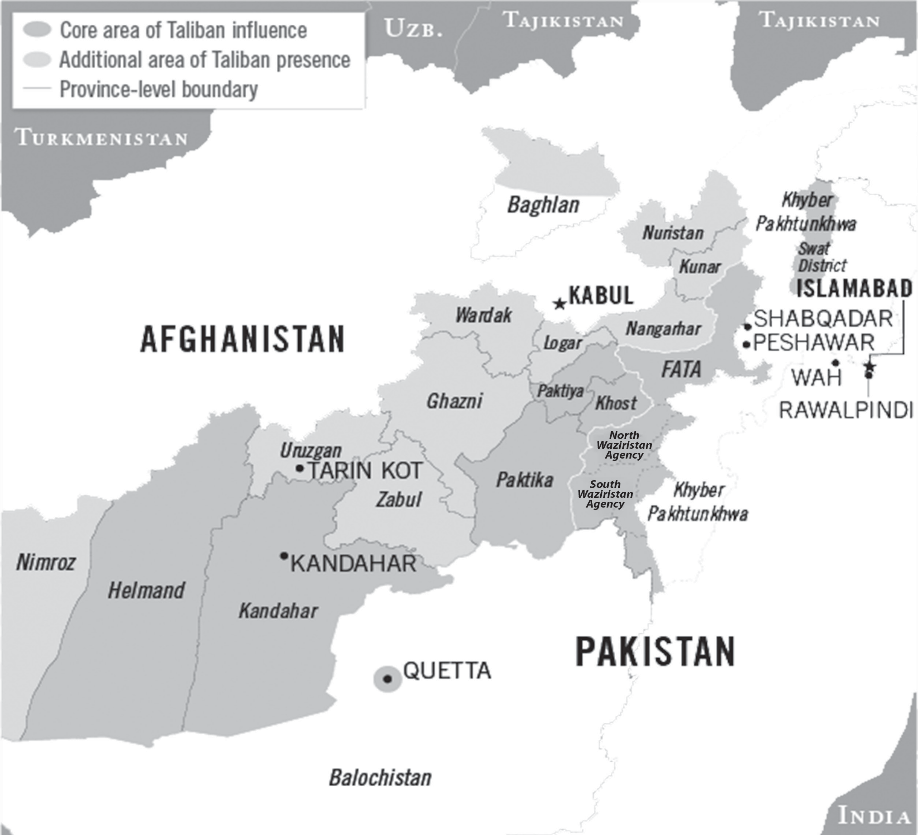
Figure: Tehrik-E Taliban Pakistan (TTP)
• The Haqqani Network is a Sunni Islamist militant organization founded by Jalaluddin Haqqani, who emerged as a top Afghan warlord and insurgent commander during the anti-Soviet war.
• The Islamic State, also known as the Islamic State of Iraq and the Levant, Islamic State of Iraq and Syria, and by its Arabic acronym Da'ish or Daesh, is a transnational militant Islamist terrorist group and former unrecognized quasi-state, founded in 2013 that follows the Salafi jihadist branch of Sunni Islam. It has a particularly violent ideology that calls itself a caliphate and claims religious authority over all Muslims.
• Al-Qaeda is a Sunni pan-Islamist militant organization, established in 1988 in Pakistan, led by Salafi jihadists It aims to overthrow the corrupt “apostate” regimes in the Middle East and replace them with “true” Islamic governments, Al Qaeda's primary enemy is the United States, which it sees as the root cause of the Middle East's problems.
Tackling Terror Financing
TACKLING TERROR FINANCING
'Terrorist financing' refers to the act of soliciting, collecting, or providing funds with the intent that they will be used to support terrorist acts or organizations. These funds can come from both legal and illegal sources.
According to the International Convention for the
Suppression of the Financing of Terrorism, a person is guilty of financing terrorism if they unlawfully and intentionally provide or gather funds, either directly or indirectly, with the knowledge or intent that these funds will be used, fully or partially, to carry out an offense covered by the Convention.
Sources of terrorist funding include, but are not limited to, low-level fraud, kidnapping for ransom, the misuse of non-profit organisations, the illicit trade in commodities (such as oil, charcoal, diamonds, gold and the narcotic “captagon”), and digital currencies.
The global flow of funds, for nefarious [criminal] purposes, has three traditional channels:
• First, direct smuggling of cash through international borders.
• Second, the use of hawala networks.
• Third, banking networks including SWIFT and other international channels.
Overall approach of ‘Beyond-Border Cooperation” is the basis for countering terror funding at global level.
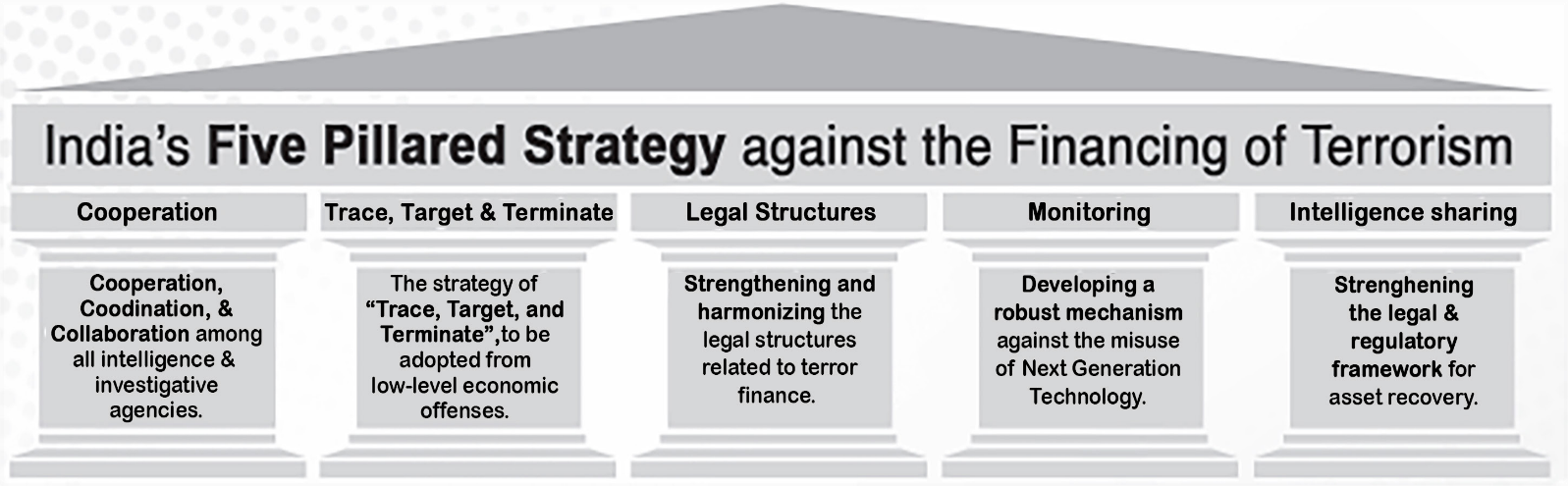
Figure: India’s Five Pillared Strategy against the Financing of Terrorism
International Institutional Frameworks
India is a Member of Financial Action Task Force (FATF), an inter-Governmental Body, responsible for setting global standards on Anti- Money Laundering (AML) and Combating the Financing of Terrorism (CFT) since 2010.
India is also a member of FATF Styled Regional Bodies (FSRBs) such as Eurasian Group (EAG) on Combating Money Laundering and Financing of Terrorism and Asia Pacific Group on Money Laundering (APG). India also participates actively in the meetings of the BIMSTEC Subgroup on Combating the Financing of Terrorism.
Third ministerial ‘No Money for Terror (NMFT)’ conference was organized by Ministry of Home Affairs in 2022. The conference agreed on-
Fully criminalising terrorism financing, even in the absence of a link to a specific terrorist act.
•
Enhancing the traceability and transparency of financial flows.
• Advancing implementation on FATF standards for crypto currency.
• Traceability and transparency of non-profit organisations (NPOs) and charitable funds.
• India asked the international community to initiate discussion on ‘Countering Financing of Radicalisation (CFR)’, which would prevent radicalization.
Zero Tolerance Approach: India has articulated its “zero tolerance approach” towards terrorism in these conferences and tried to attract the attention to the cross- border terrorism from Pakistan
Institutional and Legal Framework in India to Tackle Terrorism
INSTITUTIONAL FRAMEWORK IN INDIA TO TACKLE TERRORISM
National Investigation Agency (NIA)
• The National Investigation Agency (NIA) was established
under the NIA Act of 2008 as a specialized agency for investigating and prosecuting offenses listed in the NIA Act’s Schedule.
• The NIA has concurrent jurisdiction, granting the central government the authority to investigate terrorist attacks anywhere in the country.
NATGRID
• The National Intelligence Grid or NATGRID is conceived to be a framework, which will leverage Information Technology to connect approved User Agencies (UAs) (security/law enforcement) with designated data providers in order to enhance the country's counter terrorism capabilities.
• NATGRID gathers a wide range of data from government databases, including tax records, bank account details, credit card transactions, visa and immigration information, as well as travel itineraries for rail and air travel.
• This combined data will be made available to 11 central agencies, viz. Research and Analysis Wing, the Intelligence Bureau, Central Bureau of Investigation, Financial intelligence unit, Central Board of Direct Taxes, Directorate of Revenue Intelligence, Enforcement Directorate, Narcotics Control Bureau, Central Board of Excise and Customs and the Directorate General of Central Excise Intelligence.
Multi Agency Centre (MAC)
• MAC is a multi-agency centre for Counter Terrorism whose mandate is to share terrorism related intelligence inputs and strengthened and re-organised to enable it to function on a 24X7 basis for real-time collection and sharing of intelligence amongst intelligence agencies and states.
• MAC had also launched National Memory Bank (NMB) integrated with Threat Management system (TMS) on MAC-SMAC -State SB network in June 2021.
Combating Financing of Terrorism Cell (CFT Cell)
• The Combating Financing of Terrorism (CFT) Cell within the Ministry of Home Affairs is responsible for handling policy issues related to combating terrorist financing and the circulation of Fake Indian Currency Notes (FICN).
• The Ministry of Home Affairs has established an FICN Coordination Group (FCORD) to facilitate the sharing of intelligence and information among state and central security agencies to address the issue of fake currency circulation.
• A Terror Funding and Fake Currency (TFFC) Cell has been set up within the National Investigation Agency (NIA) to focus on investigating cases related to terror funding and fake currency.
• India and Bangladesh have signed a Memorandum of Understanding (MoU) to prevent and combat the smuggling and circulation of fake currency notes.
•
Training programs are organized for police officials from Nepal and Bangladesh to raise awareness about the smuggling and counterfeiting of Indian currency.
Creation of Four New National Security Guard (NSG) Hubs
• NSG is a statutory counter terrorism unit under the Ministry of Home affairs, setup after the 2008 Mumbai attacks.
• The limitation of inadequate security forces was addressed by opening NSG hubs at four places at Mumbai, Kolkata, Chennai and Hyderabad after Manesar in order to ensure faster and more effective reaction to crisis situations.
Financial Intelligence Unit-India (FIU-IND)
• FIU-IND is a statutory body established by the Government of India in 2004. It serves as the central national agency responsible for receiving, processing, analyzing, and disseminating information related to suspect financial transactions.
• The FIU-IND plays a crucial role in coordinating and strengthening efforts against money laundering and financing of terrorism, both nationally and internationally. It operates independently and reports directly to the Economic Intelligence Council headed by the Finance Minister of India.
The FIU-IND aligns with international standards and the recommendations of the Financial Action Task Force (FATF) to combat money laundering and terrorist financing.
LEGAL FRAMEWORK IN INDIA TO TACKLE TERRORISM
Unlawful Activities (Prevention) Act (UAPA), 1967:
• It is also called the ‘anti-terror law’ is aimed at tackling activities threatening the integrity and sovereignty of India.
• UAPA provides special procedures to deal with terrorist activities, among other things; the central government may designate an individual/organisation as a terrorist/ terrorist organisation if it:
Commits/participates in acts of terrorism,
Prepares for terrorism,
Promotes terrorism, or
Is otherwise involved in terrorism.
• The first schedule of the Act lists ‘terrorist’ organisations which are banned.
• The Unlawful Activities Act of 1967 was recently amended in 2019. This was done to furnish more powers to the agencies and designate individuals as terrorists.
• National Investigation Agency Act 2008: The National Investigation Agency (NIA) was set up in 2009 under the NIA Act, 2008. It was set up in the wake of the Mumbai terror attack.
• Currently, the NIA operates as the central law enforcement
agency for counter-terrorism in India, under the Ministry of Home Affairs.
• The National Investigation Agency (Amendment) Act of 2019 aims to enable the NIAto investigate crimes related to human trafficking, counterfeit currency or banknotes, the manufacture or sale of prohibited arms, cyberterrorism, and offenses under the Explosive Substances Act. It also grants the NIA the authority to investigate terrorist incidents targeting Indians and Indian interests globally.
• Mandate: It is a central agency to investigate and prosecute offences related to:
• affecting the sovereignty, security and integrity of India, security of State, friendly relations with foreign States.
• against atomic and nuclear facilities.
• smuggling in counterfeit Indian currency.
• counter terrorism law enforcement agency across states without special permission from the states.
Jurisdiction:
• A State Government can request the Central Government to transfer the investigation of a case to the NIA, as long as the case involves offenses listed in the schedule of the NIA Act.
• The Central Government can also direct the NIA to take over the investigation of any scheduled offense anywhere in India. State governments are obligated to provide full cooperation to the NIA.
Special NIA Courts:
• These cases are overseen by a judge appointed by the Central Government based on the recommendation of the Chief Justice of the High Court with jurisdiction in the relevant region.
• The Supreme Court of India is also authorized to transfer cases from one special court to another, whether within the state or outside it.
• Outside India: If the Central Government determines that a scheduled offense has been committed at a location outside India where this Act applies, it can instruct the NIA to register the case and conduct an investigation.
• Allied offenses: While investigating a scheduled offense, the agency can also look into any other related offenses that the accused may have committed, provided the offense is connected to the scheduled offense.
Challenges:
• Coordination with state police as law and order is a state subject.
• Quality manpower, particularly cyber attack capabilities.
• Dependence on foreign technology imports.
• There are no dedicated officers; mostly on deputation from other forces.
• Lack of coordination mechanism with other agencies
like RAW, IB, State police etc. E.g.: Confusion during Pathankot attacks
• No financial autonomy.
Recommendations:
• Granting of financial autonomy similar to CAPF.
• To tackle cyber-crimes, need skilled manpower and ethical hackers.
• Need for a comprehensive National Security Doctrine.
• National Security Strategy indicating state response to various kinds of security challenges.
Anti Hijacking Act, 2016
• It aims to enforce the Hague Hijacking Convention and the 2010 Beijing Protocol Supplementary to the Convention, to which India is a party.
• The act aims to punish not only an actual act of hijacking, but even a false threat that may appear genuine.
• Hijacking includes taking over control of an aircraft.
Bhartiya Nyay Sanhita Bill, 2023
• The Bill has been proposed to replace the Indian Penal Code, 1870.
• Section 111 defines a terrorist act which is done with intent to threaten the integrity and security of India, to intimidate the public or disturb public order.
• The Act punishes terrorism with imprisonment and fine.
India’s Foreign Contribution Regulation Act (FCRA), 1976
• An amended version of the FCRA was introduced in 2010 to "consolidate the law" regarding the use of foreign funds and to "prohibit" their use for "activities harmful to national interests."
• The law was further amended in 2020, providing the government with greater control and oversight over the receipt and use of foreign funds by NGOs.
• The FCRA requires every person or NGO seeking to receive foreign donations to be:
• Registered under the Act
• To open a bank account for the receipt of the foreign funds in State Bank of India, Delhi
• To utilize those funds only for the purpose for which they have been received and as stipulated in the Act.
Under the FCRA, the applicant should
• The individual must not be fictitious and should not have been prosecuted or convicted for participating in activities aimed at converting others through inducement or force, whether directly or indirectly, from one religion to another.
• The individual must not have been prosecuted or convicted for inciting communal tension or disharmony.
• The individual must not be involved in, or likely to engage in, the promotion of sedition.
Prevention of Money Laundering Act (PMLA), 2002
• The Act, passed by the Parliament of India, aims to prevent
money laundering and provides for the confiscation of property obtained through money laundering.
• According to the PMLA's "charging provision," anyone who, directly or indirectly, attempts to engage in,
knowingly assists, knowingly participates in, or is involved in any process or activity related to "proceeds of crime," such as concealing, possessing, acquiring, using, or falsely claiming it to be clean property, is committing the crime of money laundering.
Aims of PMLA 2002
• To address the problem of money laundering, the Prevention of Money Laundering Act of 2002 was introduced. Following are a few of its goals:
• Stop the laundering of money.
• Combating or preventing the flow of money into criminal and commercial activity.
• Allow for the confiscation of assets utilised, implicated, or generated from money laundering.
• Penalise those who commit crimes involving money laundering.
• Establishing a decision-making body and an appeals court to handle money laundering cases.
• Make provisions for issues related to and incidental to money laundering activities.
Investigative Agencies
• Enforcement Directorate (ED) enjoys a wide range of administrative and implementing powers with respect to scheduled offences under PMLA.
• Sections 48 and 49 empower ED to investigate money laundering and terror financing cases.
• Other agencies entrusted with investigating the offences under PMLA are State Police, Customs, SEBI, RIU, CBI, and NCB under their respective legislations.
• ED achieves 93.33% conviction rate in money-laundering cases as of march 2026
National Security Act 1980
• This Act aims to provide for preventive detention in certain cases. This act empowers the Central Government and State Governments to detain a person to prevent him/ her from acting in any manner prejudicial to the security of India, the relations of India with foreign countries, the maintenance of public order, or the maintenance of supplies and services essential to the community it is necessary so to do.
• The Act also gives power to the governments to detain a foreigner in a view to regulate his presence or expel from the country.
• The maximum detention period is 12 months. The order can be issued by the District Magistrate or a Commissioner of Police within their respective areas, but it must be reported to the State Government along
with the reasons for the detention within twelve days. The National Security Act may also be applied if a person assaults a police officer on duty.
• Article 22 of the Constitution outlines the framework for enacting preventive detention laws. The Preventive Detention Act of 1950 was enacted and remained in force until the Maintenance of Internal Security Act (MISA) was introduced in 1971 and remained until 1977, after which the NSA was enacted.
India in International Conventions
INDIA IN INTERNATIONAL CONVENTIONS
Comprehensive Convention on International Terrorism (CCIT) 1996
The original draft that was tabled in 1996 and discussed until April 2013.
It aims to have a universal definition of terrorism that all 193-members of the UNGA will adopt into their own criminal law.
It is a treaty which intends to “criminalise all forms of international terrorism, denial of safe havens, access to funds, and arms to terrorists and the financiers of terrorism”.
Chemical Weapons Convention 1997
As a member of the Executive Council (EC) of the Organisation for the Prohibition of Chemical Weapons (OPCW), India is involved in reviewing the implementation of the Chemical Weapons Convention (CWC), which includes chemical weapon destruction, industry verification, national implementation, and international cooperation and assistance. India also participates in the Conference of States Parties and in various OPCW bodies addressing specific issues.
Biological & Toxin Weapons Convention 1972
India is also a signatory to the Biological & Toxin Weapons Convention (BTWC), which provides a framework to prevent the production, acquisition, or transfer of biological weapons. India takes part in the Annual Meeting of State Parties and other BTWC meetings.
Convention On Certain Conventional Weapons 1983
As a signatory to the Convention on Certain Conventional Weapons (CCW), India takes part in CCW meetings, its Protocols, and the Group of Governmental Experts (GGE) on Lethal Autonomous Weapon Systems. India
also submits its annual national reports under the United Nations Programme of Action to Prevent, Combat, and Eradicate the Illicit Trade in Small Arms and Light Weapons in All Its Aspects (UNPoA), which offers a comprehensive set of national, regional, and global measures, and participates in its meetings.
MEASURES TO CHECK ONLINE TERRORISM
• International Cooperation: There should be a global consensus among nations and various IT-related organizations to establish guidelines for regulating internet use.
• Comprehensive Legislation: Strict laws need to be enacted to deter involvement in radicalization activities.
• Empowered Investigation and Judicial Process : Strengthening the investigative and judicial processes to ensure that individuals involved in such activities are punished.
• Improved coordination and intelligence sharing between agencies such as NIA, IB, and state police are essential to prevent such incidents.
• Law enforcement agencies should be trained to enhance counter-terrorism capabilities and equipped with knowledge of the latest technologies.
• Use of Technology:
• Technologies like big data can be leveraged to identify and remove radicalizing content.
• Strong online surveillance and social media monitoring capabilities are necessary to counter radicalization.
• Multi-pronged Strategy: A comprehensive approach, incorporating rational and logical counter-propaganda efforts, should be adopted with support from civil society, NGOs, and other stakeholders.
COUNTERING RADICALISATION
• India is a diverse country with a rich history of religious and ethnic pluralism. However, this diversity also makes it vulnerable to radicalisation.
• Radicalisation is the process by which individuals or groups adopt extreme political, social, or religious ideas and aspirations that reject or undermine the status quo or prevailing order.
Factors for Radicalisation
• Poverty and inequality: Poverty and inequality can create a sense of hopelessness and marginalisation, which can make people more susceptible to radicalisation.
• Lack of education: Lack of education can make people more vulnerable to radical propaganda and misinformation.
• Social and cultural issues: Discrimination and social exclusion can also lead to radicalisation.
• Religious extremism: Religious extremism can also lead to radicalisation, particularly among young people who are searching for meaning and purpose in their lives.
• Geopolitical factors: India's proximity to conflict zones and the presence of radical groups in the region also
contribute to radicalisation in the country.
The impact of radicalisation in India can be devastating. It can lead to violence, terrorism, and social unrest. It can also undermine India's democratic values and institutions.
Strategies to counter radicalisation
Addressing the root causes of radicalisation: This includes investing in development, reducing poverty and inequality, and promoting social inclusion.
Strengthening security forces: This includes providing the security forces with adequate resources and training, and improving intelligence gathering. India has a Counter Radicalisation Division in the ministry of home affairs.
Building trust with the local population: This includes engaging with the local community, addressing their concerns, and providing them with basic services and
infrastructure.
Promoting education and critical thinking: This includes providing quality education to all children and promoting critical thinking skills.
Countering radical propaganda: This includes countering radical propaganda on social media and other online platforms.
Promoting tolerance and pluralism: This includes promoting tolerance and pluralism in society and countering all forms of discrimination.
Promote interfaith dialogue and understanding: This can be done through educational programs, cultural events, and other initiatives that bring people of different faiths together.
Strengthen community resilience: This can be done by promoting social cohesion and civic engagement. It is also important to address the grievances of marginalized groups this will bring them closer to mainstream.
It is a complex issue with deep-rooted causes. However, by adopting a comprehensive and multi-pronged approach, the Indian government and other stakeholders can make significant progress in countering the threat of radicalisation in the country.
Tackling Terrorism
TACKLING TERRORISM: A ROADMAP
International Forums to Tackle Terrorism
Across the globe, the United Nations Office of Counter- Terrorism (UNOCT) leads and coordinates an all-of-UN approach to prevent and counter-terrorism and violent extremism.
UN Counter-Terrorism Centre (UNCCT) under UNOCT, promotes international cooperation in the fight against terrorism and supports the Member States in implementing the Global Counter-Terrorism Strategy.
The Terrorism Prevention Branch (TPB) of the United Nations Office on Drugs and Crime (UNODC) plays a significant role in international efforts.
It works to assist the Member States, upon request, with the ratification, legislative incorporation and implementation of the universal legal framework against terrorism.
The Financial Action Task Force (FATF) which is a global money laundering and terrorist financing watchdog, sets international standards that aim to prevent these illegal activities and the harm they cause to society.
• The Delhi Declaration by the Counter-Terrorism Committee (CTC) of the UN Security Council (UNSC) was unanimously adopted to address the use of new
and emerging technologies for terrorist activities. The
declaration focuses on key concerns regarding the misuse of drones, social media platforms, and crowdfunding, and aims to establish guidelines to effectively combat the increasing threat of terrorism.
• SCO Regional Anti-Terrorism Structure (RATS) 2004:
The Regional Anti-Terrorist Structure is a permanent organ of the Shanghai Cooperation Organisation (SCO) tasked with creating a practical organisational, legal and regulatory framework for effective cooperation and coordination in counterterrorism efforts across member countries and advancing cooperation on SCO initiatives to mitigate the "Three Evils" – terrorism, separatism and religious extremism apart from Narco-Terror.
• SCO is a nine-member multilateral organisation, established on 15 June 2001 in Shanghai, China by the leaders of ‘Shanghai Five’ i.e. China, Kazakhstan, Kyrgyzstan, Russia, Tajikistan and Uzbekistan. Later, India and Pakistan in 2017 and Iran in 2023 were included.
• At the Shanghai Cooperation Organization (SCO)- 2025 Defense Ministers' meeting in China, India refused to sign the joint declaration. Due to the draft statement's omission of references to the Pahalgam terror assault in Jammu and Kashmir and its inclusion of occurrences in Pakistan.
No Money for Terror Ministerial Conference: India hosted the annual International ‘No Money for Terror’ Conference at New Delhi attended by 78 countries, including 20 ministers, indicating the growing importance of fighting the financing of terrorism and to collaborate with countries across the world for suppressing the funding sources that allow terrorists and extremists to carry out their violent acts. The inaugural event was held at Paris in 2018.
Global Counter Terrorism Forum (GCTF)- It is an informal, apolitical, multilateral forum for coordinating for counter terrorism since 2011. It is small, nimble, inclusive, and consensus-based. Its overarching mission is to reduce the global vulnerability to terrorism by supporting United Nations Global Counter-Terrorism Strategy, mobilizing expertise and resources to prevent, combat, and prosecute terrorist acts and counter incitement and recruitment to terrorism.
The Forum brings together policymakers and practitioners from around the world to share experiences and expertise, and to develop practical, publicly available tools and strategies on how to prevent and counter the evolving terrorist threat. The GCTF is currently co-chaired by Egypt and the European Union.
Way Forward to Counter Terrorism
Preventing Youth from Terrorism: promoting education in peace, nonviolence and tolerance. Ensuring employment and other opportunities for meaningful engagement with society.
• Enhancing Capacity: The Indian military should be specially trained to combat cross-border terrorism, ensuring co-ordination among intelligence and security agencies to prevent infiltration.
• Curbing Terror Funding: There is a need for stronger laws that require banks to perform due diligence on
clients and to report suspicious transactions to prevent terrorism. Regulating crypto currency is must as it is a new form of terror financing.
• Enhancing Technological Capabilities- to tackle issues like social networking of terrorism, toolkit of terror networks, bio-terrorist means etc.
• Traditional risk assessment tools do not allow data to be analysed at a large scale, limiting the potential for correlations and analysis to generate a more fine- grained picture of the risks
• Enhancing Legislative & Institutional Capacities- with
Fast Track Courts and special judges.
• Developmental Works and Inclusive Growth: To ensure that no man is left behind so that the appeal to take to terrorist activities is not there.
• International Efforts
• It is necessary to re-energize the global agenda of counter-terrorism by emphasizing the need for unity, and checking the veto power of P5 when it comes to identifying terrorists worldwide.
• Adopting a Universal Definition of Terrorism so that domestic laws of all countries can be streamlined and synchronized to ban terror groups, prosecute terrorists, and extradite terrorists.
• In 1996, India proposed a draft document on Comprehensive Convention on International Terrorism (CCIT) at the UN, however it is yet to be adopted due to deadlock over differences on the definition of terrorism.
• Intelligence sharing: As terrorism is taking global form, intelligence sharing among countries is critical in preventing or minimizing the terror attacks.
• Global cooperation on Extremist Online Content: Christchurch Call of Action outlined voluntary commitments from governments, ISPs to address issue of violent extremist content online. India is a
signatory to this plan.
With biological warfare being recognised as a looming threat to the world, Indo-US joint exercise, TARKASH has for the first-time included response to Biological terror attacks.
• Coordinated response of Government, political parties, security agencies, civil society and media is necessary to tackle the menace of terrorism. There is a need for National Counter Terrorism Centre.
• A think tank and monitoring body like Terrorism Watch Centre, is needed which could also get sufficient inputs from academic and private experts.
• United Nations High Commissioner for Human Rights: While condemning terrorism unequivocally and recognizing the duty of States to protect those living within their jurisdictions from terrorism, there has to be a priority on the question of protecting human rights in the context of counter-terrorism measures, even in states of emergency.
As Secretary-General Kofi Annan stated "Our responses to terrorism… should uphold the human rights that terrorists aim to destroy. Respect for human rights, fundamental freedoms and the rule of law are essential tools in the effort to combat terrorism - not privileges to be sacrificed at a time of tension."
• Interpol: The International Criminal Police Organisation, commonly known as Interpol, is the world’s largest international police organisation that facilitates global cooperation, crime control, sharing intelligence and alerts on transnational terrorist networks, to better understand their methods, motives and financing and – ultimately
– to identify and arrest suspects. The Interpol Terrorism Watch List permits access by authorized police agencies to information on fugitives and suspected terrorists.
About Notices
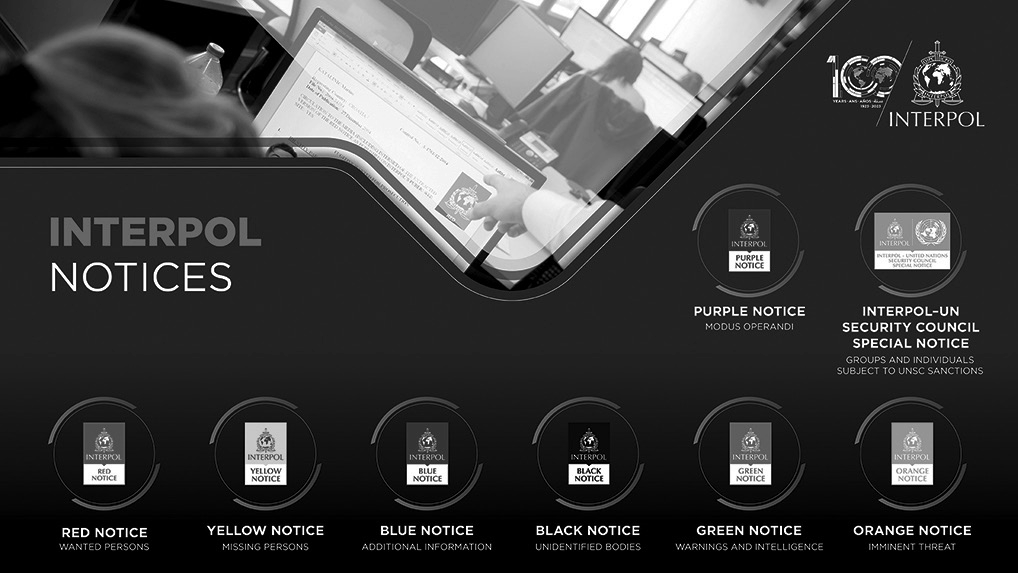
Figure: Interpol Colour Coded Notices
• United Nations Global Counter-Terrorism Strategy 2006: It is a unique global instrument to enhance national, regional and international efforts to counter terrorism. Through its adoption by consensus, all Member States agreed to a common strategic and operational approach to fighting terrorism.
• The Strategy reaffirms preventing and countering terrorism and violent extremism conducive to terrorism.
• The Plan of Action consists of four key components:
Actions to address the underlying conditions that facilitate the spread of terrorism.
Actions to prevent and combat terrorism.
Actions to enhance the capacity of States to prevent and combat terrorism, as well as to strengthen the role of the United Nations in this effort.
Actions to ensure the protection of human rights for all and uphold the rule of law as the core foundation in the fight against terrorism.
• United Nations Security Council Committee Resolutions:
• The Al-Qaeda and Taliban Sanctions Committee or 1267 Resolution Committee is better known as the ISIL (Da'esh) and Al-Qaida Sanctions List. The Consolidated List includes all individuals and entities subject to measures and sanctions imposed by the Security Council, like asset freeze, travel ban, economic, trade, or diplomatic sanctions etc.
• UNSC Counter-Terrorism Committee (CTC) or 1373 Committee was established by Security Council resolution 1373 (2001), which was adopted unanimously on 28 September 2001 after 9/11 attack in the United States. It monitors the implementation of resolution 1373 (2001), which requested countries to implement a number of measures intended to
enhance their legal and institutional ability to counter terrorist activities at home, in their regions and around the world.
Case of Militancy in Jammu and Kashmir
CASE OF MILITANCY IN JAMMU AND KASHMIR
Jammu & Kashmir (J&K) has experienced terrorist and secessionist violence, supported and funded from across the border, for over thirty years.
The ongoing militancy in Jammu and Kashmir is closely associated with the infiltration of terrorists from across both the “International Border” and the “Line of Control” in J&K.
The trends of terrorist violence in J&K over the past five years are presented in the table below:
| Yea | Incidents | SFs killed | Civilians killed | Terrorists killed |
| 2017 | 279 | 80 | 40 | 213 |
| 2018 | 417 | 91 | 39 | 257 |
| 2019 | 255 | 80 | 39 | 157 |
| 2020 | 244 | 62 | 37 | 221 |
| 2021 | 229 | 42 | 41 | 180 |
Pakistan has adopted proxy war techniques by facilitating terrorism in India with a view to ‘Bleed India with a Thousand Cuts’. These include Khalistan movement in Punjab, terrorism in Kashmir finds root in Pakistan Occupied Kashmir (PoK)¸ 1993 Bombay Blasts, 26/11 Mumbai Attacks, 2016 Uri Attacks, 2019 Pulwama, 2023 Poonch attack etc.
Pakistan sponsored terrorism in Jammu and Kashmir has terrorized the population, violated human rights through kidnappings and killings of innocent civilians and hindered political dialogue.
Origins
The origins of insurgency in Jammu & Kashmir can be traced back to the late 1940s when Pakistan attacked India with the aim of capturing Jammu & Kashmir.
Since then, a section of the population has supported secession from India. These groups, often aided by forces across the border, have frequently engaged in insurgent activities. After the 1971 India-Pakistan war, there was a brief period of calm in secessionist actions. However, the 1980s saw a surge in border infiltration and a sharp rise in insurgency. Innocent civilians were targeted and forced to flee the region. The 1990s saw the large-scale deployment of security forces in the state.
History
Maharaja Hari Singh acceded to India in 1947 by signing the Instrument of Accession where except for Defence, Foreign Affairs, Finance and Communications, the Indian Parliament needs the State Government’s concurrence for applying all other laws.
Kashmir and UN: Through the intervention of UN Security Council, India and Pakistan arrived at a ceasefire and established the Line of Control (LOC).
Major Counter Terrorism Operations
Operation Rakshak: Counter-insurgency and counter- terrorism operation in Jammu and Kashmir in 1990.
Operation Sarp Vinash: Undertaken by Indian army to flush out terrorists in the areas of the Pir Panjal range in Jammu and Kashmir in 2003.
Operation All Out: Joint offensive launched by Indian security forces to flush out militants and terrorists in Kashmir in 2017.
Operation SINDOOR: To destroy the terror bases in Pakistan which were responsible for the attack of Pahalgam in April 2022
Shift in strategy against Terrorism
• In February 2019, the Pulwama attack happened where a CRPF convoy was rammed into by a Jaish-e- Mohammed (JeM) explosive laden SUV. India undertook a non-military pre-emptive strike on JeM camps in Balakot.
In response to this attack on February 26, 2019, Indian Airforce with 12 Mirage 2000 fighter planes struck terrorist camps operating in Balakot and other locations destroying terror camps of Jaish-e- Mohammed
This is a shift in India’s strategy against terrorism. The strategy is now to counter attack at a massive scale to ensure deterrence.
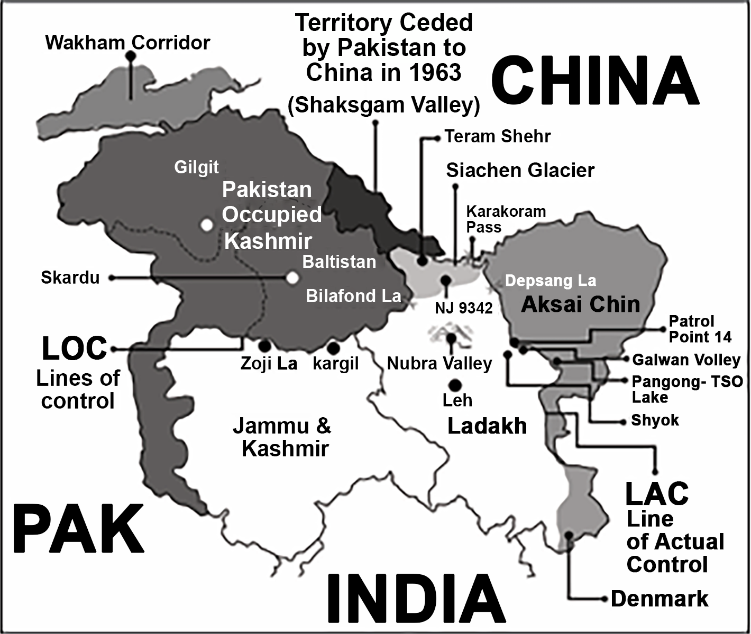
Figure: Line of Control and Line of Actual Control
NATIONAL COUNTER-TERRORISM POLICY & STRATEGY-2026
India has consistently supported terrorist victims and remained unwavering in its conviction that there is absolutely no excuse for violence in the world. The Indian policy of "zero tolerance" against terrorism is based on this ethical approach.
The counter-terrorism strategy of India, ‘PRAHAAR’, flows
from these ideals and is predicated on the following:
P- Prevention of terror attacks to protect Indian citizens and interests
R- Responses, which are swift and proportionate to the threat posed
A- Aggregating internal capacities for achieving synergy in a whole-of-government approach
H- Human rights and ‘Rule of Law’ based processes for mitigation of threats
A-Attenuating theconditions enabling terrorism, including radicalization
A-Aligning and shaping the international efforts to counter terrorism
R-Recovery and resilience through a whole-of-society approach
Military Actions Against Terrorist Attacks
• Surgical Strikes: A surgical strike is essentially a swift and targeted attack on specific target that aims to neutralise them while ensuring minimum collateral damage to the surrounding areas and civilians. These attacks can be carried out via air raids, airdropping special ops teams or a ground operation. E.g., 2016 military strike in PoK and 2019 aerial surgical strike in Pakistan (first time since
1971), etc.
• Hot pursuit refers to a situation where a military force crosses the border of a country in order to pursue and engage a group of terrorists who have carried out an attack on the pursuing country's territory. E.g., 2015 counter-insurgency operation in Myanmar.
Government Programmes in Kashmir
• The Government of India has been working to address the issues of the troubled state through a comprehensive strategy that focuses on political, security, developmental, and administrative concerns. Politically, the government has prioritized dialogue, placing importance on democratic processes and the rule of law.
Multi-Pronged Approach:
Take proactive steps to protect the borders from cross- border terrorism and control militancy.
Ensure the continuity of the democratic process and restore the dominance of civil administration to effectively address the socio-economic challenges faced by the people due to the prolonged militancy in J&K.
Maintain a continuous peace process and provide sufficient opportunities for all groups in J&K who reject violence to express their views and address their legitimate concerns.
Security Initiatives
• Checking Infiltration from Across the Border- strengthening border infrastructure, weapons upgradation, synergizing intelligence flow.
• Special Police Officers (SPOs) of J&K- allowance enhanced and recruitment increased.
• Central assistance: reimbursing costs to UT and providing CAPF support.
• Subsidized Helicopter Services to ensure connectivity to remote areas.
Public Outreach Programmes
• Jan Abhiyan: Ration cards, Health Insurance (PMJAY), other relevant certificates issued to over 5 lakh people. Under Jal Jeevan mission doubling of tap water connections since 2019, all rural schools and anganwadis connected to piped water. Prime Minister's Awas Yojna- Urban covers all cities of Jammu & Kashmir, Kisan Credit Card beneficiaries received 11 lakh rupees.
• My Town My Pride (MTMP): Public outreach in towns, Service Delivery at doorstep and strengthening grass root Democracy.
• Developmental works:
• Prime Minister's Development Package (PMDP),
• Foundation for metro services,
• Doubling hydro power generation, road construction under Pradhan Mantri Gram Sadak Yojana,
•
Transmission lines, smart prepaid meters, 100% door to door solid waste management collection,
• Two cluster universities at Jammu and Srinagar have been established,
• The Border Area Development Programme (BADP) aims to address the unique developmental needs and improve the well-being of people residing in remote and hard-to-reach areas near international borders. It seeks to provide essential infrastructure by integrating Central, State, UT, BADP, and local schemes, along with a participatory approach.
• Decentralisation of Power
• Empowering Panchayati Raj Institutions: 27 functions transferred to PRIs & Urban Local Bodies and over Rs 1700 crores devolved.
• Restoring grassroots democracy: The government has conducted the first-ever district development council (DDC) elections in J&K in December 2020, which saw a high voter turnout of 51.42%.
• Constituting a Hill Council for Kargil district to ensure local representation and autonomy.
• Economy
• The 149-year-old ‘Darbar Move’ practice involving shifting the capital between Srinagar and Jammu in Jammu and Kashmir was abolished in June 2021, to save 200 Crore per year. Now the Civil Secretariat functions from both Jammu and Srinagar through e-office.
• New Programmes
• J&K Metropolitan Region Development Authorities Act and establishment of two Metropolitan Region Development Authorities for the Metropolitan Regions of Jammu and Srinagar.
• Creation of Unified Metropolitan Transport Authority (UMTA) under which comprehensive Mobility Plans for both the cities formulated.
• Ease of Doing Business: New Central Sector Scheme for Industrial Development of UT of J&K notified. Streamlined process for land allotment for industrial use. The J&K Single Window (Industrial Investment and Business Facilitation) Act 2018 has been made operational.
• J&K Industrial Land Allotment Policy, 2021-30 notified
• J & K Private Industrial Estate Development Policy 2021-30 notified
• J&K Wool Processing, Handicrafts and Handloom Policy 2020 notified for promotion of handicrafts.
• Credit Card Scheme for Artisans and Weavers notified
• 'Karkhandar Scheme' has been notified for the National/State awardees as well as the aspirant trainees with thrust on the endangered Crafts.
• Notification of J&K Tourism Policy-2020: In order to attract private investors. Other initiatives include
identifying 75 off-beat tourist destinations, holding annual fairs, conducting gold tournaments and air shows.
• National Saffron Mission: providing irrigation infrastructure, GI tag for saffron.
• Integrated Dairy & Poultry Development Scheme, 2020–21: To make J&K net exporter in the milk production and processed milk products
• Rise Together Scheme- Mission Youth, J&K has rolled out a specially designed community-oriented livelihood generation scheme for youth of J&K
• Under 'Mumkin' Scheme, unemployed youth are facilitated to procure small commercial vehicles, on subsidized basis, to promote sustainable livelihood in the transport sector
• 'TEJASWINI' to promote entrepreneurship among young women
• Parvaaz Scheme- The scheme is aimed to sponsor coaching for competitive examinations for recruitments conducted by UPSC/ JKPSC.
• Aap Ki Zameen Aap ki Nigrani: Under this the land/ revenue records have been scanned and uploaded.
• Project UDAA: providing skills to 40,000 youth over a period of five years.
• 'Operation SADBHAVANA': Indian Army is undertaking multiple welfare activities such as running of Army Goodwill Schools, Infrastructure Development Projects and Education Tours etc. for the children living in remote areas of Union Territory (UT) of Ladakh.
• In 2004, a New Rehabilitation Policy was approved which was applicable to “known militants who surrender with weapons” and “dreaded militants even without weapons”. It also promised a fixed deposit of Rs 1.5 lakh, monthly stipend of Rs 2,000 and some vocational training. This policy was effective insofar as it introduced incentives for surrendering weapons and ammunition and provided monetary benefits to over 200 ex-militants in the form of cash and stipend. In 2010, another policy was announced for Kashmiri militants who had gone to Pakistan occupied Kashmir for arms training between 1989 and 2009 and wanted to return.
PRESENT STATUS OF MILITANCY IN JAMMU AND KASHMIR
• Kashmir is experiencing a period of relative stability and peace due to greater counter-terrorism operations,
surveillance along the borders, and a drop in cross-border infiltration along the Line of Control (LoC).
• The August 2019 abrogation of Jammu & Kashmir’s (J&K) special constitutional status prompted militant groups in Kashmir to change their tactics, including recruiting “hybrid militants” who are difficult to identify.
• According to police, ‘hybrid’ militants are not listed as militants, but radicalized and trained enough to carry out terror attacks and then slip back into the routine life. As most of them are teenagers and highly motivated, they do not cross the border for arms training nor do they go underground to commit violent acts.
The Jammu and Kashmir Reorganisation Act, 2019
• The Jammu and Kashmir Reorganisation Act, 2019, divided the State into two union territories (UTs), namely, Jammu & Kashmir, and Ladakh with legislative assemblies.
• Special Status of J&K under Article 370 is now revoked. Erstwhile Article 370 allowed the State to enact its own constitution, criminal code, prohibit purchase of land by outsiders etc.
• In June 2020, Doda district was declared militancy free while Tral was declared free from Hizbul Mujahideen militants.
• Bandipora, Kupwara and Ganderbal districts in Kashmir have zero active terrorists currently even as two prominent terror organisations, Lashkar-e-Toiba (LeT) and Jaish- e-Mohammed, have gone headless after security forces neutralised their operatives and commanders.
• A figure released by security forces deployed in Jammu and Kashmir revealed that there has been a 78 percent decline in the number of terrorists killed in the valley since the start of 2023 compared to the corresponding period in 2022.
Challenges & Concerns
• Rise in targeted killings, particularly of Kashmiri Hindus and non-Kashmiris (migrant laborers).
• Although militancy in Kashmir has decreased, there is a new pattern of localization and indigenization of terror in the region.
• Over 50% of civilian killings since Aug 5, 2019, occurred in the last eight months.
• Small weapons dropped by low-cost drones from across the border used in killings.
• Crimes against women and children are on the rise.
• Militancy has resurfaced in the Pir Panjal region, which
had experienced a decline in the past 15 years.
• Casualties among CRPF troops have risen significantly since 2019.
• Occasional house arrest of the leaders in J&K has been going on for several years. Political leaders are denied permission to protest peacefully, and their offices are sealed.
• Legislative elections have been postponed for five years.
• Unemployment is alarmingly high at 23.1%, well above the national average. While government job placements have occurred, a significant number of vacancies remain.
• Social Stigma is very high against militants who surrendered and poor delivery of benefits to them apart from harassment by security forces.
Generations of Warfare
• In military history, the term "generations of warfare" refers to the concept of five "generations" in warfare, with each generation having different tactics, strategies, and technologies.
• First-Generation Warfare refers to ancient and post-classical battles fought with massed manpower, using phalanx, line, and column tactics with uniformed soldiers governed by the state. It ended in mid-nineteenth century due to rapid improvements in the range, accuracy, and rate-of-fire of many weapon systems.
• Second-Generation Warfare refers to industrial warfare, evolving after the invention of the rifled musket and breech- loading weapons and continuing through the development of the machine gun and indirect fire. This generation predates the widespread effective use of motorised vehicles in battle and combined arms. The term second generation warfare was created by the U.S. military in 1989.
• Third-Generation Warfare focuses on using late modern technology-derived tactics of leveraging speed, stealth, and surprise to bypass the enemy's lines and collapse their forces from the rear. Essentially, this was the end of linear warfare on a tactical level, with units seeking not simply to meet each other face to face but to outmaneuver each other to gain the greatest advantage. Armoured units, military aircraft, and airborne forces began to play an increasingly critical role in operations, with the development of strategies such as Blitzkrieg and deep operation.
• Fourth-Generation Warfare/Asymmetric Warfare is conflict characterized by a blurring of the distinction between war and politics, and of the distinction between combatants and civilians. It is normally characterized by a violent non-state actor (VNSA) fighting a state. Small wars, wars of liberation, insurgencies, cross-border terrorism, proxy wars, sub-conventional warfare. This fighting can be physically done, such as by modern examples Hezbollah or the Liberation Tigers of Tamil Eelam (LTTE), Guerrilla groups like Naxals, private military contractors, and paramilitary organisations.
• Fifth-Generation Warfare (5gw) is warfare that is conducted primarily through non-kinetic military action, such as social engineering, misinformation, cyberattacks, along with emerging technologies such as artificial intelligence and fully autonomous systems.
Way Forward
• A Multi-Pronged Approach to Tackle Above Mentioned Challenges
• Restoring Normalcy and Trust: Release political detainees, foster dialogue, engage local leaders.
• Inclusive Governance and Participation: Prompt local elections, empower through political platforms.
• Boosting economicdevelopment, investment, employment
• Strengthening security and peace
• Respecting cultural diversity: Preserve culture, balance regional interests.
• Enhance infrastructure and connectivity: Develop connectivity for trade, tourism and boost digital
Contemporary Issues
CONTEMPORARY ISSUES
Unlawful Activities (Prevention) Act 1967
UAPA was passed in 1967 on the basis of 16th Amendment and later became India's main anti- terror law in 2004 after inclusion of several provision of repealed Prevention of Terrorism Act 2002. UAPA was not a terror law before this amendment. With this modification, a new offence known as a "terrorist act" was added to the list of crimes that are prohibited. This gives the government the ability to impose ban on groups for engaged in "terrorist acts." The most recent amendment in 2019, allows the government to label anyone as a terrorist.
Key Provisions of UAPA
Ambiguous Meaning of Terrorist Act
The term "terrorist act", “any other means”, “likely” under Section 15 allow the government to classify any physical act as a terrorist act. Setting such a low standard for what constitutes terrorist activities is a capricious tactic the government uses to repress dissenters.
• Arbitrary Arrest under UAPA
• Against the Article 22 of the Constitution and Section 50 of the Criminal Procedure Code, an arrest may be made in accordance with UAPA without a reasonable justification.
• Terms like "as quickly as possible" or "as soon as maybe" don’t establish legislative time limit.
• Excessive Period of Detention
• Expanding the discretionary powers of arrests and detention, the imprisonment period increased from
90 days to 180 days by the 2008 amendment, if demonstrated that the investigation is progressing and there is a considerable risk in releasing. This is contrary to the Section 167 of the Criminal Procedure Code which limits it to 90 days even in capital punishment and 60 days for other offences.
• Presumption of Guilt not Innocence:
• The UAPA violates Right to a Fair Trial which is the basis of Rule of Law and Human Rights, by assuming the guilt of the accused unless the accused can demonstrate his innocence under Section 43A of the Act.
• Another violation is of the international principle that Burden of Proof for guilt rests with the prosecution.
Hate Speech
• The expression ‘hate speech’ has not been defined by any law in India, nor does it have any general legal definition. The literal explanation of Hate Speech as per Oxford Dictionary may be defined as expression which is likely to cause offence or distress to other individuals on the basis of their association with a particular group and/or incitement.
• Hate Speech is not covered under Fundamental Right to Freedom of Speech and Expression and comes under reasonable restrictions on the freedom.
• Under Art 19(2), a reasonable restriction to strike a balance between the use and misuse of this freedom.
Various laws:
• Section 153A (BNS 196): It aims to penalize individuals who engage in deliberate vilification or attacks based on religion, race, place of birth, residence, language, or any particular group or class, including the founders and prophets of a religion.
• Key Provisions of Section 153A (BNS 196)
•
Encouraging enmity between different groups
• Committing acts that disrupt harmony among various groups
• Engaging in activities that instill fear, alarm, or insecurity among members of any group.
• Section 153B Section 197: Section 153B of the IPC, which criminalizes imputations and assertions by speech directed towards certain members of a group
• Section 295A (BNS 299): It is designed to penalize intentional and malicious acts aimed at offending the religious sentiments of any group by disrespecting their religion or religious beliefs.
• Ingredients of Section 295-A (BNS 299):
• The accused must insult or attempt to insult the religion or religious beliefs of any group of Indian citizens.
• The insult must be carried out with a deliberate and malicious intent to offend the religious sentiments of that group.
• The insult can be expressed through spoken or written words, gestures, visual representations, or any other means.
• Offenses under Section 295-A (BNS 299) are cognizable, non-bailable, and non-compoundable.
• The police have the authority to arrest an individual charged under Section 295-A (BNS 299) without requiring a warrant.
• Section 298 (BNS 298): Section 298 (BNS 298) of the IPC, criminalizes speech that would hurt the religious sentiments of a person. ‘Deliberate intention’ is the necessary component
Election laws and Hate Speech
• Section 123 of Representation of People’s Act (RPA), 1951 deals with corrupt electoral practices.
• An appeal to vote or refrain from voting on the ground of his religion, race, caste, community or language or appeal to religious symbols or nation symbol to impact an election is considered a Corrupt Electoral Practice under Section 123(3).
• In the case of Abhiram Singh v C.D. Commachen, a seven-judge Constitution Bench held that an election will be void if votes are sought in the name of the religion of the contestant.
Prevention of Atrocities Act and Hate Speech
• Speech directed by any person who himself is not a member of SC or ST community towards the SC or/ and ST community to demean them and hurt them are prevented from occurrence under the Prevention of Atrocities Act, 1989. Prosecution will have to prove the ingredients of such a criminal offence. Social
media has been used to post speeches which has been prohibited by few platforms like twitter.
• Media law and Hate Speech
• The Cinematography Act, 1952 Section 5B and Section 7 of the Cinematography Act, 1952 are various legislations that empowers the Board of Film Certification to prohibit and regulate the screening of the film. Section 4 talks about the examination of the film.
• According to Section 5B, a film will not be granted certification for public screening if the certifying authority believes that the film or any part of it is detrimental to the security, sovereignty, or integrity of the nation, affects friendly relations with foreign states, disrupts public order, violates decency or morality, involves defamation or contempt of court, or is likely to incite the commission of an offense.
• Section 7 talks about the penalties for contraventions of this part
• Judicial View:
• In Shaheen Abdulla case 2022, Supreme Court has mandated the police forces of all Indian states to suo moto register FIRs in hate speech cases
• In Sukumar v. State of Tamil Nadu (2019), the apex court held that hate speech on social media platforms is not protected by the right to freedom of speech and expression.
Challenges and Issues
• No universal definition: Different countries and cultures have different norms and expectations.
• Misuse of Free speech rights: in the name of civil liberties by fringe groups and political parties.
• Difficult to curb Online hate: Platforms and Apps like Facebook, WhatsApp and Twitter face issues of secrecy, anonymity and breach of trust.
• Languages and Interpretations: Cultural and linguistic nuances and contexts may be difficult to interpret especially in multicultural society like India.
• Political Culture of Impunity: Hate speech by politicians is often condoned in the name of Parliamentary Privileges. Like recently Member of Parliament Ramesh Bidhuri has not been reprimanded for his hate speech in Parliament and left with just a warning.
• Lack of resources and legal framework: No clear laws and regulations unlike the Prevention of Atrocities Act.
• Communal violence and marginalisation: Hate speech not only hurts a person emotionally but also
incites violence against the community over time by rapidly building up the momentum of hate. For example, hate speech was given just before communal riots in many instances like Muzaffarnagar riots 2013, Godhra riots 2002, Delhi 1984 riots, etc.
• Lack of Awareness: Personnel manning the Law enforcement agencies also sometimes display the prejudices and engage in hate speech informally and behave in discriminatory manner due to lack of awareness.
Recommendations:
• Amending IPC: Law Commission’s Report No. 267 titled “Hate Speech”, which, while noting several infirmities in the existing legal framework in hate speech, recommended insertion of new Sections 153C and 505A in the IPC. Similar suggestions have also been made by T.K. Viswanathan Committee to curb online hate speech.
• Comprehensive law to balance freedom of speech and expression, while also protecting individuals and groups from the caustic effects of hate speech.
• Clear Guidelines for Police: Police must be provided with clear guidelines on how to determine whether a statement constitutes hate speech, subject to review by a Monitoring Committee, headed by senior lawyers or sitting or retired Judges of High Court or the Supreme Court.
• Regulation on Political Parties: Political parties and individuals must be discouraged from using hate speech and such behaviour be dealt with dire and exemplary penal consequences.
• Awareness and Training: Hate speech must be curbed with all out ideological multi-pronged attack through developing empathy and understanding of humanitarian point of view by rigorous training and awareness campaigns.
Conclusion
• The issue of hate speech is a complex and multifaceted one, with no easy solutions. However, a concerted effort by all stakeholders, including the government, political parties, media and the public, can go a long way in addressing this problem and fostering a culture of harmony, tolerance and respect in society. Only then can we hope to achieve our constitutional goal of a truly democratic and perfect society, where all individuals are free to express their opinions without fear of persecution or discrimination.
Fake News
• Disinformation is understood as false information that is created or spread with the deliberate intent of causing harm; in the case of misinformation, the element of intent
is thought to be absent.
• Fake News is a false propaganda published under the guise of authentic news.
• Fake or Hoax news or Yellow Journalism is a serious problem around the world. There is no specific law against fake news in India. Free publication of news flows from Article 19 of the Constitution guaranteeing freedom of speech. Spreading misinformation or disinformation is a crime under both the Indian Penal Code and the Information Technology Act, 2000 in India.
• Fake news spread through social media in the country has become a serious problem, with the potential of it resulting in moral panic, mass hysteria, lynchings and mob violence.
For example, at least 20 people were killed in 2018 as a result of misinformation circulated on WhatsApp like Palghar mob lynchings, Karbi Anglong mob lynchings.
• Fake video clips, artificial intelligence, or a similarly computer-rendered visual news, images, stories with morphed media logos, bots, paid commentators for favourable online reputation (troll farm) and win elections have become very common.
• In 2020, cases of 'circulating fake/false news/rumours' under Section 505 of the Indian Penal Code (IPC) have increased by 214%, according to the National Crime Records Bureau.
Impact of Fake News
• Influence Public Opinion: Widespread use of social media is used by vested interests to promote propaganda and cultivate followers to influence public opinion, to gain popularity or to malign the image of certain individuals or opponents or to defame them. Like the opposition leader was denigrated and discredited as immature through nicknames like ‘pappu’ etc.
• Political and Communal Polarisation: Particularly before elections, fake news is used to polarise public opinion, deepening the existing social discord, loss of civic trust in the electoral system and democracy. For example, accusing the constitution, judiciary, election commission, police, etc. of biasedness by fringe groups.
• Affects Communal and Social Harmony: by spreading extremists’ ideologies especially in sensitive areas like radicalization of youths, inciting violence and hatred among the communities, swinging public opinions etc.
Challenges
• Low Digital Literacy: India's digital literacy rate is still low at 38%, which makes it easy for fake news to spread. According to the India Inequality Report 2022, high
Digital Divide, as approximately 70% do not have digital services.
• Electoral Use: to manipulate public opinion, which makes it challenging to control the spread of fake news.
• Limited Fact-Checking Infrastructure: For example, PIB fact check units are small and poorly funded.
• Lack of Penalties: There are currently no strict penalties for the spread of fake news in India, which makes it difficult to deter people from creating and disseminating fake news.
• Opacity of Social Media Platforms: Social media platforms having public discourse are unable to curb misinformation due to lack of transparency and the data is often not presented in a manner that facilitates easy analysis.
• Anonymity: Fake profiles earlier used to speak the truth against vindictive governments are now being used to spread false information without any repercussions.
Various Bodies to Control Media
• Press Council of India, a regulatory body, can warn, admonish or censure the newspaper, the news agency, the editor or the journalist or disapprove the conduct of the editor or the journalist if it finds that a newspaper or a news agency has violated journalistic ethics.
• News Broadcasters Association (NBA) represents the private television news and current affairs broadcasters. The self-regulatory body probes complaints against electronic media.
• Indian Broadcast Foundation (IBF) also looks into the complaints against contents aired by channels.
• Broadcasting Content Complaint Council (BCCC) admits complaints against TV broadcasters for objectionable TV content and fake news.
Sections under Indian Penal Code 1860/Bharatiya Nyaya Sanhita (BNS)
• Section 153A (BNS 196): This section pertains to “promoting enmity between different groups
• Section 295A (BNS 299): This section relates to “deliberate and malicious acts intended to outrage religious feelings”.
Section 499 (BNS 356): This section pertains to the offence of defamation. It defines defamation as making a false statement to harm a person’s reputation. Exceptions include “imputation of truth”, which is required for the “public good” and thus has to be published, on the public conduct of government officials, the conduct of any person touching any public question, and merits of the public performance.
• Section 469 (BNS 336): It deals with the cases in which a person who forges a document or electronic record for the purpose of harming the reputation of another person. Such a person shall be punished with imprisonment for a term which may extend to 3 years with fine. However, such an offence is bailable unlike section 468.
• Section 500 (BNS 356): While Section 499 defines defamation, section 500 prescribes the punishment for criminal defamation. In India, defamation can be both a civil and a criminal offence. The punishment for criminal defamation can include imprisonment for up to two years, a fine, or both. It is under this section that Congress leader Rahul Gandhi was sentenced to two years in prison, which triggered the law that led to his disqualification from Parliament.
• Section 503 (BNS 351): This relates to the offence of “criminal intimidation”. It criminalises the act of threatening another person with injury to their person, property, or reputation with the intention to cause fear or compel them to do something against their will. The punishment may include imprisonment for up to two years, a fine, or both, depending on the circumstances and severity of the threat.
• Section 504 (BNS 352): This section deals with “intentional insult with intent to provoke breach of the peace”. The punishment includes imprisonment for up to two years, a fine, or both.
• Section 505 (BNS 353): This pertains to the offence of making “statements conducing to public mischief”. It criminalises spreading statements, rumours, or reports with the intent to incite fear, alarm, or provoke a breach of peace. It carries a punishment of imprisonment up to three years, a fine, or both.
• Section 505 (1) / (BNS 353): This section deals with the offence of “making, publishing, or circulating statements, rumours, or reports with intent to incite a class or community to commit an offence against any other class or community”. It criminalises the deliberate spread of statements to incite hatred or provoke violence between different groups. The punishment includes imprisonment up to three years, a fine, or both.
Sections under IT Act, 2000
• Section 67: This section pertains to “publishing or transmitting obscene material in electronic form”. It carries a three-year prison term, a fine, or both.
• Section 69: This section empowers the government to
intercept, monitor, or decrypt any information generated, transmitted, received, or stored in any computer resource in the interest of national security. It does not specify a punishment but outlines the government’s authority to access such information under certain conditions and procedures.
• Section 79: This provides “safe harbour” provisions for intermediaries, shielding them from liability for user- generated content if they follow certain due diligence requirements. It does not specify punishment but defines the legal responsibilities and immunities of intermediaries in handling user content.
Sections in Other Laws
• Section 54 of the Disaster Management Act, 2005 says: “If any person circulates any fake news or warning as to disaster, or regarding its severity or magnitude, which leads to panic among the public, then such person shall be punished with one year of imprisonment or with fine.”
• The Digital Personal Data Protection Bill 2023 (which has not been implemented yet) has provisions to curb the misuse of individuals’ data on online platforms.
• Information Technology (Intermediary Guidelines and Digital Media Ethics Code) Amendment Rules, 2023: Social media platforms and other intermediaries on the Internet are now required to make sure that “fake news” articles about the Union Government, which have been declared as such by the Press Information Bureau (PIB), are taken down from their platforms when they are alerted to such posts.
Examples of Fake News
• Misinformation related to coronavirus COVID-19 pandemic is in the form of social media messages related to home remedies that have not been verified, fake advisories and conspiracy theories.
• Muzaffarnagar riots of 2013: fake video fuelled communal passions.
• Mainstream Media: Dawood properties worth Rs 15000 Cr seized in Dubai (Zee News, ABP), GPS tracking nanochip in 2000 Rupee notes (Nov 2016)
• Rumours: Child kidnapping rumours lead to lynchings by a mob in Jharkhand
• The CAA Protests led to a flooding of fake news and manipulated content on social media targeting the protesters and Delhi police alike. Members of the ruling BJP were seen to be sharing videos, falsely insinuating that the students of Aligarh Muslim University were raising anti-Hindu slogans.
• Fake news was very prevalent during the 2019 Indian General Elections.
• There have been multiple instances of pictures from the Syrian and the Iraqi civil wars being passed off as from the Kashmir conflict with the intention of fueling unrest and backing insurgencies.
Measures:
• Separate Media Agencies and Departments:
• Fact-checking in India has become a business, spurning the creation of fact-checking websites such as BOOM, Alt News, Factly and SM Hoax Slayer. Media houses also have their own fact-checking departments now such as the India Today Group, Times Internet has TOI Factcheck and The Quint has WebQoof.
• Global and National Partnerships:
• India Today Group, Vishvas.news, Factly, Newsmobile, and Fact Crescendo (all International Fact-Checking Network certified) are Facebook partners in fact-checking.
• Facebook recently announced that it has tied up with Boom Live, an Indian fact-checking agency, to fight fake news during the Karnataka elections.
• Restrictions:
• Following over 30 killings linked to rumours spread over WhatsApp, WhatsApp limited the forwarding to as well as introducing a tip-line among other measures such as suspending accounts and sending cease-and-desist letters.
• Twitter has also taken action to curb the spread of fake news such as deleting accounts.
• Governance:
• In 2022, the Tamil Nadu Government formed a special Social Media Monitoring Centre, under Tamil Nadu Police "to monitor and curb the spread of fake news and misinformation online".
• Schemes:
• In the years 2014 to 2016, two Schemes titled “National Digital Literacy Mission” (NDLM) and “Digital Saksharta Abhiyan” (DISHA) were implemented by the Government with a target to train 52.50 lakh candidates in digital literacy across the country. Under these two schemes, a total of 53.67 lakh beneficiaries were certified.
• In 2017, a scheme titled “Pradhan Mantri Gramin Digital Saksharta Abhiyan (PMGDISHA)” was approved by Union Cabinet to usher in digital literacy in rural India by covering 6 crore rural households (one person per household). So far, a total of around 5.78 crore candidates have been enrolled and 4.90 crore have been trained, out of which around
3.62 crore candidates have been certified under this scheme.
Conclusion
• Fundamental Duty under Article 51A (h) of the Constitution says, “It shall be the duty of every citizen to develop the scientific temper, humanism and the spirit of inquiry and reform.
• Multi-stakeholder approach is must to tackle this menace through governments, social media platforms,
and individuals taking responsibility for preventing its spread by identifying and debunking fake news, regulate social media, increase media literacy, and conduct public awareness campaigns.
Defamation
• Defamation is the act of communicating false statements about a person to cause injury or damage to the reputation of an individual. The term defamation has been derived from the Latin word diffamare which means circulating or spreading information about an individual which could harm the reputation of the person. Therefore, defamation is nothing but causing injury to one's reputation.
• It is often argued that criminalising defamation is a colonial legacy and has a harsh effect on the Right to Freedom of Speech and Expression provided under Article 19. There are many demands to make defamation only as a civil wrong.
Various Laws under IPC/BNS
IPC Section 499/ (BNS 356) elaborates on how defamation could be through words – spoken or intended to be read, through signs, and also through visible representations.
• IPC Section 500/ (BNS 356): It stipulates imprisonment of up to two years, with or without a fine, for someone held guilty of criminal defamation.
• Section 503 (BNS 351): (Criminal intimidation) Anyone who threatens another person with harm to their body, reputation, or property, or to the person or reputation of someone they care about, with the intent to cause fear or pressure them into doing something they are not legally required to do, or refraining from something they have the legal right to do, in order to avoid the threat being carried out, commits the offense of criminal intimidation.
• Explanation: Threatening to damage the reputation of a deceased person in whom the victim has an interest also falls under this provision.
• Example: If A threatens to set fire to B’s house to force B to withdraw from a civil lawsuit, A is guilty of criminal intimidation.
• IPC Section 504 (BNS 352): Anyone who intentionally insults another person with the intent to provoke a breach of peace, knowing or expecting that such provocation is likely to disturb public order or lead to the commission of an offense, shall be punished with imprisonment of up to two years, a fine, or both.
Classification of Offence: Punishment Imprisonment for 2 years, or fine, or both Non-cognizable Bailable Triable by any Magistrate Compoundable by the person insulted.
• Information Technology Act (IT Act): This act includes provisions related to online defamation and cybercrime, which can be used to prosecute cases of criminal defamation that occur on the internet.
Examples:
• The Surat court has sentenced the Congress leader and a Member of Parliament was sentenced with two years jail term in a 2019 defamation case.
Figure: Defamation
• Judicial View: The Supreme Court in Subramanian Swamy judgement 2014, has ruled that because protection of reputation is a fundamental right to life under Article
21 of the Constitution as well as a human right, the criminal provisions of defamation are thus:
• Constitutionally valid.
• Not in conflict with the right to free speech.
• Valid in treating defamation as a public wrong.
• Not disproportionately restrictive against free speech.
Recommendations
• Balance between Various Rights: There is a need to strike balance between article 19 and article 21.
•
A joint consultation paper published by the Law Commission of India in September 2014 notes that criminal defamation laws violated international norms and that the penalty of imprisonment up to two years was clearly disproportionate.
• International Standards: International bodies such as the United Nations had recognized the threat posed by criminal defamation laws and have recommended that they should be abolished.
• Decriminalise Defamation: The new legislation is needed for decriminalizing defamation, but one which also reforms civil defamation to make it fairer and clearer.
• Clarity on Criteria: For there to constitute an offence of civil defamation, the requirements under the law must include not just a substantial proof but also substantial loss to the reputation.
• Inclusive and Logical: Truth, opinion and reasonable inference must also be included as valid.
• Punish Frivolous Cases: If any person institutes suit for frivolous purposes, the court shall be empowered to punish the same through exemplary costs.
• Accountability: The law must differentiate between authors, publishers, editors and other intermediaries. Action should be taken on those responsible to curb defamatory statements.
• Proportionate Punishment: Avoid excessive fines and other harsh criminal penalties to ensure a balanced protection of free speech and avoid political vendetta during elections.
Conclusion
• The Constitution of India has given the citizens certain rights and they should use them in limits so that they should not hamper the rights of others. Ultimately Defamation laws should no longer remain the tool of the powerful people to blackmail, harass, and silence inconvenient speech in India and at the same time to protect the right to dignity and reputation of the individuals.
Riots and Vandalism
• Maintenance of order and curbing violence—the core constituents of internal security—are fundamental responsibilities of any government. Developing countries find this task especially challenging since they face a multitude of internal security threats, either caused by misgovernance or internal political turmoil, or provoked from outside.
• Since independence, the Indian state has grappled with a variety of internal security challenges including insurgencies, terrorist attacks, caste and communal violence, riots, and electoral violence.
• Their toll has claimed more lives than all of India’s five external wars put together. However, after a sharp upswing in the 1980s and 1990s, a number of violence- related indicators have declined over the past two decades.
Right to Protest
• In a democratic country, one should adhere to obligations or duties while practicing or appreciating serene dissent.
• Fundamental Duty of the citizen under Article 51A is to safeguard public property and to avoid violence during public protests. Invoking violence during public protests, therefore, results in an infringement of that fundamental obligation.
•
In the Constitution, Article 19(1)(a) explains this Right to Freedom Of Speech and Expression. It includes that each individual has the privilege to express their own viewpoints however exposed to reasonable restrictions.
• The Right to Assemble Peaceably and Without Arms is under Article 19(1)(b). Thus, the Right to Peaceful Protest is given to Indian citizens by our Constitution.
• Article 19(2) has reasonable restrictions, which are imposed to protect the sovereignty & integrity of India, the security of the State, friendly relations with foreign States, public order, decency or morals, or in relation to the disdain of court, offense, or incitement to an offence.
Reasons behind the Riots and Violence
• Political and Administrative Causes:
• Dissatisfaction of people against unfulfilled promises made for Electoral gains or ideological agendas.
• A political strategy of divide and rule among the people which causes rivalry and hatred among communities.
• The failure of political institutions and mechanisms to prevent or resolve communal conflicts.
• The culture of impunity for perpetrators of violence.
• Social Causes:
• Deep-rooted social prejudices and stereotypes against different communities, being exploited by vested interests.
• Communication gap and distrust which leads to feelings of hatred and alienation.
• Lack of quality education and issue of unemployment causing frustration with the government policies.
• The influence of extremist and radical groups and organisations in civil society which indirectly supports and promotes violence.
• The manipulation of religious symbols and sentiments for communal purposes.
Economic Causes:
• Poverty and inequality due to cut-throat competition for scarce resources and lack of opportunities causing violent outbursts.
• The perception of relative deprivation or discrimination among marginalized groups like among the minorities and depressed classes, who are already left out from the mainstream and ghettoized.
• The impact of globalization and modernization on traditional livelihoods and identities which is causing forced migration and displacement.
• Demand for redressal of communal grievances for economic benefits and redressal of economic grievances for communal benefits, which results into communal consolidation and creation of an enemy
‘the other’ within the country for blaming it for all the problems and challenges of the community.
• Cultural Factors:
• The clash of values and lifestyles between different communities. The erosion of cultural diversity and pluralism.
• Frustration with Secularism and liberalism in a capitalistic structure leading to inclination towards religious orthodoxy and conservatism.
• The appropriation or desecration of cultural heritage and sacred sites.
• Lack of Awareness:
• Spread of misinformation and disinformation by various state and non-sate actors including mainstream media and social media, causes deepening mistrust and misunderstanding, and eventually contributing to the eruption of violence.
Impacts of Riots and Violence
• Loss of Human Lives and Property:
• Loss of human lives. Individuals, families, and entire communities and the destruction of homes, businesses, and places of worship.
• Psychological Impact:
• The trauma inflicted causes psychological distress, anxiety, and depression, affecting the victims and perpetrators’ overall well-being and ability to lead fulfilling lives.
• Social Disintegration:
• Weakening of social cohesion, tolerance, solidarity, trust and unity causing divisions along caste, class, religious, ethnic lines, eroding the bonds that have held them together.
• Economic Setbacks:
• Wastage of resources and funds and hesitation by Investors in such areas prone to violence, economic activities disrupted, and developmental projects derailed, slowing down progress and growth.
• Political Impact:
• Subversion of values like democracy, secularism, rule of law, justice, etc., causes degradation of credibility of political institutions and actors. This leads to increase in corruption, nepotism, patronage, violence, etc., in political processes and subsequent rise or resurgence of authoritarianism, populism, ultra-nationalism, communalism, etc.
• Impact on Security:
• Involvement or interference of external actors or forces in volatile situation across borders due to linkages or nexus between communalism, violence and other illegal activities like terrorism, insurgency, militancy, etc.
Various Laws to Curb Riots
Unlawful Assembly
• IPC Section 142 (BNS 189): According to Section 141, unlawful assembly refers to the assembly of five or more people to disobey the law or when sanctions are imposed by the government. According to Section 142, if any person becomes a member of an unlawful assembly in any manner and at any time, and if one has the knowledge of the unlawful nature of the assembly and still continues to be a part of it, he/she becomes liable for all the acts of such assembly.
• IPC Section 143 (BNS 189): As per this Section, if any person, who is a member of an unlawful assembly, shall be liable to be punished with imprisonment up to six months, or with fine, or with both.
• IPC Section 149 (BNS 190): This Section makes the person vicariously liable if proved to be sharing a common objective of the unlawful assembly, engaged in rioting, arson, assault, looting, etc. He/she will be guilty of the offence.
• IPC Section 151 (BNS 190): According to Section 129 of Cr.PC, the state can prohibit an assembly of five or more persons if there is likely to be a disturbance of public peace. If someone fails to disperse after such an order is pursued, such a person can be punished under IPC Section 151 (BNS 190) with imprisonment which may extend to up to six months, or with fine, or with both.
• Joining an Unlawful Assembly with Deadly Weapon
• CrPC Section 144 (BNSS 163): It prevents unlawful assembly of four or more persons and public movement in groups. A curfew restricts all public movement during the specified period over which it is in effect. Only essential services are operational, while schools, markets and businesses remain closed. According to this Section, If any person, who is a member of an unlawful assembly is armed with a deadly weapon or a weapon likely to cause death then such a person is punishable with imprisonment for up to two years, or with fine, or with both.
• CrPC Section 145 (BNSS 164): According to this Section, if anyone joins or continues to be a member of an unlawful assembly, even after it has been given a command to disperse, then such a person is punishable with imprisonment for up to two years, or with fine, or with both.
• Rioting
• CrPC Section 146 (BNSS 165): The judicial system of India takes cognizance of communal violence under the purview and scope of CrPC Section 146 (BNSS 165). No other section of IPC defines it deals with communal violence or communal rioting. This is the only section related to it which refers to “rioting”. Cases are filed under this section.
• CrPC Section 147 (BNSS 166): This Section provides punishment for the act of rioting, which is imprisonment for up to two years, or with fine, or with both.
• CrPC Section 148 (BNSS 167): This Section punishes the person who is armed with a deadly weapon while committing an offensive act of rioting. Such a person is punishable with imprisonment for up to three years, or with fine, or with both.
•
Religious Vandalism
• IPC Section 295 (BNS 298): IPC Section 295 (BNS 298) makes destruction, damage, or defilement of a place of worship or an object held sacred, with intent to insult the religion of a class of persons, punishable with imprisonment which may extend to two years, or with fine, or with both. This section has been enacted to compel people to respect the religious susceptibilities of persons of different religious persuasion or creeds.
• Laws for Recovery of Damages to Property During Disturbance to Public Order:
Figure: Supreme Court Guidelines on Riots
Such acts are being implemented by Uttar Pradesh, Haryana and Madhya Pradesh during violent protests, processions, bandhs, dharnas, strikes, and communal riots etc. due to which any damage done to people's shops, vendor carts, houses, government offices, vehicles, buses and other public and private property in guise of any movement will be recovered from the protestors and from those who provoke protestors/rioters.
Examples
•
Violent civil protests like Jat quota agitation in Haryana, violent protests, stone pelting and arson after killing of Hizbul Mujahideen leader Burhan Wani in Kashmir in 2016.
• In 2021, violent protests were seen during Farmer’s protests in Delhi near Red Fort.
• In 2022, violent Protests against the Centre's Agnipath scheme for defence recruitment in several states like trains were set on fire in Bihar.
• In 2023, many parts in Manipur state witnessed violence
after communities clashed over quotas in jobs.
• In 2023, local shops and other temporary structures set ablaze by miscreants when a communal clash broke out in the Nuh district of Haryana after a VHP procession was attacked after a video was posted on social media.
Recommendations
• Strict implementation of laws:
• Protection of the rights and interests of different communities and prevention or prohibition of crimes, riots, etc. The swift prosecution of perpetrators or instigators. Adequate compensation of justice or relief to victims or survivors.
• Strengthening Institutional Mechanism:
• Empowerment of independent or impartial bodies or agencies that monitor or investigate violence. The promotion or enhancement of transparency, accountability, responsiveness, and inclusiveness in governance.
• Educational Reforms:
• Curriculum and textbooks must foster a culture of peace, tolerance, respect, and diversity with coexistence.
• The training or sensitization of teachers, students, parents, media, law enforcement agencies and political representatives etc. on essential community values is necessary.
• Social-cultural Reform:
• The mobilization or involvement of civil society actors, such as NGOs, religious leaders, women groups, youth groups, etc., in the creation or expansion of opportunities for inter-community dialogue and exchange. Grassroots efforts can foster connections that transcend caste, religion, region, language and ethnic differences.
• The recognition or celebration of the contributions and achievements of different communities to India’s society and culture.
• Economic Reforms:
• The alleviation or elimination of poverty, inequality, discrimination, etc., among marginalized groups must be targeted with focus on inclusive growth with employment opportunities.
• The facilitation or integration of economic cooperation and collaboration among different communities.
• Media Responsibility:
• Self-Regulation is must to report objectively and responsibly, avoiding sensationalism, communal and biased coverage that can cause tensions.
Way Forward
• Right to Protest is not only a fundamental right granted
by the Indian Constitution but also a moral duty to protest injustice. By now, it is pretty obvious that the constitution safeguards the Right to Protest.
• In some instances, it can be considered a treasure to secure the right of free expression and peaceful protest, and it should be protected at all times.
• However, these rights are not absolute and should be subject to reasonable restrictions as provided under Article 19(2), which is crucial for the sovereignty and integrity of the country.
• Fundamental rights do not exist in isolation, and the rights of protestors and commuters need to be balanced together.
Second Administrative Reforms Commission Recommendations on Terrorism
• Need for a Comprehensive Anti-Terrorism Law
• A well-structured and effective legal framework is essential to address all aspects of terrorism while ensuring safeguards against potential misuse.
• Provisions related to counterterrorism can be incorporated as a dedicated chapter within the National Security Act, 1980.
• Clear Definition of Terrorism
• The use of firearms, explosives, or any other lethal means to inflict harm or pose a threat to life, property, and critical infrastructure, including military installations.
• The assassination or attempted assassination of public officials with the intent to undermine India's integrity, security, and sovereignty, intimidate public functionaries, or instill fear among the general public or specific groups.
• The unlawful confinement of an individual or the threat to harm or kill someone with the intent to coerce the government into taking or refraining from a specific action.
• Offering or enabling material assistance, including financial resources, to support the aforementioned activities.
• Engaging in specific acts or possessing certain weapons, particularly by members or supporters of terrorist organizations, that result in or have the potential to result in loss of life, personal injury, or property damage.
• Bail Provisions
• Regardless of any provision in the Code, a person accused of an offense punishable under this Act shall not be granted bail or released on their own bond while in custody unless the Court provides the Public Prosecutor an opportunity to present their arguments.
• If the Public Prosecutor objects to the bail application, the accused shall not be released on bail unless the Court is convinced that there is sufficient reason to
believe that the accused is not guilty of the alleged offense.
• A Review Committee must periodically assess the cases of all detainees and provide recommendations to the prosecution regarding the release of the accused on bail, and the prosecution shall be obligated to follow such advice.
• Period of Detention (Remand) during Investigation
• For terrorist and other related offences, it should be modified from “sixty days” to “ninety days” and “thirty days”, from “sixty” days” respectively.
• Confession before a Police Officer
• Confession before the police should be made admissible as recommended in the Report on Public Order. But this should be done only if comprehensive police reforms as suggested by the Commission are carried out. Till such time, confessions should continue to be made before judicial magistrates under Section 164 CrPC.
• Presumptions under the Law
If it is proved –
• that the arms or explosives or any other dangerous substance were recovered from the possession of the accused and there is reason to believe that such arms or explosives or other substances of similar nature, were used in the commission of such offence; or that by the evidence of an expert the fingerprints of the accused, or any other definitive evidence were found at the site of the offence or on anything including arms and vehicles used in connection with the commission of such offence the Court shall draw adverse inference against the accused.
• If it is proved that the accused rendered any financial assistance to a person accused of, or reasonably suspected of, an offence of terrorism, the Court shall draw adverse inference against the accused.
• Review Committee
• A statutory Review Committee should be constituted to examine each case registered, within 30 days of its registration. The Review Committee should satisfy itself that a prima facie case has been made out by the investigation agency. This Committee should review each case every quarter.
• Special Courts
• Provisions for constitution of Special Fast Track Courts exclusively for trial of terrorism related cases may be incorporated in the law on terrorism.
• Possession of Arms etc.
•
Provision for penalizing unauthorized possession of certain specified arms and ammunition in notified areas and unauthorized explosive substances, weapons of mass destruction and biological or chemical substances of warfare in notified as well as non-notified areas, may be incorporated in the law on terrorism.
• A Federal Agency to Investigate Terrorist Offences
• Creation of a specialized Division in the CBI to investigate terror offences.
• It should be staffed by personnel of proven integrity, professionally competent with required expertise in investigation of terrorism related offences.
• The autonomy and independence of this agency may be ensured through a laid down procedure of appointment and assured fixed tenure for its personnel.
• Measures against Financing of Terrorism – Anti-money Laundering
• The Prevention of Money-laundering Act (PMLA) may be suitably amended at an early date to expand the list of predicate offences to widen its scope and outreach.
• The stage at which search and seizure action may be taken under the PMLA may be advanced in cases involving wider ramifications. Adequate safeguards may also be put in place in such cases.
• It may be examined whether institutional coordination mechanisms between the Directorate of Enforcement and other intelligence collecting and investigating agencies, could be strengthened and some provisions of the PMLA delegated to them by the Enforcement Directorate.
• The financial transaction reporting framework under the Financial Intelligence Unit (FIU-IND) may be expanded to include high-risk sectors like real estate. It is essential to enhance the capacity of FIU-IND to ensure it can effectively address future challenges.
• Additionally, leveraging the platform offered by the Regional Economic Intelligence Councils (REICs) can improve coordination among investigative agencies in cases with potential links to money laundering. Given the complexity of such cases, FIU-IND should not only provide agency-specific intelligence but also compile and share region-focused insights with the Central Economic Intelligence Bureau (CEIB). This will enable CEIB to further disseminate relevant information to the respective REICs, thereby strengthening the overall information-sharing framework.
• Measures against Financing of Terrorism – Measures to Block the flow of Funds for Financing Terrorist Activities
• The revised legal framework on terrorism could
include provisions for freezing assets, funds, bank accounts, deposits, and cash when there is reasonable suspicion of their potential use in terrorist activities. Such measures should be implemented by the investigating officer with prior approval from a designated authority, ensuring adequate safeguards. These provisions may be integrated into a separate chapter within the National Security Act, 1980.
• A dedicated cell could be established within the proposed National Counterterrorism Centre, incorporating expertise from the Union Ministries of Finance and Home Affairs, as well as the Cabinet Secretariat. This specialized unit would focus on coordinated action based on financial intelligence gathered from various sources.
• To facilitate swift investigations into the financial dimensions of cases or groups of cases linked to terrorist activities, specialized teams may be set up within the relevant agencies responsible for handling terrorism-related offenses.
• Role of Citizens, Civil Society and Media in Combatting Terrorism
• Education
• NCERT has introduced a scheme aimed at promoting Education for Peace by supporting institutions, voluntary organizations, and NGOs involved in school education across the country. These efforts should be reinforced through adequate funding and material assistance.
• Additionally, the possibility of extending this scheme to religious schools should be explored.
• Media
• The media's ability to educate and raise awareness should be leveraged to empower citizens in effectively responding to public disturbances, especially incidents of terrorist violence.
• The media should be encouraged to develop a self- regulatory code of conduct to prevent coverage of
terrorist attacks from inadvertently aiding their anti- national objectives.
CONCLUSION
• According to Neumann, aim must be to prevent terrorist attacks whilst maintaining legitimacy in the eyes of the population. In doing so, governments need to
• ‘Harden’ potential targets;
• Develop good intelligence in order to disrupt terrorist structures;
• Bring the full force of the law whilst acting within the law;
• Address legitimate grievances where they can be addressed; and, not least,
• Convey a sense of calm and determination when communicating with the public.
• This prescription would draw up a Counter-Terrorism Policy as part of a comprehensive National Security Strategy.
• Also, the effective social, economic, and political reintegration of ex-militants must be informed by the crucial lessons of Singapore’s Rehabilitation Model, as well as building on India’s past rehabilitation policies.
• In a diverse country like India, disaffection and discontent is not uncommon in India. Indian democracy has the necessary resilience to accommodate genuine grievances within the framework of our sovereignty, unity and integrity.
• In case of Jammu & Kashmir (J&K), it must be clear to all that J&K is an integral part of India. There can be no compromise on India's unity and integrity. India remains determined and totally committed to resist terrorism and violence until it is decisively eliminated and ensure its proper, sustainable, holistic and inclusive development.
• Finally, Terrorism must be dealt at the levels of political, religious and ideological levels simultaneously, along with effective international cooperation to end the menace
Significantly Lower Requirement to Establish Mens Rea
• Only show that the person or group is "likely" to strike terror in the people in order to prove mens rea. Like a foreign person delivering a speech against the government will be detained even before he delivers the speech as it is likely to incite fear among the populace.
• Under UAPA, the government is permitted to detain anyone without having to give a valid reason.
Critical Analysis
• Judiciary's Approach:
• The restrictive approach is taken in the Watali Judgement 2020: In the case of National Investigation Agency v. Zahoor Ahmad Shah Watali, the Supreme Court applied a limited interpretation to the UAPA's already limited provision for regular bail or sufficiency of evidence. This would lead to a nearly total ban on the granting of bail under Section 43D(5).
• However later, in Union of India v K.A. Najeeb judgement 2021, Supreme Court supported granting bail if breach of fundamental rights, even under limitations. Court stated that along with timely trials and protection of innocent people must take constitutional rights and bail was granted due to the lengthy term of incarceration and the unlikelihood of the trial being concluded anytime in the near future based on Right to a Speedy and Fair Trial under Article 21.
Similarly, Delhi High Court granted bail to Natasha Narwal, Devangana Kalita, and Asif Iqbal Tanha, three activists who were accused of "conspiring to ignite the Delhi riots", until all the elements are evidently present, protests and opposition against the government cannot be deemed "terrorist activities." The Court in this case emphasised how the State's use of UAPA to repress dissent has made it difficult to distinguish between legitimate protest and terrorist activity.
Guwahati High Court granted bail in 2021, to a person who claimed that Taliban in Afghanistan are not terrorists, in a Facebook post, where court called for additional incriminating evidence.
Bombay High Court ruled that simple discussion and even advocacy of a certain cause, however unpopular is allowed, except when such talk or advocacy rises to the level of provocation, invoking Article 19(2).
Decision to grant bail is still mainly discretionary, and the Act's provisions leave room for abuse by the government. This puts the people at the mercy of the judiciary's ability to stop the abuse of the law.
• Critical View:
• Critics of the law, meanwhile, contend that all laws,
legislation, and statutes must be in accordance with the fundamental rights of the country. The state is required to defend political dissent as a fundamental right, but this statute does the exact opposite.
• The UAPA not only infringes the right to freedom of association but also fails to distinguish between legitimate political dissent and criminal sedition.
• However, accused cannot be protected by the courts from the abuse of the UAPA, unless the abuse occurs and taken cognizance of. Therefore, the removal of UAPA is essential since its provisions permit blatant abuse and the citizens' access to judicial safeguards is limited or non-existent.
• UAPA is today criticized for its low conviction rate, which is around 2%. According to the recent National Crime Records Bureau report 2020, UAPA conviction rate between 2015 and 2020, on the basis of number of cases is 27.57%. But it drops to 2.8%, when calculated on the basis of arrests made.
The 2019 Amendment to UAPA
• First, it gave the National Investigation Agency total authority to conduct investigations and operate in any region of the country without first obtaining consent from the State Governments and local authorities. Federalism may take a hit as a result of this shift.
• Second, it provided the Central Government unrestricted authority to add the name of any "person" to the list of terrorists without providing any justifications, which can have significant negative impact on that person's life.
Criticism:
• In the case of Sajal Awasthi v. Union of India 2019, this amendment's constitutionality is sub judice in the Supreme Court of India.
• The petitioner has claimed that designating any person as a terrorist without identifying any concrete criteria is a clear violation of Articles 14, 19, and 21 of the Indian Constitution.
• The Fundamental Right to Life with Dignity includes the Right to Reputation under Article 21 of the Indian Constitution, and it "does not comply to procedure" to label someone a terrorist before the trial even starts or to apply the judicial mind to it.
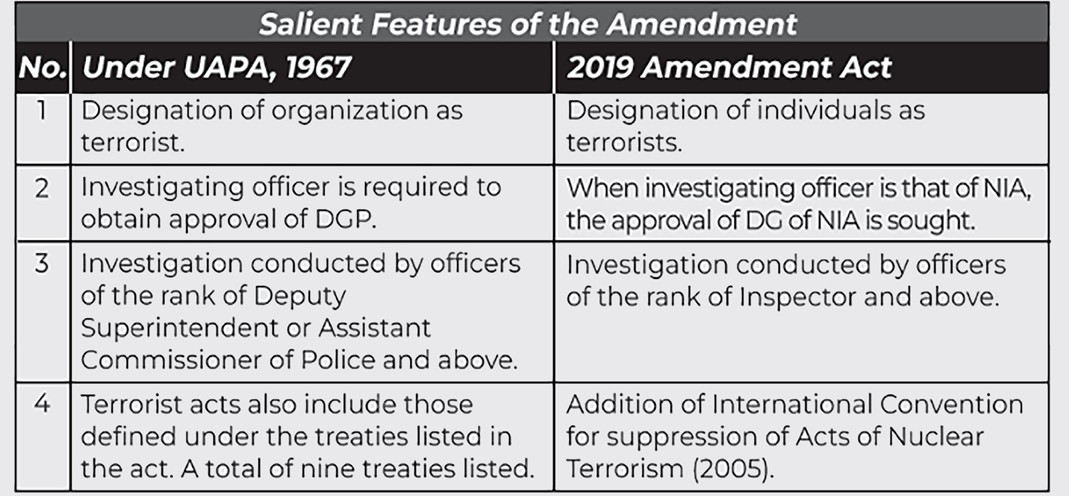
Recent Examples:
• In 2023, NewsClick's founder and editor-in-chief Prabir Purkayastha was arrested for having alleged links of having funding from China.
• Siddique Kappan, a Malayali journalist, was released in 2022 on bail after two years of imprisonment without trial, for his report on the “Hathras gang rape and murder” case.
• Various arrests of Journalists like Gautam Navlakha, intellectuals, rights activists like Varvara Rao, Anand Teltumbde, Stan Swamy and Sudha Bhardwaj, poets, etc under Bhima Koregaon case were done under UAPA.
• Delhi Congress Councillor Ishrat Jahan, RTI Activist Akhi Gogoi etc for anti-CAA protests. Most of the arrests were on bail or long incarcerated without trial or acquitted.
• JNU PhD student Umar Khalid for stone pelting in Delhi Riots, in which he was acquitted.
Recommendations:
• Periodic Evaluation: Review must be mandatory, to avoid abusing its significant powers or making rash use of the UAPA provisions. Global Best Practices must be followed in such laws.
• Compensation Plan: To achieve fair justice, a compensation plan should be established for persons who were unjustly accused under the Act and incarcerated without prosecution.
• Police Reforms: There should be reforms in the police, which should involve raising community and religious awareness and working to reduce the vast arbitrary powers that the police wield.
• Monitoring Committee: A committee must be established with a sitting or recently retired High Court judge serving as its chairman. The committee can be charged with determining whether a given situation falls under the Act and with monitoring any violations of a defendant's human rights that occur throughout the course of the prosecution.
• Fast Track Courts: Establishing separate fast track courts to handle the cases under UAPA.
Conclusion
• A Law cannot prevent terrorism on its own, but if it is not applied in letter and spirit, it may be used against the weak by those in positions of power, as was the case with UAPA.
• Making laws that result in the inclusion of minorities, promote social and economic development, address the issue of unequal development, allow for political dissent and debate, etc. are all crucial in order to stop the threat of terrorism in its tracks.
• Without a doubt, the UAPA in its present form is inadequate and Centre has been given extremely
broad powers that are prone to abuse. However, there should unquestionably be Zero Tolerance for Terrorism. Therefore, it must be ensured that, in the interests of justice and security, the measures and provisions to combat terrorism do not go beyond what is essential.
• UAPA, if used appropriately, can be beneficial. Only by adopting a reasonable and balanced strategy will this be accomplished.
National Security Act 1980 (NSA)
• The NSA was brought in by the Parliament of India in the year 1980. The Act provides for preventive detention in certain cases and matters connected therewith. The Act focuses on maintaining law and order of a state or country. The Act contains 18 sections and confers power on states and central government to detain any person in the presence of the following grounds:
• Engaging in activities that could harm India's defence, its foreign relations, or national security.
• Managing the stay of any foreigner in India and making provisions for their removal if required.
• Restricting actions that could threaten:
The security of the nation
Public order and stability
The availability of essential supplies and services for the community.
• Preventive detention is the extra-judicial confinement of an individual without charge for up to one year under the NSA in order to ostensibly prevent a future crime.
• Brief History:
• It was first enacted in colonial India in 1818 as Bengal Regulation III, with the intention of allowing the British government to arrest anyone in the name of defence and public order without a trial. The Rowlatt Acts of 1919 were the next in line, and they caused quite a stir.
• As a result of these acts, the Jalliawala Bagh massacre occurred, which was followed by a nationwide protest as part of the non-cooperation movement. When it came to post-colonial independent India, Preventive Detention Act, 1950 was passed.
• Article 22 of the Constitution allows to preventively detain a person even before he has committed any offense. This power is often used to curb the voice of dissent.
• Entry 9 (Union List) and Entry 3 (Concurrent List) empowers both the Centre and State government to
enact preventive detention legislation.
Preventive Detention Act 1950 provides several provisions to NSA. Under Section 151 of The Criminal Procedure Code, 1973 (CrPC) preventive detention is an action taken on grounds of suspicion that some wrong actions may be done by the person concerned. A police officer can arrest an individual without orders from a Magistrate and without any warrant if he gets any information that such an individual can commit any offense against national security or public order without charged or trial.
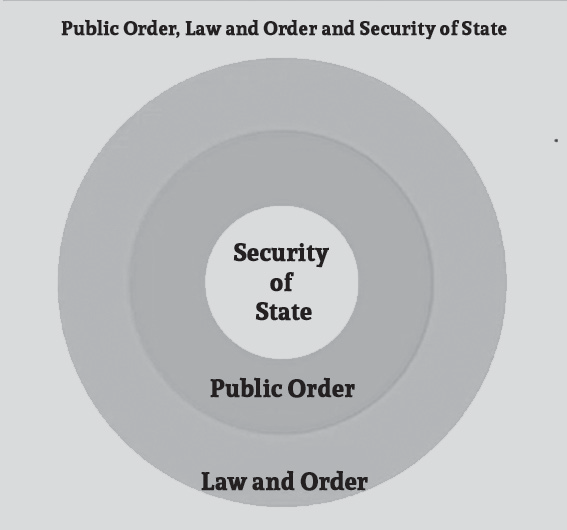
Figure: Hierarchy of Security of State
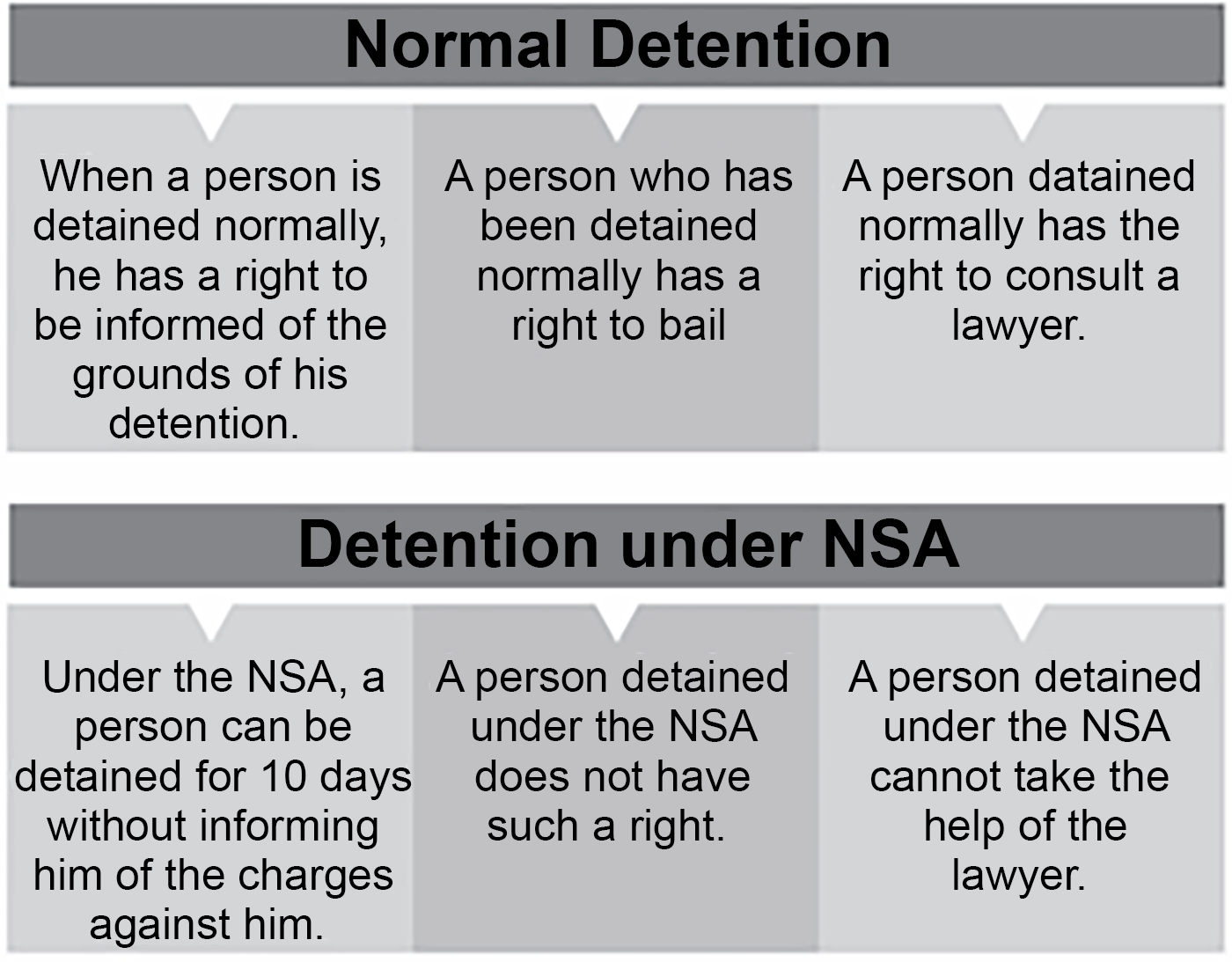
Concerns over Key Provisions of the Act:
• Ambiguous Terms: Preventive detention laws are frequently used to maintain public order. However, every minor violation of law enforcement in a given situation cannot be considered a threat to public order.
The Supreme court made this distinction in the case of Ram Manohar Lohia v. State of Bihar, and the Court clarified that an act may affect law and order, but not public order just as an act may affect public order but not security of the State.
• Section 8(1) of the Act states that:
• The person detained should know of the grounds of his detention in not more than 5 days but not later than 10 days.
• However, Section 8(2) states that nothing in sub- section (1) shall require the authority to disclose facts which it considers to be against the public interest to disclose.
• Section 9(1) of the act deals with the formation of the advisory board consisting of three persons who are, or have been, or are qualified to be appointed as, Judges of a High Court and such persons shall be appointed by the appropriate Government.
• The advisory board has been mocked because it is only appointed by the government to rule on orders issued by it.
• Another dimension that may undermine the advisory board's review power is that the proceedings and final report of the board are kept in-camera and thus not publicly available scrutiny under Section 11(4) not even the detainee, who may be uninformed and unaware of his legal rights.
• Section 13 establishes the maximum period of detention, which may be up to 12 months. It also gives the government the authority to abrogate or alter the detention.
• If clearly invalid reasons, he will not be released as long as government officials do it. It indicates the arbitrary nature of the law which is against Equality Before Law under Article 14 and its Principle of Rationality, and reasonable procedure suggested by Article 21.
Analysis of Issues
• Arbitrariness:
Preventive detentions can only be enforced in the most extraordinary situations in any democratic country. It must be used with extreme caution and only for as long as absolutely necessary. Nonetheless, in a democratic society like India, it has been used arbitrarily at the decision of the government and law state agencies.
• Tool to Hide Systemic Weaknesses:
The National Security Act (NSA) preventive detention regime has become a convenient tool for concealing flaws in the Indian criminal justice system and depriving individuals of their constitutional and statutory rights, 42 years after its enactment.
•
Violation of Rights:
• It infringes on nearly all due process rights, most notably the presumption of innocence. Proponents justify the practice as necessary to, for example, prevent terrorist attacks or respond to existential national crises, claiming that the gravity of the threat justifies the limitations on fundamental rights.
• Irrational and Regular Use:
While most international activists see preventive detention as a last resort in exceptional situations, India employs it on a regular basis to deal with ordinary criminal matters. In a democratic, political government like India's, such use cannot be rationalised.
• Use During Peacetime:
• Preventive Detention is often justified as the state action to prevent total-warfare, the dissent of those indulging in fifth-column activities, et-al. For such justifications, United Kingdom used it during World Wars whereas United States of America used it during World War II. India, on the contrary, continues to use preventive detention even during peacetime.
Recent Examples:
In 2023, Supreme Court of India ruled that the action of UP Government to invoke the stringent National Security Act (NSA) against Samajwadi Party leader Yusuf Malik, for allegedly threatening the additional Municipal Commissioner, was misuse of the law in cases of political nature.
It has been found to be mainly used against Muslims, Dalits and dissenters for alleged offences such as cow slaughter, protests against the Citizenship (Amendment) Act and attacks on the police, etc. which can be dealt with ordinary law.
The Uttar Pradesh government detained DR. Kafeel Khan under the NSA after he delivered an anti-CAA speech at Aligarh Muslim University, and he was also charged under sections 153A and 295A of the IPC. Allahabad High Court, after an investigation, exonerated him in the BRD medical death case, it was clear that it was a misuse.
Arrest of Bhim Army Supremo Chandrashekhar under the NSA was making headlines all over the media.
Recently, the Allahabad High Court has overturned the UP-government’s orders to impose the National Security Act (NSA) in 94 cases and ordered the detainees' release.
Kamal Nath government in Madhya Pradesh used it in a cow slaughter case.
Manipur government detained a journalist under the law
for uncharitable comments on the chief minister, though he was granted bail for the offence by the magistrate.
In Tamil Nadu, folk singer Kovan was arrested for writing a song against the former Chief Minister in 2015 and activist Thiru Murugan Gandhi for holding protests against the government in 2018 under the NSA.
The 177th Law Commission Report of 2001, stated for persons arrested in India under preventive provisions, a whopping 14,57,779. This does not include Jammu and Kashmir. Obviously, this number has increased now.
Preventive detentions in 2021 saw a rise of over 23.7% compared to the year before, with over 1.1 lakh people being placed under preventive detention, according to National Crime Records Bureau 2022.
Conclusion
The Indian parliament and judiciary must reconsider the NSA in order to close any discrepancies that allow law enforcement to violate constitutional and statutory rights.
Critical Analysis
They must restrict the police of this convenient tool for punishing alleged criminals without having to maintain the basic rights of the accused and compel the criminal justice system to address its flaws directly and appropriately.
It should not be used as a routine law and order measure.
In case of Vijay Narain Singh V. State of Bihar and others, Justice A.P Sen indicated that the detention of individuals without trial for any length of time, however short, is wholly inconsistent with the basic ideas of our government and must ensure never invading the personal liberty of the citizens except in accordance with the procedure established by law.
Section 124A of Indian Penal Code 1860/ Section 152 of Bharatiya Nyaya Sanhita (BNS) 2023
Freedom of Speech and Expression under Article 19(1)
(a) of the Indian Constitution guarantees that everyone has the freedom to express their opinions. However, the freedom of speech and expression is subject to some reasonable restrictions under Article 19(2), therefore this right is not unrestricted.
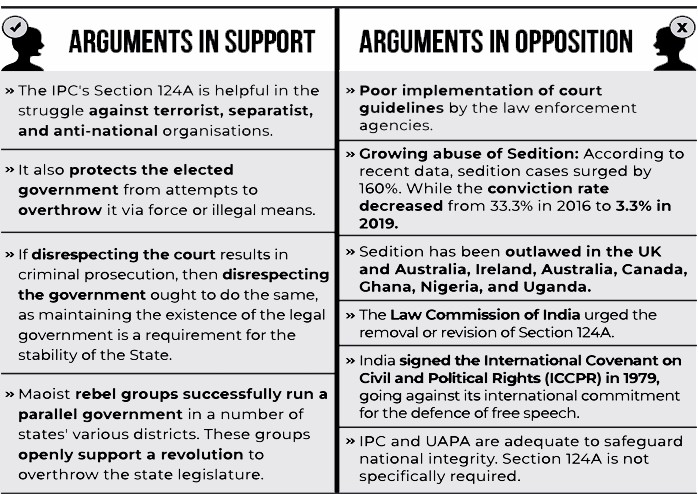
• Judicial View:
Kedar Nath Singh vs State of Bihar 1962 upheld the constitutionality of sedition, but limited its application to “acts involving intention or tendency to create disorder, or disturbance of law and order, or incitement to violence”.
Examples of Sedition cases:
• Malayalam journalist Siddique Kappan was booked for sedition when he was proceeding to cover the Hathras gang rape case.
• Three Kashmiri scholarship students were booked under sedition for allegedly celebrating the Pakistani cricket team’s win against India in the T20 World Cup.
• Vinod Dua case (2021):
• Vinod Dua, a senior journalist, made statements on the lack of testing facilities with the government and was alleged to have made false statements regarding the availability of PPE kits with a comment that there was no sufficient information on them. He went on to state that the export of ventilators and sanitizers was stopped later than stated. He also stated that the PM has garnered votes for election through acts of terrorism. He talked about the major labour migration during the COVID-19 lockdown.
• It was alleged that Vinod Dua made the statements with the intention of inciting panic, hatred, contempt, and disaffection followed by violence towards the government.
• The Supreme Court, while quashing the charge of Section 124A observed that, the statements made in the respected circumstances can at best be termed as an expression of disapprobation of the actions of the government and its functionaries so that the prevailing situation can be addressed quickly and efficiently, not to incite violence or public disorder. Hence, they would be covered as an exception to sedition.
• Disha A. Ravi (2021): Disha Ravi, a Bengaluru environmental activist, was named the editor of a toolkit made for international online support of the farmers’ protests in India. The toolkit document was created by an organisation called the ‘Poetic Justice Foundation,’ a pro-Khalistan organization. The State submitted that content and links in the toolkit were objectionable, showing disaffection against the government. They were connected through Zoom meeting and messaging apps. Disha was allegedly in a conspiracy to incite violence in India with the perpetrators of the January 26, 2021 clash.
• The court granted her bail and commented that the citizens are the conscience keepers of the government in any democratic nation.
• They cannot be put behind bars simply because they choose to disagree with the state’s policies. Merely engaging is not relevant.
•
There was no direct link between the act of the defendant and the violence of January 26, 2021.
• The Right to Seek a Global Audience without any geographical barriers to communication is included in Article 19.
• Arun Jaitley case (2015):
• Arun Jaitley, a senior supreme court lawyer and senior BJP leader, wrote and posted a well-written critical article titled ‘NJAC Judgement-An Alternative View’ on his Facebook page about Supreme Court judgment which set aside National Judicial Accountability Commission (NJAC). The judicial Magistrate took sou-moto cognizance and booked him under Section 124A and Section 505 of the IPC. The Allahabad High Court quashed the magistrate’s order and commented that:
• Using very strong words to criticise the measures of the government or acts of public officials is not sedition, but only intended to exercise its freedom of speech with the view of striking a balance between the two pillars of the country.
• Disrespect of the judiciary does not constitute the offence of sedition.
• Sanskar Marathe case (2015):
• Aseem Trivedi, a political cartoonist and social activist, displayed several cartoons in public and online on a website called ‘Cartoons Against Corruption.’ He was accused of defaming Parliament, the Constitution of India, and the National Emblem, and also of sedition under Section 124A. A non-bailable warrant was issued by the Additional Metropolitan Magistrate. However, the Metropolitan Magistrate ordered his release on bail and charges of sedition were dropped.
• Later, Public Interest Litigation (PIL) was disposed of as the government issued Guidelines to Police Personnel stating the pre-conditions before invoking Section 124A. The court observed that:
• Disloyalty to the government is not the same as commenting in strong words upon its measures or acts, so as to ameliorate the condition of the people or to secure the cancellation or alteration by lawful means.
• Freedom of Expression includes Freedom of Communication and the Right to Propagate or Publish an Opinion.
• Open criticism of government policies and operations is not a ground for restricting expression.
• The freedom of speech and expression is available to express indignation against corruption in the political system. This cannot be encroached upon when there is no incitement to violence or public disorder.
Recommendations:
• Amendment: Include amendments like explanation on acts expressing disapprobation of the measures or the
administrative action, clarifications that it will apply only if it directly results in incitement of violence and commission of an offence of certain punishment, the scope of "disaffection", legitimate protests etc. and include procedural safeguards.
• Training: To address the issue of misuse, training be provided on the implementation of sedition laws and other criminal defamation laws, as well as on when they do not apply.
• Parent-Child Relationship: The government must treat all of its citizens as though they were its children and ensure adequate tolerance levels.
• Acceptance of Inevitable Criticism: The state should also acknowledge that prominent people will inevitably draw criticism.
• Passage of Protection of Speech and Reputation Bill, 2016, in amended form. The Private Member's Bill has certain crucial features, including determining the maximum claim amounts and prohibiting libel and sedition lawsuits (statutory functions).
• Imposing sanctions for less serious transgressions, such as apologies, corrections, and retractions.
Conclusion
• India is the largest democracy in the world and the Right to Freedom of Speech and Expression is an essential ingredient of democracy. Dissent is the lifeblood of democracy. Criticisms at the right time to the government, can save a lot of resources, government machinery, etc.
• On the other hand, to secure national integrity, divisive forces have to be kept in check.
• Preventing wrongful enforcement and misuse alone can remove the majority of the criticism against the Sedition.