Indian Armed Forces
INTRODUCTION
• 2022 was the year of path-breaking reforms for Ministry of Defence to transform the military into a youthful, modern and ‘Aatmanirbhar’ force.
• Improved Technology: Armed Forces were equipped with state-of-the-art weapons/equipment/ technologies manufactured by a self-reliant indigenous industry; a major reform was rolled out with the aim to build a youthful & tech-savvy military ready to meet future challenges.
• Make in India: Continuous efforts to increase defence exports in order to achieve the collective goal of global peace and prosperity, in line with the ‘Make in India, Make for the World’ vision, bore fruit as many countries showed keen interest in Indian platforms, resulting in record defence exports.
• Awareness & Inclusivity: Border Area Development, Nari Shakti, expansion of National Cadet Corps (NCC) and setting up of new Sainik Schools to instil patriotism among youth moved forward with renewed thrust.
Ministry of Defence
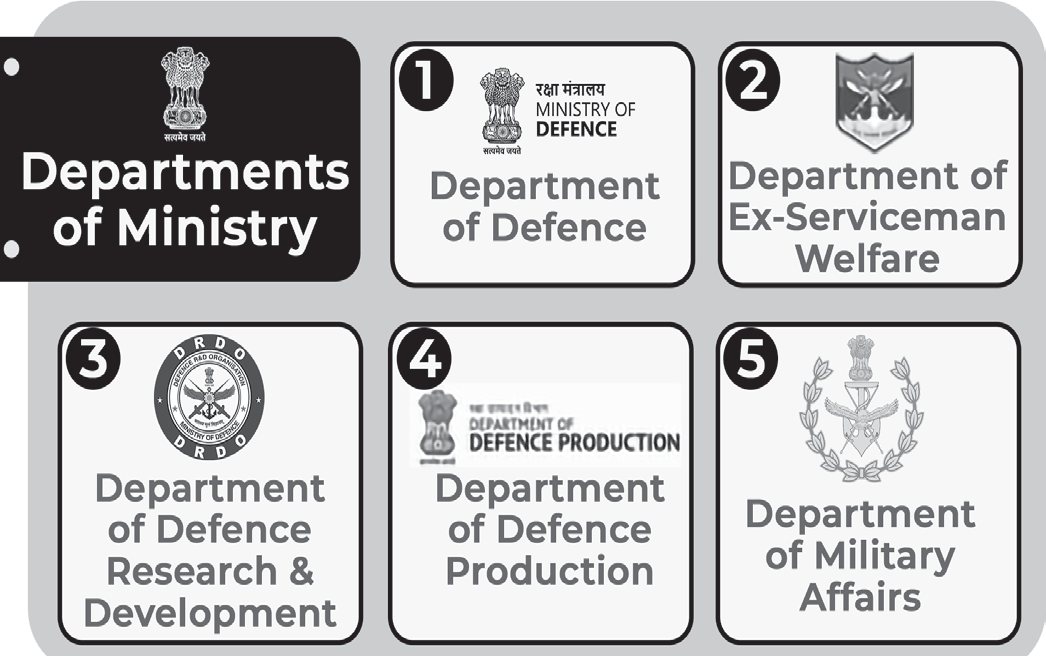
Figure: Departments of Defence Ministry
Department of Defence is headed by the Defence Secretary and deals with Defence Policy and, budget and planning. It regulates the following organisations-
Border Road Organisation
Indian Coast Guard
National Cadet Corps
• Department of Military Affairs headed by the Chief of Defence Staff.
• The Department of Ex-Servicemen Welfare (DESW) is headed by the Secretary (Ex-Servicemen Welfare), who functions under the overall charge of the Defence Minister/Minister of State for Defence in the Ministry of Defence.
• The Department of Defence Research and Development (DDR&D) is headed by the Defence Research and Development Secretary, who is also the Chairman of the Defence Research and Development Organisation (DRDO) and the Scientific Adviser to the Defence Minister.
• The Department of Defence Production (DDP) is headed by the Defence Production Secretary, who functions under the Ministry of Defence.
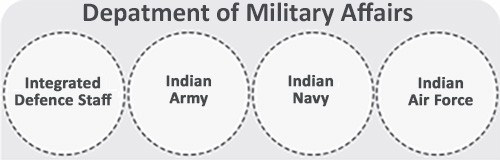
Figure: Department of Military Affairs
National Security Architecture in India
• Cabinet Committee on Security (CCS)
• It is the apex body for executive action on matters of national security headed by the prime minister.
• It is responsible for political oversight and decision making on national security.
• Both the National Security Council and CCS have a common membership which helps in easier decision making and implementation.
• National Security Council
• It provides guidance to the Prime Minister’s Office on national security and strategic concerns. Established in November 1998.
• It operates through a three-tier structure comprising the Strategic Policy Group (SPG), the National Security Advisory Board (NSAB), and the National Security Council Secretariat (NSCS).
• The organization is led by the National Security Advisor.
• Strategic Policy Group (SPG)
• It is responsible for publishing the National Defence Review, which outlines both short-term and long- term security threats and defense-related issues for the National Security Council’s consideration.
• It serves as the primary platform for inter-ministerial coordination, ensuring the integration of relevant inputs in national security policy formulation.
• The Cabinet Secretary oversees the implementation of Strategic Policy Group (SPG) decisions across Union Ministries, departments, and State governments.
National Security Advisory Board (NSAB)
consists of a group of eminent national security experts outside of the government
The board meets at least once a month, and more frequently as required. It provides a long-term prognosis and analysis to the NSC and recommends solutions and address policy issues referred to it
Indian Cyber Crime Coordination Centre (I4C)
Formed in 2018 to deal with cybercrime in India, in a coordinated and effective manner. It is affiliated to the Ministry of Home Affairs, Government of India.
Joint Intelligence Committee
It evaluates intelligence data gathered from the Intelligence Bureau, Research and Analysis Wing, and the Directorates of Military, Naval, and Air Intelligence, thereby assessing both domestic and foreign intelligence.
Defence Planning Committee (DPC) (2018)
It is under the chairmanship of the National Security Advisor (NSA).
Aim: To facilitate “comprehensive” planning for the defence forces besides focusing on military doctrines to deal with emerging security challenges.
It assists in the creation of national security strategy.
Economic Intelligence Council (EIC)
Formed in 1990, it is the apex forum overseeing government agencies responsible for economic intelligence and combating economic offences in India.
Chaired by the Finance Minister, and is part of the Ministry of Finance.
Functions: coordination, strategy and information- sharing amongst the government agencies responsible for intelligence and control of economic offences such as smuggling, money laundering tax evasion and fraud
Advising the Finance Minister on laws regulating the financial sector and fighting economic crimes.
Issues in the Structure
Infrequent meetings of NSC.
Empowering the NSC: government’s allocation of business rules should be amended to give more powers to the NSC and its subordinate organisations, such as the Strategic Policy Group.
Accountability of NSA: legislative backing will not only empower NSA and at the same time hold it accountable.
Lack of coordination between various agencies.
Indian Armed Forces
• The Indian Armed Forces consists of three professional uniformed services:
• Indian Army
• Indian Navy
• Indian Air Force
• The ‘Global Firepower Index 2022’ report ranks Indian Armed Forces as the fourth most-powerful military in the world, after the U.S.A, Russia and China.
Indian Army
• The Indian Army operates on a voluntary basis and is one of the largest standing armies in the world, making it the largest all-volunteer force.
• Initially, its primary role was to safeguard the nation's borders, having engaged in multiple conflicts with China, Pakistan, and Bangladesh.
• Global Presence: The Indian Army has actively contributed to various United Nations peacekeeping missions worldwide including:
The Indian Army has participated in those in: Cyprus, Lebanon, the Democratic Republic of the Congo, Angola, Cambodia, Vietnam, Namibia, El Salvador, Liberia, Mozambique, and Somalia. Additionally, it deployed a paramedical unit to assist in evacuating the sick and wounded during the Korean War. The army has also committed a brigade of troops to the UN’s standby arrangements.
Internal Security Role
• Over the years, the army has also taken up the responsibility of providing internal security, especially in insurgent-hit Kashmir and the north-east under AFSPA and otherwise.
• The balance configuration of firm & compassionate outlook by the Indian Army & Assam Rifles in insurgency-affected North East India have resulted in neutralisation of three cadres, apprehension of 339 cadres, surrender by 133 cadres from various insurgent groups and recovery of 342 weapons of different types in 2022.
• Army & Assam Rifles continued to reach out to the local population through various awareness programmes, health & educational camps, seminars and infrastructure development projects to reduce the drug menace in the NE Region.
• To contribute towards Nation Building, Indian Army is undertaking various activities in border areas by organising research & studies, Tibetology Cadres in Sikkim &
Arunachal Pradesh, promoting toursim, training of hospitality & home stays, Vibrant Village Programme, Vocational training, recruitment drives and adventure
activities. All these help in increasing awareness, improves survivability and employment options in border villages.
Indian Navy
• As a blue-water navy, it operates significantly in the Persian Gulf Region, the Horn of Africa, the Strait of Malacca, and routinely conducts anti-piracy operations and partners with other navies in the region. It also conducts routine two to three month-long deployments in the South and East China seas as well as the western Mediterranean sea simultaneously.
Internal Security Contribution
• Mission Based Deployments: Indian Navy undertook Mission Based Deployments in Areas of Interest in the Indian Ocean Region (IOR) to safeguard national maritime interests and maintain continuous/ near continuous presence in areas of significant maritime importance in the IOR in consonance ‘Security And Growth for All in the Region (SAGAR)’.
• Anti-Piracy Deployment: to ensure safe passage in Gulf of Aden, Gulf of Hormux (Operation SANKALP).
• Anti-Narcotics Operations: In 2022, the security agencies in the region have intercepted massive heroin shipments in the Arabian Sea. Since April, 2021, nine Anti-Narcotics Operations have been undertaken by the IN. These Anti-Narcotics operations were conducted in close coordination with the intelligence agencies.
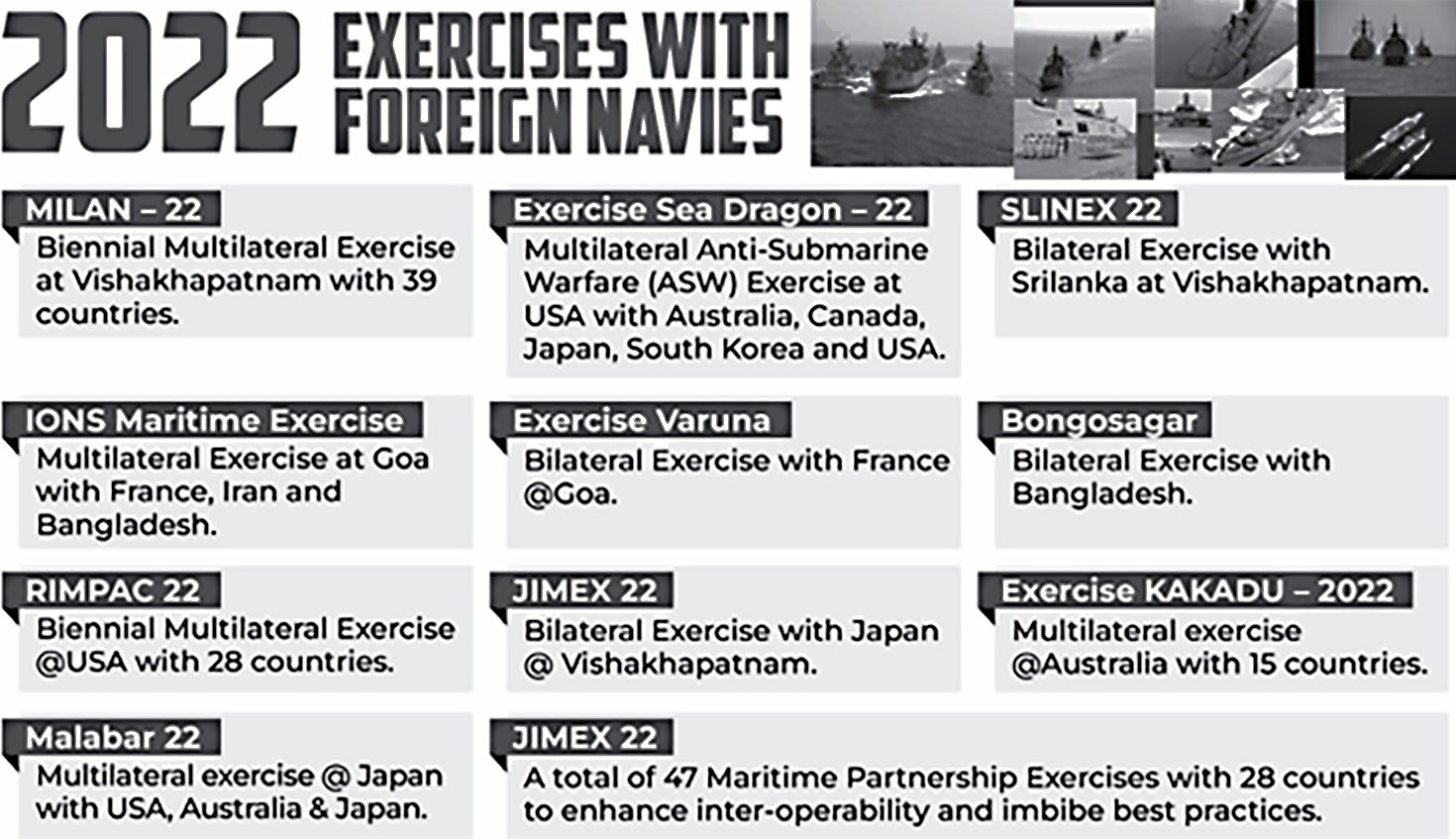
Figure: Exercises with Foreign Navies-2022
Indian Air Force (IAF)
• Over the years, the IAF has grown from a tactical force to one with transoceanic reach.
• In 2022, the IAF continued to modernise its airfield infrastructure under project - Modernisation of Airfield Infrastructure (MAFI) with a major Indian company M/s Tata Advanced Systems Limited (TASL). The upgradation of navigational aids and infrastructure under this project is enhancing the operational capability by facilitating air operations of military and civil aircraft even in adverse weather conditions.
Internal Security
• The IAF has done its bit by launching Mehar Baba-2 competition aimed at developing indigenous technology for a ‘Swarm drone-based system to detect foreign objects on aircraft operating surfaces’.
• IAF enhanced strategic reach by induction of Force Multipliers like Flight Refuelling Aircraft (FRA), Unmanned Aerial Vehicle (UAV) and credible strategic lift capabilities.
• Helicopters have been regularly undertaking Air Maintenance, Disaster Relief, Casualty evacuation, Anti Naxal Operations and Communication Duties for various agencies.
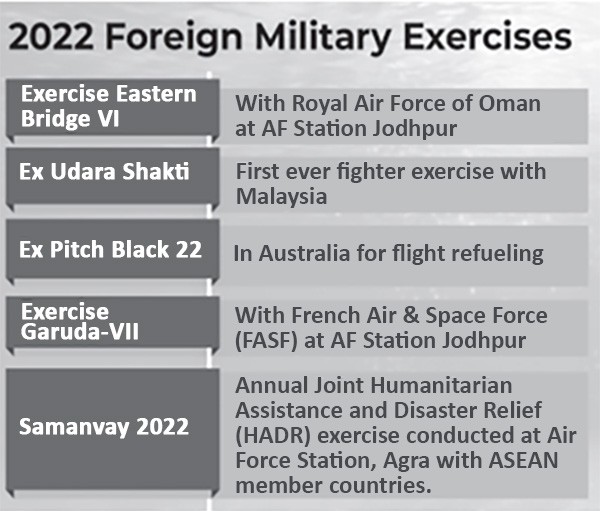
Figure: Exercises with Foreign Navies-2022
Chief of Defence Staff (CDS)
• The Chief of Defence Staff is the highest-ranking uniformed officer on active duty in the Indian military and chief military adviser to the Minister of Defence. The post was created in 2020.
• It offers seamless tri-service views and single-point advice to the Executive-
• Long-term defence planning and management
• Manpower, equipment and strategy
• Jointsmanship in operations
• In 1999, the Kargil Review Committee headed by Shri K Subrahmanyam, had recommended a review of the National Security Framework for improved decision- making on defence matters. The Committee also
suggested that the mechanisms and interface between the Defence Ministry and the Service Headquarters should be thoroughly studied and reorganised.
• Based on the K Subrahmanyam Committee Report, a Group of Ministers (GoM) in 2001 recommended creation of the post of Chief of Defence Staff.
• Cabinet Committee on Security took the historic decision on 24th December, 2019 to create the post of the Chief of Defence Staff (CDS) to enhance the quality of military advice to political leadership through integration of service inputs.
• Former Chief of the Army Staff, General Bipin Rawat was appointed as the country’s first Chief of Defence Staff on 31st December 2019.
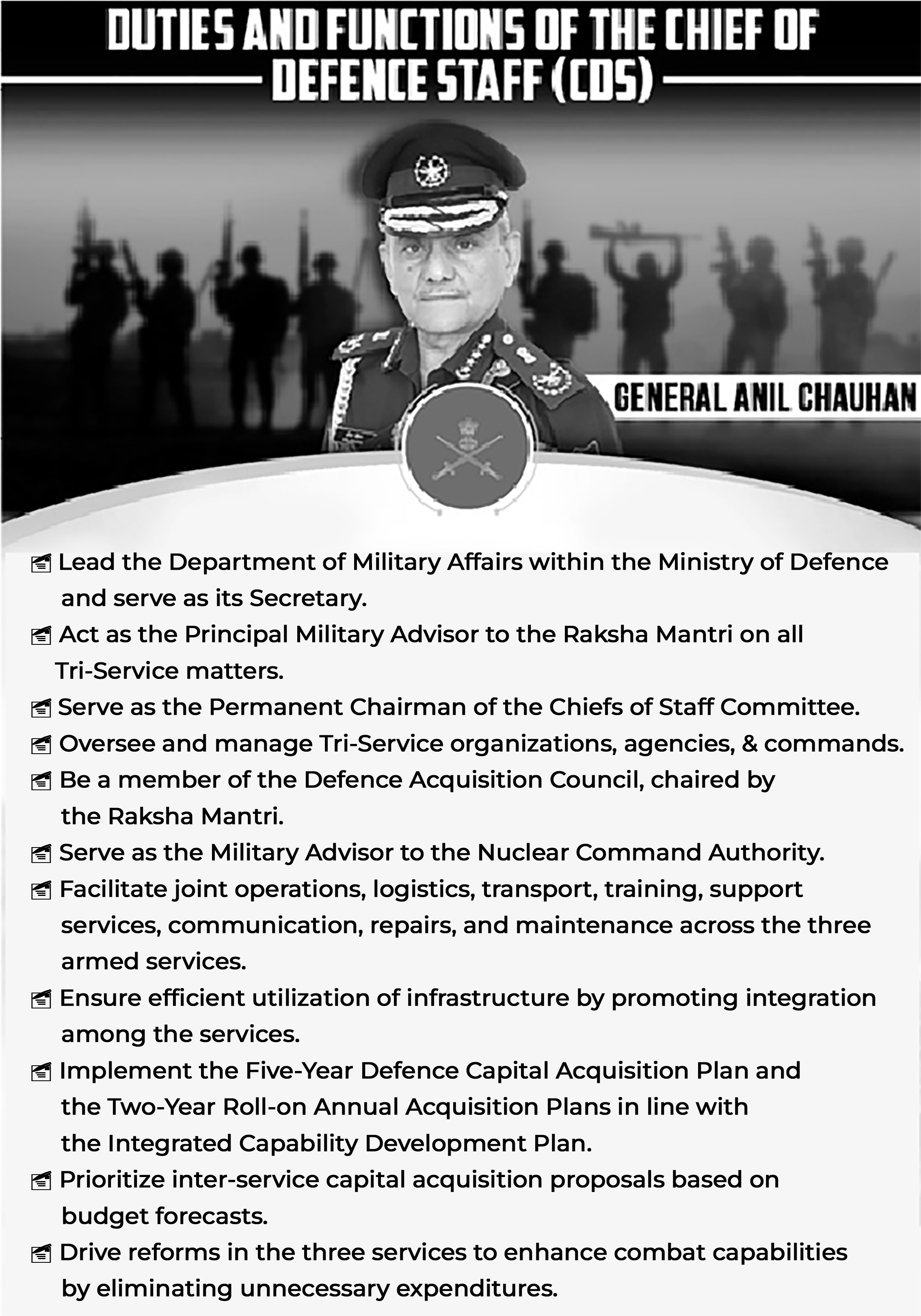
Figure: Duties and Functions of the Chief of Defence Staff (CDS)
Women Representation in Armed Forces
• In the 1.4-million-strong Indian Army, women constitute a minuscule 0.56%, while the corresponding figure is 1.08% in the Air Force and 6.5% in the Navy.
• Supreme Court of India in a landmark, named The Secretary, Ministry of Defence v. Babita Puniya & Ors. ordered the grant of permanent commission in 10 non-combat service units at three months and held them to be eligible to hold command posts by enervating the existing ceiling.
• INDIAN ARMY
• Women are serving proudly and confidently in various operational theatres of the Indian Army. Woman Combat Aviators have joined their counterparts at various Aviation units. Women soldiers forming part of the Corps of Military Police will continue to be inducted through the ‘Agnipath Scheme’ as well.
Women in National Defence Academy (NDA
The Armed Forces have opened entry for women candidates in NDA with 19 cadets, including 10 for the Indian Army, joining the academy every six months. The first batch of women cadets has started training in the NDA with effect from July 2022, and the second batch has commenced training with effect from January 2023.
• Abhilasha Barak is an officer in the Indian Army from Haryana. She did her training from Officers Training Academy Chennai. She is known for becoming the first woman combat aviator in the Indian Army in 2022.
• Women soldiers are also making significant contributions as part of UN Peace Keeping Missions and Joint exercises with friendly foreign countries.
• While women officers are already part of various adventure activities and part of airborne formations for operational employment, recent sky diving activity by three women soldiers is a new beginning and Indian Army is planning to conduct more such activities to motivate the female youth to join the Indian Army.
• INDIAN NAVY
• Women can now join the Indian Navy as both officers as well as sailors (Agnipath Scheme). For both officers’ entries as well as sailors’ entries, the eligibility criteria, methodology and induction process for women candidates is the same as that for men. There has been a steady increase both in the number of entries open for women and the overall number of women being inducted into the Indian Navy.
• Women are also now being inducted as permanent commission officers. Further, women are also being inducted into Naval Aviation as Pilots and Naval Air Operators, MARCOS (Marine Commandos), RPA Pilots, Provost Officers and for Diplomatic assignments.
• INDIAN AIR FORCE
• In October 2015, that the Indian Government took the decision to open the fighter stream for women.
•
Squadron leader Avani Chaturvedi was inducted into the Indian Air Force fighter squadron in June 2016 alongside Mohana Jitarwal and Bhawana Kanth. Flight Lieutenant Shivangi Singh, the first and only female pilot to fly the Rafale fighter aircraft.
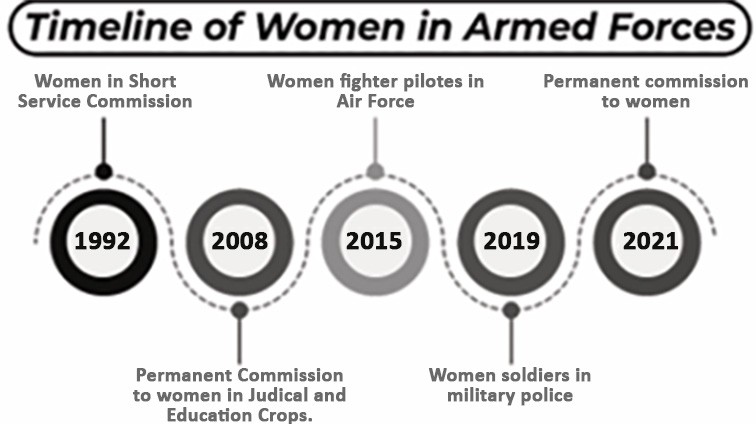
Figure: Timeline of Women in Armed Forces
• Significance
• Increased diversity and inclusivity
• Enhanced operational capabilities
• Role models for future generations
• Challenges
• Gender Stereotypes and Discrimination: Can make it difficult for them to advance in their careers. They may also be subjected to sexual harassment and assault.
• Lack of Infrastructure and Support: The Indian armed forces are still largely male-dominated, and there is a lack of infrastructure and support in place to meet the needs of women.
• Work-Life Balance: having to take prolonged leaves of absence due to pregnancy, motherhood etc.
Integrated Theatre Commands
• The current tri-service structure, in which the Army, Navy, and Air Force are separate and independent entities, can lead to duplication of effort and delays in decision-making
• Integrated theatre commands (ITCs) are unified commands that integrate the air, land, and sea forces of a country under a single commander. Benefits of this are-
• Improved coordination and efficiency
• Faster and more effective decision-making and operations.
• Increased flexibility and adaptability
• Better use of resources
• Eliminate duplication of effort and allow resource sharing among services.
• Meet hybrid warfare requirements
• Systematic planning in resource acquisition
• Military Reforms Commission headed by Lt. General (ret.) D.B. Shekatkar made this recommendation in 2016.
Figure: Integrated Theatre Commands
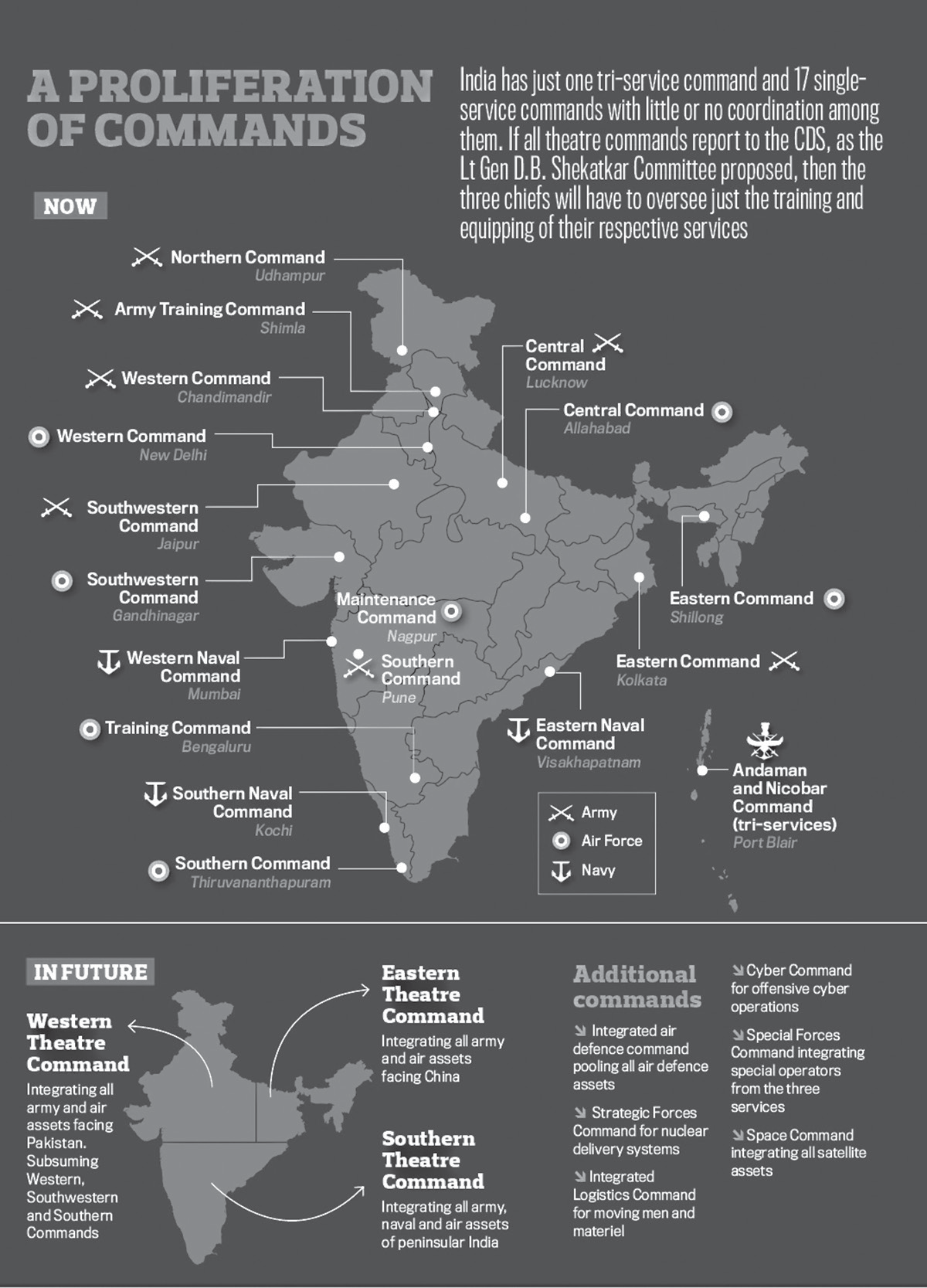
• Joint Service Commands: At present, there are two joint services commands in India, the first one is Andaman and Nicobar Command (ANC) and the second, being Strategic Forces Command (SFC).
• The Andaman and Nicobar Command (ANC) is the only Tri-Service Theater Command of the Indian Armed Forces, headquartered in Port Blair. Established in 2001, its primary objective is to protect India’s strategic interests in Southeast Asia and the Strait of Malacca by enhancing the swift deployment of military resources in the region.
• The Strategic Forces Command (SFC), also known as the Strategic Nuclear Command, operates under India’s Nuclear Command Authority (NCA). It is responsible for overseeing the management, administration, and deployment of the nation’s tactical and strategic nuclear arsenal.
• Inter-Services Organisations (Command, Control and Discipline) Act, 2023
• Recently, the Inter-Services Organisations (Command, Control and Discipline) Act, 2023, was passed to empower designated military commanders to take charge of soldiers and enforce discipline, regardless of the service they belong to. The Act would also pave the way for much greater integration and jointness amongst the three Services; lay a strong foundation for creation of Joint Structures in times to come and further improve the functioning of the Armed Forces.
• In a current Joint Services setup, an Army soldier commanded by a Navy officer would have to be sent back to his parent unit for any disciplinary proceedings. The Commanding officer of a service does not have administrative powers over the
soldiers belonging to other services.
• The Act also seeks to empower the Central Government to constitute new Inter Services Organisations to which the provisions of this Act may apply.
Central Armed Police Forces
CENTRAL ARMED POLICE FORCES
Introduction
• The Central Armed Police Forces, which are referred to as ‘Armed Police Forces’ are not armed forces. As such they are headed by civilian officers from the Indian Police Service and are under the control of the Ministry of Home Affairs,not the Ministry of Defence.
• The Central Reserve Police Force (CRPF) is the largest Central Armed Police Force in India.
Recruitment Reform
• Starting from the year 2011-12, the recruitment scheme for Constables in CAPFs and Assam Rifles was revised to ensure a fair, efficient, and transparent selection process. The objective of these changes was to minimize
subjectivity by incorporating advanced technology, making the recruitment process more effective and impartial.
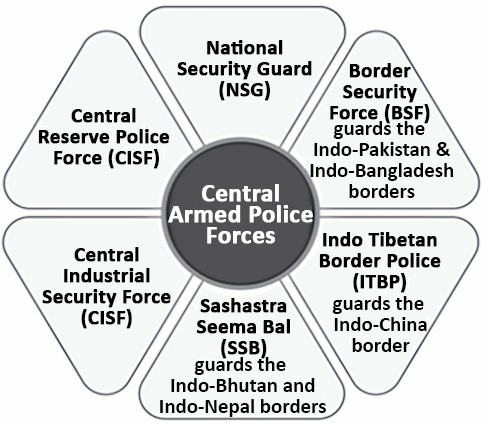
Figure: Border Guarding Forces
To promote opportunities to the youths of border and militancy-affected areas, some percentage of the vacancies in the Border Guarding Forces (viz.AR, BSF, ITBP and SSB) are allotted
20% to the border districts, which fall within the responsibility of the Force.
20% to areas affected by militancy i.e. J&K, North- Eastern States, and naxal-affected areas as notified by the Government from time to time.
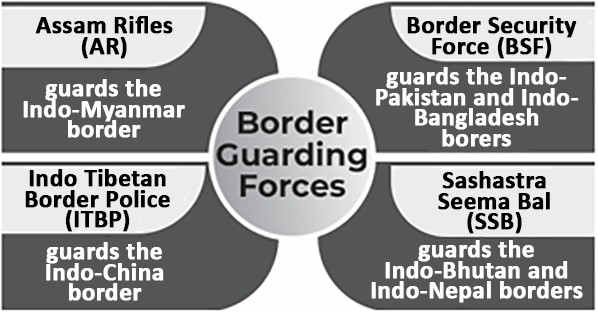
Figure: Border Guarding Forces Standing Committee Report on Working Conditions in Border Guarding Forces, 2018
• Recruitment: there was lack of foresight, planning, and proactive estimation of future vacancies.
• Promotion avenues: The Committee observed that there was stagnation in promotions among the CAPFs. This affects morale.
• Deputation to CAPFs: Committee recommended that the MHA, in consultation with the Ministry of Defence, should explore the induction of armed forces personnel in CAPFs on short-term deputation as work of armed forces rather than police is similar to CAPF.
• Electricity supply: The Committee noted that there was lack of electricity at several installations of Border Out Posts (BOPs)
• Road connectivity and mobility: The Committee noted that personnel of the Assam Rifles are located in remote areas, and therefore, all-weather roads are required to improve their working conditions.
Representation of Women in CAPFs and Assam Rifles
• The Parliamentary Committee on Empowerment of Women, in its sixth report, recommended increasing the representation of women in paramilitary forces.
• Following this recommendation, directives were issued:
• In 2011, a mandate was set for 5% women’s representation in the forces.
• Also in 2011, it was directed that 6.33% of constable positions in CRPF and CISF be reserved for women, while border guarding forces such as BSF, SSB, and ITBP should have 14% women constables.
• Various measures have been implemented to integrate women officers into mainstream policing, including modifying training programs to cover gender sensitization, combat training, and syllabus revisions, along with assigning operational duties to more women personnel.
• All CAPFs are strictly adhering to the Supreme Court’s directives by establishing Sexual Harassment Complaint Committees, led by senior-ranking female officers, to address workplace concerns.
• To support women personnel, separate toilets have been installed at static locations and vehicles have been modified to include mobile toilet facilities as needed.
• Additionally, CAPFs have set up crèches and daycare centers for women employees based on necessity.
The Central Reserve Police Force (CRPF)
• The Central Reserve Police Force (CRPF) is the largest paramilitary force of India, functioning under the Ministry of Home Affairs. Raised in 1939 as the Crown Representative’s Police, it was renamed the CRPF after Independence in 1949. Its primary role is to assist the state and union territories in maintaining law and order, counterinsurgency, anti-Naxal operations, and internal security.
• The CRPF is headed by a Director General (DG), assisted by Special Directors General, Additional DGs, Inspectors General (IGs), Deputy IGs, and Commandants. The force is organised into sectors and zones, each headed by an IG or DIG, and is further divided into ranges, battalions, and companies. A CRPF battalion generally consists of about 1,000 personnel, divided into companies and platoons for operational flexibility.
• In terms of composition, the CRPF is an all-India service, with personnel drawn from across the country, trained to operate in diverse terrains ranging from urban environments to dense forests. It has specialised units such as the COBRA (Commando Battalion for Resolute
Action) for anti-Naxal operations, the Rapid Action Force (RAF) for riot and crowd control, and the Special Duty Group for VVIP security. The force also maintains a large presence in Jammu and Kashmir, the North-East, and Left-Wing Extremism-affected states.
• Some specialised formations of CRPF are as follows:
The Rapid Action Force (RAF):
It is a specialised 15 battalion wing of CRPF.
Battalions are located in highly sensitive locations across the country to facilitate quick response and to control a flared-up Law & Order situation before it goes disorderly
It was formed in October 1992 to deal with communal riots and related civil unrest.
It is a specialised force with multi-ethnic composition and better mobility for swift action to control communal riots.
Commando Battalions for Resolute Action (COBRA) Bn/ The Jungle Warriors:
The COBRA unit comprises 10 specialized battalions that became operational in 2008-09.
These battalions were formed through an internal selection process within the CRPF, based on personnel’s age and physical capabilities.
They are trained, well-equipped, and deployed in Left-Wing Extremism (LWE)-affected states, including Chhattisgarh, Bihar, Odisha, Jharkhand, Madhya Pradesh, Maharashtra, West Bengal, Andhra Pradesh, and Assam. This elite commando force is specifically trained to operate, combat, and prevail in jungle warfare.
To enhance their skills, the CoBRA School for specialized training in Jungle Warfare & Tactics (CSJWT) was established in Belgaum, Karnataka, in 2014, offering scientific and advanced training tailored for elite special force commandos.
Special Duty Group (SDG) and Parliament Duty Group (PDG):
The Special Duty Group (SDG) is a premier unit of the CRPF responsible for providing armed security to locations under SPG protection.
Its personnel undergo specialized training to handle nuclear and biochemical threats, conduct rescue operations, and manage crisis situations with strategic behavioral responses.
Similarly, the Parliament Duty Group (PDG) is an elite CRPF unit assigned to ensure armed security for the Parliament House.
National Security Guard
• The National Security Guard (NSG) is a special force set up in 1984 as a Federal Contingency Deployment Force that has primarily been utilised for counter-terrorism activities and was created by the Cabinet Secretariat under the National Security Guard Act of the Indian Parliament in 1986.
• It works completely within the Central Armed Police Forces structure.
• Established in 1984, the National Security Guard (NSG) is a specialized force designed as a Federal Contingency Deployment Force, primarily engaged in counter- terrorism operations. It was formed under the National Security Guard Act, passed by the Indian Parliament in 1986, under the Cabinet Secretariat’s directive.
• The NSG functions entirely within the framework of the Central Armed Police Forces (CAPFs).
• It is a 100 percent deputation-based force, with personnel drawn from the Army, CAPFs, State Police, and other organizations.
• Led by an IPS officer, the NSG operates under the administrative authority of the Ministry of Home Affairs (MHA).
• The NSG’s specific goals include:
• Neutralisation of terrorist threats.
• Handling hijacking situations in air and on land.
• Bomb disposal (search, detection and neutralisation of IEDs).
• Engaging and neutralising terrorists in specific situations.
• Hostage rescue.
• Reconnaissanceof sensitive places/ airports/ installations.
• Immediate Back up Security Operations (IBUS) for national events like Republic Day etc.
• Anti-Hijack Mock Exercises (AHME).
• Black Cats: Over time, the NSG has earned a prestigious reputation as the 'Best Amongst the Best' due to its exceptional training standards and operational effectiveness. For their commitment, bravery, and precise operational skills, the commandos of this elite force are known by the nickname 'Black Cats.'
• Five Hubs: Following the 26.11.2008 terrorist attack in Mumbai, four Regional Hubs were set up in Mumbai, Chennai, Hyderabad, and Kolkata to decrease response times and ensure nationwide coverage. In 2016, a fifth hub was established in Gandhinagar, Gujarat.
Central Industrial Security Force
• It was established in the year 1969.
• It provides security cover to 307 industrial unit including 59 domestic and international airports and fire protection cover to 86 industrial undertakings. Industrial sectors such as atomic power plants, space installations, mints, oil fields and refineries, major ports, the Delhi metro, heavy engineering and steel plants, barrages, fertiliser units, airports and hydroelectric/thermal power plants owned and controlled by the Central PSUs, Heritage Buildings like Taj Mahal, Red Fort, and currency note presses producing Indian currency are protected by the CISF.
•
The CISF is led by an IPS officer and operates under the administrative control of the Ministry of Home Affairs (MHA).
• With the globalization and liberalization of the economy, CISF has emerged as the country’s leading multi-skilled security agency, tasked with securing major critical infrastructure across various regions, including areas affected by terrorism and Naxalism.
• On February 25, 2009, the Indian Parliament authorized the CISF to provide security services to private and cooperative establishments nationwide for a fee, through the CISF (Amendment) Act, 2008.
This legislation also allows for the deployment of CISF personnel to protect Indian missions abroad and participate in UN peacekeeping
operations.
Notable recent additions to the list of private sector establishments under CISF protection include Infosys Mysore, Reliance Refinery in Jamnagar, and the Delhi Metro Airport Express Line.
Border Security Force
• The Border Security Force (BSF) was established on December 1, 1965, as a dedicated force for border protection.
• Its main responsibility is to secure India’s international borders with Pakistan and Bangladesh during peacetime while also preventing cross-border crimes.
• The BSF is led by an IPS officer and operates under the administrative jurisdiction of the Ministry of Home Affairs (MHA).
• The BSF has a strength of 2,50,000 personnel in 186 battalions.
• Some of its battalions are also deployed with CRPF in the Naxal affected region of Dandakaranya and Jammu and Kashmir.
• The air wing of the BSF also played a constructive role in the relief work in Uttarakhand during the Kedarnath disaster in 2013.
• Two battalions of the BSF, located at Kolkata and Guwahati, are designated as the National Disaster Response Force (NDRF).
• During peacetime, the BSF is associated with the following:
• To promote sense of security among the people living in the borderareas.
• To prevent trans-border crimes, unauthorised entry into or exit fromthe territory of India.
• To prevent smuggling and any other illegal activities on the border.
• Anti-infiltration duties.
• To collect trans-border intelligence.
• During the war, BSF is responsible for:
• Holding ground in assigned sectors.
• Limited aggressive action against the Central Armed Police Force or on irregular forces of the enemy.
• Maintenance of law and order in enemy territory administered underthe Army’s control.
• Guarding of prisoners of war camps.
• Acting as guides to the army in border areas.
• Assistance in control of refugees.
• Provision of escorts.
• Performing special tasks connected with intelligence, including raids.
Indo-Tibetan Border Police
• The Indo-Tibetan Border Police (ITBP) is a border security force.
• It is led by an IPS officer and operates under the administrative control of the Ministry of Home Affairs (MHA).
• Established on October 24, 1962, the ITBP was created to safeguard India’s border with the Tibet Autonomous Region of China.
• Initially formed with four service battalions after the Indo-China conflict in 1962, it was originally intended as a "guerrilla-com-intelligence-cum-fighting force" with self- sufficiency in supplies, communication, and intelligence gathering. Over time, it evolved into a conventional Border Guarding Force.
• Currently, ITBP battalions are deployed on border security duties from Karakoram Pass in Ladakh to Diphu La in Arunachal Pradesh, covering 3,488 km of the Indo-China Border. Additionally, eight ITBP battalions are stationed in Maoist-affected regions of Chhattisgarh.
• ITBP is a specialized mountain force, with many officers and personnel trained as professional mountaineers and skiers.
• The ITBP is a multi-faceted force with five key functions:
• Vigilance along northern borders, detecting and preventing border violations, and fostering a sense of security among local populations.
• Combating illegal immigration and trans-border smuggling.
• Providing security to sensitive installations and at- risk VIPs. ITBP commando units also safeguard Indian embassies and consulates in Afghanistan.
• Restoring and maintaining order during disturbances.
• Ensuring peace within the country.
• The ITBP has recently expanded its role in disaster management.
• As the first responder to natural disasters in the Himalayas, the ITBP established six (now eight) Regional Response Centres in Himachal Pradesh, Uttaranchal, and the North-East.
•
Since 1981, the ITBP has been providing security, communication, and medical support to pilgrims during the annual Kailash Mansarovar Yatra.
Sashastra Seema Bal
• The Special Service Bureau, the predecessor of the current ‘Sashastra Seema Bal,’ was established in early 1963 following the India-China conflict of 1962. Its primary purpose was to enhance the morale and capabilities of the border population in combating threats such as subversion, infiltration, and sabotage across the border. In 2001, it was renamed as "Sashastra Seema Bal" under the Ministry of Home Affairs. This change occurred after the Kargil War, when the ‘one border, one force’ concept was implemented.
The SSB is also the first border security force to initiate the recruitment of women battalions.
• Role
• To protect India’s international borders with Nepal and Bhutan.
• To foster a sense of security among the people residing in border areas.
• To prevent cross-border crimes and unauthorized entry or exit from Indian territory.
• To curb smuggling and other unlawful activities.
• To carry out counter-insurgency operations in Jammu and Kashmir.
• To undertake anti-Naxal operations in Jharkhand, Chhattisgarh, and Bihar.
• It also performs internal security duties, including election-related tasks.
Special Forces
• India's Special Forces are Indian military units with expert training in various special operations, including "Direct action, hostage rescue, counter-terrorism,
unconventional warfare, special reconnaissance, foreign internal defense, personnel recovery, asymmetric warfare, and counter-proliferation."
Special Frontier Force
• The Special Frontier Force (SFF) is a paramilitary special
unit of India, established on November 14, 1962. Initially
• Its primary objective was to carry out covert missions behind Chinese lines in the event of a future Sino-Indian War.
• The force became widely known as 'Establishment 22' in reference to its first Inspector General, Major General (Retd.) Sujan Singh Uban, who was a former commander of the 22 Mountain Regiment during World War II. Uban was a Military Cross recipient and a distinguished figure in the British Indian Army.
• Headquartered in Chakrata, Uttarakhand, the SFF was initially overseen by the Intelligence Bureau and later
came under the jurisdiction of the Research and Analysis Wing (RAW), India's external intelligence agency.
Brahmastra Corps / XVII Corps
• XVII Corps is the first mountain strike corps of Indian Army which has been built as a quick reaction force and as well as counter offensive force against China along LAC. Its headquarters are located at Panagarh in West Bengal under Eastern Command. It is also known as Brahmastra Corps.
In other words, it will have “rapid reaction force” capability to launch a counter-offensive into Tibet Autonomous Region (TAR) in the event of any Chinese attack.
Para (Special Forces)
• Formed in 1966, the Para (SF) are the largest and most important part of the Special Forces of India.
• They are a part of the highly trained Parachute Regiment
of the Indian Army.
• The main aim of having a Parachute Regiment is for quick deployment of soldiers behind the enemy lines to attack the enemy from behind and destroy their first line of defence.
• Para (SF) conducted a series of joint exercises with US army special forces called Vajra Prahar.
Ghatak Force
• The Ghatak Platoon, also known as Ghatak Commandos,
is an infantry platoon specialized in special operations.
• Each infantry battalion of the Indian Army has one such
platoon.
• The word "Ghatak" in Hindi translates to "killer" or
"lethal."
• The platoon functions as shock troops, leading assaults ahead of the main battalion.
• Their role is akin to that of the US Marine Corps' Scout Sniper Platoon, STA platoon, and the British Army's Patrols platoon.
• A Ghatak Platoon typically consists of 20 soldiers, including a commanding captain, two non-commissioned officers, and various specialized teams such as marksman and spotter pairs, light machine gunners, a medic, and a radio operator.
Marine Commandos (MARCOS)
• Marine Commandos (MARCOS) is an elite special operations unit of the Indian Navy.
• It is specially organised, trained and equipped for the conduct of special operations in a maritime environment.
• The MARCOS are capable of undertaking operations in all types of terrain, but are specialised in maritime operations in Jammu and Kashmir through the Jhelum River and Wular Lake.
• To strengthen its capabilities to carry out special operations, the navy is planning to procure advanced Integrated Combat System (ICS) for the MARCOS.
Garud Commando Force
• The Garud Commando Force is the Special Forces unit of the Indian Air Force.
• It was formed in September 2004 and has a strength of approximately 2000 personnel.
• Garud is tasked with the protection of critical Air Force bases and installations; search and rescue during peace and hostilities and disaster relief during calamities.
• Garuds are deployed in the Congo as part of the UN peace keeping operations.
Other Forces
OTHER FORCES
Assam Rifles
It is a Central Paramilitary Force led and headed by
Army officers
Assam Rifles is fondly known as ‘Friends of the North East People’.
It is the oldest Paramilitary force in the country with its
headquarters at Shillong.
The force is completely deployed in the North- east and is mandated for dual role of maintaining internal security in the North-east and guarding the Indo- Myanmar border.
Deployment of two Assam Rifles Battalion in J & K: Two Assam Rifles Battalions are deployed in Jammu & Kashmir with effect from 20.05.2021 as part of Operation Rakshak.
It assists Indian Armed Forces but reports to MHA. It is under administrative control of MHA but operates under Army.
Indian Coast Guard
Its mission is the protection of India’s maritime interests and enforcement of maritime law; with jurisdiction over the territorial waters of India, including its contiguous zone and exclusive economic zone.
It operates under the Ministry of Defence.
Internal Security
• Anti-Drugs Operations:
• ‘Operation Khojbeen’, a joint operation by ICG and Directorate of Revenue Intelligence was launched. ICG ships and aircraft were deployed in the area for sea-air coordinated search. Two suspected boats were apprehended with 218 kgs of heroin worth Rs 1,526 crore.
• Nabbing Pakistani fishing boats containing
contrabands, drugs etc.
• Securing Borders: Security drill ‘Sajag’ was conducted by Coast Guard Regional Hqrs (West), Mumbai and Coast Guard Regional Hqs (North West), Gandhinagar in January to enhance safety and security in the area of responsibility. Marine Police, Fisheries, CISF and Customs also participated in the drill
National Disaster Response Force
• The National Disaster Response Force (NDRF), established in 2006, is a specialized force created to respond to disaster situations or threats. It is the largest force in the world dedicated exclusively to disaster response.
• The NDRF is staffed by personnel on deputation from various Central Armed Police Forces and currently consists of 12 battalions stationed across India.
• The force operates under the control of the National Disaster Management Authority (NDMA), which is chaired by the Prime Minister.
• Role and Mandate of NDRF
• Specialised response during disasters
• Proactive deployment during impending disaster situations
• To acquire and continually upgrade its existing
training and skills
• Liaison, reconnaissance, rehearsals and mock drills
• Impart basic and operational level training to State Response Forces (Police, Civil Defence and Home Guards) vis-à-vis Community— All NDRF Bns are actively engaged in various:
Community Capacity Building Programme
Public Awareness Campaign
Exhibitions: Posters, Pamphlets, Literatures
• The swift and effective response of NDRF during Japan Triple Disaster-2011, Nepal Earthquake 2015 and Türkiye Earthquake 2023 was acclaimed globally.
Special Protection Group
• The force is tasked with ensuring the security of the Prime Minister of India, former Prime Ministers, and their immediate family members.
• It operates under the authority of the Cabinet Secretariat.
• Established in 1985, the force was created following the assassination of Indira Gandhi, the former Prime Minister.
Railway Protection Force
• The Railway Protection Force (RPF) of Indian Railways is responsible for securing the Indian Railways network, with a workforce of approximately 65,000 personnel.
• The duties of the Railway Protection Force include:
• Ensuring the smooth and uninterrupted movement of trains.
• Protecting and securing railway property.
• Ensuring the safety of passengers.
• Members of the Railway Protection Force have the authority to make arrests without a warrant for the illegal possession of railway property.
• Offenders are prosecuted under the Railway Property (Unlawful Possession) Act, 1966.
• The Railway Protection Force now operates under a
distinct administrative structure, functioning under the overall oversight of the Railway Administration.
Various Operations Undertaken
• “Operation Satark”: objective of taking action against illicit liquor/FICN/illegal tobacco products/ unaccounted gold/cash/precious items/ any other items being transported through railway network for the purpose of tax evasion/smuggling/commission of crime/acts of terror.
• “Operation Nanhe Fariste” undertake identifying and rescuing children lost/runaway/separated from their family due to various reasons and are in need of care & protection.
• Operation “AAHT” (Against Human Trafficking): identify and rescue victims of human trafficking
CHALLENGES FOR ARMED FORCES
• Corruption: defence procurement scams like Bofors and AugustaWestland VVIP chopper, land scam, recruitment scams etc.
• Government has taken steps with the Defence Acquisition Procedure 2020 to streamline the procurement process and increasing the defence budget
• Intelligence lapses: Intelligence failures have caused several major terror incidents across India, including the 1999 Kargil War, 2008 Mumbai attacks, 2001 Indian Parliament attack, 2016 Pathankot attack, 2019 Pulwama attack, among others.
• Misallocation of budget: At $76.6 billion in 2021, India’s military expenditure is third-highest in the world, behind only the United States and China. However, most of the expenditure goes to the maintenance of cantonments and salaries, instead of critical arms and ammunition.
• Staff Allocation: The Indian Army has the world’s second-largest military force, with over 1.4 million active personnel. The Indian Army has plans to downsize by 150,000 troops. However, it is also facing a shortage of personnel, especially in the officer ranks.
• Outdated equipment: The Indian Armed Forces are equipped with a lot of outdated equipment, which makes it difficult for them to match the capabilities of their adversaries.
• Lack of coordination between the three services: hence
Integrated Theatre Commands have been brought in.
• Cyber threats: The Indian Armed Forces are increasingly facing cyber threats from adversaries. These threats can be used to disrupt operations, steal classified information, and even cause physical damage.
• Geopolitical challenges: The Indian Armed Forces are facing a number of geopolitical challenges, including the rise of China, militant inflitration from Pakistan, the ongoing conflict in Afghanistan, and the threat of terrorism.
• Mental health challenges: Military personnel are often exposed to traumatic experiences, which can lead to
mental health problems such as post-traumatic stress disorder (PTSD). This can have a significant impact on their personal and professional lives.
• India’s Army, Navy and Airforce have together lost more than 800 personnel to suicide since 2017.
Security Agencies and Their Mandates
Security Agencies and their Mandates
Until 1998, India lacked a fully unified intelligence and security structure. Intelligence agencies were responsible for gathering, analyzing, and distributing processed intelligence to relevant agencies, while the Joint Intelligence Committee (JIC) handled the creation of net- assessments and long-term policy reviews. This system had evident shortcomings in managing the increasing complexities and demands of a country rapidly evolving in its regional and global roles.
On the recommendations of the Kargil Review Committee (KRC) Report 2000, it was decided to go in for a major overhaul of national security apparatus and the processes of decision making to evolve a more efficient and cost- effective national security system, capable of dealing with threat profile of 21st century. Following organisations have since comeup post its recommendations-
National Security Council (NSC) setup in November 1998 and
National Security Advisor, 1999
Defence Acquisition Council, 2001
Multi Agency Centre, 2001.
Defence Intelligence Agency, 2002
Chief of Defence Staff, 2019
Tri-Services Commands like: Andaman and Nicobar Command, the Nuclear Command Authority, Strategic Forces Command have comeup.
• The Naresh Chandra Committee Report was submitted in 2012 which recommended incremental changes after review of implementation of the Kargil Report.
• creation of three new tri-Service commands to better manage future challenges and vulnerabilities – Special Operations Command, Aerospace Command and Cyber Command.
• establishment of a Bureau of Politico-Military Affairs to deliberate on security issues having foreign policy implications.
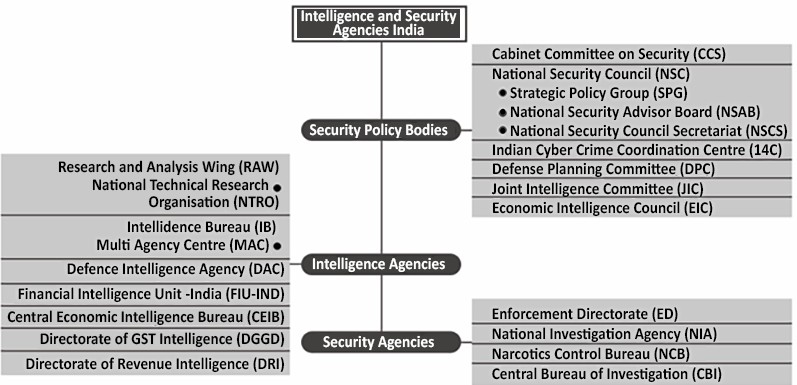
Figure: India’s Intelligence and Security Agencies
Intelligence Bureau (IB)
• The Intelligence Bureau (IB) is India’s domestic intelligence agency and is widely regarded as the world’s oldest, having been established in 1887.
• It operates under the Ministry of Home Affairs.
• The Bureau includes personnel from law enforcement agencies, primarily from the Indian Police Service (IPS) and the military.
However, the Director of Intelligence Bureau (DIB) has always been an IPS officer.
•
Functions
• Domestic intelligence duties
• Include gathering intelligence in border regions
• Serving as the primary coordinating body for counterterrorism efforts. It collaborates with police forces across various states throughout the country.
• The IB was initially India’s internal and external intelligence agency.
After the Sino-Indian War of 1962, and later on, India-
Pakistan War in 1965, it was bifurcated in 1968 and entrusted with the task of internal intelligence only
Multi Agency Centre (MAC)
• MAC is a multi-agency centre for counter-terrorism whose mandate is to share terrorism related inputs on a day-to-day basis.
• It was formed in December 2001 following the Kargil intrusion and the subsequent overhaul of the Indian national security apparatus by the Intelligence Bureau.
• Multi Agency Centre (MAC) was created at Delhi and Subsidiary Multi Agency Centres (SMACs) in various states comprising representatives from various security agencies, for streamlining intelligence efforts.
Daily meetings are held to analyse inputs received in the previous 24 hours.
• 24x7 Control Rooms have been set up at Multi Agency Centre (MAC) at New Delhi and the Subsidiary Multi Agency Centres (SMACs) at State Level and at Headquarters of Intelligence Wings of other agencies to ensure timely sharing of information and better co- ordination between intelligence agencies.
• Criticism: The Indian model of the MAC had continued functioning despite being modelled after the now abandoned US Mission Centre for Counter Terrorism.
• There are several gaps in sharing critical information at the right time and the biggest challenge is how to “coordinate, create and act upon inputs gathered by
various units.
Due to a lack of coordination, distrust amongst intelligence agencies, timely action to prevent terrorist incidents could not be taken.
• States are often reluctant to share information on the platform.
The reluctance on the part of the States was also stated in a parliamentary standing committee report in 2020.
• It had observed that the contribution made over the years by State agencies is lower in the overall inputs that had been received at the MAC.
Research and Analysis Wing
• foreign intelligence, counter-terrorism efforts, promoting counter-proliferation, advising Indian policymakers, and advancing India’s strategic interests abroad.
• The agency also plays a role in safeguarding India’s nuclear program.
• Based in New Delhi, the current head of RAW is Parag Jain.
•
The head of RAW holds the title of "Secretary (Research)" within the Cabinet Secretariat, operating directly under the Prime Minister’s authority and administratively reporting to India’s Cabinet Secretary, who in turn reports to the Prime Minister.
• The present RAW objectives include:
• Tracking political, military, economic, and scientific developments in countries that impact India’s national security and the shaping of its foreign policy.
• Shaping global public opinion and influencing foreign governments through the support of the active and influential Indian diaspora.
• Conducting covert operations to protect India’s national interests.
• Carrying out anti-terrorism operations and neutralizing terror threats targeting India.
• In the past, following the Sino-Indian war of 1962 and due to India’s volatile relations with Pakistan, RAW’s objectives had also consisted of the following:
• To watch the development of international communism and the schism between the two big communist nations, the Soviet Union and China.
As with other countries, both these powers had direct access to the communist parties in India.
• To control and limit the supply of military hardware to Pakistan, mostly from European countries, America and more importantly from China.
The National Technical Research Organisation
• The National Technical Research Organisation (NTRO) is
a technical intelligence agency set up in 2004.
Under the control of RAW.
• It also includes National Institute of Cryptology Research and Development (NICRD), which is first of its kind in Asia.
• It is a highly specialised technical intelligence gathering agency.
It acts as a super-feeder agency for providing technical intelligence to other agencies on internal and external security.
• Functions
• The agency develops technology capabilities in aviation and remote sensing, data gathering and processing, cyber security, cryptology systems, strategic hardware and software development and strategic monitoring.
• The organisation does hi-tech surveillance jobs, including satellite monitoring, terrestrial monitoring, internet monitoring, considered vital for the national security apparatus.
• NTRO also has access to data from Technology Experiment Satellite(TES), Cartosat-2A and Cartosat- 2B besides two Radar Imaging Satellites namely RISAT-1 & RISAT-2
• The National Critical Information Infrastructure Protection Centre, an agency under the control of National Technical Research Organisation, has been created to monitor, intercept and assess threats to crucial infrastructure and other vital installations from intelligence gathered using sensors and platforms which include satellites, underwater buoys, drones, VSAT- terminal locators and fiber-optic cable nodal tap points.
National Investigation Agency (NIA)
• The National Investigation Agency (NIA) was established following the passage of the National Investigation Agency Act, 2008, in response to the 2008 Mumbai terror attacks.
• It serves as the primary national agency for counter- terrorism law enforcement.
• The agency is authorized to handle terrorism-related crimes across states without needing special approval from the states.
• It is also empowered to investigate and prosecute offenses listed in the Schedule of the NIA Act.
A state government can request the Central Government to transfer a case for investigation by the NIA, as long as the case involves offenses mentioned in the NIA Act’s schedule.
Additionally, the Central Government can direct the NIA to investigate any scheduled offense anywhere in India.
• NIA officers, who are selected from the Indian Police Service and the Indian Revenue Service, have the same powers, privileges, and responsibilities as police officers when investigating any offense.
• The National Investigation Agency (NIA) Act
The act was amended in 2019 to expedite investigations and prosecutions, particularly for offenses committed abroad.
• The amendment allowed the agency to investigate crimes occurring outside India, in compliance with international treaties and the domestic laws of other nations.
• The scope of the law was expanded in the amendment. The NIA’s jurisdiction was broadened to include offenses related to
human trafficking,
counterfeit currency or banknotes,
the manufacturing or sale of prohibited weapons,
cyber-terrorism,
violations of the Explosive Substances Act, 1908.
• In addition to the original offenses under the Atomic Energy Act, 1962, the Unlawful Activities (Prevention) Act, 1967, and the Anti-Hijacking Act, 1982.
• Furthermore, the 2019 amendment enabled the central government to designate Sessions Courts as Special Courts to try scheduled offenses
• These courts can be designated by either the Central
or State government after consulting with the Chief Justice of the High Court under whose jurisdiction the Sessions Court falls.
Central Bureau of Investigation
• It was established in 1941 as the Special Police Establishment, tasked with domestic security and renamed as The Central Bureau of Investigation (CBI) in 1963 based on recommendation of the Santhanam Committee.
• CBI is not a statutory body. It derives its power to investigate from the Delhi Special Police Establishment Act 1946.
• Function: The CBI is involved in major criminal probes, and is the Interpol agency in India.
• Initially, it was set up to investigate corruption in government departments and public sector undertakings.
• However, over the years, its jurisdiction has expanded to cover a wide range of cases, including economic offences, cyber-crimes, organized crimes,
and special crimes.
• Organisation: The CBI is overseen by the Department of Personnel and Training of the Ministry of Personnel, Public Grievances and Pensions of the Centre.
• The CBI is headed by a director, an IPS officer with a rank of Director General of Police. The director has a two-year term.
• Appointment Process: 2021 Amendment Act Empowers a committee to appoint the director of CBI. The committee consists of the following people:
• Prime Minister – chairperson
• Leader of Opposition – member
• Chief Justice of India or a Supreme Court Judge recommended by the Chief Justice – member
• Jurisdiction
• Similar to the Federal Bureau of Investigation (FBI) in the United States, the Central Bureau of Investigation (CBI) operates with certain limitations in terms of its powers and functions, as defined by specific Acts.
• According to these Acts, the CBI can only conduct investigations upon notification by the central government.
• The central government can expand the CBI's powers and jurisdiction to any area (excluding Union Territories), provided it receives consent from the respective state government.
• The CBI can also investigate significant cases involving state police, with the agreement of the concerned state government.
• In cases related to offenses under the Prevention of Corruption Act, the CBI is overseen by the Central Vigilance Commission.
• CBI and its relationship with State Police
• Maintaining law and order is a state responsibility as ‘police’ is a State subject, and the jurisdiction to investigate crime lies with the state police exclusively.
• With respect to states, the CBI being a Union subject, may investigate:
Offences against central-government employees, or concerning affairs of the central government and employees of central public- sector undertakings and public-sector banks
Cases involving the financial interests of the
central government
Breaches of central laws enforceable by the Government of India
Major fraud or embezzlement; multi-state organised crime
Multi-agency or international cases
Narcotics Control Bureau (NCB)
• It was setup under the Narcotic Drugs and Psychotropic Substances Act, 1985.
• Functions:
• Coordination of actions by various offices, state governments, ministries and other authorities under the NDPS Act, Customs Act, Drugs and Cosmetics Act etc.
• Assistance to concerned authorities in foreign countries and concerned international organisations to facilitate coordination and universal action for prevention and suppression of illicit traffic in these drugs and substances.
• Implementation of counter measures against illicit traffic of drugs under the various international conventions and protocols
• Narcotics Policy
• The National Policy on Narcotic Drugs and Psychotropic Substances is founded on the Directive Principles outlined in Article 47 of the Indian Constitution, which mandates the State to work towards the prohibition of the consumption of harmful intoxicating drugs, except for medicinal purposes.
• The overarching legislative framework is provided by three key Central Acts:
The Drugs and Cosmetics Act, 1940
The Narcotic Drugs and Psychotropic Substances Act, 1985
The Prevention of Illicit Traffic in Narcotic Drugs and Psychotropic Substances Act, 1988
India is a signatory to several international agreements, including the Single Convention on Narcotic Drugs, 1961 (as amended by the 1972 Protocol), the 1971
Convention on Psychotropic Substances, and the United Nations Convention against Illicit Traffic in Narcotic Drugs and Psychotropic Substances, 1988.
Central Economic Intelligence Bureau (CEIB)
• Formed in 1985, it is the agency responsible for gathering information and monitoring the economic and financial sectors for economic offences and warfare.
• Headed by a Director General, it reports to the Ministry of Finance.
• Functions
• To collect information on various illegal economic activities and monitor sensitive and susceptible sectors of the Indian economy and financial sector.
• To ensure the full implementation of the Conservation of Foreign Exchange and Prevention of Smuggling Activities Act, 1974 (COFEPOSA)
• It is the chief coordinator of other agencies in the Ministry of Finance that are responsible for fighting economic offences i.e. DGGI, DRI etc.
• Cooperates at the international level with the agencies of other countries responsible for customs, drugs and economic law enforcement
Enforcement Directorate
• The Directorate of Enforcement is a multi-disciplinary agency responsible for investigating money laundering offenses and violations of foreign exchange laws.
• It operates under the Ministry of Finance within the Ministry of Finance.
• The Directorate includes officers from the Indian Revenue Service, Indian Police Service, and Indian Administrative Service.
• Originally established in 1958 to address violations of the Exchange Control Laws under the Foreign Exchange Regulation Act, 1947.
• It was renamed the 'Enforcement Directorate' in 1957.
• The primary objective of the Enforcement Directorate is to enforce the Foreign Exchange Management Act of 1999 (FEMA), the Fugitive Economic Offenders Act of 2018 (FEOA), and the Prevention of Money Laundering Act of 2002 (PMLA).
Financial Intelligence Unit – India (FIU-IND)
• The Financial Intelligence Unit - India (FIU-IND) is the primary national agency tasked with collecting, processing, analyzing, and sharing information on suspicious financial transactions with law enforcement agencies and international financial intelligence units (FIUs).
• Established in 2004, it functions as a central authority for
handling such financial data.
• FIU-IND operates independently and reports directly to the Economic Intelligence Council (EIC), which is chaired by the Finance Minister.
• Functions
• Acting as the central hub, it collects Cash Transaction Reports (CTRs), Cross Border Wire Transfer Reports (CBWTRs), Reports on the Purchase or Sale of Immovable Property (IPRs), and Suspicious Transaction Reports (STRs) from designated reporting entities.
• The gathered data is then analyzed to identify transaction patterns indicative of potential money laundering and related financial crimes.
• Disseminate financial intelligence to national law enforcement and intelligence agencies, regulatory bodies, and international Financial Intelligence Units (FIUs).
• Develop and maintain a national database of cash transactions and suspicious activities based on reports submitted by reporting entities.
• Enhance coordination and intelligence sharing to combat money laundering and related crimes through a robust national, regional, and global network.
• Track and analyze key trends, methods, and emerging developments in money laundering activities.
The Directorate of GST Intelligence (DGGI)
• Founded in 1979 it is the apex intelligence and investigative agency for matters relating to violation of the Goods & Services Tax, Central Excise Duty and Service Tax.
• Function: improving compliance of Indirect Tax laws.
• The agency is part of NATGRID and is staged by officers of Central Board of Indirect Taxes and Customs.
The Directorate of Revenue Intelligence (DRI)
• The Directorate is run by officers from Central Excise
and Customs.
• Though its early days were committed to combating smuggling of gold, it now also addresses narcotics and economic crimes.
• Functions
• Collection of intelligence about smuggling of contraband goods, narcotics, under-invoicing etc. through sources of India and abroad, including secret sources.
• Analysis and dissemination of such intelligence to the field formations for action and working on such intelligence, where necessary.
Proactive: Guiding important investigation/ prosecution cases. Keeping watch over important seizures and investigation cases. Associating or taking over the investigations which warrant specialised handling by the Directorate.
• Liaising:
• Maintain coordination with foreign nations, Indian diplomatic missions, and overseas enforcement agencies on anti-smuggling issues.
• Establish liaison with the CBI and, through them, with Interpol, while referring cases under the Customs Act to the Income Tax Department for necessary action under the Income Tax Act.
• Maintain records of seizures, market prices, and related data to monitor smuggling trends and provide necessary information to the Ministry of Finance and other relevant ministries.
• Analyze legal and procedural gaps in anti-smuggling measures and propose solutions for more effective enforcement.
National Intelligence Grid (NATGRID)
• The National Intelligence Grid or NATGRID is an integrated intelligence grid that will link the databases of several departments and ministries of the Government of India so as to collect comprehensive patterns of intelligence that can be readily accessed by intelligence agencies.
• First proposed in the aftermath of 2008 Mumbai Attacks.
• Unlike the NCTC and the NIA which are central organisations, the NATGRID is a tool that will enable security agencies to locate and obtain relevant information on terror suspects from pooled data of various organisations and services in the country.
• It is a counter-terrorism measure that collects and collates a host of information from government databases, including tax and bank account details, credit card transactions, visa and immigration records and itineraries of rail and air travel.
• It will help identify, capture and prosecute terrorists
and help pre-empt terrorist plots.
• In 2020, NATGRID and National Crime Records Bureau (NCRB) signed a MoU which will give access to FIRs and reports on stolen vehicles to NATGRID.