Whatsapp 88106-52225 For Details
Get Free IAS Booklet
Get Free IAS Booklet
INTRODUCTION
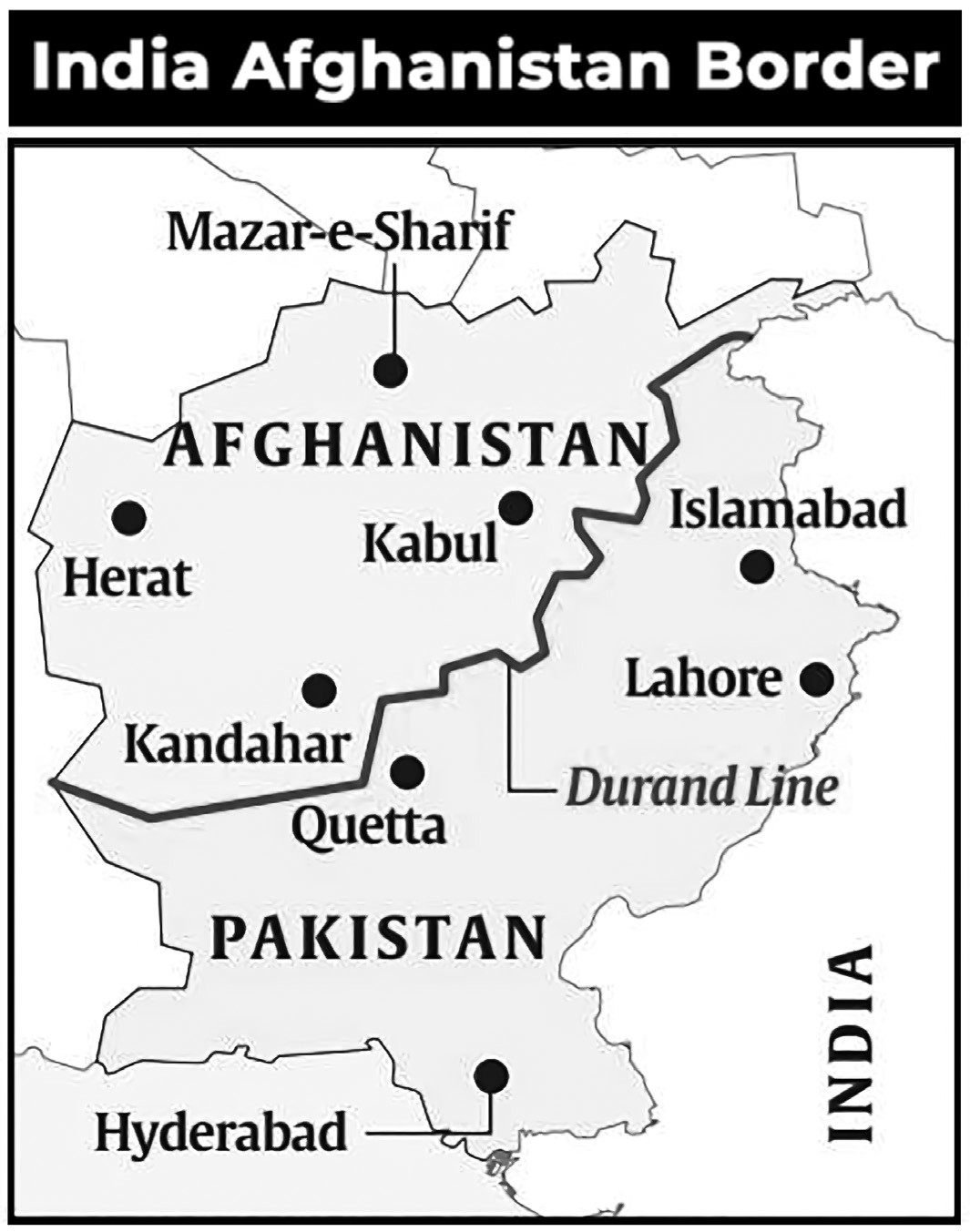
The India Afghanistan relationship is not a simple bilateral engagement. India’s Afghan policy is driven by many extraneous factors such as its geographical constraints, its search for a transit route to Central Asia through Afghanistan and Iran, its troubled relationship with Pakistan and the growing threat of terrorism in India and Afghanistan etc.
The centuries-old ties between India and Afghanistan shaped by history, culture and strong people-to-people linkages have become the foundation of the deep and strong relationship between the two countries. Building on the mutual trust and commonalities in traditional and cultural values, India continues to play a major role in supporting Afghanistan’s journey towards peace and prosperity.
Afghan is considered as ‘Graveyard of empires. The fall of Alexander (in Bactria), disintegration of USSR, and the decline of US hegemony were started in this region. There is an ever-growing perception that it is difficult to come out of Afghan quagmire.

Historical and Cultural ties
Relations between the people of Afghanistan and India traces back to the Indus Valley Civilisation.
The Mauryans controlled much of the area known today as Afghanistan and brought Buddhism in this region.
India and Afghanistan share centuries-old rich heritage with deep-rooted linkages in the field of arts, culture, architecture, cuisine and language.
In the field of music, most Afghan musicians were trained in the Patiala Gharana.
Today, Indian films, songs and TV serials are popular with the masses.
As part of India’s restructuring programme for Afghanistan, India has regularly aimed to take up projects there that will render Afghanistan’s cultural heritage sustainable.
Diplomatic Relations
India was the only South Asian country to recognize the Soviet-backed Democratic Republic of Afghanistan in the 1980s. Its relations were diminished during the 1990s Afghan civil war and the Taliban government. Later, India aided the overthrow of the Taliban.
Now, there exists a high-level political engagement with Afghanistan, which is reflected in the large number of bilateral high-level visits from both sides.
In 2005, India proposed Afghanistan’s membership in the South Asian Association for Regional Cooperation (SAARC).
In past, India-Afghanistan relations have been further strengthened by the Strategic Partnership Agreement, which was signed between the two countries in October 2011.
The Strategic Partnership Agreement (SPA) between the two sides, provides for
assistance to help rebuild Afghanistan’s infrastructure and institutions,
education and technical assistance to re-build indigenous Afghan capacity in different areas,
encouraging investment in Afghanistan’s natural resources,
providing duty free access to the Indian market for
Afghanistan’s exports
support for an Afghan-led, Afghan-owned, broadbased and inclusive process of peace and reconciliation, and advocating the need for a sustained and longterm commitment to Afghanistan by the international community
In 2015, when Afghanistan was going through a transition on the political, economic and security fronts, the government of India was quick to reassure Afghanistan of India’s long-term support towards its reconstruction and rehabilitation.
In 2016, Afghanistan supported India’s boycott of the SAARC summit hosted by Pakistan. This was a major diplomatic victory for India.
India - Afghanistan Joint Statement (October 2025): In New Delhi, Afghan Foreign Minister Mawlawi Amir Khan Muttaqi and External Affairs Minister Dr. S. Jaishankar had in-depth talks. Both parties talked about significant regional developments as well as a wide range of topics of shared interest
High Impact Community Development Projects (HICDP)
Since 2005, India and Afghanistan have partnered in the area of community development through the HICDP program.
Under this scheme, USD 120 million has been committed till date to various small to medium scale projects in areas such as education, health, water management, government buildings, sport facilities, agriculture and irrigation, etc.
Around 433 High Impact Community Development Projects have been completed with Indian financial support in all 34 provinces of Afghanistan so far and around 110 projects are ongoing in various provinces of Afghanistan.
Cultural Relations
India and Afghanistan have a strong cultural link, leading to significant cultural exchange events.
Major events include the India-Afghanistan Culture Week, a cultural troupe visited Kabul in 2017, and a folk musical troupe's visited the 5th International Folk Music and Dance Festival in 2018.
The India-Afghanistan Foundation (IAF) was established in 2007 to foster economic, scientific, educational, technical, and cultural cooperation between the two countries.
Indian Prime Minister Shri Narendra Modi was conferred with Amir Amanullah Khan Award,
Afghanistan’s highest civilian honour in 2016. He was bestowed the honour by President Ashraf Ghani after the inauguration of the landmark Salma Dam (Afghan-India Friendship Dam) in Herat.
India and Afghanistan have strong sports ties, with Afghanistan participating in the Subroto Cup International Tournament since 2011. Cricket has also played a significant role in fostering people-to-people ties between the two countries. India has allotted three cricket home grounds in Afghanistan, Noida, Dehradun, and Lucknow, and is involved in construction of cricket stadiums and grounds in various provinces. The first India-Afghan test match took place in Bangalore in 2018, and a bilateral test series was held in India, with Afghanistan as the host country from November 19 to December 2019. Indian FMCG Amul sponsored the Afghan National Cricket Team for the ICC Cricket World Cup in 2019.
India constructed parliament building in Aghanistan worth $ 178 million
Human Resource Development and Capacity Building
On an average, more than 3,500 Afghan nationals undergo training/education in India every year.
More than 15,000 Afghan students pursue education in India on self-financing basis.
A Special Scholarship Scheme of 1,000 scholarships per annum to Afghan nationals with 100% utilization in most years.
India offers over 1,000 Indian Technical and Economic Cooperation (ITEC) slots to Afghanistan annually.
The Afghanistan National Agricultural Sciences and
Technology University (ANASTU) established with India’s assistance is contributing to capacity building in agricultural sciences. The Indian Agriculture Research Institute (IARI) is involved in training, equipping and establishing the University.
Under India-Afghanistan Agricultural Fellowship Programme, Afghan students and scholars pursue graduation and research courses at various agricultural universities and institutes in India.
Nearly 50 Afghans are completing graduation in the Indian school of Mines Dhanbad with a view to strengthen technical man-power in mining sector in Afghanistan.
To continue with the policy of supporting Afghanistan, the GOI has been decided that from the A.Y 2023-24 onwards, 1000 scholarships, annually will be offered to Afghan Nationals for online UG & PG level courses.
Food assistance to primary school children, and construction and rehabilitation of schools ($ 321 million).
Expansion of national television network with an uplink from Kabul and downlinks in all 34 provincial capitals.
Women’s Vocational Training Center in Bagh-e-Zanana for training of Afghan women in garment making, nursery plantation, food processing and marketing.
Reconstruction of Indira Gandhi Institute for Child Health, Afghanistan’s only hospital for children, in Kabul.
84 ongoing projects related to agriculture, education, health, vocational training and solar energy.
Humanitarian Assistance
To combat the global pandemic of COVID-19 and related issues of food security, India is committed to deliver 75,000 MT of Wheat to Afghanistan in 2020.
In addition, India has also undertaken supply of 5 lakh tablets of Hydroxy-chloroquinine, 1 Lakh tablets of Paracetamol and 50,000 pairs of surgical gloves to Government of Afghanistan in 2020.
Provision of food assistance of 11 lakh tonnes of wheat, both as grains and biscuits, was distributed to approximately 1.5 million school children.
To promote food security, particularly children during the times of drought, India has distributed 2000 tonnes of pulses to Afghanistan in 2018.
Medical Diagnostic Centre in Kabul was set up in 2015. The Centre provides latest diagnostic facilities to children of Afghanistan thereby generating goodwill for India.
Economic and Commercial Relations
The bilateral trade for the year 2016-17 was USD 800 million approximately and has immense potential to be expanded further.
India’s main export items to Afghanistan are textiles, pharmaceuticals, tobacco, iron & steel and electrical machinery, while its imports from Afghanistan are fruits and nuts, gums and resins, coffee, tea and spices.
The massive reconstruction plans for the country offer a lot of opportunities for Indian companies for investment.
The inauguration of the Dedicated Air Cargo Corridor in June 2017 between Kabul-Delhi and Kandahar-Delhi has provided a fresh impetus to bilateral trade.
Over $1 billion is traded bilaterally between Afghanistan and India.
Nearly 43% of Afghanistan's exports currently go to India, according to figures released by the country's Ministry of Industry and Commerce. From $612 million in 2024 to $755 million in 2025, the nation's exports to India increased by more than 23%.
In this Union Budget 2026-27, India also raised its development assistance to Afghanistan to ₹150 crore, up from ₹100 crore
India-Afghanistan relations were strengthened by the Strategic Partnership Agreement signed in October
2011. The agreement offers assistance for rebuilding Afghanistan's infrastructure, education, and capacity building, encourages investment in natural resources, provides duty-free export access, and advocates for peace and reconciliation.
Operationalization of the Chabahar Port:
Another important initiative which strengthened bilateral trade was the operationalization of the Chabahar Port in December 2017, followed by commercial agreement to manage port operations in February 2018.
The Port has so far handled over 5,000 containers ferrying over 110,000 tons of wheat and over 2,000 tons of pulses sent by India as assistance to Afghanistan via Chabahar.
These were delivered to various parts of Afghanistan and average transportation time (excluding processing time) involved was less than 2 weeks.
In 2019, Afghanistan shipped around 700 tons of agricultural and mineral products to India through the Chabahar Port, clearly demonstrating the feasibility of Chabahar Port as a transit point for Afghanistan and eventually to Central Asia.
India-Afghanistan Air-Freight Corridor
Launched in June 2017.
Since its inauguration in 2017, India-Afghanistan AirFreight corridor has carried goods valued at over USD 216 million.
This has provided a boost to Afghan exports to India and has directly benefited Afghan farmers and small traders and exporters. India and Afghanistan now aim to expand the Corridor to other cities in both the countries.
Security dynamics
In 1999, the hijacked Indian Airlines Flight 814 landed and stayed in Kandahar in Afghanistan and the Taliban was suspected of supporting the hijackers.
After the hijack India became key supporter of AntiTaliban Northern Alliance (The Northern Alliance, also known as the United Islamic Front for Salvation of Afghanistan (UIFSA), it was a coalition of militias seeking to topple the rule of the Taliban throughout Afghanistan.
Allies: India, Iran, Russia, Turkey, USA, Tajikistan, Turkmenistan, Uzbekistan. Opponents: Al-Qaeda and Taliban.
At present, both nations have developed strategic and military cooperation against Islamic militants.
Almost whole country’s territory is now controlled by the Taliban, while the Islamic State has set up base in eastern Afghanistan.
Afghanistan being a part of Golden Crescent of caters to a much larger market in India of Narcotic drugs which is a major cause of concern for India’s security infrastructure
Security cooperation between the two countries is intended to enhance their mutual efforts in the fight against terrorism, organised crime, narcotics trafficking, money laundering and so on.
India agreed to help in the equipping and capacity building programmes for Afghan National Security Forces.
People to people ties
Most of the Indians in Afghanistan are engaged as professionals in banks, IT firms, construction companies, hospitals, NGOs, telecom companies, security companies, universities, Govt. of India sponsored projects, Govt. of Afghanistan and UN Missions.
The Mission interacts closely with members of the Indian Diaspora, assisting wherever required.
The diaspora members also actively participate in the Mission’s cultural activities and celebrations of national days.
In Afghanistan, Indian medicines and health care system are perceived to be highly trustworthy. Thus, India is the most favoured destination for most Afghan tourists, especially for medical tourism.
India has maintained an Afghan centric liberalized tourist visa and medical visa regime.
India offers many scholarships to Afghan students including Indian Council for Cultural Relations (ICCR) scholarships.
WHY AFGHANISTAN IS IMPORTANT FOR INDIA?
• Afghanistan serves India’s security and economic interests.
• Afghanistan is tied to India’s vision of being a regional leader and a great power, coupled with its competition with China over resources and its need to counter Pakistani influence.
• India’s ability to mentor a nascent democracy will go a long way to demonstrate to the world that India is indeed a major power, especially a responsible one.
• The pipeline project TAPI (Turkmenistan-
Afghanistan-Pakistan-India), which seeks to connect an energy-rich Central to South Asia, will only see the light of the day if stability is established in Afghanistan.
• India’s interest in Afghanistan relates to its need to reduce Pakistani influence in the region.
• New Delhi needs Kabul to get a better view of Islamabad and hence it is pertinent that it fosters positive relations.
• For access to the landlocked Central Asian countries that border Afghanistan.
The country is home to resource deposits worth one trillion dollars, according to the US Geological Survey.
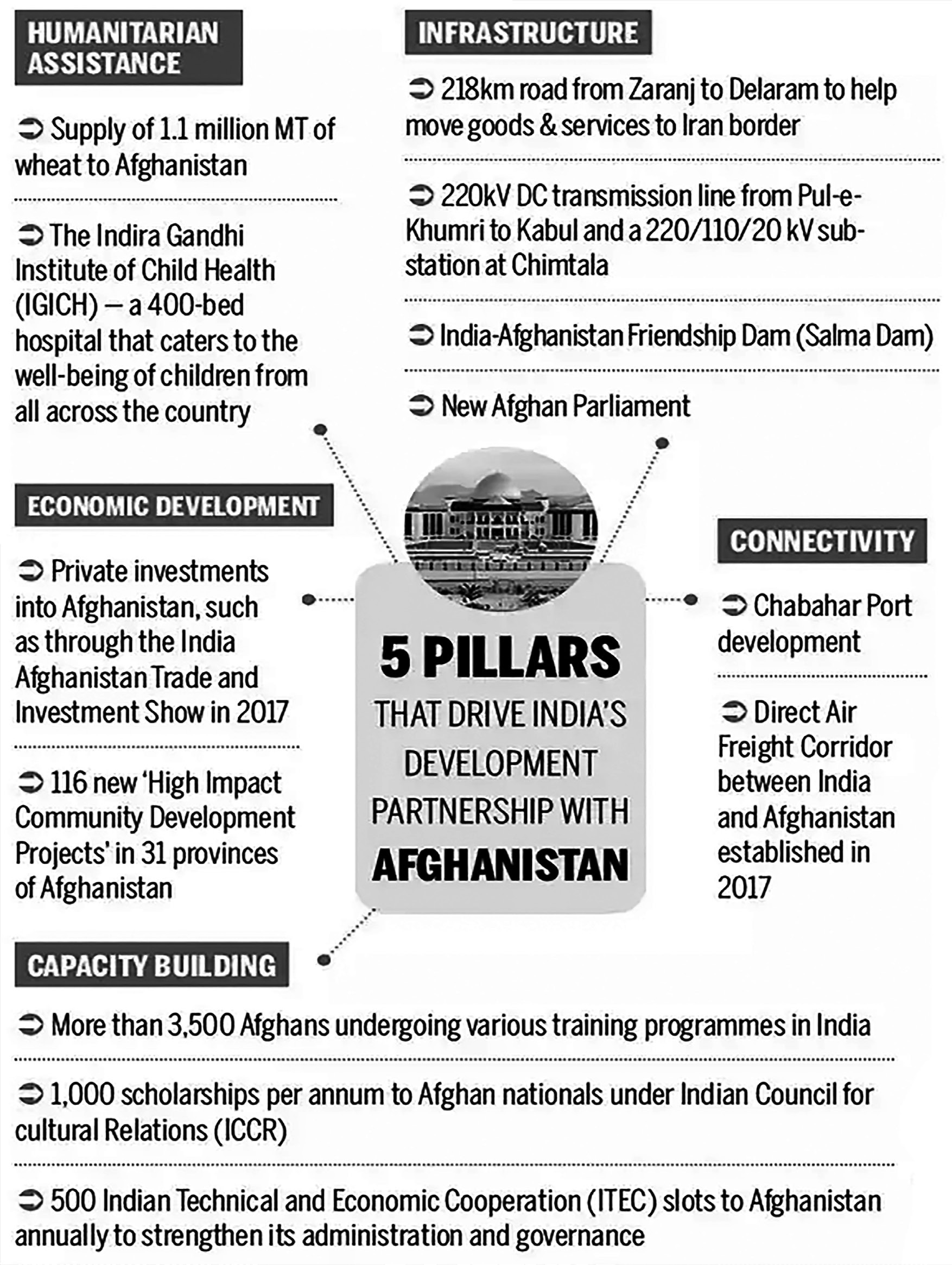
| INDIA’S ROLE IN RECONSTRUCTION AND REHABILITATION OF AFGHANISTAN India helped build Delaram-Zaranj highway connecting the Delaram district in Afghanistan to the border of Iran. It will provide Afghanistan with another outlet to a seaport in Chabahar in Iran and also facilitate its bilateral trade with India. India has constructed Afghan-India Friendship Dam (earlier known as Salma Dam) in Herat province. As a goodwill gesture, India constructed new parliament building in Afghanistan. |
• India also established Agriculture University ANASTU in Kandahar in 2014.
• India has constructed over 2,500 miles of roads in Afghanistan.
• India has built over 200 public and private schools, sponsors over 1000 scholarships, hosts over 16,000
Afghan students
• Many Indian companies are involved in several reconstruction projects in Afghanistan.
• India is running several programmes for training and capacity building for civil servants and police force in Afghanistan.Recently, India has also agreed to implement some important new projects such as the Shahtoot Dam and drinking water project for Kabul.
Opportunities for India
• India enjoys ample goodwill among the bureaucracy and the people of Afghanistan which can be leveraged to build strong ties with Afghanistan.
• The strategic location of Afghanistan between South
Asia and Central Asia offers India a great opportunity to boost its trade with Central Asia through Chabahar route.
• Shift in US policy and its pro-India stand on Afghan question can also be leveraged for our advantage.
Tussle with Pakistan
• Pakistani political leaders and the army are of the opinion that any Indian involvement in Afghanistan is inimical to Pakistan’s interests.
• They have also alleged that the Indo-Afghan nexus stokes the secular ethno-national Baloch and Pashtun separatist movements in Pakistan.
• Pakistani leadership has been quick in claiming that Pakistan wants zero political or military role for India in Afghanistan.
• Pakistan has also used Taliban and other terrorist outfits as its proxy to counter India in Afghanistan.
• Pakistan has also created hurdle in bilateral trade between India and Afghanistan through Afghanistan Pakistan Trade and Transit agreement (APTTA).
• APTTA provides both nations equal access up to national boundaries of each other. Thus, Pak allows Afghan trucks carrying goods meant for India only up to its last check point at Wagah and not to Indian check point at Attari, less than a Km away.
• As a matter of fact, despite Pakistan’s many allegations, India has practically no military presence in Afghanistan.
• India’s focus has solely been on development and reconstruction of war-torn Afghanistan.
CHALLENGES FOR INDIA
India’s efforts to provide assistance to Afghanistan are hampered considerably by the lack of geographical contiguity and limited access.
The prevailing security situation in Afghanistan and Pakistan’s continuing interference in Afghan affairs through proxies such as the Haqqani network.
Growing terrorism in Afghanistan under influence of Al Qaeda and ISIS has created security concerns for India.
Afghanistan, in the Golden Crescent, has been one of the most extensive opium-producing areas and drugs trafficked from Afghanistan into the Indian states like Punjab, has affected its youth and has also promoted terrorism and organized crime.
In 2011 Afghanistan and Pakistan signed Afghanistan Pakistan Trade and Transit agreement (APTTA) which has been restrictive in the bilateral trade between India and Afghanistan.
Growing Chinese influence in Afghanistan has also created a diplomatic challenge for India
CHINA’S AFGHAN OUTREACH
Given India’s and China’s propensity to increase their respective regional influence, often creating zones of overlapping and contending interests, countries like Afghanistan are bound to look for ways to maximize their gains and minimize their losses.
India’s strategic partnership with Afghanistan has not stopped the latter from expanding its areas of engagement with China.
While India’s role in the reconstruction of Afghanistan, and its largely benign presence there, can be seen as an asset as far as the protection and promotion of India’s interests are concerned, its relative absence from the political negotiations involving the Taliban has been acutely debated.
On the other hand, China, notwithstanding its low profile until more recently, seems to be opening new chapters in its Afghan outreach, being more willing to open communication channels to the Taliban, with its ally in the region, Pakistan, playing the role of a catalyst.
Amid American exit from Afghanistan, rising US-China tensions, deteriorating India-Pakistan relations, the new low in India-China ties, and, finally, the tenuous path to peace in Afghanistan, it is imperative to assess how New Delhi should read the Chinese designs in Afghanistan, especially in the wake of the recent meeting between China, Pakistan, Nepal, and Afghanistan
China also plans to expand China-Pakistan Economic Corridor (CPEC) to Afghanistan, as envisioned via a railway line to Kandahar.
INDIA’S ADVANTAGE OVER CHINA IN AFGHANISTAN
Despite China’s willingness to engage with the Taliban and growing ties with the government in Kabul, the evolving security situation in Afghanistan owing to US withdrawal strategy and the treacherous peace talks will pose a challenge to Chinese designs in the country.
Moreover, Afghanistan does not feature in China’s priority areas as far as economic investments are concerned.
Chinese assistance to Afghanistan has been rather paltry, standing at a meager $2.2 million as of 2016.
| Delhi Declaration on Afghanistan The Third Regional Security Dialogue on Afghanistan took place on 10 November 2021 in New Delhi, with the participation of the National Security Advisers/ Secretaries of the National Security Councils of India, Iran, Kazakhstan, Kyrgyz Republic, Russia, Tajikistan, Turkmenistan, and Uzbekistan. The meeting focused on the evolving security situation in Afghanistan, its regional and global implications, and the need for humanitarian |
India is not only the largest South Asian donor to Afghanistan, but it has also played a credible role in the infrastructure development of Afghanistan as well as in humanitarian assistance, small and communitydevelopment projects, and in education and capacity building.
RECENT AFGHAN PEACE DEAL
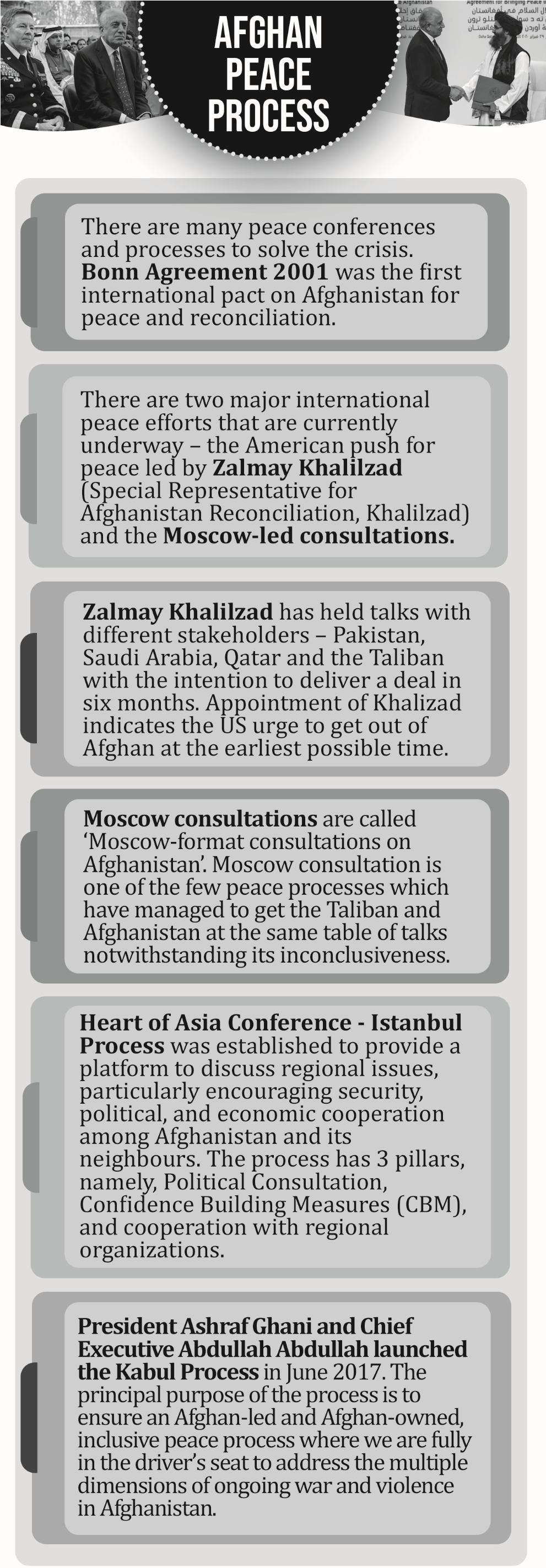
On February 29, 2020, the United States and the Taliban signed an agreement intended to be a first step toward an intra-Afghan peace deal.
Important provisions of the deal included a US commitment to eventually withdraw all US and foreign troops from Afghanistan, a Taliban pledge to prevent Al-Qaeda and other terrorist groups from using Afghan territory to threaten the United States and its partners, and a promise by both sides to support intra-Afghan peace negotiations.
As part of the agreement, the United States promised to decrease the number of US forces proportionately, reduce the number of other international forces in Afghanistan, and work with both sides to release prisoners.
There were notable problems with the agreement, such as its failure to include the Afghan government in the negotiations.
The Afghan government was not a participant of the February 2020 agreement because the Taliban considered the Ghani government illegitimate and refused to negotiate with its representatives.
Taliban leaders also walked out of discussions with the Afghan government in April 2020 after failing to reach an agreement on prisoner swaps.
A peace agreement aimed at ensuring that Afghanistan does not once again become a safe haven for international terrorism was central to the United States’ decision to end its military presence in the country. The U.S. formally withdrew its forces in August 2021, bringing an end to nearly two decades of war. This withdrawal followed the Doha Agreement of February 2020 between the U.S. and the Taliban, which outlined the exit plan in exchange for counterterrorism assurances.
Between 2001 and 2021, the U.S. spent over $2 trillion on military operations, reconstruction, security, and development assistance in Afghanistan. The withdrawal marked the conclusion of America’s longest war, though it also raised concerns about the Taliban’s return to power and the potential resurgence of extremist groups.
An agreement is particularly desirable as the United States focuses on competition with China and Russia, and as the United States deals with the budgetary pressures caused by the coronavirus (COVID-19) pandemic.
assistance. The National Security Advisers / Secretaries reiterated their support for a peaceful, secure, and stable Afghanistan, emphasizing sovereignty, unity, territorial integrity, and non-interference in its internal affairs. They expressed deep concern over the suffering of the Afghan people and condemned terrorist attacks in Kunduz, Kandahar, and Kabul. They emphasized the need for Afghanistan's territory not to be used for sheltering, training, planning, or financing terrorist acts. They reaffirmed their commitment to combat terrorism in all forms and manifestations, calling for collective cooperation against radicalization, extremism, separatism, and drug trafficking in the region. They stressed the importance of forming an open, inclusive government that represents the will of all Afghans and has representation from all sections of society. They also emphasized the need to preserve the United Nations' central role in Afghanistan and ensure the protection of fundamental rights of women, children, and minority communities
US INTERESTS IN AFGHAN
The United States still has interests in Afghanistan, such as preventing the country from becoming a sanctuary for international terrorist groups such as Al-Qaeda and the self-proclaimed Islamic State.
Averting regional instability as Russia, Iran, Pakistan, and India compete for influence in Afghanistan.
Minimizing the likelihood of a major humanitarian crisis.
The overthrow of the Afghan government by the Taliban would also likely be a boon for Islamist extremists.
Finally, a precipitous US withdrawal without a peace deal would likely raise serious questions about US reliability from its allies.
Managing points of conflict and geopolitical balance with Russia, which seeks to expand its influence in Afghanistan and Central Asia, often in ways that challenge U.S. strategic objectives in the region.
Concerns over the Peace Process
It remains unclear whether the Taliban was ever genuinely committed to a political settlement or merely used the negotiations to secure the complete withdrawal of U.S. forces, after which it rapidly overthrew the Afghan government in August 2021.
Even after taking power, significant unresolved issues persist — including political inclusivity, women’s rights, human rights, and the role of Islam in governance.
The collapse of the peace process has highlighted the fragility of earlier negotiations and the inability to reach a durable political framework before the U.S. withdrawal.
In the United States, domestic pressure to end the “forever war” played a central role in shaping policy, with both Republicans and Democrats supporting withdrawal despite the risks.
Following the U.S.–Taliban agreement and subsequent troop pullout, the Taliban consolidated power, and the Afghan government in Kabul collapsed. The reduction in U.S. funding and military support weakened Afghan institutions, allowing the Taliban to dominate the interAfghan process and control the country’s political future.
India’s Stand on Afghan Peace Process
In peace conferences, India’s stand is that it should be Afghan-led, Afghan-owned and Afghan-controlled and with the participation of the government of Afghanistan.
India is also wary of talks with the Taliban and the distinction of ‘good Taliban-bad Taliban’.
Concerns Over India’s Exclusion In The Peace Process
United Nations Secretariat organised a meeting on Afghanistan where it invited the six current physical neighbours of Afghanistan—China, Pakistan, Iran, Turkmenistan, Uzbekistan and Tajikistan.
In addition, invitations were extended to the United States, Russia and the Ghani government.
However, President Ghani did not make India’s inclusion a condition for his participation, even though he should have, given the constructive role New Delhi has played in Afghanistan’s reconstruction since the Taliban were ousted from power in 2001–2002 after the 9/11 attacks.
What truly cut India more to the quick was the US going along with India’s absence.
The reason given for keeping India out of regional discussions on Afghanistan was ostensibly that it holds no “boundary” with Afghanistan; but in fact it is because New Delhi has never announced its support for the USTaliban peace process.
Clearly, as the most significant power in the region, India should have ensured that it had a place on the table and should have devised ways to achieve that end.
This is especially so because Afghanistan impacts on India’s interests, especially its security concerns.
U.S. Special Representative for Afghanistan Reconciliation thinks that by avoiding open contacts with the Taliban, India has reduced its role in international diplomatic efforts.
India’s participation is vital to the present peace-making efforts, especially when the US-Taliban deal was concluded leading to a possible new stage in Afghanistan’s evolution
India’s resistance to publicly talk to the Taliban has made it an awkward interlocutor at any table.
Its position that only an Afghan-led, Afghan-owned, and Afghan-controlled process can be allowed is a principled one, but has no takers.
Taliban ready to have dialogue with India
The Taliban has reinforced its intent to engage with India by nudging its readiness to accept Kashmir as India’s internal affair amid a new round of international diplomacy to encourage a broad-based political settlement in Afghanistan.
Ground Situation
India has reopened its embassy in 2022 in Kabul after nearly ten months of Taliban takeover of Afghanistan (August 2021).
India has so far focused only on the isolating Taliban. However, beyond a point, this option will yield diminishing returns, as many other countries are now starting to engage the Taliban and India is an important stakeholder in Afghanistan.
Taliban has ties with the Lashkar-e-Taiba and Jaish-e Mohammed. An engagement with the Taliban would give an opportunity to convey Indian concerns regarding terrorist activities in India.
Taliban encouraged India to reopen its mission in Kabul, resumed direct flights to the country and also accept Afghan military trainees.
India needs a long-term strategic approach towards Afghanistan that weaves political, economic, military and diplomatic dimensions into a coherent whole within the framework of a grand strategy.
India’s Afghan policy must be based on a clear-cut understanding of India’s strategic goals in the region, and the regional and global strategic environment.
It is necessary for both sides i.e. India and Taliban to take into account each other’s concerns and improve diplomatic and economic relations.
India’s Foreign Secretary held talks with Afghanistan’s acting Foreign Minister in Dubai amid global geopolitical instability.
It is India’s highest-ranking outreach with the Taliban rulers of Afghanistan to secure India’s national and security interests.
Way forward for relations
India should remain committed towards the elimination of terrorism from Afghanistan and the destruction of all sanctuaries of the anti-India terrorist outfits.
India should continue to provide aid and assistance to the government and the people of Afghanistan.
India should also continue its developmental efforts in Afghanistan especially training its security forces and building its infrastructure so as to maintain peace and prosperity in this friendly neighbouring country.
India should also help Afghanistan to attain strategic autonomy and free itself from the clutches of Pakistani leadership.
Ensuring expeditious implementation of the trilateral agreement involving Iran which would use Chahbahar port to augment connectivity in the region.
Efforts of India’s Afghan policy should also take into account its energy security, for example, through the commissioning of the TAPI pipeline.
It is essential for India to have maintained its strong links with the Afghan government and support its traditional Afghan allies but also establish open lines of communication with the Taliban.
It is also important for India to address the Pakistan factor in its relations with Afghanistan. For that, it is crucial for India and Pakistan to discuss their suspicions at the official level so as to allay each other’s apprehensions and work together for peace and stability in the region.
India seeks a peaceful and stable Afghanistan which will not only be in interest of India but also in the whole neighbouring region and the world.
CONCLUSION
Despite its many challenges, the India-Afghan relations have been stronger than ever. Indian policy narrative of sustained reconstruction and concerted socio-economic development in Afghanistan has helped bringing peace and prosperity in this war-torn country. India’s investment in its relationship with Afghanistan has already paid off, as India’s consistent developmental efforts and its aid and assistance programmes in Afghanistan have generated ample goodwill for India among the people in Afghanistan. According to the Gallup poll and survey, Afghan adults are more likely to approve of India’s leadership than Chinese or US leadership