India-africa Relations
INDIA-AFRICA RELATIONS
INTRODUCTION
India and the African countries are in news lately, however the ties between the two regions date back to the ancient civilizations. Along with geographical proximity, there are factors such as the cultural connect colonial past and development hurdles that are more or less common to both and thus bring each other much closer.
In this context it can be rightly said that through cooperation if the opportunities of these two regions is utilized, then there cannot be anything bigger in the geopolitical world scenario today than this cooperation.
Although triggered by the unfortunate racist attacks, this relationship moved ahead and now presents an opportunity for both these regions to cement their ties.
Historical Perspective
• Once known as the ‘dark continent’ by the colonial exploiters due to inaccessibility into the interiors of the continent.
• The geographical proximity between the two was an important factor for building up relations during the ancient and the colonial period.
Ancient Period
• During the ancient period, the Indian merchants were in the constant look out beyond the Arabian Sea towards the west for lucrative markets. Slowly, the increasing people- to-people contacts made them a part of ‘Indian Ocean circuit of trade’
• They sailed regularly to the Zenj coast (Zanzibar) palm oil, gold, copper, spices, ivory, rhino horn etc.
• They sold cloth, metal implements, foodstuff like wheat,
rice and jaggery, besides porcelain and glassware.
• Trade developed through the knowledge of sea winds and the development of a suitable marine technology.
• The Periplus of the Erythraean Sea, a first-century AD guide for merchants and sailors, provides valuable insight into the flourishing trade between India and the Western Indian Ocean region. It also details India’s extensive trading connections, which spanned from Egypt and the coastal areas of northern Somalia to the ancient land of Punt, the Kingdom of Kush (Sudan), and Axum.
Islamic Era
• Indian presence in Africa is also seen during the Islamic age. The Venetian traveller Marco Polo mentioned explicitly about the Gujarati and Saurashtrian merchants on Africa’s east coast.
• The use of Indian system of weights and measures Cowries as currency, pointed to the fact that Indians were playing a key role in this area.
• Not only economic benefits, the trade also contributed to the development of internal links in the African continent even before the advent of Europeans
By seventeenth century, the nature of Indian Ocean trade underwent a radical change due to demand for captives who could be sold as slaves.
Advent of Colonialism
• With the advent of European colonial powers in India and Africa, the trade pattern underwent a significant change as Indo–African relations entered a new era of ‘colonialism’
• During the colonialism period, trade continued and also started the slave trade
The Indians who went to Africa as slaves and post abolition of slavery, as the indentured labourers, and the merchant class of Gujarat slowly settled down there
During the medieval time, the Africans came to India and were part of the Muslim rule in India
• A good example could be of ‘Malik Amber’ and ‘Siddis’ who are still a part of the Indian population and are settled in parts of Gujarat, Karnataka and Hyderabad.
• India’s link with the African continent dates back to the anti-apartheid struggle of Mahatma Gandhi with the colonial rulers in South Africa.
• India has been aggressively putting forward the issue of apartheid on multilateral forums such as UN, NAM and Commonwealth.
Political Relations
• Even though tackling its own problems within the first two and three decades, India shared experts in the field of agriculture and other fields. This helped generate goodwill for Indians among Africans.
• Africa can be said to be a home to one of the growing countries of the decade.
• Today the Indian-African diplomatic relations range from India – Africa Forum Summit (IAFS), India Regional Economic Communities (RECs) meetings, annual India – Africa trade ministers meeting along with others
• It goes ahead with business meetings such as the ‘Pan Africa e-network’ and multilateral forums such as the ‘Indian Ocean Rim Association for Regional Cooperation’ (IOR – ARC)’
• The India-Africa Summits since 2008 have further enhanced the South-South cooperation.
• India has been an active member of the UN peacekeeping missions to Africa for conflict management in the region.
• Strengthened the political bond through forums and groupings such as IBSA and BRICS. Economic Relations
• Africa accounting for around 17% of global population and projected to reach 25% by 2050, India recognizes its crucial role
in the partnership as a rising global power.
• India-Africa trade has multiplied and diversified in the past 15 years.
• India is the third largest export destination for Africa.
• India sources nearly 18% of its crude oil and also its LNG requirement from Africa.
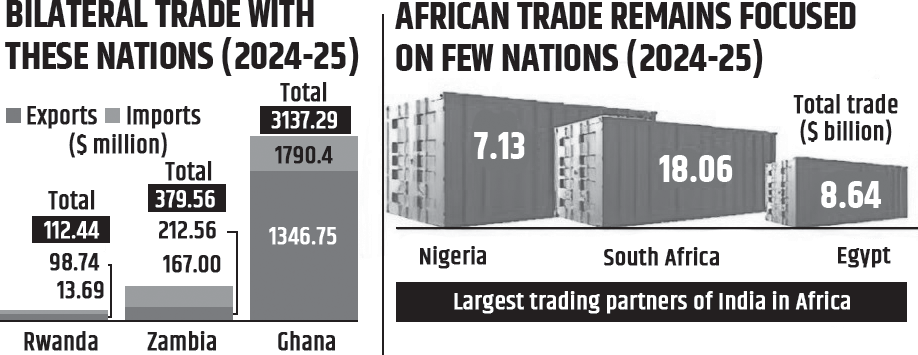
• India is currently Africa’s fourth-largest trading partner and among its top five investors. For the FY 2024-25, trade between India and Africa amounted to USD 81.99 billion (with India’s export amounting to USD 42.6 billion and India’s import amounting to USD 39.2 billion).
• India’s cumulative investment in Africa has reached approximately USD 80 billion between 1996 and 2025
• Diamonds, gemstones, gold, copper and other minerals are also sourced from Africa. Sizeable quantities of Phosphates
are imported from Tunisia and Morocco.
• Almost 90% of raw cashews are sourced from Africa, besides other agricultural commodities sourced including pulses, spices, fruit and nuts, and most recent addition is mangoes from Malawi.
• The development of Africa with respect to the growing middle class, reducing poverty and growing trend of globalization makes it an apt destination for India to engage in investments and trade with Africa.
Energy Cooperation
• To meet its energy security, India sources nearly 18% of its crude oil and also LNG requirement mostly from the West African region.
• About 13% of the India's total energy requirement comes from Africa. Thirty-Nine (39) African countries have joined the international Solar Alliance (ISA) so far.
• India imports crude oil from Nigeria, Angola, Chad Sudan/South Sudan and LNG from Nigeria.
• While oil exploration in Sudan/South Sudan, Gabon and Libya is going on, LNG and Coal mining in
Mozambique etc.
• South Africa and Ghana supply more than a quarter of country’s total coal requirements.
Socio Cultural Cooperation
• In 2017, African students received approximately $50,000 in scholarships over a five-year period from the Indian Council for Cultural Relations (ICCR). Through training programmes, the Indian Technical and Economic Cooperation (ITEC) programme is helping Africa provide its citizens with opportunities to gain new skills and knowledge.
Maritime Security
• India aims to enhance cooperation with African countries in order to keep the oceans open and free for the benefit of all nations. Indeed, the world needs cooperation, rather than competition in the eastern shores of Africa
and the Eastern Indian Ocean.
• To this end, complementarities can be drawn between Indian Navy’s 2015 Maritime Strategy document and the African Union’s 2050 Africa Integrated Maritime Strategy (AIMS 2050).
• Complemented by PM Modi’s SAGAR (Security Growth for All in the Region) and SAGARMALA
(port development) initiatives, the AAGC (Asia Africa Growth Corridor), with Africa being an equal partner, can potentially be a game-changer in the Indian Ocean Region.
• Naval cooperation continues to grow strong with regular port visits, transfer of hardware and logistical support,naval intelligence, and patrolling of Exclusive Economic Zones (EEZs) being undertaken.
• In December 2018, an Information Fusion Center, in Gurugram in India’s National Capital Region, was launched. It will help to track and monitor shipping traffic in the Indian Ocean, coordinate incident responses, and share submarine safety information.
• The decision to ‘jointly develop’ naval facilities Assumption and Agalega Island, off the coast of Seychelles and Mauritius respectively, has helped to increase the Indian Navy’s presence in the Indian Ocean.
AGENDA 2063 is Africa's strategic blueprint for transforming the continent into a global powerhouse in the future. It outlines a comprehensive framework focused on achieving inclusive and sustainable development, reflecting the pan-African commitment to unity, self-determination, freedom, progress, and collective prosperity. This plan embodies the
RE-ENERGISING INDIA’S ENGAGEMENT WITH AFRICA
• India’s relations with African nations have progressed at a fast pace in the last decade.
• India entered into a structured engagement with countries with the launch of the first Indian Africa Forum Summit in 2008 in New Delhi.
• The first term of the Modi government saw an unprecedented intensification of India’s political engagement with Africa, with 29 visits to African countries at the level of President, Vice President and
Prime Minister apart from several ministerial visits. African leaders too visited India in larger numbers in the past five years.
• Subsequent to the visit of 41 heads of state or government who attended the India Africa Summit in 2015, Indiahosted more than 35 leaders from Africa at various events.
• India has already opened six of the 18 additional missions it intends to set up in Africa.
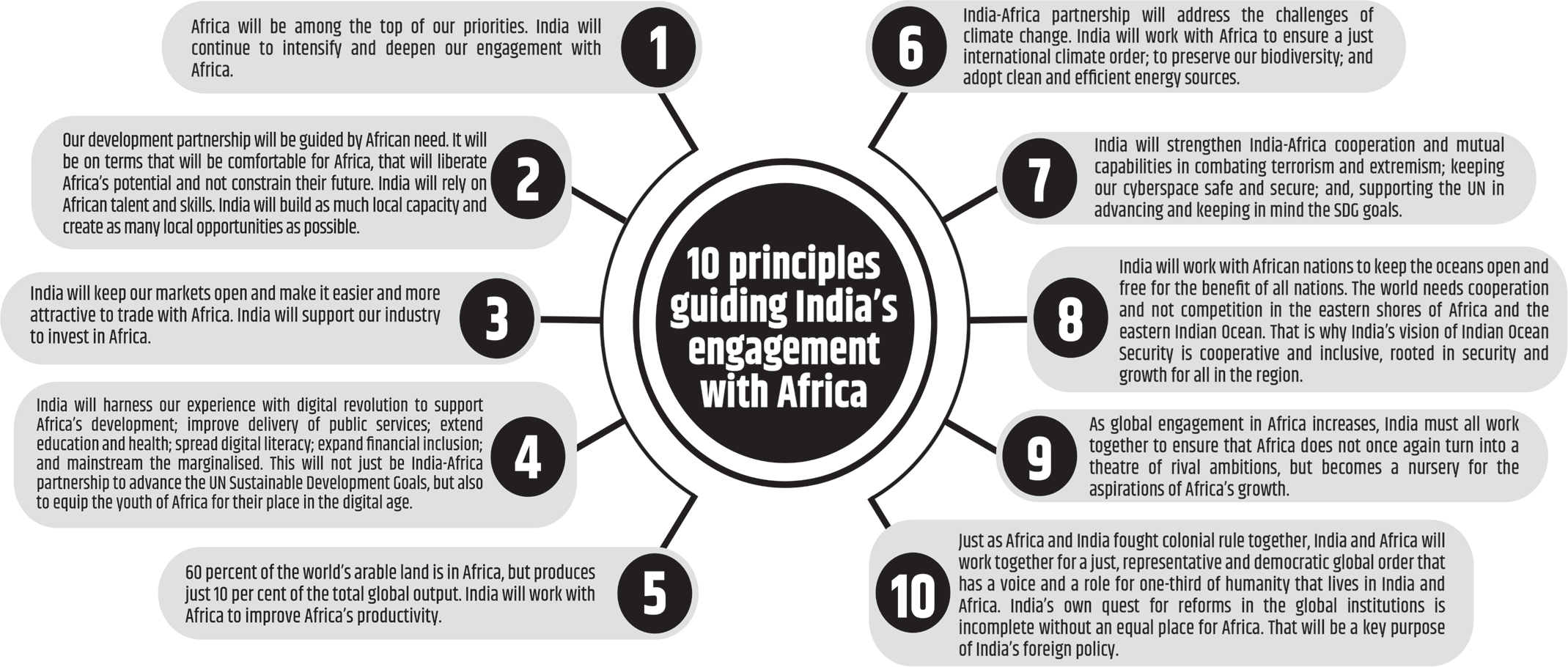
• In July 2018, Prime Minister Narendra Modi addressed the Ugandan Parliament during his state visit, sharing a vision for enhancing India-Africa relations. He emphasized not only the importance of bilateral cooperation but also collaboration in multilateral forums, outlining the '10 guiding principles for India-Africa engagement.'
• India has a strong commitment to Africa's progress, with the principle of "developing together as equals" at the heart of this partnership.
RECENT DEVELOPMENTS
• In March 2015, Prime Minister Modi visited Seychelles and Mauritius, signalling India’s intent to enhance ties with the African Indian Ocean Rim Countries.
• India also signed an agreement for infrastructure development for improving sea and air connectivity on Agalega Island.
• In Seychelles, India launched a coastal surveillance radar project, announced the transfer of a Dornier aircraft and signed an agreement to build infrastructure on
Assumption Island.
• The third India Africa Forum Summit was held in October 2015
• In a break from past tradition and moving away from the Banjul arrangement, Heads of State of all 54 African countries were invited to participate in the summit.
• During the Summit, India reaffirmed that development cooperation was the cornerstone of the India Africa partnership and offered an additional USD10 billion concessional credit over the next five years. Also, a grant of USD 600 million was offered.
• An India-Africa development fund of USD 10 was created.
• It was announced that India’s cooperation will be in line with the objectives set by the Agenda 2063 initiative of the African countries.
• India announced a joint initiative with the United States to provide training for troops in five African countries before their deployment in United Nations peacekeeping missions.
• Similarly, India and Japan agreed to enhance cooperation with African countries.
• A three-day India-Africa Health Sciences Meet, is being jointly organised by Indian Council of Medical Research (ICMR) and Ministry of External Affairs.
Whether India’s relationship with Africa should be seen through Chinese prism?
• While China has been deeply involved in Africa's infrastructure, mining, oil, and natural gas sectors for many years, India, though arriving later, has focused on training, education, and capacity-building programs, which have been widely appreciated by African nations.
• China is actively developing key ports along both the western and eastern coasts of Africa, extending to the Mediterranean, and building rail linkages to connect these ports.
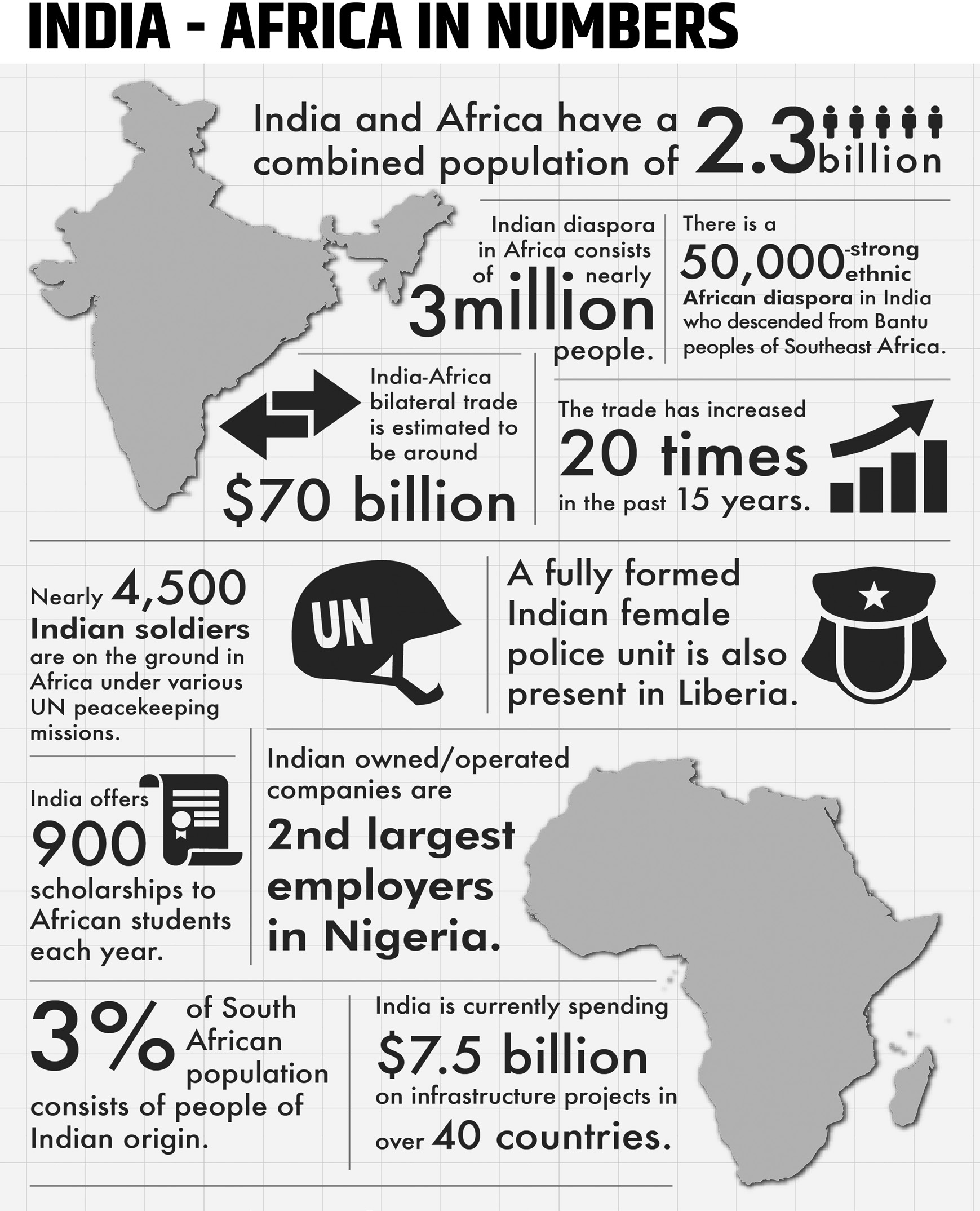
• Over the past 15 years, trade between India and Africa has increased twentyfold, reaching $70 billion, according to government reports.
• India's investment in Africa stands between $30 billion and $35 billion, with concessional credit provided to the tune of $7.4 billion, of which $5 billion has been disbursed. These credit lines have facilitated the creation of 137 projects across 41 countries.
• Additionally, a Pan-African e-Network for education and healthcare is operational in 48 countries.
• Since 2008, India has extended 40,000 scholarships to African nations under the ITEC program.Therefore, it would be inaccurate to view India’s engagement with Africa solely as a counterbalance to China’s growing influence in the region. Furthermore, China’s strategy of sending Chinese labour abroad to address domestic unemployment has sparked dissatisfaction among the African population. This has led to protests against China’s discriminatory employment practices in countries like Nigeria and Kenya.
A BRIEF ANALYSIS OF THE THIRD INDIA-AFRICA FORUM SUMMIT 2015
‘New Hopes, New Horizons’
The Third India-Africa Forum Summit introduced a "dynamic and transformative agenda" focused on mutual empowerment and resurgence, aimed at further strengthening the bond between India and African nations in the future.
This summit, the third since the initiative began in 2008, marked a significant milestone, as it was the first time that 54 heads of state, representing the entire African continent, gathered in India for a common purpose. To commemorate the event, special coins were released as a symbol of the occasion.
Development Partnership
The 2015 Delhi Declaration outlines the vision for India-Africa partnership in development. In line with this, India has pledged a $10 billion credit for development projects across Africa, along with $600 million in grant assistance. This grant covers various areas, including development funds, health initiatives, and scholarships for African students in India.
The Indian Technical and Economic Cooperation (ITEC) program has already established a foundation for knowledge sharing and serves as a bridge connecting students from both regions.
The Delhi Declaration aligns with Africa's Vision 2063 which similarly emphasizes growth, stability, and prosperity for the continent.
Arc of Prosperity
The India-Africa Business Forum was a key component of the summit, emphasizing economic development through public- private partnerships, institution-building, infrastructure growth, and the development of small and medium enterprises. The focus also extended to poverty alleviation, healthcare, education, and sustainable development.
Blue Economy
A significant agenda introduced at the summit was the development of the blue economy, or ocean economy. This initiative aims to sustainably harness marine resources to promote growth and development in countries like India, along the African coast, and in other littoral states with coastlines.
Strategic Partnership
India called for stronger collaboration with Africa to advocate for the reform of international institutions, such as the United Nations and its Security Council. The summit also highlighted the need for collective action on climate change, promoting the principle of ‘clean and green.’ India extended an invitation to all African nations to join its 'Solar Club,' encouraging partnerships in clean energy, sustainable habitats, public transport, and climate-resilient agriculture.
Partners in Peace
India plays a significant role in UN Peacekeeping missions across the African continent. The key missions in which India is actively involved include:
• Democratic Republic of Congo
• South Sudan
• Ivory Coast
• Liberia
To date, India has deployed approximately 4,500 soldiers for these missions, including the only fully-formed Indian female police unit, which is stationed in Liberia.
Cultural Bonding
Opportunities for India
Apart from the immense opportunities as can be comprehended from the above analysis of the third India- Africa Forum Summit, some of the rest can be listed as below:
• India has the opportunity to benefit from Africa’s rich resources such as coal, oil, and natural gas reserves whereas Africa would gain from India’s world-class downstream capabilities (Downstream operations are oil and gas processes that take place after the production phase to the point of sale. The closer an oil and gas company is to the process of providing consumers with petroleum products, the further downstream the company is said to be feasible).
• Indian banks to expand their footprint on the continent for developing Africa’s financial market.
• The huge market can serve as an alternative to ours.
• The hydrocarbon from Africa is a source of clean, energy efficient fuel which is of immense importance given India’s ambitious goals for energy production and security.
Challenges for India
• There is “considerable competition” for India within Asia for ambitious African projects.
• Being “sensitive” towards local concerns and contribute to the development and prosperity of local communities is a prerequisite.
• Piracy related activities off the coast of Somalia.
• The disease outbreak such as Ebola needs to be given special attention.
• Racial discrimination is one of the biggest challenges in front of both the regions
The rise of terrorism with organisations operating such as the Al Qaeda, ISIS, Boko Haram etc. give dangerous signals as India too has long been a victim of terrorism itself.
Although Africa is going strong on the economic front, however there are severe challenges that are a major hindrance for the development of its people. The vicious cycle of poverty, unemployment, food security, environmental awareness, disease out breaks, poor health facilities and infrastructure are not only a challenge for the African countries but also India, as India is facing the same problems which are deterring its growth and development, though at a lower scale.
As mentioned above of the ‘Agenda 2063’ of Africa to deal with the above stated challenges, India’s partnership in the form of ‘Delhi Declaration’ is a positive step in this direction for both the landmasses.
The recent racist attacks on the African nationals have left a dark spot-on India’s hospitality. It betrays our own understanding of ‘Vasudhaiva Kutumbakam. It is high time that being a responsible citizen of the country, we need to realize that these steps are not isolated in nature but send the image of our nation as racist and intolerant. It marks a big blow on all our previous efforts to generate goodwill.
India and Africa share a bond as ancient as the civilization itself. We need to preserve it and nurture in the best possible way by avoiding any unfortunate incidents by following restraint and tolerance on part of citizens, stringent policy making in this regard on the part of the legislative and effective implementation on the part of the executive.
Difference in the Approaches of Indian and Chinese engagement with African Countries.
Indian engagement lays emphasis on the long-term ties, which People centric, based on mutual cooperation and aspirations.
People Centric –Enhancing Africa’s productive capacities, diversifying skills and knowledge, and investing in SMEs are on the cards.
India is also seeking to reinvigorate its cultural links with East Africa under the rubric of Project ‘Mausam’, it seeks to revival of lost linkages between -East Africa, the Arabian Peninsula, the Indian subcontinent and Southeast Asia.
Contrarily, China’s approach is more trade and resource extraction, infrastructure development and elite-level wealth creation.
Connectivity-India’s African cross -border connectivity initiatives has three primary forms: Maritime-port connectivity under the government’s “Security and Growth for All in the Region” (SAGAR) and the Sagar Mala initiative.
Digital connectivity under the Pan African e-Network project on tele-education and tele-medicine (launched in 2004)
Air connectivity through direct flights between Indian and African cities.
In contrast, China’s focus is solely on big ticket investments that will provide strategic control to it for enhancing its economic might
Joint Initiatives –India, Japan and many African nations have also launched a trilateral initiative, the Asia Africa Growth Corridor (AAGC- The AAGC is a consultative initiative between three equal partners India, Japan and Africa which contrasts it to China’s BRI) .
This is to develop ‘industrial corridors’, ‘networks’ for the growth of Asia and Africa and to promote development cooperation.
Notably, BRI is structured more as a top-down, approach to secure and enhance China’s economic and strategic interests.
Military and security: African region is important for the security and geo-strategic considerations of both India and China.
India –India’s security and defence cooperation with Africa is mainly limited to anti -piracy operations off the coast of Africa.
Other aspects include -deployment of Indian forces to UN peacekeeping missions in Africa, and joint-naval patrolling of Western Indian
These engagements are mainly with Tanzania, Kenya, Mozambique, and the island nations of “Mauritius, Seychelles, Madagascar and Comoros”.
Shortcomings of India’s involvement in Africa:
China –China supports Africa’s military transformation by providing equipment, advanced technology, and independent capacity-building. The “China-Africa Defence and Security Forum” is an important development in this context.
The African nations are increasingly realizing that though Chinese investments are attractive, there are certain issues like:
Chinese companies instead of employing locals Chinese workers.
It is also seen that these companies don’t pay attention to environment protection.
Chinese loans come with strict conditions that only
Chinese technology will be utilized.
China’s Debt Trap Diplomacy is also a major concern for African nations.
Challenges India faces from the presence of countries like
U.S in Africa?
Initially, US trade with Africa was significant due to its strategy to reduce dependence on Middle Eastern oil, leading to increased purchases from Africa. However, with the shale revolution in the US, trade volumes have declined. The US remains involved in infrastructure development, the export of commodities (such as food and refined products), equipment, and mineral exploration projects—areas where India, like China, is also interested.
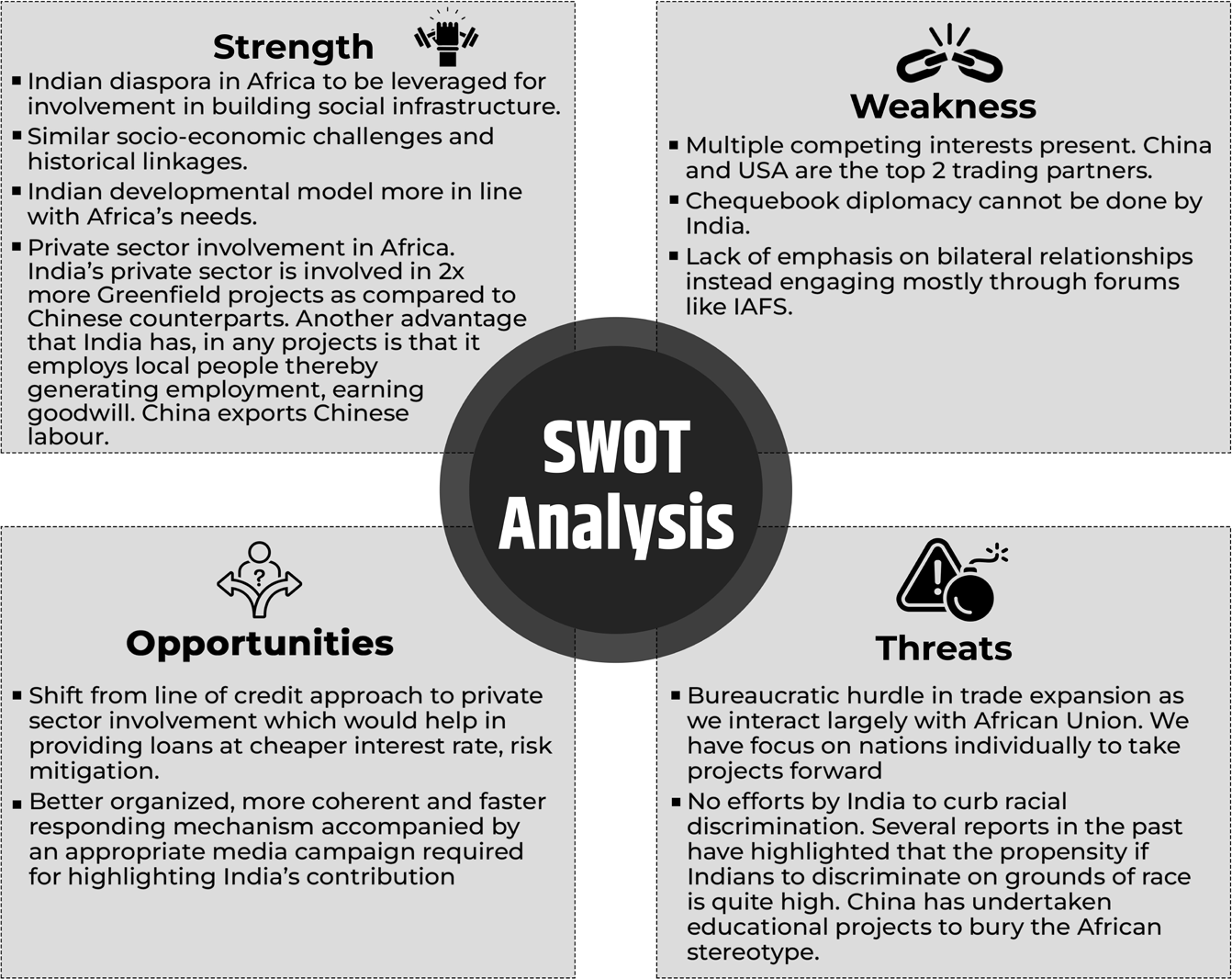
Both the US and China have been offering soft loans, which are eagerly embraced by capital-starved African nations. In terms of "cheque-book diplomacy," India cannot compete with China or the US. Some African countries, including wealthier ones like Nigeria, expect India to make generous contributions under the India-Africa Forum Summit (IAFS). However, India emphasizes the importance of joint efforts for sustainable development.
India tends to distance itself from mid-stream and downstream delivery processes, often relying on multilateral agencies like the African Union. As a result, India sometimes loses recognition for a project, despite providing significant financial and technological support.
India made substantial contributions to Ebola relief, offering more aid than other countries, but chose not to highlight its efforts. Indian assistance was primarily channeled through multilateral forums and provided in a piecemeal manner.
India–Africa Forum Summit (IAFS 3) – Delhi Declaration
The declaration placed development cooperation at the heart of India-Africa partnership, with India unveiling
$10 billion in Lines of Credit for a host of development projects over the next five years and pledging a grant assistance of $600 million. This grant includes an India- Africa Development Fund of $100 million and an India- Africa Health Fund of $10 million. It will also include 50,000 scholarships in India over the next five years and support the expansion of the Pan Africa E-Network and institutions of skilling, training and learning across Africa.
Amid the growing salience of ocean economy, IAFS-III mapped out a blueprint for enhanced cooperation in developing blue economy and to promote what Prime Minister Narendra Modi called “the blue revolution.” Blue Economy aims at sustainable development of marine resources, which will drive growth and prosperity of India, Africa and other littoral states blessed with long coastlines.
The third India-Africa Forum Summit saw a striking convergence of positions between India and 54 African countries to address a host of cross-cutting global issues, ranging from the UN Security Council reforms, piracy/maritime security and terrorism to multilateral
trade negotiations, climate change and sustainable development.
India plans to conduct a new training course at the Centre for UN Peacekeeping (CUNPK) in New Delhi and at other Peacekeeping Training Centres in Africa dedicated for Training of Trainers from upcoming Troop Contributing Countries from Africa. They also agreed on jointly promoting greater involvement of the Troop Contributing Countries in the decision-making process.
WAY FORWARD
There should also be greater connectivity and people-to people contact, which is vital for growth of relations. To generate and incubate more ideas, both India and Africa should look to engage with one another in more programmes and platforms at the Track I diplomacy and Track II diplomacy levels. The declaration of the Ten Guiding Principles for India-Africa engagement is a welcome step in creating a concrete framework for India’s relations with Africa.
India-Africa Partnership: Achievements, Challenges and Roadmap 2030’.
Important highlights of the report:
Africa's politics, economy, society, and demography are all changing dramatically. It is dedicated to advancing democracy, peace, and progress and is progressively heading towards regional integration.
However, issues brought on by terrorism, ethnic violence, and insurgency continue to plague some nations, such as Ethiopia, Sudan, and the Central African Republic.
A number of external allies are competing with one another to fortify their ties with various regions of Africa, including China, Russia, the US, the EU, Japan, Turkey, and the United Arab Emirates. They want to increase their political and economic clout in the area while gaining access to markets, energy, and mineral resources.
Since 2000, China has distinguished itself as Africa's largest economic partner. It is a major financier, resource supplier, and infrastructure developer in Africa.
China has committed significant resources, including cash and materials, as well as diplomatic efforts.