Whatsapp 88106-52225 For Details
Get Free IAS Booklet
Get Free IAS Booklet
INDIA - AUSTRALIA RELATIONS
INTRODUCTION
The India-Australia bilateral relationship is based on shared values of pluralistic, Westminster-style democracies, Commonwealth traditions, economic engagement, and high-level interaction.
The relationship has been strengthened by longstanding people-to-people ties, increasing Indian students coming to Australia for higher education, growing tourism, and sporting links, particularly cricket and hockey.
In recent years, the relationship has seen transformational growth, with exponential growth in existing frameworks of cooperation and expansion across new areas.
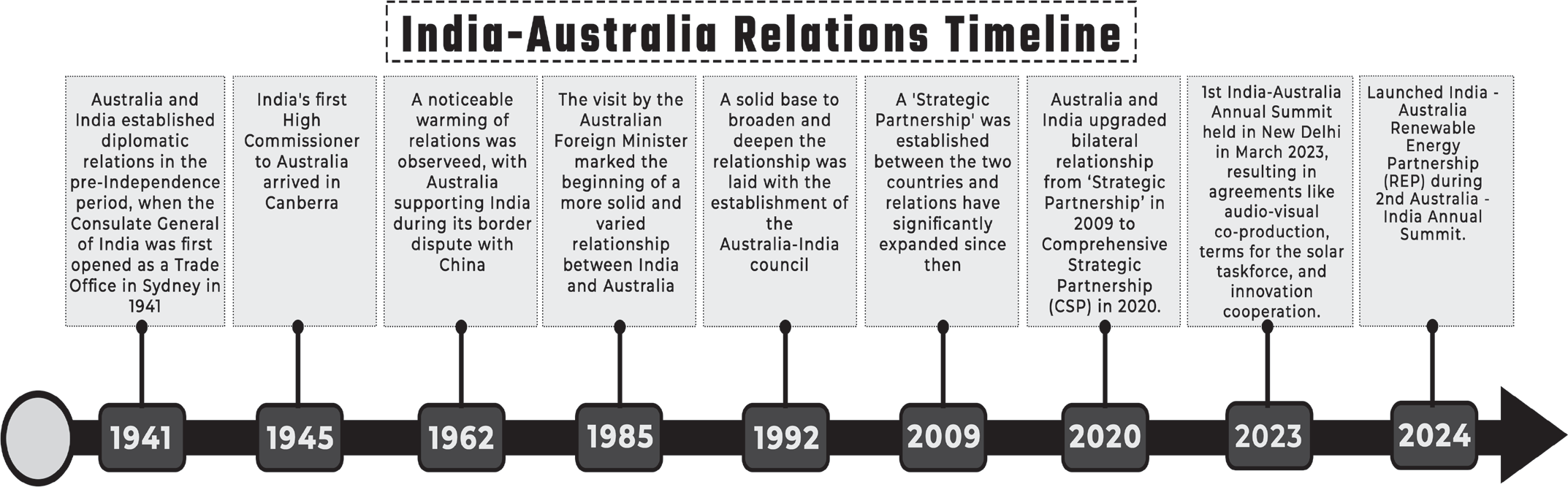
The historical ties between India and Australia began following European settlement in Australia in 1788, with the establishment of the India Trade Office in Sydney in 1941.
In 2009, India and Australia established a ‘Strategic Partnership’, including a Joint Declaration on Security Cooperation.
This cooperation has been further elevated to Comprehensive Strategic Partnership (CSP) in 2020.
The Australian foreign policy blueprint released in November 2017 sees India in the front rank of Australia’s international partnerships.
In order to pursue the CSP, Foreign and Defence Ministers of both countries agreed to meet in a ‘2+2’ format biennially.
Institutional mechanisms have been put in place to promote bilateral cooperation, including high-level visits, annual meetings of Prime Ministers, Foreign Ministers' Framework Dialogue, 2+2 Defence and Foreign Ministers' Dialogue, Joint Trade & Commerce Ministerial Commission, Defence Policy Talks, Australia- India Education Council, Defence Services Staff Talks, and Energy Dialogue.
India and Australia are both members of key international organizations such as the Commonwealth, IORA, the ASEAN Regional Forum, the Asia-Pacific Partnership on Climate and Clean Development, and have participated in the East Asia Summits. The two countries also collaborate as part of the Five Interested Parties (FIP) within the WTO framework. Australia plays a significant role in APEC and has been a strong advocate for India’s membership. In 2008, Australia also became an Observer in SAARC.
In 2022, both countries signed the India-Australia Economic Cooperation and Trade Agreement (India- Australia ECTA), a significant trade agreement expected to boost bilateral trade.
BILATERAL ECONOMIC AND TRADE RELATIONSHIP
• The Australian Government commissioned the India Economic Strategy to 2035 in July 2018 to develop a strong economic relationship with India.
• India–Australia Trade Reaches USD 24.1 Billion in 2024–25. India’s exports to Australia have more than doubled, rising from USD 4 billion in FY 2020–21 to USD 8.5 billion in FY 2024–25.
• During 2024–25, total bilateral trade stood at USD 24.1 billion, while India’s exports to Australia recorded an 8% growth over the previous year. In FY 2025–26 (up to February), India’s total trade with Australia stood at USD
• billion.
• Under the India–Australia ECTA-2022, India granted preferential market access on 70.3% of its tariff lines, covering 90.6% of trade value, while Australia granted preferential market access on 100% of its tariff lines, corresponding to 100% of imports from India.
• Of this, 98.3% of tariff lines became duty-free immediately upon implementation, while the remaining 1.7% (113 tariff lines) are being phased out over five years.
• From 1 January 2026, all Indian exports are eligible for zero-duty market access into Australia
CIVIL NUCLEAR CO-OPERATION AGREEMENT
• A Civil Nuclear Cooperation Agreement between the two countries was signed in September 2014 during the visit of the Australian Prime Minister to India. The agreement came into force from 13 November 2015.
• The Australian Parliament passed the “Civil Transfer to India Bill 2016” on 01 December, 2016 which ensures that Uranium mining companies in Australia
may fulfil contracts to supply Australian uranium to India for civil use with confidence that exports would not be hindered by domestic legal action challenging the consistency of the safeguards applied by the IAEA in India and Australia’s international non-proliferation
obligations. It also ensures that any future bilateral trade in other nuclear-related material or items for civil use will also be protected.
• The Australia-India Strategic Research Fund (AISRF) is a joint initiative between the Indian and Australian governments to promote bilateral collaboration in science. Its goals include increasing the adoption of advanced science and technology, strengthening strategic alliances, and facilitating access to the global S&T system. The funding is divided into 15 priority areas, including Artificial Intelligence and machine learning, New and Renewable energy technologies, and Urban mining and electronic waste recycling.
DEFENCE CO-OPERATION
• Defence Cooperation between India and Australia has expanded significantly in recent years. A MoU on Defence Cooperation has been signed as well as a Joint Declaration on Security Co-operation was signed.
• Both countries concluded Mutual Logistics Support Agreement (MLSA) during the Virtual Summit in June 2020 and India-Australia 2+2 Ministerial Dialogue was held in Nov. 2023 in which both countries have emphasized enhanced cooperation in information exchange and Indo- Pacific Maritime Domain Awareness (MDA), with the implementation of the Quad's Indo-Pacific MDA being a key agenda item at the upcoming Quad summit. They also discussed implementing arrangements for hydrography and air-to-air refuelling, a shared vision for specialized training in AI, anti-submarine warfare, anti-drone warfare, and cyber domain, and potential collaboration in defense industry and underwater technologies. Both countries reaffirmed their commitment to strengthening bilateral defense relations.
COOPERATION IN EDUCATION
• The Mechanism for Mutual Recognition of Educational Qualifications (MREQ) was signed in March 2023, aiming to facilitate student mobility between India and Australia.
• Deakin University and University of Wollongong plan to open campuses in India. Over 1 lakh Indian students are pursuing higher education in Australian universities.
The Australia-India Strategic Research Fund (AISRF) and the Australia-India Cyber and Critical Technology Partnership (AICCTP) are grants that support collaboration between Australian and Indian organizations in critical technologies like AI, IoT, quantum computing, and big data.
The International Space Investments program allows Australian businesses to collaborate with India's space sector.
The Australia-India Indo-Pacific Oceans Initiative Partnership (AIIPOIP) promotes maritime cooperation.
The Australian Alumni Grants Scheme supports alumni from India.
The Maitri Cultural Partnerships promote collaboration between Australian and Indian creative industries.
INDIAN DIASPORA
• Australia's Indian diaspora is the second-largest and fastest-growing overseas-born group in the world, with 976,000 people reporting Indian heritage in the 2021
Census.
• The Indian community is Australia's largest source of skilled migrants and international students.
• The country's fastest-growing language is Punjabi, and Hindi remains one of the top ten languages in Australia.
• In May 2023, Prime Minister Albanese and Prime Minister Modi signed the Migration and Mobility Partnership Arrangement to promote two-way mobility between Australia and India, enhancing cooperation on irregular migration and people smuggling.
• The Centre for Australia-India Relations, launched in May 2023, supports greater engagement and collaboration with India, including Maitri programs, enhancing cultural exchange, and promoting policy interchange.
• The Australia India Leadership and Youth Dialogues bring leaders and emerging leaders together to address shared challenges, explore cooperation opportunities, and build stronger ties.
CHINA FACTOR
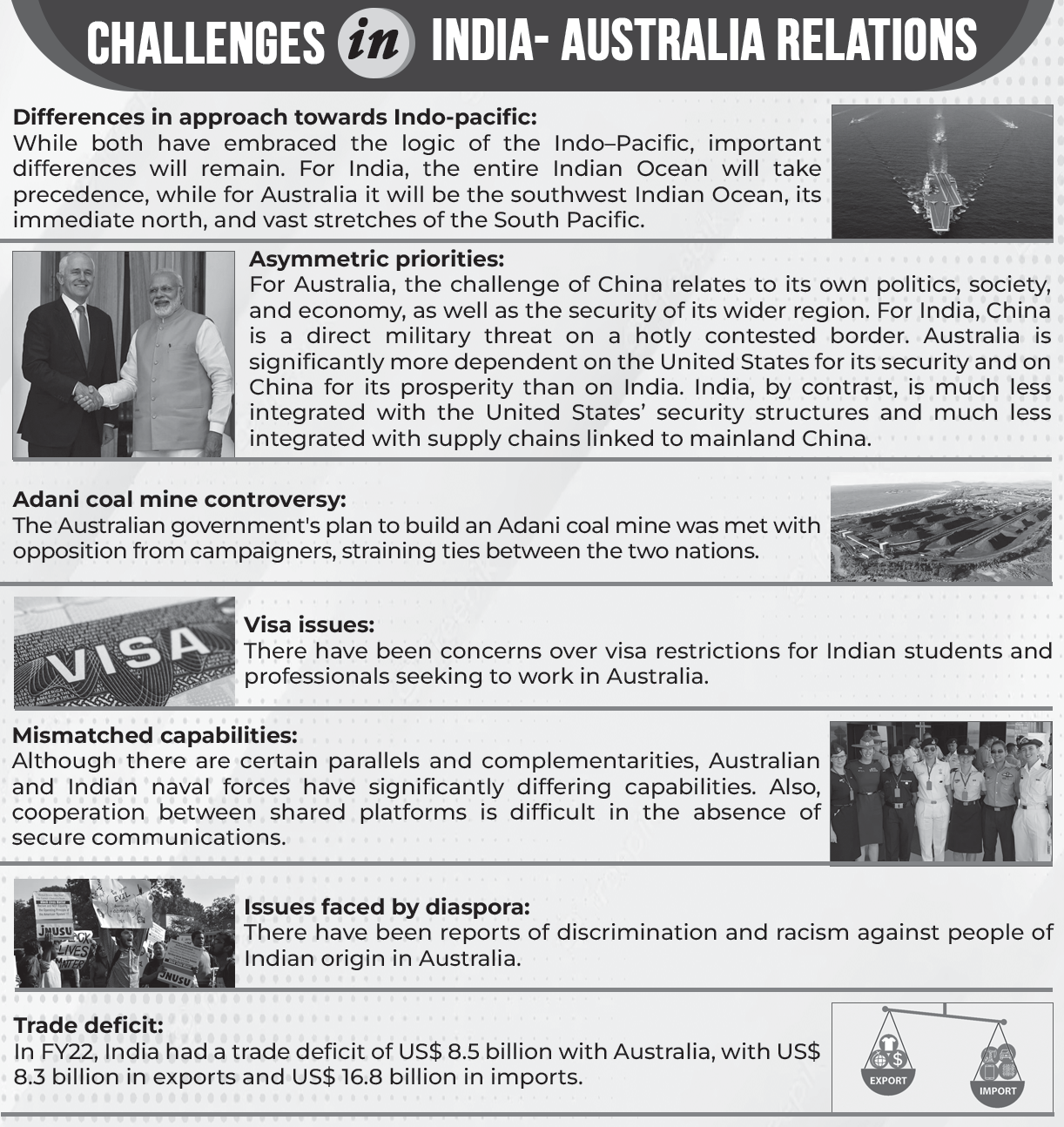
• Relations between Australia and China deteriorated for a number of reasons, including Australia’s ban on Huawei from the 5G network, requests for an investigation into the source of the Covid-19 pandemic, and criticism of China’s human rights abuses in Xinjiang and Hong Kong.
• In response, China severed all ministerial ties and placed trade restrictions on Australian exports.
• China’s border aggressiveness against India has been brought to light by events like the conflict in the Galwan Valley.
• In addition to supporting an international order based on rules, Australia and India are working to create inclusive regional institutions in the Indo-Pacific area that will advance further economic integration.
• The Quad member countries—Australia, the US,Japan, India, and Australia—showcase how their shared concerns have led to a convergence of interests.
In coming years, the overall relationship between India and Australia will continue to grow and has the potential to assume greater prominence. The prospects for bilateral relationship are recognised in both countries as strategically useful, economically productive and aligned with each other’s new agenda.
INDIA-AUSTRALIA ECONOMIC COOPERATION AND TRADE AGREEMENT: (ECTA)
• The FTA between the two countries officially known as Economic Cooperation and Trade Agreement (ECTA) between India and Australia provides for an institutional mechanism to encourage and improve trade between the two countries.
• Australia exports largely raw materials to India, while India exports finished goods. The ECTA builds on this complementarity, creating win-win opportunities for the two countries.
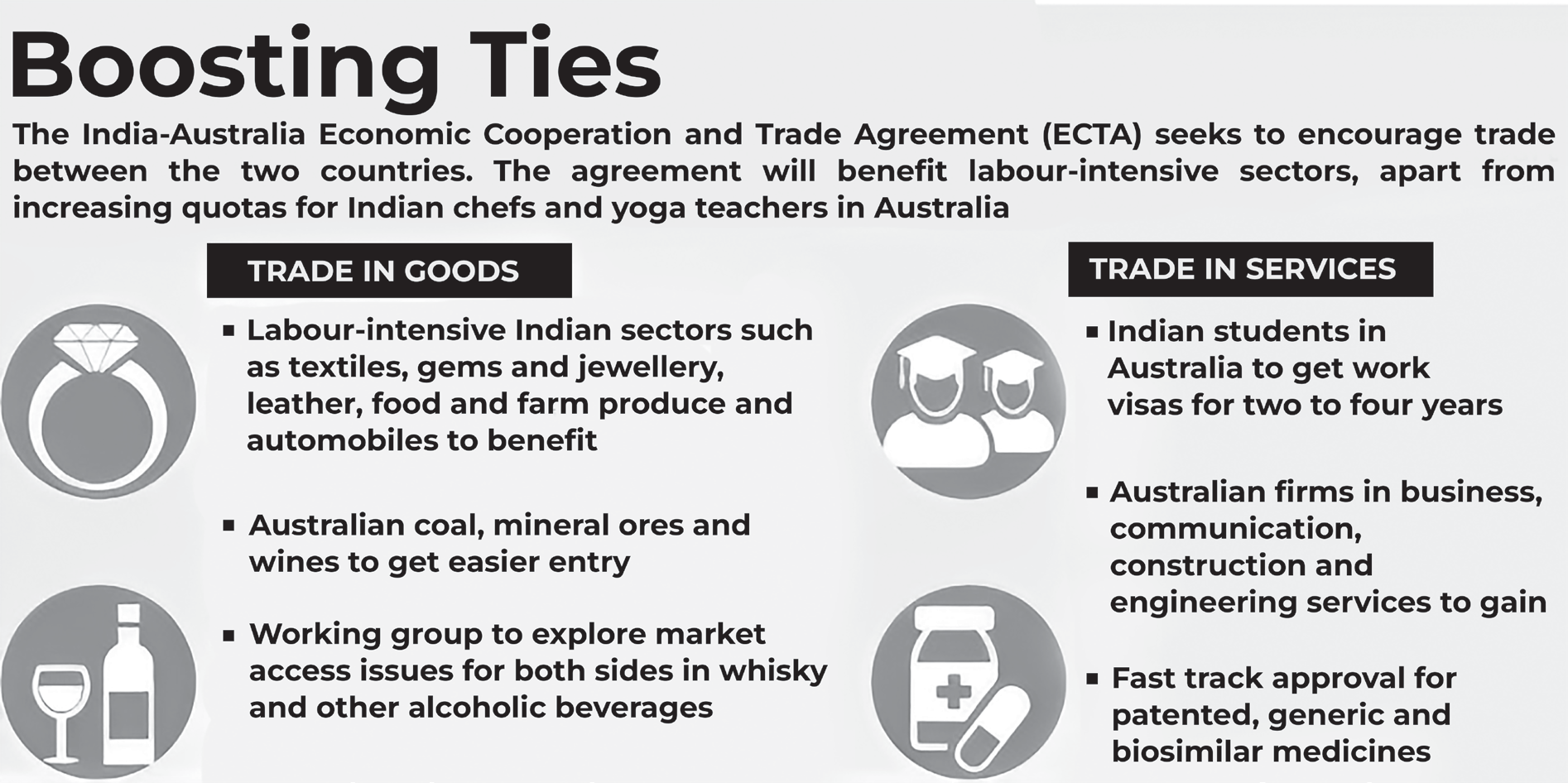
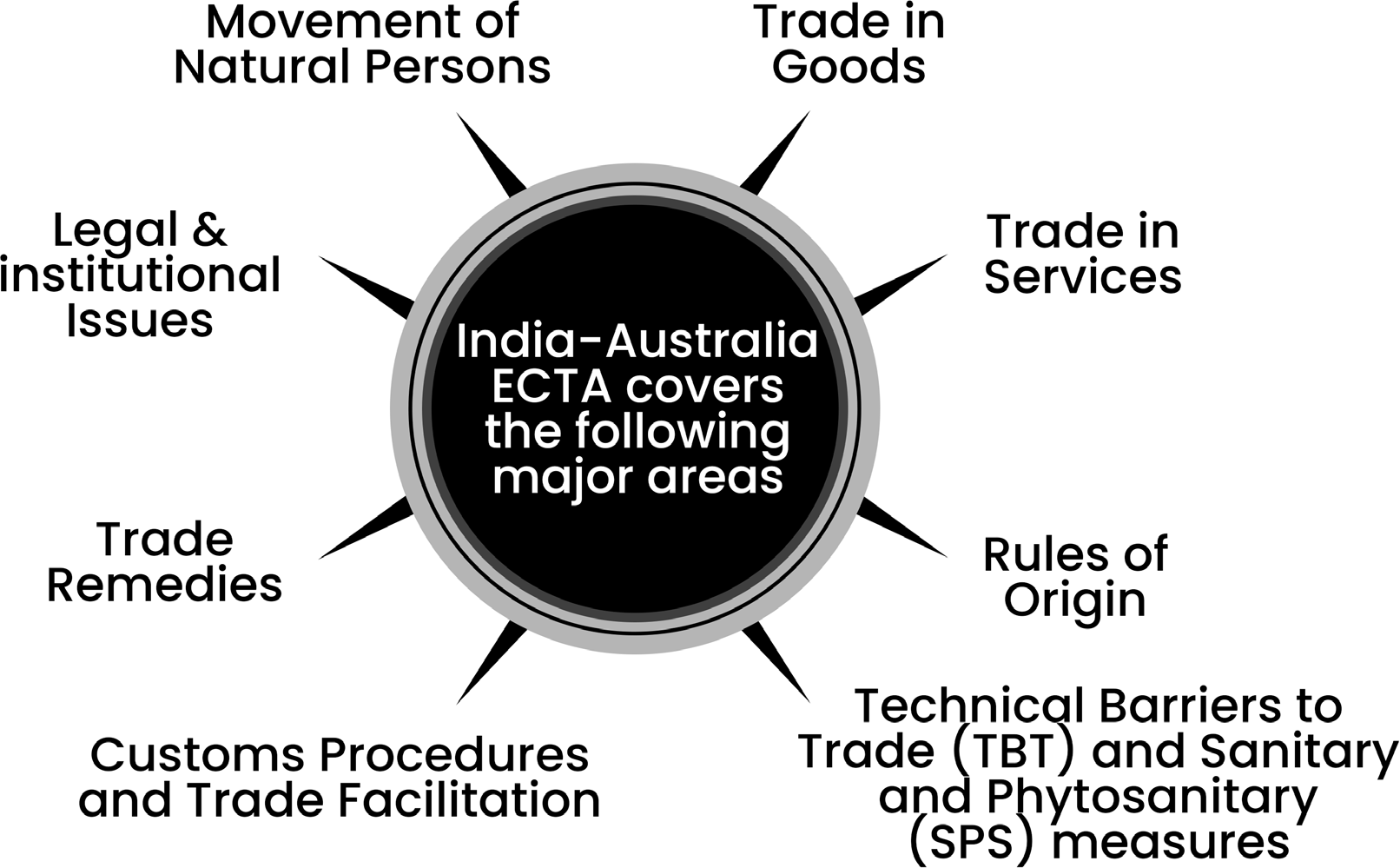
The ECTA between India and Australia covers almost all the tariff lines dealt with by India and Australia, respectively. India will benefit from preferential market access provided by Australia on 100 per cent of its tariff lines. This includes all the labour-intensive sectors of export interest to India, such as gems and jewellery, textiles, leather, footwear, furniture, food, agricultural products, engineering products, medical devices, and automobiles.
On the other hand, India will be offering preferential access to Australia on over 70 percent of its tariff lines, including lines of export interest to Australia which are primarily raw materials and intermediaries such as coal, mineral ores and wines, etc..
Australia has offered wide-ranging commitments in around 135 sub-sectors and Most Favoured Nation (MFN) in 120 sub- sectors which cover key areas of India’s interest like IT, ITES, business services, health, education, and audio-visual.
Some of the key offers from Australia in the services space include a quota for chefs and yoga teachers; Post study work visa of 2-4 years for Indian students on a reciprocal basis; mutual recognition of professional services and other licensed/regulated occupations; and work & holiday visa arrangement for young professionals.
WAY FORWARD
• Recent years have seen an improvement in India- Australian relations because of common goals, interests, geography, and values.
• In order to resolve disagreements or conflicts, both nations envision an Indo-Pacific area that is free, open, inclusive, and governed by rules; hence, unilateral or forceful measures are discouraged.
• Rekindled relations between Australia and India through programs like bilateral summits present a chance to deepen the two nations’ relationship and actively contribute to maintaining rule-based order in the Indo-Pacific.
• India and Australia support peaceful dispute resolution over unilateral or forceful measures, as well as cooperative usage of the oceans by adhering to international law, such as the United Nations Convention on the Law of the Sea (UNCLOS).The strategic and intimate ties that already exist between Australia and India would be strengthened by the India- Australia ECTA.
Although there have been significant developments in the last few years in the India-Australia strategic partnership, its potential and promise remain unfulfilled.
Therefore, in order to move forward and become more than a work in progress, both capitals must provide committed attention and political leadership.