Whatsapp 88106-52225 For Details
Get Free IAS Booklet
Get Free IAS Booklet
INTRODUCTION
• With a population of nearly 170 million, Bangladesh is the eighth most populated country in the world. Even more important, it is one of the world's fastest growing economies and has been called the "miracle in the east". India is a natural partner of Bangladesh. India's links with Bangladesh are civilizational, cultural, social and economic. There is much that unites the two countries - a shared history and common heritage, linguistic and cultural ties, passion for music, literature and the arts.
• With Bangladesh, India shares not only a common history of struggle for freedom and liberation but also enduring feelings of both fraternal as well as familial ties. This commonality is reflected in multi-dimensional relations with Bangladesh at several levels of interaction. S. Jaishankar, India's external affairs minister has called Bangladesh as one of the most trusted partners for India.
BACKGROUND
India and Bangladesh, two South Asian democracies, neighbors have the common border of over 4,000 km with each other.
India was the first country to recognize Bangladesh as a separate and independent state and established diplomatic relations with Bangladesh immediately after its independence in December 1971.
Bangladesh liberation day, 16th December, is celebrated as "Vijay Diwas" in India. India-Bangladesh relations, the unique ties are forged in shared sacrifices.

Figure: Lt Gen AAK Niazi signs the Instrument of Surrender on Dec 16, 1971, as Lt Gen Jagjit Singh Arora looks on
SIGNIFICANCE OF BANGLADESH FOR INDIA
1. Connectivity
• Perhaps on top of the list is connectivity between India’s mainland and the crucial northeast, which is a strategically, culturally important area for India.
• The only land connection between India’s mainland and the northeast is the Chicken’s Neck – a narrow strip of land that has always been a huge security concern.
• India and Bangladesh have signed several pacts, under which India can send goods and passengers over land through Bangladesh, connecting Bengal to Tripura.
• Chittagong port is now open to Indian vessels and will ease supply of goods, which ensures India is even more connected to the northeast than before.
| It provides India with access to the Bay of Bengal and an important route for trade and connectivity with Southeast Asia.Also, the trans-shipment of containerized export cargo from Bangladesh to third world countries through India gained a streamlined process. |
2. Strategic
For the security of the northeast, it is essential that Bangladesh does not become a shelter for insurgent groups having anti-India aims.
Bangladesh is located at the crossroads of South Asia and Southeast Asia and is important for India’s Act East Policy, which aims to build closer ties with the countries of Southeast Asia.
Bangladesh has played a crucial role in flushing out northeastern terrorists from its soil and even handing over the once-dreaded ULFA terrorist Anup Chetia to India.
The other big security concern for India is that Bangladesh should not turn into the frontline of Islamic terror in the southeast — something that looked possible in the early 2000s when the Jamaat-ul Mujahideen Bangladesh (JMB) was prominent.
It was PM Sheikh Hasina’s government which proactively cracked down on groups like the JMB, that used to have a free-run in the previous regime of Begum Khaleda Zia of the Bangladesh Nationalist Party.
3. Economic
• India-Bangladesh have had close economic ties, with
• India being one of Bangladesh’s largest trading partners. For example,
• In FY 2024-25, the total bilateral trade is reported to be USD 13.70 billion with India exporting USD 11.37 billion and Bangladesh exporting USD 2.32 billion of goods.
• In FY26 (till November 2025), Bangladesh ranks 7th in exports, and in imports ranks 49th.
• The total trade turnover in FY26 (till November 2025) touched US$ 7.42 billion.
• One of the world’s fastest growing economy, Bangladesh presents opportunity for both the countries to cooperate and reap dividends.
• Given Bangladesh’s rising GDP and economic growth, the Indian industry is taking a serious interest in investing in the country. PM Sheikh Hasina has helmed an economic upswing in the country, which has made industry hopeful for future.
• India has allowed duty-free access of Bangladeshi goods to Indian market.
• India has provided duty free quota free access to Bangladesh on all tariff lines except tobacco and alcohol under South Asian Free Trade Area (SAFTA) since 2011.
4. Tourism
• According to the Ministry of Tourism, Bangladesh accounted for the largest share of foreign tourist arrivals in India in 2023, including tens of thousands of people who come to the country for medical treatment.
• Ganga Vilas cruise, beginning its route from Varanasi (U.P.) to Dibrugarh (Assam) via Bangladesh having
World Heritage Sites, National Parks, and River Ghats on its route, has potential to be a major tourist attraction for both the countries.
• According to the India Tourism Statistics Report 2022 of Ministry of Tourism, Bangladesh has been the second largest amongst tourist generating markets for India in the year 2021.
• Bangladeshi visitors to India fell from 1.75 million in 2024 to 466,012 in 2025, a 73% decrease. Geopolitical tensions and reciprocal visa restrictions caused this steep decrease
5. Countering China’s presence in South Asia
• India should ensure that Bangladesh does not become a pearl in China’s “String of Pearls” strategy to contain India by using its neighbours.
• India needs cooperation from Bangladesh to counter the Chinese ‘String of Pearls’.
6. International cooperation
• India and Bangladesh can jointly push for their common interests in multilateral institutions such as United Nations, World Bank.
7. Environmental
• Bangladesh and India share trans-boundary rivers and ecological systems, making it important for the two countries to cooperate on issues such as water management and flood control.
• For example, coordinated efforts are needed for the conservation of Sunderbans, a Ramsar convention site.
ISSUES IN THE BILATERAL RELATIONS
1. Insurgency
• Insurgency is one of the bones of contention between two countries. The question of ISI operating from Bangladesh and supporting the insurgents in the North-East is one of the major issues.
• In 1999, it was reported that the porous border between India and Bangladesh has been used by the insurgent groups for movement to and from their camps.
• In 2001, media reports highlighted the presence of a number of camps in Bangladesh operated by National Liberation Front of Tripura (NLFT), United Liberation Front of Assam (ULFA) and National Democratic Front of Bodoland (NDFM).
• There are also reports that ULFA has several lucrative income generating projects in Bangladesh to sustain its insurgency activities in India.
2. Illegal Migration
• Large influx of such migrants across the boundary has posed serious socio-economic-political problems for the people of Indian states bordering Bangladesh viz, Tripura, Mizoram, Assam, Meghalaya and West Bengal.
• India sought to check problem of refugees by erecting barbed wire fence along the border which was greatly resented by Bangladesh.
• India facilitated the repatriation of Bangladeshi Chakma refugees from camps in Tripura.
3. Terrorist Infiltration
• Terrorist infiltration has been a matter of concern since the creation of Bangladesh.
• Recently a report sent by the Bangladesh Government to India’s Ministry of Home Affairs noted that approximately 2,000 operatives of the Harkat ul Jihad al
Islami – Bangladesh (HUJI-B) and Jama’atul Mujahideen Bangladesh (JMB) had entered India through the porous India-Bangladesh border.
4. Production and supply of fake Indian Currency Notes
• Recently several duplicate notes have been found along the border, which cripple the Indian Economy severely.
• Bangladesh is considered as important source of fake Indian Currency Notes.
5. Border Disputes
• India and Bangladesh share a land border of almost 4,096 km and a maritime border of 180 km.
• The non-demarcation of a 6.5 km land border along the Comilla—Tripura makes the border question unresolved.
• India’s reluctance to resolve this issue is attributed to the concerns of the Hindus living in the lands likely to go to Bangladesh after demarcation.
• Long-standing disputes over the demarcation of the shared border, particularly in the areas of Assam and Tripura.
6. Transit Rights
• While India wants transit rights through Bangladesh to develop its North Eastern region, Bangladesh is wary of any such request as infringement of its sovereignty.
7. Water Dispute
• There are various ongoing river water disputes like Ganga River dispute, Teesta River dispute etc...
8. Economic disputes
• Both countries face non-tariff barriers at the border, such as lengthy customs procedures and bureaucratic red tape, which have hindered trade.
9. Sharing of Transboundary River Waters
• India and Bangladesh share 54 common rivers, but only two treaties have been signed so far of Ganga Waters Treaty and the Kushiyara River Treaty.
• The other major river treaties, such as the Teesta and Feni are still under negotiation.
• Teesta river dispute: In order to keep the river’s water flow to a minimum, an agreement was concluded in 2011 that gave India 42.5% of the water, Bangladesh 37.5%, and the remaining 20% of the river’s water flow-free rein. Due to some disagreement, this agreement has not been put into effect to this point.
• Farakka barrage dispute: Diversion of water from the Ganges to the Hooghly River is a major source of concern raised by Bangladesh many times in the past.
10. Drug Smuggling & Cattle Trafficking
• There have been many incidences of cross border drug smuggling & trafficking.
• Humans (especially children & women) are trafficked & various animal & bird species are poached through these borders.
• Cattle smuggling is considered to be one of the losses for India as it’s losing its indigenous variety of cattle and trade.
• Cattle haats along the India-Bangladesh border are becoming a source of cattle for smuggling.
11. Lack of infrastructure
• Insufficient infrastructure and connectivity, hindering the development of economic ties between the two countries.
12. Growing Chinese Influence in Bangladesh
• China’s increasing involvement with Bangladesh could potentially undermine India’s regional standing and impede its strategic aspirations.
• China has been increasing its investments in
Bangladesh, particularly in the areas of infrastructure development, energy, and telecommunications. For example, BRI and investment in Chittagong port.
13. The 2024 Sheikh Hasina Crisis
• Exile in India: On August 5, 2024, Sheikh Hasina resigned and fled to India amidst widespread student-led protests.
• Extradition Demands of Hasina from Bangladesh: Since she was given a death sentence in absentia for charges connected to the 2024 rebellion, Bangladesh's interim and successive administrations have asked for her return.
• India’s position and the Diplomatic Crisis: New Delhi is in a difficult situation as a result of sheltering Hasina. Refusing to extradite her harms ties with Bangladesh's new administration, while extraditing her could harm India's standing as a reliable friend.
14. St Martin's Island controversy:
Sheikh Hasina, the former prime minister of Bangladesh, asserted that the US overthrew her administration because she refused to give over or lease St. Martin's Island to the US for a naval base.
St. Martin's Island is well situated close to Myanmar in the northeastern Bay of Bengal. Due to its position, it is a hotly contested region for regional influence between the US, China, and India.
The influence of America or China on this island will be direct threat to India’s security. The northeastern border regions of India can also be influenced by this island. India's hegemony in the Bay of Bengal may be diminished by the entry of other nations
ROHINGYA ISSUE AND INDO-BANGLADESH RELATIONS
What is the Rohingya Crisis?
• The Rohingya people have suffered decades of violence, discrimination and persecution in Myanmar.
• Rohingyas are not recognized as an official ethnic group and have been denied citizenship since 1982. They are one of the largest stateless populations in the world.
• Since the early 1990’s, the Rohingya have fled successive waves of violence in Myanmar.
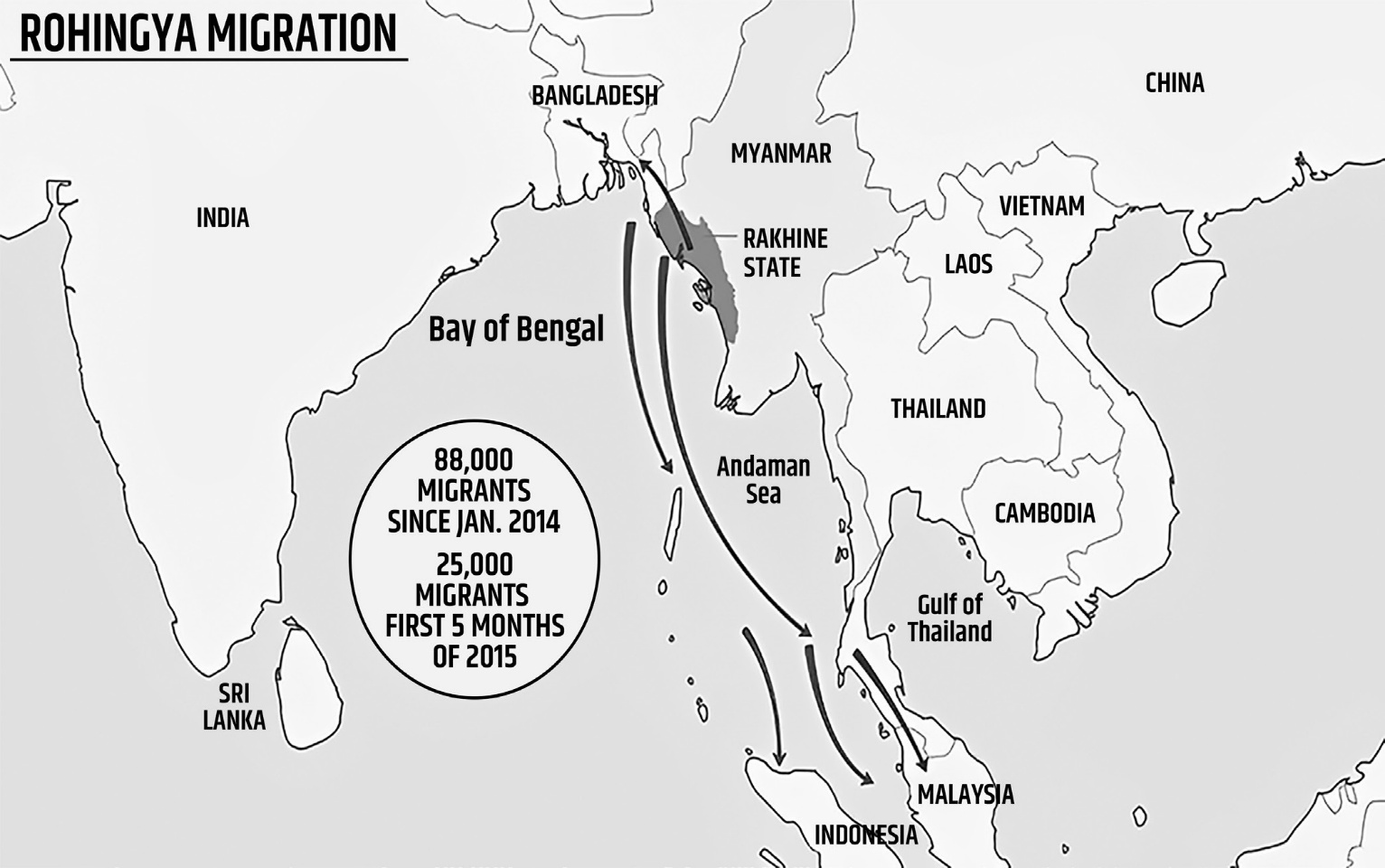
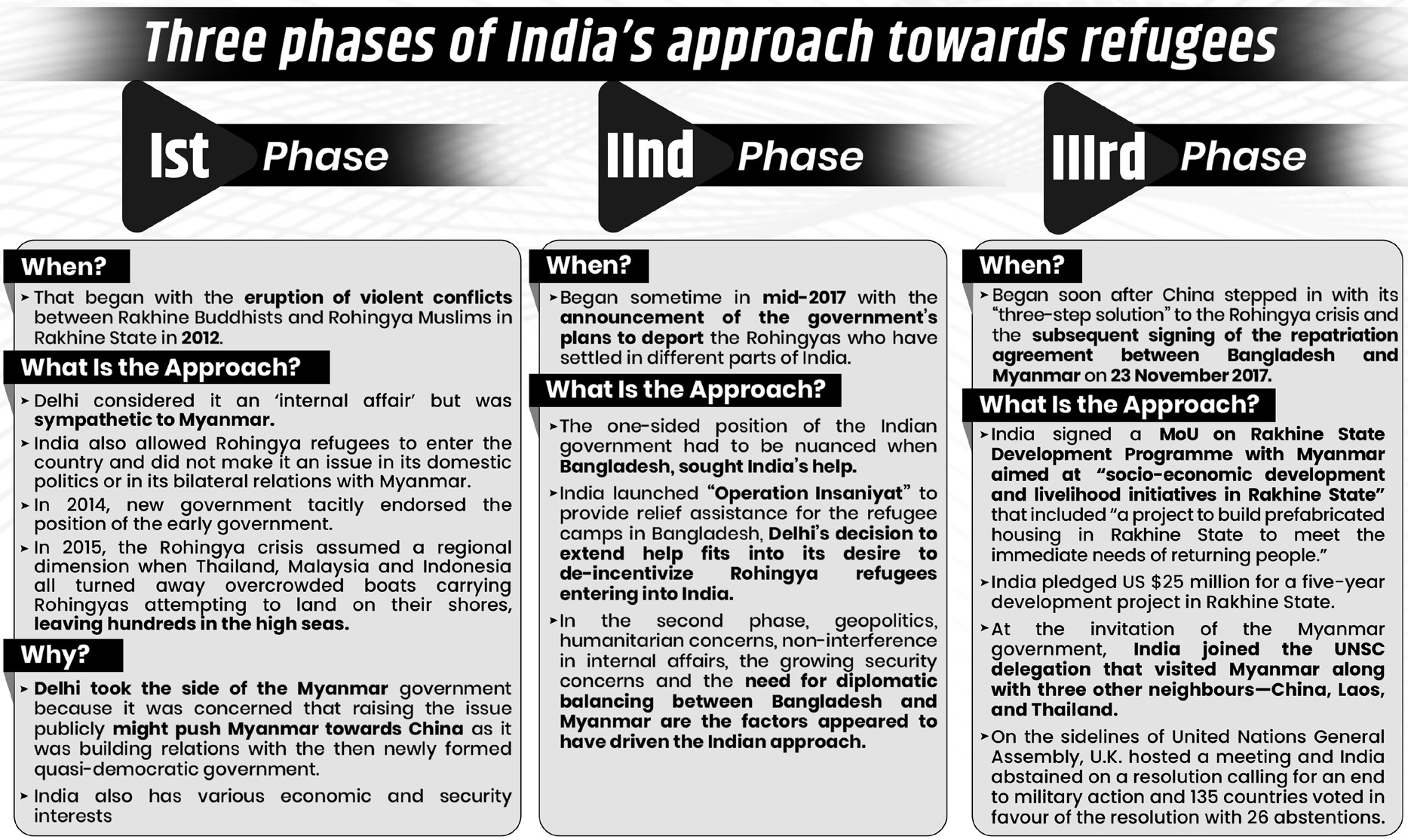
| The Rohingya crisis has raised several questions about India’s approach towards refugees, in general, and the Rohingya, in particular. India’s Rohingya position has two aspects. The first concerns the implications of India’s stand on the Rohingya refugees; The second, how India can play a role in finding a solution to the crisis. In India’s approach towards refugees, three phases are identifiable |
• Their largest and fastest exodus began in August 2017 when violence broke out in Myanmar’s Rakhine State, driving more than 742,000 people to seek refuge in neighbouring countries —the majority of whom were women and children.
Concerns related to Rohingyas refugees in India
• Many refugees live under constant fear of stigmatization due to prevailing anti-refugee sentiments in the country. They also face the risk of deportation and often endure harsh and insecure living conditions.
• Some Rohingyas have reportedly obtained illegal documents, such as Aadhaar cards, with the help of vested interests. This not only raises security concerns but also leads to misuse of Indian resources.
Indo-Bangladesh relations in light of Rohingya issue
• Bangladesh finds itself constrained on resources to provide refuge to Rohingyas fleeing from Myanmar.
• India’s plans to deport Rohingyas are not much appreciated by Dhaka as it could mean more pressure on refugee camps in Bangladesh.
• The Rohingya issue has imposed a huge economic and security burden on Bangladesh.
• India, on its part, published the draft National Register of Citizens in Assam to account genuine Indian citizens residing in Assam and to curb the flow of illegal migrants in the future.
• The Bangladesh Prime Minister requested her Indian counterpart to use his “good relations” with the Myanmar government to facilitate the return of all the refugees (Rohingyas), while appreciating the aid India has given to refugees in Bangladesh as well as 250 homes built for them in Myanmar
AREAS OF CO-OPERATION BETWEEN INDIA AND
BANGLADESH
India’s Economic Assistance to Bangladesh
On the economic assistance side, India has extended a line of credit of US$1 billion to Bangladesh for a range of projects, including railway infrastructure, supply of BG locomotives and passenger coaches, procurement of buses, and dredging projects.
India has stood by Bangladesh in its hour of need with aid worth over Taka 250 crore (over US $ 37 million) to help it cope with natural disasters and floods in 2007-08 including supply of 1,000 MT of skimmed milk powder, and 40,000 MT of rice.
Trade
Bangladesh is India’s biggest trading partner in the subcontinent and India is the second biggest export partner accounting for 12% of the total exports to Bangladesh.
India’s export to Bangladesh stood at US$ 11.37 billion during 2024-25. India’s imports from Bangladesh stood at US$ 2.32 billion during 2024-25
To enable more Bangladeshi exports to flow into India, duty free entry was granted in 2011 under the South Asian Free Trade Area (SAFTA). Also, a Special economic zone (SEZ) in Bangladesh for Indian manufacturing companies has been mooted and notified recently.
Development of Border Haats
The border haats aim at promoting the wellbeing of the people dwelling in remote areas across the borders of two countries, by establishing traditional system of marketing the local produce through local markets.
Currently, four border haats are operational, along the India-Bangladesh border. Two border haats are located in Meghalaya at Kalaichar and Balat and two are located in Tripura at Srinagar and Kamalasagar.
The trade at border haats is permitted to be carried out in Indian Rupees/Bangladesh Taka and on barter basis.
| Connectivity |
Dhaka also has the central role in shaping the future of sub-regional cooperation with Bhutan, Burma, India and Nepal. It is also a land bridge to East Asia and the fulcrum of a future Bay of Bengal community.
The India-Bangladesh Friendship Pipeline connecting Siliguri in West Bengal and Parbatipur in Dinajpur district of Bangladesh, will transport one million Metric Tonnes Per Annum (MMTPA) of High-Speed Diesel to Bangladesh.
A bus service and a train service between Kolkata and Khulna will also be launched as a rail link from Radhikapur in north Bengal.
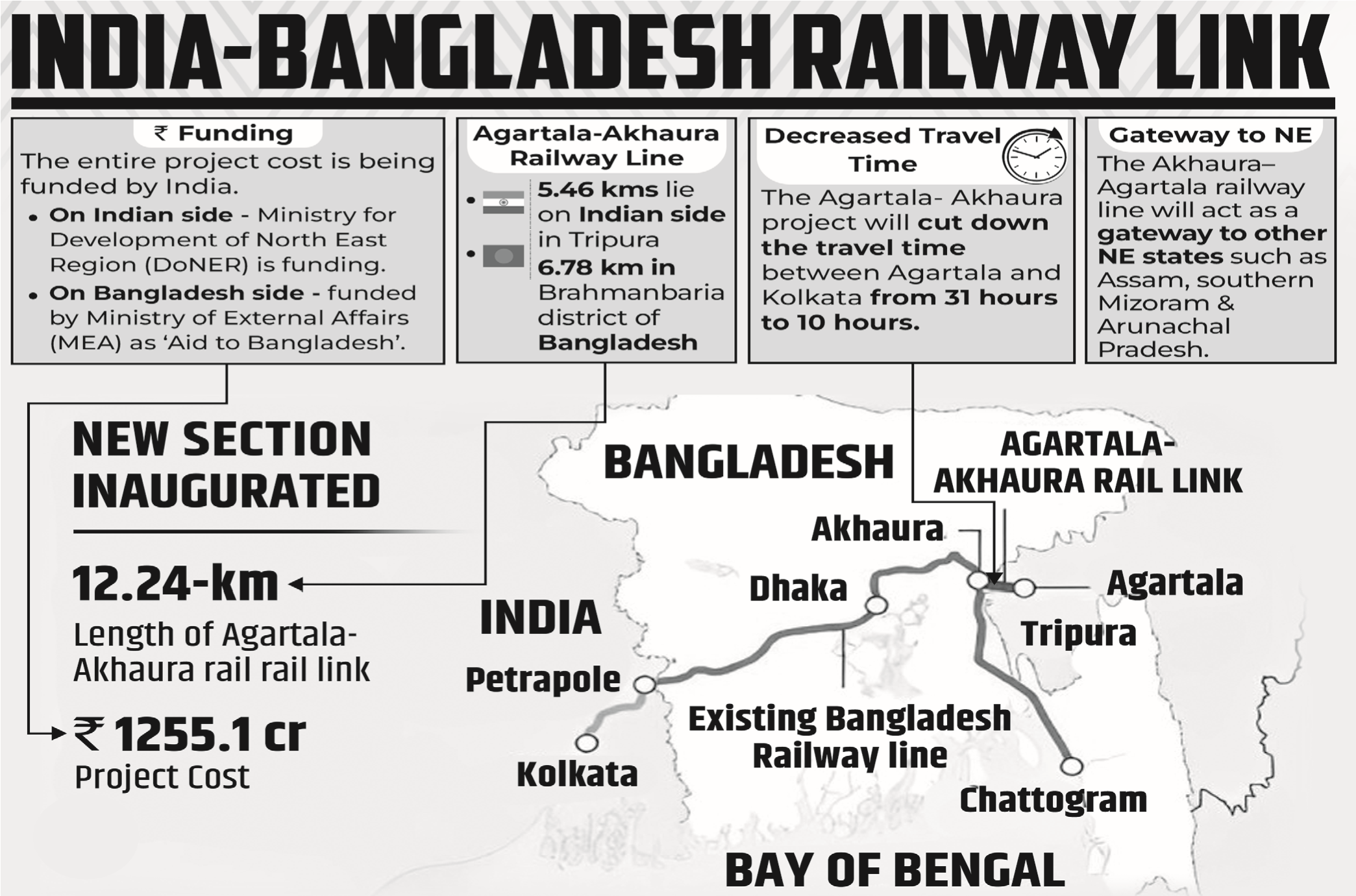
The Padma multipurpose bridge and the Akhaura-
Agartala rail link will dramatically change connectivity within Bangladesh and with India.
Memoranda of Understanding (MoU) has been signed on the development of Ashuganj-Zakiganj stretch of Kushiyara river and Sirajganj-Daikhawa stretch of the Jamuna River to improve connectivity between the two countries and this will help reduce logistics cost of cargo movement to northeast India and also reduce congestion through the Siliguri’s Chicken’s Neck corridor.
Technical Cooperation
Scholarships and training programmes under ITEC,
TCS of Colombo Plan, ICCR, AYUSH, Commonwealth, SAARC and IOR-ARC scholarships/fellowship schemes are being offered to Bangladesh nationals.
India offers 100 slots under ITEC and 35 slots under Technical Cooperation Scheme of Colombo Plan every year to Bangladesh.
Cultural Exchanges
Given the shared history and commonality of language, cultural exchanges form an important bond of friendship between the people of two countries.
Special emphasis has been laid on promotion of exchanges in the fields of music, theatre, art, painting, books, etc.
A bilateral Cultural Exchange Programme (CEP) 20092012 provides the framework for such exchanges.
In February 2024, a 100-person youth group from Bangladesh traveled to India and took part in the "Bali Yatra Festival 2024," which took place in Cuttack, Odisha.
Both the countries celebrate ‘Maitri Diwas’ on 06 December every year since 2021 to commemorate diplomatic ties established in 1971
Indo-Bangladesh Maritime Delimitation Award
Recently, UN tribunal has awarded Bangladesh nearly four-fifths of an area sprawling over 25,000 sq km (9,700 sq miles) in the Bay of Bengal, ending a dispute over a sea border with India.
The verdict, binding on both countries, opens the way for Bangladesh to explore for oil and gas in the Bay of Bengal, the site of important energy reserves.
Energy Cooperation
Energy cooperation between the two sides has also shown a lot of positivity with Indian state Tripura supplying a total of 160 MW of power to Bangladesh in addition to the 500 MW the country is receiving from West Bengal since 2013. Bangladesh has sought extra 100 MW electricity from India to solve its power crisis.
India has also become a partner in Bangladesh’s nuclear power programme, with the beginning of construction at the Rooppur Nuclear Power Plant
India is poised to export around 1100 MW of power to meet the energy deficit in Bangladesh.
Power projects totalling more than 3600 MW are under implementation by Indian companies.
Bangladesh has acknowledged Indian oil corporation ltd as a registered government to supply refined petroleum products.
India and Bangladesh have inaugurated the IndiaBangladesh Friendship Pipeline (IBFP), marking the first cross-border energy pipeline between the two countries. The pipeline, which can transport 1 MMTPA of High-Speed Diesel to Bangladesh, will strengthen peopleto-people linkages and enhance energy cooperation between the two countries. The operationalisation of the Friendship Pipeline will also contribute to Bangladesh's growth, particularly in the agriculture sector.
Cultural cooperation
The Indira Gandhi Cultural Centre (IGCC) in Dhaka plays a significant role in promoting and celebrating the shared cultural ties between the two countries. It conducts training programs in Yoga, Kathak, Manipuri dance, Hindi language and Hindustani classical music.
India organized events on ‘Mujib Borsho’ which is the birth centenary year of Bangladesh’s founder president Sheikh Mujibur Rahman. To honor Mujib Borsho, a commemorative postal stamp was jointly unveiled in 2020.
Earlier in September 2020, Bangladesh issued a stamp commemorating Mahatma Gandhi's 150th birth anniversary.
Bangladesh has proposed renaming the historic route connecting Mujib Nagar and Nodia on the BangladeshIndia border as 'Shadhinota Shorok.' The route has historical significance dating back to Bangladesh's Liberation War.
Defence Cooperation
There are talks that a defence treaty is to be signed between India and Bangladesh, it will be a long-term defence deal that will allow for increased cooperation, information sharing, joint exercises, training etc.
However, India needs to figure out where it can meet Bangladesh’s security concerns, considering that Bangladesh’s largest defence partner is China.
Expanding security cooperation with India could only enhance Dhaka’s global leverage. For India, a strong partnership with Bangladesh will help boost the prospects of peace and prosperity in the Indian subcontinent.
Exercise Sampriti is an important bilateral defence cooperation endeavour between India and Bangladesh.
Regional Cooperation
Both countries not only have a solid bilateral relationship but are also engaged in regional cooperation mechanisms through multilateral forums such as SAARC (South Asian Association for Regional Cooperation), BIMSTEC (Bay of Bengal Multi-Sectoral Technical and Economic Cooperation) and IORARC (Indian Ocean Rim Association for Regional Cooperation), amongst others.
In these forums, both countries share a common outlook pertaining to issues like regional security, connectivity and infrastructure development in the region.
Cyberspace
Bangladesh has provided cyber connectivity between the international gateway at Cox’s Bazar to Agartala for faster Internet connectivity in India’s north-eastern States.
Tourism
Over a million visas are issued to Bangladeshi citizens by India annually. Both countries have signed Revised Travel Arrangement 2018 (RTA 2018) for further liberalizing the visa regime, including enhanced duration for employment and student visas.
Terrorism
Bangladesh has denied support to anti-India insurgent groups, with insurgent leaders handed over to India. This has progressively built trust and confidence between the two neighbours.
INDIA-BANGLADESH LAND BOUNDARY AGREEMENT & 100TH CONSTITUTIONAL AMENDMENT ACT, 2015
The India-Bangladesh Land Boundary Agreement (LBA) and the accompanying 100th Constitutional Amendment Act, 2015, marked a historic resolution to long-standing border disputes between the two nations. Signed on June 6, 2015, during the tenure of Indian Prime Minister Narendra Modi and Bangladeshi Prime Minister Sheikh Hasina, the agreement aimed to streamline and demarcate the land boundary, facilitating a more defined and peaceful border.
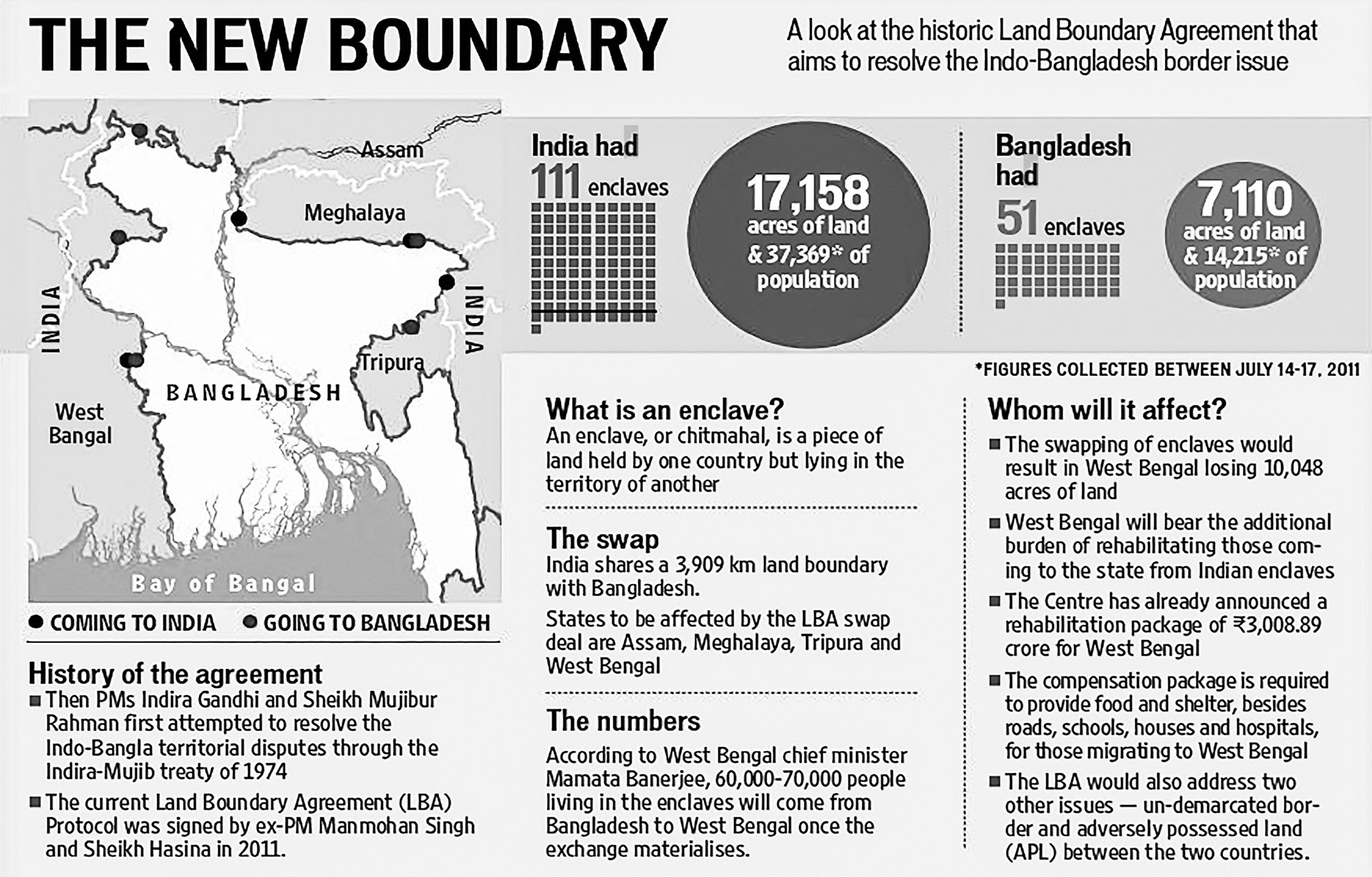
Key points include
Territorial Exchange: The LBA involved the exchange of enclaves and adverse possessions. India transferred 111 enclaves, including Dahagram–Angarpota and 51 enclaves were transferred from Bangladesh to India.
Humanitarian Aspects: The agreement addressed the humanitarian concerns of people residing in enclaves, allowing them to choose their nationality. The enclaves exchanged included significant ones like Teen Bigha, Bekalchhari, and Angarpota.
Challenges Addressed: The LBA resolved the complex issues stemming from the colonial era, providing a more coherent and functional border, reducing the potential for disputes.
100th Constitutional Amendment: The Amendment facilitated the ratification of the LBA, amending the First Schedule of the Constitution to reflect the territorial changes.
Presidential Approval: The amendment received the assent of the President of India, Pranab Mukherjee, and was subsequently passed by the Indian Parliament with overwhelming support.
This landmark agreement and constitutional amendment underscored the commitment of India and Bangladesh to fostering friendly relations and resolving longstanding border issues through diplomatic means.
Recent Developments: (India and Bangladesh)
Maitri setu bridge ?
The Maitri Setu Bridge, inaugurated in March 2021, is a key symbol of friendship and connectivity between India and Bangladesh. Spanning the
Feni River, it links Sabroom in Tripura, India, with Ramgarh in Bangladesh’s Chittagong Hill Tracts. The 1.9 km long bridge facilitates faster movement of goods and people, significantly reducing travel time and transport costs.
For India’s Northeast, the bridge provides access to Bangladesh’s Chittagong Port, located just 80 km from Sabroom, thereby opening new trade and transit opportunities. It is expected to boost crossborder trade, strengthen sub-regional connectivity, and enhance economic integration between the two countries.
The 6th edition of the Conference (2023): It was organised by India Foundation in association with the Ministry of External Affairs of India; Ministry of Foreign Affairs, Government of Bangladesh and S. Rajaratnam School of International Studies, Singapore in Dhaka, Bangladesh. With the theme of “Peace, Prosperity and Partnership for a Resilient Future”, the conference brought together a luminary gathering of key stakeholders to chart the roadmap for strengthening the Indian Ocean Region.

Tripartite electricity trade deal: India, Nepal and Bangladesh are working on a tripartite power trade deal under which Nepal will supply up to 500 megawatts (MW) of hydropower to Bangladesh using India’s transmission line, a move that can further boost crossborder electricity trading in South Asia.
Prime Minister Narendra Modi and his Bangladeshi counterpart Sheikh Hasina jointly inaugurated three Indian-assisted development projects via video conferencing. The three projects are the Akhaura- Agartala Cross-Border Rail Link, Khulna - Mongla Port Rail Line, and Unit - II of the Maitree Super Thermal Power Plant in Rampal, Bangladesh.