Whatsapp 88106-52225 For Details
Get Free IAS Booklet
Get Free IAS Booklet
INTRODUCTION
The Anglo Bhutanese War occurred in 1864, aimed at establishing a trade route to China via Bhutan. The Treaty of Friendship and Cooperation (Treaty of Sinchula) was signed in 1865, allowing free passage of goods and people between British India and Bhutan. The Anglo Chinese Treaty of 1890 marked the boundary demarcation between Sikkim, Bhutan, and Tibet. In 1907, the Wangchuck dynasty was established by Ugyen Wangchuck, who consolidated power after the death of Ngawang Namgyal. The Treaty of Punakha in 1910 marked Bhutan's transition to a Protectorate state under British rule, guiding its foreign and defense policies and thus India-Bhutan relations begin.
When India declared independence in 1947, Bhutan was among the first nations to recognise it. Since then, the relationship between the countries has become stronger, especially because Bhutan also has a historically tense relationship with China.
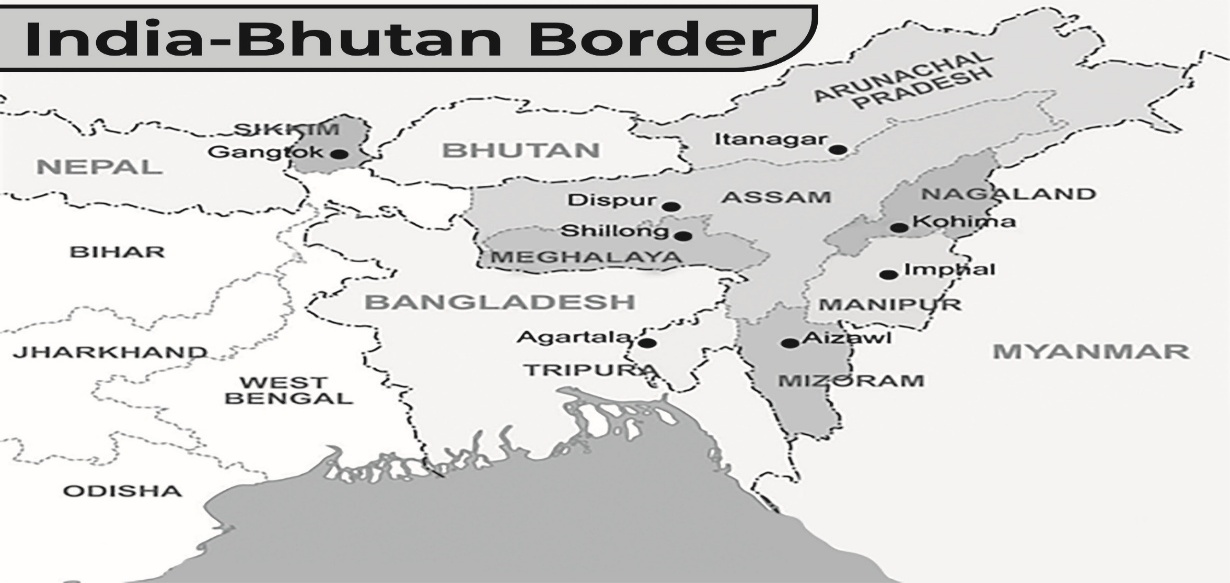
Besides sharing a 699 Kilometres border (Assam 267 km, Arunachal Pradesh 217 km, West Bengal 183 km, Sikim 32 km). India and Bhutan also share deep religioncultural links.
India opened an office of a Special Representative in Thimphu in 1968, Bhutan reciprocated in 1971. The two offices of special representatives were upgraded to fullfledged embassies in 1978.
The basis for bilateral relations between India and Bhutan was formed by the Indo-Bhutan Treaty of Peace and Friendship of 1949.
INDO-BHUTAN TREATY OF PEACE AND FRIENDSHIP, 1949
The Treaty provides for, among other things, perpetual peace and friendship, free trade and commerce and equal justice to each other’s citizens.
In 2007 the treaty was re-negotiated, and provisions were included to encourage Bhutan’s sovereignty, abolishing the need to take India’s guidance on foreign policy.
The updated treaty, besides providing close cooperation on national issues, provides for stronger cooperation in cultural and economic fields.
The new treaty says that Bhutan can import arms as long as Indian interests are not harmed and there is no re-export of the weapons, either by the government or individuals
INDIA-BHUTAN FRIENDSHIP TREATY
Article 1: There shall be perpetual peace and friendship between India and Bhutan.
Article 2: Close cooperation with each other on issues relating to their national interests. Neither Government shall allow the use of its territory for activities harmful to the national security and interest of the other.
Article 3: Full cooperation and assistance to each other in the matter of trade and commerce.
Article 4: Bhutan can import arms as long as Indian interests are not harmed and there is no re-export of the weapons, either by the government or individuals.
Article 5: Bhutanese subjects residing in Indian territories shall have equal justice with Indian subjects, and that Indian subjects residing in Bhutan shall have equal justice with the subjects of the Government of Bhutan
Article 6: The extradition of persons wanted by either state for crimes and for unlawful activities affecting their security.
Article 7: The Government of Bhutan and the Government of India agree to promote cultural exchanges and cooperation between the two countries.
Article 8: The Government of Bhutan and the Government of India agree to continue to consolidate and expand their economic cooperation for mutual and long-term benefit.
Article 9: Any differences and disputes arising in the interpretation and application of this Treaty shall be settled bilaterally by negotiations in a spirit of trust and understanding in consonance with the historically close ties of friendship and mutually beneficial cooperation that form the bedrock of Bhutan-India relations.
Article 10: This Treaty shall come into force upon the exchange of Instruments of Ratification by the two Governments which shall take place in Thimphu within one month of the signing of this Treaty. The Treaty shall continue in force in perpetuity unless terminated or modified by mutual consent
BHUTAN’S SIGNIFICANCE TO INDIA

AREAS OF COOPERATION
Trade:
Trade between India and Bhutan is governed by the India-Bhutan Trade and Transit Agreement of 1972, which was last renewed in November 2016.
This agreement establishes a free trade regime between the two nations and ensures duty-free transit of Bhutanese exports to third countries.
As a source of imports and a destination for exports, India has always been Bhutan's major commercial partner.
From USD 484 million in 2014–15 to USD 1744.44 million in 2024–25, India's trade with Bhutan has nearly tripled since 2014, making up around 80% of Bhutan's total trade.
Over 55% of all foreign direct investment (FDI) in Bhutan comes from India, which continues to be the country's top investment source
India’s major exports to Bhutan include mineral products, machinery and mechanical appliances, and electrical equipment, while Bhutan primarily exports electricity, ferrosilicon, and Portland cement to India.
Economic Assistance
India is Bhutan's primary development partner. Since the launch of Bhutan's First Five-Year Plan in 1961, India has been providing financial assistance to support the country's FYPs. For Bhutan's 12th FYP, India allocated Rs 4500 crore.
India has reaffirmed its commitment to supporting Bhutan's socio-economic development, with a particular emphasis on the 13th FYP.
India allocated Rs 2288.55 Crore to Bhutan in Budget 2026-27
The Bhutanese currency, the Ngultrum (Nu.), is officially pegged to the Indian Rupee (Rs.).
Additionally, India has granted Bhutan duty-free transit for trade with third world countries.
Diplomatic Cooperation
Frequent visits by top government officials from both India and Bhutan have become a long-standing tradition. For instance, in 2014, India’s Prime Minister chose Bhutan as his first foreign destination after taking office.
India also sends foreign service officers to Bhutan to ensure strong diplomatic ties between the two countries.
Bhutan is a founding member of the South Asian Association for Regional Cooperation (SAARC) and is also part of other important international organizations such as BIMSTEC, the World Bank, the IMF, and the Group of 77, among others.
Water Resources
India plays a key role in the development of hydropower projects in Bhutan, providing the country with electricity for domestic use while generating revenue from the export of surplus electricity to India.
Indo-Bhutan hydropower cooperation began in 1961 with the signing of the Jaldhaka Agreement. The Jaldhaka project, located on the Indian side of the Indo-Bhutan border in West Bengal, produced most of its power for export to southern Bhutan.
India has built three major hydroelectric projects in Bhutan, with a combined capacity of 1,416 MW: the 336 MW Chukha HEP, the 60 MW Kurichhu HEP, and the 1,020 MW Tala HEP. Hydropower exports account for over 40% of Bhutan’s domestic revenue and make up about 25% of its GDP.
Currently, three new Inter-Government (IG) model hydroelectric projects are under construction: the 1,200 MW Punatsangchu I, the 1,020 MW Punatsangchu II, and the 720 MW Mangdechhu.
This cooperation is governed by the 2006 Agreement on Cooperation in Hydropower. Under a protocol to this agreement, India has committed to helping Bhutan develop at least 10,000 MW of hydropower capacity and to import surplus electricity by 2020.
Additionally, India and Bhutan have established a Joint Group of Experts (JGE) to address flood management concerns.
Border Management
There is a Secretary-level mechanism on border management and security related matters between the two countries.
There is also a Border District Coordination Meeting (BDCM) Mechanism between the bordering States and the Royal Government of Bhutan (RGoB) to facilitate coordination on border management and other related matters.
Educational and Cultural Cooperation
A large number of colleges going Bhutanese students’ study in India. Government of India provides number of scholarships to Bhutanese students.
Regular cultural exchanges take place between the two countries. One of the basic objectives of India Bhutan Foundation established in 2003 is to enhance people to people exchange in cultural field.
Nehru-Wangchuck Cultural Centre was established at Thimphu on 21st September 2010.
Indian Community
About 60,000 Indian nationals live in Bhutan, employed mostly in the hydro-electric power construction and road industry.
In addition, around 8000-10,000 daily workers enter and exit Bhutan every day in border towns.
Environment Cooperation
India is considering involving Bhutan in National Mission for Sustaining the Himalayas. The project aims at protecting the Himalayan ecosystem that has been endangered by numerous ecological problems.
Election Commissions
The Election Commission of India (ECI) maintains a strong collaboration with the Election Commission of Bhutan in the area of election management.
This partnership was formalized through a Memorandum of Understanding (MoU) in 2006, which was renewed in September 2011 for five years. A new MoU was signed in New Delhi in January 2019, continuing the collaboration for another five years.
Officials from the Election Commission of Bhutan, including Dzongdas (District Collectors) and other district officials, have visited India to observe various state and local elections. India has provided comprehensive assistance to Bhutan in developing its election laws.
The Government of India also granted Rs 47.506 million to the Royal Government of Bhutan to facilitate the procurement of electronic voting machines from India.
Additionally, the Election Commission of India actively engages with the Election Commission of Bhutan through regional and global platforms such as the Forum of Election Management Bodies of South Asia (FEMBoSA), the Association of World Election Bodies (A-WEB), and the Association of Asian Election Authorities (AAEA).
India-Bhutan Foundation (IBF)
India-Bhutan Foundation was established in August 2003 during the visit to India of the present King and the then Crown Prince with the aim to enhance people to people exchanges in the focus areas i.e. education, cultural exchanges and environment preservation.
Ambassadors of Bhutan and India are the co-Chairpersons of India- Bhutan Foundation. GoI has contributed Rs. 16 crore as main corpus amount for IBF with a matching contribution from RGoB.
New Areas of Cooperation
Space: The Prime Minister of Bhutan extended his heartfelt congratulations and gratitude to the Indian Prime Minister for launching the South Asian Satellite. This satellite has been instrumental in helping Bhutan connect with its people via the Bhutanese Broadcasting Corporation, support educational initiatives, and respond to disasters. India has also committed to providing additional bandwidth and transponders to Bhutan.
Education: Educational institutions in Bhutan are collaborating with prestigious Indian institutions like the IITs and NITs. Currently, around 4,000 Bhutanese students are pursuing their studies in India. India continues to invite Bhutanese students to not only study Buddhism but also explore fields such as science and technology.
Defense: The Bhutanese Army follows the training standards of the Indian Army, with all its officers and personnel receiving training at India’s National Defence Academy, Indian Military Academy, and Officer Training Academy. Additionally, India is considering supplying weapons to Bhutan.
CHALLENGES IN RELATIONSHIP
There is a growing feeling in Bhutan that India’s development of Bhutan’s hydropower production is driven by self-interest as it is getting Bhutan’s surplus power at relatively cheap rates.
Also, Bhutan wants to increase its export power tariff to India that is complained for being lesser than its cost of production
Bhutan’s concern regarding profitability of its Hydropower projects in the wake of India’s shift to renewable sources of energy like wind, solar etc..
From internal security perspective, illicit establishment of camps by militant outfits in the dense jungles of southeast Bhutan is a cause of concern for both the nations.
The Motor Vehicles Agreement that was signed in 2015 involving Bangladesh, Bhutan, India and Nepal (BBIN) was blocked by Bhutan’s upper house citing environmental concerns.
India has been occasionally complained by Bhutan for meddling in its internal affairs. This has led to negative perception of India in the minds of Bhutanese.
Growing and unsustainable trade imbalance in favour of India. Bhutan’s trade deficit is set to worsen as India’s Good and Services Tax (GST) taxes makes its exports to Bhutan cheaper and imports from Bhutan more expensive.
Bhutan has been taken as safe haven by insurgent elements like National Democratic Front for Bodoland (NDFB), United Liberation Front of Assam (ULFA) militants and Kamtapur Liberation Organization (KLO) that often pose threat to internal peace and security in the northeast region of India.
Issues with Hydropower projects
Bhutan alleged that India wanted greater role in management on Joint venture Hydro projects in Bhutan. Most of the time this compromises the interest of Bhutan.
Cross Border Trade of Electricity (CBTE) issued by power ministry will establish the monopoly of India being Bhutan’s sole power market. It restricts the type of hydro power investments that could be made in Bhutan.
CHINA’S INFLUENCE ON INDIA BHUTAN RELATIONS
There has been distancing in Indo-Bhutan relations because of China.
Revised friendship and cooperation treaty have the potential for China to have inroads in Bhutan’s internal affairs and foreign policy.
Bhutan has problems like high rates of unemployment and national debt. This can be a source for an economically strong China to exert its influence.
China has not sorted out its border problems, with both India and Bhutan. Doklam incident is an example. In 2017, in Doklam (a disputed region between China and Bhutan), China started constructing a road in the Bhutanese area.
By constructing the road, China came close to the Chumbi Valley i.e. the Chicken’s Neck and Siliguri Corridor, thereby bringing the region under their artillery range.
After India’s intervention, China after 73 days, stopped
STEPS TAKEN TO BOOST RELATIONS
• There is a frequent visit of state heads to boost the relation. PM Narendra Modi paid his first visit to Bhutan after assumption of office.
• India announced assistance for establishment of an E-Project covering all the 20 districts of Bhutan. An e-project is any initiative that involves the design, implementation, and use of ICT applications for institutional or organizational purposes.
• The Prime Minister coined the idea of B2B as ‘Bharat to Bhutan’ for building effective and renewed bilateral relationship.
• Bhutan recently became the largest beneficiary of India’s foreign aid.
• A 1,000 strong Indian Military Training Team (IMTRAT) is permanently based in western Bhutan to train the Royal Bhutan Army while other units regularly cooperate with the Royal Bhutan Army.
INDIA’S VISIT TO BHUTAN
• The two countries also signed 10 MoUs in the fields of space research, aviation, IT, power and education.
• The leader of both countries unveiled an e-plaque on the interconnection between India’s National Knowledge Network and Bhutan’s Druk Research and Education Network.
• An additional $100 million will be available to Bhutan under India’s standby swap arrangement to meet the foreign exchange requirement.
Key Takeaways
• The biggest thing is the broad basing of bilateral arrangements.
• 720 MW Mangdechhu Hydroelectric Plant has been inaugurated.
• There was a concrete recognition that both the countries have shared security interests and there will be mutual coordination in matters affecting each other’s national and security interests.
• Another important element was the launching of the RuPay card which would reduce the need for foreign exchange.
• The Ground Earth Station of the South Asian Satellite, constructed with the support of the Indian Space Research Organisation (ISRO), was inaugurated in Thimphu.
• India announced the increase in scholarships for Bhutanese students for studies at Nalanda University from 2 to 5.
Recent Developments
• India & Bhutan plan to set up first Integrated Check Post along border near Jaigaon.
• Recently, China has claimed the Sakteng sanctuary, which is on Bhutan’s east.
• King Jigme Khesar Namgyel Wangchuck’s State Visit to India in 2023: This visit further strengthened bilateral ties, with leaders discussing cooperation in hydropower, trade, border management, and regional connectivity.

Way Forward
• India can assist Bhutan in boosting its economy by investing in infrastructure development, tourism, and other sectors, fostering self-reliance and employment opportunities. Cultural exchange programs can promote understanding and appreciation of each other's cultures, art, music, and literature. A visa-free movement can strengthen sub-regional cooperation. Strategic cooperation between India and Bhutan can address shared security concerns, such as terrorism and drug trafficking, and work together to combat transnational crimes