India-central Asia Relations
INDIA-CENTRAL ASIA RELATIONS
INTRODUCTION
• Central Asia consists of five countries (Kazakhstan Kyrgyzstan, Tajikistan, Turkmenistan, Uzbekistan) collectively known as Central Asian Republics (CAR).
• All five nations became independent after the collapse the USSR in 1991.
• Geographic location of these countries makes them a bridge between different regions of Asia and between Europe and Asia.
• Central Asian countries have powerful Presidencies with authoritarian to semi-authoritarian regimes.
• Press and political opposition are mostly ineffective. Democracy is yet to take roots.
HISTORICAL TIES WITH CENTRAL ASIA
• India has had historical ties with Central Asia dating back to the 3rd century B.C., as the region lay along the legendary Silk Route.
• The Silk Route not only facilitated the transport of goodslike silk, textiles, and spices but also played a crucial role in the exchange of ideas, religion, and philosophy.
• Buddhism spread across several Central Asian cities such as Merv, Khalachayan, Tirmiz, and Bokhara, where it was represented by stupas and monasteries.
• In 1526, Babur, hailing from the fertile Fergana Valley (the food bowl of Central Asia), journeyed to the dusty town of Panipat, where he established the powerful Mughal Empire in India.
• Prominent figures like Amir Khusrau, Dehlawi, Al Biruni, and Abdur Rahim Khan-i-Khanan, who had Central Asian roots, made their mark in India.
• During the Soviet era, cultural ties—through music, dance, films, and literature—brought the Soviet republics and India closer. Iconic Indian stars like Raj Kapoor and Nargis became household names, endearing India to the hearts of the region's people.
• However, bilateral relations experienced significant neglect in the 25 years following the independence of these Central Asian countries in 1991.
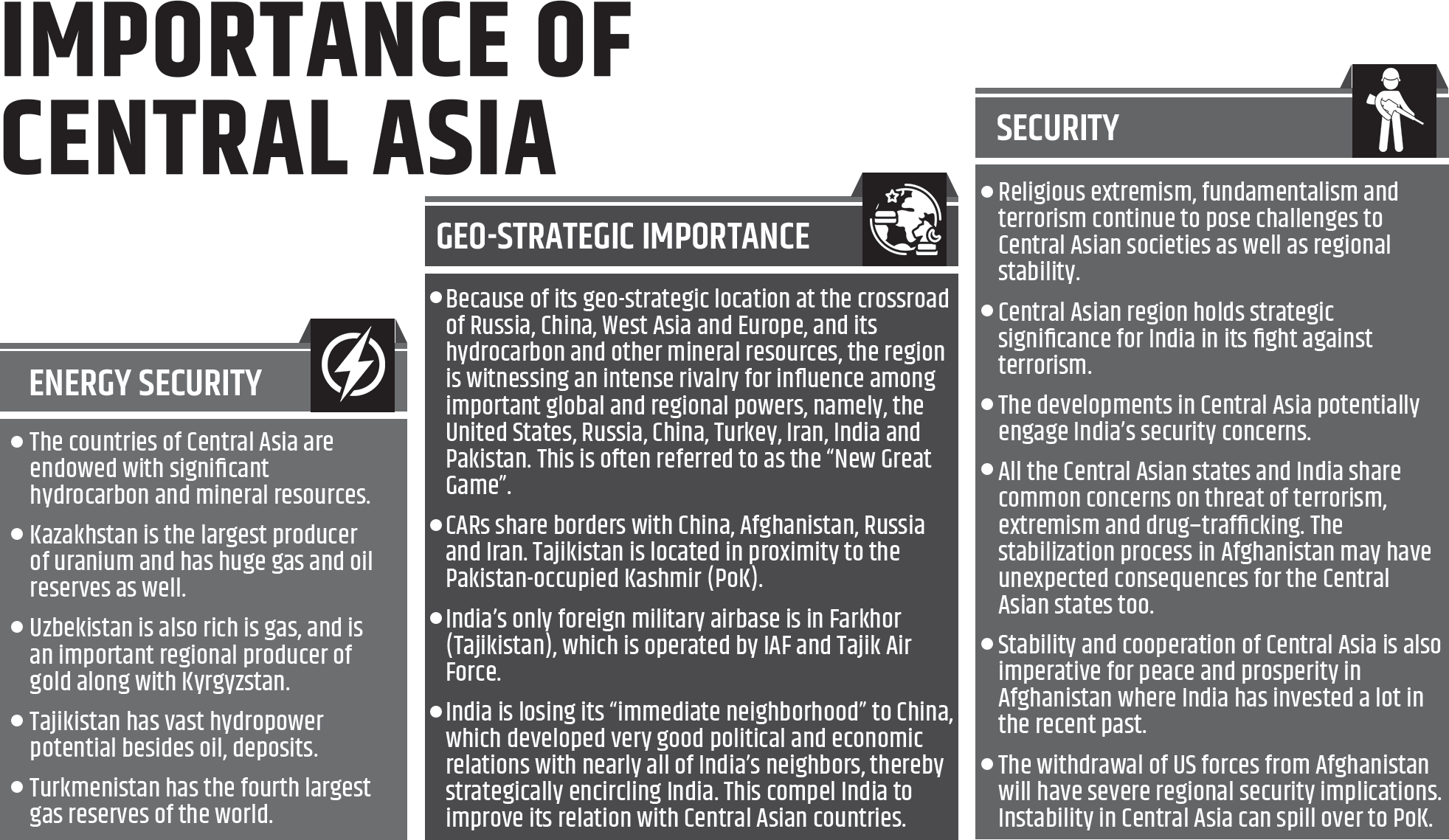
Increasing multilateral engagement with Central Asian partners
Establishing long-term energy partnerships
Expanding cooperation in the medical field, which holds significant potential, among other areas.
India-Central Asia Dialogue
External Affairs Minister, Dr S. Jaishankar will host the Foreign Ministers of the Republic of Kazakhstan, the Kyrgyz Republic, the Republic of Tajikistan, Turkmenistan and the Republic of Uzbekistan for the 4th meeting of the India-Central Asia Dialogue in New Delhi on 6 June 2025.
Outcomes:
Condemned Pahalgam attack and called for early adoption of UN Comprehensive Convention on International Terrorism.
Expressed joint interest in exploration and investment in rare earths; Second India-Central Asia Rare Earth Forum to be convened soon.
Emphasized optimum use of INSTC and Chabahar Port; supported Uzbekistan and Turkmenistan’s entry into INSTC.
Agreed on enhancing digital payment systems, interbank cooperation, and trade in national currencies.
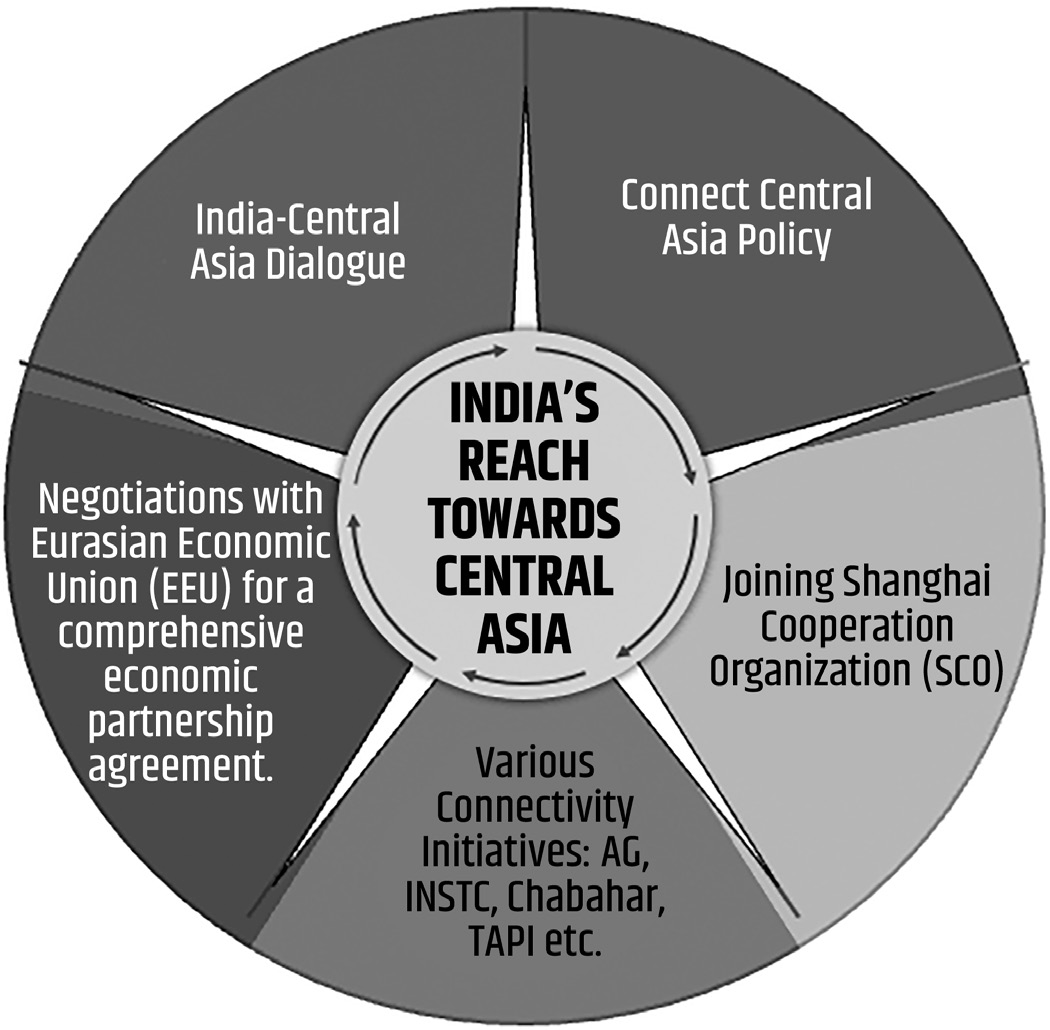
Joining Shanghai Cooperation Organisation (Sco)
On 9 June 2017, at the historic summit in Astana, India and Pakistan officially joined SCO as full-fledged members.
India’s Connect Central Asia Policy
• India's Connect Central Asia policy is a comprehensive approach that encompasses political, security, economic, and cultural ties.
• Launched in 2012.
• Key elements of India’s Connect Central Asia strategy include:
• Strengthening political relations
• Enhancing strategic and security cooperation
• CONNECTIVITY INITIATIVES
• India has registered significant progress recently through renovation of Chabahar port, development of the International North-South Transport Corridor (INSTC) and becoming a member of Ashgabat Agreement.
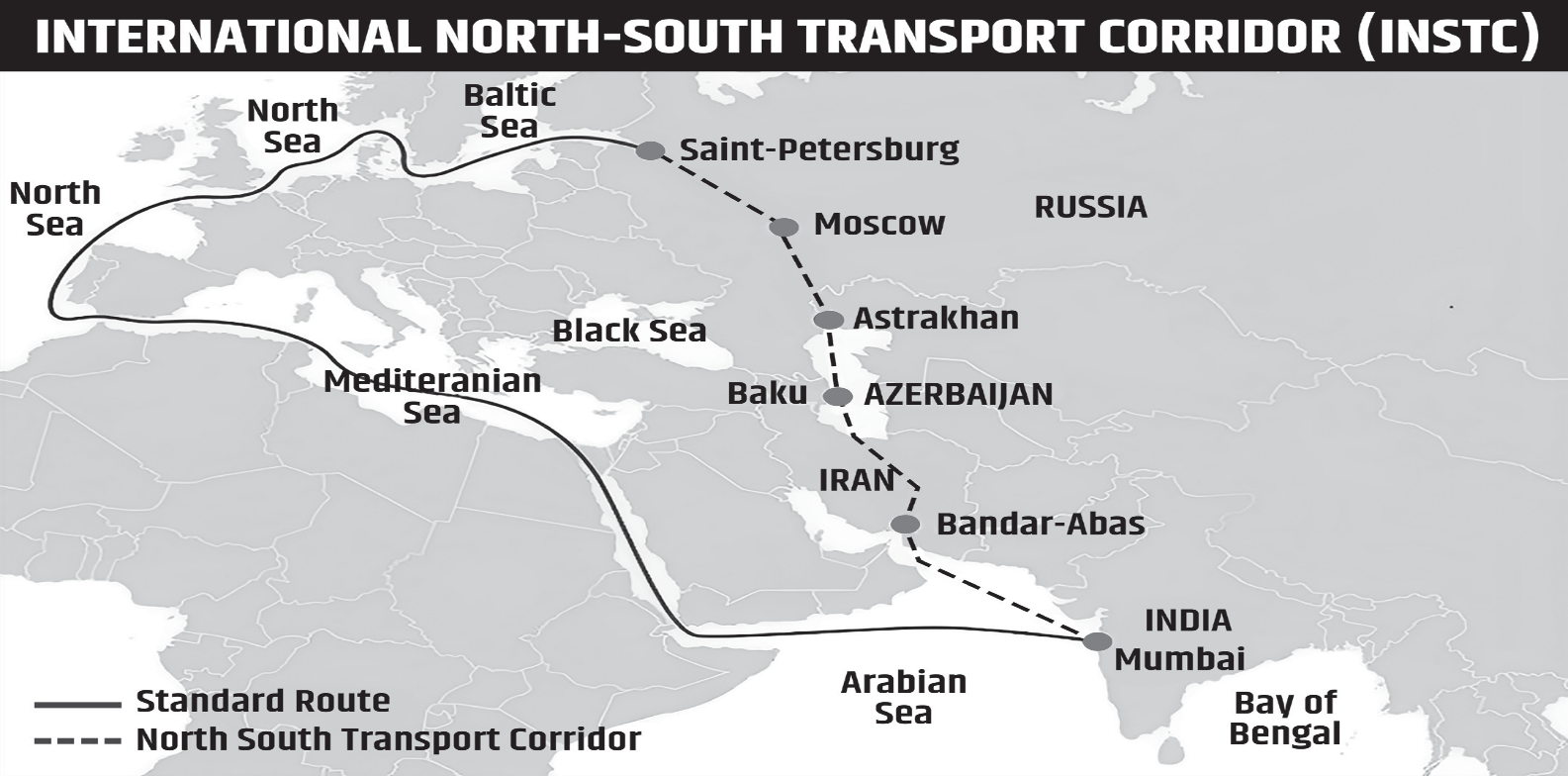
International North-South Transport Corridor (INSTC)
• The International North-South Transport Corridor (INSTC) is a multi-modal transportation network established on September 12, 2000, in St. Petersburg by Iran, Russia, and India to promote transportation cooperation among its member states.
• This corridor connects the Indian Ocean and the Persian Gulf to the Caspian Sea via Iran, and extends to St. Petersburg and Northern Europe through Russia.
• The INSTC has since expanded to include eleven newmembers: Azerbaijan, Armenia, Kazakhstan, Kyrgyzstan, Tajikistan, Turkey, Ukraine, Belarus, Oman, Syria, and Bulgaria (as an observer).
• Ashgabat Agreement
• The Ashgabat Agreement is a multimodal transport agreement between the governments of Kazakhstan, Uzbekistan, Turkmenistan, Iran, Pakistan, India, and Oman.
• The agreement aims to facilitate the transit and transportation of goods between Central Asia and the Persian Gulf.
• India’s accession to the Ashgabat Agreement enhances its connectivity options with Central Asia, positively impacting trade and commercial relations with the region. After receiving approval from the Union Cabinet for India’s accession, India deposited the Instrument of Accession with Turkmenistan in April 2016.
• Initially signed on April 25, 2011, by Iran, Oman, Qatar, Turkmenistan, and Uzbekistan, Qatar withdrew from the agreement in 2013. That same year, Kazakhstan applied for membership, which was approved in 2015. 0
• Pakistan also joined the agreement in November 2016.
India formally joined in February 2018.
Indian Plans: For enhanced connectivity, the Ashgabat Agreement will also synchronize with the International North–South Transport Corridor (INSTC).
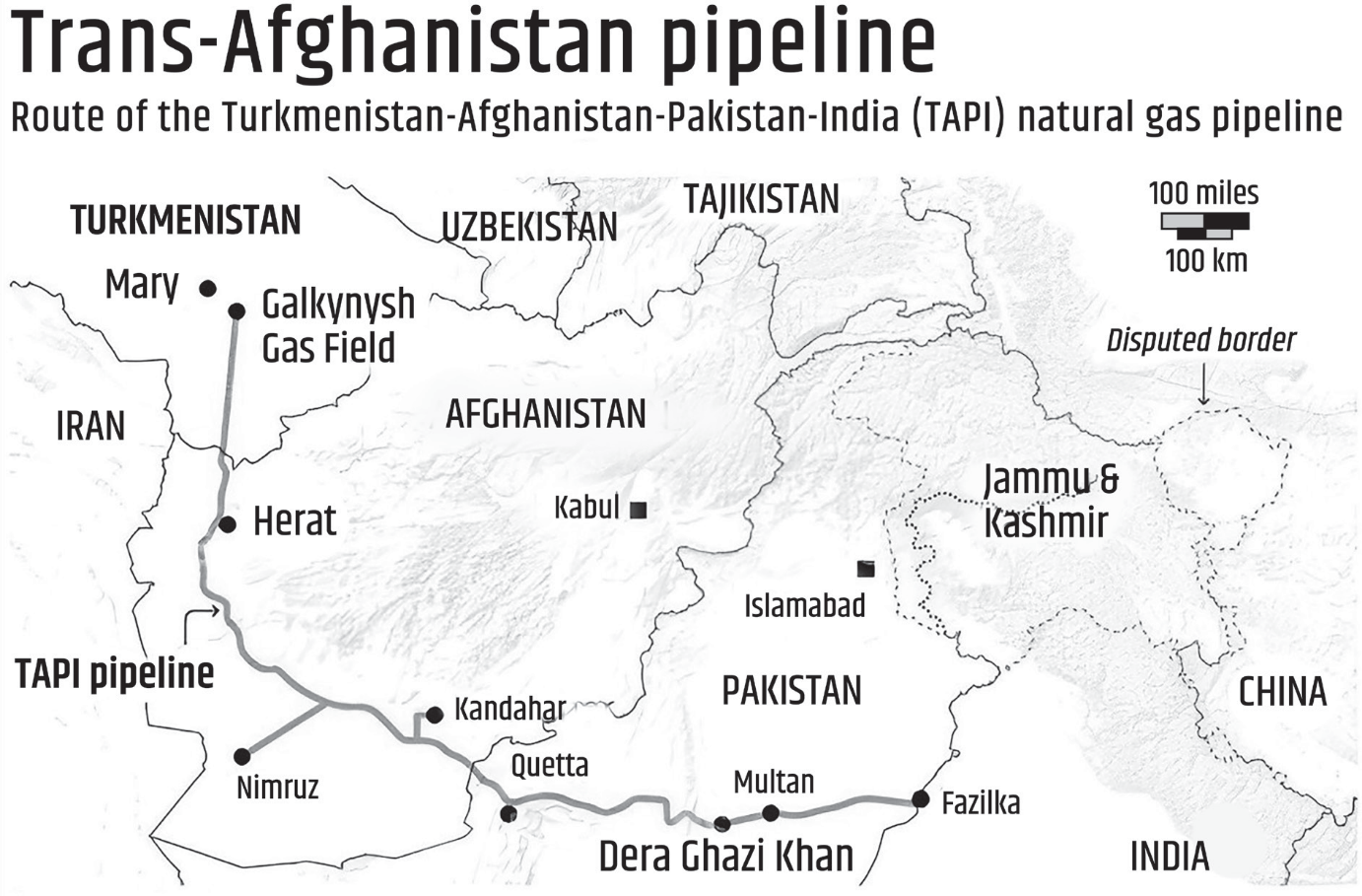
Turkmenistan-Afghanistan-Pakistan-India (TAPI) pipeline
• The Turkmenistan-Afghanistan-Pakistan-India (TAPI) pipeline will be a 1,814km trans-country natural gas pipeline running across four countries. Also known as the Peace Pipeline and Trans-Afghanistan Pipeline, the TAPI pipeline will begin in Turkmenistan and traverse Afghanistan to enter Pakistan and India.
• The TAPI gas pipeline will transport gas produced from the Galkynysh gas field in Turkmenistan to Afghanistan, Pakistan and India.
• The TAPI project is being funded by the Asian Development Bank (ADB), which is also acting as transaction adviser for the development.
INDIAN SYNERGY IN CENTRAL ASIAN REGION
Central Asia is facing many challenges in food security; Indian expertise in the field can be a game changer in the region.
Commercial farming is another important area where India and CARs can cooperate.
India’s experience in boosting food and milk production and modernizing Agro-techniques under the green and white revolution can prove a panacea for Central Asia.
Good relations with India will provide an assured market to these countries for their energy, raw materials, oil and gas, uranium, minerals, hydroelectric power etc.
India can significantly bring in lots of foreign investment along with technical expertise in field of infrastructure, hospitality, medical etc.
CHALLENGES
• There are obstructions of physical connectivity due to Pakistan’s hostility and Afghan instability for its desultory attitude towards Central Asia. India’s current trade volume with Central Asia is minimal, and cannot be increased without substantially improving transport connectivity.
• Politically, the Central Asian republics are highly fragile and also face threats like terrorism, Islamic fundamentalism etc. making the region a volatile and unstable market.
• There are several administrative laggards in the region such as non-availability of hard currency, banking services, and prevailing corruption creating roadblocks in smooth bilateral relations.
• India’s “Look East” policy has resulted in concentrating its economic and diplomatic resources in Southeast and East Asia.
• Involvement of China in Central Asia in form of and Road Initiative while posing opportunity by giving easy access to India in the region, it can significantly undermine India’s influence in the region.
Porous border and unbridled corruption along with the proximity with regions of soaring opium (Golden Crescent and Golden Triangle) makes the region a powerhouse for drug and money trafficking.
WAY FORWARD
India should be fully mindful of its historic Silk Route ties with Central Asia, and try to make an entry into the largely untapped energy potential of the region.
India needs to use its instrument of economic leverages
more efficiently to build closer ties with Central Asia.
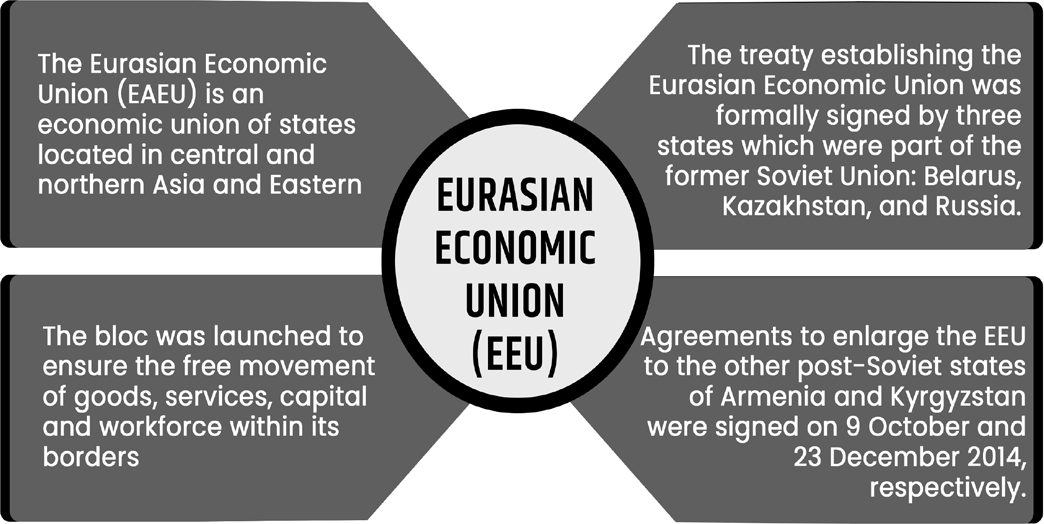
‘Connect Central Asia’ Policy is a very comprehensive policy which includes political, security, economic and cultural cooperation.India should make efforts to step up multilateral engagement with Central Asian partners using the synergy of existing forums like the SCO, Eurasian Economic Community (EEC) etc.
Measures such as relaxing of visa regimes, establishing schools and universities; strengthening tourism; Investment in agriculture sector can significantly improve India’s position in the region.
Growing synergies between the India and CAR will promote security, stability, economic growth and development of all countries.