Whatsapp 88106-52225 For Details
Get Free IAS Booklet
Get Free IAS Booklet
INDIA-EUROPEAN UNION
INTRODUCTION
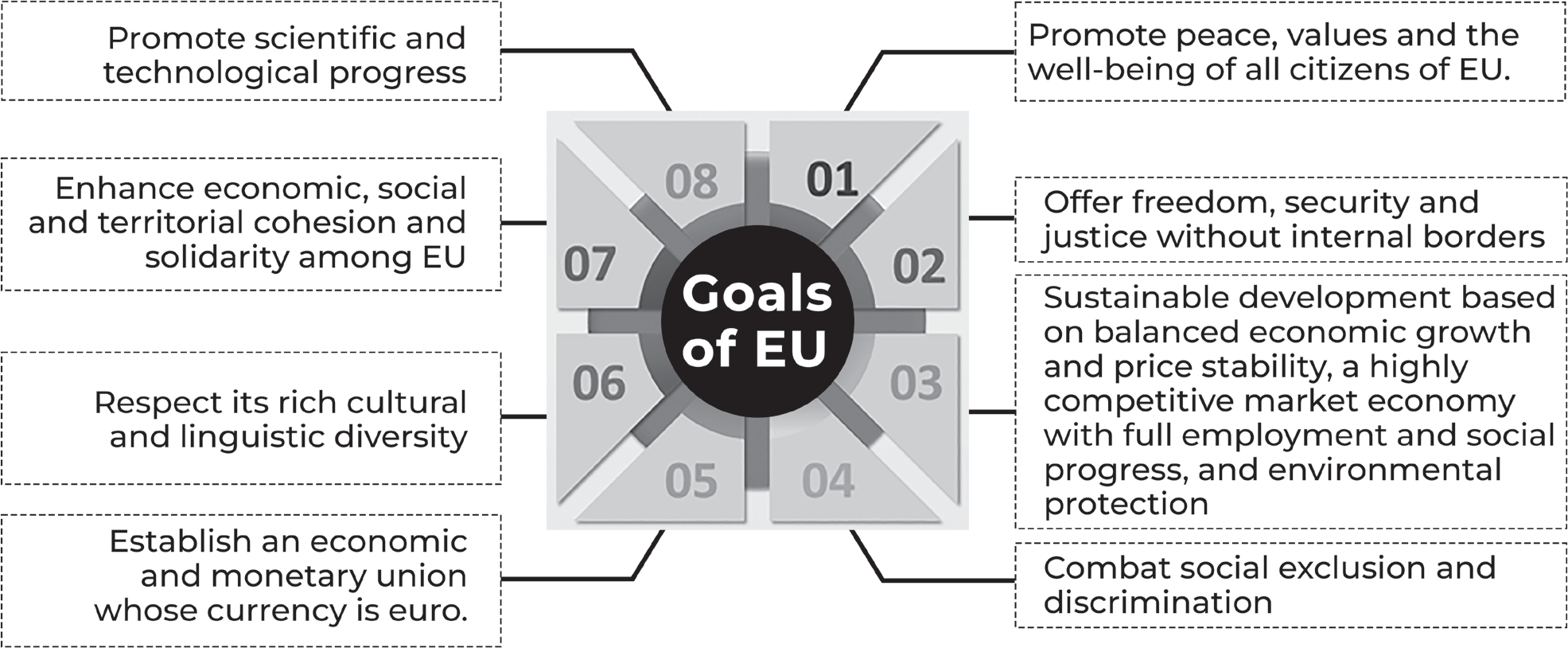
• The European Union (EU) is a political and economic union of 27 countries that function as a cohesive bloc.
• Of these, 20 countries use the euro as their official currency, while 7 EU members—Bulgaria, Czech Republic, Denmark, Hungary, Poland, Romania, and Sweden—do not. The EU was born out of the desire to create a unified European political entity to prevent the recurring wars between European nations, a legacy of centuries of conflict that culminated in the devastation of World War II.
• Over time, the EU has developed a single internal market, underpinned by a standardized legal framework that applies across all member states in areas where they have agreed to act collectively
HISTORY of EU
• After World War II, European integration was viewed as a solution to the excessive nationalism that had ravaged the continent.
• In 1946, at the University of Zurich in Switzerland, Winston Churchill advocated for the creation of a "United States of Europe."
• In 1952, the European Coal and Steel Community (ECSC) was established under the Treaty of Paris (1951) by six founding countries—Belgium, France, Germany, Italy, Luxembourg, and the Netherlands. These nations agreed to share their coal and steel production in a common market, thereby surrendering part of their sovereignty.
• Alongside the ECSC, the European Court of Justice was established in 1952 under the Paris Treaty. Until 2009, it was known as the "Court of Justice of the European Communities."
• The European Atomic Energy Community (EAEC or Euratom) is an international organization established by the Euratom Treaty in 1957. Its original goal was to create a specialized market for nuclear power in Europe by advancing nuclear energy development and distributing it among member states, while also selling any surplus to non-member states.
• Euratom shares its membership with the European Union and is governed by the European Commission (EC) and the Council, operating under the jurisdiction of the European Court of Justice.
• The European Economic Community (EEC) was created by the Treaty of Rome in 1957. Its primary aim was to promote economic integration, including establishing a common market and customs union, among the six founding members.
• The EEC ceased to exist under the Lisbon Treaty of 2007, with its functions being incorporated into the European Union.
• The 1965 Merger Treaty, signed in Brussels, brought together the three communities—the ECSC, EAEC, and EEC—into a single institutional framework, forming the European Communities (ECs).
• The Commission and Council of the EEC were to take over the responsibilities of its counterparts (ECSC, EAEC) in other organisations.
• The Schengen Agreement of 1985 laid the foundation for the creation of open borders, allowing most member states to eliminate passport controls. This system was fully implemented in 1995.
• The Single European Act of 1986, enacted by the European Community, set a timeline for economic integration among member countries. It also paved the way for a single European currency, alongside the establishment of common foreign and domestic policies.
• The Maastricht Treaty, signed on February 7, 1992, further advanced European integration. This treaty, also known as the Treaty on European Union, was significantly influenced by the end of the Cold War and marked a major step in the creation of the European Union, incorporating the European Communities (ECSC, EAEC, and EEC).
• Key outcomes of the Maastricht Treaty included:
• The establishment of European citizenship, granting citizens the right to live and move freely across member states.
• The creation of a common foreign and security policy.
• Enhanced cooperation between police forces and judicialsystems in criminal matters.
• The groundwork for the euro, the single European currency, which resulted from decades of debate over increasing economic cooperation.
• The establishment of the European Central Bank
(ECB).
• The introduction of the ability for EU citizens to run for local office and participate in European Parliament elections in their country of residence.
• A monetary union was formed in 1999 and fully implemented in 2002, comprising 19 EU member states that use the euro as their currency. These countries are Austria, Belgium, Cyprus, Estonia, Finland, France, Germany, Greece, Ireland, Italy, Latvia, Lithuania, Luxembourg, Malta, Netherlands, Portugal, Slovakia, Slovenia, and Spain.
• In 2002, the Treaty of Paris (1951) expired, leading to the dissolution of the ECSC, with its functions absorbed by the European Community (EEC).
• The Treaty of Lisbon in 2007 had significant consequences:
• The European Community, now composed only of the EEC and EAEC (since the ECSC had already ceased to exist in 2002), was dissolved, and its activities were incorporated into the European Union.
• The European Atomic Energy Community (EAEC) became the only remaining legally distinct community organization from the EU, though it shares membership with the EU and operates under many of its institutions. The Euro Crisis: Since the global financial collapse in 2008, the EU and the European Central Bank (ECB) have faced challenges with high sovereign debt and slow growth in countries like Portugal, Ireland, Greece, and Spain. Greece and Ireland received financial bailouts in 2009, which came with fiscal austerity measures. Portugal followed in 2011, along with a second Greek bailout. Despite multiple interest rate cuts and economic stimulus efforts, the problem persisted. Northern EU countries, such as Germany, the United Kingdom, and the Netherlands, increasingly resented the financial strain caused by the southern nations.
• In 2012, the EU was awarded the Nobel Peace Prize for its contributions to advancing peace, reconciliation, democracy, and human rights in Europe.
• Brexit: In 2016, the United Kingdom held a referendum (referred to as Brexit) in which the country voted to leave the EU. The process of formal withdrawal is currently underway in the UK Parliament.
GOVERNANCE
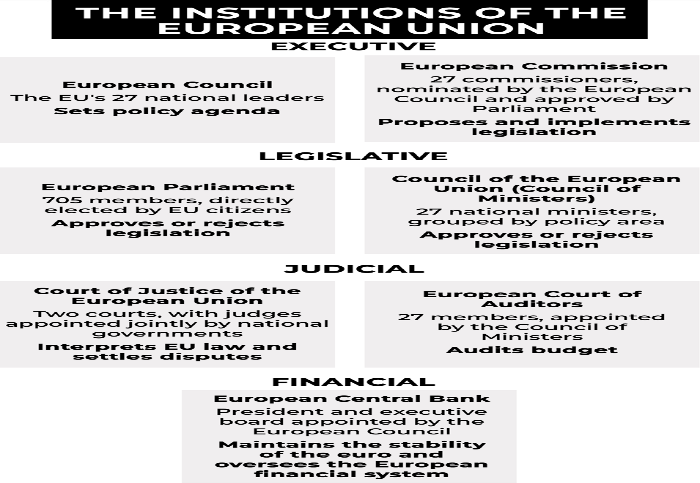
There are seven official EU institutions, which can be roughly grouped by their executive, legislative, judicial, and financial functions.
• European Council
• It is a collective body that defines the European Union’s overall political direction and priorities.
• It comprises of the heads of state or government of the EU member states, along with the President of the European Council and the President of the European Commission.
• The High Representative of the Union for Foreign Affairs and Security Policy also takes part in its meetings.
• Established as an informal summit in 1975, the European Council was formalised as an institution in 2009 upon the entry into force of the Treaty of Lisbon.
• The decisions of its summits are adopted consensus.
• European Parliament
• It is the only parliamentary institution of the European Union (EU) that is directly elected by EU citizens aged 18 years or older. Together with the Council of the European Union (also known as the ‹'Council'›), it exercises the legislative function of the EU.
• European Parliament does not possess as much legislative power as its member countries’ parliaments do.
Council of the European (1949)
The Council of the European Union is a key component of the EU's bicameral legislature, with the European Parliament being the other legislative body. It represents the executive branches (ministries) of the EU member states.
In the Council, government ministers from each EU country come together to discuss, amend, and adopt legislation, as well as to coordinate policies. These ministers have the authority to commit their respective governments to the actions agreed upon during the meetings.
European Commission (1958)
The European Commission is the executive of the European Union, tasked with proposing legislation, implementing decisions, ensuring the enforcement of EU treaties, and overseeing the daily operations of the EU.
The Commission functions like a cabinet government, comprising 27 members, with one representative from each member state. These members are nominated by their respective countries, with the European Parliament providing the final approval.
One of the 27 members serves as the President, who is proposed by the European Council and elected by the European Parliament.
The Commission is organized into departments called Directorates-General (DGs), which resemble ministries or departments. Each DG is led by a director-general, who reports to a
commissioner.
The High Representative (HR) of the Union for Foreign Affairs and Security Policy is appointed by the European Council through voting, with the agreement of the President of the European Commission. The HR is responsible for shaping and implementing the EU's foreign, security, and defense policies.
European Court of Auditors (1977)
The European Court of Auditors (ECA) investigates the proper management of finances within EU institutions as well as the EU funds allocated to its member states.
• If any issues remain unresolved, the ECA can refer them to the European Court of Justice to resolve any alleged irregularities.ECA members are appointed by the Council after consulting with the European Parliament, serving renewable terms of six years.
• The Court of Justice of the European Union (1952)
• The Court of Justice of the European Union (CJEU) makes sure that EU law is applied the same way in every EU country. It also settles disagreements between national governments and EU institutions.
• People, businesses, or organizations can take legal action against an EU institution if they think their rights under EU law have been violated.
• Judges and Advocates General are chosen by governments of EU member countries.
• The court is located in Luxembourg.
• The European Central Bank (1998)
• The European Central Bank (ECB) is the central bank for the euro and oversees monetary policy for the 19 countries in the Eurozone.
• Governing Council: This is the main decision- making body of the ECB. It includes the Executive Board and the governors of national central banks from the Eurozone countries.
• Executive Board: Responsible for the daily operations of the ECB, it is made up of the ECB President, Vice-President, and four other members chosen by the governments of Eurozone countries.
• The ECB sets interest rates for lending to commercial banks in the Eurozone, helping control the money supply and inflation. It also approves the production of euro banknotes and ensures the stability of the European banking system.
• The ECB is based in Frankfurt, Germany.
• The European System of Financial Supervision (ESFS): It was introduced in 2010. It consists of:
• The European Systemic Risk Board (ESRB)
• 3 European supervisory authorities (ESAs):
• the European Banking Authority (EBA)
• the European Securities and Markets Authority (ESMA)
• the European Insurance and Occupational Pensions Authority (EIOPA)
FUNCTIONS
EU’s law and regulation are meant to create a cohesive economic entity of its countries, so that goods can flow freely across the borders of its member nations, without tariffs, with the ease of one currency, and the creation of one enlarged labour pool, which creates a more efficient distribution and use of labour.
There is a pooling of financial resources, so that member nations can be “bailed out” or lent money for investment.
Union’s expectations in areas such as human rights the environment have political implications for member countries. Union can exact a heavy political cost such as severe cutbacks and an austerity budget on its members as a condition of giving aid.
This is a great experiment, really, in cooperation amongst nations, who wish to be economically unified, ceding as little political and national power as possible.
Trade
• Free trade among its members was one of the EU’s founding principles. This is possible thanks to the single market. Beyond its borders, the EU is also committed to liberalising world trade.
• The European Union is the largest trade block in the world. It is the world’s biggest exporter of manufactured goods and services, and the biggest
import market for over 100 countries.
Humanitarian Aid
• The EU is committed to helping victims of man-made and natural disasters worldwide and supports over 120 million people each year.
• EU and its constituent countries is the world’s leading donor of humanitarian aid.
Diplomacy and Security
• The EU plays an important role in diplomacy and works to foster stability, security and prosperity, democracy, fundamental freedoms and the rule of law at international level.
CHALLENGES & REFORMS
It is no longer certain that all old member states remain in the EU, as the Treaty of Lisbon now allows countries the right to leave. The financial crisis has particularly impacted Greece, with many speculating that it may eventually exit the Union.
Increased layoffs, job outsourcing to countries with cheaper labor, and rising unemployment are affecting the daily lives of European citizens. The EU is under pressure to address these economic challenges and improve employment opportunities.
There is also growing demand for standardized agreements across Europe, and even globally, to ensure fair working conditions. As a member of the World Trade Organization, the EU has the ability to influence global developments in this area.
The EU is a global leader in the development of Enabling Technologies (KETs), but it has struggled to translate this knowledge into marketable products. KET- related manufacturing in Europe is on the decline, and patents are increasingly being exploited outside the EU.
In addition, Europe is witnessing a resurgence of sovereignty, fueled by nationalistic sentiments. This shift in public opinion is reflected in political parties from both ends of the spectrum. Popular dissatisfaction with EU membership is growing, partly due to the combined impacts of the economic and migration crises.
USA, by withdrawing from the Paris climate deal, by pulling out of the Joint Comprehensive Plan of Action (JCPOA) on Iran’s nuclear programme, and by attacking the integrity of the international trading system through the unilateral imposition of tariffs, has called into question Europeans’ formerly unshakeable faith in diplomacy as a way to resolve disagreements and to protect Europe.
European leaders are now concerned that security may shift from being based on shared alliances and interests to focusing more on purchasing American technology and military equipment.
Like the United States, the EU has had to rethink its relationship with a more assertive Russia, which has significant implications for European security and stability. The EU has supported Ukraine's political transition, condemned Russia’s annexation of Crimea in 2014, and urged Russia to stop supporting separatist forces in eastern Ukraine. However, democratic backsliding in Ukraine and a more hardline stance from Moscow are limiting Ukraine’s ability to pursue EU membership.
Regarding Brexit, many felt the EU had imposed too many regulations on businesses while charging hefty membership fees with little return. The 2004 addition of eight Eastern European countries led to a surge in immigration, straining public services. By 2011, the proportion of foreign-born residents in England and Wales had risen to 13.4% of the population, double what it was in 1991.
Brexit supporters argued that the UK should regain full control over its borders and reduce immigration. They also contended that the EU was evolving into a super- state that increasingly undermines national sovereignty. Many believed that the UK, outside the EU, could negotiate better trade deals on its own and maintain global influence. Withdrawal from the EU is governed by Article 50 of the Treaty on European Union.
A deal between UK & EU that gives it control over immigration and also preferential access to the EU’s tariff-free single market of 500 million people (UK), the economic backbone of the world’s largest trading bloc is rejected by Germany & other EU leaders.
INDIA & EUROPEAN UNION
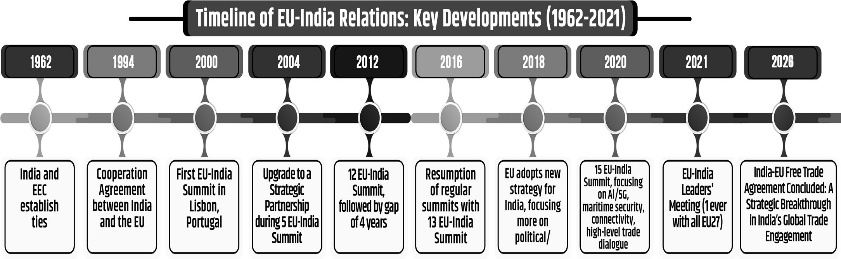
India-EU relations date back to the early 1960s with being amongst the first countries to establish diplomatic relations with the European Economic Community in 1962. A Joint Political statement signed in 1993 followed by
the Cooperation Agreement between India and the EU in
1994 expanded ties from the pillar of trade and economic cooperation and enabled political dialogue and annual ministerial meetings.
Over the years, a multi-tiered institutional architecture for cooperation with the EU has been created with the Summit at its apex. The first India-EU Summit was held in Lisbon on 28 June 2000 which marked a watershed in the development of the relationship. Since then, fourteen annual bilateral Summits have been held between India and the EU. The relationship was upgraded to a ‘Strategic Partnership’ during the 5th India-EU Summit held at The Hague in 2004. The 14th Summit was held on 6 October 2017 in New Delhi.
On 20 November 2018, EU’s strategy on India entitled “ Partnership for Sustainable Modernization and Rules-based Global Order” was issued by the European Commission and the EU High Representative for Foreign Affairs and Security Policy. It views India as an emerging global power that plays a key role in the current multipolar world and a factor of stability in a complex region and calls for greater India-EU political, security and defence cooperation.
The India-EU Agenda for Action 2020, approved at the 13th India-EU Summit in March 2016, serves as a guide for cooperation and exchange between India and the EU across various sectors. This bilateral Strategic Partnership includes thirty-one dialogue mechanisms that address a broad range of topics, such as trade, energy security, science and research, non-proliferation and disarmament, counter-terrorism, cyber security, counter-piracy, migration, and mobility, among others.
Evolution of India's relationship with EU
India and the EU have a long and complex relationship, with the EU being India's largest trading partner.The relationship began to strengthen in the early 1990s due to India's economic liberalization and the EU's expansion of membership.
In 1994, a Cooperation Agreement was established, forming the basis for their strategic partnership.
The first India-EU Summit in 2000 marked a significant milestone in the relationship.
In 2005, a Joint Action Plan was signed, strengthening cooperation in trade, investment, education, and research.
In 2017, a renewed dialogue on foreign policy, defense, and security was launched, further deepening cooperation.
In recent years, the EU and India have collaborated on issues related to international peace and security, climate change, and sustainable development.
The European Union is India’s one of the largest trading partners, with bilateral trade in goods and services growing steadily over the years.
In 2024–25, India’s bilateral trade in goods with the EU stood at INR 11.5 Lakh Crore (USD 136.54 billion) with exports worth INR 6.4 Lakh Crore (USD 75.85 billion) and imports amounting to INR 5.1 Lakh Crore (USD 60.68 billion).
India-EU trade in services reached INR 7.2 Lakh Crore (USD 83.10 billion) in 2024
India–EU Free Trade Agreement 2026
Historic Milestone Announced at the 16th India–EU Summit by Hon’ble Prime Minister Shri Narendra Modi and European Commission President H.E. Ms. Ursula von der Leyen
India, 4th largest economy, and the European Union, 2nd largest economy, comprising 25% of Global GDP, Forge a Trusted Partnership.
Over 99% of Indian exports gain preferential entry into the EU, unlocking massive growth potential
The FTA will open new opportunities for MSMEs and create jobs for women, artisans, youth and professionals
INR 6.41 Lakh Crore (USD 75 Billion) exports poised for take-off, 33 bn USD of exports in labour-intensive sectors like textiles, leather, marine products, gems and jewellery set to gain immensely from preferential access under the FTA.
India’s predictable access to EU’s 144 subsectors (which includes IT/ITeS, Professional Services, Other Business Services and Education Services) will provide boost to Indian service providers and enable them to provide competitive world class Indian services to EU’s consumers while EU’s access to 102 subsectors offered by India will bring in high tech services, investment into India from EU resulting in a mutually beneficial arrangement.
Additionally, India has also secured access forpractitioners of Indian Traditional Medicine to work under home title in EU Member States where traditional medical practices are not regulated.
The FTA is expected to facilitate cooperation in critical areas like Artificial Intelligence, clean technologies, and semiconductors, supporting India's technological advancement.
The EU will eliminate tariffs on over 90% of tariff lines, and 91% in terms of value. India will eliminate tariffs on 86% of tariff lines, and 93% in terms of value. Moreover, both sides will partially liberalise a significant additional number of lines, thereby bringing the overall coverage of trade liberalisation to 96.6% for India and 99.3% for the EU
Challenges to deepening co-operation
India will expect some agreement on visa quotas, to enhance its services exports, but this remains the competence of EU member states.
India’s new bilateral investment treaties are relatively shallow, and aligning India-EU approaches on investor protection will be complex.
India’s industrial policy has a strong focus on domestic car production and it may have difficulty lowering tariffs on EU car imports.
Market access for alcohol will be difficult as, unlike other markets, it remains the domain of 28 different states with different duties and licensing laws.
India’s procurement market discriminates against foreign suppliers. It is also shared between India’s federal and state levels, adding to complexity.
The EU and India have significantly different approaches to digital regulation since India’s emerging regulatory framework may lack the EU’s comprehensive protections for personal data. Effective lobbying by US firms might sway it further away from European standards.
While India has promised to address such issues, FTA negotiations have only progressed slowly. India is interested in concluding an “early harvest” agreement, as it has with Australia. But the EU sees this as in conflict with its WTO obligations.
Demands from European civil society to account for sustainable development clash with India’s emphasis on sovereignty and suspicion of hidden protectionism. India is particularly sensitive to developed-country efforts to impose their will on developing countries through trade policy.
The EU must also work harder to convince Indian opinion that its emphasis on sustainable development is not driven by protectionist instincts. While India must realise that there is a pro-sustainability consensus in the EU, collaboration to increase rather than decrease trade in the sectors affected by mechanisms like CBAM is essential.
EUROPEAN UNION AND INDIA TRADE AND TECHNOLOGY COUNCIL (TTC)
The first ministerial-level meeting of the India-European Union Trade and Technology Council (TTC) was held in May 2023 in Brussels.
The formation of the TTC with the objective of creating a high-level coordination platform to tackle strategic challenges at the nexus of trade, trusted technology and security.
Key outcomes of recent meet
Strategic technologies, digital governance and digital connectivity:
The European Union and India will cooperate quantum and High-Performance Computing research and development projects to help address challenges such as climate change and natural disasters and improve healthcare via personalised medicine.
Both partners are also committed to seek cooperation trustworthy Artificial Intelligence and coordinate their policies with regards to the strategic semiconductors sector through a dedicated Memorandum of
Understanding.
The EU and India will work towards bridging the digital skills gap and promoting the exchange of digital talent. Both partners will engage in 5G, telecoms and Internet of Things standardisation. They will enhance the interoperability of their respective digital public infrastructures and promote secure, privacy-preserving solutions to the benefit of developing countries.
Green and clean energy technologies: Cooperation on research and innovation is seen as an important vehicle to unlock potential and bring new and sustainable technologies to the market. The EU and India will focus on wastewater management, including plastic litter and waste to hydrogen; recycling of batteries for e-vehicles and standards through pre-normative research.
Trade, investment and resilient value chains: The EU and India have agreed to deepen their common work on resilient value chains, work to resolve bilateral market access issues and exchange information on each other’s mechanisms on foreign direct investment screening. They will also address global and multilateral trade issues, with particular emphasis on the World Trade Organization.
The EU-India Trade and Technology Council is the second bilateral forum between the EU and India, and the first of its kind for India. In June 2021, the EU and the US also launched their own TTC
Political Cooperation
The EU and India have a strategic partnership, involving regular political dialogue and cooperation on counter- terrorism and non-proliferation. The EU has provided development assistance to India in health, education, and agriculture. They have also collaborated on terrorism, cyber security, and climate change through conferences and workshops, focusing on combating terrorism and enhancing cyber security.
Other areas of Cooperation
The EU and India have collaborated on security, research, and innovation issues through various multilateral organizations.
The EU's Horizon 2020 program supports joint projects in renewable energy, health, and advanced materials.
The EU also supports cultural and educational exchange programs like Erasmus+, allowing Indian students to study in the EU and vice versa.
The EU and India also collaborate on global issues like climate change, development, and security, and have supported India's efforts to gain greater access to the global trade system, including the WTO.
CHALLENGES IN INDIA-EU RELATIONS
India-EU relations face challenges in trade, global security, intellectual property, human rights, and governance.
The EU has criticized India's high tariffs on certain products, such as automobiles and pharmaceuticals, and has sought greater access to the Indian market for its
products. They have also differed in their approaches to security, particularly regarding Afghanistan and the Middle East.
The EU has raised concerns about India's intellectual property regime, particularly regarding patent protection and enforcement of intellectual property rights.
It has also raised concerns about human rights and governance issues in India, such as religious freedom, minority treatment, and the rule of law.
The EU has expressed concern about the Citizenship Amendment Act 2019.
The EU and India have different perspectives on change, leading to differences in their approaches to addressing this global challenge.
Additionally, the EU and India have sometimes had differences in foreign policy approaches, particularly regarding the Balkans, Iran, and the Israeli-Palestinian conflict.
WAY FORWARD
To strengthen the relationship between India and the EU, several steps can be taken. These include
deepening trade and investment ties,
promoting greatertwo-way investment, and resolving trade disputes.
Increased cooperation on counterterrorism, cyber security, and climate change can be achieved through intelligence sharing, joint training, and capacity building in multilateral forums.
Research and innovation can be increased in areas of mutual interest, such as renewable energy, health, and advanced materials.
Cultural and people-to-people exchanges can be promoted through educational programs.
Multilateral cooperation can be achieved by working together in multilateral forums like the United Nations, WTO, and G20 to address global challenges and promote shared values.
CONCLUSION
The evolution of the EU stems from the need to unify a divided Europe, which had been torn apart by intense nationalism and two world wars. Over time, it has played a crucial role in improving economic conditions and raising the living standards of the less affluent member countries.