Whatsapp 88106-52225 For Details
Get Free IAS Booklet
Get Free IAS Booklet
INDIA – GERMANY RELATIONS
INTRODUCTION
• Indo-Germanic relations have roots dating back to World War I when Indian independence activists sought help from Imperial Germany during their fight for freedom. Subash Chandra Bose sought military assistance from Nazi Germany during World War II, leading to the formation of the Indische Legion as a liberation force for British- ruled India. After WWII, India ended the State of War with Germany and did not claim war reparations despite the loss of 24,000 soldiers.
• Having come into existence as the states we know them today at a similar time — India in 1947 Germany in 1949 after the devastation of World War II — the two countries entered into diplomatic relations almost immediately.
• In fact, India was one of the first nations to recognise young Federal Republic of Germany in 1951.
• India and Germany have a “Strategic Partnership” 2001, which has been further strengthened with the Inter- Governmental Consultations (IGC) at the level of Head of Governments (German Chancellor and PM) which allows for a comprehensive review of Cooperation and identification of new areas of engagement. India is amongst a select group of countries with which Germany has such a high-level Consultations.

COOPERATION ACROSS SECTORS
• In the early years and in line with the government policy of that time, the joint projects targeted industrial growth, poverty reduction and rural development.
• Time has changed the focus of development as circumstances changed
• Now, the areas of focus are renewable energy and efficiency, sustainable urban development, environment protection and resource management.
• This is complemented by supporting economic development, including vocational education and training (VET). Their bilateral relations contribute to the UN Development Goals, which seek to end poverty and create a more inclusive and equitable world.
• The G4 nations (Brazil, Germany, India, and Japan) support each other’s bids for permanent seats on the United Nations Security Council.
Economic & Commercial Relations
• Germany has a Bilateral Trade and Investment Agreement (BTIA) with India via the EU.
• India-Germany bilateral trade was USD 29.57 billion in which India’s exports to Germany was USD 10.62 billion and India’s imports from Germany was USD 18.947 billion.
• Germany was the 8th largest trading partner for India in 2024-25. India was Germany’s 23rd largest trading partner in 2024.
• Germany is the 9th largest foreign direct investor in India with a cumulative FDI of US$ 15.11 billion from April 2000 to March 2025. German investments in India in FY 2024-25 were US$ 469 million (US$ 505 million in FY 2023-24, US$ 547 million in FY 2022-23)
• India’s major exports to Germany include and mechanical appliances, textiles, and chemicals. At the same time, principal commodities imported by India from Germany include optical and medical instruments, machinery and mechanical appliances, vehicles, and accessories.
• Additionally, Germany is the ninth largest in India, with cumulative foreign direct investment (FDI) inflows of US$13.8 billion during the April 2000– September 2022 period.
• In 2020, over 1700 German companies created more than 400,000 jobs in India. At the same time, more than 200 Indian companies had registered offices in Germany, investing more than US$7.07 billion in that country.
• To further boost investment, the Department for Promotion of Industry and Internal Trade (DPIIT) established a Fast Track Mechanism in 2015 for German companies in India to expedite the resolution of issues encountered by German companies in India.
• The Make in India Mittelstand (MIIM) Programme was launched in 2015 to facilitate the entry of German micro, small, and medium enterprises (MSMEs). Currently, 135 MSMEs are being facilitated through the MIIM Program.
• In 2018, India and Germany also launched the German India Startup Exchange Program (GINSEP), a non-monetary platform set up to foster Indo-German economic relations in the start-up sector.
Defence Cooperation
• Indo-German military and strategic relations got a new momentum with the signing of an agreement in 2006 between the German Federal Ministry of Defence and the Indian Ministry of Defence. The agreement envisaged a deeper cooperation regarding security and defence issues.
• The agreement envisaged a deeper cooperation regarding security and defence issues including the exchange and training of military personnel, greater cooperation with regard to the development of joint defence productions as well as increased technology transfer.
• To further enhance the Defence Industry and defence cooperation between Germany and India, an Arrangement on Implementation of the Agreement, concerning Bilateral Defence Cooperation was signed on February 12, 2019 during the visit of India's Defencwe Minister to Berlin. The agreement will enable both the countries to share classified information with each other.
• India and Germany maintain an ongoing dialogue in the areas of commercial maritime security and cooperation in the field of anti-terrorism
• The Indian Navy and the German Navy carried out a joint exercise in the Gulf of Aden near Yemen, in the Indian Ocean leg of Indo-Pacific Deployment 2021. The Indian Navy was represented by frigate “Trikand” while the German Navy was represented by frigate “Bayern”.
• Germany's military is primarily structured to defend Eastern Europe and support NATO operations in the Western European theatre of operations. Unlike the UK and France, Germany does not have any sovereign territories in the Indo-Pacific region and lacks the capability for power projection.
Development Cooperation
• Indo-German development cooperation is a solid pillar of the Indo-German strategic partnership.
The construction of the Rourkela Steel Plant in was a hallmark of this intensive cooperation in the early 1960s. Later, both countries set up one of India’s premiere educational institutions - the Indian Institute of Technology in Madras. In the 1990’s, development cooperation dealt with the issues of poverty reduction and social infrastructure.
Financial assistance from Germany is mainly as soft loan, composite loans or grants routed through KfW, German Government’s Development Bank. Technical assistance
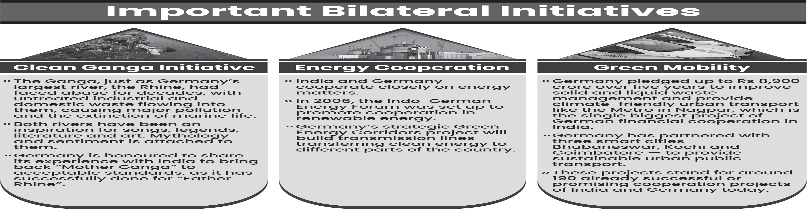
is provided through GIZ, German Government’s development agency. Major projects are in the sectors of energy (Renewables, Green Energy Corridor), Indo- German Solar Partnership, Skill Development and Sustainable urban development (water/sanitation/waste, climate friendly urban mobility, smart cities).
Oil price Cap: The G7, along with the European Union and Australia, plans to impose a price cap on Russian crude oil shipments, pegged at USD 60 per barrel. The cap, effective from 5th December 2022, will only apply to shipments loaded after the date.
Germany and Indo-Pacific
Germany is determined to contribute to buttressing the rules-based international order. Within the German Indo- Pacific guidelines, India is mentioned for the enhancement of engagement and fulfilment of objectives. India should now be an important node while discussing issues relating to international security. India is a maritime powerhouse and a strong advocate for free and inclusive trade — and, therefore, a primary partner for Germany (eventually the EU) on this mission.
Science and Technology
Indo-German Science & Technology cooperation started with the signing of the Intergovernmental S&T Cooperation Agreement in 1971 and 1974.
There are more than 150 joint S&T research projects and 70 direct partnerships between Universities of both countries. India’s scientific establishments have close partnerships with German R&D institutions, including the Max Planck Society, Fraunhofer Laboratories and the Alexander von Humboldt Foundation.
The jointly funded Indo-German Science Technology Centre (IGSTC) was set up in Gurgaon in September 2008.
Culture
India and Germany have a long tradition of academic and cultural exchange.
Max Mueller was the first scholar of Indo- languages to translate and publish the Upanishads and the Rigveda.
There has been growing interest in Germany in dance, music and literature, as well as motion picture and TV industry, in particular Bollywood. Indian filmsand artists regularly feature at the Berlin International Film Festival and at festivals across Germany.
German interest in the Indian philosophy and languages resulted in the setting up of the first Chair of Indology at the University of Bonn in 1818. The Government of India has funded 31 short term rotating chairs of Indian studies in German Universities so far.
Indian Community in Germany
There are nearly 1.5 lakh Indians and people of origin (2017 figures) in Germany. The Indian diaspora mainly comprises of professionals, technocrats, businessmen/traders and nurses.
There has been an increase in the last few years in the number of qualified Indian professionals in Germany in the fields of IT, banking, finance, etc.
There are a number of Indian organizations and associations active on the business/cultural front, cementing ties between India and Germany at the people- to-people level.
More than 15,000 Indian students are pursuing various courses in Germany.
Sister States
Some States and Cities of India and Germany have entered into twinning arrangements. Karnataka and Bavaria have Sister State arrangement since 2007.
Mumbai and Stuttgart are sister cities since 1968. In January 2015, Maharashtra and Baden-Wurttemberg signed an MoU to establish a Sister State relationship.
Other Initiatives between India and Germany
Green and Sustainable Development Partnership (GSDP): Agreed in 2022, under this, Germany will provide additional development assistance of 10 billion till 2030 to support India’s green growth plans.
Indo-German Science and Technology Centre (IGSTC): Supports projects on national priority areas such as Advanced Manufacturing, Embedded Systems and ICT, Sustainable Energy/Environment, etc.
Triangular Development Cooperation: Agreed in 2022, it represents development projects in third countries by India and Germany. Four projects are at advanced stages of implementation under it with Cameroon, Malawi, Ghana and Peru as third countries.
Clean Technologies: Indo-German Green Hydrogen Task Force was constituted in 2022. Collaboration between India’s Department of Science and Technology (DST)
and Germany’s Fraunhofer-Gesellschaft (FhG) on Hydrogen Energy Clusters being set up by DST. It focuses on integrating FhG’s technologies with Indian technologies, and long-term technology development in renewable energy areas.
GERMAN CHANCELLOR OLAF SCHOLZ VISIT TO INDIA IN MARCH 2023
The German chancellor's visit to Russia coincides with the end of the Russia-Ukraine conflict and the recent Chinese spy balloon incident, causing global geopolitical turmoil.
Key outcomes of the Visit
Green and Sustainable Development Partnership (GSDP): Germany plans to invest €10 billion in India's development cooperation portfolio under the umbrella partnership GSDP, which provides political guidance and supports climate action and SDGs.
India-Germany agreed on a vision statement to Enhance Cooperation in Innovation & Technology: Under the framework of the Inter-Governmental Agreement on ‘Cooperation in Scientific Research and Technological Development’, the two countries share a long history of cooperation in science and technology, research and innovation.
Cooperation in Green Hydrogen: For this, the Indo- German Green Hydrogen Task Force was constituted in September 2022
Triangular Development Cooperation: India and Germany agreed to work on development projects in third countries. Both sides concluded agreements on “Digital Transformation, FinTech, IT, Telecom and Supply chains’ diversification”.
CHALLENGES IN INDIA GERMANY RELATIONS
Germany’s low trade: Germany’s trade with India is less than ten percent of its trade with china.
Restrictive Policies: Germany has an advanced defence manufacturing comparable to that of france, but the defence exports are less than potential because of restrictive arms export policy
Lack of a separate bilateral investment treaty between the two countries hampers the commercial potential between two countries.
Germany is not confident about India’s trade liberalization measures, it bats for more liberal labour regulations.
WAY FORWARD
Germany seems to be in driver’s seat when it comes to EU. India’s relation, as it gets better with Germany will help consolidate its position as one of the major players in Asia. The time is right for India to partner with Europe as it is said that this century belongs to Asia. India will have to engage much more with Germany and France after Brexit as far as bilateral relationship is concerned. This is good for India as Germany comes with good source of investment and are not protectionist. Germany and India were part of G-4 to fight for permanent membership of UN Security Council. This was huge step forward in India German relationship. Also, in NSG, Germany and France have supported India. Germany and India continue to work as equal partners to tackle global development challenges.