Whatsapp 88106-52225 For Details
Get Free IAS Booklet
Get Free IAS Booklet
INDIA-IRAN RELATIONS
INTRODUCTION
Iranian and Indian historical relations date back to the Indus Valley Civilization with resemblances in designs and patterns. During the Middle Ages, Persian culture merged with Indian culture, particularly during the Delhi Sultanate and Mughal periods. However, British colonization led to decreased contact between Iran and India.
India-Iran relations span millennia marked by meaningful interactions. The two countries shared a border till 1947 and share several common features in their language, culture and traditions. Both South Asia and the Persian Gulf have strong commercial, energy, cultural and people-to-people links.
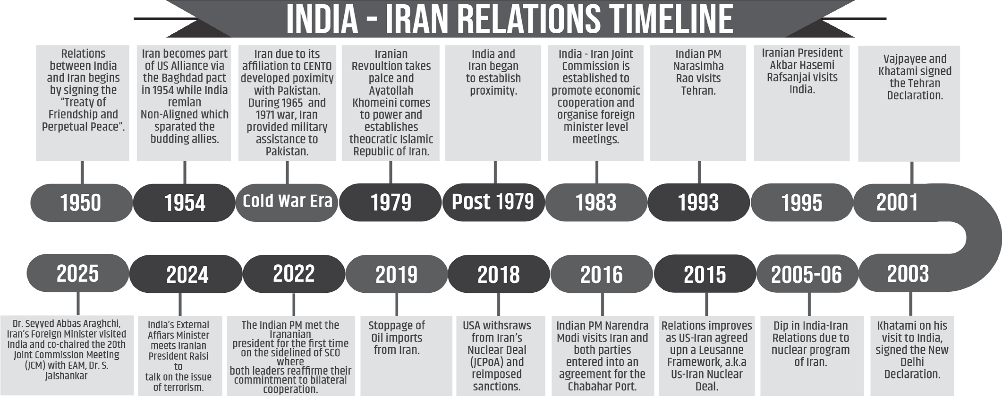
India and Iran signed a friendship treaty on March 15 1950. Prime Minister Shri Atal Bihari Vajpayee to Tehran in April 2001 wherein the two countries signed the “Tehran Declaration” which set forth the areas of possible cooperation between the two countries.
President Mohammad Khatami visited India from January 24-28, 2003 as the Chief Guest at the Republic Day parade. Both sides signed “The New Delhi Declaration” which set forth the vision of strategic partnership between India and Iran.
Prime Minister Shri Narendra Modi paid a bilateral visit to Iran from May 22-23, 2016. Prime Minister called on the Supreme Leader Ayatollah Khamenei and held delegation level talks with President Rouhani. A Joint Statement titled “Civilizational Connect, Contemporary Context” was released.
Dr. Hassan Rouhani, President of Iran, paid his first State Visit to India from February 15-17, 2018. 13 MoU’s/ Agreements were signed during the visit, prominent among them being the contract for interim operations of Chabahar port and MoU on Cooperation in the field of Health and Medicine. A Joint Statement titled “Towards prosperity through greater connectivity” was signed during the visit.
INDIA AND IRAN: ECONOMIC RELATIONS
• India and Iran have experienced fluctuations in bilateral trade in the past, but achieved a significant milestone in the 2000s with the establishment of a "strategic partnership."
• Despite facing pressure from Western allies, India's sustained economic growth makes Iran's economic cooperation and energy indispensable. The signing of the Joint Comprehensive Plan of Action (JCPOA) initially propelled trade relations between the two nations to reach an impressive volume of US$18 billion. However, the withdrawal of the US from the JCPOA in May 2018 and the imposition of multi-layered sanctions on Iran presented formidable challenges to bilateral trade.
• Still, India and Iran have witnessed a notable surge in bilateral trade, with exports and imports experiencing significant growth. Despite facing challenges such as sanctions and import restrictions from the US, both nations recognize the immense potential for economic cooperation.
• The value of India’s exports to Iran saw a remarkable increase in 2022, reaching US$1,847 million, representing a substantial increase of 44 percent. At the same time, India’s imports from Iran experienced a significant rise of 60 percent, totalling US$653 million.
• The notable growth in bilateral trade was largely driven by India’s rice exports to Iran, which reached an impressive value of US$1.098 billion, demonstrating a remarkable growth rate of 52 percent.
• India’s major exports to Iran include rice, tea, sugar, soya, medicines/pharmaceuticals, man-made staple fibres, electrical machinery, etc. Major imports from Iran include inorganic / organic chemicals, fertilisers, cement clinkers, fruits and nuts, leather, etc.
• Iran has long been one of India's top-three oil suppliers, with energy being the foundation of their economic ties. India's economic strength, population, military capabilities, nuclear power status, and membership in BRICS have attracted Iran's attention.
• As part of its "Look East" roadmap, Iran is prioritizing enhancing ties with India. Iran's trade with BRICS member countries reached $34 billion.
• India is committed to strengthening trade relations with Iran, engaging in strategic dialogues and exploring cooperation avenues.
• However, in 2023, India had to stop procuring crude oil from Iran due to the US's refusal to continue with sanction waivers for India and several other countries.
• Foreign Trade Policy (FTP) 2023 - India's foreign trade policy 2023 aims to enhance exports, promote growth, and become a leading commercial trade center. The policy emphasizes the use of the Indian rupee in cross- border trade and deepens trade relations, highlighting the rupee's potential as a global currency, particularly relevant for trade with Iran.
What are the primary obstacles to India-Iran economic cooperation?
• External factors have had a significant impact on India- Iran relations, resulting in several geopolitical setbacks. India halted the purchase of Iranian oil following the US withdrawal from the JCPOA, and the Chabahar port and railway project’s long-term investment agreement faced significant delays.
• India is apprehensive about the growing strategic partnership between Iran and China, particularly after the signing of a 25-year agreement. Beijing’s plan to expand its maritime trade network and gain access to shipping routes has created a clash with India’s aspirations.
• US sanctions on Iran have curtailed Iran’s ambitions to become a significant energy supplier to India.
• India’s relations with Iran’s rivals+, pose another complication for bilateral ties.
Aligning India-Iran economic and geopolitical interests through Chabahar Port and INSTC
India and Iran are not considered geopolitical rivals, despite occasional challenges in their bilateral relations. In fact, their economic and geopolitical interests align in many areas, particularly in transit, energy, and commerce. As a member state of BRICS and the Shanghai Cooperation Organization (SCO), India is critical to Iran not only in terms of trade, investment, and security, but also in Tehran’s broader vision of advancing a multipolar world order with its pivot to the East.
Iran and India are jointly working on the International North-South Transport Corridor (INSTC), which is a 7,200-kilometer network of sea, rail, and road routes connecting Mumbai in India to northern Europe through Iran, Azerbaijan, and Russia.
CHABAHAR PORT AGREEMENT
New Delhi and Tehran had agreed in 2003 to develop the port, near the Iran-Pakistan border. But the project did not take off, mainly owing to international sanctions against Iran over its nuclear programme, but also on account of inertia in Delhi.
The port has the potential of becoming India’s to Afghanistan, Central Asia and Europe.
A contract for the development and operation for 10 of two terminals and five berths.
The extension of credit lines of $500 million for the port and of Rs.3,000 crore for importing steel rails and implementation of the port;
Memorandums of understanding on provision of services by Indian Railways, including financing to the tune of $1.6 billion, for the Chabahar-Zahedan railway line — a line that is also part of the trilateral agreement between India, Iran and Afghanistan on a transit and trade corridor.
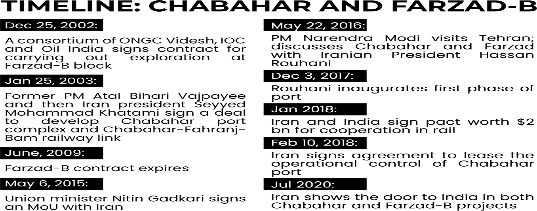
India will invest billions of dollars in setting up industries — ranging from aluminium smelter to urea plants in Iran’s Chabahar free trade zone after it signed a pact to operate a strategic port on the Persian Gulf nation’s southern coast.
Economic Significance of Port
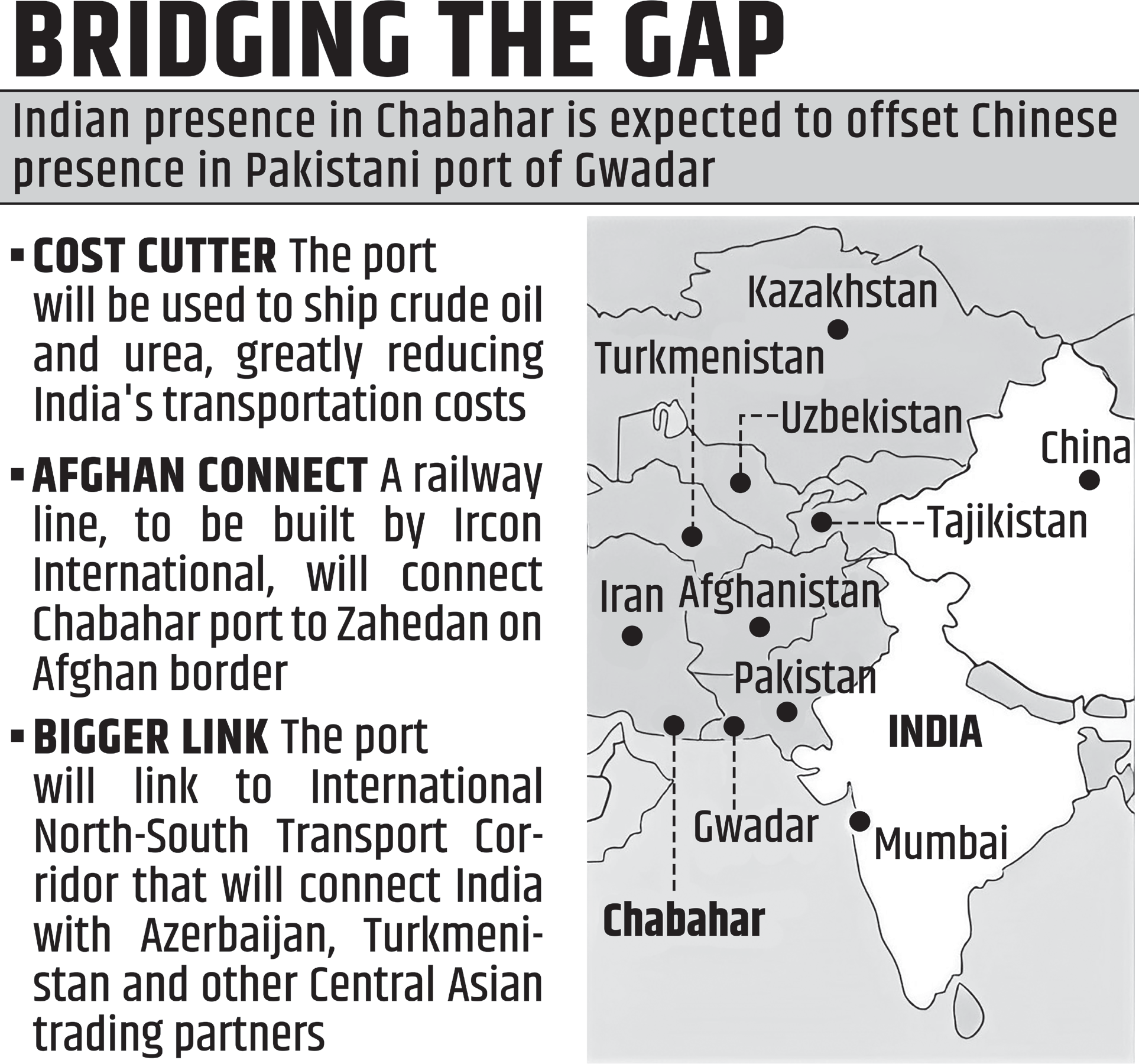
Once the Chabahar port is developed, Indian ships will get direct access to the Iranian coast; a rail line to the Afghan border town of Zaranj will allow India a route around Pakistan.
The Zaranj-Delaram road constructed by India in 2009 can give access to Afghanistan’s Garland Highway, setting up road access to four major cities in Afghanistan — Herat, Kandahar, Kabul and Mazar-e-Sharif. This will surely boost trade with Iran and Afghanistan.
Once the Chabahar port is developed, goods from India will not only travel up to Afghanistan, but beyond, along the yet- to-be developed International North-South Transport Corridor (INSTC) to Central Asia.
The road, rail and port development projects, once implemented, will change the way India, Afghanistan and Iran do business.
Strategic Significance
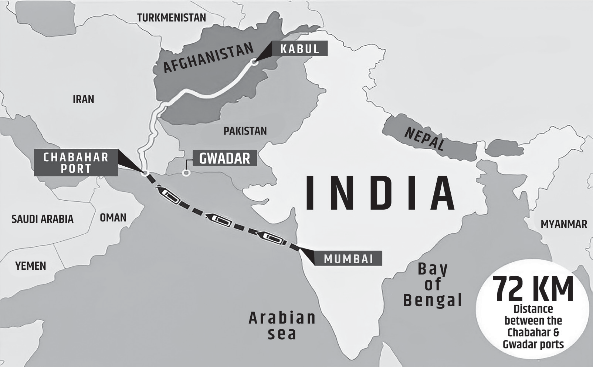
Chabahar is situated just 100 km from Pakistan’s Gwadar port, the centrepiece of a $46 billion economic corridor that China is building.
The Chabahar port will act as a gateway for India to Central Asia bypassing the China-Pakistan arc.
India’s presence in Chabahar will offset the Chinese presence in Pakistan port of Gwadar.
THE TRILATERAL TRADE TREATY
India, Afghanistan and Iran signed the trilateral trade treaty for developing the Chabahar port.
The signing of the trilateral agreement between India, Iran and Afghanistan has been described as a “game changer”. A trilateral transport corridor project has the potential to alter the geopolitical map of South and Central Asia.
Iran’s Nuclear Controversy
In 2008, the UN Security Council, responding to Iran’s failure to comply with its demand to suspend uranium
enrichment, unanimously adopts Resolution imposing sanctions on Iran.
After intense negotiations and decades of economic sanctions imposed on Iran by the US and its allies, finally Iran and US and its allies agreed to sign The Joint Comprehensive Plan of Action, commonly known as the Iran deal.
The Joint Comprehensive Plan of Action
The Joint Comprehensive Plan of Action, commonly known as the Iran Nuclear deal, was signed on July 14, 2015 between Iran, the US, China, France, Russia, the U.K., Germany and the European Union.
Under this deal, Iran agreed not to build any more heavy water facilities, eliminate its stockpile or medium- enriched uranium, cut its stockpile of low-enriched uranium, and reduce the number of its gas centrifuges.
Other nuclear facilities in Iran would have to be converted into non-nuclear facilities.
The International Atomic Energy Agency will have access to all facilities in Iran to monitor and verify if the West Asian country was acceding to the terms of the agreement.
US Withdrawal from the Deal
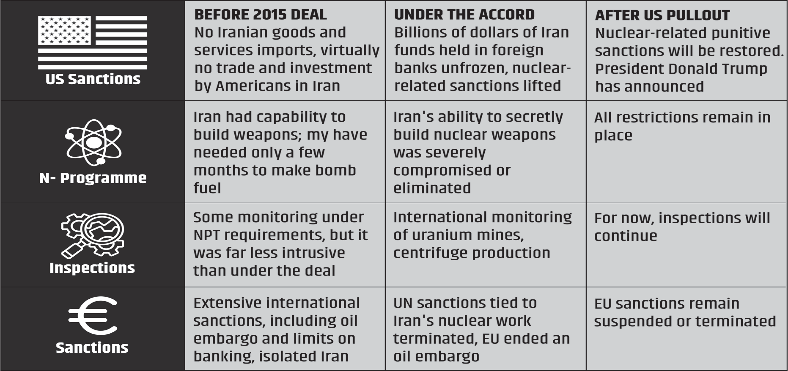
US unilaterally withdrew from the deal in 2018.
Trump Administration believes that President Barack Obama allowed Iran to retain too much of its nuclear infrastructure leaving Iran with the ability to quickly
US argues lifting American and European economic sanctions gave Iran a financial windfall that Tehran’s clerical leaders have used to pay for terrorism and destabilizing military activity across the Middle East.
There are also other concerns that the Nuclear Deal did not limit Iran’s ballistic missile program.
Now US has again imposed sanctions on Iran.
The imposition of sanctions resulted in eight countries including India, China, Japan and South Korea requesting waivers from the US to continue buying oil from Iran in November 2018. The US granted waivers for a period of six months, which expired in early May 2019. Any country or company importing crude oil from Iran will now invite penalties from the US.
Impact of Sanctions on Iran :Triple Whammy
At the outset, Iran’s economy is largely dependent on its oil exports; with the sanctions in place, the country is cut off from its main source of revenue.The International Monetary Fund has forecast that Iran’s economy, hit by the Triple Whammy of US sanctions, fall in oil prices and the coronavirus outbreak, will contract by 6% this year.
Further, companies such as Airbus and Boeing had agreed deals with Iran to sell 100 and 80 aircrafts respectively after the JCPOA was signed in 2015. These deals now stand void at a loss of billions of dollars.
Tourism in Iran is again to see a steep decline after a brief period of relief after the 2015 deal.
The Iranian economy has been deeply impacted and saw a contraction of 6% in 2018 due to the value of Iranian Riyal plummeting, capital flight from the country and banking transactions becoming more complicated.
There is a severe lack of essential commodities leading to inflation, which is making the life of the civil population extremely tough within Iran, and of Iranian citizens abroad.
Impact on India
India being the second largest importer of crude oil from Iran has begun to effectuate a plan to ensure that there is no shortage in supply by increasing imports from other countries. While this may seem like an adequate response to a situation like this, such a quick-fix solution may not work in the long run as prices will inevitably increase due to lack of supply from Iran.
The immediate impact of the sanctions on India is that can no longer use US dollars for transactions with Iran.
Investment by Indian companies in Iran’s oil gas development projects and pipeline projects, if sanctioned, may result in companies not being permitted to open new US bank accounts and facing restrictions on loans, licences and credit.
Further, banks that permit crude oil transactions Iran may face a restriction of activities on their existing US accounts, which invariably would lead to international banks not engaging with the Central Bank of Iran for payments pertaining to petroleum.
India’s Dilemma
After the US deadline ended, India has stopped oil from Iran.
Iran had always been India’s trusted crude oil exporter, which had aided to India’s growing energy requirements.
The changing dynamics of geopolitics has resulted in a change in India’s position on its import of crude oil from Iran. There is no denying the fact that India had to go along with US sanctions compliance and tilt towards the United States, especially at a time when India’s whole effort has been to enhance its GDP and address the concerns emanating from the ongoing economic slowdown
India’s dependence on Iran’s export of crude oil was being seen as a major factor in the US approach to sanctions against Iran. India had no option but to comply with the United States’ decisions on reducing Iran’s crude oil exports to zero and hence, the US ended waivers in May 2019 that had allowed the top buyers of Iranian oil to continue with their imports for six months. India had to stop importing oil from Iran after the United States refused to extend exemption from sanctions.
Latest Developments
India and Iran are aiming to establish themselves as independent strategic actors in shaping a new multipolar order in their Eurasian neighbourhood and globally.
Despite American sanctions, Iran, India, and Russia continue to work on the International North-South Transport Corridor (INSTC).
India is pushing for Chabahar integration into the INSTC.
The two sides have pledged to redouble efforts to build a railway line between Iran's Caspian port of Rasht and Astara on the Iran-Azerbaijan border.
The activation of an alternative Caspian Sea route reflects Iran, India, and Russia's positive outlook on the corridor.
Iran is also seeking to convince New Delhi to restore its crude oil purchases, which it cancelled in 2019 due to U.S. sanctions.
Efforts to construct a special purpose vehicle (an INSTEX-like mechanism) to facilitate trade in the face of international sanctions highlight the strength of economic cooperation.
The resilience of health diplomacy during global crises, such as medical supplies provision and joint research initiatives, is evident in the COVID-19 pandemic.
Khamenei was killed in a joint US-Israeli airstrike on February 2026. India officially conveyed condolences following the death of Iran's Supreme Leader, Ayatollah Ali Khamenei.
Concerns for India
The US sanctions on Iran after Tehran withdrew from the nuclear deal in 2018 may have significantly impacted India-Iran trade, particularly energy imports.
New Delhi's decision to join an "anti-Iran" coalition and perceptions of Iranian support for Yemeni Houthis also impacted ties.
India's entry point into Central Asian countries is through Iran, and the increasing presence of China in Iran raises concerns about the strategic stakes of the Chabahar port project.
India's closer ties with oil producers could bring governance and energy security issues.
CONCLUSION
India abstained from voting on the US and its allies' resolution to censure Iran at the IAEA, stating that it prefers to resolve the issue through dialogue. The revival of the nuclear deal could boost India's economic ties with Iran. India and Iran need to rebuild their ties, and India should remain politically engaged with Iran to understand each other's interests. India should lead in creating an institutional structure with Iran and Afghanistan and pursue the TAPI gas pipeline project for energy security.