India-israel Relations
INDIA-ISRAEL RELATIONS
INTRODUCTION
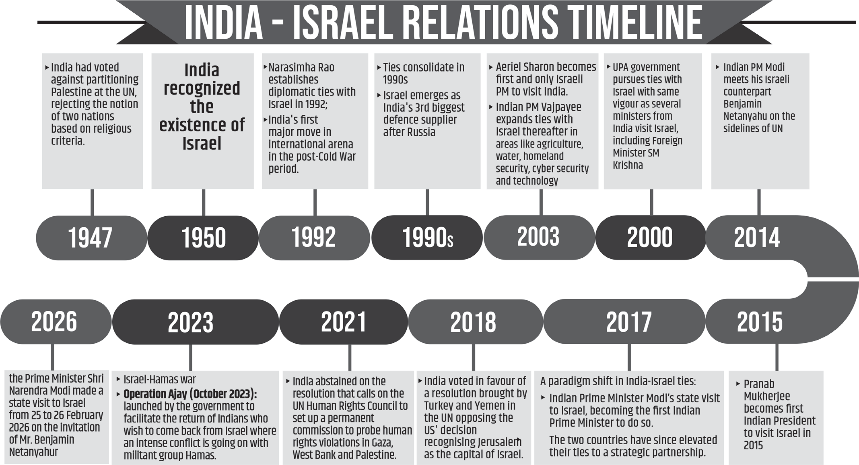
Although India recognised Israel in 1950 and permitted an Israeli consulate to function in Mumbai, it held back from establishing full diplomatic relations until 1992 because of its support for anti-colonial movements and its close ties with Arab countries. Even after 1992, there was a dearth of high-visibility visits, especially from the Indian side. Between 1998 and 2014, the foreign minister’s visits in 2000 and 2001 were the highest-level visits ever made to Israel.
This changed when Pranab Mukherjee became the first Indian President to travel to Israel in 2015 followed by the breakthrough visit of PM Modi in 2017 and Benjamin Netanyahu’s reciprocal visit in 2018. These visits marked a paradigm shift in bilateral ties and a growing strategic partnership expanded from strong military cooperation as seen in Israel’s assistance to India during its war against China in 1962, and against Pakistan in 1965, 1971, and 1999—to one focusing equally on economic development and technology.
Growing economic partnership
• India is Israel’s second-largest trading partner in Asia and the seventh largest globally.
• From around US$ 200 million in 1992 (comprising primarily of diamonds), merchandise trade diversified and reached around US$ 10.7 billion (excluding defence) in FY 2022-23, with Indian exports at around US$ 8.4 billion.
• In the period from April 2000 to September 2023, the direct F.D.I from Israel to India was around US$ 286.15 million.
• Major exports from India to Israel include pearls and precious stones, automotive diesel, chemical and mineral products, machinery and electrical equipment, plastics, textiles, apparel, base metals and transport equipment, and agricultural products.
• Major exports from Israel to India include pearls and precious stones, chemical and mineral/fertilizer products, machinery and electrical equipment, petroleum oils, defence, machinery, and transport equipment.
• Trade in diamonds constitutes close to 40% of bilateral trade.
Water and agriculture
• A unique aspect of Indo-Israel ties is their growing collaboration in the areas of water and agriculture since 2017.
• Given Israel’s impressive track record of reusing 90 percent of its wastewater, Indian authorities have partnered with Mashav, Israel’s international development organisation, to combat a looming water crisis. Currently, there are over 30 Israeli projects in India looking at various aspects including water distribution and management, leak detection, wastewater treatment, desalination, and water security.
• Not only have public-private partnerships in drip Irrigation and desalination projects been successful, but university collaborations have also shown promising results in the past three to four years.
• With respect to agriculture, the Indo-Israeli Project (IIAP) operates 29 Centres of Excellence (CoEs) across 21 states in India.
• Their main focus areas includes vertical farming, solarisation, and increased productivity. These centres specialise in the cultivation of different crops such as vegetables, mangoes, citrus fruits, and non-farming activities like beekeeping and animal husbandry.
Defence and security
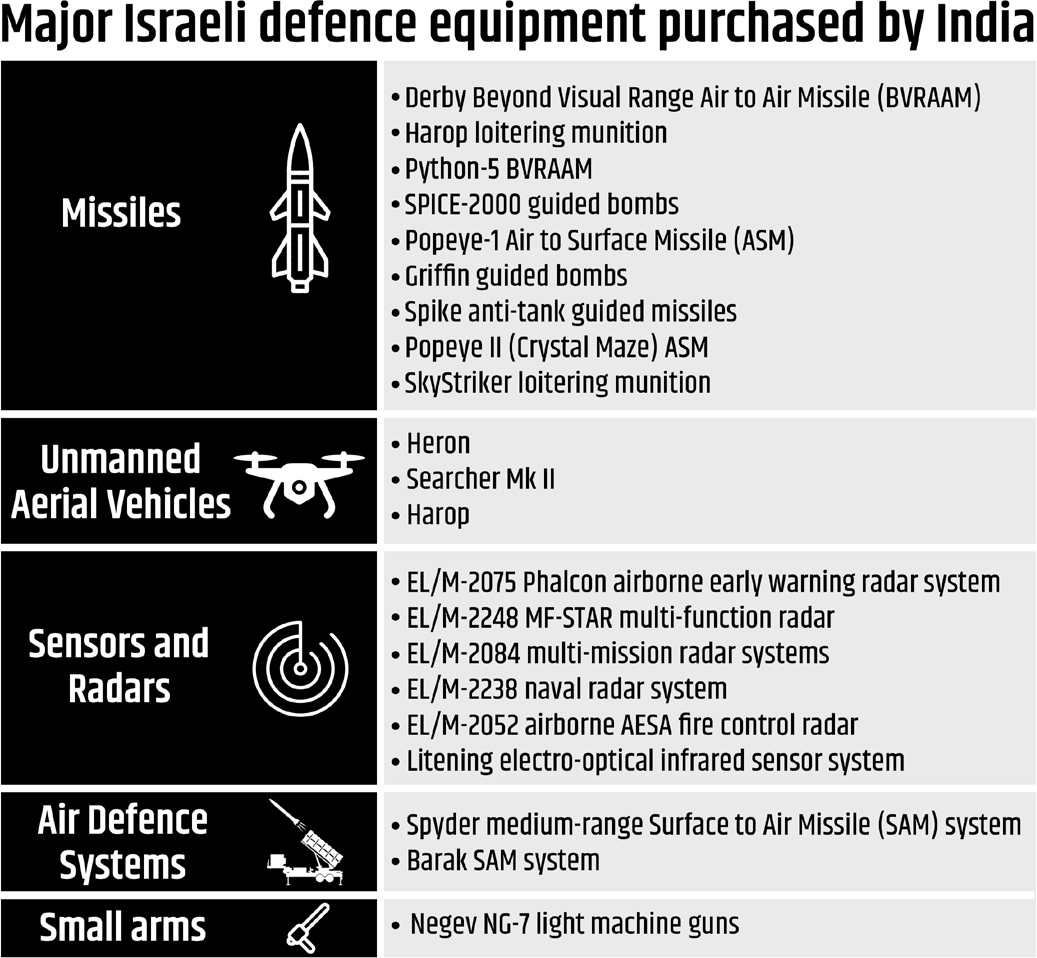
• India is one of the largest importers of weapons Israel, contributing to about 40 percent of its annual arms exports.
• The net worth of Israeli fully-formed armaments and prime subsystems supplied to India since 1992 is estimated to be about US$40 billion.
• Their defence partnership also extends to sharing of crucial technologies by Israel for missiles, electronic warfare systems, radar systems, navigation systems, and weapon control systems designed and produced by DRDO.
• India’s shift towards self-reliance in recent years has resulted in joint defence ventures being set up. The recently signed India-Israel Vision on Defence Cooperation is a step forward in this direction.
• State-of-the-art arms systems such as Barak 8 surface- to-air missiles, Skystriker drones, and Travor Assault Rifles are some of the products of the co-production and development initiative undertaken by the two countries.
• Within the security domain, a promising area of cooperation that has come up is that of cybersecurity. In his 2017 visit, PM Modi acknowledged the potential of such a partnership. Since then, various Israeli unicorns such as Wiz, Orca Security, and Coralogix have opened up operations in India.
Cooperation in S&T and Space
• India-Israel cooperation in S&T is overseen by the Joint Committee on S&T, established under the S&T Cooperation Agreement signed in 1993.
• During the visit of PM Modi in July 2017, an MoU for establishing India-Israel Industrial R&D and Innovation Fund (I4F) by the Department of Science and Technology,
India and the National Authority for Technological
Innovation, Israel was signed. This MoU, with a contribution of $ 20 million from each side over 5 years, is expected to play an important role in enabling Indian and Israeli enterprises to undertake joint R&D projects.
• In a momentous milestone in S&T cooperation between India and Israel, a Memorandum of Understanding (MoU) on Industrial Research and Development Cooperation was signed between the Council of Scientific and Industrial Research (CSIR) under the Ministry of Science and Technology (MoST) of the Republic of India and the Directorate of Defense Research and Development (DDR&D), under the Ministry of Defense of the State of Israel.
• The MoU aims to foster cooperation in industrial R&D programs across key sectors like healthcare, aerospace, civil, engineering, chemicals, sustainable energy, ecology, environment, mining, and agriculture.
• India and Israel inked a cooperative agreement in 2002 to foster space cooperation. India has effectively launched Israel's TecSAR and RISAT-2 radar imaging satellites from the ISRO PSLV.
Culture and Education
• India is known in Israel as an ancient nation with strong cultural traditions, and in popular Israeli perception, India is an attractive, alternative tourist destination. Israeli youth are particularly attracted to India. More than 50000 Israelis visited India in 2018, whereas more than 70000 Indian tourists visited Israel during the year.
• In December 2025, ICCR and Tel Aviv University signed an agreement creating the first ICCR-TAU India Chair in Israel, allowing TAU to host prominent Indian scholars annually across various disciplines.
Energy cooperation
• India was among the first nations to submit an exploration licence application in order to access the Tamar and Levianthan gas fields off the coast of Israel, with the goal of extracting and importing natural gas.
• The Israeli government has granted exploration licences to Indian companies ONGC Videsh, Bharat PetroResources, Indian Oil, and Oil India; this is a clear indication of the continued diversification of ties between the two nations.
Indian Community
• There are over 100,000 Jews of Indian origin in Israel who are Israeli passport holders.
• The main waves of immigration into Israel from India took place in the fifties and sixties. The majority is from Maharashtra (Bene Israelis) and relatively smaller
numbers from Kerala (Cochini Jews) and Kolkata (Baghdadi Jews).
• In recent years some Indian Jews from North Eastern states of India (Bnei Menashe) have been immigrating to Israel. While the older generation still maintains an Indian lifestyle and their cultural links with India, the younger generation is increasingly assimilated into Israeli society.
Why India and Israel are bringing their relation out of the carpet?
De-hyphenation at work
• India’s partnership with Israel has clearly flourished once it started to actively delink the Israeli-Palestinian conflict from its relations with the two parties.
• The current government has made conscious efforts to make both relationships direct and visible, less linked to one another while ensuring that neither enjoys a veto against the other. An example of this was seen when PM Modi did not combine his 2017 visit to Israel with one to the Palestinian authority in Ramallah but chose to make a separate visit in 2018.
• At the same time, India has continued its principled support for a Palestinian State. It has even voted against Israel on numerous occasions. In 2014, it voted in support of a UNHRC resolution to launch a probe into Israel’s offensive on Gaza and in 2015, India voted against Israel over another resolution condemning human rights violations in Palestine. Thereafter, in 2021, it backed two other resolutions—one on the right to self- determination of the Palestinian people and the other on Israeli settlements in East Jerusalem.
The deepening and more open relationship with Israel, however, hasn’t been accompanied by a U-turn on the Indian government’s policy toward Palestine. Government seems to be doing is trying to de-hyphenate its ties with Israel and Palestine. The de-hyphenated approach, in turn, potentially gives Indian policymakers more space to take India’s relationship with Israel further. The government has reiterated India’s traditional position on a two-state solution, as an independent Palestinian state with East Jerusalem as its capital.
WHAT CHALLENGES REMAIN?
• One area that needs attention is co-production in order to produce cheaper products and to reduce dependency on third actors. Military exercises should be incorporated into defence cooperation since Israel has a growing interest in the Indian Ocean Region.
• In the area of academics, one issue constraining better relations between Indian and Israeli academics is money.
• Foreign policy concerns for the two countries are dominated by third party issues such as Iran and the Palestinian issue.
• India values cooperation for energy supplies and a Chabahar port route to Afghanistan and Central Asia, while Israel views Iran as an existential threat.
• With strong technological and investment ties, China is Israel's largest trading partner in Asia, with bilateral trade between the two countries expected to reach $22.1 billion in 2022.
Way Forward
• Going forward, a Comprehensive Free Trade that includes trade in services would give a boost to the economic relationship.
• In the water sector, India can capitalise on Israeli to develop a centralised platform for water solutions catering to different regions.
• In the cybersecurity domain, the focus can shift to deepening A2A collaboration through joint doctoral fellowships, while encouraging the private sector to play a more active role in the partnership.
• Tower Semiconductor’s plans to set up a chip- making foundry in India are likely to benefit from India’s Production-Linked Incentive scheme to reduce dependence on China. India can work with Israel to develop nano and radar-enabled satellite systems.
The India-Israel relationship provides a valuable lesson in international politics, especially for states whose ideological alliances prevent them from forging solely pragmatic ties. India has shown that the even-handed pursuit of diplomatic, military, and economic interests is the way to garner diplomatic credibility and popular good will without damaging other strategic relationships. As it enters into its fourth decade, a relationship described by former Israeli PM Benjamin Netanyahu as a “marriage made in heaven” seems to be getting stronger with time.
RECENT EVENTS
2019–2020 Persian Gulf crisis
The 2019–2020 Persian Gulf crisis, also known as the Crisis in the Gulf and the Iranian–American confrontation is an intensification of military tensions between the Islamic Republic of Iran and their allies and the United States of America and their allies in the Persian Gulf region.
Series of events:
The US began a buildup of its military presence in the region to deter an alleged planned campaign by Iran and its non-state allies to attack American forces and interests in the Persian Gulf and Iraq.
This followed a rise in political tensions between the two countries during the Trump administration, which included the withdrawal of the US from the Joint Comprehensive Plan of Action (JCPOA), the imposition of new sanctions against Iran, and the designation of the Islamic Revolutionary Guard Corps (IRGC) as a
terrorist organization.
• Several merchant ships in the Persian Gulf were damaged in two incidents in May and June 2019. Western nations blamed Iran, while Iran denied involvement.In June 2019, Iran shot down an American RQ-4A surveillance drone flying over the Strait of Hormuz, sharply increasing tensions and nearly resulting in an
armed confrontation.
• In July 2019, an Iranian oil tanker was seized by Britain in the Strait of Gibraltar on the grounds that it was shipping oil to Syria in violation of European Union sanctions. Iran later captured a British oil tanker and its crew members in the Persian Gulf. Both Iran and the UK later released the ships.
Meanwhile, the US created the multinational International Maritime Security Construct (IMSC), which sought to increase “overall surveillance and security in key waterways in the Middle East”
In January 2020 American drone attack near the Baghdad airport early killed Maj. Gen. Qassim Suleimani, the powerful Iranian commander, drastically ratcheted up tensions between Washington and Tehran, threatening to tip hostilities into war.
The US and Iran nearly entered into an open conflict on 8 January 2020 when the IRGC launched missile attacks against two Iraqi military bases housing US soldiers in retaliation for the killing of Soleimani, a rare direct Iran–US confrontation and the closest to the brink of war between the two nations in decades.
Upon initial assessments of no US casualties, the Trump administration curtailed tensions by temporarily ruling out a direct military response but announcing new sanctions.
It was later revealed that more than a hundred US troops sustained injuries during the attacks.
During the crisis, Ukraine International Airlines
Flight 752 was shot down after departing from Tehrān with the intended destination of Kyiv, Ukraine. Western officials said the plane had been brought down by an Iranian SA-15 surface-to-air missile. On 11 January 2020, the Iranian military admitted in a statement that they had mistakenly shot down the plane due to human error.
Israel-UAE deal
Israel and the United Arab Emirates, helped by the US, have arrived at an important peace agreement that has the potential to change the geopolitics of West Asia and beyond.
The announcement by the White House recently took the world by surprise, Palestinians included.
The deal: the UAE will establish diplomatic relations with Israel in return for President Benjamin Netanyahu committing to give up a stated plan to annex the West Bank, the main territory of a state that the Palestinians want. The UAE becomes the third Arab nation to recognise Israel after Egypt (in 1979) and Jordan (1994).
What about the Palestinians?
President Mahmoud Abbas of the Palestinian Authority, which seeks a two-state solution, lashed out against the deal as a “betrayal” by the UAE. He has been disengaged from the Trump administration for the last two years for its pro-Israel stand. “The Palestinian leadership rejects and denounces the UAE, Israeli and US trilateral, surprising, announcement,” a senior adviser to Abbas said. It was a “betrayal of Jerusalem, Al-Aqsa and the Palestinian cause,” he said.
The Hamas, a Palestinian Islamist militant group that de facto runs the Gaza strip, and views the relationship with Israel as a fight to the finish, called it a “stabbing in the back of our people” by the UAE.
How have the Arab states reacted?
Saudi Arabia has said nothing so far, although the family’s Prince Turki al-Faisal had strongly rejected the proposals for Israel-Palestine peace unveiled by the US in January this year, which included a plan to hand over Jerusalem to Israel and permit it to extend its sovereignty to all Jewish settlements in the West Bank.
But Crown Prince Mohammed bin Salman has been hailed as an ally by the Trump administration. He has formed a solid friendship with Trump’s son-in-law Jared Kushner, the President’s pointman in the Middle East, tasked with finding a solution to the Israeli-Arab conflict.
There is bound to be speculation that the UAE could not have taken its extraordinary decision on Israel without the backing and support of the House of Saud.
Over the years, the Saudis have seen both the US and Israel as insurance against Shia Iran. But as the leader of the Arab world, and the custodian of Islam’s
ABRAHAM ACCORDS
Holiest shrines, it might have preferred someone else to take the revolutionary first step on this.
The smaller Gulf states of Oman and Bahrain have quickly fallen in line behind UAE, and it could be a matter of time before the others, including Saudi, do as well.
How does the region’s geopolitics change?
If the Arab states do fall in line, it would dramatically bring all Sunni nations in the region in an anti-Iran alliance with Israel that they have secretly wished for all these years. Iran and its proxies and allies – in Syria, Lebanon and Iraq, the Hezbollah in Lebanon, and the Houthis in Yemen – have been weakened and broken by war, the ISIS and al-Qaeda. Hezbollah, which Israel has treated as enemy number 1 after Iran, faces a domestic backlash in Lebanon after the explosion that has destroyed Beirut. Russia, a staunch ally of Syria, has not yet reacted; neither has China.
The deal will send ripples through other parts of the world. In South Asia, it will put Pakistan in a bind. Despite having toyed with the idea of establishing diplomatic ties with Israel for nearly two decades, Pakistan could never take the plunge for fear of a domestic backlash.
Pakistan has already annoyed Saudi Arabia, another “country”, by showing its teeth at the OIC because it did not agree to hold a special session on Kashmir. The kingdom responded by asking for immediate repayment of a $3 bn loan given in 2018, and it has frozen a $3.2 bn line of credit for oil purchases. Even if Pakistan does not join the Arab stampede towards Israel, it cannot rail against them for it.
In Kashmir too, where pro-independence lobbies have compared stone pelting agitations of the last 10 years with the intifada, the isolation of Palestine is certain to mirror the isolation of Kashmir today.
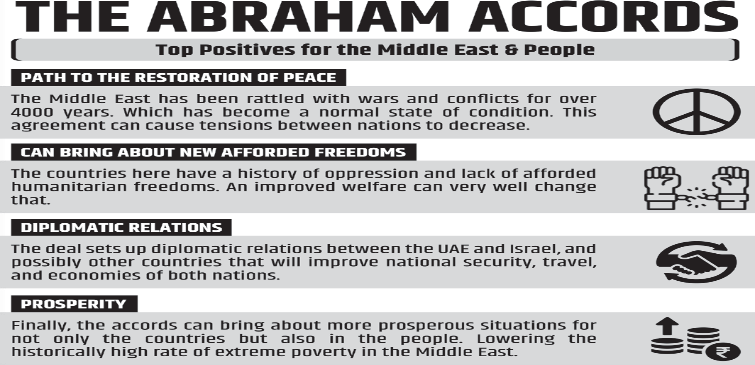
Abraham Accords is a series of peace agreements between Israel and several Arab countries, UAE being the first.
In 2020, it was mediated by USA between UAE, Bahrain and Israel.
The name “Abraham” refers to the great father of the faith of the three Abrahamic religions: Judaism, Christianity, and Islam.
It’s a symbolic title that promotes unity between Arabic and Jewish people by recognizing the shared patriarch.
ISRAEL –PALESTINE CONFLICT:
Balfour Declaration
When British Foreign Secretary Arthur James Balfour issued the Balfour Declaration in 1917, formally endorsing a Jewish “national home” in Palestine, the seeds of strife were sown.
Creation of Palestine
Britain withdrew its forces from Palestine in 1948, putting the newly established United Nations in charge of resolving the conflicting claims because it was unable to control Arab and Jewish violence.
The majority of Arab countries rejected the UN’s partition plan, which called for the creation of independent Jewish and Arab governments in Palestine.
Arab Israel War (1948): The Jewish declaration of independence from the surrounding Arab governments in 1948 led to an invasion. Israel possessed almost 50% more land at the end of the war than the UN partition plan had predicted.
UN Partition Plan: According to the Plan, Egypt controlled the Gaza Strip and Jordan controlled the West Bank and the holy sites in Jerusalem. However, it was unable to end the Israeli-Palestinian conflict, which prompted the establishment of the Palestinian Liberation Organization in 1964.
Palestinian Liberation Organisation (PLO): The PLO was established with the goal of liberating Palestine from Israeli control and opposing Jewish dominance, while seeking to promote the influence of the Muslim Brotherhood across the Arab world.
In 1975, the United Nations granted the observer status and officially acknowledged the Palestinian people's right to self-determination.
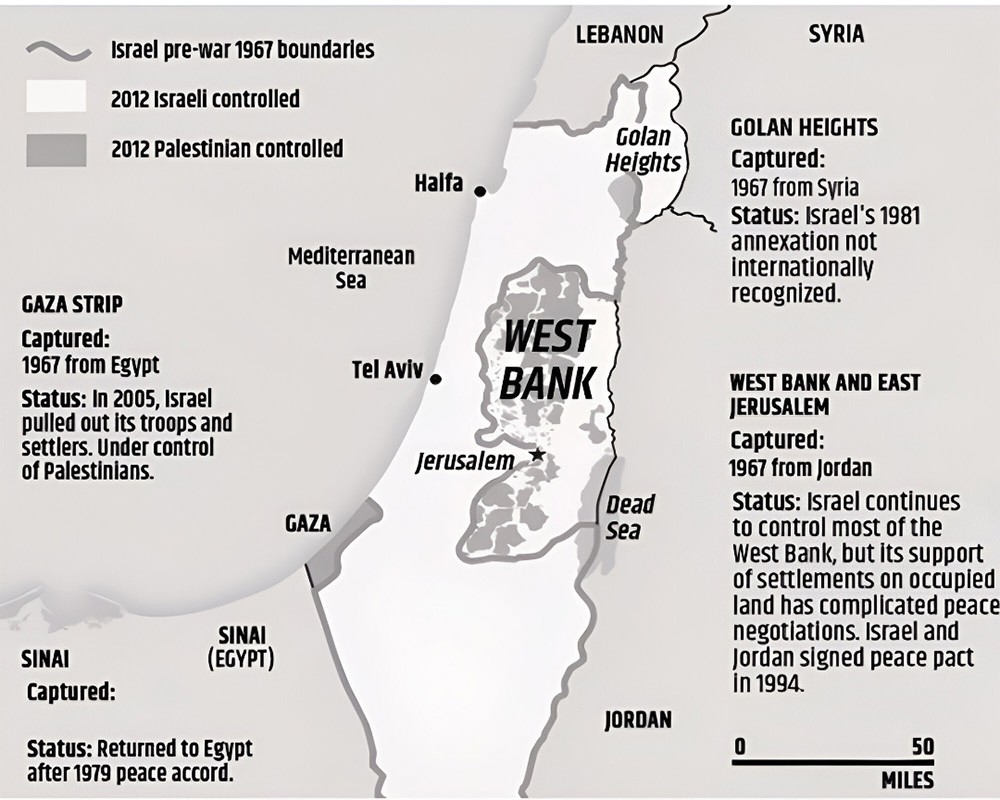
Six-Day War: In 1967, Israeli forces captured the Gaza Strip and Sinai Peninsula from Egypt, the Golan Heights from Syria, and the West Bank and East Jerusalem from Jordan.
The 1978 Camp David Accords: The United States- brokered “Framework for Peace in the Middle East” cleared the way for peace negotiations between Israel and its neighbors as well as a settlement of the “Palestinian problem”. But this never came to pass.
The Formation of Hamas: 1987 saw the founding of Hamas, a terrorist branch of the Muslim Brotherhood in Egypt that aimed to carry out violent jihad to further its objectives.
The U.S. government views Hamas as a terrorist organization. The Palestinian Authority held legislative elections in 2006, which Hamas won. In 2007, it drove Fatah out of Gaza and fragmented
the Palestinian organization geographically.
1987: The First Intifada (Palestinian Uprising) began as tensions in the occupied regions of Gaza and the West Bank approached a breaking point. Between Palestinian terrorists and the Israeli army, it developed into a little conflict.
Oslo Accords: 1993: Israel and the PLO commit to cease using violence against one another and to formally recognize one another. The Oslo Accords also created the Palestinian Authority, which was granted certain degrees of autonomy in the West Bank and Gaza Strip.
2005: Israel starts removing Jews from Gaza settlements on its own. All border crossings were, nevertheless, tightly under Israeli control (blockade).
2012: The UN raises Palestine’s status to “non member observer state” in its representation.
Israel’s territorial disputes with its neighbors:
West Bank: Israel and Jordan are encircled by the West Bank. Ramallah, the de facto administrative capital of Palestine, is one of its principal cities. Israel seized possession of it during the 1967 conflict and built settlements there over time.
Gaza: The Gaza Strip, which is between Egypt and Israel. After 1967, Israel controlled the strip; however, as part of the Oslo peace process, it gave up sovereignty over Gaza City and the majority of the territory’s daily operations. Although Israel still maintains control over international access to the land, it unilaterally evacuated Jewish settlements from it in 2005.
Golan Heights: During the 1967 war, Israel took control of this strategically important region from Syria. In actuality, Israel annexed the region in 1981. Recently, the USA has officially recognized Jerusalem and Golan Heights as a part of Israel.India’s ties to Israel as a National Interest:
Over the past few years, India and Israel have expanded their collaboration in a number of areas, including trade, technology, defense, and counterterrorism.
India’s backing of Israel is perceived as a reaction to battle against transnational terrorism, notwithstanding the substantial disparities between the circumstances in Israel and India.
Supports the Palestine Cause:
In addition to strengthening ties with Israel, India has reaffirmed support for the cause of Palestine.
India has donated USD 29.53 million to the UN and Works Agency (UNRWA) in support of Palestinian refugees amidst the continuing hostilities.
Additionally, India delivered 32 tonnes of disaster supplies and approximately 6.5 tonnes of medical help to the Palestinian people.
India Balancing its Stance:
The Indian prime minister first traveled to Israel in 2017 and then made his first official trip to Palestine in 2018.
India voted in opposition to the United States and Israel in 2017 against a proposal to unilaterally designate Jerusalem as the capital of Israel.
India has a clear stance: they oppose terrorism but do not back bombings carried out as indiscriminate retaliation.
Israel-Hamas War (2023-2024)
Israeli troops have been attacked by Hamas gunmen, who have also taken many civilians hostage. The nation is currently under a state of emergency as a result.
According to Hamas, the attack was a reaction to Israeli military incursions into the West Bank and unrest at Jerusalem's al-Aqsa Mosque.
From the Gaza Strip, which is under Hamas control, more than 5,000 rockets were fired. There have been casualties from the fighting on both sides of the border.
Operation "Iron Swords" has been launched by the Israel Defence Forces (IDF) in retaliation for an unprecedented and "surprise" attack by Hamas.
Iran is a tactical ally of Hamas, having funded the organisation and given its members arms and training to launch attacks.
India’s viewpoint on Israel-Hamas war
India, which has experienced terrorism firsthand, is obligated to condemn all such occurrences worldwide.
It will convey the wrong message to the rest of the world about its stance on terrorism if there is no denunciation.
On the larger Israel-Palestine dispute, however, India has consistently supported a diplomatic resolution that upholds the rights of all sides.
India will probably continue its policy of calling for a peaceful resolution to the conflict. It will advocate for negotiations between the two opposing factions.
About Hamas
Hamas is a Palestinian Islamist militant group that rules the Gaza Strip. It has been designated as a terrorist group by Israel, and the Western world.
INDIA’S OFFICIAL POSITION
India continues to support a two-state solution with Israel and Palestine as good neighbors in its official position on the Israel-Palestine conflict.
The Israeli-Palestinian dispute was only resolved to a two-state solution in the 1991 Madrid Peace Conference, which was mediated by the US.
The Indian Prime Minister’s 2018 visit to Ramallah in the West Bank serves as proof of this.
WAY FORWARD
Sustaining the current state of affairs in the Israel- Palestine conflict is a difficult undertaking, but India may contribute positively by advocating for a two-nation theory-based peaceful settlement.
India should keep up its diplomatic efforts and make use of its global clout to persuade Israel and Palestine to resume talks.
In order to meet the urgent needs and lessen suffering in places affected by war, India must continue to serve as a mediator and offer humanitarian aid to the Palestinian
people.
To foster trust and understanding between Israeli and Palestinian civil society organizations, intellectuals, and young people, encourage talks and exchanges.