Whatsapp 88106-52225 For Details
Get Free IAS Booklet
Get Free IAS Booklet
India and Myanmar relation
INTRODUCTION
Myanmar is important for India because of the geographic, historical, cultural and economic linkages/ties that span centuries as well as for the overall development of North- Eastern Indian states. India and Myanmar relationship officially got underway after the Treaty of Friendship was signed in 1951 and and Prime Minister Rajiv Gandhi's visit in 1987 strengthened the relationship.
Numerous agreements have been signed to enhance bilateral cooperation, and institutional mechanisms have been established to facilitate regular dialogue on various bilateral issues.
In 2002, the Indian Consulate General in Mandalay was reopened, and the Consulate General of Myanmar was established in Kolkata.
India responded to the 2008 cyclone 'Nargis' in Myanmar with relief materials and offers of assistance. In 2011, India provided $1 million for humanitarian relief and rehabilitation in areas affected by the 2011 earthquake in Shan State.
Since the military overthrew the government in a coup February 2021 and imprisoned Aung San Suu Kyi and other leaders of her National League for Democracy, Myanmar has been in unrest (NLD).
India, the largest democracy in the world, will be alarmed democracy in such a close proximity is in danger. But India also wants to safeguard and advance its important interests in Myanmar. India does not have the luxury of viewing Myanmar through the lens of democracy as the West has.
India, like the majority of its near neighbors, has been eager to counteract the authoritarian inclinations of the Myanmar military. Given its range of interests, India should maintain open lines of communication with all parties involved.
India shares 1,643 kilometres long terrestrial with Myanmar and a long maritime border as well. It touches Indian states of Mizoram, Nagaland, Manipur and Arunachal Pradesh.
HISTORICAL BACKGROUND OF INDIA AND MYANMAR
India has strong cultural affinities with Burma owing to the spread of Buddhism into the region during ancient times. These affinities further grew during the colonial period as India and Myanmar together endured imperialism. Indian leaders also maintained close relations with it during the freedom struggle which was led by Aung San. India
established diplomatic ties with Myanmar in 1948 after it gained independence. The ties however deteriorated after the overthrow of democracy in Myanmar in 1962 as India condemned the military coup. Incidentally, this was the period when Myanmar went into the Chinese fold. The relations further worsened during late 1980s when Myanmar witnessed pro-democracy movements that were suppressed by the military junta causing a mass influx of Burmese refugees into India. Indo- Myanmar ties however witnessed a turnaround during 1990s when India mooted the Look East Policy with Myanmar emerging as key to this foreign policy posture by India. The landslide victory by Aung San Suu Kyi-led National League for Democracy (NLD) in November 2015 general elections and the formation of NLD government has provided opportunities to further strengthen the engagement building on our previous efforts.
INDO-MYANMAR RELATIONS: DIFFERENT ASPECTS
Trade and Economy
• The success of India’s Act East Policy, Neighbourhood
first policy largely depend on its relations with Myanmar.
• Myanmar and India share an ever-expanding economic and trade partnership.
• The bilateral trade stands at US$2.1 billion in 2024-25 which includes India’s export of over US$614 million and import from Myanmar of around US$1533 million [April March 2025].
• The trade between the two countries has increased from
previous FY 2023-24 [US$1.74 billion].
• Myanmar’s export to India has increased more than India’s export to Myanmar due to Govt. of India’s announcement of free import of Urad and Tur upto 31 March 2025, which has further extended up to 31 March 2026.
• The overall trade has risen from US$1.29 billion in 2020- 21 to US$1.89 billion in 2021-22; US$1.76 billion in 2022-23 and US$1.74 Billion in 2023-24.
• India has become fourth largest trading partner of Myanmar. Earlier India was on seventh position.
• As per Govt. of Myanmar’s statistics, India is presently the eleventh largest investor with an approved investment of US$782.821 million (as on 31 March 2025)
• Up to 100% FDI allowed (includes manufacturing, construction and IT); up to 74% FDI allowed (includes pharmaceuticals and defence); up to 49% FDI allowed (includes air transport services and private sector banking);. up to 26% FDI allowed (print media)
• Myanmar is also the beneficiary of a duty-free tariff preference scheme for least developed countries (LDCs).
• Some of the Indian companies such as Essar, GAIL, and ONGC Videsh Ltd. have invested in Myanmar’s energy sector.
• Cooperation in the banking sector, which is crucial for investment and trade, is moving ahead steadily. United Bank of India and EXIM Bank have representative offices in Myanmar.
• Indian firms engage in manufacturing, services (banking insurance, dry port), power sector etc.
Infrastructure development and connectivity
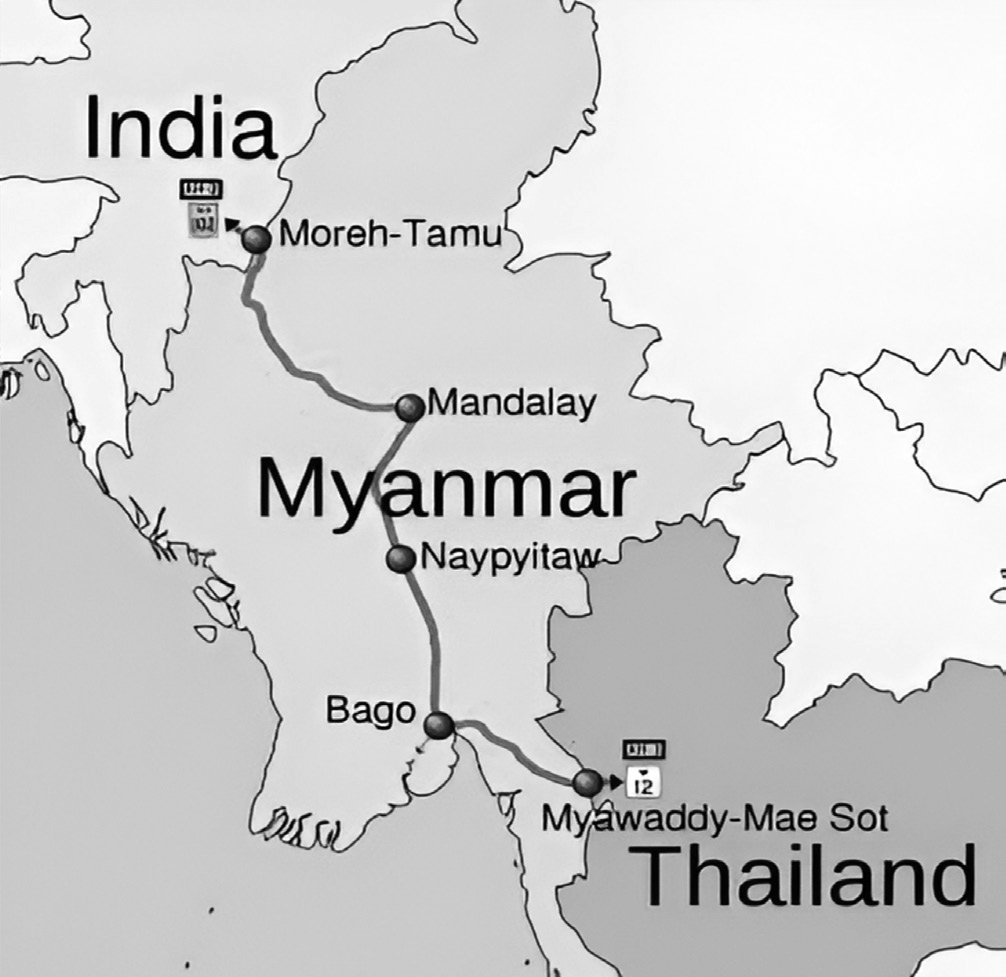
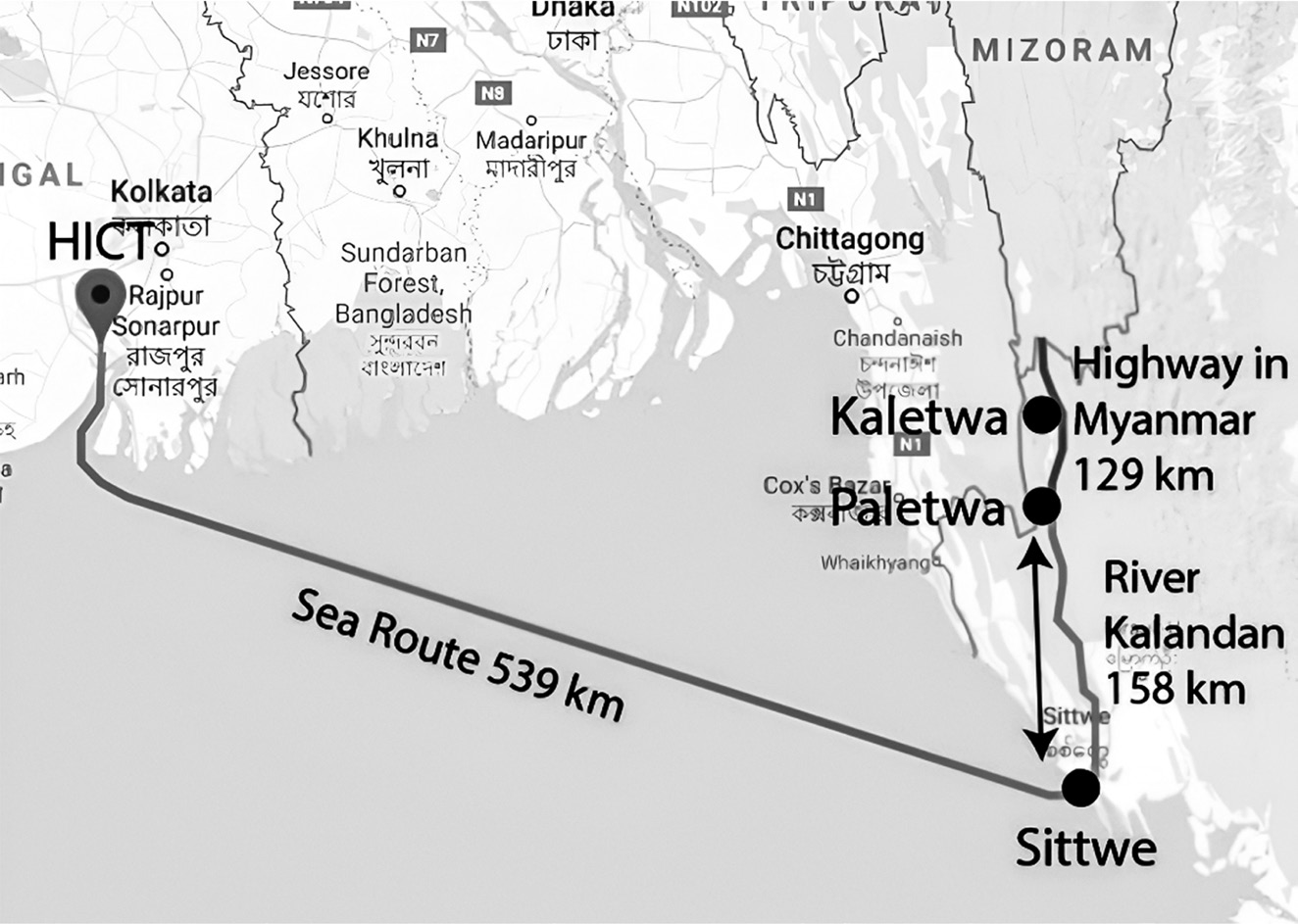
By 2001, BRO had constructed the Indo- Myanmar Road to improve connectivity between the two countries. Also, under construction is the India-Myanmar Thailand Trilateral Highway that connects Guwahati in India with Mandalay and yangon in Myanmar and finally culminates in Thailand. Another connectivity project underway is the Kaladan multi-modal Highway that connects Kolkata with Sittwe via sea and Sittwe with Myanmar via Kaladan river, thereby reducing transit time and costs. These projects will help boost bilateral trade between the countries. In September 2022, India and Myanmar signed a Project Agreement for constructing a Modern Integrated check post at Tamu in Myanmar.
Development Aid
India has committed $ 1.7 billion of aids and loans to Myanmar for infrastructure development which is inclusive of schools and health care centers. This aid is an important tool for exercising soft power.
Disaster relief
India has responded promptly and effectively in rendering assistance following natural calamities in Myanmar like Cyclone Mora (2017), Komen (2015), earthquake in Shan State (2010), assistance for settlement of displaced Rohingyas from the Rakhine state, etc. apart from monetary support in rehabilitation and reconstruction. India supported Myanmar in its fight against COVID-19, in total, India supplied more than 20 million doses of COVID-19 vaccine to Myanmar, including both gift and commercial supplies.
In response to the 7.7 magnitude earthquake which struck Myanmar on 28 March 2025, India launched "Operation Brahma" to provide immediate support to the affected people of Myanmar
Cultural Cooperation
Given India’s Buddhist heritage, India and Myanmar share close cultural ties and a sense of deep kinship. Building on this shared heritage, India is undertaking some key initiatives in restoring the Ananda Temple in Bagan and repairing and conserving many damaged pagodas. The India-Myanmar relations are framed by the 5 B's: Buddhism, Business, Bollywood, Bharatanatyam, and Burma teak. Three cultural pillars, such as common devotion to Buddhism, Burmese interest in Bollywood, and Burma training for Bharatanatyam, have fostered friendship and mutual understanding between the two neighbouring countries.
Indian Diaspora
The origin of the Indian community in Myanmar is traced to the mid-19th century with the advent of the British rule in Lower Burma in 1852. The two cities Yangon and Mandalay had a dominating presence of Indians in civil services, education, trade and commerce during the British rule. The 7000 strong NRI community in Myanmar mainly lives in Yangon and Mandalay, engaged in export-import business or employees of MNCs based in India,Singapore and Thailand.
Defence cooperation
• India also aids Myanmar for military modernization. Myanmar has acquired rocket launchers, night vision systems, radar and engineering equipment from India. The two neighbours also conducted joint Army exercises called IMBAX in 2017 and have been conducting joint maritime patrols since 2013. IMBAX is a first of its kind military training exercise on United Nations
Peacekeeping Operations (UNPKO) between India and Myanmar. The aim of this bilateral training event is to train the Myanmar delegation for participation in United Nations Peacekeeping Operations under the UN Flag. Besides, Myanmar has given India an assurance that it will prevent the use of its territory for anti-India activities.
Energy Cooperation
• Myanmar holds significance for India’s energy security. With an energy portfolio of over USD 1.2 billion, Myanmar is the largest recipient of India’s investment in the oil and gas sector in Southeast Asia. India also provides power from Moreh in Manipur to Myanmar.
BILATERAL COOPERATION IN REGIONAL/ SUB- REGIONAL CONTEXT
Myanmar’s membership of ASEAN, BIMSTEC and Mekong Ganga Cooperation has introduced a regional/sub-regional dimension to bilateral relations and imparted added significance in the context of our “Act East” policy. Myanmar has generally been supportive of India’s stand to various international organisations. For our part, we have supported Myanmar’s association with SAARC as an observer; Myanmar formally acquired such status in 2008.
On Rohingya Issue
India showed diplomatic fine balancing by abstaining from voting against Myanmar during the Bali declaration and also condemned the terrorist attacks in Rakhine district led
by ARSA.
MYANMAR’S IMPORTANCE FOR INDIA
Gateway to the East
Myanmar is the only ASEAN member that shares its borders with India and thus provides opportunity for deepening ties with south-east Asian nations under the Look East and Act East policies.
Strategic Significance
• India and Myanmar share a long 1,643 km geographical land border and maritime boundary in the Bay of Bengal. Myanmar shares borders with 4 Indian states – Mizoram, Manipur, Nagaland and Arunachal Pradesh in Northeast India.
• India - Myanmar border is highly porous, poorly guarded and located along a remote, underdeveloped, insurgency- prone region and proximate to opium producing area. The border is also vulnerable to the activities of insurgents and drugs and arms traffickers.
• Myanmar is also important from the security point of view as the influx of sizable numbers of Rohingya from Myanmar’s Rakhine state continues. India–Myanmar border poses a challenge to India’s security.
• Gateway to Southeast Asia: Myanmar serves as a land bridge connecting South Asia to Southeast Asia. The proximity of Myanmar to India's northeastern states establishes a strategic link and facilitates regional connectivity.
• Bay of Bengal Connectivity: The maritime boundary shared by India and Myanmar in the Bay of Bengal enhances opportunities for maritime cooperation, fostering economic and strategic collaboration. India - Myanmar Joint Statement during the Official Visit of the President of Myanmar to India (May 2026), PM Modi stated that Myanmar lies at the confluence of India’s Neighbourhood First, Act East and MAHASAGAR (Mutual and Holistic Advancement for Security and Growth Across Regions) policies.
• Regional Power Balancing: Given the geopolitical complexities in the region, a strong relationship with Myanmar helps India avoid any potential regional power imbalances that could arise from the influence of other major players. India's proactive engagement with Myanmar serves as a counterbalance to China's growing influence in the region.
Connectivity Initiatives
The Kaladan Multimodal Project
The Kaladan Multi Modal Transit Transport Project was jointly identified by the India and Myanmar to create a multi-modal mode of transport for shipment of cargo from the eastern ports of India to Myanmar as well as to the North-Eastern part of India through Myanmar. This project, which will connect Sittwe Port in Myanmar to the India-Myanmar border, is expected to contribute to the economic development of the North-Eastern States of India, by opening up the sea route for the products. It also provides a strategic link to the North- East, thereby reducing pressure on the Siliguri Corridor.
India-Myanmar-Thailand Trilateral Highway
The trilateral highway, stretching over 1,400 kilometres, will connect the Indian city of Moreh in Manipur to Thailand’s Mae Sot via Myanmar. This visionary project aims to establish seamless connectivity and bolster economic cooperation between India, Myanmar, and Thailand.
Regional Cooperation
• Myanmar is a key component of India's ambitions at bridging South Asia and South-East Asia through BIMSTEC which brings together 21% of world’s population and has a combined GDP of nearly $2.5 trillion. BIMSTEC also offers an alternative to SAARC which has been held back due to strains in Indo- Pakistan ties.
Security in North East
• Cooperation with Myanmar is crucial for controlling insurgency in North Eastern states. Besides, the porous borders provide fertile grounds for organized crime that is human trafficking, drugs peddling and smuggling of arms and ammunition. These can be checked only with the collaborative effort between India and Myanmar.
Energy security
Myanmar has rich reserves of oil and natural gas. Since India imports nearly 80% of its fuel, Myanmar is important for India.
Food security
Import of pulses and beans from Myanmar is vital to ensuring food security in India.
Counterbalancing China
India needs to increase its presence in Myanmar so as to counter the growing Chinese dominance in the region. Myanmar thus has strategic significance for India.
INDIA MYANMAR RELATIONS CHALLENGES
• Bilateral trade between the two countries remains far below potential. A major reason for this is the movement of infrastructure projects at snail’s pace. Notably, India’s project implementation capacity is very lacklustre.
• India sees Myanmar as being vital to fulfilling its ambition to become a $5 trillion economy by 2024. But with a total of $2 billion, India's economic engagement with Myanmar is laggin behind China.
• Rohingya Influx India hosts nearly 40,000 Rohingya Muslims who are denied citizenship in Myanmar and who sought refuge in India in order to escape religious persecution. But India faces tremendous burden on its
resources on account of refugees and also apprehends
a security threat from radicalized Rohingya youth. As a result, India pushes for repatriation of refugees back into Myanmar.
• Growing Chinese presence Myanmar agreed to be a part of the Belt and Road Initiative and has also welcomed Chinese investments in various infrastructure projects including port projects such as Kyaukpyu port. This has made India apprehensive as growing Chinese presence in India s neighbourhood spells strategic concerns.
• Conflict in Rakhine state is central to many connectivity projects currently underway between India and Myanmar such as the Kaladan Multi-modal highway. Conflict in the region has slowed the progress of such projects. This does not augur well for a bilateral trade. China’s relationship with Myanmar is extractive in nature. It is already has an oil and gas terminal near Bay of Bengal coast.
• China is going to build Special Economic Zone. Now it is asking for controlling stake in a natural deep sea harbor at Kyaukpyu that could form part of its ambitious BRI
• India imposed restrictions on the import of pulses in order to improve price realization for Indian farmers. This decision did not go down well with the Mynamarese government as it impacted Myanmar s exports to India.
• Over the years, the India-Myanmar border has become the main conduit for the trafficking of arms and drugs from Myanmar.
Rohingyas issue
Who are Rohingyas?
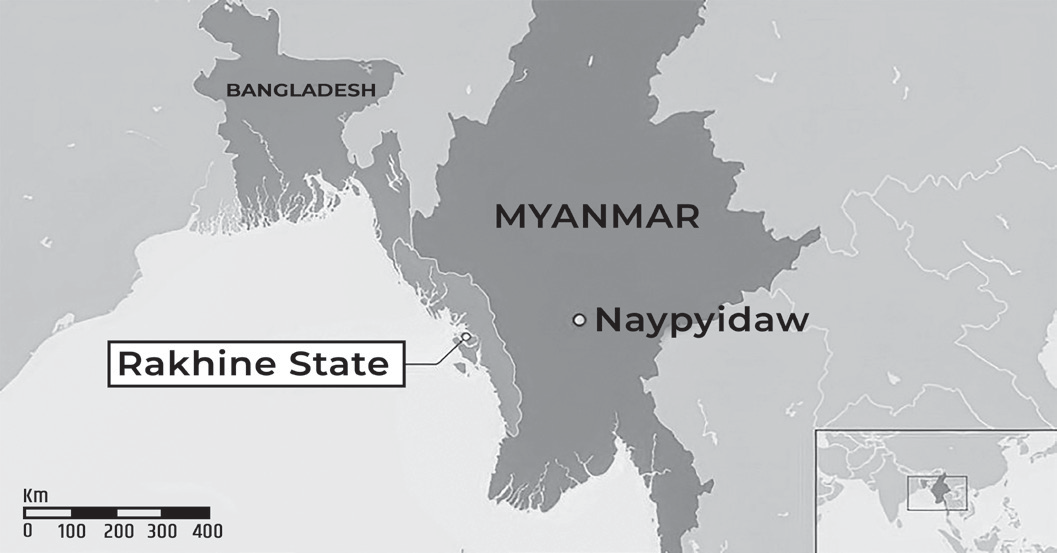
• Rohingya are an ethnic group, largely comprising Muslims, who predominantly live in the Western Myanmar province of Rakhine.
• They speak a dialect of Bengali, as opposed to the commonly spoken Burmese language.
• Though they have been living in the South East Asian country for generations, Myanmar considers them as persons who migrated to their land during the Colonial rule.
• So, it has not granted Rohingyas full citizenship. According the 1982 Burmese citizenship law, a Rohingya (or any ethnic minority) is eligible for citizenship only if he/she provides proof that his/her ancestors have lived in the country prior to 1823.
• Else, they are classified as “resident foreigners” or as “associate citizens” (even if one of the parents is a Myanmar citizen).
• In this way, the Rohingyas became officially stateless. They were subsequently denied citizenship documents, education, employment, freedom of movement, and even the right to marry freely, and were vulnerable to arbitrary detention, forced labour, discriminatory taxation and confiscation of property.
• Rakhine, in which the majority of Rohingyas live, is also Myanmar’s least developed region. Widespread poverty, along with poor infrastructure and lack of employment opportunities, has intensified cleavages between the Buddhists and the Muslim Rohingyas in the state, exacerbated by their religious differences.
• Apart from such discrimination, the Myanmar government also launched two major operations – Naga Min (King Dragon) in 1978 and Pyi Thar Ya in 1991 – to oust so-called illegal immigrants, especially Rohingyas, from the country. In each case, significant numbers of Rohingyas migrated to Bangladesh to avoid communal violence or alleged abuse by the security forces in Myanmar. The Bangladeshi government provided them safe haven in Cox’s Bazar district.
Humanitarian Crisis Since 2017
• Myanmar state, which was ruled by the military junta until 2011, has been accused of ethnic cleansing in Rakhine by the United Nations.
• It deported thousands of Rohingya to Bangladesh in the 1970s and the citizenship law was also enacted by the junta.
Sectarian violence between Rohingyas and Rakhine’s Buddhist natives began flaring up in June 2012, following the rape and murder of a Rakhine woman in a Rohingya- dominated locality. The riots, which were triggered as a result, went on for almost a month with causalities on both the sides.
• Muslim militants in Myanmar started staging a coordinated attack on police posts and an army base in Rakhine state.
• The Arakan Rohingya Salvation Army (ARSA), a group previously known as Harakah al-Yaqin, claims responsibility for the attacks.
• The ARSA is an armed guerilla outfit, which is active since 2016, claiming to fight for a “democratic Muslim state for the Rohingya.” The group has been targeting Myanmar armed forces. Bangladesh and India have also claimed ARSA is creating trouble in their soil too.
• This led to the major crackdown by the ‘Tatmadaw’ on the Rohingya population in 2017 led to a massive exodus of more than 9,60,000 Rohingyas to Bangladesh; this movement caused a sharp increase in the Rohingya population of Bangladesh.
Bangladesh’s stand on Rohingya
• Under United Nations conventions, communities like the Rohingyas are categorised as “de jure stateless”.
• But the Bangladeshi government calls them “forcibly displaced Myanmar nationals”. Like other South Asian countries, Bangladesh “has not signed any of the conventions or protocols relating to refugees” – the 1951 UN Convention on the Status of Refugees, the 1954
Convention on Stateless Persons, the 1961 Convention on Reduction of Statelessness, or the 1967 Protocol.
• As a result, it is not obligated to use the term ‘refugee’ in its official documents relating to the Rohingyas or provide them special support.
• In past decades, Bangladesh’s response to successive inflows of displaced Rohingyas has been to focus almost exclusively on their repatriation to Myanmar. Hundreds of thousands of Rohingyas returned to Rakhine state after the forced migrations of 1978 and 1991.
• Bangladesh had hoped that in 2017 it could negotiate a similar deal. It opened formal negotiations with Myanmar on repatriation in October 2017.
• The following month, the two countries signed a memorandum of understanding, under which, in December 2017, they set up a joint working group to coordinate repatriation in a safe, voluntary and dignified manner.
However, after four meetings and two failed efforts in 2018 and 2019, there has been no repatriation so far.
Current Situation
• Nearly a million Rohingya, including about 400 Hindu families, are now living in precarious conditions in the Bangladesh’s mud tracts in Kutupalong camp.
• In 2018, the United Nations inked a deal with the government of Burma to begin the long process of resettling some of the 700,000 Rohingya refugees who fled their homes for neighboring Bangladesh after a brutal military campaign in 2017.
• The fact-finding mission to Myanmar, set up by the Human Rights Council, last year branded the army operations in 2017 as “genocide” and called for the prosecution of top generals, including Army Chief Min Aung Hlaing.
• Some 7,40,000 Rohingya fled burning villages, bringing accounts of murder, rape and torture over the border to sprawling refugee camps in Bangladesh, where survivors of previous waves of persecution already languish.
• Myanmar is denying “wrongdoing, destroying evidence, refusing to conduct effective investigations and clearing, razing, confiscating and building on land” from which it displaced Rohingya.
• The UN mission called for the UN Security Council to refer Myanmar to the International Criminal Court (ICC) or to set up a tribunal, like for the former Yugoslavia and Rwanda.
International Reaction to the Coup
• The Western nations are still denouncing and imposing sanctions.
• To little effect, the US has persisted in using the abused threat of ever-stronger sanctions.
• The army of Myanmar appears to have given up on the rhetoric coming from the West.
• China is making investments and encircling Myanmar.
• The majority of ASEAN members, as well as South Korea, Japan, and other nations, have advanced in their engagement with the military regime in Myanmar.
• In January 2022, the prime minister of Cambodia is also expected to visit Myanmar, where he is expected to negotiate new terms of engagement.
India’s Dilemma
• Myanmar's military takeover in 2021 has posed challenging choice for countries in the region.
• India also faced the difficult choice of safeguarding national interests vis-a-vis its neighbors’ expectations.
• India shares borders with Myanmar and Bangladesh and the two countries are critical for the peace and stability of India’s conflict-prone northeast.
• Maintaining a friendly relationship with both Myanmar and Bangladesh is imperative for India. Hence, the issue required delicate handling.
• India was one of the first few countries to provide humanitarian assistance and relief for the Rohingya refugees in Bangladesh. Still, there is a feeling in Bangladesh that India could have contributed much more to helping the country deal with the crisis.
• However, India has not even publicly condemned the horrible atrocities that the Rohingya have faced at the hands of Myanmar’s security forces.
• India has so far refused to exert any pressure on Myanmar, instead choosing to balance ties with Dhaka and Naypyidaw by sending humanitarian aid to both. But India’s soft, backfoot approach is being increasingly seen by Bangladesh, which is hosting nearly a million Rohingya refugees, to be tilted in Myanmar’s favour.
Bashan char island
• There is an agreement among the Rohingya refugees residing in camps in Bangladesh to relocate to Bhashan Char Island in the Bay of Bengal.
• “Thengar Char Island” is another name for the island.
• Approximately twenty years ago, Bhashan Char Island formed at the mouth of the Meghna river.
• In South-East Bangladesh, the deserted island is situated
about 30 kilometers to the east of Hatiya Island.
• Bangladesh sought to relieve the strain on the overcrowded border camps by relocating 100,000 Rohingya migrants to the muddy silt island.
• The Bhashan Char is located in a vulnerable ecological region that is prone to cyclones, floods, and erosion.
However, in order to prevent tidal surges during storms, the government of Bangladesh constructed a three-meter-high embankment around its perimeter.
WAY FORWARD
• Both the countries are affected due to the misuse of open border by internal and external forces, the responsibility of border management and regulation depends on both.
• It is also the only country that can act as a link between India and ASEAN.
• Myanmar is India’s gateway to Southeast Asia and could be the required impetus to realize India’s Act East Policy.
• Cultural diplomacy: India may use Buddhism to develop its ties with Myanmar by using cultural diplomacy.
• Burma, which is predominately Buddhist, should be sympathetic to India’s “Buddhist Circuit” plan, which links historic Buddhist heritage sites across Indian states in an effort to quadruple the number of international tourists visiting India.
• Myanmar itself is an emerging consumer market of million people who have demands for products ranging from personal care to beverages to smart phones. India should leverage these export opportunities.
• There are a few sectors where India can extend its presence in Myanmar. These include manufacturing high-end smart phones, exporting cement, furniture,
FMCG, energy, telecommunications, healthcare, creating townships, low cost housing development, ports and logistics, rural electrification etc.
• Agriculture is another sector where India can substantially augment its cooperation with Myanmar in rice research activities, post-harvest technology,agriculture financing and articulating policies.
• India’s Kaladan Multimodal Transit and Transport project and India-Myanmar-Thailand Trilateral Highway have seen much delay over the past couple of years. Hence, it can be said that the success of India’s Act East Policy will now depend on India’s prompt action and pragmatic approach for completion of projects.
• Enhancing economic partnership with Myanmar needs to be a priority in India’s Act East Policy which will benefit New Delhi in enhancing ties with Southeast Asia.
• Resolving the Rohingya Issue: India will find it easier to handle its relations with Bangladesh and Myanmar and to concentrate more on bilateral and subregional economic cooperation the sooner the Rohingya issue is settled.
India shares many common concerns with Myanmar that range from socio-economic development, similar ecological and climatic concerns, shared concerns over insurgency and regional peace and preserving sovereignty in light of growing Chinese assertiveness. These offer tremendous scope for cooperation. India needs to seize this opportunity and expedite the work on ongoing projects while at the same time exercising soft power through constructive aid and cultural exchange.
It is crucial that India engages with Myanmar and forges its own path there, much like the country’s other close neighbors.