India-saudi Arabia Relations
INDIA-SAUDI ARABIA RELATIONS
INTRODUCTION
• India and Saudi Arabia have long-standing diplomatic relations, dating back to 1947.
• The first visit of King Abdullah in 2006 marked the signing of the 'Delhi Declaration', followed by the 'Riyadh Declaration' in 2010, which elevated the bilateral relations to a Strategic Partnership.
• The visit of Hon’ble Prime Minister Shri Narendra Modi to Riyadh in April 2016 captured the spirit of enhanced cooperation in the political, economic, security and defence realms. During the visit, King Salman conferred the Kingdom’s highest civilian honor, the King Abdulaziz Sash, on the Hon’ble Prime Minister, indicating the importance Saudi Arabia attached to its relations with India.
• The visit of Crown Prince Mohammad bin Salman to India in February 2019 further took forward this momentum. During the visit, it was announced that the Kingdom would invest approximately US$ 100 billion in India and 06 MoUs/Agreements were signed in various fields, including investment, tourism, housing, exchange of audio-visual programmes, and an agreement was signed to pave way for Saudi Arabia to join the International Solar Alliance (ISA), which was launched by the Hon’ble Prime Minister.
• In 2023, Crown Prince Mohammed bin Salman visited India to participate in the G20 Leaders' Summit and co- chair the 1st Leaders' Meeting of the India-Saudi Arabia Strategic Partnership Council. The two leaders signed eight MoUs/MoCs/Agreements across various fields, including energy, banking, investment, manufacturing, archival cooperation, anti-corruption, and water desalination. The India-Saudi Investment Forum was also organized during his visit.
• India and Saudi have been in frequent contact and they recently reviewed progress in the Bilateral Strategic Partnership and shared concerns about the situation in West Asia, particularly terrorism, violence, and loss of civilian life. They agreed to work together for peace, security, and stability in the region.
SIGNIFICANCE OF SAUDI ARABIA
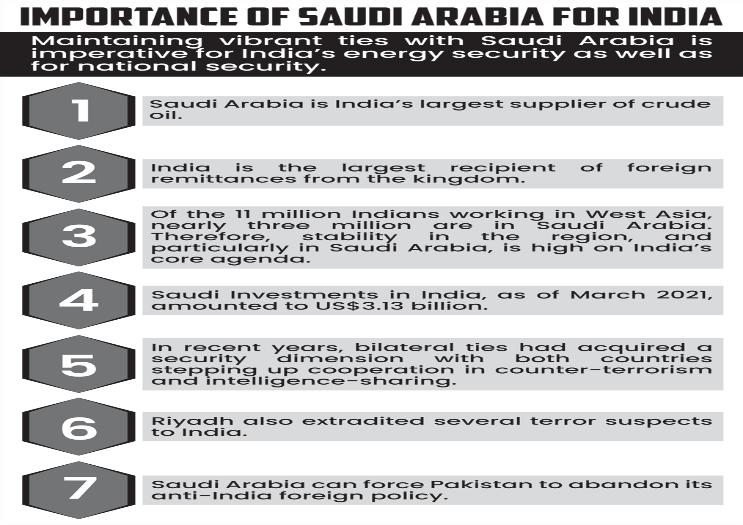
• Saudi Arabia's Vision 2030: It aims to diversify its oil- dependent economy by attracting tourism and foreign investment, and turning it into a global hub for business and culture. The country requires India's technological assistance to execute this vision, opening up opportunities for Indian businesses in the IT and infrastructure sectors.
• Energy: Saudi Arabia is a key pillar of India's energysecurity, providing additional crude oil supplies to meet its growing needs.
• Investment: The total Saudi investment in India including that of Saudi sovereign wealth fund - PIF, other Saudi companies and Saudi backed Vision Fund, has been about USD 10 billion.
• Trade: Bilateral trade ties have steadily grown over the years. India is the 2nd largest trade partner of Saudi Arabia whereas Saudi Arabia is the 5th largest trading partner of India. In FY 2024-25, bilateral trade stood at USD 41.88 billion, with Indian exports at USD 11.76 billion and imports at USD 30.12 billion
• Cultural: Saudi Arabia also has cultural significance for India, as it facilitates Hajj pilgrimage to over 1,75,000 Indians annually.
• Diaspora: The 2.7 million strong Indian community in Saudi Arabia acts as soft power diplomacy, sending remittances of over $11 billion annually to India.
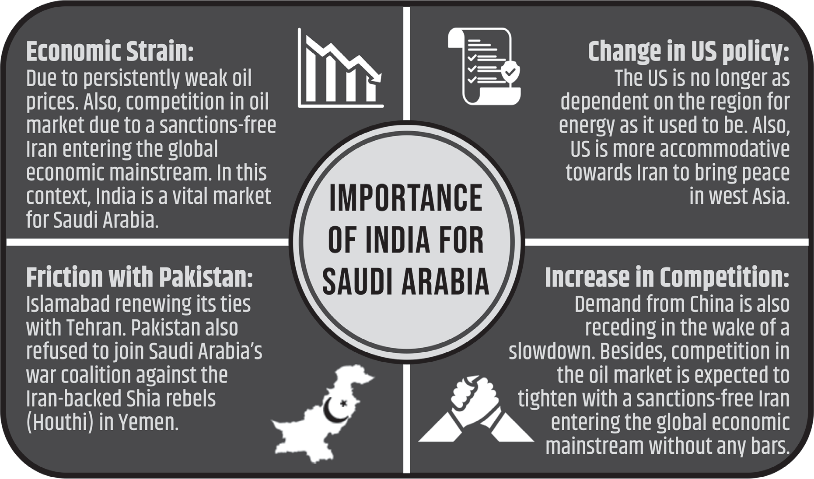
In this context, India is a vital market for Saudi Arabia. There is believed to be friction between Islamabad and Riyadh over the former warming up to Tehran and their growing energy cooperation.
Strategic Significance of Indo-Saudi Relations
• The stability and security of the Gulf region and the Indian subcontinent are closely interlinked. From an Indian perspective, the main challenges to regional stability include the ongoing civil war in Syria, US-Iran hostility and the Palestine issue.
A new Ministerial Committee on Defence Cooperation under the India–Saudi Arabia Strategic Partnership Council was announced in April 2025.
Two editions of the bilateral naval exercise ‘Al Mohed Al Hindi’ have been held, in 2021 and 2023. The first ever bilateral Land Force Exercise ‘EX-SADA TANSEEQ-I’ was held in 2024 in Rajasthan
Cyber security and maritime security are other major issues in the region. Such developments have given space for the formation of positive relations between India and Saudi Arabia.
To enhance strategic cooperation between the two countries, Saudi military cadets have also engaged with the India’s NDA for military training. It is a positive step given the fact that apart from Diaspora, this could possibly lead to an organised interaction among the strategic and defence community too.
Apart from these engagements between India and Saudi Arabia, other common interests of cooperation are:
Health sector offers significant potential for cooperation between the two countries; especially in areas like training and doctors exchange programmes’, medical tourism, extending healthcare services, building healthcare infrastructure and developing its related technologies.Both countries are focusing on knowledge-based economies. They are considering their respective strengths in, for instance, information technology, space science and other frontier technologies.
India possesses one of the largest pools of scientific and technical manpower in the world and is well- known for their technological prowess. Many Indian expatriates, who are specialists in IT, can contribute further to the growth of Saudi IT and knowledge- based industries.
Education, vocational training and promotion of tourism are other areas where the two countries focus to jointly work and mutually benefit.
Other prospective areas of cooperation explored during the Prince Salman’s visit were tourism, aviation industry, Indian Ocean Rim for enhancing maritime security, technical cooperation on cyber space; promote reformed multilateralism, global governance etc.
CRITICAL ISSUES WITH SAUDI ARABIA
Saudi-Pakistan Relations: Pakistan has long been considered a "historic ally" of Saudi Arabia, with the two nations sharing deep-rooted ties based on mutual interests and cooperation. Strategic Mutual Defense Agreement (SMDA) 2025 is a military cooperation between Saudi Arabia and Pakistan, that may affect India’s national interests in South Asia and the Gulf region. The pact includes a collective defence clause, joint military mechanisms, and intelligence-sharing
Saudi-Iran Rivalry: The ongoing rivalry between Saudi Arabia and Iran has been a major destabilizing force in West Asia, significantly influencing the region’s geopolitics and contributing to ongoing conflicts.
Ideological Challenges:
While Saudi Arabia officially condemns terrorism, its financial support for Wahhabi Islamic groups around the world has raised concerns. Many extremist organizations draw inspiration from the Wahhabi interpretation of Islam, further fueling radical ideologies.
Saudi Arabia’s aggressive foreign policy in West Asia has had a destabilizing effect, undermining regional stability—something that is crucial to India’s interests in the region.
In Syria, Saudi backing of rebel groups played a key role in destabilizing the government, which ultimately contributed to the rise of extremist factions like the Islamic State (ISIS), further escalating the conflict.
In Yemen, the war has unleashed chaos and a humanitarian catastrophe, creating conditions for radicalism to flourish.
Prospects
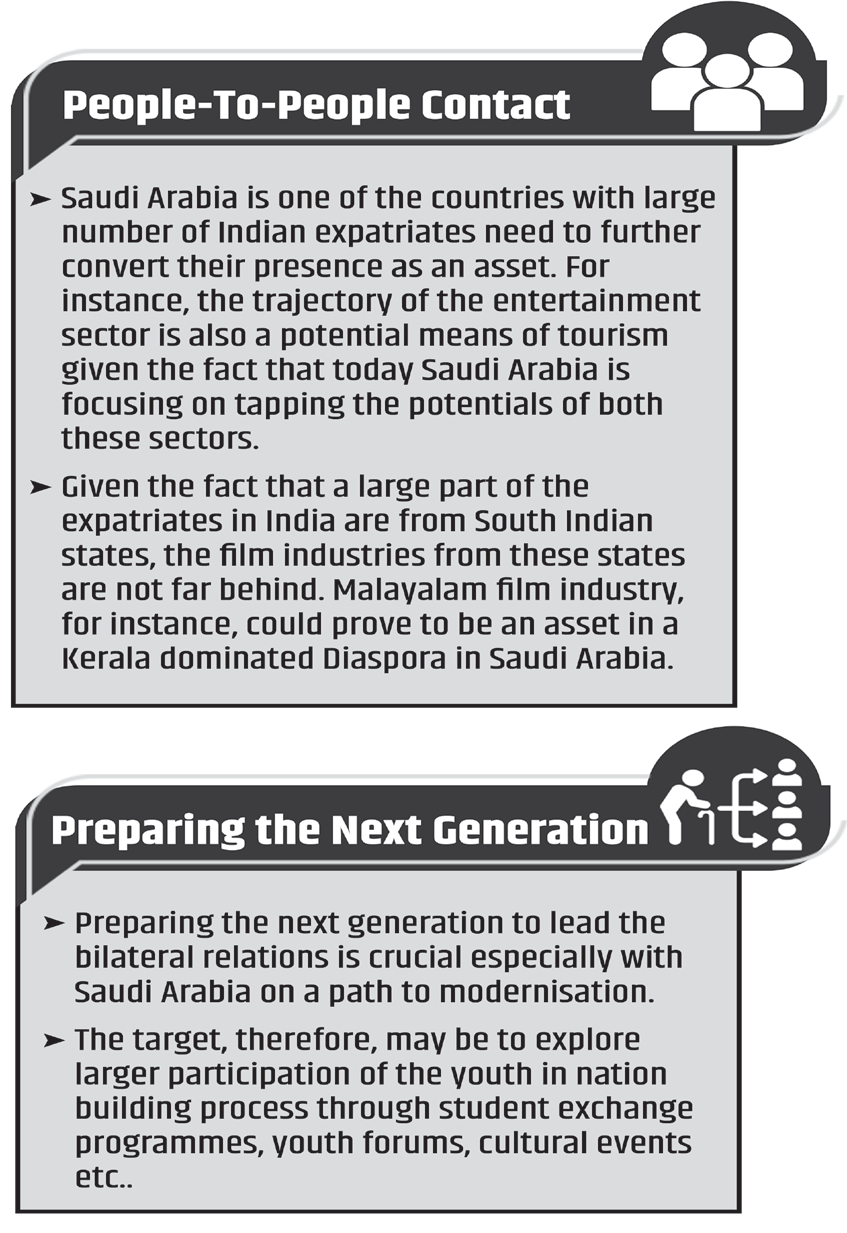
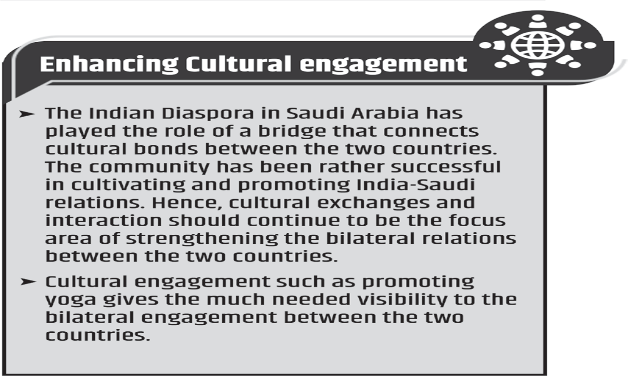
The following three avenues are crucial to strengthen the relations although there are many prospective areas
CONCLUSION
With both India and Saudi Arabia focused to widen the scope of bilateral engagement, the two countries may balance each other’s interests, but at the same time not overlook each other’s sensitivities. The two countries may also address some of the issues that are likely to impact the partnership such as the grievances of the Indian Diaspora. The task ahead for the countries is to put into action the promising agreements signed between the two countries and taking stock of them from time to time for effective outcomes.