Whatsapp 88106-52225 For Details
Get Free IAS Booklet
Get Free IAS Booklet
INDO-SINGAPORE RELATIONS
INTRODUCTION
• India's relationship with Singapore dates back to the Cholas, who named the island and established a permanent settlement.
• Sir Stamford Raffles established a trading station on the Straits of Malacca in 1819 to protect East India Company ships carrying cargo between India and the region, especially China.
• Singapore's location was increasingly recognized as strategic to the British Empire's security, and it became a colony under British India from 1830 to 1867.
• The colonial connection is reflected in similar institutions, practices, English usage, and a large Indian community.
• India was among the first countries to establish diplomatic relations after Singapore's independence in 1965.
• The close relationship is based on convergence of economic and political interests. Economic reforms in India since the early 1990s have created a strong basis for cooperation with Singapore, and Singapore has played a significant role in reconnecting India with South East Asia countries since the Look East Policy in the early 1990s.
Political Relations
• India-Singapore relations are based on shared values, economic opportunities, and convergence of interests on key issues. There are over 20 regular bilateral mechanisms, dialogues, and exercises, and both are members of various forums, including the East Asia Summit, G20, Commonwealth, IORA, and IONS.
• A new high-level Ministerial mechanism has been established to discuss the roadmap to take bilateral relations to a new level.
• The inaugural meeting of the India-Singapore Ministerial Roundtable (ISMR) took place on 17 September 2022 in New Delhi, with four senior Singapore Ministers traveling to India. The focus was on emerging areas such as digital connectivity, Fintech, green economy, green hydrogen, skill development, and food productivity.
• Key agreements between India and Singapore reflect the growing overall cooperation, providing a larger framework for activities between the two Governments, commercial and people-to-people exchanges. Key agreements include the -
• Comprehensive Economic Cooperation Agreement (2005) and its Second Review (2018)
• Double Taxation Avoidance Agreement(1994, P rotocols signed in 2011)
• Bilateral Air Services Agreement (1968, revised in 2013)
• Defence Cooperation Agreement (2003, enhanced Agreement signed in 2015)
• MOU on Foreign Office Consultations (1994), Mutual Legal Assistance Treaty (2005)
• Mutual Recognition Agreement on Nursing (2018) and cooperation in Fintech (2018)
• Agreement for Conduct of Joint Army Training and Exercises (renewed in 2019) and
• FinTechCooperation Ag reement between the Monetary Authority of Singapore (MAS) and
• the International Financial Services Centres Authority (IFSCA).
• There is a Joint Ministerial Committee (JMC), chaired by EAM and FM of Singapore and Foreign Office Consultation (FOC) at the Secretary level. Last FOC was held in New Delhi between Secretary (East) and Second Permanent Secretary, Ministry of Foreign Affairs on 18 September 2023.
The Prime Minister of the Republic of Singapore Mr. Lee Hsien Loong visited Indiain 2016. During his visit the following agreements were signed -
• A Memorandum of Understanding (MoU) on Property Cooperation was signed during the visit between the Department of Industrial Policy and Promotion (DIPP) and the Intellectual Property Office of Singapore.
• Another MoU on Collaboration in the Field of and Vocational Education and Training was signed between the National Skill Development Corporation and ITE Education Services, Singapore;
• A third MoU on Collaboration in the Field of and Vocational Education and Training was signed between the Government of Assam and ITE Education Services, Singapore.
• The agreements were signed for “smart cities drive and “skill India program” during the bilateral visit as Singapore has expertise in both the fields.
Trade and Economic Relations
• Bilateral trade expanded after the conclusion of CECA from USD 6.7 billion in FY 2004-05 to USD 34.3 billion in 2024-25.
• Singapore is India’s 6th largest trade partner (FY 2024-25) with a share of around 2.96 % of India’s overall trade.
• Our imports from Singapore in FY 2024-25 were USD
21.29 billion (YoY growth of 0.43%), exports to Singapore totaled USD 12.98 billion (YoY decline of 9.98 %) with trade deficit of USD 8.31 billion.
• Singapore is India’s largest trade partner in ASEAN. It is the leading source of FDI, among the largest sources of External Commercial Borrowings and Foreign Portfolio Investment.
• In FY 2024-25 Singapore was the largest source of FDI into India, with FDI flows of USD 14.94 billion. The cumulative FDI inflows from Singapore to India stood at USD 179.48 billion (April 2000– June 2025) which is 24 % of total FDI inflows in India
• Unified Payments Interface (UPI)-PayNow Linkage: Launched in 2023, this is the first real-time payment systems linkage in the world, facilitating easier and faster financial transactions between the two countries.
• Trade Trust Framework: Introduced in 2023, this framework utilizes blockchain technology for electronic Bills of Lading, enhancing efficiency in trade finance transactions between Singapore and Indian entities.
• Focus on Renewable Energy: India’s renewable energy initiatives, with 92% of its 2022 power capacity growth from renewables, attract interest from Singapore for investment and sourcing.
Defence and Security Cooperation
• Both countries, despite their differing concerns about regional stability and maritime security in the Indo-Pacific region, have elevated their relationship to a Strategic Partnership in 2015, and have signed agreements to strengthen their defense ties.
• Defence Exercises-
• Navy: SIMBEX
• Air Force: SINDEX
• Army: Bold Kurukshetra
Defence Cooperation Agreement: India and Singapore signed a Defence Cooperation Agreement, allowing the Singapore army and air force to conduct training on Indian soil.
Naval Cooperation: India-Singapore Bilateral Agreement for Navy Cooperation was signed which gave Indian Navy ships access to Singapore’s Changi Naval Base near the disputed South China Sea, mutual logistical support and refuelling rights at the port.
India and Singapore signed the agreement for the “strategic relationship” across the board including defence and military, security and intelligence cooperation, political exchanges, enhancing trade and investment, improving financial linkages, improving air connectivity and cooperation in multilateral forums.
• In 2025, a total of eleven Indian Navy ships have so far visited Singapore for operational turn around, goodwill visits or exercises with the latest being INS Nistar in September 2025 for the multinational Exercise Pacific Reach 2025 (XPR 25).
• Indian Air Force’s Sarang Helicopter Display team participated in Singapore Air Show 2026 (held in February 2026)
Infrastructure, Innovation and Technology Development
• Singapore's expertise in infrastructure development, smart cities, and urban planning aligns with India's sustainable development goals. Singaporean companies are actively involved in infrastructure projects in India, including industrial parks, airports, and urban infrastructure.
• The 28th edition of the DST-CII India- Technology Summit highlighted India-Singapore's partnership in AI, IoT, fintech, healthcare, biotech, green mobility, logistics, smart manufacturing, and sustainable urban development.
Singapore is considering working with India to develop public digital infrastructure, similar to Aadhaar, and combining 'Proxtera', a global digital hub for MSME ecosystems, with India's Open Network for Digital Commerce (ONDC).
Indian Community
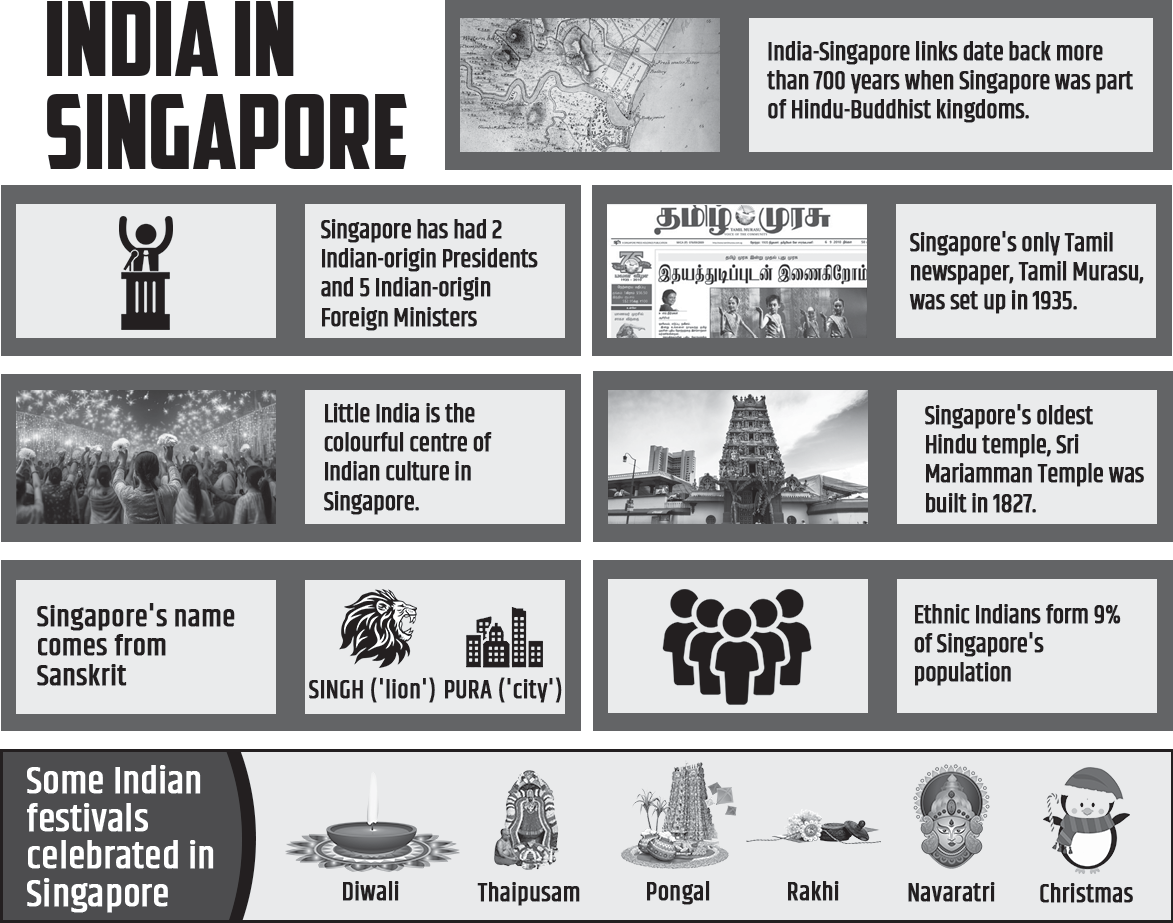
Around 9.1%, or roughly 3.5 lakhs, of Singapore’s 3.9 million residents are ethnic Indians.
In addition, of the 1.6 million foreign residents in Singapore, around 3.5 lakh, or 21%, are Indian expatriates with Indian passports; these individuals primarily work in the financial services, IT, student, construction, and maritime industries.
Of all the cities outside of India, Singapore has highest number of IIT and IIM alumni.
In Singapore, there are roughly one lakh Indian worker. However, Singapore is not included in the ECR group.
One of Singapore’s four official languages is Tamil.
Schools also teach Bengali, Punjabi, Hindi, Gujarati, and Urdu. The welfare and well-being of Indian citizens, including those employed by them, are a major part of the Mission’s consular duties.
The 25th anniversary of the ASEAN-India Partnership was celebrated during the ASEAN-India Pravasi Bharatiya Divas (PBD) with the theme "Ancient Route, New Journey" from January 6-7, 2018 in Singapore.
Significance of Singapore for India
Singapore and India have a complex relationship that is both strategic and commercial.
Close ties between Singapore and Indian states such as West Bengal, Rajasthan, Andhra Pradesh, and Telangana
have been established. As a result, business partnerships are growing.
Both nations are attempting to investigate additional domains including tourism and talent enhancement.
ASEAN is evolving and Singapore has been supporting India’s increased involvement in the Indo-Pacific area. Under such circumstances, Singapore’s voice will probably become even more important, and the strategic cooperation between India and Singapore will probably get much stronger.
INDIA-SINGAPORE: DTAA
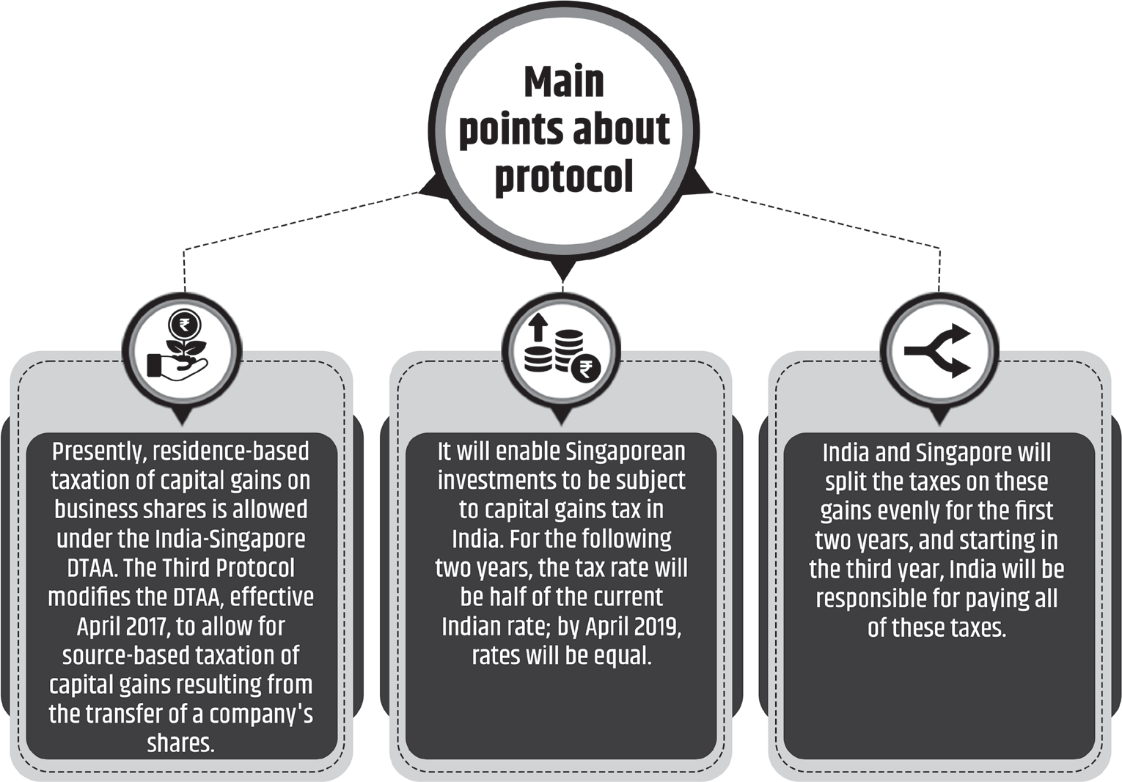
In an effort to combat tax cheating, India and Singapore signed a third protocol to modify the bilateral double taxation avoidance agreement (DTAA).
Significance of protocol
An important step has been taken to address yet another black money loophole: this amendment essentially stops one method of “round-tripping” domestic black money laundering. Regulators have long believed that wealthy Indians are sending money back to India after passing via these tax havens.
This aligns with India’s treaty policy to mitigate revenue loss, stop double non-taxation, and combat the threat of black money through automated information sharing.
This move is favorable to taxpayers and aligns with India’s obligations under the Base Erosion and Profit Shifting (BEPS) Action Plan to fulfill the minimal requirement of granting access to the Mutual Agreement Procedure (MAP) in transfer pricing disputes.
Framework of the Bilateral Relationship
The foundation of relations between Singapore and India includes common views and ideals, as wellas convergence of interests on important issues and economic prospects. Political participation is frequent. Relations in the defense sector are very good..
Human and cultural ties are strong, over 20 bilateral processes, discussions, and exercises are conducted.
They have a great deal of agreement on a wide variety of global problems, and they both participate in the East Asia Summit, the G20, the Commonwealth, the Indian Ocean Rim Association, (IORA) and the Indian Ocean Naval Symposium (IONS).
CONCLUSION
In the international arena, India has a close working relationship with Singapore, and a number of regional mechanisms connect these two countries together, including ASEAN, the ASEAN Regional Forum (ARF), ASEAN plus three, the East Asia Summit, and the ASEAN Defence Ministers Meeting (ADMM) Plus. Singapore has vigorously backed India’s expanded geostrategic influence in ASEAN, as well as India’s permanent membership in the United Nations Security Council.