India-south Korea Relations
INDIA-SOUTH KOREA RELATIONS
India-Republic of Korea (RoK) relations has made great strides in recent years and has become truly multidimensional, spurred by a significant convergence of interests, mutual goodwill and high-level exchanges.
History of India-South Korea relations
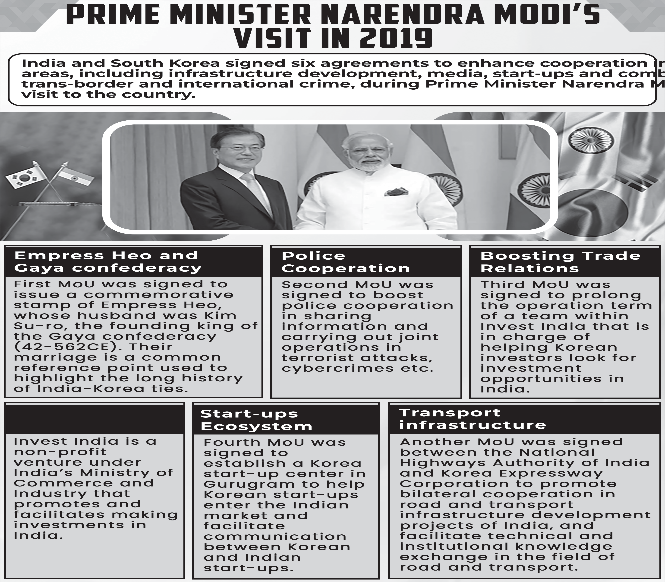
• In the 13th century Korean historical text "Samguk Yusa Princess Suriratna from Ayodhya, India, arrived in Korea in 48 AD and married King Kim-Suro, becoming Queen Heo Hwang-ok.
• Many Koreans trace their ancestry to this lineage, and some scholars believe Buddhism reached Korea via the maritime route.
• Nobel Laureate Rabindranath Tagore also composed a short but evocative poem – ‘Lamp of the East’ - in 1929 about Korea’s glorious past and its promising bright future. He wrote: “In the golden age of Asia Korea was one of its lamp bearers, and that lamp is waiting to be lit once again For the illumination of the East.”
• India-Republic of Korea established diplomatic relations on 10 December 1973. Consular relations were established in 1962. Both countries formed a “Strategic Partnership” in year 2010, which was elevated to “Special Strategic Partnership” in year 2015 during the State Visit of Prime Minister Narendra Modi to Seoul.
• Over time, India’s economic liberalization, “Look Policy,” and “Act East Policy” found resonance with RoK’s free market ideas. India’s consistent advocacy for the amicable unification of the two Koreas has been highly accepted there.
India-South Korea (Republic of Korea) diplomatic relations achieved the mark of 50 years in 2023. Both India and South Korea stand to gain strategically and economically from the deepening of people-to-people ties.
India’s Role in Korean War
• India played a significant role in the Korean peninsula after Korea's independence in 1945.
• Former Indian diplomat Shri K P S Menon was the Chairman of the UN Commission established in 1947 to hold elections in Korea.
• India sent an Army medical unit, the 60th Parachute Field Ambulance, to treat around 220,000 patients during the Korean War. After the war, both sides accepted a UN resolution sponsored by India, leading to the declaration of a ceasefire in 1953.
• Lt. General K.S. Thimayya of India served as the Chairman of the Neutral Nations Repatriation Commission, contributing to resolving humanitarian issues.
• India also sent a Brigade Group, Custodian Forces -India (CFI), to Korea to resolve the Prisoners of War issue.
• In June 2020, PM Narendra Modi commemorated the 70th anniversary of the Korean War, and an exhibition commemorating India's contribution was co-organized by the Embassy of India in Seoul in 2022.
The India-South Korea axis can significantly contribute to peace, security, and stability in the Indo-Pacific region, especially through strengthened economic partnership and deepen security relations. South Korea’s open market policies find a clear resonance with India’s economic liberalization.
The ‘Act East Policy’of India certainly complements the ‘New Southern Policy’ of South Korea and adds new substance and impetus to bilateral cooperation between two nations in all areas of engagement. A lot of complementarities exist at various levels between two countries; for example, South Korea’s technological advancement and manufacturing
capabilities can be helpful in India’s economic growth and human resource development.
Complementarities between ‘Act East Policy’ and ‘New Southern Policy’
• To reduce export dependence on China and United States and establish alternative trade structures in the region, South Korean President Moon Jae-in has unveiled the ‘New Southern Policy’ to deepen relations with ASEAN and India in 2021.
• The ‘New Southern Policy’ emphasises the “3P community: People, Prosperity, and Peace. With a ‘people first’ mindset, the government hopes to increase trade with this region to establish symbiotic prosperity. Additionally, given the abnormal atmosphere on the Korean peninsula, the Republic of Korea hopes to build an alliance of nations to help promote communication in the region, keeping in mind the goal of attaining denuclearisation on the peninsula and greater peace for the East Asian region as a whole.
• Similarly, since 2014, India has been seeking deeper involvement with its Eastern neighbours to reduce dependence on its Western counterparts, namely through the ‘Act East Policy.’ The focus of this policy can be simplified into the “3C’s,” Culture, Connectivity, and Commerce. India’s close geographic proximity and cultural similarities with many of these nations give it a huge advantage in conducting trade with them.
• The importance of Indo-Korean relations has been amply underscored in recent years especially under both current governments. President Moon’s visit to India in July 2018 was a landmark in their diplomatic relations and PM
Modi’s second official visit to Seoul in February 2019 and recent visit of Union Defence Minister, further cemented their relations.
Economic Relations
• India and South Korea's economic and trade relations have significantly improved since the signing of the Comprehensive Economic Partnership Agreement in 2010.
• Bilateral trade has grown from USD 14.2 billion at the time of its implementation to USD 26.89 billion in 2024–25, an increase of nearly 90%. Of this, India’s imports from the ROK account for approximately USD 21 billion, while exports stand at about USD 5.8 billion.
• Bilateral trade between India and Korea stood at US$ 18.35 billion in FY 2026 (till November 2025).
• ROK is India’s 13th largest FDI investor, with cumulative investments of USD 6.91 billion since 2000.
• South Korea ranks 20th as an export destination and
11th as an import source
• By 2022, the relationship reached $27 billion, with a target of $50 billion by 2030.
• India's major exports include iron and steel, mineral fuel, and cereals, while South Korea's major exports include telecommunication equipment, refined petroleum products, nuclear reactors, electrical machinery, iron and steel products, and automobile parts.
• The Invest India Programme has established a Korea Plus facilitation cell to assist South Korean investors.
• In 2018, the Indian Prime Minister and South Korean President commissioned Samsung's largest smartphone assembly unit in Noida.
• India aims to increase its share in global technological manufacturing, with South Korea's technological prowess playing a significant role. South Korea's presence in India is further enhanced by the Civil Nuclear Cooperation Agreement signed in 2011.
• India and South Korea signed an arrangement on November 30, 2022, regarding the Economic Development Cooperation Fund loan of over US$ 1,900 million (245 billion Korean Won) for the establishment of an Intelligent Transport System on the Nagpur- Mumbai Super Communication Expressway Project in Delhi. The project's objective is to enhance traffic management efficiency by establishing the Intelligent Traffic Management System.
• Camp David Summit: The 2023 Camp David Summit was a trilateral security pact between the United States, Japan, and South Korea, held on August 18, 2023. The summit aimed to strengthen trilateral security coordination against North Korean and Chinese threats and deepen Indo-Pacific cooperation. The outcomes included a new era of trilateral partnership, a commitment to consult quickly to coordinate responses to regional challenges, and closely aligned strategic policies based on shared principles and common threats.
Cultural Relations
To further enhance cultural exchanges between India and Korea, an Indian Cultural Centre (ICC) was established in Seoul in April 2011. Another Culture Centre was established in Busan in December 2013 on Public Private Partnership mode. A bust of Gurudev Rabindranath Tagore was unveiled in Seoul by the Speaker of the Lok Sabha Smt. Meira Kumar in May 2011.
Good air connectivity between the two countries has been established with direct flights operated by Air India and Korean Air. Further, as part of our effort to promote tourism and greater people-to-people exchanges, Government of India granted Visa on Arrival facility to Korean nationals coming through 6 designated international airports in India since 1 October 2018.
Government of India offers scholarships and fellowships to Korean nationals for various programmes and disciplines covering research work and non-formal courses every year to study in India. Ayush Scholarship Scheme facilitates courses in Ayurveda, Unani, Siddha, Yoga and Homeopathy, while Hindi language scholarship is being offered by the Kendriya Hindi Sansthan., Agra. RoK Government also offers scholarships to Indian nationals each year to study Korean Language and Literature at Masters and PhD level at select Korean Universities.
The bond between both countries strengthened further when the Uttar Pradesh Government renovated the Ram Katha Park on the banks of River Sarayu in Ayodhya and renamed it after the Korean Queen Heo Hwang-ok Memorial Park in 2021.
Additionally, on June 27, 2022, the Busan University of Foreign Studies (BUFS) opened an India Centre to promote Korean activities focused on India. In October 2025, the 11th edition of Sarang – The Festival of India in the ROK showcased a diverse array of art exhibitions, classical dance and music performances, films, and culinary experiences.
South Korea has set targets for 150,000 Indians to visit Korea in 2023, Korea Tourism Organization (KTO) reporting over 187,000 Indian arrivals between January and November 2025 and 500,000 by the year 2026.
On March 9, 2023, 108 Buddhist pilgrims from South Korea participated in a 1,100 km walk to celebrate 50 years of bilateral and cultural relations between India and Korea. The Sangwol Society of South Korea organized the pilgrimage, aiming to boost friendship and collaboration, while also opening avenues for spiritual tourism between the two countries.
Indian community
The total number of Indian nationals living in ROK is estimated to be around 11,000, which includes 120 PIOs. Around 1,000 Indian scholars are pursuing post- graduate and Ph. D programmes, mostly in pure sciences in Korea.
During the past few years, many professionals mainly in the areas of IT, shipping and automobile have immigrated to ROK. They are working mostly with Samsung, LG, Hyundai TATA Daewoo and TCS. There is also significant number of students and academicians in the universities.
Prominent associations of expatriate Indians in RoK include the Annapurna Indian Women’s Association (AIWA), Indians in Korea (IIK) - comprising mostly of professionals, Indian Student Association in Korea and Indian Merchants’ Association (IMA).
Defence Relations
India and South Korea have deepened their bilateral relations in the defense sector through more military exercises and training as part of efforts to enlarge their partnership beyond economic engagement.
The two countries hold a joint anti-piracy, search and rescue exercise, Sahyog-Hyeoblyeog, which is conducted between the Indian Coast Guard (ICG) and Korean Coast Guard (KCG) to improve maritime security and interoperability in the Indian Ocean Region.
Besides holding more joint exercises, New Delhi is also looking to attract South Korean defense companies to invest in India.
India is developing strong military hardware cooperation with South Korea as the Indian Army has already inducted the K-9 Vajra self-propelled howitzers (which has roots in South Korea’s K-9 Thunder) built in partnership with the Indian firm Larsen and Toubro. South Korean-built K2 Black Panther tanks could also be co-produced in
India for the Indian Army or third countries.
India and South Korea are aiming to enhance their defense cooperation amid security challenges in the Indo- Pacific due to China's aggressive nature. They signed a Roadmap for Cooperation in Defence Industries in 2020, with South Korea pledging to increase its defense expenditure.
India is seeking to modernize its armed forces with advanced technologies, and South Korea's experience in developing such solutions could help achieve security objectives.
A strong, democratic, and independent South Korea is crucial for India's vision of a free and open Indo-Pacific.
In December 2021, the Defence Ministers of India and South Korea inaugurated India South Korea Friendship Park, showcasing the contributions of Indian Peacekeeping Forces during the Korean War.
In April 2018, the first joint maritime exercise between India and South Korea, named Sahyog-Hyoeblyeog, to increase cooperation and ensure maritime security in the Indian Ocean region.
South Korea has shown interest in Indian Navy’s P75(I) project under which 06 stealth submarines to be built indigenously again under Make in India.
In 2005, India and South Korea signed an agreement to cooperate in defense and logistics. In 2013, an 18-member team from the Defense Research and Development Organisation participated in the Seoul International Aerospace and Defence Exhibition, marking the organization's largest overseas outreach initiative. In 2014, an agreement was signed on the Protection of Classified Military Information.
In 2022, the Korea Coast Guard and Indian Coast Guard conducted joint exercises, further improving interoperability.
In November 2023, General Manoj Pande visited the Republic of Korea with the aim to strengthen military ties and address mutual challenges in defence cooperation. The visit marked a crucial moment in the course of India- Korea defence cooperation.
Recent Developments
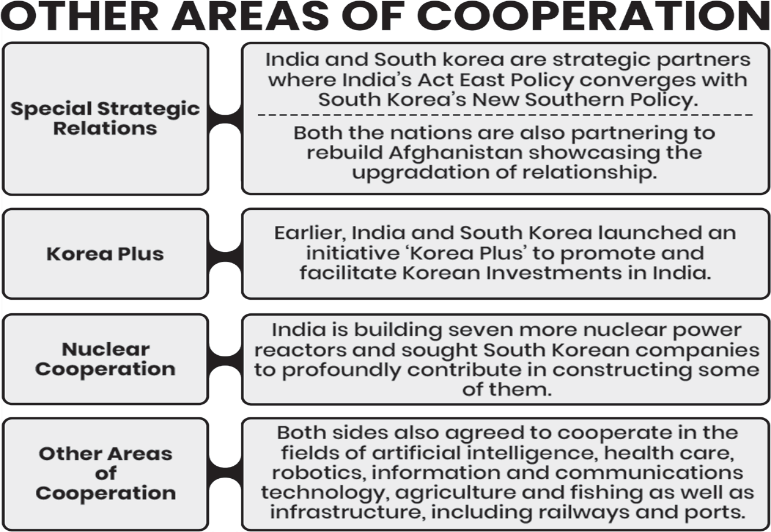
Defence Minister Rajnath Singh's recent visit to Seoul, India and South Korea signed a military logistics agreement and outlined a forward-looking roadmap to strengthen bilateral defence industry cooperation.
The agreement to provide mutual logistical support to their navies will significantly expand India's reach in the Indo-Pacific, positioning South Korea alongside key partners like the US and France with similar bilateral agreements
The roadmap highlights proposed cooperation in areas including land systems, aerospace, naval systems, research and development, as well as testing, certification, and quality assurance collaboration.
India has presented significant business opportunities for Korean defence industries, as it seeks to tap into external markets to build a commercially viable military industrial complex. The Indian government has set an ambitious target to make the defence sector a $25 billion part of its $1 trillion manufacturing economy by 2025, with defence exports from Indian companies aiming for $5 billion.
India’s Importance for Korea
Similar to India’s ‘Act East Policy,’ South Korea has introduced its ‘New Southern Policy,’ which aims to enhance economic and strategic ties with Southeast Asia, Australia, and India.
Challenges from Export Dependency:
South Korea's economy is heavily reliant on exports, with China and the US being its top two trade partners.
The ongoing trade conflict between the US and China has impacted South Korea’s major exporters, like Samsung and Hyundai, leading to a decline in their profits.
Diversification of Trade Relationships:
In response to these challenges, South Korea is focusing on strengthening ties with India and ASEAN nations to reduce its dependence on China and the US.
India as a Growth Partner:
South Korea is targeting rapidly growing economies, with India’s vast consumer market projected to grow at more than double the rate of South Korea in the coming years.
The presence of South Korean companies in India adds to the strategic advantage, and India’s youthful population offers a potential talent pool for South Korea.
Reducing Risks from China:
South Korea’s reliance on China has given Beijing significant leverage, which has been used to pursue its political interests.
For example, China imposed economic sanctions on South Korea in response to the US deploying its missile defense system, prompting Seoul to reconsider its strategy towards China.
Strengthening alliances with India and ASEAN nations is seen as a way for South Korea to reduce risks associated with its dependence on China.
Korea’s ‘China’ Dilemma
China emerged as South Korea’s biggest economic partner as their relations normalised after the end of the Cold War. South Korea’s trade and investment relations with China have increased manifold due to its economic liberalisation and the rise of China’s economy.
At the same time, its relations with the US and Japan have declined because of the rise of American protectionism and the stagnation of the Japanese economy. Indeed, the equations have changed over the past two-and-half decades. China has now emerged as South Korea’s top export destination. It made up 26.6 percent of South Korea’s total exports in the first half of 2018, higher than the 16.5 percent accounted for by the US and Japan combined.
Such economic dependence was not a security concern for Seoul’s policymakers until China began its path of “peaceful rise”. The change began in the late 2000s with the controversy over the Goguryeo Dynasty, Cheonan and Yeonpyeong incidents in which many South Koreans were killed by North Korea and a few years later China’s declaration of a new Air Defence Identification Zone (ADIZ) in 2013 which partly overlapped South Korea and Japan.
China has been South Korea’s largest trading partner since 2014, and South Korea was China’s third-largest trading partner in 2020. In 2015, China and South Korea signed the bilateral China–South Korea Free Trade Agreement, which boosted annual bilateral trade to over
$300 billion in 2018. In November 2020, China and South Korea, along with 13 other Asia-Pacific nations, signed the Regional Comprehensive Economic Partnership (RCEP), the largest free trade agreement in history, covering 30 percent of the world’s population and economic output. China, South Korea, and Japan are also engaged in long- running negotiations for a trilateral free trade agreement to integrate their economies further.
Political analysts in South Korea have observed that China’s economic policy towards the country is largely driven by political motives. Beijing seeks to use its economic relations with South Korea to influence and address broader regional political issues.
The situation worsened when China targeted South Korean business interests following the deployment of the US missile defense system, THAAD (Terminal High Altitude Area Defense), in South Korea. In response, Beijing imposed sanctions on South Korean businesses, and exports to China were severely curtailed, contributing to a further deterioration in perceptions of China.
This series of events led South Korea to reassess its trade strategy and recognize the urgent need to diversify its economic partners. Consequently, South Korea has turned its focus towards alternative partners such as India and other ASEAN countries.
There is a growing sentiment within South Korea that China’s rise as an economic power is now perceived more as a "threat" than an opportunity, influencing the country's shift in its foreign and trade policies.
South Korea is eager to join the QUAD due to concerns about regional security threats, including North Korea's nuclear and missile programs, which could pose a threat. The Quad aims to address shared security problems and promote a free and open Indo-Pacific region. South Korea's close economic and trade relations with the US and Japan make it a significant economic force in the region. By promoting stronger economic integration and collaboration, joining the Quad would improve South Korea's economic and commercial chances. The Quad aims to counterbalance China's growing dominance in the Indo-Pacific area, and South Korea may view participation as a way to interact with China's neighbours and maintain a balance in its international ties. Additionally, South Korea aims to broaden its diplomatic engagements and alliances, expanding its network of strategic allies and increasing opportunities for multilateral involvement. South Korea has participated in Quad Plus meetings, which include representatives from New Zealand, Vietnam, and South Korea.
Pivot to India
South Korea’s interest in India is succinctly captured by Trade Minister Kim Hyun-chong, who stated, "India is a country with no geopolitical issues with us, making its economic cooperation less vulnerable to external factors. For instance, China caused significant problems for South Korea over the THAAD issue, but with India, there are no such concerns."
South Korean companies like Samsung, LG Electronics, and Hyundai Motor are expanding their operations in India, and new entrants are also making their mark. Kia Motors, for example, signed an MoU to invest around US$ 1.1 billion, which was later increased to US$ 2 billion, for establishing its first factory in Andhra Pradesh.
In light of the challenges faced by South Korean companies in China, Seoul is encouraging its small and medium-sized businesses to explore opportunities in India. The South Korean government has also expressed its willingness to collaborate with India's major initiatives, including 'Make in India,' 'Skill India,' 'Digital India,' 'Startup India,' and 'Smart Cities Mission.'
Additionally, the Moon administration has decided to set up the Korea-India Future Strategy Group and the India- Korea Centre for Research and Innovation Cooperation (IKCRI). This center will provide a structured framework for collaboration focused on research, innovation, and entrepreneurship.
To support these efforts, the Indian government has introduced initiatives like the ‘Korea Plus’ mechanismunder the Department of Industrial Policy & Promotion (DIPP), aimed at fostering South Korean investment. A series of events and campaigns have been organized to raise awareness among Korean companies. Given the growing interest, India plans to elevate the ‘Korea Plus’ initiative into a more comprehensive ‘Korea Square’ mechanism.
Deepening Ties
The new approach of South Korea also puts an emphasis on enhancing its strategic relationship with India. India also looks at South Korea as an indispensable partner in its Act East Policy (AEP). The two countries are now working towards a new diplomatic mechanism in the 2+2 format. Once it is operationalized, South Korea would become the third country to hold such a dialogue with India, after Japan and the US.
In addition, South Korea has demonstrated its desire to cooperate with India to secure the sea lines of communication (SLOCs) in the Indian Ocean. The navies of the two countries have held a joint drill in the Indian Ocean in 2017 and followed by a joint exercise between the coast guards of the two countries in 2018.
Although Seoul has not openly endorsed the emerging ‘Indo-Pacific’ concept due to its apprehension that China might retaliate through economic measures, it believes that it will gain from a US-led security system in Asia and an India-centric Indo-Pacific region. South Korea is exploring ways to become a part of the Indo-Pacific construct.
There have been a number of conferences and seminars in which South Korea’s leading scholars and diplomats have discussed the country’s role in the Indo-Pacific era. India’s role in the region and its relations with South Korea are also highlighted in these gatherings, both official and non-official. Seoul also recently agreed to explore a tripartite partnership with New Delhi for the development of capacity building programmes in Afghanistan.
Seoul is also seeking to strengthen relationships in the strategic sectors, including the defence and civil nuclear industries. Both the countries are now working towards implementing the India-Korea civil nuclear deal signed during the Manmohan Singh regime.
All these changes in the bilateral engagements have undoubtedly brought about a noticeable shift in India’s approach to the Korean peace process. From a policy of strategic isolation, India has moved to strategic engagement. The Korean security related issues have gained wider attention in India’s new regional posture in Asia.
Korean Armistice Agreement
A United Nations investigation into a recent exchange of gunfire between North Korea and South Korea inside the Demilitarized Zone (DMZ) has determined that both countries violated the armistice that ended the 1950-53 Korean War.
The Korean Armistice Agreement
The Korean Armistice Agreement signed on 27 July 1953 is the armistice that brought about a complete cessation of hostilities of the Korean War.
It was not the end of a war, but only a cessation of hostilities in an attempt to negotiate a lasting peace.
Military commanders from China and North Korea signed the agreement on one side, with the US-led United Nations Command signing on behalf of the international community.
What is the Demilitarized Zone (DMZ)?
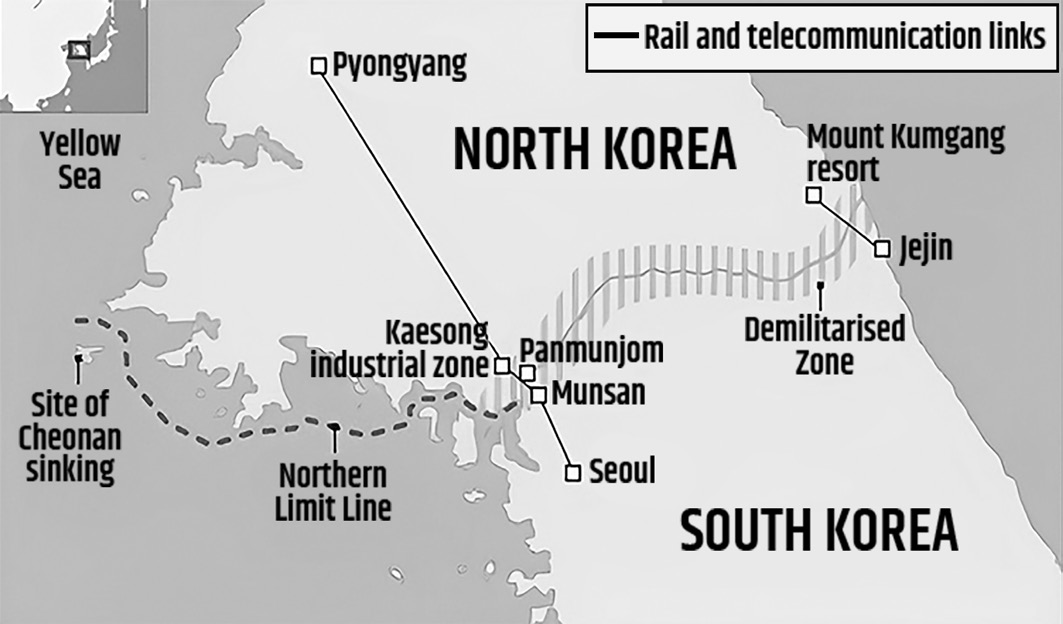
The DMZ marks where the 1950-53 Korean War — when China and North Korea battled UN forces led by the United States — ended with an armistice, not a treaty.
It is a 2 km-wide buffer, stretc.hing coast to coast across the peninsula, lined by both sides with razor wire, heavy armaments and tank traps.
It is 60 km from Seoul and 210 km from the North Korean capital of Pyongyang. Inside the DMZ is a Joint Security Area (JSA).
The so-called ‘peace village’ of Panmunjom, where the armistice that halted the Korean War was signed in 1953, is located in the 800-metre-wide and 400-metre-long JSA zone.
A Military Demarcation Line (MDL) marks the boundary between the two Koreas.
India, South Korea agree on framework to improve trade Comprehensive Economic Partnership Agreement
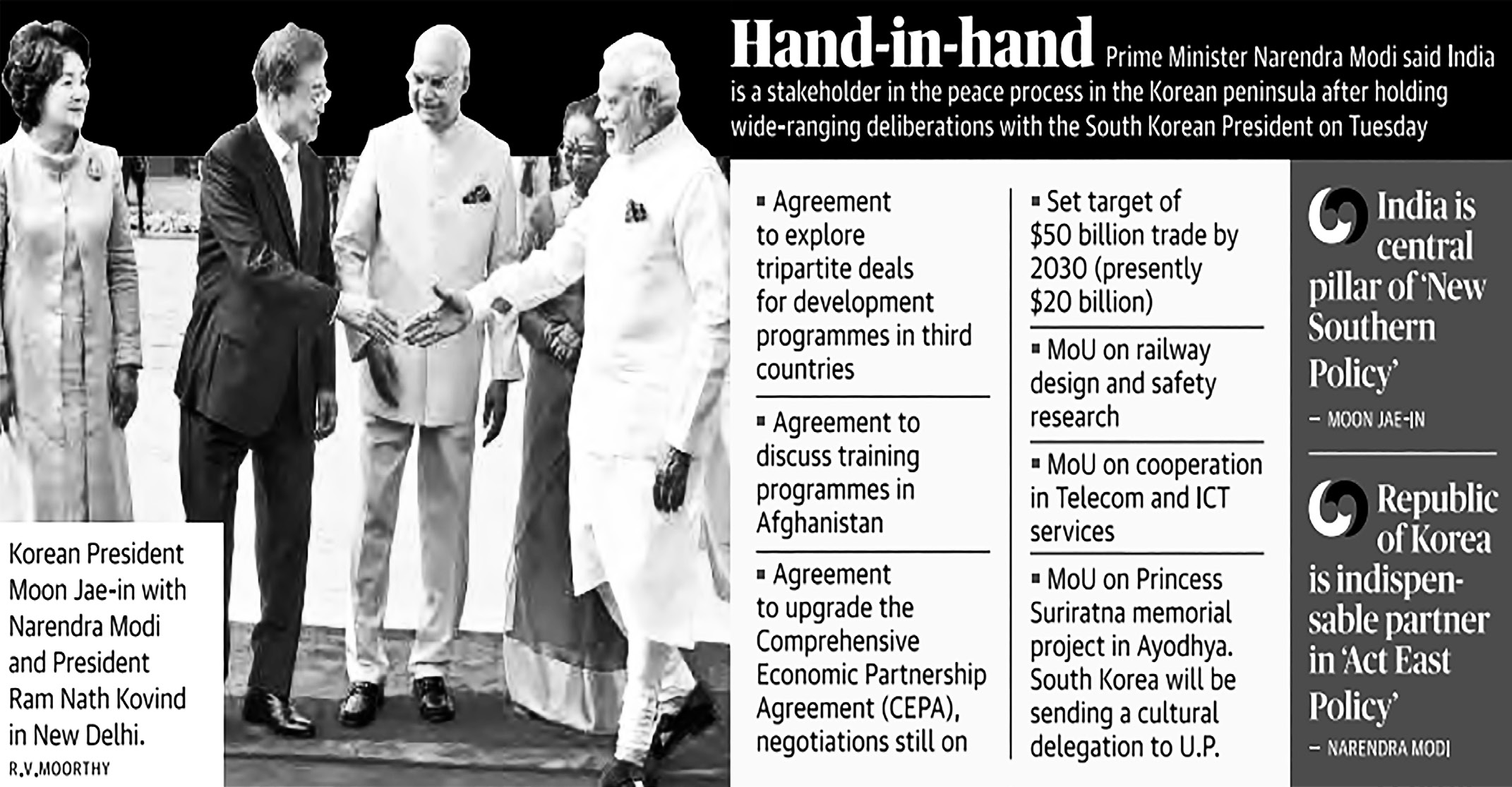
India and South Korea signed a joint statement agreeing to discuss an ‘early harvest’ package for the Comprehensive Economic Partnership Agreement (CEPA) aimed at identifying key areas for enhanced trade between the two countries.
The CEPA came into existence in 2010.
As per the agreement, South Korea will eliminate duties on 93% of its industrial and agricultural products and India will do the same on 85% of its goods. India has excluded sensitive items farm products, textile items and built up automobiles from tariff elimination commitments. Duties will be phased out on most of these products in the next eight years.
The two countries also agreed to try to increase their bilateral trade to $50 billion by 2030, up from current levels of $20 billion.
Military Logistics Agreement
India and South Korea have concluded a Military Logistics Agreement during the visit of Defence Minister to Seoul.
It has been considered as an opportunity to combine India’s ‘Act East Policy’ with the Republic of Korea’s ‘New Southern Policy’.
About the Agreement
It would help assured logistic support when India operates in the Indo-Pacific in the ports of South Korea.
To extend the reach, presence and sustainability of Indian Navy ships when deployed at great distances.
About New Southern Policy of South Korea: It’s aimed at elevating Korea’s strategic ties with ASEAN and with India to bring relations on par with Korea’s four major diplomatic partners: the United States, China, Japan and Russia.
Concerns
Despite of the robust ties, not everything is going as planned. The trade target of $50 billion by 2030 is most likely to be missed due to lack of adequate efforts. The Comprehensive Economic Partnership Agreement, originally the core mechanism for economic ties, requires immediate upgrading. An early harvest offer agreed last year, under which India agreed to reduce tariff on 11 commodities and South Korea on 17, failed to see completion.
Way Forward
India’s significance for South Korea is growing primarily because of the latter’s deepening strategic dilemma with China – its largest economic partner. South Korea’s shifting perception about its economic engagement with China has influenced Seoul’s strategy towards other Asian powers. Against this background, policymakers in Seoul see India as a crucial partner and their government is taking various steps to upgrade ties under their new policy framework called the ‘New Southern Policy.’
India needs to take advantage of this opportunity. Korea can be a major economic partner in India’s economic growth. After all, South Korea, which is Asia’s fourth largest economy, has become one of the fastest growing economies in the world in recent years. India should also pay particular attention to developing its strategic relations with South Korea.
Such engagement with Seoul will also enhance New Delhi’s strategic leverage, especially in the Indo-Pacific region. As India is facing pressure from China in South Asia due to the ‘One Belt, One Road’ initiative. India should design a similar type of strategy in East Asia.
In this regard, New Delhi must nurture its relations with Seoul just as it has done with Tokyo in recent years. India and South Korea, two leading democracies in Asia, are natural partners and should closely work together to foster peace and stability in the region.